• Trade
  • Markets
  • Copy
  • Contests
  • News
  • 24/7
  • Calendar
  • Q&A
  • Chats
Trending
Screeners
SYMBOL
LAST
BID
ASK
HIGH
LOW
NET CHG.
%CHG.
SPREAD
SPX
S&P 500 Index
6846.50
6846.50
6846.50
6878.28
6827.18
-23.90
-0.35%
--
DJI
Dow Jones Industrial Average
47739.31
47739.31
47739.31
47971.51
47611.93
-215.67
-0.45%
--
IXIC
NASDAQ Composite Index
23545.89
23545.89
23545.89
23698.93
23455.05
-32.22
-0.14%
--
USDX
US Dollar Index
99.000
99.080
99.000
99.000
99.000
+0.050
+ 0.05%
--
EURUSD
Euro / US Dollar
1.16350
1.16380
1.16350
1.16365
1.16322
-0.00014
-0.01%
--
GBPUSD
Pound Sterling / US Dollar
1.33194
1.33240
1.33194
1.33217
1.33140
-0.00011
-0.01%
--
XAUUSD
Gold / US Dollar
4189.70
4190.14
4189.70
4218.85
4175.92
-8.21
-0.20%
--
WTI
Light Sweet Crude Oil
58.555
58.807
58.555
60.084
58.495
-1.254
-2.10%
--

Community Accounts

Signal Accounts
--
Profit Accounts
--
Loss Accounts
--
View More

Become a signal provider

Sell trading signals to earn additional income

View More

Guide to Copy Trading

Get started with ease and confidence

View More

Signal Accounts for Members

All Signal Accounts

Best Return
  • Best Return
  • Best P/L
  • Best MDD
Past 1W
  • Past 1W
  • Past 1M
  • Past 1Y

All Contests

  • All
  • Trump Updates
  • Recommend
  • Stocks
  • Cryptocurrencies
  • Central Banks
  • Featured News
Top News Only
Share

Ukraine's Security Must Be Guaranteed, In The Long Term, As A First Line Of Defence For Our Union, Says European Commission President

Share

Ukraine's Sovereignty Must Be Respected, Says European Commission President

Share

The Goal Is A Strong Ukraine, On The Battlefield And At The Negotiating Table, Says European Commission President

Share

As Peace Talks Are Ongoing, The EU Remains Ironclad In Its Support For Ukraine, Says European Commission President

Share

Pepsico: Asking USA-Based Pepna Employees As Well As Pbus Division Offices And Pfus Region Offices To Work Remotely This Week

Share

A U.S. Judge Ruled That President Trump’s Ban On Several Wind Power Projects Was Illegal

Share

Senior USA Administration Official: We Continue To Monitor Drc-Rwanda Situation Closely, Continue To Work With All Sides To Ensure Commitments Are Honored

Share

Israeli Military Says It Has Struck Infrastructure Belonging To Hezbollah In Several Areas In Southern Lebanon

Share

SPDR Gold Holdings Down 0.11%, Or 1.14 Tonnes

Share

On Monday (December 8), In Late New York Trading, S&P 500 Futures Fell 0.21%, Dow Jones Futures Fell 0.43%, NASDAQ 100 Futures Fell 0.08%, And Russell 2000 Futures Fell 0.04%

Share

Morgan Stanley: Data Center ABS Spreads Are Expected To Widen In 2026

Share

(US Stocks) The Philadelphia Gold And Silver Index Closed Down 2.34% At 311.01 Points. (Global Session) The NYSE Arca Gold Miners Index Closed Down 2.17%, Hitting A Daily Low Of 2235.45 Points; US Stocks Remained Slightly Down Before The Opening Bell—holding Steady Around 2280 Points—before Briefly Rising Slightly

Share

IMF: IMF Executive Board Approves Extension Of The Extended Credit Facility Arrangement With Nepal

Share

Trump: Same Approach Will Apply To Amd, Intel, And Other Great American Companies

Share

Trump: Department Of Commerce Is Finalizing Details

Share

Trump: $25% Will Be Paid To United States Of America

Share

Trump: President Xi Responded Positively

Share

[Consumer Discretionary ETFs Fell Over 1.4%, Leading The Decline Among US Sector ETFs; Semiconductor ETFs Rose Over 1.1%] On Monday (December 8), The Consumer Discretionary ETF Fell 1.45%, The Energy ETF Fell 1.09%, The Internet ETF Fell 0.18%, The Regional Banks ETF Rose 0.34%, The Technology ETF Rose 0.70%, The Global Technology ETF Rose 0.93%, And The Semiconductor ETF Rose 1.13%

Share

Trump: I Have Informed President Xi, Of China, That United States Will Allow Nvidia To Ship Its H200 Products To Approved Customers In China

Share

Argentina's Merval Index Closed Up 0.02% At 3.047 Million Points. It Rose To A New Daily High Of 3.165 Million Points In Early Trading In Buenos Aires Before Gradually Giving Back Its Gains

TIME
ACT
FCST
PREV
France Trade Balance (SA) (Oct)

A:--

F: --

P: --
Euro Zone Employment YoY (SA) (Q3)

A:--

F: --

P: --
Canada Part-Time Employment (SA) (Nov)

A:--

F: --

P: --

Canada Unemployment Rate (SA) (Nov)

A:--

F: --

P: --

Canada Full-time Employment (SA) (Nov)

A:--

F: --

P: --

Canada Labor Force Participation Rate (SA) (Nov)

A:--

F: --

P: --

Canada Employment (SA) (Nov)

A:--

F: --

P: --

U.S. PCE Price Index MoM (Sept)

A:--

F: --

P: --

U.S. Personal Income MoM (Sept)

A:--

F: --

P: --

U.S. Core PCE Price Index MoM (Sept)

A:--

F: --

P: --

U.S. PCE Price Index YoY (SA) (Sept)

A:--

F: --

P: --

U.S. Core PCE Price Index YoY (Sept)

A:--

F: --

P: --

U.S. Personal Outlays MoM (SA) (Sept)

A:--

F: --

P: --
U.S. 5-10 Year-Ahead Inflation Expectations (Dec)

A:--

F: --

P: --

U.S. Real Personal Consumption Expenditures MoM (Sept)

A:--

F: --

P: --
U.S. Weekly Total Rig Count

A:--

F: --

P: --

U.S. Weekly Total Oil Rig Count

A:--

F: --

P: --

U.S. Consumer Credit (SA) (Oct)

A:--

F: --

P: --
China, Mainland Foreign Exchange Reserves (Nov)

A:--

F: --

P: --

Japan Trade Balance (Oct)

A:--

F: --

P: --

Japan Nominal GDP Revised QoQ (Q3)

A:--

F: --

P: --

China, Mainland Imports YoY (CNH) (Nov)

A:--

F: --

P: --

China, Mainland Exports (Nov)

A:--

F: --

P: --

China, Mainland Imports (CNH) (Nov)

A:--

F: --

P: --

China, Mainland Trade Balance (CNH) (Nov)

A:--

F: --

P: --

China, Mainland Exports YoY (USD) (Nov)

A:--

F: --

P: --

China, Mainland Imports YoY (USD) (Nov)

A:--

F: --

P: --

Germany Industrial Output MoM (SA) (Oct)

A:--

F: --

P: --
Euro Zone Sentix Investor Confidence Index (Dec)

A:--

F: --

P: --

Canada National Economic Confidence Index

A:--

F: --

P: --

U.K. BRC Like-For-Like Retail Sales YoY (Nov)

--

F: --

P: --

U.K. BRC Overall Retail Sales YoY (Nov)

--

F: --

P: --

Australia Overnight (Borrowing) Key Rate

--

F: --

P: --

RBA Rate Statement
RBA Press Conference
Germany Exports MoM (SA) (Oct)

--

F: --

P: --

U.S. NFIB Small Business Optimism Index (SA) (Nov)

--

F: --

P: --

Mexico 12-Month Inflation (CPI) (Nov)

--

F: --

P: --

Mexico Core CPI YoY (Nov)

--

F: --

P: --

Mexico PPI YoY (Nov)

--

F: --

P: --

U.S. Weekly Redbook Index YoY

--

F: --

P: --

U.S. JOLTS Job Openings (SA) (Oct)

--

F: --

P: --

China, Mainland M1 Money Supply YoY (Nov)

--

F: --

P: --

China, Mainland M0 Money Supply YoY (Nov)

--

F: --

P: --

China, Mainland M2 Money Supply YoY (Nov)

--

F: --

P: --

U.S. EIA Short-Term Crude Production Forecast For The Year (Dec)

--

F: --

P: --

U.S. EIA Natural Gas Production Forecast For The Next Year (Dec)

--

F: --

P: --

U.S. EIA Short-Term Crude Production Forecast For The Next Year (Dec)

--

F: --

P: --

EIA Monthly Short-Term Energy Outlook
U.S. API Weekly Gasoline Stocks

--

F: --

P: --

U.S. API Weekly Cushing Crude Oil Stocks

--

F: --

P: --

U.S. API Weekly Crude Oil Stocks

--

F: --

P: --

U.S. API Weekly Refined Oil Stocks

--

F: --

P: --

South Korea Unemployment Rate (SA) (Nov)

--

F: --

P: --

Japan Reuters Tankan Non-Manufacturers Index (Dec)

--

F: --

P: --

Japan Reuters Tankan Manufacturers Index (Dec)

--

F: --

P: --

Japan Domestic Enterprise Commodity Price Index MoM (Nov)

--

F: --

P: --

Japan Domestic Enterprise Commodity Price Index YoY (Nov)

--

F: --

P: --

China, Mainland PPI YoY (Nov)

--

F: --

P: --

China, Mainland CPI MoM (Nov)

--

F: --

P: --

Italy Industrial Output YoY (SA) (Oct)

--

F: --

P: --

Q&A with Experts
    • All
    • Chatrooms
    • Groups
    • Friends
    Connecting
    .
    .
    .
    Type here...
    Add Symbol or Code

      No matching data

      All
      Trump Updates
      Recommend
      Stocks
      Cryptocurrencies
      Central Banks
      Featured News
      • All
      • Russia-Ukraine Conflict
      • Middle East Flashpoint
      • All
      • Russia-Ukraine Conflict
      • Middle East Flashpoint
      Search
      Products

      Charts Free Forever

      Chats Q&A with Experts
      Screeners Economic Calendar Data Tools
      Membership Features
      Data Warehouse Market Trends Institutional Data Policy Rates Macro

      Market Trends

      Market Sentiment Order Book Forex Correlations

      Top Indicators

      Charts Free Forever
      Markets

      News

      News Analysis 24/7 Columns Education
      From Institutions From Analysts
      Topics Columnists

      Latest Views

      Latest Views

      Trending Topics

      Top Columnists

      Latest Update

      Signals

      Copy Rankings Latest Signals Become a signal provider AI Rating
      Contests
      Brokers

      Overview Brokers Assessment Rankings Regulators News Claims
      Broker listing Forex Brokers Comparison Tool Live Spread Comparison Scam
      Q&A Complaint Scam Alert Videos Tips to Detect Scam
      More

      Business
      Events
      Careers About Us Advertising Help Center

      White Label

      Data API

      Web Plug-ins

      Affiliate Program

      Awards Institution Evaluation IB Seminar Salon Event Exhibition
      Vietnam Thailand Singapore Dubai
      Fans Party Investment Sharing Session
      FastBull Summit BrokersView Expo
      Recent Searches
        Top Searches
          Markets
          News
          Analysis
          User
          24/7
          Economic Calendar
          Education
          Data
          • Names
          • Latest
          • Prev

          View All

          No data

          Scan to Download

          Faster Charts, Chat Faster!

          Download App
          English
          • English
          • Español
          • العربية
          • Bahasa Indonesia
          • Bahasa Melayu
          • Tiếng Việt
          • ภาษาไทย
          • Français
          • Italiano
          • Türkçe
          • Русский язык
          • 简中
          • 繁中
          Open Account
          Search
          Products
          Charts Free Forever
          Markets
          News
          Signals

          Copy Rankings Latest Signals Become a signal provider AI Rating
          Contests
          Brokers

          Overview Brokers Assessment Rankings Regulators News Claims
          Broker listing Forex Brokers Comparison Tool Live Spread Comparison Scam
          Q&A Complaint Scam Alert Videos Tips to Detect Scam
          More

          Business
          Events
          Careers About Us Advertising Help Center

          White Label

          Data API

          Web Plug-ins

          Affiliate Program

          Awards Institution Evaluation IB Seminar Salon Event Exhibition
          Vietnam Thailand Singapore Dubai
          Fans Party Investment Sharing Session
          FastBull Summit BrokersView Expo

          Dow, S&P 500, Nasdaq end Volatile Week Lower Amid Worst Tech Sell-Off Since April

          Manuel

          Stocks

          Economic

          Summary:

          The tech-heavy Nasdaq Composite (^IXIC) pared losses to fall 0.2%, while the S&P 500 (^GSPC) erased losses to close out the session up 0.1%. The Dow Jones Industrial Average (^DJI) rose 0.1%.
          US stocks came off session lows on Friday as investors weighed bearish consumer sentiment data and odds that the AI investment boom will pay off, while monitoring the ongoing US government shutdown for any signs of an end.
          The tech-heavy Nasdaq Composite (^IXIC) pared losses to fall 0.2%, while the S&P 500 (^GSPC) erased losses to close out the session up 0.1%. The Dow Jones Industrial Average (^DJI) rose 0.1%.
          Stocks pared declines after Democrats laid down conditions for a deal to end the government shutdown, a proposal that Republicans subsequently rejected. Democrats had suggested including a one-year extension of expiring health care subsidies in legislation to reopen the government.
          Stocks ended a volatile week with the Nasdaq Composite posting the index's deepest loss since April, with seesaw stretches for "Magnificent Seven" stalwarts Nvidia (NVDA) and Tesla (TSLA). The S&P 500 and the Dow also closed out the bumpy week in the red as persistent worries about an AI bubble and Big Tech valuations run high.
          Markets on Friday also digested more signs of an economic slowdown: namely, a bearish reading on consumer sentiment from the University of Michigan. Overall sentiment dropped to 50.3, the worst reading since 2022, as respondents fretted over the shutdown's effects.
          Friday's data point came the day after October job cuts hit their highest level for the month in more than 20 years, underscoring what’s shaping up to be the worst year for layoffs since 2009.
          The private data reverberated through Wall Street more than usual, given the current dearth of official updates on the economy. The Bureau of Labor Statistics was scheduled to release the October jobs report on Friday, but for a second straight month, the data's publication has been delayed by the government shutdown.
          In the latest tech extravagance, Tesla approved a $1 trillion pay package for CEO Elon Musk on Thursday, setting high targets for growth in the EV maker's market value. Musk is also being asked to deliver on his promises for its robotaxi and Optimus humanoid robot — the hardware side of the AI boom. Tesla shares fell over 3%.

          Source: Yahoo Finance

          To stay updated on all economic events of today, please check out our Economic calendar
          Risk Warnings and Disclaimers
          You understand and acknowledge that there is a high degree of risk involved in trading. Following any strategies or investment methods may lead to potential losses. The content on the site is provided by our contributors and analysts for information purposes only. You are solely responsible for determining whether any trading assets, securities, strategy, or any other product is suitable for investing based on your own investment objectives and financial situation.
          Add to Favorites
          Share

          Another Weekend of Shutdown Looms as Senators Prepare to Hole up in Washington

          Manuel

          Political

          Economic

          The Senate found itself once again gridlocked Friday and geared up for another weekend of the government shutdown, but a flurry of proposals and counterproposals did offer glimmers of hope that the two sides could be moving toward compromise.
          Lawmakers debated multiple options on the Senate floor through the day Friday — from a bill to end the shutdown to another to simply pay federal workers — but saw each side object to the other's efforts.
          Late Friday afternoon, Senate Minority Leader Chuck Schumer announced a new Democratic plan to reopen the government if a one-year extension of enhanced Obamacare healthcare subsidies were attached.
          Republicans immediately rejected that — as did Democrats of the GOP's efforts — but a day of both sides at least talking was a contrast to weeks of non-communication.
          Senate Majority Leader John Thune told reporters he hopes another idea he is floating — a new bill that could include a new end date for the shutdown and full-year authorization for some programs — could gain traction and suggested he might try a vote on it by this weekend.
          As for a takeaway for markets, Pangaea Policy founder Terry Haines joined Yahoo Finance and could offer only that the shutdown will "probably" end by Thanksgiving.
          "The practical pain that people will go through," he added, "probably plays a role in all of that."
          Ed Mills at Raymond James added, "We believe we are at the beginning of the end, but are unlikely to see a resolution pass into law before next week."
          Election results haven't helped shutdown talks
          The week is also ending with new political challenges, particularly election results that saw the Democratic Party gain across the board.
          Prominent Democrats, like Sen. Chris Murphy of Connecticut, immediately responded that the results were a message to keep fighting.
          It was no coincidence, Murphy wrote, that "these big wins came at the exact moment when Democrats are using our power to stand for something and be strong."
          Meanwhile, President Trump has shown no signs of offering concessions and has continued to ignore pressure to meet with Democrats for negotiations.
          The president repeated calls this week to change the Senate's filibuster rules, including three separate social media posts Friday morning, as well as during an appearance at the White House alongside Hungarian Prime Minister Viktor Orbán.
          The president also appeared with Senate Republicans on Wednesday and rhetorically asked if this week's election results could herald a quicker end to the shutdown.
          He then immediately answered his own question, saying, "I don't think so."
          The gridlock among leaders comes as moderate lawmakers continue to negotiate with Republicans — Politico reported that one such meeting is on the books for Friday — but the ongoing search for a path forward faces difficult political terrain.

          The mood music of spiraling economic costs

          The ongoing gridlock on Capitol Hill also comes as economic costs continue to mount.
          US airlines have canceled hundreds of flights after a ​Federal Aviation Administration order reduced air traffic capacity by 4% Friday morning.
          That first cut took effect at 6 a.m. ET Friday at 40 high-traffic airports and will deepen next week and reach a cut of 10%.
          Transportation Secretary Sean Duffy has warned that an already difficult travel situation could soon descend into "mass chaos."
          Duffy added in a Fox News appearance Friday that air traffic capacity could be cut further — 15% or even 20% — if the stalemate continues beyond that.
          Meanwhile, a federal judge in Rhode Island on Thursday ordered the Trump administration to immediately cover Supplemental Nutrition Assistance Program (SNAP) benefits for tens of millions of Americans.
          The Trump administration had previously announced plans to pay only partial benefits for the program, which is relied on by about 1 in 8 Americans, but late on Friday, the US Department of Agriculture announced it would be paying "full issuances" after all.

          Source: Yahoo Finance

          To stay updated on all economic events of today, please check out our Economic calendar
          Risk Warnings and Disclaimers
          You understand and acknowledge that there is a high degree of risk involved in trading. Following any strategies or investment methods may lead to potential losses. The content on the site is provided by our contributors and analysts for information purposes only. You are solely responsible for determining whether any trading assets, securities, strategy, or any other product is suitable for investing based on your own investment objectives and financial situation.
          Add to Favorites
          Share

          Oil Notches Second Weekly Loss Amid Sanctions, Looming Surplus

          Manuel

          Commodity

          Political

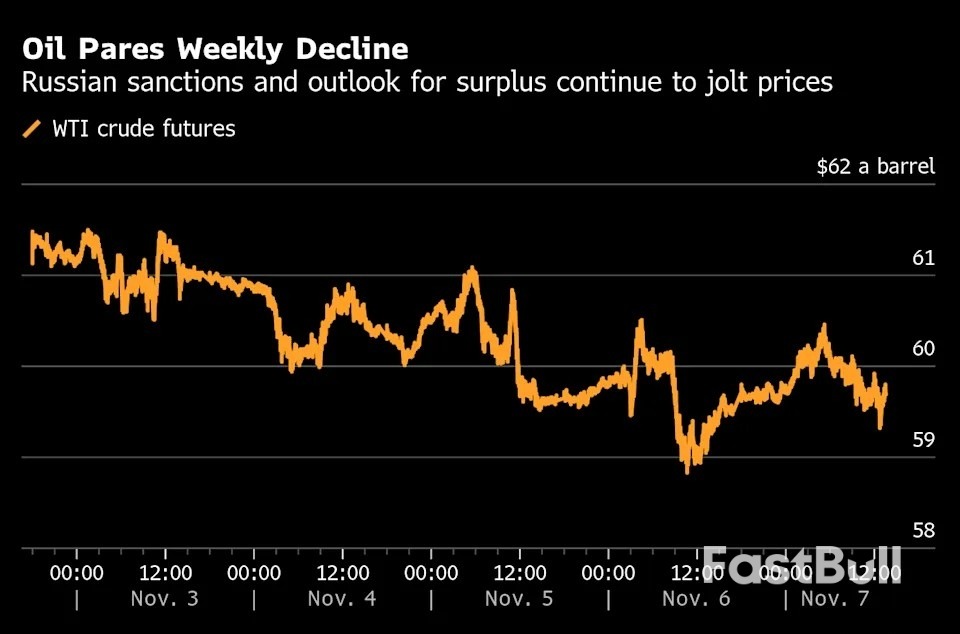
          Oil rose on Friday but still notched a second weekly loss as the market continued to weigh the threat to output from sanctions on Russia against a looming oversupply.
          West Texas Intermediate futures rose around 0.5% to settle below $60 a barrel, but were still down for the week. Adding to fears of a glut, oil prices have also been buffeted by swings in equity markets this week.
          Meanwhile, the White House’s move to clamp down on the buying of Russian crude led oil trading giant Gunvor Group to withdraw an offer for the international assets of Lukoil PJSC. The fate of the assets, which include stakes in oil fields, refineries and gas stations, remains unclear.
          Prices pared some gains in post-settlement trading after Hungary won an exemption from US sanctions on Russian energy, Prime Minister Viktor Orban said following talks with US President Donald Trump. The development appeared to allay shortage fears, given that Budapest imports over 90% of its crude from Moscow.
          Senior industry figures have warned the latest US curbs on Russia’s two largest oil companies are beginning to have an impact on the market, particularly in diesel, where prices have been surging in recent days, with time spreads for the fuel signaling supply pressure.Oil Notches Second Weekly Loss Amid Sanctions, Looming Surplus_1
          At the same time, the US measures have come against a backdrop of oversupply that has weighed on key crude oil metrics. The spread between the nearest West Texas Intermediate futures closed at the weakest level since February on Thursday.
          “If the market flips to contango, we may see more bearish funds enter the crude space,” said Dennis Kissler, senior vice president for trading at BOK Financial said of the potential that longer-dated contracts trade at a premium to nearer-term ones. “Most traders remain surprised that US crude oil production remains as strong as it has given the latest price drop.”
          Supplies from both within and outside of the Organization of the Petroleum Exporting Countries and its allies are set to surge at the end of this year and into 2026, with the International Energy Agency expecting a record oversupply. While the rising volumes of oil are beginning to show up on tankers, key storage hubs aren’t yet feeling the impact. US oil inventories ended October lower than where they started the month.
          China — the second-largest crude consumer — said on Friday that imports rose in October from a year ago. But the country’s pace of stockpiling is expected to slow, potentially removing a support for prices.
          Next week, traders will be looking to a raft of reports, including from the IEA and OPEC, to get further insights into the supply-demand balance as the year-end approaches.

          Source: Bloomberg

          Risk Warnings and Disclaimers
          You understand and acknowledge that there is a high degree of risk involved in trading. Following any strategies or investment methods may lead to potential losses. The content on the site is provided by our contributors and analysts for information purposes only. You are solely responsible for determining whether any trading assets, securities, strategy, or any other product is suitable for investing based on your own investment objectives and financial situation.
          Add to Favorites
          Share

          Bitcoin Slumps Nearly 20% From All-Time High as Strategist Warns 'we Could Correct Quite a Bit More'

          Manuel

          Cryptocurrency

          Bitcoin (BTC-USD) had a rough week, with the token briefly slipping below $100,000, its lowest level in six months.
          On Friday, the world's largest cryptocurrency was sitting as much as 20% off its all-time high of above $126,000 notched on Oct. 6.
          Wall Street has attributed the slide to early adopters offloading their large holdings. Since late June, net sales from long-term holders have exceeded 1 million bitcoin, according to research from Compass Point analyst Ed Engel.
          A massive liquidation of leveraged crypto positions on Oct. 10 also weighed on the market, with bitcoin struggling to find a footing after breaking below support levels of $117,000 and then $112,000.
          “We haven’t really reclaimed this level since then, and I think that’s a sign we are, unfortunately, in a bear market,” Markus Thielen, founder and CEO of Singapore-based 10X Research told Yahoo Finance on Friday morning.
          Thielen’s firm, which last month predicted bitcoin would fall to $100,000, now expects the market may still be “a few weeks away” from reaching a buyable bottom.
          “I think there’s this brief risk where we could correct quite a bit more,” he added
          10X Research said the marginal buyer is stepping back as capital that chased higher prices has either been flushed out or is no longer bidding with conviction. Fund managers with long exposure through exchange-traded funds may also be forced to trim positions as underlying asset prices decline.
          The dollar’s recent bottom could also pose a challenge for crypto markets. A continued rally in the greenback may be a potential headwind for bitcoin.
          "There's this air pocket below $93,000, and there is not much support," Thielen said. "It could be that there is going to be some liquidation that brings us to potentially the $70,000 level."
          "Historically these OG investors (early adopters), they tend to sell at the top of the cycle, only to buy back in later again, and I think that's probably what we're going to see here," he added.
          Bullish catalysts that could lift prices include a potential Federal Reserve rate cut in December and the prospect of more dovish leadership at the central bank, with Chair Jerome Powell’s term set to expire in May.
          The reopening of the US government could also provide a tailwind for crypto, as some strategists expect additional liquidity from government spending to flow back into markets and support prices.
          "The shutdown is stifling liquidity conditions and it is furthering growth concerns," Sean Farrell, head of digital assets at Fundstrat, said in a Thursday video to clients.
          JPMorgan said in a note on Wednesday that the deleveraging episode that sent bitcoin lower in October “is largely behind us.”
          JPMorgan managing director Nikolaos Panigirtzoglou added that “the rise in gold volatility over the past month has made bitcoin more attractive” to investors relative to gold.
          That comparison implies “significant upside for bitcoin over the next 6–12 months," potentially sending the price as high as $170,000.

          Source: Cryptoslate

          Risk Warnings and Disclaimers
          You understand and acknowledge that there is a high degree of risk involved in trading. Following any strategies or investment methods may lead to potential losses. The content on the site is provided by our contributors and analysts for information purposes only. You are solely responsible for determining whether any trading assets, securities, strategy, or any other product is suitable for investing based on your own investment objectives and financial situation.
          Add to Favorites
          Share

          How High Could Solana´s Valuation go if Wall Street Starts Using it Properly?

          Manuel

          Cryptocurrency

          For years, the assumption inside crypto and across traditional finance was simple: when institutional adoption finally matured, Ethereum would be the chain Wall Street chose.
          This is unsurprising, considering the network is the largest smart-contract network, the default environment for developers, and the ecosystem that has shaped today’s idea of programmable finance.
          However, as institutional tokenization efforts accelerate, a new hypothetical question has entered mainstream discussion: what if the chain institutions ultimately rely on is not Ethereum, but Solana?
          The scenario remains speculative, but the fact that it is being entertained reflects a shift in how market infrastructure is now being evaluated.

          Solana’s evolving image

          Solana’s early identity was shaped by retail speculation. Its low fees, high throughput, and ease of deployment made it the natural home for memecoins, high-velocity trading, and experimental retail primitives. For much of its existence, that chaotic environment defined the network’s cultural brand.
          Yet the same characteristics, including sub-second finality, negligible fees, and a high-performance runtime, that fueled its speculative mania are now being reframed as the foundations for institutional-grade settlement.
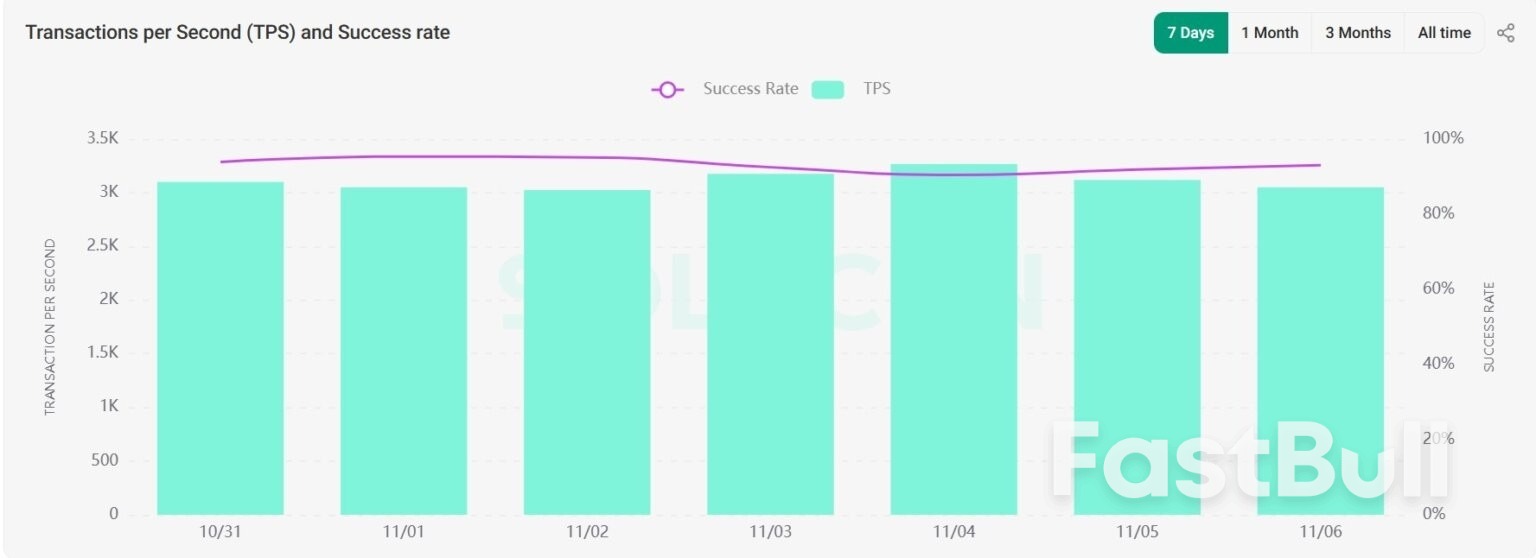
          Solana can process more than 3,000 transactions per second at an average cost of half a penny, according to Solscan data. Ethereum, by contrast, remains constrained at the base layer, relying on rollups to scale throughput and manage costs.How High Could Solana´s Valuation go if Wall Street Starts Using it Properly?_1
          This performance profile has caught the attention of analysts tracking the intersection of blockchains and traditional capital markets.
          Bitwise CIO Matt Hougan recently described Solana as “the new Wall Street,” arguing that its low-latency execution model aligns more closely with institutional workflows than general-purpose alternatives.
          At the same time, stablecoin issuers and tokenization firms have amplified this narrative by building increasingly sophisticated products on the network.
          Still, Solana’s aspirations remain far ahead of its reality.
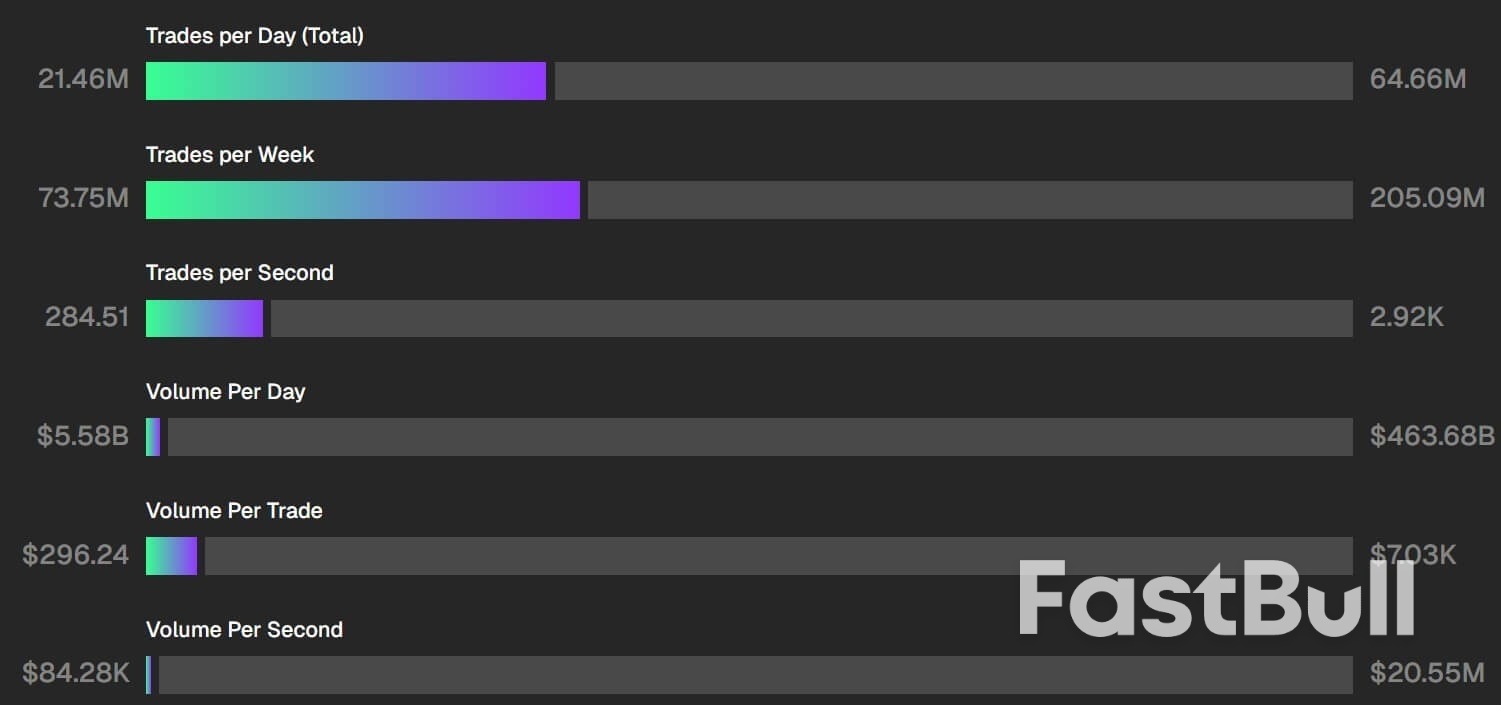
          Today, the blockchain network averages around 284 “trades” per second in the sense of user-initiated value-moving instructions, which is far below the raw throughput it advertises.
          On the other hand, Nasdaq executes roughly 2,920 trades per second and processes about $463 billion in daily volume, compared with Solana’s approximately $6 billion.How High Could Solana´s Valuation go if Wall Street Starts Using it Properly?_2
          So, the gap in economic density between the two platforms remains substantial.
          However, Solana’s developers claim that upcoming upgrades will further optimize validator performance, enhance scheduling, and reduce block contention. Indeed, these are advances that could bring the network closer to the reliability profile expected of market infrastructure.
          But whether that is achievable remains uncertain; nonetheless, the ambition signals a strategic shift, showing that Solana no longer wants to be merely a fast blockchain. The network wants to be an execution engine capable of supporting regulated financial operations at scale.
          As Galaxy Research stated:
          “[Solana] is now evolving toward a cohesive vision of “Internet Capital Markets,” a system capable of supporting the full spectrum of digital financial activity, from retail speculation and consumer apps to enterprise-grade infrastructure and tokenized real-world assets.”
          What will Solana be worth if Wall Street gives it a Chance by 2030
          The question of what Solana could be worth if Wall Street were to adopt it meaningfully has prompted the development of new modeling frameworks.
          Artemis CEO Jon Ma recently published one such model, arguing that once traditional assets move on-chain, blockchains will be valued more like infrastructure than speculative equities.
          In Ma’s framework, the value drivers become throughput, cost efficiency, fee capture, and the ability to support high-volume, low-latency financial flows. Narrative dominance matters less. His model predicts that the global tokenization market will be between $10 trillion and $16 trillion by 2030.
          Under a scenario where Solana captures even 5% of that activity, it could support a market capitalization approaching $880 billion.
          The model incorporates factors such as annual turnover, projected declines in inflation, and blended revenue rates derived from priority fees, base fees, and Jito tips.
          None of these projections implies inevitability. They highlight, instead, how the market may begin to assess blockchains once real-world assets are moved on-chain at scale.
          Tokenized RWAs already total about $35.8 billion, nearly double their level from late 2024, according to Rwa.xyz. As that figure grows, performance and execution costs become more central to the conversation.
          In this framework, Solana’s appeal stems from the qualities that once defined its retail culture: speed, low fees, and the ability to scale without relying on external execution layers.
          Ethereum’s strengths, including security, tooling maturity, and regulatory familiarity, remain the default institutional preference, but tokenization adds pressure to assess chains through a new lens.

          Source: Cryptoslate

          Risk Warnings and Disclaimers
          You understand and acknowledge that there is a high degree of risk involved in trading. Following any strategies or investment methods may lead to potential losses. The content on the site is provided by our contributors and analysts for information purposes only. You are solely responsible for determining whether any trading assets, securities, strategy, or any other product is suitable for investing based on your own investment objectives and financial situation.
          Add to Favorites
          Share

          Week Ahead for FX, Bonds: Focus on U.S. Shutdown Developments, China Data

          Adam

          Economic

          Below are the most important global events likely to affect FX and bond markets in the week starting Nov. 10.
          The U.S. government shutdown has continued and is now the longest in history, leaving investors eyeing any developments that could lead to a breakthrough to end the political deadlock. If the shutdown continues, then official U.S. economic data will continue to be delayed.
          Beyond the U.S., focus will center on China's October data, including industrial output, retail sales and investment. Gross domestic product data are also due from the eurozone and the U.K.
          U.S.
          The coming week will be quiet if the government shutdown continues. This would mean official data will still be delayed, including key inflation data for October, and there is little in the way of private data due.
          The lack of recent official data, particularly figures on the labor market, make it difficult for investors and for the Federal Reserve to make an accurate assessment of the state of the U.S. economy and about how far and how quickly U.S. interest rates will need to fall.
          At the time of its last decision, the Fed cut interest rates by 25 basis points but said a follow-up reduction was not a foregone conclusion.
          Signals from recent non-official data have been mixed. The ISM services survey and ADP private payrolls figures for October were better than expected. Data from outplacement firm Challenger, Gray & Christmas, however, showed companies cut more than 150,000 jobs in October, the biggest reduction for the month since 2003.
          Official data due during the week--which will be delayed unless there is a breakthrough in talks between Republicans and Democrats--include inflation data for October and jobless claims on Thursday, followed by October retail sales and producer prices on Friday.
          "All eyes will be on Washington and the question of whether there will be any movement in the deadlocked budget dispute now that regional elections are over," analysts at LBBW said in a note.
          The Treasury will auction $58 billion in three-year notes on Monday, $42 billion in 10-year notes on Wednesday and $25 billion in 30-year bonds on Thursday, marking a test of investor appetite for long-dated bonds.
          Tuesday is the U.S. Veterans Day holiday. Treasury markets will be closed but stock markets will open as usual.
          Eurozone
          Germany's ZEW economic sentiment indicator for November on Tuesday will be one of the key releases during the week, possibly confirming cautiously optimistic sentiment in Europe's largest economy.
          The second estimate of eurozone gross domestic product for the third quarter and flash estimate employment data on Friday are also awaited. Other releases include final CPI data for Germany and Italian industrial production for September on Wednesday, then final October CPI data for France and Spain on Friday.
          Bond supply will include the Netherlands reopening the July 2035 DSL on Tuesday. Germany will offer 2046- and 2056-dated Bunds on Wednesday, while Italy's bond auction is scheduled for Thursday.
          U.K.
          Focus in the U.K. will continue to center on any clues on possible measures in the upcoming Nov. 26 budget and their implications for U.K. government bonds and sterling.
          Investors will also pay close attention to jobs data on Tuesday and third-quarter gross domestic product figures on Thursday amid uncertainty about whether the Bank of England will cut interest rates as early as next month, or whether it will wait until February.
          The BOE left interest rates on hold at 4.0% at its latest meeting, but the vote was tight, with four out of nine policymakers preferring to cut the main rate by 25 basis points. The central bank acknowledged that inflation had declined considerably and had likely now peaked, although it remains too high. If inflation continues to edge lower, the BOE should be able to gradually cut rates further, Gov. Andrew Bailey said in a statement.
          Analysts interpreted this to mean that rates could fall in December as long as data continue to show a weakening in inflationary pressures and a slowing economy.
          If Tuesday's jobs data show easing wage pressures while unemployment ticks up, this could add to prospects of a rate reduction before year-end.
          "The labor market is expected to weaken further, with a rise in unemployment and slower pay growth," HSBC economists said in a note.
          U.K. money markets currently price in a 58% chance of a rate cut on Dec. 18, LSEG data show.
          Trade and industrial output data for September are also released on Thursday. The BRC's retail sales monitor for October is due Tuesday and the RICS October house-price survey on Thursday.
          Scandinavia
          Norwegian inflation data for October are due Monday, while Sweden releases detailed inflation data for October on Thursday.
          Norway will hold an auction Wednesday.
          Switzerland
          A bond auction is scheduled for Wednesday.
          Japan
          With the timing of the Bank of Japan's next interest-rate hike in focus, investors will look for clues in the central bank's summary of opinions from its latest October meeting and in a speech by policy board member Junko Nakagawa, both scheduled for Monday.
          Japanese local media have reported that the central bank "is now seriously considering an additional rate hike, and there is a possibility that a policy change could be implemented as early as the December meeting," Barclays analysts said.
          "Against this backdrop, the focus will be on any discussions among the policy makers regarding the timing of a rate hike," the analysts said.
          Japan's current-account balance for September and bank-lending data for October are slated for release on Tuesday.
          On Wednesday, the Bank of Japan is scheduled to conduct outright purchases of Japanese government bonds across three sectors of the yield curve--securities with tenors of more than one year and up to three years, more than five years and up to 10 years, and more than 10 years and up to 25 years. The planned operations are expected to lend support to the domestic bond market.
          The Ministry of Finance will auction about 700 billion yen of 30-year JGBs on Tuesday and about 2.4 trillion yen of five-year sovereign notes on Thursday. The 30-year bonds to be issued in November will reopen the October 2025 issue, the ministry said. Among the two auctions, the 30-year sale could attract stronger investor demand thanks to the higher yield likely to be offered.
          China
          A busy data week awaits in China, with a slew of indicators offering a snapshot of the economy's strength at the start of the year's final quarter. Industrial output, retail sales and fixed asset investment figures due on Friday will gauge momentum across key sectors, with markets looking for signs of a pickup in consumption and investment.
          Economists in a Wall Street Journal poll expect October industrial production to have grown 5.5% on year, down from 6.5% in September. Last month's on-year retail sales growth is expected to ease slightly to 2.8%, while non-rural fixed-asset investment growth will likely slow further to 0.8% in the year to date.
          Citi economists attributed the moderation partly to fewer working days and softer exports, while DBS economists say industrial activity remains constrained by weak domestic demand and persistent overcapacity, with firms scaling back operations amid Beijing's crackdown on excessive competition.
          Despite continuing trade-in subsidies for durable goods such as home appliances and electronics, household sentiment remains fragile due to poor job prospects, slowing income growth and high precautionary savings, DBS economists added. Echoing those projections, HSBC economists also expect the October data to show slowing momentum, with Fixed Asset Investment likely deteriorating as the property-sector malaise drags on.
          Markets will also watch housing-price data for signs of stabilization in the real-estate slump--a development economists say is key to reviving weak consumer and business confidence.
          China's money-supply data is also due this week. ANZ economists expect M2 growth to ease to 7.8%, though they don't anticipate an immediate policy response given external pressures.
          Australia
          Australian bond traders are still adjusting to the new reality that the Reserve Bank of Australia may have already delivered its final interest rate cut of the current cycle.
          The recent release of third-quarter inflation data has substantially reshaped the outlook for interest rates--a view reinforced by recent comments by RBA Governor Michele Bullock.
          Deputy Governor Andrew Hauser will speak Monday, offering the RBA another opportunity to guide expectations.
          With inflation expected to stay elevated well into next year, the central bank will likely remain sidelined. Only a sharp rise in unemployment might prompt a change in direction, but it would likely need to be significant for the RBA to shift its focus away from inflation risks.
          Indeed, the next move in the official cash rate could even be upward.
          Malaysia
          Malaysia's revised third-quarter gross domestic product data on Friday will likely confirm that the economy expanded, supported by domestic demand. Barclays economists expect the reading to match the advance estimates of 5.2% on-year growth.
          If the data come in line with or above estimates, it would reinforce the improving outlook for Malaysia's economy. The Southeast Asian nation has consistently outperformed expectations, prompting a string of full-year forecast upgrades despite lingering tariff risks.
          Hong Kong
          Hong Kong is set to release its third-quarter GDP data Friday. Advanced figures showed the city's economy grew 3.8% in real terms from a year earlier, reinforcing signs of recovery.
          The government said last month it expects steady growth for the rest of 2025.
          A continued, though moderate, global expansion and prospective U.S. interest-rate cuts should support asset-market sentiment, according to the city's statistics department.
          India

          Source: morningstar

          To stay updated on all economic events of today, please check out our Economic calendar
          Risk Warnings and Disclaimers
          You understand and acknowledge that there is a high degree of risk involved in trading. Following any strategies or investment methods may lead to potential losses. The content on the site is provided by our contributors and analysts for information purposes only. You are solely responsible for determining whether any trading assets, securities, strategy, or any other product is suitable for investing based on your own investment objectives and financial situation.
          Add to Favorites
          Share

          Gold on pace for its best year since 1979 — but one analyst thinks prices have peaked

          Adam

          Commodity

          Gold (GC=F) futures sat near $4,000 per ounce on Friday, remaining steady after last month's sharp sell-off but raising questions over where the precious metal is headed next.
          Gold remains on pace for its best year since 1979, driven by central bank purchasing, increased inflows into exchange-traded funds (ETFs), and bar and coin purchases. But the yellow metal is off roughly 9% from its all-time high north of $4,350 last month.
          Analysts at Macquarie Group said Thursday they believe gold prices have likely peaked, noting that other central banks began cutting rates ahead of the Federal Reserve, which has remained noncommittal about another move in December. Rate cuts typically boost the metal's appeal over yield-bearing assets.
          "With global growth beginning to rebound, central bank easing cycles near an end, real interest rates still relatively high and tensions between the US and China easing (at least for now), we suspect the near-term peak is in, with prices likely to fall over the coming year," chief economist Ric Deverell wrote on Thursday.
          "However, the decline will likely be slower than seen after previous peaks, with prices remaining well above the end-2023 level through the current US Presidential term," he added. Gold was sitting near $2,000 per troy ounce almost two years ago.
          The analysts noted that if geopolitical tensions reescalate or concerns about the size of the US government return, gold may rally further.
          Gold saw its biggest daily drop in more than a decade in October, bringing a stunning rally to a sudden stop. It still ended the month with a roughly 5% gain.
          A World Gold Council report released earlier this week said that a stronger dollar fueled gold's seesaw from its recent all-time high.
          "With no long-term momentum 'sell' signals seen thus far, our view is that an October decline will likely provide a healthy and much needed breather in the core long-term uptrend," the report said.
          Even if a peak is reached, some Wall Street analysts still expect gold to rise from current levels by the end of the year.
          "Despite the recent pullback in gold to around USD 4,000 an ounce from a peak above USD 4,300/oz, our target remains USD 4,200/oz for the next 12 months; a rise in political and financial market risks could lead gold to our upside target of USD 4,700/oz," UBS analysts said in a note on Thursday.
          Meanwhile, Goldman Sachs analysts predicted last month that gold would reach $4,900 per troy ounce by the end of next year.
          "While a correction in speculative upside call options structures likely contributed to the selloff, we believe sticky, structural buying will continue further, and still see upside risk to our $4,900 end-2026 forecast from growing interest in gold as a strategic portfolio diversifier," Goldman Sachs analysts said in October.

          Source: finance.yahoo

          Risk Warnings and Disclaimers
          You understand and acknowledge that there is a high degree of risk involved in trading. Following any strategies or investment methods may lead to potential losses. The content on the site is provided by our contributors and analysts for information purposes only. You are solely responsible for determining whether any trading assets, securities, strategy, or any other product is suitable for investing based on your own investment objectives and financial situation.
          Add to Favorites
          Share
          FastBull
          Copyright © 2025 FastBull Ltd

          728 RM B 7/F GEE LOK IND BLDG NO 34 HUNG TO RD KWUN TONG KLN HONG KONG

          TelegramInstagramTwitterfacebooklinkedin
          App Store Google Play Google Play
          Products
          Charts

          Chats

          Q&A with Experts
          Screeners
          Economic Calendar
          Data
          Tools
          Membership
          Features
          Function
          Markets
          Copy Trading
          Latest Signals
          Contests
          News
          Analysis
          24/7
          Columns
          Education
          Company
          Careers
          About Us
          Contact Us
          Advertising
          Help Center
          Feedback
          User Agreement
          Privacy Policy
          Business

          White Label

          Data API

          Web Plug-ins

          Poster Maker

          Affiliate Program

          Risk Disclosure

          The risk of loss in trading financial instruments such as stocks, FX, commodities, futures, bonds, ETFs and crypto can be substantial. You may sustain a total loss of the funds that you deposit with your broker. Therefore, you should carefully consider whether such trading is suitable for you in light of your circumstances and financial resources.

          No decision to invest should be made without thoroughly conducting due diligence by yourself or consulting with your financial advisors. Our web content might not suit you since we don't know your financial conditions and investment needs. Our financial information might have latency or contain inaccuracy, so you should be fully responsible for any of your trading and investment decisions. The company will not be responsible for your capital loss.

          Without getting permission from the website, you are not allowed to copy the website's graphics, texts, or trademarks. Intellectual property rights in the content or data incorporated into this website belong to its providers and exchange merchants.

          Not Logged In

          Log in to access more features

          FastBull Membership

          Not yet

          Purchase

          Become a signal provider
          Help Center
          Customer Service
          Dark Mode
          Price Up/Down Colors

          Log In

          Sign Up

          Position
          Layout
          Fullscreen
          Default to Chart
          The chart page opens by default when you visit fastbull.com
