Markets
News
Analysis
User
24/7
Economic Calendar
Education
Data
- Names
- Latest
- Prev


Signal Accounts for Members
All Signal Accounts
All Contests


Japan Tankan Small Manufacturing Outlook Index (Q4)A:--
F: --
P: --
Japan Tankan Large Non-Manufacturing Outlook Index (Q4)A:--
F: --
P: --
Japan Tankan Large Manufacturing Outlook Index (Q4)A:--
F: --
P: --
Japan Tankan Small Manufacturing Diffusion Index (Q4)A:--
F: --
P: --
Japan Tankan Large Manufacturing Diffusion Index (Q4)A:--
F: --
P: --
Japan Tankan Large-Enterprise Capital Expenditure YoY (Q4)A:--
F: --
P: --
U.K. Rightmove House Price Index YoY (Dec)A:--
F: --
P: --
China, Mainland Industrial Output YoY (YTD) (Nov)A:--
F: --
P: --
China, Mainland Urban Area Unemployment Rate (Nov)A:--
F: --
P: --
Saudi Arabia CPI YoY (Nov)A:--
F: --
P: --
Euro Zone Industrial Output YoY (Oct)A:--
F: --
P: --
Euro Zone Industrial Output MoM (Oct)A:--
F: --
P: --
Canada Existing Home Sales MoM (Nov)A:--
F: --
P: --
Canada National Economic Confidence IndexA:--
F: --
P: --
Canada New Housing Starts (Nov)A:--
F: --
U.S. NY Fed Manufacturing Employment Index (Dec)A:--
F: --
P: --
U.S. NY Fed Manufacturing Index (Dec)A:--
F: --
P: --
Canada Core CPI YoY (Nov)A:--
F: --
P: --
Canada Manufacturing Unfilled Orders MoM (Oct)A:--
F: --
P: --
U.S. NY Fed Manufacturing Prices Received Index (Dec)A:--
F: --
P: --
U.S. NY Fed Manufacturing New Orders Index (Dec)A:--
F: --
P: --
Canada Manufacturing New Orders MoM (Oct)A:--
F: --
P: --
Canada Core CPI MoM (Nov)A:--
F: --
P: --
Canada Trimmed CPI YoY (SA) (Nov)A:--
F: --
P: --
Canada Manufacturing Inventory MoM (Oct)A:--
F: --
P: --
Canada CPI YoY (Nov)A:--
F: --
P: --
Canada CPI MoM (Nov)A:--
F: --
P: --
Canada CPI YoY (SA) (Nov)A:--
F: --
P: --
Canada Core CPI MoM (SA) (Nov)A:--
F: --
P: --
Canada CPI MoM (SA) (Nov)A:--
F: --
P: --
Federal Reserve Board Governor Milan delivered a speech
U.S. NAHB Housing Market Index (Dec)--
F: --
P: --
Australia Composite PMI Prelim (Dec)--
F: --
P: --
Australia Services PMI Prelim (Dec)--
F: --
P: --
Australia Manufacturing PMI Prelim (Dec)--
F: --
P: --
Japan Manufacturing PMI Prelim (SA) (Dec)--
F: --
P: --
U.K. 3-Month ILO Employment Change (Oct)--
F: --
P: --
U.K. Unemployment Claimant Count (Nov)--
F: --
P: --
U.K. Unemployment Rate (Nov)--
F: --
P: --
U.K. 3-Month ILO Unemployment Rate (Oct)--
F: --
P: --
U.K. Average Weekly Earnings (3-Month Average, Including Bonuses) YoY (Oct)--
F: --
P: --
U.K. Average Weekly Earnings (3-Month Average, Excluding Bonuses) YoY (Oct)--
F: --
P: --
France Services PMI Prelim (Dec)--
F: --
P: --
France Composite PMI Prelim (SA) (Dec)--
F: --
P: --
France Manufacturing PMI Prelim (Dec)--
F: --
P: --
Germany Services PMI Prelim (SA) (Dec)--
F: --
P: --
Germany Manufacturing PMI Prelim (SA) (Dec)--
F: --
P: --
Germany Composite PMI Prelim (SA) (Dec)--
F: --
P: --
Euro Zone Composite PMI Prelim (SA) (Dec)--
F: --
P: --
Euro Zone Services PMI Prelim (SA) (Dec)--
F: --
P: --
Euro Zone Manufacturing PMI Prelim (SA) (Dec)--
F: --
P: --
U.K. Services PMI Prelim (Dec)--
F: --
P: --
U.K. Manufacturing PMI Prelim (Dec)--
F: --
P: --
U.K. Composite PMI Prelim (Dec)--
F: --
P: --
Euro Zone ZEW Economic Sentiment Index (Dec)--
F: --
P: --
Germany ZEW Current Conditions Index (Dec)--
F: --
P: --
Germany ZEW Economic Sentiment Index (Dec)--
F: --
P: --
Euro Zone Trade Balance (Not SA) (Oct)--
F: --
P: --
Euro Zone ZEW Current Conditions Index (Dec)--
F: --
P: --
Euro Zone Trade Balance (SA) (Oct)--
F: --
P: --
U.S. Retail Sales MoM (Excl. Automobile) (SA) (Oct)--
F: --
P: --


No matching data
Latest Views
Latest Views
Trending Topics
Top Columnists
Latest Update
White Label
Data API
Web Plug-ins
Affiliate Program
View All

No data
The U.S. dollar fell after subdued inflation data reinforced market bets on a Federal Reserve rate cut in September, while political tensions over Fed independence added further downward pressure.....
Australia’s annual wage growth remained elevated last quarter, underscoring a tight labor market and persistently weak productivity — a key challenge for the Reserve Bank as it seeks to rein in cost pressures.The Wage Price Index advanced an annual 3.4% in the three months through June, compared with economists’ estimate of 3.3%, Australian Bureau of Statistics data showed Wednesday. On a quarterly basis, wages grew 0.8%, matching estimates. The report showed public sector wage growth was higher than the private sector.
On Tuesday, Governor Michele Bullock signaled a “couple more” interest-rate cuts will be required to achieve the RBA’s latest forecasts after the policy board eased as anticipated to bring its key rate to 3.6% — the lowest level since April 2023. Traders view the RBA’s September decision as a coin toss, with the fourth rate cut of the year seen as more likely to come in November.The RBA is closely monitoring the price-setting behavior of firms and the labor market, with employment data on Thursday expected to show the jobless rate edged down in July to 4.2%, from 4.3% in June.
The central bank on Tuesday predicted unemployment would hold at 4.3% over its forecast horizon while wages growth would ease to 3% in mid-2026.RBA officials have said in the past that wage growth of around 4% is consistent with the central bank meeting its 2-3% inflation target, as long as the economy’s productivity performance improves. Yet they’ve sounded increasingly pessimistic about a turnaround in recent times.
Bullock has said the board needs to see better productivity in order to be comfortable that wages can rise without rekindling inflationary pressures. The government will convene a three-day roundtable in Canberra next week to generate ideas to boost efficiency in the economy and Bullock is due to speak at the opening session.Wednesday’s data showed private sector annual wage growth was 3.4%, while the public sector climbed 3.7%.
The US Consumer Price Inflation (CPI) for July came in mostly as expected. Headline inflation increased by 0.2% compared to last month and 2.7% compared to last year. Core inflation (which excludes food and energy) rose by 0.3% month-on-month and 3.1% year-on-year.Looking at the details, energy prices dropped by 1.1% from the previous month, while food prices stayed the same. For products most affected by tariffs, the impact seems mild for now. Core goods (excluding cars) increased by 0.2% in July, which is a slower rise compared to the 0.55% jump in June. This suggests that companies are currently absorbing most of the extra costs from tariffs.
Some specific changes: appliance prices surprisingly fell by 0.9%, clothing prices went up slightly by 0.1%, sporting goods increased by 0.4%, and furniture prices rose by 0.9%.It would appear that any inflationary impact expected from tariffs thus far are largely absorbed within US corporate profit margins.Also frontloading ahead of tariff deadlines may be keeping prices in check.The question going forward is now whether companies will continue to absorb increasing costs or will it be passed to consumers.The impact on gold was interesting with an initial move higher followed by fresh daily lows and a test of key support at 3334. Gold should in theory rise, given that the inflation print only helps a Fed rate cut in September.
Tariffs will not be placed on gold bars, according to a statement by Trump on Monday, ending uncertainty that had caused panic in the gold markets last week.Last Friday, gold futures prices hit a record high on reports of potential US tariffs on 1kg gold bars, which would have impacted Switzerland, a major gold exporter.Following Trump’s statement, US gold futures fell 2.4% to $3,407 per ounce, while spot gold dropped 1.2% to $3,357. The Swiss Association of Precious Metals Producers welcomed the news but called for a formal decision to ensure stability.A White House official said an executive order is being prepared to address misinformation about gold tariffs
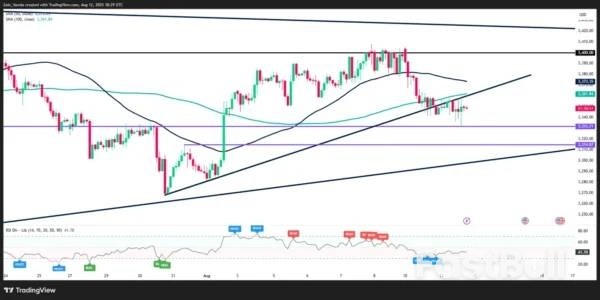
Looking at Gold over the medium-term and none of these events served as a catalyst for the precious metal. For now that 3500 handle seems to be unattainable as every bullish rally seems to be making a lower high the most recent of which occurred around 3407.The failure to gain acceptance above the 3400 handle does leave the precious vulnerable to further downside.
From a technical standpoint, Gold on a two-hour timeframe is also flashing bearish signs.There was a short-term ascending trendline which has been broken, with resistance being provided by the 100-day MA.If the 100-day MA holds firm further downside could materialize. Immediate support rests around the 3330 handle with a break below opening up a retest of the swing high at 3314 and then of course the 3300.A move higher has significant hurdles to clear in the short-term. First we have the 100-day MA at 3361 before the 50-day MA at 3373 and then of course the psychological 3400 handle.
Gold (XAU/USD) Daily Chart, August 12, 2025

Key points:
U.S. crude production will hit a record 13.41 million barrels per day in 2025 due to increases in well productivity, though lower oil prices will prompt a fall in output in 2026, the Energy Information Administration forecasted on Tuesday in a monthly report.
The decline in 2026 production to 13.28 million bpd would be the first drop in output since 2021 for the world's largest producer, the EIA data showed. Prices for the international benchmark Brentwill average $51 per barrel next year, down from the EIA's previous forecast of $58 per barrel, after the Organization of the Petroleum Exporting Countries and its members decided to accelerate the pace of production increases.
"Low oil prices in early 2026 will lead to a reduction in supply by both OPEC+ and some non-OPEC producers, which we expect will help moderate inventory builds later in 2026," the EIA said.
In last month's report, the EIA had projected U.S. crude output at 13.37 million bpd in both 2025 and 2026.
TheUnited Statesproduced 13.21 million bpd in 2024. U.S. producers this year have had to navigate PresidentDonald Trump'son-again, off-againtariffsthat have sparked economic uncertainty, rising supply quotas from OPEC+, and ongoing conflicts in theMiddle Eastandin Ukraine.
Lower crude prices are expected to push down retail prices for petroleum products, the EIA said, adding it expects retail gasoline prices in the U.S. to average less than $2.90 per gallon next year, about 20 cents per gallon less than this year.
U.S. distillate fuel inventories will end 2025 at the lowest end-of-year level since 2000, after decreasing 14% over the course of the year due to increased exports and demand, the EIA said. Lower U.S. refinery capacity and continued strong export demand will keep inventory levels lower, with distillate inventories remaining relatively flat in 2026, the agency added.
U.S. oil demand will increase to 20.4 million bpd in 2025, in line with previous forecasts, the EIA said. In 2026, oil demand will rise to 20.5 million bpd, versus a previous estimate of 20.4 million bpd.
White Label
Data API
Web Plug-ins
Poster Maker
Affiliate Program
The risk of loss in trading financial instruments such as stocks, FX, commodities, futures, bonds, ETFs and crypto can be substantial. You may sustain a total loss of the funds that you deposit with your broker. Therefore, you should carefully consider whether such trading is suitable for you in light of your circumstances and financial resources.
No decision to invest should be made without thoroughly conducting due diligence by yourself or consulting with your financial advisors. Our web content might not suit you since we don't know your financial conditions and investment needs. Our financial information might have latency or contain inaccuracy, so you should be fully responsible for any of your trading and investment decisions. The company will not be responsible for your capital loss.
Without getting permission from the website, you are not allowed to copy the website's graphics, texts, or trademarks. Intellectual property rights in the content or data incorporated into this website belong to its providers and exchange merchants.
Not Logged In
Log in to access more features

FastBull Membership
Not yet
Purchase
Log In
Sign Up