• Trade
  • Markets
  • Copy
  • Contests
  • News
  • 24/7
  • Calendar
  • Q&A
  • Chats
Trending
Screeners
SYMBOL
LAST
BID
ASK
HIGH
LOW
NET CHG.
%CHG.
SPREAD
SPX
S&P 500 Index
6827.42
6827.42
6827.42
6899.86
6801.80
-73.58
-1.07%
--
DJI
Dow Jones Industrial Average
48458.04
48458.04
48458.04
48886.86
48334.10
-245.98
-0.51%
--
IXIC
NASDAQ Composite Index
23195.16
23195.16
23195.16
23554.89
23094.51
-398.69
-1.69%
--
USDX
US Dollar Index
97.980
98.060
97.980
98.070
97.920
+0.030
+ 0.03%
--
EURUSD
Euro / US Dollar
1.17325
1.17333
1.17325
1.17447
1.17283
-0.00069
-0.06%
--
GBPUSD
Pound Sterling / US Dollar
1.33620
1.33630
1.33620
1.33740
1.33546
-0.00087
-0.07%
--
XAUUSD
Gold / US Dollar
4341.41
4341.84
4341.41
4347.21
4294.68
+42.02
+ 0.98%
--
WTI
Light Sweet Crude Oil
57.525
57.562
57.525
57.601
57.194
+0.292
+ 0.51%
--

Community Accounts

Signal Accounts
--
Profit Accounts
--
Loss Accounts
--
View More

Become a signal provider

Sell trading signals to earn additional income

View More

Guide to Copy Trading

Get started with ease and confidence

View More

Signal Accounts for Members

All Signal Accounts

Best Return
  • Best Return
  • Best P/L
  • Best MDD
Past 1W
  • Past 1W
  • Past 1M
  • Past 1Y

All Contests

  • All
  • Trump Updates
  • Recommend
  • Stocks
  • Cryptocurrencies
  • Central Banks
  • Featured News
Top News Only
Share

India's Nov Merchandise Trade Deficit At $24.53 Billion - Reuters Calculation (Poll $32 Billion)

Share

India's Nov Merchandise Imports At $62.66 Billion

Share

India's Nov Merchandise Exports At $38.13 Billion

Share

Stats Office - Swiss November Producer/Import Prices -1.6% Year-On-Year (Versus-1.7% In Prior Month)

Share

Stats Office - Swiss November Producer/Import Prices -0.5% Month-On-Month (Versus-0.3% In Prior Month)

Share

Thailand To Hold Elections On Feb 8 - Multiple Local Media Reports

Share

Taiwan Dollar Falls 0.6% To 31.384 Per USA Dollar, Lowest Since December 3

Share

Stats Office - Botswana November Consumer Inflation At 0.0% Month-On-Month

Share

Stats Office - Botswana November Consumer Inflation At 3.8% Year-On-Year

Share

Statistics Bureau - Kazakhstan's Jan-Nov Industrial Output +7.4% Year-On-Year

Share

Fca: Sets Out Plans To Help Build Mortgage Market Of Future

Share

Eurostoxx 50 Futures Up 0.38%, DAX Futures Up 0.43%, FTSE Futures Up 0.37%

Share

[Delivery Of New US Presidential Aircraft Delayed Again] According To The Latest Timeline Released By The US Air Force, The Delivery Of The First Of The Two Newly Commissioned Air Force One Presidential Aircraft Will Not Be Earlier Than 2028. This Means That The Delivery Of The New Air Force One Has Been Delayed Once Again

Share

German Nov Wholesale Prices +0.3% Month-On-Month

Share

Norway's Nov Trade Balance Nok 41.3 Billion - Statistics Norway

Share

German Nov Wholesale Prices +1.5% Year-On-Year

Share

Romania's Adjusted Industrial Production +0.4% Month-On-Month In October, +0.2% Year-On-Year - Statistics Board

Share

Russia Says It Destroyed 130 Ukrainian Drones Overnight, Some Moscow Airports Disrupted

Share

EU Commissioner Kos: This Is No Time To Speculate On Timeframe For Ukraine's Accession To EU

Share

Lithuania Foreign Minister: Ukraine Needs Article 5-Alike Security Guarantees, With Nuclear Deterrent

TIME
ACT
FCST
PREV
U.K. Trade Balance Non-EU (SA) (Oct)

A:--

F: --

P: --

France HICP Final MoM (Nov)

A:--

F: --

P: --

China, Mainland Outstanding Loans Growth YoY (Nov)

A:--

F: --

P: --

China, Mainland M2 Money Supply YoY (Nov)

A:--

F: --

P: --

China, Mainland M0 Money Supply YoY (Nov)

A:--

F: --

P: --

China, Mainland M1 Money Supply YoY (Nov)

A:--

F: --

P: --

India CPI YoY (Nov)

A:--

F: --

P: --

India Deposit Gowth YoY

A:--

F: --

P: --

Brazil Services Growth YoY (Oct)

A:--

F: --

P: --

Mexico Industrial Output YoY (Oct)

A:--

F: --

P: --

Russia Trade Balance (Oct)

A:--

F: --

P: --

Philadelphia Fed President Henry Paulson delivers a speech
Canada Building Permits MoM (SA) (Oct)

A:--

F: --

P: --

Canada Wholesale Sales YoY (Oct)

A:--

F: --

P: --

Canada Wholesale Inventory MoM (Oct)

A:--

F: --

P: --

Canada Wholesale Inventory YoY (Oct)

A:--

F: --

P: --

Canada Wholesale Sales MoM (SA) (Oct)

A:--

F: --

P: --

Germany Current Account (Not SA) (Oct)

A:--

F: --

P: --

U.S. Weekly Total Rig Count

A:--

F: --

P: --

U.S. Weekly Total Oil Rig Count

A:--

F: --

P: --

Japan Tankan Small Manufacturing Outlook Index (Q4)

A:--

F: --

P: --

Japan Tankan Large Non-Manufacturing Diffusion Index (Q4)

A:--

F: --

P: --

Japan Tankan Large Non-Manufacturing Outlook Index (Q4)

A:--

F: --

P: --

Japan Tankan Large Manufacturing Outlook Index (Q4)

A:--

F: --

P: --

Japan Tankan Small Manufacturing Diffusion Index (Q4)

A:--

F: --

P: --

Japan Tankan Large Manufacturing Diffusion Index (Q4)

A:--

F: --

P: --

Japan Tankan Large-Enterprise Capital Expenditure YoY (Q4)

A:--

F: --

P: --

U.K. Rightmove House Price Index YoY (Dec)

A:--

F: --

P: --

China, Mainland Industrial Output YoY (YTD) (Nov)

A:--

F: --

P: --

China, Mainland Urban Area Unemployment Rate (Nov)

A:--

F: --

P: --

Saudi Arabia CPI YoY (Nov)

A:--

F: --

P: --

Euro Zone Industrial Output YoY (Oct)

--

F: --

P: --

Euro Zone Industrial Output MoM (Oct)

--

F: --

P: --

Canada Existing Home Sales MoM (Nov)

--

F: --

P: --

Euro Zone Total Reserve Assets (Nov)

--

F: --

P: --

U.K. Inflation Rate Expectations

--

F: --

P: --

Canada National Economic Confidence Index

--

F: --

P: --

Canada New Housing Starts (Nov)

--

F: --

P: --

U.S. NY Fed Manufacturing Employment Index (Dec)

--

F: --

P: --

U.S. NY Fed Manufacturing Index (Dec)

--

F: --

P: --

Canada Core CPI YoY (Nov)

--

F: --

P: --

Canada Manufacturing Unfilled Orders MoM (Oct)

--

F: --

P: --

U.S. NY Fed Manufacturing Prices Received Index (Dec)

--

F: --

P: --

U.S. NY Fed Manufacturing New Orders Index (Dec)

--

F: --

P: --

Canada Manufacturing New Orders MoM (Oct)

--

F: --

P: --

Canada Core CPI MoM (Nov)

--

F: --

P: --

Canada Trimmed CPI YoY (SA) (Nov)

--

F: --

P: --

Canada Manufacturing Inventory MoM (Oct)

--

F: --

P: --

Canada CPI YoY (Nov)

--

F: --

P: --

Canada CPI MoM (Nov)

--

F: --

P: --

Canada CPI YoY (SA) (Nov)

--

F: --

P: --

Canada Core CPI MoM (SA) (Nov)

--

F: --

P: --

Canada CPI MoM (SA) (Nov)

--

F: --

P: --

Federal Reserve Board Governor Milan delivered a speech
U.S. NAHB Housing Market Index (Dec)

--

F: --

P: --

Australia Composite PMI Prelim (Dec)

--

F: --

P: --

Australia Services PMI Prelim (Dec)

--

F: --

P: --

Australia Manufacturing PMI Prelim (Dec)

--

F: --

P: --

Japan Manufacturing PMI Prelim (SA) (Dec)

--

F: --

P: --

U.K. Unemployment Claimant Count (Nov)

--

F: --

P: --

U.K. Unemployment Rate (Nov)

--

F: --

P: --

Q&A with Experts
    • All
    • Chatrooms
    • Groups
    • Friends
    Connecting
    .
    .
    .
    Type here...
    Add Symbol or Code

      No matching data

      All
      Trump Updates
      Recommend
      Stocks
      Cryptocurrencies
      Central Banks
      Featured News
      • All
      • Russia-Ukraine Conflict
      • Middle East Flashpoint
      • All
      • Russia-Ukraine Conflict
      • Middle East Flashpoint
      Search
      Products

      Charts Free Forever

      Chats Q&A with Experts
      Screeners Economic Calendar Data Tools
      Membership Features
      Data Warehouse Market Trends Institutional Data Policy Rates Macro

      Market Trends

      Market Sentiment Order Book Forex Correlations

      Top Indicators

      Charts Free Forever
      Markets

      News

      News Analysis 24/7 Columns Education
      From Institutions From Analysts
      Topics Columnists

      Latest Views

      Latest Views

      Trending Topics

      Top Columnists

      Latest Update

      Signals

      Copy Rankings Latest Signals Become a signal provider AI Rating
      Contests
      Brokers

      Overview Brokers Assessment Rankings Regulators News Claims
      Broker listing Forex Brokers Comparison Tool Live Spread Comparison Scam
      Q&A Complaint Scam Alert Videos Tips to Detect Scam
      More

      Business
      Events
      Careers About Us Advertising Help Center

      White Label

      Data API

      Web Plug-ins

      Affiliate Program

      Awards Institution Evaluation IB Seminar Salon Event Exhibition
      Vietnam Thailand Singapore Dubai
      Fans Party Investment Sharing Session
      FastBull Summit BrokersView Expo
      Recent Searches
        Top Searches
          Markets
          News
          Analysis
          User
          24/7
          Economic Calendar
          Education
          Data
          • Names
          • Latest
          • Prev

          View All

          No data

          Scan to Download

          Faster Charts, Chat Faster!

          Download App
          English
          • English
          • Español
          • العربية
          • Bahasa Indonesia
          • Bahasa Melayu
          • Tiếng Việt
          • ภาษาไทย
          • Français
          • Italiano
          • Türkçe
          • Русский язык
          • 简中
          • 繁中
          Open Account
          Search
          Products
          Charts Free Forever
          Markets
          News
          Signals

          Copy Rankings Latest Signals Become a signal provider AI Rating
          Contests
          Brokers

          Overview Brokers Assessment Rankings Regulators News Claims
          Broker listing Forex Brokers Comparison Tool Live Spread Comparison Scam
          Q&A Complaint Scam Alert Videos Tips to Detect Scam
          More

          Business
          Events
          Careers About Us Advertising Help Center

          White Label

          Data API

          Web Plug-ins

          Affiliate Program

          Awards Institution Evaluation IB Seminar Salon Event Exhibition
          Vietnam Thailand Singapore Dubai
          Fans Party Investment Sharing Session
          FastBull Summit BrokersView Expo

          Dollar Choppy As Risk-off Mood, Dovish Fed Unsettle Markets

          Glendon

          Forex

          Economic

          Summary:

          Fed outcome less hawkish than expected; Dollar soft; euro, sterling hit new highs; Fed to start buying Treasury bills to manage market liquidity; Souring risk mood sends Aussie, cryptos sliding; SNB leaves rates steady, franc strong.

          The dollar found support on Thursday from a broad risk-off mood in markets, but failed to recoup its overnight losses against peers such as the euro, yen and sterling after the Federal Reserve delivered a less hawkish outlook than some had expected.

          Investors in Asia dumped risk assets such as stocks and cryptocurrencies after disappointing earnings from U.S. cloud computing giant Oraclereignited fears that surging AI infrastructure costs could outpace profitability.

          That helped stem the safe-haven dollar's slide, which initially faced selling pressure after remarks from Fed Chair Jerome Powell surprised some who had been positioned for a more hawkish tone.

          The risk selloff petered out somewhat in Europe, however, to leave the euro at $1.1704, steady on the day at a near two-month high, after a 0.6% gain on Wednesday. Sterling was at $1.13374, also steady after a 0.65% rise on Wednesday.,

          The dollar also dipped versus the yen. It was down 0.14% at 155.8 yen after a 0.56% drop the previous day.

          The Fed lowered rates on Wednesday by 25 basis points but, as the move was widely expected, the reaction reflected much more the broader messaging, projections and the voting split.

          "Investors were bracing for a hawkish rate cut. In the end, there were only two dissenters to the cut and the Fed kept a rate cut in their median forecast for 2026," said Chris Turner, global head of markets at ING.

          "Equally, it seems that Chair Powell was reluctant to be boxed into the view that the Fed was now on a pause," he said.

          Heading into the Fed meeting, traders had been wondering whether they would get a similar message to those received from the Australian central bank chief and from an influential European Central Bank policymaker suggesting that their next moves would be rate hikes.

          Also weighing on the dollar, U.S. Treasuries attracted bids after the Fed announced it would start buying short-dated government bonds from December 12 to help manage market liquidity levels, with an initial round totalling around $40 billion in Treasury bills.

          AUSSIE AND CRYPTO HIT

          However, while the largest currencies were still focused on the Fed, the most risk-sensitive parts of the market were still being swayed by the weakness in tech stocks.

          Bitcoin, often viewed as a barometer of risk appetite, briefly slid back below the $90,000 level, and was last hovering at that point, down 2.4%. Etherwas down more than 4% at $3,200.

          "Even with a softer Fed outlook, the market is still working through the excess leverage from October, so reactions to macro signals are slower than usual," Gracie Lin, OKX's Singapore CEO, said of the fall in crypto prices.

          "The 25-basis-point cut was already priced in... and the wider macro and geopolitical backdrop is still uncertain. All of that keeps the immediate response muted."

          The Australian dollaralso got caught in the flight from risk and fell 0.5% to $0.6644.

          Also hurting the Aussie was data showing that Australian employment in November fell by the most in nine months.

          The Swiss franc firmed slightly after the Swiss National Bank left its policy rate unchanged at 0%, and said a recent agreement to reduce U.S. tariffs on Swiss goods had improved the economic outlook, even as inflation has somewhat undershot expectations.

          The franc last traded at 0.7992 per dollarafter hitting its strongest level in nearly a month. It was at 0.9348 to the euro.

          Source: TradingView

          To stay updated on all economic events of today, please check out our Economic calendar
          Risk Warnings and Disclaimers
          You understand and acknowledge that there is a high degree of risk involved in trading. Following any strategies or investment methods may lead to potential losses. The content on the site is provided by our contributors and analysts for information purposes only. You are solely responsible for determining whether any trading assets, securities, strategy, or any other product is suitable for investing based on your own investment objectives and financial situation.
          Add to Favorites
          Share

          Markets Cheer Fed’s ‘Hawkish Cut’ as Liquidity Boost, Economic Upgrade Drive Year-End Optimism

          Gerik

          Economic

          Fed Cuts Rates But Warns of Caution Ahead

          The U.S. Federal Reserve lowered its benchmark interest rate by 25 basis points to a target range of 3.5%–3.75% its third cut of the year but emphasized restraint going forward. Two voting members, Jeffrey Schmid and Austan Goolsbee, opposed the cut, favoring a hold instead, while one called for a more aggressive reduction. This division reflected broader uncertainty about the future policy path, and the Fed's "dot plot" revealed that officials anticipate just one rate cut in 2026 and another in 2027.
          Chair Jerome Powell's remarks during the press conference struck a cautious tone. While reiterating confidence in the U.S. economy, he offered no guidance on further cuts, instead stating, “I don’t think that a rate hike is anybody’s base case at this point.” This statement signaled that while the Fed is not looking to tighten again, future easing will be measured and data-dependent.

          Liquidity Injection Surprises Market, Lifts Sentiment

          Despite the hawkish signals, markets rallied. The unexpected catalyst was the Fed’s announcement that it will begin purchasing $40 billion in Treasury bills starting Friday a move interpreted by investors as stealth quantitative easing. Though framed as a liquidity management measure, this purchase program will expand the Fed’s balance sheet, increasing the money supply and helping to stabilize short-term interest rates in the financial system.
          This injection of liquidity appeared to override the restrained rate path in investors' minds, particularly at a time when year-end funding stress can strain repo markets and short-term borrowing costs. As a result, the Dow Jones Industrial Average climbed 1.1% on Wednesday, with similar strength across other major indexes.

          Economic Forecast Raised as Fed Reaffirms Resilience

          In another positive development, the Fed upgraded its 2026 GDP forecast from 1.8% to 2.3%, citing sustained economic strength. Powell described the U.S. economy as “extraordinary,” reinforcing confidence in consumer and business resilience despite inflation and global volatility.
          The combination of no immediate threat of rate hikes, a liquidity injection, and a rosier economic forecast supported risk-on sentiment. Investors began to anticipate a “Santa Claus rally,” with José Torres of Interactive Brokers suggesting the S&P 500 could surpass the 7,000 milestone in the coming weeks.

          Earnings and Global AI Bets Add Market Complexity

          While monetary policy buoyed equities, corporate earnings painted a more mixed picture. Oracle reported 14% year-over-year revenue growth but missed expectations, with shares plunging over 11% in after-hours trading. The results despite a strong AI backlog raised doubts about how quickly AI infrastructure investments will yield profits, dragging down related tech stocks.
          At the same time, AI investment momentum continued globally. In India, Microsoft and Amazon committed over $50 billion to AI development within a 24-hour span, citing the country's deep talent pool, abundant resources, and massive market potential. These commitments reflect a broader shift in Big Tech’s geographic strategy, with India emerging as a critical hub for next-generation innovation.

          European Defense Startups Ride AI Boom

          In Europe, AI-driven defense startups are also enjoying tailwinds. Venture capital investment in this sector has surged to $4.3 billion since 2022 nearly quadruple the total from the previous four years. This trend follows NATO’s agreement to raise defense spending to 5% of GDP and a growing openness by the UK and German governments to adopt solutions from newer tech players like Anduril, which just completed the first flight of its unmanned drone YFQ-44A.
          The surge in defense funding signals a significant alignment of state-led innovation policy and private capital, creating fertile ground for startups in high-tech defense and security applications.
          The Fed’s latest rate cut may have arrived with cautious projections and internal dissent, but investors seized on the hidden dovish cues: renewed Treasury purchases, a dismissal of future hikes, and a brighter economic outlook. These developments, coupled with ongoing AI and defense investment narratives, have helped lift risk sentiment, potentially setting the stage for a strong year-end rally even as central bank officials remain wary of overcommitting to further easing. The mixed signals require careful navigation, but for now, markets are choosing to focus on what’s working.

          Source: CNBC

          To stay updated on all economic events of today, please check out our Economic calendar
          Risk Warnings and Disclaimers
          You understand and acknowledge that there is a high degree of risk involved in trading. Following any strategies or investment methods may lead to potential losses. The content on the site is provided by our contributors and analysts for information purposes only. You are solely responsible for determining whether any trading assets, securities, strategy, or any other product is suitable for investing based on your own investment objectives and financial situation.
          Add to Favorites
          Share

          Mexico’s Tariff Hike Threatens $1 Billion Indian Auto Exports, Forcing Strategic Recalibration

          Gerik

          Economic

          Tariff Surge Strikes at the Heart of India’s Export Strategy

          Mexico’s latest policy move to hike import duties on automobiles to 50% starting next year presents a direct threat to India’s third-largest car export market. This decision, which targets countries without formal trade agreements such as India and China, undermines the current cost structure of Indian vehicle exports and could trigger a strategic rethink among top automakers like Volkswagen, Hyundai, Nissan, and Maruti Suzuki.
          The Society of Indian Automobile Manufacturers (SIAM), which includes the most affected brands, had urged India’s Commerce Ministry to negotiate with Mexico before the tariff was finalized. However, despite industry lobbying, Mexico proceeded with the measure a move that mirrors a broader global shift toward protectionist trade policies, notably influenced by the U.S.

          Volkswagen, Hyundai, and Nissan Among Most Exposed

          According to trade data and the letter reviewed by Reuters, vehicles constitute nearly one-fifth of India’s $5.3 billion total exports to Mexico. Volkswagen’s Skoda Auto division is the most vulnerable, accounting for half of all Indian car shipments to the country. Hyundai exported $200 million worth of vehicles, followed by Nissan at $140 million and Suzuki at $120 million.
          These exports predominantly consist of compact, sub-1-litre engine vehicles tailored for the Mexican domestic market not intended for re-export to the United States. Car makers have emphasized that these models do not directly compete with high-end vehicles produced in Mexico for the North American market, indicating that the tariff’s impact on local industry is marginal in nature. Nevertheless, the new trade barrier will drastically reduce the price competitiveness of Indian-origin vehicles.

          Trade Disruption Undermines Economies of Scale and Margins

          India's vehicle exports serve not only as a market-expansion strategy but also as a vital buffer for automakers managing slow domestic sales and pursuing economies of scale. The sudden tariff increase introduces significant uncertainty. With profit margins already thin on compact vehicles, a 50% tariff threatens to make India’s exports unviable in Mexico especially when competing against countries with established free trade agreements.
          As automakers reassess their production plans and target markets, the tariff disruption could ripple through India’s broader manufacturing sector. Notably, Mexico has long served as a strategic destination for car makers looking to balance global production loads and optimize factory output.

          Diplomatic Implications for India's Global Manufacturing Aspirations

          The Mexican tariff spike raises strategic questions about India’s positioning in global supply chains. Prime Minister Narendra Modi has consistently marketed India as a cost-effective manufacturing alternative to China. However, the absence of a free trade agreement with Mexico combined with its exposure to external geopolitical pressure has exposed vulnerabilities in that narrative.
          Mexico’s decision was partly influenced by U.S. pressure to curtail trade with China, but Indian automakers have become collateral damage. In this context, India’s failure to secure bilateral trade protections may limit its global industrial outreach, especially in strategically important markets like Latin America.

          Industry Response and Uncertain Path Forward

          At the time of reporting, Hyundai, Maruti Suzuki, and the Indian Commerce Ministry had not issued official responses. Nissan declined to comment. Piyush Arora, head of Volkswagen’s India operations, previously acknowledged Mexico’s importance, highlighting growing demand and strong traction for India-made models. But with the new tariffs, continued growth in the market may be untenable without a revised trade arrangement.
          Automakers now face a dilemma: either absorb losses or divert exports to alternative regions. Both options carry operational and financial costs. India’s lack of diversified free trade agreements may increasingly limit export scalability, making policy negotiations critical moving forward.
          Mexico’s steep tariff hike presents a clear and present risk to Indian automakers relying on Latin American markets. The development exposes a cause-and-effect cycle in which geopolitical pressures and trade fragmentation can severely disrupt emerging market strategies. Without policy intervention or diversified trade access, India’s aspirations to become a global export hub may encounter increasingly protectionist roadblocks. For automakers, the message is clear: overreliance on any single unprotected market carries growing risks in today’s volatile trade environment.

          Source: Reuters

          To stay updated on all economic events of today, please check out our Economic calendar
          Risk Warnings and Disclaimers
          You understand and acknowledge that there is a high degree of risk involved in trading. Following any strategies or investment methods may lead to potential losses. The content on the site is provided by our contributors and analysts for information purposes only. You are solely responsible for determining whether any trading assets, securities, strategy, or any other product is suitable for investing based on your own investment objectives and financial situation.
          Add to Favorites
          Share

          Swiss National Bank Holds Interest Rate at Zero, Cuts Inflation Forecast

          Glendon

          Forex

          Economic

          The Swiss National Bank kept its interest rate at zero, judging that a weakened inflation outlook doesn't yet justify a return to negative borrowing costs.

          The decision on Thursday marks the second quarterly result with an unchanged benchmark, and matched the forecasts of all 23 economists surveyed by Bloomberg. Markets had also priced in only a very small chance of a cut.

          "Inflation in recent months has been slightly lower than expected," the SNB said in a statement that showed reduced predictions for price growth for the next two years. "Although the conditional inflation forecast is somewhat lower in the short term than in September, there is only little change in the medium term. The forecast is within the range of price stability."

          The Swiss franc held earlier gains to trade 0.1% higher at 0.9348 per euro after the decision. The currency gained 0.2% to 0.7986 per dollar, the highest since Nov. 19.

          The outcome underscores how President Martin Schlegel and his colleagues are applying a higher bar to a move into negative territory than they would for a more conventional rate cut. With the franc touching recent decade-highs against the euro, and inflation at zero, the case for such a reduction under normal circumstances would have been more persuasive.

          While the US Federal Reserve's own quarter-point move on the eve of the SNB decision might have provided another pressure point to consider — given that it will narrow the differential between each country's borrowing costs — the backdrop of rising global bond yields may have offered some comfort, as will the clouded prospects for US policy next year.

          Faced with the trade-off between a feeble price outlook or taking a step of reintroducing the subzero policy that Switzerland had for seven years — a measure acknowledged to have hurt pensions, savers and the financial system — the SNB opted to stay steady this time round.

          The Swiss central bank cut its inflation forecast to 0.3% next year and 0.6% in 2027, down from 0.5% and 0.7%, respectively. For this year, the central bank kept its projection of 0.2% unchanged.

          Consumer-price growth has now turned out weaker than economists expected for three months in a row. It slowed to zero last month, making a pickup for the current quarter that had been anticipated by the SNB almost certainly unachievable.

          One challenge there is the franc. It surged to a decade high against the euro last month before then paring some gains. The currency's strength weighs on prices by making imports cheaper.

          The most recent driver of increases in the franc was the news that Switzerland had finally clinched a trade deal with the US after months of enduring the highest tariffs imposed on any advanced economy.

          Given that backdrop, the SNB predicts growth of about 1% next year, compared with "just under" that number, as predicted in September.

          Emboldening officials in their tolerance of weak inflation readings, or even negative outcomes, is an inflation target range of between zero and 2%, and the view that their current stance is expansive enough to stoke prices over time. Schlegel has also previously said that the SNB doesn't have to react to every piece of monthly data.

          Policymakers have said that they're willing to cut rates below zero, though they would rather avoid such a step if they can. Schlegel and his two colleagues may offer further clues on that when they address reporters at 10 a.m. in Bern.

          "The SNB will continue to monitor the situation and adjust its monetary policy if necessary, in order to ensure price stability," it said in the statement, reiterating its usual position.

          Source: Bloomberg Europe

          To stay updated on all economic events of today, please check out our Economic calendar
          Risk Warnings and Disclaimers
          You understand and acknowledge that there is a high degree of risk involved in trading. Following any strategies or investment methods may lead to potential losses. The content on the site is provided by our contributors and analysts for information purposes only. You are solely responsible for determining whether any trading assets, securities, strategy, or any other product is suitable for investing based on your own investment objectives and financial situation.
          Add to Favorites
          Share

          Nasdaq 100 Chart Analysis After The Fed Decision

          FXOpen

          Stocks

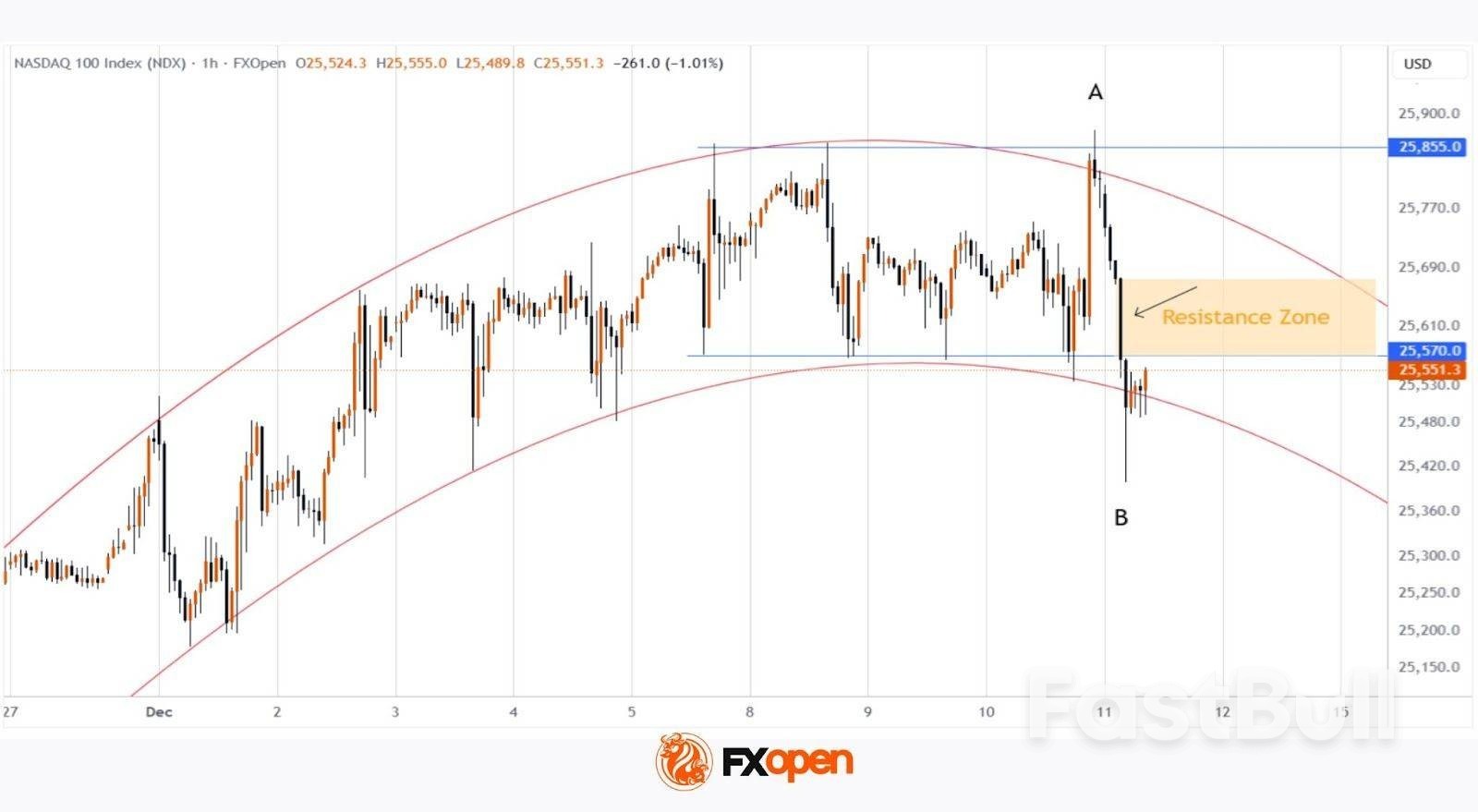
          The Nasdaq 100 index (US Tech 100 mini on FXOpen) showed sharp volatility yesterday following the interest rate announcement. The market action can be interpreted as follows:

          → First, the FOMC decision was released: as expected, the Federal Funds Rate was cut from 4.00% to 3.75% (a bullish catalyst), which pushed the index up towards point A.

          → However, half an hour later Jerome Powell's press conference began, and his tone was noticeably hawkish (a bearish catalyst). The Fed Chair signalled that the rate-cutting cycle has been paused because inflation remains elevated and additional labour-market data is needed. As a result, the index fell sharply from point A to the low at point B.

          Meanwhile, Donald Trump criticised the Fed's decision, arguing that rates should be cut far more aggressively. This adds to uncertainty, especially given expectations that Powell will leave his post in May 2026.

          Bearish pressure on the tech index intensified further after Oracle's earnings release — see yesterday's post for details. The results disappointed investors, fuelling renewed talk of an AI bubble, and ORCL shares plunged around 11% in after-hours trading.

          Technical Analysis of the Nasdaq 100 Chart

          Looking at recent price action in the Nasdaq 100 (US Tech 100 mini on FXOpen), the index appears to be forming a bearish Rounding Top pattern:

          → The peak at point A resembles a bull trap, as the price only slightly exceeded the December highs before reversing — in SMC terms, a sign of a bearish liquidity grab.

          → The price then broke support from several recent sessions around 25,570 after forming a large bearish candle (marked by the arrow). This indicates strong selling pressure (a market imbalance) and the area may now act as resistance.

          It is possible that bulls will attempt to recover some of yesterday's losses today. However, if any rebound stalls near this resistance zone, the Nasdaq 100 (US Tech 100 mini on FXOpen) may continue to drift lower along a rounding downward trajectory.

          Source: FXOpen

          Risk Warnings and Disclaimers
          You understand and acknowledge that there is a high degree of risk involved in trading. Following any strategies or investment methods may lead to potential losses. The content on the site is provided by our contributors and analysts for information purposes only. You are solely responsible for determining whether any trading assets, securities, strategy, or any other product is suitable for investing based on your own investment objectives and financial situation.
          Add to Favorites
          Share

          Trump’s $12 Billion Farm Aid Faces Skepticism as Tariff Fallout Deepens

          Gerik

          Economic

          Federal Aid Returns, But Farmer Confidence Wanes

          President Donald Trump’s renewed effort to support U.S. farmers through $12 billion in direct payments has done little to restore confidence among rural producers grappling with the long-term consequences of the ongoing trade war. While the assistance echoes the administration’s first-term bailouts, many farmers now view the payouts as inadequate and unsustainable.
          Gene Stehly, who farms corn, wheat, and soybeans, openly voiced frustration, noting that federal support cannot offset the substantial losses caused by slumping export markets and rising operational costs. The current situation, he observed, doesn’t resemble the “better outcome” initially promised by the administration. Like many others, he fears the support is too little, too late.
          Charlie Radman, a fourth-generation farmer in Minnesota, called the payments a temporary “bridge,” not a strategy. What farmers are demanding, he emphasized, is predictability

          Trade War Fallout Disrupts Agricultural Exports

          The root of the discontent lies in a deeply altered global trade landscape. Trump’s tariffs reignited tensions with China, once the largest buyer of American soybeans. Following retaliatory measures, China slashed its agricultural imports from the U.S., shifting toward Brazil and other suppliers. As a result, soybean and sorghum growers who typically export over half their harvest faced a dramatic contraction in demand.
          Though Trump and President Xi Jinping announced a deal in October aiming to restore agricultural trade, the actual numbers suggest a shortfall. Only about 25% of the 12 million metric tons of promised soybean purchases have materialized, casting doubt on China’s commitment to the agreement. Without confirmation from Beijing, skepticism is growing among U.S. farmers who remember unfulfilled pledges from previous negotiations.
          For Missouri farmer Bryant Kagay, the issue isn’t just economic it’s a question of trust. He bluntly stated his lack of faith in China’s “motives and integrity.” Even if the full volume of soybeans is eventually purchased, it merely restores exports to pre-Trump levels not growth, but recovery.

          Farmers Demand Market Expansion, Not Bailouts

          Many in the agricultural community are shifting focus away from China entirely. Glen Groth, a farmer in Minnesota, advocated for the development of new markets beyond Asia, while others called for bolstering domestic uses such as biofuels, animal feed, and aviation fuel. Iowa’s Dan Keitzer put it clearly: “We need more demand for our product,” adding that government checks are no substitute for a healthy market.
          This sentiment reflects a broader cause-and-effect pattern: years of technological advances have increased yields, yet market access has not kept pace. Without new buyers, oversupply will continue to depress prices, rendering aid payments a recurring necessity rather than a one-time solution.

          Policy Limits and Structural Challenges

          The structure of the newly announced aid package raises additional concerns. Payments are capped at $155,000 per farmer or entity, and only available to those with adjusted gross income below $900,000. During Trump’s first term, loopholes enabled large agribusinesses to sidestep these limits, drawing criticism from smaller operations.
          Moreover, the current $12 billion allocation is substantially lower than previous efforts: $22 billion in 2019 and $46 billion in 2020, which included COVID-related relief. As farmers prepare for next year’s crop cycle, many are already meeting with lenders, placing orders, and bracing for continued uncertainty. Financial commitments now far exceed what this round of aid can cover, reducing its impact to a mere accounting buffer.

          Trump Targets Ag Industry Monopolies, But With Unclear Outcomes

          Recognizing the growing frustration, Trump issued an executive order directing the DOJ and FTC to investigate anti-competitive practices across the food supply chain from fertilizer and seed suppliers to meatpacking firms and grocers. The goal, the administration claims, is to rein in price distortions that increase input costs while squeezing farmer margins.
          Tregg Cronin, a farmer from South Dakota, welcomed the acknowledgment that producers are “caught in the middle” of the trade and supply chain battles. Still, he acknowledged that any aid he receives will likely be consumed immediately by those same inflated expenses, leaving little for reinvestment or savings.

          Aid Offers Short-Term Relief, Not Long-Term Strategy

          Trump’s farm bailout is a political and economic gesture meant to placate a critical voting bloc. Yet, the gap between compensation and confidence is widening. While direct payments provide temporary support, they cannot replace predictable market access, competitive pricing, and structural reforms.
          Farmers across the Midwest are calling not just for financial relief but for lasting solutions from diversified trade to domestic demand stimulation and tighter control of agribusiness monopolies. Until those materialize, aid checks may keep operations afloat, but they do little to address the deeper challenges threatening the long-term viability of American agriculture.

          Source: AP

          To stay updated on all economic events of today, please check out our Economic calendar
          Risk Warnings and Disclaimers
          You understand and acknowledge that there is a high degree of risk involved in trading. Following any strategies or investment methods may lead to potential losses. The content on the site is provided by our contributors and analysts for information purposes only. You are solely responsible for determining whether any trading assets, securities, strategy, or any other product is suitable for investing based on your own investment objectives and financial situation.
          Add to Favorites
          Share

          Part Of Powell’s Analysis Allows Market To Consider A Less Hawkish Interpretation

          Justin

          Political

          Central Bank

          Markets

          The Fed cut its policy rate for the third consecutive meeting by 25 bps yesterday to 3.5%-3.75%. The Fed still has to balance a weakening labour market against somewhat elevated inflation. There was again no consensus within the FOMC on how to address these opposing factors, as one member (Stephen Miran) voted for a 50 bps cut, but two others (Schmid and Goolsbee) wanted to keep the policy rate unchanged. The dots even showed a total of 6 out of 19 members in favour of the status quo. The median Federal Funds Rate projection for 2026 and 2027 remained unchanged at respectively 3.25%-3.5% and 3%-3.25%. Fed chair Powell indicated that the policy rate now is "within the range of plausible neutral estimates", allowing the Fed to assess incoming data, with a January rate cut seen as rather unlikely.

          However, part of Powell's analysis allowed the market to consider a less hawkish interpretation. PCE inflation forecasts for this (2.9% from 3%) and next (2.4% from 2.6%) faced downward revisions. Powell's working hypothesis is still that most of the current elevated inflation was temporary due to higher goods prices driven by tariffs. Services inflation has been cooling. In addition, the Fed chair pointed at ongoing downside risks to the labour market, especially as current estimates on employment growth probably present an over-estimation. Markets responded to the "dovish" opening created by the labour market remarks.

          The US curve bull steepened, with yields declining between 7.7 bps (2-y) and -2.1 bps (30-y), assuming that the Fed focus remains slightly more tilted to maximum employment part of its dual mandate. An additional announcement to start buying T-bills (and other short-term Treasury securities) from next week on at a $40bn pace to maintain a situation of ample reserves added to the bull steepening move. By nearing neutral interest rate levels, the bar for additional rate cuts in early 2026 has been raised. Nevertheless, in case of weak (labour) market data next week and/or January, the debate on an additional precautionary rate cut might rapidly resurface.

          On other markets, equities rebounded yesterday with the Fed upwardly revising its growth forecasts, especially for next year (2.3% from 1.8% in September) and the Fed chair elaborating on ongoing high productivity gains supported. The combination of losing interest rate support and a risk rebound weighed on the dollar. DXY eased further from the 99.2 area early in the session to close at 98.79. EUR/USD closed just below the 1.17 big figure (1.1695).

          Today's eco calendar is thin, apart from weekly jobless claims. The Swiss national bank is expected to keep its policy rate unchanged at 0%. Even as Powell indicated that the Fed is now in a position to wait, we assume that both US yields and the dollar remain more sensitive to weaker than expected (labour market) data.

          News & Views

          The Bank of Canada as expected kept the policy rate unchanged at 2.5%. Economic growth at a 2.6% annualized clip in Q2 was surprisingly strong, it said, but that was the result of a steep drop in imports. The BoC anticipates a weak Q4 number with the import normalizing hanging in the balance with a grow in domestic demand. Growth is forecast to pick up in 2026, although uncertainty remains high.

          The labour market is a similar "on the one hand, but on the other" narrative. after solid employment gains over the last three months. Inflation, 2.2% in October, should remain close to the 2% target with the BoC willing to look through some choppiness in the coming months. Underlying gauges hover around 2.5%. The central bank concludes that "the current policy rate at about the right level to keep inflation close to 2% while helping the economy through this period of structural adjustment." Canadian swap yields fell up to 5 bps at the front. USD/CAD ended lower below 1.38 but that was mainly a US dollar move.

          Brazil's central bank left the policy rate at 15% and kept their view of an economy cooling while inflation, though still above the 3% target, is improving. They lowered CPI forecasts to hit 3.2% in 2027Q2 (from 3.3%), which is their relevant policy horizon for now. Risks remain symmetrical.

          The 15% level is considered "appropriate" to bring inflation to target, considered a slight dovish change compared to November's "will be enough". The Brazilian real's strengthening over much of 2025 probably helps explain the downwardly adjusted CPI forecasts. But its recent weakening to a two month low of USD/BRL 5.47 warrants ongoing caution, meaning the 15% level may be the reference for the time being..

          Source: KBC Bank

          Risk Warnings and Disclaimers
          You understand and acknowledge that there is a high degree of risk involved in trading. Following any strategies or investment methods may lead to potential losses. The content on the site is provided by our contributors and analysts for information purposes only. You are solely responsible for determining whether any trading assets, securities, strategy, or any other product is suitable for investing based on your own investment objectives and financial situation.
          Add to Favorites
          Share
          FastBull
          Copyright © 2025 FastBull Ltd

          728 RM B 7/F GEE LOK IND BLDG NO 34 HUNG TO RD KWUN TONG KLN HONG KONG

          TelegramInstagramTwitterfacebooklinkedin
          App Store Google Play Google Play
          Products
          Charts

          Chats

          Q&A with Experts
          Screeners
          Economic Calendar
          Data
          Tools
          Membership
          Features
          Function
          Markets
          Copy Trading
          Latest Signals
          Contests
          News
          Analysis
          24/7
          Columns
          Education
          Company
          Careers
          About Us
          Contact Us
          Advertising
          Help Center
          Feedback
          User Agreement
          Privacy Policy
          Business

          White Label

          Data API

          Web Plug-ins

          Poster Maker

          Affiliate Program

          Risk Disclosure

          The risk of loss in trading financial instruments such as stocks, FX, commodities, futures, bonds, ETFs and crypto can be substantial. You may sustain a total loss of the funds that you deposit with your broker. Therefore, you should carefully consider whether such trading is suitable for you in light of your circumstances and financial resources.

          No decision to invest should be made without thoroughly conducting due diligence by yourself or consulting with your financial advisors. Our web content might not suit you since we don't know your financial conditions and investment needs. Our financial information might have latency or contain inaccuracy, so you should be fully responsible for any of your trading and investment decisions. The company will not be responsible for your capital loss.

          Without getting permission from the website, you are not allowed to copy the website's graphics, texts, or trademarks. Intellectual property rights in the content or data incorporated into this website belong to its providers and exchange merchants.

          Not Logged In

          Log in to access more features

          FastBull Membership

          Not yet

          Purchase

          Become a signal provider
          Help Center
          Customer Service
          Dark Mode
          Price Up/Down Colors

          Log In

          Sign Up

          Position
          Layout
          Fullscreen
          Default to Chart
          The chart page opens by default when you visit fastbull.com