• Trade
  • Markets
  • Copy
  • Contests
  • News
  • 24/7
  • Calendar
  • Q&A
  • Chats
Trending
Screeners
SYMBOL
LAST
BID
ASK
HIGH
LOW
NET CHG.
%CHG.
SPREAD
SPX
S&P 500 Index
6870.39
6870.39
6870.39
6895.79
6858.28
+13.27
+ 0.19%
--
DJI
Dow Jones Industrial Average
47954.98
47954.98
47954.98
48133.54
47871.51
+104.05
+ 0.22%
--
IXIC
NASDAQ Composite Index
23578.12
23578.12
23578.12
23680.03
23506.00
+72.99
+ 0.31%
--
USDX
US Dollar Index
98.910
98.990
98.910
98.960
98.730
-0.040
-0.04%
--
EURUSD
Euro / US Dollar
1.16516
1.16524
1.16516
1.16717
1.16341
+0.00090
+ 0.08%
--
GBPUSD
Pound Sterling / US Dollar
1.33186
1.33194
1.33186
1.33462
1.33136
-0.00126
-0.09%
--
XAUUSD
Gold / US Dollar
4213.19
4213.60
4213.19
4218.85
4190.61
+15.28
+ 0.36%
--
WTI
Light Sweet Crude Oil
59.278
59.308
59.278
60.084
59.160
-0.531
-0.89%
--

Community Accounts

Signal Accounts
--
Profit Accounts
--
Loss Accounts
--
View More

Become a signal provider

Sell trading signals to earn additional income

View More

Guide to Copy Trading

Get started with ease and confidence

View More

Signal Accounts for Members

All Signal Accounts

Best Return
  • Best Return
  • Best P/L
  • Best MDD
Past 1W
  • Past 1W
  • Past 1M
  • Past 1Y

All Contests

  • All
  • Trump Updates
  • Recommend
  • Stocks
  • Cryptocurrencies
  • Central Banks
  • Featured News
Top News Only
Share

India Government: Cancellations Are On Account Of Developer Delays And Not Due To Transmission Side Delays

Share

Fitch: We See Moderation Of Export Performance In China In 2026

Share

India Government: Revokes Grid Access Permissions For Renewable Energy Projects

Share

Fitch: Calibrating Fiscal And Monetary Policies In China To Boost Domestic Demand And Reverse Deflationary Pressures Will Be A Key Challenge

Share

Stats Office - Tanzania Inflation At 3.4% Year-On-Year In November

Share

Fitch: External Risks From US Tariffs For Greater China Region Have Subsided

Share

Temasek CEO Dilhan Pillay: We Are Taking A Conservative Stance On Allocating Capital

Share

Brazil Economists See Brazilian Real At 5.40 Per Dollar By Year-End 2025 Versus 5.40 In Previous Estimate - Central Bank Poll

Share

Brazil Economists See Year-End 2026 Interest Rate Selic At 12.25% Versus 12.00% In Previous Estimate - Central Bank Poll

Share

Brazil Economists See Year-End 2025 Interest Rate Selic At 15.00% Versus 15.00% In Previous Estimate - Central Bank Poll

Share

EU Commission Says Meta Has Committed To Give EU Users Choice On Personalised Ads

Share

Sources Revealed That The Bank Of England Has Invited Employees To Voluntarily Apply For Layoffs

Share

The Bank Of England Plans To Cut Staff Due To Budget Pressures

Share

Traders Believe There Is Less Than A 10% Chance That The European Central Bank Will Cut Interest Rates By 25 Basis Points In 2026

Share

Egypt, European Bank For Reconstruction And Development Sign $100 Million Financing Agreement

Share

Israel Budget Deficit 4.5% Of GDP In November Over Past 12 Months Versus 4.9% Deficit In October

Share

JPMorgan - Council Chaired By Jamie Dimon Includes Jeff Bezos

Share

UK Government: UK Health Security Agency Identified New Recombinant Mpox Virus In England In Individual Who Had Recently Travelled To Asia

Share

European Central Bank Governing Council Member Kazimir: I See No Reason To Change Rates In The Coming Months, Definitely No In December

Share

European Central Bank Governing Council Member Kazimir: Overengineering Policy Around Small Inflation Deviations Would Introduce Unnecessary Policy Uncertainty

TIME
ACT
FCST
PREV
France Industrial Output MoM (SA) (Oct)

A:--

F: --

P: --
France Trade Balance (SA) (Oct)

A:--

F: --

P: --
Euro Zone Employment YoY (SA) (Q3)

A:--

F: --

P: --
Canada Part-Time Employment (SA) (Nov)

A:--

F: --

P: --

Canada Unemployment Rate (SA) (Nov)

A:--

F: --

P: --

Canada Full-time Employment (SA) (Nov)

A:--

F: --

P: --

Canada Labor Force Participation Rate (SA) (Nov)

A:--

F: --

P: --

Canada Employment (SA) (Nov)

A:--

F: --

P: --

U.S. PCE Price Index MoM (Sept)

A:--

F: --

P: --

U.S. Personal Income MoM (Sept)

A:--

F: --

P: --

U.S. Core PCE Price Index MoM (Sept)

A:--

F: --

P: --

U.S. PCE Price Index YoY (SA) (Sept)

A:--

F: --

P: --

U.S. Core PCE Price Index YoY (Sept)

A:--

F: --

P: --

U.S. Personal Outlays MoM (SA) (Sept)

A:--

F: --

P: --
U.S. 5-10 Year-Ahead Inflation Expectations (Dec)

A:--

F: --

P: --

U.S. Real Personal Consumption Expenditures MoM (Sept)

A:--

F: --

P: --
U.S. Weekly Total Rig Count

A:--

F: --

P: --

U.S. Weekly Total Oil Rig Count

A:--

F: --

P: --

U.S. Consumer Credit (SA) (Oct)

A:--

F: --

P: --
China, Mainland Foreign Exchange Reserves (Nov)

A:--

F: --

P: --

Japan Trade Balance (Oct)

A:--

F: --

P: --

Japan Nominal GDP Revised QoQ (Q3)

A:--

F: --

P: --

China, Mainland Imports YoY (CNH) (Nov)

A:--

F: --

P: --

China, Mainland Exports (Nov)

A:--

F: --

P: --

China, Mainland Imports (CNH) (Nov)

A:--

F: --

P: --

China, Mainland Trade Balance (CNH) (Nov)

A:--

F: --

P: --

China, Mainland Exports YoY (USD) (Nov)

A:--

F: --

P: --

China, Mainland Imports YoY (USD) (Nov)

A:--

F: --

P: --

Germany Industrial Output MoM (SA) (Oct)

A:--

F: --

P: --
Euro Zone Sentix Investor Confidence Index (Dec)

A:--

F: --

P: --

Canada National Economic Confidence Index

--

F: --

P: --

U.K. BRC Like-For-Like Retail Sales YoY (Nov)

--

F: --

P: --

U.K. BRC Overall Retail Sales YoY (Nov)

--

F: --

P: --

Australia Overnight (Borrowing) Key Rate

--

F: --

P: --

RBA Rate Statement
RBA Press Conference
Germany Exports MoM (SA) (Oct)

--

F: --

P: --

U.S. NFIB Small Business Optimism Index (SA) (Nov)

--

F: --

P: --

Mexico 12-Month Inflation (CPI) (Nov)

--

F: --

P: --

Mexico Core CPI YoY (Nov)

--

F: --

P: --

Mexico PPI YoY (Nov)

--

F: --

P: --

U.S. Weekly Redbook Index YoY

--

F: --

P: --

U.S. JOLTS Job Openings (SA) (Oct)

--

F: --

P: --

China, Mainland M1 Money Supply YoY (Nov)

--

F: --

P: --

China, Mainland M0 Money Supply YoY (Nov)

--

F: --

P: --

China, Mainland M2 Money Supply YoY (Nov)

--

F: --

P: --

U.S. EIA Short-Term Crude Production Forecast For The Year (Dec)

--

F: --

P: --

U.S. EIA Natural Gas Production Forecast For The Next Year (Dec)

--

F: --

P: --

U.S. EIA Short-Term Crude Production Forecast For The Next Year (Dec)

--

F: --

P: --

EIA Monthly Short-Term Energy Outlook
U.S. API Weekly Gasoline Stocks

--

F: --

P: --

U.S. API Weekly Cushing Crude Oil Stocks

--

F: --

P: --

U.S. API Weekly Crude Oil Stocks

--

F: --

P: --

U.S. API Weekly Refined Oil Stocks

--

F: --

P: --

South Korea Unemployment Rate (SA) (Nov)

--

F: --

P: --

Japan Reuters Tankan Non-Manufacturers Index (Dec)

--

F: --

P: --

Japan Reuters Tankan Manufacturers Index (Dec)

--

F: --

P: --

Japan Domestic Enterprise Commodity Price Index MoM (Nov)

--

F: --

P: --

Japan Domestic Enterprise Commodity Price Index YoY (Nov)

--

F: --

P: --

China, Mainland PPI YoY (Nov)

--

F: --

P: --

China, Mainland CPI MoM (Nov)

--

F: --

P: --

Q&A with Experts
    • All
    • Chatrooms
    • Groups
    • Friends
    Connecting
    .
    .
    .
    Type here...
    Add Symbol or Code

      No matching data

      All
      Trump Updates
      Recommend
      Stocks
      Cryptocurrencies
      Central Banks
      Featured News
      • All
      • Russia-Ukraine Conflict
      • Middle East Flashpoint
      • All
      • Russia-Ukraine Conflict
      • Middle East Flashpoint
      Search
      Products

      Charts Free Forever

      Chats Q&A with Experts
      Screeners Economic Calendar Data Tools
      Membership Features
      Data Warehouse Market Trends Institutional Data Policy Rates Macro

      Market Trends

      Market Sentiment Order Book Forex Correlations

      Top Indicators

      Charts Free Forever
      Markets

      News

      News Analysis 24/7 Columns Education
      From Institutions From Analysts
      Topics Columnists

      Latest Views

      Latest Views

      Trending Topics

      Top Columnists

      Latest Update

      Signals

      Copy Rankings Latest Signals Become a signal provider AI Rating
      Contests
      Brokers

      Overview Brokers Assessment Rankings Regulators News Claims
      Broker listing Forex Brokers Comparison Tool Live Spread Comparison Scam
      Q&A Complaint Scam Alert Videos Tips to Detect Scam
      More

      Business
      Events
      Careers About Us Advertising Help Center

      White Label

      Data API

      Web Plug-ins

      Affiliate Program

      Awards Institution Evaluation IB Seminar Salon Event Exhibition
      Vietnam Thailand Singapore Dubai
      Fans Party Investment Sharing Session
      FastBull Summit BrokersView Expo
      Recent Searches
        Top Searches
          Markets
          News
          Analysis
          User
          24/7
          Economic Calendar
          Education
          Data
          • Names
          • Latest
          • Prev

          View All

          No data

          Scan to Download

          Faster Charts, Chat Faster!

          Download App
          English
          • English
          • Español
          • العربية
          • Bahasa Indonesia
          • Bahasa Melayu
          • Tiếng Việt
          • ภาษาไทย
          • Français
          • Italiano
          • Türkçe
          • Русский язык
          • 简中
          • 繁中
          Open Account
          Search
          Products
          Charts Free Forever
          Markets
          News
          Signals

          Copy Rankings Latest Signals Become a signal provider AI Rating
          Contests
          Brokers

          Overview Brokers Assessment Rankings Regulators News Claims
          Broker listing Forex Brokers Comparison Tool Live Spread Comparison Scam
          Q&A Complaint Scam Alert Videos Tips to Detect Scam
          More

          Business
          Events
          Careers About Us Advertising Help Center

          White Label

          Data API

          Web Plug-ins

          Affiliate Program

          Awards Institution Evaluation IB Seminar Salon Event Exhibition
          Vietnam Thailand Singapore Dubai
          Fans Party Investment Sharing Session
          FastBull Summit BrokersView Expo

          China’s Export Recovery Overshadowed by Continued U.S. Trade Weakness Despite Tariff Truce

          Gerik

          Economic

          Summary:

          Although China’s total exports rebounded by 5.9% in November 2025, shipments to the United States plunged nearly 29%, marking the eighth straight month of double-digit declines despite a recent trade agreement between the two countries....

          Export Rebound Masks Deepening U.S. Trade Weakness

          China’s export performance in November 2025 painted a mixed picture. On the surface, total outbound shipments rose 5.9% year-on-year in U.S. dollar terms, significantly outperforming expectations of 3.8% and reversing a contraction seen in October. However, this overall recovery conceals a strikingly poor performance in U.S.-bound trade, with exports to the world’s largest consumer market plummeting 28.6%. This marks the eighth consecutive month of double-digit decline in exports to the U.S., highlighting that the recent tariff truce has yet to restore trade flows between the two economic superpowers.
          Despite the diplomatic breakthrough between President Xi Jinping and President Donald Trump in late October where both sides agreed to suspend several trade restrictions for one year China’s trade with the U.S. continued to deteriorate. Not only did exports collapse, but imports from the U.S. also shrank by 19% compared to a year earlier. These figures suggest that the deal’s impact has not yet materialized in transactional terms, potentially due to residual tariffs still in place (47.5% average on U.S. goods to China and 32% vice versa) and lagged implementation of commitments such as soybean purchases and rare earth access.
          By contrast, China’s exports to other major partners have flourished. Shipments to ASEAN and the EU rose by over 8% and nearly 15%, respectively. This disparity reflects a likely causal relationship between geopolitical alignment and supply chain diversification, as Chinese exporters prioritize regions where policy friction is lower and logistical efficiency is more stable. The substitution effect is further validated by the growth in China’s rare earth exports, which rose 24% year-on-year in November, hinting at an active redirection of critical materials to non-U.S. destinations.

          Trade Surplus Rises While Domestic Demand Falters

          Even as exports recovered, domestic conditions remained fragile. Imports rose only 1.9%, underperforming expectations of 3%, suggesting that weak domestic demand largely attributed to a persistent housing downturn and labor market uncertainty continues to undermine consumption. Compared to the same period in 2024, imports for the first 11 months of 2025 dropped 0.6%, while exports rose 5.4%, pushing the trade surplus to a massive $1.076 trillion, up 21.6% year-on-year. This stark imbalance indicates that external demand not internal consumption remains the primary engine of economic growth.
          Trade categories such as soybeans and rare earths, central to the U.S.-China agreement, showed early signs of increased activity. Soybean imports climbed 13% year-on-year to 8.1 million metric tons in November, though still below October levels. China’s commitment to purchase 12 million metric tons of U.S. soybeans by year-end may still fall short, reflecting a lag in implementation. Meanwhile, the rare earth sector benefited from a 24% year-on-year volume surge, aided by a new licensing regime aimed at accelerating exports. While these developments represent partial compliance with the trade deal, they remain insufficient to reverse the declining trajectory of overall bilateral trade.

          Domestic Manufacturing Under Pressure Despite External Gains

          Although November’s export rebound offered relief to Chinese manufacturers, internal indicators showed ongoing stress. Official data confirmed that factory activity contracted for the eighth consecutive month, while private surveys focusing on export-oriented manufacturers also slipped back into contraction territory. This suggests a weak correlation between headline export numbers and actual industrial health, as a limited set of commodity exports (such as rare earths) may be masking broader stagnation in manufacturing orders.
          With the Central Economic Work Conference scheduled for later this month, attention is now turning to Beijing’s next fiscal and monetary strategies. While the government is expected to retain the 2026 growth target of “around 5%,” analysts including Goldman Sachs anticipate more aggressive easing in early 2026. Potential measures include expanding the fiscal deficit cap by 1 percentage point of GDP and reducing policy interest rates by at least 20 basis points. These policy responses are designed to offset the effects of weak domestic consumption and a sluggish fourth quarter.
          The strengthening yuan, which appreciated nearly 5% since April to 7.0669 per dollar, has not yet hindered export performance. However, as Weijian Shan of PAG argued, a stronger yuan could play a positive role in boosting household purchasing power and consumption’s contribution to GDP which has slipped to 53%, down from 86% in 2023. The implicit suggestion is that China’s long-term economic sustainability hinges on rebalancing growth away from export dependency and toward internal demand, a structural shift that remains largely unaddressed.
          China’s trade data for November 2025 reveals a complex narrative of selective resilience. While exports to the rest of the world have surged, the continuing collapse in trade with the United States indicates that bilateral tensions and structural frictions run deeper than a single-year tariff suspension can resolve. Moreover, internal vulnerabilities persist despite impressive external figures. As Beijing prepares for 2026, policymakers must grapple with not only maintaining external momentum but also delivering domestic reforms that can unlock sustainable, consumption-led growth.

          Source: CNBC

          To stay updated on all economic events of today, please check out our Economic calendar
          Risk Warnings and Disclaimers
          You understand and acknowledge that there is a high degree of risk involved in trading. Following any strategies or investment methods may lead to potential losses. The content on the site is provided by our contributors and analysts for information purposes only. You are solely responsible for determining whether any trading assets, securities, strategy, or any other product is suitable for investing based on your own investment objectives and financial situation.
          Add to Favorites
          Share

          Gold Outlook: $4,250 Resistance Tests Ahead Of Volatile FOMC Week

          Pepperstone

          Commodity

          Forex

          This week, market attention turns to the Fed's final rate decision of the year. Updates to the dot plot, adjustments to economic projections, and Powell's remarks could all be key factors influencing gold's year-end trajectory.

          Technical Observation: Consolidation Near Highs, $4,250 Resistance Stands Out

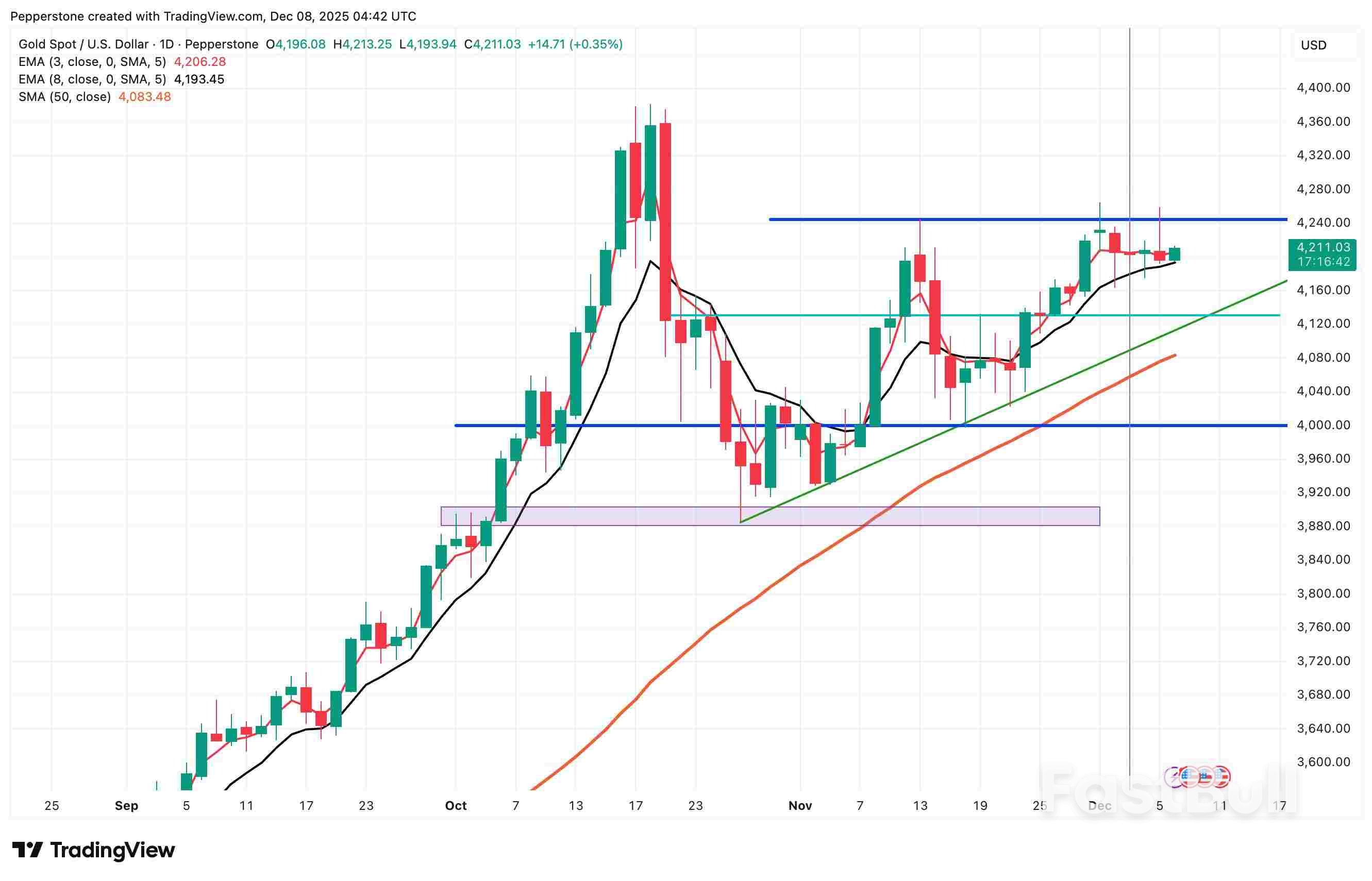
          Looking at the XAUUSD daily chart, gold has been trading in a tight range between $4,180 and $4,250. Bulls face clear resistance near $4,250, with multiple attempts failing to hold above this level. Although the uptrend formed at the end of October remains intact, buying momentum has been limited, keeping supply and demand relatively balanced.

          On Monday morning, gold traded near $4,200. To the upside, $4,250 is a critical level for resuming the uptrend. A sustained break above this level, accompanied by higher volume, could reignite bullish momentum, pushing toward $4,300 and ultimately the record high of $4,381.

          To the downside, a drop below last week's $4,180 low would shift focus to the October uptrend line near the 50-day moving average, likely attracting buying interest and prompting a short-term rebound.

          FOMC Decision in Focus: Gold Awaits Guidance

          Bullish factors remain dominant for gold. In the U.S., the December rate cut is priced at nearly 90%, the dollar is weak, and internal Fed divisions over the path of future easing have grown, all supporting gold. Meanwhile, China's central bank increased its gold holdings for the 13th consecutive month in November, reinforcing price support. Yet, last week's economic data only reinforced existing bullish narratives without providing new momentum.

          At the same time, U.S. Treasuries faced continued selling, with yields rising, reflecting cautious expectations for a "hawkish cut," which adds some pressure to the non-yielding asset.

          The market's focus is squarely on the Fed's decision this week. Beyond the rate cut itself, traders are watching dot plot updates, Powell's tone, and guidance on the 2026 rate cut path. Unlike Powell's previous emphasis on internal consensus, committee members now differ significantly in both policy direction and magnitude. Even minor adjustments by a few members could lead to notable dot plot shifts and rate path changes.

          The baseline scenario for traders is that the U.S. labor market faces downside risks, unemployment forecasts may be slightly revised higher, and Powell may acknowledge internal Fed divisions while using moderately hawkish language on the rate cut. With dot plot uncertainty intact, this policy risk hedging could provide some support to gold.

          If the Fed's outcome and comments are clearly dovish, gold's upside momentum could strengthen further. Conversely, if economic forecasts show persistent inflation and some Fed members lean hawkish, delaying 2026 rate cuts, profit-taking could intensify, putting short-term pressure on gold prices.

          Beyond the Fed: Other Key Events This Week

          Overall, gold remains in high-level consolidation, and market confidence in its long-term bullish outlook stays firm. In the short term, "range trading and trend-following" remains the preferred strategy. Until $4,250 is decisively breached, chasing positions carries risk. Any reasonable pullback is likely to attract buying interest and support prices.

          Aside from the Fed, the market will also monitor policy meetings from the RBA, Bank of Canada, and Swiss National Bank. The market's main tension has shifted from simply validating economic data to pre-pricing potential divergences in major central bank policies. Greater volatility in interest rates and currencies could further enhance gold's appeal as a safe-haven asset.

          On Tuesday, the U.S. will release October JOLTS job openings, expected at 7.15 million. This will be the first data reflecting the true labor market post-government shutdown, potentially shaping expectations for Fed policy.

          If the figure falls below consensus, it may reinforce expectations of a weaker labor market, increase the probability of rate cuts, and provide additional support for gold.

          Source: Pepperstone

          Risk Warnings and Disclaimers
          You understand and acknowledge that there is a high degree of risk involved in trading. Following any strategies or investment methods may lead to potential losses. The content on the site is provided by our contributors and analysts for information purposes only. You are solely responsible for determining whether any trading assets, securities, strategy, or any other product is suitable for investing based on your own investment objectives and financial situation.
          Add to Favorites
          Share

          Oil Prices Stabilize as India-Russia Trade Deepens and Geopolitical Risks Rise

          Gerik

          Economic

          Commodity

          Oil Prices Hover Amid Conflicting Forces of Demand and Geopolitical Instability

          Brent crude prices remained below the $64 per barrel threshold on Monday, showing signs of stabilization after achieving consecutive weekly gains for the first time since August. West Texas Intermediate hovered around $60, signaling a temporary equilibrium in global oil markets. This price movement reflects a fragile balance between geopolitical tensions, specifically the Ukraine-Russia conflict, and shifting trade dynamics, notably India’s increasing engagement with Russian oil supplies.
          A key driver of this price stability is India's sustained interest in Russian crude. Russian President Vladimir Putin recently pledged to ensure uninterrupted fuel shipments to India, a gesture seen as reinforcing bilateral energy ties. This commitment arrives just as US negotiators land in New Delhi for broader trade discussions. India’s growing role as a key buyer of sanctioned Russian oil appears to have softened some of the downward pressure on prices, at least in the short term. The causality here stems from India’s willingness to purchase discounted Russian crude, which provides a steady demand stream that supports market prices even as other variables suggest bearish conditions.

          Ukraine’s Military Strategy Targets Russian Energy Infrastructure

          Simultaneously, Ukraine has intensified attacks on Russian energy infrastructure, notably the Caspian Pipeline Consortium (CPC) terminal on the Black Sea, a vital hub for Russian oil exports. These offensives have disrupted loadings and driven up physical crude premiums. Kyiv’s broader targeting of energy-related assets within Russia is adding a layer of volatility to supply expectations. The effect of these strikes is not necessarily linear in its impact on pricing, but they do create a correlation between rising geopolitical risk and short-term support for oil benchmarks.
          Despite these developments, broader market fundamentals suggest a bearish outlook. Rising output from OPEC+ nations and non-OPEC producers such as the US, Brazil, and Guyana is projected to outpace lukewarm global demand growth. The market’s oversupply condition is not yet fully priced in but is increasingly acknowledged by analysts. Vivek Dhar from the Commonwealth Bank of Australia noted that as Russia successfully redirects its oil flows around sanctions, the impact of supply resilience will weigh more heavily on the market. His projection indicates that Brent could trend downwards toward $60 per barrel through 2026, implying that the current price stability may be fleeting.

          Outlook Hinges on Major Energy Reports

          Market participants await new forecasts this week from the Energy Information Administration (EIA), the International Energy Agency (IEA), and OPEC. These reports are expected to provide updated insights into global inventory levels, production forecasts, and demand projections. Their release could shift current sentiment by validating oversupply concerns or revising growth outlooks depending on emerging data.
          In summary, oil prices are currently supported by India’s energy diplomacy and the disruptive impact of Ukrainian strikes on Russian export capacity. However, this support exists in tension with structural market concerns over increasing global supply. The interaction of these variables some directly causal, others correlative will likely determine the trajectory of oil prices heading into 2026. Without a significant uptick in demand or a sustained supply shock, bearish pressures may gradually override short-term stabilizing forces.

          Source: Bloomberg

          To stay updated on all economic events of today, please check out our Economic calendar
          Risk Warnings and Disclaimers
          You understand and acknowledge that there is a high degree of risk involved in trading. Following any strategies or investment methods may lead to potential losses. The content on the site is provided by our contributors and analysts for information purposes only. You are solely responsible for determining whether any trading assets, securities, strategy, or any other product is suitable for investing based on your own investment objectives and financial situation.
          Add to Favorites
          Share

          Asia Markets Mixed as Investors Eye China Trade Data and RBA Decision

          Gerik

          Economic

          Stocks

          Markets Await China Trade Recovery as Sentiment Remains Cautious

          Asia-Pacific equities traded without clear direction as investors focused on the upcoming release of China’s November trade data, with expectations of an export recovery. According to a Reuters poll, China’s exports are forecast to grow 3.8% year-over-year in November, reversing October’s 1.1% decline. Imports are also expected to rise 3%, up from 1% previously. A better-than-expected print could strengthen confidence in China’s manufacturing and global trade momentum heading into 2026.
          Meanwhile, Hong Kong’s Hang Seng Index futures pointed to a higher open, and the index rose 0.24% during the session. Mainland China’s CSI 300 added 0.43%, with markets drawing support from optimism around a trade rebound.
          However, the excitement from Moore Threads’ massive IPO debut last week waned, as the Beijing-based GPU maker saw its shares drop more than 5% following Friday’s 400% surge on Shanghai’s STAR Market. Despite the slip, the stock remains well above its IPO price of 114.28 yuan, closing at 600.50 yuan.

          Japan’s Growth Disappoints, Raises Concerns About Economic Momentum

          Japan’s economic outlook dimmed as revised data showed a sharper contraction in Q3. The economy shrank at an annualized rate of 2.3% between July and September, worse than both the initial estimate of a 1.8% fall and economists’ forecast of a 2.0% decline. The downward revision underscores persistent domestic weaknesses amid sluggish consumption and global headwinds.
          Japan’s Nikkei 225 slipped 0.14%, while the broader Topix managed a modest 0.25% gain, suggesting some sector rotation even as growth concerns deepened.

          Australia Awaits RBA Decision Amid Rate Hold Expectations

          The Reserve Bank of Australia (RBA) began its two-day policy meeting, with a decision due Tuesday. Economists widely expect the central bank to maintain its cash rate at 3.60% and hold steady through 2026. Market participants are closely watching for any shifts in the RBA’s tone regarding inflation risks or labor market trends.
          The S&P/ASX 200 edged 0.17% lower as investors turned cautious ahead of the announcement. Some analysts suggest that with inflation moderating and household consumption under pressure, the RBA is likely to retain its current stance, though market-implied pricing still leaves the door open for cuts later in 2026.

          Regional Performance Snapshot

          As of the latest updates, major indexes across Asia-Pacific displayed diverging trends. South Korea’s Kospi rose 0.78% to 4,132.22, supported by gains in technology stocks, while the Kosdaq added 0.45%. India’s Nifty 50 fell 0.39% to 26,083.70, tracking broader concerns over global economic growth and domestic valuations.
          China’s Shanghai Composite gained 0.62% to close at 3,927.19, reflecting moderate optimism ahead of the trade data. The Nikkei ended slightly positive at 50,525.59 (+0.07%), rebounding from earlier losses.

          U.S. Markets Set the Tone with Cautious Optimism

          Investor sentiment in Asia was also influenced by Wall Street’s Friday performance. All three major U.S. indexes posted gains despite mixed economic data. The S&P 500 rose 0.19% to 6,870.40, achieving its fourth consecutive winning session and moving within 0.7% of its all-time intraday high.
          The Nasdaq Composite climbed 0.31% to 23,578.13, while the Dow Jones Industrial Average added 104.05 points (+0.22%) to finish at 47,954.99. The modest gains suggest resilient investor confidence amid hopes for a soft landing and potential rate cuts in 2026.
          As markets await China’s November trade report and the RBA’s rate decision, the region remains in a holding pattern. A positive surprise from China could lift sentiment and fuel momentum in Asia-Pacific equities. However, recent disappointments such as Japan’s weaker GDP highlight the fragile recovery still underway across the region. Investors will be watching closely for signals that could shift monetary policy expectations or reveal new insights into global demand trends.

          Source: CNBC

          To stay updated on all economic events of today, please check out our Economic calendar
          Risk Warnings and Disclaimers
          You understand and acknowledge that there is a high degree of risk involved in trading. Following any strategies or investment methods may lead to potential losses. The content on the site is provided by our contributors and analysts for information purposes only. You are solely responsible for determining whether any trading assets, securities, strategy, or any other product is suitable for investing based on your own investment objectives and financial situation.
          Add to Favorites
          Share

          Silver Nears Record as ETF Inflows and Retail Frenzy Push Rally Forward

          Gerik

          Economic

          Commodity

          Silver Pauses After Explosive Surge

          Silver prices wavered near $58.23 an ounce on Monday, pulling back slightly after touching $59.33 on Friday just shy of its all-time high. The white metal had gained over 2% in the previous session and has more than doubled in value this year, fueled by a potent mix of macroeconomic expectations, structural shortages, and speculative activity.
          ETF investors added nearly 590 tons to silver-backed funds last week, marking the strongest inflow since July. This surge in institutional interest is a clear indication that many investors believe the rally still has room to run despite signs of overheating.

          Fed Policy Outlook: Driving the Rally or Fueling the Bubble?

          Investor positioning in silver has been deeply influenced by expectations that the Federal Reserve will cut interest rates at its upcoming meeting. Lower rates reduce the opportunity cost of holding non-yielding assets like precious metals, making them more attractive in a softening rate environment.
          The anticipation of monetary easing has strengthened both silver and gold, with the latter also rebounding to $4,205.21 an ounce after a minor 1% dip last week. The Bloomberg Dollar Spot Index edged 0.1% lower, providing an additional tailwind for dollar-denominated commodities.
          However, analysts are split on the sustainability of the rally. Justin Lin of Global X Management warned of “frothy” conditions, noting that the current price action reflects significant momentum-chasing behavior, particularly among retail investors.

          Structural Supply Pressures Add Fuel

          Beyond macro drivers, silver’s rally is underpinned by a continuing global supply strain. October’s historic short squeeze in London shocked the market, and while some physical silver has since flowed into London’s trading vaults, lease rates remain unusually elevated at around 6%, indicating persistent scarcity.
          The strain has rippled to other key markets. In China, silver inventories in Shanghai are hovering near decade lows. This tightness is drawing interest from both commercial hedgers and speculative traders who foresee further upside or heightened volatility.
          Options trading on Comex silver futures is surging as investors position themselves for wider price swings. Micro silver futures, in particular, have seen five-day average volumes that are second only to peaks recorded during the October squeeze, based on CME Group data.

          Retail and Institutional Buying Intensifies

          Retail participation remains a crucial part of the rally’s current phase. The uptick in micro contracts and heavy ETF inflows suggests that smaller investors are piling into the trade, chasing the price momentum and reinforcing the upward pressure. This surge in retail activity mirrors past episodes of parabolic silver moves, raising concerns that sentiment may be running ahead of fundamentals.
          Meanwhile, institutional investors appear to be hedging for higher volatility or seeking exposure to further upside. Comex options data confirms heightened activity on call spreads and straddles, indicating expectations of continued large price moves in either direction.

          Gold Holds Ground, Central Banks Keep Buying

          Gold, while less volatile than silver recently, also showed resilience. Prices rose 0.2% Monday, buoyed in part by central bank activity. China’s central bank added to its gold reserves for the 13th consecutive month, pushing total holdings to around 74.12 million troy ounces. This sustained accumulation reflects strategic diversification away from the dollar and adds credibility to the broader precious metals rally.
          Other precious metals showed mixed results, with platinum rising slightly and palladium falling.

          A Fragile Rally Fueled by Rate Bets and Supply Squeeze

          Silver’s explosive move toward record highs reflects a rare alignment of monetary policy expectations, speculative energy, and structural supply disruption. While the rally has strong technical and sentiment backing, its long-term sustainability remains uncertain.
          With the Federal Reserve decision looming and volatility rising, silver markets are entering a critical phase. Any deviation from the expected rate-cut narrative or signs of easing physical constraints could trigger sharp reversals. Until then, both bulls and bears are likely to face high-stakes swings in a market where fundamentals and momentum are locked in a delicate balance.

          Source: Bloomberg

          To stay updated on all economic events of today, please check out our Economic calendar
          Risk Warnings and Disclaimers
          You understand and acknowledge that there is a high degree of risk involved in trading. Following any strategies or investment methods may lead to potential losses. The content on the site is provided by our contributors and analysts for information purposes only. You are solely responsible for determining whether any trading assets, securities, strategy, or any other product is suitable for investing based on your own investment objectives and financial situation.
          Add to Favorites
          Share

          Bond Market Rebels Against Fed’s Rate Cuts, Igniting Wall Street Debate

          Gerik

          Bond

          Yields Climb as Fed Cuts: A Rare Disconnect

          In a striking reversal of normal market dynamics, U.S. Treasury yields have risen sharply even as the Federal Reserve has reduced its benchmark rate by 1.5 percentage points since September 2024. Ten-year yields have climbed to 4.1% and 30-year yields are up more than 0.8 percentage points, undermining the usual pattern where lower short-term rates lead to falling long-term borrowing costs.
          Such divergence hasn’t occurred at this scale since the 1990s, prompting a heated debate on Wall Street over what this behavior signals ranging from optimism about growth to fears over policy credibility and debt sustainability.

          Dueling Interpretations: Growth vs. Structural Breakdown

          Some analysts see this as a vote of confidence in the economy’s strength, interpreting higher yields amid easing policy as a sign that the Fed is successfully engineering a soft landing. Jay Barry of JPMorgan argues that markets had already priced in the pivot months before the Fed began cutting, muting the yield response. Furthermore, with inflation still above target, rate cuts reduce recession risk rather than amplify it hence less downward pressure on yields.
          However, others see darker implications. The rising term premium the extra compensation investors demand for holding long-term bonds suggests deeper fears. According to the New York Fed, this premium has risen by nearly one full percentage point since rate cuts began, signaling concerns over persistent inflation, ballooning federal deficits, and potential erosion of Fed independence.
          Jim Bianco of Bianco Research warns the Fed is cutting too aggressively while inflation remains above 2%. "The market is really concerned about the policy,” he says, suggesting that continued easing could push mortgage rates “vertical,” hurting financial stability rather than supporting it.

          Politics in Play: Trump, the Fed, and the Next Chair

          The debate is further inflamed by political pressure. President Donald Trump is widely expected to nominate a loyalist Kevin Hassett to replace Chair Jerome Powell when his term ends in May. Trump's repeated calls for aggressive rate cuts have already raised questions about the Fed’s independence, and markets fear that a more compliant chair could further erode confidence in policy discipline.
          Steven Barrow of Standard Bank warns that political interference won’t achieve Trump’s goal of lower long-term yields. “Putting a political figure at the Fed will not get bond yields down,” he argues, pointing out that credibility not rhetoric drives real outcomes.

          Structural Forces: Beyond the Fed’s Control

          Some experts frame the current scenario as part of a broader return to pre-crisis norms. Robert Tipp of PGIM believes yields are settling at “normal” levels not seen since before the 2008 financial crisis, driven by higher expected real returns and the Fed’s long-term inflation target.
          Others argue that the supply-demand dynamics in the global bond market have shifted. During the Greenspan era, excess global savings suppressed yields despite rate hikes now, says Barrow, the opposite is true: a glut of sovereign debt is overwhelming demand, pushing yields higher even as central banks ease.
          This suggests the Fed’s ability to steer long-term rates may be structurally constrained. As Barrow puts it, “At the end of the day, central banks don’t determine the long-term rate.”

          Economic Calendar: All Eyes on Data and Fed Guidance

          Market participants will watch closely this week’s data releases including JOLTS, inflation readings, and jobless claims and Fed communications for hints about the next policy steps. With another 25-basis-point cut priced in and two more expected in 2026, any shift in tone or dissent within the FOMC could rattle markets.
          Treasury Secretary Scott Bessent remains publicly optimistic, calling 2025 “the best year for bonds since 2020” and projecting inflation to fall significantly in 2026. However, this sentiment contrasts with the upward trajectory of yields, reinforcing the market’s growing disconnect from official narratives.

          A Crisis of Confidence or Return to Normal?

          The divergence between Fed policy and bond market behavior reflects more than a short-term anomaly it highlights deep tensions between political goals, market expectations, and institutional credibility. Whether yields eventually respond to rate cuts or remain stubbornly elevated will depend on inflation data, fiscal discipline, and the Fed’s ability to maintain independence under political pressure.
          As Wall Street debates whether this marks a structural shift or a policy misstep, the outcome will have profound implications for everything from mortgages and credit cards to federal borrowing costs and financial market stability.

          Source: Reuters

          Risk Warnings and Disclaimers
          You understand and acknowledge that there is a high degree of risk involved in trading. Following any strategies or investment methods may lead to potential losses. The content on the site is provided by our contributors and analysts for information purposes only. You are solely responsible for determining whether any trading assets, securities, strategy, or any other product is suitable for investing based on your own investment objectives and financial situation.
          Add to Favorites
          Share

          Trump Expresses Frustration with Zelenskiy as US Peace Proposal Stalls

          Gerik

          Political

          Russia-Ukraine Conflict

          Disappointment Signals Fractured Momentum in Peace Talks

          Former U.S. President Donald Trump has publicly criticized Ukrainian President Volodymyr Zelenskiy for not yet reviewing a U.S.-led peace proposal aimed at ending the war with Russia. Speaking to reporters in Washington, Trump revealed that although Zelenskiy's aides were reportedly supportive of the draft framework, the Ukrainian leader himself had not read the document as of “a few hours ago.” Trump contrasted this with his characterization of Russia’s response, stating that “Russia’s fine with it.”
          This marks a growing impatience from Trump, whose team led by envoy Steve Witkoff and adviser Jared Kushner has engaged both Ukrainian and Russian leadership in backchannel discussions. While Trump maintains his tone of optimism regarding Russian President Vladimir Putin’s reaction, he appears less satisfied with Kyiv’s pace in moving forward.

          Peace Proposal and the Stalemate in Miami

          U.S. negotiators last week announced they had agreed with Ukraine on a "framework of security arrangements," but did not offer specifics or evidence of any near-term resolution. The ongoing discussions in Miami, now in their third day, are being conducted amid continued Russian air strikes on Ukraine, further complicating diplomatic overtures.
          According to a social media post from Zelenskiy, he did meet with both Witkoff and Kushner to discuss the proposed terms, and both sides agreed to proceed with further talks. However, details of the actual content remain confidential, and it is unclear whether the framework includes concessions that could threaten Ukraine’s long-term sovereignty.
          Trump’s dissatisfaction with Zelenskiy especially after lauding Putin’s perceived willingness to deal suggests a significant divergence in expectations. The disparity also reflects the increasing pressure on Kyiv to respond swiftly to U.S. diplomatic maneuvers, even as the conflict intensifies.

          European Allies Join the Process

          Leaders from France, Germany, and the UK are expected to meet Zelenskiy in London to assess the state of U.S.-brokered negotiations and potentially realign European positions. These allies have remained largely supportive of Ukraine’s terms for a just peace, and their involvement may serve as a moderating force amid Trump’s assertive push for resolution.
          Meanwhile, the Kremlin has not formally endorsed the current U.S. proposal. President Putin acknowledged last week that while some ideas are under consideration, the plan includes elements that are unacceptable to Russia. This signals that despite the rhetoric, both sides remain far from a mutually acceptable settlement.

          Fragile Diplomacy and Diverging Expectations

          The gap between U.S. expectations and Ukraine’s strategic priorities is becoming more visible. Trump’s public rebuke of Zelenskiy paired with his praise of Putin raises questions about the perceived neutrality of the U.S. position and the extent to which any proposal can achieve balanced legitimacy.
          With little consensus reached and substantial policy differences remaining, the current round of talks risks falling into a pattern of symbolic diplomacy rather than substantive resolution. The presence of European leaders may help recalibrate the discussion, but Zelenskiy now faces mounting pressure from both allies and adversaries as he weighs the next steps.

          Source: Bloomberg

          Risk Warnings and Disclaimers
          You understand and acknowledge that there is a high degree of risk involved in trading. Following any strategies or investment methods may lead to potential losses. The content on the site is provided by our contributors and analysts for information purposes only. You are solely responsible for determining whether any trading assets, securities, strategy, or any other product is suitable for investing based on your own investment objectives and financial situation.
          Add to Favorites
          Share
          FastBull
          Copyright © 2025 FastBull Ltd

          728 RM B 7/F GEE LOK IND BLDG NO 34 HUNG TO RD KWUN TONG KLN HONG KONG

          TelegramInstagramTwitterfacebooklinkedin
          App Store Google Play Google Play
          Products
          Charts

          Chats

          Q&A with Experts
          Screeners
          Economic Calendar
          Data
          Tools
          Membership
          Features
          Function
          Markets
          Copy Trading
          Latest Signals
          Contests
          News
          Analysis
          24/7
          Columns
          Education
          Company
          Careers
          About Us
          Contact Us
          Advertising
          Help Center
          Feedback
          User Agreement
          Privacy Policy
          Business

          White Label

          Data API

          Web Plug-ins

          Poster Maker

          Affiliate Program

          Risk Disclosure

          The risk of loss in trading financial instruments such as stocks, FX, commodities, futures, bonds, ETFs and crypto can be substantial. You may sustain a total loss of the funds that you deposit with your broker. Therefore, you should carefully consider whether such trading is suitable for you in light of your circumstances and financial resources.

          No decision to invest should be made without thoroughly conducting due diligence by yourself or consulting with your financial advisors. Our web content might not suit you since we don't know your financial conditions and investment needs. Our financial information might have latency or contain inaccuracy, so you should be fully responsible for any of your trading and investment decisions. The company will not be responsible for your capital loss.

          Without getting permission from the website, you are not allowed to copy the website's graphics, texts, or trademarks. Intellectual property rights in the content or data incorporated into this website belong to its providers and exchange merchants.

          Not Logged In

          Log in to access more features

          FastBull Membership

          Not yet

          Purchase

          Become a signal provider
          Help Center
          Customer Service
          Dark Mode
          Price Up/Down Colors

          Log In

          Sign Up

          Position
          Layout
          Fullscreen
          Default to Chart
          The chart page opens by default when you visit fastbull.com