• Trade
  • Markets
  • Copy
  • Contests
  • News
  • 24/7
  • Calendar
  • Q&A
  • Chats
Trending
Screeners
SYMBOL
LAST
BID
ASK
HIGH
LOW
NET CHG.
%CHG.
SPREAD
SPX
S&P 500 Index
6827.42
6827.42
6827.42
6899.86
6801.80
-73.58
-1.07%
--
DJI
Dow Jones Industrial Average
48458.04
48458.04
48458.04
48886.86
48334.10
-245.98
-0.51%
--
IXIC
NASDAQ Composite Index
23195.16
23195.16
23195.16
23554.89
23094.51
-398.69
-1.69%
--
USDX
US Dollar Index
97.920
98.000
97.920
98.070
97.890
-0.030
-0.03%
--
EURUSD
Euro / US Dollar
1.17391
1.17398
1.17391
1.17447
1.17262
-0.00003
0.00%
--
GBPUSD
Pound Sterling / US Dollar
1.33799
1.33808
1.33799
1.33856
1.33546
+0.00092
+ 0.07%
--
XAUUSD
Gold / US Dollar
4346.00
4346.43
4346.00
4350.16
4294.68
+46.61
+ 1.08%
--
WTI
Light Sweet Crude Oil
57.382
57.412
57.382
57.601
57.194
+0.149
+ 0.26%
--

Community Accounts

Signal Accounts
--
Profit Accounts
--
Loss Accounts
--
View More

Become a signal provider

Sell trading signals to earn additional income

View More

Guide to Copy Trading

Get started with ease and confidence

View More

Signal Accounts for Members

All Signal Accounts

Best Return
  • Best Return
  • Best P/L
  • Best MDD
Past 1W
  • Past 1W
  • Past 1M
  • Past 1Y

All Contests

  • All
  • Trump Updates
  • Recommend
  • Stocks
  • Cryptocurrencies
  • Central Banks
  • Featured News
Top News Only
Share

London Metal Exchange: Intends To Publish A Consultation On The Proposed Changes To Our Rules In Response To The Regime Early In2026

Share

London Metal Exchange: Announces Publication Of Update Describing How The London Metal Exchange Plans To Implement The Fca Policy Statement 25/1 On Commodity Reform

Share

USA - Listed Shares Of Gold Miners Rise Premarket After Gold Rises About 1%

Share

The Council Of The European Union: In Light Of The Situation In Venezuela, The Council Decided Today To Extend The Existing Restrictions For Another Year, Until 10 January 2027

Share

Ivory Coast 2025/26 Cocoa Arrivals Reached 894000 T By December 14 Versus 895000 T Year Ago - Exporters' Estimate

Share

Ishares MSCI Chile ETF Up 3.9% Premarket After Jose Antonio Kast Wins Chile's Presidential Election On Sunday

Share

Spain's Debt-To-GDP Ratio Falls To 103.2% In Third Quarter 2025

Share

China's Central Bank: Authorises DBS Bank As Yuan Clearing Bank In Singapore

Share

Bank Of Korea - South Korea Central Bank, Nps Agree To Extend Currency Swap Agreement For Another Year

Share

Poland's CPI At 0.1% Month-On-Month In November Versus 0.1% Released Earlier

Share

London Metal Exchange (LME): Copper Inventories Decreased By 25 Tons, Aluminum Inventories Decreased By 50 Tons, Nickel Inventories Increased By 360 Tons, Zinc Inventories Increased By 2,550 Tons, Lead Inventories Increased By 17,725 Tons, And Tin Inventories Increased By 125 Tons

Share

Polish Inflation At 2.5% Year-On-Year In November

Share

Poland's January-October Import Up 5.4% To 309.3 Billion Euros

Share

Poland's January-October Trade Balance At -5.1 Billion Euros

Share

Poland's January-October Export Up 2.8% To 304.3 Billion Euros

Share

Ceasefire Negotiations Between Ukraine And US Representatives In Berlin To Continue Monday Morning - German Source Familiar With The Schedule

Share

Spain's IBEX Hits Fresh Record High, Up Over 1%

Share

Spot Silver Rises Nearly 3% To $63.82/Oz

Share

France's Foreign Minister Says He Suggesd To EU's Kallas That US Representatives Brief EU Foreign Ministers On Gaza Peace Plan During Their Meeting

Share

India Trade Secretary: Prime Facie Don't See A Case Of Rice Dumping To USA And There Is No Active Investigation On That

TIME
ACT
FCST
PREV
France HICP Final MoM (Nov)

A:--

F: --

P: --

China, Mainland Outstanding Loans Growth YoY (Nov)

A:--

F: --

P: --

China, Mainland M2 Money Supply YoY (Nov)

A:--

F: --

P: --

China, Mainland M0 Money Supply YoY (Nov)

A:--

F: --

P: --

China, Mainland M1 Money Supply YoY (Nov)

A:--

F: --

P: --

India CPI YoY (Nov)

A:--

F: --

P: --

India Deposit Gowth YoY

A:--

F: --

P: --

Brazil Services Growth YoY (Oct)

A:--

F: --

P: --

Mexico Industrial Output YoY (Oct)

A:--

F: --

P: --

Russia Trade Balance (Oct)

A:--

F: --

P: --

Philadelphia Fed President Henry Paulson delivers a speech
Canada Building Permits MoM (SA) (Oct)

A:--

F: --

P: --

Canada Wholesale Sales YoY (Oct)

A:--

F: --

P: --

Canada Wholesale Inventory MoM (Oct)

A:--

F: --

P: --

Canada Wholesale Inventory YoY (Oct)

A:--

F: --

P: --

Canada Wholesale Sales MoM (SA) (Oct)

A:--

F: --

P: --

Germany Current Account (Not SA) (Oct)

A:--

F: --

P: --

U.S. Weekly Total Rig Count

A:--

F: --

P: --

U.S. Weekly Total Oil Rig Count

A:--

F: --

P: --

Japan Tankan Small Manufacturing Outlook Index (Q4)

A:--

F: --

P: --

Japan Tankan Large Non-Manufacturing Diffusion Index (Q4)

A:--

F: --

P: --

Japan Tankan Large Non-Manufacturing Outlook Index (Q4)

A:--

F: --

P: --

Japan Tankan Large Manufacturing Outlook Index (Q4)

A:--

F: --

P: --

Japan Tankan Small Manufacturing Diffusion Index (Q4)

A:--

F: --

P: --

Japan Tankan Large Manufacturing Diffusion Index (Q4)

A:--

F: --

P: --

Japan Tankan Large-Enterprise Capital Expenditure YoY (Q4)

A:--

F: --

P: --

U.K. Rightmove House Price Index YoY (Dec)

A:--

F: --

P: --

China, Mainland Industrial Output YoY (YTD) (Nov)

A:--

F: --

P: --

China, Mainland Urban Area Unemployment Rate (Nov)

A:--

F: --

P: --

Saudi Arabia CPI YoY (Nov)

A:--

F: --

P: --

Euro Zone Industrial Output YoY (Oct)

--

F: --

P: --

Euro Zone Industrial Output MoM (Oct)

--

F: --

P: --

Canada Existing Home Sales MoM (Nov)

--

F: --

P: --

Euro Zone Total Reserve Assets (Nov)

--

F: --

P: --

U.K. Inflation Rate Expectations

--

F: --

P: --

Canada National Economic Confidence Index

--

F: --

P: --

Canada New Housing Starts (Nov)

--

F: --

P: --

U.S. NY Fed Manufacturing Employment Index (Dec)

--

F: --

P: --

U.S. NY Fed Manufacturing Index (Dec)

--

F: --

P: --

Canada Core CPI YoY (Nov)

--

F: --

P: --

Canada Manufacturing Unfilled Orders MoM (Oct)

--

F: --

P: --

U.S. NY Fed Manufacturing Prices Received Index (Dec)

--

F: --

P: --

U.S. NY Fed Manufacturing New Orders Index (Dec)

--

F: --

P: --

Canada Manufacturing New Orders MoM (Oct)

--

F: --

P: --

Canada Core CPI MoM (Nov)

--

F: --

P: --

Canada Trimmed CPI YoY (SA) (Nov)

--

F: --

P: --

Canada Manufacturing Inventory MoM (Oct)

--

F: --

P: --

Canada CPI YoY (Nov)

--

F: --

P: --

Canada CPI MoM (Nov)

--

F: --

P: --

Canada CPI YoY (SA) (Nov)

--

F: --

P: --

Canada Core CPI MoM (SA) (Nov)

--

F: --

P: --

Canada CPI MoM (SA) (Nov)

--

F: --

P: --

Federal Reserve Board Governor Milan delivered a speech
U.S. NAHB Housing Market Index (Dec)

--

F: --

P: --

Australia Composite PMI Prelim (Dec)

--

F: --

P: --

Australia Services PMI Prelim (Dec)

--

F: --

P: --

Australia Manufacturing PMI Prelim (Dec)

--

F: --

P: --

Japan Manufacturing PMI Prelim (SA) (Dec)

--

F: --

P: --

U.K. Unemployment Claimant Count (Nov)

--

F: --

P: --

U.K. Unemployment Rate (Nov)

--

F: --

P: --

U.K. 3-Month ILO Unemployment Rate (Oct)

--

F: --

P: --

Q&A with Experts
    • All
    • Chatrooms
    • Groups
    • Friends
    Connecting
    .
    .
    .
    Type here...
    Add Symbol or Code

      No matching data

      All
      Trump Updates
      Recommend
      Stocks
      Cryptocurrencies
      Central Banks
      Featured News
      • All
      • Russia-Ukraine Conflict
      • Middle East Flashpoint
      • All
      • Russia-Ukraine Conflict
      • Middle East Flashpoint
      Search
      Products

      Charts Free Forever

      Chats Q&A with Experts
      Screeners Economic Calendar Data Tools
      Membership Features
      Data Warehouse Market Trends Institutional Data Policy Rates Macro

      Market Trends

      Market Sentiment Order Book Forex Correlations

      Top Indicators

      Charts Free Forever
      Markets

      News

      News Analysis 24/7 Columns Education
      From Institutions From Analysts
      Topics Columnists

      Latest Views

      Latest Views

      Trending Topics

      Top Columnists

      Latest Update

      Signals

      Copy Rankings Latest Signals Become a signal provider AI Rating
      Contests
      Brokers

      Overview Brokers Assessment Rankings Regulators News Claims
      Broker listing Forex Brokers Comparison Tool Live Spread Comparison Scam
      Q&A Complaint Scam Alert Videos Tips to Detect Scam
      More

      Business
      Events
      Careers About Us Advertising Help Center

      White Label

      Data API

      Web Plug-ins

      Affiliate Program

      Awards Institution Evaluation IB Seminar Salon Event Exhibition
      Vietnam Thailand Singapore Dubai
      Fans Party Investment Sharing Session
      FastBull Summit BrokersView Expo
      Recent Searches
        Top Searches
          Markets
          News
          Analysis
          User
          24/7
          Economic Calendar
          Education
          Data
          • Names
          • Latest
          • Prev

          View All

          No data

          Scan to Download

          Faster Charts, Chat Faster!

          Download App
          English
          • English
          • Español
          • العربية
          • Bahasa Indonesia
          • Bahasa Melayu
          • Tiếng Việt
          • ภาษาไทย
          • Français
          • Italiano
          • Türkçe
          • Русский язык
          • 简中
          • 繁中
          Open Account
          Search
          Products
          Charts Free Forever
          Markets
          News
          Signals

          Copy Rankings Latest Signals Become a signal provider AI Rating
          Contests
          Brokers

          Overview Brokers Assessment Rankings Regulators News Claims
          Broker listing Forex Brokers Comparison Tool Live Spread Comparison Scam
          Q&A Complaint Scam Alert Videos Tips to Detect Scam
          More

          Business
          Events
          Careers About Us Advertising Help Center

          White Label

          Data API

          Web Plug-ins

          Affiliate Program

          Awards Institution Evaluation IB Seminar Salon Event Exhibition
          Vietnam Thailand Singapore Dubai
          Fans Party Investment Sharing Session
          FastBull Summit BrokersView Expo

          China’s Export Engine Finds Lifeline in Southeast Asia Amid U.S. Trade Collapse

          Gerik

          Economic

          China–U.S. Trade War

          Summary:

          China’s exports surged 8.1% in April 2025, powered by booming trade with Southeast Asia, even as shipments to the U.S. plummeted over 21% under new tariff regimes...

          Export Growth Defies Expectations Despite U.S. Collapse

          In a surprising reversal of expectations, China’s exports in April soared 8.1% year-on-year in U.S. dollar terms, sharply beating Reuters’ forecast of just 1.9%. This impressive growth occurred in the face of an escalating trade war with the U.S., where outbound shipments plunged more than 21%, and imports from America fell nearly 14%.
          The divergence between overall export growth and the sharp decline in U.S.-bound trade highlights a new dynamic: China is increasingly leaning on regional partners—particularly in Southeast Asia—to cushion the blow of lost access to the American market.

          Southeast Asia Becomes Key Buffer Zone

          China’s exports to ASEAN countries surged 20.8% year-on-year in April, up from 11.6% in March. Within the bloc, Indonesia and Thailand posted standout gains of 37% and 28%, respectively, in imports of Chinese goods. Vietnam and Malaysia continued to be major trade partners, suggesting a deepening of intra-Asian trade integration amid geopolitical tensions.
          This rapid redirection reflects both proactive trade policy shifts and possible transshipment strategies. Analysts, such as Zhiwei Zhang of Pinpoint Asset Management, noted that some of the export gains may stem from contracts signed before tariff escalation or goods being rerouted through third-party countries to bypass trade restrictions.

          Tariffs Bite as Trade with U.S. Recedes Sharply

          The collapse in U.S.-China trade volumes was driven by the Trump administration’s imposition of 145% tariffs on Chinese imports, matched by Beijing’s 125% retaliation. These historically high levies effectively froze direct trade lanes, with container traffic between the two countries dropping significantly by late April, according to ANZ’s chief economist Raymond Yeung.
          In March, Chinese exporters had briefly frontloaded shipments ahead of the tariff spike, pushing U.S.-bound exports up 9.1% temporarily. But that surge proved short-lived, with April marking the steepest year-on-year drop since the trade war began. Imports followed suit, reflecting diminished bilateral demand and the chilling effect of policy uncertainty.

          Domestic Pain Surfaces as Economic Risks Deepen

          Despite headline export growth, underlying indicators signal mounting distress in China’s export-driven economy. Factory activity sank to a 16-month low in April, with new export orders hitting their weakest level since December 2022. The broader purchasing managers’ index also indicated falling employment, as manufacturers began suspending operations and placing workers on leave.
          Goldman Sachs now estimates that as many as 16 million Chinese jobs—roughly 2% of the national labor force—are at risk, primarily in sectors reliant on U.S. demand. Local governments and businesses are being urged to redirect unsold goods into the domestic market, a move that could exacerbate deflationary pressures.

          Macroeconomic Indicators Point Toward Deflation

          China is expected to post further evidence of deflation when consumer and wholesale price data are released. The CPI is forecast to fall 0.1% and the PPI by 2.8%, continuing a trend of declining prices driven by weakening demand and excess supply.
          To counteract these pressures, Chinese authorities have introduced new monetary easing and support packages for affected exporters. Still, investor confidence remains fragile. The CSI 300 fell 0.23% on Friday, and the offshore yuan stayed largely flat at 7.2483 per U.S. dollar, indicating limited optimism despite the strong export figures.

          U.S.-China Talks: A Chance for De-escalation or Just Optics?

          Markets are now watching closely as U.S. and Chinese officials prepare for high-level talks in Switzerland—the first since the latest tariff round. While analysts expect no immediate breakthrough, even a partial rollback of tariffs could provide relief.
          Morgan Stanley forecasts that U.S. tariffs on Chinese goods could ease from the current 145% average to around 45% by the end of 2025, though it warns that the path will be turbulent and politically fraught. Laura Wang, the firm’s equity strategist, described the potential for tariff de-escalation as a “major positive” for Chinese equities but cautioned that no durable agreement is yet in sight.
          April’s strong export figures offered a glimmer of resilience in China’s trade position, driven largely by increased integration with Southeast Asia and the EU. However, the sharp decline in trade with the U.S., coupled with rising domestic stress and looming deflation, underscores the fragility of this recovery. As negotiations resume, the potential for policy relief remains—but without structural shifts in global supply chains or a clear diplomatic thaw, China’s export engine remains on uneven ground.

          Source: CNBC

          To stay updated on all economic events of today, please check out our Economic calendar
          Risk Warnings and Disclaimers
          You understand and acknowledge that there is a high degree of risk involved in trading. Following any strategies or investment methods may lead to potential losses. The content on the site is provided by our contributors and analysts for information purposes only. You are solely responsible for determining whether any trading assets, securities, strategy, or any other product is suitable for investing based on your own investment objectives and financial situation.
          Add to Favorites
          Share

          Vietnam's Banking M&A Wave Set to Ignite as Foreign Ownership Cap Lifts

          Gerik

          Economic

          Stocks

          Legal Reforms Trigger a Strategic Inflection Point

          Beginning May 19, 2025, Vietnam's Decree 69/2025/NĐ-CP officially takes effect, alongside the recently activated Circular 18/2025/TT-BTC. These regulatory changes redefine the landscape for foreign capital in the banking sector, unlocking mechanisms for equity inflows previously constrained by strict ownership limits and technical hurdles. The reforms signal a transition from incremental adjustments to structural transformation, as Vietnam moves to align with global investment norms.
          As of April 2025, data from the Vietnam Securities Depository and Clearing Corporation (VSDC) shows that 13 out of 27 publicly listed banks have foreign ownership above 15%, with several nearing the previous 30% ceiling—ACB at 29.97%, MSB at 27.28%, and VietinBank at 26.76%. These banks typically offer high profitability, transparent governance, and expansive customer bases—features that appeal to long-term institutional investors.
          The planned lift to a 49% foreign ownership cap at strategic institutions—especially those undergoing forced transfers—has the potential to reshape capital flows. While some banks like VIB and Eximbank have proactively capped foreign room to reserve space for future strategic investors, others are now reevaluating their shareholder structures following the withdrawal of players such as Commonwealth Bank of Australia and Dragon Capital. The shift signals not a retreat but a repositioning ahead of a selective M&A wave.

          Forced Transfers Reshape Ownership and Investment Strategy

          Decree 69 introduces a critical clause (6a to Article 7), permitting foreign investors to own up to 49% of banks undergoing mandatory restructuring—provided they are not majority state-owned. MBBank (MBV), VPBank (GPBank), and HDBank (Vikki Bank) are the first to utilize this channel.
          MBV’s transformation into a single-member LLC structure opens the door to full foreign ownership. VPBank’s ambitious turnaround plan for GPBank—once a chronic loss-maker—targets VND 500 billion in profit this year alone. Meanwhile, HDBank’s Vikki Bank is focused on SMEs and retail clients using an integrated tech ecosystem to achieve early profitability. These cases show how the restructuring mechanism has become a gateway for foreign entry into previously closed institutions.

          Digital Banking Emerges as a Golden Pathway to Full Ownership

          Vietnam’s regulatory framework does not cap foreign ownership in digital banks established under a single-member LLC model. This loophole effectively allows 100% foreign ownership without new licensing. Since no fully foreign-owned bank licenses have been granted since 2017, this provides a rare and legal workaround. New-generation digital banks like MBV, Vikki Bank, and VCBNeo are the vanguard of this trend.
          These banks benefit from lean operational models, minimal legacy debt, and the ability to use behavioral data and AI to drive credit decision-making. Their appeal lies in offering strategic foreign investors immediate market access, reduced regulatory friction, and scalable digital platforms tailored for rapid growth.

          KRX Clearing System: Technical Reform Unlocks Capital Efficiency

          Circular 18/2025 also introduces the KRX clearing mechanism, allowing institutional investors to execute trades without pre-funding orders, provided settlement is completed by 10:15 a.m. on T+2. Under this framework, foreign investors retain ownership until T+3, even in case of temporary payment shortfalls, assuming settlement confirmation is provided. Previously, unsettled trades would revert to proprietary accounts, risking ownership loss due to room limits.
          With the integration of CCP (Central Counterparty Clearing), Vietnam now aligns its post-trade infrastructure with global standards. This is particularly impactful for high-capitalization sectors like banking, where foreign investor appetite is strongest. According to SSI and VDSC, full utilization of foreign room in the three banks under restructuring could attract USD 1–1.5 billion in net foreign capital in H2 2025 alone.

          Strategic Shareholder Restructuring Marks a New Capital Cycle

          Recent divestments by major funds—such as CBA’s exit from VIB and Norges Bank’s trimming of Sacombank—signal not a withdrawal, but a recalibration toward more focused, longer-term holdings. Banks like Techcombank and MB are now selectively courting partners with financial muscle and alignment on governance and digital transformation.
          Chairman Ho Hung Anh of Techcombank stated that equity issuance will proceed only with “truly high-quality” partners. This signals a shift toward a new M&A phase where foreign ownership becomes not just a funding tool, but a mechanism for corporate governance enhancement, operational synergy, and resilience building in a volatile global environment.
          Vietnam’s banking sector is on the cusp of a transformative M&A wave, fueled by synchronized regulatory reform, institutional capital readiness, and strategic digital banking models. The convergence of expanded foreign room, streamlined trading infrastructure, and targeted restructuring has laid the groundwork for a deep revaluation of bank equities. Institutions that manage their foreign room strategically, embrace digital innovation, and cultivate strong, aligned partners will be best positioned to lead in Vietnam’s next financial growth cycle.
          To stay updated on all economic events of today, please check out our Economic calendar
          Risk Warnings and Disclaimers
          You understand and acknowledge that there is a high degree of risk involved in trading. Following any strategies or investment methods may lead to potential losses. The content on the site is provided by our contributors and analysts for information purposes only. You are solely responsible for determining whether any trading assets, securities, strategy, or any other product is suitable for investing based on your own investment objectives and financial situation.
          Add to Favorites
          Share

          ECB's Rehn Favors A Rate Cut In June If Justified By Forecasts

          Catherine Richards

          Central Bank

          The European Central Bank should cut its interest rate next month if its new forecasts confirm an outlook of disinflation and waning growth momentum, according to Governing Council member Olli Rehn.
          Speaking in Helsinki on Friday, the Finnish central bank governor signaled his openness to an eighth reduction at a time when US tariffs are presenting policymakers with “exceptional uncertainty.”
          “Against this background of disinflation on track and growth having weakened, in case this is going to be confirmed in our June forecast, then in my view in order to achieve our 2% symmetric inflation target over the medium term, the right reaction in monetary policy is to cut rates,” Rehn said.
          While markets are betting on two to three additional reductions in borrowing costs this year, policymakers have been more hesitant to commit. Before specifying his view on the outlook, Rehn reiterated the ECB's stance that the “Governing Council is maintaining full freedom of action in monetary policy,” and he went on to insist that nothing is set in stone.
          “We are data dependent and we take decisions at each meeting,” he said. “I don't say anything more at this stage because I want to see the data and the roadmap economic projection exercise of June first before taking any decisions.”
          In March, the ECB projected 0.9% growth this year, followed by 1.2% and 1.3% in 2026 and 2027. In April, Chief Economist Philip Lane told Bloomberg that trade tensions had darkened the outlook, but that it's “important to say it is a markdown to a little bit less” as the economy is still growing.
          Since then, the economy showed unexpected resilience with a first quarter growth outcome of 0.4% — double the previous period's gain. A revised estimate will be released next week.
          Earlier on Friday, Rehn described the difficulty for ECB officials in forecasting and setting policy during testing times.
          “Recent data has shown signs of recovery in the euro area, but the outlook remains clouded by exceptional uncertainty due to President Trump's trade war,” he said. “We will adjust our rates to bring inflation to 2% in the medium term — just as our strategy tells us to do.”

          Source: Bloomberg Europe

          Risk Warnings and Disclaimers
          You understand and acknowledge that there is a high degree of risk involved in trading. Following any strategies or investment methods may lead to potential losses. The content on the site is provided by our contributors and analysts for information purposes only. You are solely responsible for determining whether any trading assets, securities, strategy, or any other product is suitable for investing based on your own investment objectives and financial situation.
          Add to Favorites
          Share

          Uneasy Gains: Why London Markets Shrugged Off the U.S.-U.K. Trade Deal

          Gerik

          Economic

          Stocks

          Wall Street Cheers, But London Stays Cautious

          While U.S. markets surged on news of a preliminary trade deal between the United States and the United Kingdom, the response in London was notably cooler. The FTSE 100, the benchmark index for British equities, closed lower, diverging from gains across the S&P 500, Dow Jones, and Nasdaq. This divergence highlights a fundamental split in how the deal was interpreted on each side of the Atlantic.
          In the U.S., investors celebrated the political symbolism of the first finalized trade deal under President Trump’s new round of tariff policies. However, in London, market participants appeared less convinced that the agreement would translate into tangible economic benefits for Britain.

          The Substance Behind the Announcement: More Flash Than Function?

          According to preliminary details released by the White House, the U.S. will maintain a blanket 10% tariff on U.K. imports. Although the U.K. secured concessions such as reduced tariffs on its first 100,000 exported vehicles and a discussion on Trump's 25% levies on steel and aluminum, the overall structure heavily favors American interests. Crucially, the 10% rate announced on April 2 remains unchanged, offering little relief to most British exporters.
          The deal, so far, appears more symbolic than economically transformative. As Andy Abbott, CEO of Atlantic Container Line, put it: “What we heard today is just noise for most U.K. imports. It doesn’t affect the majority of products.” In other words, the deal lacks the breadth and depth needed to meaningfully boost British trade.

          Trade Asymmetries Undermine Investor Confidence

          One key reason for the market’s lukewarm reaction is the trade imbalance between the two nations. The U.S. already runs a surplus with the U.K., exporting more than it imports. The retention of U.S. tariffs only cements this asymmetry. Without reciprocal benefits or significant tariff reductions, U.K. firms remain exposed to U.S. protectionism with limited upside.
          From an investor’s standpoint, that means continued pressure on key export industries, especially in manufacturing, autos, and metals. It also raises questions about Prime Minister Keir Starmer’s leverage in global trade negotiations and the broader economic outlook amid stagnant growth and persistent inflation risks.

          Structural Concerns and Geopolitical Risks Weigh Heavily

          Another factor dragging down U.K. market sentiment is the broader uncertainty tied to Trump’s global trade policy. The new U.S. tariff regime—framed as "reciprocal import duties" on all trading partners—was initially rolled out at high rates, then paused and revised to a baseline 10% for most countries. Though temporarily softened, these measures reflect a return to aggressive protectionism.
          Major European retailers, including Puma, Pandora, and Hugo Boss, have already begun reevaluating pricing strategies and supply chains in anticipation of potential disruptions. Such uncertainty filters through to export-heavy economies like the U.K., which must now navigate an increasingly transactional and unpredictable U.S. trade environment.

          A Temporary Lift or a Strategic Win? Diverging Outlooks

          While U.S. equity markets responded positively to the announcement, some analysts, including CNBC Pro contributor Josh Brown, warned the boost might be temporary. Without signed documentation or a clear timeline, the agreement remains a policy outline rather than a binding commitment. As a result, investors are pricing in a short-term diplomatic thaw, not a structural shift in trade dynamics.
          Meanwhile, the ongoing strength in Chinese exports—up 8.1% year-on-year in April despite a 21% drop in shipments to the U.S.—indicates that Washington’s trade policy may be failing to isolate Beijing while simultaneously alienating traditional allies like the U.K. That adds a layer of geopolitical friction to the already fragile global trade outlook.
          The U.S.-U.K. trade deal, while politically significant, appears skewed in favor of Washington and lacking in material benefits for British industries. London’s cautious market reaction reflects deeper skepticism about the durability and fairness of the agreement, especially amid broader concerns about Trump’s tariff strategy and global economic uncertainty. Unless future negotiations yield more balanced terms, Britain may find that symbolism alone cannot offset structural disadvantages in its trade relationship with the U.S.

          Source: CNBC

          To stay updated on all economic events of today, please check out our Economic calendar
          Risk Warnings and Disclaimers
          You understand and acknowledge that there is a high degree of risk involved in trading. Following any strategies or investment methods may lead to potential losses. The content on the site is provided by our contributors and analysts for information purposes only. You are solely responsible for determining whether any trading assets, securities, strategy, or any other product is suitable for investing based on your own investment objectives and financial situation.
          Add to Favorites
          Share

          Behind Closed Doors: Why China Finally Entered Trade Talks Amid Trump Tariffs

          Gerik

          Economic

          China–U.S. Trade War

          Mounting Pressure Forces a Shift in Beijing’s Strategy

          After a month of escalating tariffs imposed by the Trump administration, Beijing's public response remained defiantly nationalistic, broadcasting anti-American rhetoric and invoking historical images of resistance. Yet beneath the surface, economic pressures and a shifting diplomatic landscape prompted a significant recalibration. Chinese officials, increasingly concerned about the tariffs' long-term damage and the risk of being sidelined in global trade negotiations, decided to send economic czar He Lifeng to Geneva for talks with the U.S.
          This decision marked a critical turning point. Despite aggressive retaliatory tariffs and propaganda-driven resistance, China faced immediate pain from supply chain disruptions, factory closures, and job losses—particularly in vulnerable export sectors like textiles, furniture, and toys. These factors played a central role in Beijing’s reluctant but pragmatic return to the negotiating table.

          Easing Rhetoric and Diplomatic Openings Enable Talks

          The talks were preceded by subtle changes in tone from both Washington and Beijing. After weeks of inflammatory statements, U.S. officials reached out through multiple backchannels, signaling a willingness to engage. By late April, contacts at IMF and World Bank meetings—particularly those involving U.S. Treasury Secretary Scott Bessent—paved the way for formal discussions.
          China responded by elevating its negotiating delegation, sending Vice Premier He Lifeng, a trusted ally of Xi Jinping and former architect of the 2019 “Phase One” trade deal. This choice satisfied U.S. demands for a senior-level counterpart without exposing Xi to potential embarrassment in case of hostile exchanges. However, Chinese sources emphasized that the Geneva session was classified internally not as full negotiations but as exploratory “pre-talks” to gauge Washington's intentions.

          Trade War’s Economic Toll Becomes Unmanageable

          China’s decision was driven not just by geopolitics, but by concrete economic fallout. Analysts slashed China’s 2025 growth forecasts, with Nomura predicting that the ongoing trade war could threaten up to 16 million jobs. Domestic signals—from strike activity to factory closures—painted a picture of escalating distress, particularly in export-reliant regions.
          Compounding this was a fear of diplomatic exclusion. As key Asian economies like Vietnam, India, and Japan began pursuing trade deals with the U.S., China risked losing influence over global supply chains and investment flows. By delaying engagement, Beijing risked not only economic losses but also a deterioration in its geopolitical leverage.

          Fentanyl Letter Sparks Diplomatic Tension

          One major complication to the resumption of talks was a letter sent in late April from Washington to several Chinese ministries, outlining Trump’s demands for more visible and aggressive action on fentanyl precursor controls. The document included controversial suggestions such as front-page announcements in the Communist Party’s official newspaper and internal messaging through party channels. Chinese officials viewed this as overly intrusive, even “arrogant,” citing it as an attempt to dictate internal political procedures.
          Nonetheless, fentanyl remains on the agenda in Geneva, with the U.S. planning to present the same four-point proposal during initial meetings. The issue adds a volatile element to already fraught negotiations, and Beijing's perception of interference in its governance may limit flexibility on other topics.

          Internal Disarray on the U.S. Side Raises Questions

          Ironically, while China made efforts to elevate its representation and manage risk, the American diplomatic front has experienced disruption. Key embassy officials with China expertise—particularly those from the previous Biden administration—were sidelined, including Deputy Chief of Mission Sarah Beran. The upcoming arrival of Trump’s new ambassador to China, David Perdue, may bring more cohesion, but the current vacuum has reduced the level of diplomatic preparation and internal consultation before the Geneva talks.
          This disarray could hinder progress, especially in complex areas like intellectual property rights, de minimis exemptions, or technology exports, which are likely to emerge in later phases if talks proceed.

          Modest Goals, Cautious Hopes for Geneva

          Expectations remain deliberately low on both sides. Chinese officials emphasize that the Geneva meeting is not a venue for striking a grand bargain, but rather a fact-finding session to decode Washington’s often-contradictory messages. Still, Beijing may consider offering expanded purchases of American LNG and agricultural products—a playbook drawn from the 2019 trade deal—if early signals from the U.S. suggest a genuine interest in compromise.
          Trump, for his part, continues pushing for direct leader-level engagement. However, Beijing has made clear that such a meeting would be premature and politically risky without prior substantive agreement. Any misstep could result in a loss of face for Xi Jinping, especially after Trump’s recent public chastisement of Ukrainian President Zelenskiy.
          China’s re-engagement in trade talks reflects a tactical recalibration, not a retreat. While nationalist rhetoric continues at home, economic urgency and shifting global alignments have forced Beijing to re-enter dialogue with Washington. The Geneva meetings represent the first step in what may be a long, arduous process of rebuilding fragile economic ties under turbulent leadership and deep-seated mistrust. What happens next will hinge on both sides’ ability to move beyond performance politics and re-anchor negotiations in mutual interest and strategic foresight.

          Source: Reuters

          To stay updated on all economic events of today, please check out our Economic calendar
          Risk Warnings and Disclaimers
          You understand and acknowledge that there is a high degree of risk involved in trading. Following any strategies or investment methods may lead to potential losses. The content on the site is provided by our contributors and analysts for information purposes only. You are solely responsible for determining whether any trading assets, securities, strategy, or any other product is suitable for investing based on your own investment objectives and financial situation.
          Add to Favorites
          Share

          Trump US UK Trade Deal Expected To Escalate Major Crypto Growth

          Grace Montgomery

          Economic

          Political

          Cryptocurrency

          The United States and the United Kingdom have agreed on a new trade deal that focuses on making it easier to trade goods like chemicals, energy products, and cars. The agreement reduces some taxes and speeds up how fast American products can enter the UK. This is the first big trade deal the US has made since President Trump announced a new approach to Trump tariffs last month.
          While the agreement mostly talks about traditional goods, it leaves out one important area, digital trade. This includes things like cryptocurrencies, online services, crypto payments and tech-based industries. Even though this part was not included in the final deal, both countries said they will keep talking about it. For the industry, this unfinished part of the deal could actually be good news.

          Digital Trade Left on the Table

          This is an important topic, especially with the growing use of blockchain, cryptocurrency, and other online finance tools. The fact that digital taxes and services are not yet finalized in this deal means that both the US and UK still have time to decide how they want to treat these technologies. This gives room for cryptocurrency companies, developers, and experts to step in and offer advice on creating fair and clear rules.
          Both the US and UK are leading countries when it comes to cryptocurrency and digital innovation, signals this Trump announcement. If they manage to agree on friendly, open rules for digital trade, it could influence how other countries handle this market as well. That could lead to a global system where cryptocurrencies are more accepted and easier to use across borders.

          Why This Deal Matters to the Crypto Market

          Even though the deal is about physical products like steel and cars, it still creates a more stable connection between the US and the UK. This kind of partnership can be helpful for crypto businesses. When two big economies work closely together, it builds trust and lowers the risks of sudden changes in rules or taxes. For cryptocurrency investors and startups, that kind of stability is very important.
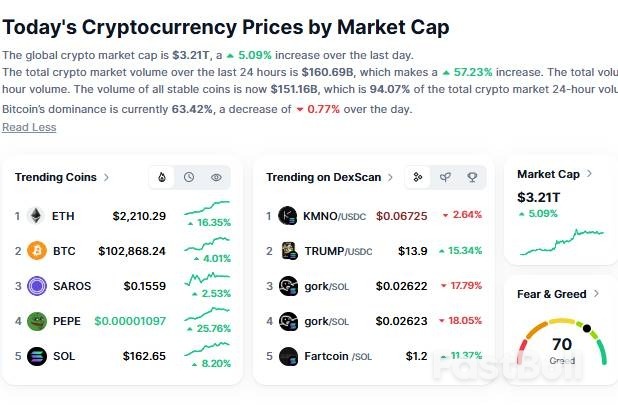
          Also, as trade in regular goods becomes smoother, it opens the door for tools like blockchain to be used in supply chains, smart contracts, and international payments. These tools are already being explored in some industries. After this Trump announcement, the current crypto market stands at a market cap of $3.21T and it has increased by 5.09% in the last 24 hours, as per the CoinMarketCap.

          A Bigger Global Strategy

          The deal by Trump also indicates that the US is seeking to create stronger alliances with nations such as the UK, particularly as tensions in relations with China and the EU increase. This matters because the US seeks to dominate the world in emerging industries, such as crypto and digital finance. By collaborating with partners on equitable trade and new technology, the US can establish an open system that fosters innovation.
          If the US and UK establish good and equitable digital regulations, it might pressure other nations to follow suit. That would result in fewer trade issues, improved regulations for exchanges and wallets, and greater liberty for crypto projects to develop in various nations.

          Final Thoughts

          This Trump announcement suggests that digital commerce is still being debated, the crypto sector has the opportunity to make its voice heard and contribute to shaping the regulations. If both nations can come to an understanding of smart and well-balanced policies, it may generate increased growth, more secure markets, and a better international standing for crypto and blockchain technologies.

          Source: CryptoSlate

          To stay updated on all economic events of today, please check out our Economic calendar
          Risk Warnings and Disclaimers
          You understand and acknowledge that there is a high degree of risk involved in trading. Following any strategies or investment methods may lead to potential losses. The content on the site is provided by our contributors and analysts for information purposes only. You are solely responsible for determining whether any trading assets, securities, strategy, or any other product is suitable for investing based on your own investment objectives and financial situation.
          Add to Favorites
          Share

          U.S.-Russia Trade Surges Unexpectedly Amid Sanctions Pressure

          Gerik

          Economic

          Unexpected Trade Growth Defies Sanctions Landscape

          In a surprising development, data released on May 8 by Russian state news agency RIA Novosti, citing customs statistics, revealed that bilateral trade between the Russian Federation and the United States surged by 50% from February to March 2025. This growth comes against the backdrop of one of the most comprehensive sanctions regimes imposed on Russia since the escalation of the conflict in Ukraine in early 2022.
          This increase marks the most substantial monthly growth in two years, pushing total trade volume to $573 million in March, up from roughly $382 million in February. The last comparable peak was in March 2023, when trade reached $628.5 million.

          Fertilizers and Agricultural Goods Lead Export Growth

          The primary driver behind the spike in Russian exports to the U.S. was a sharp rise in the import of Russian fertilizers, which reached $219 million in March alone. Additionally, the United States imported significant quantities of platinum ($87.5 million), plywood ($6 million), and phosphate ($5 million) within the same period.
          This surge occurred even though these items—particularly fertilizers and grains—were not directly subject to Western export bans. However, they have still been affected indirectly by sanctions on shipping, insurance, and financial transactions, all of which complicate trade logistics with Russia.

          Navigating Sanctions: A Shift in Market Dynamics

          The current trade trend illustrates how certain essential goods—such as fertilizers critical to global agriculture—can remain in high demand despite broader geopolitical tensions. Russia, one of the world’s leading fertilizer exporters, has managed to maintain supply to key markets like the United States by leveraging exceptions in sanctions regimes and finding alternative channels for financial and logistical operations.
          What appears to be a paradox—escalating sanctions coinciding with increased trade—is in fact a reflection of selective dependencies in global commodity flows. Essential goods such as fertilizers are deeply embedded in the food security of importing nations, making outright embargoes politically and economically risky for Western countries, including the U.S.

          Correlation or Policy Flexibility: A Deeper View

          While the data shows a clear association between March’s spike and fertilizer exports, it's important to assess whether this is a sustainable trend or a temporary anomaly. The correlation suggests that market demand for specific Russian goods—those not directly banned—remains robust. However, causality could also involve U.S. policy flexibility or implicit prioritization of food-related imports amid inflationary pressures in domestic agriculture.
          Additionally, the surge may reflect timing strategies by importers, taking advantage of temporary logistical windows or easing of operational constraints that might not persist in the following months. Therefore, while the trade rise is factual and quantifiable, its underlying drivers require further observation to determine long-term shifts versus short-term adjustments.
          The 50% increase in U.S.-Russia trade highlights a complex reality in global economic relations: even in times of conflict and sanctions, interdependence in strategic resources can override ideological divides. As sanctions remain in force, and geopolitical pressure continues, the durability of this trade uptick will depend on both regulatory developments and shifts in global supply chain resilience.

          Source: RIA Novosti

          To stay updated on all economic events of today, please check out our Economic calendar
          Risk Warnings and Disclaimers
          You understand and acknowledge that there is a high degree of risk involved in trading. Following any strategies or investment methods may lead to potential losses. The content on the site is provided by our contributors and analysts for information purposes only. You are solely responsible for determining whether any trading assets, securities, strategy, or any other product is suitable for investing based on your own investment objectives and financial situation.
          Add to Favorites
          Share
          FastBull
          Copyright © 2025 FastBull Ltd

          728 RM B 7/F GEE LOK IND BLDG NO 34 HUNG TO RD KWUN TONG KLN HONG KONG

          TelegramInstagramTwitterfacebooklinkedin
          App Store Google Play Google Play
          Products
          Charts

          Chats

          Q&A with Experts
          Screeners
          Economic Calendar
          Data
          Tools
          Membership
          Features
          Function
          Markets
          Copy Trading
          Latest Signals
          Contests
          News
          Analysis
          24/7
          Columns
          Education
          Company
          Careers
          About Us
          Contact Us
          Advertising
          Help Center
          Feedback
          User Agreement
          Privacy Policy
          Business

          White Label

          Data API

          Web Plug-ins

          Poster Maker

          Affiliate Program

          Risk Disclosure

          The risk of loss in trading financial instruments such as stocks, FX, commodities, futures, bonds, ETFs and crypto can be substantial. You may sustain a total loss of the funds that you deposit with your broker. Therefore, you should carefully consider whether such trading is suitable for you in light of your circumstances and financial resources.

          No decision to invest should be made without thoroughly conducting due diligence by yourself or consulting with your financial advisors. Our web content might not suit you since we don't know your financial conditions and investment needs. Our financial information might have latency or contain inaccuracy, so you should be fully responsible for any of your trading and investment decisions. The company will not be responsible for your capital loss.

          Without getting permission from the website, you are not allowed to copy the website's graphics, texts, or trademarks. Intellectual property rights in the content or data incorporated into this website belong to its providers and exchange merchants.

          Not Logged In

          Log in to access more features

          FastBull Membership

          Not yet

          Purchase

          Become a signal provider
          Help Center
          Customer Service
          Dark Mode
          Price Up/Down Colors

          Log In

          Sign Up

          Position
          Layout
          Fullscreen
          Default to Chart
          The chart page opens by default when you visit fastbull.com