• Trade
  • Markets
  • Copy
  • Contests
  • News
  • 24/7
  • Calendar
  • Q&A
  • Chats
Trending
Screeners
SYMBOL
LAST
BID
ASK
HIGH
LOW
NET CHG.
%CHG.
SPREAD
SPX
S&P 500 Index
6851.14
6851.14
6851.14
6861.30
6847.07
+23.73
+ 0.35%
--
DJI
Dow Jones Industrial Average
48565.46
48565.46
48565.46
48679.14
48562.94
+107.42
+ 0.22%
--
IXIC
NASDAQ Composite Index
23290.32
23290.32
23290.32
23345.56
23265.18
+95.16
+ 0.41%
--
USDX
US Dollar Index
97.860
97.940
97.860
98.070
97.810
-0.090
-0.09%
--
EURUSD
Euro / US Dollar
1.17529
1.17536
1.17529
1.17596
1.17262
+0.00135
+ 0.11%
--
GBPUSD
Pound Sterling / US Dollar
1.33913
1.33920
1.33913
1.33961
1.33546
+0.00206
+ 0.15%
--
XAUUSD
Gold / US Dollar
4327.10
4327.44
4327.10
4350.16
4294.68
+27.71
+ 0.64%
--
WTI
Light Sweet Crude Oil
56.894
56.924
56.894
57.601
56.789
-0.339
-0.59%
--

Community Accounts

Signal Accounts
--
Profit Accounts
--
Loss Accounts
--
View More

Become a signal provider

Sell trading signals to earn additional income

View More

Guide to Copy Trading

Get started with ease and confidence

View More

Signal Accounts for Members

All Signal Accounts

Best Return
  • Best Return
  • Best P/L
  • Best MDD
Past 1W
  • Past 1W
  • Past 1M
  • Past 1Y

All Contests

  • All
  • Trump Updates
  • Recommend
  • Stocks
  • Cryptocurrencies
  • Central Banks
  • Featured News
Top News Only
Share

The Nasdaq Golden Dragon China Index Fell 0.9% In Early Trading

Share

The S&P 500 Opened 32.78 Points Higher, Or 0.48%, At 6860.19; The Dow Jones Industrial Average Opened 136.31 Points Higher, Or 0.28%, At 48594.36; And The Nasdaq Composite Opened 134.87 Points Higher, Or 0.58%, At 23330.04

Share

Miran: Goods Inflation Could Be Settling In At A Higher Level Than Was Normal Before The Pandemic, But That Will Be More Than Offset By Housing Disinflation

Share

Miran, Who Dissented In Favor Of A Larger Cut At Last Fed Meeting, Repeats Keeping Policy Too Tight Will Lead To Job Losses

Share

Miran: Does Not Think Higher Goods Inflation Is Mostly From Tariffs, But Acknowledges Does Not Have A Full Explanation For It

Share

Toronto Stock Index .GSPTSE Rises 67.16 Points, Or 0.21 Percent, To 31594.55 At Open

Share

Miran: Excluding Housing And Non-Market Based Items, Core Pce Inflation May Be Below 2.3%, “Within Noise” Of The Fed's 2% Target

Share

Polish State Assets Minister Balczun Says Jsw Needs Over USD 830 Million Financing To Keep Liquidity For A Year

Share

Miran: Prices Are “Once Again Stable” And Monetary Policy Should Reflect That

Share

Fed's Miran: Current Excess Inflation Is Not Reflective Of Underlying Supply And Demand In The Economy

Share

Portugal Treasury Puts 2026 Net Financing Needs At 13 Billion Euros, Up From 10.8 Billion In 2025

Share

Portugal Treasury Expects 2026 Net Financing Needs At 29.4 Billion Euros, Up From 25.8 Billion In 2025

Share

Bank Of America Says With Indonesia's Smelter Now Ramping Up, It Expects Aluminium Supply Growth To Accelerate To 2.6% Year On Year In 2026

Share

Bank Of America Expects A Deficit In Aluminium Next Year And Sees Prices Pushing Above $3000/T

Share

Fed Data - USA Effective Federal Funds Rate At 3.64 Percent On 12 December On $102 Billion In Trades Versus 3.64 Percent On $99 Billion On 11 December

Share

Brazil's Petrobras Says No Impact Seen On Oil, Petroleum Products Output As Workers Start Planned Strike

Share

Statement: US Travel Group Warns New Proposed Trump Administration Requirements For Foreign Tourists To Provide Social Media Histories Could Mean Millions Of People Opting Not To Visit

Share

Blackrock: Kerry White Will Become Head Of Citi Investment Management At Citi Wealth

Share

Blackrock: Rob Jasminski, Head Of Citi Investment Management, Has Joined With Team

Share

Blackrock: Effective Dec 15, Citi Investment Management Employees Will Join Blackrock

TIME
ACT
FCST
PREV
Japan Tankan Small Manufacturing Outlook Index (Q4)

A:--

F: --

P: --

Japan Tankan Large Non-Manufacturing Outlook Index (Q4)

A:--

F: --

P: --

Japan Tankan Large Manufacturing Outlook Index (Q4)

A:--

F: --

P: --

Japan Tankan Small Manufacturing Diffusion Index (Q4)

A:--

F: --

P: --

Japan Tankan Large Manufacturing Diffusion Index (Q4)

A:--

F: --

P: --

Japan Tankan Large-Enterprise Capital Expenditure YoY (Q4)

A:--

F: --

P: --

U.K. Rightmove House Price Index YoY (Dec)

A:--

F: --

P: --

China, Mainland Industrial Output YoY (YTD) (Nov)

A:--

F: --

P: --

China, Mainland Urban Area Unemployment Rate (Nov)

A:--

F: --

P: --

Saudi Arabia CPI YoY (Nov)

A:--

F: --

P: --

Euro Zone Industrial Output YoY (Oct)

A:--

F: --

P: --

Euro Zone Industrial Output MoM (Oct)

A:--

F: --

P: --

Canada Existing Home Sales MoM (Nov)

A:--

F: --

P: --

Canada National Economic Confidence Index

A:--

F: --

P: --

Canada New Housing Starts (Nov)

A:--

F: --

P: --
U.S. NY Fed Manufacturing Employment Index (Dec)

A:--

F: --

P: --

U.S. NY Fed Manufacturing Index (Dec)

A:--

F: --

P: --

Canada Core CPI YoY (Nov)

A:--

F: --

P: --

Canada Manufacturing Unfilled Orders MoM (Oct)

A:--

F: --

P: --

U.S. NY Fed Manufacturing Prices Received Index (Dec)

A:--

F: --

P: --

U.S. NY Fed Manufacturing New Orders Index (Dec)

A:--

F: --

P: --

Canada Manufacturing New Orders MoM (Oct)

A:--

F: --

P: --

Canada Core CPI MoM (Nov)

A:--

F: --

P: --

Canada Trimmed CPI YoY (SA) (Nov)

A:--

F: --

P: --

Canada Manufacturing Inventory MoM (Oct)

A:--

F: --

P: --

Canada CPI YoY (Nov)

A:--

F: --

P: --

Canada CPI MoM (Nov)

A:--

F: --

P: --

Canada CPI YoY (SA) (Nov)

A:--

F: --

P: --

Canada Core CPI MoM (SA) (Nov)

A:--

F: --

P: --

Canada CPI MoM (SA) (Nov)

A:--

F: --

P: --

Federal Reserve Board Governor Milan delivered a speech
U.S. NAHB Housing Market Index (Dec)

--

F: --

P: --

Australia Composite PMI Prelim (Dec)

--

F: --

P: --

Australia Services PMI Prelim (Dec)

--

F: --

P: --

Australia Manufacturing PMI Prelim (Dec)

--

F: --

P: --

Japan Manufacturing PMI Prelim (SA) (Dec)

--

F: --

P: --

U.K. 3-Month ILO Employment Change (Oct)

--

F: --

P: --

U.K. Unemployment Claimant Count (Nov)

--

F: --

P: --

U.K. Unemployment Rate (Nov)

--

F: --

P: --

U.K. 3-Month ILO Unemployment Rate (Oct)

--

F: --

P: --

U.K. Average Weekly Earnings (3-Month Average, Including Bonuses) YoY (Oct)

--

F: --

P: --

U.K. Average Weekly Earnings (3-Month Average, Excluding Bonuses) YoY (Oct)

--

F: --

P: --

France Services PMI Prelim (Dec)

--

F: --

P: --

France Composite PMI Prelim (SA) (Dec)

--

F: --

P: --

France Manufacturing PMI Prelim (Dec)

--

F: --

P: --

Germany Services PMI Prelim (SA) (Dec)

--

F: --

P: --

Germany Manufacturing PMI Prelim (SA) (Dec)

--

F: --

P: --

Germany Composite PMI Prelim (SA) (Dec)

--

F: --

P: --

Euro Zone Composite PMI Prelim (SA) (Dec)

--

F: --

P: --

Euro Zone Services PMI Prelim (SA) (Dec)

--

F: --

P: --

Euro Zone Manufacturing PMI Prelim (SA) (Dec)

--

F: --

P: --

U.K. Services PMI Prelim (Dec)

--

F: --

P: --

U.K. Manufacturing PMI Prelim (Dec)

--

F: --

P: --

U.K. Composite PMI Prelim (Dec)

--

F: --

P: --

Euro Zone ZEW Economic Sentiment Index (Dec)

--

F: --

P: --

Germany ZEW Current Conditions Index (Dec)

--

F: --

P: --

Germany ZEW Economic Sentiment Index (Dec)

--

F: --

P: --

Euro Zone Trade Balance (Not SA) (Oct)

--

F: --

P: --

Euro Zone ZEW Current Conditions Index (Dec)

--

F: --

P: --

Euro Zone Trade Balance (SA) (Oct)

--

F: --

P: --

U.S. Retail Sales MoM (Excl. Automobile) (SA) (Oct)

--

F: --

P: --

Q&A with Experts
    • All
    • Chatrooms
    • Groups
    • Friends
    Connecting
    .
    .
    .
    Type here...
    Add Symbol or Code

      No matching data

      All
      Trump Updates
      Recommend
      Stocks
      Cryptocurrencies
      Central Banks
      Featured News
      • All
      • Russia-Ukraine Conflict
      • Middle East Flashpoint
      • All
      • Russia-Ukraine Conflict
      • Middle East Flashpoint
      Search
      Products

      Charts Free Forever

      Chats Q&A with Experts
      Screeners Economic Calendar Data Tools
      Membership Features
      Data Warehouse Market Trends Institutional Data Policy Rates Macro

      Market Trends

      Market Sentiment Order Book Forex Correlations

      Top Indicators

      Charts Free Forever
      Markets

      News

      News Analysis 24/7 Columns Education
      From Institutions From Analysts
      Topics Columnists

      Latest Views

      Latest Views

      Trending Topics

      Top Columnists

      Latest Update

      Signals

      Copy Rankings Latest Signals Become a signal provider AI Rating
      Contests
      Brokers

      Overview Brokers Assessment Rankings Regulators News Claims
      Broker listing Forex Brokers Comparison Tool Live Spread Comparison Scam
      Q&A Complaint Scam Alert Videos Tips to Detect Scam
      More

      Business
      Events
      Careers About Us Advertising Help Center

      White Label

      Data API

      Web Plug-ins

      Affiliate Program

      Awards Institution Evaluation IB Seminar Salon Event Exhibition
      Vietnam Thailand Singapore Dubai
      Fans Party Investment Sharing Session
      FastBull Summit BrokersView Expo
      Recent Searches
        Top Searches
          Markets
          News
          Analysis
          User
          24/7
          Economic Calendar
          Education
          Data
          • Names
          • Latest
          • Prev

          View All

          No data

          Scan to Download

          Faster Charts, Chat Faster!

          Download App
          English
          • English
          • Español
          • العربية
          • Bahasa Indonesia
          • Bahasa Melayu
          • Tiếng Việt
          • ภาษาไทย
          • Français
          • Italiano
          • Türkçe
          • Русский язык
          • 简中
          • 繁中
          Open Account
          Search
          Products
          Charts Free Forever
          Markets
          News
          Signals

          Copy Rankings Latest Signals Become a signal provider AI Rating
          Contests
          Brokers

          Overview Brokers Assessment Rankings Regulators News Claims
          Broker listing Forex Brokers Comparison Tool Live Spread Comparison Scam
          Q&A Complaint Scam Alert Videos Tips to Detect Scam
          More

          Business
          Events
          Careers About Us Advertising Help Center

          White Label

          Data API

          Web Plug-ins

          Affiliate Program

          Awards Institution Evaluation IB Seminar Salon Event Exhibition
          Vietnam Thailand Singapore Dubai
          Fans Party Investment Sharing Session
          FastBull Summit BrokersView Expo

          China’s $11 Trillion Stock Market Extends Gains as Liquidity and Retail Momentum Drive Rally

          Gerik

          Economic

          Summary:

          Chinese equities have entered a steady uptrend, supported by abundant domestic liquidity, record household savings, and increasing retail participation, even in the absence of major policy catalysts or a trade deal with the US....

          Liquidity-Driven Rally Gains Traction

          China’s equity market has staged a notable resurgence since April, with the CSI 300 Index rising 16% from its lows. The rally is rooted in an environment of record-high household savings, falling interest rates, and limited alternative investment opportunities, prompting retail and institutional investors to channel funds into equities. Margin financing has reached its highest level since 2015, signaling heightened risk appetite. Monthly turnover on onshore exchanges is also set to climb for a third straight month, reinforcing the momentum.
          Although Beijing has refrained from announcing large-scale stimulus, targeted policy measures such as curbing excessive price wars and tackling overcapacity in key industries are being interpreted as steps toward easing deflationary pressures and stabilizing corporate profitability. This has encouraged funds with higher risk tolerance to increase equity exposure, with small-cap indexes favored by retail traders reaching eight-year highs and showing persistent overbought technical signals.

          Liquidity Cushion Against Corrections

          Money supply growth accelerated to 4.6% year-on-year in June, the fastest in over two years, providing a liquidity cushion that could absorb profit-taking pressures. Analysts suggest that while some selling may occur as the Shanghai Composite approaches the 3,700-point resistance level a near four-year high the scope for a sharp correction is limited in the near term. The Shanghai gauge’s outperformance relative to the CSI 300 this year has been aided by strong bank stock weightings.
          Despite the bullish momentum, skeptics point to uneven sector performance and the absence of a broad-based earnings recovery as signs that the rally may lack sustainable fundamental support. However, improving trade relations with the US, strategic government guidance via the five-year development plan, and continued inflows from domestic insurance funds are adding to risk-on sentiment. Major investment houses, including Citigroup and Goldman Sachs, have upgraded their views on Chinese equities.
          The current rally appears to be liquidity- and sentiment-driven rather than earnings-led, which suggests near-term gains could persist as long as monetary conditions remain loose and retail enthusiasm holds. Yet, without a synchronized improvement in corporate profitability and economic fundamentals, the market remains vulnerable to sentiment shifts particularly if external trade negotiations stall or domestic policy momentum fades.

          Source: Reuters

          To stay updated on all economic events of today, please check out our Economic calendar
          Risk Warnings and Disclaimers
          You understand and acknowledge that there is a high degree of risk involved in trading. Following any strategies or investment methods may lead to potential losses. The content on the site is provided by our contributors and analysts for information purposes only. You are solely responsible for determining whether any trading assets, securities, strategy, or any other product is suitable for investing based on your own investment objectives and financial situation.
          Add to Favorites
          Share

          S&P 500 Index Reaches New All-Time High

          FXOpen

          Stocks

          Forex

          Economic

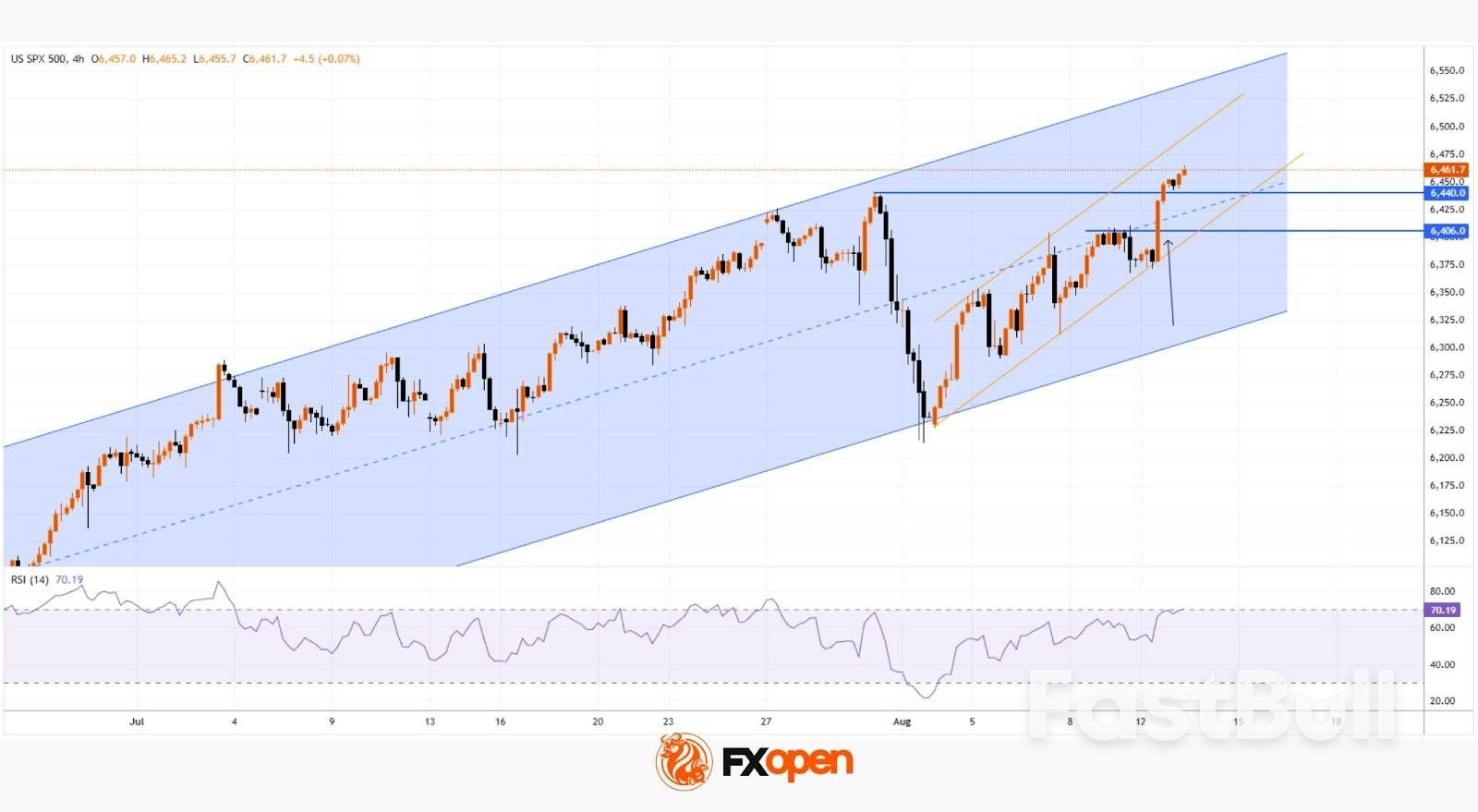
          The S&P 500 index set a new all-time high, climbing above the 6,460 mark. The rally in equities is a direct result of yesterday’s CPI report.According to Forex Factory, the annual CPI remained at 2.7%, whereas analysts had forecast an increase to 2.8%. Moderate inflation readings provide stronger grounds for a Federal Reserve interest rate cut — a move President Trump has been strongly advocating.Data from the CME FedWatch tool shows that traders now price in a 94% probability of a key rate cut in September, compared to nearly 86% the day before and around 57% a month ago. This prospect of monetary policy easing acts as a bullish driver for the stock market.
          S&P 500 Index Reaches New All-Time High_1

          Technical Analysis of the S&P 500 Chart

          On the H4 chart of the S&P 500 (US SPX 500 mini on FXOpen), there are grounds to outline an ascending channel (shown in blue). The price is currently in the upper half of the channel — a sign of prevailing optimism in the market.Following yesterday’s CPI release, the price generated a strong bullish impulse, breaking two resistance levels from below (as indicated by the arrow):→ August high at 6,406→ Previous all-time high around 6,440

          As a result, these former resistance levels now form the 6,406–6,440 zone. We can assume that:→ this area may act as support going forward, as buyers clearly held the advantage here;→ the median line of the ascending channel may also provide support, having shown signs of resistance in early August before being decisively broken on yesterday’s strong impulse.The RSI indicator is hovering near overbought territory, making the market vulnerable to corrections. However, given the improved fundamental backdrop, any pullbacks might be shallow.

          Source: FXOpen

          To stay updated on all economic events of today, please check out our Economic calendar
          Risk Warnings and Disclaimers
          You understand and acknowledge that there is a high degree of risk involved in trading. Following any strategies or investment methods may lead to potential losses. The content on the site is provided by our contributors and analysts for information purposes only. You are solely responsible for determining whether any trading assets, securities, strategy, or any other product is suitable for investing based on your own investment objectives and financial situation.
          Add to Favorites
          Share

          IEA Lifts 2025 Oil Supply Forecast as OPEC+ Output Rises, Demand Outlook Softens

          Gerik

          Economic

          Commodity

          Supply Outlook Strengthened by OPEC+ Policy Shift

          In its latest monthly report, the IEA revised up its 2025 oil supply growth forecast to 2.5 million barrels per day (bpd) from the previous 2.1 million bpd estimate. The upward adjustment reflects the recent OPEC+ agreement to raise production, signaling a coordinated effort to capture market share and respond to tightening conditions earlier in the year. Despite the boost from OPEC+, the agency notes that non-OPEC producers will remain the dominant contributors to supply growth, underscoring the structural diversification of oil production capacity.
          Conversely, the IEA lowered its 2025 oil demand growth forecast to 680,000 bpd from 700,000 bpd. The revision is attributed to sluggish consumption in major economies and persistently low consumer confidence, which the agency says makes a sharp rebound in demand unlikely in the near term. The macroeconomic backdrop marked by slow industrial activity, cautious household spending, and geopolitical uncertainty continues to suppress oil use despite relatively stable prices in recent months.

          Refining Activity Near Record Levels

          While demand growth is muted, refining activity is expected to reach near-record highs. The IEA projects global refining runs will approach 85.6 million bpd in August, driven by seasonal peaks and robust export demand from certain regions. This suggests that although end-user consumption is under pressure, refinery utilization is being supported by inter-regional trade flows and the need to meet product demand in faster-growing markets.
          Oil prices briefly extended losses following the IEA’s publication, reflecting a market response to the combination of higher anticipated supply and subdued demand expectations. The prospect of excess supply growth over demand adds to the bearish sentiment, particularly if OPEC+ maintains elevated production levels into year-end. However, refining tightness and regional demand disparities may provide short-term price support.
          Overall, the IEA’s forecast adjustment highlights a near-term imbalance risk, where accelerated supply led by both OPEC+ and non-OPEC producers could outpace tepid demand growth, potentially capping upside momentum in oil prices through late 2025.

          Source: Reuters

          To stay updated on all economic events of today, please check out our Economic calendar
          Risk Warnings and Disclaimers
          You understand and acknowledge that there is a high degree of risk involved in trading. Following any strategies or investment methods may lead to potential losses. The content on the site is provided by our contributors and analysts for information purposes only. You are solely responsible for determining whether any trading assets, securities, strategy, or any other product is suitable for investing based on your own investment objectives and financial situation.
          Add to Favorites
          Share

          Economische Vooruitzichten Augustus 2025

          Samantha Luan

          Forex

          Political

          Economic

          Zoals verwacht escaleerde de Amerikaanse handelsoorlog opnieuw op 1 augustus met de verhoging van de tarieven op een groot aantal handelspartners door Donald Trump. Veel landen zagen hun tarieven aanzienlijk stijgen ten opzichte van het tijdelijke wederkerige tarief van 10%. Zo wordt er nu een tarief van 35% aangerekend op de invoer van goederen uit Canada die niet voldoen aan de USMCA, en dit als reactie op de Canadese erkenning van Palestina. Brazilië kreeg een tarief van 50% opgelegd omwille van de vervolging van voormalig president Bolsonaro. De tarieven van andere Zuid-Amerikaanse landen werden onder de 20% gehouden. In Afrika vallen vooral de hoge tarieven van 30% voor Zuid-Afrika, Libië en Algerije op. Ook in Zuid-Azië zagen veel landen, zoals India (25%), Pakistan (19%), Bangladesh (20%), Indonesië (19%) en Thailand (19%), grote tariefstijgingen. Enkele belangrijke handelspartners van de VS hebben via onderhandelingen lagere tarieven bedongen dan eerder aangekondigd. Japan en de EU verkregen een algemeen tarief van 15% (inclusief een verlaagd tarief op auto's) in ruil voor hogere investeringen in de VS en een versoepeling van de invoerbeperkingen op Amerikaanse goederen. De EU schafte ook alle tarieven op industriële goederen af. In totaal wordt het effectieve tarief in de VS nu geschat op 18,3%, een niveau dat sinds de Grote Depressie van de vorige eeuw niet meer is voorgekomen. Hoewel de onzekerheid op korte termijn afgenomen is door het aflopen van de meeste tariefpauzes, blijft voorzichtigheid geboden. Veel handelsovereenkomsten zijn immers nog lang niet rond. Op middellange termijn kunnen de handelsspanningen opnieuw oplopen als er onenigheid zou ontstaan over de precieze voorwaarden van de "handelsovereenkomsten" (bijvoorbeeld over de toegezegde EU-investeringen of -energieaankopen).
          De olieprijzen stegen vorige maand met 3,9%, tot 71,7 USD per vat. Deze stijging was grotendeels het gevolg van de toegenomen druk van de VS op Rusland en diens handelspartners. De VS dreigden met secundaire sancties en boetes voor landen die Russische olie blijven kopen (Rusland exporteert ongeveer 7 miljoen vaten per dag). Als reactie daarop hebben verschillende Indiase staatsraffinaderijen hun Russische olieaankopen stopgezet. China, de grootste afnemer van Russische olie, heeft evenwel aangegeven dat het olie zal blijven kopen van Rusland. Ondanks de recente stijgen blijven de olieprijzen laag naar historische maatstaven, onder meer omdat OPEC+ het aanbod de afgelopen maanden heeft opgevoerd. De recent aangekondigde aanbodstijging van 547.000 vaten per dag vanaf september zet deze trend voort. Ook de Europese aardgasprijzen namen vorige maand licht toe (+1,6%), tot 34 EUR per MWh. Door de hoge temperaturen (vooral in de VS) steeg het gebruik van airconditioning, waardoor de vraag naar gas toenam. De futuresmarkten verwachten een lichte stijging van de gasprijzen in de EU tijdens de winter, aangezien de aardgasreserves iets onder het historische gemiddelde liggen.
          Na de onverwacht sterke opstoot van de groei van het reële bbp in de eurozone in het eerste kwartaal van 2025 (0,6% tegenover het voorgaande kwartaal) is de groei in het tweede kwartaal, zoals verwacht, vertraagd tot 0,1%. In Duitsland en Italië, waar de anticipatie op invoerheffingen in de VS nog een relatief krachtige impuls gaf aan de groei in het eerste kwartaal, zorgde de correctie zelfs voor een lichte krimp van het reële bbp (met 0,1% in beide landen). In Ierland bedroeg de terugval een vol procentpunt, wat gezien de exuberante groei van 7,4% in het eerste kwartaal als eerder bescheiden kan worden bestempeld. Met een groei van 0,2% in België en 0,1% in Nederland bleef de groeivertraging in beide landen beperkt tot 0,2 procentpunt. Tegen de achtergrond van de groeivertraging in de andere eurolanden springt de groeiversteviging van de Franse economie, van 0,1% tot 0,3%, in het oog. Al moet daaraan meteen worden toegevoegd dat deze toename vooral het gevolg was van voorraadopbouw, en dus niet wijst op een kwalitatieve verbetering van de groei. Dat laatste geldt wel voor de Spaanse economie, waar investeringen en particuliere consumptie de groei deden versnellen van een robuuste 0,6% in het eerste kwartaal tot 0,7% in het tweede kwartaal, en dit terwijl de voorraden afgebouwd werden. Structurele concurrentiekrachtuitdagingen en onzekerheid zullen blijven wegen op de groei in de EU in 2025. Voor volgend jaar verwachten we dat de aangekondigde Duitse begrotingsimpuls de economische dynamiek zal aanzwengelen, niet in het minst in Duitsland zelf. Via oversijpelingseffecten kan de Duitse begrotingsstimulans tegengewicht bieden aan de negatieve groei-effecten van de begrotingssaneringen in de andere eurolanden.
          De inflatie in de eurozone stabiliseerde op 2,0% in juli. Ook de kerninflatie maakte een pas op de plaats (2,5%), een gevolg van de iets sterker dan verwachte afkoeling van de diensteninflatie (van 3,3% in juni naar 3,1% in juli) en de onverwachte opvering van het prijsstijgingstempo bij de niet-energetische goederen (van 0,5% naar 0,8%). De voedingsprijsinflatie trok aan van 3,1% tot 3,3%, terwijl de energieprijsinflatie iets minder negatief werd (-2,5% in juli tegenover -2,6% in juni). Voedings- en vooral energieprijsschommelingen kunnen de komende maanden voor volatiliteit in de algemene inflatie zorgen, maar een afkoeling van de kerninflatie blijft waarschijnlijk. De opstoot van de goedereninflatie in juli was vermoedelijk het gevolg van toevallige en tijdelijke factoren, terwijl de afkoeling van de diensteninflatie in de lijn van de verwachtingen ligt.
          De Amerikaanse economie heeft een technische recessie vermeden. Het Amerikaanse bbp groeide in het tweede kwartaal met 0,75% op kwartaalbasis, een flinke opleving ten opzichte van de negatieve groei in het eerste kwartaal. Deze groeiverbetering was grotendeels het gevolg van de sterke positieve groeibijdrage van de invoer. In Q1 steeg de invoer nog sterk in anticipatie op de verwachte verhoging van de Amerikaanse handelstarieven. Deze invoerstijging had een negatieve impact op het groeicijfer, aangezien de invoer afgetrokken wordt van de uitvoer bij de berekening van het bbp. Aan de anticiperende invoerbeweging kwam grotendeels een einde in het tweede kwartaal, wat resulteerde in een positieve groeibijdrage van de netto-uitvoer. In de details van het sterke totale groeicijfer zien we signalen die wijzen op een vertragende Amerikaanse economie, bijvoorbeeld in de afzwakkende componenten van de binnenlandse vraag. Zo droeg de consumptie slechts 0,25 procentpunt bij aan de kwartaal-op-kwartaalgroei, een cijfer dat ver onder het historisch gemiddelde ligt. De groeibijdrage van overheidsbestedingen en particuliere investeringen was verwaarloosbaar, en de bijdrage van investeringen in gebouwen en woningen was zelfs negatief. In de komende kwartalen zullen hogere tarieven en migratiebeperkingen waarschijnlijk zorgen voor een verdere verzwakking van de groei. De vertrouwensindicatoren blijven immers zwak en ook de arbeidsmarkt vertoont barsten. Vorige maand steeg het aantal jobs met slechts 73.000. Bovendien waren er ook grote neerwaartse herzieningen in de cijfers van de voorgaande maanden. In de afgelopen drie maanden steeg het aantal jobs slechts met 106.000 (meer dan drie keer lager dan het historische gemiddelde). De werkloosheid steeg in juli, van 4,1% naar 4,2%, terwijl de participatiegraad daalde. Er was bovendien ook een belangrijke toename van het deeltijds werk om economische redenen. Naarmate het economische klimaat verslechtert, verwachten we een verdere verzwakking van de arbeidsmarkt.
          Intussen neemt de inflatiedruk in de VS toe. In juli steeg de Amerikaanse kerninflatie van 2,9% naar 3,1%. Op maandbasis nam de kerninflatie toe tot 0,3%. De stijging werd voornamelijk veroorzaakt door kerndiensten, in het bijzonder medische zorgdiensten en transportdiensten. In tegenstelling tot de voorgaande maanden droegen ook de autoprijzen bij tot de versnelling van de kerngoedereninflatie in juli. Sommige invoergevoelige categorieën, zoals woninginrichting en recreatieartikelen, stegen aanzienlijk terwijl de prijstoename van kledij beperkt bleef. De tarieven zijn dus nog niet volledig doorgesijpeld in de goedereninflatie. De prijsinflatie voor huisvesting was gematigd, mede dankzij lagere hotelprijzen en de dalende trend in huurprijzen. Ondanks de stijging van de kerninflatie bleef de brede inflatie onveranderd op 2,7%. De energieprijzen daalden met 1,1% op maandbasis, terwijl de voedingsprijzen ongewijzigd bleven. We verwachten dat de inflatiedruk zal blijven toenemen de komende maanden naarmate de tarieven geleidelijk verder doorfilteren in de consumentenprijzen.
          Zowel de ECB als de Fed lieten in juli hun beleidsrente ongewijzigd op respectievelijk 2% en 4,375%. Beide centrale banken nemen daarmee een voorzichtige houding aan in afwachting van bijkomende data die de inschatting van de toekomstige groei, arbeidsmarktontwikkelingen en inflatie kunnen ondersteunen. Het belangrijkste verschil tussen beide centrale banken is dat de ECB-beleidsrente zich reeds enkele maanden in neutraal terrein bevindt, terwijl Fed-voorzitter Powell de Amerikaanse beleidsrente omschreef als matig restrictief, gezien de nog steeds hoge inflatie en lage werkloosheid. Terwijl de inflatie in de eurozone in juli op het ECB-streefcijfer van 2% lag, houdt de Fed rekening met het risico dat invoertarieven zich kunnen vertalen in hogere Amerikaanse consumentenprijzen. Momenteel gaat Fed-voorzitter Powell ervan uit dat dit slechts tot een eenmalige stijging van het prijsniveau zal leiden en dat er dus niet noodzakelijkerwijs tweederonde-effecten komen die de inflatie meer permanent verhogen. Terwijl de renteverlagingscyclus van de eurozone dus (bijna) op zijn einde loopt, verwachten we dat de Fed haar renteverlagingscyclus in de tweede helft van dit jaar zal hervatten. De Amerikaanse tienjaarsrente staat sinds kort onder licht neerwaartse druk als gevolg van het toegenomen groeipessimisme en de daaruit volgende verwachting dat de Fed haar renteverlagingscyclus spoedig zal hervatten. Voor 2026 is er een beperkt opwaarts potentieel voor de Duitse tienjaarsrente. De verwachte budgettaire expansie zal immers zorgen voor hogere Duitse schuldemissies, wat de termijnpremie op Duitse overheidsobligaties verder omhoog zal duwen.
          De Chinese economie groeide in het tweede kwartaal met 5,2% jaar-op-jaar. De totale uitvoer bleef op peil ondanks een sterke daling van de uitvoer naar de VS. Ook de industriële productie en de detailhandelsverkopen hielden goed stand aan het begin van het kwartaal, maar de gegevens van juni benadrukken de onevenwichtigheden die de economie blijven plagen. Zo steeg de industriële productie met 0,5% jaar-op-jaar terwijl de detailhandelsverkoop daalde met 0,16% jaar-op-jaar. Deze divergentie benadrukt het overcapaciteitsprobleem van China, dat veroorzaakt wordt door een combinatie van hoge productie en een zwakke binnenlandse vraag en dat bijdraagt aan de groeiende deflatiezorgen in de economie. De inflatie op jaarbasis bleef onveranderd in juli, terwijl de producentenprijzen voor de vierendertigste maand op rij daalden (-3,6% op jaarbasis). De bbp-deflator werd negatiever in het tweede kwartaal (-1,2% jaar-op-jaar), wat betekent dat het nominale bbp-cijfer een relatief zwakke 3,94% jaar-op-jaar bedroeg. Vooruitblikkend zullen hogere handelsbarrières met de VS, waaronder pogingen van de VS om invoer vanuit China via derde landen te blokkeren, druk uitoefenen op de uitvoergroei. Samen met de structurele uitdagingen die wegen op de economie en de aanhoudende zwakte in de vastgoedsector, verwachten we dat de groei in de tweede helft van het jaar relatief zwak zal blijven.
          Volgens de flashraming bedroeg de Belgische bbp-groei 0,2% in het tweede kwartaal van 2025. Dat is minder dan de 0,4%-groei in het eerste kwartaal, maar wel iets meer dan wij hadden verwacht (0,1%). Hoewel het cijfer een vertraging impliceert, bleek de Belgische groei wel opnieuw relatief veerkrachtig in vergelijking met die in de eurozone en vooral buurland Duitsland. De details inzake bbp-componenten worden pas later gepubliceerd, waardoor we nog geen zicht hebben op de drijvende krachten achter het Q2-groeicijfer. De voorlopige raming toont wel dat de groei van de toegevoegde waarde (in reële termen) in het tweede kwartaal in alle drie de sectoren verminderde. De bouwsector en de dienstensector bleven wel een positieve groei noteren (0,2%). In de industrie werd de groei opnieuw negatief (-0,1%) na het eenmalige positieve cijfer in Q1. De juli-cijfers voor zowel de consumenten- als producentenenquête stelden teleur. Na merkbare verbeteringen in de voorgaande maanden bleef het consumentenvertrouwen onveranderd, terwijl het ondernemersvertrouwen zelfs daalde. De Belgische HICP-inflatie daalde van 2,9% in juni naar 2,6% in juli, dankzij een grote daling van de voedingsprijsinflatie (van 5,0% naar 4,4%) en een kleinere daling van de energie-inflatie (van 2,2% naar 2,1%). De kerninflatie (d.w.z. exclusief energie en voeding) stagneerde op 2,2%. Met 2,6% ligt de Belgische algemene inflatie nog altijd ruim boven de inflatie in de eurozone. De kerninflatie ligt nu iets onder het cijfer voor de eurozone.
          De COE-markten (Bulgarije, Tsjechië, Hongarije, Slowakije) noteerden een bescheiden bbp-groei in het tweede kwartaal, gesteund door de binnenlandse vraag en de aanwending van EU-fondsen en ondanks de aanhoudende inflatie en externe tegenwind. Er waren wel enkele opmerkelijke verschillen in de Eurostat bbp-data: de Tsjechische kwartaalgroei vertraagde van 0,7% naar 0,2%, terwijl de Hongaarse groei versnelde van -0,1% naar 0,4%. De CPI-inflatie in Tsjechië, die 2,7% bedroeg in juli, blijft hardnekkig boven de doelstelling van de CNB hangen. Voorlopig houdt de CNB daarom haar beleidsrente ongewijzigd op 3,5%. Ook in Hongarije hield de MNB de beleidsrente ongewijzigd op 6,5%. De Hongaarse inflatie bereikte 4.3% in juli, een cijfer ver boven de doelstelling van de MNB. De extra economische schade van het tariefakkoord dat de EU en de VS in juli hebben gesloten zou, vooral in de COE-landen met een grote autosector, minimaal moeten zijn in vergelijking met de situatie van vóór het akkoord. Slowakije en Hongarije kunnen volgens onze berekeningen zelfs licht profiteren van het akkoord. De invoering van de euro in Bulgarije op 1 januari 2026 werd op 8 juli bevestigd door het EU-Parlement en het Bulgaarse parlement keurde op 30 juli de amendementen op de Euro Adoption Act goed. Deze amendementen bevatten strenge maatregelen voor consumentenbescherming waaronder een verbod op ongerechtvaardigde prijsverhogingen, de verplichte dubbele prijsaanduiding en de publicatie van data door grote retailers.

          Source: KBC Bank

          To stay updated on all economic events of today, please check out our Economic calendar
          Risk Warnings and Disclaimers
          You understand and acknowledge that there is a high degree of risk involved in trading. Following any strategies or investment methods may lead to potential losses. The content on the site is provided by our contributors and analysts for information purposes only. You are solely responsible for determining whether any trading assets, securities, strategy, or any other product is suitable for investing based on your own investment objectives and financial situation.
          Add to Favorites
          Share

          Modi Warms to China as Trump’s Tariffs Push India Toward BRICS Alignment

          Gerik

          Economic

          China–U.S. Trade War

          Renewed Engagement After Years of Tension

          Direct flights between India and China are set to resume as early as next month, marking Modi’s first visit to China in seven years to meet President Xi Jinping at the Shanghai Cooperation Organisation summit in Tianjin. Flights had been suspended during the pandemic, coinciding with a collapse in relations after the Himalayan border clash that killed 20 Indian soldiers. The thaw follows Beijing’s easing of curbs on urea exports to India and New Delhi’s decision to reinstate tourist visas for Chinese nationals, underscoring pragmatic cooperation despite lingering mistrust.
          The turnaround in India’s China policy comes after Trump doubled tariffs on Indian goods to 50% in retaliation for its purchases of Russian oil, calling India’s tariff regime “obnoxious” and its economy “dead.” The move struck at India’s largest export market and highlighted vulnerabilities in Modi’s trade strategy, prompting a reassessment of overreliance on the U.S. The tariffs also follow disputes over Trump’s claims of mediating India–Pakistan tensions, which Modi publicly refuted, souring the bilateral tone.

          Economic and Industrial Linkages Resurface

          China’s removal of fertilizer restrictions to India opens the door for expanded agricultural trade, potentially easing global supply constraints. Corporate linkages are also re-emerging, with the Adani Group exploring a partnership with Chinese EV manufacturer BYD to produce batteries in India, aligning with New Delhi’s clean energy ambitions. China remains India’s second-largest trading partner, providing critical inputs for its manufacturing sector.
          As ties with Washington cool, Modi is reinforcing connections within BRICS. He has invited Russian President Vladimir Putin to India, deepened oil trade and economic agreements with Moscow, and discussed tariff policy coordination with Brazilian President Luiz Inacio Lula da Silva. Modi and Lula also agreed to expand India’s trade pact with Mercosur, further integrating India into emerging market trade blocs.
          The U.S. has historically viewed India as a counterweight to China, but Trump’s tariff policies have opened space for Beijing and New Delhi to find common ground. While strategic rivalry and security distrust persist highlighted by China’s support to Pakistan in recent conflicts the two Asian powers are now leveraging shared grievances over U.S. trade actions to reopen channels of cooperation. Beijing’s ambassador to India, Xu Feihong, has openly backed Modi’s resistance to tariffs, framing them as a tool of economic coercion.
          This recalibration signals that India’s foreign economic policy is shifting toward a more multipolar approach, using BRICS ties to offset pressure from Washington while selectively re-engaging with China in areas of mutual benefit.

          Source: Bloomberg

          To stay updated on all economic events of today, please check out our Economic calendar
          Risk Warnings and Disclaimers
          You understand and acknowledge that there is a high degree of risk involved in trading. Following any strategies or investment methods may lead to potential losses. The content on the site is provided by our contributors and analysts for information purposes only. You are solely responsible for determining whether any trading assets, securities, strategy, or any other product is suitable for investing based on your own investment objectives and financial situation.
          Add to Favorites
          Share

          Brazil Seizes China Soybean Market Share as U.S. Exports Stall Amid Trade Tensions

          Gerik

          Economic

          Commodity

          Brazil Captures the U.S. Seasonal Advantage

          Chinese importers have already booked around 8 million metric tons of soybeans for September shipment entirely from South America and about 4 million tons for October, half their monthly requirement, traders told Reuters. This purchasing pattern is significant because September–January is traditionally the U.S.’s peak shipment season before Brazil’s harvest comes online. Last year, China sourced roughly 7 million tons from the U.S. over the same two-month period, but this year’s advance bookings suggest that Brazil is absorbing much of that market share.
          Analysts, including Wang Wenshen of Sublime China Information, see China’s heavy third-quarter buying as a deliberate move to build inventory ahead of potential fourth-quarter supply disruptions. With Chinese soybean imports hitting record highs in recent months, this stockpiling strategy reduces Beijing’s immediate reliance on U.S. shipments and minimizes exposure to ongoing trade uncertainty.
          Impact on U.S. Prices and Export OutlookThe absence of Chinese demand at the start of the U.S. crop year in September could weigh further on Chicago Board of Trade soybean futures, which are already trading near five-year lows. Traders say that without Chinese participation, U.S. exporters will face a narrower sales window, adding pressure to find alternative markets before Brazilian supplies dominate early 2026.

          Trade Policy as the Key Bottleneck

          While U.S. soybeans for October shipment are about $40 per ton cheaper than Brazilian cargoes before tariffs, China’s 23% duty keeps them uncompetitive. President Donald Trump recently urged China to quadruple its soybean purchases ahead of a tariff truce deadline a target analysts call unrealistic without a duty cut, as it would require China to source almost exclusively from the U.S. Although the two sides extended their truce by 90 days, traders see little incentive for Chinese buying until tariff relief is agreed.
          If Washington and Beijing reach a tariff-reduction deal by November, analysts such as Johnny Xiang of AgRadar Consulting say China could return to the U.S. market, potentially extending the U.S. export window and pressuring Brazil’s forward sales. Until then, Brazil’s position as China’s primary supplier even in months that traditionally favor U.S. exports underscores how trade policy, rather than price competitiveness, is driving global soybean flows in 2025.

          Source: Reuters

          To stay updated on all economic events of today, please check out our Economic calendar
          Risk Warnings and Disclaimers
          You understand and acknowledge that there is a high degree of risk involved in trading. Following any strategies or investment methods may lead to potential losses. The content on the site is provided by our contributors and analysts for information purposes only. You are solely responsible for determining whether any trading assets, securities, strategy, or any other product is suitable for investing based on your own investment objectives and financial situation.
          Add to Favorites
          Share

          BOJ Faces Growing Calls to Drop “Underlying Inflation” Metric and Signal Path to Rate Hikes

          Gerik

          Economic

          Doubts Over “Underlying Inflation” as Policy Anchor

          BOJ Governor Kazuo Ueda has used “underlying inflation” a loosely defined measure focusing on domestic demand and wage-driven price growth to justify a cautious stance on rate hikes. However, there is no single standardized indicator for this concept, making it vulnerable to criticism. This ambiguity has drawn fire from both outside observers and members of the BOJ’s own policy board, who argue that with headline and core inflation already above the 2% target for more than three years, the bank’s messaging should pivot toward actual price trends, the output gap, and inflation expectations.
          At the July policy meeting, some board members expressed concern that second-round price effects where cost increases become embedded in corporate pricing behavior and public expectations are taking hold. With headline consumer inflation at 3.3% in June, driven by an 8.2% surge in food prices, these members urged a shift toward highlighting upside risks to prices and framing communication around the likelihood of sustaining 2% inflation. Government economic council members have echoed these concerns, warning that prolonged price pressures are eroding household purchasing power and raising inflation expectations, suggesting monetary policy could be falling behind the curve.

          Policy Context and Trade-Related Shifts

          The BOJ ended its ultra-loose monetary policy last year, raising short-term rates to 0.5% in January. Its next move has been complicated by the economic impact of higher U.S. tariffs, which led to a downgrade in growth forecasts in May. However, a July trade agreement with the U.S. has improved the BOJ’s economic outlook. Several board members Naoki Tamura, Hajime Takata, and Junko Koeda have warned that sustained food price increases could broaden inflation further, making the case for tighter policy.
          While some members still see “underlying inflation” as a valuable guiding concept, the fact that others are openly questioning it signals a gradual policy recalibration. Analysts, including Naomi Muguruma, suggest the BOJ may begin phasing out references to the metric as it prepares for its next rate hike possibly as early as October. This change would mark a shift toward communication aligned more closely with observable inflation data, potentially clearing the way for a series of gradual hikes into 2026.

          Source: Reuters

          To stay updated on all economic events of today, please check out our Economic calendar
          Risk Warnings and Disclaimers
          You understand and acknowledge that there is a high degree of risk involved in trading. Following any strategies or investment methods may lead to potential losses. The content on the site is provided by our contributors and analysts for information purposes only. You are solely responsible for determining whether any trading assets, securities, strategy, or any other product is suitable for investing based on your own investment objectives and financial situation.
          Add to Favorites
          Share
          FastBull
          Copyright © 2025 FastBull Ltd

          728 RM B 7/F GEE LOK IND BLDG NO 34 HUNG TO RD KWUN TONG KLN HONG KONG

          TelegramInstagramTwitterfacebooklinkedin
          App Store Google Play Google Play
          Products
          Charts

          Chats

          Q&A with Experts
          Screeners
          Economic Calendar
          Data
          Tools
          Membership
          Features
          Function
          Markets
          Copy Trading
          Latest Signals
          Contests
          News
          Analysis
          24/7
          Columns
          Education
          Company
          Careers
          About Us
          Contact Us
          Advertising
          Help Center
          Feedback
          User Agreement
          Privacy Policy
          Business

          White Label

          Data API

          Web Plug-ins

          Poster Maker

          Affiliate Program

          Risk Disclosure

          The risk of loss in trading financial instruments such as stocks, FX, commodities, futures, bonds, ETFs and crypto can be substantial. You may sustain a total loss of the funds that you deposit with your broker. Therefore, you should carefully consider whether such trading is suitable for you in light of your circumstances and financial resources.

          No decision to invest should be made without thoroughly conducting due diligence by yourself or consulting with your financial advisors. Our web content might not suit you since we don't know your financial conditions and investment needs. Our financial information might have latency or contain inaccuracy, so you should be fully responsible for any of your trading and investment decisions. The company will not be responsible for your capital loss.

          Without getting permission from the website, you are not allowed to copy the website's graphics, texts, or trademarks. Intellectual property rights in the content or data incorporated into this website belong to its providers and exchange merchants.

          Not Logged In

          Log in to access more features

          FastBull Membership

          Not yet

          Purchase

          Become a signal provider
          Help Center
          Customer Service
          Dark Mode
          Price Up/Down Colors

          Log In

          Sign Up

          Position
          Layout
          Fullscreen
          Default to Chart
          The chart page opens by default when you visit fastbull.com
