• Trade
  • Markets
  • Copy
  • Contests
  • News
  • 24/7
  • Calendar
  • Q&A
  • Chats
Trending
Screeners
SYMBOL
LAST
BID
ASK
HIGH
LOW
NET CHG.
%CHG.
SPREAD
SPX
S&P 500 Index
6870.39
6870.39
6870.39
6895.79
6858.28
+13.27
+ 0.19%
--
DJI
Dow Jones Industrial Average
47954.98
47954.98
47954.98
48133.54
47871.51
+104.05
+ 0.22%
--
IXIC
NASDAQ Composite Index
23578.12
23578.12
23578.12
23680.03
23506.00
+72.99
+ 0.31%
--
USDX
US Dollar Index
98.820
98.900
98.820
98.960
98.730
-0.130
-0.13%
--
EURUSD
Euro / US Dollar
1.16600
1.16607
1.16600
1.16717
1.16341
+0.00174
+ 0.15%
--
GBPUSD
Pound Sterling / US Dollar
1.33298
1.33307
1.33298
1.33462
1.33151
-0.00014
-0.01%
--
XAUUSD
Gold / US Dollar
4211.12
4211.53
4211.12
4218.85
4190.61
+13.21
+ 0.31%
--
WTI
Light Sweet Crude Oil
59.979
60.009
59.979
60.063
59.752
+0.170
+ 0.28%
--

Community Accounts

Signal Accounts
--
Profit Accounts
--
Loss Accounts
--
View More

Become a signal provider

Sell trading signals to earn additional income

View More

Guide to Copy Trading

Get started with ease and confidence

View More

Signal Accounts for Members

All Signal Accounts

Best Return
  • Best Return
  • Best P/L
  • Best MDD
Past 1W
  • Past 1W
  • Past 1M
  • Past 1Y

All Contests

  • All
  • Trump Updates
  • Recommend
  • Stocks
  • Cryptocurrencies
  • Central Banks
  • Featured News
Top News Only
Share

It Was Gazprom's First Such LNG Delivery Since Sanctions Introduced In January, Lseg Data Shows

Share

United Arab Emirates Energy Minister: We Are Working To Open Opportunities For Ai Firms To Improve Efficiency Of Electricity Andwater Grids, We Already Saved 30% Of Energy Consumption By Using Ai

Share

Switzerland's Consumer Confidence Index Fell To 34 In November, Compared With A Previous Reading Of -36.9

Share

Shares In Italy's Fincantieri Up 3.2% In Early Trade

Share

India's Nifty Smallcap 100 Index Falls 2.75%

Share

Britain's FTSE 100 Up 0.17%, France's CAC 40 Down 0.07%

Share

Europe's STOXX Index Up 0.04%, Euro Zone Blue Chips Index Up 0.02%

Share

United Arab Emirates Energy Minister: Natural Gas Is Important And We Intend To Not Only Satisfy Our Local Demand, But Also Grow Our Export Of LNG

Share

Yomiuri: Mitsubishi Ufj Bank Chief Hanzawa Likely To Become MUFG President

Share

Benin's International Bonds Slip After Attempted Coup, 2052 Maturity Down By 1.5 Euro Cents, Tradeweb Data

Share

China Vice Commerce Minister, On Nexperia: Root Cause Of Chaos In The Global Semiconductor Supply Chain Lies In The Netherlands

Share

United Arab Emirates Energy Minister: We Should Not Be Worrying About When Demand For Fossil Fuels Will Peak

Share

China Vice Commerce Minister: Urges Germany And EU Auto Association To Push EU Commission To Resolve EV Anti-Subsidy Case

Share

China Vice Commerce Minister Held Video Conferences With The President Of The German Association Of The Automotive Industry And The President Of The European Automobile Manufacturers Association, Respectively, To Exchange Views On Cooperation In The Automotive Industry And Supply Chain Between China And Germany And Between China And Europe

Share

China Vice Commerce Minister: Welcomes Eu Automakers To Continue To Invest In China

Share

China Says It Is Ready To Improve US Ties While Safeguarding Sovereignty

Share

The Chinese Foreign Ministry Stated That Japanese Prime Minister Takaichi And The Right-wing Forces Behind Him Continue To Misjudge The Situation, Refuse To Repent, Turn A Deaf Ear To Criticism Both Domestically And Internationally, Downplay Their Interference In Other Countries' Internal Affairs And Threats Of Force, Distort The Truth, Disregard Right And Wrong, And Show No Basic Respect For International Law And The Fundamental Norms Of International Relations. They Attempt To Revive Japanese Militarism By Instigating Conflict And Confrontation, Thus Breaking Through The Post-war International Order. Neighboring Asian Countries And The International Community Should Remain Highly Vigilant

Share

Indonesia Government Proposes Additional 11.5 Trillion Rupiah State Injection In 2025 For Housing, Transportation Sectors

Share

Sweden Prime Minister, In Letter Sent To European Commission And European Council President: Russia's Aggression Against Ukraine Is An Existential Threat To Europe

Share

Sweden Prime Minister, In Letter Sent To European Commission And European Council President: Must Move Ahead Quickly On Proposals To Use The Cash Balances From Russia's Immobilized Assets For A Reparations Loan To Ukraine

TIME
ACT
FCST
PREV
U.S. Personal Income MoM (Sept)

A:--

F: --

P: --

U.S. PCE Price Index YoY (SA) (Sept)

A:--

F: --

P: --

U.S. PCE Price Index MoM (Sept)

A:--

F: --

P: --

U.S. Personal Outlays MoM (SA) (Sept)

A:--

F: --

P: --

U.S. Core PCE Price Index MoM (Sept)

A:--

F: --

P: --

U.S. Core PCE Price Index YoY (Sept)

A:--

F: --

P: --

U.S. UMich 5-Year-Ahead Inflation Expectations Prelim YoY (Dec)

A:--

F: --

P: --

U.S. Real Personal Consumption Expenditures MoM (Sept)

A:--

F: --

P: --

U.S. UMich Current Economic Conditions Index Prelim (Dec)

A:--

F: --

P: --

U.S. UMich 1-Year-Ahead Inflation Expectations Prelim (Dec)

A:--

F: --

P: --

U.S. UMich Consumer Expectations Index Prelim (Dec)

A:--

F: --

P: --

U.S. Weekly Total Rig Count

A:--

F: --

P: --

U.S. Weekly Total Oil Rig Count

A:--

F: --

P: --

U.S. Unit Labor Cost Prelim (SA) (Q3)

--

F: --

P: --

U.S. Consumer Credit (SA) (Oct)

A:--

F: --

P: --

China, Mainland Foreign Exchange Reserves (Nov)

A:--

F: --

P: --

Japan Wages MoM (Oct)

A:--

F: --

P: --

Japan Trade Balance (Oct)

A:--

F: --

P: --

Japan Nominal GDP Revised QoQ (Q3)

A:--

F: --

P: --

Japan Trade Balance (Customs Data) (SA) (Oct)

A:--

F: --

P: --

Japan GDP Annualized QoQ Revised (Q3)

A:--

F: --

P: --
China, Mainland Exports YoY (CNH) (Nov)

A:--

F: --

P: --

China, Mainland Trade Balance (USD) (Nov)

A:--

F: --

P: --

China, Mainland Imports YoY (CNH) (Nov)

A:--

F: --

P: --

China, Mainland Exports (Nov)

A:--

F: --

P: --

China, Mainland Imports (CNH) (Nov)

A:--

F: --

P: --

China, Mainland Trade Balance (CNH) (Nov)

A:--

F: --

P: --

China, Mainland Imports YoY (USD) (Nov)

A:--

F: --

P: --

China, Mainland Exports YoY (USD) (Nov)

A:--

F: --

P: --

Germany Industrial Output MoM (SA) (Oct)

A:--

F: --

P: --

Euro Zone Sentix Investor Confidence Index (Dec)

--

F: --

P: --

Canada Leading Index MoM (Nov)

--

F: --

P: --

Canada National Economic Confidence Index

--

F: --

P: --

China, Mainland Trade Balance (USD) (Nov)

--

F: --

P: --

U.S. 3-Year Note Auction Yield

--

F: --

P: --

U.K. BRC Overall Retail Sales YoY (Nov)

--

F: --

P: --

U.K. BRC Like-For-Like Retail Sales YoY (Nov)

--

F: --

P: --

Australia Overnight (Borrowing) Key Rate

--

F: --

P: --

RBA Rate Statement
RBA Press Conference
Germany Exports MoM (SA) (Oct)

--

F: --

P: --

U.S. NFIB Small Business Optimism Index (SA) (Nov)

--

F: --

P: --

Mexico Core CPI YoY (Nov)

--

F: --

P: --

Mexico 12-Month Inflation (CPI) (Nov)

--

F: --

P: --

Mexico PPI YoY (Nov)

--

F: --

P: --

Mexico CPI YoY (Nov)

--

F: --

P: --

U.S. Weekly Redbook Index YoY

--

F: --

P: --

U.S. JOLTS Job Openings (SA) (Oct)

--

F: --

P: --

China, Mainland M2 Money Supply YoY (Nov)

--

F: --

P: --

China, Mainland M0 Money Supply YoY (Nov)

--

F: --

P: --

China, Mainland M1 Money Supply YoY (Nov)

--

F: --

P: --

U.S. EIA Short-Term Crude Production Forecast For The Next Year (Dec)

--

F: --

P: --

U.S. EIA Short-Term Crude Production Forecast For The Year (Dec)

--

F: --

P: --

U.S. EIA Natural Gas Production Forecast For The Next Year (Dec)

--

F: --

P: --

EIA Monthly Short-Term Energy Outlook
U.S. 10-Year Note Auction Avg. Yield

--

F: --

P: --

U.S. API Weekly Cushing Crude Oil Stocks

--

F: --

P: --

U.S. API Weekly Crude Oil Stocks

--

F: --

P: --

U.S. API Weekly Refined Oil Stocks

--

F: --

P: --

U.S. API Weekly Gasoline Stocks

--

F: --

P: --

Q&A with Experts
    • All
    • Chatrooms
    • Groups
    • Friends
    Connecting
    .
    .
    .
    Type here...
    Add Symbol or Code

      No matching data

      All
      Trump Updates
      Recommend
      Stocks
      Cryptocurrencies
      Central Banks
      Featured News
      • All
      • Russia-Ukraine Conflict
      • Middle East Flashpoint
      • All
      • Russia-Ukraine Conflict
      • Middle East Flashpoint
      Search
      Products

      Charts Free Forever

      Chats Q&A with Experts
      Screeners Economic Calendar Data Tools
      Membership Features
      Data Warehouse Market Trends Institutional Data Policy Rates Macro

      Market Trends

      Market Sentiment Order Book Forex Correlations

      Top Indicators

      Charts Free Forever
      Markets

      News

      News Analysis 24/7 Columns Education
      From Institutions From Analysts
      Topics Columnists

      Latest Views

      Latest Views

      Trending Topics

      Top Columnists

      Latest Update

      Signals

      Copy Rankings Latest Signals Become a signal provider AI Rating
      Contests
      Brokers

      Overview Brokers Assessment Rankings Regulators News Claims
      Broker listing Forex Brokers Comparison Tool Live Spread Comparison Scam
      Q&A Complaint Scam Alert Videos Tips to Detect Scam
      More

      Business
      Events
      Careers About Us Advertising Help Center

      White Label

      Data API

      Web Plug-ins

      Affiliate Program

      Awards Institution Evaluation IB Seminar Salon Event Exhibition
      Vietnam Thailand Singapore Dubai
      Fans Party Investment Sharing Session
      FastBull Summit BrokersView Expo
      Recent Searches
        Top Searches
          Markets
          News
          Analysis
          User
          24/7
          Economic Calendar
          Education
          Data
          • Names
          • Latest
          • Prev

          View All

          No data

          Scan to Download

          Faster Charts, Chat Faster!

          Download App
          English
          • English
          • Español
          • العربية
          • Bahasa Indonesia
          • Bahasa Melayu
          • Tiếng Việt
          • ภาษาไทย
          • Français
          • Italiano
          • Türkçe
          • Русский язык
          • 简中
          • 繁中
          Open Account
          Search
          Products
          Charts Free Forever
          Markets
          News
          Signals

          Copy Rankings Latest Signals Become a signal provider AI Rating
          Contests
          Brokers

          Overview Brokers Assessment Rankings Regulators News Claims
          Broker listing Forex Brokers Comparison Tool Live Spread Comparison Scam
          Q&A Complaint Scam Alert Videos Tips to Detect Scam
          More

          Business
          Events
          Careers About Us Advertising Help Center

          White Label

          Data API

          Web Plug-ins

          Affiliate Program

          Awards Institution Evaluation IB Seminar Salon Event Exhibition
          Vietnam Thailand Singapore Dubai
          Fans Party Investment Sharing Session
          FastBull Summit BrokersView Expo

          China Accelerates Global Shift from Fossil Fuels Through Renewable Energy Leadership

          Gerik

          Economic

          Commodity

          Summary:

          China’s dominance in clean energy manufacturing and deployment is accelerating the global transition away from fossil fuels. Despite continued reliance on coal domestically...

          China's Role in Reshaping the Global Energy Landscape

          A new report from the UK-based energy think tank Ember reveals a pivotal shift in the global energy narrative: the beginning of a decline in fossil fuel use within the next five years, largely catalyzed by China’s aggressive investment in renewable technologies. China’s massive scale in producing solar panels, wind turbines, and batteries has not only transformed its own energy infrastructure but also made renewable energy more accessible and cost-effective for the rest of the world.
          For over a century, the global economy has been driven by fossil fuels coal, oil, and gas propelling industrialization and GDP growth. However, the scale and speed of China’s renewable energy push are upending this dependence. The report highlights that China’s dominance in clean technology production has driven down costs by 60% to 90% since 2010, disrupting traditional energy markets and accelerating decarbonization.
          In 2024 alone, over 90% of new solar and wind projects globally produced electricity cheaper than any fossil fuel source. This dramatic shift was once seen as unrealistic until China poured billions of dollars into subsidizing and scaling up clean tech industries.

          Dual Role: Carbon Emitter and Clean Energy Driver

          The analysis presents a nuanced picture. China remains the world’s largest consumer of coal and is responsible for more greenhouse gas emissions than the US and Europe combined. Yet, in the past year, 84% of China’s additional electricity demand was met with solar and wind energy, allowing the country to reduce its fossil fuel use by 2% despite rising electricity needs.
          Clean energy now contributes nearly $2 trillion to the Chinese economy equivalent to 10% of national GDP and comparable to the entire economy of Australia. This sector is growing three times faster than China's overall economic expansion. While these trends serve China's national interests energy security and economic modernization they also deliver global climate benefits by making renewables affordable and scalable.

          The Global Ripple Effect

          Ember’s report documents how China’s clean energy exports have empowered other countries, particularly in the Global South, to bypass the traditional fossil fuel pathway. Mexico, Bangladesh, and Malaysia have surpassed the United States in the share of renewables used in daily applications such as heating, cooling, and transportation.
          Across Africa, imports of Chinese solar panels surged 60% in just one year, with 20 countries reaching record import levels. The affordability and availability of these technologies are changing the energy narrative in regions previously constrained by high fossil fuel costs and limited infrastructure.

          Market Disruption and Geopolitical Concerns

          Currently, Chinese companies supply 80% of the world’s solar panels and 60% of wind turbines, leaving Western firms especially in the US struggling to match their scale. This overwhelming market share has drawn concern in some countries, where geopolitical tensions have fueled hesitancy over reliance on Chinese technology.
          While the affordability of Chinese renewables is unmatched, dependency on a single source raises questions about technological sovereignty and strategic risk. Bloomberg notes that the pathway to net-zero emissions is complicated by such geopolitical frictions, as well as domestic opposition to energy transitions in countries like the US and cost-related concerns in others.

          China's Coal as a Backup, Not a Foundation

          Despite building dozens of new coal power plants, China is shifting their function. Rather than operating them continuously, these plants are now viewed as peak-load backup systems. Clean energy especially solar and wind is steadily replacing coal as the foundation of the national grid.
          Professor Yuan Jiahai from North China Electric Power University likens this transition to installing a "spare wheel." Coal, once the primary driver, now plays a stabilizing role during demand surges, while renewables take the lead in daily power generation. This signals a fundamental restructuring of energy supply and demand, reducing fossil fuel reliance without compromising grid resilience.
          China’s clean energy surge represents a powerful paradox: the world’s top coal user is also its greatest catalyst for renewable adoption. By leveraging industrial scale and aggressive policy support, China has brought global clean energy closer to cost parity and accessibility. While fossil fuels are still embedded in China’s domestic energy mix, its renewable momentum is altering global trajectories, enabling emerging economies to leapfrog into a post-fossil era and accelerating the world’s march toward decarbonization regardless of political complexities.
          To stay updated on all economic events of today, please check out our Economic calendar
          Risk Warnings and Disclaimers
          You understand and acknowledge that there is a high degree of risk involved in trading. Following any strategies or investment methods may lead to potential losses. The content on the site is provided by our contributors and analysts for information purposes only. You are solely responsible for determining whether any trading assets, securities, strategy, or any other product is suitable for investing based on your own investment objectives and financial situation.
          Add to Favorites
          Share

          Trump Urges NATO Oil Embargo on Russia to End Ukraine War

          Gerik

          Political

          Trump Calls for Aggressive Energy Sanctions to Pressure Russia

          Former U.S. President Donald Trump publicly stated that the ongoing Russia–Ukraine war could be brought to a swift conclusion if all NATO member states agreed to completely stop purchasing oil from Russia. He further suggested that imposing tariffs ranging from 50% to 100% on China should be considered, should the country persist in buying Russian oil. This proposition reflects a broader strategy of intensifying economic pressure on Moscow to undermine its capacity to finance the war.
          Trump’s statements, posted on social media, emphasize his belief that NATO's current commitment to defeating Russia is not absolute. He described it as "less than 100%" and criticized some alliance members for continuing to buy Russian oil, calling the behavior "shocking" and counterproductive to the bloc’s diplomatic leverage.

          Undermining the Collective Front

          Trump argued that continued purchases of Russian oil by NATO members are not only weakening the alliance's negotiation stance but also providing financial resources to sustain Russia’s military operations. His comments point to a critical contradiction: while NATO aims to isolate Moscow economically, some of its own members are inadvertently fueling its economy by maintaining energy imports.
          This message followed a high-level call on September 12 involving U.S. Trade Representative Jamieson Greer and Treasury Secretary Scott Bessent with G7 finance ministers. During the discussion, the United States advocated for a "unified front" to cut off what they termed the financial "lifeblood" of Russia's war machine.

          Turkey, Hungary, and Slovakia Highlight Gaps in Sanctions

          Data from the Centre for Research on Energy and Clean Air indicates that since 2023, Turkey a NATO member has become Russia’s third-largest oil buyer after China and India. Other NATO countries such as Hungary and Slovakia also continue to import Russian crude, further complicating efforts to coordinate a unified embargo. These cases exemplify the difficulty of reconciling national energy needs with strategic military and political goals within the alliance.
          Trump's remarks coincide with recent actions by Western allies. On September 12, the UK imposed new sanctions targeting Russia’s oil trade, including a ban on 70 vessels believed to be involved in transporting Russian oil. Furthermore, the UK sanctioned 30 individuals and companies including entities based in China and Turkey accused of supplying Russia with electronics, chemicals, explosives, and weapon components.
          These measures suggest that while some NATO members continue to depend on Russian energy, others are intensifying efforts to disrupt the Kremlin’s supply chains. However, the overall picture reveals inconsistency in strategy and enforcement.

          A Question of Policy or Political Posturing?

          Trump’s latest statements raise important questions about their practical impact. While his rhetoric may influence political discourse, it remains uncertain whether such proposals particularly the suggested tariffs on China will materialize into formal policy actions. Moreover, his position underscores the tension between geopolitical goals and energy dependencies among NATO members.
          At the core of the issue lies a correlation between energy trade and the sustainability of Russia’s military operations. While causality is difficult to establish definitively, the persistence of oil revenue remains a critical enabler of Moscow’s war efforts. As such, cutting this revenue stream is seen as a potential means of pressuring Russia toward de-escalation.
          Donald Trump’s call for NATO to enact a full embargo on Russian oil and penalize other countries purchasing it, particularly China, reflects a hardline strategy aimed at isolating Russia economically. His comments not only reignite debates over energy sanctions but also expose internal divisions within NATO. As the war continues, the effectiveness of such economic tools when inconsistently applied remains a pressing concern for policymakers seeking to end the conflict through financial containment.
          Risk Warnings and Disclaimers
          You understand and acknowledge that there is a high degree of risk involved in trading. Following any strategies or investment methods may lead to potential losses. The content on the site is provided by our contributors and analysts for information purposes only. You are solely responsible for determining whether any trading assets, securities, strategy, or any other product is suitable for investing based on your own investment objectives and financial situation.
          Add to Favorites
          Share

          Cambodia–Thailand Trade Weakens Sharply Amid Border Tensions

          Gerik

          Economic

          Decline In Cambodia’s Imports From Thailand Signals Strained Trade Ties

          According to the General Department of Customs and Excise (GDCE) of Cambodia, the total value of Cambodian imports from Thailand in August 2025 fell sharply to approximately $213 million, representing a year-on-year contraction of 29.1% from the $301 million recorded in August 2024. Cambodian exports to Thailand also dropped significantly by 36.2% to only $46 million in the same month, underscoring the mutual impact of deteriorating trade conditions between the two neighboring countries.
          The month-to-month comparison does offer a slightly less pessimistic view. Compared to July 2025, when Cambodia imported only $166 million worth of goods and exported just over $40 million to Thailand, the August figures show mild recovery. However, these short-term fluctuations are overshadowed by broader systemic issues.

          Border Conflicts and Political Friction Undermining Trade

          The continuous trade downturn is strongly correlated with heightened political friction and cross-border instability. Thailand's unilateral decision to shut down its border with Cambodia due to ongoing conflict has directly contributed to the shrinking trade volume. While the causal connection is evident, the broader consequence is a disruption of routine supply chains and a weakening of investor and trader confidence in bilateral logistics.
          The trade imbalance remains notable: in the January–August 2025 period, Cambodia exported goods worth over $534 million to Thailand, whereas imports from Thailand reached $2.1 billion. This disparity, while not new, has become more structurally significant as Cambodia becomes increasingly reliant on Thai goods while losing competitive edge in exports.

          Broader Trade Picture Shows Resilience

          Despite the bilateral slowdown with Thailand, Cambodia’s overall trade performance in the first eight months of 2025 remained positive. GDCE data reveals total trade volume reached $42.15 billion, increasing 15.5% year-on-year. Export performance was also robust, with a 14.8% increase totaling $20.18 billion. These figures suggest that while the Cambodia–Thailand trade corridor is faltering, Cambodia has been able to diversify its external trade portfolio.
          The United States remained Cambodia’s largest export destination, with shipments valued at $8.3 billion, up 23.2% from the same period in 2024. Vietnam followed with $2.7 billion (up 11.5%), while China and Japan both exceeded the $1 billion mark. Spain also emerged as a substantial market, absorbing over $770 million worth of goods.

          Export Structure Remains Dominated By Manufacturing and Agriculture

          Cambodia’s exports continue to be led by labor-intensive sectors such as garments, footwear, travel products, and leather goods, alongside rising contributions from furniture, rubber, and agricultural products. Machinery and electrical equipment have also started gaining traction. This sectoral composition has supported overall export growth, although political and logistical vulnerabilities continue to pose a structural risk, particularly in regional trade corridors such as that with Thailand.
          The significant decline in trade between Cambodia and Thailand in August 2025 marks more than a short-term fluctuation. It reflects escalating geopolitical tensions that have disrupted one of Cambodia’s key trade relationships. While Cambodia’s broader trade performance remains resilient due to strong links with the US, Vietnam, and other partners, restoring stability along the Thai border is critical to sustaining long-term regional trade growth. The data underscores a clear causal link between border closures and trade declines, reinforcing the need for diplomatic and logistical resolution to safeguard economic continuity.
          To stay updated on all economic events of today, please check out our Economic calendar
          Risk Warnings and Disclaimers
          You understand and acknowledge that there is a high degree of risk involved in trading. Following any strategies or investment methods may lead to potential losses. The content on the site is provided by our contributors and analysts for information purposes only. You are solely responsible for determining whether any trading assets, securities, strategy, or any other product is suitable for investing based on your own investment objectives and financial situation.
          Add to Favorites
          Share

          Global Economic Lessons from the COVID-19 Crisis: A Historic Test of Fiscal and Monetary Intervention

          Gerik

          Economic

          A Crisis Like No Other: Global Synchronization in Economic Shutdowns

          The COVID-19 pandemic marked the first economic crisis in modern history where nearly every country on the planet 197 in total was forced to deploy support measures simultaneously. According to the World Health Organization, the virus claimed 1.8 million lives and infected over 80 million people globally in its first year, affecting even the remote continent of Antarctica.
          Unlike previous crises driven by financial system weaknesses, the COVID-19 downturn was sparked by a deliberate shutdown of economic activity to protect public health. The root cause was not overleveraging or debt accumulation, but rather a health emergency that compelled governments to halt production, consumption, and trade. This triggered a severe and sudden disruption to both demand and supply chains, shaking the global economy at its core.

          Market Shock Amid an Overheated Pre-Pandemic Cycle

          Before the pandemic, stock markets especially in the United States were riding high on more than a decade of ultra-low interest rates following the 2008 global financial crisis. Cheap borrowing had pushed equity valuations to record highs. When COVID-19 struck, markets plummeted. The Dow Jones Industrial Average recorded nine of its ten largest single-day losses during the early months of the pandemic, making this one of the most volatile periods in financial history.
          The causal link between the shutdown and market panic was direct. Unlike debt-driven crashes where economic indicators degrade gradually, the COVID shock was instantaneous, reflecting the fragility of markets built on sustained liquidity but not prepared for total economic immobilization.

          Rapid and Coordinated Policy Response: Fiscal and Monetary Firepower

          Central banks worldwide activated an extensive range of emergency measures rate cuts, asset purchases, and liquidity injections. But monetary policy alone could not stabilize the situation. For the first time in decades, fiscal policy took center stage.
          By March 2020, massive fiscal stimulus packages were announced across major economies. The International Monetary Fund tracked interventions across all 197 countries, covering everything from direct cash transfers to job retention schemes, business bailouts, and credit support programs. Governments moved with unusual speed and magnitude, recognizing the scale of systemic risk.

          U.S. and China Lead the Response with Divergent Strategies

          In the United States, the response came in the form of the CARES Act, enacted on March 27, 2020. It was the largest stimulus package in American history, deploying $2 trillion in federal funds to support households, businesses, and financial markets. For comparison, the stimulus passed during the 2008 crisis was just $800 billion. Americans received stimulus checks starting April 11, though political symbolism slowed distribution, as then-President Donald Trump insisted on printing his name on the checks.
          China took a slightly different route. It announced a 3.75 trillion yuan ($574 billion) spending plan focused on pandemic relief and an additional 100 billion yuan ($15 billion) for infrastructure upgrades. Notably, China also made the unprecedented move of not setting a GDP growth target for 2020 the first time since the country’s founding in 1949. This decision reflected the uncertainty and volatility surrounding the pandemic’s economic fallout.

          Long-Term Lessons from a Global Economic Stress Test

          The pandemic has revealed the strengths and limitations of global economic governance. First, it showed that fiscal policy can be deployed swiftly and at scale when political consensus exists. Second, it underscored the necessity for cross-sector coordination between monetary and fiscal bodies, public health systems, and international institutions.
          A key lesson lies in the divergence between public health imperatives and economic continuity. Governments learned that long-term economic stability may require short-term economic sacrifice, and that protecting lives could ultimately protect livelihoods. This is a shift in policy philosophy, emphasizing human capital as a foundation for economic recovery.
          Moreover, the pandemic has redefined the concept of “crisis contagion.” No country was immune, and interdependence once viewed as purely beneficial became a vulnerability. Supply chain disruptions, energy shortages, and vaccine nationalism exposed the limits of globalization and sparked debates about resilience, local production, and strategic autonomy.

          A Crisis That Rewrote Economic Orthodoxy

          COVID-19 was not just a health crisis; it was a stress test for the global economic system. It challenged long-held assumptions about fiscal prudence, government intervention, and the pace of market correction. The synchronized global response both in policy and in market reactions highlighted how interconnected the world has become, and how fragile that system can be under external shocks.
          The crisis did not eliminate global inequalities or institutional weaknesses, but it provided a blueprint for crisis response in the 21st century. As the world looks toward future shocks whether from climate, geopolitical conflict, or future pandemics the economic lessons of COVID-19 remain urgent and invaluable.
          To stay updated on all economic events of today, please check out our Economic calendar
          Risk Warnings and Disclaimers
          You understand and acknowledge that there is a high degree of risk involved in trading. Following any strategies or investment methods may lead to potential losses. The content on the site is provided by our contributors and analysts for information purposes only. You are solely responsible for determining whether any trading assets, securities, strategy, or any other product is suitable for investing based on your own investment objectives and financial situation.
          Add to Favorites
          Share

          Stocks Climb While Economy Slows: Decoding the Divergence Between Wall Street and Main Street

          Gerik

          Economic

          Stocks

          The Paradox of Growth Amidst Weakness

          U.S. equity markets are defying traditional economic logic. In recent months, economic signals have grown increasingly bleak rising unemployment, shrinking consumer confidence, mounting federal deficits, and inflation that remains stubbornly high. Yet, stock indices such as the S&P 500 have surged more than 12% year-to-date, brushing up against all-time highs.
          This seeming disconnect reflects not a detachment from economic reality, but a calculated response to it. Investors are reinterpreting weakening economic data as a signal for monetary easing. The Federal Reserve is widely expected to pivot toward interest rate cuts, a move that would lower borrowing costs and inject renewed liquidity into the financial system.

          Monetary Policy Expectations Drive Market Optimism

          Investors are betting that the deteriorating job market and softening macro data will compel the Federal Reserve to act decisively. Although inflation remains elevated at 2.9% year-on-year partly due to recent tariff hikes under President Donald Trump the market increasingly anticipates that the Fed will prioritize economic stabilization over inflation control, at least in the short term.
          There is a causative relationship here. Weak labor market data reduces the likelihood of a rate hike and increases the probability of a rate cut. Investors are not simply reacting to macro weakness they are anticipating that this weakness will prompt policy action beneficial to equities, particularly in interest-rate-sensitive sectors.
          Rob Haworth of U.S. Bank summarizes this sentiment, noting that the data is being interpreted not as recessionary, but as sufficiently soft to justify easing without triggering panic. The Fed, therefore, becomes the central actor in this narrative not because it has taken action, but because markets believe it will.

          Sectoral Reactions and the AI Supercycle

          The prospect of lower rates has already buoyed sectors heavily reliant on cheap capital. Homebuilders such as DR Horton and Lennar have posted double-digit gains in the past month. The Russell 2000 index, composed primarily of small-cap stocks sensitive to domestic interest rate shifts, has gained 5%.
          However, the most powerful engine behind the rally is technology especially companies tied to artificial intelligence. The AI sector is demonstrating not just growth, but a fundamental restructuring of business models. Oracle’s shares jumped 22% after announcing a $300 billion cloud deal with OpenAI. Palantir has quadrupled in value over the past year by capitalizing on enterprise demand for AI-driven operational transformation. Meanwhile, tech giants like Microsoft, Alphabet, and Nvidia have each risen more than 50% since March.
          Ross Mayfield of Baird Private Wealth Management argues that the performance of the AI sector is overshadowing broader economic weakness. The ability of these companies to “do more with less” by deploying AI to reduce labor dependence is directly increasing margins and fueling earnings.

          The Risk of Overexuberance

          Still, some economists warn that market sentiment may be outpacing reality. Diane Swonk of KPMG cautions that the current AI optimism could be sowing the seeds of a future bubble. Historically, every major wave of technological innovation has brought speculative excess.
          This suggests a potential correlation, if not causation, between investor euphoria and price inflation in tech equities. The risk is that if the Fed does not cut rates as aggressively as expected or if earnings fail to keep pace with valuation expansion the market could face a significant correction.
          Michael Farr, of Farr, Miller & Washington, points out that investors are currently pricing in as many as five rate cuts before year-end, even though the Fed has signaled only two. Any deviation from this expectation could trigger repricing, especially for already overvalued stocks.

          Fragile Confidence Built on Anticipation

          The sustained rise in U.S. stock prices amidst economic slowdown is not irrational it is contingent. It hinges on the belief that monetary policy will shift, that AI will continue to transform profitability, and that market resilience can outpace consumer anxiety and macro volatility.
          But the gap between investor expectations and policy reality remains precarious. As long as interest rate cuts remain a forecast, not a fact, and as long as AI earnings continue to justify their hype, the rally can sustain itself. Yet, should either of these pillars falter, the market’s optimism could quickly reverse, exposing the fragility beneath its current strength.
          To stay updated on all economic events of today, please check out our Economic calendar
          Risk Warnings and Disclaimers
          You understand and acknowledge that there is a high degree of risk involved in trading. Following any strategies or investment methods may lead to potential losses. The content on the site is provided by our contributors and analysts for information purposes only. You are solely responsible for determining whether any trading assets, securities, strategy, or any other product is suitable for investing based on your own investment objectives and financial situation.
          Add to Favorites
          Share

          US Urges G-7 Sanctions on Russia Oil as Trump Loses Patience

          Manuel

          Commodity

          Political

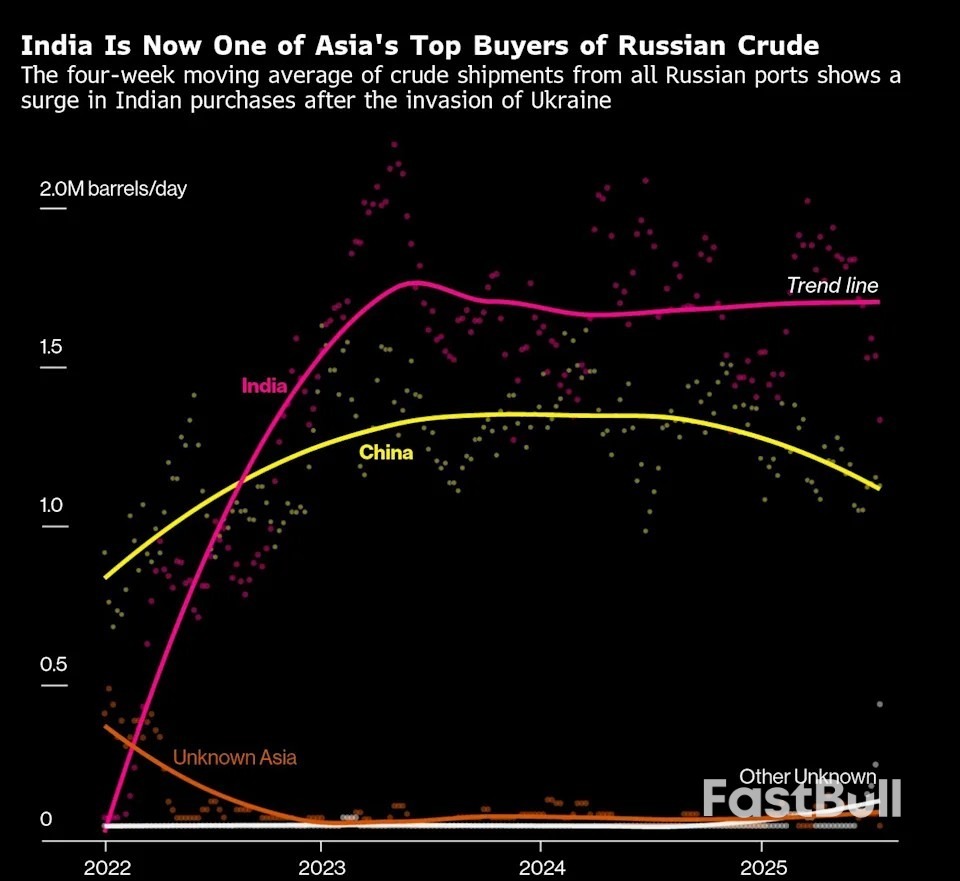
          The US will urge its allies in the Group of Seven to impose tariffs as high as 100% on China and India for their purchases of Russian oil in an effort to convince President Vladimir Putin to end his war in Ukraine.
          President Donald Trump said on Friday that his patience with Putin was “running out fast” and threatened new economic sanctions. “It’ll be hitting very hard on with sanctions to banks and having to do with oil and tariffs also,” he said in an interview on Fox News.
          The US will also tell the G-7 countries they should create a legal pathway to seize immobilized sovereign Russian assets and consider seizing or using the principle of those assets to fund Ukraine’s defense, according to a US proposal seen by Bloomberg. The vast majority of the about $300 billion of Moscow’s immobilized assets are in Europe.
          Brent crude futures extended gains following the report, briefly touching a session high, and closed up 0.8%. The euro fell to the day’s low, while trading little changed late in the New York session Friday, at around the $1.1734.
          A spokesperson from the White House didn’t immediately respond to a request for comment on the proposals.
          Separately, senior US officials have floated with European counterparts the idea of gradually seizing those frozen Russia assets to increase the pressure on Moscow to enter into negotiations, according to people familiar with the matter who spoke on the condition of anonymity.
          Profits generated by the assets are currently being used to provide loans to Ukraine.
          Canada, which holds the presidency of the G-7, convened a meeting of the group’s finance ministers on Friday to “discuss further measures to increase pressure on Russia and limit their war machinery,” according to a statement.
          Treasury Secretary Scott Bessent, in that “emergency” G-7 discussion, reiterated Trump’s call to the group that “if they are truly committed to ending the war in Ukraine, they should join the United States in imposing tariffs on countries purchasing oil from Russia,” according to a statement from the Treasury.
          Bessent and US Trade Representative Jamieson Greer welcomed commitments to “explore using immobilized Russian sovereign assets to further benefit Ukraine’s defense,” the US Treasury statement also said.
          The US proposal calls for 50% to 100% secondary tariffs on China and India as well as restrictive trade measures on both imports and exports to curb the flow of Russian energy and to prevent the transfer of dual-use technologies into Russia, according to the proposal.
          The proposal poses a challenge given that several nations in the EU, including Hungary, have blocked more stringent sanctions targeting Russia’s energy sector. Such measures would require the backing of all member states.
          Trump has told European officials he’s willing to impose sweeping new tariffs on India and China to push Putin to the negotiating table with Ukraine — but only if nations in Europe do so as well.US Urges G-7 Sanctions on Russia Oil as Trump Loses Patience_1
          Trump made the ask when he called into a meeting with senior US and European Union officials in Washington this week and said the US would be willing to mirror tariffs imposed by Europe on either country, Bloomberg reported earlier.
          Trump’s suggestion comes after his deadline for Putin to hold a bilateral meeting with Ukraine’s Volodymyr Zelenskiy passed without indication that the Russian leader was genuinely interested in engaging in face-to-face peace talks. Instead, Moscow has stepped up its Ukraine bombing campaign.
          Russia on Friday said negotiations with Ukraine were on “pause” despite Trump’s push following a meeting with Putin last month for direct talks between the Russian leader and Zelenskiy.
          The proposal to the G-7 also seeks sanctions targeting Russia’s so-called shadow fleet of oil tankers and the networks that enable the trades to flow; the Russian oil company Rosneft PJSC; and a prohibition of insurance for maritime services.
          The US will also call on its allies to sanction entities supporting Russia’s military industry; Russian regional banks; prohibit services related to artificial intelligence and financial technology in Russian Special Economic Zones, according to the proposals.
          Trump has so far refrained from imposing direct sanctions on Russia, despite skating through several self-imposed deadlines and Putin’s continued reluctance to negotiate an end to the war. Trump has, however, doubled tariffs on India to 50% over its continued purchase of Russian oil.
          The G-7 discussions come as the EU is working on a 19th package of sanctions, which is expected to target more Russian banks and the country’s oil trade, Bloomberg previously reported.

          Source: Bloomberg

          Risk Warnings and Disclaimers
          You understand and acknowledge that there is a high degree of risk involved in trading. Following any strategies or investment methods may lead to potential losses. The content on the site is provided by our contributors and analysts for information purposes only. You are solely responsible for determining whether any trading assets, securities, strategy, or any other product is suitable for investing based on your own investment objectives and financial situation.
          Add to Favorites
          Share

          Polymarket Seeking Funding Round That Could 10x its Valuation to $10B

          Manuel

          Cryptocurrency

          Prediction market Polymarket is pursuing new funding that could boost its valuation to $10 billion, as Business Insider reported on Sept. 12.
          Two people with knowledge of the matter said the valuation discussions represent at least a threefold increase from the $1 billion Polymarket achieved in a funding round that closed this summer.
          According to one source, at least one investor offered a term sheet valuing the company at $10 billion. A Polymarket spokesperson declined to comment on the funding talks.

          Strategic developments

          The reported valuation surge follows a series of strategic developments positioning Polymarket for a US comeback.
          The Commodity Futures Trading Commission granted regulatory approval for the platform to resume US operations through a no-action letter issued Sept. 3 to QCX LLC, Polymarket’s regulatory partner, acquired for $112 million in July.
          The regulatory greenlight enables Polymarket to operate event contracts while maintaining compliance with federal derivatives regulations. It also marks a return after the platform ceased US operations in 2022 following a $1.4 million CFTC settlement over unregistered derivatives trading.
          Additionally, Donald Trump Jr. joined Polymarket’s advisory board in August as his venture capital firm 1789 Capital made a strategic investment in the platform.
          The partnership adds political expertise as Polymarket prepares for US market entry. Trump Jr. recently praised the platform for cutting through “media spin and so-called expert opinion.”
          Polymarket CEO Shayne Coplan characterized the 1789 Capital partnership as reinforcing the company’s role as a trusted information source, while the firm’s founder, Omeed Malik, praised Polymarket’s intersection of financial innovation and free expression.

          Slump in user growth

          Polymarket operates as a prediction market where users place bets on outcomes ranging from political elections to cultural events, generating market-driven predictions.
          Data from a Dune dashboard by Varrock founder Richard Chen shows that Polymarket crossed $8.5 billion in year-to-date trading volume as of Sept. 12, surpassing last year’s total volume.
          The trading volume increase occurs despite a slump in active and new users. Polymarket’s monthly active traders peaked in January at 454,664, gradually falling to reach August’s 226,442 after a 20% fall from July.
          Meanwhile, new users plunged 33% between July and August, reaching 66,160, the lowest level in a year.
          The platform’s regulatory preparations and high-profile advisory additions position it for a potential pivot in these numbers with a US expansion.

          Source: Cryptoslate

          Risk Warnings and Disclaimers
          You understand and acknowledge that there is a high degree of risk involved in trading. Following any strategies or investment methods may lead to potential losses. The content on the site is provided by our contributors and analysts for information purposes only. You are solely responsible for determining whether any trading assets, securities, strategy, or any other product is suitable for investing based on your own investment objectives and financial situation.
          Add to Favorites
          Share
          FastBull
          Copyright © 2025 FastBull Ltd

          728 RM B 7/F GEE LOK IND BLDG NO 34 HUNG TO RD KWUN TONG KLN HONG KONG

          TelegramInstagramTwitterfacebooklinkedin
          App Store Google Play Google Play
          Products
          Charts

          Chats

          Q&A with Experts
          Screeners
          Economic Calendar
          Data
          Tools
          Membership
          Features
          Function
          Markets
          Copy Trading
          Latest Signals
          Contests
          News
          Analysis
          24/7
          Columns
          Education
          Company
          Careers
          About Us
          Contact Us
          Advertising
          Help Center
          Feedback
          User Agreement
          Privacy Policy
          Business

          White Label

          Data API

          Web Plug-ins

          Poster Maker

          Affiliate Program

          Risk Disclosure

          The risk of loss in trading financial instruments such as stocks, FX, commodities, futures, bonds, ETFs and crypto can be substantial. You may sustain a total loss of the funds that you deposit with your broker. Therefore, you should carefully consider whether such trading is suitable for you in light of your circumstances and financial resources.

          No decision to invest should be made without thoroughly conducting due diligence by yourself or consulting with your financial advisors. Our web content might not suit you since we don't know your financial conditions and investment needs. Our financial information might have latency or contain inaccuracy, so you should be fully responsible for any of your trading and investment decisions. The company will not be responsible for your capital loss.

          Without getting permission from the website, you are not allowed to copy the website's graphics, texts, or trademarks. Intellectual property rights in the content or data incorporated into this website belong to its providers and exchange merchants.

          Not Logged In

          Log in to access more features

          FastBull Membership

          Not yet

          Purchase

          Become a signal provider
          Help Center
          Customer Service
          Dark Mode
          Price Up/Down Colors

          Log In

          Sign Up

          Position
          Layout
          Fullscreen
          Default to Chart
          The chart page opens by default when you visit fastbull.com