• Trade
  • Markets
  • Copy
  • Contests
  • News
  • 24/7
  • Calendar
  • Q&A
  • Chats
Trending
Screeners
SYMBOL
LAST
BID
ASK
HIGH
LOW
NET CHG.
%CHG.
SPREAD
SPX
S&P 500 Index
6870.39
6870.39
6870.39
6895.79
6858.28
+13.27
+ 0.19%
--
DJI
Dow Jones Industrial Average
47954.98
47954.98
47954.98
48133.54
47871.51
+104.05
+ 0.22%
--
IXIC
NASDAQ Composite Index
23578.12
23578.12
23578.12
23680.03
23506.00
+72.99
+ 0.31%
--
USDX
US Dollar Index
98.930
99.010
98.930
98.960
98.730
-0.020
-0.02%
--
EURUSD
Euro / US Dollar
1.16488
1.16495
1.16488
1.16717
1.16341
+0.00062
+ 0.05%
--
GBPUSD
Pound Sterling / US Dollar
1.33154
1.33164
1.33154
1.33462
1.33136
-0.00158
-0.12%
--
XAUUSD
Gold / US Dollar
4210.39
4210.80
4210.39
4218.85
4190.61
+12.48
+ 0.30%
--
WTI
Light Sweet Crude Oil
59.220
59.250
59.220
60.084
59.160
-0.589
-0.98%
--

Community Accounts

Signal Accounts
--
Profit Accounts
--
Loss Accounts
--
View More

Become a signal provider

Sell trading signals to earn additional income

View More

Guide to Copy Trading

Get started with ease and confidence

View More

Signal Accounts for Members

All Signal Accounts

Best Return
  • Best Return
  • Best P/L
  • Best MDD
Past 1W
  • Past 1W
  • Past 1M
  • Past 1Y

All Contests

  • All
  • Trump Updates
  • Recommend
  • Stocks
  • Cryptocurrencies
  • Central Banks
  • Featured News
Top News Only
Share

India Foreign Ministry: Advise Indian Nationals To Exercise Caution While Travelling To Or Transiting Through China

Share

Agrural - Brazil's 2025/26 Total Corn Output Seen At 135.3 Million Tonnes Versus 141.1 Million Tonnes In Previous Season

Share

Agrural - Brazil's 2025/26 Soybean Planting Hits 94% Of Expected Area As Of Last Thursday

Share

SEBI: Modalities For Migration To Ai Only Schemes And Relaxations To Large Value Funds For Accredited Investors

Share

All 6 Bank Of Israel Monetary Policy Committee Members Voted To Lower Benchmark Interest Rate 25 Bps To 4.25% On Nov 24

Share

India Government: Cancellations Are On Account Of Developer Delays And Not Due To Transmission Side Delays

Share

Fitch: We See Moderation Of Export Performance In China In 2026

Share

India Government: Revokes Grid Access Permissions For Renewable Energy Projects

Share

Stats Office - Tanzania Inflation At 3.4% Year-On-Year In November

Share

Temasek CEO Dilhan Pillay: We Are Taking A Conservative Stance On Allocating Capital

Share

Brazil Economists See Brazilian Real At 5.40 Per Dollar By Year-End 2025 Versus 5.40 In Previous Estimate - Central Bank Poll

Share

Brazil Economists See Year-End 2026 Interest Rate Selic At 12.25% Versus 12.00% In Previous Estimate - Central Bank Poll

Share

Brazil Economists See Year-End 2025 Interest Rate Selic At 15.00% Versus 15.00% In Previous Estimate - Central Bank Poll

Share

EU Commission Says Meta Has Committed To Give EU Users Choice On Personalised Ads

Share

Sources Revealed That The Bank Of England Has Invited Employees To Voluntarily Apply For Layoffs

Share

The Bank Of England Plans To Cut Staff Due To Budget Pressures

Share

Traders Believe There Is Less Than A 10% Chance That The European Central Bank Will Cut Interest Rates By 25 Basis Points In 2026

Share

Egypt, European Bank For Reconstruction And Development Sign $100 Million Financing Agreement

Share

Israel Budget Deficit 4.5% Of GDP In November Over Past 12 Months Versus 4.9% Deficit In October

Share

JPMorgan - Council Chaired By Jamie Dimon Includes Jeff Bezos

TIME
ACT
FCST
PREV
France Industrial Output MoM (SA) (Oct)

A:--

F: --

P: --
France Trade Balance (SA) (Oct)

A:--

F: --

P: --
Euro Zone Employment YoY (SA) (Q3)

A:--

F: --

P: --
Canada Part-Time Employment (SA) (Nov)

A:--

F: --

P: --

Canada Unemployment Rate (SA) (Nov)

A:--

F: --

P: --

Canada Full-time Employment (SA) (Nov)

A:--

F: --

P: --

Canada Labor Force Participation Rate (SA) (Nov)

A:--

F: --

P: --

Canada Employment (SA) (Nov)

A:--

F: --

P: --

U.S. PCE Price Index MoM (Sept)

A:--

F: --

P: --

U.S. Personal Income MoM (Sept)

A:--

F: --

P: --

U.S. Core PCE Price Index MoM (Sept)

A:--

F: --

P: --

U.S. PCE Price Index YoY (SA) (Sept)

A:--

F: --

P: --

U.S. Core PCE Price Index YoY (Sept)

A:--

F: --

P: --

U.S. Personal Outlays MoM (SA) (Sept)

A:--

F: --

P: --
U.S. 5-10 Year-Ahead Inflation Expectations (Dec)

A:--

F: --

P: --

U.S. Real Personal Consumption Expenditures MoM (Sept)

A:--

F: --

P: --
U.S. Weekly Total Rig Count

A:--

F: --

P: --

U.S. Weekly Total Oil Rig Count

A:--

F: --

P: --

U.S. Consumer Credit (SA) (Oct)

A:--

F: --

P: --
China, Mainland Foreign Exchange Reserves (Nov)

A:--

F: --

P: --

Japan Trade Balance (Oct)

A:--

F: --

P: --

Japan Nominal GDP Revised QoQ (Q3)

A:--

F: --

P: --

China, Mainland Imports YoY (CNH) (Nov)

A:--

F: --

P: --

China, Mainland Exports (Nov)

A:--

F: --

P: --

China, Mainland Imports (CNH) (Nov)

A:--

F: --

P: --

China, Mainland Trade Balance (CNH) (Nov)

A:--

F: --

P: --

China, Mainland Exports YoY (USD) (Nov)

A:--

F: --

P: --

China, Mainland Imports YoY (USD) (Nov)

A:--

F: --

P: --

Germany Industrial Output MoM (SA) (Oct)

A:--

F: --

P: --
Euro Zone Sentix Investor Confidence Index (Dec)

A:--

F: --

P: --

Canada National Economic Confidence Index

--

F: --

P: --

U.K. BRC Like-For-Like Retail Sales YoY (Nov)

--

F: --

P: --

U.K. BRC Overall Retail Sales YoY (Nov)

--

F: --

P: --

Australia Overnight (Borrowing) Key Rate

--

F: --

P: --

RBA Rate Statement
RBA Press Conference
Germany Exports MoM (SA) (Oct)

--

F: --

P: --

U.S. NFIB Small Business Optimism Index (SA) (Nov)

--

F: --

P: --

Mexico 12-Month Inflation (CPI) (Nov)

--

F: --

P: --

Mexico Core CPI YoY (Nov)

--

F: --

P: --

Mexico PPI YoY (Nov)

--

F: --

P: --

U.S. Weekly Redbook Index YoY

--

F: --

P: --

U.S. JOLTS Job Openings (SA) (Oct)

--

F: --

P: --

China, Mainland M1 Money Supply YoY (Nov)

--

F: --

P: --

China, Mainland M0 Money Supply YoY (Nov)

--

F: --

P: --

China, Mainland M2 Money Supply YoY (Nov)

--

F: --

P: --

U.S. EIA Short-Term Crude Production Forecast For The Year (Dec)

--

F: --

P: --

U.S. EIA Natural Gas Production Forecast For The Next Year (Dec)

--

F: --

P: --

U.S. EIA Short-Term Crude Production Forecast For The Next Year (Dec)

--

F: --

P: --

EIA Monthly Short-Term Energy Outlook
U.S. API Weekly Gasoline Stocks

--

F: --

P: --

U.S. API Weekly Cushing Crude Oil Stocks

--

F: --

P: --

U.S. API Weekly Crude Oil Stocks

--

F: --

P: --

U.S. API Weekly Refined Oil Stocks

--

F: --

P: --

South Korea Unemployment Rate (SA) (Nov)

--

F: --

P: --

Japan Reuters Tankan Non-Manufacturers Index (Dec)

--

F: --

P: --

Japan Reuters Tankan Manufacturers Index (Dec)

--

F: --

P: --

Japan Domestic Enterprise Commodity Price Index MoM (Nov)

--

F: --

P: --

Japan Domestic Enterprise Commodity Price Index YoY (Nov)

--

F: --

P: --

China, Mainland PPI YoY (Nov)

--

F: --

P: --

China, Mainland CPI MoM (Nov)

--

F: --

P: --

Q&A with Experts
    • All
    • Chatrooms
    • Groups
    • Friends
    Connecting
    .
    .
    .
    Type here...
    Add Symbol or Code

      No matching data

      All
      Trump Updates
      Recommend
      Stocks
      Cryptocurrencies
      Central Banks
      Featured News
      • All
      • Russia-Ukraine Conflict
      • Middle East Flashpoint
      • All
      • Russia-Ukraine Conflict
      • Middle East Flashpoint
      Search
      Products

      Charts Free Forever

      Chats Q&A with Experts
      Screeners Economic Calendar Data Tools
      Membership Features
      Data Warehouse Market Trends Institutional Data Policy Rates Macro

      Market Trends

      Market Sentiment Order Book Forex Correlations

      Top Indicators

      Charts Free Forever
      Markets

      News

      News Analysis 24/7 Columns Education
      From Institutions From Analysts
      Topics Columnists

      Latest Views

      Latest Views

      Trending Topics

      Top Columnists

      Latest Update

      Signals

      Copy Rankings Latest Signals Become a signal provider AI Rating
      Contests
      Brokers

      Overview Brokers Assessment Rankings Regulators News Claims
      Broker listing Forex Brokers Comparison Tool Live Spread Comparison Scam
      Q&A Complaint Scam Alert Videos Tips to Detect Scam
      More

      Business
      Events
      Careers About Us Advertising Help Center

      White Label

      Data API

      Web Plug-ins

      Affiliate Program

      Awards Institution Evaluation IB Seminar Salon Event Exhibition
      Vietnam Thailand Singapore Dubai
      Fans Party Investment Sharing Session
      FastBull Summit BrokersView Expo
      Recent Searches
        Top Searches
          Markets
          News
          Analysis
          User
          24/7
          Economic Calendar
          Education
          Data
          • Names
          • Latest
          • Prev

          View All

          No data

          Scan to Download

          Faster Charts, Chat Faster!

          Download App
          English
          • English
          • Español
          • العربية
          • Bahasa Indonesia
          • Bahasa Melayu
          • Tiếng Việt
          • ภาษาไทย
          • Français
          • Italiano
          • Türkçe
          • Русский язык
          • 简中
          • 繁中
          Open Account
          Search
          Products
          Charts Free Forever
          Markets
          News
          Signals

          Copy Rankings Latest Signals Become a signal provider AI Rating
          Contests
          Brokers

          Overview Brokers Assessment Rankings Regulators News Claims
          Broker listing Forex Brokers Comparison Tool Live Spread Comparison Scam
          Q&A Complaint Scam Alert Videos Tips to Detect Scam
          More

          Business
          Events
          Careers About Us Advertising Help Center

          White Label

          Data API

          Web Plug-ins

          Affiliate Program

          Awards Institution Evaluation IB Seminar Salon Event Exhibition
          Vietnam Thailand Singapore Dubai
          Fans Party Investment Sharing Session
          FastBull Summit BrokersView Expo

          Can The US Avoid Recession? A Lot Depends On The Dollar

          Damon

          Economic

          Forex

          Summary:

          Near-term US recession risk is low, but there are pockets of weakness that could mutate into a downturn later this year. The weaker dollar, though, will be key to whether the US avoids that fate and stocks a significant decline.

          Near-term US recession risk is low, but there are pockets of weakness that could mutate into a downturn later this year. The weaker dollar, though, will be key to whether the US avoids that fate and stocks a significant decline.

          For now, it’s gone quiet on the recession front.

          Not long ago, there was febrile speculation that a downturn was imminent, despite a lack of support from leading data.
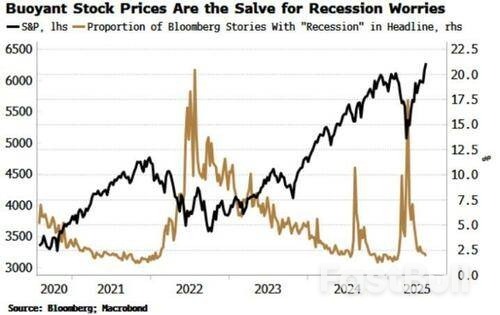
          Since then, the clamour has died down, and that can make one a little uneasy. Not necessarily because we should be worried about an imminent recession, but it does imply the market is now less prepared for bad news, which increases the likelihood of a disproportionate impact on asset prices.

          My Recession Gauge – an amalgamation of 14 separate recession indicators – has fallen and is well under the activation threshold. But there are areas of weakness in the economy that could trigger anxiety and cause stock markets to drop, at least temporarily.
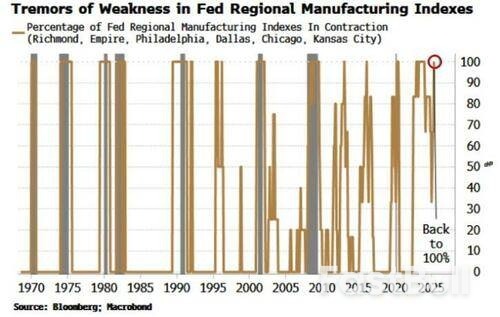
          One notable point can be found in the Federal Reserve’s regional manufacturing indexes. Individually they are very volatile. But when they act in concert, they give a more reliable indication. The combined signal has recently jumped back to 100%, with all the indexes now in the contraction zone.

          As we can see from the chart above, this particular data point has given a few false positives in the past, so it is not perfect. But equally it’s not something that should be ignored, as manufacturing is one of the most leading sectors in the economy. Moreover, recessions are pervasive. So a nationwide decline in manufacturing is best monitored.

          We might also see other signs of economic weakness in the coming months. One point to focus on might be whether the rise in WARN (advance layoff) notices presages weakness in unemployment claims and the wider labour market. Another area to watch is the housing market, and whether that starts to become a wider problem.

          None of these guarantee a recession however, especially if the weaker dollar eases financial conditions to keep a downturn at bay. The drop in the US currency should also translate into a boost for stock earnings.

          More broadly, though, dollar weakness and (at least for now) relatively stable yields are typically consistent with economic data improving relative to the consensus.
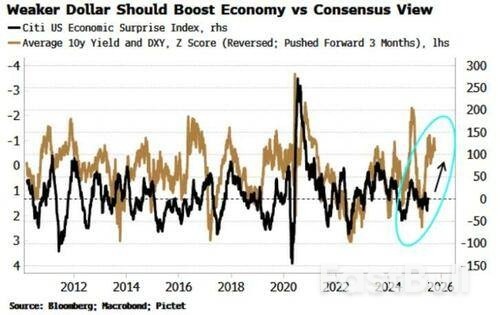
          There are more malign effects from the weaker dollar also in the pipeline such as higher inflation, but at least through the rest of this year, it might be enough to forestall a return of recession angst.

          Source: Zero Hedge

          To stay updated on all economic events of today, please check out our Economic calendar
          Risk Warnings and Disclaimers
          You understand and acknowledge that there is a high degree of risk involved in trading. Following any strategies or investment methods may lead to potential losses. The content on the site is provided by our contributors and analysts for information purposes only. You are solely responsible for determining whether any trading assets, securities, strategy, or any other product is suitable for investing based on your own investment objectives and financial situation.
          Add to Favorites
          Share

          Trump’s Brazil Tariffs Risk Upending Trade From Coffee to Beef

          Adam

          Economic

          Commodity

          President Donald Trump’s unexpected move to threaten a 50% tariff on Brazil risks roiling global commodity markets, disrupting trade on everything from beef to coffee.
          The US is Brazil’s second-largest trading partner, trailing only China. But while the two nations compete directly in some markets like corn and cotton, Brazil — an agricultural powerhouse — also produces tropical goods like coffee that can’t be grown in the continental US.
          Brazil has been ramping up beef shipments to meet growing US demand, and is a key supplier of wood pulp used in everything from books to toilet paper. That’s spurring hopes that some sectors could be singled out or exempted from tariffs.
          Still, Brazil’s strength in commodities gives it some flexibility, and the country could ease the impact by finding buyers elsewhere.
          “It’s likely that these products will have to be redirected,” said Marcos Fava Neves, a professor at the University of Sao Paulo’s Ribeirao Preto Business School. “Beef is being exported to many places, orange juice is in short supply and coffee is in short supply.”
          Brazil’s energy and metal industries are also evaluating potential impacts. Here’s how the tariffs could ripple through key commodities:

          Coffee

          The US imported nearly $2 billion worth of coffee from Brazil in 2024, according to the US Department of Agriculture. The shipments are roughly 30% of US coffee consumption, Brazilian coffee exporters group Cecafé said.
          “It’s a loss to our companies, and it means more costs and more inflation to American consumers,” Cecafé Chief Executive Officer Marcos Matos said.
          Trump’s Brazil Tariffs Risk Upending Trade From Coffee to Beef_1
          Brazil is the world’s top grower of the premium arabica variety favored by Starbucks Corp. (SBUX) and most specialty coffee shops. Prices for the bean have already surged over the past year as poor weather in Brazil threatened supplies.
          Tariffs on Brazil could result in coffee prices rising “quite a lot,” Giuseppe Lavazza, chairman of Italian roaster Lavazza, said on Bloomberg Television.

          Beef

          American meatpackers, facing the smallest US cattle herd since the 1950s, have been relying more on supplies from countries like Brazil. Demand is also rising as consumers on weight-loss drugs seek out high-protein foods. In 2024, about $1.4 billion of beef was imported into the US from Brazil, according to the US Department of Agriculture.
          Trump’s Brazil Tariffs Risk Upending Trade From Coffee to Beef_2
          Brazilian producers will likely redirect shipments, with meatpacker Minerva SA saying it can also supply the US market with its operations in Argentina, Paraguay, Uruguay and Australia. Still, the Brazilian Association of Meat Exporters pointed to risks for “global supply and food security” while pledging for more dialogue between the two countries.

          Oil

          Brazilian crude exports eclipsed all other foreign sales for Latin America’s biggest economy for the first time last year, with oil and derivatives shipments to the US totaling $7.6 billion in 2024.
          Brazil’s oil lobby group IBP said in a statement that the tariff move “brings uncertainty to the oil and gas sector, which today accounts for 17% of Brazil’s industrial GDP and 1.6 million direct and indirect jobs in the country.”
          But analysts see little structural risk to the country’s production, given Brazil’s ability to divert export flow.
          “Brazil has the capacity to redirect barrels currently exported to the US to refineries in Asia (China, India), Europe, or the Middle East, which demand light, low-sulfur crude such as those produced in Brazil’s pre-salt fields,” BTG Pactual analysts led by Luiz Carvalho wrote in a note to clients.
          Analysts also see limited impact for state-controlled oil producer Petrobras, which exports most of its crude to China.

          Orange Juice

          Brazil accounts for roughly 70% of global orange juice exports, and has played a more sizable role in the US supply as a deadly citrus greening disease spread through Florida’s groves. While the same disease is also impacting some areas of Brazil, the northeastern part of the country has been largely untouched and is expanding production. Orange juice futures rose as much as 6% on Thursday to the highest price in nearly a month.
          The new tariff would be a lot higher than the existing rate of $415 per ton applied to Brazilian juice shipments, meaning a charge equivalent to more than 70% of the value of the product, industry group CitrusBR said. This would make shipments “unfeasible,” Executive Director Ibiapaba Netto said.
          “Now we have to speed up production to ship the orders we still have as quickly as possible before the taxes come into effect,” said Bryan Souza, head of global operations at Sumo Brasil, a company that produces frozen concentrated orange juice.

          Ethanol

          Brazil has been expanding its capacity to convert corn and sugar cane into ethanol, a biofuel often blended with gasoline. The US is a key market, with incentives in California for low-carbon fuels helping to propel ethanol shipments to about 300 million liters last year. A risk of retaliation would also limit shipments to Brazil from the US, and even tighten supplies in the South American nation this year, said Bruno Lima, soft commodities business director at StoneX.

          Pulp and paper

          Brazil is home to Suzano SA, the world’s largest exporter of the pulp that goes into products like toilet paper. Pulp is Brazil’s fourth-largest agricultural export to the US, and paper and plywood are also among the top goods, according to Brazil’s Ministry of Agriculture and Livestock. Suzano Chief Executive Officer João Alberto de Abreu said in May that the company was passing the costs of tariffs — which were 10% at the time — on to US buyers. Suzano is the most exposed to tariffs among Brazilian commodity producers, as about 15% of the company’s revenue comes from the US, Citi analyst Gabriel Barra wrote in a note.

          Sugar

          While much of America’s sugar has historically been produced domestically or imported from Mexico, shipments from Brazil, the world’s top sugar grower, have boomed. The US imported a record amount from the country in 2024, topping a million metric tons, according to the USDA.
          The US limits the amount of sugar that can be imported under low fees, and allocated about 14% of that supply to Brazil in the 2025 fiscal year. Additional Brazilian shipments, which are subject to higher fees, have totaled over 265,000 tons as of the end of May, said Mike McDougall, an analyst at McDougall Global View.

          Steel

          Brazil’s steel industry doesn’t see any direct impact from the tariff announced by Trump, since the sector was already subject to that rate under Section 232 of the Trade Expansion Act, said Marco Polo de Mello Lopes, chief executive officer of industry association Aço Brasil.
          The move, however, may sour relations between Brazil and the US, making it more difficult to re-establish steel trade negotiations that may involve export quotas on semi-finished products, Lopes said. Brazilian steel mills produced around 60% of all slabs imported by the US last year to feed its industry.
          Mining and steel stocks gained in Sao Paulo on bets that rising commodity prices and limited exposure to the US will help them weather the storm.

          Bloomberg :source

          To stay updated on all economic events of today, please check out our Economic calendar
          Risk Warnings and Disclaimers
          You understand and acknowledge that there is a high degree of risk involved in trading. Following any strategies or investment methods may lead to potential losses. The content on the site is provided by our contributors and analysts for information purposes only. You are solely responsible for determining whether any trading assets, securities, strategy, or any other product is suitable for investing based on your own investment objectives and financial situation.
          Add to Favorites
          Share

          Australian Dollar Looking Attractive Here

          Warren Takunda

          Economic

          The Australian dollar is a 'buy' with two major financial institutions, where analysts cite supportive macroeconomic conditions, 'hawkish' monetary policy signals, and improving sentiment toward China.
          A central theme among strategists is the close correlation between the Australian dollar and Chinese market sentiment:
          "Since the start of the year, the Australian dollar has closely followed the trajectory of Chinese equities," says Société Générale, noting that recent relief over U.S. tariff delays has buoyed risk assets. "The upward trend seen since the ‘Liberation Day’ drawdown is not yet over."
          Bank of America's bullish stance on China's economic recovery prompts it to back Australian Dollar upside."
          "We were already bullish AUD/USD given the positive outlook for China's growth and our forecast for USD/CNY to remain rangebound (7.10–7.30).
          "China growth rebound, super fund dynamics and risk resilience are other tailwinds."
          Also potentially boosting the Australian dollar is the Reserve Bank of Australia's (RBA) unexpected decision to hold interest rates steady at 3.85% this week, defying widespread expectations of a rate cut.
          "The RBA surprised markets this week by keeping interest rates steady," Société Générale noted, adding that the RBA’s more cautious approach could provide support:
          "The AUD-USD three-year yield differential appears to be bottoming out… and the RBA’s cautious approach could support both AUD yields and the Australian dollar in the weeks ahead."
          Australian Dollar Looking Attractive Here_1

          Above: AUD vs. USD (top) and AUD vs. GBP at daily intervals.

          Bank of America took a similar view, recommending a long position on the currency following the central bank’s decision. "We recommended buying AUDUSD this week, following the RBA's decision to keep rates on hold," said analysts.
          Both institutions emphasise that the AUD remains undervalued relative to macro fundamentals. "In our view, the FX market looks particularly mispriced," Bank of America wrote, targeting a move toward 0.68 by year-end.
          Société Générale highlighted the potential for positive growth surprises, despite strong global demand for Australia's abundant natural resources.
          "The market has revised Australian growth forecasts down a long way, providing room for positive surprises," Soc Gen says. "The world is fighting over natural resources."
          Bank of America cautions that the biggest risk to its constructive AUD view is U.S.-China trade escalation, something that cannot be entirely discounted given U.S. President Donald Trump is again proving to be highly unpredictable in his tariff policy.
          "But with the relevant deadline a month away, there is a window for AUD to outperform," says Bank of America.

          Source: Poundsterlinglive

          To stay updated on all economic events of today, please check out our Economic calendar
          Risk Warnings and Disclaimers
          You understand and acknowledge that there is a high degree of risk involved in trading. Following any strategies or investment methods may lead to potential losses. The content on the site is provided by our contributors and analysts for information purposes only. You are solely responsible for determining whether any trading assets, securities, strategy, or any other product is suitable for investing based on your own investment objectives and financial situation.
          Add to Favorites
          Share

          US Equity Fund Inflows Ease on Caution Over Tariff Threats

          Michelle

          Economic

          Stocks

          U.S. equity funds saw a significant drop in net investments in the week through July 9 on caution over President Donald Trump's threats of fresh tariffs on trading partners, even though stocks surged to new records on rising demand in the artificial intelligence sector.

          Investors acquired just $2.1 billion worth of U.S. equity funds during the week when compared with a robust $31.6 billion worth of net accumulations in the prior week, data from LSEG Lipper showed.

          President Trump this week extended the tariff deadline until August 1 to facilitate trade negotiations, but announced noticeably higher duties for some key trading partners including Japan, South Korea, Canada and Brazil alongside a 50% tariff on copper.

          U.S. multi-cap funds saw the first weekly net investment in four weeks to the tune of $1.8 billion. Large-cap, mid-cap and small-cap funds, meanwhile, suffered net outflows of $2.83 billion, $785 million and $472 million, respectively.

          Sectoral funds saw net purchases extended into a second successive week, with approximately $1.28 billion flowing into these funds. Tech drew in $1.7 billion but healthcare saw net outflows of $874 million.

          U.S. money market funds faced a net $9.78 billion weekly outflow, ending two weeks of buying.

          Inflows into U.S. bond funds, meanwhile, cooled to a three-week low of $4.34 billion.

          Short-to-intermediate investment-grade funds received $1.76 billion with weekly net investments dropping by 57% over the week. General domestic taxable fixed income funds received just $634 million compared with a net $3.03 billion purchase in the prior week.

          Short-to-intermediate government and treasury funds, meanwhile, attracted $982 million, the largest amount in four weeks.

          Source: Yahoo Finance

          To stay updated on all economic events of today, please check out our Economic calendar
          Risk Warnings and Disclaimers
          You understand and acknowledge that there is a high degree of risk involved in trading. Following any strategies or investment methods may lead to potential losses. The content on the site is provided by our contributors and analysts for information purposes only. You are solely responsible for determining whether any trading assets, securities, strategy, or any other product is suitable for investing based on your own investment objectives and financial situation.
          Add to Favorites
          Share

          NVIDIA Becomes First $4 Trillion Company: What It Means for Your Index Funds

          Adam

          Economic

          The Top Story This Week: NVIDIA Makes History as First $4 Trillion Company

          NVIDIA Becomes First $4 Trillion Company: What It Means for Your Index Funds_1Daily NVIDIA Corporation

          In my view, this is the most significant market story of the week: NVIDIA became the first public company in history to reach a $4 trillion market capitalization on July 9, 2025, fundamentally reshaping the investment landscape for retail investors.
          The chip giant’s stock surged 2.5% to hit $164 per share, briefly crossing the $4 trillion threshold before closing at $3.97 trillion—still securing its position as the world’s most valuable company. NVIDIA bypassed both Apple and Microsoft in this historic race, driven by insatiable demand for its AI chips.

          Why This Matters for Your Portfolio

          NVIDIA’s dominance directly impacts most retail investors through index funds. The company now represents 7.3% of the entire S&P 500 index—meaning anyone invested in broad market funds has significant NVIDIA exposure whether they realize it or not.
          The numbers are staggering: NVIDIA has increased fifteenfold over five years, generating 1,500% returns while posting a 22% gain year-to-date in 2025. The company’s market cap now exceeds the combined value of Canada’s and Mexico’s entire stock markets.
          Market Context
          This milestone occurred against complex market conditions. The stronger-than-expected June jobs report (147,000 jobs added versus 110,000 expected) pushed Treasury yields to 4.36%, eliminating chances of July Fed rate cuts. Meanwhile, Trump’s July 9 tariff deadline created trade uncertainty, yet markets reached record highs anyway.
          Cryptocurrency markets also showed strength, with Bitcoin trading around $105,000 and analysts targeting $120,000 by month-end, supported by $5.24 billion in U.S. spot Bitcoin ETF inflows during May.

          Investment Implications

          For passive investors, NVIDIA’s achievement represents both opportunity and concentration risk. Having 7.3% of the S&P 500 in one stock creates vulnerability if AI momentum falters.
          For growth investors, this validates the AI investment theme, with Loop Capital projecting a $6 trillion market cap by 2028.
          For dividend investors, this highlights the shift from traditional value toward technology growth, though NVIDIA’s 0.03% yield remains minimal.

          The Bottom Line

          NVIDIA’s $4 trillion milestone signals a fundamental shift in how markets value AI infrastructure companies. This represents more than one company’s success—it’s validation of artificial intelligence’s transformative economic impact.
          For retail investors, this development underscores both the opportunities of participating in technological transformation and the importance of understanding concentration risk in index portfolios. As Goldman Sachs noted, “We’re at the early stages of the biggest tech transformation we’ve seen in decades.”
          This historic achievement demonstrates the market’s conviction in AI’s long-term potential, making it the defining financial story of this week.

          Source: fxempire

          To stay updated on all economic events of today, please check out our Economic calendar
          Risk Warnings and Disclaimers
          You understand and acknowledge that there is a high degree of risk involved in trading. Following any strategies or investment methods may lead to potential losses. The content on the site is provided by our contributors and analysts for information purposes only. You are solely responsible for determining whether any trading assets, securities, strategy, or any other product is suitable for investing based on your own investment objectives and financial situation.
          Add to Favorites
          Share

          EU waits on Trump letter as markets digest latest tariff salvo

          Adam

          Economic

          The European Union braced on Friday to receive a letter from U.S. President Donald Trump, outlining planned duties on his largest trade and investment partner after a broadening of his tariff war in recent days.
          The EU initially hoped to strike a comprehensive trade agreement, including zero-for-zero tariffs on industrial goods, but months of difficult talks have led to the realisation it will probably have to settle for an interim agreement and hope something better can still be negotiated.
          The 27-country bloc is under conflicting pressures as powerhouse Germany urged a quick deal to safeguard its industry, while other EU members such as France have said EU negotiators should not cave into a one-sided deal on U.S. terms.
          After keeping much of the world guessing on his intentions, Trump has outlined new tariffs for a number of countries, including allies Japan and South Korea, along with a 50% tariff on copper, and a hike to 35% on Canada.
          "We would need a crystal ball to detect what the U.S. intentions are," an EU diplomat said on condition of anonymity.
          Another source with knowledge of the U.S.-EU negotiations said an agreement was close, but that it was hard to predict if the EU might still get a letter announcing more tariffs or when any agreement might be finalised.
          One European industry lobbyist said it was nearly impossible to anticipate Trump’s thinking. “It’s policy by Truth Social,” the lobbyist said, referring to Trump's social media platform.
          European shares dipped on Friday as investors awaited word on tariffs for the EU.
          "The EU has been negotiating with the U.S. about the sector tariffs and also about the reciprocal tariffs...everybody was expecting that there would be a better trade deal coming, but now it looks like it will be a worse outcome," said Jochen Stanzl, chief market analyst at CMC Markets.
          Stanzl added a rally on Germany's DAX reflected hopes of a better trade deal with the United States, but that the tariffs on Canada, despite weeks of talks, had cast some doubt on whether it could be achieved.
          Elsewhere U.S. Secretary of State Marco Rubio met with Chinese Foreign Minister Wang Yi in Kuala Lumpur on Friday, as the two powers vied to push their agendas in Asia as tension simmers over Trump's tariffs.
          Rubio said the meeting was "very constructive," while adding the two sides had issues to resolve.
          China this week warned the United States against reinstating hefty levies on its goods next month and Beijing has also threatened to retaliate against nations that strike deals with the United States to cut China out of supply chains.
          EU trump versus the EU
          Trump has periodically railed against the EU, saying in February that it was "formed to screw the United States" and asking why Europe exports so many cars but buys so few from the U.S. in return.
          His biggest grievance is the U.S. merchandise trade deficit with the EU, which in 2024 amounted to $235 billion, according to U.S. Census Bureau data. The EU has repeatedly pointed to the U.S. surplus in services that in part redresses the balance.
          The potential escalation between the EU and the U.S. is a big deal for financial markets, said Joseph Capurso, head of international economics at the Commonwealth Bank of Australia. "If you get something similar to (the U.S.-China trade war in April), that's going to be very destabilising."
          In an interview with NBC News published on Thursday, Trump said other trading partners that had not yet received such letters would likely face blanket tariffs.
          "Not everybody has to get a letter. You know that. We’re just setting our tariffs," Trump said in the interview.
          “We're just going to say all of the remaining countries are going to pay, whether it’s 20% or 15%. We’ll work that out now,” Trump was quoted as saying by the network.

          source : Reuters

          To stay updated on all economic events of today, please check out our Economic calendar
          Risk Warnings and Disclaimers
          You understand and acknowledge that there is a high degree of risk involved in trading. Following any strategies or investment methods may lead to potential losses. The content on the site is provided by our contributors and analysts for information purposes only. You are solely responsible for determining whether any trading assets, securities, strategy, or any other product is suitable for investing based on your own investment objectives and financial situation.
          Add to Favorites
          Share

          Bitcoin Reaches New Record High Ahead of US House's ‘Crypto Week’

          Warren Takunda

          Economic

          Cryptocurrency

          Bitcoin has reached a new all-time high, trading at more than $118,000 (€100,000) on Friday. It followed an enthusiastic trading day on the US stock markets on Thursday, where the main index for tech companies, the Nasdaq, hit a record value.
          Interest in Bitcoin was fuelled by a bullish, optimistic trading outlook across risk assets and an appetite for investment in tech companies, such as Nvidia, which recently surged to a $4 trillion valuation.
          Bitcoin’s all-time high also comes days before what the US House of Representatives, one of Congress’ two chambers, has labelled as “Crypto Week”, starting on 14 July. This is when lawmakers are expected to debate a series of bills that could define the regulatory framework for the industry in the United States.
          Bitcoin gained more than 20% this year against the US dollar.
          Bloomberg’s data shows that investors poured around $1.2 billion (€1bn) into Bitcoin ETFs (exchange-traded funds) on Thursday, pushing the price to a new high beyond $116,000 before the rally continued on Friday.
          Much of the investments pouring into crypto came through ETFs. Cryptocurrency-based ETFs make it easier for investors to gain exposure to cryptocurrencies without having to buy them directly. These funds have exploded in popularity since bitcoin ETFs began trading in US markets last year.
          The strong interest in crypto boosted the price of the second-biggest crypto asset, too. Ethereum gained more than 6%, and traded at around $3,000 (€2,600) on Friday.
          Meanwhile, the US President continues to expand his crypto-related offerings. Trump was once a bitcoin sceptic but has since warmly embraced the cryptocurrency industry.
          On Tuesday, his family business Trump Media filed paperwork at the Securities and Exchange Commission for approval to launch the "Crypto Blue Chip ETF" later this year.
          This is a new exchange-traded fund tied to the prices of five popular cryptocurrencies. The proposed ETF would have 70% of its holdings in bitcoin, 15% in Ethereum, and 8% in Solana, a cryptocurrency popular in the meme coin community.
          The Trump administration has pushed for crypto-friendly regulations and laws, in line with the president’s ambitions to make the US the world capital for crypto.
          "If we didn't have it, China would," Trump said.

          Source: Euronews

          To stay updated on all economic events of today, please check out our Economic calendar
          Risk Warnings and Disclaimers
          You understand and acknowledge that there is a high degree of risk involved in trading. Following any strategies or investment methods may lead to potential losses. The content on the site is provided by our contributors and analysts for information purposes only. You are solely responsible for determining whether any trading assets, securities, strategy, or any other product is suitable for investing based on your own investment objectives and financial situation.
          Add to Favorites
          Share
          FastBull
          Copyright © 2025 FastBull Ltd

          728 RM B 7/F GEE LOK IND BLDG NO 34 HUNG TO RD KWUN TONG KLN HONG KONG

          TelegramInstagramTwitterfacebooklinkedin
          App Store Google Play Google Play
          Products
          Charts

          Chats

          Q&A with Experts
          Screeners
          Economic Calendar
          Data
          Tools
          Membership
          Features
          Function
          Markets
          Copy Trading
          Latest Signals
          Contests
          News
          Analysis
          24/7
          Columns
          Education
          Company
          Careers
          About Us
          Contact Us
          Advertising
          Help Center
          Feedback
          User Agreement
          Privacy Policy
          Business

          White Label

          Data API

          Web Plug-ins

          Poster Maker

          Affiliate Program

          Risk Disclosure

          The risk of loss in trading financial instruments such as stocks, FX, commodities, futures, bonds, ETFs and crypto can be substantial. You may sustain a total loss of the funds that you deposit with your broker. Therefore, you should carefully consider whether such trading is suitable for you in light of your circumstances and financial resources.

          No decision to invest should be made without thoroughly conducting due diligence by yourself or consulting with your financial advisors. Our web content might not suit you since we don't know your financial conditions and investment needs. Our financial information might have latency or contain inaccuracy, so you should be fully responsible for any of your trading and investment decisions. The company will not be responsible for your capital loss.

          Without getting permission from the website, you are not allowed to copy the website's graphics, texts, or trademarks. Intellectual property rights in the content or data incorporated into this website belong to its providers and exchange merchants.

          Not Logged In

          Log in to access more features

          FastBull Membership

          Not yet

          Purchase

          Become a signal provider
          Help Center
          Customer Service
          Dark Mode
          Price Up/Down Colors

          Log In

          Sign Up

          Position
          Layout
          Fullscreen
          Default to Chart
          The chart page opens by default when you visit fastbull.com