• Trade
  • Markets
  • Copy
  • Contests
  • News
  • 24/7
  • Calendar
  • Q&A
  • Chats
Trending
Screeners
SYMBOL
LAST
BID
ASK
HIGH
LOW
NET CHG.
%CHG.
SPREAD
SPX
S&P 500 Index
6851.11
6851.11
6851.11
6878.28
6841.15
-19.29
-0.28%
--
DJI
Dow Jones Industrial Average
47814.34
47814.34
47814.34
47971.51
47709.38
-140.64
-0.29%
--
IXIC
NASDAQ Composite Index
23542.80
23542.80
23542.80
23698.93
23505.52
-35.32
-0.15%
--
USDX
US Dollar Index
99.140
99.220
99.140
99.160
98.730
+0.190
+ 0.19%
--
EURUSD
Euro / US Dollar
1.16189
1.16197
1.16189
1.16717
1.16169
-0.00237
-0.20%
--
GBPUSD
Pound Sterling / US Dollar
1.33165
1.33172
1.33165
1.33462
1.33053
-0.00147
-0.11%
--
XAUUSD
Gold / US Dollar
4192.41
4192.82
4192.41
4218.85
4175.92
-5.50
-0.13%
--
WTI
Light Sweet Crude Oil
58.931
58.961
58.931
60.084
58.837
-0.878
-1.47%
--

Community Accounts

Signal Accounts
--
Profit Accounts
--
Loss Accounts
--
View More

Become a signal provider

Sell trading signals to earn additional income

View More

Guide to Copy Trading

Get started with ease and confidence

View More

Signal Accounts for Members

All Signal Accounts

Best Return
  • Best Return
  • Best P/L
  • Best MDD
Past 1W
  • Past 1W
  • Past 1M
  • Past 1Y

All Contests

  • All
  • Trump Updates
  • Recommend
  • Stocks
  • Cryptocurrencies
  • Central Banks
  • Featured News
Top News Only
Share

Israeli Prime Minister Netanyahu: Hamas Has Violated The Ceasefire Agreement, And We Will Never Allow Its Members To Re-arm Themselves And Threaten US

Share

Israeli Prime Minister Netanyahu: We Are Working To Return The Body Of Another Detainee From The Gaza Strip

Share

Iraq's West Qurna 2 Oil Field Will Increase Oil Production Beyond Normal Levels To Compensate For The Production Stoppage Caused By The Trump Administration's Sanctions Against Russia

Share

Israeli Prime Minister Netanyahu: We Are Close To Completing The First Phase Of Trump’s Plan And Will Now Focus On Disarming Gaza And Seizing Hamas Weapons

Share

Moody's Affirmed Burberry's Long-term Rating Of Baa3 And Revised Its Outlook (from Negative) To Stable

Share

The Trump Administration Supports Iraq's Plan To Transfer Russian Oil Company Lukoil Pjsc's Assets In The West Qurna 2 Oil Field To An American Company

Share

JMA: Tsunami Of 70 Centimetres Observed In Japan's Kuji Port In Iwate Prefecture

Share

The U.S. Bureau Of Labor Statistics Plans To Release A Press Release On January 15, 2026, For November 2025, Along With Data For October

Share

Tiger Global Has Established A New Fund, Aiming To Raise $2 Billion To $3 Billion

Share

The U.S. Bureau Of Labor Statistics Announced That It Will Not Release A Press Release Regarding The U.S. Import And Export Price Index (MXP) For October 2025

Share

The U.S. Bureau Of Labor Statistics (BLS) Will Not Release U.S. October CPI Data

Share

Government Negotiator: Dutch Political Center And Center Right Parties D66,  Cda And Vvd Advised To Start Talks On Possible Government

Share

New York Fed: November Home Price Rise Expectation Steady At 3%

Share

New York Fed: US Households' Personal Finance Worries Grew In November

Share

New York Fed: November Five-Year-Ahead Expected Inflation Rate Unchanged At 3%

Share

New York Fed: Households More Pessimistic On Current, Future Financial Situations In November

Share

New York Fed Report: USA Households' Year-Ahead Expected Inflation Rate Unchanged At 3.2% In November

Share

New York Fed: November Year-Ahead Expected Rise In Medical Costs Highest Since January 2014

Share

New York Fed: Labor Market Expectations Improved In November

Share

New York Fed: November Three-Year-Ahead Expected Inflation Rate Unchanged At 3%

TIME
ACT
FCST
PREV
France Trade Balance (SA) (Oct)

A:--

F: --

P: --
Euro Zone Employment YoY (SA) (Q3)

A:--

F: --

P: --
Canada Part-Time Employment (SA) (Nov)

A:--

F: --

P: --

Canada Unemployment Rate (SA) (Nov)

A:--

F: --

P: --

Canada Full-time Employment (SA) (Nov)

A:--

F: --

P: --

Canada Labor Force Participation Rate (SA) (Nov)

A:--

F: --

P: --

Canada Employment (SA) (Nov)

A:--

F: --

P: --

U.S. PCE Price Index MoM (Sept)

A:--

F: --

P: --

U.S. Personal Income MoM (Sept)

A:--

F: --

P: --

U.S. Core PCE Price Index MoM (Sept)

A:--

F: --

P: --

U.S. PCE Price Index YoY (SA) (Sept)

A:--

F: --

P: --

U.S. Core PCE Price Index YoY (Sept)

A:--

F: --

P: --

U.S. Personal Outlays MoM (SA) (Sept)

A:--

F: --

P: --
U.S. 5-10 Year-Ahead Inflation Expectations (Dec)

A:--

F: --

P: --

U.S. Real Personal Consumption Expenditures MoM (Sept)

A:--

F: --

P: --
U.S. Weekly Total Rig Count

A:--

F: --

P: --

U.S. Weekly Total Oil Rig Count

A:--

F: --

P: --

U.S. Consumer Credit (SA) (Oct)

A:--

F: --

P: --
China, Mainland Foreign Exchange Reserves (Nov)

A:--

F: --

P: --

Japan Trade Balance (Oct)

A:--

F: --

P: --

Japan Nominal GDP Revised QoQ (Q3)

A:--

F: --

P: --

China, Mainland Imports YoY (CNH) (Nov)

A:--

F: --

P: --

China, Mainland Exports (Nov)

A:--

F: --

P: --

China, Mainland Imports (CNH) (Nov)

A:--

F: --

P: --

China, Mainland Trade Balance (CNH) (Nov)

A:--

F: --

P: --

China, Mainland Exports YoY (USD) (Nov)

A:--

F: --

P: --

China, Mainland Imports YoY (USD) (Nov)

A:--

F: --

P: --

Germany Industrial Output MoM (SA) (Oct)

A:--

F: --

P: --
Euro Zone Sentix Investor Confidence Index (Dec)

A:--

F: --

P: --

Canada National Economic Confidence Index

A:--

F: --

P: --

U.K. BRC Like-For-Like Retail Sales YoY (Nov)

--

F: --

P: --

U.K. BRC Overall Retail Sales YoY (Nov)

--

F: --

P: --

Australia Overnight (Borrowing) Key Rate

--

F: --

P: --

RBA Rate Statement
RBA Press Conference
Germany Exports MoM (SA) (Oct)

--

F: --

P: --

U.S. NFIB Small Business Optimism Index (SA) (Nov)

--

F: --

P: --

Mexico 12-Month Inflation (CPI) (Nov)

--

F: --

P: --

Mexico Core CPI YoY (Nov)

--

F: --

P: --

Mexico PPI YoY (Nov)

--

F: --

P: --

U.S. Weekly Redbook Index YoY

--

F: --

P: --

U.S. JOLTS Job Openings (SA) (Oct)

--

F: --

P: --

China, Mainland M1 Money Supply YoY (Nov)

--

F: --

P: --

China, Mainland M0 Money Supply YoY (Nov)

--

F: --

P: --

China, Mainland M2 Money Supply YoY (Nov)

--

F: --

P: --

U.S. EIA Short-Term Crude Production Forecast For The Year (Dec)

--

F: --

P: --

U.S. EIA Natural Gas Production Forecast For The Next Year (Dec)

--

F: --

P: --

U.S. EIA Short-Term Crude Production Forecast For The Next Year (Dec)

--

F: --

P: --

EIA Monthly Short-Term Energy Outlook
U.S. API Weekly Gasoline Stocks

--

F: --

P: --

U.S. API Weekly Cushing Crude Oil Stocks

--

F: --

P: --

U.S. API Weekly Crude Oil Stocks

--

F: --

P: --

U.S. API Weekly Refined Oil Stocks

--

F: --

P: --

South Korea Unemployment Rate (SA) (Nov)

--

F: --

P: --

Japan Reuters Tankan Non-Manufacturers Index (Dec)

--

F: --

P: --

Japan Reuters Tankan Manufacturers Index (Dec)

--

F: --

P: --

Japan Domestic Enterprise Commodity Price Index MoM (Nov)

--

F: --

P: --

Japan Domestic Enterprise Commodity Price Index YoY (Nov)

--

F: --

P: --

China, Mainland PPI YoY (Nov)

--

F: --

P: --

China, Mainland CPI MoM (Nov)

--

F: --

P: --

Q&A with Experts
    • All
    • Chatrooms
    • Groups
    • Friends
    Connecting
    .
    .
    .
    Type here...
    Add Symbol or Code

      No matching data

      All
      Trump Updates
      Recommend
      Stocks
      Cryptocurrencies
      Central Banks
      Featured News
      • All
      • Russia-Ukraine Conflict
      • Middle East Flashpoint
      • All
      • Russia-Ukraine Conflict
      • Middle East Flashpoint
      Search
      Products

      Charts Free Forever

      Chats Q&A with Experts
      Screeners Economic Calendar Data Tools
      Membership Features
      Data Warehouse Market Trends Institutional Data Policy Rates Macro

      Market Trends

      Market Sentiment Order Book Forex Correlations

      Top Indicators

      Charts Free Forever
      Markets

      News

      News Analysis 24/7 Columns Education
      From Institutions From Analysts
      Topics Columnists

      Latest Views

      Latest Views

      Trending Topics

      Top Columnists

      Latest Update

      Signals

      Copy Rankings Latest Signals Become a signal provider AI Rating
      Contests
      Brokers

      Overview Brokers Assessment Rankings Regulators News Claims
      Broker listing Forex Brokers Comparison Tool Live Spread Comparison Scam
      Q&A Complaint Scam Alert Videos Tips to Detect Scam
      More

      Business
      Events
      Careers About Us Advertising Help Center

      White Label

      Data API

      Web Plug-ins

      Affiliate Program

      Awards Institution Evaluation IB Seminar Salon Event Exhibition
      Vietnam Thailand Singapore Dubai
      Fans Party Investment Sharing Session
      FastBull Summit BrokersView Expo
      Recent Searches
        Top Searches
          Markets
          News
          Analysis
          User
          24/7
          Economic Calendar
          Education
          Data
          • Names
          • Latest
          • Prev

          View All

          No data

          Scan to Download

          Faster Charts, Chat Faster!

          Download App
          English
          • English
          • Español
          • العربية
          • Bahasa Indonesia
          • Bahasa Melayu
          • Tiếng Việt
          • ภาษาไทย
          • Français
          • Italiano
          • Türkçe
          • Русский язык
          • 简中
          • 繁中
          Open Account
          Search
          Products
          Charts Free Forever
          Markets
          News
          Signals

          Copy Rankings Latest Signals Become a signal provider AI Rating
          Contests
          Brokers

          Overview Brokers Assessment Rankings Regulators News Claims
          Broker listing Forex Brokers Comparison Tool Live Spread Comparison Scam
          Q&A Complaint Scam Alert Videos Tips to Detect Scam
          More

          Business
          Events
          Careers About Us Advertising Help Center

          White Label

          Data API

          Web Plug-ins

          Affiliate Program

          Awards Institution Evaluation IB Seminar Salon Event Exhibition
          Vietnam Thailand Singapore Dubai
          Fans Party Investment Sharing Session
          FastBull Summit BrokersView Expo

          Bundesbank's Nagel Sees Progress on Tariffs but Work to be Done

          Manuel

          China–U.S. Trade War

          Economic

          Summary:

          The German Council of Economic Experts had earlier cut its forecast for Europe's largest economy, expecting it to stagnate this year during a "pronounced phase of weakness."
          There has been progress towards a solution on a damaging tariff dispute with the United States but there are more hurdles to overcome, the Bundesbank's President Joachim Nagel told German television on Wednesday from the G7 meeting in Canada.
          Speaking to the ARD broadcaster, European Central Bank policymaker Nagel said the United States was showing better understanding of Europe's point of view and that there was acknowledgement on both sides that trade conflicts have no winners.
          Finance ministers from the Group of Seven industrial democracies are meeting in the mountain resort town of Banff, Alberta, against the backdrop of a global trade dispute after President Donald Trump unleashed sweeping tariffs.
          "My impression here is that we are beginning to come closer together on certain issues, to better understand each other, but there are still some hurdles to overcome. So, there is still a lot of work to be done," Nagel said.
          "I also believe that the U.S. side now understands some things better, and I am a little more confident than I perhaps was a few days ago," he added.
          The German Council of Economic Experts had earlier cut its forecast for Europe's largest economy, expecting it to stagnate this year during a "pronounced phase of weakness."
          Nagel said the projection was not a surprise, given the damaging uncertainty of the tariffs. He said first-quarter growth could be better than expected but saw growth worsening in the second quarter as the effects of the tariff dispute are felt.
          He looked forward to stronger growth of 1% or more in 2026, depending on how quickly the government implemented planned fiscal measures.
          In a separate interview with German broadcaster ZDF, Nagel said U.S. Treasury Secretary Scott Bessent had been constructive.
          Nagel said he did not see a split in the G7 group into six countries against the United States. "It's a G7."

          Source: Reuters

          To stay updated on all economic events of today, please check out our Economic calendar
          Risk Warnings and Disclaimers
          You understand and acknowledge that there is a high degree of risk involved in trading. Following any strategies or investment methods may lead to potential losses. The content on the site is provided by our contributors and analysts for information purposes only. You are solely responsible for determining whether any trading assets, securities, strategy, or any other product is suitable for investing based on your own investment objectives and financial situation.
          Add to Favorites
          Share

          Bond Market Jitters Rise on 'Narrative Shift' From Positive Tariff News to Mounting US debt Crisis

          Manuel

          Bond

          Bond market jitters are back — and this time, it’s not just about inflation. Long-term Treasury yields surged to kick off the week as Moody’s US credit downgrade reignited market concerns over the country’s worsening fiscal trajectory. On Monday, the 30-year Treasury yield briefly broke above the closely watched 5% threshold, the highest level since 2023, before retreating to around 4.94% as the bond market ultimately shrugged off the downgrade. But the pullback didn’t last.
          Yields ticked higher again Tuesday, and by Wednesday the 30-year climbed back above the closely watched 5% mark. In afternoon trading, a weak Treasury auction sent yields even higher. It ended the trading day up about 12\tbasis points near 5.09%. The 10-year yield traded around 4.6%, the highest since February. Since bond prices move inversely to yields, rising yields indicate investors are selling bonds. This behavior runs counter to the typical flight-to-safety response during market turmoil and has fueled worries of a broader “sell America” trade. Wall Street analysts say the volatility reflects a shift in investor sentiment as recent optimism around trade developments gives way to renewed concern over the nation’s ballooning debt. And while markets initially shrugged off the credit downgrade, analysts caution the bond market isn’t out of the woods, pointing to rising fiscal uncertainty and stubborn inflation as key factors likely to keep long-term yields volatile in the short run.
          Citi analysts said Monday that the US “fiscal space” is narrowing due to reduced tariff revenues, meaning the government has less leeway to increase spending without worsening its debt outlook. At the same time, the potential for major fiscal expenditure is growing under President Trump’s proposed “big, beautiful” tax bill. “We have expected a narrative shift could take place from positive tariff news to negative budget/fiscal issues, which can see another round of ‘sell the US’: higher back-end yields [or long-term interest rates], lower risk assets, and lower US dollar,” Citi analyst Daniel Tobon wrote in a note to clients on Monday. He warned that a sustained move above the 5% level on the 30-year Treasury yield could trigger a broader repricing of fiscal risk, with ripple effects for the dollar and global risk assets.
          Trump’s tax proposal, still in its early stages in Congress, calls for sweeping cuts to individual and corporate tax rates, which would raise the nation’s debt ceiling by $4 trillion. Republican leaders are aiming for a vote in the House of Representatives before Memorial Day. “The clearest way in which these [deficit and budget reconciliation] uncertainties have manifested themselves is through a steeper US Treasury yield curve,” Kelsey Berro, fixed income portfolio manager at JPMorgan Asset Management, told Yahoo Finance on Monday. Historically, a steeper yield curve, which occurs when long-term interest rates rise faster than short-term ones, signals expectations of stronger growth or higher inflation. But as Berro noted, concerns over rising US debt and long-term borrowing costs are driving the steepening this time around.
          While short-term yields like the 2-year and the 5-year have remained relatively stable, reflecting expectations that the Fed will hold interest rates steady, longer-term yields like the 10-year and 30-year have climbed more sharply as investors demand greater compensation for mounting fiscal and policy uncertainties. This additional compensation investors demand amid such unknowns is known as the term premium.
          Its recent rise signals growing concern over the US’s role in the global economy and the future direction of both fiscal and monetary policy. “Ongoing tariff uncertainty means elevated risk of a recession in the US,” BNP Paribas’ James Egelhof and Guneet Dhingra wrote. “If a recession occurred, we think that concerns about debt sustainability would mean a less robust countercyclical fiscal response than observed in prior business cycles. This would mean a longer and deeper recession, with a larger monetary policy response.”
          “Nail in the coffin” The possibility of a US recession, Moody’s credit downgrade, and other weakening market signals have prompted some global investors to look elsewhere for more attractive returns. “There’s a little bit more of a nail in the coffin in the sense that investors are looking at other options, and particularly international investors are looking at other options,” Ellen Hazen, chief market strategist and portfolio manager at F.L.Putnam Investment Management, told Yahoo Finance on Monday. “So you may see flows out of the US because of these structural reasons.”
          Kathy Jones, head of fixed income at Charles Schwab, echoed this sentiment, emphasizing that while there’s no real substitute globally for US Treasurys, current policies are making it harder to attract foreign buyers. “By attempting to reduce our trade deficit in goods and services, we’re effectively limiting capital inflows and shrinking our capital account,” she explained, arguing that this conflicts with the urgent need to finance the upcoming spending bill and other activities.

          Source: Yahoo Finance

          Risk Warnings and Disclaimers
          You understand and acknowledge that there is a high degree of risk involved in trading. Following any strategies or investment methods may lead to potential losses. The content on the site is provided by our contributors and analysts for information purposes only. You are solely responsible for determining whether any trading assets, securities, strategy, or any other product is suitable for investing based on your own investment objectives and financial situation.
          Add to Favorites
          Share

          Wall Street Stocks Tumble as Worries Mount About US Debt

          Manuel

          Bond

          Stocks

          U.S. stocks closed sharply lower on Wednesday as Treasury yields spiked on worries that U.S. government debt would swell by trillions of dollars if Congress passes President Donald Trump’s proposed tax-cut bill. All three major Wall Street indexes closed with their biggest daily losses in a month. Small cap stocks also fell sharply, with the Russell 2000 index (.RUT) posting its biggest daily loss since April 10.
          Longer-dated Treasury yields rose after the Treasury Department’s $16 billion sale of 20-year bonds met soft demand from investors. The yield on benchmark U.S. 10-year notes rose 10.8 basis points to 4.589%. During the session, the 10-year yield hit its highest since mid-February. A Congressional committee set an unusual hearing as House Republicans sought to overcome internal divisions about proposed budget cuts, including to the Medicaid health program. Nonpartisan analysts said the Republican bill could add between $3 trillion and $5 trillion to the federal government’s $36.2 trillion debt.
          “There are any number of headlines, all of which have consequences if indeed they come to pass,” said Michael Farr, chief executive officer at investment advisory firm Farr, Miller & Washington in Washington. “Many of these things are threats that fade rather quickly and markets are trying to digest what’s important or what’s material or what’s perhaps negotiating bluster on behalf of the administration.”
          The Dow Jones Industrial Average (.DJI) fell 816.80 points, or 1.91%, to 41,860.44, the S&P 500 (.SPX) lost 95.85 points, or 1.61%, to 5,844.61, and the Nasdaq Composite (.IXIC) lost 270.07 points, or 1.41%, to 18,872.64. Ten of the 11 S&P 500 sectors fell, led by real estate, healthcare, financials, utilities, consumer discretionary, and technology equities. Communication services stocks gained.
          Google parent Alphabet (GOOGL.O) rose 2.7%, while Nvidia (NVDA.O) lost 1.9%, Apple (AAPL.O) fell 2.3%, and Tesla (TSLA.O) shed 2.7%. UnitedHealth Group (UNH.N) dropped nearly 6% after a Guardian report said the healthcare conglomerate secretly paid nursing homes thousands of dollars in bonuses to help reduce hospital transfers for ailing residents. HSBC downgraded the stock to “reduce” from “hold”. Target (TGT.N) fell 5.2% after slashing its annual forecast due to a pullback in discretionary spending.

          Source: Reuters

          Risk Warnings and Disclaimers
          You understand and acknowledge that there is a high degree of risk involved in trading. Following any strategies or investment methods may lead to potential losses. The content on the site is provided by our contributors and analysts for information purposes only. You are solely responsible for determining whether any trading assets, securities, strategy, or any other product is suitable for investing based on your own investment objectives and financial situation.
          Add to Favorites
          Share

          White House Says Failure to Pass Tax Bill Is ‘Ultimate Betrayal’

          Manuel

          Political

          Economic

          The White House amped up the pressure on Republicans on Wednesday urging lawmakers to quickly approve President Donald Trump’s signature tax bill, adding that a failure to do so would be the “ultimate betrayal.”
          “The House of Representatives should immediately pass this bill to show the American people that they are serious about ‘promises made, promises kept.’ President Trump is committed to keeping his promises,” the White House’s Office of Management and Budget wrote in a memo endorsing the legislation.
          Republicans made some headway in advancing Trump’s bill on Wednesday. House Speaker Mike Johnson announced that he had an agreement with lawmakers from high-tax states to increase the limit on the state and local tax deduction to $40,000, winning over a key faction of members who had threatened to block the legislation.
          “The members of the SALT caucus negotiated yesterday in good faith,” Representative Mike Lawler, a New York Republican, told Bloomberg Television Wednesday. “We settled on something that we believe in, we support.”
          However, several hardline Republicans said House GOP leaders aren’t honoring concessions the White House promised them and are threatening to tank the bill.
          The White House says they never made a deal, instead presenting some of the conservative holdouts with a menu of policy options that the Trump administration can live with, a White House official said.
          The White House made clear to conservatives they would have to persuade their moderate colleagues to sign onto those ideas, the official said, a challenging feat given Republicans’ narrow and fractious House majority.
          Trump and Johnson plan to meet with some of the ultraconservative lawmakers at the White House at 3 p.m., a person familiar with the plans said. That meeting will be an opportunity to strike a deal, the Trump official said.
          Ultraconservative Representative Andy Harris of Maryland cast the conversations with the White House as a “midnight deal” for deeper cuts in Medicaid and faster elimination of Biden-era clean energy tax breaks.
          “I’m sorry, but that’s a pay grade above the speaker,” Harris said.
          Harris said the bill doesn’t reflect that agreement and hardliners will block the package if it comes to a vote. Representative Ralph Norman, an ultraconservative from South Carolina, said the bill “doesn’t have the votes. It’s not even close.”
          Freedom Caucus members said they aren’t moving the goal posts by asking for more spending cuts than the budget outline they already voted for. They said they want to rearrange the spending cuts to focus on ending “abuse” in Medicaid and immediately ending green energy tax breaks.
          House Republicans leaders are also planning to accelerate new Medicaid work requirements to December 2026 from 2029 in a bid to satisfy ultraconservatives, according to a lawmaker familiar with the discussions.
          How deeply to cut safety-net programs such as food assistance and Medicaid health coverage for the poor and disabled has been a sticking point in reaching agreement on Trump’s tax bill, as Johnson attempts to navigate a narrow and fractious majority.
          Harris and Norman spoke shortly after Johnson announced the SALT agreement on CNN.
          Johnson said there is “a chance” the package could come to a vote Wednesday. But House Budget Chairman Jodey Arrington cautioned that work could last into the Memorial Day holiday weekend.
          “We might be hanging out here for a little bit till we get to a yes,” Arrington said.
          Several ultraconservatives also said they see a slog ahead. “There’s a long way to go,” said Representative Chip Roy of Texas, another Republican hardliner.
          The speaker can only lose a few votes and still pass the bill, which is the centerpiece of Trump’s legislative agenda.
          The $40,000 SALT limit would phase out for annual incomes greater than $500,000 for the 10-year length of the bill, Lawler said. The income phaseout threshold would grow 1% a year over a decade, a person familiar with the matter said.
          The cap is the same for both individual taxpayers and married couples filing jointly, the person added.
          Another person described the income phase-out as gradual, so that taxpayers earning more than $500,000 would not be punished.
          Several lawmakers — New York’s Lawler, Nick LaLota, Andrew Garbarino and Elise Stefanik; New Jersey’s Tom Kean, and Young Kim of California — have threatened to reject any tax package that does not raise the SALT cap sufficiently.
          The current write-off is capped at $10,000, a limit imposed in Trump’s first-term tax cut bill. Previously, there was no limit on the SALT deduction and the deduction would again be uncapped if Trump’s first-term tax law is allowed to expire at the end of this year.
          Johnson’s plan expands upon the $30,000 cap for individuals and couples included in the initial version of the tax bill released last week. That draft called for phasing down the deduction for those earning $400,000 or more. That plan was quickly rejected by several lawmakers from high-tax districts who called the plan insultingly low.
          The acceleration of new Medicaid work requirements could become an issue in the midterm elections — which fall just one month earlier — with Democrats eager to criticize Republicans for restricting health benefits for low-income households.
          House leaders initial version of legislation pushed back the new requirements until after the next presidential election.
          The earlier date for the Medicaid work requirement could alienate several Republicans from swing districts concerned about cuts to the healthcare program. It is also likely to provoke a backlash in the Senate.
          It will be very difficult for states to implement the work requirements in a year and a half, said Matt Salo, a consultant who advises health care companies and formerly worked for the National Association of Medicaid Directors.

          Source: Bloomberg

          To stay updated on all economic events of today, please check out our Economic calendar
          Risk Warnings and Disclaimers
          You understand and acknowledge that there is a high degree of risk involved in trading. Following any strategies or investment methods may lead to potential losses. The content on the site is provided by our contributors and analysts for information purposes only. You are solely responsible for determining whether any trading assets, securities, strategy, or any other product is suitable for investing based on your own investment objectives and financial situation.
          Add to Favorites
          Share

          G-7 Finance Ministers Aim to Avoid Public Spats With US Despite Trade Turmoil

          Manuel

          Economic

          Political

          Finance ministers who’ve gathered in Canada for a Group of Seven meeting this week face a difficult task — trying to find common ground on trade issues while avoiding public conflict with US Treasury Secretary Scott Bessent.
          The White House has targeted G-7 allies as part of its expansive agenda, hitting steel, aluminum, automobiles and other goods with new import taxes and threatening even more in the biggest revamp of American trade policy of the postwar era. Tariffs, and the worsening global economic outlook, will hang over everything as finance chiefs and central bankers meet in the mountains of western Alberta.
          “I think this is a very consequential moment for the G-7 in the world,” Canadian Finance Minister Francois-Philippe Champagne told reporters Tuesday. “Our role is to restore stability and growth. I would say those are two main objectives.”
          But he carefully dodged questions about the very real fractures between the US and the other members of the exclusive club — Italy, France, Germany, Japan, the UK and Canada.
          Ahead of the beginning of the summit, intensive work was underway to find common language that all G-7 members can agree to on trade and Ukraine, the two key sticking points. Bessent — who has emerged as one of President Donald Trump’s chief trade negotiators — is expected to speak with each of his counterparts.
          One topic where the group is likely to find at least some consensus is China. The Canadian hosts have made sure to put Chinese trade practices on the agenda — though some are wary of doing too much China-bashing. Bessent will advance the US position that Chinese overcapacity is doing great harm to manufacturing and output in other nations.
          Countries have stepped up their trade actions against Asia’s largest economy to align themselves more with the US.
          Canada broadly matched US tariffs on Chinese electric vehicles, steel and aluminum last year. France is pushing to add fees to small packages from discount retailers such as China’s Temu and Shein, while the UK is weighing a similar move — akin to the US step of removing the de minimis exemption. Champagne said that will be a topic of discussion at the meeting.
          “There’s a lot that we are looking to coordinate our actions and really tackle some of the big issues around overcapacity, non-market practices, financial crime,” he said. “So the spirit around the table is constructive.”
          But the group’s ability to unite against China has been fractured somewhat by Trump’s trade moves and his aggressive rhetoric against traditional allies. One person involved in the preparations described this week’s meeting as a family needing to get together and sort out its own internal issues before being able to talk about a showdown with an outsider.
          UK Chancellor of the Exchequer Rachel Reeves hopes to stress the importance of open and free trade to boost growth after her country recently signed agreements with the US, India and the European Union. She’ll try to present herself as leading the push on trade, said a person familiar with her thinking, though her conversation with Bessent may also need to address some of the unanswered questions left in the UK-US agreement.
          Bessent is in charge of negotiations with Japan and is expected to have substantial discussions with Finance Minister Katsunobu Kato, including on currency issues. Kato said Tuesday that they agree exchange rates should be set by markets but that excessive volatility has adverse economic impacts, echoing the G-7’s traditional stance.
          Strategists at Citigroup Inc. told clients in a report this week that while Bessent is unlikely to “aggressively pursue” a weaker dollar, there is “headline risk” for the greenback as high tariffs and inflation are reversed in trade negotiations. The US has said that currency pledges won’t feature in its trade deals.
          Eric Lombard, France’s minister of economy and finance, is also prepared for a discussion on financial stability, including the volatility after April’s tariff announcements and the commitment of G-7 members in regulatory frameworks such as Basel III.

          Stagflation Risk

          For the G-7 central bankers, the elephant in the room is possible stagflation should the trade war intensify. The combination of slower growth and higher inflation is a troubling mix for policymakers, and may restrain interest-rate relief that would help offset the hit their countries will take because of reduced access to the US market.
          The limits of monetary policy are likely to be a focus for finance ministers too, who will need to carefully tailor a fiscal response that supports businesses and citizens without reigniting inflationary pressures.
          With bond yields still elevated, there are likely to be questions about how much more debt advanced countries can pile on without investors demanding even higher term premia. The yield on benchmark 30-year Treasuries has shot up more than 50 basis points since April 4, when global markets were still absorbing the shock of Trump’s “Liberation Day” tariff announcement. Most of that move happened even before the US was stripped of its Aaa credit rating by Moody’s on Friday.
          The question of trade with China looms large for inflation too, given its status as a provider of low-cost goods. The rise of protectionism and the reversal of freer global trade now points to higher-for-longer price pressures in G-7 economies.
          Central bank independence is also likely to be a subject of discussion. Trump has repeatedly harangued Federal Reserve Chair Jerome Powell on social media, calling him a “major loser” and a “fool” who has been too slow to cut rates. Some, including Bank of Canada Governor Tiff Macklem, have publicly touted the importance of monetary policy remaining free from political interference.
          Ukrainian Finance Minister Serhiy Marchenko is also at the summit; his presence is likely to help members as they try to convince Bessent that clear support for Ukraine must be included in any final communique.
          Under Trump, G-7 meetings have tended to be more fraught. The last time Canada was the year’s host, in 2018, Germany’s Angela Merkel was captured in what became a famous photograph, surrounded by others and leaning over a cross-armed Trump.
          The image was seen as a public display of world leaders pushing back against a disruptive president. US allies broadly agree that they don’t want to recreate that moment for the cameras this year. The G-7 leaders will meet in Kananaskis, Alberta, in the middle of June.

          Source: Bloomberg

          To stay updated on all economic events of today, please check out our Economic calendar
          Risk Warnings and Disclaimers
          You understand and acknowledge that there is a high degree of risk involved in trading. Following any strategies or investment methods may lead to potential losses. The content on the site is provided by our contributors and analysts for information purposes only. You are solely responsible for determining whether any trading assets, securities, strategy, or any other product is suitable for investing based on your own investment objectives and financial situation.
          Add to Favorites
          Share

          Morgan Stanley turns bullish on most US assets, except dollar

          Adam

          Economic

          Morgan Stanley turned bullish on most major U.S. assets, upgrading its stance on stocks and Treasuries to "overweight", bolstered by reduced tariff uncertainty, no chance of a recession and the room for further rate cuts.
          However, the one exception was the dollar, which the Wall Street brokerage expects will continue to remain under pressure due to "a convergence in U.S. rates and growth to peers", it said in a note late on Tuesday.
          "We expect USD assets to broadly outperform the rest of the world, with the notable exception being the dollar itself ... against a backdrop of a slowing but still expanding global economy," Morgan Stanley said.
          While it does not expect either a global or U.S. recession, it does estimate that global real GDP growth will drop to 2.5% by the end of this year, from 3.5% in 2024.
          The Trump administration's tariff salvo this year has weighed on global growth and spurred investors to rotate their U.S. asset holdings into other regions. However, investor sentiment for U.S. assets has revived in the aftermath of a U.S.-China trade deal.
          Morgan Stanley expects U.S. corporate earnings revisions to bottom in the near term and a weak dollar to lift the income for multinational companies.
          The brokerage also expects equities to get a boost from easing inflation and further interest rate cuts.
          As a result, it now expects the benchmark S&P 500 index (.SPX) , opens new tab to hit 6,500 points in the second quarter of 2026, instead of the end of 2025. The index closed at 5940.46 points on Tuesday.
          It expects the 10-year Treasury yield to be at 3.45% by the second quarter of 2026. The yield ended at 4.481% on Tuesday.
          However, it projected that the dollar index (.DXY) , opens new tab, already down 8% to 99.76 so far this year, to weaken further.
          "We now forecast the DXY to fall an additional 9% over the next 12 months to 91, with USD weakness most pronounced against its safe-haven peers – EUR, JPY, and CHF," Morgan Stanley said.
          The brokerage forecasts EUR/USD at 1.25 and USD/JPY at 130 by the second quarter of 2026.

          Source: reuters

          To stay updated on all economic events of today, please check out our Economic calendar
          Risk Warnings and Disclaimers
          You understand and acknowledge that there is a high degree of risk involved in trading. Following any strategies or investment methods may lead to potential losses. The content on the site is provided by our contributors and analysts for information purposes only. You are solely responsible for determining whether any trading assets, securities, strategy, or any other product is suitable for investing based on your own investment objectives and financial situation.
          Add to Favorites
          Share

          Euro rally continues but ECB not smiling

          Adam

          Forex

          Central Bank

          Eurozone, German PMIs expected to edge higher

          The eurozone and Germany will release services and manufacturing PMIs for May on Thursday. The markets are expecting a slight improvement, but the numbers are still likely to paint a gloomy economic picture.
          Eurozone Manufacturing PMI is expected to improve to 49.3 from 49.0 and Services PMI to 50.3 from 50.1. Germany, the largest economy in the bloc, is also expected to post a slight improvement in manufacturing (48.9 from 48.4) and services (49.5 from 49.0).
          The eurozone and Germany will release services and manufacturing PMIs on Thursday. The markets are expecting a slight improvement, but the numbers are still likely to paint a gloomy economic picture which would support further rate reductions. The ECB cut rates last month to 2.25% from 2.5%, its lowest level in over two years.

          ECB says euro rising due to riskiness of US assets

          The euro has been on a tear over the last few months. In April, when many of President Trump's tariffs took effect,the euro soared as much as 7%, a result of the "sell US" wave in the financial markets in response to the stiff US tariffs.
          ECB President Christine Lagarde discussed the euro's surge last week, saying that it was due to the "uncertainty and loss of confidence in US policies" in the financial markets and that Trump's trade policies had weighed on eurozone growth and confidence.
          In the US, it's been a quiet data calendar but there's been a host of Federal Reserve members speaking. Many of the members have backed up Fed Chair Powell's wait-and-see stance and determining rate moves based on the data.

          EUR/USD Technical

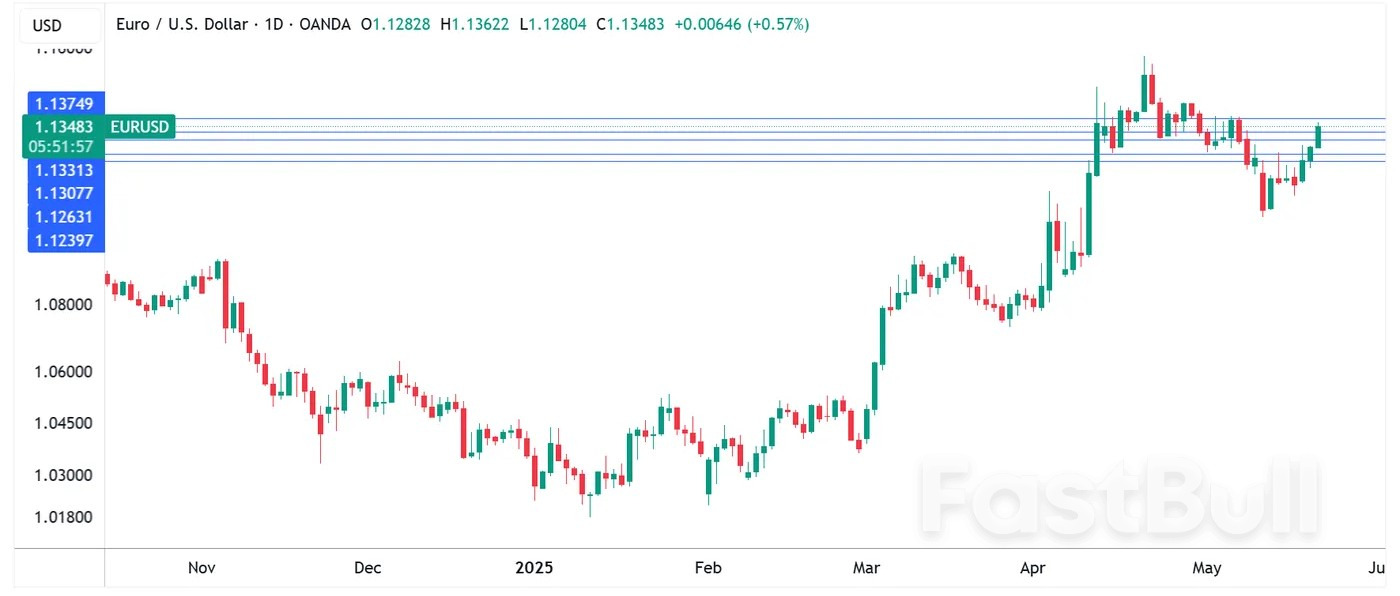
          EUR/USD has pushed above resistance 1.1307 and is testing resistance at 1.1331. Above, there is resistance at 1.1375
          1.1263 and 1.1239 are the next support levels
          Euro rally continues but ECB not smiling_1

          EURUSD 1-Day Chart, May 21, 2025

          Source :marketpulse

          Risk Warnings and Disclaimers
          You understand and acknowledge that there is a high degree of risk involved in trading. Following any strategies or investment methods may lead to potential losses. The content on the site is provided by our contributors and analysts for information purposes only. You are solely responsible for determining whether any trading assets, securities, strategy, or any other product is suitable for investing based on your own investment objectives and financial situation.
          Add to Favorites
          Share
          FastBull
          Copyright © 2025 FastBull Ltd

          728 RM B 7/F GEE LOK IND BLDG NO 34 HUNG TO RD KWUN TONG KLN HONG KONG

          TelegramInstagramTwitterfacebooklinkedin
          App Store Google Play Google Play
          Products
          Charts

          Chats

          Q&A with Experts
          Screeners
          Economic Calendar
          Data
          Tools
          Membership
          Features
          Function
          Markets
          Copy Trading
          Latest Signals
          Contests
          News
          Analysis
          24/7
          Columns
          Education
          Company
          Careers
          About Us
          Contact Us
          Advertising
          Help Center
          Feedback
          User Agreement
          Privacy Policy
          Business

          White Label

          Data API

          Web Plug-ins

          Poster Maker

          Affiliate Program

          Risk Disclosure

          The risk of loss in trading financial instruments such as stocks, FX, commodities, futures, bonds, ETFs and crypto can be substantial. You may sustain a total loss of the funds that you deposit with your broker. Therefore, you should carefully consider whether such trading is suitable for you in light of your circumstances and financial resources.

          No decision to invest should be made without thoroughly conducting due diligence by yourself or consulting with your financial advisors. Our web content might not suit you since we don't know your financial conditions and investment needs. Our financial information might have latency or contain inaccuracy, so you should be fully responsible for any of your trading and investment decisions. The company will not be responsible for your capital loss.

          Without getting permission from the website, you are not allowed to copy the website's graphics, texts, or trademarks. Intellectual property rights in the content or data incorporated into this website belong to its providers and exchange merchants.

          Not Logged In

          Log in to access more features

          FastBull Membership

          Not yet

          Purchase

          Become a signal provider
          Help Center
          Customer Service
          Dark Mode
          Price Up/Down Colors

          Log In

          Sign Up

          Position
          Layout
          Fullscreen
          Default to Chart
          The chart page opens by default when you visit fastbull.com
