• Trade
  • Markets
  • Copy
  • Contests
  • News
  • 24/7
  • Calendar
  • Q&A
  • Chats
Trending
Screeners
SYMBOL
LAST
BID
ASK
HIGH
LOW
NET CHG.
%CHG.
SPREAD
SPX
S&P 500 Index
6827.42
6827.42
6827.42
6899.86
6801.80
-73.58
-1.07%
--
DJI
Dow Jones Industrial Average
48458.04
48458.04
48458.04
48886.86
48334.10
-245.98
-0.51%
--
IXIC
NASDAQ Composite Index
23195.16
23195.16
23195.16
23554.89
23094.51
-398.69
-1.69%
--
USDX
US Dollar Index
97.950
98.030
97.950
98.500
97.950
-0.370
-0.38%
--
EURUSD
Euro / US Dollar
1.17394
1.17409
1.17394
1.17496
1.17192
+0.00011
+ 0.01%
--
GBPUSD
Pound Sterling / US Dollar
1.33707
1.33732
1.33707
1.33997
1.33419
-0.00148
-0.11%
--
XAUUSD
Gold / US Dollar
4299.39
4299.39
4299.39
4353.41
4257.10
+20.10
+ 0.47%
--
WTI
Light Sweet Crude Oil
57.233
57.485
57.233
58.011
56.969
-0.408
-0.71%
--

Community Accounts

Signal Accounts
--
Profit Accounts
--
Loss Accounts
--
View More

Become a signal provider

Sell trading signals to earn additional income

View More

Guide to Copy Trading

Get started with ease and confidence

View More

Signal Accounts for Members

All Signal Accounts

Best Return
  • Best Return
  • Best P/L
  • Best MDD
Past 1W
  • Past 1W
  • Past 1M
  • Past 1Y

All Contests

  • All
  • Trump Updates
  • Recommend
  • Stocks
  • Cryptocurrencies
  • Central Banks
  • Featured News
Top News Only
Share

USA Embassy In Lithuania: Maria Kalesnikava Is Not Going To Vilnius

Share

USA Embassy In Lithuania: Other Prisoners Are Being Sent From Belarus To Ukraine

Share

Ukraine President Zelenskiy: Five Ukrainians Released By Belarus In US-Brokered Deal

Share

USA Vilnius Embassy: USA Stands Ready For "Additional Engagement With Belarus That Advances USA Interests"

Share

USA Vilnius Embassy: Belarus, USA, Other Citizens Among The Prisoners Released Into Lithuania

Share

USA Vilnius Embassy: USA Will Continue Diplomatic Efforts To Free The Remaining Political Prisoners In Belarus

Share

USA Vilnius Embassy: Belarus Releases 123 Prisoners Following Meeting Of President Trump's Envoy Coale And Belarus President Lukashenko

Share

USA Vilnius Embassy: Masatoshi Nakanishi, Aliaksandr Syrytsa Are Among The Prisoners Released By Belarus

Share

USA Vilnius Embassy: Maria Kalesnikava And Viktor Babaryka Are Among The Prisoners Released By Belarus

Share

USA Vilnius Embassy: Nobel Peace Prize Laureate Ales Bialiatski Is Among The Prisoners Released By Belarus

Share

Belarusian Presidential Administration Telegram Channel: Lukashenko Has Pardoned 123 Prisoners As Part Of Deal With US

Share

Two Local Syrian Officials: Joint US-Syrian Military Patrol In Central Syria Came Under Fire From Unknown Assailants

Share

Israeli Military Says It Targeted 'Key Hamas Terrorist' In Gaza City

Share

Rwanda's Actions In Eastern Drc Are A Clear Violation Of Washington Accords Signed By President Trump - Secretary Of State Rubio

Share

Israeli Military Issues Evacuation Warning In Southern Lebanon Village Ahead Of Strike - Spokesperson On X

Share

Belarusian State Media Cites US Envoy Coale As Saying He Discussed Ukraine And Venezuela With Lukashenko

Share

Belarusian State Media Cites US Envoy Coale As Saying That US Removes Sanctions On Belarusian Potassium

Share

Thai Prime Minister: No Ceasefire Agreement With Cambodia

Share

US, Ukraine To Discuss Ceasefire In Berlin Ahead Of European Summit

Share

Incoming Czech Prime Minister Babis: Czech Republic Will Not Take On Guarantees For Ukraine Financing, European Commission Must Find Alternatives

TIME
ACT
FCST
PREV
U.K. Trade Balance Non-EU (SA) (Oct)

A:--

F: --

P: --

U.K. Trade Balance (Oct)

A:--

F: --

P: --

U.K. Services Index MoM

A:--

F: --

P: --

U.K. Construction Output MoM (SA) (Oct)

A:--

F: --

P: --

U.K. Industrial Output YoY (Oct)

A:--

F: --

P: --

U.K. Trade Balance (SA) (Oct)

A:--

F: --

P: --

U.K. Trade Balance EU (SA) (Oct)

A:--

F: --

P: --

U.K. Manufacturing Output YoY (Oct)

A:--

F: --

P: --

U.K. GDP MoM (Oct)

A:--

F: --

P: --

U.K. GDP YoY (SA) (Oct)

A:--

F: --

P: --

U.K. Industrial Output MoM (Oct)

A:--

F: --

P: --

U.K. Construction Output YoY (Oct)

A:--

F: --

P: --

France HICP Final MoM (Nov)

A:--

F: --

P: --

China, Mainland Outstanding Loans Growth YoY (Nov)

A:--

F: --

P: --

China, Mainland M2 Money Supply YoY (Nov)

A:--

F: --

P: --

China, Mainland M0 Money Supply YoY (Nov)

A:--

F: --

P: --

China, Mainland M1 Money Supply YoY (Nov)

A:--

F: --

P: --

India CPI YoY (Nov)

A:--

F: --

P: --

India Deposit Gowth YoY

A:--

F: --

P: --

Brazil Services Growth YoY (Oct)

A:--

F: --

P: --

Mexico Industrial Output YoY (Oct)

A:--

F: --

P: --

Russia Trade Balance (Oct)

A:--

F: --

P: --

Philadelphia Fed President Henry Paulson delivers a speech
Canada Building Permits MoM (SA) (Oct)

A:--

F: --

P: --

Canada Wholesale Sales YoY (Oct)

A:--

F: --

P: --

Canada Wholesale Inventory MoM (Oct)

A:--

F: --

P: --

Canada Wholesale Inventory YoY (Oct)

A:--

F: --

P: --

Canada Wholesale Sales MoM (SA) (Oct)

A:--

F: --

P: --

Germany Current Account (Not SA) (Oct)

A:--

F: --

P: --

U.S. Weekly Total Rig Count

A:--

F: --

P: --

U.S. Weekly Total Oil Rig Count

A:--

F: --

P: --

Japan Tankan Large Non-Manufacturing Diffusion Index (Q4)

--

F: --

P: --

Japan Tankan Small Manufacturing Outlook Index (Q4)

--

F: --

P: --

Japan Tankan Large Non-Manufacturing Outlook Index (Q4)

--

F: --

P: --

Japan Tankan Large Manufacturing Outlook Index (Q4)

--

F: --

P: --

Japan Tankan Small Manufacturing Diffusion Index (Q4)

--

F: --

P: --

Japan Tankan Large Manufacturing Diffusion Index (Q4)

--

F: --

P: --

Japan Tankan Large-Enterprise Capital Expenditure YoY (Q4)

--

F: --

P: --

U.K. Rightmove House Price Index YoY (Dec)

--

F: --

P: --

China, Mainland Industrial Output YoY (YTD) (Nov)

--

F: --

P: --

China, Mainland Urban Area Unemployment Rate (Nov)

--

F: --

P: --

Saudi Arabia CPI YoY (Nov)

--

F: --

P: --

Euro Zone Industrial Output YoY (Oct)

--

F: --

P: --

Euro Zone Industrial Output MoM (Oct)

--

F: --

P: --

Canada Existing Home Sales MoM (Nov)

--

F: --

P: --

Euro Zone Total Reserve Assets (Nov)

--

F: --

P: --

U.K. Inflation Rate Expectations

--

F: --

P: --

Canada National Economic Confidence Index

--

F: --

P: --

Canada New Housing Starts (Nov)

--

F: --

P: --

U.S. NY Fed Manufacturing Employment Index (Dec)

--

F: --

P: --

U.S. NY Fed Manufacturing Index (Dec)

--

F: --

P: --

Canada Core CPI YoY (Nov)

--

F: --

P: --

Canada Manufacturing Unfilled Orders MoM (Oct)

--

F: --

P: --

Canada Manufacturing New Orders MoM (Oct)

--

F: --

P: --

Canada Core CPI MoM (Nov)

--

F: --

P: --

Canada Manufacturing Inventory MoM (Oct)

--

F: --

P: --

Canada CPI YoY (Nov)

--

F: --

P: --

Canada CPI MoM (Nov)

--

F: --

P: --

Canada CPI YoY (SA) (Nov)

--

F: --

P: --

Canada Core CPI MoM (SA) (Nov)

--

F: --

P: --

Q&A with Experts
    • All
    • Chatrooms
    • Groups
    • Friends
    Connecting
    .
    .
    .
    Type here...
    Add Symbol or Code

      No matching data

      All
      Trump Updates
      Recommend
      Stocks
      Cryptocurrencies
      Central Banks
      Featured News
      • All
      • Russia-Ukraine Conflict
      • Middle East Flashpoint
      • All
      • Russia-Ukraine Conflict
      • Middle East Flashpoint
      Search
      Products

      Charts Free Forever

      Chats Q&A with Experts
      Screeners Economic Calendar Data Tools
      Membership Features
      Data Warehouse Market Trends Institutional Data Policy Rates Macro

      Market Trends

      Market Sentiment Order Book Forex Correlations

      Top Indicators

      Charts Free Forever
      Markets

      News

      News Analysis 24/7 Columns Education
      From Institutions From Analysts
      Topics Columnists

      Latest Views

      Latest Views

      Trending Topics

      Top Columnists

      Latest Update

      Signals

      Copy Rankings Latest Signals Become a signal provider AI Rating
      Contests
      Brokers

      Overview Brokers Assessment Rankings Regulators News Claims
      Broker listing Forex Brokers Comparison Tool Live Spread Comparison Scam
      Q&A Complaint Scam Alert Videos Tips to Detect Scam
      More

      Business
      Events
      Careers About Us Advertising Help Center

      White Label

      Data API

      Web Plug-ins

      Affiliate Program

      Awards Institution Evaluation IB Seminar Salon Event Exhibition
      Vietnam Thailand Singapore Dubai
      Fans Party Investment Sharing Session
      FastBull Summit BrokersView Expo
      Recent Searches
        Top Searches
          Markets
          News
          Analysis
          User
          24/7
          Economic Calendar
          Education
          Data
          • Names
          • Latest
          • Prev

          View All

          No data

          Scan to Download

          Faster Charts, Chat Faster!

          Download App
          English
          • English
          • Español
          • العربية
          • Bahasa Indonesia
          • Bahasa Melayu
          • Tiếng Việt
          • ภาษาไทย
          • Français
          • Italiano
          • Türkçe
          • Русский язык
          • 简中
          • 繁中
          Open Account
          Search
          Products
          Charts Free Forever
          Markets
          News
          Signals

          Copy Rankings Latest Signals Become a signal provider AI Rating
          Contests
          Brokers

          Overview Brokers Assessment Rankings Regulators News Claims
          Broker listing Forex Brokers Comparison Tool Live Spread Comparison Scam
          Q&A Complaint Scam Alert Videos Tips to Detect Scam
          More

          Business
          Events
          Careers About Us Advertising Help Center

          White Label

          Data API

          Web Plug-ins

          Affiliate Program

          Awards Institution Evaluation IB Seminar Salon Event Exhibition
          Vietnam Thailand Singapore Dubai
          Fans Party Investment Sharing Session
          FastBull Summit BrokersView Expo

          Brazil Central Bank Keeps May Rate Hike Open Amid Uncertainty, Unclear Activity Trend

          Manuel

          Central Bank

          Forex

          Summary:

          Brazilian policymakers raised interest rates by 100 basis points for the third consecutive time in March, bringing the benchmark Selic rate to 14.25%

          Brazil's central bank has left the size of its upcoming interest rate hike in May open and remains unable to gauge it, citing a still-uncertain economic outlook and inconclusive signs of cooling activity in Latin America's largest economy.
          The message was conveyed on Thursday by two central bank directors during events hosted by Brazilian institutions on the sidelines of the IMF and World Bank Spring Meetings in Washington.
          Brazilian policymakers raised interest rates by 100 basis points for the third consecutive time in March, bringing the benchmark Selic rate to 14.25%, fully adhering to a forward guidance they had issued in December.
          The bank signaled a further, albeit smaller, hike for May, but stopped short of specifying its size, unlike previous instances when it explicitly indicated that 100 basis-point increases were appropriate.
          Speaking at an event hosted by brokerage XP, the bank's economic policy director Diogo Guillen said that policymakers must be "extra cautious" and "more flexible" in the face of heightened uncertainty, as the current environment clouds interest rate guidance.
          Also speaking at a sideline event in Washington, on Wednesday, monetary policy director Nilton David said he was skeptical about providing forward guidance due to the uncertainty in between meetings, which could have an impact on domestic inflation.
          Paulo Picchetti, the bank's director of international affairs, emphasized at an event hosted by lender Itau later in the day that policymakers have left the outcome of May's monetary policy meeting open and there is little more he can say about future decisions given the current environment.
          "There are very important elements that will impact our decision about which you don't have a clear picture yet," he said.
          Picchetti also acknowledged that two key variables of the current tightening cycle remain unclear - its total size and duration.
          "Both are open now. They will be analyzed and communicated through time in the best manner for us to believe that they can shift expectations towards the (inflation) target we have a mandate to achieve," he said.
          Picchetti stressed that domestic economic indicators can be interpreted in various ways and that "none of them, I believe, presents a clear trend for us to base decisions."
          According to Guillen, there is no concrete evidence of an economic slowdown in the country, noting that signals vary significantly across different sectors.
          He said the central bank's previous language referring to "incipient signs" of moderation remains an appropriate way to describe the current situation.
          Guillen defended the effectiveness of the bank's monetary policy and said its reaction function remains stable, with decisions based on the same factors whether in tightening or easing cycles.
          "It's a world of high uncertainty," said Guillen.
          "When you have less uncertainty, you can provide more visibility and have a better commitment. When you have higher uncertainty, you commit less and incorporate more the data," he added.
          Guillen said that in the central bank's latest analysis ahead of its policy decision, the only point of consensus among all members of the rate-setting board was their discomfort with inflation expectations.
          He noted that while expectations remain unanchored, they are now more stable than last year, when they were drifting further from the official 3% target.
          Guillen also pointed to persistently high and sticky services inflation, saying it feeds into the bank's models and implies a more positive output gap.

          Source: Reuters

          Risk Warnings and Disclaimers
          You understand and acknowledge that there is a high degree of risk involved in trading. Following any strategies or investment methods may lead to potential losses. The content on the site is provided by our contributors and analysts for information purposes only. You are solely responsible for determining whether any trading assets, securities, strategy, or any other product is suitable for investing based on your own investment objectives and financial situation.
          Add to Favorites
          Share

          Wall Street Rally Powers On as Fed-Cut Wagers Grow: Markets Wrap

          Manuel

          Stocks

          Economic

          Wall Street investors weighing the impacts of President Donald Trump’s trade war on Corporate America sent stocks climbing on bets the Federal Reserve could cut rates sooner than anticipated to prevent a recession.
          The rally in equities drove the S&P 500 up about 2%, toward the highest since the day Trump announced his tariff offensive. The president said the US is talking with China on trade despite Beijing’s denial. Big tech led gains before Alphabet Inc.’s earnings. Bond yields slid on wagers Fed Chair Jerome Powell will be under pressure to ease policy if the labor market unravels.
          In an interview with Bloomberg Television, Fed Governor Christopher Waller said he’d support rate cuts in the event aggressive tariff levels hurt the jobs market. Fed Bank of Cleveland President Beth Hammack told CNBC the central bank could move on rates as early as June if it has clear evidence of the economy’s direction.
          “While the Fed has maintained a cautious approach to monetary easing, we believe it will be willing and able to respond to signs of economic weakness, especially rising layoffs,” said Ulrike Hoffmann-Burchardi at UBS Global Wealth Management.
          Trump’s tariffs are more likely to hurt growth than spur inflation, Myles Bradshaw at JPMorgan Asset Management told Bloomberg Television. He expects the US central bank will eventually need to cut rates more aggressively, having kept policy on hold for longer.
          As traders waded through the latest batch of earnings, Texas Instruments Inc. jumped on a bullish forecast, while International Business Machines Corp.’s solid results failed to impress investors.
          Among companies showing unease about prospects for the economy are American Airlines Group Inc., which withdrew its full-year earnings outlook, while PepsiCo Inc. and Procter & Gamble Co. lowered their forecasts.
          The looming impact of higher costs from the Trump administration’s trade policy is making it very difficult for the corporate world to forecast how the year will play out as consumers brace for economic pain.
          “Companies with direct impact from tariffs are generally being forthcoming, providing guide that incorporates the full brunt of both blanket and reciprocal tariffs,” said John Belton at Gabelli Funds.
          In another sign of how firms are growing cautious amid uncertainty surrounding tariffs and tax policy, data Thursday showed orders placed with US factories for business equipment barely rose in March.
          “Companies are front-running the tariffs, so these durable goods data aren’t something to get excited about,” said Jamie Cox at Harris Financial Group. “The good news is that companies are protecting their earnings and margins, and investors will be happy about that.”
          Yet several analysts are already souring on the profit outlook due to the risk of an economic slowdown, with the US benchmark’s earnings revisions breadth — or estimated upgrades versus downgrades — approaching downside extremes.
          One of Wall Street’s biggest bulls is seeing tariffs hitting corporate America the hardest. Deutsche Bank AG’s Bankim Chadha slashed his year-end S&P 500 target to 6,150. He also sees S&P 500 earnings declining 5% this year, compared with a consensus expecting 8% growth.
          “Investors should continue to focus on the long term, with an eye toward companies with high earnings achievability, limited tariff exposure, and quality balance sheets, “ said Daniel Skelly, head of Morgan Stanley’s Wealth Management Market Research & Strategy Team.
          While stocks stocks have finally found breathing room, that doesn’t mean pressure points that rattled the market are gone, according to Goldman Sachs Group Inc.’s Flow of Funds team.
          “Much like an 80 degree day in NYC in April, I wouldn’t jump into the pool just yet,” the funds specialists wrote in a note to clients this week.
          “We continue to expect very volatile trading heading into and including next week,” said Dan Wantrobski at Janney Montgomery Scott. “This includes the potential for explosive moves in either direction.”
          He also noted that the 5,500 level in the S&P 500 remains a key resistance level to watch. That’s roughly a 50% retracement of the entire correction cycle to date, he added.
          “Rallying above this on a closing basis would generate a bullish technical signal and help put the bulls back in charge of the field,” he concluded.
          Craig Johnson at Piper Sandler noted that while the recent rally is constructive, he’s also monitoring the S&P 500’s March lows around 5,500 as a key resistance.
          “Until buyers overcome that level, ideally with increased volume, more backing and filling is likely,” he said. “However, once 5,500 is successfully cleared, we are likely to see another leg up toward 5,800.”

          Source: Bloomberg

          To stay updated on all economic events of today, please check out our Economic calendar
          Risk Warnings and Disclaimers
          You understand and acknowledge that there is a high degree of risk involved in trading. Following any strategies or investment methods may lead to potential losses. The content on the site is provided by our contributors and analysts for information purposes only. You are solely responsible for determining whether any trading assets, securities, strategy, or any other product is suitable for investing based on your own investment objectives and financial situation.
          Add to Favorites
          Share

          Japan, US Finance Chiefs Meet for Talks on Currency Rates

          Manuel

          Forex

          Central Bank

          Japanese and U.S. finance chiefs meet on Thursday for high-stakes talks on exchange rates that have drawn market attention as a venue where Washington could pressure Tokyo to prop up the yen and help it reduce the huge U.S. trade deficit.
          As the two countries proceed with separate bilateral talks on tariffs, the thorny currency rate topic has been set aside for Japanese Finance Minister Katsunobu Kato and U.S. Treasury Secretary Scott Bessent to discuss in Washington - the first face-to-face talks between the two.
          U.S. President Donald Trump's focus on addressing the trade deficit, and his past remarks criticizing Japan for intentionally maintaining a weak yen, have led to market expectations that Tokyo will face pressure to strengthen the yen's value against the dollar and give U.S. manufacturers a competitive advantage.
          Such expectations have pushed up the yen against the dollar by about 9% since Trump's return to office in January.
          Bessent has also said he was looking forward to discussions with Japan on tariff, non-tariff barriers and exchange rates.
          So far, Japan has revealed little on its strategy, saying it will negotiate with the U.S. based on a shared understanding that currency rates should be set by markets, and that excessive market volatility would have an adverse impact on growth.
          "The only thing I can say is that we will actively exchange views based on Japan's basic stance" on currencies, Kato told Reuters last week, when asked what he may discuss with Bessent.
          But sources have told Reuters that Japanese policymakers see little scope for direct action such as currency intervention or an immediate interest rate hike by the central bank.

          HEIGHTENED UNCERTAINTY

          Japan's latest foray into the exchange-rate market was in 2024, when it bought yen to prop up the currency from a nearly three-decade low of 161.99 to the dollar hit in early July.
          With broad-based dollar declines already having pushed up the yen to around 140 per dollar, Japanese officials are wary of taking steps to further strengthen the currency for fear of narrowing exporters' margins at a time of tariff strains.
          The hurdle is even higher to use Japan's monetary policy as a means to prop up the yen. The Bank of Japan is in no mood to rush into hiking rates at a time Trump's tariffs threaten to derail Japan's fragile economic recovery.
          For Japanese finance authorities, the focus would be to avoid being forced to make explicit exchange-rate commitments as part of a broader bilateral trade deal, as doing so could tie their hands in dealing with sharp moves in the yen.
          Bessent said on Wednesday the U.S. does not have specific currency targets in mind as part of bilateral trade talks with Japan, offering some relief for Japan.
          In a sign of Japan's sensitivity over exchange rate moves, Kato said he told a meeting of G20 finance chiefs on Wednesday that U.S. tariff measures have heightened uncertainty, destabilized markets including currency rates, and hurt growth.
          "The G20 must monitor developments carefully, exchange information, and coordinate in responding nimbly to maintain economic and market stability," Kato told a news conference after attending the G7 and G20 finance leaders' meetings in Washington.
          The meeting between Kato and Bessent on Thursday afternoon will be followed by a scheduled visit to Washington by Japan's top trade negotiator Ryosei Akazawa next week for a second round of bilateral trade talks.

          Source: Reuters

          Risk Warnings and Disclaimers
          You understand and acknowledge that there is a high degree of risk involved in trading. Following any strategies or investment methods may lead to potential losses. The content on the site is provided by our contributors and analysts for information purposes only. You are solely responsible for determining whether any trading assets, securities, strategy, or any other product is suitable for investing based on your own investment objectives and financial situation.
          Add to Favorites
          Share

          SoftBank Is Buying Bitcoin Again, After $130M Loss in 2018. Is This Time Different?

          Manuel

          Cryptocurrency

          Japanese investment giant SoftBank is dipping its toes back into crypto by backing a new bitcoin (BTC) investment vehicle, Twenty One Capital, in conjunction with Tether, Bitfinex, and Cantor Fitzgerald.
          For some, the SoftBank Group—which has $308.7 billion assets under management—taking an interest in bitcoin is a welcome development and another sign of mounting institutional crypto adoption. After all, SoftBank functions more or less like a Japanese sovereign wealth fund, according to Jeff Park, head of alpha strategies at Bitwise.
          But for seasoned observers, it could be more of a déjà-vu than a breakthrough.
          Flashback to 2019, SoftBank made headlines when its founder, Masayoshi Son, took a gigantic loss on a personal bitcoin investment.
          Son had taken exposure to cryptocurrency in late 2017, when the ICO mania was at its peak and bitcoin was trading at an all-time high of around $20,000.
          With bitcoin now trading at $93,000, Son’s investment would have been very profitable had he held on. But he sold in early 2018 as bitcoin began to crash, resulting in a $130 million loss, according to the Wall Street Journal.
          So the question investors could be asking themselves now is, would this time be different?.
          To find a clue, let's take Oracle (ORCL) stock as an example. Recently, U.S. President Donald Trump announced that SoftBank would be part of a $100 billion push to build AI infrastructure in the U.S. in conjunction with OpenAI and Oracle (ORCL).
          One would say this is a bullish outcome for ORCL stock. However, since the announcement was made on Jan. 22, coinciding with ORCL topping at $188 per share, the stock fell 28%, while the Nasdaq has gone down 12% in the same period of time.
          Other outside factors, including macro headwinds and geopolitical tension, could explain the underperformance. It could also be just a plain coincidence. However, one analyst tied this Oracle selloff to Softbank's involvement in the AI infrastructure project.
          “When SoftBank enters an asset you own, you sell. I don't make the rules,” Quinn Thompson, founder of crypto hedge fund Lekker Capital, wrote in a post on X, citing the Oracle pullback.

          Source: CoinDesk

          Risk Warnings and Disclaimers
          You understand and acknowledge that there is a high degree of risk involved in trading. Following any strategies or investment methods may lead to potential losses. The content on the site is provided by our contributors and analysts for information purposes only. You are solely responsible for determining whether any trading assets, securities, strategy, or any other product is suitable for investing based on your own investment objectives and financial situation.
          Add to Favorites
          Share

          Bitcoin rebounds as bulls eye $100K and bears scramble to cover short positions

          Adam

          Cryptocurrency

          Bitcoin held above the $93,000 mark on April 24, suggesting a potential conclusion to the 52-day bear market that bottomed at $74,400. Although Bitcoin is beginning to show signs of decoupling from the stock market, professional traders have not altered their strategies, as indicated by BTC futures and margin market data.
          Bitcoin rebounds as bulls eye $100K and bears scramble to cover short positions_1

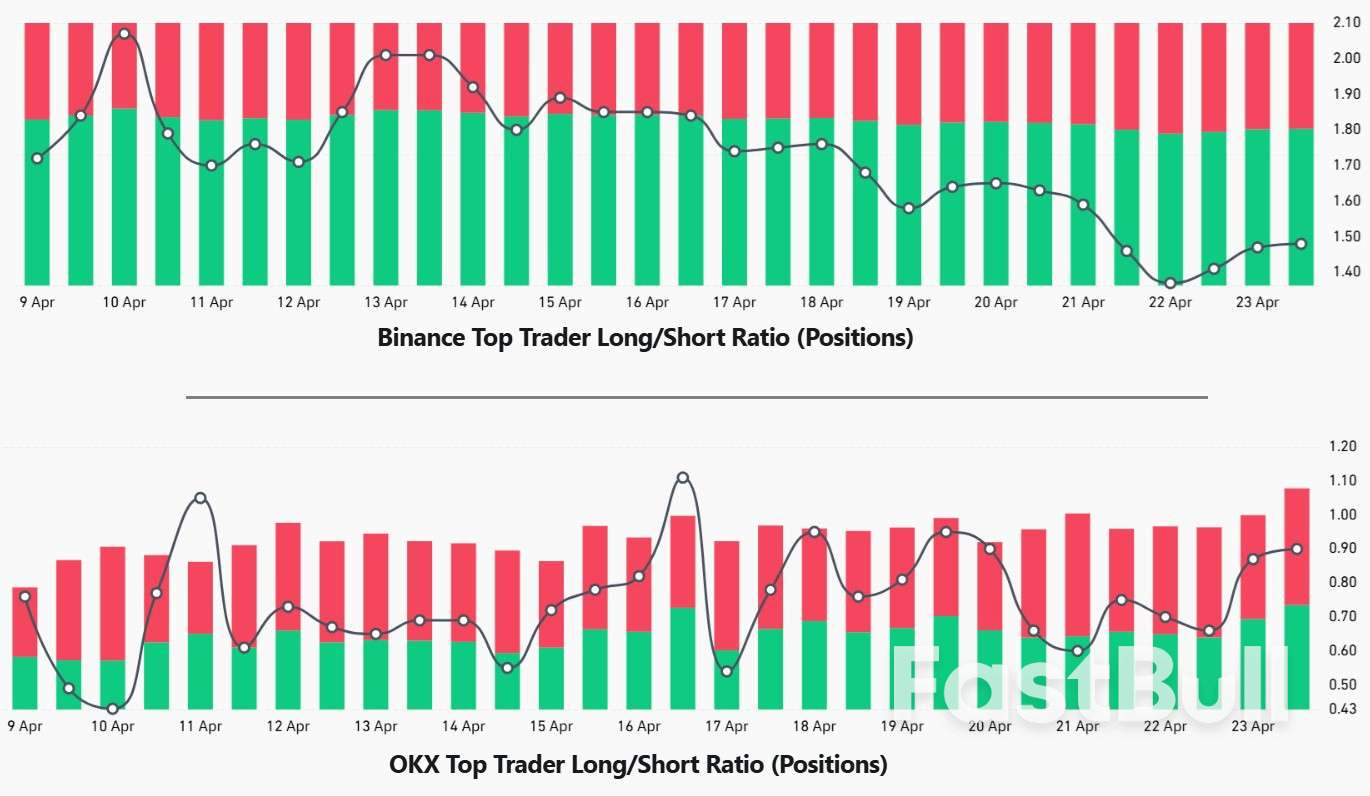
          BTC top traders' long-to-short ratio

          A higher long-to-short ratio reflects a preference for long (buy) positions, while a lower ratio indicates a tilt toward short (sell) contracts. Currently, the top traders’ long-to-short ratio on Binance stands at 1.5x, a notable decrease from the 2x level observed ten days earlier. At OKX, the ratio peaked near 1.1x on April 17 but has since lost momentum and now sits at 0.9x.

          Bitcoin shines as dollar weakens and S&P 500 targets are slashed

          Bitcoin’s 10% rally between April 20 and April 24 coincided with a more conciliatory stance from US President Donald Trump regarding import tariffs and his criticism of Federal Reserve Chair Jerome Powell, who has faced scrutiny for maintaining high interest rates. On April 24, Trump stated he had “no intention” of firing Powell, marking a notable shift from his previous rhetoric.
          Amid economic uncertainty, Deutsche Bank strategists have reduced their year-end S&P 500 target by 12% to 6,150. Meanwhile, the US dollar has weakened against other major currencies, pushing the DXY index below 99 for the first time in three years. Despite a modest 6% gain over the past 30 days, Bitcoin’s performance has secured it a place among the world’s top eight tradable assets, with a market capitalization of $1.84 trillion.
          The sharp move above $90,000 caught Bitcoin bears off guard, resulting in over $390 million in leveraged short (sell) futures liquidations between April 21 and April 22. More significantly, aggregate open interest in BTC futures remains just 5% below its all-time high, indicating that bearish traders have not fully exited their positions.
          Bitcoin rebounds as bulls eye $100K and bears scramble to cover short positions_2

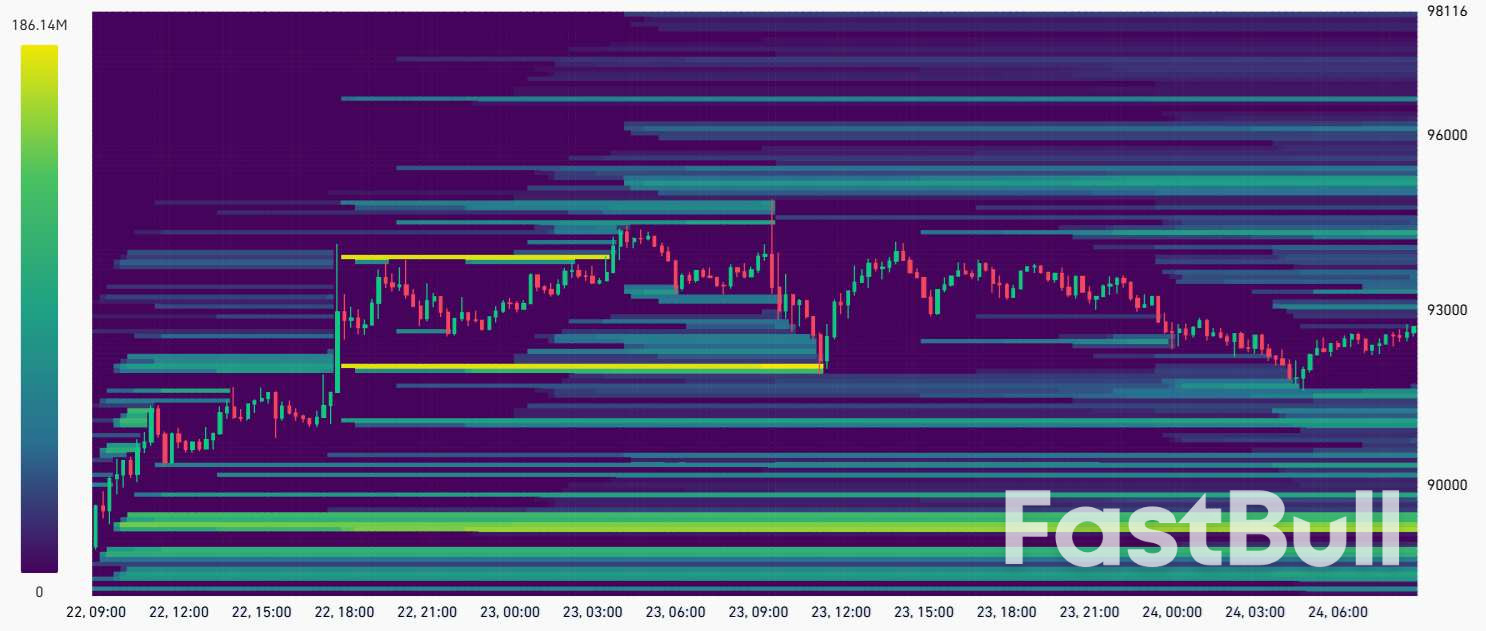
          BTC futures liquidation heatmap, USD

          If Bitcoin’s price maintains its upward momentum and breaks above $95,000, an additional $700 million in short (sell) futures positions could be liquidated, according to CoinGlass data. This potential short squeeze may prove especially challenging for bears, given the robust inflows into spot Bitcoin exchange-traded funds (ETFs), which totaled over $2.2 billion between April 21 and April 23.
          A newly announced joint venture involving SoftBank, Cantor Fitzgerald, and Tether aims to accumulate Bitcoin through convertible bonds and equity financing, which could further strengthen the bullish case. Named “Twenty One Capital,” the Bitcoin treasury company is led by Strike founder Jack Mallers and plans to launch with 42,000 BTC.
          The muted response from top traders in BTC margin and futures markets suggests that the recent buying pressure has originated mainly from spot markets, which is generally considered a positive indicator for a sustainable bull run.
          The longer Bitcoin consolidates above $90,000, the greater the pressure on bears to cover their shorts, as this level reinforces the narrative that Bitcoin is decoupling from the stock market. This could provide the confidence needed to challenge the $100,000 psychological threshold.

          source : cointelegraph

          Risk Warnings and Disclaimers
          You understand and acknowledge that there is a high degree of risk involved in trading. Following any strategies or investment methods may lead to potential losses. The content on the site is provided by our contributors and analysts for information purposes only. You are solely responsible for determining whether any trading assets, securities, strategy, or any other product is suitable for investing based on your own investment objectives and financial situation.
          Add to Favorites
          Share

          The Market is Cheering Trump's Positive Tariff Aignals, Deal details Remain Scarce.

          Manuel

          Economic

          Political

          President Trump and his team have been aggressive this week in touting their ambitious efforts to strike trade deals.
          "We are doing well with every country," the president said Tuesday afternoon, noting how investors seemed to be noticing: "I see the stock market was up nicely."
          But the claims, which have indeed helped spur a market boost that continued Wednesday morning, haven’t yet been backed by concrete signs of progress.
          Markets pulled back on Thursday as the White House sent conflicting signals on trade. Treasury Secretary Scott Bessent cast doubt on a swift resolution to the US-China tariff dispute, adding to investor confusion. The back-and-forth from officials has made it difficult to gauge the true direction of policy, fueling uncertainty.
          The closest thing to public receipts, as Trump officials like to say, are agreements that essentially boil down to a plan to begin formal talks. The term of art in one recent back and forth was the finalizing of "terms of reference for the trade negotiation."
          And it's unclear the status of other major talks — especially with China.
          "We're talking to China," offered Trump last week before sidestepping that question Tuesday and then saying Wednesday, "everything is active."
          That last comment came at roughly the same time that Treasury Secretary Scott Bessent told reporters in a roundtable that tariffs between the US and China need to come down first before talks can begin between the two economies.
          "We are engaged in meaningful discussions and look forward to talking with others," Bessent added Wednesday in a speech. "China in particular is in need of a rebalancing."
          China had previously signaled it wanted to wait on formal talks until it saw things like more "respect."
          Foreign Ministry Spokesperson Guo Jiakun responded to Trump's recent comments Tuesday by saying, according to a translation, "We don't want a trade war, but we are not afraid of one." Yet, he added, "Our doors are wide open."
          These plans and a flood of accompanying optimistic language boosted stock prices alongside a series of signs that Trump is easing back on some of his hard-line tariff signals, including a new Wall Street Journal report Wednesday that he is considering cutting rates on China.
          Secretary Bessent declined to comment on that report Wednesday, saying he would be surprised if discussions on slashing tariffs by the administration are happening, noting, “No unilateral offer from the president to deescalate, not at all.”
          He instead wants tariffs to decline in a "mutual way,” but perhaps the question is how patient markets will continue to be amid what former Treasury official Brad Setser recently described as a “consistent gap” between White House rhetoric and the apparent status in actual talks.
          "I think the administration has been spinning a bit too hard here," added Setser, a fellow at the Council on Foreign Relations, in a recent Yahoo Finance appearance. "They want to give the stock market a little bit of hope, but the actual negotiations don't seem to be moving nearly as fast."
          It’s part of a pattern that has been seen throughout the Trump administration so far, on issues from Ukraine to Israel to trade, where the White House has opened negotiations on a vast number of fronts — with the president himself often promising a deal will be quick and easy — before actual progress has been slow.
          But on trade talks in particular, some suggest that market patience could soon run out.
          "He needs to get a deal done or this is going to continue to unravel," added Mahoney Asset Management CEO Ken Mahoney, describing the challenges of investing amid "Hurricane Donald."

          'Ask me in July'

          The gap between rhetoric and concrete results so far has been in evidence throughout the week.
          Vice President JD Vance traveled to India and announced "significant progress" toward “a new and modern trade agreement,” but declined to lay out much detail on exactly what the agreement could entail beyond the aforementioned “terms of reference.”
          By Tuesday afternoon, White House press secretary Karoline Leavitt touted what she said were 18 formal trade proposals that the administration had received from countries — but then declined to answer follow-ups about whether any of those proposals were acceptable.
          Leavitt also didn't say whether other possible initial agreements that fall short of a full trade deal would be enough to stave off new tariffs this summer. Politico reported Tuesday the White House was close to such agreements with Japan and India.
          “Ask me in July," Leavitt responded in reference to the deadline for the 90-day tariff pause Trump announced earlier this month.
          By the evening, Trump himself further boosted investor optimism when he weighed in to say China’s 145% tariffs would eventually “come down substantially” — but then offered little sense of the talks, saying at one point, "If we don’t make a deal we’ll set it, we’ll just set the number."

          Source: Yahoo Finance

          To stay updated on all economic events of today, please check out our Economic calendar
          Risk Warnings and Disclaimers
          You understand and acknowledge that there is a high degree of risk involved in trading. Following any strategies or investment methods may lead to potential losses. The content on the site is provided by our contributors and analysts for information purposes only. You are solely responsible for determining whether any trading assets, securities, strategy, or any other product is suitable for investing based on your own investment objectives and financial situation.
          Add to Favorites
          Share

          Has the stock market hit bottom? History is a guide

          Adam

          Stocks

          US stocks soared Wednesday, but the S&P 500 is still trying to climb out of a slump instigated by President Donald Trump’s trade war.
          After hitting a record high in February, the S&P 500 dropped into correction in March as Trump unveiled his plan for tariffs. The benchmark index as of Wednesday was still down 12.5% from its peak two months ago. (A 10% decline from a peak is considered a correction. A 20% decline from a peak is considered a bear market).
          The S&P 500 has shed $6.5 trillion in market value since its record high in February, according to Howard Silverblatt, senior index analyst at S&P Dow Jones Indices.
          As stocks have gyrated, investors are wondering when the market might find a bottom.
          The truth is: No one can know for sure.
          The market hit its lowest closing price this year on April 8, down 18.9% from its February peak. The S&P 500 has yet to test that low again, and it’s anyone’s guess whether the market continues climbing higher.
          While uncertainty is rife, history can serve as a guide as to when the S&P 500 might find a bottom.

          Four months to bottom, historically

          The S&P has had 24 corrections since the end of World War II, according to Sam Stovall, chief investment strategist at CFRA Research. Historically, when the S&P entered correction but did not enter a bear market, it took the index an average of 133 days to find a bottom, and an average of 113 days to recover.
          If April 8 turns out to be the market’s bottom, it would be just 48 days from February’s peak to bottom — much faster than the historical average.
          Additionally, it has historically taken the S&P 500 an average of 77 days to go from a peak to confirming a correction, according to Stovall. This year, it took the benchmark index just 22 days to confirm a correction (a peak on February 19 to a correction on March 13), which is also much faster than the historical average.
          Typically, when there is a sharp decline from a peak to correction, the slump tends to be relatively short before the market recovers, according to Stovall.
          “Swift declines tend to be shallow and short-lived,” he said. “History is a great guide, but it’s never gospel, so we’ll have to wait and see whether that will hold true.”
          And vast uncertainty looms. The market correction this year has been driven by the White House’s policy, Stovall said, which is historically rare.
          “The only problem is that this is what I call a manufactured correction, meaning that it started because Trump initiated a trade war,” he said. “It is because of what the current administration is doing.”

          Retesting the low and 1987

          The S&P 500’s closing price on April 8 was 4,982.77. Some Wall Street analysts expect the market to “retest” that low before finding a bottom.
          “In order for the April 8 lows to hold, investors must see enough of a trade policy shift to give them hope that the worst has passed,” said Nick Colas, co-founder of DataTrek Research, in a Monday note.
          Colas noted that “modern market lore” about retesting lows can go back to the 1987 market crash. On October 19, 1987, The S&P 500 plummeted 20.5% before rebounding about 14% across the next two days. Yet the benchmark index struggled to hold on to those gains and eventually retested its October low point in December. Despite briefly falling below the October low, the December retest turned out to be the bottom.
          “Then … the index rallied 10.3% through year end,” Colas said. “Investors saw that as an ‘all clear’ sign, and the S&P went on to gain 16.5% in 1988.”
          Colas noted that not every market slump historically needed to retest its low, though he said it is “likely” this year due to the amount of uncertainty swirling through markets.
          Ed Yardeni, president of Yardeni Research, said in a Monday note that the S&P 500 is likely to retest its April 8 low and “probably find support there.”
          “If so, then the market may be forming a bottom,” Yardeni said.

          V-shaped recovery or sideways grind

          The last time the S&P 500 entered a correction was in 2023, when it fell from a peak on July 31 to a bottom on October 27. After hitting a bottom, the S&P 500 recovered swiftly in just 24 days.
          Adam Turnquist, chief technical strategist at LPL Financial, said he has been hesitant to call for a swift recovery this year. He said he has not seen the hallmark signs of a recovery, like investors shifting out of defensive stocks and into cyclical stocks.
          “It’s still very defensive right now, which gave us pause in terms of calling for any type of V-shaped recovery,” he said. “In terms of history, more often than not, you tend to retest the lows.”
          Turnquist said it seems like “peak fear” has passed, which could be a good sign for momentum. The CBOE Volatility Index, or Wall Street’s fear gauge, hit its highest level this year on April 8. CNN’s Fear and Greed index also slumped to its lowest level this year on April 8.
          “What comes next is a grind sideways as we need to build a base to begin the next leg up,” said Kim Abmeyer, a certified financial planner and founder of Abmeyer Wealth Management.
          Larry Tentarelli, founder of Blue Chip Daily Trend Report, said in a Wednesday note that the “key range levels” for the S&P 500 are 5,100 and 5,500. At Wednesday’s close, the index stood right in the middle at 5,376.
          “Whichever level breaks first on a closing basis will likely signal the next leg of this move,” Tentarelli said.
          There has also been pervasive bearish sentiment in the market, which can be a buying signal. The latest survey from the American Association of Individual Investors showed that for the past eight weeks, more than 50% of respondents have been bearish on the US stock market.
          Yet there are less optimistic signs, too. The S&P 500 on April 14 experienced what Wall Street calls a “death cross,” when the index’s 50-day moving average closed below its 200-day moving average. That can be a sign of more selling to come, according to Stovall.

          Markets reward patience

          It is incredibly difficult to pinpoint a market bottom in the midst of a slump. What matters for investors is being patient and having a plan, according to Yusuf Abugideiri, a certified financial planner and chief investment officer at Yeske Buie.
          “The patient, disciplined, policy-based investor ultimately is going to be rewarded over the long run,” Abugideiri said. “That’s the way the market makes you work for the returns. You’ve got to be patient; you’ve got to be disciplined.”
          Younger investors with long-term goals should see a market correction as a buying opportunity while stocks are on sale, he said. Meanwhile, if you are approaching retirement, diversifying your portfolio into more Treasuries and cash equivalents like money market funds can help protect your investments.
          While a variety of factors influence finding a bottom, Abugideiri said, the outlook for the market largely hinges on investors getting more clarity from the White House.
          “If investors get more clarity and have to deal with less uncertainty, markets are going to react favorably,” Abugideiri said.

          Source: edition.cnn

          Risk Warnings and Disclaimers
          You understand and acknowledge that there is a high degree of risk involved in trading. Following any strategies or investment methods may lead to potential losses. The content on the site is provided by our contributors and analysts for information purposes only. You are solely responsible for determining whether any trading assets, securities, strategy, or any other product is suitable for investing based on your own investment objectives and financial situation.
          Add to Favorites
          Share
          FastBull
          Copyright © 2025 FastBull Ltd

          728 RM B 7/F GEE LOK IND BLDG NO 34 HUNG TO RD KWUN TONG KLN HONG KONG

          TelegramInstagramTwitterfacebooklinkedin
          App Store Google Play Google Play
          Products
          Charts

          Chats

          Q&A with Experts
          Screeners
          Economic Calendar
          Data
          Tools
          Membership
          Features
          Function
          Markets
          Copy Trading
          Latest Signals
          Contests
          News
          Analysis
          24/7
          Columns
          Education
          Company
          Careers
          About Us
          Contact Us
          Advertising
          Help Center
          Feedback
          User Agreement
          Privacy Policy
          Business

          White Label

          Data API

          Web Plug-ins

          Poster Maker

          Affiliate Program

          Risk Disclosure

          The risk of loss in trading financial instruments such as stocks, FX, commodities, futures, bonds, ETFs and crypto can be substantial. You may sustain a total loss of the funds that you deposit with your broker. Therefore, you should carefully consider whether such trading is suitable for you in light of your circumstances and financial resources.

          No decision to invest should be made without thoroughly conducting due diligence by yourself or consulting with your financial advisors. Our web content might not suit you since we don't know your financial conditions and investment needs. Our financial information might have latency or contain inaccuracy, so you should be fully responsible for any of your trading and investment decisions. The company will not be responsible for your capital loss.

          Without getting permission from the website, you are not allowed to copy the website's graphics, texts, or trademarks. Intellectual property rights in the content or data incorporated into this website belong to its providers and exchange merchants.

          Not Logged In

          Log in to access more features

          FastBull Membership

          Not yet

          Purchase

          Become a signal provider
          Help Center
          Customer Service
          Dark Mode
          Price Up/Down Colors

          Log In

          Sign Up

          Position
          Layout
          Fullscreen
          Default to Chart
          The chart page opens by default when you visit fastbull.com