Markets
News
Analysis
User
24/7
Economic Calendar
Education
Data
- Names
- Latest
- Prev


Signal Accounts for Members
All Signal Accounts
All Contests


France Trade Balance (SA) (Oct)A:--
F: --
Euro Zone Employment YoY (SA) (Q3)A:--
F: --
Canada Part-Time Employment (SA) (Nov)A:--
F: --
P: --
Canada Unemployment Rate (SA) (Nov)A:--
F: --
P: --
Canada Full-time Employment (SA) (Nov)A:--
F: --
P: --
Canada Labor Force Participation Rate (SA) (Nov)A:--
F: --
P: --
Canada Employment (SA) (Nov)A:--
F: --
P: --
U.S. PCE Price Index MoM (Sept)A:--
F: --
P: --
U.S. Personal Income MoM (Sept)A:--
F: --
P: --
U.S. Core PCE Price Index MoM (Sept)A:--
F: --
P: --
U.S. PCE Price Index YoY (SA) (Sept)A:--
F: --
P: --
U.S. Core PCE Price Index YoY (Sept)A:--
F: --
P: --
U.S. Personal Outlays MoM (SA) (Sept)A:--
F: --
U.S. 5-10 Year-Ahead Inflation Expectations (Dec)A:--
F: --
P: --
U.S. Real Personal Consumption Expenditures MoM (Sept)A:--
F: --
U.S. Weekly Total Rig CountA:--
F: --
P: --
U.S. Weekly Total Oil Rig CountA:--
F: --
P: --
U.S. Consumer Credit (SA) (Oct)A:--
F: --
China, Mainland Foreign Exchange Reserves (Nov)A:--
F: --
P: --
Japan Trade Balance (Oct)A:--
F: --
P: --
Japan Nominal GDP Revised QoQ (Q3)A:--
F: --
P: --
China, Mainland Imports YoY (CNH) (Nov)A:--
F: --
P: --
China, Mainland Exports (Nov)A:--
F: --
P: --
China, Mainland Imports (CNH) (Nov)A:--
F: --
P: --
China, Mainland Trade Balance (CNH) (Nov)A:--
F: --
P: --
China, Mainland Exports YoY (USD) (Nov)A:--
F: --
P: --
China, Mainland Imports YoY (USD) (Nov)A:--
F: --
P: --
Germany Industrial Output MoM (SA) (Oct)A:--
F: --
Euro Zone Sentix Investor Confidence Index (Dec)A:--
F: --
P: --
Canada National Economic Confidence IndexA:--
F: --
P: --
U.K. BRC Like-For-Like Retail Sales YoY (Nov)--
F: --
P: --
U.K. BRC Overall Retail Sales YoY (Nov)--
F: --
P: --
Australia Overnight (Borrowing) Key Rate--
F: --
P: --
RBA Rate Statement
RBA Press Conference
Germany Exports MoM (SA) (Oct)--
F: --
P: --
U.S. NFIB Small Business Optimism Index (SA) (Nov)--
F: --
P: --
Mexico 12-Month Inflation (CPI) (Nov)--
F: --
P: --
Mexico Core CPI YoY (Nov)--
F: --
P: --
Mexico PPI YoY (Nov)--
F: --
P: --
U.S. Weekly Redbook Index YoY--
F: --
P: --
U.S. JOLTS Job Openings (SA) (Oct)--
F: --
P: --
China, Mainland M1 Money Supply YoY (Nov)--
F: --
P: --
China, Mainland M0 Money Supply YoY (Nov)--
F: --
P: --
China, Mainland M2 Money Supply YoY (Nov)--
F: --
P: --
U.S. EIA Short-Term Crude Production Forecast For The Year (Dec)--
F: --
P: --
U.S. EIA Natural Gas Production Forecast For The Next Year (Dec)--
F: --
P: --
U.S. EIA Short-Term Crude Production Forecast For The Next Year (Dec)--
F: --
P: --
EIA Monthly Short-Term Energy Outlook
U.S. API Weekly Gasoline Stocks--
F: --
P: --
U.S. API Weekly Cushing Crude Oil Stocks--
F: --
P: --
U.S. API Weekly Crude Oil Stocks--
F: --
P: --
U.S. API Weekly Refined Oil Stocks--
F: --
P: --
South Korea Unemployment Rate (SA) (Nov)--
F: --
P: --
Japan Reuters Tankan Non-Manufacturers Index (Dec)--
F: --
P: --
Japan Reuters Tankan Manufacturers Index (Dec)--
F: --
P: --
Japan Domestic Enterprise Commodity Price Index MoM (Nov)--
F: --
P: --
Japan Domestic Enterprise Commodity Price Index YoY (Nov)--
F: --
P: --
China, Mainland PPI YoY (Nov)--
F: --
P: --
China, Mainland CPI MoM (Nov)--
F: --
P: --


No matching data
Latest Views
Latest Views
Trending Topics
Top Columnists
Latest Update
White Label
Data API
Web Plug-ins
Affiliate Program
View All

No data
Bitcoin traders show moderate caution ahead of Fed Chair Powell’s comments, with some buying protective puts amid uncertainty over June rate cuts and trade tensions impacting market sentiment.
The US Energy Information Administration (EIA) no longer expects to publish one of its major energy reports this year after losing some of its staff through President Donald Trump's efforts to downsize the federal workforce.
The EIA does not plan to publish its International Energy Outlook (IEA) — which models long-term global trends in energy supply and demand — this year because of a loss of staff responsible for producing the report, according to an internal email initially reported by the news outlet ProPublica. The EIA confirmed the authenticity of the email.
"At this point, you can assume that we will not be releasing the IEO this year," the EIA's Office of Energy Analysis assistant administrator Angelina LaRose wrote in the 16 April email. "This was a difficult decision based on the loss of key resources."
Oil and gas producers, traders, utility companies, federal regulators and foreign governments have come to rely on the data and models from the EIA, an independent agency within the US Department of Energy. The 2025 version of the IEO might still be published early next year, the EIA said.
The agency for now is focusing on trying to "preserve as much institutional knowledge as possible" with an "all hands-on deck" effort under which remaining staff will document models and procedures on long-term modeling, LaRose wrote in the email.
Trump and his administration have worked to cut the size of the government's workforce through voluntary buyouts and a process known as a reduction in force. The EIA has yet to say how many personnel it has lost, but about a third of the agency's 350 staffers have accepted voluntary buyouts, according to a person familiar with the situation. The White House last week proposed an 18pc budget cut for the non-nuclear portions of the Department of Energy, but has yet to say if it is seeking to cut spending at the EIA.
Last month, the EIA released its premier report, the Annual Energy Outlook, but omitted its traditional in-depth analysis. A technical issue on 1 May delayed the release of a key natural gas storage report by more than three hours, the EIA said.
Republicans in the US House are more likely than not to kill a consumer tax credit for electric vehicles, according to Speaker Mike Johnson.
“I think there is a better chance we kill it than save it,” Johnson said in a Tuesday interview. “But we’ll see how it comes out.”
Eliminating the popular tax credit of as much as $7,500 for consumers who purchase an EV has been a prime target for Republicans looking for ways to help pay for President Donald Trump’s massive tax-cut package.
The credit was expanded in former President Joe Biden’s sweeping climate law to include used and commercial vehicles. Its cost is projected to balloon from an initial estimate of $12.5 billion made by the Congressional Budget Office in 2022. An analysis by consulting firm Capital Alpha Partners in March said the credit’s 10-year cost could total more than $200 billion.
The debate also comes as Trump has railed against EVs and his administration has begun the process of undoing scores of Biden’s environmental and climate policies, while promoting fossil fuels such as oil, gas and coal. Earlier this month, Republicans moved a step closer to repealing a federal waiver allowing California to ban gasoline-powered cars by 2035.
The fate of the EV tax credit, and the resulting impact on manufactures such as Elon Musk’s Tesla Inc., Rivian Automotive, Inc., General Motors Co. and Ford Motor Co., is in the air as the House is set to detail their plan for the future of hundreds of billions in energy tax credits for sources such as solar, wind, nuclear power, and carbon capture.
Johnson said details of lawmakers’ plan for the energy credits would be revealed later this week, but he acknowledged the difficulty in reaching a consensus on the fate of those credits, as well as the EV credit. One issue is that many EV factories have been built or are under construction in GOP districts.
A growing number of House Republicans have expressed support for keeping some clean energy tax incentives. Last week, 26 of the lawmakers sent a letter to the chair of the House’s tax writing committee asking that breaks for nuclear and clean electricity credits be spared. In total, 38 House Republicans have voiced support for keeping Inflation Reduction Act clean energy incentives, according to a May 2 note by ClearView Energy Partners, a Washington consulting firm.
In all, House Republicans are aiming for a total of $2 trillion in spending reductions paired with a $4.5 trillion in reduced revenue from tax cuts.
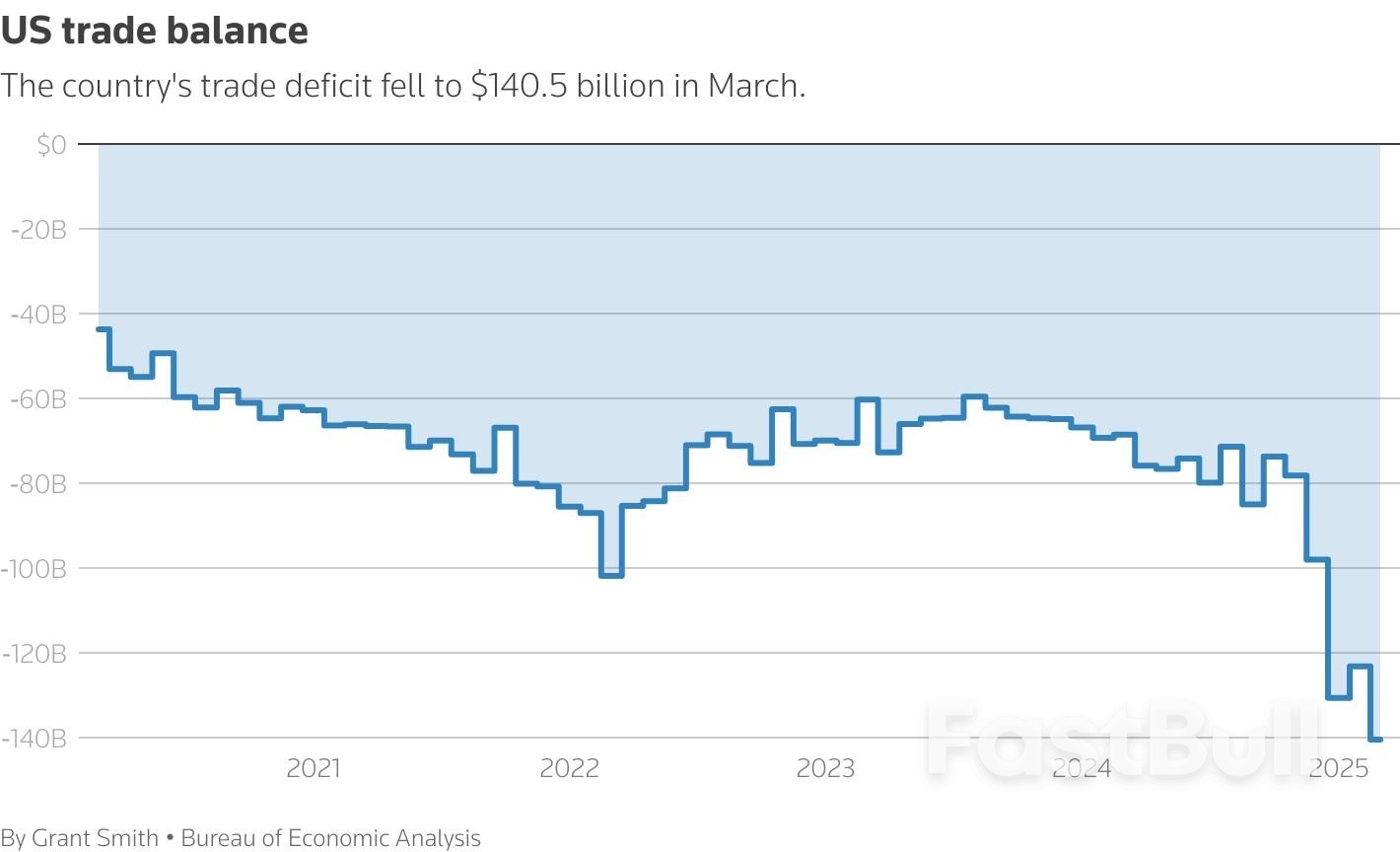
The U.S. trade deficit widened to a record high in March as businesses boosted imports of goods ahead of President Donald Trump's sweeping tariffs, which dragged gross domestic product into negative territory in the first quarter for the first time in three years.
The report from the Commerce Department on Tuesday showed the nation imported a record amount of goods from 10 countries, including Mexico and Vietnam. Imports from China were, however, the lowest in five years and could drop further as Trump has hiked duties on Chinese goods to a staggering 145%.
While reciprocal tariffs with most of the United States' trade partners were suspended for 90 days, duties on Chinese goods came into effect in early April, triggering a trade war with Beijing.
"Businesses are clearly scrambling as they try to find a way through this time of unprecedented change, but the worst is undoubtedly yet to come because the import tariff collections did not start to roll in earnest until after the White House Liberation Day announcement on April 2," said Christopher Rupkey, chief economist at FWDBONDS. "There are still no trade deals announced in Trump 2.0."
The trade gap jumped 14.0%, or $17.3 billion, to a record $140.5 billion, the Commerce Department's Bureau of Economic Analysis (BEA) said on Tuesday. Economists polled by Reuters had forecast the trade deficit rising to $137.0 billion.
Imports vaulted 4.4% to an all-time high $419.0 billion in March. Goods imports soared 5.4% to a record $346.8 billion. They were boosted by a $22.5 billion jump in consumer goods to an all-time high, mostly pharmaceutical preparations.
Capital goods imports increased $3.7 billion to a record high, reflecting a solid rise in computer accessories. Imports of automotive vehicles, parts and engines increased $2.6 billion, driven by passenger cars.
But imports of industrial supplies declined $10.7 billion amid decreases in finished metal shapes and nonmonetary gold, which had accounted for the surge in the prior two months. Crude oil imports fell $1.2 billion.

Exports climbed 0.2% to $278.5 billion, also a record high. Exports of goods increased 0.7% to $183.2 billion, the highest since July 2022, lifted by industrial supplies and materials, which advanced $2.2 billion amid rises in natural gas and nonmonetary gold.
Automotive vehicles, parts and engines exports increased $1.2 billion. But exports of capital goods decreased $1.5 billion, weighed down by a $1.8 billion decline in shipments of civilian aircraft. The goods trade deficit ballooned 11.2% to a record $163.5 billion in March.
The government reported last week that the trade deficit cut a record 4.83 percentage points from GDP last quarter, resulting in the economy contracting at a 0.3% annualized rate, the first decline since the first quarter of 2022.
Trump sees the tariffs as a tool to raise revenue to offset his promised tax cuts and to revive a long-declining U.S. industrial base. Economists expect the flood of imports to ebb by May, which could help GDP to rebound in the second quarter.
They, however, caution that the lift from subsiding imports could be offset by a drop in exports as other nations boycott American goods and travel. There has been a decrease in visitors to the U.S., especially from Canada, in protest over the punitive tariffs as well as an immigration crackdown and Trump's musings about annexing Canada and Greenland.
Indeed, exports of services fell $0.9 billion to $95.2 billion in March, pulled down by a $1.3 billion drop in travel.
The rush to beat tariffs saw imports from Mexico, the United Kingdom, Ireland, the Netherlands, Belgium, France, Germany, Italy, India and Vietnam hitting all-time highs. But imports from China were the lowest since March 2020, when the world was grappling with the first wave of the COVID-19 pandemic.
The seasonally adjusted goods trade deficit with China narrowed to $24.8 billion from $26.6 billion in February. The trade deficit with Canada also declined to $4.9 billion from $7.4 billion in February. The trade gap with Mexico was little changed, while the surplus with the United Kingdom narrowed.
White Label
Data API
Web Plug-ins
Poster Maker
Affiliate Program
The risk of loss in trading financial instruments such as stocks, FX, commodities, futures, bonds, ETFs and crypto can be substantial. You may sustain a total loss of the funds that you deposit with your broker. Therefore, you should carefully consider whether such trading is suitable for you in light of your circumstances and financial resources.
No decision to invest should be made without thoroughly conducting due diligence by yourself or consulting with your financial advisors. Our web content might not suit you since we don't know your financial conditions and investment needs. Our financial information might have latency or contain inaccuracy, so you should be fully responsible for any of your trading and investment decisions. The company will not be responsible for your capital loss.
Without getting permission from the website, you are not allowed to copy the website's graphics, texts, or trademarks. Intellectual property rights in the content or data incorporated into this website belong to its providers and exchange merchants.
Not Logged In
Log in to access more features

FastBull Membership
Not yet
Purchase
Log In
Sign Up