• Trade
  • Markets
  • Copy
  • Contests
  • News
  • 24/7
  • Calendar
  • Q&A
  • Chats
Trending
Screeners
SYMBOL
LAST
BID
ASK
HIGH
LOW
NET CHG.
%CHG.
SPREAD
SPX
S&P 500 Index
6870.39
6870.39
6870.39
6895.79
6858.28
+13.27
+ 0.19%
--
DJI
Dow Jones Industrial Average
47954.98
47954.98
47954.98
48133.54
47871.51
+104.05
+ 0.22%
--
IXIC
NASDAQ Composite Index
23578.12
23578.12
23578.12
23680.03
23506.00
+72.99
+ 0.31%
--
USDX
US Dollar Index
98.930
99.010
98.930
98.960
98.730
-0.020
-0.02%
--
EURUSD
Euro / US Dollar
1.16500
1.16508
1.16500
1.16717
1.16341
+0.00074
+ 0.06%
--
GBPUSD
Pound Sterling / US Dollar
1.33163
1.33172
1.33163
1.33462
1.33136
-0.00149
-0.11%
--
XAUUSD
Gold / US Dollar
4211.89
4212.23
4211.89
4218.85
4190.61
+13.98
+ 0.33%
--
WTI
Light Sweet Crude Oil
59.273
59.303
59.273
60.084
59.160
-0.536
-0.90%
--

Community Accounts

Signal Accounts
--
Profit Accounts
--
Loss Accounts
--
View More

Become a signal provider

Sell trading signals to earn additional income

View More

Guide to Copy Trading

Get started with ease and confidence

View More

Signal Accounts for Members

All Signal Accounts

Best Return
  • Best Return
  • Best P/L
  • Best MDD
Past 1W
  • Past 1W
  • Past 1M
  • Past 1Y

All Contests

  • All
  • Trump Updates
  • Recommend
  • Stocks
  • Cryptocurrencies
  • Central Banks
  • Featured News
Top News Only
Share

SEBI: Modalities For Migration To Ai Only Schemes And Relaxations To Large Value Funds For Accredited Investors

Share

All 6 Bank Of Israel Monetary Policy Committee Members Voted To Lower Benchmark Interest Rate 25 Bps To 4.25% On Nov 24

Share

India Government: Cancellations Are On Account Of Developer Delays And Not Due To Transmission Side Delays

Share

Fitch: We See Moderation Of Export Performance In China In 2026

Share

India Government: Revokes Grid Access Permissions For Renewable Energy Projects

Share

Fitch: Calibrating Fiscal And Monetary Policies In China To Boost Domestic Demand And Reverse Deflationary Pressures Will Be A Key Challenge

Share

Stats Office - Tanzania Inflation At 3.4% Year-On-Year In November

Share

Fitch: External Risks From US Tariffs For Greater China Region Have Subsided

Share

Temasek CEO Dilhan Pillay: We Are Taking A Conservative Stance On Allocating Capital

Share

Brazil Economists See Brazilian Real At 5.40 Per Dollar By Year-End 2025 Versus 5.40 In Previous Estimate - Central Bank Poll

Share

Brazil Economists See Year-End 2026 Interest Rate Selic At 12.25% Versus 12.00% In Previous Estimate - Central Bank Poll

Share

Brazil Economists See Year-End 2025 Interest Rate Selic At 15.00% Versus 15.00% In Previous Estimate - Central Bank Poll

Share

EU Commission Says Meta Has Committed To Give EU Users Choice On Personalised Ads

Share

Sources Revealed That The Bank Of England Has Invited Employees To Voluntarily Apply For Layoffs

Share

The Bank Of England Plans To Cut Staff Due To Budget Pressures

Share

Traders Believe There Is Less Than A 10% Chance That The European Central Bank Will Cut Interest Rates By 25 Basis Points In 2026

Share

Egypt, European Bank For Reconstruction And Development Sign $100 Million Financing Agreement

Share

Israel Budget Deficit 4.5% Of GDP In November Over Past 12 Months Versus 4.9% Deficit In October

Share

JPMorgan - Council Chaired By Jamie Dimon Includes Jeff Bezos

Share

UK Government: UK Health Security Agency Identified New Recombinant Mpox Virus In England In Individual Who Had Recently Travelled To Asia

TIME
ACT
FCST
PREV
France Industrial Output MoM (SA) (Oct)

A:--

F: --

P: --
France Trade Balance (SA) (Oct)

A:--

F: --

P: --
Euro Zone Employment YoY (SA) (Q3)

A:--

F: --

P: --
Canada Part-Time Employment (SA) (Nov)

A:--

F: --

P: --

Canada Unemployment Rate (SA) (Nov)

A:--

F: --

P: --

Canada Full-time Employment (SA) (Nov)

A:--

F: --

P: --

Canada Labor Force Participation Rate (SA) (Nov)

A:--

F: --

P: --

Canada Employment (SA) (Nov)

A:--

F: --

P: --

U.S. PCE Price Index MoM (Sept)

A:--

F: --

P: --

U.S. Personal Income MoM (Sept)

A:--

F: --

P: --

U.S. Core PCE Price Index MoM (Sept)

A:--

F: --

P: --

U.S. PCE Price Index YoY (SA) (Sept)

A:--

F: --

P: --

U.S. Core PCE Price Index YoY (Sept)

A:--

F: --

P: --

U.S. Personal Outlays MoM (SA) (Sept)

A:--

F: --

P: --
U.S. 5-10 Year-Ahead Inflation Expectations (Dec)

A:--

F: --

P: --

U.S. Real Personal Consumption Expenditures MoM (Sept)

A:--

F: --

P: --
U.S. Weekly Total Rig Count

A:--

F: --

P: --

U.S. Weekly Total Oil Rig Count

A:--

F: --

P: --

U.S. Consumer Credit (SA) (Oct)

A:--

F: --

P: --
China, Mainland Foreign Exchange Reserves (Nov)

A:--

F: --

P: --

Japan Trade Balance (Oct)

A:--

F: --

P: --

Japan Nominal GDP Revised QoQ (Q3)

A:--

F: --

P: --

China, Mainland Imports YoY (CNH) (Nov)

A:--

F: --

P: --

China, Mainland Exports (Nov)

A:--

F: --

P: --

China, Mainland Imports (CNH) (Nov)

A:--

F: --

P: --

China, Mainland Trade Balance (CNH) (Nov)

A:--

F: --

P: --

China, Mainland Exports YoY (USD) (Nov)

A:--

F: --

P: --

China, Mainland Imports YoY (USD) (Nov)

A:--

F: --

P: --

Germany Industrial Output MoM (SA) (Oct)

A:--

F: --

P: --
Euro Zone Sentix Investor Confidence Index (Dec)

A:--

F: --

P: --

Canada National Economic Confidence Index

--

F: --

P: --

U.K. BRC Like-For-Like Retail Sales YoY (Nov)

--

F: --

P: --

U.K. BRC Overall Retail Sales YoY (Nov)

--

F: --

P: --

Australia Overnight (Borrowing) Key Rate

--

F: --

P: --

RBA Rate Statement
RBA Press Conference
Germany Exports MoM (SA) (Oct)

--

F: --

P: --

U.S. NFIB Small Business Optimism Index (SA) (Nov)

--

F: --

P: --

Mexico 12-Month Inflation (CPI) (Nov)

--

F: --

P: --

Mexico Core CPI YoY (Nov)

--

F: --

P: --

Mexico PPI YoY (Nov)

--

F: --

P: --

U.S. Weekly Redbook Index YoY

--

F: --

P: --

U.S. JOLTS Job Openings (SA) (Oct)

--

F: --

P: --

China, Mainland M1 Money Supply YoY (Nov)

--

F: --

P: --

China, Mainland M0 Money Supply YoY (Nov)

--

F: --

P: --

China, Mainland M2 Money Supply YoY (Nov)

--

F: --

P: --

U.S. EIA Short-Term Crude Production Forecast For The Year (Dec)

--

F: --

P: --

U.S. EIA Natural Gas Production Forecast For The Next Year (Dec)

--

F: --

P: --

U.S. EIA Short-Term Crude Production Forecast For The Next Year (Dec)

--

F: --

P: --

EIA Monthly Short-Term Energy Outlook
U.S. API Weekly Gasoline Stocks

--

F: --

P: --

U.S. API Weekly Cushing Crude Oil Stocks

--

F: --

P: --

U.S. API Weekly Crude Oil Stocks

--

F: --

P: --

U.S. API Weekly Refined Oil Stocks

--

F: --

P: --

South Korea Unemployment Rate (SA) (Nov)

--

F: --

P: --

Japan Reuters Tankan Non-Manufacturers Index (Dec)

--

F: --

P: --

Japan Reuters Tankan Manufacturers Index (Dec)

--

F: --

P: --

Japan Domestic Enterprise Commodity Price Index MoM (Nov)

--

F: --

P: --

Japan Domestic Enterprise Commodity Price Index YoY (Nov)

--

F: --

P: --

China, Mainland PPI YoY (Nov)

--

F: --

P: --

China, Mainland CPI MoM (Nov)

--

F: --

P: --

Q&A with Experts
    • All
    • Chatrooms
    • Groups
    • Friends
    Connecting
    .
    .
    .
    Type here...
    Add Symbol or Code

      No matching data

      All
      Trump Updates
      Recommend
      Stocks
      Cryptocurrencies
      Central Banks
      Featured News
      • All
      • Russia-Ukraine Conflict
      • Middle East Flashpoint
      • All
      • Russia-Ukraine Conflict
      • Middle East Flashpoint
      Search
      Products

      Charts Free Forever

      Chats Q&A with Experts
      Screeners Economic Calendar Data Tools
      Membership Features
      Data Warehouse Market Trends Institutional Data Policy Rates Macro

      Market Trends

      Market Sentiment Order Book Forex Correlations

      Top Indicators

      Charts Free Forever
      Markets

      News

      News Analysis 24/7 Columns Education
      From Institutions From Analysts
      Topics Columnists

      Latest Views

      Latest Views

      Trending Topics

      Top Columnists

      Latest Update

      Signals

      Copy Rankings Latest Signals Become a signal provider AI Rating
      Contests
      Brokers

      Overview Brokers Assessment Rankings Regulators News Claims
      Broker listing Forex Brokers Comparison Tool Live Spread Comparison Scam
      Q&A Complaint Scam Alert Videos Tips to Detect Scam
      More

      Business
      Events
      Careers About Us Advertising Help Center

      White Label

      Data API

      Web Plug-ins

      Affiliate Program

      Awards Institution Evaluation IB Seminar Salon Event Exhibition
      Vietnam Thailand Singapore Dubai
      Fans Party Investment Sharing Session
      FastBull Summit BrokersView Expo
      Recent Searches
        Top Searches
          Markets
          News
          Analysis
          User
          24/7
          Economic Calendar
          Education
          Data
          • Names
          • Latest
          • Prev

          View All

          No data

          Scan to Download

          Faster Charts, Chat Faster!

          Download App
          English
          • English
          • Español
          • العربية
          • Bahasa Indonesia
          • Bahasa Melayu
          • Tiếng Việt
          • ภาษาไทย
          • Français
          • Italiano
          • Türkçe
          • Русский язык
          • 简中
          • 繁中
          Open Account
          Search
          Products
          Charts Free Forever
          Markets
          News
          Signals

          Copy Rankings Latest Signals Become a signal provider AI Rating
          Contests
          Brokers

          Overview Brokers Assessment Rankings Regulators News Claims
          Broker listing Forex Brokers Comparison Tool Live Spread Comparison Scam
          Q&A Complaint Scam Alert Videos Tips to Detect Scam
          More

          Business
          Events
          Careers About Us Advertising Help Center

          White Label

          Data API

          Web Plug-ins

          Affiliate Program

          Awards Institution Evaluation IB Seminar Salon Event Exhibition
          Vietnam Thailand Singapore Dubai
          Fans Party Investment Sharing Session
          FastBull Summit BrokersView Expo

          Bitcoin slides to near $121,000 but analysts say ‘Uptober’ sentiment intact

          Adam

          Cryptocurrency

          Summary:

          Bitcoin fell near $121,000 after hitting a record $126,000 earlier this week, but analysts say the “Uptober” bullish trend remains intact amid strong ETF inflows, low exchange supply, and resilient long-term holders.

          Bitcoin BTC -0.81% price fell near $121,000 on Friday after recording a new all-time high earlier in the week.
          According to The Block's bitcoin price page, the world's largest cryptocurrency is down 0.64% in the past day, trading at $121,141. This shows a near 4% decline from its new all-time high of $126,080 recorded on Monday.
          "Bitcoin’s pullback after the ATH looks like a pause rather than a pivot," said Justin d'Anethan, analyst and Head of Partnerships at Arctic Digital. "Short-term holders took profits, some leverage longs got liquidated but long-term supply hasn’t moved."
          The crypto analyst also pointed out that spot crypto exchange-traded fund flows remain strong and exchange balances are at a six-year low. d'Anethan said that markets are currently moved by macro uncertainty, such as a stronger dollar, sticky yields and the lack of clarity from the Federal Reserve regarding future rate decisions.
          The U.S. is also going through an extended period of partial government shutdown, which analysts have previously suggested acts as a tailwind for "hedge" assets such as gold and bitcoin. While Fed Chair Jerome Powell had sent out mixed signals regarding future rate cuts, CME's FedWatch Tool gives a 94.6% chance that the U.S. central bank will lower rates again at the end of the month.
          Kronos Research CIO Vincent Liu said that the current market sentiment is "mixed but resilient," with long-term holders continuing to accumulate.
          Analysts said the "Uptober" narrative is still intact, given the market structure holding up despite the recent price decline. So far, Bitcoin has gained 6.7% since the beginning of the month.
          "Bitcoin has historically gained an average of 22% in October, with Ethereum typically adding around 5%, a pattern that fuels the 'Uptober' thesis," Liu said. "On-chain data shows continued accumulation and resilient positioning, but macro uncertainty means volatility will remain part of the equation."
          Arctic's d'Anethan also said that his market predictions for October still lean bullish, but the move may be slower than traders might have expected.
          "If we get a soft inflation print or dovish Fed pivot, BTC could break out again," d'Anethan said. "But even without that, the structure is healthy: low leverage, strong spot interest, and plenty of sidelined capital. Uptober doesn’t necessarily need a melt-up to deliver."
          Meanwhile, Min Jung, research associate at Presto Research, mentioned that the market currently lacks a dominant headline or narrative.
          "For now, traders should keep an eye on broader economic data and policy headlines, as these will likely set the tone for crypto in the near term," Jung said.

          Source: theblock

          Risk Warnings and Disclaimers
          You understand and acknowledge that there is a high degree of risk involved in trading. Following any strategies or investment methods may lead to potential losses. The content on the site is provided by our contributors and analysts for information purposes only. You are solely responsible for determining whether any trading assets, securities, strategy, or any other product is suitable for investing based on your own investment objectives and financial situation.
          Add to Favorites
          Share

          UMich Survey Shows Inflation Fears Fading

          Michelle

          Economic

          Forex

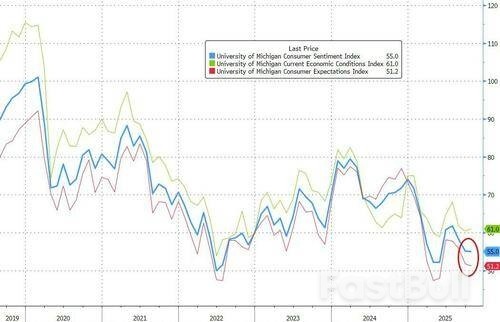
          Amid a barren landscape of macro data due to the shutdown, the fact that many are strongly focused on the incredibly noisy and historically dismissed University of Michigan sentiment survey for any signals on inflation expectations or job hopes is in itself noteworthy.

          So, with a big pinch of salt we dig in and see that the preliminary October headline sentiment index dropped very marginally (but was better than expected - 55.0 vs 54.0 exp vs 55.1 prior) with Current Conditions rising (from 60.4 to 61.0) and Expectations falling (from 51.7 to 51.2)...
          Source: Bloomberg

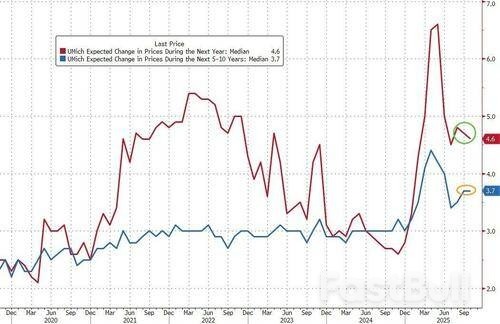
          On the inflation side, 1Yr expectations fell to 4.6% from 4.7% (while 5-10Y expectations were flat at 3.7%)...
          Source: Bloomberg

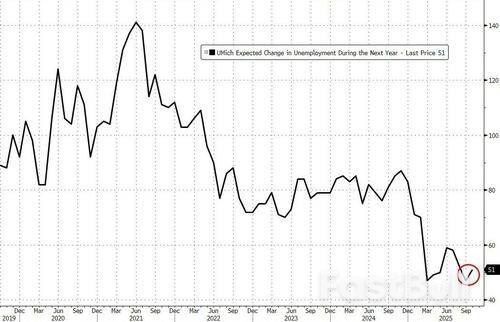
          On the unemployment side, the balance of respondents who expect a rise in unemployment rose modestly (but remain near multi-year lows)...
          Source: Bloomberg

          Under the hood, Republicans' confidence is at cycle highs while Democrats' confidence fell to Trump term lows...
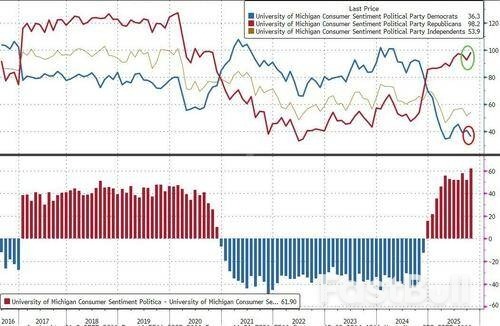
          Source: Bloomberg

          UMich Surveys of Consumers Director, Joanne Hsu, noted that "improvements this month in current personal finances and year-ahead business conditions were offset by declines in expectations for future personal finances as well as current buying conditions for durables. Overall, consumers perceive very few changes in the outlook for the economy from last month. Pocketbook issues like high prices and weakening job prospects remain at the forefront of consumers’ minds."

          Meanwhile, Hsu notes that "interviews reveal little evidence that the ongoing federal government shutdown has moved consumers’ views of the economy thus far."

          Source: Zero Hedge

          To stay updated on all economic events of today, please check out our Economic calendar
          Risk Warnings and Disclaimers
          You understand and acknowledge that there is a high degree of risk involved in trading. Following any strategies or investment methods may lead to potential losses. The content on the site is provided by our contributors and analysts for information purposes only. You are solely responsible for determining whether any trading assets, securities, strategy, or any other product is suitable for investing based on your own investment objectives and financial situation.
          Add to Favorites
          Share

          Gold retreats from highs, as key questions need answering

          Adam

          Commodity

          Risk sentiment is up and down this week. After reaching fresh record highs on Wednesday, global stocks fell on Thursday and Asian markets are broadly lower on Friday. The dollar is also giving back gains and is the third worst currency in the G10 FX space, falling for the first time this week. Even gold’s scorching run has come to an end and it is back below $4000 an ounce, in contrast, silver is bucking this trend and is back at the highs of the session after an earlier sell off.

          Dip buying?

          The question now is, will traders see this as a chance to buy the dip? UK and European futures are little changed so far this morning, and US futures are pointing to a higher open, suggesting that the selloff could be temporary. Aside from the Nikkei, gains for global stock markets have been meagre so far this week, suggesting that the market is readying itself for a pause.

          US economic data hope before FOMC

          A pause in the risk rally is to be expected, as investors wait for answers to some key questions. 1 who will be the new French Prime Minister, the announcement should come later today? How did the new Japanese PM get on in coalition talks? And, lastly, how is the US economy doing? The BLS reported that some economic data, including CPI, could be released at the end of this month, which means that the Fed might have a chance of viewing the CPI data before their meeting on 28/29th October.

          Q3 earnings season gets off to a flying start

          Interestingly, while fears mount about the level of tech stock valuations, the top performers on the S&P 500 on Thursday included Delta Airlines and Pepsi, who both reported earnings earlier in the day. Their stock prices both rose by more than 4% yesterday, which suggests that the stock market will react favorably to the Q3 earnings season. This sets the stage for next week, when we start to get key releases from the US banking sector.

          Insurance woes

          The insurance sector in Europe and the US could be in focus today, as the fallout from First Brand Group’s bankruptcy continues. Allianz, Coface and AIG all have written policies for First Brand’s partners and investors. This leaves the world’s largest insurers exposed to the car parts maker’s supply chain. We need to find out how exposed these companies are to First Brand’s supply chain, and that will determine how big the sell-off in their stock prices will be, however, Jeffries, the US bank, has seen its share price sink by more than 20% this month after it announced a $715mn exposure to the group. We do not think that First Brands bankruptcy will lead to a domino effect, with other companies falling, however, companies with exposure could take a knock later today.

          French PM could make or break the bond market

          Ahead today, all eyes will be on the French bond market, can yields continue to fall as we hear news of who will be the new PM, or will this be a buy the rumour, sell the fact day? Can gold reclaim the $4,000 level? We think that gold could come under pressure alongside any sell-off in the tech trade, as gold has been partly used as a hedge against lofty stock market valuations, so, as stock prices fall, the need for this hedge is reduced.
          In the UK, there are signs that the labour market is stabilizing, with employers scaling back hiring at their softest pace in a year, and also signs that wage growth could be moderating, which is good news for the inflation outlook and the Bank of England.
          Ahead today, the focus is likely to be on the US University of Michigan sentiment index that will be released later this afternoon, especially the inflation expectations index.

          Source: xtb

          Risk Warnings and Disclaimers
          You understand and acknowledge that there is a high degree of risk involved in trading. Following any strategies or investment methods may lead to potential losses. The content on the site is provided by our contributors and analysts for information purposes only. You are solely responsible for determining whether any trading assets, securities, strategy, or any other product is suitable for investing based on your own investment objectives and financial situation.
          Add to Favorites
          Share

          US Throws Argentina €17bn Lifeline as Milei-Trump Ties Deepen

          Warren Takunda

          Economic

          The US Treasury just threw Argentina a rare lifeline, moving to stabilise the country's markets by buying $20 billion (€17.28 bn) worth of Pesos as Buenos Aires battles dwindling dollar reserves.
          “The US Treasury is prepared, immediately, to take whatever exceptional measures are warranted to provide stability to markets,” said US Treasury Secretary Scott Bessent, adding that the Treasury Department held four days of meetings with Argentine Economy Minister Luis Caputo in Washington DC to cement the deal.
          The move steadied assets but triggered pushback on Capitol Hill, where critics claimed the US was bailing out the Argentinian economy — something Bessent denied.
          Argentina’s libertarian President Javier Milei, a fervent admirer of US President Donald Trump, thanked the Treasury Secretary for his “strong support” and Trump for his “powerful leadership”.
          “Together, as the closest of allies, we will make a hemisphere of economic freedom and prosperity,” Milei said in a social media post.
          Bessent is coming under fire from US farmers and Democratic lawmakers for supporting an economy that directly competes with American producers in certain sectors.
          US farmers are angry about the idea of rescuing Argentina, whose own farmers have benefited from a recent gush of sales of soybeans to China at the expense of their US counterparts. Lawmakers have pushed Trump to explain how this financial help aligns with his “America First” agenda.
          After the announcement Thursday, a group of Democratic Senators introduced the “No Argentina Bailout Act”, which would stop the Treasury Department from using its Exchange Stabilisation Fund to assist Argentina.
          “It is inexplicable that President Trump is propping up a foreign government, while he shuts down our own," Democratic Senator Elizabeth Warren of Massachusetts said in a statement.
          “Trump promised ‘America First,’ but he’s putting himself and his billionaire buddies first and sticking Americans with the bill.”
          It doesn't help that repeated bailouts have failed to stabilise the crisis-stricken economy of Argentina. As the International Monetary Fund's biggest debtor, it owes the global lender a staggering $41.8bn (€35.43bn).
          Milei, a wild-haired far-right economist, came to office in late 2023 on the bold promise that this time would be different.
          He vowed to take a chainsaw to reckless public spending that he inherited from his left-wing predecessor.
          But his radical austerity programme has been painful, with no economic revival in sight and Argentinians are losing patience.
          Now, Milei faces his greatest test yet as he heads into a midterm congressional election on 26 October that could decide the fate of his free-market experiment.
          A disastrous defeat in local elections last month triggered a sudden exodus from Argentine assets as investors fretted over the country's political dysfunction, overvalued peso and rapidly depleting foreign exchange reserves.
          The US financial help offers Milei a crucial reprieve. On Thursday, Argentina’s dollar-denominated bonds rose about 10% on Bessent's confirmation of the credit line and the Buenos Aires stock market surged 15%.
          Economy Minister Caputo expressed his “deepest gratitude” to Bessent following the announcement.
          “Your steadfast commitment has been remarkable,” he wrote.
          Bessent made no mention of any economic conditions attached to the swap line for Argentina, leading many observers to criticise the intervention as a pre-election reward for a loyal friend rather than an investment in a strategic partner.

          Source: Euronews

          To stay updated on all economic events of today, please check out our Economic calendar
          Risk Warnings and Disclaimers
          You understand and acknowledge that there is a high degree of risk involved in trading. Following any strategies or investment methods may lead to potential losses. The content on the site is provided by our contributors and analysts for information purposes only. You are solely responsible for determining whether any trading assets, securities, strategy, or any other product is suitable for investing based on your own investment objectives and financial situation.
          Add to Favorites
          Share

          Canada’s Jobs Jump Up in September, Unemployment Rate Steady As Labour Force Surges

          Glendon

          Economic

          Forex

          Canada’s economy added a staggering 60k jobs in September (+0.3% month/month), 55k more than consensus expectations for a 5k gain. The details were similarly strong with full-time positions jumping 106k, and the private sector rising 22K.

          The unemployment rate held steady at 7.1% in September, as the labour force more than made up for the past two months of losses, adding 72k workers.

          Job gains were concentrated in manufacturing (+28k), health care and social assistance (+14k), and agriculture (+13k). The biggest losses were seen in wholesale and retail trade (-21k), construction (-8.2k), and transportation and warehousing (-7.4k).

          Wage growth was steady in September with average hourly wages up 3.6% versus a year ago.

          Key Implications

          Well, that’s quite the surprise. Canada’s job market looks like it recovered all of August’s losses in September. Importantly, even for a noisy data series, this is a strong result. That said, it’s important to note that the unemployment rate remained unchanged as the labour force jumped by an even greater amount. Considering population growth slowed to 28k people, the biggest surprise was a large influx of new workers despite a weak job market.

          The Bank of Canada’s next decision is due at the end of the month and this surprise from the labour market could change the calculus on the decision. However, underlying inflation continues to hover within the target range and the unemployment rate suggest that the labour market still has excess slack. The next inflation report is due on the 21st and the bar will be even higher for inflation to underperform and bring the BoC onside for another rate cut. Markets seems to agree as the pricing for a rate cut materially deteriorated this morning.

          Source: ACTIONFOREX

          To stay updated on all economic events of today, please check out our Economic calendar
          Risk Warnings and Disclaimers
          You understand and acknowledge that there is a high degree of risk involved in trading. Following any strategies or investment methods may lead to potential losses. The content on the site is provided by our contributors and analysts for information purposes only. You are solely responsible for determining whether any trading assets, securities, strategy, or any other product is suitable for investing based on your own investment objectives and financial situation.
          Add to Favorites
          Share

          They’ll Go With The (Data) Flow

          Samantha Luan

          Forex

          Political

          Economic

          The RBA has almost certainly not yet decided whether or not to cut the cash rate in November. The data flow from here will determine the outcome, with hesitation now likely to result in more cuts later.

          ● There is still enough data to come before the next RBA meeting to justify a November cut, even though currently available information would suggest a hold is more likely.
          ● Some recent data on inflation and household spending may contain less signal about the outlook for subsequent quarters than the RBA’s September communication seems to imply. A hold in November could be followed by a downside inflation surprise in the December quarter and a cash rate cut in February, similar to the flow of surprises in late 2023 and early 2024.
          ● If the RBA does hold the cash rate steady at the November meeting, the chance increases that it cuts in February and ends up at a trough of 2.85% rather than something higher.

          It’s almost certain that RBA has not yet decided whether or not to cut the cash rate at its November meeting. If the meeting were held today, they would keep rates on hold, awaiting further data. Several potentially decisive data releases are due before the actual meeting, though, including the September labour data and the full quarterly CPI. Until then, we need to hold two possible futures in mind: hold or cut.

          The August CPI indicator did imply an ugly result for the September quarter. Our own nowcast for the trimmed mean measure is a ‘big’ 0.8%qtr that could easily round up to a 0.9%, a result that would surely stay the RBA’s hand. Looking at the detail, though, outside home-building costs it is not clear that the August data provided much signal of an ongoing higher rate of inflation than expected. As we noted at the time, the result in market services was mixed, with some personal services inflation below our forecasts while the cost of eating out was stronger. The latter suggests that, following a period of retrenchment in hospitality (evident in the labour account employment data), improving conditions have allowed for some margin repair. Some of the price gains may also indirectly relate to recent annual award wage increase; though this is a normal seasonal effect, its size will depend on how margins react. Neither of these influences on price growth are likely to be sustained if demand remains patchy.

          We therefore think the economy could be in for something like a re-run of late 2023, when an upside surprise in September quarter inflation was followed by a downside surprise (to something more like our own near-cast) in the December quarter. The result was a hike in late 2023 followed by an ‘on-the-fly’ pivot following the February 2024 meeting – from flagging possible further hikes in the post-meeting statement to ‘not ruling anything in or out’ in the media conference. That message landed a lot better, and sure enough, the next move was, eventually, a cut.

          We are also mindful of the two-sided risks around both the labour market and household spending data. We will know more about the labour market shortly when the September monthly labour force data is released next week, completing the picture for the quarter. So far, we see a gradual softening in employment growth as demand pivots away from the jobs-rich ‘care economy’. The unemployment and underemployment consequences of this are being masked by an unwind in the extra labour supply induced by earlier cost-of-living pressures. With demographic drivers still implying an upward trend in labour force participation, we see more latent labour market slack emerging over time and weighing on wages growth and inflation. There is precedent for this outcome in Australia’s experience in the late 2010s.

          On household spending, the August Household Spending Indicator, released after the September RBA Monetary Policy Board (MPB) meeting, was notably below market expectations. This accords with our assessment that the expected recovery in consumer spending has been patchy and that the strength in national accounts consumption in Q2 partly reflected some one-off factors such as insurance payouts and the unwinding of some electricity rebates. Though we see two-sided risks around the consumption outlook, the more downbeat tone from consumer sentiment in recent months certainly suggests that underlying momentum is still subdued. Given how weak real household incomes have been for a number of years, this ongoing pessimistic tone does not surprise us.

          Recall also that a recovery in household spending is necessary to counterbalance the slowdown in public sector demand growth that is already underway. Faster growth in household spending should only stay the MPB’s hand from further rate cuts if the pick-up is stronger than implied by the RBA’s August forecasts. These were constructed on an assumption of a couple more cash rate cuts, as the market was pricing at the time. Far too many observers are in the habit of seeing any pick-up in demand or housing prices as something for policy to react against, rather than as the expected and intended transmission of monetary policy. The Governor’s comments at the latest media conference show that the RBA, at least, does understand the difference.

          The rates outlook boils down to the issue of how much signal to take from an upside surprise in one quarter in terms of what that means for subsequent quarters. RBA Governor Bullock has on several occasions insisted that ‘we will be guided by our forecasts’. However, that statement sits a bit uncomfortably with the flat profile for the RBA’s trimmed mean inflation forecasts and the unemployment rate. These give the impression of a set of forecasts being used as a communication device to explain and frame a policy decision rather than an independent input into that decision. This is understandable and perhaps inevitable given the judgement involved in synthesising the output of many different models and information sources. However, it does hold the risk that the policy view helps shape the forecast rather than the other way around.

          What’s left in these circumstances is reactivity to incoming data – that is, to the recent past. As well as making policy less predictable – contrary to the MPB’s stated intentions – it is not a great way to run an economy policy setting that affects the economy with a lag, especially when inflation has been within the target range for a little while now at the same time as policy is likely still restrictive.

          Bottom line: the odds that the RBA cuts in November are, at this point, below 50% but still a long way from zero. The data flow could change things again. Frankly, the prospect of flip-flopping a ‘call’ as the month goes on is unattractive, especially when it is quite obvious that the policymakers have not made up their mind yet. We must hold the two possibilities in mind at least until the labour market data come in. (A good-enough labour market result would make it unlikely that the RBA would cut, even if the September quarter CPI comes in a little more benign than we currently expect.)

          The RBA communications schedule has half a dozen speeches between now and the November meeting that will be opportunities for it to provide guidance on some of its key forecast judgements, though they all pre-date the release of the September quarter CPI. If the RBA does hold in November, though, our conviction that they end up cutting in February rises, as does our expectation that the trough will be 2.85% rather than something higher. The more the MPB hesitates in the face of uncertainty, the more likely it is that domestic inflation pressures surprise it on the downside next year, and trimmed mean inflation turns out more like the Westpac Economics forecast than the August RBA one.
          Source: ACTIONFOREX

          To stay updated on all economic events of today, please check out our Economic calendar
          Risk Warnings and Disclaimers
          You understand and acknowledge that there is a high degree of risk involved in trading. Following any strategies or investment methods may lead to potential losses. The content on the site is provided by our contributors and analysts for information purposes only. You are solely responsible for determining whether any trading assets, securities, strategy, or any other product is suitable for investing based on your own investment objectives and financial situation.
          Add to Favorites
          Share

          The Big Dollar Short Is Becoming a Pain Trade for Investors

          Adam

          Forex

          Economic

          Betting against the dollar has been the dominant trade this year in the $9.6 trillion-a-day foreign exchange market, but the wager is starting to stumble.
          The world’s primary reserve currency is around a two-month high even as the US government shutdown drags on, and traders in Asia and Europe say hedge funds are adding options bets that the rebound versus most major peers will extend into year-end.
          Overseas developments have been a key driver, with the euro and the yen falling abruptly this month. At the same time, comments from Federal Reserve officials urging caution around further interest-rate cuts have boosted the dollar’s appeal.
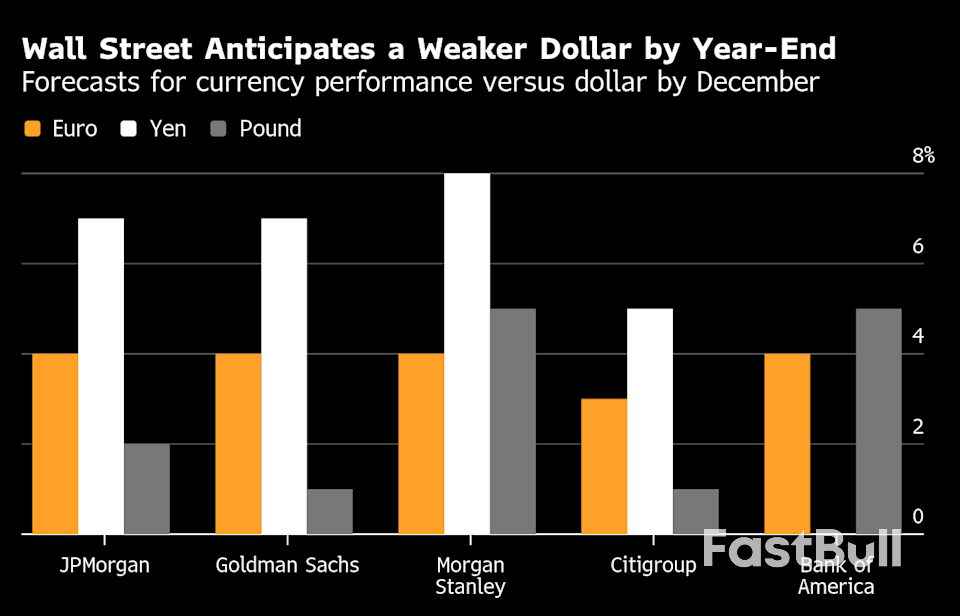
          The longer the strength persists, the more painful it is for those sticking with calls for the greenback to take another leg lower. Among the bears: Goldman Sachs Group Inc., JPMorgan Chase & Co. and Morgan Stanley.
          The trend, if it continues, could reverberate across the global economy, for example making it harder for other central banks to ease monetary policy, pushing up the cost of commodities and increasing the burden of foreign borrowings in the currency.
          A rapid rebound could derail some of the year’s most favored trades, knocking bullish expectations for emerging-market equities and bonds in the final quarter and also weighing on the shares of American exporters.
          Count Ed Al-Hussainy at Columbia Threadneedle among dollar pessimists who have flipped their view. The portfolio manager went short at the end of 2024 when the greenback was still rallying as part of the so-called Trump trade after the US election.
          Over the past month and a half he’s trimmed that stance by reducing exposure to emerging markets. For him it boils down to markets leaning too heavily toward Fed rate cuts given the resilience of the American economy.
          “We have become a lot more positive on the dollar,” he said. “The markets have priced in a very aggressive series of cuts, and it’s going to be difficult to execute them without a lot more labor-market pain.”
          The Big Dollar Short Is Becoming a Pain Trade for Investors_1
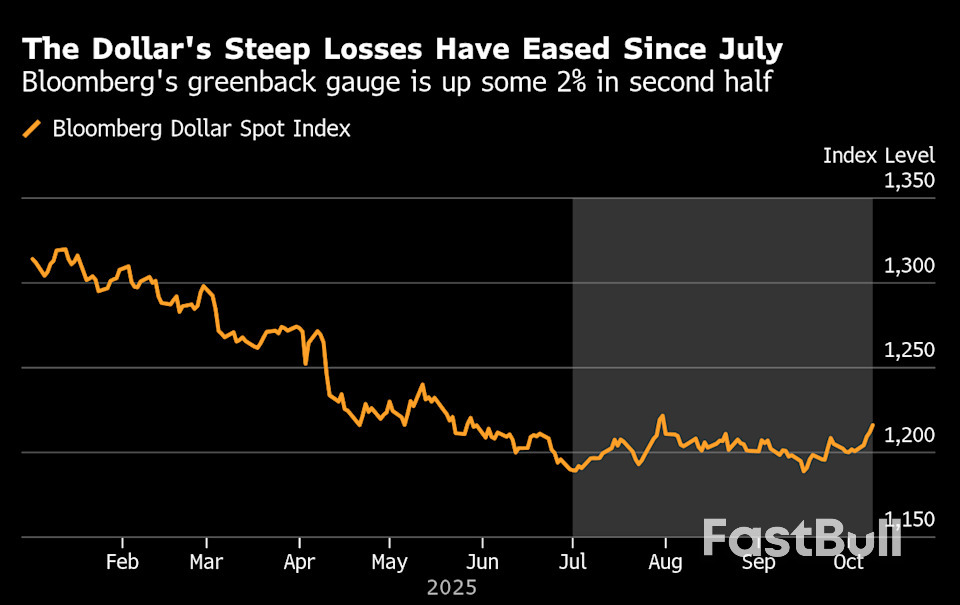
          The Bloomberg Dollar Spot Index is now up roughly 2% since mid-year, after its steepest first-half slide in decades. It’s gained 1.2% this week, the best performance in 11 months. In early 2025, after President Donald Trump held off on applying across-the-board tariffs once he took office, the greenback slid in part on the view that inflation would be tame enough for the Fed to resume lowering rates.
          The slump deepened with his rollout of sweeping levies in April, which fueled worries that foreign investors would sour on the US amid the trade war. There was also speculation that the president favored a weaker dollar, which would help US exporters, on top of his pressure on the Fed to slash rates, all of which amplified the bearish wave.
          As it turned out, however, international investors haven’t shunned the US, although there are signs they’ve been buying derivatives to protect against dollar losses. The lure of US equities, led by megacap technology shares, has been too great. And overseas demand at Treasury auctions has been mostly solid.
          The latest Commodity Futures Trading Commission data show that hedge funds, asset managers and commodity trading advisers were still short the greenback as of late September. Even though the positions are well below the peak reached at mid-year, that still leaves considerable scope for pain should the dollar continue to appreciate.
          Hedge funds ramping up bullish option trades on the dollar into year-end are expressing that view against most Group-of-10 currencies, according to Mukund Daga, global head of currency options at Barclays Bank Plc.
          Dollar Advances Toward Key Resistance Levels: Major Techs
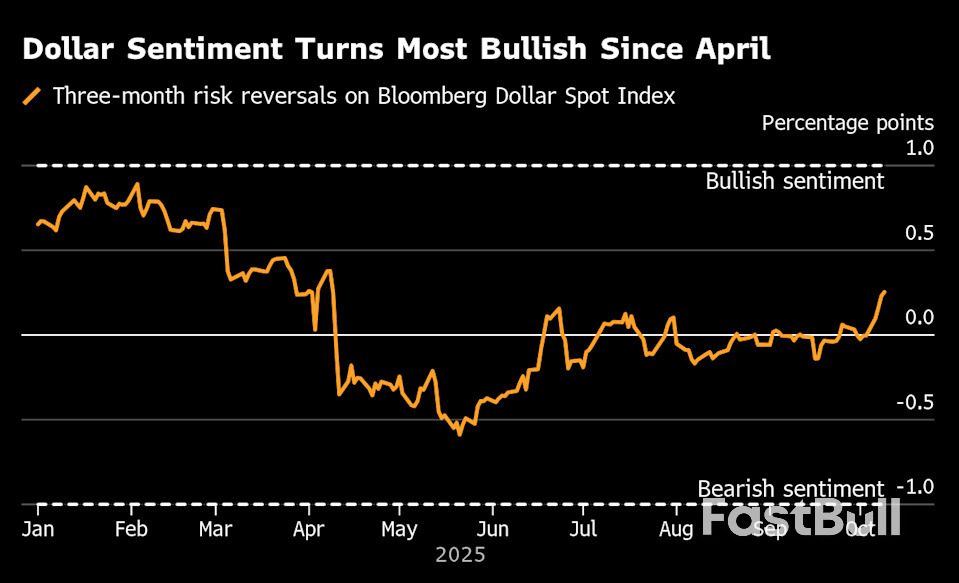
          There are also signs that options traders are paying more to hedge against the risk of a dollar rally than a decline. A measure of the difference in demand for bullish versus bearish bets shows traders are the most optimistic on the greenback since April. The appetite for dollar-bullish structures has exceeded that for bearish ones every day this week, Depository Trust & Clearing Corp. data show.
          The Big Dollar Short Is Becoming a Pain Trade for Investors_2
          Where the dollar goes from here, of course, is anybody’s guess. The Fed’s next steps will play a major role.
          Traders are pricing in roughly two quarter-point cuts by year-end and more next year. Yet recent commentary — including the minutes of the central bank’s September meeting and remarks from policymakers — suggests the trajectory is far from assured. While there are signs the job market is cooling, inflation remains sticky.
          “Markets are now pricing in a full Federal Reserve cutting cycle,” said Mona Mahajan, head of investment strategy at Edward Jones. “They weren’t before, and that helps explain why the dollar has weakened so much, but some mean reversion is to be expected.”
          What Bloomberg Strategists say...
          “The growing momentum for the greenback is spurring a fresh squeeze for overstretched dollar bears. There seems to be still plenty of money hanging on to bearish dollar positions in the hope that the “sell America” narrative from early 2025 makes a return. If that’s so then further dollar squeezes are on the cards.”
          — Garfield Reynolds,MLIV Asia Team Leader.
          For the full analysis, click here.
          A big complication for currency prognosticators is that the government shutdown has delayed crucial employment figures, though the Bureau of Labor Statistics is said to have recalled staff to prepare a key inflation report. Evidence that labor-market weakness is building could revive the short-dollar trade, and some of the biggest banks on Wall Street still see more dollar losses in the coming months.
          Another wrinkle for the dollar could be the so-called debasement trade, as growing fiscal concerns around the biggest economies lead some investors to seek the perceived safety of Bitcoin and precious metals instead of major currencies.
          The Big Dollar Short Is Becoming a Pain Trade for Investors_3
          “Markets are quite clearly rethinking popular short-USD trades, but further gains may prove harder to sustain unless markets start to price out Fed easing,” wrote ING analysts Chris Turner and Francesco Pesole.
          A large part of the dollar downdraft earlier this year came from the view that a brightening outlook for non-US markets would lure investors. But politics in France and Japan have muddied that narrative.
          Exchange rates measure relative values, and sentiment toward the yen has soured with the prospect of the likely ascendancy to Japan’s premiership of Sanae Takaichi, the new chief of the nation’s ruling party. Her policies are seen as fueling inflation and debt-funded stimulus, a scenario that pushed the yen to the weakest since February.
          In France, meanwhile, President Emmanuel Macron’s government remains in crisis, a fresh weight on the euro, which has dropped to the lowest since August.
          Given the situation in France and expectations of looser fiscal and monetary policy in Japan, the rally in the dollar against those two currencies may have legs, said Carol Kong, a strategist at Commonwealth Bank of Australia.
          “The fact is, to use one of our old adages, the dollar is relatively the least dirty shirt in the laundry,” said Andrew Brenner, vice chairman at Natalliance Securities in New York. “Don’t expect a major dollar downside with both the yen and euro under pressure.”

          Source: Bloomberg

          To stay updated on all economic events of today, please check out our Economic calendar
          Risk Warnings and Disclaimers
          You understand and acknowledge that there is a high degree of risk involved in trading. Following any strategies or investment methods may lead to potential losses. The content on the site is provided by our contributors and analysts for information purposes only. You are solely responsible for determining whether any trading assets, securities, strategy, or any other product is suitable for investing based on your own investment objectives and financial situation.
          Add to Favorites
          Share
          FastBull
          Copyright © 2025 FastBull Ltd

          728 RM B 7/F GEE LOK IND BLDG NO 34 HUNG TO RD KWUN TONG KLN HONG KONG

          TelegramInstagramTwitterfacebooklinkedin
          App Store Google Play Google Play
          Products
          Charts

          Chats

          Q&A with Experts
          Screeners
          Economic Calendar
          Data
          Tools
          Membership
          Features
          Function
          Markets
          Copy Trading
          Latest Signals
          Contests
          News
          Analysis
          24/7
          Columns
          Education
          Company
          Careers
          About Us
          Contact Us
          Advertising
          Help Center
          Feedback
          User Agreement
          Privacy Policy
          Business

          White Label

          Data API

          Web Plug-ins

          Poster Maker

          Affiliate Program

          Risk Disclosure

          The risk of loss in trading financial instruments such as stocks, FX, commodities, futures, bonds, ETFs and crypto can be substantial. You may sustain a total loss of the funds that you deposit with your broker. Therefore, you should carefully consider whether such trading is suitable for you in light of your circumstances and financial resources.

          No decision to invest should be made without thoroughly conducting due diligence by yourself or consulting with your financial advisors. Our web content might not suit you since we don't know your financial conditions and investment needs. Our financial information might have latency or contain inaccuracy, so you should be fully responsible for any of your trading and investment decisions. The company will not be responsible for your capital loss.

          Without getting permission from the website, you are not allowed to copy the website's graphics, texts, or trademarks. Intellectual property rights in the content or data incorporated into this website belong to its providers and exchange merchants.

          Not Logged In

          Log in to access more features

          FastBull Membership

          Not yet

          Purchase

          Become a signal provider
          Help Center
          Customer Service
          Dark Mode
          Price Up/Down Colors

          Log In

          Sign Up

          Position
          Layout
          Fullscreen
          Default to Chart
          The chart page opens by default when you visit fastbull.com