• Trade
  • Markets
  • Copy
  • Contests
  • News
  • 24/7
  • Calendar
  • Q&A
  • Chats
Trending
Screeners
SYMBOL
LAST
BID
ASK
HIGH
LOW
NET CHG.
%CHG.
SPREAD
SPX
S&P 500 Index
6870.39
6870.39
6870.39
6895.79
6858.28
+13.27
+ 0.19%
--
DJI
Dow Jones Industrial Average
47954.98
47954.98
47954.98
48133.54
47871.51
+104.05
+ 0.22%
--
IXIC
NASDAQ Composite Index
23578.12
23578.12
23578.12
23680.03
23506.00
+72.99
+ 0.31%
--
USDX
US Dollar Index
98.900
98.980
98.900
98.960
98.730
-0.050
-0.05%
--
EURUSD
Euro / US Dollar
1.16515
1.16524
1.16515
1.16717
1.16341
+0.00089
+ 0.08%
--
GBPUSD
Pound Sterling / US Dollar
1.33218
1.33227
1.33218
1.33462
1.33136
-0.00094
-0.07%
--
XAUUSD
Gold / US Dollar
4204.90
4205.24
4204.90
4218.85
4190.61
+6.99
+ 0.17%
--
WTI
Light Sweet Crude Oil
59.275
59.305
59.275
60.084
59.247
-0.534
-0.89%
--

Community Accounts

Signal Accounts
--
Profit Accounts
--
Loss Accounts
--
View More

Become a signal provider

Sell trading signals to earn additional income

View More

Guide to Copy Trading

Get started with ease and confidence

View More

Signal Accounts for Members

All Signal Accounts

Best Return
  • Best Return
  • Best P/L
  • Best MDD
Past 1W
  • Past 1W
  • Past 1M
  • Past 1Y

All Contests

  • All
  • Trump Updates
  • Recommend
  • Stocks
  • Cryptocurrencies
  • Central Banks
  • Featured News
Top News Only
Share

Ukraine President Zelenskiy: No Accord So Far On Eastern Ukraine In US Talks

Share

NATO: Ukrainian President Zelenskiy Will Meet NATO's Rutte And EU Commission Chief Von Der Leyen And Costa In Brussels On Monday

Share

China Finance Ministry: To Reopen 119 Billion Yuan 10-Year Bonds On Dec 12

Share

Sudan's Paramilitary RSF Say They Controlled Oil-Rich Area Of Heglig In Kordofan

Share

German Government Spokesperson: We See Russia As A Threat To Our Security

Share

Thai Army Chief Of Staff: Thailand Seeking To Cripple Cambodia's Military Capability

Share

German Government Spokesperson: We Reject Criticism Of Europe In New US National Security Strategy

Share

Ivory Coast 2025/26 Cocoa Arrivals Reached 803000 T By December 7 Versus 820000 T A Year Ago - Exporters' Estimate

Share

EU To Delay Proposals For Automotive Sector, Including Co2 Emissions, To Dec 16, Draft EU Commission Document Shows

Share

Kremlin: India Buys Energy Where It Is Profitable To And As Far As We Understand They Will Continue To Do That

Share

Turkey's Main Banking Index Up 2.5%

Share

Turkey's Main BIST-100 Index Up 1.9%

Share

Hungary's Preliminary November Budget Balance Huf -403 Billion

Share

Indian Rupee Down 0.1% At 90.07 Per USA Dollar As Of 3:30 P.M. Ist, Previous Close 89.98

Share

India's Nifty 50 Index Provisionally Ends 0.96% Lower

Share

[JPMorgan: US Stock Rally May Stagnate Following Fed Rate Cut] JPMorgan Strategists Say The Recent Rally In US Stocks May Stall As Investors Take Profits Following The Anticipated Fed Rate Cut. The Market Currently Predicts A 92% Probability Of The Fed Lowering Borrowing Costs On Wednesday. Expectations Of A Rate Cut Have Continued To Rise, Fueled By Positive Signals From Policymakers In Recent Weeks. "Investors May Be More Inclined To Lock In Gains At The End Of The Year Rather Than Increase Directional Exposure," Mislav Matejka's Team Wrote In A Report

Share

Russian Defence Ministry: Russian Forces Take Control Of Novodanylivka In Ukraine's Zaporizhzhia Region

Share

Russian Defence Ministry: Russian Forces Take Control Of Chervone In Ukraine's Donetsk Region

Share

French Finance Ministry: Government Started Process To Block Temporarily Shein Platform

Share

Finance Minister: Indonesia To Impose Coal Export Tax Of Up To 5% Next Year

TIME
ACT
FCST
PREV
France Industrial Output MoM (SA) (Oct)

A:--

F: --

P: --
France Trade Balance (SA) (Oct)

A:--

F: --

P: --
Euro Zone Employment YoY (SA) (Q3)

A:--

F: --

P: --
Canada Part-Time Employment (SA) (Nov)

A:--

F: --

P: --

Canada Unemployment Rate (SA) (Nov)

A:--

F: --

P: --

Canada Full-time Employment (SA) (Nov)

A:--

F: --

P: --

Canada Labor Force Participation Rate (SA) (Nov)

A:--

F: --

P: --

Canada Employment (SA) (Nov)

A:--

F: --

P: --

U.S. PCE Price Index MoM (Sept)

A:--

F: --

P: --

U.S. Personal Income MoM (Sept)

A:--

F: --

P: --

U.S. Core PCE Price Index MoM (Sept)

A:--

F: --

P: --

U.S. PCE Price Index YoY (SA) (Sept)

A:--

F: --

P: --

U.S. Core PCE Price Index YoY (Sept)

A:--

F: --

P: --

U.S. Personal Outlays MoM (SA) (Sept)

A:--

F: --

P: --
U.S. 5-10 Year-Ahead Inflation Expectations (Dec)

A:--

F: --

P: --

U.S. Real Personal Consumption Expenditures MoM (Sept)

A:--

F: --

P: --
U.S. Weekly Total Rig Count

A:--

F: --

P: --

U.S. Weekly Total Oil Rig Count

A:--

F: --

P: --

U.S. Consumer Credit (SA) (Oct)

A:--

F: --

P: --
China, Mainland Foreign Exchange Reserves (Nov)

A:--

F: --

P: --

Japan Trade Balance (Oct)

A:--

F: --

P: --

Japan Nominal GDP Revised QoQ (Q3)

A:--

F: --

P: --

China, Mainland Imports YoY (CNH) (Nov)

A:--

F: --

P: --

China, Mainland Exports (Nov)

A:--

F: --

P: --

China, Mainland Imports (CNH) (Nov)

A:--

F: --

P: --

China, Mainland Trade Balance (CNH) (Nov)

A:--

F: --

P: --

China, Mainland Exports YoY (USD) (Nov)

A:--

F: --

P: --

China, Mainland Imports YoY (USD) (Nov)

A:--

F: --

P: --

Germany Industrial Output MoM (SA) (Oct)

A:--

F: --

P: --
Euro Zone Sentix Investor Confidence Index (Dec)

A:--

F: --

P: --

Canada National Economic Confidence Index

--

F: --

P: --

U.K. BRC Like-For-Like Retail Sales YoY (Nov)

--

F: --

P: --

U.K. BRC Overall Retail Sales YoY (Nov)

--

F: --

P: --

Australia Overnight (Borrowing) Key Rate

--

F: --

P: --

RBA Rate Statement
RBA Press Conference
Germany Exports MoM (SA) (Oct)

--

F: --

P: --

U.S. NFIB Small Business Optimism Index (SA) (Nov)

--

F: --

P: --

Mexico 12-Month Inflation (CPI) (Nov)

--

F: --

P: --

Mexico Core CPI YoY (Nov)

--

F: --

P: --

Mexico PPI YoY (Nov)

--

F: --

P: --

U.S. Weekly Redbook Index YoY

--

F: --

P: --

U.S. JOLTS Job Openings (SA) (Oct)

--

F: --

P: --

China, Mainland M1 Money Supply YoY (Nov)

--

F: --

P: --

China, Mainland M0 Money Supply YoY (Nov)

--

F: --

P: --

China, Mainland M2 Money Supply YoY (Nov)

--

F: --

P: --

U.S. EIA Short-Term Crude Production Forecast For The Year (Dec)

--

F: --

P: --

U.S. EIA Natural Gas Production Forecast For The Next Year (Dec)

--

F: --

P: --

U.S. EIA Short-Term Crude Production Forecast For The Next Year (Dec)

--

F: --

P: --

EIA Monthly Short-Term Energy Outlook
U.S. API Weekly Gasoline Stocks

--

F: --

P: --

U.S. API Weekly Cushing Crude Oil Stocks

--

F: --

P: --

U.S. API Weekly Crude Oil Stocks

--

F: --

P: --

U.S. API Weekly Refined Oil Stocks

--

F: --

P: --

South Korea Unemployment Rate (SA) (Nov)

--

F: --

P: --

Japan Reuters Tankan Non-Manufacturers Index (Dec)

--

F: --

P: --

Japan Reuters Tankan Manufacturers Index (Dec)

--

F: --

P: --

Japan Domestic Enterprise Commodity Price Index MoM (Nov)

--

F: --

P: --

Japan Domestic Enterprise Commodity Price Index YoY (Nov)

--

F: --

P: --

China, Mainland PPI YoY (Nov)

--

F: --

P: --

Q&A with Experts
    • All
    • Chatrooms
    • Groups
    • Friends
    Connecting
    .
    .
    .
    Type here...
    Add Symbol or Code

      No matching data

      All
      Trump Updates
      Recommend
      Stocks
      Cryptocurrencies
      Central Banks
      Featured News
      • All
      • Russia-Ukraine Conflict
      • Middle East Flashpoint
      • All
      • Russia-Ukraine Conflict
      • Middle East Flashpoint
      Search
      Products

      Charts Free Forever

      Chats Q&A with Experts
      Screeners Economic Calendar Data Tools
      Membership Features
      Data Warehouse Market Trends Institutional Data Policy Rates Macro

      Market Trends

      Market Sentiment Order Book Forex Correlations

      Top Indicators

      Charts Free Forever
      Markets

      News

      News Analysis 24/7 Columns Education
      From Institutions From Analysts
      Topics Columnists

      Latest Views

      Latest Views

      Trending Topics

      Top Columnists

      Latest Update

      Signals

      Copy Rankings Latest Signals Become a signal provider AI Rating
      Contests
      Brokers

      Overview Brokers Assessment Rankings Regulators News Claims
      Broker listing Forex Brokers Comparison Tool Live Spread Comparison Scam
      Q&A Complaint Scam Alert Videos Tips to Detect Scam
      More

      Business
      Events
      Careers About Us Advertising Help Center

      White Label

      Data API

      Web Plug-ins

      Affiliate Program

      Awards Institution Evaluation IB Seminar Salon Event Exhibition
      Vietnam Thailand Singapore Dubai
      Fans Party Investment Sharing Session
      FastBull Summit BrokersView Expo
      Recent Searches
        Top Searches
          Markets
          News
          Analysis
          User
          24/7
          Economic Calendar
          Education
          Data
          • Names
          • Latest
          • Prev

          View All

          No data

          Scan to Download

          Faster Charts, Chat Faster!

          Download App
          English
          • English
          • Español
          • العربية
          • Bahasa Indonesia
          • Bahasa Melayu
          • Tiếng Việt
          • ภาษาไทย
          • Français
          • Italiano
          • Türkçe
          • Русский язык
          • 简中
          • 繁中
          Open Account
          Search
          Products
          Charts Free Forever
          Markets
          News
          Signals

          Copy Rankings Latest Signals Become a signal provider AI Rating
          Contests
          Brokers

          Overview Brokers Assessment Rankings Regulators News Claims
          Broker listing Forex Brokers Comparison Tool Live Spread Comparison Scam
          Q&A Complaint Scam Alert Videos Tips to Detect Scam
          More

          Business
          Events
          Careers About Us Advertising Help Center

          White Label

          Data API

          Web Plug-ins

          Affiliate Program

          Awards Institution Evaluation IB Seminar Salon Event Exhibition
          Vietnam Thailand Singapore Dubai
          Fans Party Investment Sharing Session
          FastBull Summit BrokersView Expo

          Bitcoin Halving Countdown: This Altcoin Could Outperform All Majors In 2025

          Winkelmann

          Cryptocurrency

          Forex

          Economic

          Summary:

          Bitcoin’s price has surged past $121,000 after a 5% weekly climb, putting the spotlight back on the next big market event — the Bitcoin halving.

          Bitcoin’s price has surged past $121,000 after a 5% weekly climb, putting the spotlight back on the next big market event — the Bitcoin halving.These programmed supply cuts have a history of triggering major price waves, not just for Bitcoin but also for the altcoins riding its momentum.With the next halving set for April 2028, investors are already building watchlists for the best altcoin to buy in 2025 and the top altcoins 2025 that could lead the charge.

          The Countdown to Bitcoin’s Next Supply Shock

          The fourth Bitcoin halving took place on April 20, 2024, slashing mining rewards from 6.25 BTC to 3.125 BTC per block.This hard-coded event reduced new supply by 50% and reinforced Bitcoin’s scarcity model.The next one — projected for April 4, 2028 at block 1,050,000 — will cut the reward again to just 1.5625 BTC.With around 140,129 blocks left (about 965 days), the market has entered a long build-up phase. Past cycles show that altcoins often outperform in percentage gains when the post-halving bull run kicks in.That’s why traders are already hunting for the best crypto to invest in 2025 — aiming to position before the real momentum begins.

          Why This Halving Could Change the Game for Altcoins

          Every halving triggers a fresh wave of attention to crypto markets. Bitcoin may lead the headlines, but the fastest moves often happen in smaller, high-growth coins.That’s where opportunities lie for investors looking beyond the big names.

          Source: CryptoSlate

          To stay updated on all economic events of today, please check out our Economic calendar
          Risk Warnings and Disclaimers
          You understand and acknowledge that there is a high degree of risk involved in trading. Following any strategies or investment methods may lead to potential losses. The content on the site is provided by our contributors and analysts for information purposes only. You are solely responsible for determining whether any trading assets, securities, strategy, or any other product is suitable for investing based on your own investment objectives and financial situation.
          Add to Favorites
          Share

          Alaska Summit Rekindles the Complex Trump-Putin Dynamic

          Gerik

          Political

          An Evolving Power Play: Trump and Putin Meet Again

          The 2025 summit between Donald Trump and Vladimir Putin in Alaska is more than a diplomatic meeting it reflects a decade-long, highly personalized political theatre. The venue itself, once Russian territory, is a carefully chosen symbol by the Kremlin, tapping into Trump’s real estate instincts and Putin’s geopolitical messaging. Their relationship has long oscillated between camaraderie and confrontation, shaped less by formal protocol than by personal calculations and global events.
          The Kremlin’s suggestion to hold the summit in Alaska was far from arbitrary. The choice carries layered symbolism: it nods to historical ties while subtly reviving Russian nostalgia. Putin’s aim appears to be both psychological and strategic, using symbolism to negotiate from a position of influence. This setting appeals to Trump’s flair for dramatic visuals and deal-making imagery, enhancing the perceived importance of the meeting and attempting to reset the terms of their engagement on Ukraine.

          From Admiration to Frustration: The Changing Tone

          During Trump’s first term, his admiration for Putin was evident, calling him a “genius” during the 2022 Ukraine invasion. That tone has shifted. Although their rapport remains informal Putin calls him “Donald” Trump now expresses irritation at Putin’s prolonged tactics and lack of cooperation. This behavioral shift suggests a potential causal relationship between the prolonged Ukraine war and Trump’s cooling enthusiasm. It also highlights how protracted conflict can erode even previously stable alliances, particularly when personal respect gives way to geopolitical impatience.
          Their summit history, starting with Hamburg in 2017, reveals a consistent pattern of informal backchannel interactions. The unrecorded hour-long talk at the Elbphilharmonie concert and the impromptu “on-the-fly” exchange in Da Nang in 2017 show a preference for discretion, raising transparency concerns. These instances suggest a correlation between Trump’s distrust of formal diplomacy and his affinity for backroom-style politics. They also expose vulnerabilities in diplomatic accountability, particularly when one leader dominates institutional checks more effectively than the other.

          Helsinki 2018: A Turning Point in Political Optics

          The Helsinki summit stands as the most politically damaging for Trump domestically. By publicly siding with Putin over US intelligence agencies, he triggered bipartisan outrage. While Moscow celebrated the shift in tone, the backlash at home created a long-term liability for Trump. This incident offers a clear example of cause-effect dynamics: Trump’s perceived deference undermined domestic credibility and shifted US foreign policy narratives toward skepticism of his Russian policy.
          Subsequent encounters from Paris to Buenos Aires were marked by unpredictability. Trump canceled planned meetings twice in late 2018, citing Russian military aggression. These decisions, conveyed publicly via social media, contrasted sharply with earlier warm rhetoric. The Kremlin was caught off guard, illustrating a shift in Trump’s diplomatic calculus. While the public framing cited policy concerns, underlying motivations may include increased domestic scrutiny and the Mueller investigation’s shadow.

          Osaka 2019: Light Jokes in the Shadow of Mueller

          By mid-2019, the political climate was further complicated by the release of the Mueller Report. Trump and Putin met again in Osaka, with their on-camera banter “Don’t meddle in the election” appearing unserious to many observers. Despite the levity, the context of this meeting reflected heightened legal and political pressures, showing a correlation between investigative oversight in the US and Trump’s performative diplomacy abroad.
          Putin’s invitation to Trump for the 75th WWII anniversary was never accepted, partly due to the pandemic and Trump’s election loss. The global health crisis and domestic political upheaval disrupted diplomatic continuity. Putin’s extended isolation during this period likely contributed to his hardened stance toward the West, a development that created a backdrop of deepened hostility by the time of the Alaska summit. This illustrates how exogenous shocks like pandemics can indirectly shape long-term geopolitical strategies and realign diplomatic priorities.
          Despite surface-level warmth, the Trump-Putin relationship is fundamentally transactional. Both leaders have used each other to project strength domestically and internationally, but their goals often diverge. The Alaska summit is not a culmination of trust but a convergence of necessity. Trump seeks a legacy-defining foreign policy breakthrough, while Putin aims to leverage symbolism and disruption to regain footing. Their shared preference for optics over institutions continues to define a volatile, consequential dynamic.

          Source: Bloomberg

          Risk Warnings and Disclaimers
          You understand and acknowledge that there is a high degree of risk involved in trading. Following any strategies or investment methods may lead to potential losses. The content on the site is provided by our contributors and analysts for information purposes only. You are solely responsible for determining whether any trading assets, securities, strategy, or any other product is suitable for investing based on your own investment objectives and financial situation.
          Add to Favorites
          Share

          Oil Holds Steady as Markets Await Trump-Putin Summit Signals on Russia Supply

          Gerik

          Economic

          Commodity

          Market Poised for Potential Supply Shock

          Oil prices were little changed as investors positioned for the outcome of the long-anticipated meeting between US President Donald Trump and Russian President Vladimir Putin. The discussions could carry significant implications for Russia’s role in global oil flows, given its status as the world’s second-largest crude exporter after Saudi Arabia. Any easing or tightening of Washington’s sanctions on Moscow could directly alter export volumes, with knock-on effects for international benchmarks.
          Russia’s wartime reliance on discounted sales to China and India has created a trade flow pattern that diverges sharply from pre-war norms. This has been reinforced by Western restrictions designed to limit Russia’s access to energy revenues. Trump recently doubled tariffs on Indian goods to 50% as a penalty for New Delhi’s purchases of Russian crude, signaling a willingness to weaponize trade policy to influence oil markets. However, China remains untouched by such measures, reflecting concerns that broader sanctions could trigger an oil price spike damaging to US consumers.

          Geopolitics and Market Sentiment

          Putin praised Trump’s efforts toward ending the Ukraine conflict, though Trump placed the probability of success at just 25%, tempering expectations for an immediate breakthrough. Analysts suggest that while a direct ceasefire remains unlikely, even incremental progress in US-Russia cooperation could introduce a framework for follow-up talks, potentially exerting a downward influence on prices if geopolitical risk premiums recede. This connection between diplomatic developments and price direction underscores the sensitivity of oil to perceived stability in supply routes.
          Oil has already lost around 10% this year, reflecting concerns about weaker demand tied to Trump’s trade policies and the swift return of OPEC+ barrels to the market. Expectations of a record supply glut in 2026 have also weighed on sentiment, potentially giving Trump leverage in negotiations with Putin. The interplay here is largely causal: anticipation of excess supply reduces forward prices, thereby enhancing the bargaining power of consuming nations.

          Short-Term Trading Dynamics

          With the summit set to begin at 3 p.m. New York time and oil trading closing just two hours later, meaningful market reactions are unlikely until the Asian session opens on Monday. The light trading volumes in Brent contracts during Asian hours well below daily averages indicate that traders are holding back until concrete signals emerge from the talks.
          The next trading week may bring sharper moves depending on summit outcomes. A cooperative framework or sanctions adjustment could shift the market balance and either tighten or loosen expected 2026 supply conditions. Conversely, if discussions stall, existing sanctions and trade tensions will likely continue to shape oil’s trajectory, with geopolitical uncertainty maintaining its role as a primary driver of price volatility.

          Source: Bloomberg

          To stay updated on all economic events of today, please check out our Economic calendar
          Risk Warnings and Disclaimers
          You understand and acknowledge that there is a high degree of risk involved in trading. Following any strategies or investment methods may lead to potential losses. The content on the site is provided by our contributors and analysts for information purposes only. You are solely responsible for determining whether any trading assets, securities, strategy, or any other product is suitable for investing based on your own investment objectives and financial situation.
          Add to Favorites
          Share

          Gold Faces Weekly Decline as US Inflation Spike Dampens Fed Rate-Cut Hopes

          Gerik

          Economic

          Commodity

          Inflation Data Shifts Fed Rate-Cut Expectations

          Gold hovered near $3,340 per ounce after falling 0.6% in the previous session, pressured by a US wholesale inflation report showing the sharpest annual acceleration in three years for July. This data pushed bond yields and the US dollar higher, undermining gold’s appeal as a non-yielding asset priced in dollars. The relationship here is direct: higher yields and a stronger currency typically reduce gold’s relative attractiveness to investors seeking returns.
          Earlier in the week, swap markets fully priced in a September Federal Reserve rate cut. However, post-data, the probability fell to around 90%, reflecting reduced confidence. Gold usually thrives in a lower-rate environment as borrowing costs drop and the opportunity cost of holding the metal diminishes, meaning the shift in expectations has exerted downward pressure.

          Performance and Long-Term Drivers

          Despite this week’s weakness, gold remains one of the best-performing major assets in 2025, up more than 25% year-to-date, with most gains occurring between January and April. The price surge has been driven by safe-haven demand amid persistent geopolitical and trade tensions, as well as robust central bank buying. These factors have had a reinforcing relationship with gold’s price: heightened risk prompts investor inflows, while sustained official sector purchases add structural support.
          Attention now turns to the Alaska summit between US President Donald Trump and Russian President Vladimir Putin. Trump has warned of “very severe consequences” if Putin rejects a Ukrainian ceasefire proposal. If tensions escalate, the resulting uncertainty could spur renewed safe-haven flows into gold. Conversely, a breakthrough could ease geopolitical risk premiums, limiting upside momentum.

          Market Technicals and Price Dislocation

          Recent confusion over potential US tariffs on gold bars caused a temporary surge in the premium for New York futures over London spot prices. Trump’s subsequent statement that no levy would be imposed narrowed this gap, although formal policy clarification is still awaited. Spot gold in Singapore rose 0.2% to $3,342.68 an ounce as of 2:42 p.m. local time, but remains on track for a 1.6% weekly decline. The Bloomberg Dollar Spot Index eased 0.2%. Silver and palladium were steady, while platinum posted modest gains.
          While short-term sentiment has softened due to inflation data and shifting Fed expectations, the broader backdrop of geopolitical uncertainty and continued central bank accumulation keeps gold’s medium-term outlook resilient. Price movements in the coming week will likely hinge on the Alaska summit’s outcome and whether inflation pressures persist enough to delay monetary easing. A sustained break below current levels could test investor conviction, but any flare-up in political or trade tensions may quickly reassert upward momentum.

          Source: Bloomberg

          To stay updated on all economic events of today, please check out our Economic calendar
          Risk Warnings and Disclaimers
          You understand and acknowledge that there is a high degree of risk involved in trading. Following any strategies or investment methods may lead to potential losses. The content on the site is provided by our contributors and analysts for information purposes only. You are solely responsible for determining whether any trading assets, securities, strategy, or any other product is suitable for investing based on your own investment objectives and financial situation.
          Add to Favorites
          Share

          Japan GDP Surprise, China Data Disappoints, Trump-Putin Meeting In Focus As DAX Advances Following Breakout

          MarketPulse by OANDA Group

          Forex

          Political

          Economic

          Asia Market Wrap – Japan, China Data, Stocks Steady

          Hong Kong stocks fell 1.2% after data showed China’s economy slowed in July, with weak factory activity and retail sales. This suggests Donald Trump’s trade war is affecting the world’s second-largest economy. Meanwhile, Japanese stocks rose 1% as the country’s economy grew faster than expected last quarter.MSCI’s broad Asia-Pacific index (outside Japan) dropped 0.2%. Japan’s Nikkei 225 bounced back 1.6%, nearing a record high after a big drop on Thursday, which ended its six-day winning streak. Australian stocks rose 0.7%, while Hong Kong stocks fell 1.1%.

          China’s CSI 300 index went up 0.8% after weaker-than-expected July economic data, like retail sales and industrial production, raised hopes for new government stimulus. Markets in India and South Korea are closed for holidays.Earlier, hopes for US monetary easing had boosted market confidence, with traders expecting a quarter-point rate cut. However, US wholesale inflation rose in July at its fastest pace in three years, causing traders to lower the chances of a September rate cut to 90%, down from being fully certain before.

          Japan GDP Posts Upside Surprise

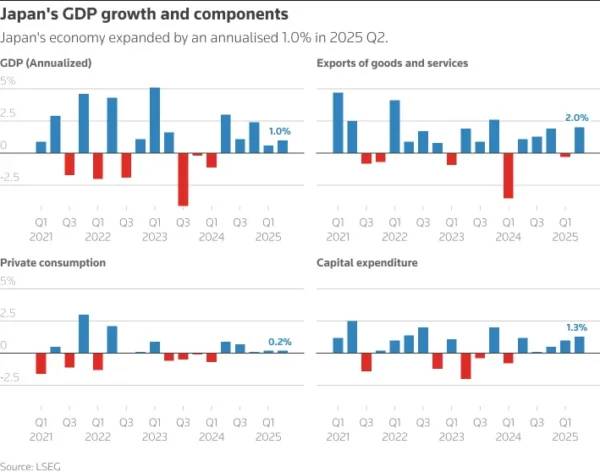
          Japan’s economy grew faster than expected in the second quarter, with GDP rising 1.0% annually, marking five straight quarters of growth. This was supported by strong exports and capital spending, despite US tariffs. The growth beat market expectations of 0.4% and followed a revised 0.6% rise in the previous quarter.
          Japan GDP Surprise, China Data Disappoints, Trump-Putin Meeting In Focus As DAX Advances Following Breakout_1

          Source: LSEG

          However, analysts warn that US tariffs and global uncertainties could hurt Japan’s economy in the coming months, especially for automakers trying to keep prices low for US customers.

          China Data Disappoints as Factory Output and Retail Sales Slump

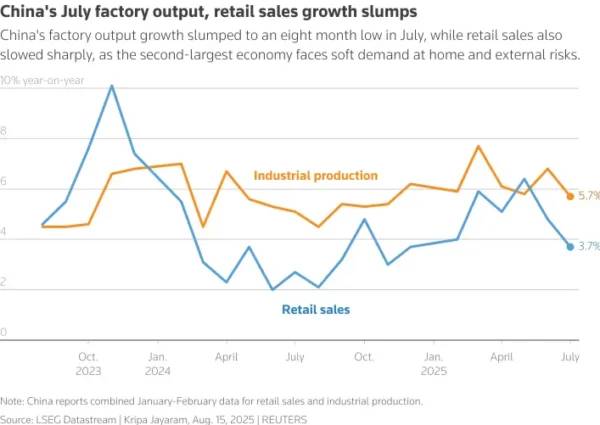
          China’s factory output growth hit an eight-month low in July, and retail sales slowed sharply, increasing pressure on policymakers to boost the $19 trillion economy with more stimulus.Challenges include US trade policies, extreme weather, tough domestic competition, and a weak property sector. Industrial output grew 5.7% in July, down from 6.8% in June and below the 5.9% forecast. Retail sales rose 3.7%, the slowest since December 2024, missing the expected 4.6% increase.
          Japan GDP Surprise, China Data Disappoints, Trump-Putin Meeting In Focus As DAX Advances Following Breakout_2

          Source: LSEG

          European Open – European Indexes Higher Ahead Trump-Putin Meeting

          Heading into the European Open, Pan-region futures rose 0.5%, German DAX futures increased 0.5%, and FTSE futures also gained 0.5%.Investors are keeping a close eye on US President Donald Trump’s meeting with Russia’s Vladimir Putin on Friday, aimed at ending the war in Ukraine.There’s concern about how long any agreement might last, and European leaders worry the US and Russia could make big decisions that leave them out or pressure Ukraine into a bad deal.

          If the Trump-Putin Alaska summit gets positive feedback, European stocks are likely to see a boost. The details matter, and Europe is unlikely to fully welcome Russia, even if peace is restored. This means defense stocks might slow down their steady rise but won’t face major setbacks.On the FX front, The euro and British pound stayed mostly unchanged after dropping 0.5% and 0.3% in the previous session, ahead of US retail sales data.

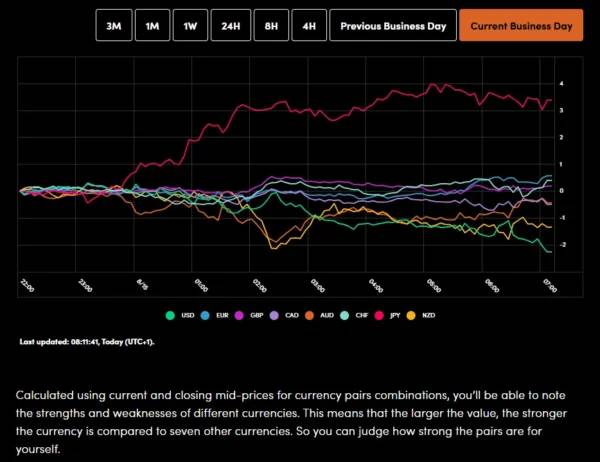
          The Japanese yen strengthened thanks to surprisingly strong economic growth, with exports holding up well against new US tariffs.The Australian dollar remained steady, while the Chinese yuan fell from a two-week high due to weaker-than-expected economic data.

          Currency Power Balance
          Japan GDP Surprise, China Data Disappoints, Trump-Putin Meeting In Focus As DAX Advances Following Breakout_3

          Source: OANDA Labs

          Geopolitics will be in the news as the Trump-Putin meeting gets underway while we also have the Jackson Hole Symposium where all eyes will be on Fed Chair Jerome Powell.From a data perspective, the US session brings retail sales numbers will give a glimpse to consumer demand but the bigger one could be the Michigan Consumer Sentiment data.It will be interesting to see where survey respondents see inflation expectations over the 12 months in particular.

          Japan GDP Surprise, China Data Disappoints, Trump-Putin Meeting In Focus As DAX Advances Following Breakout_4

          For all market-moving economic releases and events, see the MarketPulse Economic Calendar.

          Chart of the Day – DAX Index

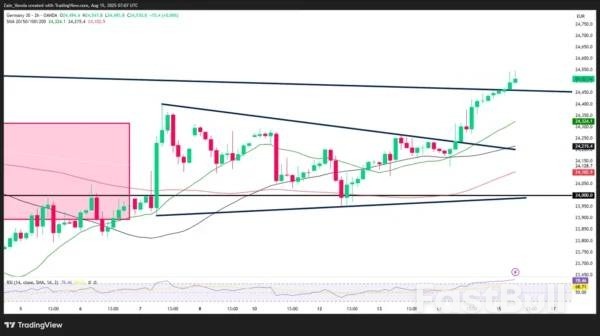
          From a technical standpoint, the DAX index has continued to advance following yesterdays breakout.

          DAX Index Two-Hour Chart, August 15. 2025
          Japan GDP Surprise, China Data Disappoints, Trump-Putin Meeting In Focus As DAX Advances Following Breakout_5

          Source: TradingView.com

          Source: OANDA

          To stay updated on all economic events of today, please check out our Economic calendar
          Risk Warnings and Disclaimers
          You understand and acknowledge that there is a high degree of risk involved in trading. Following any strategies or investment methods may lead to potential losses. The content on the site is provided by our contributors and analysts for information purposes only. You are solely responsible for determining whether any trading assets, securities, strategy, or any other product is suitable for investing based on your own investment objectives and financial situation.
          Add to Favorites
          Share

          Vietnam’s Struggle to Build a Skilled Workforce in the Age of Technological Transformation

          Gerik

          Economic

          Demographic Advantage Yet Insufficient for Future Demands

          According to the report presented to the National Assembly Standing Committee on August 11, 2025, Vietnam’s workforce reached 53 million people aged 15 and above by April 1, 2024, accounting for over 52% of the population. The trained labor rate stood at 69%, and the national average monthly income in 2024 was 7.7 million VND. Labor productivity rose by 5% annually from 2021 to 2024, nearly 1.3 times higher than in 2021. However, these promising figures mask deeper concerns about workforce quality and readiness for high-tech industry demands.
          Despite economic growth, 64.6% of the workforce remains in informal employment with poor working conditions and low wages. Only 28.3% of workers hold official qualifications or certifications, while nearly 38 million workers are untrained. Even in foreign direct investment (FDI) enterprises typically requiring high skills there has been a decline in the share of qualified employees, from 25.5% in 2021 to 21.69% in 2024. This downward trend signals a persistent gap in the quality of the labor force, especially in sectors driving innovation.

          Mismatch Between Training Output and Market Needs

          The gap between academic training and labor market demand is growing. While industries are increasingly driven by automation, AI, and sustainability, the majority of university students continue to pursue economics, finance, and law. Core science and agriculture programs are shrinking. This mismatch leads to a high rate of job mismatches, with approximately 30% of graduates working outside their trained fields. Many are unable to meet the soft skills, adaptability, or professionalism required by employers, pointing to systemic issues in both curriculum and pedagogy.
          Industrial hubs like Hai Phong face acute labor shortages. As more provinces develop manufacturing zones and birth rates stagnate, competition for labor has intensified. Enterprises, particularly those in high-tech manufacturing, report difficulties in recruiting skilled workers. This indicates a causal link between industrial decentralization and the thinning of local talent pools, raising alarms about workforce planning and distribution.

          Weak Collaboration Between Enterprises and Education Systems

          The absence of strong links between schools, vocational centers, and businesses is a key factor exacerbating the labor mismatch. Despite willingness from corporations to invest in workforce development, current policy lacks incentives. LG Vietnam’s CEO stressed that vocational school graduates still fall short of employer expectations. Without tax relief or subsidies to support on-site training initiatives, corporate investment in education remains minimal, further weakening the talent pipeline.
          At the parliamentary session, Vice Chairman Nguyen Khac Dinh proposed a five-pillar strategy: learning, utilizing, retaining, connecting, and innovating. Learning emphasizes restructuring the national education system from primary to vocational, shifting from exam-driven learning to work-oriented training. Utilizing calls for matching graduates with relevant jobs to prevent skill waste. Retaining focuses on keeping top talent both in public institutions and within the country by rotating experts across sectors to promote innovation, similar to Japan and South Korea. Connecting advocates stronger coordination between academia and industry to create a sustainable labor ecosystem. Innovating highlights the need for digitization and agile governance to keep pace with global trends.

          Golden Demographic Window But It’s Closing Fast

          Vietnam’s current population structure provides a rare opportunity to advance national development. However, this advantage is time-sensitive. The shortfall in high-quality workers, particularly in strategic fields such as AI, semiconductor engineering, and green technology, could soon limit growth potential. If no drastic and coordinated interventions are made, the country risks missing its historical window for industrial upgrading and innovation leadership.
          Vietnam is at a critical crossroads where demographic strength alone is no longer sufficient to sustain future economic ambitions. The relationship between training quality, skill application, and labor market fit is not merely correlative but sequentially linked in a feedback loop. Weak connections and underinvestment in applied training contribute to skill erosion and talent loss. The nation must urgently shift from a cost-competitive labor model to a knowledge- and innovation-driven workforce strategy. Building a skilled, adaptive, and connected workforce is not just a priority it is the foundation for sustainable national resilience in an increasingly tech-driven global economy.
          To stay updated on all economic events of today, please check out our Economic calendar
          Risk Warnings and Disclaimers
          You understand and acknowledge that there is a high degree of risk involved in trading. Following any strategies or investment methods may lead to potential losses. The content on the site is provided by our contributors and analysts for information purposes only. You are solely responsible for determining whether any trading assets, securities, strategy, or any other product is suitable for investing based on your own investment objectives and financial situation.
          Add to Favorites
          Share

          South Korea To Restore Pact Curbing Military Activity On North Korean Border

          James Whitman

          Political

          South Korea intends to restore an agreement to suspend some military activity along the border with North Korea, President Lee Jae Myung said on Friday, as his government seeks to improve relations between neighbours still technically at war.

          The 2018 military accord was designed to curb the risk of inadvertent clashes, but broke down after a spike in tensions.

          WHAT HAPPENED IN 2018?

          The so-called Comprehensive Military Agreement (CMA) signed between the two Koreas was the most substantive deal to result from months of historic meetings between leader Kim Jong Un and then-South Korean President Moon Jae-in.

          On September 19, 2018, South Korea's defence minister and his North Korean counterpart signed the CMA in the North's capital, Pyongyang, accompanied by polite applause from the onlooking leaders.

          Under the CMA, both countries agreed to "completely cease all hostile acts against each other" and implement military confidence-building measures in air, land and sea domains.

          The measures included the two sides ending military drills near the border, banning live-fire exercises in certain areas, the imposition of no-fly zones, the removal of some guard posts along the Demilitarized Zone, and maintaining hotlines.

          On the ground, both sides agreed to completely cease artillery drills and field training within 5 km (3 miles) of the Military Demarcation Line (MDL) between the countries.

          At sea, they installed covers on the barrels of naval guns and coastal artillery and closed gun ports in a buffer zone along the sea border.

          MILITARY DEAL FALLS APART

          With inter-Korean and denuclearisation talks long stalled, the military accord started to fracture in recent years amid drills and shows of force along the fortified border between the Koreas as they accused the other of breaches.

          North Korea's launch of a spy satellite in 2023 further ratcheted up tensions on the Korean peninsula, and the countries walked away from the confidence-building pact.

          South Korea's National Security Council that year moved to "suspend the effect of Article 1, Clause 3" establishing no-fly zones close to the border in the 2018 military agreement, enabling Seoul to restore reconnaissance and surveillance activities along the border.

          South Korea's military then restarted aerial surveillance in border areas, the defence ministry said.

          North Korea in return said its army would "never be bound" by the pact, ripping up the agreement and vowing to restore all military measures it had halted under the deal.

          In June 2024, former South Korean President Yoon Suk Yeol declared a complete suspension of the military pact in response to North Korea's move to send hundreds of rubbish-stuffed balloons across the border.

          Later that year, as hostilities increased state-run news agency KCNA said North Korea amended its constitution to designate the South as a "hostile state".

          HOW WILL PYONGYANG RESPOND?

          President Lee, who won a snap election in June, has sought to re-engage Pyongyang after a period of cross-border tension and shown a willingness to return to dialogue.

          He touted on Friday his government's efforts to ease tensions, including halting the launch of balloons floated by activists with anti-North Korea leaflets and dismantling loudspeaker propaganda broadcasts across the border.

          How Pyongyang might respond remains unclear. Top North Korean officials have in recent weeks dismissed moves taken by Lee's new liberal government to ease tensions.

          Some analysts are also sceptical about the short-term prospects of a favourable response from North Korea to such overtures.

          Source: Reuters

          Risk Warnings and Disclaimers
          You understand and acknowledge that there is a high degree of risk involved in trading. Following any strategies or investment methods may lead to potential losses. The content on the site is provided by our contributors and analysts for information purposes only. You are solely responsible for determining whether any trading assets, securities, strategy, or any other product is suitable for investing based on your own investment objectives and financial situation.
          Add to Favorites
          Share
          FastBull
          Copyright © 2025 FastBull Ltd

          728 RM B 7/F GEE LOK IND BLDG NO 34 HUNG TO RD KWUN TONG KLN HONG KONG

          TelegramInstagramTwitterfacebooklinkedin
          App Store Google Play Google Play
          Products
          Charts

          Chats

          Q&A with Experts
          Screeners
          Economic Calendar
          Data
          Tools
          Membership
          Features
          Function
          Markets
          Copy Trading
          Latest Signals
          Contests
          News
          Analysis
          24/7
          Columns
          Education
          Company
          Careers
          About Us
          Contact Us
          Advertising
          Help Center
          Feedback
          User Agreement
          Privacy Policy
          Business

          White Label

          Data API

          Web Plug-ins

          Poster Maker

          Affiliate Program

          Risk Disclosure

          The risk of loss in trading financial instruments such as stocks, FX, commodities, futures, bonds, ETFs and crypto can be substantial. You may sustain a total loss of the funds that you deposit with your broker. Therefore, you should carefully consider whether such trading is suitable for you in light of your circumstances and financial resources.

          No decision to invest should be made without thoroughly conducting due diligence by yourself or consulting with your financial advisors. Our web content might not suit you since we don't know your financial conditions and investment needs. Our financial information might have latency or contain inaccuracy, so you should be fully responsible for any of your trading and investment decisions. The company will not be responsible for your capital loss.

          Without getting permission from the website, you are not allowed to copy the website's graphics, texts, or trademarks. Intellectual property rights in the content or data incorporated into this website belong to its providers and exchange merchants.

          Not Logged In

          Log in to access more features

          FastBull Membership

          Not yet

          Purchase

          Become a signal provider
          Help Center
          Customer Service
          Dark Mode
          Price Up/Down Colors

          Log In

          Sign Up

          Position
          Layout
          Fullscreen
          Default to Chart
          The chart page opens by default when you visit fastbull.com