• Trade
  • Markets
  • Copy
  • Contests
  • News
  • 24/7
  • Calendar
  • Q&A
  • Chats
Trending
Screeners
SYMBOL
LAST
BID
ASK
HIGH
LOW
NET CHG.
%CHG.
SPREAD
SPX
S&P 500 Index
6857.13
6857.13
6857.13
6865.94
6827.13
+7.41
+ 0.11%
--
DJI
Dow Jones Industrial Average
47850.93
47850.93
47850.93
48049.72
47692.96
-31.96
-0.07%
--
IXIC
NASDAQ Composite Index
23505.13
23505.13
23505.13
23528.53
23372.33
+51.04
+ 0.22%
--
USDX
US Dollar Index
98.940
99.020
98.940
98.980
98.740
-0.040
-0.04%
--
EURUSD
Euro / US Dollar
1.16492
1.16499
1.16492
1.16715
1.16408
+0.00047
+ 0.04%
--
GBPUSD
Pound Sterling / US Dollar
1.33365
1.33373
1.33365
1.33622
1.33165
+0.00094
+ 0.07%
--
XAUUSD
Gold / US Dollar
4221.09
4221.50
4221.09
4230.62
4194.54
+13.92
+ 0.33%
--
WTI
Light Sweet Crude Oil
59.312
59.342
59.312
59.543
59.187
-0.071
-0.12%
--

Community Accounts

Signal Accounts
--
Profit Accounts
--
Loss Accounts
--
View More

Become a signal provider

Sell trading signals to earn additional income

View More

Guide to Copy Trading

Get started with ease and confidence

View More

Signal Accounts for Members

All Signal Accounts

Best Return
  • Best Return
  • Best P/L
  • Best MDD
Past 1W
  • Past 1W
  • Past 1M
  • Past 1Y

All Contests

  • All
  • Trump Updates
  • Recommend
  • Stocks
  • Cryptocurrencies
  • Central Banks
  • Featured News
Top News Only
Share

Reuters Poll - Bank Of Canada Will Hold Overnight Rate At 2.25% On December 10, Say 33 Economists

Share

US Wants Europe To Assume Most NATO Defense Capabilities By 2027, Pentagon Officials Tell Diplomats, According To Sources

Share

Chile Says November Consumer Prices +0.3%, Market Expected +0.30%

Share

Ukraine Grain Exports As Of December 5

Share

Ministry: Ukraine's 2025 Grain Harvest At 53.6 Million Tons So Far

Share

Citigroup Expects European Central Bank To Hold Interest Rates At 2.0% At Least Until End-Of-2027 Versus Prior Forecast Of Cuts To 1.5% By March 2026

Share

Japan Economy Minister Kiuchi: Hope Bank Of Japan Guides Appropriate Monetary Policy To Stably Achieve 2% Inflation Target, Working Closely With Government In Line With Principles Stipulated In Government-Bank Of Japan Joint Agreement

Share

Japan Economy Minister Kiuchi: Specific Monetary Policy Means Up To Bank Of Japan To Decide, Government Won't Comment

Share

Japan Economy Minister Kiuchi: Government Will Watch Market Moves With High Sense Of Urgency

Share

Japan Economy Minister Kiuchi: Important For Stock, Forex, Bond Markets To Move Stably Reflecting Fundamentals

Share

Norway Government: Will Order 2 More German-Made Submarines, Taking Total To 6 Submarines, Increasing Planned Spending By Nok 46 Billion

Share

Norway Government: Plans To Buy Long-Range Artillery Weapons For Nok 19 Billion, With Strike Distance Of Up To 500 Km

Share

Japan Economy Minister Kiuchi: Inflationary Impact Of Stimulus Package Likely Limited

Share

BP : BofA Global Research Cuts To Underperform From Neutral, Cuts Price Objective To 375P From 440P

Share

Shell : BofA Global Research Cuts To Neutral From Buy, Cuts Price Objective To 3100P From 3200P

Share

Russia Plans To Supply 5-5.5 Million Tons Of Fertilizers To India In 2025

Share

Euro Zone Q3 Employment Revised To 0.6% Year-On-Year

Share

Rheinmetall Ag : BofA Global Research Cuts Price Objective To EUR 2215 From EUR 2540

Share

China's Commerce Minister: Will Eliminate Restrictive Measures

Share

Russia - India Statement Says Defence Partnership Is Responding To India's Aspirations For Self-Reliance

TIME
ACT
FCST
PREV
U.S. Challenger Job Cuts MoM (Nov)

A:--

F: --

P: --

U.S. Initial Jobless Claims 4-Week Avg. (SA)

A:--

F: --

P: --

U.S. Weekly Initial Jobless Claims (SA)

A:--

F: --

P: --

U.S. Weekly Continued Jobless Claims (SA)

A:--

F: --

P: --

Canada Ivey PMI (SA) (Nov)

A:--

F: --

P: --

Canada Ivey PMI (Not SA) (Nov)

A:--

F: --

P: --

U.S. Non-Defense Capital Durable Goods Orders Revised MoM (Excl. Aircraft) (SA) (Sept)

A:--

F: --

P: --
U.S. Factory Orders MoM (Excl. Transport) (Sept)

A:--

F: --

P: --

U.S. Factory Orders MoM (Sept)

A:--

F: --

P: --

U.S. Factory Orders MoM (Excl. Defense) (Sept)

A:--

F: --

P: --

U.S. EIA Weekly Natural Gas Stocks Change

A:--

F: --

P: --

Saudi Arabia Crude Oil Production

A:--

F: --

P: --

U.S. Weekly Treasuries Held by Foreign Central Banks

A:--

F: --

P: --

Japan Foreign Exchange Reserves (Nov)

A:--

F: --

P: --

India Repo Rate

A:--

F: --

P: --

India Benchmark Interest Rate

A:--

F: --

P: --

India Reverse Repo Rate

A:--

F: --

P: --

India Cash Reserve Ratio

A:--

F: --

P: --

Japan Leading Indicators Prelim (Oct)

A:--

F: --

P: --

U.K. Halifax House Price Index YoY (SA) (Nov)

A:--

F: --

P: --

U.K. Halifax House Price Index MoM (SA) (Nov)

A:--

F: --

P: --

France Current Account (Not SA) (Oct)

A:--

F: --

P: --

France Trade Balance (SA) (Oct)

A:--

F: --

P: --

France Industrial Output MoM (SA) (Oct)

A:--

F: --

P: --

Italy Retail Sales MoM (SA) (Oct)

A:--

F: --

P: --

Euro Zone Employment YoY (SA) (Q3)

A:--

F: --

P: --

Euro Zone GDP Final YoY (Q3)

A:--

F: --

P: --

Euro Zone GDP Final QoQ (Q3)

A:--

F: --

P: --

Euro Zone Employment Final QoQ (SA) (Q3)

A:--

F: --

P: --

Euro Zone Employment Final (SA) (Q3)

A:--

F: --

P: --
Brazil PPI MoM (Oct)

--

F: --

P: --

Mexico Consumer Confidence Index (Nov)

--

F: --

P: --

Canada Unemployment Rate (SA) (Nov)

--

F: --

P: --

Canada Labor Force Participation Rate (SA) (Nov)

--

F: --

P: --

Canada Employment (SA) (Nov)

--

F: --

P: --

Canada Part-Time Employment (SA) (Nov)

--

F: --

P: --

Canada Full-time Employment (SA) (Nov)

--

F: --

P: --

U.S. Personal Income MoM (Sept)

--

F: --

P: --

U.S. Dallas Fed PCE Price Index YoY (Sept)

--

F: --

P: --

U.S. PCE Price Index YoY (SA) (Sept)

--

F: --

P: --

U.S. PCE Price Index MoM (Sept)

--

F: --

P: --

U.S. Personal Outlays MoM (SA) (Sept)

--

F: --

P: --

U.S. Core PCE Price Index MoM (Sept)

--

F: --

P: --

U.S. UMich 5-Year-Ahead Inflation Expectations Prelim YoY (Dec)

--

F: --

P: --

U.S. Core PCE Price Index YoY (Sept)

--

F: --

P: --

U.S. Real Personal Consumption Expenditures MoM (Sept)

--

F: --

P: --

U.S. 5-10 Year-Ahead Inflation Expectations (Dec)

--

F: --

P: --

U.S. UMich Current Economic Conditions Index Prelim (Dec)

--

F: --

P: --

U.S. UMich Consumer Sentiment Index Prelim (Dec)

--

F: --

P: --

U.S. UMich 1-Year-Ahead Inflation Expectations Prelim (Dec)

--

F: --

P: --

U.S. UMich Consumer Expectations Index Prelim (Dec)

--

F: --

P: --

U.S. Weekly Total Rig Count

--

F: --

P: --

U.S. Weekly Total Oil Rig Count

--

F: --

P: --

U.S. Consumer Credit (SA) (Oct)

--

F: --

P: --

China, Mainland Foreign Exchange Reserves (Nov)

--

F: --

P: --

China, Mainland Exports YoY (USD) (Nov)

--

F: --

P: --

China, Mainland Imports YoY (CNH) (Nov)

--

F: --

P: --

China, Mainland Imports YoY (USD) (Nov)

--

F: --

P: --

China, Mainland Trade Balance (CNH) (Nov)

--

F: --

P: --

China, Mainland Exports (Nov)

--

F: --

P: --

Q&A with Experts
    • All
    • Chatrooms
    • Groups
    • Friends
    Connecting
    .
    .
    .
    Type here...
    Add Symbol or Code

      No matching data

      All
      Trump Updates
      Recommend
      Stocks
      Cryptocurrencies
      Central Banks
      Featured News
      • All
      • Russia-Ukraine Conflict
      • Middle East Flashpoint
      • All
      • Russia-Ukraine Conflict
      • Middle East Flashpoint
      Search
      Products

      Charts Free Forever

      Chats Q&A with Experts
      Screeners Economic Calendar Data Tools
      Membership Features
      Data Warehouse Market Trends Institutional Data Policy Rates Macro

      Market Trends

      Market Sentiment Order Book Forex Correlations

      Top Indicators

      Charts Free Forever
      Markets

      News

      News Analysis 24/7 Columns Education
      From Institutions From Analysts
      Topics Columnists

      Latest Views

      Latest Views

      Trending Topics

      Top Columnists

      Latest Update

      Signals

      Copy Rankings Latest Signals Become a signal provider AI Rating
      Contests
      Brokers

      Overview Brokers Assessment Rankings Regulators News Claims
      Broker listing Forex Brokers Comparison Tool Live Spread Comparison Scam
      Q&A Complaint Scam Alert Videos Tips to Detect Scam
      More

      Business
      Events
      Careers About Us Advertising Help Center

      White Label

      Data API

      Web Plug-ins

      Affiliate Program

      Awards Institution Evaluation IB Seminar Salon Event Exhibition
      Vietnam Thailand Singapore Dubai
      Fans Party Investment Sharing Session
      FastBull Summit BrokersView Expo
      Recent Searches
        Top Searches
          Markets
          News
          Analysis
          User
          24/7
          Economic Calendar
          Education
          Data
          • Names
          • Latest
          • Prev

          View All

          No data

          Scan to Download

          Faster Charts, Chat Faster!

          Download App
          English
          • English
          • Español
          • العربية
          • Bahasa Indonesia
          • Bahasa Melayu
          • Tiếng Việt
          • ภาษาไทย
          • Français
          • Italiano
          • Türkçe
          • Русский язык
          • 简中
          • 繁中
          Open Account
          Search
          Products
          Charts Free Forever
          Markets
          News
          Signals

          Copy Rankings Latest Signals Become a signal provider AI Rating
          Contests
          Brokers

          Overview Brokers Assessment Rankings Regulators News Claims
          Broker listing Forex Brokers Comparison Tool Live Spread Comparison Scam
          Q&A Complaint Scam Alert Videos Tips to Detect Scam
          More

          Business
          Events
          Careers About Us Advertising Help Center

          White Label

          Data API

          Web Plug-ins

          Affiliate Program

          Awards Institution Evaluation IB Seminar Salon Event Exhibition
          Vietnam Thailand Singapore Dubai
          Fans Party Investment Sharing Session
          FastBull Summit BrokersView Expo

          Between A Dock & A Hard Place: Record Short Oil Positions Squeezed By Sanctions Despite Record Crude Glut On-Water

          John Adams

          Commodity

          Economic

          Summary:

          "...the most anticipated oil supply glut in history"...

          There are some extreme dichotomies in the crude complex currently that are worth a quick look...

          Amid what Eric Nuttall coined as "the most anticipated oil supply glut in history"...

          ... crude prices had fallen to 5-month lows just over a week ago. Then Washington unleashed sanctions on two of Russia's oil giants, Rosneft PJSC and Lukoil PJSC (and India and China suggested it would cut back on Russian oil purchases, implying demand for alternatives), prices for oil surged back higher...
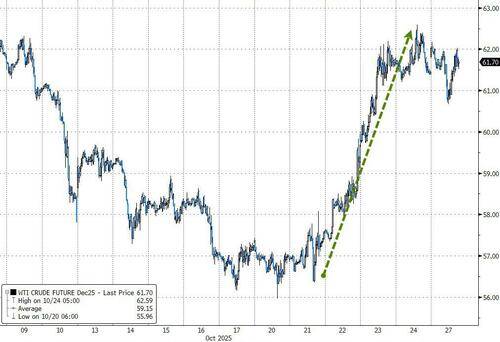
          OilPrice reports that India imported 19.93 million tons of crude oil last month, a 1.7% increase from August, the Economic Times reported, citing government data. The total is equal to roughly 4.87 million barrels daily.

          The annual increase in imports for September was more pronounced, at 6.1%, the data also showed.

          In oil products, the government's Petroleum Planning and Analysis Cell reported imports of 4.40 million tons, which was a 20.9% increase on September 2024. Product exports, on the other hand, fell by 4.8% to 6.18 million tons.

          But, the publication also reported that Russian exports of crude oil to India declined by 8.4% over the three months to September amid shrinking discounts and tighter availability of barrels. The decline is expected to become sharper in the coming weeks, following the latest U.S. sanctions on Russian oil, targeting two of the largest exporters—Rosneft and Lukoil.

          India needs more local discoveries of oil and gas in order to be able to meet future energy demand, the secretary of petroleum and natural gas at the Indian energy ministry said.

          "One day, we will be looking at a situation where alternative forms of energy will increasingly matter more for incremental demand satisfaction than fossil fuels," Pankaj Jain said, as quoted by PTI.

          Additionally, supertanker freight futures surged on Thursday and Friday after the U.S. sanctions against Russia's biggest oil firms created a rush to replace Russian barrels.

          The front-month supertanker contracts on the route Middle East to China, the benchmark route, jumped by 16% on Thursday, to the highest level in nearly two years, according to data from the Baltic Exchange data cited by Bloomberg.

          "We anticipate the rush for replacement crudes will be larger and more sustained because of the exhaustive list of Russian producers under OFAC sanctions," Anoop Singh, global head of shipping research at Oil Brokerage, told Bloomberg.

          Supertanker rates were already rising earlier this month due to the latest tit-for-tat fees on port callings in the U.S.-China trade spat.

          The port fees threaten to create additional vortexes in global oil flows.

          Ahead of the rally, money managers boosted bearish positions on the global benchmark by 40,233 lots to 197,868 in the week ended Oct. 21, according to ICE Futures Europe. That's the most on record... providing a lot of ammunition for a sizable short squeeze...
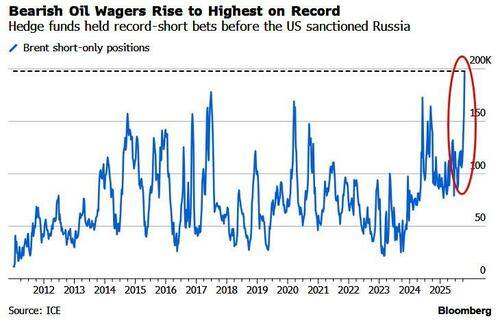
          ...as traders worldwide bet on mounting evidence that a long-anticipated supply surplus is finally underway with a flotilla of crude oil on the world's oceans expanded to a fresh high as producer nations keep adding barrels and the tankers sail further for deliveries...
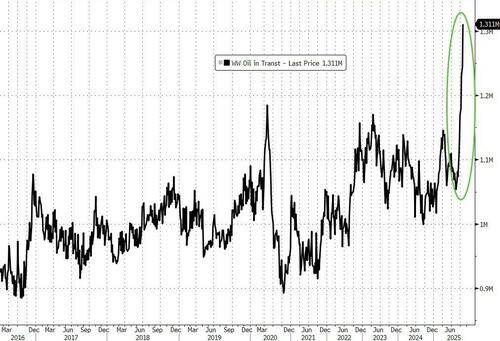
          Production is rising from members of the OPEC+ group of nations, which are unwinding earlier output cuts - as well as countries outside the group, predominantly in the Americas, where Guyana recently started pumping from a new offshore field and US output hit a new high.

          The build-up comes at a time when demand growth is slowing, with forecasters predicting a surplus that could rise to as much as 4 million barrels a day in the early months of next year.

          However, as Eric Nuttall reminds, inventory on land is much lower than expected...

          "...onshore inventories have FALLEN by 39MM Bbls in the first 20 days of October, and are actually the tightest to the 5 year average in ~ 4 months. It wasn't supposed to be like this!"
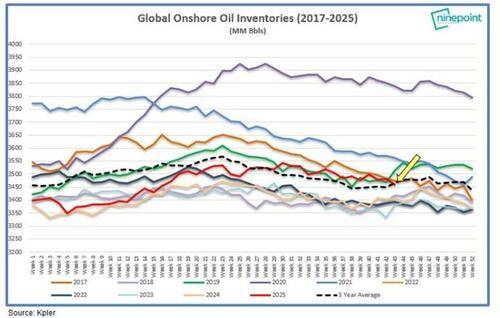
          ...and much of the oil-on-water is already headed to specific processing units.

          Finally, remember China is stockpiling 500k barrels-a-day for its own Strategic Petroleum Reserve, so there's plenty of demand (for bulls to squeeze on), but any progress toward peace, such as reviving Budapest meeting plans, may undermine the rally as will chatter that OPEC+ is currently expected to focus on reviving another modest sliver of oil production in December as a base case when key members meet this weekend, according to two delegates.

          Domestic demand is booming too, as Bloomberg's Javier Blas notes, US oil consumption is heading toward a 18-year high of 20.59 million b/d in 2025. And further increases are likely.
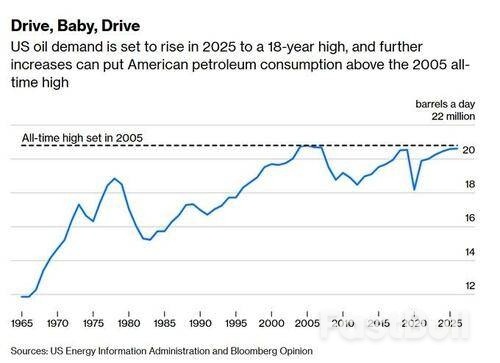
          That's a lot of supply, demand, and positioning extremes to consider.

          Source: Zero Hedge

          To stay updated on all economic events of today, please check out our Economic calendar
          Risk Warnings and Disclaimers
          You understand and acknowledge that there is a high degree of risk involved in trading. Following any strategies or investment methods may lead to potential losses. The content on the site is provided by our contributors and analysts for information purposes only. You are solely responsible for determining whether any trading assets, securities, strategy, or any other product is suitable for investing based on your own investment objectives and financial situation.
          Add to Favorites
          Share

          Currencies: The balance of power has reversed

          Adam

          Forex

          Economic

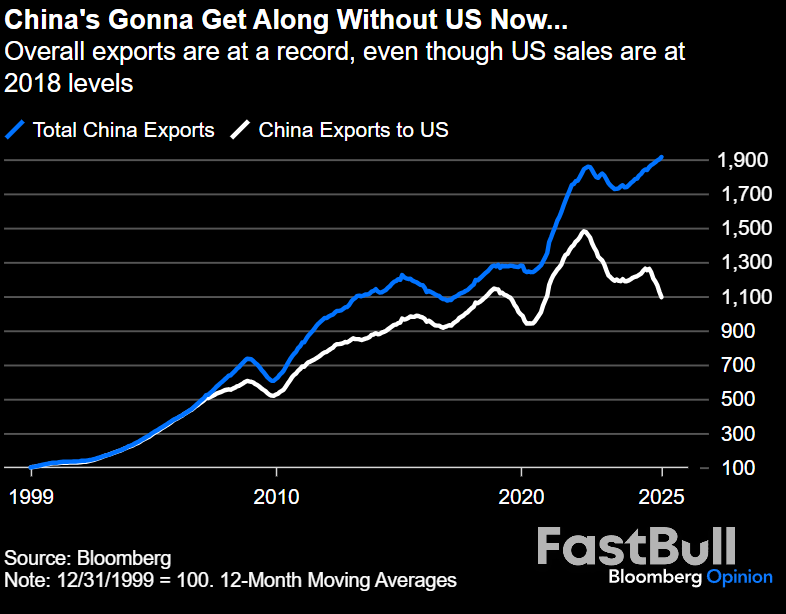
          The balance of power established by the US president has enabled the United States to renegotiate customs duties with its main trading partners, with the notable exception of its Chinese competitor. It must be said that the US position, so dominant at the end of World War II, has gradually lost momentum. The map below illustrates this perfectly. While in the early 2000s, the US and Europe largely dominated world trade, the situation in 2024 paints a very different picture. The US stronghold in Latin America has eroded in favor of China, as has European dominance in Africa, the Middle East, and Asia. On a global scale, one could almost say that trade is local (everything is relative, of course). What is particularly striking is the predominance of the Middle Kingdom in global trade.
          Worse still, while Chinese exports have reached a new all-time high, sales to the US are at the same level as in 2018. This decoupling between the two world super-powers is obviously not in the interests of the Americans, who have less leverage over their Asian competitor, even though the latter has a stranglehold on almost all of the production of rare earths, which are so important to all our industries. I invite you to read Laurent Pignot's excellent article on this subject.
          Currencies: The balance of power has reversed_1
          What does this have to do with currencies, you may ask?
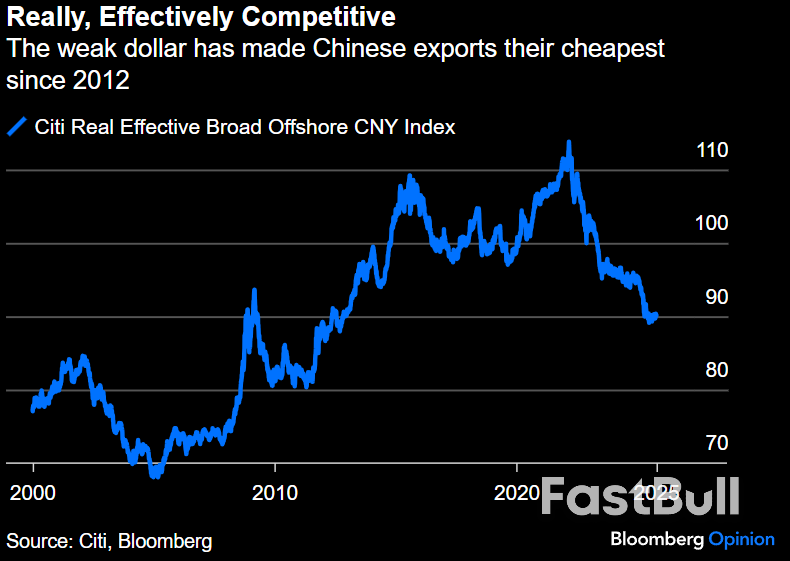
          Paradoxically, the weakness of the US dollar has benefited the yuan, whose performance remains closely linked to the greenback.
          Currencies: The balance of power has reversed_2
          Thus, even in the event of tough negotiations, the Chinese now seem better equipped to absorb the shock, which certainly explains their reluctance to make any changes.
          Technically, the EUR/USD is still trading above its key support level of 1.1500, which only a break below would truly validate the medium-term consolidation scenario. It should be noted that, at the same time, the dollar index (DXY) has not yet managed to break above 99.50.
          The USD/JPY has performed well on its support at 149.90 and is retesting previous highs at 153.27 before ideally continuing its rise to 154.15/50. The Aussie and Kiwi have so far held their targets at 0.6445/00 and 0.5690. The former is currently testing initial resistance at 0.6545, which it will need to hold at the close to keep the consolidation structure that has been in place since mid-September intact.

          Source: marketscreener

          To stay updated on all economic events of today, please check out our Economic calendar
          Risk Warnings and Disclaimers
          You understand and acknowledge that there is a high degree of risk involved in trading. Following any strategies or investment methods may lead to potential losses. The content on the site is provided by our contributors and analysts for information purposes only. You are solely responsible for determining whether any trading assets, securities, strategy, or any other product is suitable for investing based on your own investment objectives and financial situation.
          Add to Favorites
          Share

          OPEC+ Base Case Scenario Is Small Hike For Now, Delegates Say

          Thomas

          Commodity

          Economic

          OPEC+ is currently expected to focus on reviving another modest sliver of oil production in December as a base case when key members meet this weekend, according to two delegates.

          The group led by Saudi Arabia is so far expected to focus on a third monthly increase of 137,000 barrels a day, to be discussed at a video conference on Nov. 2, the delegates said. OPEC+ is in the process of restarting 1.66 million barrels-a-day in monthly stages a bid to reclaim its share of global oil markets.

          Still, the alliance's plans haven't been fully formed. World crude prices remain in flux amid signs of an impending oversupply, faltering demand in China and new US sanctions on Russia, a major OPEC+ member. The decision may also depend on the outcome of trade talks between the US and China, one of the delegates said.

          Oil futures are trading near $66 a barrel in London, after jumping last week on the latest sanctions against Russian producers.

          Nine of 10 oil traders, refiners and analysts surveyed by Bloomberg said they also expected a 137,000-barrel hike, while the other one predicted a larger boost.

          The Organization of the Petroleum Exporting Countries and its partners have surprised markets this year by reviving production halted two years ago in order to shore up prices. The coalition restored one tranche, amounting to 2.2 million barrels a day, a year ahead of schedule, but is adopting a more careful pace with this latest layer.

          Officials have said that the group's shift to opening the taps has been driven by Riyadh's desire to recoup market share ceded in recent years to rivals like US shale drillers.

          There could also be a political consideration in the decision, as Saudi Crown Prince Mohammed bin Salman prepares to visit the White House on Nov. 18. President Donald Trump has repeatedly called for cheaper fuel prices, while Saudi Arabia has demonstrated a desire to strengthen ties.

          In the meantime, crude traders are waiting for clarity on the impact of Washington's move to sanction Russia's top two oil producers, Rosneft PJSC and Lukoil PJSC, as Trump seeks to end the war in Ukraine.

          Source: Bloomberg Europe

          To stay updated on all economic events of today, please check out our Economic calendar
          Risk Warnings and Disclaimers
          You understand and acknowledge that there is a high degree of risk involved in trading. Following any strategies or investment methods may lead to potential losses. The content on the site is provided by our contributors and analysts for information purposes only. You are solely responsible for determining whether any trading assets, securities, strategy, or any other product is suitable for investing based on your own investment objectives and financial situation.
          Add to Favorites
          Share

          Market navigator: week of 27 October 2025

          Adam

          Economic

          What happened last week

          Progress on trade negotiations: US Treasury Secretary Bessent met Chinese Vice Premier He in Malaysia, marking significant progress towards de-escalation. The White House expressed optimism regarding the Trump-Xi dialogue at the South Korea summit on Thursday. The Hang Seng Index rebounded 3.6% last week. Meanwhile, the US terminated all trade talks with Canada following an anti-tariff television advertisement.
          Persistent challenges in China's economy: Third-quarter gross domestic product (GDP) expanded 4.8%, meeting expectations. Whilst year-to-date growth of 5.2% suggests China remains on course to achieve its 5% target, expansion remains concentrated within industrial production. Retail sales growth decelerated to 3.0%, the slowest pace since last November, while used home prices recorded their steepest drop in twelve months.
          Key takeaways from China's plenum: The four-day session established priorities for the 15th five-year plan, emphasising artificial intelligence and technology development. Officials committed to combating involution while promoting birth-friendly policies. Notable personnel changes underscored the party's intensified focus on anti-corruption measures.
          Japan's new prime minister: Sanae Takaichi secured a simple majority in both parliamentary houses, becoming Japan's first female prime minister after forming an alliance with Nippon Ishin. However, challenges lie ahead as her Liberal Democratic Party struggles to maintain public support. The Nikkei broke through historic highs, approaching 50,000.

          Markets in focus

          Easing credit and inflation concerns propel US equities to record highs
          All three major US equity indices established fresh all-time highs on Friday. The S&P 500 concluded the week with 1.9% gains, whilst the Nasdaq 100 and Dow Jones indices both advanced 2.2%. Improved US-China trade narratives provided positive sentiment, while robust earnings from regional banks Zions and Western Alliance alleviated credit concerns.
          Markets surged on Friday following a cooler-than-expected Consumer Price Index (CPI) report. Core inflation rose 0.2% month-on-month (MoM) in September, the lowest reading in three months. Shelter prices increased modestly, though furniture, audio and video equipment, and apparel reflected tariff impacts. The CPI report provides confidence for the Federal Reserve (Fed) to cut rates at Wednesday's meeting. Bond futures reflect a 98% probability of an October cut and 91% probability of a December reduction.
          Several major technology companies announced results last week. Tesla recorded strong sales in Q3 driven by US consumers' urgency to purchase electric vehicles ahead of the tax credit expiry. However, a 50% surge in operating expenses caused profits to decline substantially. Adjusted earnings per share fell 31% year-on-year (YoY), below market expectations. Intel, conversely, returned to profitability after securing significant artificial intelligence deals and implementing aggressive cost reduction measures. Share prices surged to an 18-month high following the results announcement. Earnings from five Magnificent Seven companies will be the focal point this week.
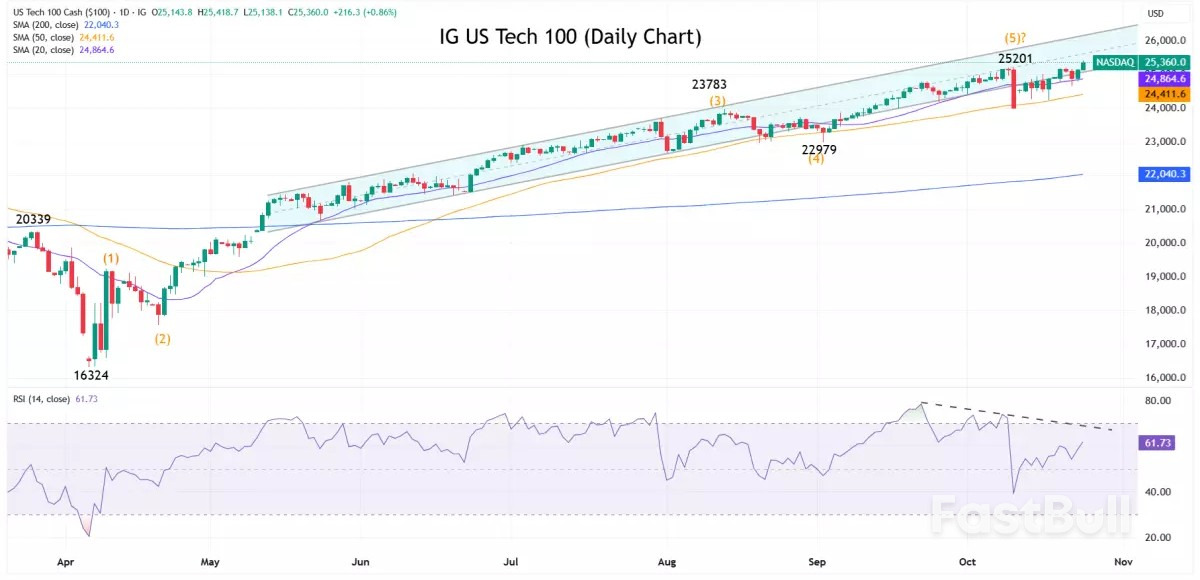
          The US Tech 100 has regained momentum following the sharp sell-off on 10 October. With price action restored within the ascending channel established since mid-May, the index has potential to test the upper boundary near 26,150. However, the Relative Strength Index (RSI) warrants close monitoring as early signs of bearish divergence emerge. Inability to maintain momentum could drive the index towards the 50-day moving average (MA) near 24,400.
          Figure 1: US Tech 100 index (daily) price chart

          Market navigator: week of 27 October 2025_1as of 26 Oct 2025. Past performance is not a reliable indicator of future performance.

          Gold retreats from historic peak
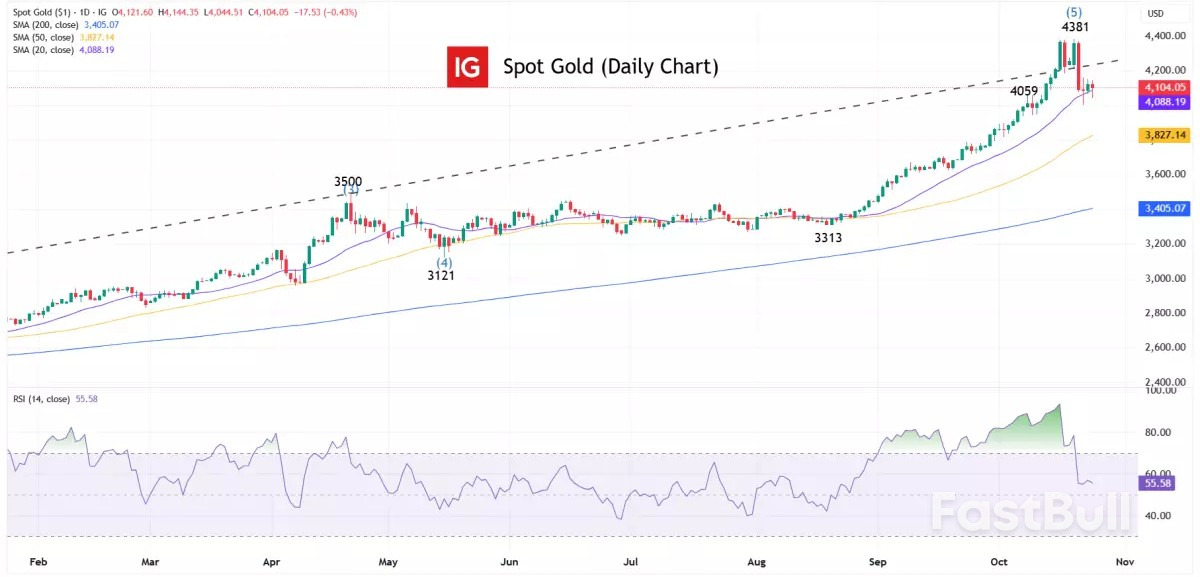
          Following an impressive 14% rally since the start of the month, gold prices exhausted their upward momentum. After establishing a new record high at $4381, gold prices experienced a sharp 6% retreat on Tuesday, marking the steepest daily drawdown since 2013.
          While the long-term fundamental investment thesis for gold continues to be supported by geopolitical uncertainties, central bank allocations, and diminishing confidence in fiat currencies, the recent surge exhibited signs of overbought conditions. With part of the rally driven by fear-of-missing-out (FOMO) sentiment and exuberant interest from leveraged traders, profit-taking from investors appears unsurprising. The recent pullback could represent a healthy reset for the medium to long-term trend.
          Since reaching $4003 on Wednesday, the decline has largely stabilised. Whether last week's sell-off represents the beginning of a trend reversal or merely a technical correction will depend on price action in the coming week. Key levels to monitor include support at approximately $4000 near the 20-day MA, as well as $3940, which marks a 10% drawdown from the peak. If historical patterns provide guidance, the pullbacks in November 2024 and April 2025 were both approximately 10%. A break below these levels could further exacerbate outflows from the asset class. Conversely, a hold above $4000 would signify buy-on-dip interest, which could propel gold prices back towards record high levels.
          Figure 2: Spot gold (daily) price chart

          Market navigator: week of 27 October 2025_2as of 26 Oct 2025. Past performance is not a reliable indicator of future performance.

          Crude oil rebounds on sanctions
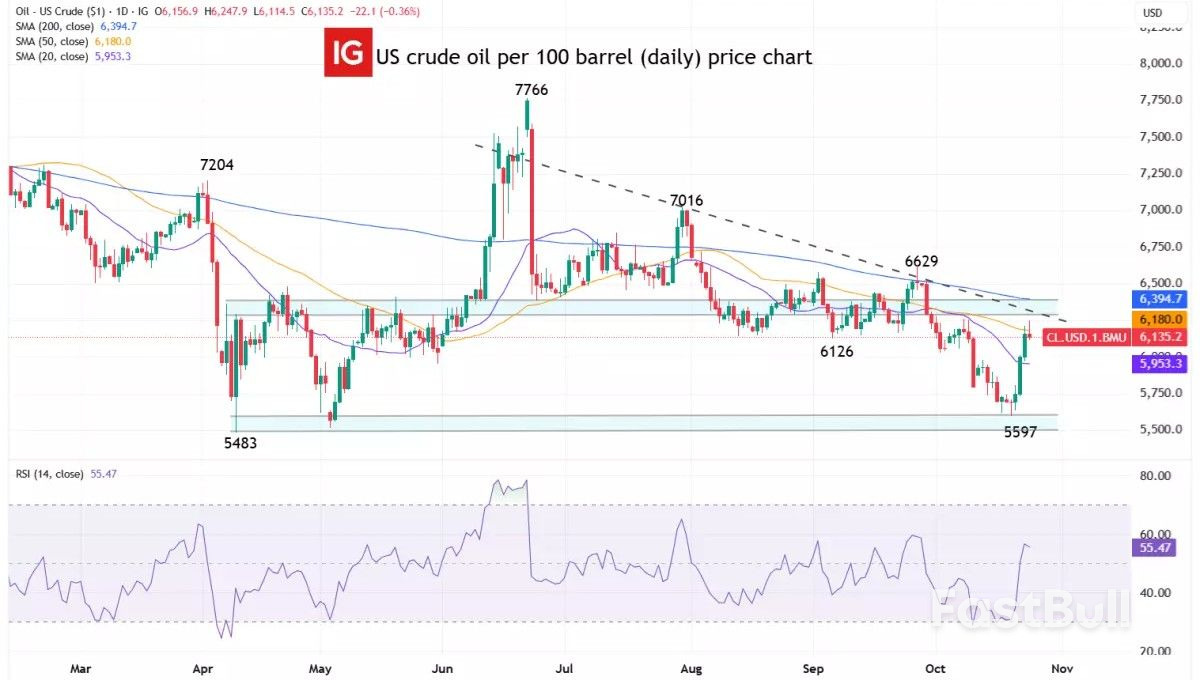
          Western Texas Intermediate (WTI) crude oil rebounded sharply from its five-month low on Monday, recording its strongest weekly performance since the Israel-Iran conflict in June, with front-month futures surging 8%. However, this does not alter the fact that oil remains one of the worst-performing asset classes this year, returning -14%.
          Last week's rally was triggered by US sanctions on Russia's largest oil companies, Rosneft and Lukoil. In response to Russia's lack of progress in ending the war against Ukraine, the US intensified its sanctions on oil companies, aiming to eliminate a major revenue stream supporting the military campaign. The UK also added Rosneft and Lukoil to its sanction list, while the European Union is implementing a ban on Rosneft and Gazprom. The latest round of sanctions is likely to substantially complicate India's ability to continue purchasing Russian oil, which currently accounts for 36% of India's total oil imports. Reuters reported that Chinese state-owned oil companies have paused purchases of seaborne Russian crude oil to assess the implications of sanctions.
          These sanctions should not be viewed lightly as they possess the capacity to drive oil prices higher. However, the impact appears to have been weighed against the backdrop of increasing output from OPEC+ as well as lower consumption demand from slower global economic growth. Despite an unexpected decrease in US crude oil inventories last week, the medium-term outlook appears dim as the International Energy Agency anticipates supply surplus to exceed 4 million barrels per day in 2026.
          The latest price chart indicates that US crude oil prices remain dominated by a bearish trend established since late June, trading below the 200-day MA. The sharp rebound is currently positioned at the 50-day MA at approximately $61.80 per barrel. Additional developments restricting future oil supplies could propel prices further towards the resistance range between $62.90 and $63.90. Should oil prices fail to break through the 50-day MA, the bearish trend may resume, with support at approximately $55-$56.
          Figure 3: US crude oil futures (daily) price chart

          Market navigator: week of 27 October 2025_3as of 26 October 2025. Past performance is not a reliable indicator of future performance.

          The week ahead

          The week presents critical central bank decisions alongside important economic indicators. Central banks dominate Thursday's agenda with three major policy meetings. The Fed is widely expected to deliver a 25-basis-point rate cut, bringing the policy rate to 3.75%-4.00% as labour market softening continues. Focus will centre on the tone of the meeting statement, as investors scrutinise for clues regarding the monetary policy trajectory in December and 2026. The European Central Bank (ECB) will likely maintain its deposit rate at 2% as the central bank has signalled the easing cycle may be at its end. The Bank of Japan (BoJ) faces a more complex calculus as core inflation accelerated to 2.9% in September, yet newly appointed Prime Minister Takaichi advocates for maintaining accommodative policy, creating uncertainty around the central bank's next move from its current 0.5% rate.
          US economic data releases remain subject to considerable uncertainty. The shutdown has already disrupted the normal calendar, putting Friday's scheduled core personal consumption expenditure (PCE) – the Fed's preferred inflation gauge – and retail sales figures in limbo.
          Australia's third-quarter inflation and the Euro Area's October price data will prove significant for the Reserve Bank of Australia (RBA) and ECB respectively, while China's official purchasing managers' indices (PMI) will assess business activities in the world's second-largest economy.
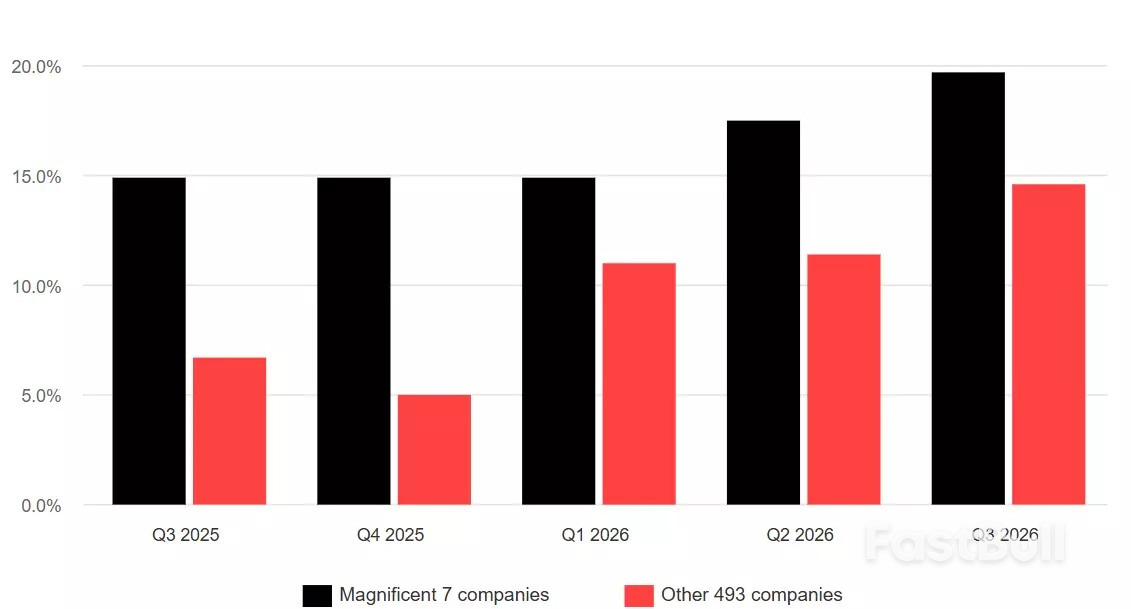
          Corporate earnings season reaches its climax with five Magnificent Seven members reporting results. Microsoft, Alphabet, Meta, Apple and Amazon will provide essential perspectives on artificial intelligence investment returns and consumer technology demand. The seven mega caps are still anticipated to outpace other US companies, though the growth gap may narrow next year. Earnings from Chinese state-owned financial institutions including Industrial and Commercial Bank, China Construction Bank and Bank of China will reveal how domestic economic challenges are affecting the banking sector. Meanwhile, results from Japan's industrial leaders such as Hitachi, Keyence and Panasonic will demonstrate the health of the manufacturing sector amid trade uncertainties.
          Figure 4: Earnings growth projection by analysts – Magnificent Seven vs. other US companies
          Market navigator: week of 27 October 2025_4

          Source: ig

          To stay updated on all economic events of today, please check out our Economic calendar
          Risk Warnings and Disclaimers
          You understand and acknowledge that there is a high degree of risk involved in trading. Following any strategies or investment methods may lead to potential losses. The content on the site is provided by our contributors and analysts for information purposes only. You are solely responsible for determining whether any trading assets, securities, strategy, or any other product is suitable for investing based on your own investment objectives and financial situation.
          Add to Favorites
          Share

          US Bond Market Remains on Track for Strong Bull Run in 2025

          Adam

          Bond

          There are several risk factors that, in theory, could weigh on bond market sentiment. Tariffs, gradually rising inflation, elevated policy uncertainty in Washington, a government shutdown, and a deteriorating trend for federal finances, to name a few. But the US bond market is looking through these headwinds and instead focusing on one scenario: expectations for a slowing economy.
          Anticipating softer growth is arguably is the main driver that’s lifting bond prices these days, which in turn is weighing on bond yields (prices and yields move inversely). The Federal Reserve is expected to play along and cut interest rates on Wednesday (Oct. 29), according to Fed funds futures.
          Reflecting the tailwind for bonds, US Treasury yields are trading near their lows for the year. The benchmark 10-year rate, for instance, ended last week at 4.02%, close to the year’s intraday low of 3.86% and well below the year’s 4.79% peak set in January.
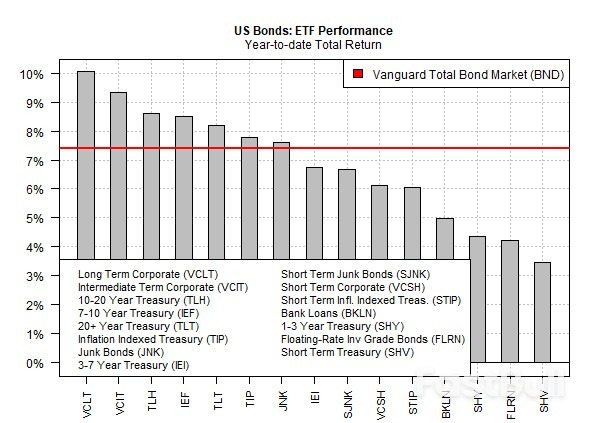
          US bonds generally are posting across-the-board gains year to date, based on a set of ETFs through Friday’s close. The top performer: long-term corporates (VCLT), which is up more than 10% in 2025. The benchmark for US investment grade bonds (BND) has rallied 7.4%.
          US Bond Market Remains on Track for Strong Bull Run in 2025_1
          The combination of Fed rate cuts and a growing sense in markets that US economic growth is downshifting is keeping demand humming for bonds.
          Investors will be watching this week’s Fed meeting for clues on whether the party will continue through the end of the year. But the signals could be turn muddy as the government shutdown continues to postpone key economic reports.
          “With a dearth of data and a still-divided FOMC, our US economists think Chair [Jerome] Powell is unlikely to provide clear signals on the policy path ahead, focusing more on topics including balance sheet policy and financial stability,” Deutsche Bank analysts wrote in a note.
          To the extent that the bond market holds on to its gains, and perhaps rallies further, softer economic conditions will likely be a key factor.
          “The economy is weaker than the market thinks, inflation is going to come off and, therefore, the Fed will be cutting rates,” predicts Steven Blitz, managing director and chief US economist at GlobalData TS Lombard. “Will it be four or five times? Probably not.”
          By the end of the year, the Fed funds futures market is confident that the central bank’s target rate will slide to a 3.50%-to-3.75% range, or 50 basis points below the current range. That implies two more ¼-point rate cuts between now and New Year’s celebrations. On that basis, the bond market’s upside momentum still has room to run.

          Source: investing

          Risk Warnings and Disclaimers
          You understand and acknowledge that there is a high degree of risk involved in trading. Following any strategies or investment methods may lead to potential losses. The content on the site is provided by our contributors and analysts for information purposes only. You are solely responsible for determining whether any trading assets, securities, strategy, or any other product is suitable for investing based on your own investment objectives and financial situation.
          Add to Favorites
          Share

          Natural Gas News: Futures Rebound Above 50-Day Average with Weather Forecasts in Spotlight

          Adam

          Commodity

          Natural Gas Prices Test Support as Traders Weigh Weather-Driven Bounce Against Bearish Fundamentals
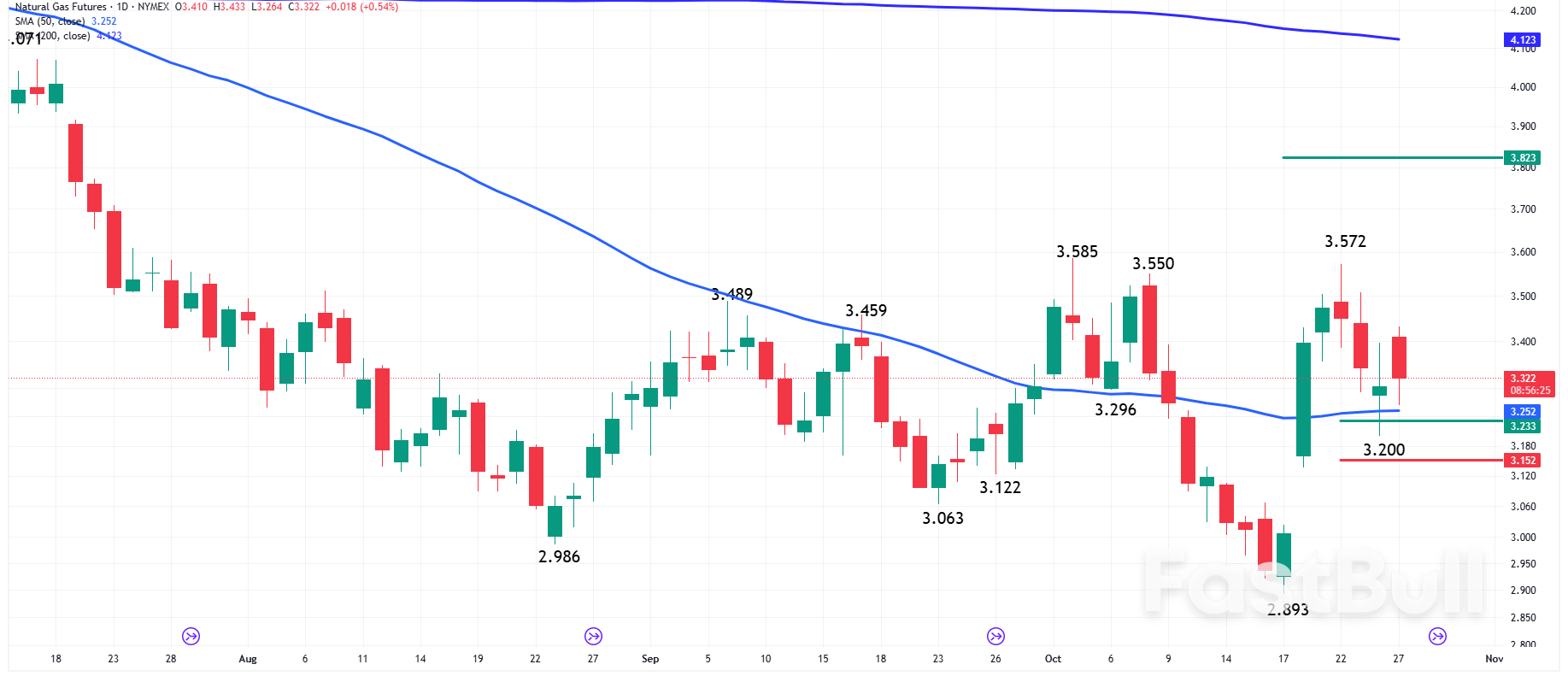
          U.S. natural gas futures opened the week with modest gains, extending Friday’s bounce off a successful test of a short-term support zone. After briefly dropping to $3.200 late last week, futures reversed higher and are now testing key resistance levels, driven by a modest shift in near-term weather forecasts. However, strong bearish fundamentals—surging production and above-average storage—continue to cap upside potential.
          At 12:28 GMT, Natural Gas Futures are trading $3.272, down $0.032 or -0.97%.

          Is Weather Enough to Fuel a Sustainable Rally?

          Early-week strength in gas prices appears tied to weekend weather updates showing a short-term bump in heating demand. According to NatGasWeather, colder air will move through the northern U.S. through October 29, though overall demand is expected to remain light to moderate due to milder conditions across the South.
          The brief cold snap follows last week’s weather-driven rally, which peaked at $3.572 before retreating under pressure from a warming outlook into early November. Traders should treat weather models cautiously as forecast consistency has been lacking.

          Storage and Supply Data Continue to Pressure the Market

          Fundamentals remain heavy. The latest EIA report showed a larger-than-expected 87 Bcf injection for the week ending October 17, pushing storage levels 4.5% above seasonal norms. Inventories are also up 0.6% year-over-year. At the same time, production continues to break records, with lower-48 output hitting 108.5 Bcf/day on Friday, up 5.5% from last year. The EIA’s forecast for 2025—107.14 Bcf/day—underscores the ongoing supply-heavy environment, adding further pressure on any weather-led upside.

          Are Demand Channels Offering Any Relief?

          LNG exports and power generation demand have provided some support but remain insufficient to flip sentiment. LNG exports held firm at 16.6 Bcf/day last week, and pipeline flows to Mexico stayed strong. Meanwhile, electricity output rose 4.0% year-over-year, driven partly by gas-fired generation. Still, demand growth is being outpaced by supply gains, keeping sellers in control near key resistance levels.

          Can Bulls Clear Technical Hurdles or Is This Just a Bounce?

          Natural Gas News: Futures Rebound Above 50-Day Average with Weather Forecasts in Spotlight_1Daily Natural Gas

          Traders are watching resistance at $3.386 and $3.572 closely. A sustained move above $3.572 could open the door toward $3.823, but failure at $3.386 would signal a short-covering bounce rather than a trend reversal. Support between $3.152 and $3.200 remains critical; a break below could trigger a sharp sell-off.

          Short-Term Forecast: Bearish Below Resistance

          Despite today’s early strength, the broader setup leans bearish. High production, strong storage, and inconsistent weather support suggest that upside will be challenged. Unless colder trends solidify, sellers are expected to defend resistance aggressively, keeping natural gas futures under pressure heading into November.

          Source: fxempire

          Risk Warnings and Disclaimers
          You understand and acknowledge that there is a high degree of risk involved in trading. Following any strategies or investment methods may lead to potential losses. The content on the site is provided by our contributors and analysts for information purposes only. You are solely responsible for determining whether any trading assets, securities, strategy, or any other product is suitable for investing based on your own investment objectives and financial situation.
          Add to Favorites
          Share

          How US Presidents Wield Their Mighty Power To Pardon

          Devin

          Economic

          The US president's power to pardon is both one of the most absolute and misunderstood provisions of the Constitution. Rooted in the "prerogative of mercy" of English kings dating back to the seventh century, America's founders wanted a robust pardon power to allow "easy access to exceptions in favor of unfortunate guilt" by the justice system, as Alexander Hamilton wrote.

          Today, the power has become as polarizing as the men using it. On the first day of his second term, President Donald Trump issued a sweeping pardon for people convicted for their actions in the riot at the US Capitol on Jan. 6, 2021.

          In his last weeks in office, Trump's predecessor Joe Biden pardoned his son Hunter from convictions on tax and gun violations. He also offered so-called blanket pardons to five other members of his family, expressing concern they'd be unjustly prosecuted under Trump, as well as to leading government officials that Trump has labeled as political enemies and threatened to punish.

          A pardon is the legal forgiveness of a crime granted by a president, governor or other executive authority. While in some US states the governor shares the power with a pardon board, the power to pardon federal crimes is the president's alone.

          It's not an expungement; the conviction remains on the record. Nor is it a statement on either the guilt or innocence of the individual.

          Pardons come under the broader presidential power of executive clemency, which also includes lesser forms of presidential mercy, such as:

          Reprieves and remittances are rare in modern times.

          Every president except two – William Henry Harrison and James Garfield, who died in office – has issued pardons. Cumulatively, presidents have granted almost 35,000 individual acts of clemency, beginning with the first known pardon by George Washington for the offense of smuggling rum from Barbados in casks smaller than 50 gallons.

          The power had generally fallen into relative disuse in recent decades, reserved by presidents, for the most part, for use around the holidays and at the end of their terms.

          But Biden was an avid pardoner. As he was leaving office, he released 1,499 convicts serving home confinement – including some convicted of public corruption, commuted 37 death sentences, and shortened the sentences of 2,490 drug offenders who he said received disproportionately long sentences.

          As of the last day of his presidency, he had issued a total of 79 pardons and 4,168 commutations to named individuals, which makes him the most prolific employer of presidential clemency in history, granting it more times in a single term than all of his last seven predecessors combined.

          In granting a pardon, a president is often communicating his views on justice, mercy, norms and social mores.

          The list of those receiving pardons reads like a social history of the US, as presidents seek to heal old conflicts and reconcile the country with a more punitive past. Wars, insurrections, prohibition, the war on drugs – all have been followed years or decades later by rounds of clemency.

          In a clear precedent for Trump's pardons of Jan. 6 insurrectionists, Washington himself pardoned 10 ringleaders of the tax protest known as the Whiskey Rebellion in the 1790s who had been convicted of high treason. Presidents Abraham Lincoln and Andrew Johnson pardoned Confederate soldiers and Gerald Ford pardoned their general, Robert E. Lee.

          Some pardons are seen as being more motivated by self-interest. President Richard Nixon pardoned influential US labor leader Jimmy Hoffa, who had been convicted of jury tampering and fraud and later supported Nixon's reelection bid. Bill Clinton pardoned financier Marc Rich, the husband of a major campaign donor, after Rich had been indicted for tax evasion and striking oil deals with Iran during an embargo. On Oct. 23, Trump pardoned Binance founder Changpeng Zhao, who served four months in federal prison for failing to maintain an effective anti-money laundering program at the cryptocurrency exchange. The pardon came after Zhao and Binance became key backers of the Trump family crypto venture World Liberty Financial Inc.

          The founders intentionally created the pardon power with few strings attached. Hamilton wrote that it "should be as little as possible fettered or embarrassed."

          The Supreme Court has held that because it's a power explicitly given to the president in the Constitution,"its limitations, if any, must be found in the Constitution itself."

          In other words, a pardon is valid as long as it doesn't violate some other provision of the Constitution. Those cases are undoubtedly narrow; some commentators have argued that acceptance of a bribe for a pardon could possibly invalidate it, but even that isn't clear.

          The Constitution does contain two clear limitations. Presidents can grant pardons only for "offenses against the United States," meaning only federal and not state crimes. And there's an exception for cases of impeachment: the president can't use the power to frustrate the power of Congress to remove him or other officials from office.

          Neither Congress nor the courts have the power to overturn presidential pardons. However, a president can revoke a pardon if the documents haven't yet been delivered to and accepted by the person receiving clemency.

          George W. Bush in 2008 granted a pardon to real estate developer Isaac Toussie, who had been convicted of mail fraud. But just a day later, after learning Toussie's father had made donations to Bush's Republican Party, the president reversed his decision and instructed that the pardon not be given. Because Toussie hadn't received the paperwork, the clemency didn't take effect.

          A president could similarly attempt to revoke an undelivered pardon issued by a predecessor. In 1869, Andrew Johnson awarded pardons to three people convicted of fraud. But just days later, President Ulysses S. Grant took office and recalled the members of the US Marshals Service delivering the paperwork, and the pardons were withdrawn.

          Most legal scholars say he can't, based in part on the plain language of the power. The Constitution says that the president has the power to "grant" pardons, which means to "bestow" or "transfer" them — in other words, give them to someone else. In addition, in a legal memo crafted just before Nixon's resignation in 1974, the Justice Department's Office of Legal Counsel held that the president can't self-pardon "under the fundamental rule that no one may be a judge in his own case." In any event, Ford pardoned Nixon for any alleged Watergate crimes.

          But the question has never been tested, and even scholars who oppose the idea of the self-pardon concede that it's an open question. Regardless, there's a workaround: A president could temporarily cede power to the vice president, who could issue a pardon as acting president.

          The president can't grant a pardon for a crime that has not yet been committed, which would be the equivalent of a lifetime get-out-of-jail-free card.

          But a person can be pardoned after committing a crime and before any charges have been brought. A seminal 1866 Supreme Court case dealing with Confederate soldiers, Ex parte Garland, held that the pardon power "extends to every offense known to the law, and may be exercised at any time after its commission, either before legal proceedings are taken or during their pendency, or after conviction and judgment."

          Yes. A president doesn't need to identify the crime committed in order to issue a pardon. The most famous example is Ford's pardon of Nixon for all offenses carried out while he was president.

          Biden's 11th-hour pardons of family members and officials identified as enemies by Trump also fall into this category. The relatives included three siblings and two of their spouses. The officials included retired General Mark Milley, infectious diseases expert Anthony Fauci, and the members of Congress and staff who served on the committee that investigated the 2021 attack on the US Capitol and recommended that Trump be prosecuted for his role in it.

          Those on the panel included Liz Cheney, a former Wyoming Republican congresswoman who helped lead the investigation, and now-Senator Adam Schiff, a Democrat from California who also led the prosecution in Trump's first impeachment trial. Biden also pardoned US Capitol and DC Metropolitan police officers who testified before the committee.

          Biden's pardon of his son Hunter included the gun and tax evasion charges for which he was convicted but also any other offenses he may have committed for the previous 11 years.

          And Trump in his first term pardoned a number of allies, including former political adviser Stephen Bannon and Albert Pirro Jr., the ex-husband of Fox News host Jeanine Pirro, for unspecified "offenses against the United States individually enumerated and set before me for my consideration."

          No. Presidents have granted pardons often to people they believed to be innocent or otherwise victims of injustice. For example, Trump posthumously pardoned boxer Jack Johnson, who was convicted in 1913 of transporting a woman across state lines for "immoral purposes" — a crime that frequently formed the basis of racist prosecutions. Biden pardoned service members convicted of violating a now-repealed military ban on consensual gay sex. And in one of his last acts of clemency, he posthumously pardoned Marcus Garvey, a Black nationalist icon convicted of mail fraud in 1923. Civil rights activists have long argued Garvey's prosecution was racially motivated.

          The popular notion that a pardon implies guilt comes from a 1915 Supreme Court ruling in the case of Burdick v. United States, which said that a pardon "carries an imputation of guilt; acceptance a confession of it." Ford kept a dog-eared copy of the decision in his wallet as vindication of his pardon of Nixon.

          But later courts have not viewed that "imputation of guilt" as essential to the Burdick decision, which held that someone granted a pardon has the right to refuse it.

          "The answer is undoubtedly no," a federal appeals court ruled in February 2024. "The plain language of the Constitution imposes no such limit."

          But as a practical and historical matter, it helps to have a record. In that 2024 decision, the Fourth Circuit Court of Appeals ruled that Trump's verbal statement to former Cleveland Browns running back Jim Brown that "I'm gonna do this" and "I want this done" weren't enough to free a man serving a life sentence for drug trafficking and murder.

          No again. There's a history of categorical pardons, granting clemency for everyone convicted of a certain offense. President Jimmy Carter used this power to give amnesty to draft dodgers after the Vietnam war and Biden used it for marijuana offenses, for example. In those cases, people convicted of the specified crime can apply to the Office of the Pardon Attorney in the Justice Department, for a certificate that verifies they're covered by the pardon.

          There are two procedural paths. The first, which President Barack Obama followed, requires someone seeking a pardon or commutation to file with the Office of the Pardon Attorney. The office generally considers applications only after a five-year waiting period, and won't consider posthumous pardons or those for misdemeanors. After a thorough review – including an FBI background check – the recommendation goes to the attorney general, the White House Counsel's Office and then to the president, who may grant or deny it.

          The second model, favored by Trump, is much looser. In his first term, he often took recommendations from celebrities such as Kim Kardashian and Sylvester Stallone, skipped the waiting period and background check, and signed pardons in pomp-filled ceremonies.

          Most presidents use a combination of the two, with the more controversial pardons often following the direct path to the president.

          One reason to bypass the bureaucracy: The backlog of pardon applications reached record highs under Biden before his final grants brought the logjam down to pre-Trump numbers.

          Source: Bloomberg Europe

          To stay updated on all economic events of today, please check out our Economic calendar
          Risk Warnings and Disclaimers
          You understand and acknowledge that there is a high degree of risk involved in trading. Following any strategies or investment methods may lead to potential losses. The content on the site is provided by our contributors and analysts for information purposes only. You are solely responsible for determining whether any trading assets, securities, strategy, or any other product is suitable for investing based on your own investment objectives and financial situation.
          Add to Favorites
          Share
          FastBull
          Copyright © 2025 FastBull Ltd

          728 RM B 7/F GEE LOK IND BLDG NO 34 HUNG TO RD KWUN TONG KLN HONG KONG

          TelegramInstagramTwitterfacebooklinkedin
          App Store Google Play Google Play
          Products
          Charts

          Chats

          Q&A with Experts
          Screeners
          Economic Calendar
          Data
          Tools
          Membership
          Features
          Function
          Markets
          Copy Trading
          Latest Signals
          Contests
          News
          Analysis
          24/7
          Columns
          Education
          Company
          Careers
          About Us
          Contact Us
          Advertising
          Help Center
          Feedback
          User Agreement
          Privacy Policy
          Business

          White Label

          Data API

          Web Plug-ins

          Poster Maker

          Affiliate Program

          Risk Disclosure

          The risk of loss in trading financial instruments such as stocks, FX, commodities, futures, bonds, ETFs and crypto can be substantial. You may sustain a total loss of the funds that you deposit with your broker. Therefore, you should carefully consider whether such trading is suitable for you in light of your circumstances and financial resources.

          No decision to invest should be made without thoroughly conducting due diligence by yourself or consulting with your financial advisors. Our web content might not suit you since we don't know your financial conditions and investment needs. Our financial information might have latency or contain inaccuracy, so you should be fully responsible for any of your trading and investment decisions. The company will not be responsible for your capital loss.

          Without getting permission from the website, you are not allowed to copy the website's graphics, texts, or trademarks. Intellectual property rights in the content or data incorporated into this website belong to its providers and exchange merchants.

          Not Logged In

          Log in to access more features

          FastBull Membership

          Not yet

          Purchase

          Become a signal provider
          Help Center
          Customer Service
          Dark Mode
          Price Up/Down Colors

          Log In

          Sign Up

          Position
          Layout
          Fullscreen
          Default to Chart
          The chart page opens by default when you visit fastbull.com