Markets
News
Analysis
User
24/7
Economic Calendar
Education
Data
- Names
- Latest
- Prev


Signal Accounts for Members
All Signal Accounts
All Contests


France Trade Balance (SA) (Oct)A:--
F: --
Euro Zone Employment YoY (SA) (Q3)A:--
F: --
Canada Part-Time Employment (SA) (Nov)A:--
F: --
P: --
Canada Unemployment Rate (SA) (Nov)A:--
F: --
P: --
Canada Full-time Employment (SA) (Nov)A:--
F: --
P: --
Canada Labor Force Participation Rate (SA) (Nov)A:--
F: --
P: --
Canada Employment (SA) (Nov)A:--
F: --
P: --
U.S. PCE Price Index MoM (Sept)A:--
F: --
P: --
U.S. Personal Income MoM (Sept)A:--
F: --
P: --
U.S. Core PCE Price Index MoM (Sept)A:--
F: --
P: --
U.S. PCE Price Index YoY (SA) (Sept)A:--
F: --
P: --
U.S. Core PCE Price Index YoY (Sept)A:--
F: --
P: --
U.S. Personal Outlays MoM (SA) (Sept)A:--
F: --
U.S. 5-10 Year-Ahead Inflation Expectations (Dec)A:--
F: --
P: --
U.S. Real Personal Consumption Expenditures MoM (Sept)A:--
F: --
U.S. Weekly Total Rig CountA:--
F: --
P: --
U.S. Weekly Total Oil Rig CountA:--
F: --
P: --
U.S. Consumer Credit (SA) (Oct)A:--
F: --
China, Mainland Foreign Exchange Reserves (Nov)A:--
F: --
P: --
Japan Trade Balance (Oct)A:--
F: --
P: --
Japan Nominal GDP Revised QoQ (Q3)A:--
F: --
P: --
China, Mainland Imports YoY (CNH) (Nov)A:--
F: --
P: --
China, Mainland Exports (Nov)A:--
F: --
P: --
China, Mainland Imports (CNH) (Nov)A:--
F: --
P: --
China, Mainland Trade Balance (CNH) (Nov)A:--
F: --
P: --
China, Mainland Exports YoY (USD) (Nov)A:--
F: --
P: --
China, Mainland Imports YoY (USD) (Nov)A:--
F: --
P: --
Germany Industrial Output MoM (SA) (Oct)A:--
F: --
Euro Zone Sentix Investor Confidence Index (Dec)A:--
F: --
P: --
Canada National Economic Confidence IndexA:--
F: --
P: --
U.K. BRC Like-For-Like Retail Sales YoY (Nov)--
F: --
P: --
U.K. BRC Overall Retail Sales YoY (Nov)--
F: --
P: --
Australia Overnight (Borrowing) Key Rate--
F: --
P: --
RBA Rate Statement
RBA Press Conference
Germany Exports MoM (SA) (Oct)--
F: --
P: --
U.S. NFIB Small Business Optimism Index (SA) (Nov)--
F: --
P: --
Mexico 12-Month Inflation (CPI) (Nov)--
F: --
P: --
Mexico Core CPI YoY (Nov)--
F: --
P: --
Mexico PPI YoY (Nov)--
F: --
P: --
U.S. Weekly Redbook Index YoY--
F: --
P: --
U.S. JOLTS Job Openings (SA) (Oct)--
F: --
P: --
China, Mainland M1 Money Supply YoY (Nov)--
F: --
P: --
China, Mainland M0 Money Supply YoY (Nov)--
F: --
P: --
China, Mainland M2 Money Supply YoY (Nov)--
F: --
P: --
U.S. EIA Short-Term Crude Production Forecast For The Year (Dec)--
F: --
P: --
U.S. EIA Natural Gas Production Forecast For The Next Year (Dec)--
F: --
P: --
U.S. EIA Short-Term Crude Production Forecast For The Next Year (Dec)--
F: --
P: --
EIA Monthly Short-Term Energy Outlook
U.S. API Weekly Gasoline Stocks--
F: --
P: --
U.S. API Weekly Cushing Crude Oil Stocks--
F: --
P: --
U.S. API Weekly Crude Oil Stocks--
F: --
P: --
U.S. API Weekly Refined Oil Stocks--
F: --
P: --
South Korea Unemployment Rate (SA) (Nov)--
F: --
P: --
Japan Reuters Tankan Non-Manufacturers Index (Dec)--
F: --
P: --
Japan Reuters Tankan Manufacturers Index (Dec)--
F: --
P: --
Japan Domestic Enterprise Commodity Price Index MoM (Nov)--
F: --
P: --
Japan Domestic Enterprise Commodity Price Index YoY (Nov)--
F: --
P: --
China, Mainland PPI YoY (Nov)--
F: --
P: --
China, Mainland CPI MoM (Nov)--
F: --
P: --
Italy Industrial Output YoY (SA) (Oct)--
F: --
P: --


No matching data
Latest Views
Latest Views
Trending Topics
Top Columnists
Latest Update
White Label
Data API
Web Plug-ins
Affiliate Program
View All

No data
US Treasury Secretary Scott Bessent said he isn’t calling for a series of interest-rate cuts from the Federal Reserve (Fed), just pointing out that models suggest a “neutral” rate would be about 1.5 percentage points lower.
“I didn’t tell the Fed what to do,” Bessent said on Thursday in an interview on Fox Business, referring to his comments a day before about how the central bank “could go into a series of rate cuts here”.
Bessent said Thursday that “what I said was that to get to a neutral rate on interest, that that would be approximately a 150-basis-point cut”.
The so-called neutral rate is the level at which policy neither stimulates nor restricts the economy. Fed chair Jerome Powell said July 30 that there are “a range of views of what the neutral rate is at this moment for our economy” and that his own estimate was that the current setting was “modestly restrictive”.
“I believe that there is room, if one believes in the neutral rate,” for a series of rate cuts, Bessent said. “I am not calling for one. I didn’t call for one. I just said that a model of a neutral rate is approximately 150 basis points lower.”
The Fed last month kept its target range for the benchmark rate at 4.25% to 4.5%. The median estimate of the neutral rate among Fed officials over the long run is 3%. Powell and many of his colleagues have for months argued that more time was needed to assess any impact on inflation and inflation expectations from President Donald Trump’s tariff hikes.
Trump has regularly criticised Powell for holding rates. Bessent, after taking the Treasury’s helm, said he would only address past Fed actions, not future ones, but later weighed in on what he thought markets were expecting monetary policymakers to do. This week, he has taken to referring to economic models, and has repeatedly suggested a 50-basis-point rate cut is possible at the Fed’s September meeting.
“It’s not really the role of the Treasury secretary to opine” on the neutral rate, said Julia Coronado, the founder of the research firm MacroPolicy Perspectives and a former Fed economist. “The fact that the most senior economic official in the administration is saying these things publicly is direct, public pressure on what he wants the Fed to do.”
Former Treasury secretary Lawrence Summers, who served under Democratic president Bill Clinton, said he was “surprised” to see Bessent’s remarks on Wednesday.
“Usually that kind of judgement is not made by administration officials, and I am not sure it’s helpful for the administration to be publicly prescribing on monetary policy,” Summers said on Bloomberg Television’s Wall Street Week with David Westin.
Summers, a paid contributor to Bloomberg TV, also suggested that a measure of the neutral rate should incorporate the effects of large budget deficits and elevated demand for funds to pay for data centres — along with higher asset prices that reduce the flow of funds into savings. Against that backdrop, “you wouldn’t be prescribing a 175 basis point cut in rates unless we see a recession”.
Interest-rate futures as of Thursday morning reflect bets that the Fed will cut rates by less than a cumulative 150 basis points by the end of next year. They also show slightly less confidence in a 25-basis-point reduction at the September meeting. The retreat came after a release on US wholesale inflation showed those prices climbed by the most in three years.
Speaking to Bloomberg Television on Wednesday, Bessent said “if you look at any model” it suggests that “we should probably be 150, 175 basis points lower” on the Fed’s benchmark. He also said that officials might have cut rates if they had been aware of the revised data on the labour market that came out a couple of days after the latest meeting. “I suspect we could have had rate cuts in June and July,” Bessent said.
“I don’t know what model he’s talking about,” said Jim Bianco, the president of Bianco Research and a long-time Fed and Treasury watcher. “There is no model I am aware of that says it should be that low,” he said of the Fed’s benchmark.
Other gauges of where the Fed should be, such as the Taylor rule, also aren’t arguing that the main rate should be 150 to 175 basis points lower than it is, Bianco said. He added that there have been many instances over the decades of “cajoling Fed chairs,” and they are “welcome to offer their opinion,” but it shouldn’t change the central bank leader’s opinion.
Bessent repeated on Thursday that, given the context of the weaker jobs figures and not having cut rates the past couple of months, “perhaps a 50-basis-point cut in September was warranted”.
Two Fed district bank presidents said they are not backing such a move at this point. San Francisco Fed president Mary Daly said in a Wall Street Journal interview on Wednesday, “I just don’t see that. I don’t see the need to catch up.” St Louis president Alberto Musalem said on CNBC on Thursday, that a 50-basis-point cut would be “unsupported by the current state of the economy and the outlook for the economy”.
The hot U.S. producer inflation print dominated market sentiment in the overnight (U.S.) session, sparking a risk-off move in equities and a rally in the dollar and yields. Gold and crypto held their ground on medium-term rate cut optimism, while rate- and tariff-sensitive sectors were hit hardest. U.S. PPI surged 0.9% month-over-month in July (forecast: 0.2%), and 3.3% year-over-year (forecast: 2.5%), marking the largest gain in three years. This came in significantly above expectations, fueling concerns about persistent inflationary pressures.
Focus on China’s industrial and retail data early Friday, followed by any shifts in the U.S. rate cut narrative and associated market reactions. Currency moves, especially for JPY and CNY, and capital flows into/out of regional equities, are likely to be especially volatile. Any significant deviation in the major data releases from consensus expectations could trigger sharp moves across Asian equities, FX, and commodity markets.Sentiment is dominated by expectations for Fed interest rate cuts as early as September. The probability of a 50 basis point cut has risen following dovish remarks from Treasury Secretary Scott Bessent and softer labor market and inflation data in the U.S.
The US Dollar enters Friday, August 15, 2025, in a firm position bolstered by unexpectedly strong inflation prints and front-loaded retail sales/consumer data that are set to determine whether the USD rally persists or moderates. Watch for sharp, event-driven moves around the 8:30–10:00 AM ET data releases, which are likely to set the tone for FX markets through the session. Retail sales and consumer sentiment data on August 15 are in sharp focus and expected to drive the dollar’s moves. Consensus is that a robust retail sales number would reinforce the dollar’s strength, further delaying Fed easing.Central Bank Notes:
Next 24 Hours Bias
Medium Bearish
Gold today is consolidating just above key support levels, as market participants weigh strong U.S. data and currency dynamics against persistent geopolitical tensions and evolving Federal Reserve policy expectations.Gold fell about 0.7% on Thursday (August 14), settling near $3,331 per ounce as hot U.S. inflation data (strong PPI) and a drop in weekly jobless claims reinforced the dollar’s strength and trimmed hopes for a large September Federal Reserve rate cut. U.S. gold futures for December delivery dipped to $3,376.50
Next 24 Hours Bias
Medium Bullish
The Australian dollar’s immediate outlook is stable but cautious, supported by solid domestic jobs data and tempered inflation, but capped by global economic headwinds, dovish RBA policy, and shifting US monetary expectations. The Reserve Bank of Australia (RBA) recently reduced its cash rate from 3.85% to 3.60%, citing easing inflation and previous labor softness. Markets are now betting that the RBA will pause and reconsider the next move in November, awaiting further inflation data. The AUD/USD exchange rate has been volatile, recently trading in the 0.65–0.66 USD range, with the latest quotes showing the pair near 0.6530–0.6545Central Bank Notes:
Medium Bearish
The NZD is expected to remain under pressure in the near term, with further weakness likely if the RBNZ delivers on expected rate cuts and unless there are positive surprises from global growth or domestic data. Some moderate recovery could occur later in the year, contingent on global sentiment and improved commodity/export prices. A rise in New Zealand’s unemployment rate (now at 5.2%) and continued weakness in consumer and export sectors have prompted expectations that the Reserve Bank of New Zealand (RBNZ) will cut its Official Cash Rate (OCR) by 25 basis points at its August 20 meeting.
Central Bank Notes:
Next 24 Hours Bias
Weak Bearish
Into Friday, the yen’s bias is firmer on shifting BOJ rhetoric and increased Fed‑cut pricing; data and official commentary remain the swing factors for whether USD/JPY extends below 146 or recoils toward 148–149. The yen strengthened into multi‑week highs as markets bet on a more hawkish Bank of Japan, while the US Dollar softened on growing Fed‑cut expectations.USD/JPY traded in the mid‑146s to high‑147s on Thursday, marking a 3‑week high for the yen; recent 7‑day range roughly ¥146.4–148.2 per $1.A high‑profile US interview further pressured the Fed narrative and even argued the BOJ is “behind the curve,” boosting yen bids as traders priced a higher chance of BOJ tightening and lower US rates.
Central Bank Notes:
Next 24 Hours BiasStrong Bullish
Oil markets are caught between geopolitical risk and oversupply concerns. The Trump-Putin summit on August 15 could be a turning point for both prices and global oil flows, with traders closely watching for outcomes that might sharply move the market in either direction. Oil prices rose about 2% on Thursday, August 14, following two days of losses, with Brent closing at $66.71/barrel and U.S. West Texas Intermediate (WTI) at $64.05/barrel.
This upward move brought prices to a weekly high, but both benchmarks remain down over the past month and year, reflecting longer-term bearish trends. Brent and WTI are still near their lowest levels since early June, with Brent down more than 17% year-on-year.Next 24 Hours Bias
Medium Bearish
Key Points:
Fresh Chinese economic data offered mixed signals, soothing property market concerns but stoking fears of slowing consumer demand.
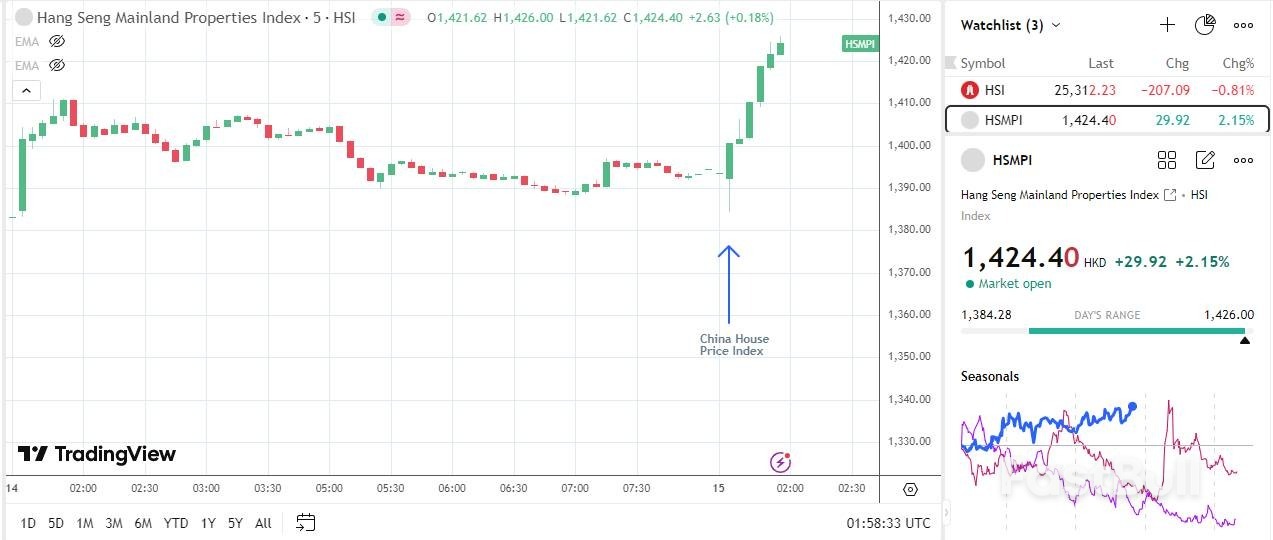
The housing sector continued to show tentative signs of recovery early in the third quarter. The House Price Index fell 2.8% year-on-year (YoY) in July after declining 3.2% in June. July’s data raised hopes that Beijing’s efforts to stabilize the real estate market had gained traction.
The Hang Seng Mainland Properties Index was up 2.12% following the data release, underscoring investor relief.
HSMPI – 5 Minute Chart – 150825Crucial economic data from China highlighted the effect of US tariffs on the industrial sector, consumer sentiment, and domestic consumption.
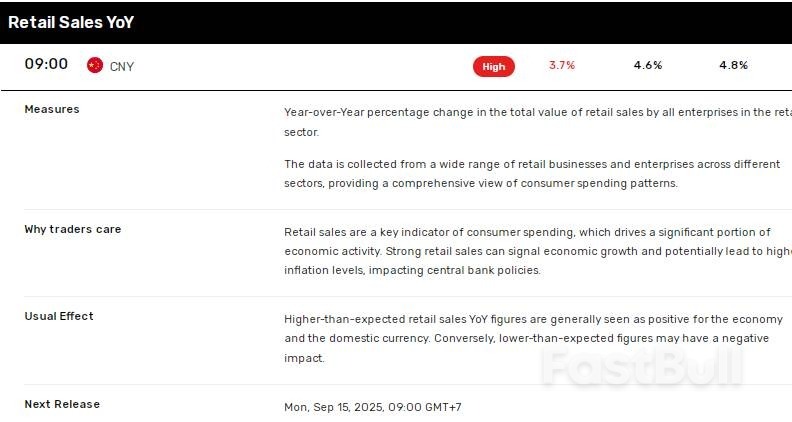
Slower industrial production growth aligned with the July Manufacturing PMI surveys, which revealed a further drop in external demand. After impressive GDP growth in Q2 and export surge in July, today’s data suggest US tariffs are beginning to affect China’s terms of trade.Rising unemployment also aligned with the Manufacturing PMIs. Manufacturers continued to cut staffing levels amid rising cost pressures and narrowing profit margins. Deteriorating labor market conditions weighed on domestic consumption, despite Beijing’s efforts to boost consumer spending.

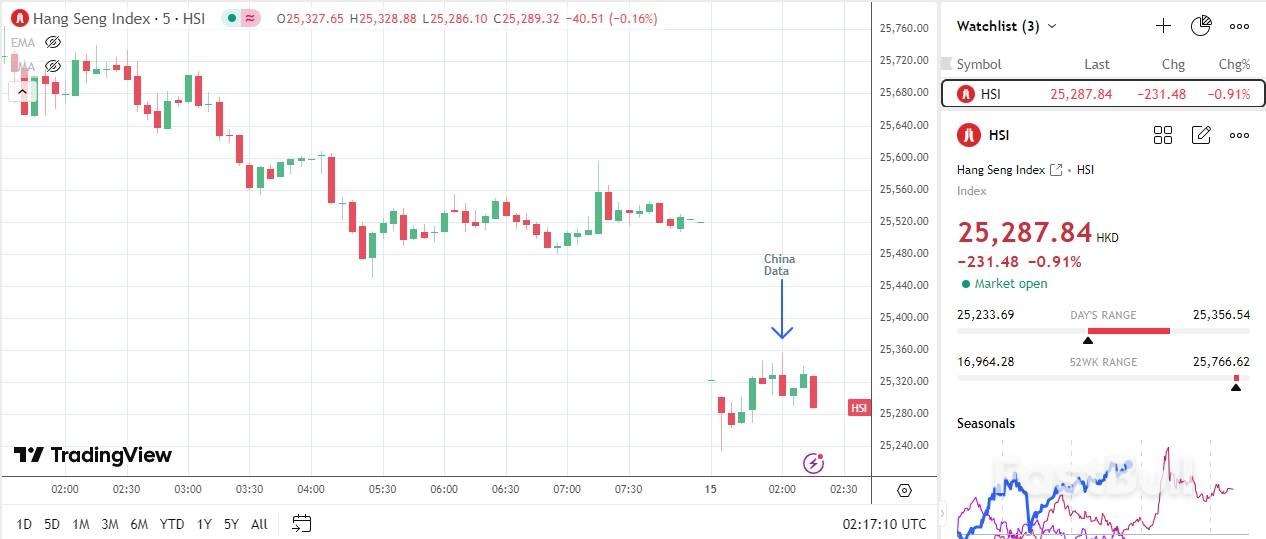
The Hang Seng Index and the AUD/USD pair reacted to the mixed data as trade uncertainties lingered.On Friday, August 15, the Hang Seng Index was down 0.8% to 25,315 before the data release. However, the Index dipped to a low of 25,286 in response to the numbers. At the time of writing, the Hang Seng Index was down 0.91% to 25,289.
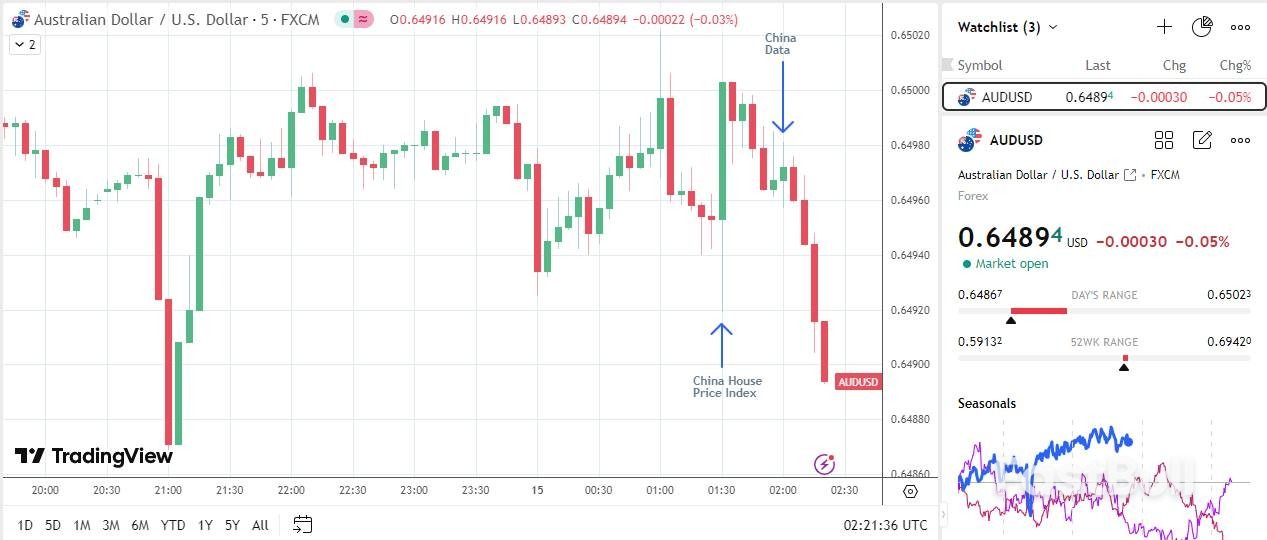
Hang Seng Index – 5 Minute Chart – 150825In the forex markets, the AUD/USD pair responded to the China stats, initially rising from $0.64919 to $0.65003 upon the release of the housing sector data. However, the weaker-than-expected retail sales, unemployment, and industrial production numbers weighed on the Aussie dollar. AUD/USD slid from $0.64967 to a low of $0.64893. At the time of writing, the AUD/USD pair was down 0.05% to $0.64894.
AUDUSD – 5 Minute Chart – 150825Despite the mixed data, recent stimulus measures from Beijing, targeting domestic consumption, cushioned the downside. Furthermore, the latest data may raise expectations of further stimulus measures to bolster the economy.Earlier reports discussed recent stimulus measures and whether the measures would be sufficient to boost consumption despite labor market and consumer sentiment woes. Today’s data suggested more policy support would be needed.
Beijing’s stimulus measures remain crucial for Mainland China and Hong Kong-listed stocks. However, traders should also closely monitor trade headlines following the extension of the trade war truce. Track the latest developments and policy signals here. Given the latest data, a cautious approach is essential.
White Label
Data API
Web Plug-ins
Poster Maker
Affiliate Program
The risk of loss in trading financial instruments such as stocks, FX, commodities, futures, bonds, ETFs and crypto can be substantial. You may sustain a total loss of the funds that you deposit with your broker. Therefore, you should carefully consider whether such trading is suitable for you in light of your circumstances and financial resources.
No decision to invest should be made without thoroughly conducting due diligence by yourself or consulting with your financial advisors. Our web content might not suit you since we don't know your financial conditions and investment needs. Our financial information might have latency or contain inaccuracy, so you should be fully responsible for any of your trading and investment decisions. The company will not be responsible for your capital loss.
Without getting permission from the website, you are not allowed to copy the website's graphics, texts, or trademarks. Intellectual property rights in the content or data incorporated into this website belong to its providers and exchange merchants.
Not Logged In
Log in to access more features

FastBull Membership
Not yet
Purchase
Log In
Sign Up