Markets
News
Analysis
User
24/7
Economic Calendar
Education
Data
- Names
- Latest
- Prev


Signal Accounts for Members
All Signal Accounts
All Contests


Euro Zone IHS Markit Construction PMI (Nov)A:--
F: --
P: --
Italy IHS Markit Construction PMI (Nov)A:--
F: --
P: --
U.K. Markit/CIPS Construction PMI (Nov)A:--
F: --
P: --
France 10-Year OAT Auction Avg. YieldA:--
F: --
P: --
Euro Zone Retail Sales MoM (Oct)A:--
F: --
P: --
Euro Zone Retail Sales YoY (Oct)A:--
F: --
P: --
Brazil GDP YoY (Q3)A:--
F: --
P: --
U.S. Challenger Job Cuts (Nov)A:--
F: --
P: --
U.S. Challenger Job Cuts MoM (Nov)A:--
F: --
P: --
U.S. Challenger Job Cuts YoY (Nov)A:--
F: --
P: --
U.S. Initial Jobless Claims 4-Week Avg. (SA)A:--
F: --
P: --
U.S. Weekly Initial Jobless Claims (SA)A:--
F: --
P: --
U.S. Weekly Continued Jobless Claims (SA)A:--
F: --
P: --
Canada Ivey PMI (SA) (Nov)A:--
F: --
P: --
Canada Ivey PMI (Not SA) (Nov)A:--
F: --
P: --
U.S. Non-Defense Capital Durable Goods Orders Revised MoM (Excl. Aircraft) (SA) (Sept)A:--
F: --
U.S. Factory Orders MoM (Excl. Transport) (Sept)A:--
F: --
P: --
U.S. Factory Orders MoM (Sept)A:--
F: --
P: --
U.S. Factory Orders MoM (Excl. Defense) (Sept)A:--
F: --
P: --
U.S. EIA Weekly Natural Gas Stocks ChangeA:--
F: --
P: --
Saudi Arabia Crude Oil ProductionA:--
F: --
P: --
U.S. Weekly Treasuries Held by Foreign Central BanksA:--
F: --
P: --
Japan Foreign Exchange Reserves (Nov)A:--
F: --
P: --
India Repo RateA:--
F: --
P: --
India Benchmark Interest RateA:--
F: --
P: --
India Reverse Repo RateA:--
F: --
P: --
India Cash Reserve RatioA:--
F: --
P: --
Japan Leading Indicators Prelim (Oct)A:--
F: --
P: --
U.K. Halifax House Price Index YoY (SA) (Nov)A:--
F: --
P: --
U.K. Halifax House Price Index MoM (SA) (Nov)A:--
F: --
P: --
France Current Account (Not SA) (Oct)--
F: --
P: --
France Trade Balance (SA) (Oct)--
F: --
P: --
France Industrial Output MoM (SA) (Oct)--
F: --
P: --
Italy Retail Sales MoM (SA) (Oct)--
F: --
P: --
Euro Zone Employment YoY (SA) (Q3)--
F: --
P: --
Euro Zone GDP Final YoY (Q3)--
F: --
P: --
Euro Zone GDP Final QoQ (Q3)--
F: --
P: --
Euro Zone Employment Final QoQ (SA) (Q3)--
F: --
P: --
Euro Zone Employment Final (SA) (Q3)--
F: --
Brazil PPI MoM (Oct)--
F: --
P: --
Mexico Consumer Confidence Index (Nov)--
F: --
P: --
Canada Unemployment Rate (SA) (Nov)--
F: --
P: --
Canada Labor Force Participation Rate (SA) (Nov)--
F: --
P: --
Canada Employment (SA) (Nov)--
F: --
P: --
Canada Part-Time Employment (SA) (Nov)--
F: --
P: --
Canada Full-time Employment (SA) (Nov)--
F: --
P: --
U.S. Personal Income MoM (Sept)--
F: --
P: --
U.S. Dallas Fed PCE Price Index YoY (Sept)--
F: --
P: --
U.S. PCE Price Index YoY (SA) (Sept)--
F: --
P: --
U.S. PCE Price Index MoM (Sept)--
F: --
P: --
U.S. Personal Outlays MoM (SA) (Sept)--
F: --
P: --
U.S. Core PCE Price Index MoM (Sept)--
F: --
P: --
U.S. UMich 5-Year-Ahead Inflation Expectations Prelim YoY (Dec)--
F: --
P: --
U.S. Core PCE Price Index YoY (Sept)--
F: --
P: --
U.S. Real Personal Consumption Expenditures MoM (Sept)--
F: --
P: --
U.S. 5-10 Year-Ahead Inflation Expectations (Dec)--
F: --
P: --
U.S. UMich Current Economic Conditions Index Prelim (Dec)--
F: --
P: --
U.S. UMich Consumer Sentiment Index Prelim (Dec)--
F: --
P: --
U.S. UMich 1-Year-Ahead Inflation Expectations Prelim (Dec)--
F: --
P: --
U.S. UMich Consumer Expectations Index Prelim (Dec)--
F: --
P: --


No matching data
Latest Views
Latest Views
Trending Topics
Top Columnists
Latest Update
White Label
Data API
Web Plug-ins
Affiliate Program
View All

No data
Australia's inflation accelerated in October, beating analysts' estimates and rising at its fastest pace in seven months, the Australian Bureau of Statistics said Wednesday.

Australia's inflation accelerated in October, beating analysts' estimates and rising at its fastest pace in seven months, the Australian Bureau of Statistics said Wednesday.
The consumer price index rose 3.8% in October, year on year, marking its fastest pace since adopting a new measure for headline inflation starting April, according to the official release. That was higher than economists' forecast for a 3.6% rise in a Reuters poll.
The largest contributor to the elevated inflation was the housing sector, which grew 5.9%. On a monthly basis, the CPI was flat compared to September, versus analysts' estimates for a 0.2% gain.
This is the first that that the ABS has released the complete monthly CPI, as the government transitions from the quarterly CPI to using the monthly gauge as the primary measure for headline inflation.
Separately, a gauge on Australian business conditions picked up in October, rising to the highest level since March 2024, according to a survey by National Australia Bank earlier this month, as companies reported better sales and profits.
The Reserve Bank of Australia held interest rates at 3.6% earlier this month, saying it was cautious about easing further given higher inflation, a stronger-than-expected recovery in consumer demand and a revival in the housing market.
Key points:
Democratic U.S. Senator Edward Markey on Tuesday urged President Donald Trump not to resume explosive nuclear weapons testing, saying that doing so could spur rival nuclear powers Russia and China to do the same.
Trump late last month announced on social media that he was directing the Pentagon to immediately restart the process for testing nuclear weapons after a halt of 33 years. His move caused confusion because it is the National Nuclear Security Administration, a branch of the Energy Department, that would carry out explosive nuclear weapons tests.
"Even one small U.S. nuclear test would give Russia and China the green light to conduct many large nuclear tests that would be much more useful for the development of new nuclear weapons that could pose a threat to U.S. national security," Markey wrote in a letter to Trump.
Markey, a co-chair of the Nuclear Weapons and Arms Control Working Group with members in the Senate and House of Representatives, has been a longtime leader of non-proliferation efforts in Congress. He had pushed Trump in 2020, during his first presidential term, against resuming explosive nuclear weapons tests.
The White House reiterated on Tuesday that the testing process will begin "immediately" and that Trump had instructed his administration to do it "because of other countries' testing programs."
Trump would like to see denuclearization, but he feels the action is appropriate to "maintain a strong, credible and effective nuclear deterrent," a White House official said.
CIA Director John Ratcliffe said on social media on November 3 that Trump "is right" about other countries testing nuclear weapons.
In response to Trump, Russian President Vladimir Putin ordered his top officials to draft proposals for a possible test of nuclear weapons, something Moscow has not done since the 1991 collapse of the Soviet Union.
Trump has suggested that Russia and China are conducting small nuclear tests that are hard to detect, known as hydronuclear tests, in violation of U.S. policy and the Comprehensive Test Ban Treaty, Markey said in the letter.
"Reports of such tests from 2019 raise concerns, but they are unconfirmed," Markey said. "Even if true, they would not justify renewed U.S. nuclear testing."
Markey asked Trump for evidence by December 15 that Russia and China are conducting secret nuclear tests. He also asked Trump whether his statements reflect a misunderstanding of the difference between missile tests and nuclear explosive tests.
The U.S. Bureau of Labor Statistics reported a 0.3% rise in the Producer Price Index for September 2025, with impacts seen across various economic sectors.
With the Federal Reserve's upcoming meeting, these inflation figures could influence monetary policy decisions amidst ongoing economic discussions.
The September PPI increase aligns with economic forecasts, reflecting ongoing pressure from rising energy and food costs. This data plays a crucial role in shaping the Fed's assessment of inflation trends. Despite the rise, core PPI—excluding food and energy—showed a tamer increase of 2.9% year-on-year, marking a period of moderation. This could influence the Fed's balance between preventing inflation and fostering growth.
Market reactions were limited, with the S&P 500 trading flat pre-market. No significant movements were observed in cryptocurrency markets, with Bitcoin and Ethereum remaining stable. Federal Reserve officials have not commented yet, and their upcoming December meeting is poised to consider this data alongside the forthcoming PCE index for potential policy adjustments.
The Producer Price Index for final demand increased 0.3 percent in September, seasonally adjusted. Over the past 12 months, the index rose 2.7 percent.
Did you know? In 2022, similar PPI increases led to a 75-basis-point rate hike, causing Bitcoin to drop by ~20% in the following week.
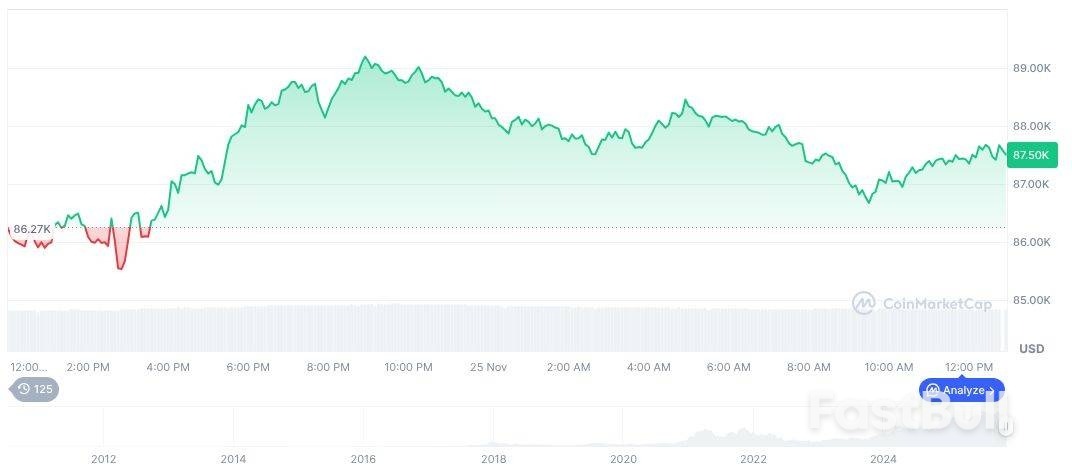
Currently, Bitcoin (BTC) is priced at $87,590.66, with a market capitalization of formatNumber(1747735553640, 2). Its dominance is 57.90%, and the trading volume has decreased by 12.42% over 24 hours. BTC's 30-day price has declined by 23.66%, while its circulating supply stands at 19,953,446, as reported by CoinMarketCap.
Bitcoin(BTC), daily chart, screenshot on CoinMarketCap at 00:52 UTC on November 26, 2025. Source: CoinMarketCapThe Coincu research team highlights that past inflation data often foreshadow Fed interest adjustments. While crypto markets remain steady, significant PPI changes can still trigger volatility if followed by unexpected Fed action. The sector continues to watch closely for future regulatory outcomes.
Computer and printer maker HP announced on Nov 25 a sweeping restructuring plan that will eliminate about 10 per cent of its workforce globally as the company pivots toward artificial intelligence to boost efficiency.
According to its latest earnings report, the tech giant expects to reduce its global headcount by between 4,000 and 6,000 employees to focus on adopting AI to increase innovation and customer satisfaction.
HP's move reflects a growing trend across the tech sector, where companies are investing heavily in AI development while using the technology to reduce operational costs.
Major tech firms including Google, Microsoft, and Amazon have announced workforce reductions over the past two years, with many citing the need to reallocate resources, including jobs, toward AI initiatives.
Industry analysts say AI automation is particularly affecting roles in customer support, content moderation, data entry, and certain computer programming tasks.
HP said its AI plan aims to generate approximately US$1 billion in annual savings by the end of fiscal 2028.
The company has been working to transform its business model amid changing demand patterns in the PC and printing markets.
HP chief executive officer Enrique Lores told the Wall Street Journal that the company plans to raise the prices of its computers and work with new suppliers to help offset the higher costs of AI computing.
In its latest quarter, HP posted a profit of US$795 million, compared with US$906 million a year earlier.
Revenue rose 4.2 per cent to US$14.64 billion, topping analyst estimates with sales in PCs offsetting a decline in printer sales. AFP
This has been a good year for international stocks. In a turnaround from recent years, Europe and many emerging markets have outperformed US equities in 2025. The depreciation of the US dollar has magnified gains for US investors with global exposure.
How much global exposure US investors actually have in their portfolios is an open question. A protracted period of strength for US equities has led to a decline in market share for international-stock funds. The artificial intelligence boom is only the latest technology trend whose benefits have accrued disproportionately to US companies. As a result, the US share of global equity market value has climbed an incredible 20 percentage points since 2010. Despite representing approximately one-fourth of the global economy, US stocks exceed 62% of global equity market value, as measured by the US weight of the Morningstar Global Markets Index. It's a striking imbalance.
With AI dominating the investment conversation and contributing to strong gains for US stocks in 2025, I'd like to share an excerpt of a conversation I recently had with BlackRock's Mike Pyle for Morningstar's The Long View podcast. Pyle was talking about the diversifying potential of taking both long and short positions in stocks around the world. I followed up to get his views on global exposure within a portfolio.
Dan Lefkovitz: And I wanted to zero in on the global aspect of that strategy. Obviously, global equity investing has paid off this year, but going back 10, 15 years, the US market has really been the place to be. I'm curious what you're thinking in terms of allocations to international equities?
Mike Pyle: I would say this is one of those points where market neutrality actually really matters a lot. So, yes, 100% right that at some level, the trade of the last, not just a couple of years, the last 15 years has been to be overweight the United States versus the rest of the world. But that's different than saying that there isn't alpha in other markets elsewhere in the world when you're going long and going short in a market-neutral way. So, investors aren't exposed to the beta of the rest of the world. But what they're able to gain access to is alpha insights that make accurate forecasts about companies that are going to outperform, companies that are going to underperform, and generate return from the difference between those two things. And importantly, to the point I was making earlier, having a bigger investment opportunity set, being able to reach across global markets, just not US markets, expands the reach of the strategies that the systematic team has developed over time and expands the number of alpha opportunities that are available to generate return for clients, again in this market-neutral way. So, 100% right, the US has outperformed. We can talk about the outlook for that. But this strategy is benefiting by being neutral to the market, but capitalizing on the expanded number of opportunities that come from being invested globally, not just in the US.
Lefkovitz: Well, I'll take you up on your offer to share the outlook. A lot of folks are wondering if this is the time to increase their allocations to international.
Pyle: The principal driver of the US equity market since its lows in April, just as it has been for the last couple of years, a strong performance, really, is that those exposures that are giving you access to the theme around AI transformation, the mega trend around AI transformation. And importantly, this goes to the point around a more uncertain, more unstable macro environment. In some ways, we think diversification is obviously no less important than it ever has been. But getting diversification, not just across geographies, but also mega trends like the AI transformation, is vital for building portfolios that are going to generate the outcomes that investors want.
What does that mean? It means, bottom line, that continuing to be exposed to the US equity market, because the US equity market is providing the exposure to this underlying theme of AI transformation that really no other equity market globally can do, still needs to be a core part of portfolios. But again, whether you're looking at geographic diversification or thematic diversification, being sure you're being thoughtful about just how much of the US you want, just how much AI you want, is a really important question as well. And building balance around that is going to be the right way of thinking about building a portfolio that can generate return, but also resilience.
Lefkovitz: What about currency diversification? You mentioned the dollar weakening earlier in our conversation. Do you think it's important for investors to diversify their currency exposure?
Pyle: I think that this is a particularly important point for global investors and a conversation that I regularly have when I'm abroad, whether that's in Europe or Canada or Asia. A number of investors globally allowed their hedge ratios to move considerably lower over the past couple of years as the US has outperformed. And so, increasingly, they were taking US equity exposure, exposure to US assets generally, on an unhedged basis. And this year, that's been a difficult spot to be. Even as the S&P is up a little more than 13%, the dollar is down a little more than 10%. And so the experience this year for a Europe-based investor, for example, of those US exposures, hasn't been the most favorable one. And so I think what it's causing investors to do is to say, not, is this the end of the dollar? Not, am I going to bail on the dollar? But do I want to move away perhaps from the extended degree of unhedged exposures I had to the US back toward something that looks more historically normal in terms of that hedging ratio, that balance between having US exposure, but hedging out some of the currency?
Australian consumer prices rose at a faster-than-expected pace in October, a new monthly report showed on Wednesday, suggesting a pick-up in inflation that reinforced bets that the current policy easing cycle could well be over.
The Australian dollar edged 0.2% higher to $0.6480, while three-year government bond futures slumped 7 ticks to 96.17. Investors pared bets that the Reserve Bank of Australia could deliver one last rate cut in May next year to 27%, from 40% before.
Data from the Australian Bureau of Statistics showed its monthly consumer price index (CPI) rose 3.8% in October compared with a year earlier, up from 3.6% in September and above median forecasts of 3.6%.
The trimmed mean measure of core inflation ran at an annual 3.3% in October, up from 3.2% in September, also not going in the RBA's desired direction.
This is the first complete monthly CPI report published by ABS, replacing the old and partial monthly series. However, the RBA has said it still prefers the quarterly prints for a better gauge of inflation trends given the new data can be volatile.
Headline inflation surged in the last quarter to 3.2%, back above the target band of 2-3%, fuelling concerns that monetary policy might not be restrictive after three rate cuts this year. Home loans jumped and the consumer mood turned optimistic for the first time in four years.

Details of the report suggested some elevated price pressures in the services sector, which ran at an annual rate of 3.9% last month, up from 3.5% in September.
Housing inflation picked up to 5.9% in the 12 months to October, up from 5.7% before.
New Zealand's central bank cut its benchmark official cash rate by 25 basis points to 2.25% on Wednesday, its lowest level since mid-2022, as policymakers extended their efforts to revive a struggling economy and mitigate global headwinds.

The decision matched a Reuters poll in which all but four of the 36 economists surveyed forecast the Reserve Bank of New Zealand would cut the cash rate by a quarter point.
The central bank, which surprised markets by slashing rates by a bigger-than-expected 50 basis points in October, has delivered 325 basis points worth of easing since August 2024 to shore up an economy that has contracted in three of the last five quarters.
White Label
Data API
Web Plug-ins
Poster Maker
Affiliate Program
The risk of loss in trading financial instruments such as stocks, FX, commodities, futures, bonds, ETFs and crypto can be substantial. You may sustain a total loss of the funds that you deposit with your broker. Therefore, you should carefully consider whether such trading is suitable for you in light of your circumstances and financial resources.
No decision to invest should be made without thoroughly conducting due diligence by yourself or consulting with your financial advisors. Our web content might not suit you since we don't know your financial conditions and investment needs. Our financial information might have latency or contain inaccuracy, so you should be fully responsible for any of your trading and investment decisions. The company will not be responsible for your capital loss.
Without getting permission from the website, you are not allowed to copy the website's graphics, texts, or trademarks. Intellectual property rights in the content or data incorporated into this website belong to its providers and exchange merchants.
Not Logged In
Log in to access more features

FastBull Membership
Not yet
Purchase
Log In
Sign Up