• Trade
  • Markets
  • Copy
  • Contests
  • News
  • 24/7
  • Calendar
  • Q&A
  • Chats
Trending
Screeners
SYMBOL
LAST
BID
ASK
HIGH
LOW
NET CHG.
%CHG.
SPREAD
SPX
S&P 500 Index
6827.42
6827.42
6827.42
6899.86
6801.80
-73.58
-1.07%
--
DJI
Dow Jones Industrial Average
48458.04
48458.04
48458.04
48886.86
48334.10
-245.98
-0.51%
--
IXIC
NASDAQ Composite Index
23195.16
23195.16
23195.16
23554.89
23094.51
-398.69
-1.69%
--
USDX
US Dollar Index
97.950
98.030
97.950
98.500
97.950
-0.370
-0.38%
--
EURUSD
Euro / US Dollar
1.17394
1.17409
1.17394
1.17496
1.17192
+0.00011
+ 0.01%
--
GBPUSD
Pound Sterling / US Dollar
1.33707
1.33732
1.33707
1.33997
1.33419
-0.00148
-0.11%
--
XAUUSD
Gold / US Dollar
4299.39
4299.39
4299.39
4353.41
4257.10
+20.10
+ 0.47%
--
WTI
Light Sweet Crude Oil
57.233
57.485
57.233
58.011
56.969
-0.408
-0.71%
--

Community Accounts

Signal Accounts
--
Profit Accounts
--
Loss Accounts
--
View More

Become a signal provider

Sell trading signals to earn additional income

View More

Guide to Copy Trading

Get started with ease and confidence

View More

Signal Accounts for Members

All Signal Accounts

Best Return
  • Best Return
  • Best P/L
  • Best MDD
Past 1W
  • Past 1W
  • Past 1M
  • Past 1Y

All Contests

  • All
  • Trump Updates
  • Recommend
  • Stocks
  • Cryptocurrencies
  • Central Banks
  • Featured News
Top News Only
Share

USA Embassy In Lithuania: Maria Kalesnikava Is Not Going To Vilnius

Share

USA Embassy In Lithuania: Other Prisoners Are Being Sent From Belarus To Ukraine

Share

Ukraine President Zelenskiy: Five Ukrainians Released By Belarus In US-Brokered Deal

Share

USA Vilnius Embassy: USA Stands Ready For "Additional Engagement With Belarus That Advances USA Interests"

Share

USA Vilnius Embassy: Belarus, USA, Other Citizens Among The Prisoners Released Into Lithuania

Share

USA Vilnius Embassy: USA Will Continue Diplomatic Efforts To Free The Remaining Political Prisoners In Belarus

Share

USA Vilnius Embassy: Belarus Releases 123 Prisoners Following Meeting Of President Trump's Envoy Coale And Belarus President Lukashenko

Share

USA Vilnius Embassy: Masatoshi Nakanishi, Aliaksandr Syrytsa Are Among The Prisoners Released By Belarus

Share

USA Vilnius Embassy: Maria Kalesnikava And Viktor Babaryka Are Among The Prisoners Released By Belarus

Share

USA Vilnius Embassy: Nobel Peace Prize Laureate Ales Bialiatski Is Among The Prisoners Released By Belarus

Share

Belarusian Presidential Administration Telegram Channel: Lukashenko Has Pardoned 123 Prisoners As Part Of Deal With US

Share

Two Local Syrian Officials: Joint US-Syrian Military Patrol In Central Syria Came Under Fire From Unknown Assailants

Share

Israeli Military Says It Targeted 'Key Hamas Terrorist' In Gaza City

Share

Rwanda's Actions In Eastern Drc Are A Clear Violation Of Washington Accords Signed By President Trump - Secretary Of State Rubio

Share

Israeli Military Issues Evacuation Warning In Southern Lebanon Village Ahead Of Strike - Spokesperson On X

Share

Belarusian State Media Cites US Envoy Coale As Saying He Discussed Ukraine And Venezuela With Lukashenko

Share

Belarusian State Media Cites US Envoy Coale As Saying That US Removes Sanctions On Belarusian Potassium

Share

Thai Prime Minister: No Ceasefire Agreement With Cambodia

Share

US, Ukraine To Discuss Ceasefire In Berlin Ahead Of European Summit

Share

Incoming Czech Prime Minister Babis: Czech Republic Will Not Take On Guarantees For Ukraine Financing, European Commission Must Find Alternatives

TIME
ACT
FCST
PREV
U.K. Trade Balance Non-EU (SA) (Oct)

A:--

F: --

P: --

U.K. Trade Balance (Oct)

A:--

F: --

P: --

U.K. Services Index MoM

A:--

F: --

P: --

U.K. Construction Output MoM (SA) (Oct)

A:--

F: --

P: --

U.K. Industrial Output YoY (Oct)

A:--

F: --

P: --

U.K. Trade Balance (SA) (Oct)

A:--

F: --

P: --

U.K. Trade Balance EU (SA) (Oct)

A:--

F: --

P: --

U.K. Manufacturing Output YoY (Oct)

A:--

F: --

P: --

U.K. GDP MoM (Oct)

A:--

F: --

P: --

U.K. GDP YoY (SA) (Oct)

A:--

F: --

P: --

U.K. Industrial Output MoM (Oct)

A:--

F: --

P: --

U.K. Construction Output YoY (Oct)

A:--

F: --

P: --

France HICP Final MoM (Nov)

A:--

F: --

P: --

China, Mainland Outstanding Loans Growth YoY (Nov)

A:--

F: --

P: --

China, Mainland M2 Money Supply YoY (Nov)

A:--

F: --

P: --

China, Mainland M0 Money Supply YoY (Nov)

A:--

F: --

P: --

China, Mainland M1 Money Supply YoY (Nov)

A:--

F: --

P: --

India CPI YoY (Nov)

A:--

F: --

P: --

India Deposit Gowth YoY

A:--

F: --

P: --

Brazil Services Growth YoY (Oct)

A:--

F: --

P: --

Mexico Industrial Output YoY (Oct)

A:--

F: --

P: --

Russia Trade Balance (Oct)

A:--

F: --

P: --

Philadelphia Fed President Henry Paulson delivers a speech
Canada Building Permits MoM (SA) (Oct)

A:--

F: --

P: --

Canada Wholesale Sales YoY (Oct)

A:--

F: --

P: --

Canada Wholesale Inventory MoM (Oct)

A:--

F: --

P: --

Canada Wholesale Inventory YoY (Oct)

A:--

F: --

P: --

Canada Wholesale Sales MoM (SA) (Oct)

A:--

F: --

P: --

Germany Current Account (Not SA) (Oct)

A:--

F: --

P: --

U.S. Weekly Total Rig Count

A:--

F: --

P: --

U.S. Weekly Total Oil Rig Count

A:--

F: --

P: --

Japan Tankan Large Non-Manufacturing Diffusion Index (Q4)

--

F: --

P: --

Japan Tankan Small Manufacturing Outlook Index (Q4)

--

F: --

P: --

Japan Tankan Large Non-Manufacturing Outlook Index (Q4)

--

F: --

P: --

Japan Tankan Large Manufacturing Outlook Index (Q4)

--

F: --

P: --

Japan Tankan Small Manufacturing Diffusion Index (Q4)

--

F: --

P: --

Japan Tankan Large Manufacturing Diffusion Index (Q4)

--

F: --

P: --

Japan Tankan Large-Enterprise Capital Expenditure YoY (Q4)

--

F: --

P: --

U.K. Rightmove House Price Index YoY (Dec)

--

F: --

P: --

China, Mainland Industrial Output YoY (YTD) (Nov)

--

F: --

P: --

China, Mainland Urban Area Unemployment Rate (Nov)

--

F: --

P: --

Saudi Arabia CPI YoY (Nov)

--

F: --

P: --

Euro Zone Industrial Output YoY (Oct)

--

F: --

P: --

Euro Zone Industrial Output MoM (Oct)

--

F: --

P: --

Canada Existing Home Sales MoM (Nov)

--

F: --

P: --

Euro Zone Total Reserve Assets (Nov)

--

F: --

P: --

U.K. Inflation Rate Expectations

--

F: --

P: --

Canada National Economic Confidence Index

--

F: --

P: --

Canada New Housing Starts (Nov)

--

F: --

P: --

U.S. NY Fed Manufacturing Employment Index (Dec)

--

F: --

P: --

U.S. NY Fed Manufacturing Index (Dec)

--

F: --

P: --

Canada Core CPI YoY (Nov)

--

F: --

P: --

Canada Manufacturing Unfilled Orders MoM (Oct)

--

F: --

P: --

Canada Manufacturing New Orders MoM (Oct)

--

F: --

P: --

Canada Core CPI MoM (Nov)

--

F: --

P: --

Canada Manufacturing Inventory MoM (Oct)

--

F: --

P: --

Canada CPI YoY (Nov)

--

F: --

P: --

Canada CPI MoM (Nov)

--

F: --

P: --

Canada CPI YoY (SA) (Nov)

--

F: --

P: --

Canada Core CPI MoM (SA) (Nov)

--

F: --

P: --

Q&A with Experts
    • All
    • Chatrooms
    • Groups
    • Friends
    Connecting
    .
    .
    .
    Type here...
    Add Symbol or Code

      No matching data

      All
      Trump Updates
      Recommend
      Stocks
      Cryptocurrencies
      Central Banks
      Featured News
      • All
      • Russia-Ukraine Conflict
      • Middle East Flashpoint
      • All
      • Russia-Ukraine Conflict
      • Middle East Flashpoint
      Search
      Products

      Charts Free Forever

      Chats Q&A with Experts
      Screeners Economic Calendar Data Tools
      Membership Features
      Data Warehouse Market Trends Institutional Data Policy Rates Macro

      Market Trends

      Market Sentiment Order Book Forex Correlations

      Top Indicators

      Charts Free Forever
      Markets

      News

      News Analysis 24/7 Columns Education
      From Institutions From Analysts
      Topics Columnists

      Latest Views

      Latest Views

      Trending Topics

      Top Columnists

      Latest Update

      Signals

      Copy Rankings Latest Signals Become a signal provider AI Rating
      Contests
      Brokers

      Overview Brokers Assessment Rankings Regulators News Claims
      Broker listing Forex Brokers Comparison Tool Live Spread Comparison Scam
      Q&A Complaint Scam Alert Videos Tips to Detect Scam
      More

      Business
      Events
      Careers About Us Advertising Help Center

      White Label

      Data API

      Web Plug-ins

      Affiliate Program

      Awards Institution Evaluation IB Seminar Salon Event Exhibition
      Vietnam Thailand Singapore Dubai
      Fans Party Investment Sharing Session
      FastBull Summit BrokersView Expo
      Recent Searches
        Top Searches
          Markets
          News
          Analysis
          User
          24/7
          Economic Calendar
          Education
          Data
          • Names
          • Latest
          • Prev

          View All

          No data

          Scan to Download

          Faster Charts, Chat Faster!

          Download App
          English
          • English
          • Español
          • العربية
          • Bahasa Indonesia
          • Bahasa Melayu
          • Tiếng Việt
          • ภาษาไทย
          • Français
          • Italiano
          • Türkçe
          • Русский язык
          • 简中
          • 繁中
          Open Account
          Search
          Products
          Charts Free Forever
          Markets
          News
          Signals

          Copy Rankings Latest Signals Become a signal provider AI Rating
          Contests
          Brokers

          Overview Brokers Assessment Rankings Regulators News Claims
          Broker listing Forex Brokers Comparison Tool Live Spread Comparison Scam
          Q&A Complaint Scam Alert Videos Tips to Detect Scam
          More

          Business
          Events
          Careers About Us Advertising Help Center

          White Label

          Data API

          Web Plug-ins

          Affiliate Program

          Awards Institution Evaluation IB Seminar Salon Event Exhibition
          Vietnam Thailand Singapore Dubai
          Fans Party Investment Sharing Session
          FastBull Summit BrokersView Expo

          Australian dollar eyes jobs report

          Adam

          Forex

          Summary:

          The Australian dollar dipped after strong wage growth data raised uncertainty about rate cuts. Markets await jobs data, while global sentiment is influenced by a surprise 90-day US-China tariff deal.
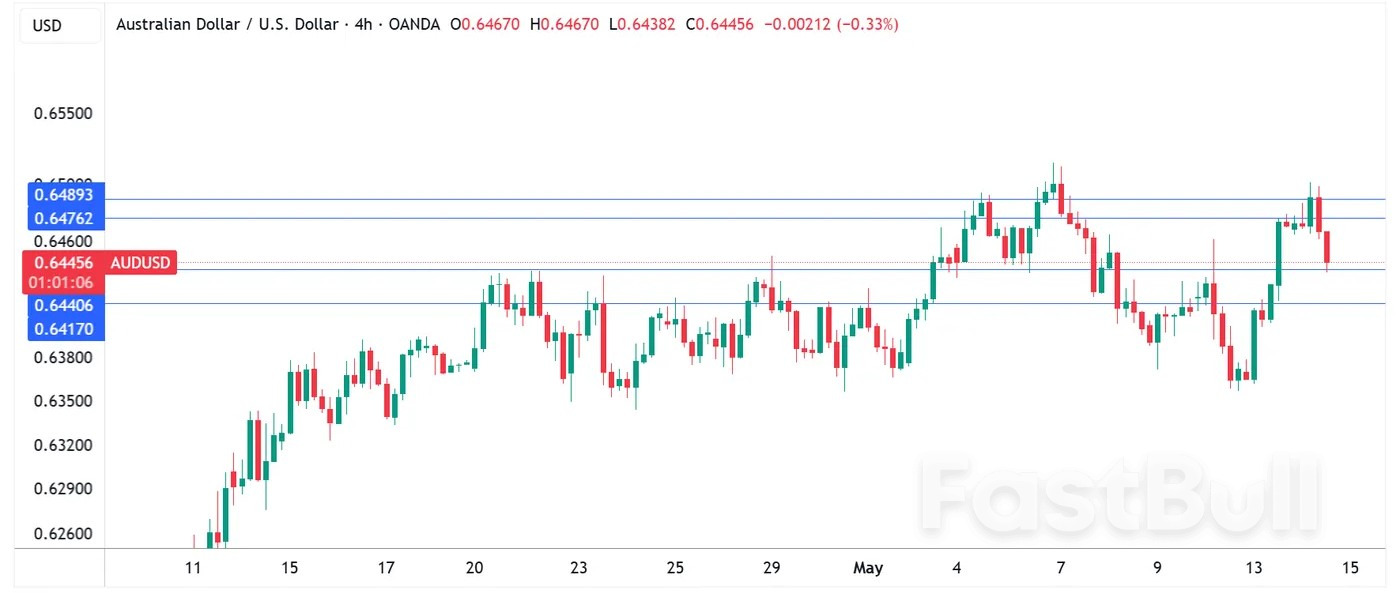
          The Australian dollar has declined on Wednesday. In the North American session, AUD/USD is trading at 0.6441, down 0.45% on the day. This follows the Australian dollar's massive gains of 1.5% a day earlier.

          Australia's wage growth accelerates

          Australia' s wage growth accelerated in the first quarter. Annually, the Wage Price index gained 3.4%, up from 3.2% in Q4 2024 and above the market estimate of 3.2%. The gain was driven by stronger wage growth in the public sector. On a quarterly basis, wage growth rose 0.9% q/q, up from 0.7% and above the market estimate of 0.8%. This is the first time since Q2 2024 that annual wage growth has accelerated.
          The higher-than-expected wage report comes before next week's Reserve Bank of Australia's rate decision. Currently, it looks like a coin toss as to whether the Reserve Bank will maintain or lower rates.

          Australia's employment change expected to ease

          Australia releases employment data on Thursday. Employment change is expected to ease to 20 thousand in April, down from 32.2 thousand in March. The unemployment rate is expected to remain at 4.1%. The labor market has been cooling and if it continues to deteriorate, there will be pressure on the Reserve Bank to lower rates.
          At last week's Federal Reserve meeting, Fed Chair Powell said that he would take a wait-and-see attitude in its rate policy. Trump's erratic tariff policy must be frustrating for the Fed, as it makes it difficult to make reliable growth and inflation forecasts.
          This week's surprise announcement of a tariff deal between the US and China is a case in point at Trump's zig-zag trade policy. The two sides have been engaged in a bruising trade war and slapped massive tariffs on each other's products. Suddenly, the tariffs were slashed, leading to a sigh of relief in the financial markets. The deal is only for 90 days, and what happens then is very much up in the air.

          AUD/USD Technical

          AUD/USD is testing support at 0.6440. Below, there is support at 0.6417There is resistance at 0.6476 and 0.6489
          Australian dollar eyes jobs report_1

          AUD/USD 4-Hour Chart, May 14, 2025

          Source: marketpulse

          Risk Warnings and Disclaimers
          You understand and acknowledge that there is a high degree of risk involved in trading. Following any strategies or investment methods may lead to potential losses. The content on the site is provided by our contributors and analysts for information purposes only. You are solely responsible for determining whether any trading assets, securities, strategy, or any other product is suitable for investing based on your own investment objectives and financial situation.
          Add to Favorites
          Share

          Why The China-US Trade War Truce Won’t Last

          Owen Li

          Economic

          Defying expectations, on May 12 the United States and China announced an important agreement to de-escalate bilateral trade tensions after talks in Geneva, Switzerland.

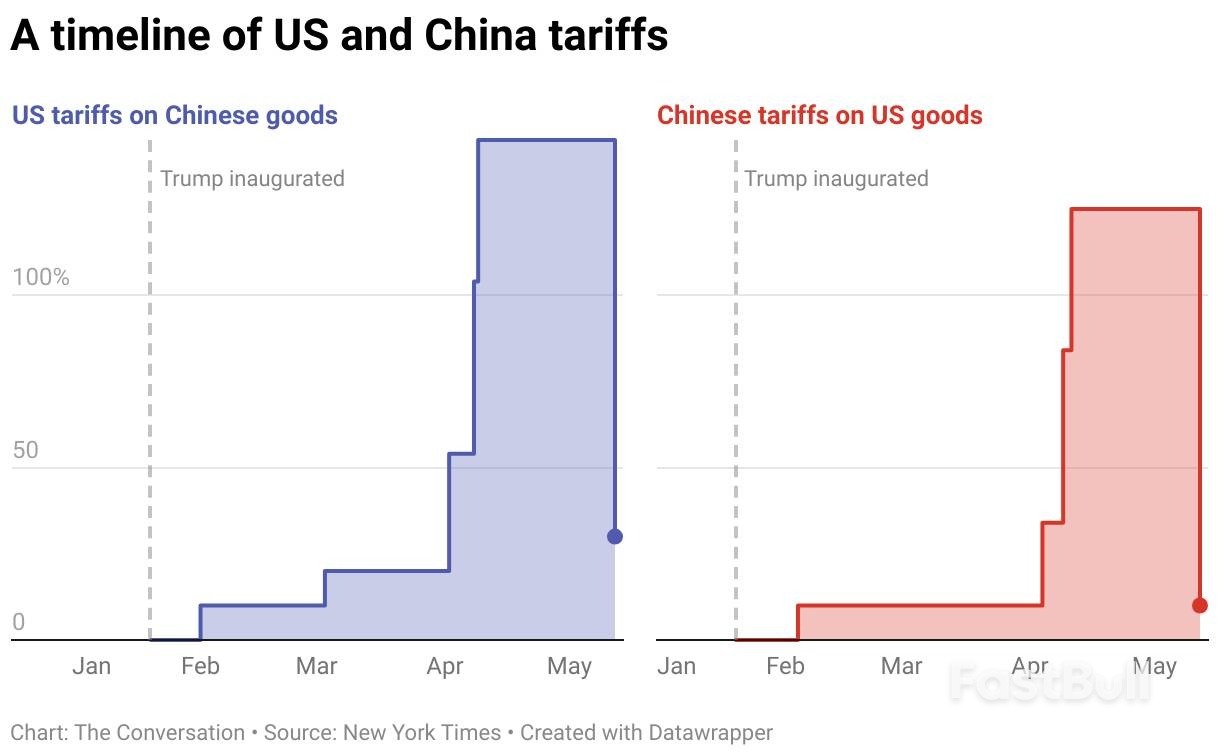
          The good news is their recent tariff increases will be slashed. The U.S. has cut tariffs on Chinese imports from 145 percent to 30 percent, while China has reduced levies on U.S. imports from 125 percent to 10 percent. This greatly eases major bilateral trade tensions, and explains why financial markets rallied.

          The bad news is twofold. First, the remaining tariffs are still high by modern standards. The U.S. average trade-weighted tariff rate was 2.2 percent on January 1 2025, while it is now estimated to be up to 17.8 percent. This makes it the highest tariff wall in the United States since the 1930s.

          Overall, it is very likely a new baseline has been set. Bilateral tariff-free trade belongs to a bygone era.
          Why The China-US Trade War Truce Won’t Last_1

          Second, these tariff reductions will be in place for 90 days, while negotiations continue. Talks will likely include a long list of difficult-to-resolve issues. China’s currency management policy and industrial subsidies system dominated by state-owned enterprises will be on the table. So will the many non-tariff barriers Beijing can turn on and off like a tap.

          China is offering to purchase unspecified quantities of U.S. goods in a repeat of the China-U.S. “Phase 1 deal” from Trump’s first presidency, which was not implemented. On his first day in office in January, amid a blizzard of executive orders, Trump ordered a review of that deal’s implementation. The review found China didn’t follow through on the agriculture, finance, and intellectual property protection commitments it had made.

          Unless the United States has now decided to capitulate to Beijing’s retaliatory actions, it is difficult to see Washington being duped again.

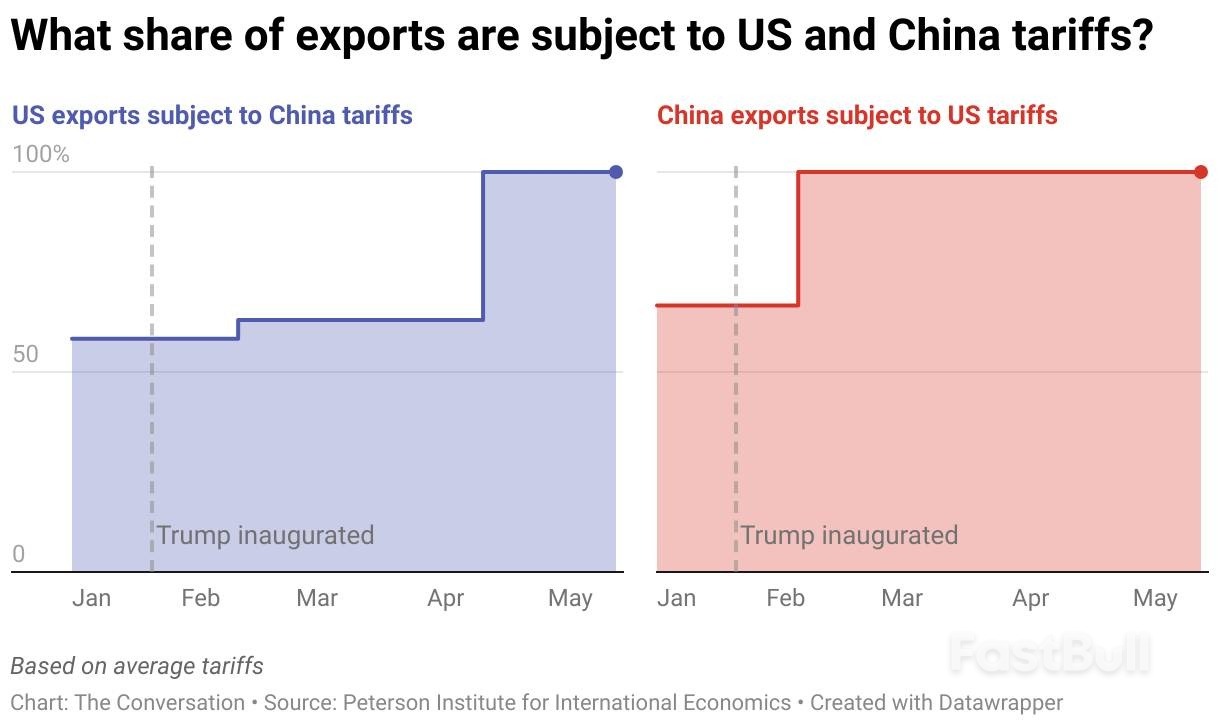
          Failure to agree on these points would reveal the ugly truth that both countries continue to impose bilateral export controls on goods deemed sensitive, such as semiconductors (from the U.S. to China) and processed critical minerals (from China to the U.S.).
          Why The China-US Trade War Truce Won’t Last_2

          Moreover, in its so-called “reciprocal” negotiations with other countries, the United States is pressing trading partners to cut certain sensitive China-sourced goods from their exports destined for U.S. markets. China is deeply unhappy about these U.S. demands and has threatened to retaliate against trading partners that adopt them.

          Overall, the announcement is best viewed as a truce that does not shift the underlying structural reality that the United States and China are locked into a long-term cycle of escalating strategic competition.

          That cycle will have its ups (the latest announcement) and downs (the tariff wars that preceded it). For now, both sides have agreed to announce victory and focus on other matters.

          For the U.S., this means ensuring there will be consumer goods on the shelves in time for Halloween and Christmas, albeit at inflated prices. For China, it means restoring some export market access to take pressure off its increasingly ailing economy.

          As neither side can vanquish the other, the likely long-term result is a frozen conflict. This will be punctuated by attempts to achieve “escalation dominance,” as that will determine who emerges with better terms. Observers’ opinions on where the balance currently lies are divided.

          Along the way, and to use a quote widely attributed to Winston Churchill, to “jaw-jaw is better than to war-war.” Fasten your seat belts, as there is more turbulence to come.

          Significantly, the United States has not (so far) changed its basic goals for all its bilateral trade deals. Its overarching aim is to cut the goods trade deficit by reducing goods imports and eliminating non-tariff barriers it says are “unfairly” prohibiting U.S. exports. Washington also wants to remove barriers to digital trade and investments by tech giants and “derisk” certain imports that it deems sensitive for national security reasons.

          The agreement between the U.S. and United Kingdom last week clearly reflects these goals in operation. While the U.K. received some concessions, the remaining tariffs are higher, at 10 percent overall, than on April 2 and subject to U.S.-imposed import quotas. Furthermore, the U.K. must open its market for certain goods while removing China-originating content from steel and pharmaceutical products destined for the United States.

          For Washington’s Pacific defense treaty allies, including Australia, nothing has changed. Potentially difficult negotiations with the Trump administration lie ahead, particularly if the U.S. decides to use security dependencies as leverage to wring concessions in trade. Japan has already disavowed linking security and trade, and their progress in negotiations should be closely watched.

          The United States has previously paused high tariffs on manufacturing nations in Southeast Asia, particularly those used by other nations as export platforms to avoid China tariffs. Vietnam, Cambodia, and others will face sustained uncertainty and increasingly difficult balancing acts. The economic stakes are higher for them.

          They, like the Japanese, are long-practiced in the subtle arts of balancing the two giants. Still, juggling ties with both Washington and Beijing will become the act of an increasingly high-wire trapeze artist.
          Source: The Diplomat

          To stay updated on all economic events of today, please check out our Economic calendar
          Risk Warnings and Disclaimers
          You understand and acknowledge that there is a high degree of risk involved in trading. Following any strategies or investment methods may lead to potential losses. The content on the site is provided by our contributors and analysts for information purposes only. You are solely responsible for determining whether any trading assets, securities, strategy, or any other product is suitable for investing based on your own investment objectives and financial situation.
          Add to Favorites
          Share

          ECB supervisors press banks on dollar funding over Trump concerns, sources say

          Adam

          Economic

          Central Bank

          European Central Bank supervisors are asking some of the region's lenders to assess their need for U.S. dollars in times of stress, as they game out scenarios in which they cannot rely on tapping the Federal Reserve under the Trump administration, three people with knowledge of the discussions said. Nearly one-fifth of euro zone banks' funding needs are denominated in U.S. dollars, with the lenders borrowing in markets for short-term funding that can shut down abruptly in times of financial stress. In the past, European central banks borrowed dollars from the Fed, the source of the currency, to make up for the shortfall.
          The Fed has lending facilities with the ECB and other major counterparts to alleviate shortages of the global reserve currency and to keep financial stress from spilling over into the United States.
          Two of the sources familiar with the ECB supervisory discussions said the Fed had never suggested - including now - that it would not stand by those backstops.
          Even so, with President Donald Trump’s questioning of long-held defence and trade agreements with European allies breeding mistrust, there are concerns the Fed’s position could change, said the sources, who requested anonymity to speak candidly about sensitive banking supervisory matters.
          ECB supervisors are thus requesting as a matter of urgency that the region’s lenders assess gaps in their balance sheets, such as where they have lent out dollars to clients and financed other dollar-denominated assets but don’t have sufficient or reliable funding in that currency to meet liabilities, one of the sources said.
          They are pressing some banks in the euro zone to reduce such gaps and in some cases demanding that they consider changing some of their business to make them less exposed to dollar funding, this person said.
          The ECB declined to comment. The White House didn't respond to a request for comment.
          The Fed also declined to comment and referred to a speech by Fed Chair Jay Powell in April where he said that the central bank remains prepared to provide dollars to counterparts. "We want to make sure that dollars are available," Powell said. While the Fed is independent of the White House, Trump has frequently and openly criticised Powell, whose term runs out in a year, leading some to worry about the possibility of a less-independent Fed in future.
          SIGNIFICANT RISK The supervisory actions - previously unreported - follow a March report by Reuters that revealed some European central banking and supervisory officials were considering whether they could rely on the Fed for dollars under Trump. In response to a query on the March report, Claudia Buch, the ECB's supervisory chief, told a parliamentary hearing that month that the ECB monitors liquidity in the banking system "very closely." She also warned of risks to liquidity from geopolitical shocks in the ECB's annual report on banking supervision.
          While the questions about the Fed backstops involve risk assessments in situations considered highly unlikely, and while there is no stress on the dollar funding market at present, the precautionary supervisory requests show the extent of unease among the U.S.' closest allies. A senior executive at one of the biggest lenders in Europe, which is not regulated by the ECB but by other authorities, said their bank is now assigning a 5% risk to a scenario in which Fed financing might not be available, up from zero a few months ago.
          The person described that level of risk as "quite significant," and added that ways to address a dollar shortage such as reducing exposures and seeking alternatives will form part of the bank's risk discussions going forward.
          Another senior European banking executive said their bank, which is regulated by the ECB, in recent weeks and for the first time modelled for a "tricky scenario" where the Fed swap lines would not be available. While the bank could keep trading for a prolonged period, it would come at a great cost for new activity in dollars, the executive said.

          FUNDING GAPS

          The European discussions reflect the sprawling, interlinked nature of big lenders and are relevant to financial stability.
          Global banks, including some of Europe's biggest lenders, run huge balance sheets and have exposure to a range of currencies including the dollar. They can often operate in different currencies and their assets and liabilities can have various durations.
          In its Financial Stability Review last November the ECB said 17% of euro zone banks’ funding was in dollars. These banks raised the bulk of that in U.S. funding markets, such as commercial paper and overnight repurchase agreements, where they borrowed dollars against Treasuries and other collateral.
          They used those dollars to lend to non-banks in the euro zone and finance other client activities such as trade.
          Those funding sources could dry up in the event of stress, and when banks lose trust in each other. That's where the Fed's arrangements come in. Most recently, the system was tested in March 2023 when Credit Suisse ran into trouble. As the market's confidence in the Swiss lender withered and clients withdrew tens of billions of dollars, its peers quickly reduced their exposure to the bank, Reuters reported at that time. The Fed provided tens of billions of dollars to the Swiss National Bank, which in turn enabled Credit Suisse to meet client demand for cash, averting a broader crisis.
          One of the sources familiar with the latest supervisory discussions said that while replacing liquidity lines from central banks isn't a task for banks, they can do more to ensure they have the liquidity available in the right currency.
          Regulators typically tolerate some gaps in liquidity and duration - or mismatches in the periods over which assets and liabilities mature - but are now pressing banks to reduce them, the person said.
          In some cases, European banking supervisors have asked them as part of their recent requests to consider changes in their business models to better match currency liquidity needs with their funding sources, the person added.
          Banks can trim their dollar-denominated liabilities by reducing their activities in certain markets or business lines. For instance, European lenders that do not have a U.S. subsidiary and are active in global commerce, such as in financing shipping, can have large exposure to dollars, most likely causing a liquidity imbalance in their balance sheets, said one European banking regulator not directly involved in bank supervision.

          Source : Reuters

          To stay updated on all economic events of today, please check out our Economic calendar
          Risk Warnings and Disclaimers
          You understand and acknowledge that there is a high degree of risk involved in trading. Following any strategies or investment methods may lead to potential losses. The content on the site is provided by our contributors and analysts for information purposes only. You are solely responsible for determining whether any trading assets, securities, strategy, or any other product is suitable for investing based on your own investment objectives and financial situation.
          Add to Favorites
          Share

          EURUSD Technical Analysis – Sellers Lean At Resistance, Bias Bearish Below Support Zone

          James Whitman

          Forex

          Technical Analysis

          EURUSD technicals

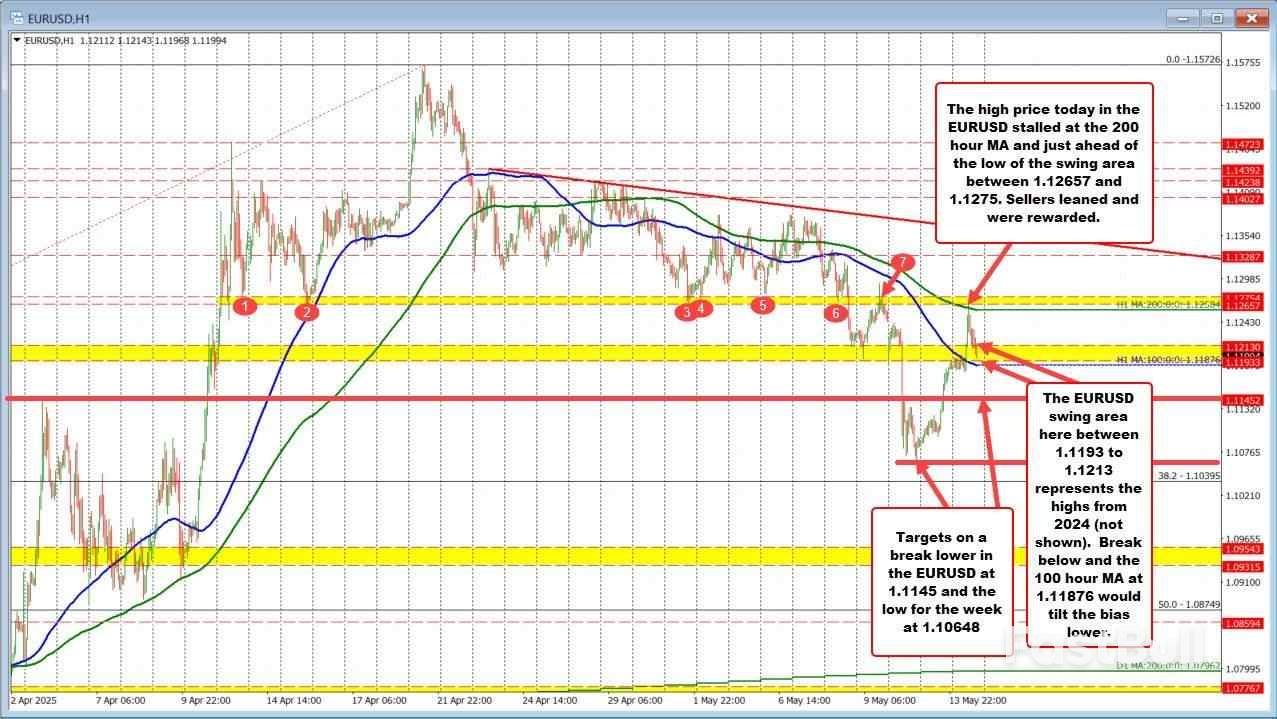
          EURUSD failed to sustain earlier gains as price action today stalled just ahead of the 200-hour moving average (green line on the chart above) and the lower boundary of a key swing zone between 1.12657 and 1.1275. Sellers leaned into the level and have since pushed the pair back toward the 100-hour moving averages.

          The current focus is on the swing area between 1.1193 and 1.1213, which previously marked key highs from 2024 (not shown). A confirmed break below this zone - and the 100 hour MA at 1.11876 - would be technically significant and likely accelerate selling momentum.

          On the downside, immediate targets include the 1.1145 support area followed by the weekly low near 1.10648. These levels could attract additional sellers if the current pressure persists. To shift momentum back to the upside, EURUSD would need to reclaim 1.1213 and the 200 hour MA (and stay above) at 1.12578.

          Key technical levels:

          ● Resistance: 1.1213, 200-hour MA at 1.12578, 1.12657–1.1275 (swing area)

          ● Support: 1.1193–1.1213 (swing zone), 1.11876 (100-hour MA), 1.1145, 1.10648

          ● Bias: Bearish below 1.1213; intensifies under 1.11876

          The sellers remain in control as long as price stays capped below 1.1213. Watch for follow-through below key supports to confirm bearish continuation.

          Source: ForexLive

          Risk Warnings and Disclaimers
          You understand and acknowledge that there is a high degree of risk involved in trading. Following any strategies or investment methods may lead to potential losses. The content on the site is provided by our contributors and analysts for information purposes only. You are solely responsible for determining whether any trading assets, securities, strategy, or any other product is suitable for investing based on your own investment objectives and financial situation.
          Add to Favorites
          Share

          EIA Crude Oil Inventories Show Unexpected Increase, Indicating Weaker Demand

          Thomas

          Economic

          Commodity

          The Energy Information Administration (EIA) has reported a significant increase in its Crude Oil Inventories, pointing towards weaker demand for crude oil. The weekly change in the number of barrels of commercial crude oil held by US firms was recorded at 3.454 million barrels, an unexpected swing from the forecasted decrease of 2 million barrels.

          This recent data release reveals a stark contrast to the projected estimates. Analysts had predicted a decrease of 2 million barrels, based on various market factors and trends. However, the actual inventory numbers have defied these forecasts, indicating a potential shift in the market dynamics.

          When compared to the previous week’s data, the numbers also show a notable increase. The previous week saw a decrease of 2.032 million barrels, reflecting a stronger demand for crude oil. The sudden rise in the inventory this week, therefore, suggests a weakening demand, which could potentially impact crude prices in the bearish direction.

          The level of inventories significantly influences the price of petroleum products, which, in turn, can have an impact on inflation. An increase in crude inventories is generally considered bearish for crude prices as it implies weaker demand.

          Given the importance of the EIA Crude Oil Inventories data, this unexpected increase will likely be closely monitored by investors and market analysts. The implications of this shift could be wide-ranging, influencing not only crude prices but also impacting broader market trends and the inflation outlook.

          As the market continues to digest this unexpected data, the focus will now be on how this might influence the Federal Reserve’s approach to monetary policy, especially in the context of inflation concerns. The EIA’s next report will be eagerly awaited for further insights into the demand and supply dynamics of the crude oil market.

          Source: Investing

          To stay updated on all economic events of today, please check out our Economic calendar
          Risk Warnings and Disclaimers
          You understand and acknowledge that there is a high degree of risk involved in trading. Following any strategies or investment methods may lead to potential losses. The content on the site is provided by our contributors and analysts for information purposes only. You are solely responsible for determining whether any trading assets, securities, strategy, or any other product is suitable for investing based on your own investment objectives and financial situation.
          Add to Favorites
          Share

          Trump's Gulf Tour Sparks AI, Finance And Energy Deals

          Thomas

          Economic

          U.S. President Donald Trump secured a $600 billion commitment from Saudi Arabia to invest in the United States on the first day of a four-day tour of the Gulf, opening the way for a series of business deals.

          Here is an overview of major deals and announcements made on the sidelines of Trump's Gulf visit:

          * Saudi Aramco (2222.SE), opens new tab has signed 34 agreements with major U.S. companies, potentially worth as much as $90 billion, the oil giant said.

          * Qatar Airways signed a deal to purchase jets from U.S. manufacturer Boeing (BA.N), opens new tab.

          * Nvidia (NVDA.O), opens new tab said it will sell hundreds of thousands of AI chips in Saudi Arabia, with a first tranche of 18,000 of its newest "Blackwell" chips going to Humain, an AI startup the kingdom's sovereign wealth fund launched this week.

          * Qualcomm Inc (QCOM.O), opens new tab said it signed a memo of understanding to develop and build a data centre central processor.

          * Franklin Templeton (BEN.N), opens new tab said it has signed a non-binding memorandum of understanding with Saudi Arabia's Public Investment Fund to partner in investing up to $5 billion in the kingdom's financial markets.

          * Neuberger Berman signed an agreement with PIF to invest up to $6 billion in the kingdom, and to launch a Riyadh-based multi-asset investment management platform.

          * BlackRock Saudi Arabia (BLK.N), opens new tab and PIF signed a non-binding letter of intent at the Saudi-U.S. Investment Forum to formalise their strategic collaboration through potential new allocations to the BlackRock Riyadh Investment Management platform.

          * Cisco (CSCO.O), opens new tab said it will collaborate with the AI Infrastructure Partnership, which is led by BlackRock (BLK.N), opens new tab, Global Infrastructure Partners, MGX, Microsoft (MSFT.O), opens new tab, Nvidia and xAI.

          The company also said it will join Saudi Arabia's Humain and extend its strategic partnership with Abu Dhabi's G42 to advance AI innovation and infrastructure development.

          * Infrastructure investment manager I Squared Capital said it has signed a memorandum of understanding with PIF to establish a dedicated infrastructure investment strategy focused on the Middle East.

          * Amazon Web Services (AMZN.O), opens new tab and Saudi Arabia's AI startup Humain said they planned to invest $5 billion-plus in a strategic partnership to build an "AI Zone" in the kingdom.

          * U.S. chip firm AMD (AMD.O), opens new tab and Humain said they would build AI infrastructure that will lead them to invest up to $10 billion to deploy 500 megawatts of AI computing capacity over the next five years.

          * Saudi Arabian DataVolt plans to invest $20 billion in AI data centres and energy infrastructure in the United States.

          * Google (GOOGL.O), opens new tab , DataVolt, Oracle (ORCL.N), opens new tab, Salesforce (CRM.N), opens new tab, AMD (AMD.O), opens new tab, and Uber (UBER.N), opens new tab say they will invest $80 billion in technologies in both countries.

          * Construction consulting firms Hill International, Jacobs, Parsons, and AECOM are building infrastructure projects such as King Salman International Airport, King Salman Park, The Vault, Qiddiya City, and more, totalling $2 billion in U.S. services exports.

          * Additional major exports include GE Vernova's (GEV.N), opens new tab gas turbines and energy solutions totalling $14.2 billion and Boeing 737-8 passenger aircraft for AviLease totalling $4.8 billion.

          * Healthcare firm Shamekh IV Solutions will be investing $5.8 billion, including a plant in Michigan to launch a high-capacity IV fluid facility.

          * Hassana Investment Company and Franklin Templeton signed a memorandum of understanding valued at $150 million to explore a strategic partnership related to investments in Saudi private credit opportunities.

          * Saudi Aramco (2222.SE), opens new tab said it would sign memorandums of understanding with U.S. liquefied natural gas producer NextDecade (NEXT.O), opens new tab and utility Sempra (SRE.N), opens new tab.

          * U.S.-based investment platform Burkhan World Investments said it signed memorandums of understanding with Saudi partners, totalling $15 billion in investment commitments.

          Source: Reuters

          To stay updated on all economic events of today, please check out our Economic calendar
          Risk Warnings and Disclaimers
          You understand and acknowledge that there is a high degree of risk involved in trading. Following any strategies or investment methods may lead to potential losses. The content on the site is provided by our contributors and analysts for information purposes only. You are solely responsible for determining whether any trading assets, securities, strategy, or any other product is suitable for investing based on your own investment objectives and financial situation.
          Add to Favorites
          Share

          Fed Warns of Economic Shock Risk Despite US-China Trade Truce

          Gerik

          Economic

          China–U.S. Trade War

          Fed's Cautious Stance Amid Trade Uncertainty

          Federal Reserve (Fed) President for the Chicago branch, Austan D. Goolsbee, expressed cautious optimism regarding the recent reduction in trade tensions between the US and China. While the 90-day tariff reduction deal between the two nations offers temporary relief, Goolsbee warned that the risk of stagflation—where inflation rises alongside slow economic growth—remains a concern. Despite the easing of tensions, the overall tariff levels remain high, continuing to exert pressure on the economy.
          Goolsbee highlighted that the trade deal, which includes a reduction of US tariffs on Chinese imports from 145% to 30% and Chinese tariffs on US goods from 125% to 10%, only addresses part of the issue. While the temporary tariff reductions offer some respite, the high tariffs that remain could still lead to increased costs for consumers and slow growth.

          Tariffs and Uncertainty Impeding Economic Growth

          The ongoing tariff situation, coupled with the uncertainty surrounding President Trump’s broader trade policies, continues to hinder economic forecasts. With tariffs on goods from almost all of the US's trading partners still in place, economists estimate that American consumers are facing an effective tariff rate of around 15%. This uncertainty has already started to affect consumer sentiment, with surveys showing growing pessimism about the economic outlook and businesses pausing investments and hiring until there is greater clarity.
          Despite these challenges, Goolsbee emphasized that the labor market remains relatively stable, and the Fed is taking a cautious approach in its policy decisions. The central bank paused its interest rate cuts after January, following a series of reductions in 2024, and remains in wait-and-see mode to assess the impact of these policies.

          Fed's Focus on Inflation Risks

          The biggest concern for the Fed remains inflation. Goolsbee warned that if inflation expectations increase significantly or if the labor market worsens, the Fed may be forced to take action. He stressed that stagflation is a particularly difficult scenario for central banks to manage, as rising prices without corresponding growth can dampen both consumer spending and investment.
          With ongoing economic uncertainty, the Fed’s next steps will depend on the evolving impact of tariffs and trade policies. While there is room for optimism regarding the temporary relief from trade tensions, the lingering effects of high tariffs and market volatility mean the central bank must remain vigilant.

          Source: The Business Times

          To stay updated on all economic events of today, please check out our Economic calendar
          Risk Warnings and Disclaimers
          You understand and acknowledge that there is a high degree of risk involved in trading. Following any strategies or investment methods may lead to potential losses. The content on the site is provided by our contributors and analysts for information purposes only. You are solely responsible for determining whether any trading assets, securities, strategy, or any other product is suitable for investing based on your own investment objectives and financial situation.
          Add to Favorites
          Share
          FastBull
          Copyright © 2025 FastBull Ltd

          728 RM B 7/F GEE LOK IND BLDG NO 34 HUNG TO RD KWUN TONG KLN HONG KONG

          TelegramInstagramTwitterfacebooklinkedin
          App Store Google Play Google Play
          Products
          Charts

          Chats

          Q&A with Experts
          Screeners
          Economic Calendar
          Data
          Tools
          Membership
          Features
          Function
          Markets
          Copy Trading
          Latest Signals
          Contests
          News
          Analysis
          24/7
          Columns
          Education
          Company
          Careers
          About Us
          Contact Us
          Advertising
          Help Center
          Feedback
          User Agreement
          Privacy Policy
          Business

          White Label

          Data API

          Web Plug-ins

          Poster Maker

          Affiliate Program

          Risk Disclosure

          The risk of loss in trading financial instruments such as stocks, FX, commodities, futures, bonds, ETFs and crypto can be substantial. You may sustain a total loss of the funds that you deposit with your broker. Therefore, you should carefully consider whether such trading is suitable for you in light of your circumstances and financial resources.

          No decision to invest should be made without thoroughly conducting due diligence by yourself or consulting with your financial advisors. Our web content might not suit you since we don't know your financial conditions and investment needs. Our financial information might have latency or contain inaccuracy, so you should be fully responsible for any of your trading and investment decisions. The company will not be responsible for your capital loss.

          Without getting permission from the website, you are not allowed to copy the website's graphics, texts, or trademarks. Intellectual property rights in the content or data incorporated into this website belong to its providers and exchange merchants.

          Not Logged In

          Log in to access more features

          FastBull Membership

          Not yet

          Purchase

          Become a signal provider
          Help Center
          Customer Service
          Dark Mode
          Price Up/Down Colors

          Log In

          Sign Up

          Position
          Layout
          Fullscreen
          Default to Chart
          The chart page opens by default when you visit fastbull.com
