• Trade
  • Markets
  • Copy
  • Contests
  • News
  • 24/7
  • Calendar
  • Q&A
  • Chats
Trending
Screeners
SYMBOL
LAST
BID
ASK
HIGH
LOW
NET CHG.
%CHG.
SPREAD
SPX
S&P 500 Index
6827.42
6827.42
6827.42
6899.86
6801.80
-73.58
-1.07%
--
DJI
Dow Jones Industrial Average
48458.04
48458.04
48458.04
48886.86
48334.10
-245.98
-0.51%
--
IXIC
NASDAQ Composite Index
23195.16
23195.16
23195.16
23554.89
23094.51
-398.69
-1.69%
--
USDX
US Dollar Index
97.950
98.030
97.950
98.500
97.950
-0.370
-0.38%
--
EURUSD
Euro / US Dollar
1.17394
1.17409
1.17394
1.17496
1.17192
+0.00011
+ 0.01%
--
GBPUSD
Pound Sterling / US Dollar
1.33707
1.33732
1.33707
1.33997
1.33419
-0.00148
-0.11%
--
XAUUSD
Gold / US Dollar
4299.39
4299.39
4299.39
4353.41
4257.10
+20.10
+ 0.47%
--
WTI
Light Sweet Crude Oil
57.233
57.485
57.233
58.011
56.969
-0.408
-0.71%
--

Community Accounts

Signal Accounts
--
Profit Accounts
--
Loss Accounts
--
View More

Become a signal provider

Sell trading signals to earn additional income

View More

Guide to Copy Trading

Get started with ease and confidence

View More

Signal Accounts for Members

All Signal Accounts

Best Return
  • Best Return
  • Best P/L
  • Best MDD
Past 1W
  • Past 1W
  • Past 1M
  • Past 1Y

All Contests

  • All
  • Trump Updates
  • Recommend
  • Stocks
  • Cryptocurrencies
  • Central Banks
  • Featured News
Top News Only
Share

Israel Says It Kills Senior Hamas Commander Raed Saed In Gaza

Share

Ukraine's Navy Says Russian Drone Attack Hit Civilian Turkish Vessel Carrying Sunflower Oil To Egypt On Saturday

Share

Israeli Military Says It Put Planned Strike On South Lebanon Site On Hold After Lebanese Army Requested Access

Share

Norwegian Nobel Committee: Calls On The Belarusian Authorities To Release All Political Prisoners

Share

Norwegian Nobel Committee: His Freedom Is A Deeply Welcome And Long-Awaited Moment

Share

Ukraine Says It Received 114 Prisoners From Belarus

Share

USA Embassy In Lithuania: Maria Kalesnikava Is Not Going To Vilnius

Share

USA Embassy In Lithuania: Other Prisoners Are Being Sent From Belarus To Ukraine

Share

Ukraine President Zelenskiy: Five Ukrainians Released By Belarus In US-Brokered Deal

Share

USA Vilnius Embassy: USA Stands Ready For "Additional Engagement With Belarus That Advances USA Interests"

Share

USA Vilnius Embassy: Belarus, USA, Other Citizens Among The Prisoners Released Into Lithuania

Share

USA Vilnius Embassy: USA Will Continue Diplomatic Efforts To Free The Remaining Political Prisoners In Belarus

Share

USA Vilnius Embassy: Belarus Releases 123 Prisoners Following Meeting Of President Trump's Envoy Coale And Belarus President Lukashenko

Share

USA Vilnius Embassy: Masatoshi Nakanishi, Aliaksandr Syrytsa Are Among The Prisoners Released By Belarus

Share

USA Vilnius Embassy: Maria Kalesnikava And Viktor Babaryka Are Among The Prisoners Released By Belarus

Share

USA Vilnius Embassy: Nobel Peace Prize Laureate Ales Bialiatski Is Among The Prisoners Released By Belarus

Share

Belarusian Presidential Administration Telegram Channel: Lukashenko Has Pardoned 123 Prisoners As Part Of Deal With US

Share

Two Local Syrian Officials: Joint US-Syrian Military Patrol In Central Syria Came Under Fire From Unknown Assailants

Share

Israeli Military Says It Targeted 'Key Hamas Terrorist' In Gaza City

Share

Rwanda's Actions In Eastern Drc Are A Clear Violation Of Washington Accords Signed By President Trump - Secretary Of State Rubio

TIME
ACT
FCST
PREV
U.K. Trade Balance Non-EU (SA) (Oct)

A:--

F: --

P: --

U.K. Trade Balance (Oct)

A:--

F: --

P: --

U.K. Services Index MoM

A:--

F: --

P: --

U.K. Construction Output MoM (SA) (Oct)

A:--

F: --

P: --

U.K. Industrial Output YoY (Oct)

A:--

F: --

P: --

U.K. Trade Balance (SA) (Oct)

A:--

F: --

P: --

U.K. Trade Balance EU (SA) (Oct)

A:--

F: --

P: --

U.K. Manufacturing Output YoY (Oct)

A:--

F: --

P: --

U.K. GDP MoM (Oct)

A:--

F: --

P: --

U.K. GDP YoY (SA) (Oct)

A:--

F: --

P: --

U.K. Industrial Output MoM (Oct)

A:--

F: --

P: --

U.K. Construction Output YoY (Oct)

A:--

F: --

P: --

France HICP Final MoM (Nov)

A:--

F: --

P: --

China, Mainland Outstanding Loans Growth YoY (Nov)

A:--

F: --

P: --

China, Mainland M2 Money Supply YoY (Nov)

A:--

F: --

P: --

China, Mainland M0 Money Supply YoY (Nov)

A:--

F: --

P: --

China, Mainland M1 Money Supply YoY (Nov)

A:--

F: --

P: --

India CPI YoY (Nov)

A:--

F: --

P: --

India Deposit Gowth YoY

A:--

F: --

P: --

Brazil Services Growth YoY (Oct)

A:--

F: --

P: --

Mexico Industrial Output YoY (Oct)

A:--

F: --

P: --

Russia Trade Balance (Oct)

A:--

F: --

P: --

Philadelphia Fed President Henry Paulson delivers a speech
Canada Building Permits MoM (SA) (Oct)

A:--

F: --

P: --

Canada Wholesale Sales YoY (Oct)

A:--

F: --

P: --

Canada Wholesale Inventory MoM (Oct)

A:--

F: --

P: --

Canada Wholesale Inventory YoY (Oct)

A:--

F: --

P: --

Canada Wholesale Sales MoM (SA) (Oct)

A:--

F: --

P: --

Germany Current Account (Not SA) (Oct)

A:--

F: --

P: --

U.S. Weekly Total Rig Count

A:--

F: --

P: --

U.S. Weekly Total Oil Rig Count

A:--

F: --

P: --

Japan Tankan Large Non-Manufacturing Diffusion Index (Q4)

--

F: --

P: --

Japan Tankan Small Manufacturing Outlook Index (Q4)

--

F: --

P: --

Japan Tankan Large Non-Manufacturing Outlook Index (Q4)

--

F: --

P: --

Japan Tankan Large Manufacturing Outlook Index (Q4)

--

F: --

P: --

Japan Tankan Small Manufacturing Diffusion Index (Q4)

--

F: --

P: --

Japan Tankan Large Manufacturing Diffusion Index (Q4)

--

F: --

P: --

Japan Tankan Large-Enterprise Capital Expenditure YoY (Q4)

--

F: --

P: --

U.K. Rightmove House Price Index YoY (Dec)

--

F: --

P: --

China, Mainland Industrial Output YoY (YTD) (Nov)

--

F: --

P: --

China, Mainland Urban Area Unemployment Rate (Nov)

--

F: --

P: --

Saudi Arabia CPI YoY (Nov)

--

F: --

P: --

Euro Zone Industrial Output YoY (Oct)

--

F: --

P: --

Euro Zone Industrial Output MoM (Oct)

--

F: --

P: --

Canada Existing Home Sales MoM (Nov)

--

F: --

P: --

Euro Zone Total Reserve Assets (Nov)

--

F: --

P: --

U.K. Inflation Rate Expectations

--

F: --

P: --

Canada National Economic Confidence Index

--

F: --

P: --

Canada New Housing Starts (Nov)

--

F: --

P: --

U.S. NY Fed Manufacturing Employment Index (Dec)

--

F: --

P: --

U.S. NY Fed Manufacturing Index (Dec)

--

F: --

P: --

Canada Core CPI YoY (Nov)

--

F: --

P: --

Canada Manufacturing Unfilled Orders MoM (Oct)

--

F: --

P: --

Canada Manufacturing New Orders MoM (Oct)

--

F: --

P: --

Canada Core CPI MoM (Nov)

--

F: --

P: --

Canada Manufacturing Inventory MoM (Oct)

--

F: --

P: --

Canada CPI YoY (Nov)

--

F: --

P: --

Canada CPI MoM (Nov)

--

F: --

P: --

Canada CPI YoY (SA) (Nov)

--

F: --

P: --

Canada Core CPI MoM (SA) (Nov)

--

F: --

P: --

Q&A with Experts
    • All
    • Chatrooms
    • Groups
    • Friends
    Connecting
    .
    .
    .
    Type here...
    Add Symbol or Code

      No matching data

      All
      Trump Updates
      Recommend
      Stocks
      Cryptocurrencies
      Central Banks
      Featured News
      • All
      • Russia-Ukraine Conflict
      • Middle East Flashpoint
      • All
      • Russia-Ukraine Conflict
      • Middle East Flashpoint
      Search
      Products

      Charts Free Forever

      Chats Q&A with Experts
      Screeners Economic Calendar Data Tools
      Membership Features
      Data Warehouse Market Trends Institutional Data Policy Rates Macro

      Market Trends

      Market Sentiment Order Book Forex Correlations

      Top Indicators

      Charts Free Forever
      Markets

      News

      News Analysis 24/7 Columns Education
      From Institutions From Analysts
      Topics Columnists

      Latest Views

      Latest Views

      Trending Topics

      Top Columnists

      Latest Update

      Signals

      Copy Rankings Latest Signals Become a signal provider AI Rating
      Contests
      Brokers

      Overview Brokers Assessment Rankings Regulators News Claims
      Broker listing Forex Brokers Comparison Tool Live Spread Comparison Scam
      Q&A Complaint Scam Alert Videos Tips to Detect Scam
      More

      Business
      Events
      Careers About Us Advertising Help Center

      White Label

      Data API

      Web Plug-ins

      Affiliate Program

      Awards Institution Evaluation IB Seminar Salon Event Exhibition
      Vietnam Thailand Singapore Dubai
      Fans Party Investment Sharing Session
      FastBull Summit BrokersView Expo
      Recent Searches
        Top Searches
          Markets
          News
          Analysis
          User
          24/7
          Economic Calendar
          Education
          Data
          • Names
          • Latest
          • Prev

          View All

          No data

          Scan to Download

          Faster Charts, Chat Faster!

          Download App
          English
          • English
          • Español
          • العربية
          • Bahasa Indonesia
          • Bahasa Melayu
          • Tiếng Việt
          • ภาษาไทย
          • Français
          • Italiano
          • Türkçe
          • Русский язык
          • 简中
          • 繁中
          Open Account
          Search
          Products
          Charts Free Forever
          Markets
          News
          Signals

          Copy Rankings Latest Signals Become a signal provider AI Rating
          Contests
          Brokers

          Overview Brokers Assessment Rankings Regulators News Claims
          Broker listing Forex Brokers Comparison Tool Live Spread Comparison Scam
          Q&A Complaint Scam Alert Videos Tips to Detect Scam
          More

          Business
          Events
          Careers About Us Advertising Help Center

          White Label

          Data API

          Web Plug-ins

          Affiliate Program

          Awards Institution Evaluation IB Seminar Salon Event Exhibition
          Vietnam Thailand Singapore Dubai
          Fans Party Investment Sharing Session
          FastBull Summit BrokersView Expo

          Asian IPO Market Stalls as Trade War and Tariff Concerns Cloud Outlook

          Gerik

          Economic

          Summary:

          Amid rising global trade tensions and US tariff measures, many companies across Asia are delaying IPO plans, especially in markets more exposed to higher retaliatory duties....

          IPO Momentum in Asia Falters Amid Growing Trade Uncertainty

          The Asian initial public offering (IPO) market, once buoyed by a strong pipeline in early 2025, is now entering a state of pause as companies reassess listing strategies in response to intensifying global trade tensions. According to financial experts, firms across the region are holding back IPO launches due to declining investor appetite, largely triggered by the escalating tariff war initiated by the United States under President Donald Trump.
          Manishi Raychaudhuri, Managing Director at Emmer Capital Partners in Hong Kong, observed that while Q1 2025 saw pockets of IPO optimism, markets underestimated the Trump administration’s determination to pursue wide-ranging reciprocal tariff policies. This miscalculation has led to a sharp pivot in sentiment.

          Trade Disputes Undermine Market Confidence and IPO Demand

          The catalyst for the current unease came in early April when the US introduced aggressive new tariff measures, followed by a limited trade deal with the UK. Although this suggested willingness to negotiate, skepticism remains high. Investors continue to worry about prolonged volatility and the growing possibility of a US economic slowdown. Raychaudhuri noted that “companies are unlikely to enter a market where investor commitment is weak,” highlighting a mutual hesitation from both issuers and backers.

          Q1 Activity Strong in Select Regions, But Risks Intensify

          According to EY, Asia-Pacific led the world in IPO volume in Q1 2025, outperforming even the US. Hong Kong and South Korea drove much of this momentum, while activity in Japan, India, and ASEAN countries saw notable declines. Despite this early strength, current projections suggest a sharp deceleration due to macroeconomic risk.
          Chan Yew Kiang, Head of IPO Services at EY ASEAN, emphasized that most companies planning IPOs are now adopting a "wait-and-see" approach, given the unpredictable trajectory of the trade war and the wide-reaching implications of tariff changes for Asian economies.

          Tariff Exposure Creates Regional Disparities

          The effects of trade friction are not uniformly felt across Asia. Abhineet Kaul from Access Partnership pointed out that countries with lower US tariff exposure may fare better. For example, Singapore, with a base US import tariff of 10%, is positioned more favorably than peers like Thailand and Malaysia, which are subject to retaliatory rates of 24% or higher. This variation has direct implications for market stability and IPO prospects within the region.
          Despite broader caution, Hong Kong remains one of the few IPO markets showing signs of durability. Louis Lau, Head of Capital Markets at KPMG Hong Kong, described the outlook as “cautiously optimistic.” As of March 31, 120 companies had filed for IPOs in Hong Kong—a 38% increase year-on-year—highlighting sustained supply interest.
          Several structural advantages underpin this resilience. The Hong Kong Stock Exchange has eased IPO requirements for select sectors, particularly tech, and established dedicated listing channels. Pamela Chung from Vistra added that favorable policy shifts in mainland China supporting tech and private firms are further boosting interest in Hong Kong listings.
          Hong Kong’s role as a dual-listing hub for mainland Chinese firms and its currency peg to the US dollar offer additional stability. These factors collectively echo the IPO surge experienced during Trump’s first term, suggesting that the city may again serve as a strategic listing venue even in turbulent times.
          Asia’s IPO landscape is entering a cautious phase, shaped by trade policy shifts, investor wariness, and divergent regional exposures to tariffs. While markets like Japan, ASEAN, and India face growing constraints, relatively shielded economies such as Singapore and structurally favored markets like Hong Kong may maintain IPO momentum. The coming months will test the region’s ability to adapt to geopolitical shocks and capitalize on regulatory flexibility to keep capital markets active.

          Source: Nikkei Asia

          To stay updated on all economic events of today, please check out our Economic calendar
          Risk Warnings and Disclaimers
          You understand and acknowledge that there is a high degree of risk involved in trading. Following any strategies or investment methods may lead to potential losses. The content on the site is provided by our contributors and analysts for information purposes only. You are solely responsible for determining whether any trading assets, securities, strategy, or any other product is suitable for investing based on your own investment objectives and financial situation.
          Add to Favorites
          Share

          Goldman Sachs Pushes Fed Rate Cut Forecast To December 2025

          Fiona Harper

          Central Bank

          Economic

          Cryptocurrency

          Key Points:
          ● Goldman Sachs adjusts Fed rate cut timing to December 2025.
          ● Implications for financial markets and cryptocurrencies like BTC and ETH.
          ● Market participants anticipate changes in asset pricing and investor sentiment.
          Goldman Sachs has adjusted the timing for the anticipated Federal Reserve rate cut to December 2025, diverging from an earlier prediction for July. This adjustment follows strong employment data and potential macroeconomic shifts.
          The forecast shift by Goldman Sachs suggests significant implications for both financial markets and the cryptocurrency sector. Market participants anticipate changes in asset pricing and investor sentiment, with particular attention on BTC and ETH sensitivity to US rate policies.

          Goldman Sachs Extends Fed Rate Cut Expectation to Q4 2025

          Goldman Sachs, a major US financial player, has revised its Federal Reserve rate cut projection, now anticipating the next cut in December instead of July. This change comes amid a landscape of easier financial conditions and macroeconomic recalculations. The expected rate cut delay aligns with improved employment statistics and an updated growth outlook. Goldman Sachs analysts have increased the US 2025 fourth-quarter GDP growth estimate by 0.5 percentage points. They also predict a 3.6% peak in core personal consumption expenditure inflation, fostering better economic prospects.
          Market sentiment has shifted with these adjustments. Notable individual insights come from Raoul Pal, CEO of Real Vision, paraphrasing that the expected pause and potential cut may catalyze risk asset rotations, prominently including cryptocurrencies. Community sentiment across social platforms reflects cautious optimism, pending definitive Fed actions.
          “The pause, and more so, the eventual first cut, will trigger a huge rotation into risk assets. Crypto will move fast and hard once the Fed signals—it’s about the liquidity, stupid.” - Raoul Pal, CEO, Real Vision.

          Crypto Response: BTC and ETH Under Rate Pressure

          Did you know? In past instances where the Fed delayed cuts, similar to 2019, BTC and ETH experienced notable short-term volatility, underscoring the close relationship between macroeconomic policy shifts and crypto market dynamics.
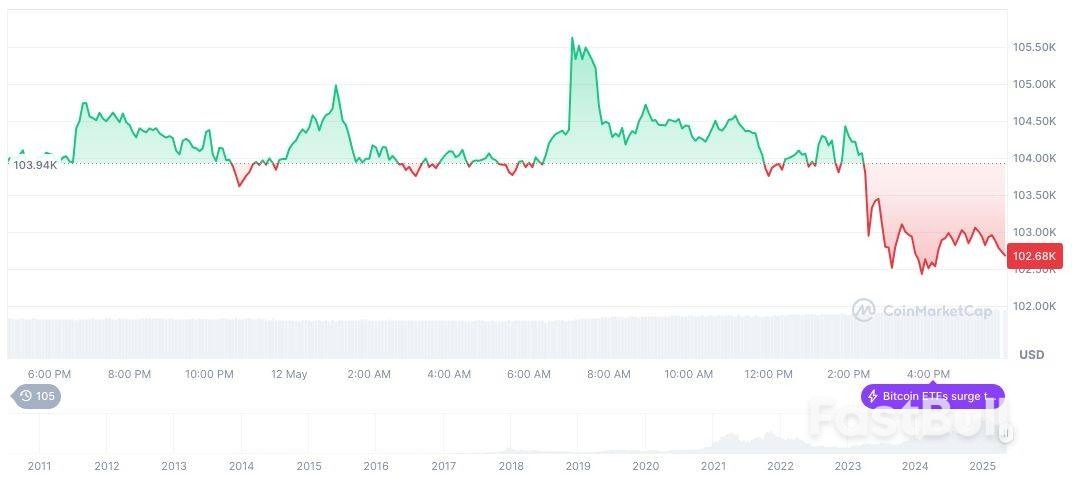
          Bitcoin's current data: trading at $102,929.11 with a market cap of $2.04 trillion, according to CoinMarketCap. Despite a 1.07% decline over 24 hours, Bitcoin saw growth of 8.56% in seven days, and a broader upward trend with a 30-day increase of 20.62%. Trading volume reached $64.05 billion, clearly impacting market engagement and investor strategies.

          Bitcoin(BTC), daily chart, screenshot on CoinMarketCap at 23:49 UTC on May 12, 2025.

          Insights from the Coincu research team emphasize the potential ripple effects on technological sectors and crypto product innovations. Delayed monetary easing creates interim pressure but historically catalyzes post-adjustment asset influxes. Such contexts illustrate opportunities for strategic positioning in risk-on environments.

          Source: CryptoSlate

          To stay updated on all economic events of today, please check out our Economic calendar
          Risk Warnings and Disclaimers
          You understand and acknowledge that there is a high degree of risk involved in trading. Following any strategies or investment methods may lead to potential losses. The content on the site is provided by our contributors and analysts for information purposes only. You are solely responsible for determining whether any trading assets, securities, strategy, or any other product is suitable for investing based on your own investment objectives and financial situation.
          Add to Favorites
          Share

          Explainer: What Has Trump Said About Cutting Drug Prices?

          Michelle Reid

          May 12 (Reuters) - U.S. President Donald Trump signed a broad executive order on Monday directing drugmakers to lower the prices of their prescription drugs to align with what other countries pay.

          White House officials said the government will give drugmakers price targets in the next month, and will take further action within six months if the companies do not make "significant progress" toward the goal of lower prices.

          WHAT IS TRUMP'S STANCE ON PRESCRIPTION DRUG PRICES?

          Trump has sharply criticised the pharmaceutical industry for years over the price of medicines in the United States. He has also chided other wealthy nations for "freeloading" on U.S. pharmaceutical innovation.

          During his first term, in 2017, he accused the industry of "getting away with murder" in the prices they charge the government for prescription drugs.

          Trump's proposed international reference pricing program was blocked by a court in 2020.

          During his 2024 presidential campaign, Trump said Americans were being overcharged for medicines compared to other nations and pledged to take action.

          On Monday, he said he wants to "equalize" prices with other countries by implementing tariffs.

          ARE U.S. DRUG PRICES MORE EXPENSIVE?

          Yes. The U.S. pays the most for prescription medicines in the world, often nearly three times that of other developed nations.

          Top-selling blood thinner Eliquis from Bristol Myers Squibb (BMY.N), opens new tab and Pfizer (PFE.N), opens new tab carries a U.S. list price of $606 for a month's supply. The previous administration of Democratic President Joe Biden negotiated that down to $295 for Medicare, which goes into effect in 2026, but the drug costs $114 in Sweden and just $20 in Japan.

          WHAT IS TRUMP GOING TO DO ABOUT IT?

          Since taking office in January, Trump has reiterated that he wants to end this inequity. On Sunday, he announced on Truth Social that he would sign an executive order to pursue "most favoured nation" pricing.

          Also known as international reference pricing, it seeks to narrow the gap between the U.S. and foreign drug prices. Reuters reported in April such a policy was under consideration.

          The executive order on Monday differed from what drugmakers had been expecting. Lobbyist sources had told Reuters ahead of the order's signing on Monday that they expected the "most favored nation" pricing to apply to drugs for Medicare patients. But the order appeared to apply to all medicines.

          Separately, Trump has also pushed for drugmakers to boost U.S. manufacturing. His administration is conducting an investigation into imports of pharmaceuticals in a bid to levy tariffs on grounds that reliance on foreign production of medicine threatens national security.

          HOW DOES THIS DIFFER FROM PREVIOUS PRICE REDUCTION EFFORTS?

          Biden's Inflation Reduction Act allows the government to negotiate the price of its most expensive drugs within Medicare.

          The prices for the first 10 prescription drugs it negotiated were still on average more than double, and in some cases five times, what drugmakers had agreed to in four other high-income countries, Reuters previously reported.

          WHAT IS THE PHARMA INDUSTRY'S RESPONSE?

          The industry is strongly opposed to the prospect of dramatically lower drug prices in the United States, the world's largest pharmaceuticals market.

          Two industry sources told Reuters last month that any such policy was more concerning to the industry than other potential government moves such as tariffs on imported medicines.

          The main U.S. lobby group for drugmakers, the Pharmaceutical Research and Manufacturers of America, known as PhRMA, said, "to lower costs for Americans, we need to address the real reasons U.S. prices are higher: foreign countries not paying their fair share and middlemen driving up prices for U.S. patients."

          "Most favored nation is a deeply flawed proposal that would devastate our nation's small- and mid-size biotech companies," said John Crowley, CEO of BIO, the main U.S. trade group for biotechnology companies, in a statement.

          WHAT ARE THE CHALLENGES IN CARRYING OUT THE ORDER?

          Experts warn that referencing prices from other countries is complex, as many drugs sold in the U.S. are not available abroad, and some nations do not publish what they pay for drugs or take years to negotiate prices.

          The U.S. does not buy drugs directly for a national health system, as countries such as England and Germany do, instead relying on the private sector to manage drug price negotiations for both government and private health plans.

          Analysts said implementing the broad order would be difficult.

          The executive order is also likely to face legal challenges, particularly for exceeding limits set by U.S. law, including on imports of drugs from abroad, legal experts said.

          Reporting by Maggie Fick in London; Editing by Josephine, Mason, Caroline Humer and Bill Berkrot

          Source: Reuters

          Risk Warnings and Disclaimers
          You understand and acknowledge that there is a high degree of risk involved in trading. Following any strategies or investment methods may lead to potential losses. The content on the site is provided by our contributors and analysts for information purposes only. You are solely responsible for determining whether any trading assets, securities, strategy, or any other product is suitable for investing based on your own investment objectives and financial situation.
          Add to Favorites
          Share

          Toy Stocks Rally After Chinese Tariffs Slashed To 30%

          Edward Lawson

          China–U.S. Trade War

          Toys made by Mattel, Hasbro and others are seen at a Macy's store in New York.

          Shares of major toy makers rallied on Monday after the U.S. agreed to temporarily reduce tariffs on China.

          The agreement will pause most tariffs and other trade barriers for 90 days, including reducing the 145% levy President Donald Trump had in place on Chinese imports to 30%.

          Shares of Mattel jumped more than 10% Monday, Hasbro traded up 6.5%, Jakks rose more than 15% and Funko soared a whopping 46.4%.

          The rally pushed shares of Hasbro above their trading level from early April, before Trump first announced his so-called "reciprocal tariffs" on dozens of trade partners. The rest of the toy stocks are still trading below their April 1 closing prices.

          The stocks had been hammered by Wall Street as investors anticipated manufacturing hiccups and price hikes resulting from the tariff scheme. The toy industry is heavily reliant on supply chains in China, leaving toy makers at the mercy of trade policy. Bank of America estimates that both Mattel and Hasbro source around 40% of their U.S. product from China.

          Last month, Hasbro estimated that it would see as much as a $300 million hit to its bottom line if Trump's 145% China duty held.

          Mattel, too, warned last week that it was taking mitigating actions to fully offset costs associated with Trump's trade war with China, including raising prices in the U.S.

          Both companies had previously issued forecasts that assumed 25% tariffs on Chinese imports. Mattel retracted its guidance earlier this month, citing macroeconomic volatility and uncertainty surrounding U.S. tariffs. Hasbro, meanwhile, maintained the full-year guidance it issued last quarter, but warned investors about the uncertainty of the current tariff environment.

          Representatives from Hasbro, Mattel, Jakks and Funko did not immediately return CNBC's request for comment.

          Source: CNBC

          Risk Warnings and Disclaimers
          You understand and acknowledge that there is a high degree of risk involved in trading. Following any strategies or investment methods may lead to potential losses. The content on the site is provided by our contributors and analysts for information purposes only. You are solely responsible for determining whether any trading assets, securities, strategy, or any other product is suitable for investing based on your own investment objectives and financial situation.
          Add to Favorites
          Share

          US House Republicans Seek To Kill EV Tax Credit, Loan Program

          Catherine Richards

          Economic

          Political

          Republicans in the U.S. House of Representatives on Monday proposed killing the electric vehicle tax credit and repealing fuel efficiency rules designed to prod automakers into building more zero-emission vehicles as part of a broad-based tax reform bill.
          The proposal, which is set for a House Ways and Means Committee hearing on Tuesday, would repeal a $7,500 new-vehicle tax credit and a $4,000 used-vehicle credit on Dec. 31, although it would maintain the new-vehicle credit for an additional year for automakers that have not yet sold 200,000 EVs.
          The president of the Electric Drive Transportation Association, Genevieve Cullen, criticized the proposal, saying that plans "to abandon U.S. leadership in energy innovation by gutting federal investment in electrification are catastrophically short-sighted."
          The proposal, she said, would deliver "an enormous market advantage" to competitors like China and threaten U.S. manufacturing and jobs.
          The U.S. Treasury in 2024 awarded more than $2 billion in point-of-sale rebates for EVs.
          The proposal leaves in place a key battery production tax credit for automakers and battery makers, but a new provision would bar the credit for vehicles produced with components made by some Chinese companies or under a license agreement with Chinese firms.
          The provision, which would take effect in 2027, could bar credits for cars powered by Chinese battery technology licensed by American companies such as Ford Motor or Tesla.
          House Republicans also propose to kill a loan program that supports the manufacture of certain advanced technology vehicles. It would rescind any unobligated funding and rescind corporate average fuel economy standards and greenhouse gas emission rules for 2027 and beyond. That portion will be taken up by the Energy and Commerce Committee.
          Among outstanding loans finalized in President Joe Biden's last weeks in office are $9.63 billion to a joint venture of Ford Motor and South Korean battery maker SK On for construction of three battery manufacturing plants in Tennessee and Kentucky; $7.54 billion to a joint venture of Chrysler-parent Stellantis and Samsung SDI for two EV lithium-ion battery plants in Indiana; and $6.57 billion to Rivian for a plant in Georgia to begin building smaller, less expensive EVs in 2028.

          Source: Yahoo Finance

          To stay updated on all economic events of today, please check out our Economic calendar
          Risk Warnings and Disclaimers
          You understand and acknowledge that there is a high degree of risk involved in trading. Following any strategies or investment methods may lead to potential losses. The content on the site is provided by our contributors and analysts for information purposes only. You are solely responsible for determining whether any trading assets, securities, strategy, or any other product is suitable for investing based on your own investment objectives and financial situation.
          Add to Favorites
          Share

          US-China Trade Truce Set To Bolster Asian Stocks: Markets Wrap

          Diana Wallace

          China–U.S. Trade War

          Economic

          Political

          Stocks

          Wall Street's buoyant rebound in risk appetite following the easing of US-China tariffs is poised to spill into Asia trading Tuesday.
          Futures showed Tokyo's equity benchmark may rise more than 2% at the open, with hefty gains also earmarked for Shanghai and Sydney. A gauge of US-listed Chinese stocks surged 5.4% on Monday in its best session in over two months. The S&P 500 closed more than 3% higher, while the dollar climbed the most since its November post-election rally.
          Diminished expectations of a recession drove the US stock benchmark above President Donald Trump's April 2 “Liberation Day” level. A surge in big techs put the Nasdaq 100 back into a bull market just about a month after it plunged 20% from a previous record. Amid a potential reset in inflation expectations, Treasury yields climbed as traders lowered their Federal Reserve wagers to just two rate cuts in 2025.
          For big investors shocked into defensive measures at the height of April's chaos, the swift recovery in markets has been a mixed blessing. Shorting the dollar, going long stock volatility and piling on bets premised on multiple Fed rate cuts were among the most popular trades in mid-April. Now, their unwinding may be adding fuel to the bounce-back.
          After two days of high-stakes talks in Switzerland, trade negotiators from the world's biggest economies announced Monday a massive de-escalation in tariffs. In a carefully coordinated joint statement, the US slashed duties on Chinese products to 30% from 145% for a 90-day period, while Beijing dropped its levy on most goods to 10%.
          “No one had these low China tariff rates on their bingo cards. This is a big positive surprise,” said Jeff Buchbinder at LPL Financial. “Risk remains that tariffs go back up from current levels as the pauses end, though taking worst-case scenarios off the table is reassuring.”
          The S&P 500 breached its 200-day moving average. The Nasdaq 100 rallied 4%. The Dow Jones Industrial Average added over 1,000 points. A gauge of megacaps soared 5.7%. Trump said he spoke with Apple Inc.'s Tim Cook, just as the iPhone maker was reported to be considering price hikes. Drugmakers bounced on bets they averted the worst-case scenario as the president targets price cuts.
          The two-year yield climbed 11 basis points to around 4%. The Bloomberg Dollar Spot Index rose 1%.
          “Things could easily turn out a bit bumpier in future trade negotiations — but clearly the US administration has altered its tone such that future episodes of weakness should be used as buying opportunities, in our view,” HSBC Bank Plc strategists including Max Kettner wrote in a note to clients.
          The risk-on move suggests that investors had not expected such a positive outcome so quickly, according to Ulrike Hoffmann-Burchardi at UBS Global Wealth Management. The deal is consistent with her firm's base-case that the effective US tariff on Chinese imports will settle around 30-40%.
          “Investors will now be focused on signs that the temporary fix can be turned into a lasting agreement,” she said.
          Regardless, the reverberations of Trump's trade war will continue to affect global markets in the months to come. In Japan, Prime Minister Shigeru Ishiba said Monday that his government won't accept any initial trade agreement with the US that excludes an accord on autos. Top trade negotiator Ryosei Akazawa said the nation will continue to seek a reprieve from all the tariff measures imposed by the US.
          In China, there was a sense of relief on Monday that the trade negotiations between the two biggest economies had quickly borne fruit. The Hang Seng China Enterprises Index and Hong Kong's benchmark Hang Seng Index both closed the day 3% higher.
          To Matt Maley at Miller Tabak, the news of a trade agreement between the US and China is certainly positive for the stock market. The question now is whether this change will be enough to help earnings growth reverse higher in a significant way or not.
          “Think of this like a trade embargo being lifted, at least for now,” said Callie Cox at Ritholtz Wealth Management. “Tariffs are still high, Americans will likely feel the sting of higher prices, and companies probably won't make different strategic decisions in the wake of this deal. But trade between the US and China could open up more, which means more shipping and fewer empty shelves (for now).”
          Investors who followed Trump's advice on social media in the past month have enjoyed one of the biggest rallies in the S&P 500 under his leadership.
          Having slumped on Trump's “Liberation Day” tariff announcement, the benchmark soared in the month after he said it was “a great time to buy” on April 9 — hours before he paused some of the harshest levies in a century. He reiterated that on May 8, telling reporters the economic outlook warranted piling into stocks.
          With good news on the trade front giving a boost to stocks at the start of the week, it will be up to inflation data, retail sales, and earnings to sustain the momentum, according to Chris Larkin at E*Trade from Morgan Stanley.
          “There's still debate about how much tariffs have already disrupted supply chains and potentially slowed growth,” Larkin said. “While numbers that feed into the stagflation narrative could certainly derail the bullish mood, the economy still appears to be on solid ground, as Jerome Powell noted last week.”
          Swaps that track upcoming central bank meetings showed just 56 basis points of easing by December, down from near 75 basis points last week. Traders still see the first quarter-point cut in September.
          Fed Governor Adriana Kugler said the Trump administration's tariff policies are likely to boost inflation and weigh on economic growth, even with the recently announced reduction in levies on China.
          “Trade policies are evolving and are likely to continue shifting, even as recently as this morning,” Kugler said Monday in remarks prepared for an event in Dublin. “Still, they appear likely to generate significant economic effects even if tariffs stay close to the currently announced levels.”

          Source: Bloomberg Europe

          To stay updated on all economic events of today, please check out our Economic calendar
          Risk Warnings and Disclaimers
          You understand and acknowledge that there is a high degree of risk involved in trading. Following any strategies or investment methods may lead to potential losses. The content on the site is provided by our contributors and analysts for information purposes only. You are solely responsible for determining whether any trading assets, securities, strategy, or any other product is suitable for investing based on your own investment objectives and financial situation.
          Add to Favorites
          Share

          Brazil Central Bank to Sign Currency Swap Deal With China's PBOC

          Manuel

          Central Bank

          Forex

          Brazil's central bank said Monday it will sign a currency swap agreement with the People's Bank of China, with a maximum outstanding value of 157 billion reais ($27.69 billion) and a five-year term.
          The agreement, to be signed on Tuesday in Beijing during Brazilian central bank governor Gabriel Galipolo's visit to China, aims to provide liquidity to support financial markets in times of stress, the bank said.
          The announcement marks another step in strengthening ties between Latin America's largest economy and China, amid heightened global volatility triggered by sweeping trade tariffs imposed U.S. President Donald Trump.
          It follows Monday's announcement of more than $4.5 billion in planned Chinese investments in Brazilian sectors ranging from auto manufacturing and renewable energy to pharmaceuticals and semiconductors, as leftist President Luiz Inacio Lula da Silva visits the country.
          Washington and Beijing reached a deal to temporarily ease tariffs, but even before tensions escalated between the two, Lula had long emphasized China's global importance, saying on Monday that "if it's up to my government, our relationship with China will be indestructible."
          Brazil's central bank noted it already has a similar currency swap arrangement with the U.S. Federal Reserve, made permanent in 2021, which allows the Brazilian monetary authority to access U.S. dollars through repurchase operations backed by U.S. Treasury securities.
          The bank added it is also in talks with other counterparts to establish similar agreements, which it said have become common since the 2008 global financial crisis.
          China is Brazil's largest trading partner, while the U.S. remains Brazil's biggest source of foreign investment.

          Source: Reuters

          Risk Warnings and Disclaimers
          You understand and acknowledge that there is a high degree of risk involved in trading. Following any strategies or investment methods may lead to potential losses. The content on the site is provided by our contributors and analysts for information purposes only. You are solely responsible for determining whether any trading assets, securities, strategy, or any other product is suitable for investing based on your own investment objectives and financial situation.
          Add to Favorites
          Share
          FastBull
          Copyright © 2025 FastBull Ltd

          728 RM B 7/F GEE LOK IND BLDG NO 34 HUNG TO RD KWUN TONG KLN HONG KONG

          TelegramInstagramTwitterfacebooklinkedin
          App Store Google Play Google Play
          Products
          Charts

          Chats

          Q&A with Experts
          Screeners
          Economic Calendar
          Data
          Tools
          Membership
          Features
          Function
          Markets
          Copy Trading
          Latest Signals
          Contests
          News
          Analysis
          24/7
          Columns
          Education
          Company
          Careers
          About Us
          Contact Us
          Advertising
          Help Center
          Feedback
          User Agreement
          Privacy Policy
          Business

          White Label

          Data API

          Web Plug-ins

          Poster Maker

          Affiliate Program

          Risk Disclosure

          The risk of loss in trading financial instruments such as stocks, FX, commodities, futures, bonds, ETFs and crypto can be substantial. You may sustain a total loss of the funds that you deposit with your broker. Therefore, you should carefully consider whether such trading is suitable for you in light of your circumstances and financial resources.

          No decision to invest should be made without thoroughly conducting due diligence by yourself or consulting with your financial advisors. Our web content might not suit you since we don't know your financial conditions and investment needs. Our financial information might have latency or contain inaccuracy, so you should be fully responsible for any of your trading and investment decisions. The company will not be responsible for your capital loss.

          Without getting permission from the website, you are not allowed to copy the website's graphics, texts, or trademarks. Intellectual property rights in the content or data incorporated into this website belong to its providers and exchange merchants.

          Not Logged In

          Log in to access more features

          FastBull Membership

          Not yet

          Purchase

          Become a signal provider
          Help Center
          Customer Service
          Dark Mode
          Price Up/Down Colors

          Log In

          Sign Up

          Position
          Layout
          Fullscreen
          Default to Chart
          The chart page opens by default when you visit fastbull.com