• Trade
  • Markets
  • Copy
  • Contests
  • News
  • 24/7
  • Calendar
  • Q&A
  • Chats
Trending
Screeners
SYMBOL
LAST
BID
ASK
HIGH
LOW
NET CHG.
%CHG.
SPREAD
SPX
S&P 500 Index
6870.39
6870.39
6870.39
6895.79
6858.28
+13.27
+ 0.19%
--
DJI
Dow Jones Industrial Average
47954.98
47954.98
47954.98
48133.54
47871.51
+104.05
+ 0.22%
--
IXIC
NASDAQ Composite Index
23578.12
23578.12
23578.12
23680.03
23506.00
+72.99
+ 0.31%
--
USDX
US Dollar Index
98.890
98.970
98.890
98.960
98.730
-0.060
-0.06%
--
EURUSD
Euro / US Dollar
1.16504
1.16512
1.16504
1.16717
1.16341
+0.00078
+ 0.07%
--
GBPUSD
Pound Sterling / US Dollar
1.33231
1.33241
1.33231
1.33462
1.33151
-0.00081
-0.06%
--
XAUUSD
Gold / US Dollar
4209.60
4209.94
4209.60
4218.85
4190.61
+11.69
+ 0.28%
--
WTI
Light Sweet Crude Oil
59.812
59.842
59.812
60.084
59.752
+0.003
+ 0.01%
--

Community Accounts

Signal Accounts
--
Profit Accounts
--
Loss Accounts
--
View More

Become a signal provider

Sell trading signals to earn additional income

View More

Guide to Copy Trading

Get started with ease and confidence

View More

Signal Accounts for Members

All Signal Accounts

Best Return
  • Best Return
  • Best P/L
  • Best MDD
Past 1W
  • Past 1W
  • Past 1M
  • Past 1Y

All Contests

  • All
  • Trump Updates
  • Recommend
  • Stocks
  • Cryptocurrencies
  • Central Banks
  • Featured News
Top News Only
Share

Tkms CEO: With Meko Frigates We Are Offering To German Government An Alternative To Delayed F126 Frigates

Share

Tkms CEO: Expect Decision On Canadian Submarine Order In 2026

Share

EU's Costa: Normal We Do Not Share Vision On Different Issues With The USA, But Interference In Political Life Is Unacceptable

Share

Swiss Six Exchange: Several Derivatives From UBS Are Under Mistrade Investigation

Share

Hsi Down 319 Pts, Hsti Closes Flat At 5662, Ccb Down Over 4%, Ping An, Hansoh Pharma, Global New Mat Hit New Highs, Market Turnover Rises

Share

It Was Gazprom's First Such LNG Delivery Since Sanctions Introduced In January, Lseg Data Shows

Share

United Arab Emirates Energy Minister: We Are Working To Open Opportunities For Ai Firms To Improve Efficiency Of Electricity Andwater Grids, We Already Saved 30% Of Energy Consumption By Using Ai

Share

Switzerland's Consumer Confidence Index Fell To 34 In November, Compared With A Previous Reading Of -36.9

Share

Shares In Italy's Fincantieri Up 3.2% In Early Trade

Share

India's Nifty Smallcap 100 Index Falls 2.75%

Share

Britain's FTSE 100 Up 0.17%, France's CAC 40 Down 0.07%

Share

Europe's STOXX Index Up 0.04%, Euro Zone Blue Chips Index Up 0.02%

Share

United Arab Emirates Energy Minister: Natural Gas Is Important And We Intend To Not Only Satisfy Our Local Demand, But Also Grow Our Export Of LNG

Share

Yomiuri: Mitsubishi Ufj Bank Chief Hanzawa Likely To Become MUFG President

Share

Benin's International Bonds Slip After Attempted Coup, 2052 Maturity Down By 1.5 Euro Cents, Tradeweb Data

Share

China Vice Commerce Minister, On Nexperia: Root Cause Of Chaos In The Global Semiconductor Supply Chain Lies In The Netherlands

Share

United Arab Emirates Energy Minister: We Should Not Be Worrying About When Demand For Fossil Fuels Will Peak

Share

China Vice Commerce Minister: Urges Germany And EU Auto Association To Push EU Commission To Resolve EV Anti-Subsidy Case

Share

China Vice Commerce Minister Held Video Conferences With The President Of The German Association Of The Automotive Industry And The President Of The European Automobile Manufacturers Association, Respectively, To Exchange Views On Cooperation In The Automotive Industry And Supply Chain Between China And Germany And Between China And Europe

Share

China Vice Commerce Minister: Welcomes Eu Automakers To Continue To Invest In China

TIME
ACT
FCST
PREV
Italy Retail Sales MoM (SA) (Oct)

A:--

F: --

P: --

Euro Zone Employment YoY (SA) (Q3)

A:--

F: --

P: --

Euro Zone GDP Final YoY (Q3)

A:--

F: --

P: --

Euro Zone GDP Final QoQ (Q3)

A:--

F: --

P: --

Euro Zone Employment Final QoQ (SA) (Q3)

A:--

F: --

P: --

Euro Zone Employment Final (SA) (Q3)

A:--

F: --

P: --
Brazil PPI MoM (Oct)

A:--

F: --

P: --

Mexico Consumer Confidence Index (Nov)

A:--

F: --

P: --

Canada Unemployment Rate (SA) (Nov)

A:--

F: --

P: --

Canada Labor Force Participation Rate (SA) (Nov)

A:--

F: --

P: --

Canada Employment (SA) (Nov)

A:--

F: --

P: --

Canada Part-Time Employment (SA) (Nov)

A:--

F: --

P: --

Canada Full-time Employment (SA) (Nov)

A:--

F: --

P: --

U.S. Personal Income MoM (Sept)

A:--

F: --

P: --

U.S. PCE Price Index YoY (SA) (Sept)

A:--

F: --

P: --

U.S. PCE Price Index MoM (Sept)

A:--

F: --

P: --

U.S. Personal Outlays MoM (SA) (Sept)

A:--

F: --

P: --

U.S. Core PCE Price Index MoM (Sept)

A:--

F: --

P: --

U.S. Core PCE Price Index YoY (Sept)

A:--

F: --

P: --

U.S. UMich 5-Year-Ahead Inflation Expectations Prelim YoY (Dec)

A:--

F: --

P: --

U.S. Real Personal Consumption Expenditures MoM (Sept)

A:--

F: --

P: --

U.S. 5-10 Year-Ahead Inflation Expectations (Dec)

A:--

F: --

P: --

U.S. UMich Current Economic Conditions Index Prelim (Dec)

A:--

F: --

P: --

U.S. UMich Consumer Sentiment Index Prelim (Dec)

A:--

F: --

P: --

U.S. UMich 1-Year-Ahead Inflation Expectations Prelim (Dec)

A:--

F: --

P: --

U.S. UMich Consumer Expectations Index Prelim (Dec)

A:--

F: --

P: --

U.S. Weekly Total Rig Count

A:--

F: --

P: --

U.S. Weekly Total Oil Rig Count

A:--

F: --

P: --

U.S. Unit Labor Cost Prelim (SA) (Q3)

--

F: --

P: --

U.S. Consumer Credit (SA) (Oct)

A:--

F: --

P: --

RBA Rate Statement
RBA Press Conference
EIA Monthly Short-Term Energy Outlook
BOE Gov Bailey Speaks
ECB President Lagarde Speaks
BOC Monetary Policy Report
U.S. Refinitiv/Ipsos Primary Consumer Sentiment Index (PCSI) (Dec)

--

F: --

P: --

Russia CPI YoY (Nov)

--

F: --

P: --

U.S. Federal Funds Rate Projections-Longer Run (Q4)

--

F: --

P: --

U.S. Federal Funds Rate Projections-2nd Year (Q4)

--

F: --

P: --

U.S. Budget Balance (Nov)

--

F: --

P: --

U.S. Target Federal Funds Rate Lower Limit (Overnight Reverse Repo Rate)

--

F: --

P: --

U.S. Federal Funds Rate Projections-Current (Q4)

--

F: --

P: --

U.S. Interest Rate On Reserve Balances

--

F: --

P: --

U.S. Target Federal Funds Rate Upper Limit (Excess Reserves Ratio)

--

F: --

P: --

U.S. Federal Funds Rate Projections-1st Year (Q4)

--

F: --

P: --

U.S. Federal Funds Rate Projections-3rd Year (Q4)

--

F: --

P: --

U.S. Federal Funds Rate Target

--

F: --

P: --

FOMC Statement
FOMC Press Conference
Brazil Selic Interest Rate

--

F: --

P: --

U.K. 3-Month RICS House Price Balance (Nov)

--

F: --

P: --

Australia Employment (Nov)

--

F: --

P: --

Australia Full-time Employment (SA) (Nov)

--

F: --

P: --

Australia Labor Force Participation Rate (SA) (Nov)

--

F: --

P: --

Australia Unemployment Rate (SA) (Nov)

--

F: --

P: --

Turkey Retail Sales YoY (Oct)

--

F: --

P: --

Italy Quarterly Unemployment Rate (SA) (Q3)

--

F: --

P: --

IEA Oil Market Report
South Africa Gold Production YoY (Oct)

--

F: --

P: --

South Africa Mining Output YoY (Oct)

--

F: --

P: --

Q&A with Experts
    • All
    • Chatrooms
    • Groups
    • Friends
    Connecting
    .
    .
    .
    Type here...
    Add Symbol or Code

      No matching data

      All
      Trump Updates
      Recommend
      Stocks
      Cryptocurrencies
      Central Banks
      Featured News
      • All
      • Russia-Ukraine Conflict
      • Middle East Flashpoint
      • All
      • Russia-Ukraine Conflict
      • Middle East Flashpoint
      Search
      Products

      Charts Free Forever

      Chats Q&A with Experts
      Screeners Economic Calendar Data Tools
      Membership Features
      Data Warehouse Market Trends Institutional Data Policy Rates Macro

      Market Trends

      Market Sentiment Order Book Forex Correlations

      Top Indicators

      Charts Free Forever
      Markets

      News

      News Analysis 24/7 Columns Education
      From Institutions From Analysts
      Topics Columnists

      Latest Views

      Latest Views

      Trending Topics

      Top Columnists

      Latest Update

      Signals

      Copy Rankings Latest Signals Become a signal provider AI Rating
      Contests
      Brokers

      Overview Brokers Assessment Rankings Regulators News Claims
      Broker listing Forex Brokers Comparison Tool Live Spread Comparison Scam
      Q&A Complaint Scam Alert Videos Tips to Detect Scam
      More

      Business
      Events
      Careers About Us Advertising Help Center

      White Label

      Data API

      Web Plug-ins

      Affiliate Program

      Awards Institution Evaluation IB Seminar Salon Event Exhibition
      Vietnam Thailand Singapore Dubai
      Fans Party Investment Sharing Session
      FastBull Summit BrokersView Expo
      Recent Searches
        Top Searches
          Markets
          News
          Analysis
          User
          24/7
          Economic Calendar
          Education
          Data
          • Names
          • Latest
          • Prev

          View All

          No data

          Scan to Download

          Faster Charts, Chat Faster!

          Download App
          English
          • English
          • Español
          • العربية
          • Bahasa Indonesia
          • Bahasa Melayu
          • Tiếng Việt
          • ภาษาไทย
          • Français
          • Italiano
          • Türkçe
          • Русский язык
          • 简中
          • 繁中
          Open Account
          Search
          Products
          Charts Free Forever
          Markets
          News
          Signals

          Copy Rankings Latest Signals Become a signal provider AI Rating
          Contests
          Brokers

          Overview Brokers Assessment Rankings Regulators News Claims
          Broker listing Forex Brokers Comparison Tool Live Spread Comparison Scam
          Q&A Complaint Scam Alert Videos Tips to Detect Scam
          More

          Business
          Events
          Careers About Us Advertising Help Center

          White Label

          Data API

          Web Plug-ins

          Affiliate Program

          Awards Institution Evaluation IB Seminar Salon Event Exhibition
          Vietnam Thailand Singapore Dubai
          Fans Party Investment Sharing Session
          FastBull Summit BrokersView Expo

          APEC Flags Trade Slowdown Amid US Tariffs, While Members Pursue Bilateral Deals

          Gerik

          China–U.S. Trade War

          Economic

          Summary:

          APEC warns that regional export growth will slow to just 0.4% in 2025, with economic growth also downgraded, as U.S. tariffs unsettle trade flows...

          APEC Sounds Alarm Over Sluggish Export Outlook

          As the 21-member Asia-Pacific Economic Cooperation (APEC) forum convened its annual meeting of trade ministers in Jeju, South Korea, the group released a sobering outlook for regional trade and growth. APEC’s latest regional trends analysis forecasts export growth will nearly stall in 2025, rising only 0.4% compared to 5.7% in the previous year. This dramatic slowdown underscores the widespread disruption caused by new rounds of U.S. tariffs, which have affected more than half of the forum’s economies.
          Alongside the trade warning, APEC revised its regional economic growth forecast downward to 2.6%, from an earlier estimate of 3.3%. According to the report, weakening external demand, particularly for manufactured and consumer goods, combined with uncertainty surrounding trade policy, are the primary factors weighing on performance. The softening in services trade—historically more resilient—is also attributed to anxiety over goods-related restrictions and shifting policy landscapes.

          Tariff Tensions Threaten Multilateral Progress

          The new U.S. tariff actions, launched under the Trump administration, mark a significant shift in the region’s trade architecture. Historically, APEC has benefited from a sustained reduction in average tariffs—from 17% in 1989 to just 5.3% by 2021—which enabled a more than ninefold increase in merchandise trade over the past three decades. However, the reintroduction of high, targeted tariffs undermines this liberalization momentum, particularly as they have disproportionately affected key APEC economies like China, Vietnam, and South Korea.
          The disruption comes at a time when the global rules-based trading system is under pressure. The U.S. has paused funding to the World Trade Organization (WTO), a move rooted in Washington’s belief that the WTO has facilitated unfair trade practices by China. As a result, APEC’s role as a platform for informal dialogue and economic integration has gained renewed urgency—albeit with diminished multilateral coherence.

          Bilateral Talks Gain Traction as Multilateralism Falters

          While multilateral trade cooperation appears strained, APEC member states are actively engaging Washington through bilateral channels. U.S. Trade Representative Jamieson Greer is holding a series of one-on-one meetings during the Jeju summit, including sessions with South Korea and New Zealand. These talks follow up on previous negotiations in Washington and complement broader U.S. efforts to reshape trade relationships across the Indo-Pacific region.
          Greer emphasized the urgency of these dialogues, stating that his office is "moving as quickly as we possibly can with folks who want to be ambitious." Although the U.S. declined to release Greer’s full meeting schedule, it is clear that bilateralism has become a preferred vehicle for managing U.S. trade strategy in the region. Notably, China’s Vice Commerce Minister Li Chenggang is also present, though there has been no confirmation of follow-up meetings with Greer after their earlier tariff-suspension agreement in Geneva.

          Structural Divergence and Trade Fragmentation Take Hold

          The divergence between the U.S.'s protectionist trade posture and APEC's historic commitment to trade liberalization is now creating structural uncertainties. Although tariff truce efforts—such as those between the U.S. and China—have moderated immediate risks, they have not restored confidence in a predictable trading environment. Business investments and supply chain planning continue to be shaped by this fragmentation, pushing countries and firms to reassess long-term dependencies.
          The shift from coordinated multilateral trade agreements toward bilateral arrangements also risks deepening the regional disparity in trade access and regulatory standards. Countries unable to secure bilateral deals with the U.S. may find themselves at a disadvantage, amplifying trade asymmetries within APEC.
          As APEC grapples with slower trade growth and rising policy uncertainty, the forum faces a test of relevance. The regional bloc still accounts for half of global trade and 60% of global GDP, but its ability to shield members from external shocks has diminished. While member economies scramble to forge individual agreements with the U.S., the broader vision of inclusive and open regional trade is increasingly challenged. The upcoming APEC leaders’ summit in Gyeongju may be a crucial opportunity to reassert collective commitments—or to acknowledge the region’s shift toward fragmented, interest-driven negotiations.

          Source: Reuters

          To stay updated on all economic events of today, please check out our Economic calendar
          Risk Warnings and Disclaimers
          You understand and acknowledge that there is a high degree of risk involved in trading. Following any strategies or investment methods may lead to potential losses. The content on the site is provided by our contributors and analysts for information purposes only. You are solely responsible for determining whether any trading assets, securities, strategy, or any other product is suitable for investing based on your own investment objectives and financial situation.
          Add to Favorites
          Share

          Fragile Progress in U.S.-China Trade Relations Marks a Turning Point, but Risks Persist

          Gerik

          Economic

          China–U.S. Trade War

          Diplomatic Thaw and a Rare Joint Statement

          After years of escalating trade tensions and tit-for-tat tariffs, the United States and China have entered a tentative period of dialogue. This shift was marked by a 90-day suspension of most new tariffs following a high-level meeting in Geneva on May 11, 2025. Notably, both sides issued a joint statement—an act unseen since the "Sunnylands" climate declaration in 2023—signaling a rare alignment in rhetoric. U.S. Treasury Secretary Scott Bessent and Trade Representative Jamieson Greer emphasized that negotiations were now taking place under a “mutual respect” framework, a sharp contrast to the combative exchanges under the Biden administration.
          Despite the rollback, the trade environment remains fundamentally altered. The brief imposition of what resembled a trade embargo revealed how tariffs have become not only punitive but also a flexible diplomatic tool. China’s swift retaliatory action—unlike the 179 other regions targeted—highlighted its growing confidence in economic countermeasures. Meanwhile, Washington is reportedly weighing the use of secondary sanctions, particularly against third-party buyers of Russian or Chinese commodities, reinforcing tariffs as part of a broader geopolitical toolkit.

          Supply Chain Diversification Accelerates as Business Sentiment Cools

          Companies have emerged from this episode more cautious. The abruptness of the tariff escalation triggered fresh momentum in supply chain diversification. Jianwei Xu of Natixis argues that the post-WWII era of trade predictability has ended, and even if tariffs are temporarily reduced, the erosion of confidence cannot be reversed quickly. While large corporations have the resources to mitigate risks through geographic diversification, small firms—especially those with single-country dependencies—face production disruptions and higher costs.
          China’s response has been both tactical and ideological. Within minutes of publishing the joint statement in Chinese, the Ministry of Commerce convened stakeholders to bolster export controls on critical minerals, reinforcing Beijing’s leverage in high-tech supply chains. The release of a new whitepaper on national security underscored a self-reliance narrative rooted in historical grievances, warning of foreign coercion and emphasizing internal strength.
          Trade flows also reflect this strategic shift. Although Chinese exports to the U.S. plunged over 20% in April, exports to Southeast Asia, Latin America, and the EU expanded. China’s $900 million agricultural deal with Argentina and resumed soybean imports from Brazil signal a growing intention to diversify sourcing away from U.S. suppliers. Nonetheless, analysts caution that seasonality, weather conditions, and shipping infrastructure will limit China’s ability to completely pivot in the short term.
          Despite official rhetoric, many U.S. goods still enjoy practical exemptions when entering China. Jacob Cooke, CEO of WPIC Marketing + Technologies, noted that products composed largely of China-made components often receive tariff leniency. This practice, also observed during Trump’s first term, allows trade to continue under the surface even amid headline restrictions. Peking University economist Justin Yifu Lin adds that complete decoupling remains unlikely due to American dependence on Chinese intermediate goods, especially in electronics and consumer hardware.

          Implications for U.S. Firms and Strategic Competition

          The 90-day window has done little to ease long-term uncertainties for U.S. businesses. The U.S.-China Business Council warns that ongoing ambiguity in trade rules and market access continues to harm American firms' competitiveness. At the same time, China’s growing assertiveness in its foreign policy posture, illustrated by President Xi Jinping’s criticisms of "bullying and coercion" during a summit with Latin American leaders, signals a global realignment that seeks to reduce reliance on Western markets.
          Meanwhile, investors have responded with cautious optimism. Hong Kong’s Hang Seng Index and the S&P 500 both recovered to pre-tariff escalation levels, suggesting markets are interpreting the truce as a temporary de-escalation rather than a structural resolution.
          The recent diplomatic engagements between the U.S. and China mark a delicate and potentially fragile turning point. While the mutual decision to suspend new tariffs provides short-term breathing room, it does not undo years of strategic divergence and mutual distrust. The structural shift toward national security prioritization in Beijing, and tariff fluidity in Washington, suggests that trade will remain both a battleground and a bargaining chip. Businesses and policymakers must prepare for continued volatility as the two largest economies in the world continue navigating a path between cooperation and competition.

          Source: CNBC

          To stay updated on all economic events of today, please check out our Economic calendar
          Risk Warnings and Disclaimers
          You understand and acknowledge that there is a high degree of risk involved in trading. Following any strategies or investment methods may lead to potential losses. The content on the site is provided by our contributors and analysts for information purposes only. You are solely responsible for determining whether any trading assets, securities, strategy, or any other product is suitable for investing based on your own investment objectives and financial situation.
          Add to Favorites
          Share

          Absence of Putin and Trump Dampens Hopes Ahead of Ukraine Peace Talks in Istanbul

          Gerik

          Russia-Ukraine Conflict

          Leaders Absent as Peace Talks Resume After Three-Year Hiatus

          The latest attempt at direct negotiations between Russia and Ukraine is scheduled to take place in Istanbul, marking the first formal meeting between the two sides since March 2022. Despite the high stakes of ending Europe’s largest military conflict since World War II, both Russian President Vladimir Putin and former U.S. President Donald Trump—who had recently floated the possibility of attending—have confirmed their absence. Instead, Russia is sending a delegation of seasoned officials, including presidential adviser Vladimir Medinsky and Deputy Defence Minister Alexander Fomin.
          Putin had proposed the talks on Sunday without any preconditions, a move that initially raised expectations for high-level participation. However, his decision not to attend in person, combined with Trump's withdrawal, has been interpreted as a sign that the meeting may serve more as a technical dialogue rather than a venue for landmark decisions. Ukrainian President Volodymyr Zelenskiy had previously conditioned his attendance on Putin’s presence, challenging the Russian leader to demonstrate a genuine commitment to peace. Nonetheless, Zelenskiy is en route to Turkey, indicating Ukraine's continued interest in dialogue despite diminished leadership presence.
          Diverging Strategies on Ceasefire
          The terms and structure of a potential ceasefire remain a key point of contention. Trump has advocated for an immediate 30-day truce, positioning himself as a neutral broker frustrated by both sides’ intransigence. Meanwhile, Ukraine has signaled support for this temporary pause, whereas Moscow has expressed interest in preliminary talks to explore the framework of such an agreement. A Russian lawmaker suggested the agenda might also include a large-scale prisoner exchange, signaling a potential humanitarian dimension to the discussions.

          Diplomatic Alignments and Pressures

          The U.S. has dispatched a delegation led by Secretary of State Marco Rubio, along with envoys Steve Witkoff and Keith Kellogg, to represent American interests. Ukrainian Foreign Minister Andrii Sybiha has already conferred with Rubio, aiming to align strategies in what he described as a "critical week" for diplomacy. The presence of the same Russian officials who participated in the March 2022 talks suggests a return to procedural negotiations rather than top-level breakthroughs.
          In parallel with the diplomatic effort, Trump has hinted at escalating economic pressure if progress stalls. He reiterated the possibility of enforcing secondary sanctions on Russian oil buyers, alongside other financial penalties targeting Moscow. Such a move reflects continued use of economic statecraft to compel negotiation outcomes in a conflict that has deeply entangled global energy markets and geopolitical alliances.

          Historical Context and Present Stakes

          The backdrop of these talks is a war that began with Russia’s large-scale invasion in February 2022, described by Moscow as a "special military operation." However, Kyiv and its Western allies view the action as an unjustified act of aggression aimed at territorial conquest. The last face-to-face negotiations also occurred in Istanbul during the early weeks of the conflict but failed to yield lasting outcomes. The resumption of dialogue—regardless of top-level absence—still holds symbolic and strategic value as the international community pushes for de-escalation.
          While the absence of Putin and Trump diminishes the potential for a decisive resolution in Istanbul, the meeting may still lay groundwork for future negotiations. The competing diplomatic and strategic signals underscore a fragile but persistent desire to halt the conflict, even as battlefield dynamics and political ambitions continue to shape the trajectory of peace.

          Source: Reuters

          Risk Warnings and Disclaimers
          You understand and acknowledge that there is a high degree of risk involved in trading. Following any strategies or investment methods may lead to potential losses. The content on the site is provided by our contributors and analysts for information purposes only. You are solely responsible for determining whether any trading assets, securities, strategy, or any other product is suitable for investing based on your own investment objectives and financial situation.
          Add to Favorites
          Share

          Korean Won Rallies Amid High-Level US-South Korea Forex Talks

          Gerik

          Economic

          Foreign Exchange Diplomacy Signals Possible Policy Shift

          The South Korean won surged past a critical psychological threshold on May 14, gaining 1.4% to trade at 1,398.40 per US dollar as of 08:30 GMT. This movement followed a key diplomatic engagement between South Korea’s Deputy Finance Minister, Choi Ji-young, and Robert Kaproth, Assistant Secretary for International Finance at the US Treasury. The bilateral dialogue, held on May 5 in Milan during the 58th Annual Meeting of the Asian Development Bank, focused on the dollar/won exchange market and broader trade concerns.
          The meeting was part of a wider framework announced in late April, wherein the United States and South Korea committed to crafting a comprehensive trade package. This future agreement would cover tariffs, investment cooperation, economic security, and foreign exchange policy. The timing is particularly significant as it precedes the expected end of a reciprocal tariff pause set to expire in July. Although no immediate decisions were disclosed, the optics of policy coordination between the two governments appeared to boost market confidence in the won, which had depreciated over 14% against the dollar in the previous year—marking it as the weakest among emerging Asian currencies in 2024.

          Market Behavior Suggests Confidence but Not Yet Confirmation

          While the won’s appreciation may be linked to anticipation surrounding the outcome of these talks, market participants remain cautious. A local foreign exchange dealer noted the magnitude of the won’s upward movement, especially in afternoon trading, but emphasized that actual capital flow data will be essential in confirming whether investor behavior is truly shifting. The current rise may reflect expectations rather than material changes in portfolio allocations or monetary interventions.
          Further developments are anticipated as U.S. Trade Representative Jamieson Greer is scheduled to meet with South Korean Trade Minister Ahn Duk-geun later this week during the APEC meeting in South Korea. This continued dialogue is expected to touch on a range of trade-related topics, potentially including currency matters and export competitiveness.

          Interpreting the Correlation Between Diplomacy and Exchange Rate Movement

          The proximity in timing between the diplomatic engagement and the won’s rally raises the possibility that investor sentiment is influenced by signals of policy alignment. However, at this stage, it remains an observable correlation rather than a confirmed strategic outcome. The magnitude of the currency movement suggests traders may be anticipating supportive measures, but no direct intervention or structural shift in policy has been officially announced.
          The recent strength of the Korean won underscores how sensitive financial markets are to signals of economic cooperation between major partners like South Korea and the United States. As trade negotiations continue, particularly in the context of tariff disputes and currency management, the potential for further exchange rate stabilization remains open. Yet, investors will likely wait for more tangible policy actions or joint statements before fully adjusting their risk outlook.

          Source: Reuters

          To stay updated on all economic events of today, please check out our Economic calendar
          Risk Warnings and Disclaimers
          You understand and acknowledge that there is a high degree of risk involved in trading. Following any strategies or investment methods may lead to potential losses. The content on the site is provided by our contributors and analysts for information purposes only. You are solely responsible for determining whether any trading assets, securities, strategy, or any other product is suitable for investing based on your own investment objectives and financial situation.
          Add to Favorites
          Share

          May 15th Financial News

          FastBull Featured

          Daily News

          [Quick Facts]

          1. White House Announces U.S.-Qatar Agreement, likely to facilitate at Least $1.2 trillion in economic Activity.
          2. Iran prepared to sign a conditional nuclear deal with Trump, abandoning highly enriched Uranium.
          3. Putin may not attend Russia-Ukraine talks.
          4. China-to-US container shipping bookings surge nearly 300% after mutual tariff cuts.
          5. Daly: Fed in no rush to cut rates.
          6. Jefferson: Expects growth slowdown, inflation rebound possible but uncertain.

          [News Details]

          White House Announces U.S.-Qatar Agreement, likely to facilitate at Least $1.2 trillion in economic Activity
          The White House issued a statement announcing that U.S. President Donald Trump and Qatar have signed an agreement expected to facilitate at least 1.2 trillion in economic activity. Trump also revealed that the two nations have finalized economic deals worth over $243.5 billion, including Qatar Airways' historic purchase of Boeing aircraft and General Electric (GE) aircraft engines. Additionally, the statement noted that the U.S. and Qatar signed a ​statement of intent​ to strengthen their security partnership, involving potential investments exceeding ​​$38 billion. This includes cost-sharing support for ​Al Udeid Air Base, as well as future capacity-building in air defense and maritime security.
          Iran prepared to sign a conditional nuclear deal with Trump, abandoning highly enriched Uranium
          A senior Iranian official stated on Wednesday that Iran is ready to sign a ​conditional nuclear agreement​ with the Trump administration in exchange for the lifting of economic sanctions. The official affirmed that Iran would pledge to ​never develop nuclear weapons, destroy its stockpile of ​highly enriched uranium​ usable for weaponization, limit uranium enrichment to lower levels for civilian purposes, and allow international inspectors to oversee the process. In return, Iran demands the ​immediate removal of all economic sanctions. When asked if Iran would sign the deal if these conditions are met, the official replied, ​​"Yes."​​This marks the clearest public signal to date from within the inner circle of Iran's Supreme Leader, who holds ultimate authority over all national security decisions.
          Putin may not attend the Russia-Ukraine talks
          Russian President Vladimir Putin has signed a decree authorizing a Russian delegation to hold talks with Ukraine. The delegation will be led by Presidential Aide Vladimir Medinsky and includes Deputy Foreign Minister Andrey Rudenko, Director of the Main Directorate of the Russian Armed Forces General Staff Igor Kostyukov, and Deputy Defense Minister Alexander Fomin. Following the outbreak of the Russia-Ukraine conflict in 2022, negotiations between the two sides were briefly held, with Medinsky also serving as the head of the Russian delegation at that time.
          China-to-US container shipping bookings surge nearly 300% after mutual tariff cuts
          Trade tracking agency Vizion reported on May 14th that container shipping bookings from China to the U.S. have surged by nearly 300% after the U.S. and China mutually reduced tariffs. Ben Tracy, Vice President of Strategic Business Development at Vizion, stated that the seven-day average of bookings reached 21,530 TEUs (twenty-foot equivalent units) as of May 14th - a 277% increase from the 5,709 TEUs recorded in the seven days leading up to May 5th.
          Daly: Fed in no rush to cut rates
          San Francisco Fed President Mary Daly said on Wednesday that the strength of the US economy allows policymakers to be patient as they wait for more evidence of how US President Donald Trump's policies will affect businesses and households. She noted that monetary policy is "well-positioned" to respond in a timely manner to any surprises stemming from the administration's policies on tax cuts, trade tariffs, immigration, and deregulation.
          Jefferson: Expects growth slowdown, inflation rebound possible but uncertain
          Fed Vice Chair Philip Jefferson stated in a speech Wednesday that heightened uncertainty around government policies makes it uncertain whether inflationary pressures would be temporary or persistent. These factors could slow U.S. economic growth and push inflation higher this year, but monetary policy stands ready to react if needed.
          "Recent data are consistent with further progress toward our 2 percent inflation target; however, that goal has not yet been reached." "The rate has been held at what I view as a moderately restrictive level." Jefferson said, "I have adjusted down my expectations for economic growth this year, but I see the U.S. economy as continuing to expand."

          [Today's Focus]

          UTC+8 14:00 UK March GDP MoM
          UTC+8 20:30 U.S. April PPI
          UTC+8 20:30 U.S. April Retail Sales
          UTC+8 20:40 Fed Chair Powell's opening remarks at an event
          Risk Warnings and Disclaimers
          You understand and acknowledge that there is a high degree of risk involved in trading. Following any strategies or investment methods may lead to potential losses. The content on the site is provided by our contributors and analysts for information purposes only. You are solely responsible for determining whether any trading assets, securities, strategy, or any other product is suitable for investing based on your own investment objectives and financial situation.
          Add to Favorites
          Share

          Republicans Push Forward on Trump’s Budget Amid Internal Divisions

          Gerik

          Economic

          Republicans Advance Trump’s Budget Despite Internal Dissent

          On May 14, 2025, Republicans in the U.S. Congress moved forward with key elements of President Donald Trump's ambitious budget proposal, a package that includes substantial tax cuts and increases in government spending. The controversial plan, which has sparked significant debate, includes tax cuts that could add trillions of dollars to the U.S. debt, while also proposing cuts to healthcare programs such as Medicaid.
          Despite opposition from Democrats, who criticize the plan as harmful to the poor and financially unsustainable, Republicans have used their majorities in the House Ways and Means Committee and the Energy and Commerce Committee to push the package through. House Speaker Mike Johnson is optimistic that the legislation can be passed before the Memorial Day holiday on May 26, but faces significant opposition from moderate Republicans within his own party.

          Divisions Within the Republican Party

          The GOP faces a split between its hardline conservatives, who are calling for deeper spending cuts, and moderate Republicans, particularly those from states like New York, New Jersey, and California. These moderates are concerned about provisions limiting the amount of state and local taxes that can be deducted from federal income taxes, a key issue for their constituents. Representative Mike Lawler of New York, a vocal advocate for the SALT (state and local tax) deduction, stated that he would vote against the bill unless a solution is found to address this issue.
          In contrast, more conservative members like Representative Ralph Norman of South Carolina are demanding steeper cuts to federal spending to reduce the national debt. They argue that the current proposal does not do enough to curb government expenditure.

          Medicaid Cuts and Healthcare Debate

          The proposed cuts to Medicaid, which would save the government $715 billion but kick 7.7 million people off the program, have sparked fierce debate. The Energy and Commerce Committee, which oversees healthcare programs, passed the Medicaid proposal along party lines after a 26-hour work session. Democrats, including Representative Lizzie Fletcher of Texas, have criticized the bill for targeting Planned Parenthood, which provides essential health services to low-income women, arguing that these cuts could harm women’s healthcare even in states where abortion is illegal.
          Republicans defend the Medicaid changes, with Representative Buddy Carter arguing that the goal is to "stabilize" and "secure" the program while reducing government spending. The GOP’s goal is to offset some of the tax cuts for the wealthy by cutting entitlement programs, which they argue is necessary to reduce the federal deficit.

          Urgency and Debt Ceiling Deadline

          The urgency of passing this package is heightened by the looming debt ceiling deadline. Treasury Secretary Scott Bessent has warned lawmakers that the U.S. must raise the debt ceiling by mid-July to avoid defaulting on its debt, which could have catastrophic effects on the global economy. The Republicans' plan includes raising the debt ceiling by $4 trillion, but it remains unclear whether they will be able to garner enough support within their own ranks to pass such a significant package before the deadline.
          While Republicans push forward with Trump’s tax and spending plan, the path to passage is complicated by internal party divisions and strong opposition from Democrats. The fate of the package will depend on whether Republicans can reconcile their differences and gain enough support to pass the legislation before the looming debt ceiling deadline. As the debate continues, the future of the U.S. economy and its fiscal policy hangs in the balance.

          Source: Reuters

          To stay updated on all economic events of today, please check out our Economic calendar
          Risk Warnings and Disclaimers
          You understand and acknowledge that there is a high degree of risk involved in trading. Following any strategies or investment methods may lead to potential losses. The content on the site is provided by our contributors and analysts for information purposes only. You are solely responsible for determining whether any trading assets, securities, strategy, or any other product is suitable for investing based on your own investment objectives and financial situation.
          Add to Favorites
          Share

          Nvidia Is Back In The Green Amid Trump's Dealmaking

          Daniel Carter

          Economic

          Stocks

          Political

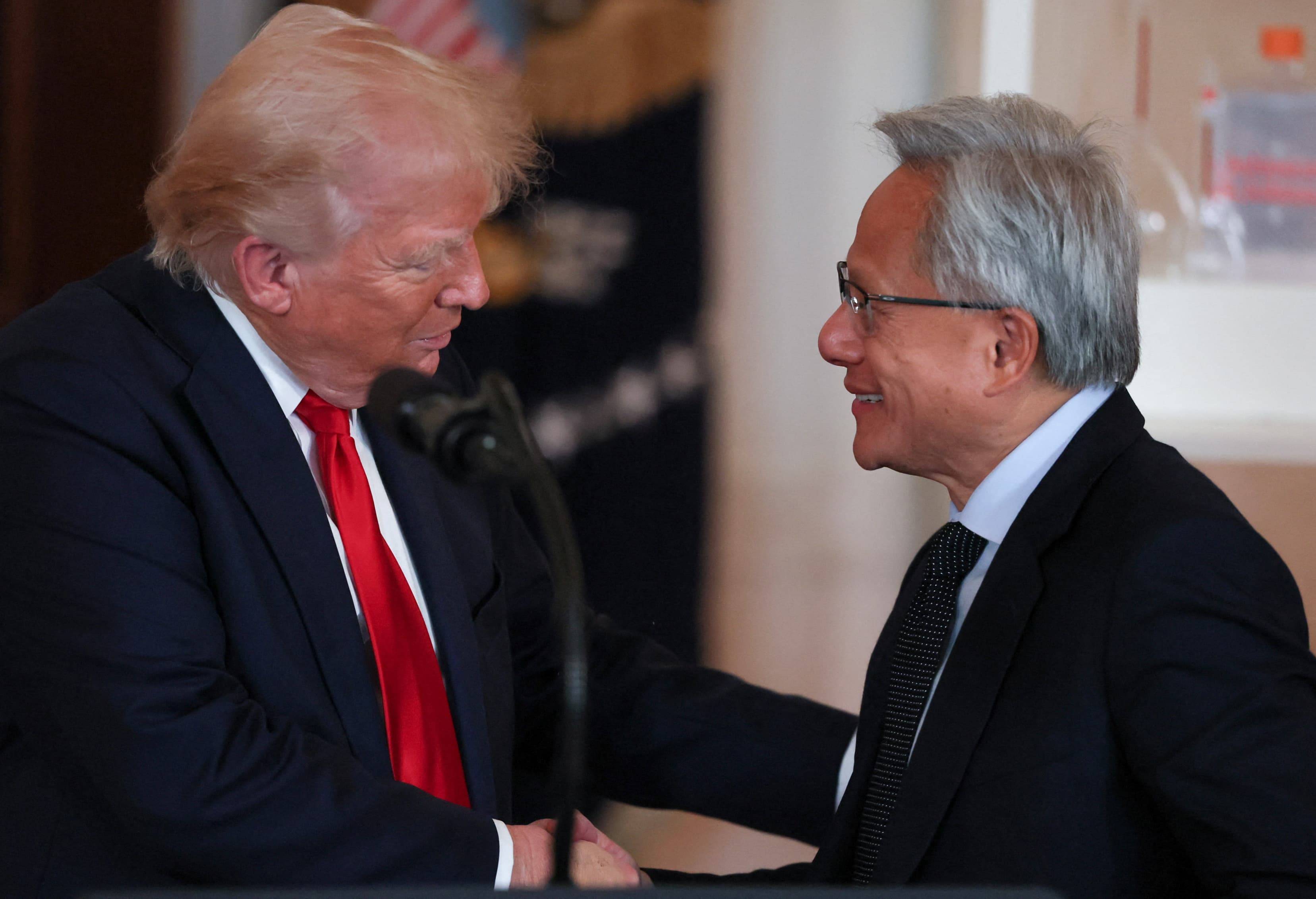
          NVIDIA CEO Jensen Huang and U.S. President Donald Trump shake hands at an 'Investing in America' event in Washington, D.C., U.S., April 30, 2025.

          The "Magnificent Seven" group of stocks — comprising Alphabet, Amazon, Apple, Meta Platforms, Microsoft, Nvidia and Tesla — drove much of the S&P 500's sterling 23.31% gain in 2024.
          They have also been some of the hardest stocks hit by U.S. President Donald Trump's tariffs. Those that rely heavily on global supply chains and export markets, such as Apple and Nvidia, suffered the most. By contrast, Meta and Microsoft, which derive more of their revenue from digital services, such as ad sales or enterprise software, actually saw their shares head upward this year.
          On Wednesday, Nvidia joined Meta and Microsoft to become the third member of the Magnificent Seven to trade in the green year to date. It's a significant move because the chipmaker — as the word suggests — doesn't deal in intangible products that can slip through trade barriers.
          Nvidia's recovery suggests that dealmaking under Trump — in terms of tariff agreements and broad bilateral ties, such as those he is forging with Saudi Arabia on his state visit — is providing businesses with a better environment. But it also emphasizes how volatile the market can be this year, when the engine behind 2024's blistering rally can sputter out within the weeks surrounding Trump's "Liberation Day."

          What you need to know today

          Three-day winning streak for S&P 500U.S. markets traded mixed Wednesday. The S&P 500 ticked up 0.1% and the Nasdaq Composite rose 0.72%. The tech-heavy index was lifted by a 4.7% rise in AMD shares after the chip company announced a $6 billion share buyback as well as a jump in Nvidia shares. The Dow Jones Industrial Average lost 0.21%. The pan-European Stoxx 600 dipped 0.24%, ending its four-day winning streak. Burberry shares surged 17% after announcing cost cuts and a turnaround plan.
          Nvidia is back in the greenNvidia on Wednesday climbed more than 4% on the back of news that it would sell more than 18,000 of its top artificial intelligence chips to Saudi Arabia. The share move puts Nvidia into positive territory for the year, becoming the latest "Magnificent 7" member stock to return to the green amid the broader market's recovery. Amazon, Alphabet, Tesla and Apple are still facing year-to-date losses in their share prices.
          Largest deal for Boeing and Qatar AirwaysBoeing and Qatar Airways on Wednesday announced a deal for the Middle Eastern airline to buy up to 210 jets during Trump's state visit with the emir of Qatar. The order, which is the biggest in Qatar Airways' history — and for Boeing, according to Trump — is a boost to the beleaguered planemaker, which hasn't posted a profit since 2018.
          'I like you too much': Trump to Saudi crown princeAt the U.S.-Saudi Investment Forum on Tuesday that was attended by CEOs such as Tesla's Elon Musk, Nvidia's Jensen Huang and BlackRock's Larry Fink, Trump gave a speech in which he praised Saudi Arabia and told the country's Crown Prince Mohammed bin Salman — who was in the audience — "I like you too much." Trump also met with Syrian leader Ahmed al-Sharaa in Saudi Arabia the same day.
          AI shrank Klarna's workforceKlarna CEO Sebastian Siemiatkowski told CNBC the company has cut its workforce "from about 5,000 to now almost 3,000 employees" — that's a reduction of around 40% — because of investments in artificial intelligence and natural attrition in its workforce. The company said last year that AI was doing the work of 700 customer service agents. Klarna paused its initial public offering after Trump announced tariffs.
          Stocks could retest April lows: Steve CohenSteve Cohen, founder of investment firm Point72, said he thinks stocks could "go back toward the lows" in April and that there's a 45% chance of a recession. Cohen, however, said a decline in the stock market would not necessarily be a "calamity."
          U.S. President Donald Trump (L) listens as Nvidia CEO Jensen Huang speaks in the Cross Hall of the White House during an event on "Investing in America" on April 30, 2025 in Washington, DC.

          Trump administration's next wave of China AI chip export rules are yet another obstacle for Nvidia

          Nvidia announced an agreement with Saudi Arabia on Tuesday to develop the kingdom's artificial intelligence capabilities, a sign of its expanding global strategy.
          As Nvidia CEO Jensen Huang was in Saudi Arabia announcing the Blackwell deal, the Trump administration released a new round of AI chip restrictions targeting China. The Commerce Department issued a warning against the use of U.S. AI chips for Chinese models and singled out "diversion tactics" and securing supply chains to target smuggling.
          The new export restrictions came days after the U.S. and China agreed to pause most tariffs on each other. With the White House also eliminating the "AI Diffusion Rule," the new policies add another layer of controls for Nvidia to navigate.

          Source: CNBC

          To stay updated on all economic events of today, please check out our Economic calendar
          Risk Warnings and Disclaimers
          You understand and acknowledge that there is a high degree of risk involved in trading. Following any strategies or investment methods may lead to potential losses. The content on the site is provided by our contributors and analysts for information purposes only. You are solely responsible for determining whether any trading assets, securities, strategy, or any other product is suitable for investing based on your own investment objectives and financial situation.
          Add to Favorites
          Share
          FastBull
          Copyright © 2025 FastBull Ltd

          728 RM B 7/F GEE LOK IND BLDG NO 34 HUNG TO RD KWUN TONG KLN HONG KONG

          TelegramInstagramTwitterfacebooklinkedin
          App Store Google Play Google Play
          Products
          Charts

          Chats

          Q&A with Experts
          Screeners
          Economic Calendar
          Data
          Tools
          Membership
          Features
          Function
          Markets
          Copy Trading
          Latest Signals
          Contests
          News
          Analysis
          24/7
          Columns
          Education
          Company
          Careers
          About Us
          Contact Us
          Advertising
          Help Center
          Feedback
          User Agreement
          Privacy Policy
          Business

          White Label

          Data API

          Web Plug-ins

          Poster Maker

          Affiliate Program

          Risk Disclosure

          The risk of loss in trading financial instruments such as stocks, FX, commodities, futures, bonds, ETFs and crypto can be substantial. You may sustain a total loss of the funds that you deposit with your broker. Therefore, you should carefully consider whether such trading is suitable for you in light of your circumstances and financial resources.

          No decision to invest should be made without thoroughly conducting due diligence by yourself or consulting with your financial advisors. Our web content might not suit you since we don't know your financial conditions and investment needs. Our financial information might have latency or contain inaccuracy, so you should be fully responsible for any of your trading and investment decisions. The company will not be responsible for your capital loss.

          Without getting permission from the website, you are not allowed to copy the website's graphics, texts, or trademarks. Intellectual property rights in the content or data incorporated into this website belong to its providers and exchange merchants.

          Not Logged In

          Log in to access more features

          FastBull Membership

          Not yet

          Purchase

          Become a signal provider
          Help Center
          Customer Service
          Dark Mode
          Price Up/Down Colors

          Log In

          Sign Up

          Position
          Layout
          Fullscreen
          Default to Chart
          The chart page opens by default when you visit fastbull.com