• Trade
  • Markets
  • Copy
  • Contests
  • News
  • 24/7
  • Calendar
  • Q&A
  • Chats
Trending
Screeners
SYMBOL
LAST
BID
ASK
HIGH
LOW
NET CHG.
%CHG.
SPREAD
SPX
S&P 500 Index
6855.86
6855.86
6855.86
6878.28
6855.86
-14.54
-0.21%
--
DJI
Dow Jones Industrial Average
47830.66
47830.66
47830.66
47971.51
47771.72
-124.32
-0.26%
--
IXIC
NASDAQ Composite Index
23557.99
23557.99
23557.99
23698.93
23557.99
-20.13
-0.09%
--
USDX
US Dollar Index
99.070
99.150
99.070
99.110
98.730
+0.120
+ 0.12%
--
EURUSD
Euro / US Dollar
1.16286
1.16293
1.16286
1.16717
1.16245
-0.00140
-0.12%
--
GBPUSD
Pound Sterling / US Dollar
1.33173
1.33182
1.33173
1.33462
1.33087
-0.00139
-0.10%
--
XAUUSD
Gold / US Dollar
4191.30
4191.71
4191.30
4218.85
4175.92
-6.61
-0.16%
--
WTI
Light Sweet Crude Oil
59.027
59.057
59.027
60.084
58.892
-0.782
-1.31%
--

Community Accounts

Signal Accounts
--
Profit Accounts
--
Loss Accounts
--
View More

Become a signal provider

Sell trading signals to earn additional income

View More

Guide to Copy Trading

Get started with ease and confidence

View More

Signal Accounts for Members

All Signal Accounts

Best Return
  • Best Return
  • Best P/L
  • Best MDD
Past 1W
  • Past 1W
  • Past 1M
  • Past 1Y

All Contests

  • All
  • Trump Updates
  • Recommend
  • Stocks
  • Cryptocurrencies
  • Central Banks
  • Featured News
Top News Only
Share

German Spy Chief: No Need To 'Break' With US Over Security Policy

Share

United Arab Emirates Official To Reuters: The United Arab Emirates Asserts That The Governance And Territorial Integrity Of Yemen Must Be Determined By Yemenis

Share

United Arab Emirates Official To Reuters: The United Arab Emirates's Position On The Yemen Crisis Is In Line With Saudi Arabia In Supporting A Political Process Based On An Initiative Backed By Gulf States

Share

French Presidential Residence Elysee: Work Will Be Intensified To Provide Ukraine With Robust Security Guarantees And To Plan Measures For The Reconstruction Of Ukraine

Share

French Presidential Residence Elysee: Meeting Of Leaders In The E3 Format And President Zelensky Allowed For The Continuation Of Joint Work On The US Plan

Share

US Dollar Extends Gains Versus Yen After Japan Earthquake, Last Up 0.2% At 155.64 Yen

Share

US Natural Gas Futures Drop 6% On Less Cold Forecasts, Near-Record Output

Share

Russian Central Bank: Sets Official Rouble Rate For December 9 At 77.2733 Roubles Per USA Dollar (Previous Rate - 76.0937)

Share

Russian Deputy Prime Minister Novak: Russia Will Restrict Gold Exports Starting In 2026

Share

US Dollar Touches Session High Versus Yen On Earthquake News, Last Up 0.5% At 155.81%

Share

NHK: A 40-centimeter-high Tsunami Has Reached Mutsuki Port In Aomori, Japan

Share

ICE Cotton Stocks Totalled To 13971 - December 08, 2025

Share

Japan Prime Minister Takaichi: Trying To Gather Information After Quake

Share

UK Trade Minister To Visit US This Week For Talks On Tariffs

Share

Head Of Yemen's Anti-Houthi Presidential Council Says Actions Of Southern Transitional Council Across South Yemen Undermines Legitimacy Of Internationally-Recognised Government

Share

Carvana Rose 9.1% And Crh Rose 6.8% As Both Companies Were Added To The S&P 500 Index

Share

Japanese Regulators Say No Problems Have Been Found At The Onagawa Nuclear Power Plant

Share

KYODO News: Some Tohoku Shinkansen Services Have Been Suspended Following The Earthquake In Japan

Share

The Japan Meteorological Agency Has Issued Tsunami Warnings For The Central Pacific Coast Of Hokkaido, The Pacific Coast Of Aomori Prefecture, And Iwate Prefecture

Share

Euro Hits Session High Versus Yen Following Strong Japan Quake, Last Up 0.3% At 181.36 Yen

TIME
ACT
FCST
PREV
France Trade Balance (SA) (Oct)

A:--

F: --

P: --
Euro Zone Employment YoY (SA) (Q3)

A:--

F: --

P: --
Canada Part-Time Employment (SA) (Nov)

A:--

F: --

P: --

Canada Unemployment Rate (SA) (Nov)

A:--

F: --

P: --

Canada Full-time Employment (SA) (Nov)

A:--

F: --

P: --

Canada Labor Force Participation Rate (SA) (Nov)

A:--

F: --

P: --

Canada Employment (SA) (Nov)

A:--

F: --

P: --

U.S. PCE Price Index MoM (Sept)

A:--

F: --

P: --

U.S. Personal Income MoM (Sept)

A:--

F: --

P: --

U.S. Core PCE Price Index MoM (Sept)

A:--

F: --

P: --

U.S. PCE Price Index YoY (SA) (Sept)

A:--

F: --

P: --

U.S. Core PCE Price Index YoY (Sept)

A:--

F: --

P: --

U.S. Personal Outlays MoM (SA) (Sept)

A:--

F: --

P: --
U.S. 5-10 Year-Ahead Inflation Expectations (Dec)

A:--

F: --

P: --

U.S. Real Personal Consumption Expenditures MoM (Sept)

A:--

F: --

P: --
U.S. Weekly Total Rig Count

A:--

F: --

P: --

U.S. Weekly Total Oil Rig Count

A:--

F: --

P: --

U.S. Consumer Credit (SA) (Oct)

A:--

F: --

P: --
China, Mainland Foreign Exchange Reserves (Nov)

A:--

F: --

P: --

Japan Trade Balance (Oct)

A:--

F: --

P: --

Japan Nominal GDP Revised QoQ (Q3)

A:--

F: --

P: --

China, Mainland Imports YoY (CNH) (Nov)

A:--

F: --

P: --

China, Mainland Exports (Nov)

A:--

F: --

P: --

China, Mainland Imports (CNH) (Nov)

A:--

F: --

P: --

China, Mainland Trade Balance (CNH) (Nov)

A:--

F: --

P: --

China, Mainland Exports YoY (USD) (Nov)

A:--

F: --

P: --

China, Mainland Imports YoY (USD) (Nov)

A:--

F: --

P: --

Germany Industrial Output MoM (SA) (Oct)

A:--

F: --

P: --
Euro Zone Sentix Investor Confidence Index (Dec)

A:--

F: --

P: --

Canada National Economic Confidence Index

A:--

F: --

P: --

U.K. BRC Like-For-Like Retail Sales YoY (Nov)

--

F: --

P: --

U.K. BRC Overall Retail Sales YoY (Nov)

--

F: --

P: --

Australia Overnight (Borrowing) Key Rate

--

F: --

P: --

RBA Rate Statement
RBA Press Conference
Germany Exports MoM (SA) (Oct)

--

F: --

P: --

U.S. NFIB Small Business Optimism Index (SA) (Nov)

--

F: --

P: --

Mexico 12-Month Inflation (CPI) (Nov)

--

F: --

P: --

Mexico Core CPI YoY (Nov)

--

F: --

P: --

Mexico PPI YoY (Nov)

--

F: --

P: --

U.S. Weekly Redbook Index YoY

--

F: --

P: --

U.S. JOLTS Job Openings (SA) (Oct)

--

F: --

P: --

China, Mainland M1 Money Supply YoY (Nov)

--

F: --

P: --

China, Mainland M0 Money Supply YoY (Nov)

--

F: --

P: --

China, Mainland M2 Money Supply YoY (Nov)

--

F: --

P: --

U.S. EIA Short-Term Crude Production Forecast For The Year (Dec)

--

F: --

P: --

U.S. EIA Natural Gas Production Forecast For The Next Year (Dec)

--

F: --

P: --

U.S. EIA Short-Term Crude Production Forecast For The Next Year (Dec)

--

F: --

P: --

EIA Monthly Short-Term Energy Outlook
U.S. API Weekly Gasoline Stocks

--

F: --

P: --

U.S. API Weekly Cushing Crude Oil Stocks

--

F: --

P: --

U.S. API Weekly Crude Oil Stocks

--

F: --

P: --

U.S. API Weekly Refined Oil Stocks

--

F: --

P: --

South Korea Unemployment Rate (SA) (Nov)

--

F: --

P: --

Japan Reuters Tankan Non-Manufacturers Index (Dec)

--

F: --

P: --

Japan Reuters Tankan Manufacturers Index (Dec)

--

F: --

P: --

Japan Domestic Enterprise Commodity Price Index MoM (Nov)

--

F: --

P: --

Japan Domestic Enterprise Commodity Price Index YoY (Nov)

--

F: --

P: --

China, Mainland PPI YoY (Nov)

--

F: --

P: --

China, Mainland CPI MoM (Nov)

--

F: --

P: --

Q&A with Experts
    • All
    • Chatrooms
    • Groups
    • Friends
    Connecting
    .
    .
    .
    Type here...
    Add Symbol or Code

      No matching data

      All
      Trump Updates
      Recommend
      Stocks
      Cryptocurrencies
      Central Banks
      Featured News
      • All
      • Russia-Ukraine Conflict
      • Middle East Flashpoint
      • All
      • Russia-Ukraine Conflict
      • Middle East Flashpoint
      Search
      Products

      Charts Free Forever

      Chats Q&A with Experts
      Screeners Economic Calendar Data Tools
      Membership Features
      Data Warehouse Market Trends Institutional Data Policy Rates Macro

      Market Trends

      Market Sentiment Order Book Forex Correlations

      Top Indicators

      Charts Free Forever
      Markets

      News

      News Analysis 24/7 Columns Education
      From Institutions From Analysts
      Topics Columnists

      Latest Views

      Latest Views

      Trending Topics

      Top Columnists

      Latest Update

      Signals

      Copy Rankings Latest Signals Become a signal provider AI Rating
      Contests
      Brokers

      Overview Brokers Assessment Rankings Regulators News Claims
      Broker listing Forex Brokers Comparison Tool Live Spread Comparison Scam
      Q&A Complaint Scam Alert Videos Tips to Detect Scam
      More

      Business
      Events
      Careers About Us Advertising Help Center

      White Label

      Data API

      Web Plug-ins

      Affiliate Program

      Awards Institution Evaluation IB Seminar Salon Event Exhibition
      Vietnam Thailand Singapore Dubai
      Fans Party Investment Sharing Session
      FastBull Summit BrokersView Expo
      Recent Searches
        Top Searches
          Markets
          News
          Analysis
          User
          24/7
          Economic Calendar
          Education
          Data
          • Names
          • Latest
          • Prev

          View All

          No data

          Scan to Download

          Faster Charts, Chat Faster!

          Download App
          English
          • English
          • Español
          • العربية
          • Bahasa Indonesia
          • Bahasa Melayu
          • Tiếng Việt
          • ภาษาไทย
          • Français
          • Italiano
          • Türkçe
          • Русский язык
          • 简中
          • 繁中
          Open Account
          Search
          Products
          Charts Free Forever
          Markets
          News
          Signals

          Copy Rankings Latest Signals Become a signal provider AI Rating
          Contests
          Brokers

          Overview Brokers Assessment Rankings Regulators News Claims
          Broker listing Forex Brokers Comparison Tool Live Spread Comparison Scam
          Q&A Complaint Scam Alert Videos Tips to Detect Scam
          More

          Business
          Events
          Careers About Us Advertising Help Center

          White Label

          Data API

          Web Plug-ins

          Affiliate Program

          Awards Institution Evaluation IB Seminar Salon Event Exhibition
          Vietnam Thailand Singapore Dubai
          Fans Party Investment Sharing Session
          FastBull Summit BrokersView Expo

          Amid ‘Instability and Fear’ in Trump’s Economy, Americans Are Cutting Holiday Spending

          Warren Takunda

          Economic

          Summary:

          In addition to rising prices and tariffs, readers cite growing unemployment as a reason not to exchange gifts this year

          Americans are feeling rattled about the state of the economy. Donald Trump has batted away question after question from reporters on concerns over higher prices, just a year after he won an election promising to bring down costs.
          While the White House has tried to reduce concern, floating tariff-funded $2,000 stimulus checks and removing import levies on certain agricultural imports, many consumers remain anxious.
          Preparing for the holiday season, and bracing for the spending it often demands, Guardian readers across the US expressed apprehension – and explained how they plan to spend – in this economy. Many said the higher cost of necessities, like groceries, was imposing on their ability to buy gifts for family and friends.
          “I love giving people gifts,” said Grace Brown, 34, of Charlotte, North Carolina. “I’m a person that pays attention all year and will keep notes in my phone if someone mentions something in July they may want.”
          But this year is different. As prices have climbed over the last year, Brown said that her budget for gifts has shrunk. Things already feel squeezed: she and her fiance are already limiting eating out, and have agreed they won’t exchange gifts with each other this holiday.
          “Prices for everything have gone up,” Brown said. “It’s kind of hard to have luxuries.”
          Collection of key pricing data was halted during the shutdown, so it’s unclear how much higher prices have been rising. In September, the latest available reading, prices went up 3%, compared with 2.3% in April.
          Regardless of the official data, consumers feel like prices have been climbing. On Tuesday, the Conference Board reported that consumer confidence had fallen to its lowest level since April, when Trump first announced his full slate of tariffs. The University of Michigan’s Surveys of Consumers, another measure of consumer sentiment, similarly showed drops in confidence after the summer.
          “Being on a fixed income, we have had to cut way back on our spending for the holiday,” said Jeffrey Larimore, 68, of Caldwell, Idaho. “We had enough disposable income to go out to dinner, take weekend trips and spoil [my granddaughters]. Since the tariffs have raised the cost of living, we have cut out all of that.”
          Ryan, a retired law enforcement officer in Texas, who wished to withhold his last name, said his family “can barely put food on the table” let alone do holiday shopping for his young children.
          “I’m scrambling to find some way to preserve some aspect of magic for them,” he said. “I spent my life in service to my country. What he [Trump] has done in less than a single year breaks my heart.”
          Recent surveys indicated that Americans are set to cut back on holiday shopping this year. Deloitte estimated that spending could be down 4% compared with last year, while the National Retail Federation said that after hitting a record high last year, the amount of money Americans are planning to spend this year is down 1.3%.
          In addition to prices going up, more Americans are concerned about the labor market. While expectations of unemployment dropped after Trump’s election, it has been climbing up over the last year. This sentiment tracks with the slow rise in unemployment, which was 4.4% in September – the highest it’s been since October 2021. For many, this means that higher prices aren’t the only concern.
          “My homeowner’s insurance is up, 2026 health insurance is up, property taxes are up for 2026,” said Sarah Tenbensel of Minneapolis. “I may need a second job very soon.”
          Shari Dunn, 57, of Oregon, said that in addition to prices going up, “there is fear regarding employment and contacts”. “It’s more than just tariffs – it’s everything. The instability and fear,” she said.
          Dunn said she is participating in the economic boycott taking place over the Black Friday shopping holiday, one of a handful of consumer boycotts that have been organized since Trump started his second term.
          For some, this past year has meant opting out of the economy in frustration with national politics. Linda McKim Bell, 79, of Portland, Oregon, said that she has tried not to buy anything new since Trump took office.
          “I have shopped all year at online thrift stores for my family gifts,” she said. “I am making the rest of our holiday gifts: orange marmalade and homemade pastries make great gifts. Will continue to buy items that are used as much as possible.”
          Brown said that even though she and her fiance have agreed not to exchange gifts, she may make a trip to Asheville, North Carolina, and support local artists there as the community continues to recover from Hurricane Helene.
          “Whenever we have money to spend, we try to spend it there with small businesses,” Brown said. “One thing I just remember from high school is my teacher would always tell us ‘you vote with your dollars’.”

          Source: Theguardian

          To stay updated on all economic events of today, please check out our Economic calendar
          Risk Warnings and Disclaimers
          You understand and acknowledge that there is a high degree of risk involved in trading. Following any strategies or investment methods may lead to potential losses. The content on the site is provided by our contributors and analysts for information purposes only. You are solely responsible for determining whether any trading assets, securities, strategy, or any other product is suitable for investing based on your own investment objectives and financial situation.
          Add to Favorites
          Share

          The K-Shaped Economy in One Graph

          Adam

          Economic

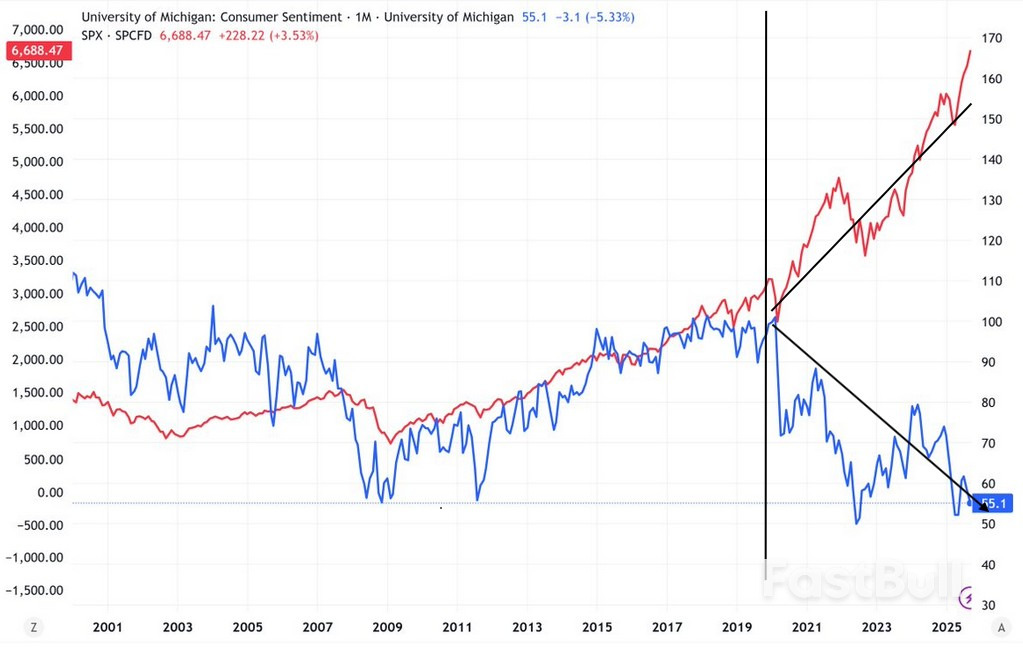
          Tuesday’s weak Consumer Confidence report was a good reminder of why some economists are calling our economy the K-shaped economy. The Conference Board Consumer Confidence Index fell 6.8 points to 88.7 in November, below expectations of 93. Moreover, it sits at levels similar to those of early 2020, when the pandemic shuttered the economy. Similarly, the University of Michigan Consumer Sentiment survey is slightly above 70-year lows. Both surveys indicate that a large majority of consumers are struggling. Within the surveys, the outlook on current jobs and job availability is low. Inflation, tariffs, politics, and the government shutdown are also weighing on the consumer and limiting big-ticket spending plans.
          A K-shaped economy describes a post-crisis recovery where different parts of the economy and society are performing at sharply diverging rates, forming the two arms of the letter “K.”:
          The upper arm (going up): Sectors, companies, assets, and people that benefit from the recovery and, in many cases, are wealthier than before the pandemic. This includes investors in technology stocks, big tech companies, the luxury sectors, high-income professionals, and asset owners.
          The lower arm (going down): Sectors, small businesses, and people that continue to decline or stagnate even as the overall economy appears to improve. Examples include: the hospitality and travel industries, many lower-priced retail outlets, low-wage service workers, small businesses, and many middle-class and lower-income households.
          The graph below, showing the stark divergence between the S&P 500 and the University of Michigan consumer survey best depicts the K-shaped economy. You can make similar K-shaped plots comparing stock markets, GDP, and megacap corporate profits versus small business closures, wage growth for low-income workers, and economic activity in the manufacturing sector.
          The K-Shaped Economy in One Graph_1
          Black Friday And Holiday Estimates
          Black Friday kicks off a spending frenzy as consumers worldwide buy holiday gifts. Often, holiday sales, particularly Black Friday sales, can make or break the entire year. Given the weak consumer sentiment we outlined in the opening section, we thought it might be helpful to see a few estimates of what this year’s holiday season may have in store for consumption.
          Adobe Analytics: US online sales forecasted to reach $11.7 billion, marking an 8.3% year-over-year increase from 2024’s $10.8 billion record.
          National Retail Federation (NRF): Overall holiday spending for November and December is expected to exceed $1 trillion for the first time, driven by a projected 3.7% to 4.2% growth in total retail sales, slightly down from last year’s 4.8% surge.
          Deloitte: They anticipate a more modest 3% rise in sales amid consumer caution over high prices and tariffs
          Bain & Company: Predicts an outsized 11% increase specifically for the Black Friday weekend but a more restrained 4% holiday forecast. They expect shopper turnout to hit a record 186.9 million over the five-day Thanksgiving-to-Cyber Monday stretch, up from 183.4 million in 2024. Moreover, they suspect shoppers will be enticed with deeper discounts—averaging up to 28% off on electronics, toys, and appliances.
          The graph below, courtesy of Bloomberg, shows a KPMG survey estimating the percentage of spending by broad product category.
          The K-Shaped Economy in One Graph_2
          Tweet of the Day
          The K-Shaped Economy in One Graph_3

          Source: investing

          To stay updated on all economic events of today, please check out our Economic calendar
          Risk Warnings and Disclaimers
          You understand and acknowledge that there is a high degree of risk involved in trading. Following any strategies or investment methods may lead to potential losses. The content on the site is provided by our contributors and analysts for information purposes only. You are solely responsible for determining whether any trading assets, securities, strategy, or any other product is suitable for investing based on your own investment objectives and financial situation.
          Add to Favorites
          Share

          Norway Set To Keep Ukraine Aid Steady For Longer

          Daniel Carter

          Political

          Russia-Ukraine Conflict

          Norway is likely to keep aid for Ukraine close to current levels beyond next year, a senior opposition lawmaker signaled, citing a low chance of peace anytime soon.
          Norway, a member of NATO and neighbor of Russia, has earmarked 85 billion kroner ($8.4 billion) in assistance to Ukraine in 2026, according to a draft budget that's being negotiated by the ruling Labor Party and its leftist partners. There's broad parliamentary backing to helping Ukraine.
          "We must be prepared for the fact that the support Norway is now providing must be long-lasting," Ine Eriksen Soreide, the head of the parliament's Committee on Foreign Affairs and Defense, said in an interview on Friday.
          "There is no reason to imagine that it can be scaled down very soon," said Soreide, a former defense and foreign affairs minister who is set to take over the reins of opposition Conservatives from former premier Erna Solberg in February.
          Norway is among the five biggest contributors of donations to Ukraine as a share of its economy, based on data from the Kiel Institute for the World Economy. It has also reaped windfall gains from increased gas and oil exports after sanctions against Russia.
          Its aid is disbursed under a so-called Nansen program, with 205 billion kroner of spending planned for 2023 to 2030. So much has already been disbursed that, assuming stable outlays next year, just 10 billion kroner is left for the period from 2027. Still, its politicians have ruled out directly tapping the energy-rich nation's $2.1 trillion sovereign wealth fund — the world's largest — to boost defense spending or aid to Ukraine.
          Earlier this month, Finance Minister Jens Stoltenberg rebuffed suggestions that his country become the sole guarantor for a loan of about €140 billion ($162 billion) by the European Union to Ukraine, according to broadcaster NRK. Norway isn't part of the bloc though it has access to the single market through the European Economic Area agreement.
          Soreide said her party is urging the government to consider contributing to a potential guarantee mechanism should the EU strike an agreement and invite third countries to join.
          She declined to specify any potential increases to Norway's contributions. Her party isn't pushing for any ceiling for Ukraine aid.
          There's a need to avoid a situation where "it's primarily northern European countries that contribute," while "it is also important to keep the United States in and engaged in it," Soreide said.

          Source: Bloomberg Europe

          Risk Warnings and Disclaimers
          You understand and acknowledge that there is a high degree of risk involved in trading. Following any strategies or investment methods may lead to potential losses. The content on the site is provided by our contributors and analysts for information purposes only. You are solely responsible for determining whether any trading assets, securities, strategy, or any other product is suitable for investing based on your own investment objectives and financial situation.
          Add to Favorites
          Share

          Australia Home Prices Set To Rise About 7% In A Tight Market: Reuters Poll

          Samantha Luan

          Forex

          Economic

          Australian home prices will rise more than previously expected in 2026, thanks to tight supply and resilient demand, according to a Reuters poll of analysts who said a lack of entry-level homes is still among the biggest barriers for first-time buyers.

          House prices rose around 40% during the COVID-19 pandemic but fell about 9% when the Reserve Bank of Australia hiked interest rates to combat high inflation.

          The central bank's 75 basis points of rate cuts in 2025 have reignited buyer interest, however, pushing the national median home price to a record high of A$872,538 in October.

          But with interest rates expected to stay at an over two-year low of 3.60% in the near term, analysts predict national home prices will continue to outrun the country's inflation rate.

          The November 13–26 survey of 15 property analysts showed national home prices rising around 8% this year and 6.9% in 2026, up from 5.0% and 5.6% in the previous poll - the largest upgrade this year.

          Home prices in Sydney, Melbourne, Adelaide, Brisbane and Perth will rise between 5% and 7% next year.

          "It's a resumption of consumer confidence with the interest rate fall, which then leads to a sense of fear of missing out," said Michael Yardney, founder of Metropole, a real estate advisory firm.

          "We still haven't got enough properties for all the immigrants and the first-time buyers, so I see strong price growth, especially in the first six months of 2026. Then maybe things will slow a little bit in the second half."

          Only two of 11 analysts who answered a separate question expected purchasing affordability for first-time buyers to improve over the coming year.

          While existing homeowners reap most of the benefits of rising property values, first-time buyers are being squeezed by a dearth of listings, weak wage growth and tighter borrowing limits.

          MEDIAN HOME VALUE

          In Australia, the median value of a home is now nearly eight times annual income, and about two-thirds of households own property.

          Most respondents cited a shortage of entry-level homes, followed by difficulty saving for a deposit as the most severe barriers for first-time buyers.

          "High rents, cost-of-living pressures, and only moderate wage growth will continue to make deposit saving difficult," said Mark Dawson, director at Urbis.

          "While elevated construction costs, labour constraints, and longer delivery time frames mean the supply of genuinely entry-level dwellings is unlikely to increase materially in such a short period."

          A federal scheme allowing first-time buyers to purchase with a 5% deposit has eased pressure, but analysts warned it risks inflating demand without addressing the underlying shortage of homes.

          Meanwhile, the government has pledged to build 1.2 million new homes by 2030.

          "To see the 1.2 million homes over the next five years is impossible. It's definitely good to set a target, but we find ourselves in a situation where perhaps even 1.2 million is not going to be enough to meet growth and demand," said Maurice Tapang, senior economist at Housing Industry Association.

          Source: Investing

          To stay updated on all economic events of today, please check out our Economic calendar
          Risk Warnings and Disclaimers
          You understand and acknowledge that there is a high degree of risk involved in trading. Following any strategies or investment methods may lead to potential losses. The content on the site is provided by our contributors and analysts for information purposes only. You are solely responsible for determining whether any trading assets, securities, strategy, or any other product is suitable for investing based on your own investment objectives and financial situation.
          Add to Favorites
          Share

          Investors snap nine-week buying streak in global equity funds

          Adam

          Stocks

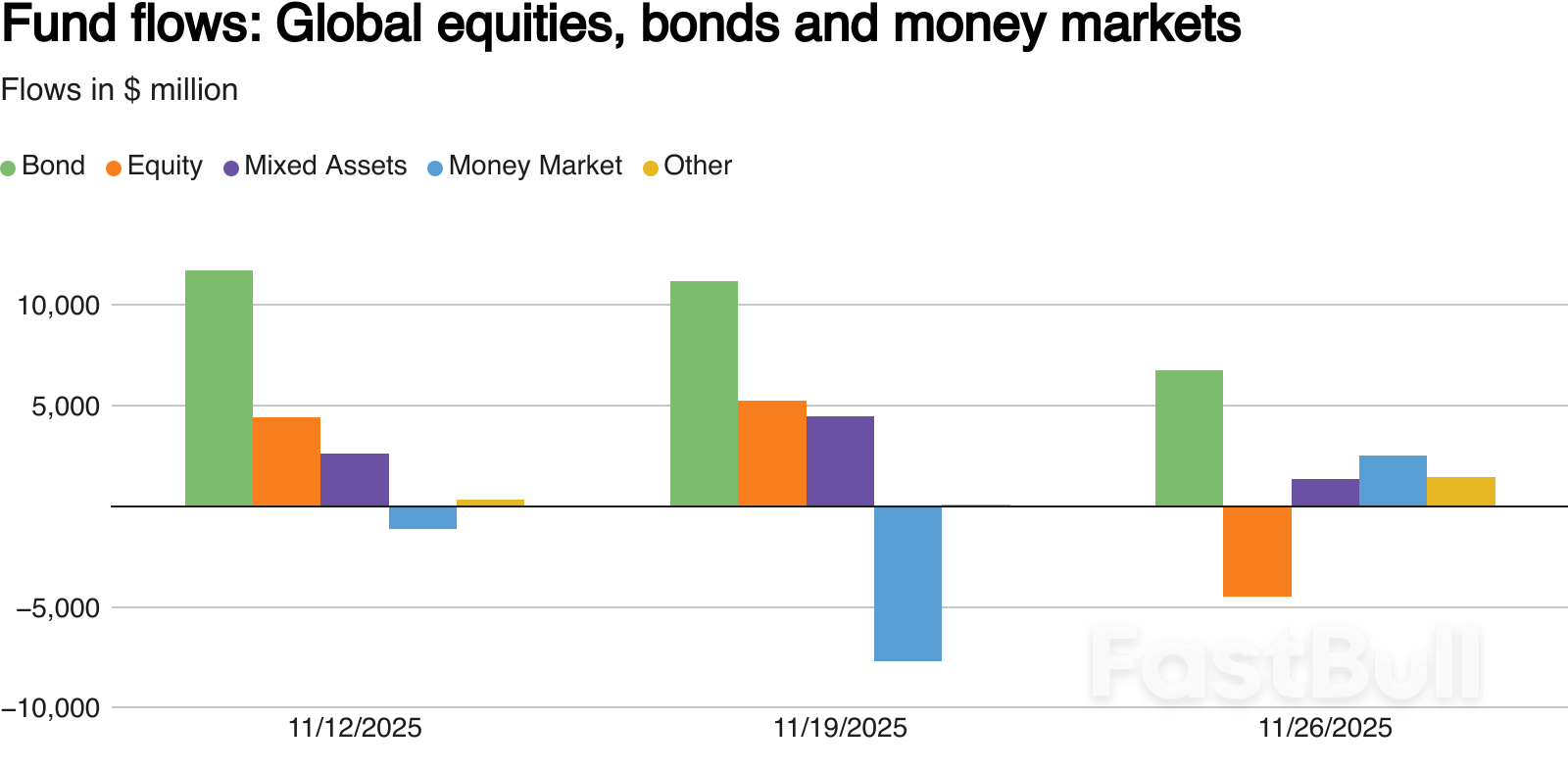
          Global equity funds saw their first weekly outflow in 10 weeks in the week to November 26, as concerns about stretched valuations, particularly in the tech sector, outweighed optimism around expected U.S. interest rate cuts next month.
          According to LSEG Lipper data, investors withdrew a net $4.48 billion from global equity funds as they registered their first weekly net sales since September 17.
          Investors snap nine-week buying streak in global equity funds_1

          Weekly flows into global equity, bond and money market funds in $ million

          In the most recent week, investors divested U.S. and European equity funds of $4.56 billion and $1.21 billion, respectively, but invested approximately $170.37 million in Asian equity funds.
          Overall, global equities had a volatile November, with fears over stretched tech valuations and a record 43-day U.S. government shutdown weighing on sentiment.
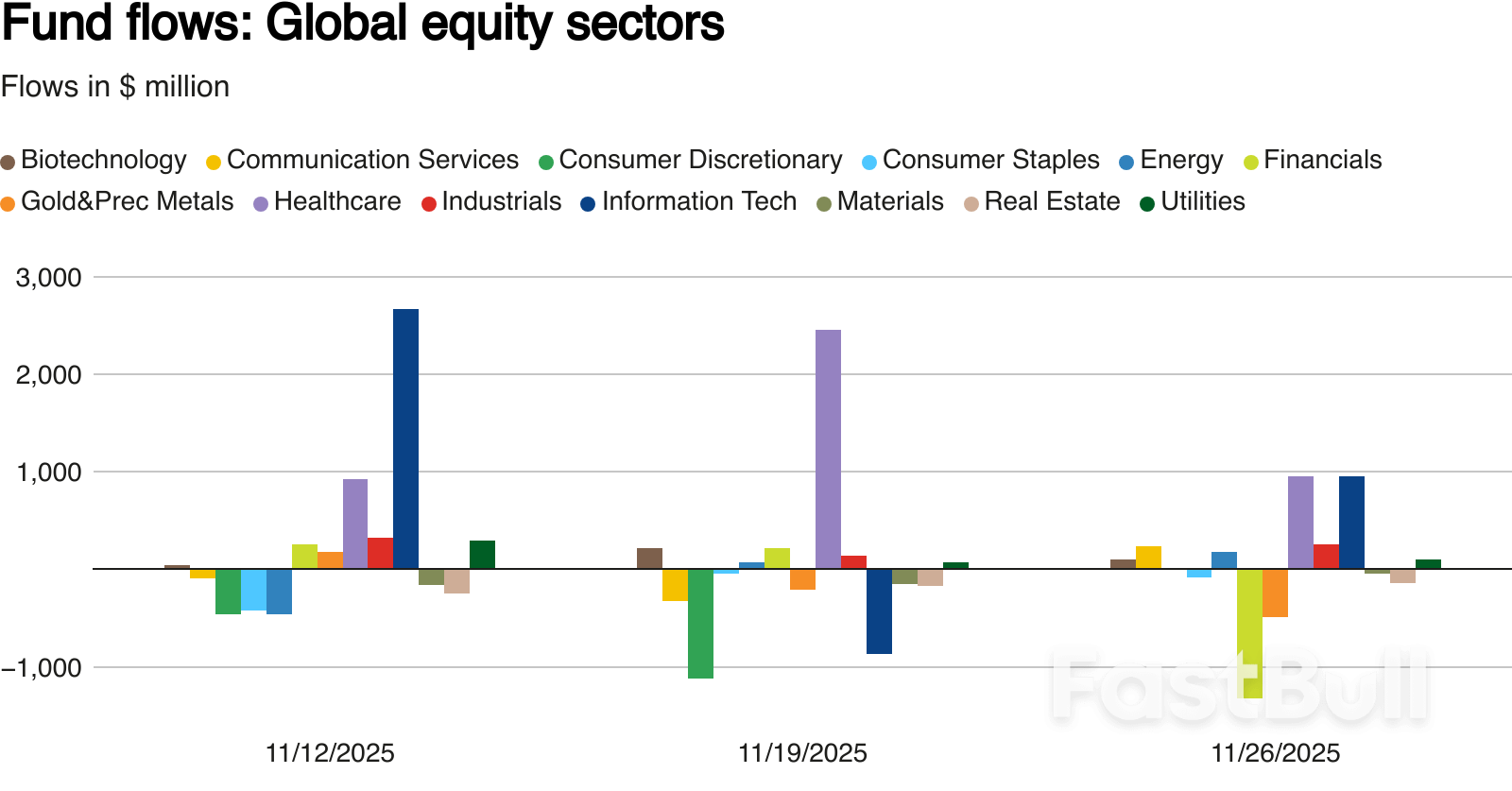
          "We continue to view AI as a market driver, but the sector will likely be assessed more selectively, and high valuations of many AI leaders carry disappointment risk," said Vincenzo Vedda, chief investment officer at asset management firm DWS Group.
          "For this reason, we remain broadly diversified and see gold as a relative hedge."
          Investors snap nine-week buying streak in global equity funds_2

          Weekly flows into global equity sector funds in $ million

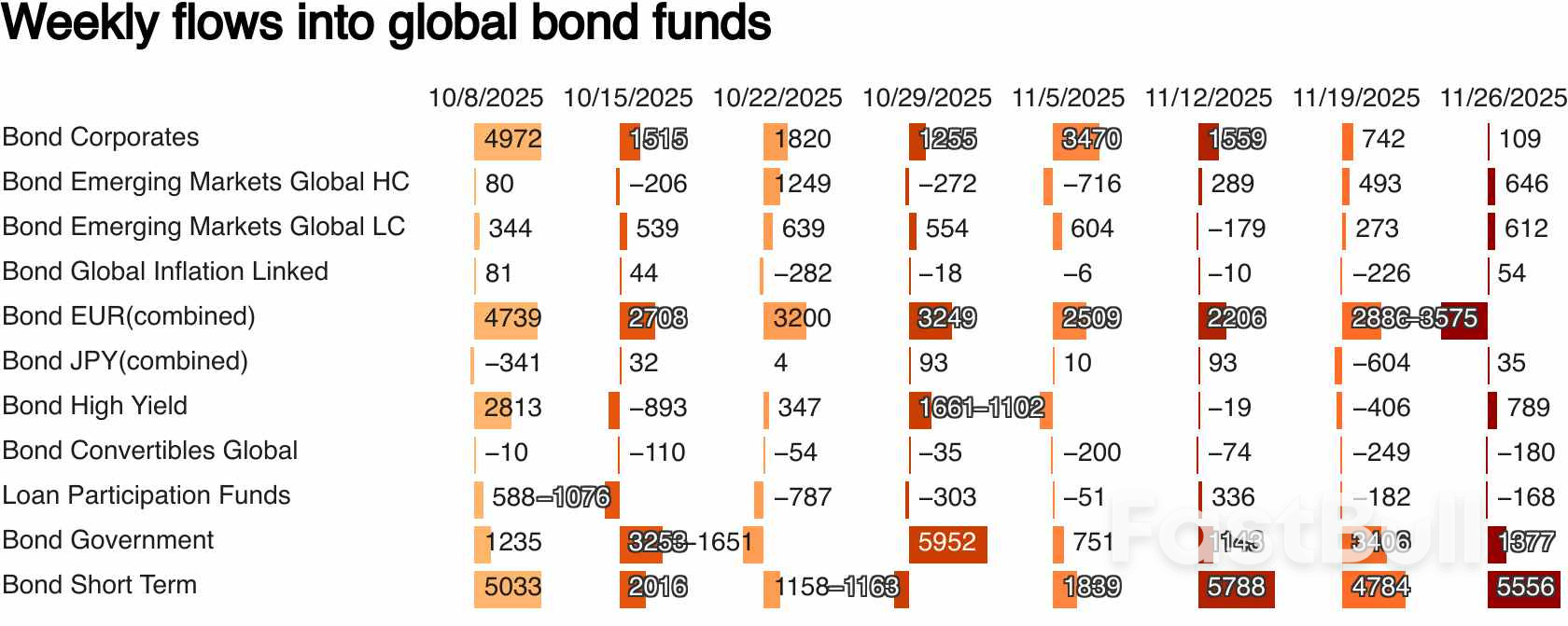
          Inflows in global bond funds, meanwhile, cooled to a 22-week low of $6.77 billion during the week.
          Euro-denominated bond funds faced a net $3.58 billion outflow, the first weekly net sales since July 9. Short-term bond funds, however, gained $5.56 billion in a fourth successive week of net purchases.
          Investors snap nine-week buying streak in global equity funds_3

          Weekly flows into global bond funds in $ million

          Investors added $2.54 billion worth of money market funds as they ended a two-week selling trend.
          Gold and precious metals commodity funds, meanwhile, stayed popular for a seventh straight week as these funds drew roughly $1.66 billion in weekly inflows.
          In emerging markets, investors snapped up $3.34 billion worth of equity funds, the most since July 9. They also added a marginal $5.98 million worth of bond funds, data for a combined 28,793 funds showed.

          Source: reuters

          Risk Warnings and Disclaimers
          You understand and acknowledge that there is a high degree of risk involved in trading. Following any strategies or investment methods may lead to potential losses. The content on the site is provided by our contributors and analysts for information purposes only. You are solely responsible for determining whether any trading assets, securities, strategy, or any other product is suitable for investing based on your own investment objectives and financial situation.
          Add to Favorites
          Share

          India’s Economic Momentum Defies U.S. Tariffs, Heads Toward $5 Trillion Milestone by 2029

          Gerik

          Economic

          India’s Resilience Amid Global Trade Pressures

          India is demonstrating exceptional economic strength, even as external challenges mount. With the implementation of 50% tariffs from the United States among the highest imposed on any major economy analysts feared a cooling in India’s growth. However, the latest GDP figures for Q3 (July–September 2025) show a robust 8.2% year-on-year increase, well above the 7.4% consensus forecast. This follows a 7.8% expansion in Q2, placing India among the world’s fastest-growing large economies.
          Bond markets responded swiftly: the yield on India’s 10-year government bond rose by 4 basis points to 6.50% following the release of the data, signaling a positive reappraisal of the growth outlook by investors.

          Policy Response: Modi Government’s Proactive Stimulus Strategy

          A major contributor to this outperformance is the Indian government's proactive fiscal stance. In response to rising global uncertainties and declining U.S. orders particularly concerning given that the U.S. is India’s largest export market Prime Minister Narendra Modi introduced a large-scale stimulus plan focused on stimulating domestic demand.
          Key among these efforts was a major cut to the Goods and Services Tax (GST) in September, timed to encourage consumer spending during India’s festive season. Since private consumption makes up nearly 60% of the nation’s GDP, preserving and stimulating household spending is a critical driver of economic expansion. This fiscal maneuver represents a direct cause-and-effect strategy to shield the domestic economy from external shocks.

          Sectoral Drivers: Manufacturing and Services Lead the Way

          Beyond consumer spending, India’s growth has been powered by strong industrial performance. The manufacturing sector grew 9.1% year-on-year in Q3, while services also contributed significantly. According to Shumita Deveshwar of GlobalData TS Lombard, this dual-engine performance exceeded expectations, though she cautioned that the momentum might ease in the coming quarters as base effects normalize and trade headwinds persist.
          This surge in manufacturing growth reflects both domestic reforms and the gradual shift of global supply chains into India, which has been positioning itself as a China-plus-one manufacturing destination.

          Export Slowdown and External Balances Under Pressure

          Despite this robust growth, trade indicators point to emerging pressures. According to the IMF, India’s merchandise exports could decline by 5.8% in FY2026, falling to $416 billion, partly due to continued delays in reaching a new trade agreement with the U.S. On the other hand, imports are expected to grow 2.4%, reaching $746 billion widening the trade deficit.
          This imbalance underscores a correlation, rather than causation, between U.S. tariffs and export contraction. While tariffs are a contributing factor, global demand cycles and exchange rate dynamics also influence trade figures.

          Long-Term Outlook: A $5 Trillion Economy Within Reach

          The IMF projects India’s real GDP will expand 6.6% in FY2026 and 6.2% in FY2027, with the moderation reflecting global uncertainties rather than domestic weakness. Still, India’s structural fundamentals remain strong: a large, youthful population, expanding digital infrastructure, and resilient financial institutions.
          Crucially, if India sustains its current growth momentum, the IMF expects it to cross the $5 trillion GDP threshold by FY2029. This trajectory aligns with New Delhi’s strategic vision to elevate India’s global economic position while bolstering domestic demand-led growth.
          India’s recent economic performance illustrates that even amid protectionist pressures and global demand fluctuations, a well-calibrated policy mix can maintain momentum. While the U.S. tariff regime presents a real threat to India’s trade growth, domestic consumption, manufacturing resilience, and strategic government interventions continue to fuel expansion. The challenge now is to convert short-term growth into sustainable development that can weather future global realignments ultimately anchoring India’s ascent to a $5 trillion economy within the decade.
          To stay updated on all economic events of today, please check out our Economic calendar
          Risk Warnings and Disclaimers
          You understand and acknowledge that there is a high degree of risk involved in trading. Following any strategies or investment methods may lead to potential losses. The content on the site is provided by our contributors and analysts for information purposes only. You are solely responsible for determining whether any trading assets, securities, strategy, or any other product is suitable for investing based on your own investment objectives and financial situation.
          Add to Favorites
          Share

          Gold glitters once more, as markets take UK Budget risks in their stride

          Adam

          Commodity

          A theme is emerging as we reach the last trading day of November, risk is back on. Global indices are a sea of green this week, after a bruising first half of the month. Although European and US indices are on track to record a loss for the entire month of November, the scene could be set for a rally in the final weeks of the year. Interestingly, the Philadelphia Semi-Conductor Index is higher in November, as Google’s shares surged by more than 20%, and other tech stocks also recovered. This sector has led financial markets since their low in April, so the fact that semi-conductors are rallying, along with broader market width, could stoke the anticipated ‘Santa rally’.
          The gold price is on track to record its fourth monthly gain and is higher by 3% so far this week. Silver is higher by 8%, as Fed rate cut bets ramp up. There is now an 82% of a rate cut from the Fed next month. This is sparking a rally in gold back above $4,000 per ounce, and the gold price is higher by $28 today. The silver price is higher by 1%. There are also gains for the oil price, as the Russia/ Ukraine peace plan remains on hold for the US’s Thanksgiving holiday.
          Trading could be more volatile than usual today, as US markets open for half day and liquidity is likely to be thin. Added to this, a disruption on the CME trading exchange, could also affect trading across FX, stocks, commodities and some bonds.
          The problem is linked to a cooling issue at one of its data centers. This closure ultimately means that liquidity will be even thinner than usual on the Friday of Thanksgiving. If there is any sensitive market news flow or events, then moves could be exacerbated by liquidity issues, and there could be more volatility as a result.
          So far, news flow has not been too disruptive to trade. Donald Trump announced plans to dramatically tighten the US’s immigration system, which appears to be in response to the shooting of two National Guard members outside the White House, has not impacted market sentiment. The President’s post on Truth Social contained little detail, and so it is unlikely to be market moving.
          Pound is resilient to Budget fears
          Interestingly, the pound is the third best performing currency in the G10 FX space this week. GBP/USD is back above $1.32, it made a high above $1.3260 on Thursday but has given back some of those gains this morning. Interestingly, the pound remains resilient in the face of Budget criticism.
          The list of concerns around the UK Budget are stacking up, including fears that the UK is at a tax tipping point, where extra revenue raising measures won’t generate as much as estimated, 2, that taxation measures are too back-dated and potentially threaten the UK's expanded fiscal headroom, 3, that spending pledges are unfair, weighing on business and consumer confidence even more, and 4, that the UK government will need to rely on short-dated debt to raise finance, which could leave UK bonds at the mercy of short term debt markets.
          Why are markets so sanguine about UK Budget?
          Although UK bonds sold off on Thursday, moves were relatively small. In the past week, UK 10-year Gilts are lower by 8 bps and are outperforming US and European peers. Does the fact that financial markets seem to be welcoming this budget mean that we are missing something? We think that financial markets have been appeased by this Budget because of the focus on building fiscal headroom, and the fact that the fiscal forecasts from the OBR were not as bad as had been feared. However, the Budget is a political disaster for the Chancellor, with YouGov reporting that the public believe it is the second most unfair Budget since 2010, a close second to the mini-Budget in 2022. Economic data backs this up, the Lloyds Business Barometer fell sharply in November to 42. From 50. This suggests that business confidence in the UK remains subdued.
          In the Eurozone, weak inflation from France and weaker than expected retail sales from Germany are weighing on the euro, which is at the lows of the day.

          Source:xtb

          Risk Warnings and Disclaimers
          You understand and acknowledge that there is a high degree of risk involved in trading. Following any strategies or investment methods may lead to potential losses. The content on the site is provided by our contributors and analysts for information purposes only. You are solely responsible for determining whether any trading assets, securities, strategy, or any other product is suitable for investing based on your own investment objectives and financial situation.
          Add to Favorites
          Share
          FastBull
          Copyright © 2025 FastBull Ltd

          728 RM B 7/F GEE LOK IND BLDG NO 34 HUNG TO RD KWUN TONG KLN HONG KONG

          TelegramInstagramTwitterfacebooklinkedin
          App Store Google Play Google Play
          Products
          Charts

          Chats

          Q&A with Experts
          Screeners
          Economic Calendar
          Data
          Tools
          Membership
          Features
          Function
          Markets
          Copy Trading
          Latest Signals
          Contests
          News
          Analysis
          24/7
          Columns
          Education
          Company
          Careers
          About Us
          Contact Us
          Advertising
          Help Center
          Feedback
          User Agreement
          Privacy Policy
          Business

          White Label

          Data API

          Web Plug-ins

          Poster Maker

          Affiliate Program

          Risk Disclosure

          The risk of loss in trading financial instruments such as stocks, FX, commodities, futures, bonds, ETFs and crypto can be substantial. You may sustain a total loss of the funds that you deposit with your broker. Therefore, you should carefully consider whether such trading is suitable for you in light of your circumstances and financial resources.

          No decision to invest should be made without thoroughly conducting due diligence by yourself or consulting with your financial advisors. Our web content might not suit you since we don't know your financial conditions and investment needs. Our financial information might have latency or contain inaccuracy, so you should be fully responsible for any of your trading and investment decisions. The company will not be responsible for your capital loss.

          Without getting permission from the website, you are not allowed to copy the website's graphics, texts, or trademarks. Intellectual property rights in the content or data incorporated into this website belong to its providers and exchange merchants.

          Not Logged In

          Log in to access more features

          FastBull Membership

          Not yet

          Purchase

          Become a signal provider
          Help Center
          Customer Service
          Dark Mode
          Price Up/Down Colors

          Log In

          Sign Up

          Position
          Layout
          Fullscreen
          Default to Chart
          The chart page opens by default when you visit fastbull.com