
• Trade
  • Markets
  • Copy
  • Contests
  • News
  • 24/7
  • Calendar
  • Q&A
  • Chats
Trending
Screeners
SYMBOL
LAST
BID
ASK
HIGH
LOW
NET CHG.
%CHG.
SPREAD
SPX
S&P 500 Index
6827.42
6827.42
6827.42
6899.86
6801.80
-73.58
-1.07%
--
DJI
Dow Jones Industrial Average
48458.04
48458.04
48458.04
48886.86
48334.10
-245.98
-0.51%
--
IXIC
NASDAQ Composite Index
23195.16
23195.16
23195.16
23554.89
23094.51
-398.69
-1.69%
--
USDX
US Dollar Index
97.950
98.030
97.950
98.500
97.950
-0.370
-0.38%
--
EURUSD
Euro / US Dollar
1.17394
1.17409
1.17394
1.17496
1.17192
+0.00011
+ 0.01%
--
GBPUSD
Pound Sterling / US Dollar
1.33707
1.33732
1.33707
1.33997
1.33419
-0.00148
-0.11%
--
XAUUSD
Gold / US Dollar
4299.39
4299.39
4299.39
4353.41
4257.10
+20.10
+ 0.47%
--
WTI
Light Sweet Crude Oil
57.233
57.485
57.233
58.011
56.969
-0.408
-0.71%
--

Community Accounts

Signal Accounts
--
Profit Accounts
--
Loss Accounts
--
View More

Become a signal provider

Sell trading signals to earn additional income

View More

Guide to Copy Trading

Get started with ease and confidence

View More

Signal Accounts for Members

All Signal Accounts

Best Return
  • Best Return
  • Best P/L
  • Best MDD
Past 1W
  • Past 1W
  • Past 1M
  • Past 1Y

All Contests

  • All
  • Trump Updates
  • Recommend
  • Stocks
  • Cryptocurrencies
  • Central Banks
  • Featured News
Top News Only
Share

Iranian Media Says 18 Crew Members Of Foreign Tanker Seized In Gulf Of Oman Over Carrying 'Smuggled Fuel' Detained

Share

Regional Governor: Two Killed In Ukrainian Drone Strike On Russia's Saratov

Share

Chinese Foreign Ministry - China Foreign Minister Met With United Arab Emirates Counterpart On Dec 12

Share

China's Central Financial And Economic Affairs Commission Deputy Director: Will Expand Export And Increase Import In 2026

Share

Thai Leader Anutin: Landmine Blast That Killed Thai Soldiers 'Not A Roadside Accident'

Share

Thai Leader Anutin: Thailand To Continue Military Action Until 'We Feel No More Harm'

Share

Cambodian Prime Minister Hun Manet Says He Had Phone Calls With Trump And Malaysian Leader Anwar About Ceasefire

Share

Cambodia's Hun Manet Says USA, Malaysia Should Verify 'Which Side Fired First' In Latest Conflict

Share

Cambodia's Hun Manet: Cambodia Maintains Its Stance In Seeking Peaceful Resolution Of Disputes

Share

Nasdaq Companies: Allergan, Ferrovia, Insmed, Monolithic Power Systems, Seagate Technology, And Western Digital Will Be Added To The NASDAQ 100 Index. Biogen, CdW, GlobalFoundries, Lululemon, ON Semiconductor, And Tradedesk Will Be Removed From The NASDAQ 100 Index

Share

Witkoff Headed To Berlin This Weekend To Meet With Zelenskiy, European Leaders -Wsj Reporter On X

Share

Russia Attacks Two Ukrainian Ports, Damaging Three Turkish-Owned Vessels

Share

[Historic Flooding Occurs In At Least Four Rivers In Washington State Due To Days Of Torrential Rains] Multiple Areas In Washington State Have Been Hit By Severe Flooding Due To Days Of Torrential Rains, With At Least Four Rivers Experiencing Historic Flooding. Reporters Learned On The 12th That The Floods Caused By The Torrential Rains In Washington State Have Destroyed Homes And Closed Several Highways. Experts Warn That Even More Severe Flooding May Occur In The Future. A State Of Emergency Has Been Declared In Washington State

Share

Trump Says Proposed Free Economic Zone In Donbas Would Work

Share

Trump: I Think My Voice Should Be Heard

Share

Trump Says Will Be Choosing New Fed Chair In Near Future

Share

Trump Says Proposed Free Economic Zone In Donbas Complex But Would Work

Share

Trump Says Land Strikes In Venezuela Will Start Happening

Share

US President Trump: Thailand And Cambodia Are In A Good Situation

Share

State Media: North Korean Leader Kim Hails Troops Returning From Russia Mission

TIME
ACT
FCST
PREV
U.K. Trade Balance Non-EU (SA) (Oct)

A:--

F: --

P: --

U.K. Trade Balance (Oct)

A:--

F: --

P: --

U.K. Services Index MoM

A:--

F: --

P: --

U.K. Construction Output MoM (SA) (Oct)

A:--

F: --

P: --

U.K. Industrial Output YoY (Oct)

A:--

F: --

P: --

U.K. Trade Balance (SA) (Oct)

A:--

F: --

P: --

U.K. Trade Balance EU (SA) (Oct)

A:--

F: --

P: --

U.K. Manufacturing Output YoY (Oct)

A:--

F: --

P: --

U.K. GDP MoM (Oct)

A:--

F: --

P: --

U.K. GDP YoY (SA) (Oct)

A:--

F: --

P: --

U.K. Industrial Output MoM (Oct)

A:--

F: --

P: --

U.K. Construction Output YoY (Oct)

A:--

F: --

P: --

France HICP Final MoM (Nov)

A:--

F: --

P: --

China, Mainland Outstanding Loans Growth YoY (Nov)

A:--

F: --

P: --

China, Mainland M2 Money Supply YoY (Nov)

A:--

F: --

P: --

China, Mainland M0 Money Supply YoY (Nov)

A:--

F: --

P: --

China, Mainland M1 Money Supply YoY (Nov)

A:--

F: --

P: --

India CPI YoY (Nov)

A:--

F: --

P: --

India Deposit Gowth YoY

A:--

F: --

P: --

Brazil Services Growth YoY (Oct)

A:--

F: --

P: --

Mexico Industrial Output YoY (Oct)

A:--

F: --

P: --

Russia Trade Balance (Oct)

A:--

F: --

P: --

Philadelphia Fed President Henry Paulson delivers a speech
Canada Building Permits MoM (SA) (Oct)

A:--

F: --

P: --

Canada Wholesale Sales YoY (Oct)

A:--

F: --

P: --

Canada Wholesale Inventory MoM (Oct)

A:--

F: --

P: --

Canada Wholesale Inventory YoY (Oct)

A:--

F: --

P: --

Canada Wholesale Sales MoM (SA) (Oct)

A:--

F: --

P: --

Germany Current Account (Not SA) (Oct)

A:--

F: --

P: --

U.S. Weekly Total Rig Count

A:--

F: --

P: --

U.S. Weekly Total Oil Rig Count

A:--

F: --

P: --

Japan Tankan Large Non-Manufacturing Diffusion Index (Q4)

--

F: --

P: --

Japan Tankan Small Manufacturing Outlook Index (Q4)

--

F: --

P: --

Japan Tankan Large Non-Manufacturing Outlook Index (Q4)

--

F: --

P: --

Japan Tankan Large Manufacturing Outlook Index (Q4)

--

F: --

P: --

Japan Tankan Small Manufacturing Diffusion Index (Q4)

--

F: --

P: --

Japan Tankan Large Manufacturing Diffusion Index (Q4)

--

F: --

P: --

Japan Tankan Large-Enterprise Capital Expenditure YoY (Q4)

--

F: --

P: --

U.K. Rightmove House Price Index YoY (Dec)

--

F: --

P: --

China, Mainland Industrial Output YoY (YTD) (Nov)

--

F: --

P: --

China, Mainland Urban Area Unemployment Rate (Nov)

--

F: --

P: --

Saudi Arabia CPI YoY (Nov)

--

F: --

P: --

Euro Zone Industrial Output YoY (Oct)

--

F: --

P: --

Euro Zone Industrial Output MoM (Oct)

--

F: --

P: --

Canada Existing Home Sales MoM (Nov)

--

F: --

P: --

Euro Zone Total Reserve Assets (Nov)

--

F: --

P: --

U.K. Inflation Rate Expectations

--

F: --

P: --

Canada National Economic Confidence Index

--

F: --

P: --

Canada New Housing Starts (Nov)

--

F: --

P: --

U.S. NY Fed Manufacturing Employment Index (Dec)

--

F: --

P: --

U.S. NY Fed Manufacturing Index (Dec)

--

F: --

P: --

Canada Core CPI YoY (Nov)

--

F: --

P: --

Canada Manufacturing Unfilled Orders MoM (Oct)

--

F: --

P: --

Canada Manufacturing New Orders MoM (Oct)

--

F: --

P: --

Canada Core CPI MoM (Nov)

--

F: --

P: --

Canada Manufacturing Inventory MoM (Oct)

--

F: --

P: --

Canada CPI YoY (Nov)

--

F: --

P: --

Canada CPI MoM (Nov)

--

F: --

P: --

Canada CPI YoY (SA) (Nov)

--

F: --

P: --

Canada Core CPI MoM (SA) (Nov)

--

F: --

P: --

Q&A with Experts
    • All
    • Chatrooms
    • Groups
    • Friends
    Connecting
    .
    .
    .
    Type here...
    Add Symbol or Code

      No matching data

      All
      Trump Updates
      Recommend
      Stocks
      Cryptocurrencies
      Central Banks
      Featured News
      • All
      • Russia-Ukraine Conflict
      • Middle East Flashpoint
      • All
      • Russia-Ukraine Conflict
      • Middle East Flashpoint
      Search
      Products

      Charts Free Forever

      Chats Q&A with Experts
      Screeners Economic Calendar Data Tools
      Membership Features
      Data Warehouse Market Trends Institutional Data Policy Rates Macro

      Market Trends

      Market Sentiment Order Book Forex Correlations

      Top Indicators

      Charts Free Forever
      Markets

      News

      News Analysis 24/7 Columns Education
      From Institutions From Analysts
      Topics Columnists

      Latest Views

      Latest Views

      Trending Topics

      Top Columnists

      Latest Update

      Signals

      Copy Rankings Latest Signals Become a signal provider AI Rating
      Contests
      Brokers

      Overview Brokers Assessment Rankings Regulators News Claims
      Broker listing Forex Brokers Comparison Tool Live Spread Comparison Scam
      Q&A Complaint Scam Alert Videos Tips to Detect Scam
      More

      Business
      Events
      Careers About Us Advertising Help Center

      White Label

      Data API

      Web Plug-ins

      Affiliate Program

      Awards Institution Evaluation IB Seminar Salon Event Exhibition
      Vietnam Thailand Singapore Dubai
      Fans Party Investment Sharing Session
      FastBull Summit BrokersView Expo
      Recent Searches
        Top Searches
          Markets
          News
          Analysis
          User
          24/7
          Economic Calendar
          Education
          Data
          • Names
          • Latest
          • Prev

          View All

          No data

          Scan to Download

          Faster Charts, Chat Faster!

          Download App
          English
          • English
          • Español
          • العربية
          • Bahasa Indonesia
          • Bahasa Melayu
          • Tiếng Việt
          • ภาษาไทย
          • Français
          • Italiano
          • Türkçe
          • Русский язык
          • 简中
          • 繁中
          Open Account
          Search
          Products
          Charts Free Forever
          Markets
          News
          Signals

          Copy Rankings Latest Signals Become a signal provider AI Rating
          Contests
          Brokers

          Overview Brokers Assessment Rankings Regulators News Claims
          Broker listing Forex Brokers Comparison Tool Live Spread Comparison Scam
          Q&A Complaint Scam Alert Videos Tips to Detect Scam
          More

          Business
          Events
          Careers About Us Advertising Help Center

          White Label

          Data API

          Web Plug-ins

          Affiliate Program

          Awards Institution Evaluation IB Seminar Salon Event Exhibition
          Vietnam Thailand Singapore Dubai
          Fans Party Investment Sharing Session
          FastBull Summit BrokersView Expo

          4 Crypto Stocks to Ride Bitcoin’s Bullish Surge to New Highs

          Adam

          Cryptocurrency

          Summary:

          Bitcoin hit a new high near $111,900 amid concerns over U.S. debt and dollar weakness. Crypto stocks like Coinbase and Riot rose, but analysts remain cautious, favoring ETFs and tech stock strategies.
          After months of waiting, Bitcoin has finally hit new record highs, reaching about $111,900.
          BTC/USD first hit a high of $109,874 in the late afternoon, then dropped to $106,200 an hour later, before climbing again to reach today’s new peak.
          Many analysts believe this sudden rise is due to growing concerns about the US Dollar and government debt. Last Friday, Moody’s downgraded the US credit rating, which triggered a wave of doubt in the market.
          With President Donald Trump pushing for big spending and tax cuts, there is little hope that the situation will improve soon.
          This uncertainty is showing up in rising US interest rates and a falling Dollar Index—a rare combination that signals declining trust in the US economy.
          So, Bitcoin is rising not because investors feel hopeful, but because the current instability is making it look more like a safe-haven asset. More companies are now treating Bitcoin as a long-term store of value and adding it to their balance sheets.

          4 Cryptocurrency Stocks to Watch

          However, the cautious tone in the broader stock market is unlikely to stop several crypto-related stocks from reacting positively to Bitcoin’s new all-time high during Thursday’s session.
          Strategy (NASDAQ:MSTR)(ex-MicroStrategy), Coinbase (NASDAQ:COIN), Riot Platforms (NASDAQ:RIOT), and Marathon Digital (NASDAQ:MARA) all posted gains in after-hours trading on Wednesday and will be worth watching closely on Thursday.
          That said, these stocks are not necessarily the top picks in the tech sector right now. In fact, we have grouped them into an InvestingPro watchlist, which currently shows a mixed outlook.
          Indeed, according to InvestingPro’s Fair Value—which combines several well-known financial models—most of these stocks appear overvalued, with the exception of Riot Platforms.
          For instance, Coinbase is currently overvalued by nearly 25% based on its Fair Value estimate.
          Meanwhile, Marathon Digital, Riot Platforms, and MicroStrategy all have below-average health scores.
          On the brighter side, analysts’ price targets suggest strong upside potential for Riot Platforms (+69.7%) and MicroStrategy (+38.3%).
          Overall, while these stocks offer a way to gain exposure to Bitcoin through the stock market, investors should keep in mind that ETFs now offer a more direct route—and may want to explore other opportunities in the tech sector as well.
          This AI’s technology stock picks sparkle in May
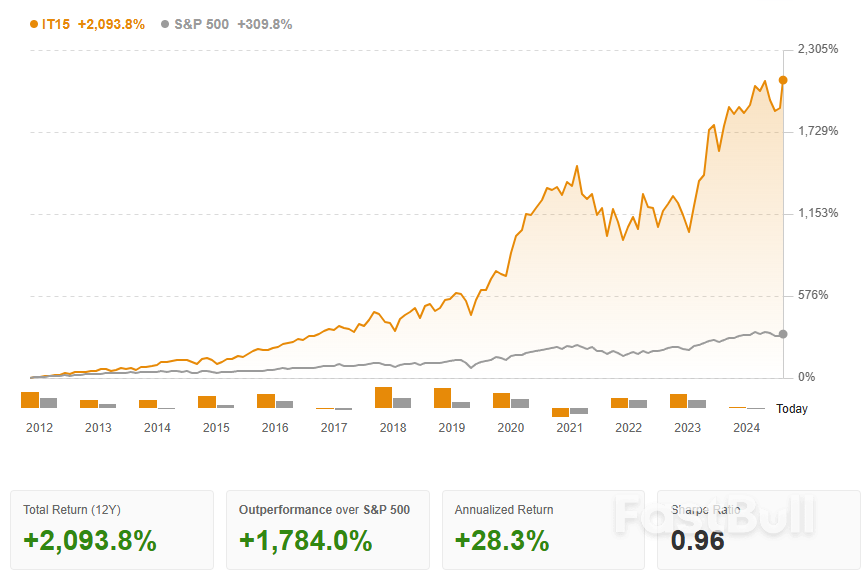
          In this context, it is worth noting that InvestingPro subscribers have already seen solid gains this month from several tech stocks highlighted in the May edition of the Tech Titans strategy, managed by Investing.com.
          In fact, out of the 15 stocks tracked by this strategy since the start of the month, 13 have gained over the past three weeks, while the two that declined posted only minor losses.
          In addition, no fewer than 6 stocks in the portfolio have delivered double-digit gains since the beginning of the month: +10.3%, +10.5%, +15.3%, +18.9%, +20.3% and +28.9%.
          However, several of the stocks identified earlier this month in the Tech Titans strategy still show strong upside potential heading into the final days of the month.
          Then, on June 1, the strategy will reassess an updated list of stocks for the new month—some will be removed from the portfolio, while new ones will be added.
          It is also worth noting that May is not the first month the Tech Titans strategy has significantly outperformed the market, as its historical performance clearly shows:
          4 Crypto Stocks to Ride Bitcoin’s Bullish Surge to New Highs_1
          source : investing
          Risk Warnings and Disclaimers
          You understand and acknowledge that there is a high degree of risk involved in trading. Following any strategies or investment methods may lead to potential losses. The content on the site is provided by our contributors and analysts for information purposes only. You are solely responsible for determining whether any trading assets, securities, strategy, or any other product is suitable for investing based on your own investment objectives and financial situation.
          Add to Favorites
          Share

          Dealmaking Activity Shows Trump Tariffs Derailed A Budding M&A Boom

          Owen Li

          Economic

          Dealmaking in the U.S. was off to a strong start this year before President Donald Trump announced tariff policies that led to extremely volatile market conditions that put a chill on activity. In a pre-tariffs world, dealmakers were encouraged by the Trump administration's pro-business flavor and deregulatory agenda, as well as previously easing concerns about inflation. Those trends were expected to fuel an even stronger M&A comeback in 2025, after last year's moderate recovery from a slow 2023.

          This year's appetite for dealmaking came back quickly after Trump suspended his highest tariffs and market jitters took a backseat. If borrowing costs remain in check, many expect activity could be brisk.

          "More clarity on trade policy and rebounding equities markets have set the stage for continued M&A, even in sectors hit especially hard by tariffs," Kevin Ketcham, a mergers and acquisitions analyst at Mergermarket, told CNBC.

          The total value of U.S. deals jumped to more than $227 billion in March, which saw 586 deals, before suddenly slowing down in April to roughly 650 deals worth about $134 billion, according to data compiled by Mergermarket.

          So far this month, activity is rebounding and the average deal has been larger. More than 300 deals collectively valued at more than $125 billion have been struck this month as of May 20, Mergermarket said.

          That's encouraging. After Trump's "liberation day" tariff announcement, U.S. deal activity plunged by 66% to $9 billion during the first week of April from the prior week, while global M&A activity dropped by 14% week over week to $37.8 billion, according to the data.

          Charles Corpening, chief investment officer of private equity firm West Lane Partners, anticipates M&A activity to pick up after the summer.

          "The trade war has indeed caused a slowdown in the anticipated M&A boom earlier this year, particularly in the second quarter," Corpening said.

          Higher bond yields are also hurting activity in the U.S. given that higher rates translate into greater financing costs, which reduces asset prices, he said.

          Corpening expects greater interest towards special situations M&A, or deals that involve a motivated seller and tend to be flexible with their structure and terms, as well as smaller transactions, which are easier to finance and generally face less regulatory scrutiny.

          "We're beginning to see signs of recovery and we're getting some clarity on the types of deals that are likely to get into the pipeline soonest," Corpening said. "We anticipate that these earlier transactions will lean toward special situations as the better-performing businesses will wait for more market stability in order to maximize sale price."

          Several major deals have been announced in recent months, with large transactions occurring in tech, telecommunications and utilities so far this year.

          Some of the biggest include:

          • Jan. 10: Constellation Energy signed an agreement to buy private natural gas and geothermal company Calpine for $16.4 billion.
          • March 6: Walgreens announced it will go private in a $10 billion deal with private equity firm Sycamore Partners. With debt and possible payouts, the deal could be worth up to $23.7 billion.
          • March 18: Google agreed to acquire cloud security startup Wiz for $32 billion.
          • May 16: Charter Communications and Cox Communications, two of the largest cable companies in the U.S., agreed to merge.
          • May 15: Dick's Sporting Goods announced plans to acquire Foot Locker for $2.4 billion.
          • May 21: AT&T said it would buy Lumen Technologies' mass markets fiber business for $5.75 billion.

          According to Ketcham, the Dick's-Foot Locker deal "likely isn't an outlier" given that Victoria's Secret on Tuesday adopted "poison pill" plan. Such a limited-duration shareholder rights plan suggests the lingerie retailer is concerned about the threat of a potential takeover, he said.

          Ketcham added that some consumer companies are adapting to the new macroeconomic environment instead of pausing dealmaking. He cited packaged food giant Kraft Heinz confirmation on Thursday that it has been evaluating potential transactions over the past several months as an example. Kraft Heinz said it would consider selling off some of its slower growing brands or buying a brands in some of its core categories such as sauces and snacks.

          This kind of trend would lead to smaller deals, which has already been seen this year. For example, PepsiCo scooped up Poppi, a prebiotic soda brand, for $1.95 billion in March.

          Source: CNBC

          To stay updated on all economic events of today, please check out our Economic calendar
          Risk Warnings and Disclaimers
          You understand and acknowledge that there is a high degree of risk involved in trading. Following any strategies or investment methods may lead to potential losses. The content on the site is provided by our contributors and analysts for information purposes only. You are solely responsible for determining whether any trading assets, securities, strategy, or any other product is suitable for investing based on your own investment objectives and financial situation.
          Add to Favorites
          Share

          The dollar could lose its crown as an 'unfortunate truth' forces investors to rethink US assets

          Adam

          Forex

          The US dollar is under pressure as global investors grow increasingly wary of America's fiscal trajectory.
          Once seen as a reliable safe haven, the greenback is now facing renewed skepticism, with strategists telling Yahoo Finance that capital is shifting toward undervalued currencies in Europe and Asia amid expectations of foreign stimulus and more attractive valuations abroad.
          The US Dollar Index (DX-Y.NYB) — which tracks the dollar's value against a basket of major currencies including the euro, Japanese yen, British pound, Canadian dollar, Swedish krona, and Swiss franc — has dropped more than 8% since the start of the year, underperforming every other G10 currency, according to Bloomberg data. It ranks as one of the worst-performing asset classes of the year, alongside Brent Crude (BZ=F).
          Since April, the index has dipped below the crucial technical and psychological level of 100, hitting lows not seen since 2022.
          "Investors now have a very strong reason to hedge their long US asset exposure, and the dollar is no longer behaving like a safe haven," Jayati Bharadwaj, FX and macro strategist at TD Securities, told Yahoo Finance on Wednesday. "I would say it's actually following much more of an emerging market playbook, which is the unfortunate truth that we need to come to terms with."
          Bharadwaj cited mounting US debt and policy uncertainty as key catalysts behind the dollar's decline. Last week's credit rating downgrade by Moody's only deepened market concerns. Adding to the fiscal anxiety, the House of Representatives on Thursday approved President Trump's sweeping tax reform package, otherwise known as the president's "big, beautiful bill."
          The proposal includes significant cuts to both individual and corporate tax rates and is projected to increase the national debt by $4 trillion over the next decade. The legislation now moves to the Senate for consideration.
          "The volatility associated with the current administration's policies is a big confidence shock, which is actually forcing other countries to step up their local fiscal policies and work on fostering stronger trade relationships amongst themselves," Bharadwaj said, noting that it ultimately reduces foreign nations' dependence on the US.
          As a result, Bharadwaj expects the dollar to keep weakening gradually, with another 5% drop likely by year-end.

          The inflationary spiral

          A weaker dollar adds to inflation by driving up import costs, an issue compounded by tariffs that remain near their highest levels since World War II.
          "The dollar going down is going to add to inflation pressure and reduce purchasing power," Kevin Gordon, senior investment strategist at Charles Schwab, told Yahoo Finance.
          Gordon highlighted that during the 2021 to 2023 inflation surge, the dollar's strength acted as a partial hedge against rising prices. But with the greenback now weakening and inflation still elevated, that protective buffer is fading. On top of that, tariffs have added further pressure by reducing capital inflows, or the money coming into the US from foreign investors seeking American assets.
          The shift comes at a challenging time for US policymakers, with President Trump's "Liberation Day" tariff announcement fueling concerns of a broader "sell America" trade, in which US stocks fall, the dollar weakens, and Treasury yields rise.
          While some of those worries eased after a partial tariff rollback, Deutsche Bank said foreign investors remain wary of America’s fiscal trajectory.
          To be sure, despite recent weakness, strategists say the US dollar remains dominant in global finance, accounting for about 80% of trade finance and nearly half of global bond issuance.
          Charles Schwab's Gordon described current softness as a "positioning adjustment" driven by sentiment and portfolio shifts rather than fundamental changes, especially after the dollar's strong bull run since 2011. "The scale is still very much in favor of the dollar, disproportionately so," he said.
          TD's Bharadwaj echoed this view, calling the recent moves a "healthy recalibration."
          "For the longest time, most markets became a pure US move and a pure dollar bet," she said. "Now you can actually start to focus on local, idiosyncratic stories."
          While she doesn’t expect the US to lose its "crown" currency status, she noted that "other princes and princesses" may start to take the stage.

          Source: finance.yahoo

          Risk Warnings and Disclaimers
          You understand and acknowledge that there is a high degree of risk involved in trading. Following any strategies or investment methods may lead to potential losses. The content on the site is provided by our contributors and analysts for information purposes only. You are solely responsible for determining whether any trading assets, securities, strategy, or any other product is suitable for investing based on your own investment objectives and financial situation.
          Add to Favorites
          Share

          Donald Trump and the loss of the triple-A rating

          Adam

          Economic

          At the end of last week, Moody's announced that it is downgrading the US credit rating from Aaa (the highest rating) to Aa1. As we explained earlier this week, only a few countries still have a AAA rating.
          This is obviously not good news for Donald Trump as he tries to get his tax cut plan through Congress.
          As always, the blame is being shifted to the previous administration. Treasury Secretary Scott Bessent said that Moody's is a "lagging indicator" and that the downgrade is the result of Joe Biden's policies.
          What is true is that the Democratic president passed several laws that significantly increased the US deficit, such as the Inflation Reduction Act in 2022, which offers companies tax credits for the development of renewable energies. In the last two years of his presidency, the public deficit rose to over 6%, even though the US did not experience a crisis over this period.
          However, this deterioration in the US budgetary situation cannot be attributed solely to Joe Biden's policies. In its statement announcing the downgrade of the US credit rating, Moody's summed it up as follows: "Successive US administrations and Congress have failed to agree on measures to reverse the trend of large annual budget deficits and rising interest costs."
          This observation still holds true today, as Congress is currently examining Donald Trump's tax cut plan, the famous "big, beautiful bill." According to estimates by the Committee for a Responsible Federal Budget, this plan is expected to add between $3.3 trillion and $5.2 trillion to the deficit over 10 years.
          The equity markets did not react much to Moody's announcement, with US indices even closing up on Monday. However, there is tension on Treasuries, particularly on the long end of the curve, which is most sensitive to deficit issues. The 30-year yield has thus once again exceeded 5%.
          Moody's decision comes as no surprise. Investors have long been aware of the US budget situation. The "definitive loss" of the triple A rating – the downgrade by the three major agencies – merely confirms this, and it is a reality that Donald Trump, who often takes liberties with the facts, will not be able to ignore. From now on, his economic policy will be closely monitored by the bond markets.

          Source: marketscreener

          To stay updated on all economic events of today, please check out our Economic calendar
          Risk Warnings and Disclaimers
          You understand and acknowledge that there is a high degree of risk involved in trading. Following any strategies or investment methods may lead to potential losses. The content on the site is provided by our contributors and analysts for information purposes only. You are solely responsible for determining whether any trading assets, securities, strategy, or any other product is suitable for investing based on your own investment objectives and financial situation.
          Add to Favorites
          Share

          Why the bond market is so worried about the ‘Big, Beautiful Bill’

          Adam

          Bond

          The decidedly unsexy bond market is usually pretty quiet. But when they want to, bond investors can send a loud, clear message to Washington. They did just that Wednesday and Thursday.
          The 20-year bond auction conducted by the US Treasury on Wednesday afternoon was unusually weak: Demand for the bonds was the lowest since February, according to the Treasury Department. Investors who bought the bonds sought a higher-than-expected yield — effectively saying they wanted to be paid more for taking on the risk of lending to Uncle Sam.
          That sent a big warning to President Donald Trump and congressional Republicans. The poor demand means that investors who lend money to the United States think the Trump agenda — in particular, the “Big, Beautiful” tax cut bill — has made America an unacceptably risky investment. They are not going to keep funding the government’s coffers unless they get paid more for it.
          Long-term Treasuries fell further Thursday; and yields, which trade in opposite direction to prices, continued to surge. The rate on the 10-year Treasury rose above 4.61%, and the 30-year eclipsed 5.14% — its highest level since October 2023.
          The stock market has started to worry a bit about the news. The Dow was flat Thursday after tumbling more than 800 points Wednesday. The broader S&P 500 fell 0.1%, and the Nasdaq gained 0.1%. Wall Street’s problems could soon be felt on Main Street.
          The bond market is already on edge. Bond prices have been falling in recent weeks, and yields have been rising for several reasons. Recession fears have been somewhat allayed after the Trump administration lowered tariffs on China significantly last week. Yet inflation remains a big concern as companies reporting earnings in recent days, including behemoths like Walmart, said they’ll be forced to raise prices because of tariffs.
          Yields have also been rising all over the world, creating competition for US bonds. And the “Sell America” trade — in which US stocks, dollar and bonds have become less attractive — has reignited over growing debt concerns because of the tax cut bill and Friday’s US credit rating downgrade from Moody’s. That raised fears that foreign investors may not want to invest in US Treasuries in the future.
          “The most troubling part of the market reaction is that the dollar is weakening at the same time,” said George Saravelos, head of FX research at Deutsche Bank, in a note to investors. “To us this is a clear signal of a foreign buyer’s strike on US assets and the associated US fiscal risks we have been warning for some time. At the core of the problem is that foreign investors are simply no longer willing to finance US twin deficits at current level of prices.”
          The “yippy” bond market, as Trump previously called it, is what concerned Treasury Secretary Scott Bessent and Commerce Secretary Howard Lutnick enough to convince Trump to reverse course shortly after the “Liberation Day” trade announcement on April 2, CNN reported. That’s why he temporarily rescinded his “reciprocal” tariffs on dozens of countries, some as high as 50%.
          The question now: Will the bond market freak out Republicans again — enough to change the “Big, Beautiful Bill” as it moves through the Senate?
          Debt hawks in the Republican party have been complaining about the Congressional Budget Office’s report that said the bill would add nearly $4 trillion to America’s $36 trillion in debt. That’s not just a number: America needs to pay interest on all that borrowing. This fiscal year alone, America has already spent $684 billion to maintain its debt, amounting to 16% of all federal spending — just on interest.
          But Bessent, the steward of America’s debt and a debt hawk himself, has pooh-poohed higher rates and the Moody’s downgrade. He said Sunday on CNN that the economic benefits of the tax cuts will outweigh the debt problems it creates. And on NBC’s “Meet the Press” on Sunday he dismissed the credit rating downgrade, saying, “Who cares? Qatar doesn’t, Saudi doesn’t, UAE doesn’t,” referring to investment agreements Trump secured during his Middle East trip last week.
          But the Treasury is about to fill its coffers again once Congress raises the debt ceiling, allowing the government to start borrowing again. If bond investors demand higher yields, that will make financing America’s debt significantly more expensive, putting at risk future safety net programs — one reason why Republicans are talking about big cuts to Medicaid.
          Higher bond rates are also going to make life more expensive for everyday Americans. Many loans pegged to Treasury yields, such as mortgages, credit card rates and auto loans, are rising as bond yields grow. That could slow down the economy, taking some of the power out of the tax cut bill, which is expected to help juice the economy.
          “Ultimately, there are only two ‘solutions’ to this problem,” said Saravelos. “Either the US has to sharply revise the current reconciliation bill currently sitting in Congress to result in credibly tighter fiscal policy; or, the non-dollar value of US debt has to decline materially until it becomes cheap enough for foreign investors to return. Brace for more volatility.”

          Source: cnn

          Risk Warnings and Disclaimers
          You understand and acknowledge that there is a high degree of risk involved in trading. Following any strategies or investment methods may lead to potential losses. The content on the site is provided by our contributors and analysts for information purposes only. You are solely responsible for determining whether any trading assets, securities, strategy, or any other product is suitable for investing based on your own investment objectives and financial situation.
          Add to Favorites
          Share

          S&P 500 Directionless After Trump's Tax-cut Bill Narrowly Wins House Vote

          Owen Li

          Economic

          Stocks

          The S&P 500 struggled for direction on Thursday after the U.S. House of Representatives passed President Donald Trump's tax and spending bill, expected to burden the federal government with trillions of dollars in extra debt, by a razor-thin margin.

          If what Trump has described as a "big, beautiful bill" becomes law, it is expected to add about $3.8 trillion to the country's $36.2 trillion debt in the next decade, according to the nonpartisan Congressional Budget Office.

          The bill now faces a test in the Republican-controlled Senate and will fulfill much of Trump's populist agenda if passed, delivering new tax breaks on tips and car loans and boosting U.S. military expenditure.

          "It seems pretty clear that, in its present form, the legislation is certainly not going to improve the budget deficit and could make it substantially worse," said Steve Sosnick, chief market analyst at Interactive Brokers.

          Longer-dated Treasury yields hovered near multi-month highs, with those on the 10-year benchmark at 4.58% and the 30-year Treasury yield at a new 19-month high.

          At 11:46 a.m. ET, the Dow Jones Industrial Average (.DJI), opens new tab rose 52.01 points, or 0.12%, to 41,912.45, the S&P 500 (.SPX), opens new tab gained 8.17 points, or 0.14%, to 5,852.78, and the Nasdaq Composite (.IXIC), opens new tab added 120.56 points, or 0.64%, to 18,993.21.

          Eight of the 11 S&P sub-sectors traded lower, with utilities (.SPLRCU), opens new tab and energy (.SPNY), opens new tab among top decliners, down more than 2% and 1% respectively.

          Most megacap and growth stocks inched up. Alphabet(GOOGL.O), opens new tab led gains with a 3.3% rise, touching a nearly three-month high.

          Shares of solar energy companies including First Solar (FSLR.O), opens new tab fell more than 6% as Trump's tax bill is expected to end a number of green-energy subsidies.

          Snowflake (SNOW.N), opens new tab jumped more than 12% after the cloud computing firm raised its fiscal-year 2026 product revenue forecast.

          All three main stock indexes had witnessed their biggest single-day percentage drops in a month on Wednesday as Treasury yields spiked on worries about mounting U.S. debt.

          U.S. stocks have had a solid month so far, with the S&P 500 climbing more than 15% from its April lows, when Trump's reciprocal tariffs roiled global markets.

          A pause in tariffs, a temporary U.S.-China trade truce and tame inflation data have pushed equities higher, although the S&P 500 is still about 3% off record highs.

          Fed Governor Christopher Waller said in an interview to Fox Business that central bank rate cuts would be on the menu if the Trump administration's tariff agenda settles on the lower side of the ledger.

          On the data front, U.S. business activity picked up in May, while separate data showed jobless claims dropped last week, suggesting that the economy maintained a steady pace of employment growth.

          Traders currently see at least two 25-basis-point rate cuts by the end of the year, according to data compiled by LSEG.

          Declining issues outnumbered advancers by a 1.95-to-1 ratio on the NYSE and by a 1.05-to-1 ratio on the Nasdaq.

          The S&P 500 posted one new 52-week high and nine new lows, while the Nasdaq Composite recorded 34 new highs and 83 new lows.

          Source: Reuters

          To stay updated on all economic events of today, please check out our Economic calendar
          Risk Warnings and Disclaimers
          You understand and acknowledge that there is a high degree of risk involved in trading. Following any strategies or investment methods may lead to potential losses. The content on the site is provided by our contributors and analysts for information purposes only. You are solely responsible for determining whether any trading assets, securities, strategy, or any other product is suitable for investing based on your own investment objectives and financial situation.
          Add to Favorites
          Share

          House budget bill effectively kills US clean energy boom

          Adam

          Economic

          The House budget bill that narrowly passed in an early morning vote on Thursday would effectively put the brakes on a clean energy production boom in the United States spurred by tax credits enacted in 2022.
          The bill to carry out President Donald Trump's "one big beautiful bill" plan that would further his tax cuts and boost spending on the military and border enforcement would kill Inflation Reduction Act tax credits for clean energy years earlier than initially planned in an earlier draft, rendering them unusable for most projects.
          The changes made from the House tax-writing committee's proposal last week would advance by three years an end-date for the use of technology-neutral clean electricity tax credits for wind, solar and battery storage projects to 2028 and require projects to begin construction within 60 days of the final bill's passage, according to a bill summary.
          The House bill also eliminates the "transferability" of tax credits that enabled developers to sell their tax credits and use the funds to finance their projects' construction, a feature that made it easier to get projects up and running except for some nuclear energy projects.
          It also strengthened restrictions using tax credits for any project associated with "foreign entities of concern," which includes companies, subsidiaries and materials linked to China. China dominates all aspects of the clean energy supply chain and the restrictions effectively kill most projects, which rely on many components sourced from there.
          The budget proposal passed with the support of over two dozen Republican representatives who had urged House leaders to preserve key IRA tax credit provisions because their districts have benefited from clean energy and manufacturing investments.
          Advocates for the clean energy industry blasted the bill on Thursday, saying it will destroy billions in investments around the country and complaining that House leadership had initially promised to carefully reform the credits, not kill them.
          "If enacted as written, this bill will weaken our power system and send shockwaves throughout the U.S. economy by raising electricity prices, killing tens of thousands of jobs, and ceding energy dominance to China," said Heather O'Neill, president of clean energy lobby group Advanced Energy United.
          "This isn't a scalpel, it's a meat cleaver, and it will hurt us all."
          The American Petroleum Institute praised the bill for "preserving competitive tax policies" as well as opening up more oil lease sales and eliminating Biden administration policies such as its fee on methane emissions for the oil and gas industry.
          Analysts at JP Morgan described the IRA tax credit changes as "unfavorable" in an analysis, and said the bill contained "significant negative changes" from last week's proposal that it hopes the Senate can reverse.
          Energy analysts at the Rhodium Group said its preliminary review of the bill found the changes amount "to the impact of a full repeal of the energy tax credits" and could raise household energy costs by 7%.
          Clean energy stocks took a hit on Thursday.
          Sunrun shares fell as much as 33%, Complete Solaria fell nearly 22% while Enphase Energy, Maxeon Solar and SolarEdge Technologies dipped between 10% and 15.6%.
          Shares of JinkoSolar fell 2.3%, while First Solar and Canadian Solar dropped 6.5% and 10%, respectively.

          source : Reuters

          To stay updated on all economic events of today, please check out our Economic calendar
          Risk Warnings and Disclaimers
          You understand and acknowledge that there is a high degree of risk involved in trading. Following any strategies or investment methods may lead to potential losses. The content on the site is provided by our contributors and analysts for information purposes only. You are solely responsible for determining whether any trading assets, securities, strategy, or any other product is suitable for investing based on your own investment objectives and financial situation.
          Add to Favorites
          Share
          FastBull
          Copyright © 2025 FastBull Ltd

          728 RM B 7/F GEE LOK IND BLDG NO 34 HUNG TO RD KWUN TONG KLN HONG KONG

          TelegramInstagramTwitterfacebooklinkedin
          App Store Google Play Google Play
          Products
          Charts

          Chats

          Q&A with Experts
          Screeners
          Economic Calendar
          Data
          Tools
          Membership
          Features
          Function
          Markets
          Copy Trading
          Latest Signals
          Contests
          News
          Analysis
          24/7
          Columns
          Education
          Company
          Careers
          About Us
          Contact Us
          Advertising
          Help Center
          Feedback
          User Agreement
          Privacy Policy
          Business

          White Label

          Data API

          Web Plug-ins

          Poster Maker

          Affiliate Program

          Risk Disclosure

          The risk of loss in trading financial instruments such as stocks, FX, commodities, futures, bonds, ETFs and crypto can be substantial. You may sustain a total loss of the funds that you deposit with your broker. Therefore, you should carefully consider whether such trading is suitable for you in light of your circumstances and financial resources.

          No decision to invest should be made without thoroughly conducting due diligence by yourself or consulting with your financial advisors. Our web content might not suit you since we don't know your financial conditions and investment needs. Our financial information might have latency or contain inaccuracy, so you should be fully responsible for any of your trading and investment decisions. The company will not be responsible for your capital loss.

          Without getting permission from the website, you are not allowed to copy the website's graphics, texts, or trademarks. Intellectual property rights in the content or data incorporated into this website belong to its providers and exchange merchants.

          Not Logged In

          Log in to access more features

          FastBull Membership

          Not yet

          Purchase

          Become a signal provider
          Help Center
          Customer Service
          Dark Mode
          Price Up/Down Colors

          Log In

          Sign Up

          Position
          Layout
          Fullscreen
          Default to Chart
          The chart page opens by default when you visit fastbull.com