Markets
News
Analysis
User
24/7
Economic Calendar
Education
Data
- Names
- Latest
- Prev




Signal Accounts for Members
All Signal Accounts
All Contests


Canada Federal Government Budget Balance (Oct)A:--
F: --
P: --
U.S. 5-Year Note Auction Avg. YieldA:--
F: --
P: --
U.S. Weekly Total Oil Rig CountA:--
F: --
P: --
U.S. Weekly Total Rig CountA:--
F: --
P: --
U.S. API Weekly Cushing Crude Oil StocksA:--
F: --
P: --
U.S. API Weekly Crude Oil StocksA:--
F: --
P: --
U.S. API Weekly Refined Oil StocksA:--
F: --
P: --
U.S. API Weekly Gasoline StocksA:--
F: --
P: --
Mexico Unemployment Rate (Not SA) (Nov)A:--
F: --
P: --
U.S. MBA Mortgage Application Activity Index WoWA:--
F: --
P: --
U.S. Weekly Continued Jobless Claims (SA)A:--
F: --
U.S. Weekly Initial Jobless Claims (SA)A:--
F: --
P: --
U.S. Initial Jobless Claims 4-Week Avg. (SA)A:--
F: --
P: --
Japan Construction Orders YoY (Nov)A:--
F: --
P: --
Japan New Housing Starts YoY (Nov)A:--
F: --
P: --
Turkey Capacity Utilization (Dec)A:--
F: --
P: --
Japan Tokyo CPI YoY (Excl. Food & Energy) (Dec)A:--
F: --
P: --
Japan Unemployment Rate (Nov)A:--
F: --
P: --
Japan Tokyo Core CPI YoY (Dec)A:--
F: --
P: --
Japan Tokyo CPI YoY (Dec)A:--
F: --
P: --
Japan Jobs to Applicants Ratio (Nov)A:--
F: --
P: --
Japan Tokyo CPI MoM (Dec)A:--
F: --
P: --
Japan Tokyo CPI MoM (Excl. Food & Energy) (Dec)A:--
F: --
P: --
Japan Industrial Inventory MoM (Nov)A:--
F: --
P: --
Japan Retail Sales (Nov)A:--
F: --
P: --
Japan Industrial Output Prelim MoM (Nov)A:--
F: --
P: --
Japan Large-Scale Retail Sales YoY (Nov)A:--
F: --
P: --
Japan Industrial Output Prelim YoY (Nov)A:--
F: --
P: --
Japan Retail Sales MoM (SA) (Nov)A:--
F: --
P: --
Japan Retail Sales YoY (Nov)A:--
F: --
P: --
Russia Retail Sales YoY (Nov)--
F: --
P: --
Russia Unemployment Rate (Nov)--
F: --
P: --
Argentina Retail Sales YoY (Oct)--
F: --
P: --
U.S. Weekly Treasuries Held by Foreign Central Banks--
F: --
P: --
China, Mainland Industrial Profit YoY (YTD) (Nov)--
F: --
P: --
Russia IHS Markit Manufacturing PMI (Dec)--
F: --
P: --
India Manufacturing Output MoM (Nov)--
F: --
P: --
India Industrial Production Index YoY (Nov)--
F: --
P: --
France Unemployment Class-A (Nov)--
F: --
P: --
Euro Zone Total Reserve Assets (Nov)--
F: --
P: --
Canada National Economic Confidence Index--
F: --
P: --
U.S. Pending Home Sales Index (Nov)--
F: --
P: --
U.S. Pending Home Sales Index MoM (SA) (Nov)--
F: --
P: --
U.S. Pending Home Sales Index YoY (Nov)--
F: --
P: --
U.S. EIA Weekly Crude Oil Imports Changes--
F: --
P: --
U.S. EIA Weekly Cushing, Oklahoma Crude Oil Stocks Change--
F: --
P: --
U.S. EIA Weekly Crude Demand Projected by Production--
F: --
P: --
U.S. EIA Weekly Gasoline Stocks Change--
F: --
P: --
U.S. Dallas Fed General Business Activity Index (Dec)--
F: --
P: --
U.S. EIA Weekly Heating Oil Stock Changes--
F: --
P: --
U.S. EIA Weekly Crude Stocks Change--
F: --
P: --
U.S. Dallas Fed New Orders Index (Dec)--
F: --
P: --
Russia CPI YoY (Dec)--
F: --
P: --
U.S. EIA Weekly Natural Gas Stocks Change--
F: --
P: --
Brazil CAGED Net Payroll Jobs (Nov)--
F: --
P: --
South Korea Industrial Output MoM (SA) (Nov)--
F: --
P: --
South Korea Retail Sales MoM (Nov)--
F: --
P: --
South Korea Services Output MoM (Nov)--
F: --
P: --
Russia IHS Markit Services PMI (Dec)--
F: --
P: --
Turkey Economic Sentiment Indicator (Dec)--
F: --
P: --


No matching data
Latest Views
Latest Views
Trending Topics
Top Columnists
Latest Update
White Label
Data API
Web Plug-ins
Affiliate Program
View All

No data
As usual when Donald Trump occupies the White House, 2025 condensed a decade's worth of political upheaval into a single year. Identifying the most important of those developments is like picking through the wreckage to find a few family heirlooms after a tornado has torn through the neighborhood.
But in the swarm of conflicts, controversies, personnel changes, policy reversals, legal battles, feuds and shifting alliances, several dynamics emerged this year that are most likely to shape the electoral landscape in 2026, 2028 and beyond.
Of those key developments, the most significant was the collapse of faith in Trump's ability to manage the economy. In virtually every survey during Trump's first term, more people approved than disapproved of his handling of the economy. Moreover, his approval rating on the economy almost always exceeded his overall job performance rating, which meant that confidence in his economic agenda was a floor bolstering his support no matter which other controversies engulfed him.
Now, that equation has reversed. Recent surveys routinely show that fewer people approve of Trump's management of the economy than at any point during his first four years; most national surveys this month have shown that 40% or fewer Americans give him positive marks on the economy, and even fewer give him good grades on the cost of living — the problem that tops every survey as Americans' biggest concern. It's a complete inversion from his first term: The economy is now dragging down overall assessments of his performance.
To some extent, Trump is simply suffering from proximity: presidents' approval ratings always sag when voters are unhappy with the economy, as they are today. (Like other presidents, he's found that efforts to blame his predecessor for current conditions fall flat after a few months.) But Trump's problems extend beyond that. Polls consistently find that most Americans believe he has not focused enough on their cost of living. Even more damaging, more voters say his agenda has hurt than helped their finances, often by a crushing margin of two or three to one. Voters particularly dislike his tariffs.
The bottom line: Trump's greatest asset during his first term — confidence in his economic mastery — has become his biggest albatross in his second. "Unless there's a fix to inflation … I think the economy is going to continue to drag him down," says Democratic pollster Jay Campbell, part of the bipartisan polling team that surveys attitudes about the economy and politics for CNBC.
The crumbling of confidence in Trump's economic performance largely explains 2025's second key electoral dynamic: the reversal of the president's beachheads among the new voter groups central to his reelection. In 2024, Trump notably improved his previous performance among several big constituencies—Latinos, young men and non-White voters without a college degree. Republican strategists dreamed of realignment.
But Trump's standing with those groups has rapidly deteriorated. Recent surveys that extensively examined attitudes among Latinos and young people, both with much larger samples than typical public polls, found his approval rating with each group has plummeted below 30%.
Frustration over the economy explains much, but not all, of that decline. In the Pew Research Center's massive recent Latino survey, for instance, more than 7 in 10 said the administration is doing too much to deport immigrants; nearly 8 in 10 said his overall agenda was hurting the Latino community. (Even a third of his 2024 Latino voters said his policies were harming the community.) Former Republican Representative Carlos Curbelo, who represented a heavily Latino South Florida district, told me that Trump "had a lot of rope" with Latinos, but has squandered that opportunity with his militarized deportation offensive. "They have gone way too far," Curbelo added. "It's going to be hard for Republicans to recover some of this support."
Which brings us to the third important development of 2025: In the normal hydraulic fashion of American politics, Trump's fall allowed Democrats to run well in this year's major elections. But the Democratic Party's overall public image remains weak.
That may not matter much next year, because midterm elections are predominantly a referendum on the incumbent president's performance. But "in 2028, the question of who we nominate matters enormously," says Simon Bazelon, an adviser at Welcome, a new centrist Democratic group. Even if Democrats win "a referendum on Trump's unpopularity in 2026," he adds, it would be a mistake to conclude "voters are happy with us again, when in fact they may still be angry at us."
The heated argument between progressives and centrists over the party's direction will play out next year in Senate primaries in Maine, Michigan, Minnesota, Iowa and Texas among other places. But the real battle will come in the 2028 presidential primary. And that race may turn less on ideology than on disposition — who Democratic voters believe is the candidate most committed to fight, and most likely to beat, Trump's Make America Great Again movement.
At home and abroad, Trump is governing as if he feels himself completely unbound. But while other Republican officials, with the rarest exceptions, have bowed to his excesses, he's provoked a clear recoil among voters beyond his core coalition.
In that way, 2025 reaffirmed the most important political trend over roughly the past 60 years. The rapid erosion of Trump's 2024 breakthroughs underscored that we continue to live through the longest period in American history when neither party has been able to establish a durable advantage over the other. The last five times a president has gone into a midterm election with unified control of the federal government (the White House, House and Senate) voters have revoked it — the longest such streak in American history. Nothing that happened in 2025 suggests Trump can stop that wheel from turning again in 2026.
Japan's Industry Ministry is set to nearly quadruple its budgeted support for cutting-edge semiconductors and artificial intelligence (AI) development to about 1.23 trillion yen (S$10.1 billion) for the fiscal year starting in April.
Overall, the Ministry of Economy, Trade and Industry's budget rose by about 50 per cent from the previous year to 3.07 trillion yen, largely due to the jump in chips and AI spending.
After Prime Minister Sanae Takaichi's Cabinet signed off on it on Dec 26, the government's initial budget plan will be debated in Parliament in the new year.
The jump in chips and AI spending comes at a time when Japan is trying to strengthen its capacities in frontier technology, as the US and China race ahead. As the world's two largest economies remain on tense terms despite a lull in their trade war, Japan is also trying to secure better supply chain access for key technologies.
Starting with the fiscal year beginning in April, the ministry also plans to secure most of the additional funding for chips and AI in regular budgets, instead of through the more ad-hoc approach of funding it through extra budgets later in the year. That is expected to provide more stable funding to the sectors.
For semiconductors, the ministry has earmarked 150 billion yen for state-backed chip venture Rapidus, bringing the cumulative government investment in the venture to 250 billion yen.
For AI, 387.3 billion yen is being marked for the development of domestic foundation AI models, strengthening data infrastructure and "physical AI", in which AI controls robots and machinery.
In the broader budget, 5 billion yen is being set aside for securing key minerals, including rare earths. For decarbonisation, 122 billion yen is earmarked for areas such as the development of so-called next-generation nuclear power plants.
Some 1.78 trillion yen of special bonds will also be issued to help state-backed Nippon Export and Investment Insurance support Japanese investment in the US as part of the two countries' trade agreement.
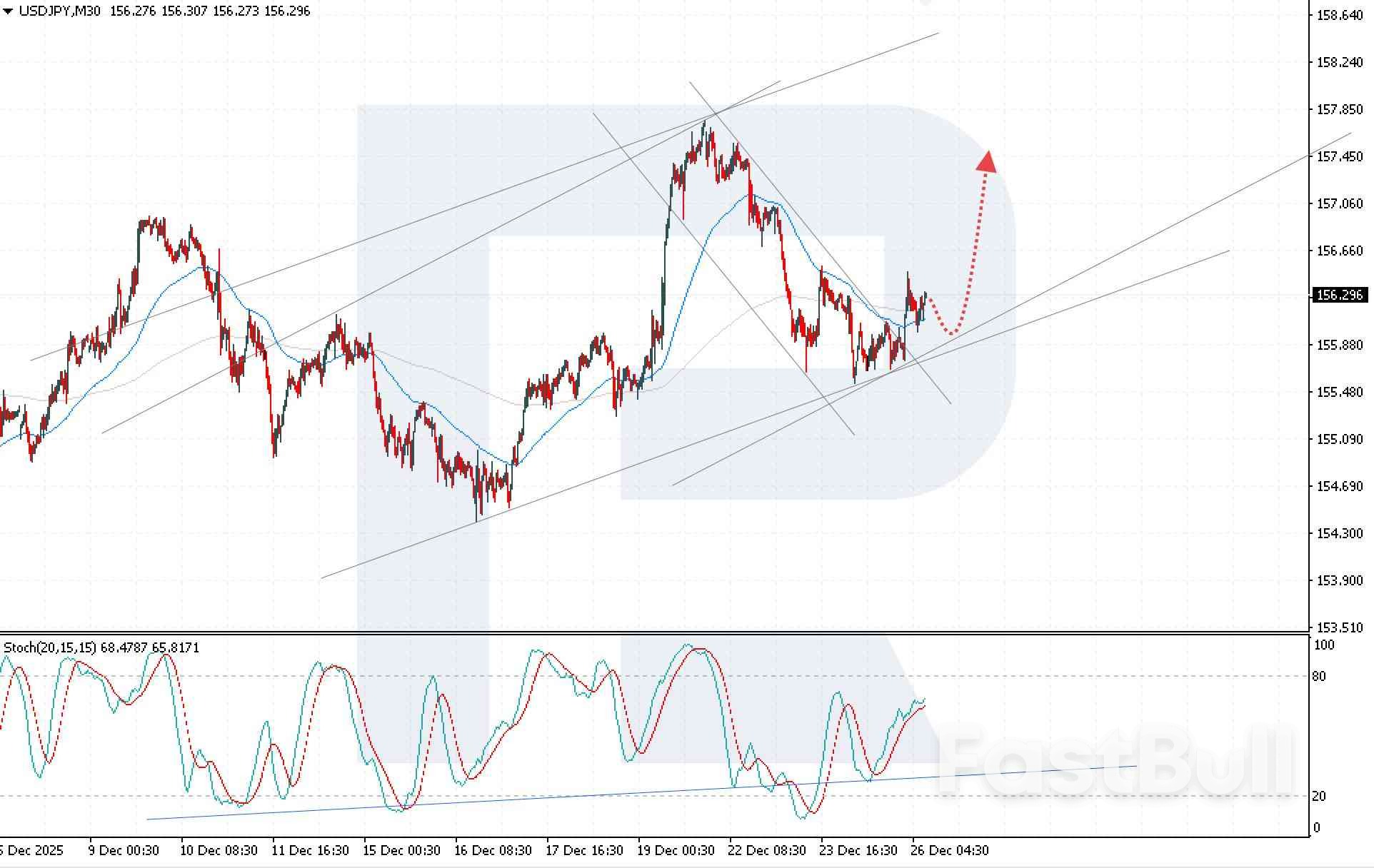
USDJPY is showing a recovery amid weak inflation in Tokyo and expectations of a pause in BoJ policy tightening. The current price is 156.29.
USDJPY is showing a recovery after declining for three consecutive trading sessions. Sellers failed to secure a breakout below the key support level at 155.75, which triggered renewed buying activity.
The Japanese yen came under pressure amid a slowdown in inflation in Tokyo, reinforcing expectations that the Bank of Japan may pause its rate-hiking cycle. Tokyo's annual inflation rate slowed to 2.0% in December, marking the lowest reading in more than a year. The decline was mainly driven by easing price pressures in food and energy components.
Tokyo inflation is regarded as a leading indicator of nationwide inflation dynamics and is closely monitored by the regulator. Its slowdown increases uncertainty around the timing of further monetary policy tightening by the Bank of Japan, which continues to weigh on the yen and supports a bullish outlook for USDJPY.
USDJPY has consolidated above the upper boundary of the descending channel. Despite the previous bearish impulse, buyers managed to hold prices above the EMA-65, indicating a significant slowdown in bearish pressure and a potential shift in market dynamics.
The USDJPY forecast for today suggests further upside with a target at 157.45. Additional confirmation of the bullish scenario comes from the Stochastic Oscillator: its signal lines have turned upward after rebounding from the oversold zone, indicating renewed buying pressure.
A sustained breakout and consolidation above the 156.15 resistance level would strengthen bullish positions and confirm the potential for continued upward movement toward new local highs.

USDJPY technical analysis points to a sustained bullish bias, with the potential for further growth toward the 157.45 level amid slowing inflation in Tokyo, which continues to pressure the Japanese yen.
Thailand's central bank has aggressively acted to ease volatility in the baht the central bank chief said on Friday, with the currency surging to its highest level against the dollar in more than four years.
The baht has gained 10.3% against the dollar so far this year to become Asia's second-best performing currency.
The baht's strength has added to the problems in Southeast Asia's second-largest economy, which has been struggling with US tariffs, high household debt, a border conflict with Cambodia and political uncertainty ahead of elections in early February.
"Although we have intervened heavily in the latter half of the year, our efforts could only mitigate fluctuations," governor Vitai Ratanakorn told reporters.
"We want to reduce volatility. We do not want the baht to strengthen to the point where it hurts exporters and the economy," he said.
The central bank has not set a specific target for the baht's value and cannot manipulate the currency due to international agreements," Vitai said.
The baht's recent strength stems from a weaker dollar, capital inflows and Thailand's higher-than-expected current account surplus, he said.
On Friday, the central bank initiated measures to strengthen scrutiny over capital inflows exceeding US$200,000 (RM808,000), Vitai said, adding that banks were now required to follow stricter review processes.
"This is the first time we are checking the purposes and documentation of such inflows," Vitai said.
The move follows measures to control gold trading, which the central bank has blamed for helping to drive up the baht.
On Friday, the central bank also announced a loan guarantee scheme expected to increase new credit by 100 billion baht (RM13 billion) over the next one to two years.
The scheme, which will begin in January 2026, will offer guarantees for loans of up to 100 million baht for targeted small- and medium-sized businesses, and up to 150 million baht for corporates.
Vitai reiterated that lowering interest rates would not solve structural problems.
Last week, the central bank cut its key interest rate for the fifth time since October 2024, with rates down by a total of 125 basis points over the period.
White Label
Data API
Web Plug-ins
Poster Maker
Affiliate Program
The risk of loss in trading financial instruments such as stocks, FX, commodities, futures, bonds, ETFs and crypto can be substantial. You may sustain a total loss of the funds that you deposit with your broker. Therefore, you should carefully consider whether such trading is suitable for you in light of your circumstances and financial resources.
No decision to invest should be made without thoroughly conducting due diligence by yourself or consulting with your financial advisors. Our web content might not suit you since we don't know your financial conditions and investment needs. Our financial information might have latency or contain inaccuracy, so you should be fully responsible for any of your trading and investment decisions. The company will not be responsible for your capital loss.
Without getting permission from the website, you are not allowed to copy the website's graphics, texts, or trademarks. Intellectual property rights in the content or data incorporated into this website belong to its providers and exchange merchants.
Not Logged In
Log in to access more features

FastBull Membership
Not yet
Purchase
Log In
Sign Up