Markets
News
Analysis
User
24/7
Economic Calendar
Education
Data
- Names
- Latest
- Prev


Signal Accounts for Members
All Signal Accounts
All Contests


Canada Labor Force Participation Rate (SA) (Nov)A:--
F: --
P: --
U.S. Personal Income MoM (Sept)A:--
F: --
P: --
U.S. PCE Price Index YoY (SA) (Sept)A:--
F: --
P: --
U.S. PCE Price Index MoM (Sept)A:--
F: --
P: --
U.S. Personal Outlays MoM (SA) (Sept)A:--
F: --
P: --
U.S. Core PCE Price Index MoM (Sept)A:--
F: --
P: --
U.S. Core PCE Price Index YoY (Sept)A:--
F: --
P: --
U.S. UMich 5-Year-Ahead Inflation Expectations Prelim YoY (Dec)A:--
F: --
P: --
U.S. Real Personal Consumption Expenditures MoM (Sept)A:--
F: --
P: --
U.S. 5-10 Year-Ahead Inflation Expectations (Dec)A:--
F: --
P: --
U.S. UMich Current Economic Conditions Index Prelim (Dec)A:--
F: --
P: --
U.S. UMich Consumer Sentiment Index Prelim (Dec)A:--
F: --
P: --
U.S. UMich 1-Year-Ahead Inflation Expectations Prelim (Dec)A:--
F: --
P: --
U.S. UMich Consumer Expectations Index Prelim (Dec)A:--
F: --
P: --
U.S. Weekly Total Rig CountA:--
F: --
P: --
U.S. Weekly Total Oil Rig CountA:--
F: --
P: --
U.S. Unit Labor Cost Prelim (SA) (Q3)--
F: --
P: --
U.S. Consumer Credit (SA) (Oct)A:--
F: --
P: --
China, Mainland Foreign Exchange Reserves (Nov)A:--
F: --
P: --
China, Mainland Exports YoY (USD) (Nov)--
F: --
P: --
China, Mainland Imports YoY (CNH) (Nov)--
F: --
P: --
China, Mainland Imports YoY (USD) (Nov)--
F: --
P: --
China, Mainland Imports (CNH) (Nov)--
F: --
P: --
China, Mainland Trade Balance (CNH) (Nov)--
F: --
P: --
China, Mainland Exports (Nov)--
F: --
P: --
Japan Wages MoM (Oct)A:--
F: --
P: --
Japan Trade Balance (Oct)A:--
F: --
P: --
Japan Nominal GDP Revised QoQ (Q3)A:--
F: --
P: --
Japan Trade Balance (Customs Data) (SA) (Oct)A:--
F: --
P: --
Japan GDP Annualized QoQ Revised (Q3)A:--
F: --
China, Mainland Exports YoY (CNH) (Nov)--
F: --
P: --
China, Mainland Trade Balance (USD) (Nov)--
F: --
P: --
Germany Industrial Output MoM (SA) (Oct)--
F: --
P: --
Euro Zone Sentix Investor Confidence Index (Dec)--
F: --
P: --
Canada Leading Index MoM (Nov)--
F: --
P: --
Canada National Economic Confidence Index--
F: --
P: --
U.S. Dallas Fed PCE Price Index YoY (Sept)--
F: --
P: --
China, Mainland Trade Balance (USD) (Nov)--
F: --
P: --
U.S. 3-Year Note Auction Yield--
F: --
P: --
U.K. BRC Overall Retail Sales YoY (Nov)--
F: --
P: --
U.K. BRC Like-For-Like Retail Sales YoY (Nov)--
F: --
P: --
Australia Overnight (Borrowing) Key Rate--
F: --
P: --
RBA Rate Statement
RBA Press Conference
Germany Exports MoM (SA) (Oct)--
F: --
P: --
U.S. NFIB Small Business Optimism Index (SA) (Nov)--
F: --
P: --
Mexico Core CPI YoY (Nov)--
F: --
P: --
Mexico 12-Month Inflation (CPI) (Nov)--
F: --
P: --
Mexico PPI YoY (Nov)--
F: --
P: --
Mexico CPI YoY (Nov)--
F: --
P: --
U.S. Weekly Redbook Index YoY--
F: --
P: --
U.S. JOLTS Job Openings (SA) (Oct)--
F: --
P: --
China, Mainland M2 Money Supply YoY (Nov)--
F: --
P: --
China, Mainland M0 Money Supply YoY (Nov)--
F: --
P: --
China, Mainland M1 Money Supply YoY (Nov)--
F: --
P: --
U.S. EIA Short-Term Crude Production Forecast For The Next Year (Dec)--
F: --
P: --
U.S. EIA Short-Term Crude Production Forecast For The Year (Dec)--
F: --
P: --
U.S. EIA Natural Gas Production Forecast For The Next Year (Dec)--
F: --
P: --
EIA Monthly Short-Term Energy Outlook
U.S. 10-Year Note Auction Avg. Yield--
F: --
P: --
U.S. API Weekly Cushing Crude Oil Stocks--
F: --
P: --


No matching data
Latest Views
Latest Views
Trending Topics
Top Columnists
Latest Update
White Label
Data API
Web Plug-ins
Affiliate Program
View All

No data
U.S. futures flat as traders digest Fed minutes showing division over rate cuts. Delta and PepsiCo report earnings today. Gold retreats after record highs amid Gaza ceasefire hopes.
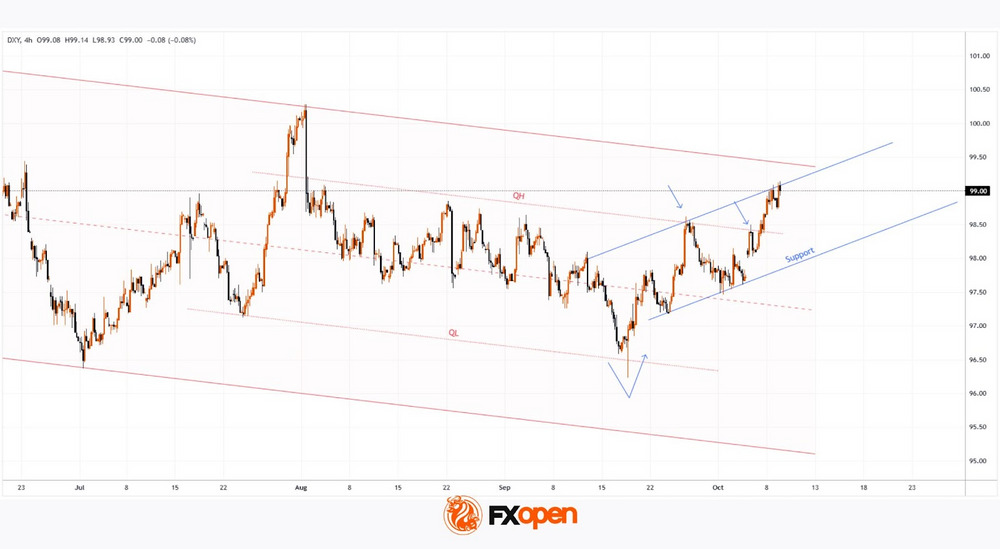
The chart shows the Dollar Index (DXY) trading above the 99-point level today — its highest since early August. The dollar’s strength is supported by the weakening of other currencies:
→ The yen is weakening amid expectations of looser monetary policy. Conservative Sanae Takaichi could become the first female prime minister in Japan’s history, pursuing substantial spending and economic stimulus.
→ The euro remains under pressure amid France’s political crisis. Following the resignation of Prime Minister Sébastien Lecornu’s government, President Emmanuel Macron stated he plans to appoint a new prime minister this week.
Technical Analysis of the DXY Chart
On 19 September, we provided a significant analysis of the DXY chart in which we:
→ Confirmed the relevance of a descending channel (shown in red), which includes intermediate QL and QH lines dividing the channel into quarters.
→ Highlighted a reversal upward from the QL line (shown with an arrow).
→ Suggested a bullish scenario aiming to reach the QH line.
This scenario has indeed unfolded:
→ On 25 September and 6 October (as shown by arrows), the QH line acted as resistance.
→ On 7 October, it was broken upward, underlining bulls’ strength.
Given this, it is reasonable to suggest that bulls remain in control, while:
→ DXY fluctuations since mid-September’s low are forming an upward channel;
→ its upper boundary may act as resistance, potentially triggering a pullback towards the Support line;
→ the upper boundary of the red channel appears to be a key target for the current rally that began last month.
President Ferdinand Marcos Jr on Wednesday signed eight licenses for oil and natural gas and hydrogen exploration across the Philippines, as the Southeast Asian country braces for depletion at its only producing gas field."This landmark unveiling marks the largest batch of PSCs [Petroleum Service Contracts] awarded in a single period in Philippine history, reaffirming the administration's strong resolve to accelerate domestic energy exploration and production", the country's Department of Energy (DOE) said in a statement on its website.
"The new contracts also include the world's first competitive bid round for native hydrogen, alongside co-managed petroleum projects with the Bangsamoro Autonomous Region in Muslim Mindanao".PSCs 80 and 81 allow Australia's Triangle Energy (Global) Ltd, the United Kingdom's Sunda Energy PLC and the Philippines' PXP Energy Corp and The Philodrill Corp "to revitalize petroleum exploration in the southern Sulu Sea", the DOE said. PSC 80 covers about 780,000 hectares while PSC 81 spans around 532,000 hectares.
Triangle Energy also bagged another license for the Cagayan basin. PSC 82 has 480,000 hectares.United States-based Koloma Inc won SCs 83 and 84 for native hydrogen exploration in Central Luzon. SCs 83 and 84 cover more than 126,600 hectares and over 85,000 hectares respectively.PSC 85 went to Singapore's Gas 2 Grid Pte Ltd for nearly 127,500 hectares onshore Cebu province.
PSC 86 in the Northwest Palawan Basin went to a Philippine consortium: Philodrill, Anglo Philippine Holdings Corp, PXP Energy Corp and Forum Energy Philippines Corp. The license covers 132,000 hectares.Israel's Ratio Petroleum Ltd won its second Philippine PSC. SC 87, like its earlier PSC 78, targets the East Palawan Basin. Under the previous license, the company "successfully conducted a 3D seismic survey last year as part of its ongoing exploration activities", the DOE said.
"Service contractors may now commence their respective work programs, which will include geological and geophysical studies, seismic surveys and drilling activities as appropriate", the DOE said."These eight PSCs signal the reinvigorated investor confidence in the Philippine upstream energy sector, paving the way for new gas exploration initiatives amid the decline of the Malampaya Gas Field", it said.
"Collectively, the contracts represent a potential investment commitment of around $207 million over a seven-year exploration period".Energy Secretary Sharon S. Garin said in the statement, "These service contracts signify not only our determination to secure new energy sources, but also our readiness to embrace innovation and sustainability while reducing import dependence. From conventional petroleum to native hydrogen, we are expanding the frontiers of Philippine energy exploration".
According to the DOE's latest power statistics report, published June 15, coal remained the biggest contributor to the archipelago’s generation in 2024 at nearly 80,000 gigawatt hours (gWh). Coal was followed by renewables at over 28,000 gWh. Gas accounted for over 18,000 gWh, while over 1,300 gWh came from oil.
Five months after taking office with pledges to stop the rot in Germany, Chancellor Friedrich Merz might have hoped for more encouraging news.
But the past three days of data releases for August have underscored just how torrid a situation manufacturing faces in Europe’s biggest economy. Factory orders unexpectedly fell for a fourth month, production plunged the most in well over three years, and exports to the US dropped to the lowest since late 2021.
The index for industry is now markedly lower than its peak reached in 2017, and sits at readings that were first surpassed all the way back in 2005. Even if the change in value-added is less dramatic, the damage to growth is undeniable.
It’s little surprise that the once-vaunted auto industry is the biggest source of pain. Not only have carmakers been hurt by US President Donald Trump’s tariff increases, but they’ve seen the previously lucrative China market steadily slip from their grasp — having been slow to pick up on Beijing’s determination to transition to electric vehicles.
Mercedes-Benz on Tuesday reported a 27% contraction in China sales, taking them down to their lowest in almost a decade. While BMW saw a much smaller drop, its guidance about the outlook ahead was worrying enough to push its shares down by the most since last November. On Thursday, Porsche revealed that its own sales in China fell 21% during the third quarter.
In a measure of the alarm in Berlin at the car industry’s woes, Merz’s coalition announced a program worth €3 billion ($3.5 billion) on Thursday offering incentives for low- and middle-income households to buy zero-emission vehicles.
While the ruling parties arrived in office with an historic deal to set aside debt rules and embrace large-scale defense and infrastructure spending, it will take time for that money to reach the economy. On Wednesday, the government raised its forecasts for economic growth this year, but those predictions still show hardly any expansion this year before a recovery finally takes hold in 2026.
“The German economy is still on shaky ground,” said Geraldine Dany-Knedlik, head of forecasting at the Berlin-based DIW institute.
There’s a consensus among economists that fiscal stimulus alone won’t be enough to sustain momentum, and that the government needs to get on with growth-friendly changes. Germany’s central bank chief chimed in again on the matter this week.
“Time to speed up on the path to reform,” Bundesbank President Joachim Nagel urged. “The government must take decisive action.”
But it’s already clear that, beyond the stellar performance of some stocks in Germany’s DAX index, the more optimistic hopes that Merz first stoked with his debt reforms are starting to fade.
“The fiscal reforms have not yet rekindled animal spirits in Germany’s private sector, except in pockets such as defense,” Deutsche Bank economists led by Robin Winkler wrote in a note this week. “In the absence of meaningful structural reforms the government has so far got less” out of its announced stimulus plans than expected, they said.
While economic data in the US are in short supply because of the government shutdown, releases from the world’s third-largest export power continue to show what impact President Donald Trump’s tariffs are having across the world.
On Thursday, trade data from Germany provided more evidence of the plight faced by Europe’s biggest economy, which has traditionally relied on manufacturers with global reach to drive growth.
The value of German exports unexpectedly dropped 0.5% in August, the month following the US trade deal with the European Union. Economists polled by Bloomberg had predicted a small gain. Shipments to the US suffered particularly, dropping 2.5% from July. It was the fifth consecutive decline, to the lowest level since November 2021.
Industrial heavyweights including BASF, Volkswagen and BMW have already had to cut their profit outlooks in recent months in part because of tariffs. The government of Chancellor Friedrich Merz is meanwhile trying to engineer a rebound by spending hundreds of billions of euros on infrastructure and through other domestic reforms.
The US is not the only source of concern for German companies. Trade with China can also no longer be counted on as an engine of growth, partly because the country has evolved into a competitor on global markets. A 5.4% jump in August in exports to the country is changing little about the downward trend, said Ralph Solveen, an economist at Commerzbank.
“Hopes for an economic recovery won’t be based on foreign demand, but rather on a domestic economy that is picking up due to lower ECB interest rates and higher government spending,” he said in a note.
Other reports this week underscored this point. Industrial production in Germany fell the most since early 2022, especially in the auto sector. The situation in the country’s flagship industry has gotten so dire that executives are meeting Merz on Thursday to discuss ways out the crisis.
Responding to the trade figures, BGA, an association representing interests of German exporters, urged the EU not to give in to protectionism. “Europe needs investments in resilience and diversification — not walls around its internal market,” BGA President Dirk Jandura said.

Europe has to confront the reality of the "hybrid warfare" being waged against it, according to European Commission President Ursula von der Leyen, telling EU lawmakers that a series of incidents was "not random harassment" but part of a concerted campaign to unsettle and weaken the bloc.Recent drone and airspace incursions, cyberattacks and election interference were just a few incidents that von der Leyen cited as instances of hybrid warfare against Europe.
"In just the past two weeks, MiG fighters have violated Estonia's airspace, and drones have flown over critical sites in Belgium, Poland, Romania, Denmark and Germany. Flights have been grounded, jets scrambled, and countermeasures deployed to ensure the safety of our citizens," von der Leyen said Wednesday during a speech to the European Parliament in Strasbourg, France.
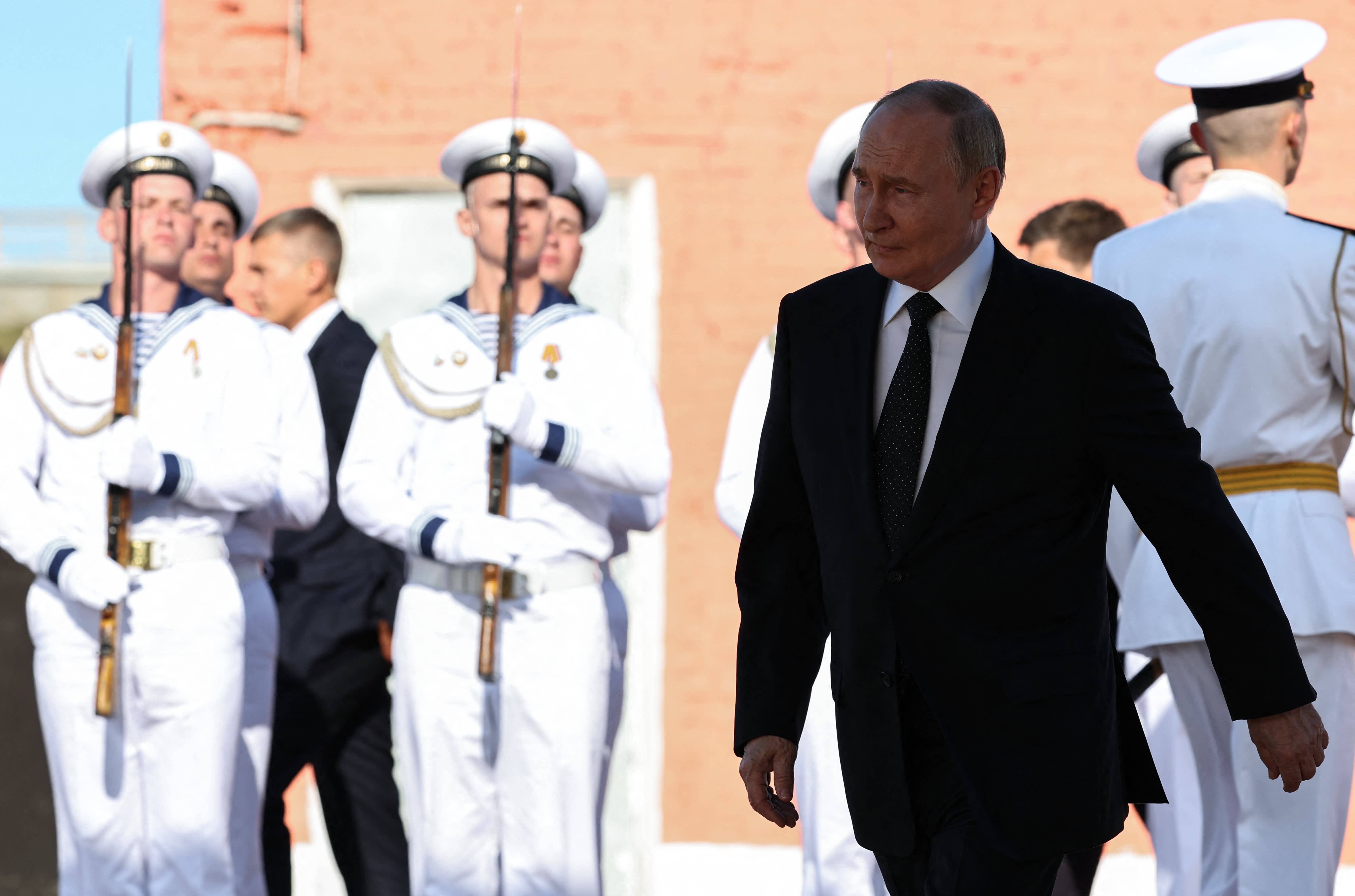
"Make no mistake. This is part of a worrying pattern of growing threats. Across our Union, undersea cables have been cut, airports and logistics hubs paralysed by cyberattacks, and elections targeted by malign influence campaigns," von der Leyen said, adding emphatically: "This is hybrid warfare, and we have to take it very seriously."While she did not blame all those incidents directly on Moscow, von der Leyen said it was evident that "Russia wants to sow division."Moscow has long been accused of being behind a multitude of "hybrid" attacks against its European neighbors but has repeatedly denied those accusations. CNBC contacted the Kremlin for a response to von der Leyen's latest remarks and is awaiting a response.
So what is a hybrid war, or warfare? Put simply, it's a way to wage a type of warfare without appearing to be doing so.There is no set definition for hybrid warfare but defense, military and security experts agree that, fundamentally, it blends conventional military methods with more subversive or irregular tactics designed to disrupt, distract and undermine adversaries.

European countries on the periphery of the EU, or those on the frontier with Russia, like the Baltic states Estonia, Latvia and Lithuania, or those in Eastern Europe such as Romania and Poland, have been increasingly exposed to hybrid warfare attacks.These incidents have ranged from energy and telecommunications infrastructure, such as undersea cables, being sabotaged, to Russian jets or submarines venturing into NATO airspace or waters for short periods of time.
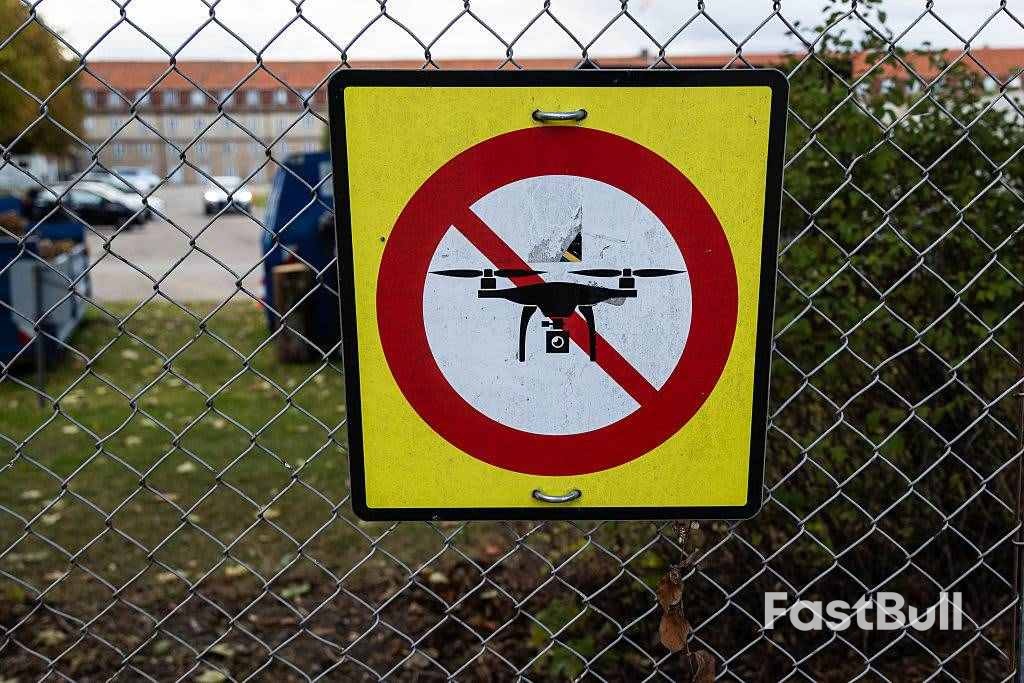
Russia has denied being behind many of these incidents, although it tends not to comment on its jets entering NATO airspace or drone incidents that led to Danish airports being closed and flights disrupted. A number of European officials accused Russia of being behind the disruption but the authorities said they had not yet found evidence of Russia's involvement.
That's one of the hallmarks of hybrid warfare, the EU's von der Leyen said, with such incidents "calculated to linger in the twilight of deniability."

Russia's campaign of hybrid activities in Europe has expanded significantly since Moscow's full-scale invasion of Ukraine began over three years ago, according to a report published earlier this year from geopolitical and security intelligence service, Dragonfly.It documented 219 incidents of suspected Russian hybrid warfare in Europe since 2014, including sabotage, assassinations and electromagnetic attacks, such as GPS jamming. Of these incidents, 86% have taken place since early 2022 and almost half (46%) occurred in 2024 alone.The Baltic states, Finland, Germany, Norway, Poland and the U.K. will probably remain the primary targets, the report noted, due to their strong support for Ukraine.
European officials are under no illusion that the time to act to bolster regional security and defenses against malign activities is now.
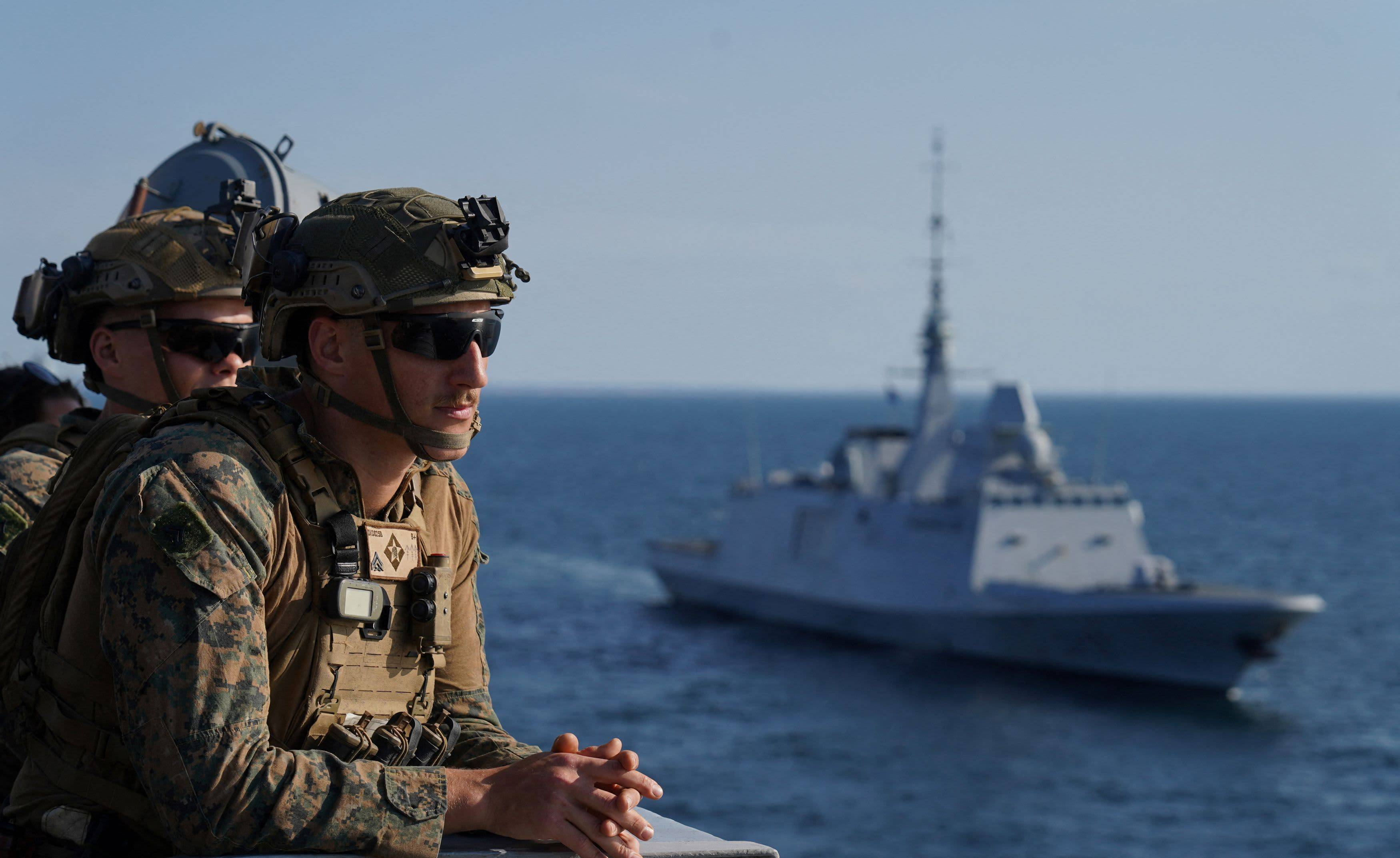
NATO members earlier this year pledged to increase defense spending to 5% of grpss domestic product and Europe has vowed to mobilize its defense sector to meet the "permanent threat to European security" that's posed by Russia, as Luxembourg Prime Minister Luc Frieden told CNBC last week.Member states discussed last week the creation of "flagship" defense projects such as the Eastern Flank Watch initiative, which proposes the creation of a "drone wall" network that would protect against airspace violations by unmanned aerial vehicles (UAVs). There is some ambivalence over the drone wall, however, with Germany's defense minister appearing to pour cold water on the idea.
Luxembourg's Frieden said the EU did not want a conflict with Russia, but needed to protect itself.
"Hybrid attacks are obviously something that can happen anywhere — the cables in the Baltic Sea, the attacks on our IT systems, the drones that can fly over some of our countries, that shows that there is a certain kind of provocation that we have to take seriously," Frieden said, adding: "I don't want us to be at war with Russia ... but we need to take threats seriously" he told CNBC's Silvia Amaro."We want to tell Russia, don't try, stop it, go back ... [and that it has] no chance in conquering the Europe."
White Label
Data API
Web Plug-ins
Poster Maker
Affiliate Program
The risk of loss in trading financial instruments such as stocks, FX, commodities, futures, bonds, ETFs and crypto can be substantial. You may sustain a total loss of the funds that you deposit with your broker. Therefore, you should carefully consider whether such trading is suitable for you in light of your circumstances and financial resources.
No decision to invest should be made without thoroughly conducting due diligence by yourself or consulting with your financial advisors. Our web content might not suit you since we don't know your financial conditions and investment needs. Our financial information might have latency or contain inaccuracy, so you should be fully responsible for any of your trading and investment decisions. The company will not be responsible for your capital loss.
Without getting permission from the website, you are not allowed to copy the website's graphics, texts, or trademarks. Intellectual property rights in the content or data incorporated into this website belong to its providers and exchange merchants.
Not Logged In
Log in to access more features

FastBull Membership
Not yet
Purchase
Log In
Sign Up