• Trade
  • Markets
  • Copy
  • Contests
  • News
  • 24/7
  • Calendar
  • Q&A
  • Chats
Screeners
SYMBOL
LAST
ASK
BID
HIGH
LOW
NET CHG.
%CHG.
SPREAD
SPX
S&P 500 Index
6932.31
6932.31
6932.31
6944.90
6828.78
+133.91
+ 1.97%
--
DJI
Dow Jones Industrial Average
50115.66
50115.66
50115.66
50169.65
49032.19
+1206.95
+ 2.47%
--
IXIC
NASDAQ Composite Index
23031.20
23031.20
23031.20
23088.46
22586.40
+490.63
+ 2.18%
--
USDX
US Dollar Index
97.430
97.510
97.430
97.790
97.390
-0.390
-0.40%
--
EURUSD
Euro / US Dollar
1.18235
1.18242
1.18235
1.18259
1.17655
+0.00447
+ 0.38%
--
GBPUSD
Pound Sterling / US Dollar
1.36202
1.36209
1.36202
1.36229
1.35081
+0.00898
+ 0.66%
--
XAUUSD
Gold / US Dollar
4953.49
4953.93
4953.49
4971.46
4655.10
+175.60
+ 3.68%
--
WTI
Light Sweet Crude Oil
63.334
63.364
63.334
64.366
62.062
+0.400
+ 0.64%
--

Community Accounts

Signal Accounts
--
Profit Accounts
--
Loss Accounts
--
View More

Become a signal provider

Sell trading signals to earn additional income

View More

Guide to Copy Trading

Get started with ease and confidence

View More

Signal Accounts for Members

All Signal Accounts

Best Return
  • Best Return
  • Best P/L
  • Best MDD
Past 1W
  • Past 1W
  • Past 1M
  • Past 1Y

All Contests

  • All
  • Trump Updates
  • Recommend
  • Stocks
  • Cryptocurrencies
  • Central Banks
  • Featured News
Top News Only
Share

White House: Trump Determines That It Is Appropriate To Allocate All Of Increased In-Quota Quantity Of Beef To Argentina

Share

Federal Reserve: U.S. Bank Deposits Totaled $18.647 Trillion Last Week, Compared With $18.610 Trillion The Previous Week

Share

S&P: Expect Cabo Verde To Post General Government Primary Budgetary Surpluses (Which Exclude Interest Payments) Over Next Three Years

Share

White House Advisor Hassett: U.S. GDP Growth Is Expected To Slow Slightly From 5% To 4.5%

Share

Mexico Central Bank Governor Rodriguez: By Next Friday All Prisoners To Be Freed Under Amnesty Law Will Be Released

Share

The US Stock Market's Kbw Regional Bank Index Broke Through The All-time Closing High Set In 2022

Share

USA Aims For March Peace Deal In Ukraine And Quick Elections

Share

The North American Technology Software Stock Index ETF Closed Up 3.50%, But Fell 8.7% This Week, Marking Its Worst Weekly Performance Since April 2025

Share

Dow Jones Industrial Average Closes Above 50000 Mark For The First Time

Share

Toronto Stock Index .GSPTSE Unofficially Closes Up 476.38 Points, Or 1.49 Percent, At 32470.98

Share

The Nasdaq Golden Dragon China Index Closed Up 3.7% Initially, With A 1% Gain This Week, Representing A V-shaped Reversal. Among Popular Chinese Concept Stocks, Pony.ai Closed Up 9.4%, NIO Up 7.4%, Li Auto Up 6.6%, Baidu Up 5%, XPeng Up 4.9%, Xiaomi And BYD Up 4.3%, Pinduoduo Up 3.6%, Alibaba Up 3%, And Tencent Up 2.2%

Share

This Week, The S&P 500 Fell Approximately 0.2%, The Dow Jones Industrial Average Rose Approximately 2.5%, The Nasdaq Composite Fell 1.6%, The Semiconductor Index Rose 0.8%, The Tech Giants Index Fell 3.2%, The Mega-cap Tech Index Fell 4.6%, The Banking Index Rose 5.2%, The Biotechnology Index Rose 2.2%, And The Small-cap Index Rose 2.1%. The S&P 500 Initially Closed Up 2%, With The Technology Sector Up 4.2%, The Industrial Sector Up 2.8%, And The Energy Sector Up 1.9%. The NASDAQ 100 Initially Closed Up 2.2%, With Strategy Rising 25.8%, Arm Holdings Rising 11.6%, Western Digital Rising 8.7%, Nvidia Rising 8.1%, Google A Falling 2.4%, And Amazon Falling 5.3%. Caterpillar Initially Closed Up 7%, With Amgen, 3M, And Goldman Sachs Rising Over 4%, Leading The Dow Jones Components Along With Nvidia; Amazon Was The Worst Performer

Share

On Friday (February 6), The Bloomberg Electric Vehicle Price Return Index Rose 1.51% To 3521.92 Points In Late Trading, But Has Fallen 0.78% So Far This Week, Showing An Overall W-shaped Trend

Share

Argentina's Merval Index Closed Up 1.53% At 2.978 Million Points, But Fell 6.94% This Week, Continuing Its Overall Downward Trend

Share

The U.S. Commodity Futures Trading Commission (CFTC) Reported That In The Week Ending February 3, Speculators Were Most Bearish On The Dollar Since July

Share

San Francisco Fed President Daly: Would Be Comfortable Holding Rates Steady For Longer If Inflation Kicks Back Up

Share

San Francisco Fed President Daly: To Cut, You'd Need To Be More Confident On Inflation, Or See Labor Market As More Challenged Than Data Currently Shows

Share

San Francisco Fed President Daly: She Leans Toward More Rate Cuts In 2026, Hard To Say If That's One Cut Or Two

Share

San Francisco Fed President Daly: She Supported Fed's Decision Last Week To Hold Rates Steady, But Thought Case Could Have Been Made For A Cut

Share

San Francisco Fed President Daly: She Keeps A 'Very Open Mind' On Interest Rates

TIME
ACT
FCST
PREV
India Repo Rate

A:--

F: --

P: --

India Reverse Repo Rate

A:--

F: --

P: --

Japan Leading Indicators Prelim (Dec)

A:--

F: --

P: --

Germany Industrial Output MoM (SA) (Dec)

A:--

F: --

P: --
Germany Exports MoM (SA) (Dec)

A:--

F: --

P: --

U.K. Halifax House Price Index YoY (SA) (Jan)

A:--

F: --

P: --
U.K. Halifax House Price Index MoM (SA) (Jan)

A:--

F: --

P: --
France Trade Balance (SA) (Dec)

A:--

F: --

P: --
Canada Leading Index MoM (Jan)

A:--

F: --

P: --
Mexico Consumer Confidence Index (Jan)

A:--

F: --

P: --

Canada Employment (SA) (Jan)

A:--

F: --

P: --
Canada Full-time Employment (SA) (Jan)

A:--

F: --

P: --
Canada Part-Time Employment (SA) (Jan)

A:--

F: --

P: --
Canada Unemployment Rate (SA) (Jan)

A:--

F: --

P: --

Canada Labor Force Participation Rate (SA) (Jan)

A:--

F: --

P: --

Due to the previous government shutdown, the release date of the US January non-farm payroll report has been changed to February 11.
U.S. UMich Consumer Sentiment Index Prelim (Feb)

A:--

F: --

P: --

U.S. UMich Consumer Expectations Index Prelim (Feb)

A:--

F: --

P: --

Canada Ivey PMI (Not SA) (Jan)

A:--

F: --

P: --

U.S. UMich Current Economic Conditions Index Prelim (Feb)

A:--

F: --

P: --

Canada Ivey PMI (SA) (Jan)

A:--

F: --

P: --

U.S. UMich 5-Year-Ahead Inflation Expectations Prelim YoY (Feb)

A:--

F: --

P: --

U.S. UMich 1-Year-Ahead Inflation Expectations Prelim (Feb)

A:--

F: --

P: --

U.S. 5-10 Year-Ahead Inflation Expectations (Feb)

A:--

F: --

P: --

China, Mainland Foreign Exchange Reserves (Jan)

--

F: --

P: --

Russia Retail Sales YoY (Dec)

A:--

F: --

P: --

Russia Unemployment Rate (Dec)

A:--

F: --

P: --

Russia Quarterly GDP Prelim YoY (Q1)

--

F: --

P: --

U.S. Weekly Total Oil Rig Count

A:--

F: --

P: --

U.S. Weekly Total Rig Count

A:--

F: --

P: --

U.S. Consumer Credit (SA) (Dec)

A:--

F: --

P: --
Japan Wages MoM (Dec)

--

F: --

P: --

Japan Trade Balance (Customs Data) (SA) (Dec)

--

F: --

P: --

Japan Trade Balance (Dec)

--

F: --

P: --

Euro Zone Sentix Investor Confidence Index (Feb)

--

F: --

P: --

Mexico CPI YoY (Jan)

--

F: --

P: --

Mexico 12-Month Inflation (CPI) (Jan)

--

F: --

P: --

Mexico PPI YoY (Jan)

--

F: --

P: --

Mexico Core CPI YoY (Jan)

--

F: --

P: --

ECB Chief Economist Lane Speaks
Canada National Economic Confidence Index

--

F: --

P: --

China, Mainland M0 Money Supply YoY (Jan)

--

F: --

P: --

China, Mainland M2 Money Supply YoY (Jan)

--

F: --

P: --

China, Mainland M1 Money Supply YoY (Jan)

--

F: --

P: --

ECB President Lagarde Speaks
U.K. BRC Overall Retail Sales YoY (Jan)

--

F: --

P: --

U.K. BRC Like-For-Like Retail Sales YoY (Jan)

--

F: --

P: --

Indonesia Retail Sales YoY (Dec)

--

F: --

P: --

France ILO Unemployment Rate (SA) (Q4)

--

F: --

P: --

U.S. NFIB Small Business Optimism Index (SA) (Jan)

--

F: --

P: --

Brazil IPCA Inflation Index YoY (Jan)

--

F: --

P: --

Brazil CPI YoY (Jan)

--

F: --

P: --

U.S. Retail Sales YoY (Dec)

--

F: --

P: --

U.S. Labor Cost Index QoQ (Q4)

--

F: --

P: --

U.S. Import Price Index MoM (Dec)

--

F: --

P: --

U.S. Export Price Index YoY (Dec)

--

F: --

P: --

U.S. Export Price Index MoM (Dec)

--

F: --

P: --

U.S. Import Price Index YoY (Dec)

--

F: --

P: --

U.S. Retail Sales MoM (Dec)

--

F: --

P: --

U.S. Core Retail Sales MoM (Dec)

--

F: --

P: --

U.S. Core Retail Sales (Dec)

--

F: --

P: --

Q&A with Experts
    • All
    • Chatrooms
    • Groups
    • Friends
    EuroTrader flag
    Nawhdir Øt
    @Nawhdir Øtbetween 77k and 79ik levels is one level that we would see price react off
    Kung Fu flag
    Ikeh Sunday
    I don't think posting account profit or lost is a good things . I can only do so if someone wants me to manage their account and they need more evidence that am a good trader . if not why would I show strangers something to attack . am sure hackers are here with us too
    @Ikeh Sundaythey sure here as is normal in every trading community. A few of them are the people posting socalled profits
    Kung Fu flag
    3563566
    HELP HERE
    @Visitor3563566whuh you need help with? Have you burnt down your equity
    Nawhdir Øt flag
    EuroTrader
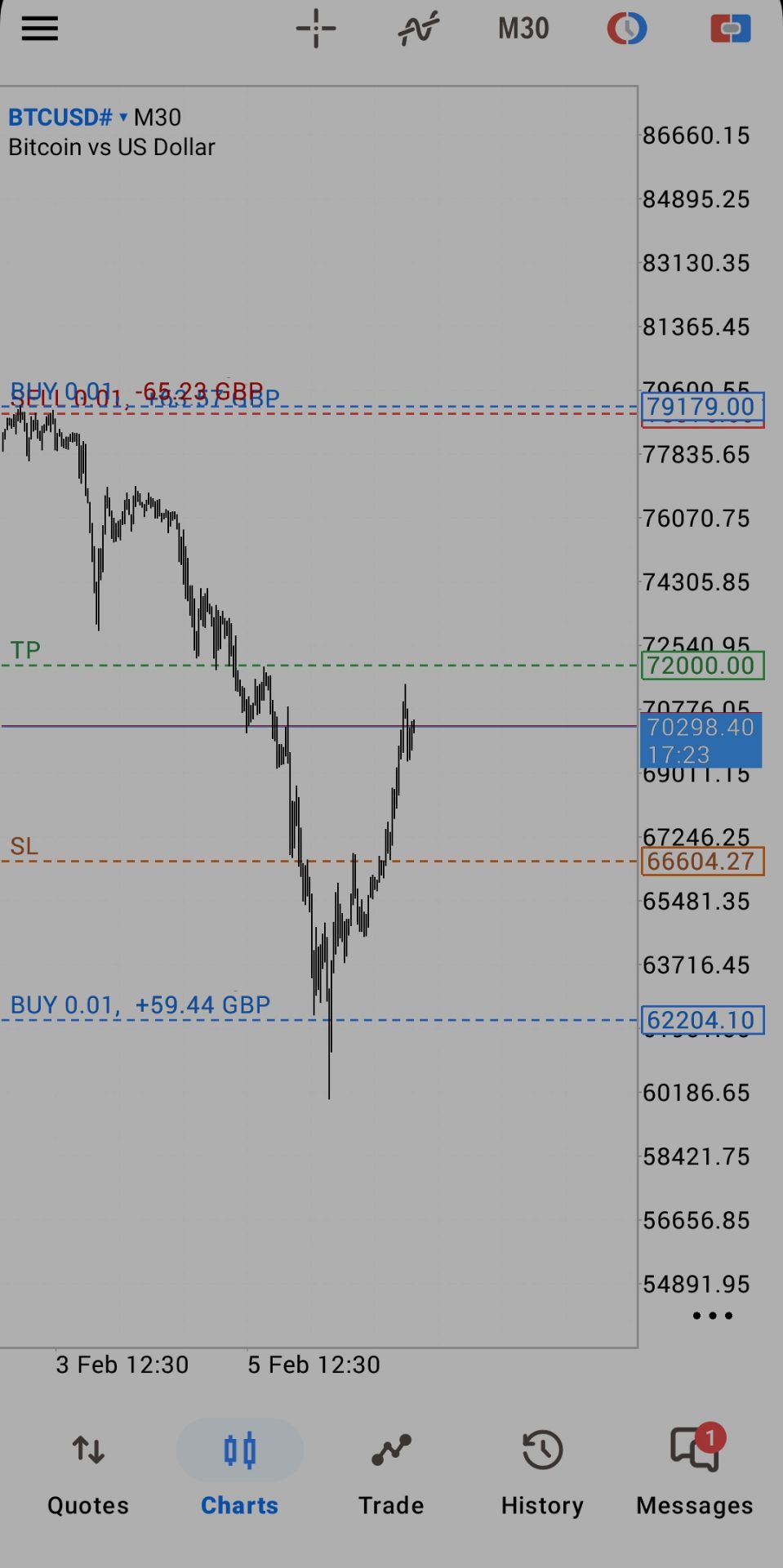
    @EuroTradermaybe yes, maybe if the price approaches my TP at 72k I will move it up again
    Nawhdir Øt flag
    Nawhdir Øt
    but I have to raise SL+ too
    Nawhdir Øt flag
    My SL is already higher, currently at 66604. from the 61K entry
    EuroTrader flag
    Nawhdir Øt
    @Nawhdir ØtOkay but what's important is that price is moving in your direction
    EuroTrader flag
    Nawhdir Øt
    My SL is already higher, currently at 66604. from the 61K entry
    @Nawhdir ØtMoved to breakeven already cousin. No more risk on the trade
    Nawhdir Øt flag
    EuroTrader
    @EuroTrader:) risk = £0
    EuroTrader flag
    Nawhdir Øt
    @Nawhdir Øtthat's a good one .You have taken the risk off the table. No more risk being incurred
    Taylor98282727q7 flag
    For detailed signals and advice on gold or silver, I use this server, its pretty good: discord.gg/QfyrZsZaTG
    EuroTrader flag
    Nawhdir Øt
    @Nawhdir ØtCousin what's wrong with the yen. The yen is becoming a bad bad boy
    EuroTrader flag
    Taylor98282727q7
    For detailed signals and advice on gold or silver, I use this server, its pretty good: discord.gg/QfyrZsZaTG
    @Taylor98282727q7instead of referring people to anonymous servers how about you share those signals here
    3563843 flag
    the btc is going down
    Eniola Ola flag
    indices
    Eniola Ola flag
    us30 will drop soon
    EuroTrader flag
    3563843
    the btc is going down
    @Visitor3563843what's your long term forecast for Bitcoin. i can see Bitcoin falling to zero
    EuroTrader flag
    Eniola Ola
    us30 will drop soon
    @Eniola OlaWe would have to take a look at gold and also observe what happens between Iran and the United States over the weekend
    SlowBull-Demo flag
    EuroTrader
    @EuroTraderif bitcoin around $1000 we can buy
    Naufal Hab flag
    better to buy zec coins
    Type here...
    Add Symbol or Code

      No matching data

      All
      Trump Updates
      Recommend
      Stocks
      Cryptocurrencies
      Central Banks
      Featured News
      • All
      • Russia-Ukraine Conflict
      • Middle East Flashpoint
      • All
      • Russia-Ukraine Conflict
      • Middle East Flashpoint

      Search
      Products

      Charts Free Forever

      Chats Q&A with Experts
      Screeners Economic Calendar Data Tools
      Membership Features
      Data Warehouse Market Trends Institutional Data Policy Rates Macro

      Market Trends

      Market Sentiment Order Book Forex Correlations

      Top Indicators

      Charts Free Forever
      Markets

      News

      News Analysis 24/7 Columns Education
      From Institutions From Analysts
      Topics Columnists

      Latest Views

      Latest Views

      Trending Topics

      Top Columnists

      Latest Update

      Signals

      Copy Rankings Latest Signals Become a signal provider AI Rating
      Contests
      Brokers

      Overview Brokers Assessment Rankings Regulators News Claims
      Broker listing Forex Brokers Comparison Tool Live Spread Comparison Scam
      Q&A Complaint Scam Alert Videos Tips to Detect Scam
      More

      Business
      Events
      Careers About Us Advertising Help Center

      White Label

      Broker API

      Data API

      Web Plug-ins

      Affiliate Program

      Awards Institution Evaluation IB Seminar Salon Event Exhibition
      Vietnam Thailand Singapore Dubai
      Fans Party Investment Sharing Session
      FastBull Summit BrokersView Expo
      Recent Searches
        Top Searches
          Markets
          News
          Analysis
          User
          24/7
          Economic Calendar
          Education
          Data
          • Names
          • Latest
          • Prev

          View All

          No data

          Scan to Download

          Faster Charts, Chat Faster!

          Download App
          English
          • English
          • Español
          • العربية
          • Bahasa Indonesia
          • Bahasa Melayu
          • Tiếng Việt
          • ภาษาไทย
          • Français
          • Italiano
          • Türkçe
          • Русский язык
          • 简中
          • 繁中
          Open Account
          Search
          Products
          Charts Free Forever
          Markets
          News
          Signals

          Copy Rankings Latest Signals Become a signal provider AI Rating
          Contests
          Brokers

          Overview Brokers Assessment Rankings Regulators News Claims
          Broker listing Forex Brokers Comparison Tool Live Spread Comparison Scam
          Q&A Complaint Scam Alert Videos Tips to Detect Scam
          More

          Business
          Events
          Careers About Us Advertising Help Center

          White Label

          Broker API

          Data API

          Web Plug-ins

          Affiliate Program

          Awards Institution Evaluation IB Seminar Salon Event Exhibition
          Vietnam Thailand Singapore Dubai
          Fans Party Investment Sharing Session
          FastBull Summit BrokersView Expo

          US GDP Growth Slows Markedly, And Inflation Remains The Focus

          ING

          Economic

          Summary:

          US GDP growth slowed to 1.6% annualised in the first quarter of this year, less than half the 3.4% rate recorded in 4Q23, but core inflation was stronger, picking up from a 2% annualised rate to 3.7%.

          Higher inflation catches the markets' eye, rather than weaker growth

          US first quarter GDP growth is an annualised 1.6%, well below the 2.5% consensus expectation, but inflation is hotter with the core PCE deflator up 3.7% annualised versus 3.4% expected. This suggests, assuming no revisions to monthly data, that the core PCE deflator will come in above 0.4% today rather than the current 0.3%MoM consensus forecast. Unsurprisingly, Treasury yields have pushed higher as if that is the case, it makes a near-term Federal Reserve interest rate cut look even more unlikely.
          That said, this inflation number is a quarter-on-quarter annualised measure, so any revisions to October through February could have influenced today's outcome - we won't know until when we get the monthly income and spending report. We could still get a 0.3%MoM, but we have to acknowledge that yesterday’s data makes it look less likely.

          US GDP Growth Slows Markedly, And Inflation Remains The Focus_1

          GDP still running below pre-pandemic trend levels

          In terms of the GDP growth breakdown, consumer spending was softer than thought likely, rising 2.5% annualised, while residential investment was a very firm +13.9%. Business capex was subdued, government spending saw a marked slowdown to 1.2%, while weakness in net trade subtracted 0.9pp from the headline growth rate, and inventories subtracted a further 0.35pp. The chart above shows that while GDP has performed well, the level of output is still a couple of percentage points below where we perhaps could have been had the pandemic not happened, and instead, the economy had continued running at its 2024-19 growth trend.US GDP Growth Slows Markedly, And Inflation Remains The Focus_2
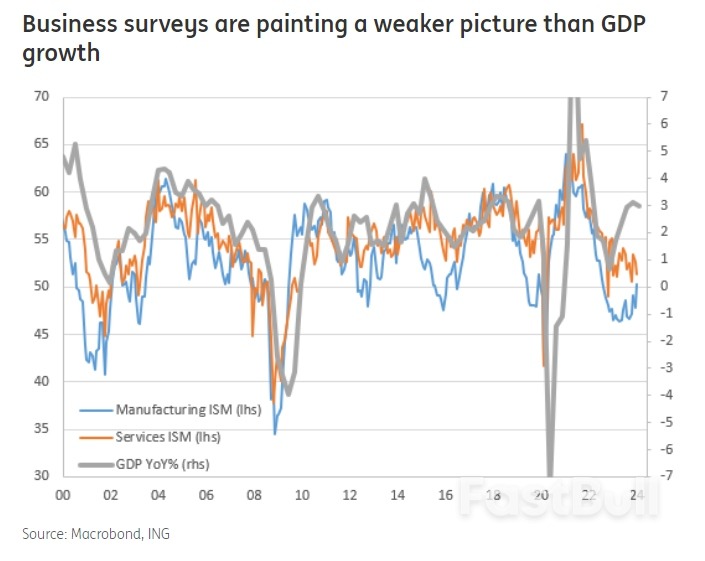
          As for the growth outlook, we expect to see more subdued activity in upcoming quarters. The divergence between business surveys and official data is very wide. We strongly suspect that business caution will translate into weaker hiring and wage growth and subdued business capex, and that will eventually show up in the official GDP data. The move higher in market borrowing costs this year will also weigh on activity and eventually dampen price pressures in the economy. Nonetheless, there is next to no chance of a rate cut before September.
          To stay updated on all economic events of today, please check out our Economic calendar
          Risk Warnings and Disclaimers
          You understand and acknowledge that there is a high degree of risk involved in trading. Following any strategies or investment methods may lead to potential losses. The content on the site is provided by our contributors and analysts for information purposes only. You are solely responsible for determining whether any trading assets, securities, strategy, or any other product is suitable for investing based on your own investment objectives and financial situation.
          Add to Favorites
          Share

          Loonie Loses Luster: Weak Retail Sales Raise Doubts About Rate Cuts (Canadian Dollar weakens vs. USD)

          Warren Takunda

          Forex

          Economic

          The Canadian dollar (CAD) is feeling the heat, falling below the key 1.37 USD level and approaching a five-month low. This decline is primarily driven by two diverging forces: a sluggish Canadian economy and a strengthening US dollar.
          Canadian Consumers Tighten Belts
          Disappointing retail sales data is painting a picture of a Canadian consumer pulling back on spending. The first quarter saw no growth in retail sales, marking the slowest pace since mid-2023. This economic weakness adds pressure to the Bank of Canada (BOC) to consider rate cuts at its upcoming June meeting.
          US Dollar Supported by Rate Hike Bets
          On the other hand, the US dollar is benefiting from expectations of sustained interest rate hikes by the Federal Reserve. Persistent inflation and a robust labor market are fueling this sentiment, even if US GDP growth sputtered in the first quarter. This monetary policy divergence between the US and Canada is making the greenback a more attractive proposition for investors.
          Technical OutlookLoonie Loses Luster: Weak Retail Sales Raise Doubts About Rate Cuts (Canadian Dollar weakens vs. USD) _1
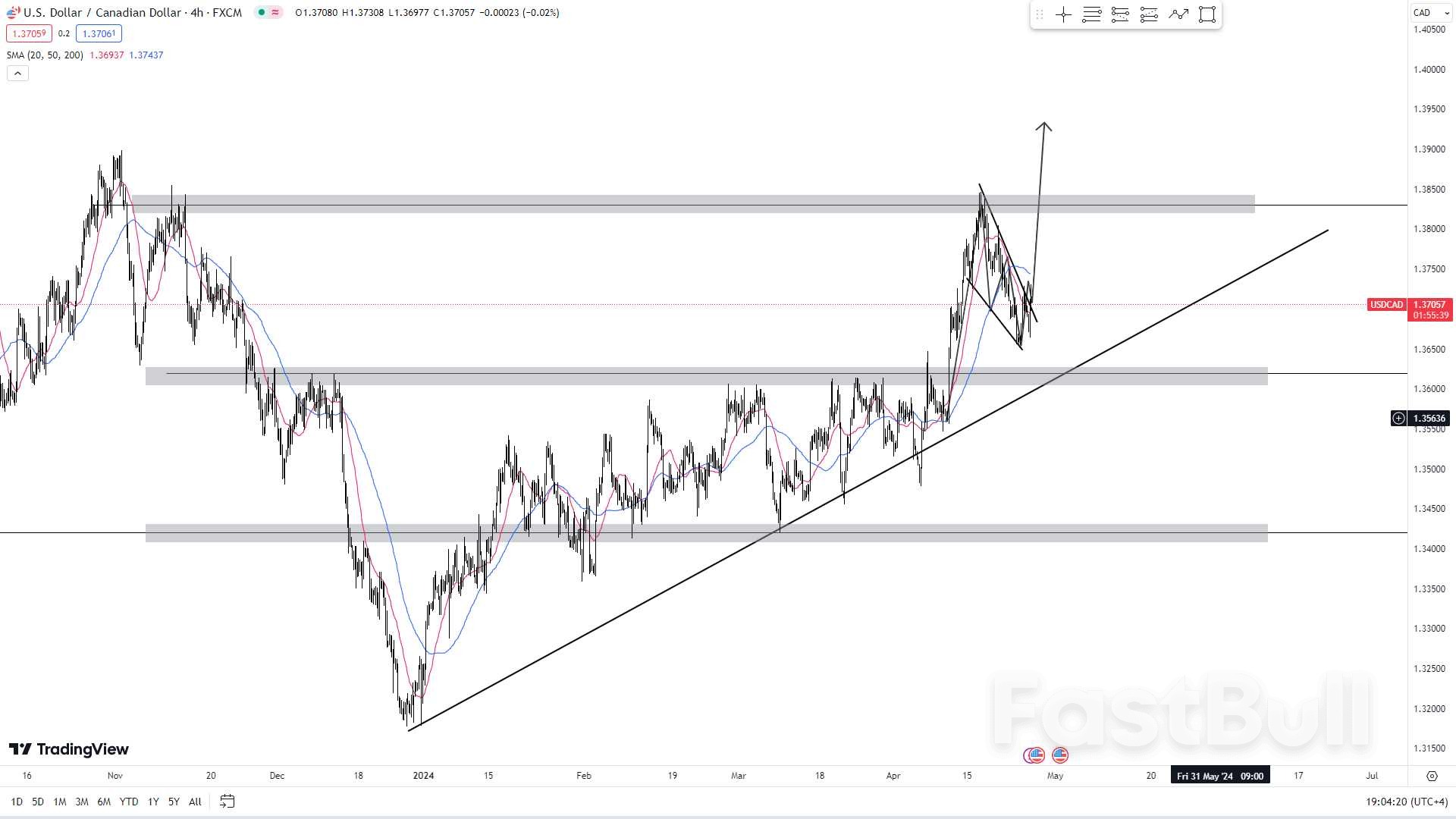
          The technical outlook for the USD/CAD pair presents a mixed picture. Intraday bias currently sits in neutral territory, with the key support level at 1.3660 USD acting as a potential floor. A strong rebound from this level could signal a continuation of the near-term bullishness for the USD/CAD pair. Conversely, a sustained break below 1.3660 USD could trigger a deeper decline, potentially targeting the 55-day exponential moving average (EMA) currently sitting around 1.3592 USD.
          Taking a broader perspective, the recent price action from the 2022 high of 1.3976 USD as a potential corrective pattern within a larger uptrend. This suggests that the current weakness might be a temporary pause before the uptrend resumes. In this scenario, strong support should emerge above the previously broken resistance level of 1.2947 USD, potentially leading to a rebound. A decisive break above 1.3976 USD would definitively confirm a resumption of the entire uptrend that began from the 2021 low of 1.2005 USD. The next potential target on that uptrend path could be the 61.8% projection of the Fibonacci retracement between 1.2401 USD and 1.3976 USD, coming in at approximately 1.4149 USD.
          Shifting to shorter timeframes, particularly the 4-hour and 1-hour charts, the USD/CAD pair has been trading within a descending channel. Recently, the price action exited this channel and hit a resistance level, which is often associated with selling pressure. This presents two potential behavioral scenarios for the 4-hour timeframe.
          The first scenario posits that if the pair is unable to break above the current resistance zone, it could retrace back down to the support level created by the previous order block (OB) that caused the price to jump. This support level would likely be situated around the area where the price exited the descending channel.
          The second scenario takes into account the recent exit from the descending channel. This return to the resistance level could be interpreted as a pullback towards the broken channel before the uptrend continues. However, for this scenario to play out, the pair would need to decisively break above the resistance level and the 61.8% Fibonacci retracement level to target the next potential resistance zone. If this breakout fails to materialize, the first scenario becomes more likely.
          To stay updated on all economic events of today, please check out our Economic calendar
          Risk Warnings and Disclaimers
          You understand and acknowledge that there is a high degree of risk involved in trading. Following any strategies or investment methods may lead to potential losses. The content on the site is provided by our contributors and analysts for information purposes only. You are solely responsible for determining whether any trading assets, securities, strategy, or any other product is suitable for investing based on your own investment objectives and financial situation.
          Add to Favorites
          Share

          March PCE Inflation Index Forecasts Show Mixed Readings On Price Pressures

          Kevin Du

          Economic

          Central Bank

          The March Personal Consumption Expenditures price index is forecast to show a mixed picture of inflation trends, potentially reinforcing the Federal Reserve's resolve to hold off on interest rate hikes.
          Analysts expect the overall PCE Price Index to rise slightly on a year-over-year basis to 2.6% from 2.5% in February, according to FactSet. However, they also predict the index's month-over-month change will fall to 0.30% from 0.33%.
          When volatile food and energy costs are factored out, economists forecast the core PCE inflation index to rise 2.7%, down slightly from a 2.8% year-over-year increase in February. However, the consensus estimate for core PCE inflation is a month-over-month increase to 0.30% from February's 0.26%.
          The Consumer Price Index report usually overshadows the PCE report, but the latter is the Fed's preferred method for tracking inflation. With the CPI showing inflation progress as stalled, the PCE is garnering more attention as Fed officials express dwindling confidence about the potential for inflation to continue its decline toward their 2% target.

          March PCE Report Forecast Highlights

          • PCE report release date and time: Friday, April 26 at 8:30 a.m. EDT.
          • The PCE price index is forecast to rise 0.30% in March after rising by 0.33% in February.
          • Core PCE is forecast to rise 0.30% in March after rising by 0.26% in February.
          • The PCE price index year over year is forecast to rise to 2.6% in March from 2.5% in February.
          • Core PCE year over year is forecast to fall to 2.7% in March from 2.8% in February.

          Stalled Progress On Inflation

          NatWest Markets economist Kevin Cummins wrote that the core PCE deflator “may have advanced by another 0.3% in March. On an unrounded basis, our estimate is a ‘low' 0.3% at 0.256%, which if realized would yield a year-over-year pace of 2.7%, after 2.8% in February and 2.9% in January ... At recent appearances, both Chair Powell and Vice-Chair Jefferson referred to the Fed's estimate of core PCE inflation for March being at 2.8%.”
          Cummins continued: “A 2.8% or a 2.7% year-over-year pace in March would be viewed as insufficient progress on the Fed's inflation mandate ... A reading in line with our estimate would push up the three-month annualized rate of change for the core PCE from 3.5% in February to 3.9% in March, while the six-month annualized rate of change would tick down from 2.9% to 2.7%—both still a bit too far above the Fed's target.”
          March PCE Inflation Index Forecasts Show Mixed Readings On Price Pressures _1
          For the March report, Cummins noted that a 0.4% gain in the March core CPI “was chiefly led by outsized gains in the motor vehicle insurance and medical care services components—both of which do not feed into the core PCE deflator.” At the same time, the components of the core PCE deflator sourced from the Producer Price Index, like airfare and financial services, “are likely to have made a decent positive contribution last month. As a result, we expect a 0.3% increase in the core services ex housing measure—a measure often cited by Chair Powell as being key in bringing inflation back down to 2.0% after a 0.2% uptick in February.”

          Milder Core PCE Inflation

          Morningstar's chief US economist Preston Caldwell sees a mixed report for March but better eventual news for the PCE. “Core PCE for March will be far milder than core CPI, but it's still accelerated to an estimated 3.8% annualized in three months ending in March, up from 1.6% in prior three months,” he says. “However, the largest contributors to the acceleration in core PCE inflation (durables, housing, and financial services) should reverse course in coming months. Slowing economic growth over the next year will provide another negative impulse for inflation.”
          Core CPI has declined significantly from its last peak in September 2022, but its rate of decline has also slowed. Core PCE also peaked in September 2022 with a 5.5% year-over-year increase. It had declined to a 4.8% rate by the end of 2022, then to 2.9% by year-end 2023.
          “Core inflation has continued to trend down on a year-over-year basis, with the core PCE Index reaching 2.7% year over year in March by our estimate, down from 2.9% as of December 2023,” explains Caldwell. “Core CPI is running a good deal higher at 3.8% year over year, with the gap versus the core PCE Index being driven largely by the former's much higher weight in housing, where inflation is running hot ... However, zooming in to a higher-frequency measure, we have seen core PCE inflation jump to about 3.8% annualized in the three months ending in March, up from 1.6% in the three months ending in December 2023.”
          Caldwell points to durable goods inflation as a key factor keeping core PCE elevated: “Given that supply chain conditions remain improved, we expect durables to dip back into deflationary territory. Housing inflation has remained stubbornly high, but leading-edge data still strongly points to a normalization of housing inflation being around the corner.”
          Core CPI has declined significantly from its last peak in September 2022, but its rate of decline has also slowed. Core PCE also peaked in September 2022 with a 5.5% year-over-year increase. It had declined to a 4.8% rate by the end of 2022, then to 2.9% by year-end 2023.
          “Core inflation has continued to trend down on a year-over-year basis, with the core PCE Index reaching 2.7% year over year in March by our estimate, down from 2.9% as of December 2023,” explains Caldwell. “Core CPI is running a good deal higher at 3.8% year over year, with the gap versus the core PCE Index being driven largely by the former's much higher weight in housing, where inflation is running hot ... However, zooming in to a higher-frequency measure, we have seen core PCE inflation jump to about 3.8% annualized in the three months ending in March, up from 1.6% in the three months ending in December 2023.”
          Caldwell points to durable goods inflation as a key factor keeping core PCE elevated: “Given that supply chain conditions remain improved, we expect durables to dip back into deflationary territory. Housing inflation has remained stubbornly high, but leading-edge data still strongly points to a normalization of housing inflation being around the corner.”

          Source: Morning Star

          To stay updated on all economic events of today, please check out our Economic calendar
          Risk Warnings and Disclaimers
          You understand and acknowledge that there is a high degree of risk involved in trading. Following any strategies or investment methods may lead to potential losses. The content on the site is provided by our contributors and analysts for information purposes only. You are solely responsible for determining whether any trading assets, securities, strategy, or any other product is suitable for investing based on your own investment objectives and financial situation.
          Add to Favorites
          Share

          FX Daily: When the Second Decimal Place Counts

          ING

          Economic

          Forex

          USD: Reading through the first quarter data tea leaves

          There has been much speculation this week over the outcome of tomorrow's release of the US March core PCE data. Remember this is the Fed'eral Reserve's preferred measure of inflation, and there is a strong consensus behind a 0.3% month-on-month reading. Such an outcome would again be too hot for the Fed's disinflation narrative and would keep expectations of the 2024 Fed easing cycle contained. Just 41bp of Fed easing is currently priced.
          But today's release of the full first quarter of 2024's core PCE deflator can provide clues for tomorrow's number. This data is released on a quarter-on-quarter annualised basis, and the consensus for today's reading is 3.4% (QoQ annualised). Assuming there are no revisions to the October-Februray data (we only find that out on Friday), analysts will today be looking at the first quarter data to extract the March reading. A 3.42% release for today's first quarter data would imply a 0.3% MoM release for tomorrow's March data, whereas a 3.40% figure would imply a 0.2% MoM release tomorrow. Equally, a 3.55% release would imply quite a bad 0.4% MoM figure and probably trigger more bearish flattening of the US yield curve and dollar strength.
          In short, today's first quarter core PCE deflator could be quite a market mover. We think the risks from this are pretty symmetric for the dollar. Long dollars is quite a crowded trade, and a fairly sharp sell-off in the dollar earlier this week on the back of the soft US PMI readings served as a reminder that long dollar positions are not bulletproof. Equally, however, signs of a 0.4% MoM reading tomorrow could see Fed easing expectations cut back to just 25bp and send DXY back to 106.50 – and perhaps 107.00. Such an outcome would probably send USD/JPY sharply higher again and heighten intervention risk – see more details on this below.

          EUR: Down, but not out

          EUR/USD has found some stability this week on the back of marginally quieter geopolitical conditions and some emerging signs of growth in the eurozone economy. Surprisingly, a June rate cut from the European Central Bank is not fully priced yet (just 73% probability) and the ECB seems to be managing communication carefully as to what happens after the June rate cut.
          EUR/USD will be driven by the US data release today. Technically, EUR/USD could stall around current levels (1.0710) and any break above 1.0725/45 today (were the US price data to come in on the soft side) would have to prompt a re-assessment of a near-term 1.05 scenario in EUR/USD.
          Elsewhere in the EMEA space today, we have a Central Bank of Turkey rate meeting. Our Chief Economist in Turkey, Muhammet Mercan, thinks that after an unexpectedly strong 500bp rate hike last month, plus a large set of macro-prudential measures, the CBT will prefer to see the impact of the tightening on the inflation outlook and keep its policy rate unchanged at 50% this month.

          GBP: False start on the sell-off

          Just as we started to get excited about an important leg lower in sterling earlier this week, Bank of England Chief Economist, Huw Pill, poured cold water over the sterling sell-off. This leaves the market a little confused over the direction of travel for the insiders on the UK MPC committee. We certainly like sterling lower this year as the restrictive 5.25% policy rate gets cut for an economy running a negative output gap. The timing of the sterling sell-off remains a little unclear, however.
          We would say the chances of a significant BoE communication shift at the 9 May meeting have been reduced after those comments from Pill. Though, EUR/GBP can probably now trade in a slightly higher 0.8550-0.8650 range.

          JPY: Intervention watch

          USD/JPY is now trading above 155 – the level that most had expected to trigger Japanese FX intervention. While we do believe that last week's trilateral meeting of US, Japanese and Korean finance ministers was an important one for the intervention story, the joint press release was necessary but not sufficient for intervention. The sufficiency has to come from market conditions and one can argue we are not there yet.
          For example, when the Bank of Japan first came in to the market to sell $20bn on a single day in September 2022, one-month USD/JPY implied volatility had been trading in a 12-15% range. And USD/JPY had seen a 20-day rate of change in the 5-8% area. Currently, one-month traded volatility is still sub 10% and the 20-day rate of change is far more modest at closer to 3%. It will therefore be tough for the Japanese to argue they are responding to disorderly FX moves.
          Were the US data to point to a 0.4% MoM March core PCE release tomorrow, USD/JPY could spike into the 156/157 and bring us closer to BoJ intervention. But those who argue intervention will not come until closer to 160 do have a point.
          To stay updated on all economic events of today, please check out our Economic calendar
          Risk Warnings and Disclaimers
          You understand and acknowledge that there is a high degree of risk involved in trading. Following any strategies or investment methods may lead to potential losses. The content on the site is provided by our contributors and analysts for information purposes only. You are solely responsible for determining whether any trading assets, securities, strategy, or any other product is suitable for investing based on your own investment objectives and financial situation.
          Add to Favorites
          Share

          Weekly Report on US Unemployment Insurance Claims

          Ukadike Micheal

          Forex

          Economic

          In the week ending April 20, the seasonally adjusted initial claims for unemployment insurance decreased by 5,000 to 207,000, compared to the previous week's level of 212,000. This decline suggests potential stability in the labor market, indicating fewer individuals filing for unemployment benefits, which could signify improved employment conditions.
          Meanwhile, the 4-week moving average, a more stable indicator that smooths out weekly fluctuations, declined by 1,250 to 213,250 from the previous week's average of 214,500. This consistent downward trend in the moving average implies a sustained decrease in initial claims over a longer period, reinforcing the notion of potential strengthening in the labor market.
          On the other hand, the advance seasonally adjusted insured unemployment rate remained unchanged at 1.2 percent for the week ending April 13. While this rate remained stable, it's crucial to monitor any shifts in insured unemployment rates, as they reflect the proportion of individuals receiving unemployment benefits relative to the total workforce.
          The number of insured unemployment claims decreased by 15,000 to 1,781,000 from the previous week's revised level, indicating a decline in the number of individuals receiving unemployment benefits. This decrease suggests potential improvements in reemployment opportunities or individuals transitioning out of unemployment.
          Examining the unadjusted data, there was a notable decrease of 7,363 in actual initial claims under state programs, totaling 201,619 for the week ending April 20. While seasonal factors typically influence unemployment claims, the decrease observed exceeded the expected decline, indicating potential positive shifts in labor market dynamics.
          Similarly, the unadjusted insured unemployment rate remained unchanged at 1.2 percent for the week ending April 13. However, the number of insured unemployment claims in state programs decreased by 27,685 to 1,820,655 from the preceding week. This substantial decrease suggests a decline in the number of individuals receiving unemployment benefits, potentially signaling improvements in labor market conditions at the state level.
          Moreover, the total number of continued weeks claimed for benefits in all programs for the week ending April 6 was 1,873,546, representing a decrease of 79,491 from the previous week. This decline in continued weeks claimed for benefits indicates potential progress in individuals exiting unemployment and reentering the workforce or finding alternative sources of income.
          Despite the overall positive trends observed in the unemployment insurance weekly claims report, it's essential to acknowledge regional disparities and demographic differences in unemployment rates and initial claims. For instance, certain states experienced higher insured unemployment rates, indicating ongoing challenges in specific labor markets.
          Additionally, fluctuations in initial claims across states highlight the uneven economic recovery from the COVID-19 pandemic and underscore the importance of targeted policy interventions to support vulnerable populations and industries disproportionately affected by the crisis.
          The latest unemployment insurance weekly claims report provides valuable insights into the evolving dynamics of the labor market. While declines in initial claims and insured unemployment rates suggest potential improvements in employment conditions, continued monitoring and proactive measures are necessary to ensure a robust and inclusive recovery for all segments of society.

          Source: U.S. Department of Labour

          To stay updated on all economic events of today, please check out our Economic calendar
          Risk Warnings and Disclaimers
          You understand and acknowledge that there is a high degree of risk involved in trading. Following any strategies or investment methods may lead to potential losses. The content on the site is provided by our contributors and analysts for information purposes only. You are solely responsible for determining whether any trading assets, securities, strategy, or any other product is suitable for investing based on your own investment objectives and financial situation.
          Add to Favorites
          Share

          First Quarter 2024 Gross Domestic Product (Advance Estimate)

          Ukadike Micheal

          Economic

          Forex

          The "advance" estimate from the Bureau of Economic Analysis indicates that real gross domestic product (GDP) in the first quarter of 2024 increased at an annual rate of 1.6 percent, down from the 3.4 percent growth recorded in the fourth quarter of 2023. This preliminary estimate is subject to further revision as more complete data becomes available, with the "second" estimate scheduled for release on May 30, 2024.
          The growth in real GDP was primarily driven by increases in consumer spending, residential fixed investment, nonresidential fixed investment, and state and local government spending, although these were partly offset by a decrease in private inventory investment. Notably, imports, which are subtracted from GDP calculations, also increased.
          Consumer spending saw an increase in services, particularly in healthcare and financial services, partially offset by a decrease in goods purchases, notably in motor vehicles and parts. Residential fixed investment rose, led by brokers' commissions and new single-family housing construction, while nonresidential fixed investment saw an increase mainly in intellectual property products. State and local government spending rose due to increased compensation, while inventory investment declined, driven by decreases in wholesale trade and manufacturing.
          Compared to the previous quarter, the slowdown in real GDP growth was primarily attributed to decelerations in consumer spending, exports, and state and local government spending, alongside a downturn in federal government spending. However, residential fixed investment accelerated, and imports saw an uptick.
          In terms of current-dollar GDP, there was a 4.8 percent increase at an annual rate in the first quarter, reaching $28.28 trillion, compared to a 5.1 percent increase in the fourth quarter. The price index for gross domestic purchases rose by 3.1 percent in the first quarter, with the personal consumption expenditures (PCE) price index increasing by 3.4 percent, driven by food and energy prices.
          Personal income also saw growth, with current-dollar personal income increasing by $407.1 billion in the first quarter, primarily due to increases in compensation and personal current transfer receipts. Disposable personal income rose by 4.5 percent, while real disposable personal income increased by 1.1 percent.
          While the GDP growth rate in the first quarter of 2024 reflects a slowdown compared to the previous quarter, various sectors of the economy continue to show resilience and growth. As more comprehensive data becomes available, further insights will emerge regarding the trajectory of economic recovery and potential implications for market dynamics.

          Source: Bureau of Economic Analysis

          To stay updated on all economic events of today, please check out our Economic calendar
          Risk Warnings and Disclaimers
          You understand and acknowledge that there is a high degree of risk involved in trading. Following any strategies or investment methods may lead to potential losses. The content on the site is provided by our contributors and analysts for information purposes only. You are solely responsible for determining whether any trading assets, securities, strategy, or any other product is suitable for investing based on your own investment objectives and financial situation.
          Add to Favorites
          Share

          Bitcoin Short Liquidation Risk Surges as BTC Price Dips Under $64K

          Warren Takunda

          Economic

          Cryptocurrency

          Bitcoin traded lower on April 25 after a fresh knee-jerk reaction to geopolitical news cost bulls up to 5%.Bitcoin Short Liquidation Risk Surges as BTC Price Dips Under $64K_1

          BTC/USD 1-hour chart.

          BTC price stays sensitive to Middle East

          Data from Cointelegraph Markets Pro and TradingView showed BTC price action attempting to form support at $64,000 prior to the Wall Street open.
          This followed a dip to $63,575 around the previous daily close, resulting from renewed Middle East tensions.
          According to the latest figures from monitoring resource CoinGlass, liquidity increased on both sides of the spot price across crypto exchanges on the day.
          Notably, a large cloud of asks had appeared, beginning with around $75 million at $64,765 and laddering up to $67,700.
          To the downside, there was comparatively modest bid interest focused on $63,500 — the local low.Bitcoin Short Liquidation Risk Surges as BTC Price Dips Under $64K_2

          Bitcoin liquidation heatmap.Source:CoinGlass

          Bitcoin managed to fill one of two recently-created CME Group futures gaps with its latest downside.
          Commenting on the current status quo, popular trader Daan Crypto Trades reiterated the “healthy” state of funding rates as a basis for a slow but steady BTC price recovery going forward.
          “Keep it this way as we grind up and we should have a solid base for higher. Don’t want to see longs ape back in on the next best green candle,” he wrote in part of commentary on X alongside CoinGlass data.Bitcoin Short Liquidation Risk Surges as BTC Price Dips Under $64K_3

          Bitcoin funding rates heatmap (screenshot). Source: CoinGlass

          In the latest edition of its “New York Color” market updates sent to Telegram channel subscribers on April 24, trading firm QCP Capital revealed shifting crypto sentiment on low-timeframes.
          “The market is expecting upside to be capped and for spot price to consolidate in the short term,” it wrote.

          Bitcoin ETF flows tread water

          Meanwhile, the United States’ spot Bitcoin exchange-traded funds (ETFs) returned to net outflows on April 24.
          These were driven mostly by outflows from the Grayscale Bitcoin Trust (GBTC), data from sources including United Kingdom-based investment firm Farside shows.Bitcoin Short Liquidation Risk Surges as BTC Price Dips Under $64K_4

          Bitcoin spot ETF flows (screenshot). Source: Farside

          In an unusual event, as Cointelegraph reported, the largest ETF offering from asset manager BlackRock saw zero inflows.
          Spot ETFs are due to begin trading in Hong Kong on April 30, marking another first for Bitcoin institutional adoption.

          Source: Cointelegraph

          To stay updated on all economic events of today, please check out our Economic calendar
          Risk Warnings and Disclaimers
          You understand and acknowledge that there is a high degree of risk involved in trading. Following any strategies or investment methods may lead to potential losses. The content on the site is provided by our contributors and analysts for information purposes only. You are solely responsible for determining whether any trading assets, securities, strategy, or any other product is suitable for investing based on your own investment objectives and financial situation.
          Add to Favorites
          Share
          FastBull
          Copyright © 2026 FastBull Ltd

          728 RM B 7/F GEE LOK IND BLDG NO 34 HUNG TO RD KWUN TONG KLN HONG KONG

          TelegramInstagramTwitterfacebooklinkedin
          App Store Google Play Google Play
          Products
          Charts

          Chats

          Q&A with Experts
          Screeners
          Economic Calendar
          Data
          Tools
          Membership
          Features
          Function
          Markets
          Copy Trading
          Latest Signals
          Contests
          News
          Analysis
          24/7
          Columns
          Education
          Company
          Careers
          About Us
          Contact Us
          Advertising
          Help Center
          Feedback
          User Agreement
          Privacy Policy
          Personal Information Protection Statement
          Business

          White Label

          Broker API

          Data API

          Web Plug-ins

          Poster Maker

          Affiliate Program

          Risk Disclosure

          The risk of loss in trading financial instruments such as stocks, FX, commodities, futures, bonds, ETFs and crypto can be substantial. You may sustain a total loss of the funds that you deposit with your broker. Therefore, you should carefully consider whether such trading is suitable for you in light of your circumstances and financial resources.

          No decision to invest should be made without thoroughly conducting due diligence by yourself or consulting with your financial advisors. Our web content might not suit you since we don't know your financial conditions and investment needs. Our financial information might have latency or contain inaccuracy, so you should be fully responsible for any of your trading and investment decisions. The company will not be responsible for your capital loss.

          Without getting permission from the website, you are not allowed to copy the website's graphics, texts, or trademarks. Intellectual property rights in the content or data incorporated into this website belong to its providers and exchange merchants.

          Not Logged In

          Log in to access more features

          Connect Broker
          Become a signal provider
          Help Center
          Customer Service
          Dark Mode
          Price Up/Down Colors

          Log In

          Sign Up

          Position
          Layout
          Fullscreen
          Default to Chart
          The chart page opens by default when you visit fastbull.com