• Trade
  • Markets
  • Copy
  • Contests
  • News
  • 24/7
  • Calendar
  • Q&A
  • Chats
Trending
Screeners
SYMBOL
LAST
BID
ASK
HIGH
LOW
NET CHG.
%CHG.
SPREAD
SPX
S&P 500 Index
6857.13
6857.13
6857.13
6865.94
6827.13
+7.41
+ 0.11%
--
DJI
Dow Jones Industrial Average
47850.93
47850.93
47850.93
48049.72
47692.96
-31.96
-0.07%
--
IXIC
NASDAQ Composite Index
23505.13
23505.13
23505.13
23528.53
23372.33
+51.04
+ 0.22%
--
USDX
US Dollar Index
98.770
98.850
98.770
98.980
98.760
-0.210
-0.21%
--
EURUSD
Euro / US Dollar
1.16673
1.16680
1.16673
1.16681
1.16408
+0.00228
+ 0.20%
--
GBPUSD
Pound Sterling / US Dollar
1.33567
1.33578
1.33567
1.33585
1.33165
+0.00296
+ 0.22%
--
XAUUSD
Gold / US Dollar
4230.22
4230.63
4230.22
4230.54
4194.54
+23.05
+ 0.55%
--
WTI
Light Sweet Crude Oil
59.378
59.415
59.378
59.469
59.187
-0.005
-0.01%
--

Community Accounts

Signal Accounts
--
Profit Accounts
--
Loss Accounts
--
View More

Become a signal provider

Sell trading signals to earn additional income

View More

Guide to Copy Trading

Get started with ease and confidence

View More

Signal Accounts for Members

All Signal Accounts

Best Return
  • Best Return
  • Best P/L
  • Best MDD
Past 1W
  • Past 1W
  • Past 1M
  • Past 1Y

All Contests

  • All
  • Trump Updates
  • Recommend
  • Stocks
  • Cryptocurrencies
  • Central Banks
  • Featured News
Top News Only
Share

Equinor: Preliminary Estimates Indicate Reservoirs May Contain Between 5 -18 Million Standard Cubic Meters Of Recoverable Oil Equivalents

Share

Japan Chief Cabinet Secretary Kihara: Government To Take Appropriate Steps On Excessive And Disorderly Moves In Foreign Exchange Market, If Necessary

Share

[Report: Amazon Pays €180 Million To Italy To End Tax And Labor Investigations] Amazon Has Paid A Settlement And Dismantled Its Monitoring System For Delivery Drivers In Italy, Ending An Investigation Into Alleged Tax Fraud And Illegal Labor Practices. In July 2024, The Group's Logistics Services Division Was Accused Of Circumventing Labor And Tax Laws By Relying On Cooperatives Or Limited Liability Companies To Supply Workers, Evading VAT, And Reducing Social Security Payments. Sources Say The Group Has Now Paid Approximately €180 Million To Italian Tax Authorities As Part Of A €1 Billion Settlement Involving 33 Companies

Share

Airbus - Booked 797 Gross Aircraft Orders In January-November

Share

[Market Update] Spot Gold Broke Through $4,230 Per Ounce, Up 0.51% On The Day

Share

Reserve Bank Of India Chief Malhotra: There Will Be Ample Liquidity As Long As We Are In An Easing Cycle

Share

Reserve Bank Of India Chief Malhotra: Quantum Of System Liquidity Will Be Managed To Ensure Monetary Transmission Is Happening

Share

China's Foreign Ministry: World Bank, IMF, WTO Top Officials To Join

Share

China's Foreign Ministry: China To Hold 1+1 Dialogue With International Economic Orgs On Dec 9

Share

Reserve Bank Of India Chief Malhotra: 5% Of Inr Depreciation Leads To 35 Bps Of Inflation

Share

Eurostoxx 50 Futures Up 0.14%, DAX Futures Up 0.12%, CAC 40 Futures Up 0.26%, FTSE Futures Up 0.03%

Share

Getlink - Over 1 Million Trucks Crossed Channel Since January 2025

Share

Malaysia International Reserves At $124.1 Billion On November 28 Versus$124.1 Billion On November 14 - Central Bank

Share

Reserve Bank Of India Chief Malhotra: Conscious Effort On Diversifying Gold Reserves

Share

Russian President Putin Thanks Indian Prime Minister Modi For Attention To Ukraine Peace Efforts

Share

Russian President Putin: India-Russia Relations Should Grow And Touch New Heights

Share

Russian President Putin: India Is Not Neutral, India Is On The Side Of Peace

Share

Russian President Putin: We Support Every Effort Towards Peace

Share

Russian President Putin: The World Should Return To Peace

Share

India Prime Minister Modi: We Should All Pursue Peace Together

TIME
ACT
FCST
PREV
Euro Zone IHS Markit Construction PMI (Nov)

A:--

F: --

P: --

Italy IHS Markit Construction PMI (Nov)

A:--

F: --

P: --

U.K. Markit/CIPS Construction PMI (Nov)

A:--

F: --

P: --

France 10-Year OAT Auction Avg. Yield

A:--

F: --

P: --

Euro Zone Retail Sales MoM (Oct)

A:--

F: --

P: --

Euro Zone Retail Sales YoY (Oct)

A:--

F: --

P: --

Brazil GDP YoY (Q3)

A:--

F: --

P: --

U.S. Challenger Job Cuts (Nov)

A:--

F: --

P: --

U.S. Challenger Job Cuts MoM (Nov)

A:--

F: --

P: --

U.S. Challenger Job Cuts YoY (Nov)

A:--

F: --

P: --

U.S. Initial Jobless Claims 4-Week Avg. (SA)

A:--

F: --

P: --

U.S. Weekly Initial Jobless Claims (SA)

A:--

F: --

P: --

U.S. Weekly Continued Jobless Claims (SA)

A:--

F: --

P: --

Canada Ivey PMI (SA) (Nov)

A:--

F: --

P: --

Canada Ivey PMI (Not SA) (Nov)

A:--

F: --

P: --

U.S. Non-Defense Capital Durable Goods Orders Revised MoM (Excl. Aircraft) (SA) (Sept)

A:--

F: --

P: --
U.S. Factory Orders MoM (Excl. Transport) (Sept)

A:--

F: --

P: --

U.S. Factory Orders MoM (Sept)

A:--

F: --

P: --

U.S. Factory Orders MoM (Excl. Defense) (Sept)

A:--

F: --

P: --

U.S. EIA Weekly Natural Gas Stocks Change

A:--

F: --

P: --

Saudi Arabia Crude Oil Production

A:--

F: --

P: --

U.S. Weekly Treasuries Held by Foreign Central Banks

A:--

F: --

P: --

Japan Foreign Exchange Reserves (Nov)

A:--

F: --

P: --

India Repo Rate

A:--

F: --

P: --

India Benchmark Interest Rate

A:--

F: --

P: --

India Reverse Repo Rate

A:--

F: --

P: --

India Cash Reserve Ratio

A:--

F: --

P: --

Japan Leading Indicators Prelim (Oct)

A:--

F: --

P: --

U.K. Halifax House Price Index YoY (SA) (Nov)

A:--

F: --

P: --

U.K. Halifax House Price Index MoM (SA) (Nov)

A:--

F: --

P: --

France Current Account (Not SA) (Oct)

--

F: --

P: --

France Trade Balance (SA) (Oct)

--

F: --

P: --

France Industrial Output MoM (SA) (Oct)

--

F: --

P: --

Italy Retail Sales MoM (SA) (Oct)

--

F: --

P: --

Euro Zone Employment YoY (SA) (Q3)

--

F: --

P: --

Euro Zone GDP Final YoY (Q3)

--

F: --

P: --

Euro Zone GDP Final QoQ (Q3)

--

F: --

P: --

Euro Zone Employment Final QoQ (SA) (Q3)

--

F: --

P: --

Euro Zone Employment Final (SA) (Q3)

--

F: --

P: --
Brazil PPI MoM (Oct)

--

F: --

P: --

Mexico Consumer Confidence Index (Nov)

--

F: --

P: --

Canada Unemployment Rate (SA) (Nov)

--

F: --

P: --

Canada Labor Force Participation Rate (SA) (Nov)

--

F: --

P: --

Canada Employment (SA) (Nov)

--

F: --

P: --

Canada Part-Time Employment (SA) (Nov)

--

F: --

P: --

Canada Full-time Employment (SA) (Nov)

--

F: --

P: --

U.S. Personal Income MoM (Sept)

--

F: --

P: --

U.S. Dallas Fed PCE Price Index YoY (Sept)

--

F: --

P: --

U.S. PCE Price Index YoY (SA) (Sept)

--

F: --

P: --

U.S. PCE Price Index MoM (Sept)

--

F: --

P: --

U.S. Personal Outlays MoM (SA) (Sept)

--

F: --

P: --

U.S. Core PCE Price Index MoM (Sept)

--

F: --

P: --

U.S. UMich 5-Year-Ahead Inflation Expectations Prelim YoY (Dec)

--

F: --

P: --

U.S. Core PCE Price Index YoY (Sept)

--

F: --

P: --

U.S. Real Personal Consumption Expenditures MoM (Sept)

--

F: --

P: --

U.S. 5-10 Year-Ahead Inflation Expectations (Dec)

--

F: --

P: --

U.S. UMich Current Economic Conditions Index Prelim (Dec)

--

F: --

P: --

U.S. UMich Consumer Sentiment Index Prelim (Dec)

--

F: --

P: --

U.S. UMich 1-Year-Ahead Inflation Expectations Prelim (Dec)

--

F: --

P: --

U.S. UMich Consumer Expectations Index Prelim (Dec)

--

F: --

P: --

Q&A with Experts
    • All
    • Chatrooms
    • Groups
    • Friends
    Connecting
    .
    .
    .
    Type here...
    Add Symbol or Code

      No matching data

      All
      Trump Updates
      Recommend
      Stocks
      Cryptocurrencies
      Central Banks
      Featured News
      • All
      • Russia-Ukraine Conflict
      • Middle East Flashpoint
      • All
      • Russia-Ukraine Conflict
      • Middle East Flashpoint

      Search
      Products

      Charts Free Forever

      Chats Q&A with Experts
      Screeners Economic Calendar Data Tools
      Membership Features
      Data Warehouse Market Trends Institutional Data Policy Rates Macro

      Market Trends

      Market Sentiment Order Book Forex Correlations

      Top Indicators

      Charts Free Forever
      Markets

      News

      News Analysis 24/7 Columns Education
      From Institutions From Analysts
      Topics Columnists

      Latest Views

      Latest Views

      Trending Topics

      Top Columnists

      Latest Update

      Signals

      Copy Rankings Latest Signals Become a signal provider AI Rating
      Contests
      Brokers

      Overview Brokers Assessment Rankings Regulators News Claims
      Broker listing Forex Brokers Comparison Tool Live Spread Comparison Scam
      Q&A Complaint Scam Alert Videos Tips to Detect Scam
      More

      Business
      Events
      Careers About Us Advertising Help Center

      White Label

      Data API

      Web Plug-ins

      Affiliate Program

      Awards Institution Evaluation IB Seminar Salon Event Exhibition
      Vietnam Thailand Singapore Dubai
      Fans Party Investment Sharing Session
      FastBull Summit BrokersView Expo
      Recent Searches
        Top Searches
          Markets
          News
          Analysis
          User
          24/7
          Economic Calendar
          Education
          Data
          • Names
          • Latest
          • Prev

          View All

          No data

          Scan to Download

          Faster Charts, Chat Faster!

          Download App
          English
          • English
          • Español
          • العربية
          • Bahasa Indonesia
          • Bahasa Melayu
          • Tiếng Việt
          • ภาษาไทย
          • Français
          • Italiano
          • Türkçe
          • Русский язык
          • 简中
          • 繁中
          Open Account
          Search
          Products
          Charts Free Forever
          Markets
          News
          Signals

          Copy Rankings Latest Signals Become a signal provider AI Rating
          Contests
          Brokers

          Overview Brokers Assessment Rankings Regulators News Claims
          Broker listing Forex Brokers Comparison Tool Live Spread Comparison Scam
          Q&A Complaint Scam Alert Videos Tips to Detect Scam
          More

          Business
          Events
          Careers About Us Advertising Help Center

          White Label

          Data API

          Web Plug-ins

          Affiliate Program

          Awards Institution Evaluation IB Seminar Salon Event Exhibition
          Vietnam Thailand Singapore Dubai
          Fans Party Investment Sharing Session
          FastBull Summit BrokersView Expo

          The Week Ahead: Tariffs, Central Banks, and a Shifting Dollar Narrative

          ACY

          Forex

          Economic

          Summary:

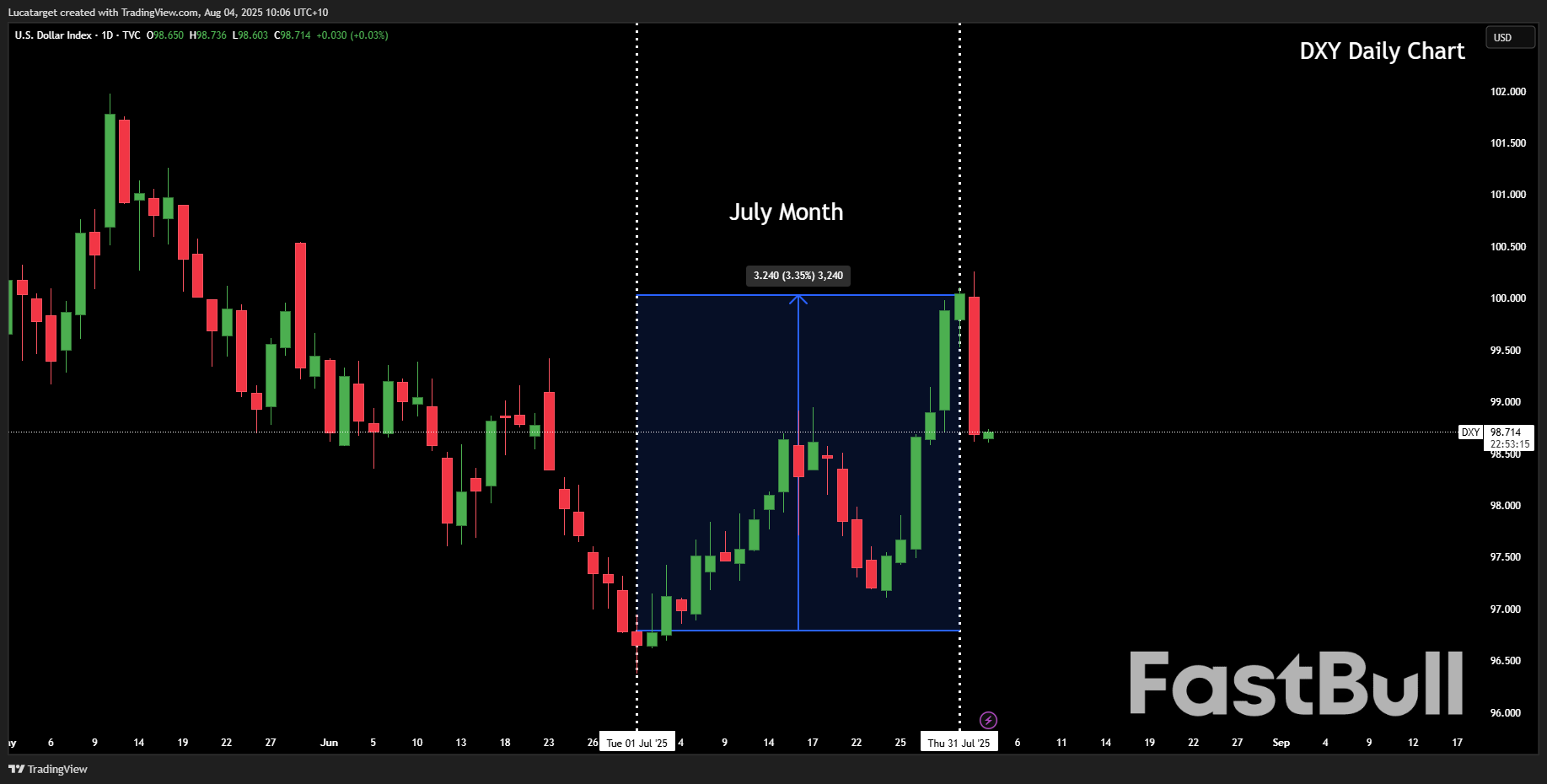
          The dollar (DXY) surged over 3% in July, its biggest monthly gain since April 2022. That strength came on the back of trade optimism, new tariff deals, and a resilient U.S. economy.
          What's Driving the Market Right Now?

          The dollar (DXY) surged over 3% in July, its biggest monthly gain since April 2022. That strength came on the back of trade optimism, new tariff deals, and a resilient U.S. economy. But here’s the thing: markets may be overly optimistic about the economic impact of these tariffs.
          The Week Ahead: Tariffs, Central Banks, and a Shifting Dollar Narrative_1

          Source: TradingView

          As of the end of July, the average effective U.S. tariff rate reached 18.4%, a level we haven’t seen since the 1930s. The real question now is how long that strength can last, especially as we begin to assess the economic fallout. That’s what I’ll be watching this week.

          The Fed Is on Pause, But Jackson Hole Looms

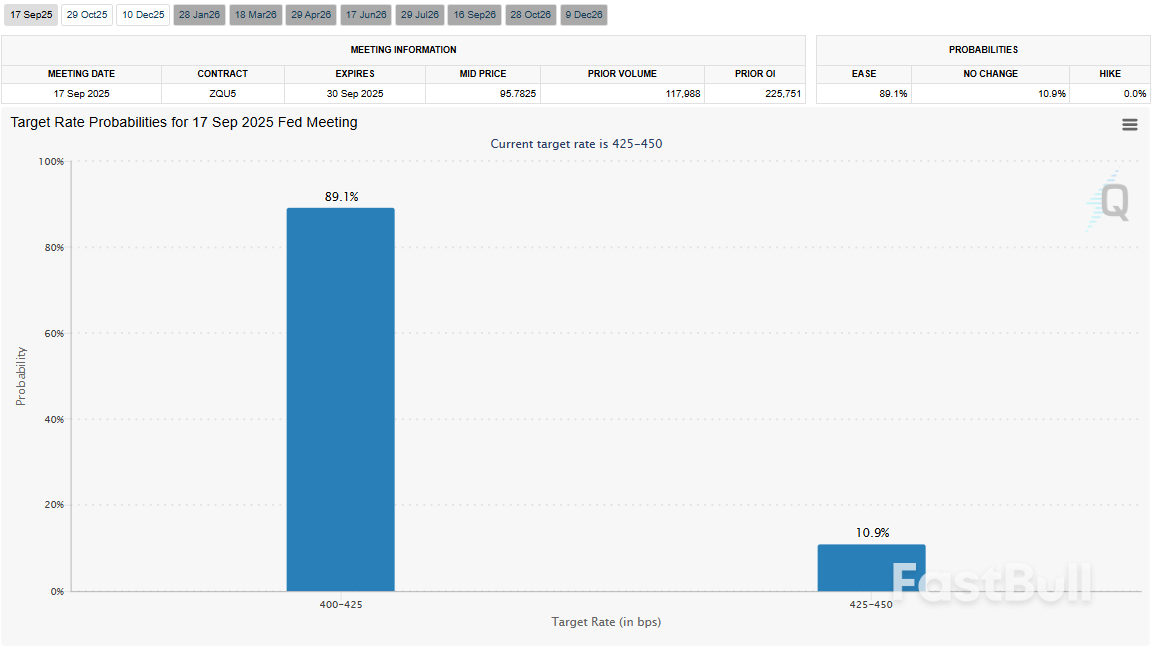
          There’s no FOMC meeting this month, but don’t think the Fed is out of the picture. All eyes are on the Jackson Hole Symposium (22–24 August), where Powell is expected to give an updated view on policy.With last week’s non-farm payrolls coming in far weaker than expected, the probability of a September rate cut has increased. If we get more softness in labor data and signs of tariff-induced inflation, that could be the turning point. Until then, expect the Fed to hold the line.
          The Week Ahead: Tariffs, Central Banks, and a Shifting Dollar Narrative_2

          Central Banks in Focus This Week

          This week is heavy on G10 central bank decisions:
          Bank of England (Aug 7) – A rate cut is almost fully priced in. Inflation is sticky, but growth is soft. Expect internal division at the MPC.Reserve Bank of Australia (Aug 12 next Tuesday) – After a weak June CPI print, I’m leaning toward a 25bp cut. The RBA seems set to proceed gradually.Norges Bank and RBNZ (Aug 14 & 20) – Both are likely to hold, though the RBNZ has around an 80% chance of cutting. I’ll be watching their tone closely.The key theme across all these decisions? Caution. Central banks are moving, but no one wants to go too far too fast.

          FX Pairs I'm Watching

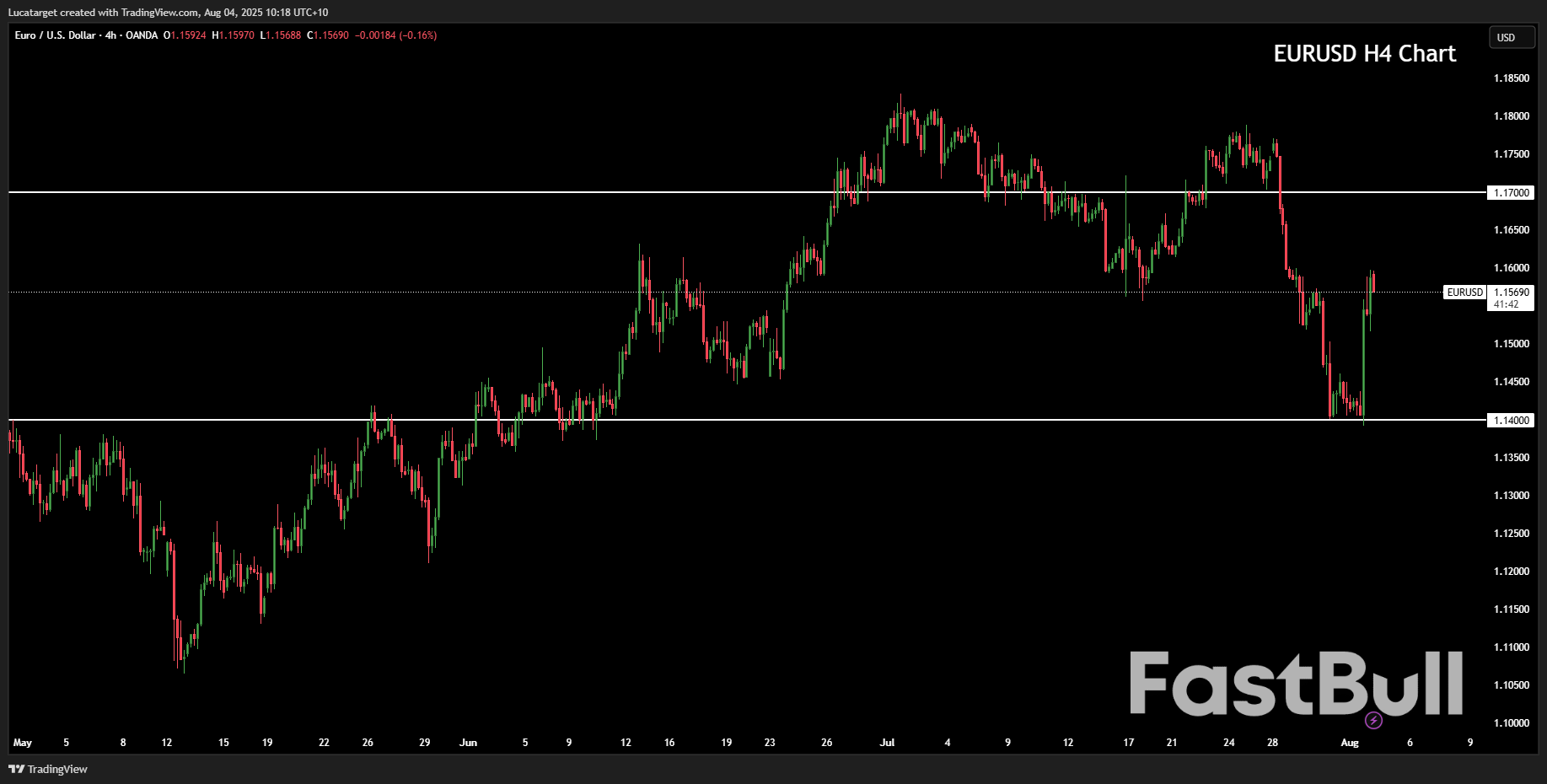
          EUR/USD: After falling from 1.17 to 1.14 in July, I’m now watching for a base around the 1.14 handle. While the EU-US trade deal brought some EUR selling, I think the worst of the positioning flush is behind us. If US data weakens, this pair could push back toward 1.17 by month-end.
          The Week Ahead: Tariffs, Central Banks, and a Shifting Dollar Narrative_3

          Source: TradingView

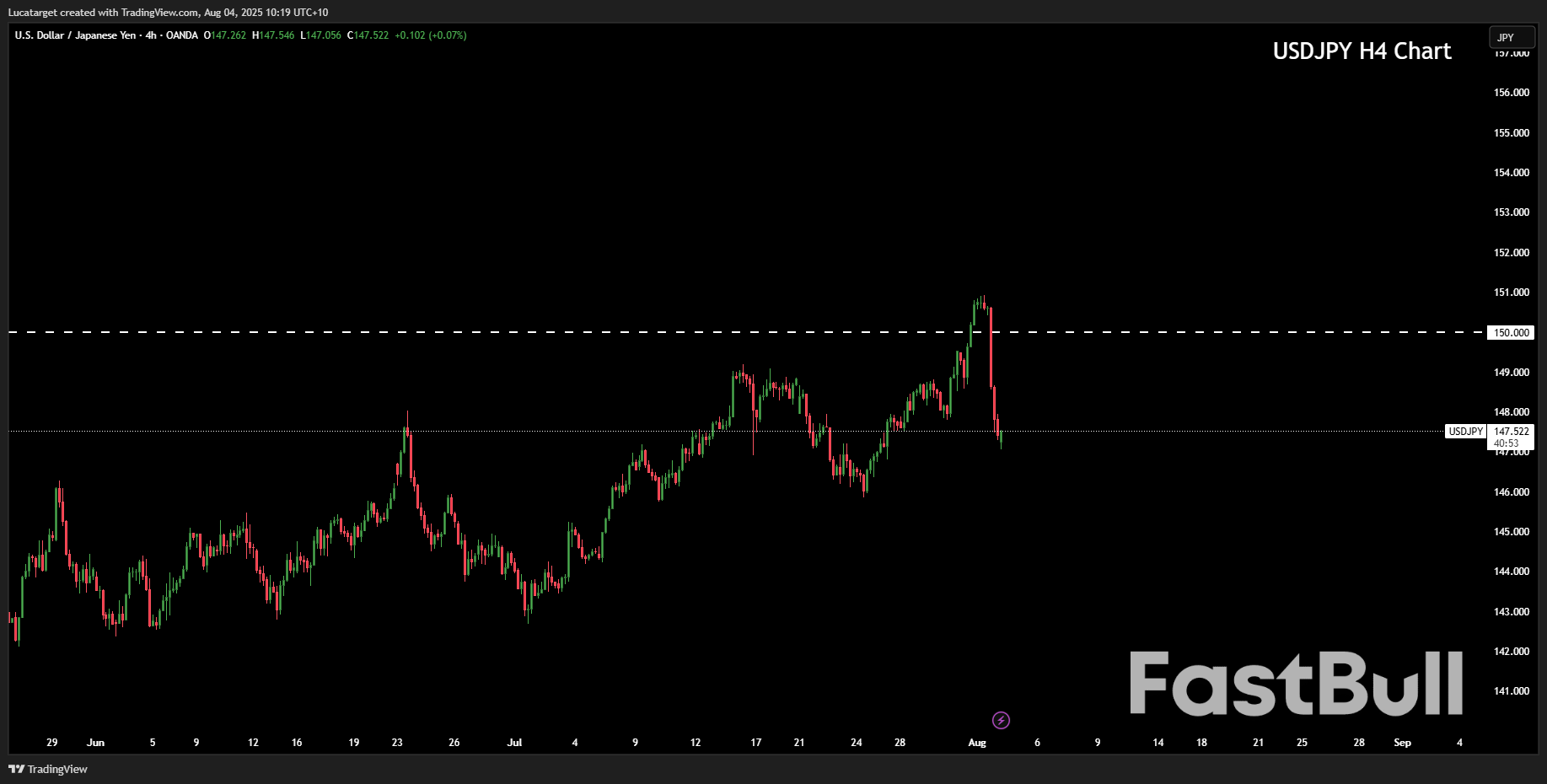
          USD/JPY: The yen sold off sharply last month, breaking through 150. That weakness has been driven more by BoJ caution and Japanese political uncertainty than by US strength. If the BoJ continues dragging its feet on tightening, I wouldn’t be surprised to see 152 tested before we see any retracement.
          The Week Ahead: Tariffs, Central Banks, and a Shifting Dollar Narrative_4

          Source: TradingView

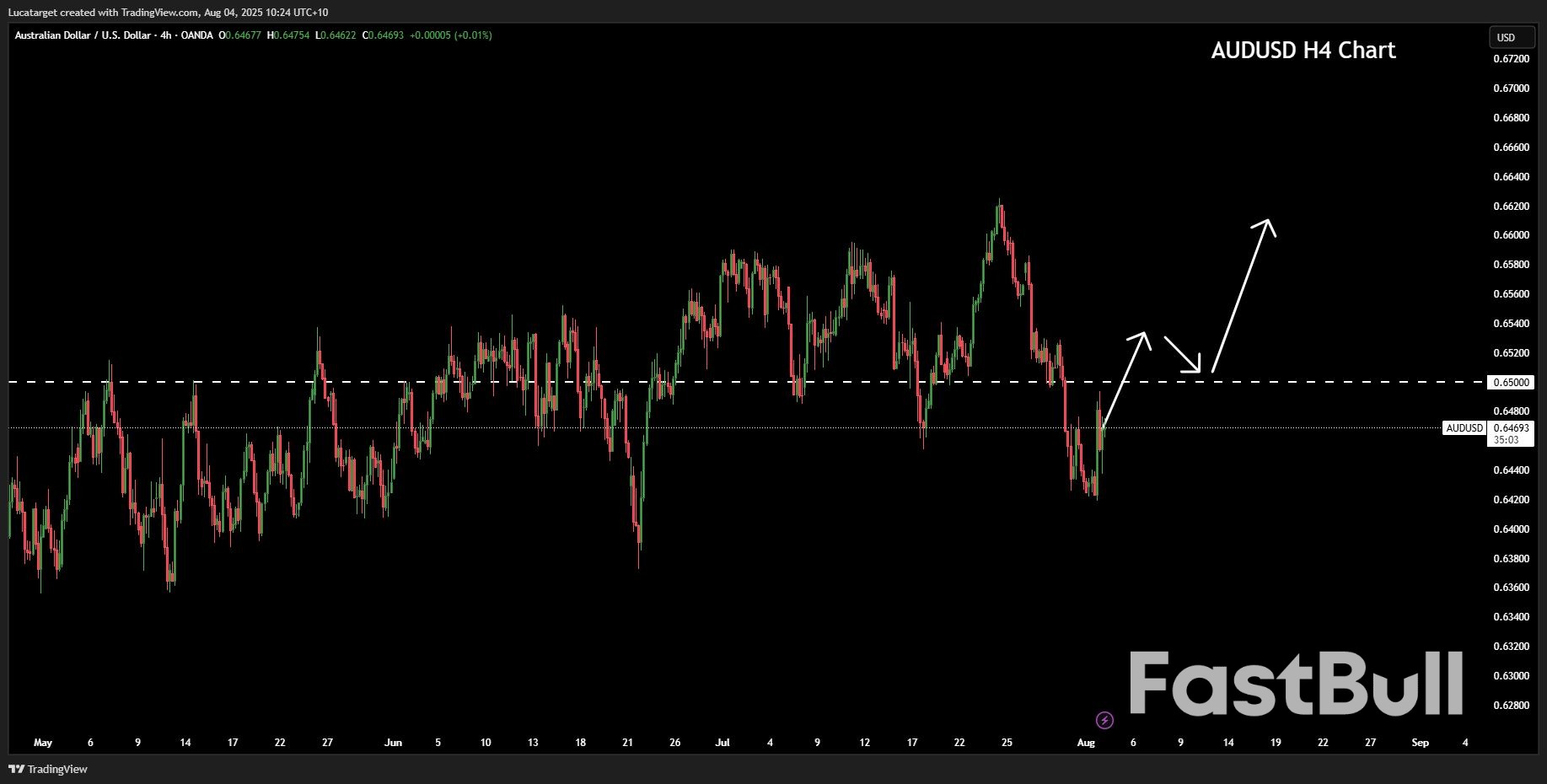
          AUD/USD: This pair remains sensitive to global growth sentiment. With the RBA likely to cut but stay cautious, and the US-China trade narrative stabilizing, I’m watching for a potential bounce above 0.65 if risk sentiment stays firm.
          The Week Ahead: Tariffs, Central Banks, and a Shifting Dollar Narrative_5

          Source: TradingView

          USD/CAD: The Canadian dollar has shown resilience, supported by strong jobs data. But weaker PMI numbers and higher inflation complicate the BoC’s path. I see limited upside for the loonie unless we get a meaningful risk-on wave.

          Emerging Markets: Focus on China and LatAm

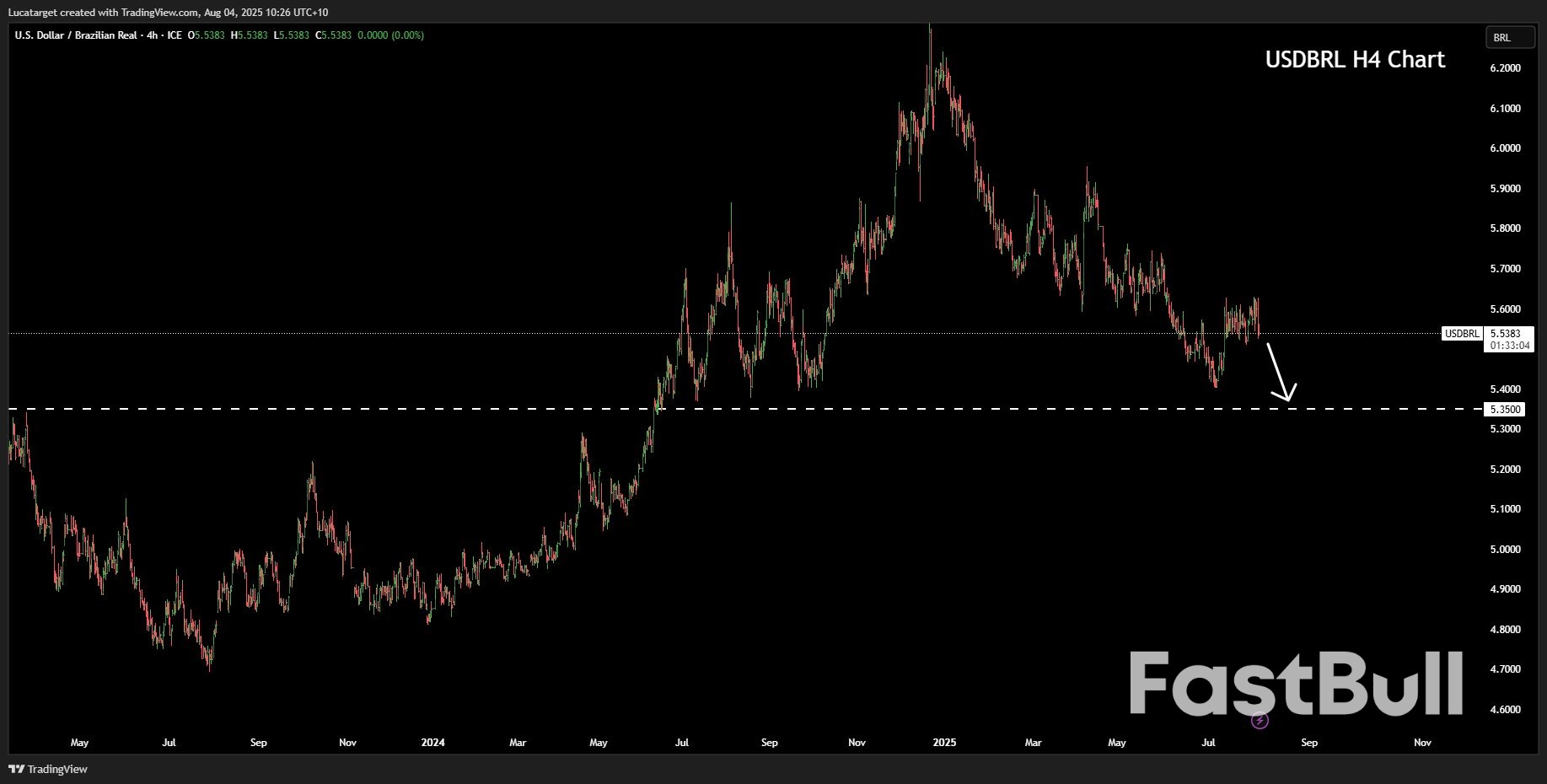
          China’s July Politburo meeting didn’t bring the stimulus fireworks many were hoping for. Still, with 5.3% GDP growth in H1 and new childcare subsidies and social programs on the table, I think Beijing is opting for targeted support over broad stimulus. I’m still cautious on CNY and expect more depreciation pressure unless we see clearer policy shifts in October’s five-year plan announcement.In LatAm, the Brazilian real is catching my attention again. With a spot rate of 5.53 and MUFG forecasting a gradual move toward 5.35, I think BRL still has room to recover, especially if commodities stabilize and political noise stays contained.
          The Week Ahead: Tariffs, Central Banks, and a Shifting Dollar Narrative_6

          Source: TradingView

          We’re in a market driven more by perception than fundamentals right now. The trade deals look good on paper, but the real impact, especially on inflation and global demand, has yet to be felt. If the data starts turning, so will the trades.Until then, I’m staying nimble, focusing on data surprises, and watching rate differentials more than headlines. As always, it’s not just about what the central banks say, it’s about what the market hears.
          1. What is driving the US dollar strength in August 2025?The US dollar has surged due to stronger-than-expected economic resilience, optimism over recent trade deals, and delayed expectations for Fed rate cuts. However, with weaker job data emerging, this trend may soon reverse if the Fed signals easing.
          2. Why is EUR/USD under pressure despite a US-EU trade deal?Although the deal reduced tariff risks, excessive long positioning and strong US economic data led to a correction in EUR/USD. The pair could recover if the Fed leans dovish and US data weakens further.
          3. What central bank decisions should traders watch this week?Key rate decisions from the Bank of England (Aug 7) and Reserve Bank of Australia (Aug 12) are in focus. Both are expected to cut, but forward guidance and economic projections will likely drive the currencies more than the cut itself.
          4. Is the Australian dollar expected to strengthen or weaken?AUD may gradually appreciate if risk sentiment remains stable and the RBA maintains a cautious tone. A potential US-China trade resolution would also support AUD in the medium term.
          5. How does Jackson Hole impact forex trading?The Jackson Hole Symposium (Aug 22–24) is closely watched for Fed Chair Powell’s policy guidance. Any shift toward dovish language or mention of labor market softness could significantly influence USD pairs.

          Source: ACY

          To stay updated on all economic events of today, please check out our Economic calendar
          Risk Warnings and Disclaimers
          You understand and acknowledge that there is a high degree of risk involved in trading. Following any strategies or investment methods may lead to potential losses. The content on the site is provided by our contributors and analysts for information purposes only. You are solely responsible for determining whether any trading assets, securities, strategy, or any other product is suitable for investing based on your own investment objectives and financial situation.
          Add to Favorites
          Share

          US Labor Market Cracks Widen As Job Growth Hits Stall Speed

          Fiona Harper

          U.S. employment growth was weaker than expected in July while the nonfarm payrolls count for the prior two months was revised down by a massive 258,000 jobs, suggesting a sharp deterioration in labor market conditions that puts a September interest rate cut by the Federal Reserve back on the table.

          The Labor Department's closely watched employment report on Friday also showed the unemployment rate rose to 4.2% last month as household employment declined. Labor market resilience has shored up the economy amid headwinds from President Donald Trump's aggressive trade and immigration policies.Import duties are starting to boost inflation, raising the risk that the economy could experience a period of tepid growth and high prices, known as stagflation, which would put the U.S. central bank in a difficult position. Domestic demand increased at its slowest pace in 2-1/2 years in the second quarter.

          "The president's unorthodox economic agenda and policies may be starting to make a dent in the labor market," said Christopher Rupkey, chief economist at FWDBONDS. "The door to a Fed rate cut in September just got opened a crack wider. The labor market is not rolling over, but it is badly wounded and may yet bring about a reversal in the U.S. economy's fortunes."

          Nonfarm payrolls increased by 73,000 jobs last month after rising by a downwardly revised 14,000 in June, the fewest in nearly five years, the Labor Department's Bureau of Labor Statistics said. Economists polled by Reuters had forecast payrolls would increase by 110,000 jobs after rising by a previously reported 147,000 in June. Estimates ranged from no jobs added to an increase of 176,000 positions.Payrolls for May were slashed by 125,000 to only a gain of 19,000 jobs. The BLS described the revisions to May and June payrolls data as "larger than normal."

          It gave no reason for the revised data but noted that "monthly revisions result from additional reports received from businesses and government agencies since the last published estimates and from the recalculation of seasonal factors."

          Economists have raised concerns about data quality in the wake of the Trump administration's mass firings of federal workers.

          Employment gains averaged 35,000 jobs per month over the last three months compared to 123,000 a year ago. Uncertainty over where tariff levels will eventually settle has made it harder for businesses to plan long-term, economists said.

          Though more clarity has emerged as the White House announced trade deals, economists said the effective tariff rate was still the highest since the 1930s. Trump on Thursday slapped dozens of trading partners with steep tariffs, including a 35% duty on many goods from Canada.

          Trump, who has demanded the U.S. central bank lower borrowing costs, stepped up his insults aimed at Fed Chair Jerome Powell, posting on the Truth Social media platform, "Too Little, Too Late. Jerome "Too Late" Powell is a disaster."

          The Fed on Wednesday left its benchmark interest rate in the 4.25%-4.50% range. Powell's comments after the decision undercut confidence the central bank would resume its policy easing in September as had been widely anticipated by financial markets and some economists.

          Powell is focused on the unemployment rate. Financial markets now expect the Fed to resume its monetary policy easing next month after pushing back rate-cut expectations to October in the wake of Wednesday's policy decision.

          The case for a September rate cut could be reinforced by the BLS' preliminary payrolls benchmark revision next month, which is expected to project a steep drop in the employment level from April 2024 through March of this year.

          The Quarterly Census of Employment and Wages data, derived from reports by employers to the state unemployment insurance programs, has indicated a much slower pace of job growth between April 2024 and December 2024 than payrolls have suggested.

          Stocks on Wall Street were trading lower on the data and latest round of tariffs. The dollar fell against a basket of currencies. U.S. Treasury yields dropped.

          SHRINKING LABOR POOL

          Job gains in July continued to be concentrated in the healthcare and social assistance sector, which added a combined 73,300 jobs. Retail employment increased by 15,700 jobs and financial activities payrolls rose by 15,000.

          There were small job gains in the construction and leisure and hospitality industries, which economists attributed to ongoing immigration raids. Several industries, including manufacturing, professional services and wholesale trade shed jobs.

          The share of industries reporting job growth, however, rose to 51.2% from 47.2% in June. Federal government employment dropped by another 12,000 positions and is down 84,000 since peaking in January. More job losses are likely after the Supreme Court gave the White House the green light for mass firings as Trump seeks to slash spending and headcount. But the administration has also said several agencies were not planning to proceed with layoffs.The unemployment rate increased to 4.248% before rounding last month. It declined to 4.1% in June also as people dropped out of the labor force, and remains in the narrow 4.0%-4.2% range that has prevailed since May 2024.

          The government's immigration crackdown has reduced labor supply, as has an acceleration of baby boomer retirements. Economists estimated the economy now needs to create less than 100,000 jobs per month to keep up with growth in the working-age population.

          About 38,000 people left the labor force, which was offset by a drop of 260,000 in household employment. The labor force participation rate fell to 62.2% from 62.3% in June, now down for three straight months and capping the rise in the jobless rate.

          "Without the participation rate decline, the unemployment rate would have added another tenth to a solid 4.3%," said Michael Gapen, chief U.S. economist at Morgan Stanley. "Immigration restrictions have and will continue to have a chilling effect on participation and will continue to add to downward pressure on the unemployment rate."

          The number of foreign-born workers fell by 341,000. Economists said this decline along with the drop in the labor force kept annual wage growth at a lofty 3.9%. There were more part-time workers and a jump in the number of people experiencing long bouts of unemployment. The median duration of unemployment increased to 10.2 weeks from 10.1 weeks in June.

          "One gets the sense that due to trade and immigration policy the domestic economy and labor market are paying a price," said Joseph Brusuelas, chief economist at RSM US. "Stagflation is the best description of the domestic economy as we enter the second half of the year.

          Source: Kitco

          Risk Warnings and Disclaimers
          You understand and acknowledge that there is a high degree of risk involved in trading. Following any strategies or investment methods may lead to potential losses. The content on the site is provided by our contributors and analysts for information purposes only. You are solely responsible for determining whether any trading assets, securities, strategy, or any other product is suitable for investing based on your own investment objectives and financial situation.
          Add to Favorites
          Share

          Oil Slips As OPEC+ Proceeds With September Output Hike

          Samantha Luan

          Economic

          Commodity

          Forex

          Oil prices extended declines on Monday after OPEC+ agreed to another large production hike in September, with concerns about a slowing economy in the U.S., the world's biggest oil user, adding to the pressure.Brent crude futures fell 40 cents, or 0.57%, to $69.27 a barrel by 0115 GMT while U.S. West Texas Intermediate crude was at $66.96 a barrel, down 37 cents, or 0.55%, after both contracts closed about $2 a barrel lower on Friday.

          The Organization of the Petroleum Exporting Countries and their allies, known as OPEC+, agreed on Sunday to raise oil production by 547,000 barrels per day for September, the latest in a series of accelerated output hikes to regain market share, citing a healthy economy and low stockpiles as reasons behind its decision.

          The move, in line with market expectations, marks a full and early reversal of OPEC+'s largest tranche of output cuts, plus a separate increase in output for the United Arab Emirates, amounting to about 2.5 million bpd, or about 2.4% of world demand.Analysts at Goldman Sachs expect that the actual increase in supply from the eight OPEC+ countries that have raised output since March will be 1.7 million bpd, or about 2/3 of what has been announced, because other members of the group have cut output after previously overproducing.

          "While OPEC+ policy remains flexible and the geopolitical outlook uncertain, we assume that OPEC+ keeps required production unchanged after September," they said in a note, adding that solid growth in non-OPEC output would likely leave little room for extra OPEC+ barrels.RBC Capital Markets analyst Helima Croft said: "The bet that the market could absorb the additional barrels seems to have paid off for the holders of spare capacity this summer, with prices not that far off from pre-tariff Liberation Day levels."

          Still, investors remain wary of further U.S. sanctions on Iran and Russia that could disrupt supplies. U.S. President Trump has threatened to impose 100% secondary tariffs on Russian crude buyers as he seeks to pressure Russia into halting its war in Ukraine.At least two vessels loaded with Russian oil bound for refiners in India have diverted to other destinations following new U.S. sanctions, trade sources said on Friday, and LSEG trade flows showed.

          However, two Indian government sources told Reuters on Saturday the country will keep purchasing oil from Russia despite Trump's threats.Concerns about U.S. tariffs impacting global economic growth and fuel consumption are also hanging over the market, especially after U.S. economic data on jobs growth on Friday was below expectations.U.S. Trade Representative Jamieson Greer said on Sunday that the tariffs imposed last week on scores of countries are likely to stay in place rather than be cut as part of continuing negotiations.

          Source: Reuters

          To stay updated on all economic events of today, please check out our Economic calendar
          Risk Warnings and Disclaimers
          You understand and acknowledge that there is a high degree of risk involved in trading. Following any strategies or investment methods may lead to potential losses. The content on the site is provided by our contributors and analysts for information purposes only. You are solely responsible for determining whether any trading assets, securities, strategy, or any other product is suitable for investing based on your own investment objectives and financial situation.
          Add to Favorites
          Share

          Canada’s Trade Minister Says The U.S. Is Still Negotiating “in Good Faith” Despite New Tariffs

          Edward Lawson

          Canada says the U.S. hasn’t walked away from trade talks, even after new tariffs were slapped on Canadian exports.

          This came straight from Dominic LeBlanc, Canada’s trade minister, during an interview on CBS’ Face the Nation on Sunday.

          According to CBS, Dominic said President Donald Trump is still “negotiating in good faith” and talks aren’t dead. Dominic expects Trump and Prime Minister Mark Carney to speak in the next few days.

          The tariffs went into effect last Thursday. They hit products that aren’t covered under the United States-Mexico-Canada Agreement. That deal, negotiated by Trump during his first term, still protects a large part of Canada’s economy.

          But not everything is off the hook. The new levies are putting real pressure on Canada’s steel and aluminum industries, as Trump’s administration continues to push for more domestic manufacturing.

          Dominic didn’t deny the impact. He said both countries should be able to keep supplying each other “in a reliable, cost-effective way” that keeps jobs going in both economies.

          Canada tries to protect trade despite political friction

          Dominic flew to Washington last week and stayed there for several days to meet with senior officials at the White House. He said the meetings were productive, even though the tariffs had already gone live.

          He pointed to the decades-long economic relationship between the two countries, referencing the original free trade agreement from the Reagan era. He said the U.S. and Canada “build things together.”

          That statement came as Dominic tried to make the case that the two economies are deeply connected. He said, “That’s why it’s difficult in this relationship when so much is integrated.” Dominic said the shared supply chains make it hard to fully separate the two sides, and that’s part of why Canada is still talking.

          He also said Canada understands why Trump wants to protect national security, but still wants to find a way to make a trade agreement that works for both countries.

          He said, “We understand and respect totally the President’s view in terms of the national security interest. In fact, we share it.” But he also pointed out that any deal must keep jobs alive on both sides of the border. Dominic framed the conversation as a search for a structure that protects critical industries in both countries without blowing up the trade flow.

          Trump’s social media post throws in a new twist

          Late last week, Trump posted on his platform that Mark Carney’s support for recognizing Palestinian statehood could get in the way of a deal. Trump wrote that the pledge makes it “very hard for us to make a Trade Deal with them.” That post added a political wrinkle to what had been mostly economic talks.

          Dominic didn’t directly respond to the comment during his CBS appearance. But he didn’t change his tone either. He kept saying there’s still room for progress and repeated that Canada wants to keep things moving.

          At the White House, Kevin Hassett, who leads the National Economic Council, gave his own update. He said Sunday on NBC that the new tariff rates are “more or less locked in,” though he added that there might still be “some dancing around the edges” when it comes to the fine print. Hassett confirmed that the reciprocal rates would kick in the following week for any country that didn’t have a deal in place, Canada included.

          He also said that no amount of negative market reaction would push Trump to change his position, unlike what happened in April when the “liberation day” tariffs triggered backlash. This time, Hassett said, “The markets have seen what we’re doing and celebrated it. And so I don’t see how that would happen. I would rule it out. Because these are the final deals.”

          So far, Canada hasn’t threatened retaliation. Dominic is keeping the focus on economic cooperation, and Carney hasn’t addressed the Palestine comment publicly. The talks remain tense but active.

          Both sides know that pulling the plug on this relationship could cause real damage, especially to the industries now caught in the crossfire.

          Source: CryptoSlate

          Risk Warnings and Disclaimers
          You understand and acknowledge that there is a high degree of risk involved in trading. Following any strategies or investment methods may lead to potential losses. The content on the site is provided by our contributors and analysts for information purposes only. You are solely responsible for determining whether any trading assets, securities, strategy, or any other product is suitable for investing based on your own investment objectives and financial situation.
          Add to Favorites
          Share

          OPEC+ Gets Lucky As It Brings Back Oil Output Amid Uncertainty: Russell

          Bethany Sullivan

          A couple of months ago it would have been a brave call to say that OPEC+ would be able to bring back 2.5 million barrels per day of crude production and still keep oil prices anchored around $70 a barrel.

          But this is exactly what has occurred, with the eight members of the producer group winding back the last of their 2.2 million bpd of voluntary cuts by September, as well as allowing a separate increase for the United Arab Emirates.

          The eight OPEC+ members met virtually on Sunday, agreeing to lift output by 547,000 bpd for September, adding to the increases of 548,000 bpd for August, 411,000 bpd for each of May, June and July, as well as the 138,000 bpd for April that kickstarted the unwinding of their voluntary cuts.

          OPEC+ stuck to their recent line that the rolling back of production cuts was justified by a strong global economy and low oil inventories.

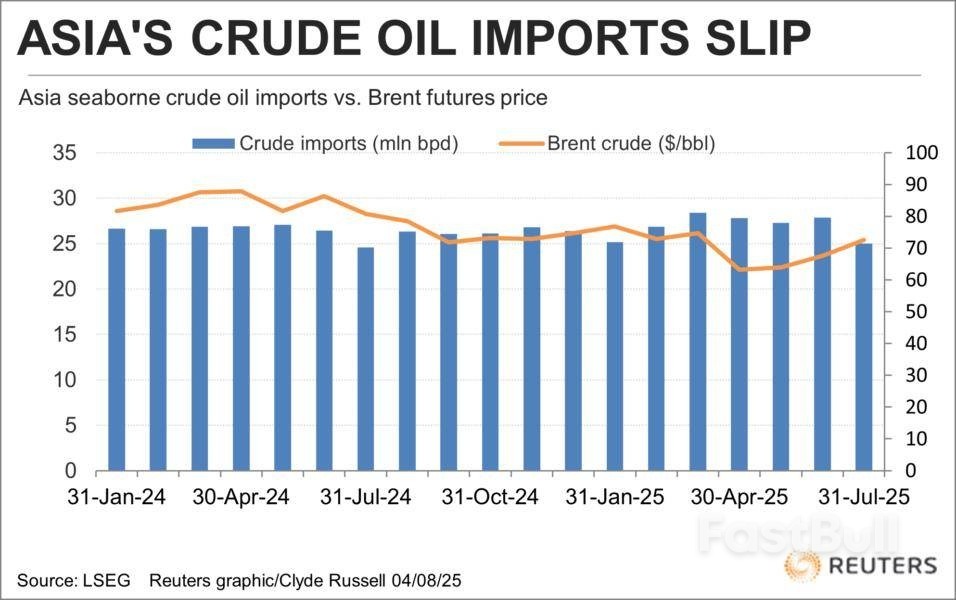
          It's debatable as to whether this is actually the case. Certainly, demand growth in the top-importing region of Asia has been lacklustre.

          Asia's oil imports were about 25.0 million bpd in July, down from 27.88 million bpd in June and the lowest monthly total since July last year, according to data compiled by LSEG Oil Research.

          While China, the world's biggest crude importer, has been increasing purchases in recent months, much of this is likely because of lower prices that prevailed when June- and July-arriving cargoes were arranged.

          It's also the case that China has likely been adding to its stockpiles at a rapid pace, and while it doesn't disclose inventories, the surplus of crude once refinery processing is subtracted from the total available from domestic output and imports was 1.06 million bpd over the first half of 2025.

          Thomson ReutersASIA OIL

          OPEC+ LUCK?

          It appears more likely that OPEC+ has largely been fortunate in that it has been increasing output at a time of rising risks in the crude oil market, largely from geopolitical tensions.

          The brief conflict between Israel andIranin June, which was later joined by the United States, did lead to an equally brief spike in crude prices, with benchmark Brent futuresreaching a six-month high of $81.40 a barrel on June 23.

          The price has since eased back to trade around the $70 mark, with some early weakness in Asia on Monday seeing Brent drop to around $69.35.

          But the point is that the Israel-Iran conflict arrested a downtrend in oil prices that had been in place for much of the first half of the year.

          Crude prices have also been supported in recent days by U.S. PresidentDonald Trump's threats of wide-ranging sanctions against buyers of Russian oil unless Moscow agrees to a ceasefire in itswar with Ukraine.

          As with everything Trump, it pays to be cautious as to whether his actions will ultimately be as drastic as his threats. But it would also be foolhardy to assume that there will be no impact on crude supplies even if any eventual measures imposed by the United States are not as drastic as feared.

          There are effectively only two major buyers of Russian crude, India and China.

          Of these two, India is the far more exposed given its refiners export millions of barrels of refined products, many made with Russian oil.

          India imported 2.1 million bpd of Russian oil in June, according to data compiled by commodity analysts Kpler, which is the second-highest monthly total behind only 2.15 million bpd in May 2023.

          In recent months, India has been buying about 40% of its crude from Russia and if it were to replace that with other suppliers, it would have a severe impact on oil flows, at least initially.

          It's likely that a combination of Middle East, Africa and Americas exporters could make up for India's loss of Russian barrels, but this would tighten supplies considerably and likely keep prices higher.

          Whether Russia and its network of shadowy traders and shippers could once again work around sanctions remains to be seen, but even if they could, it would still take some time for them to get Russian crude through to buyers.

          For now, much remains up in the air and OPEC+ members are following a smart strategy in taking advantage of the uncertainty to bring their production back and rebuild market share.

          How long this play can work is the question.

          Even if Russian barrels do leave the market, it's also possible that demand growth disappoints in the second half as the impact of Trump's trade war becomes more apparent, cutting global trade and lowering economic growth.

          Source: TradingView

          Risk Warnings and Disclaimers
          You understand and acknowledge that there is a high degree of risk involved in trading. Following any strategies or investment methods may lead to potential losses. The content on the site is provided by our contributors and analysts for information purposes only. You are solely responsible for determining whether any trading assets, securities, strategy, or any other product is suitable for investing based on your own investment objectives and financial situation.
          Add to Favorites
          Share

          Fed's Williams Highlights Job Growth Revisions Impact

          Daniel Carter

          Economic

          Central Bank

          Key Takeaways:
          ● Williams points to substantial job growth revisions as significant news.
          ● Potential impact on U.S. monetary policy outlook.
          ● Influence on crypto markets with dovish expectations rising.
          Federal Reserve Vice Chair John C. Williams highlighted significant downward revisions to May and June job growth as the core takeaway from Friday's Nonfarm Payrolls report, influencing U.S. labor market perceptions.
          These revisions suggest potential shifts in Federal Reserve policies, impacting investor sentiment and risk asset allocations, especially in macro-sensitive cryptocurrencies like Bitcoin and Ethereum.
          The Federal Reserve's Vice Chair John C. Williams emphasized the significant downward revisions in May and June job growth as the real news from the latest Nonfarm Payrolls report.
          John C. Williams, a prominent figure at the Federal Reserve, has noted these revisions as pivotal, highlighting slowing job growth and labor supply challenges. "Significant downward revisions to May and June job growth were the 'real news' in Friday's Nonfarm Payrolls Report." His insights may widen policymaking approaches.
          The revisions hint at a slowing labor market, potentially steering Federal Reserve policy towards rate cuts in 2025. This has implications across financial sectors.
          Market observers anticipate changes in risk asset allocations, including effects on Bitcoin and Ethereum, as expectations of a dovish Federal Reserve policy intensify.
          The crypto sector's historical reactions to U.S. labor data suggest that dovish policy anticipations could foster positive sentiments in digital asset markets.
          Historical data indicates that labor market changes often prompt shifts in both on-chain activity and macroeconomic policy adjustments. These developments could drive increased interest in crypto markets.

          Source: CryptoSlate

          To stay updated on all economic events of today, please check out our Economic calendar
          Risk Warnings and Disclaimers
          You understand and acknowledge that there is a high degree of risk involved in trading. Following any strategies or investment methods may lead to potential losses. The content on the site is provided by our contributors and analysts for information purposes only. You are solely responsible for determining whether any trading assets, securities, strategy, or any other product is suitable for investing based on your own investment objectives and financial situation.
          Add to Favorites
          Share

          The Week Ahead – Week Commencing 4th August 2025

          IC Markets

          Economic

          Political

          Forex

          It was a massive week for financial markets last week, with major central bank rate calls, big US data, and trade updates all contributing to some big moves across products.The week ahead certainly does not have as much scheduled on the macroeconomic calendar, but there are still some big data updates to come, and the Bank of England will be making a big interest rate call.As well as those scheduled events, traders are anticipating more on the geopolitical front, and there are more big earnings reports to come, so volatility is expected to remain high in the coming days.

          Here is our usual day-by-day breakdown of the major risk events this week:

          There are bank holidays in both Australia and Canada on Monday, which could see some liquidity removed from the market for the first day of the week, and very little on the calendar apart from the key Swiss CPI data early in the London session.

          Tuesday is also relatively quiet on the event calendar. The Bank of Japan Monetary Policy Meeting Minutes are out in the Asian session, and we have US ISM Services PMI data out in the New York day, but traders are expecting to see relatively smooth trading conditions across the sessions.

          The main data update for Wednesday comes out very early in the day, with New Zealand employment numbers due out early in the Asian session. There is very little else scheduled across the rest of the trading day; however, we are due to hear from Fed members Daly, Collins, and Cook, and given recent updates on the FOMC, traders will be expecting some moves in US markets around the updates. The weekly US Crude Oil Inventory data drop is also scheduled during the New York session.

          The busiest day of the week in terms of scheduled calendar events. Once again, Kiwi markets will be in focus during the Asian session with the latest quarterly Inflation Expectations data due out. The big event of the day – and indeed the week – comes midway through the London session, with the Bank of England expected to deliver a rate cut. The New York session sees the usual weekly Unemployment Claims data released, as well as the Canadian Ivey PMI numbers.

          It is a quiet calendar day to close out the week, with nothing of note scheduled for release during the first two trading sessions of the day. Canadian markets will be in focus during the final session of the week, with employment data set for release, and traders will also note that key Chinese CPI and PPI numbers will be released on Saturday. Any big deviations from expectations can lead to some gapping on the Monday open.

          Source: IC Markets

          To stay updated on all economic events of today, please check out our Economic calendar
          Risk Warnings and Disclaimers
          You understand and acknowledge that there is a high degree of risk involved in trading. Following any strategies or investment methods may lead to potential losses. The content on the site is provided by our contributors and analysts for information purposes only. You are solely responsible for determining whether any trading assets, securities, strategy, or any other product is suitable for investing based on your own investment objectives and financial situation.
          Add to Favorites
          Share
          FastBull
          Copyright © 2025 FastBull Ltd

          728 RM B 7/F GEE LOK IND BLDG NO 34 HUNG TO RD KWUN TONG KLN HONG KONG

          TelegramInstagramTwitterfacebooklinkedin
          App Store Google Play Google Play
          Products
          Charts

          Chats

          Q&A with Experts
          Screeners
          Economic Calendar
          Data
          Tools
          Membership
          Features
          Function
          Markets
          Copy Trading
          Latest Signals
          Contests
          News
          Analysis
          24/7
          Columns
          Education
          Company
          Careers
          About Us
          Contact Us
          Advertising
          Help Center
          Feedback
          User Agreement
          Privacy Policy
          Business

          White Label

          Data API

          Web Plug-ins

          Poster Maker

          Affiliate Program

          Risk Disclosure

          The risk of loss in trading financial instruments such as stocks, FX, commodities, futures, bonds, ETFs and crypto can be substantial. You may sustain a total loss of the funds that you deposit with your broker. Therefore, you should carefully consider whether such trading is suitable for you in light of your circumstances and financial resources.

          No decision to invest should be made without thoroughly conducting due diligence by yourself or consulting with your financial advisors. Our web content might not suit you since we don't know your financial conditions and investment needs. Our financial information might have latency or contain inaccuracy, so you should be fully responsible for any of your trading and investment decisions. The company will not be responsible for your capital loss.

          Without getting permission from the website, you are not allowed to copy the website's graphics, texts, or trademarks. Intellectual property rights in the content or data incorporated into this website belong to its providers and exchange merchants.

          Not Logged In

          Log in to access more features

          FastBull Membership

          Not yet

          Purchase

          Become a signal provider
          Help Center
          Customer Service
          Dark Mode
          Price Up/Down Colors

          Log In

          Sign Up

          Position
          Layout
          Fullscreen
          Default to Chart
          The chart page opens by default when you visit fastbull.com