Markets
News
Analysis
User
24/7
Economic Calendar
Education
Data
- Names
- Latest
- Prev


Signal Accounts for Members
All Signal Accounts
All Contests


U.S. Initial Jobless Claims 4-Week Avg. (SA)A:--
F: --
P: --
U.S. Weekly Continued Jobless Claims (SA)A:--
F: --
P: --
Canada Ivey PMI (SA) (Nov)A:--
F: --
P: --
Canada Ivey PMI (Not SA) (Nov)A:--
F: --
P: --
U.S. Non-Defense Capital Durable Goods Orders Revised MoM (Excl. Aircraft) (SA) (Sept)A:--
F: --
U.S. Factory Orders MoM (Excl. Transport) (Sept)A:--
F: --
P: --
U.S. Factory Orders MoM (Sept)A:--
F: --
P: --
U.S. Factory Orders MoM (Excl. Defense) (Sept)A:--
F: --
P: --
U.S. EIA Weekly Natural Gas Stocks ChangeA:--
F: --
P: --
Saudi Arabia Crude Oil ProductionA:--
F: --
P: --
U.S. Weekly Treasuries Held by Foreign Central BanksA:--
F: --
P: --
Japan Foreign Exchange Reserves (Nov)A:--
F: --
P: --
India Repo RateA:--
F: --
P: --
India Benchmark Interest RateA:--
F: --
P: --
India Reverse Repo RateA:--
F: --
P: --
India Cash Reserve RatioA:--
F: --
P: --
Japan Leading Indicators Prelim (Oct)A:--
F: --
P: --
U.K. Halifax House Price Index YoY (SA) (Nov)A:--
F: --
P: --
U.K. Halifax House Price Index MoM (SA) (Nov)A:--
F: --
P: --
France Current Account (Not SA) (Oct)A:--
F: --
P: --
France Trade Balance (SA) (Oct)A:--
F: --
P: --
France Industrial Output MoM (SA) (Oct)A:--
F: --
P: --
Italy Retail Sales MoM (SA) (Oct)A:--
F: --
P: --
Euro Zone Employment YoY (SA) (Q3)A:--
F: --
P: --
Euro Zone GDP Final YoY (Q3)A:--
F: --
P: --
Euro Zone GDP Final QoQ (Q3)A:--
F: --
P: --
Euro Zone Employment Final QoQ (SA) (Q3)A:--
F: --
P: --
Euro Zone Employment Final (SA) (Q3)A:--
F: --
Brazil PPI MoM (Oct)A:--
F: --
P: --
Mexico Consumer Confidence Index (Nov)A:--
F: --
P: --
Canada Unemployment Rate (SA) (Nov)--
F: --
P: --
Canada Labor Force Participation Rate (SA) (Nov)--
F: --
P: --
Canada Employment (SA) (Nov)--
F: --
P: --
Canada Part-Time Employment (SA) (Nov)--
F: --
P: --
Canada Full-time Employment (SA) (Nov)--
F: --
P: --
U.S. Personal Income MoM (Sept)--
F: --
P: --
U.S. Dallas Fed PCE Price Index YoY (Sept)--
F: --
P: --
U.S. PCE Price Index YoY (SA) (Sept)--
F: --
P: --
U.S. PCE Price Index MoM (Sept)--
F: --
P: --
U.S. Personal Outlays MoM (SA) (Sept)--
F: --
P: --
U.S. Core PCE Price Index MoM (Sept)--
F: --
P: --
U.S. UMich 5-Year-Ahead Inflation Expectations Prelim YoY (Dec)--
F: --
P: --
U.S. Core PCE Price Index YoY (Sept)--
F: --
P: --
U.S. Real Personal Consumption Expenditures MoM (Sept)--
F: --
P: --
U.S. 5-10 Year-Ahead Inflation Expectations (Dec)--
F: --
P: --
U.S. UMich Current Economic Conditions Index Prelim (Dec)--
F: --
P: --
U.S. UMich Consumer Sentiment Index Prelim (Dec)--
F: --
P: --
U.S. UMich 1-Year-Ahead Inflation Expectations Prelim (Dec)--
F: --
P: --
U.S. UMich Consumer Expectations Index Prelim (Dec)--
F: --
P: --
U.S. Weekly Total Rig Count--
F: --
P: --
U.S. Weekly Total Oil Rig Count--
F: --
P: --
U.S. Consumer Credit (SA) (Oct)--
F: --
P: --
China, Mainland Foreign Exchange Reserves (Nov)--
F: --
P: --
China, Mainland Exports YoY (USD) (Nov)--
F: --
P: --
China, Mainland Imports YoY (CNH) (Nov)--
F: --
P: --
China, Mainland Imports YoY (USD) (Nov)--
F: --
P: --
China, Mainland Imports (CNH) (Nov)--
F: --
P: --
China, Mainland Trade Balance (CNH) (Nov)--
F: --
P: --
China, Mainland Exports (Nov)--
F: --
P: --


No matching data
Latest Views
Latest Views
Trending Topics
Top Columnists
Latest Update
White Label
Data API
Web Plug-ins
Affiliate Program
View All

No data
For the last two years, economists and market strategists have been intensely engaged in a debate over this question: Is the U.S. economy headed for a hard or soft landing?
Today, the ECB is widely expected by both analysts and markets to deliver a 25bp rate cut. The moderation in the labour market and economic activity since the June meeting should lead to a further increase in the confidence of the disinflationary process being on track, in particular given the slowdown in wage growth. For more details, please see ECB preview – Dialling back, but pace uncertain, 5 September.
In Norway, the Regional Network survey is released, providing insights into capacity utilisation, which could be decisive for Norges Bank’s message on 19 September. Although Norges Bank advised markets in June against speculating on rate cuts this year, recent domestic and global developments have considerably increased the probability of a rate cut in 2024. If capacity utilisation metrics turn over significantly, we stand ready to adjust our current call for the first Norges Bank rate cut to not come until March 2025.
In Sweden, CPI for august is released. We expect CPIF inflation to drop significantly to 1.1% y/y in August, 0.6 pp. below the Riksbank’s forecast. Our forecast for CPIF excl. energy at 2.1% y/y aligns closely with the Riksbank’s view. If correct, focus is on how the Riksbank will handle such an outcome in its monetary policy.
What happened overnight
In Japan, wholesale inflation for August was lower than expected at -0.2% m/m and 2.5% y/y, compared to consensus of 0.0% m/m and 2.8% y/y. The surprise was due to the yen’s rebound, which eased import cost pressures. The slowdown, expected to impact consumer prices in the months ahead, could influence the timing of the Bank of Japan’s (BoJ) next rate hike. Moreover, this morning, the hawkish BoJ member Tamura stated that rates must rise to at least 1% by late next year, as the likelihood of achieving the 2% inflation target sustainably has improved. Tamura’s comment, the first to specify a target rate, follows other BoJ members advocating for continued hikes despite market turmoil.
What happened yesterday
In the US, headline inflation in August was close to expectations at 0.2% m/m SA and 2.5% y/y (cons: 0.2% m/m SA, 2.6% y/y). Core inflation was slightly higher than expected at 0.3% m/m SA (cons: 0.2%), while the yearly figure matched expectations. The modest upside surprise was mostly driven by shelter prices, while price pressures elsewhere in the services sector, in core goods as well as in food and energy were close to expectations. Shelter, and more precisely the contribution from owners’ equivalent rent (OER) rose to the highest level since January. However, it should be noted that shelter CPI lags changes in the actual rental/real estate market by 10-11 months, implying that this should not be seen as a sign of re-accelerating inflation pressures. Hence, the print does not derail the Fed from cutting rates next week but supports our case of a 25bp cut. After the release, markets priced the odds of 25/50bp cuts at 85%/15% in favour of a smaller move.
Kamala Harris emerged as the stronger candidate in the presidential debate against Donald Trump. Harris conveyed a more forward-looking vision, while Trump mainly focused on criticizing the current administration and lacked clarity on his own initiatives. Republican strategists noted that while Trump’s performance was not seen as a major setback, his re-election bid appeared more uncertain. A YouGov flash poll showed 43% of viewers saw Harris as the winner, compared to 28% for Trump, with 30% undecided.
Harris now also seems to be the clear favourite according to prediction markets. However, the race remains close, particularly in the swing states. For details on the US election, see our US Election Monitor, 6 September, which we plan to update bi-weekly until election day.
The markets reacted to the debate by sending the USD and yields slightly lower, suggesting that expectations of Trump pursuing more expansionary fiscal policies and protectionist measures remain intact. Yesterday’s price action likely provides a good gauge for how markets may react to election news going forward, though the longer-term implications are less clear-cut.
In the UK, the monthly GDP figure for July was weaker than expected at 0.0% m/m (cons: 0.2%, prior: 0.0%), signalling an economy starting to lose steam, while the 3M/3M measure printed at 0.5% (cons: 0.6%, prior: 0.6%). The downside surprise was broad-based, driven by declines in industrial and manufacturing production as well as construction, while services continued to contribute positively. That said, it should be noted that this data is of volatile nature, and hence that the topside risk to demand is still in place – in line with the Bank of England’s expectation.
Equities: Global equities rose yesterday, led by US large-cap, cyclical growth stocks. This movement was prompted by a slightly higher-than-expected CPI, which sent the short end of the yield curve higher in the US, thereby reducing the likelihood of a 50-basis point cut next week. Hence, equity investors see it as a relief that the Fed may not need to implement a double cut, implicitly indicating that the economic outlook remains solid. Additionally, there was a significant cyclical rotation, with energy being the worst performer and tech performing exceptionally well. If yesterday’s boost to equities had been driven by strong growth or demand numbers, we would have likely seen more broad-based gains, and energy would not have underperformed so significantly. It is also important to note the negative correlation between bonds and equities on a CPI day. This indicates significant progress in the inflation normalization process and a shift in investor views on inflation. In the US yesterday, the Dow closed up by 0.3%, the S&P 500 by 1.1%, the Nasdaq by 2.2%, and the Russell 2000 by 0.3%. Asian markets soared this morning, with some of the most cyclical and tech-heavy markets up more than 3%. US futures are also trending higher, with European futures up by more than 1%.
FI: Today’s main event is the ECB meeting. A 25bp cut seems to be a done deal, and markets will therefore focus on guidance and the updated staff projections at the meeting. On Friday, the broad wage measure – compensation per employee – showed a noticeable decline in the annual wage growth in Q2 from 4.8% y/y to 4.3% y/y, and this has likely dampened some of the concern related to the still elevated domestic inflation measures in August. We expect Lagarde to confirm that ECB is entering the dialling back phase, but we do not expect a commitment to a specific timing of further cuts; thus, we do not anticipate that it will deviate from the meeting-by-meeting and data-dependent approach to the policy rate changes, thereby keeping its guidance’s optionality and flexibility. Markets are pricing 62bp this year and 126bp in 2025. See ECB preview – Dialling back, but pace uncertain, 5 September.
FX: While the USD gained modestly in yesterday’s session the most notable G10 move was the sell-off in NOK which stopped just around the 12.00 figure in EUR/NOK before the Norwegian currency found some well-needed support from Brent crude moving back above USD 70/bbl. EUR/SEK remains in the low 11.40s while USD/JPY failed to extend a move below 142. Finally, EUR/CHF rebounded just short of the 0.93-level before finding a newly weekly high around 0.94.
The European Central Bank (ECB) is almost certain to cut interest rates again on Thursday, but with inflation risks simmering despite anaemic growth, investors will be combing its message for clues on further easing.
The ECB lowered its deposit rate to 3.75% in June and an array of policymakers have already backed another cut, suggesting their debate is likely to focus on how quickly borrowing costs need to fall in subsequent meetings.
The likely outcome is that ECB President Christine Lagarde will stick to the bank's recent narrative that decisions are taken meeting by meeting, based on incoming data with no pre-commitments.
But she may also say that all meetings are "live", keeping open the door to a cut in October, even if some conservative hawks make the case for slower easing while inflation across the 20-country eurozone remains above the ECB's 2% target.
"While an October rate cut could happen ... we think it is unlikely that the incoming information between the September and the October meeting will be sufficiently weak to bring an October rate cut in play," Danske Bank's Piet Haines Christiansen said.
More dovish policymakers, mainly from the bloc's south, are likely to argue that recession risks are rising and that with inflation within striking distance of the target at 2.2%, ECB rates are now restricting growth far more than needed.
But inflation-wary hawks, who are still in a majority, say the labour market remains too hot for the ECB to sit back, and that underlying price pressures, as evidenced in stubborn services costs, raise the risk of resurgent inflation.
New economic forecasts are unlikely to settle the debate.
Quarterly projections from the ECB's staff are expected to show slightly lower growth this year and inflation broadly on the same path as in June and set to return to 2% on a "sustainable" basis by the second half of next year.
That means few if any policymakers are likely to argue against further easing, with the key divide being just how quickly the ECB should move.
"Whilst we think the ECB is in no rush to cut rates, it also does not want to keep rates too high for too long," Pimco portfolio manager Konstantin Veit said. "We continue to envision that the ECB will cut rates at staff projection meetings, and anticipate its third cut in December."
Hawkish policymakers have made clear that they see quarterly rate cuts as appropriate, since key growth and wage indicators — which inform the ECB's own projections — are compiled every three months.
Investors are also divided, with another cut by December fully priced into financial markets but the chance of an interim move in October oscillating between 40% and 50%.
Lagarde's main task in her 1245 GMT news conference will be to keep all options on the table without stoking expectations for October.
"For now, we believe the quarterly rate cut path will hold, with domestic inflation and underlying labour cost pressures still too high for comfort," Societe Generale's Anatoli Annenkov said.
"For accelerated policy easing, we believe the labour markets in particular will need to show signs of a faster deterioration, something that has remained elusive."
With Thursday's move, the ECB's deposit rate will fall by 25 basis points to 3.5%. The refinancing rate is meanwhile likely to fall by a much bigger 60 basis points in a long-flagged technical adjustment.
The gap between the two interest rates has been set at 50 basis points for years and the ECB announced plans in March to narrow this corridor to 15 basis points from September in a move that could eventually rekindle lending between banks.
Such a revival is still years away, so the ECB's move is a pre-emptive adjustment of its operating framework.
For now, banks are sitting on €3 trillion (RM14.31 trillion) of excess liquidity and deposit this with the bank overnight, making the deposit rate in effect the ECB's main policy instrument.
Over time this liquidity should dwindle, pushing banks to borrow again from the ECB at the refinancing rate, traditionally the central bank's benchmark interest rate.
Once that happens, the main rate will regain its headline status, while the narrower rate corridor should help the ECB better manage market rates.
US yields finished 0.3 bps (30-yr) to 4.6 bps (2-yr) higher yesterday in a volatile session. The (trade-weighted) dollar approaches first resistance at 101.92/102 (101.68 close). EUR/USD came within striking distance of the 1.10 mark. For most of US trading hours, the key question was whether a small upward surprise in monthly US core CPI (0.3% M/M instead of 0.2%) was sufficient to completely close the door on a 50 bps rate cut by the Fed next week.
In the end, money markets reduced bets on such a start, but the door remains open. The upward surprise came especially from shelter costs and was for a large part compensated for by lower energy prices. Core US CPI could nevertheless remain sticky above 3% Y/Y for somewhat longer than earlier anticipated.
The US Treasury’s $39bn 10-yr Note auction was strong with the auction yield 1.4 bps below the WI yield. The bid-cover (2.64) was also above the 6-month average (2.53). An AI-driven rally pulled US stock markets up to 2.17% higher for the Nasdaq.
The ECB is expected to cut its deposit rate for a second time this year by 25 bps, to 3.50%. As announced in March, they will also reduce the spread between the main refinancing rate and the deposit rate from the current 50 bps to only 15 bps implying an MRR rate cut of 60 bps, from 4.25% to 3.65%. Updated GDP and CPI forecasts will be closely watched for clues on the monetary policy trajectory going forward.
However, we don’t expect big changes apart from perhaps some minor downward revisions to this year’s GDP and headline CPI data. Recall that ECB staff in June plotted a 0.9%-1.4%-1.6% growth path for 2024-2026 and a 2.5%-2.2%-1.9% inflation trajectory. While keeping an easing bias, we don’t expect the central bank to pre-commit to specific actions at coming meetings.
The short intermeeting period between September 12 and October 17 suggests that bar any big surprise, the central bank might be more inclined to sit the October meeting out and stick with the currently, quarterly, rate-reduction scheme with a next 25 bps move coming only in December.
Unlike the Fed, the ECB’s options for making policy less restrictive are smaller given limited room towards neutral territory in the current, stubborn, (core) inflationary environment. EMU money markets currently attach a 40% probability to a follow-up rate cut in October. Even if Lagarde holds back from giving any guidance for October, we believe that market speculation will remain in a context where most central banks are making their monetary policies less restrictive.
This suggests that any market reaction on today’s statement and Q&A session (higher ST EUR rates and stronger EUR) could be modest and in any case temporary in nature.
Insiders say the European Commission is examining its options to roll over several hundreds of billions of euros of EUNextGen bonds issued during the Covid-era. At the heart of the issue are the ones issued to finance the grants distributed to the member states. Unlike the loans, which have to be paid back by member states from 2031 on, the EC has no means outside the budget to repay those bonds when they start maturing. The amount of grants currently disbursed is some €170bn but could increase to as much as €357bn.
Leaving the matter unaddressed would result in yearly debt repayments and interest costs of around €30bn from 2028 on – an amount that roughly equals a sixth of the EU’s current annual spending.
Former ECB president Draghi in his report on European competition earlier this week warned for this looming budget squeeze given the unwillingness (for now) of EU member states to give the Commission revenue-raising powers or additional money.
It was Draghi too who floated the idea of rolling over the debt. The topic is a controversial one, especially for the likes of Germany who’s constitutional court only approved the EUNextGen programme on the grounds it was a one off and time-limited. Changing the terms requires unanimous backing of all member states.
The UK Royal Institution of Chartered Surveyors (RICS) said the house price balance edged up to 1% in August, a significant jump from the -18% recorded in July (and vs consensus of -14%). It was the first positive outcome since October 2022 and has come a long way from the a post-GFC low at -64.5% exactly one year ago.
All subindices posted improvements compared to July with price expectations (from 9% to 14%), sales expectations (37%) and new buyer enquiries (15%) al rising solidly. Agreed sales (6%) climbed to the highest level since May 2021.
The ECB cut policy rates by 25 bps in June. Stubborn inflation (core, services) make follow-up moves less evident. Markets nevertheless price in two to three more cuts for 2024 as disappointing US and unconvincing EMU activity data rolled in, dragging the long end of the curve down. The move accelerated during the early August market meltdown.
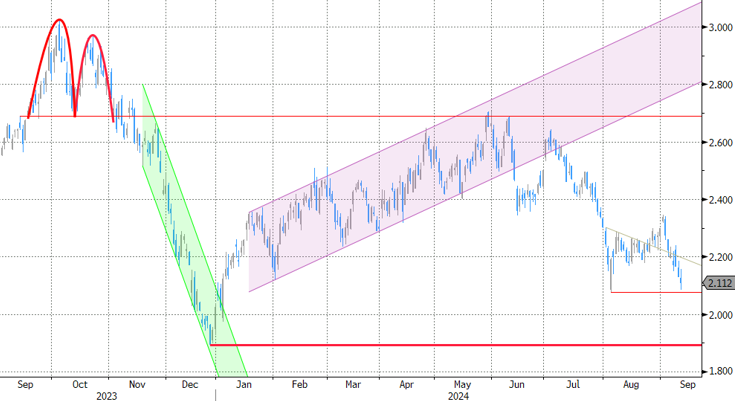
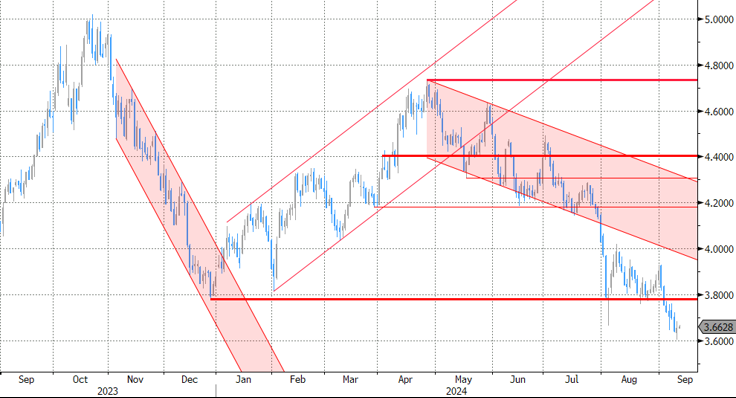
US 10y yield
The Fed in its July meeting paved the way for a first cut in September. It turned attentive to risks to the both sides of its dual mandate as the economy is moving to a better in to balance. The pivot weakened the technical picture in US yields. A string of weak eco data and a risk-off market climate pushed and kept the 10-yr sub 4%. We think we could be up to three 50 bps rate cuts this year.
EUR/USD
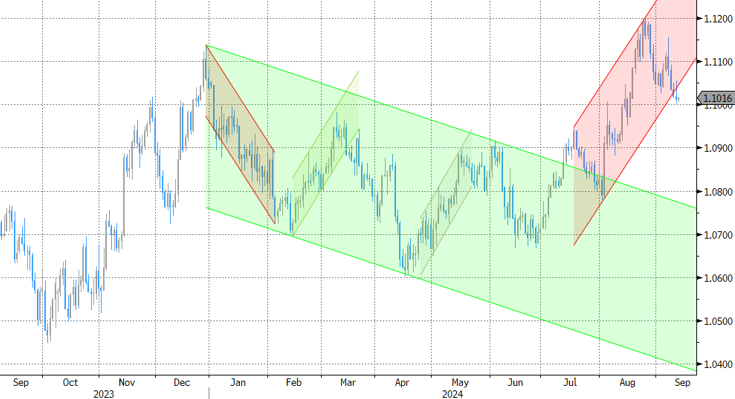
EUR/USD moved above the 1.09 resistance area as the dollar lost interest rate support at stealth pace. US recession risks and bets on fast and large rate cuts trumped traditional safe haven flows into USD. EUR/USD 1.1276 (2023 top) serves as next technical references.
EUR/GBP
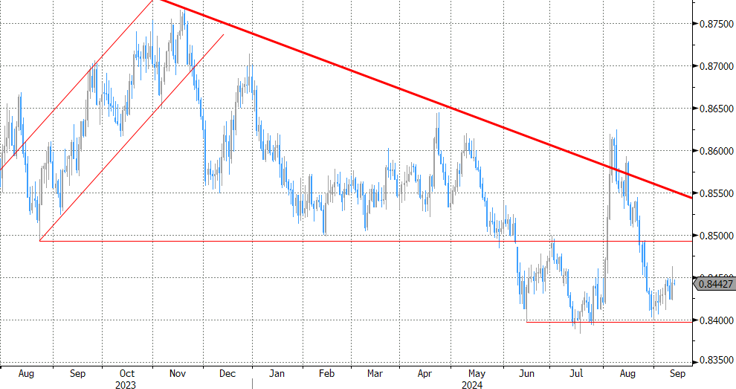
The BoE delivered a hawkish cut in August. Policy restrictiveness will be further unwound gradually on a pace determined by a broad range of data. The strategy similar to the ECB’s balances out EUR/GBP in a monetary perspective. Recent better UK activity data and a cautious assessment of BoE’s Bailey at Jackson Hole are pushing EUR/GBP lower in the 0.84/0.086 range.
White Label
Data API
Web Plug-ins
Poster Maker
Affiliate Program
The risk of loss in trading financial instruments such as stocks, FX, commodities, futures, bonds, ETFs and crypto can be substantial. You may sustain a total loss of the funds that you deposit with your broker. Therefore, you should carefully consider whether such trading is suitable for you in light of your circumstances and financial resources.
No decision to invest should be made without thoroughly conducting due diligence by yourself or consulting with your financial advisors. Our web content might not suit you since we don't know your financial conditions and investment needs. Our financial information might have latency or contain inaccuracy, so you should be fully responsible for any of your trading and investment decisions. The company will not be responsible for your capital loss.
Without getting permission from the website, you are not allowed to copy the website's graphics, texts, or trademarks. Intellectual property rights in the content or data incorporated into this website belong to its providers and exchange merchants.
Not Logged In
Log in to access more features

FastBull Membership
Not yet
Purchase
Log In
Sign Up