Markets
News
Analysis
User
24/7
Economic Calendar
Education
Data
- Names
- Latest
- Prev


Signal Accounts for Members
All Signal Accounts
All Contests


Turkey Trade BalanceA:--
F: --
P: --
Germany Construction PMI (SA) (Nov)A:--
F: --
P: --
Euro Zone IHS Markit Construction PMI (Nov)A:--
F: --
P: --
Italy IHS Markit Construction PMI (Nov)A:--
F: --
P: --
U.K. Markit/CIPS Construction PMI (Nov)A:--
F: --
P: --
France 10-Year OAT Auction Avg. YieldA:--
F: --
P: --
Euro Zone Retail Sales MoM (Oct)A:--
F: --
P: --
Euro Zone Retail Sales YoY (Oct)A:--
F: --
P: --
Brazil GDP YoY (Q3)A:--
F: --
P: --
U.S. Challenger Job Cuts (Nov)A:--
F: --
P: --
U.S. Challenger Job Cuts MoM (Nov)A:--
F: --
P: --
U.S. Challenger Job Cuts YoY (Nov)A:--
F: --
P: --
U.S. Initial Jobless Claims 4-Week Avg. (SA)A:--
F: --
P: --
U.S. Weekly Initial Jobless Claims (SA)A:--
F: --
P: --
U.S. Weekly Continued Jobless Claims (SA)A:--
F: --
P: --
Canada Ivey PMI (SA) (Nov)A:--
F: --
P: --
Canada Ivey PMI (Not SA) (Nov)A:--
F: --
P: --
U.S. Non-Defense Capital Durable Goods Orders Revised MoM (Excl. Aircraft) (SA) (Sept)A:--
F: --
U.S. Factory Orders MoM (Excl. Transport) (Sept)A:--
F: --
P: --
U.S. Factory Orders MoM (Sept)A:--
F: --
P: --
U.S. Factory Orders MoM (Excl. Defense) (Sept)A:--
F: --
P: --
U.S. EIA Weekly Natural Gas Stocks ChangeA:--
F: --
P: --
Saudi Arabia Crude Oil ProductionA:--
F: --
P: --
U.S. Weekly Treasuries Held by Foreign Central BanksA:--
F: --
P: --
Japan Foreign Exchange Reserves (Nov)A:--
F: --
P: --
India Repo RateA:--
F: --
P: --
India Benchmark Interest RateA:--
F: --
P: --
India Reverse Repo RateA:--
F: --
P: --
India Cash Reserve RatioA:--
F: --
P: --
Japan Leading Indicators Prelim (Oct)A:--
F: --
P: --
U.K. Halifax House Price Index YoY (SA) (Nov)--
F: --
P: --
U.K. Halifax House Price Index MoM (SA) (Nov)--
F: --
P: --
France Current Account (Not SA) (Oct)--
F: --
P: --
France Trade Balance (SA) (Oct)--
F: --
P: --
France Industrial Output MoM (SA) (Oct)--
F: --
P: --
Italy Retail Sales MoM (SA) (Oct)--
F: --
P: --
Euro Zone Employment YoY (SA) (Q3)--
F: --
P: --
Euro Zone GDP Final YoY (Q3)--
F: --
P: --
Euro Zone GDP Final QoQ (Q3)--
F: --
P: --
Euro Zone Employment Final QoQ (SA) (Q3)--
F: --
P: --
Euro Zone Employment Final (SA) (Q3)--
F: --
Brazil PPI MoM (Oct)--
F: --
P: --
Mexico Consumer Confidence Index (Nov)--
F: --
P: --
Canada Unemployment Rate (SA) (Nov)--
F: --
P: --
Canada Labor Force Participation Rate (SA) (Nov)--
F: --
P: --
Canada Employment (SA) (Nov)--
F: --
P: --
Canada Part-Time Employment (SA) (Nov)--
F: --
P: --
Canada Full-time Employment (SA) (Nov)--
F: --
P: --
U.S. Dallas Fed PCE Price Index YoY (Sept)--
F: --
P: --
U.S. PCE Price Index YoY (SA) (Sept)--
F: --
P: --
U.S. PCE Price Index MoM (Sept)--
F: --
P: --
U.S. Personal Outlays MoM (SA) (Sept)--
F: --
P: --
U.S. Core PCE Price Index MoM (Sept)--
F: --
P: --
U.S. UMich 5-Year-Ahead Inflation Expectations Prelim YoY (Dec)--
F: --
P: --
U.S. Core PCE Price Index YoY (Sept)--
F: --
P: --
U.S. 5-10 Year-Ahead Inflation Expectations (Dec)--
F: --
P: --
U.S. UMich Current Economic Conditions Index Prelim (Dec)--
F: --
P: --
U.S. UMich Consumer Sentiment Index Prelim (Dec)--
F: --
P: --
U.S. UMich 1-Year-Ahead Inflation Expectations Prelim (Dec)--
F: --
P: --
U.S. UMich Consumer Expectations Index Prelim (Dec)--
F: --
P: --


No matching data
Latest Views
Latest Views
Trending Topics
Top Columnists
Latest Update
White Label
Data API
Web Plug-ins
Affiliate Program
View All

No data
Last month ended on a positive note – with a solid reversal of the early-November losses on one single bet: that the Federal Reserve (Fed) would cut interest rates in December.
December is finally here. Last month ended on a positive note – with a solid reversal of the early-November losses on one single bet: that the Federal Reserve (Fed) would cut interest rates in December. US traders came back from their Thanksgiving break to a market paralysed by a tech issue on Friday, but the problem was quickly resolved, trading resumed and the S&P 500 closed both the week – and the month – just a few points below an ATH.
The November dip only shaved about 5% off the index, and those losses have almost been fully recovered. European stocks outperformed thanks to their lower exposure to tech – the major driver of the recent rallies, but also a potential major driver of any future meltdown. Gold, Bitcoin, US Treasuries – everything rallied last week.
But worries persist that the Fed may be rushing toward a rate cut without solid data in hand, and that valuations have run ahead of themselves. Those concerns will only grow if the Fed cuts and the rally continues into year-end. The Q ratio, which measures the market value of a company or the overall stock market relative to the replacement cost of its assets, hit an ATH last month, as well. In plain English: we are living incredibly exciting times with AI – but also facing very expensive stock prices compared with the real, physical value of companies' assets.
This week starts on a rather miserable note – perhaps the return from Thanksgiving is less cheerful than expected. Shoppers in the US spent almost $12bn during the shopping festival, up around 4%, but once you strip out the roughly 3% inflation rate, the real growth is modest – which is actually good news. It suggests that consumers are spending more carefully, price pressures may ease and the Fed could cut rates more confidently.
But risk appetite – judging from the price action in the Nikkei and Bitcoin – doesn't look great. And one man is largely responsible for that: Kazuo Ueda, the head of the Bank of Japan (BoJ), who said today that the bank "will consider the pros and cons of raising the policy interest rate and make decisions as appropriate" and that "any hike would merely be an adjustment in the degree of easing." In other words, they remain far behind the curve, and normalization is calling – even more loudly as Takaichi's policy measures risk pushing Japan's inflation even higher.
The result is a bloodbath in Japanese assets. The Nikkei is down nearly 2% this morning on rising bets that the BoJ will hike at the next meeting – despite soft PMI data. The Japanese 10-year yield is at a fresh multi-decade high near 1.87% this morning, which is very high relative to the 1.71% level often referenced as the point at which Japan's era of "free liquidity" effectively ends. Around $3.4 trillion circulates in global markets from Japanese investors seeking higher returns abroad – capital that could simply be repatriated as domestic yields rise.
From an economist's perspective, hiking interest rates – and counterbalancing Takaichi's fiscal push – is exactly what the BoJ should be doing. This is why central banks exist: to offset politically motivated, growth-at-all-costs fiscal impulses. BUT if the BoJ hikes, Japanese yields will rise, and Japanese capital could leave a significant hole in the global financial system at a time when everyone is wondering whether we haven't pushed the AI-driven rally too far.
This is why US 10-year yields jumped at the weekly open – that, and of course the ballooning US debt, which should theoretically push the Fed toward the same kind of thinking as their Japanese counterparts.
So, December could prove more challenging than many expected – especially for those who thought last month's 5% dip was the long-awaited correction. With Fed funds futures pricing nearly a 90% chance of a 25bp cut, there isn't much room left for additional dovish fuel.
On the contrary, incoming data could warn that a premature Fed rate cut that ignores inflation risks won't be the answer. So pray: pray for this week's PCE and inflation-expectations data to look soft enough to keep dovish expectations alive. Traders are also watching gold and the Swiss franc – both potential beneficiaries if the selloff deepens.
Potentially not helping sentiment: US crude is up more than 2% this morning as OPEC reiterated yesterday that they want to stabilise oil prices into next year, implying tighter control of output to address the supply glut that has weighed on prices – except during brief periods of geopolitical tension. And even those tensions haven't been enough lately to bring buyers back, which shows how much oil is currently sloshing around the planet. As discussed in previous reports, OPEC alone can't reverse the broader negative price dynamic, but it can help put a floor under the latest selloff. WTI is testing $60pb this morning, but prices need to climb above $65pb for the technicals to confirm an end to the bearish trend.
Vietnam's manufacturing sector maintained growth in November despite severe storms disrupting supply chains, according to the latest S&P Global Vietnam Manufacturing PMI data.
The PMI posted 53.8 in November, slightly down from 54.5 in October, but still indicating solid improvement in business conditions. This marks the fifth consecutive month of strengthening operating conditions.
New orders increased for the third straight month, helping drive production growth, though both metrics expanded at a slower pace than in October. New export orders grew at a faster rate, reaching a 15-month high, with manufacturers noting improved demand from mainland China and India.
Severe weather conditions in November significantly impacted supply chains, with suppliers' delivery times lengthening markedly to the largest extent since May 2022. The storms also hampered manufacturers' ability to complete work on time, leading to the sharpest accumulation of backlogs since March 2022.
Despite these challenges, employment increased for the second consecutive month as firms responded to higher output requirements. The modest rise in staffing levels was the largest in almost a year-and-a-half, with respondents indicating new staff were often hired on a full-time basis.
Manufacturers increased purchasing activity for the fifth straight month, with the rate of expansion quickening to a four-month high. Stocks of inputs also rose slightly for the second month in a row.
The storms contributed to higher raw material costs as supply was restricted. Input prices increased sharply, marking the second-fastest pace since July 2024, though inflation eased from October. Output price inflation also softened but remained solid as firms passed higher costs to customers.
Looking ahead, manufacturers expressed optimism about the year-ahead outlook for output, with sentiment reaching a 17-month high. Nearly half of respondents predicted increased production, citing expected improvements in new orders and hopes for calmer weather conditions.
Andrew Harker, Economics Director at S&P Global Market Intelligence, noted: "The pick-up in growth seen in October was largely sustained through to November as the Vietnamese manufacturing sector looks to be enjoying a positive end to the year. While rates of expansion in output and new orders eased, firms took on extra staff at a stronger pace in order to deal with workloads."
Over the past week, precious metals broadly advanced, with gold bulls standing out. The rally is mainly driven by a sharp repricing of U.S. interest rate expectations: Fed officials have delivered consecutive dovish signals, December rate cut odds surged, and markets anticipate the next Fed chair may lean even more toward easing, all boosting bullish sentiment.
With the Thanksgiving holiday behind us, the market will return to a "data-driven" rhythm this week. Traders will focus on key U.S. economic releases, including ISM Services PMI, ADP employment data, and core PCE inflation. With the Fed entering a blackout period, even marginal data changes could trigger outsized market reactions.
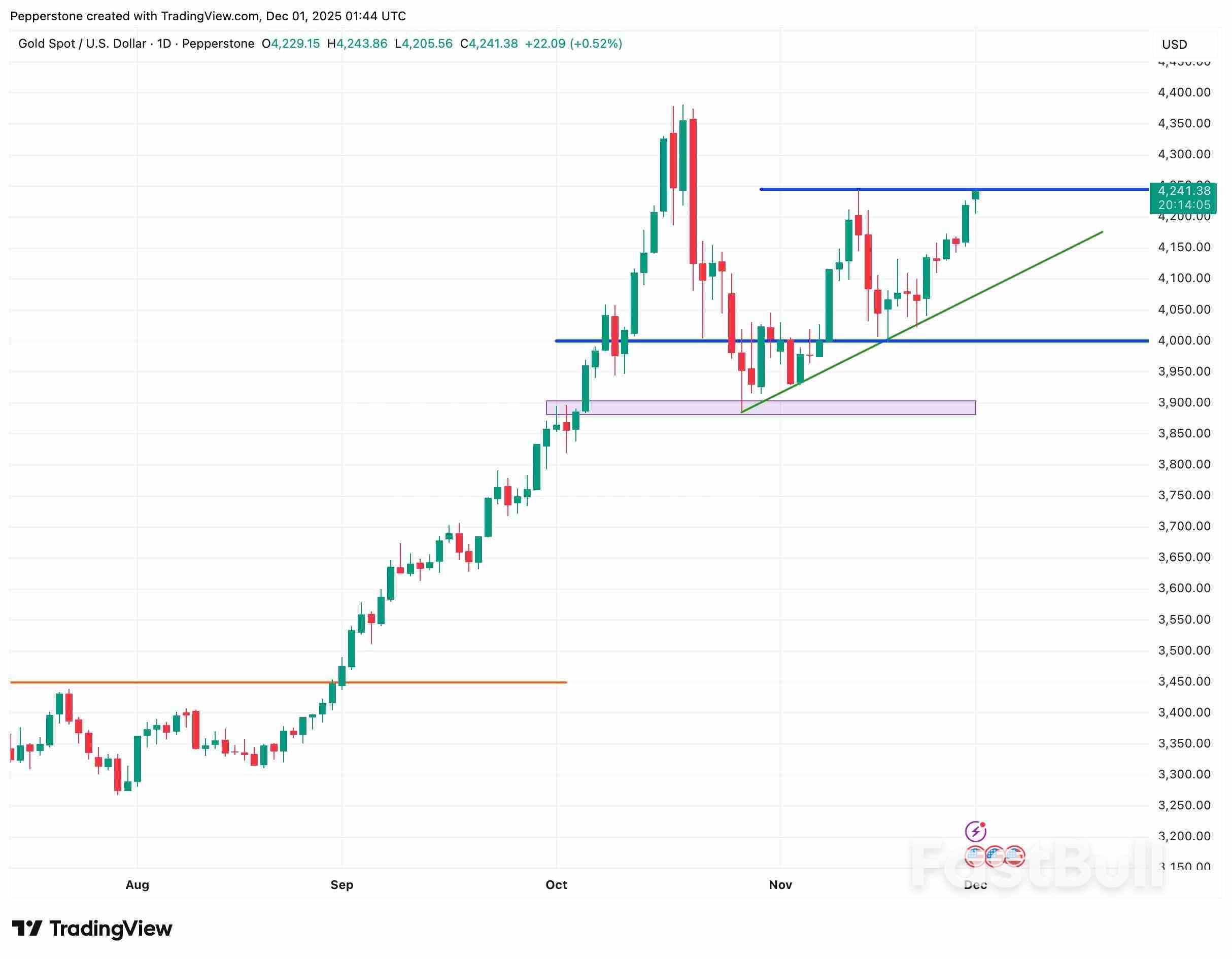
Looking at the XAUUSD daily chart, gold buying regained momentum last week, with a nearly 3.8% weekly gain. While markets expected thin holiday trading, Friday's strong push broke that assumption, allowing gold to comfortably surpass $4,200.

With the holiday over and CME's earlier technical issues resolved, price discovery should be more robust this week. Gold is currently challenging its mid-November high of $4,250. A close above this level would open the door for a push toward $4,300 and potentially revisit the all-time high of $4,381.
On the downside, profit-taking at elevated levels could find support around $4,200 and further down at $4,130. Overall, technicals remain bullish, though the strength of the breakout and market sentiment will need confirmation from this week's data.
The recent acceleration in gold is mainly fueled by a shift in Fed policy expectations. Dovish tones are now clear—both Fed Governor Waller and NY Fed President Williams have publicly backed a December rate cut, altering the market's baseline expectations.
Economic data also support this trend. U.S. retail sales slowed in September, consumer confidence fell to 88.7 in November—the lowest since April—and the Fed's Beige Book showed cooling hiring, reduced hours, and even some layoffs, with consumer spending easing. Overall, U.S. economic momentum is weakening, while inflation, though moderating, remains sticky.
Against this backdrop, bets on a December Fed rate cut have surged, currently priced near 90%. Stronger rate cut expectations imply lower real rates, the key logic supporting a rise in non-yielding assets like gold.
Dollar performance reflects this shift. As the U.S. interest rate advantage fades, the dollar index has come under pressure. Meanwhile, policy shifts in Japan add to dollar weakness.
Sanae Takahashi's aggressive fiscal stance has raised concerns over the continuation of Abenomics, while Ueda hinted at a possible December rate hike (current odds above 60%), increasing the potential for a yen rebound. If realized, this would further weaken the dollar and provide additional support for gold.
Treasury Secretary Janet Yellen indicated that President Trump may announce the next Fed chair before Christmas. Current NEC Director Hassett, a long-time proponent of Trump-style monetary easing, is the frontrunner, with betting markets pricing his nomination at roughly 64%.
Markets expect that if Hassett takes the helm, his stance will be more dovish, likely keeping rates lower than under Powell. This expectation has pushed traders to increase bets on future rate cuts and raises questions about Fed independence, naturally benefiting non-yielding, safe-haven gold.
Moreover, concerns over aggressive rate cuts heighten attention to U.S. debt expansion, while central bank gold buying provides a solid floor. Together, these factors make it difficult to break gold's upward path in the near term.
In short, gold bulls have surged recently, driven by higher December rate cut bets, a softer dollar, and expectations of a more dovish next Fed chair. Central banks continue to accumulate gold, and geopolitical risks remain, offering additional support.
In a low-rate, uncertain U.S. economic environment, gold's path of least resistance remains upward, with dip buying still the prevailing strategy. Any short-term pullbacks are likely to be limited.
This week marks the final week before the December Fed meeting. Fed officials will enter a blackout period, amplifying the market impact of economic data. Key releases include Wednesday's November ADP private payrolls and ISM Services PMI, and Friday's delayed September core PCE.
Consensus is for ADP jobs to rise 10k, below 42k previously, while core PCE is expected to fall from 2.9% YoY to 2.8%. If results align, showing a soft labor market with controlled inflation, they could reinforce December rate cut bets, pressuring the dollar and modestly lifting gold. Even if employment improves slightly and inflation remains sticky, it's unlikely to change market pricing for cuts, leaving gold in a narrow trading range.
Additionally, as major central banks diverge in policy paths—especially the RBA, NZD central bank, and BoJ returning to a rate hike trajectory—traders should monitor yield differentials for both risk and opportunity when trading gold.
White Label
Data API
Web Plug-ins
Poster Maker
Affiliate Program
The risk of loss in trading financial instruments such as stocks, FX, commodities, futures, bonds, ETFs and crypto can be substantial. You may sustain a total loss of the funds that you deposit with your broker. Therefore, you should carefully consider whether such trading is suitable for you in light of your circumstances and financial resources.
No decision to invest should be made without thoroughly conducting due diligence by yourself or consulting with your financial advisors. Our web content might not suit you since we don't know your financial conditions and investment needs. Our financial information might have latency or contain inaccuracy, so you should be fully responsible for any of your trading and investment decisions. The company will not be responsible for your capital loss.
Without getting permission from the website, you are not allowed to copy the website's graphics, texts, or trademarks. Intellectual property rights in the content or data incorporated into this website belong to its providers and exchange merchants.
Not Logged In
Log in to access more features

FastBull Membership
Not yet
Purchase
Log In
Sign Up