Markets
News
Analysis
User
24/7
Economic Calendar
Education
Data
- Names
- Latest
- Prev


Signal Accounts for Members
All Signal Accounts
All Contests


Canada Labor Force Participation Rate (SA) (Nov)A:--
F: --
P: --
U.S. Personal Income MoM (Sept)A:--
F: --
P: --
U.S. PCE Price Index YoY (SA) (Sept)A:--
F: --
P: --
U.S. PCE Price Index MoM (Sept)A:--
F: --
P: --
U.S. Personal Outlays MoM (SA) (Sept)A:--
F: --
P: --
U.S. Core PCE Price Index MoM (Sept)A:--
F: --
P: --
U.S. Core PCE Price Index YoY (Sept)A:--
F: --
P: --
U.S. UMich 5-Year-Ahead Inflation Expectations Prelim YoY (Dec)A:--
F: --
P: --
U.S. Real Personal Consumption Expenditures MoM (Sept)A:--
F: --
P: --
U.S. 5-10 Year-Ahead Inflation Expectations (Dec)A:--
F: --
P: --
U.S. UMich Current Economic Conditions Index Prelim (Dec)A:--
F: --
P: --
U.S. UMich Consumer Sentiment Index Prelim (Dec)A:--
F: --
P: --
U.S. UMich 1-Year-Ahead Inflation Expectations Prelim (Dec)A:--
F: --
P: --
U.S. UMich Consumer Expectations Index Prelim (Dec)A:--
F: --
P: --
U.S. Weekly Total Rig CountA:--
F: --
P: --
U.S. Weekly Total Oil Rig CountA:--
F: --
P: --
U.S. Unit Labor Cost Prelim (SA) (Q3)--
F: --
P: --
U.S. Consumer Credit (SA) (Oct)A:--
F: --
P: --
China, Mainland Foreign Exchange Reserves (Nov)A:--
F: --
P: --
China, Mainland Exports YoY (USD) (Nov)--
F: --
P: --
China, Mainland Imports YoY (CNH) (Nov)--
F: --
P: --
China, Mainland Imports YoY (USD) (Nov)--
F: --
P: --
China, Mainland Imports (CNH) (Nov)--
F: --
P: --
China, Mainland Trade Balance (CNH) (Nov)--
F: --
P: --
China, Mainland Exports (Nov)--
F: --
P: --
Japan Wages MoM (Oct)A:--
F: --
P: --
Japan Trade Balance (Oct)A:--
F: --
P: --
Japan Nominal GDP Revised QoQ (Q3)A:--
F: --
P: --
Japan Trade Balance (Customs Data) (SA) (Oct)A:--
F: --
P: --
Japan GDP Annualized QoQ Revised (Q3)A:--
F: --
China, Mainland Exports YoY (CNH) (Nov)--
F: --
P: --
China, Mainland Trade Balance (USD) (Nov)--
F: --
P: --
Germany Industrial Output MoM (SA) (Oct)--
F: --
P: --
Euro Zone Sentix Investor Confidence Index (Dec)--
F: --
P: --
Canada Leading Index MoM (Nov)--
F: --
P: --
Canada National Economic Confidence Index--
F: --
P: --
U.S. Dallas Fed PCE Price Index YoY (Sept)--
F: --
P: --
China, Mainland Trade Balance (USD) (Nov)--
F: --
P: --
U.S. 3-Year Note Auction Yield--
F: --
P: --
U.K. BRC Overall Retail Sales YoY (Nov)--
F: --
P: --
U.K. BRC Like-For-Like Retail Sales YoY (Nov)--
F: --
P: --
Australia Overnight (Borrowing) Key Rate--
F: --
P: --
RBA Rate Statement
RBA Press Conference
Germany Exports MoM (SA) (Oct)--
F: --
P: --
U.S. NFIB Small Business Optimism Index (SA) (Nov)--
F: --
P: --
Mexico Core CPI YoY (Nov)--
F: --
P: --
Mexico 12-Month Inflation (CPI) (Nov)--
F: --
P: --
Mexico PPI YoY (Nov)--
F: --
P: --
Mexico CPI YoY (Nov)--
F: --
P: --
U.S. Weekly Redbook Index YoY--
F: --
P: --
U.S. JOLTS Job Openings (SA) (Oct)--
F: --
P: --
China, Mainland M2 Money Supply YoY (Nov)--
F: --
P: --
China, Mainland M0 Money Supply YoY (Nov)--
F: --
P: --
China, Mainland M1 Money Supply YoY (Nov)--
F: --
P: --
U.S. EIA Short-Term Crude Production Forecast For The Next Year (Dec)--
F: --
P: --
U.S. EIA Short-Term Crude Production Forecast For The Year (Dec)--
F: --
P: --
U.S. EIA Natural Gas Production Forecast For The Next Year (Dec)--
F: --
P: --
EIA Monthly Short-Term Energy Outlook
U.S. 10-Year Note Auction Avg. Yield--
F: --
P: --
U.S. API Weekly Cushing Crude Oil Stocks--
F: --
P: --


No matching data
Latest Views
Latest Views
Trending Topics
Top Columnists
Latest Update
White Label
Data API
Web Plug-ins
Affiliate Program
View All

No data
Silver prices have retraced following the initial selloff last week. Friday’s US jobs data has obviously been extensively discussed, but that was the end of the initial bearish run for silver prices.
Silver prices have retraced following the initial selloff last week. Friday’s US jobs data has obviously been extensively discussed, but that was the end of the initial bearish run for silver prices.Since Friday Silver has risen around 3% but for now the bearish trend remains intact. The concern is that US rate cut expectations continue to ramp up. This continued today with news that Trump advisers are to push for a temporary Fed governor to fill the seat of resigned Fed Kugler.A short-term Fed pick would give Trump more time on the Chair choice, the Fed pick is likely to work in the government, and be previously vetted by the Senate.
Such a move may see market expectations for rate cuts ramp up even further. This could work in favor of bulls as the US dollar could come under renewed selling pressure.
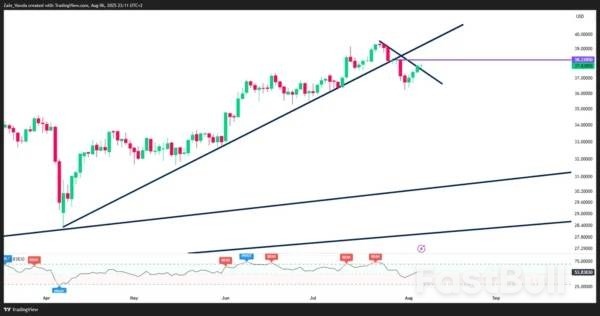
From a technical standpoint, the bearish trend remains intact as long as we do not get a daily candle close above the 38.22The current move higher could just be a retracement before the next leg to the downside and a fresh lower low.There is the descending trendline which was broken and hints at further upside. The ascending trendline is also in play.This leaves a slightly confusing outlook for Silver moving forward, with the next move looking more like a coin toss at this stage.
The RSI period-14 on the daily chart has crossed above the 50 neutral level which hints at bullish momentum. However a cross back below the 50 level could be a sign that a lower low may be incoming.A lot to ponder when it comes to Silver prices moving forward. A week ago things looked a lot simpler, highlighting the various factors at play in financial markets.
Silver (XAG/USD) Daily Chart, August 6, 2025
U.S. President Donald Trump on Wednesday said he could announce further tariffs on China similar to the 25% duties announced earlier on India over its purchases of Russian oil, depending on what happens.
"Could happen," Trump told reporters, after saying he expected to announce more secondary sanctions aimed at pressuring Russia to end its war in Ukraine.
He gave no further details.
"It may happen ... I can't tell you yet," Trump said. "We did it with India. We're doing it probably with a couple of others. One of them could be China."
Trump on Wednesday imposed an additional 25% tariff on Indian goods, on top of a 25% tariff announced previously, citing its continued purchases of Russian oil.
The White House order did not mention China, which is another big purchaser of Russian oil. Last week, U.S. Treasury Secretary Scott Bessent warned China that it could also face new tariffs if it continued buying Russian oil.
The United States will impose a tariff of about 100% on semiconductor chips imported from countries not producing in America or planning to do so, President Donald Trump said.Trump told reporters in the Oval Office on Wednesday the new tariff rate would apply to "all chips and semiconductors coming into the United States," but would not apply to companies that had made a commitment to manufacture in the United States or were in the process of doing so."If, for some reason, you say you're building and you don't build, then we go back and we add it up, it accumulates, and we charge you at a later date, you have to pay, and that's a guarantee," Trump added.
The comments were not a formal tariff announcement, and Trump offered no further specifics.It is not clear how many chips, or from which country, would be impacted by the new levy. Taiwanese chip contract manufacturer TSMC , opens new tab - which makes chips for most U.S. companies - has factories in the country, so its big customers such as Nvidia, opens new tab are not likely to face increased tariff costs.The AI chip giant has itself said it plans to invest hundreds of billions of dollars in U.S.-made chips and electronics over the next four years. An Nvidia spokesperson declined to comment for this story.
"Large, cash-rich companies that can afford to build in America will be the ones to benefit the most. It’s survival of the biggest," said Brian Jacobsen, chief economist at investment advisory firm Annex Wealth Management.Congress created a $52.7 billion semiconductor manufacturing and research subsidy program in 2022. The Commerce Department under President Joe Biden last year convinced all five leading-edge semiconductor firms to locate chip factories in the U.S. as part of the program.The department said the U.S. last year produced about 12% of semiconductor chips globally, down from 40% in 1990.
Any chip tariffs would likely target China, with whom Washington is still negotiating a trade deal."There's so much serious investment in the United States in chip production that much of the sector will be exempt," said Martin Chorzempa, senior fellow at the Peterson Institute for International Economics.Since chips made in China won't be exempt, chips made by SMIC or Huawei would not be either, Chorzempa said, noting that chips from these companies entering the U.S. market were mostly incorporated into devices assembled in China.
"If these tariffs were applied without a component tariff, it might not make much difference," he said.Chipmaking nations South Korea and Japan, as well as the European Union, have reached trade deals with the U.S., potentially giving them an advantage.The EU said it agreed to a single 15% tariff rate for the vast majority of EU exports, including cars, chips and pharmaceuticals. South Korea and Japan said separately that U.S. agreed not to give them worse tariff rates than other countries on chips, suggesting a 15% levy as well.
The Bank of England is set to cut interest rates to the lowest level in over two years, as its policymakers contend with a slowing economy and a jobs market rattled by higher taxes.
Markets and economists expect the UK central bank to lower the benchmark rate by 25 basis points to 4%, sticking to its once-a-quarter pace of easing. It will announce the decision at 12 p.m. in London, followed by a press conference led by Governor Andrew Bailey half an hour later.
The Monetary Policy Committee has maintained a cautious approach to unwinding policy restriction amid a fresh spike in inflation. Updated forecasts are expected to show stronger near-term price pressures than predicted back in May.
However, concerns over the economy are also mounting after back-to-back contractions over the spring and a hiring slowdown since employers were hit by increases in payroll taxes and the minimum wage in April. Economists expect the MPC to maintain guidance steering traders toward more gradual rate cuts.
A fifth quarter-point reduction today would take rates to the lowest since March 2023 and see the BOE pull ahead of the Federal Reserve, which has delivered 100 basis points of easing — all of it last year. On July 30, the US central bank held its benchmark rate in a range of 4.25%-4.5%.
The BOE decision is likely to expose divisions on the nine-member committee panel once again.
Economists surveyed by Bloomberg predict a three-way split with the majority supporting a quarter-point reduction, two backing a bigger half-point cut and two others wanting no change in policy. That would be a repeat of the division three months ago when the MPC last lowered rates.
Chief economist Huw Pill and external rate-setter Catherine Mann are seen as the most likely to oppose a reduction, as they did in May, while Swati Dhingra and Alan Taylor may vote for a larger half-point cut.
The MPC is expected to leave in place guidance steering markets toward more “gradual and careful” interest-rate cuts and a meeting-by-meeting approach.
However, traders will be watching closely for any hints that rate-setters are considering a slower pace as they edge toward the end of the cutting cycle. Currently markets expect two more reductions by the end of the year, including a move on Thursday, with rates eventually settling at around 3.5% next year.
“The risks are tilted in a hawkish direction – it’s possible the committee introduces language that suggests it is considering shifting away from its current pace of reducing rates once a quarter,” said Dan Hanson, chief UK economist at Bloomberg Economics. “The implication would be that a November cut is far from a done deal.”
The BOE may tweak its forecasts after hotter-than-expected inflation since its last projections in May, driven by sharp increases in energy and food prices.
Inflation hit a 17-month high of 3.6% in June, 0.2 percentage point above the BOE projection. The bank is expected to raise its near-term forecasts, predicting price growth will peak closer to 4% this year than the 3.7% it projected in May.
While Bailey believes the current spike will be temporary, others including Pill have voiced concerns about second-round effects on wages and prices. More focus may be put on the BOE’s unemployment projections with the MPC growing concerned over the hit to jobs since Labour increased hiring costs for businesses.
Over 180,000 payrolls have been eliminated since Chancellor of the Exchequer Rachel Reeves first announced the £26 billion ($35 billion) increase to employer national insurance contributions in October, pushing the jobless rate to its highest in four years.
In May, the BOE predicted growth of 1% in 2025 and 1.25% next year. A modest upgrade is possible after the economy grew faster-than-forecast in the first quarter and the bank in June informally raised its second-quarter projection from 0.1% to 0.25%.
The BOE’s latest analysis on quantitative tightening — the process of reducing the hundreds of billions of pounds of government bonds it owns — will be under the spotlight ahead of a decision on the program’s future in September.
Bailey has noted signs of strain in the long-dated bond market in recent comments after the yield on 30-year securities climbed to levels last seen in the late 1990s. That has fueled expectations that the BOE could slow sales of gilts, or skew them toward shorter-dated debt.
Currently market participants surveyed by the central bank expect the overall run-off of the BOE’s balance sheet to slow from around £100 billion a year to £75 billion, implying active sales of around £26 billion.
“Any special mention of the long-end of the gilt curve – with the MPC signalling any unwarranted tightening in long-end yields due to limited liquidity – will be important,” said Sanjay Raja, chief UK economist at Deutsche Bank. “This could set up expectations for a potential tweak to the BOE’s sales strategy in September.”
Oil held a five-day decline — the longest losing run since January — as investors looked beyond US efforts to punish buyers of Russian crude, while tracking a diplomatic push by President Donald Trump to halt the war in Ukraine.
West Texas Intermediate was little changed below $65 a barrel after slumping to the lowest close since early June, while Brent settled just shy of $67. On Wednesday, Trump doubled tariffs on Indian goods to 50% due to the nation’s purchases of Russian energy, with implementation set to begin in three weeks. Still, there’s been no similar US move against China, another major importer of Moscow’s oil.
On the diplomatic front, Trump said there was a “very good chance” he would meet soon with Russian President Vladimir Putin and his Ukrainian counterpart, Volodymyr Zelenskiy, in another bid to broker peace between the two countries. He also said there would be “a lot more” penalties related to purchases of Russian oil, without giving details.
Crude has moved sharply lower so far in August after a run of three monthly gains. Traders are positioning for a potential glut later this year after OPEC+ returned millions of barrels of shuttered capacity to the market. In addition, there are concerns about a slowdown in economic growth — and potentially weaker energy consumption — as Trump’s broader trade tariffs exact a toll.
Apple is adding $100 billion to its U.S. manufacturing plans following a closed-door meeting between Tim Cook and President Donald Trump at the White House on Wednesday.This comes as the company tries to protect its core product line from a new wave of tariffs and stay on the administration’s good side while still depending heavily on overseas factories.
Trump is expected to personally announce Apple’s new pledge at the White House event where Cook will also be present. The plan involves setting up a new domestic manufacturing program to pull more of the company’s supply chain into the U.S.This includes building and assembling more critical components locally to avoid new trade penalties.It adds to Apple’s earlier promise of $500 billion, which covered projects like a server manufacturing site in Houston, a supplier training center in Michigan, and more money flowing to existing American vendors.With this new pledge, Apple’s total investment in the U.S. now stands at $600 billion.
White House spokesperson Taylor Rogers tied the new investment directly to Trump’s economic goals, saying:
“Today’s announcement with Apple is another win for our manufacturing industry that will simultaneously help reshore the production of critical components to protect America’s economic and national security.”Apple’s stock rose 6% on Wednesday after the pledge, which is its biggest intraday gain since February. Meanwhile, Trump also signed an executive order adding another 25% tariff on goods from India in response to its Russian oil purchases, in addition to a separate 25% duty already scheduled to hit the next day.Apple’s major reliance on India for iPhone assembly makes it a direct target. Trump has repeatedly pushed Apple to move full iPhone manufacturing to U.S. factories. Earlier this year, after a meeting with Cook, Trump threatened a 25% tariff if the company didn’t act.
While officials have floated ideas like robotics for U.S. assembly, Cook has focused more on securing tariff exemptions. He did this successfully during Trump’s first term and has been working to do it again.Last week, during a call with analysts, Cook admitted that “the vast majority” of iPhones sold in the U.S. are still made in India. He added that other products such as MacBooks, iPads, and Apple Watches come from Vietnam.“We obviously try to optimize our supply chain,” Cook said. “And ultimately, we will do more in the United States.”Cook also said Apple took an $800 million hit from tariffs in the last quarter and expects that number to rise to $1.1 billion by the end of September unless there are changes in trade policy. That pressure is only increasing.
Trump is now preparing to target all products with semiconductor chips with new levies, which could drop as soon as next week. He’s also expanding country-specific tariffs that will hit dozens of trade partners on Thursday.Trump’s track record with Apple shows a pattern. During his first term, Cook managed to get several of Apple’s products exempted from import duties. If he can pull that off again, it could help Apple avoid price hikes that would squeeze its margins, or worse, give competitors like Samsung a pricing advantage.The initial $500 billion commitment Apple made in February included a promise to add 20,000 jobs, but the numbers weren’t much beyond its previously announced plans. That pledge only added $39 billion and around 1,000 jobs per year. The extra $100 billion is meant to reinforce its U.S. ties ahead of a broader trade crackdown.
The Apple news fits into a string of public investment rollouts from the Trump administration. Earlier this year, Trump hosted a joint announcement with Oracle, SoftBank, and OpenAI, revealing a $100 billion investment in AI data centers with plans to hit $500 billion.Separately, Trump said Nvidia plans to manufacture up to $500 billion in AI infrastructure inside the U.S. through new partnerships. The White House has also linked trade deals directly to investment promises.In an agreement with the European Union, Trump secured $750 billion in American energy exports and $600 billion in U.S. investments. A similar deal with Japan led to a $550 billion investment fund targeting American projects.
With CEO Tim Cook standing next to him in the Oval Office as the president announced a fresh (and very laughable) $100 billion investment plan by Apple which it would then add to the $500 billion already pledged over the next 4 years (which is ridiculous since Apple spent $43 billion in capex in the past 4 years and generated less than $100 billion in net income in its best year), Trump announced he would impose a 100% tariff on chip and semiconductor imports, but would exempt companies moving production back to the United States.
Apple had previously pledged to spend $500 billion in the US over the next four years, an acceleration over its prior investments and previously announced plans, adding about $39 billion in spending and an additional 1,000 jobs annually. The announcement will bring Apple’s cumulative commitment to $600 billion, and appears to be an ad hoc bundling of pretty much everything on the income and cash flow statements, including CoGS, SG&A, CapEx, buybacks and so on. The previously-planned $500 billion was said to include work on a new server manufacturing facility in Houston, a supplier academy in Michigan and additional spending with its existing suppliers in the country.
“We’re going to be putting a very large tariff on chips and semiconductors, but the good news for companies like Apple is, if you’re building in the United States, or have committed to build, without question, committed to build in the United States, there will be no charge,” Trump told reporters.
“So in other words, we’ll be putting a tariff of approximately 100% on chips and semiconductors. But if you’re building in the United States of America, there’s no charge,” Trump said. “Even though you’re building and you’re not producing yet, in terms of the big numbers of jobs and all of things building, if you’re building, there will be no charge.”
The hollow announcement which is largely unenforceable and amounts to nothing more than a promise by Apple, represents a major victory for Apple and Cook, who have faced escalating threats from Trump’s tariffs that threatened to ratchet up the cost of producing their signature phones and computers. And while AAPL will spend precisely zero dollars, it already got the benefit of the market which sent its stock price billions of dollars higher on absolutely nothing.
In theory, Apple’s $100 billion US investment will include a new manufacturing program designed to bring more of Apple’s production to the US. The company’s American Manufacturing Program partners include glassmaker Corning, Applied Materials, Texas Instruments and others, the company said.
Corning will dedicate an entire factory in Kentucky to Apple glass production, increasing that company’s workforce in the state by 50%. Corning was already a supplier to Apple, making glass for the very first iPhone at the same factory.
The increased pledge comes as Trump escalates a tariff push that’s set to raise costs for Apple throughout its international supply chains.
Meanwhile, Trump followed through with his plans to hit India - a key production market for Apple - with 50% tariffs, the first half of which takes effect just after midnight alongside a raft of other country-specific levies designed to reduce trade imbalances. The other half, to penalize India for buying Russian energy, will take effect later this month.
The president has said he could unveil separate levies on all products containing semiconductor chips as soon as next week.
Cook, who attended the president’s inauguration and donated to his inaugural committee, has pushed for tariff exemptions for his company’s iPhones. Most iPhones sold in the US come from India, while the bulk of other products, including Apple Watches, iPads and MacBooks, are manufactured in Vietnam, which was hit with a 20% tariff. While details of those tariffs, and how firms would qualify for exemptions, have yet to be released, Trump singled out Cook’s Apple as an example of how to avoid the increased levies. Namely, make bombastic promises that make for glitzy headlines.
Cook’s investment echoes dozens of pledges from companies since Trump won the 2024 presidential election, with CEOs flying to his Mar-a-Lago resort in Florida, and then to the White House once he was sworn in, to court the new administration and announce hundreds of billions of dollars worth of new deals.
Most if not all of these investments were already in the works prior to the November election, or were on par with previous investment trends, Bloomberg previously reported. Economists have also questioned whether all of the pledged spending, and associated job opportunities, will come to fruition.
Meanwhile, Apple’s promised investments, while substantial, fall short of the full shift to US-based production that Trump and top White House officials have envisioned and encouraged. Earlier this year, the president threatened to impose a tariff of at least 25% on Apple if it didn’t move manufacturing of the iPhone to the US, a day after he met with Cook at the White House.
Cook told the president that final iPhone assembly “will be elsewhere for a while,” though highlighted that several components are being made in the US. Trump, seemingly satisfied, praised the Apple leader’s plans.
“Look, he’s not making this kind of an investment anywhere in the world, not even close,” Trump said of Cook. “He’s coming back. I mean, Apple’s coming back to America.”
Actually, no he isn't.
White Label
Data API
Web Plug-ins
Poster Maker
Affiliate Program
The risk of loss in trading financial instruments such as stocks, FX, commodities, futures, bonds, ETFs and crypto can be substantial. You may sustain a total loss of the funds that you deposit with your broker. Therefore, you should carefully consider whether such trading is suitable for you in light of your circumstances and financial resources.
No decision to invest should be made without thoroughly conducting due diligence by yourself or consulting with your financial advisors. Our web content might not suit you since we don't know your financial conditions and investment needs. Our financial information might have latency or contain inaccuracy, so you should be fully responsible for any of your trading and investment decisions. The company will not be responsible for your capital loss.
Without getting permission from the website, you are not allowed to copy the website's graphics, texts, or trademarks. Intellectual property rights in the content or data incorporated into this website belong to its providers and exchange merchants.
Not Logged In
Log in to access more features

FastBull Membership
Not yet
Purchase
Log In
Sign Up