• Trade
  • Markets
  • Copy
  • Contests
  • News
  • 24/7
  • Calendar
  • Q&A
  • Chats
Trending
Screeners
SYMBOL
LAST
BID
ASK
HIGH
LOW
NET CHG.
%CHG.
SPREAD
SPX
S&P 500 Index
6827.42
6827.42
6827.42
6899.86
6801.80
-73.58
-1.07%
--
DJI
Dow Jones Industrial Average
48458.04
48458.04
48458.04
48886.86
48334.10
-245.98
-0.51%
--
IXIC
NASDAQ Composite Index
23195.16
23195.16
23195.16
23554.89
23094.51
-398.69
-1.69%
--
USDX
US Dollar Index
97.950
98.030
97.950
98.500
97.950
-0.370
-0.38%
--
EURUSD
Euro / US Dollar
1.17394
1.17409
1.17394
1.17496
1.17192
+0.00011
+ 0.01%
--
GBPUSD
Pound Sterling / US Dollar
1.33707
1.33732
1.33707
1.33997
1.33419
-0.00148
-0.11%
--
XAUUSD
Gold / US Dollar
4299.39
4299.39
4299.39
4353.41
4257.10
+20.10
+ 0.47%
--
WTI
Light Sweet Crude Oil
57.233
57.485
57.233
58.011
56.969
-0.408
-0.71%
--

Community Accounts

Signal Accounts
--
Profit Accounts
--
Loss Accounts
--
View More

Become a signal provider

Sell trading signals to earn additional income

View More

Guide to Copy Trading

Get started with ease and confidence

View More

Signal Accounts for Members

All Signal Accounts

Best Return
  • Best Return
  • Best P/L
  • Best MDD
Past 1W
  • Past 1W
  • Past 1M
  • Past 1Y

All Contests

  • All
  • Trump Updates
  • Recommend
  • Stocks
  • Cryptocurrencies
  • Central Banks
  • Featured News
Top News Only
Share

US Envoy Coale Says Belarus President Lukashenko Agreed To Do All He Can To Stop Weather Balloons Flying Into Lithuania

Share

Ukraine Says Russian Drone Attack Hit Civilian Turkish Vessel

Share

Islamic State Attacker In Syria Was Lone Gunman, Who Was Killed -USA Central Command

Share

US Envoy John Coale Says Around 1000 Remaining Political Prisoners In Belarus Could Be Released In Coming Months

Share

US Defense Secretary Hegseth: Attacker Was Killed By Partner Forces

Share

Pentagon Says Two USA Army Soldiers And One Civilian USA Interpreter Were Killed, And Three Were Wounded In Syria

Share

Israel Says It Kills Senior Hamas Commander Raed Saed In Gaza

Share

Ukraine's Navy Says Russian Drone Attack Hit Civilian Turkish Vessel Carrying Sunflower Oil To Egypt On Saturday

Share

Israeli Military Says It Put Planned Strike On South Lebanon Site On Hold After Lebanese Army Requested Access

Share

Norwegian Nobel Committee: Calls On The Belarusian Authorities To Release All Political Prisoners

Share

Norwegian Nobel Committee: His Freedom Is A Deeply Welcome And Long-Awaited Moment

Share

Ukraine Says It Received 114 Prisoners From Belarus

Share

USA Embassy In Lithuania: Maria Kalesnikava Is Not Going To Vilnius

Share

USA Embassy In Lithuania: Other Prisoners Are Being Sent From Belarus To Ukraine

Share

Ukraine President Zelenskiy: Five Ukrainians Released By Belarus In US-Brokered Deal

Share

USA Vilnius Embassy: USA Stands Ready For "Additional Engagement With Belarus That Advances USA Interests"

Share

USA Vilnius Embassy: Belarus, USA, Other Citizens Among The Prisoners Released Into Lithuania

Share

USA Vilnius Embassy: USA Will Continue Diplomatic Efforts To Free The Remaining Political Prisoners In Belarus

Share

USA Vilnius Embassy: Belarus Releases 123 Prisoners Following Meeting Of President Trump's Envoy Coale And Belarus President Lukashenko

Share

USA Vilnius Embassy: Masatoshi Nakanishi, Aliaksandr Syrytsa Are Among The Prisoners Released By Belarus

TIME
ACT
FCST
PREV
U.K. Trade Balance Non-EU (SA) (Oct)

A:--

F: --

P: --

U.K. Trade Balance (Oct)

A:--

F: --

P: --

U.K. Services Index MoM

A:--

F: --

P: --

U.K. Construction Output MoM (SA) (Oct)

A:--

F: --

P: --

U.K. Industrial Output YoY (Oct)

A:--

F: --

P: --

U.K. Trade Balance (SA) (Oct)

A:--

F: --

P: --

U.K. Trade Balance EU (SA) (Oct)

A:--

F: --

P: --

U.K. Manufacturing Output YoY (Oct)

A:--

F: --

P: --

U.K. GDP MoM (Oct)

A:--

F: --

P: --

U.K. GDP YoY (SA) (Oct)

A:--

F: --

P: --

U.K. Industrial Output MoM (Oct)

A:--

F: --

P: --

U.K. Construction Output YoY (Oct)

A:--

F: --

P: --

France HICP Final MoM (Nov)

A:--

F: --

P: --

China, Mainland Outstanding Loans Growth YoY (Nov)

A:--

F: --

P: --

China, Mainland M2 Money Supply YoY (Nov)

A:--

F: --

P: --

China, Mainland M0 Money Supply YoY (Nov)

A:--

F: --

P: --

China, Mainland M1 Money Supply YoY (Nov)

A:--

F: --

P: --

India CPI YoY (Nov)

A:--

F: --

P: --

India Deposit Gowth YoY

A:--

F: --

P: --

Brazil Services Growth YoY (Oct)

A:--

F: --

P: --

Mexico Industrial Output YoY (Oct)

A:--

F: --

P: --

Russia Trade Balance (Oct)

A:--

F: --

P: --

Philadelphia Fed President Henry Paulson delivers a speech
Canada Building Permits MoM (SA) (Oct)

A:--

F: --

P: --

Canada Wholesale Sales YoY (Oct)

A:--

F: --

P: --

Canada Wholesale Inventory MoM (Oct)

A:--

F: --

P: --

Canada Wholesale Inventory YoY (Oct)

A:--

F: --

P: --

Canada Wholesale Sales MoM (SA) (Oct)

A:--

F: --

P: --

Germany Current Account (Not SA) (Oct)

A:--

F: --

P: --

U.S. Weekly Total Rig Count

A:--

F: --

P: --

U.S. Weekly Total Oil Rig Count

A:--

F: --

P: --

Japan Tankan Large Non-Manufacturing Diffusion Index (Q4)

--

F: --

P: --

Japan Tankan Small Manufacturing Outlook Index (Q4)

--

F: --

P: --

Japan Tankan Large Non-Manufacturing Outlook Index (Q4)

--

F: --

P: --

Japan Tankan Large Manufacturing Outlook Index (Q4)

--

F: --

P: --

Japan Tankan Small Manufacturing Diffusion Index (Q4)

--

F: --

P: --

Japan Tankan Large Manufacturing Diffusion Index (Q4)

--

F: --

P: --

Japan Tankan Large-Enterprise Capital Expenditure YoY (Q4)

--

F: --

P: --

U.K. Rightmove House Price Index YoY (Dec)

--

F: --

P: --

China, Mainland Industrial Output YoY (YTD) (Nov)

--

F: --

P: --

China, Mainland Urban Area Unemployment Rate (Nov)

--

F: --

P: --

Saudi Arabia CPI YoY (Nov)

--

F: --

P: --

Euro Zone Industrial Output YoY (Oct)

--

F: --

P: --

Euro Zone Industrial Output MoM (Oct)

--

F: --

P: --

Canada Existing Home Sales MoM (Nov)

--

F: --

P: --

Euro Zone Total Reserve Assets (Nov)

--

F: --

P: --

U.K. Inflation Rate Expectations

--

F: --

P: --

Canada National Economic Confidence Index

--

F: --

P: --

Canada New Housing Starts (Nov)

--

F: --

P: --

U.S. NY Fed Manufacturing Employment Index (Dec)

--

F: --

P: --

U.S. NY Fed Manufacturing Index (Dec)

--

F: --

P: --

Canada Core CPI YoY (Nov)

--

F: --

P: --

Canada Manufacturing Unfilled Orders MoM (Oct)

--

F: --

P: --

Canada Manufacturing New Orders MoM (Oct)

--

F: --

P: --

Canada Core CPI MoM (Nov)

--

F: --

P: --

Canada Manufacturing Inventory MoM (Oct)

--

F: --

P: --

Canada CPI YoY (Nov)

--

F: --

P: --

Canada CPI MoM (Nov)

--

F: --

P: --

Canada CPI YoY (SA) (Nov)

--

F: --

P: --

Canada Core CPI MoM (SA) (Nov)

--

F: --

P: --

Q&A with Experts
    • All
    • Chatrooms
    • Groups
    • Friends
    Connecting
    .
    .
    .
    Type here...
    Add Symbol or Code

      No matching data

      All
      Trump Updates
      Recommend
      Stocks
      Cryptocurrencies
      Central Banks
      Featured News
      • All
      • Russia-Ukraine Conflict
      • Middle East Flashpoint
      • All
      • Russia-Ukraine Conflict
      • Middle East Flashpoint

      Search
      Products

      Charts Free Forever

      Chats Q&A with Experts
      Screeners Economic Calendar Data Tools
      Membership Features
      Data Warehouse Market Trends Institutional Data Policy Rates Macro

      Market Trends

      Market Sentiment Order Book Forex Correlations

      Top Indicators

      Charts Free Forever
      Markets

      News

      News Analysis 24/7 Columns Education
      From Institutions From Analysts
      Topics Columnists

      Latest Views

      Latest Views

      Trending Topics

      Top Columnists

      Latest Update

      Signals

      Copy Rankings Latest Signals Become a signal provider AI Rating
      Contests
      Brokers

      Overview Brokers Assessment Rankings Regulators News Claims
      Broker listing Forex Brokers Comparison Tool Live Spread Comparison Scam
      Q&A Complaint Scam Alert Videos Tips to Detect Scam
      More

      Business
      Events
      Careers About Us Advertising Help Center

      White Label

      Data API

      Web Plug-ins

      Affiliate Program

      Awards Institution Evaluation IB Seminar Salon Event Exhibition
      Vietnam Thailand Singapore Dubai
      Fans Party Investment Sharing Session
      FastBull Summit BrokersView Expo
      Recent Searches
        Top Searches
          Markets
          News
          Analysis
          User
          24/7
          Economic Calendar
          Education
          Data
          • Names
          • Latest
          • Prev

          View All

          No data

          Scan to Download

          Faster Charts, Chat Faster!

          Download App
          English
          • English
          • Español
          • العربية
          • Bahasa Indonesia
          • Bahasa Melayu
          • Tiếng Việt
          • ภาษาไทย
          • Français
          • Italiano
          • Türkçe
          • Русский язык
          • 简中
          • 繁中
          Open Account
          Search
          Products
          Charts Free Forever
          Markets
          News
          Signals

          Copy Rankings Latest Signals Become a signal provider AI Rating
          Contests
          Brokers

          Overview Brokers Assessment Rankings Regulators News Claims
          Broker listing Forex Brokers Comparison Tool Live Spread Comparison Scam
          Q&A Complaint Scam Alert Videos Tips to Detect Scam
          More

          Business
          Events
          Careers About Us Advertising Help Center

          White Label

          Data API

          Web Plug-ins

          Affiliate Program

          Awards Institution Evaluation IB Seminar Salon Event Exhibition
          Vietnam Thailand Singapore Dubai
          Fans Party Investment Sharing Session
          FastBull Summit BrokersView Expo

          Silver Price Hits Historic Record Around $64

          FXOpen

          Forex

          Commodity

          Summary:

          On 27 November, we suggested that silver was preparing to challenge its all-time high.

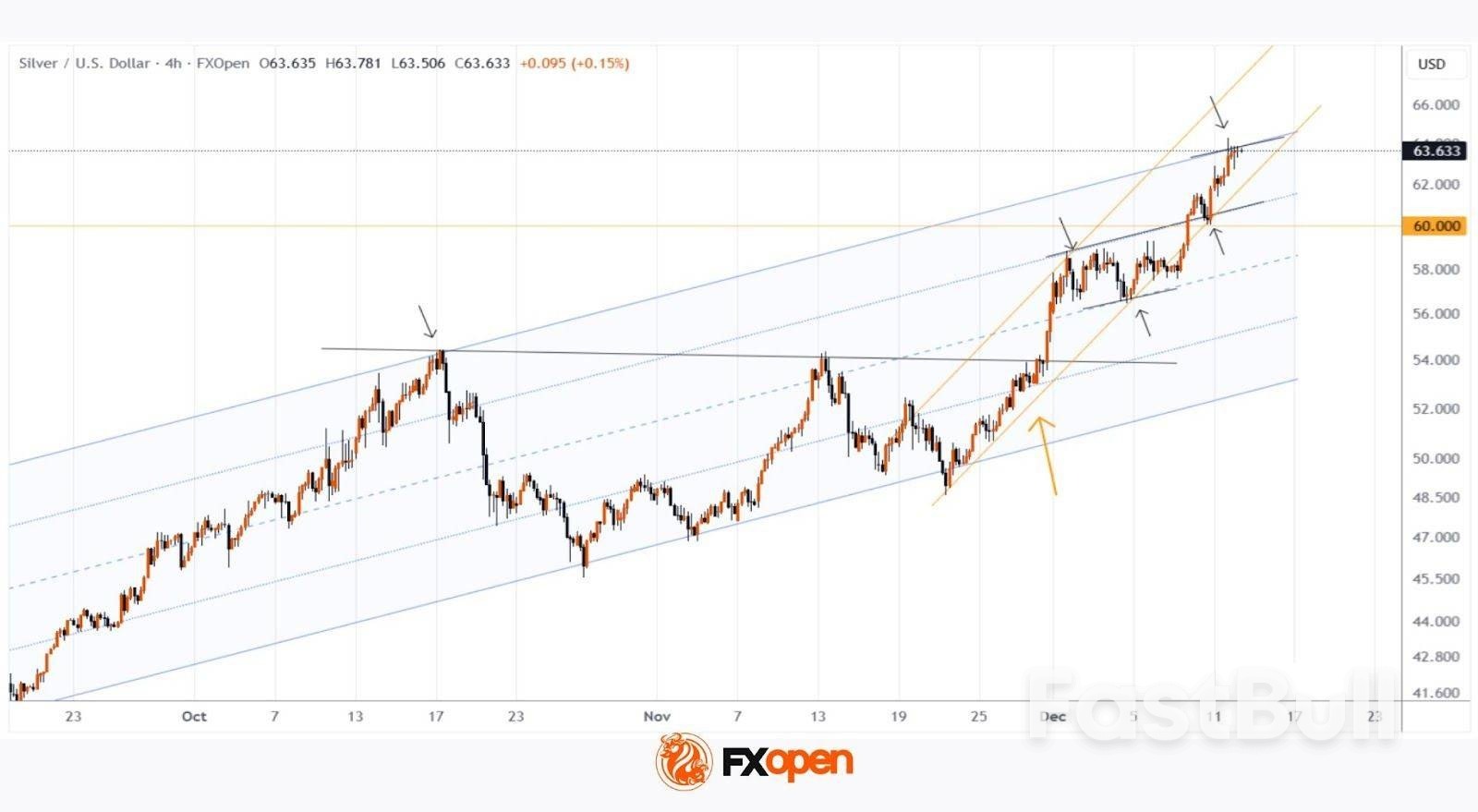
          On 27 November, we suggested that silver was preparing to challenge its all-time high. Since then (marked with the orange arrow), XAG/USD has risen by roughly 18%, breaking above the psychological $60-per-ounce threshold for the first time in history.

          The rally has been driven by strong retail inflows into silver ETFs, alongside expectations of a structural supply deficit by 2026 due to robust industrial demand—particularly from solar energy, electric vehicles, and data-centre infrastructure.

          The weakening of the US dollar following the Federal Reserve's decision on Wednesday also helped lift dollar-denominated silver to a new historic peak near $64.
          Technical Analysis of XAG/USD

          A review of the XAG/USD chart shows that the price has been moving within a rising channel that encapsulates the uptrend beginning in early September.

          Within this structure:→ the channel median acted as a springboard for price growth on 4 December;→ the line dividing the upper half of the channel into quarters switched from resistance (earlier in the month) to support on 10 December;→ silver is now trading near the channel's upper boundary, which may behave as significant resistance (as it did in mid-October).

          Given these factors, the market may now be heavily overheated, leaving it vulnerable to a correction. Should this scenario begin to unfold, we could see a bearish break of the steep upward trajectory that has lifted silver by around 30% from the 21 November low.

          Source: FXOpen

          Risk Warnings and Disclaimers
          You understand and acknowledge that there is a high degree of risk involved in trading. Following any strategies or investment methods may lead to potential losses. The content on the site is provided by our contributors and analysts for information purposes only. You are solely responsible for determining whether any trading assets, securities, strategy, or any other product is suitable for investing based on your own investment objectives and financial situation.
          Add to Favorites
          Share

          General Market Analysis – 12/12/25

          IC Markets

          Forex

          Stocks

          US Stocks Mixed After Fed – Dow up 1.3%

          US equity markets were mixed overnight as investors continued to weigh the implications of the Fed's latest rate cut. The Dow led the way, jumping 1.34% to finish at 48,704, while the S&P 500 managed a modest 0.21% rise to 6,901, both securing fresh record closes. The Nasdaq, however, slipped 0.25% to 23,593 after tech heavyweight Oracle issued a weaker-than-expected forecast, reigniting concerns that parts of the AI sector may be running ahead of fundamentals.

          In FX, the US dollar softened again, with the DXY easing 0.29% to 98.34, even as Treasury yields edged higher. The 2-year yield nudged up 0.3 bps to 3.541%, while the 10-year added 1 bp to 4.157%. Oil extended its recent decline, with Brent slipping 0.96% to $61.62 and WTI down 0.91% to $57.93, as markets drew optimism from renewed hopes for progress toward a Ukraine peace deal. Gold rallied strongly, climbing 1.06% to $4,278.85, supported by haven flows and momentum following yesterday's Fed decision.

          Investor Glasses Still Half Full for Christmas Drinks

          Major US indices pushed higher in trading yesterday to hit fresh all-time high closes as investors continued to cheer the Fed's interest rate cut on Wednesday and advice that we will see at least one more in 2026. The Dow and S&P hit records, while the Nasdaq fell marginally, which wasn't a bad result given an 11% drop for Oracle.

          The market seems to be driving forward into the year-end with the same 'glass half full' mentality that has carried it to records in 2025, and investors are happy to jump on that bandwagon. However, there are some that fear a significant early-2026 hangover could be coming their way, with growth tech firms involved in AI looking to be the highest risk for some sharp corrections in the current environment – as we saw with Oracle yesterday. In addition to those fears, the Fed left plenty of wiggle room for hawks out there as well, despite the market's initial reaction to Wednesday's cut – so for now, investors are happy to eat, drink, and be merry while the good times last, but are wary that things can sometimes look different in the cold light of a fresh new day – or fresh new year!

          Markets Strong into the Weekend

          With the macro calendar far quieter today, traders may still see swings across markets as they continue to digest the heavy run of central bank updates and geopolitical developments from earlier in the week. The Asian session is expected to have a relatively quiet start to the day; however, with products trading at significant levels, traders are expecting things to liven up as the day progresses.

          The European session sees the release of the only tier 1 data of the day, with the UK GDP numbers due out. The month-on-month figure is expected to show just a 0.1% increase, and any deviation from this will see big moves in the pound, anything lower likely to put more pressure on the Bank of England ahead of next week's interest rate call. There is little on the calendar in the New York session today, which should see smoother trading conditions; however, as above, with indices at all-time highs and the Fed update still fresh in investors' minds, most traders are expecting another lively session.

          Source: IC Markets

          Risk Warnings and Disclaimers
          You understand and acknowledge that there is a high degree of risk involved in trading. Following any strategies or investment methods may lead to potential losses. The content on the site is provided by our contributors and analysts for information purposes only. You are solely responsible for determining whether any trading assets, securities, strategy, or any other product is suitable for investing based on your own investment objectives and financial situation.
          Add to Favorites
          Share

          Taiwan Tech Rally Defies AI Bubble Fears as Local Investors Bet on Structural Edge

          Gerik

          Economic

          Local Confidence Anchors Taiwan's Market Amid Global Skepticism

          As global markets begin to exhibit caution toward artificial intelligence stocks, Taiwan’s domestic investors are charging ahead, undeterred by the fear of an AI valuation bubble. The island’s benchmark stock index is on track to breach the symbolic 30,000-point mark in early 2026, having nearly doubled over the past three years. This optimism is rooted not just in speculation, but in Taiwan’s strategic position as the nucleus of the global semiconductor ecosystem powering the AI revolution.
          Despite net foreign outflows exceeding NT$533.8 billion (approximately $17 billion) in 2025 alone, the market remains resilient. Local investors appear more focused on long-term structural fundamentals than on short-term volatility or macroeconomic noise. This divergence in sentiment reflects a deeper belief that Taiwan’s supply-side advantages give it a unique buffer against AI market volatility.

          Semiconductors Secure Taiwan’s Central Role in AI Evolution

          Concerns about Nvidia’s future market dominance have surfaced globally as Google’s custom TPUs threaten to undercut GPU pricing. However, Taiwan benefits either way. As the foundational base for both Nvidia’s GPUs and Google’s TPUs, Taiwan stands to gain from rising demand regardless of who leads the AI hardware race.
          TSMC, the world’s largest contract chip manufacturer, sits at the heart of this hardware production cycle, along with AI-aligned firms like Foxconn, Elite Material, and other upstream suppliers. Analysts argue that the strength of Taiwan’s order books and the pace of innovation in high-end chips will keep revenue momentum intact well into 2027.
          Goldman Sachs projects that hyperscaler investment globally will grow to $552 billion in 2026 and $644 billion in 2027, which further reinforces the long-term outlook for hardware demand. Gina Kim of Nordea Asset Management also emphasizes that Taiwan’s role in AI and advanced semiconductors remains “structurally intact,” suggesting persistent upside potential.

          No Bubble in Sight, Say Analysts and Fund Managers

          Unlike the speculative fervor that marked the dot-com boom, Taiwan’s AI-linked stocks are supported by real earnings and competitive business models. The market’s current price-to-earnings (P/E) ratio stands at a relatively moderate 21, lower than both the Nasdaq and Japan’s Nikkei, indicating that despite soaring valuations, Taiwan’s market isn’t detached from corporate fundamentals.
          Li Fang-kuo, head of Uni-President’s securities investment division, dismisses bubble fears, arguing that companies like Nvidia and other “magnificent seven” names enjoy gross margins of 70% or more figures that are not remotely comparable to the revenue-less companies of the early 2000s.
          This sentiment is echoed by Goldman Sachs, whose strategists maintain an overweight position on tech and AI shares, stating that the current cycle, while frothy in appearance, does not yet meet the criteria of a speculative bubble.

          Foreign Sell-Off Contrasts With Strong Domestic Accumulation

          While foreign investors have continued to reduce their exposure driven by concerns about trade tensions, AI profit sustainability, and a desire to lock in gains domestic capital has filled the vacuum. Analysts attribute this divergence not to opposing market views, but to different time horizons and risk tolerances.
          Foreign investors, often guided by macro-hedging strategies, have been more reactive to rising tensions with Beijing and broader geopolitical instability. Yet these same issues appear to have less influence on local institutions and retail investors, who instead focus on Taiwan’s entrenched role in global tech supply chains.
          HSBC strategists recently noted that the average Asian portfolio contains a 10% allocation to a single stock TSMC highlighting both concentration risk and the confidence investors place in Taiwan’s leading position.

          Taiwan’s Strategic Position Shields It From AI Volatility

          While the rest of the world debates whether the AI boom has morphed into a bubble, Taiwan's domestic investors are doubling down. They are buoyed by a clear structural advantage: the island's indispensable role in manufacturing the core hardware powering the global AI transition.
          The market’s upward trajectory, backed by robust earnings and manageable valuations, presents a contrast to the overheated conditions that typically precede a bubble burst. As long as capital expenditure in AI infrastructure continues to rise, and Taiwan maintains its dominance in advanced semiconductors, the rally appears far from over regardless of who leads the AI race.
          Even with foreign capital fleeing and geopolitical risks looming, Taiwan's market narrative remains internally driven, structurally resilient, and fundamentally optimistic. The island’s near-future market prospects will likely be shaped less by fears of overvaluation and more by the durable demand for the silicon foundation of tomorrow’s intelligent machines.

          Source: Reuters

          To stay updated on all economic events of today, please check out our Economic calendar
          Risk Warnings and Disclaimers
          You understand and acknowledge that there is a high degree of risk involved in trading. Following any strategies or investment methods may lead to potential losses. The content on the site is provided by our contributors and analysts for information purposes only. You are solely responsible for determining whether any trading assets, securities, strategy, or any other product is suitable for investing based on your own investment objectives and financial situation.
          Add to Favorites
          Share

          U.K. Economy Unexpectedly Contracted in October; GDP Dropped 0.1%

          Glendon

          Forex

          Economic

          The U.K. economy unexpectedly remained in contraction in October, with uncertainty ahead of the Autumn budget by Chancellor Rachel Reeves likely curtailing growth.

          Data released earlier Friday by the Office for National Statistics showed that U.K. gross domestic product fell by 0.1% on a monthly basis in October, matching the drop seen during the prior month and below the 0.1% growth expected.

          On an annual basis, the U.K. economy expanded by 1.1% in October, matching the growth seen the previous month and below the 1.4% growth expected

          The manufacturing sector reported growth of 0.5% in October, rebounding from the hefty 1.7% drop the previous month, boosted by the restart of operations at Jaguar Land Rover's factories early in the month, after a cyber attack.

          For more discussion surrounding economic data releases from top Wall Street analysts, subscribe to InvestingPro - get 55% off today

          The uncertainty surrounding the Autumn budget, delivered by U.K. finance minister Rachel Reeves in November, likely deterred businesses and consumers alike from making investment decisions.

          In the end, Reeves did raise taxes to give her greater room to meet her deficit-reduction targets as well as fund higher welfare spending, but not by as much as had been feared.

          As a result, the Confederation of British Industry earlier Friday lifted up its economic growth forecast for next year, citing a temporary boost to government spending following the budget.

          The business association predicted the U.K. economy will grow 1.3% next year, up from its previous forecast of 1.0% in June, and also lifted its forecast for this year to 1.4% from 1.2%, reflecting upward revisions to recent official data.

          "While it's welcome to see our growth forecast upgraded for next year, the mood music reads more 'cautious optimism' than 'cause for celebration'," CBI chief economist Louise Hellem said.

          The Bank of England holds its final policy-setting meeting of the year next week, and is widely expected to cut interest rates by a quarter point to 3.75% as recent data has shown inflation drifting lower.

          British inflation fell in October for the first time since May, to 3.6% from 3.8%, in line with the central bank's expectations, and November data due next week could show a further drift downwards.

          The BOE held interest rates unchanged at 4.0% in November, but this was a close call with four out of the nine policymakers voting for a rate reduction.

          Source: Investing

          To stay updated on all economic events of today, please check out our Economic calendar
          Risk Warnings and Disclaimers
          You understand and acknowledge that there is a high degree of risk involved in trading. Following any strategies or investment methods may lead to potential losses. The content on the site is provided by our contributors and analysts for information purposes only. You are solely responsible for determining whether any trading assets, securities, strategy, or any other product is suitable for investing based on your own investment objectives and financial situation.
          Add to Favorites
          Share

          Trump's ‘Gold Card’ Fast-Track Visa Sparks Legal and Economic Concerns

          Gerik

          Economic

          A High-Priced Path to Citizenship for the Global Elite

          President Donald Trump has launched the “Trump Gold Card,” a controversial new immigration initiative offering wealthy individuals and corporations expedited U.S. permanent residency and eventually citizenship through large, nonrefundable contributions. For individuals, a $1 million donation and a $15,000 processing fee grant access to EB-1 or EB-2 visa tracks. Corporations may sponsor employees for $2 million under the “Corporate Gold Card,” with additional fees and optional transfer rights.
          Applications for both programs opened December 10, following a September executive order. Trump claims the program will raise “billions” for the U.S. Treasury, helping fund government initiatives and strengthening the economy. The Trump administration has framed the move as a way to “bring in the best,” emphasizing elite talent and global capital over broader immigration access.

          Legal Ambiguities Undermine Policy Certainty

          Despite its high-profile rollout, legal experts argue that the program’s foundation remains shaky. Unlike the EB-5 investor visa program, which is grounded in federal statute and requires job creation, the Gold Card relies entirely on an executive order without congressional approval. This raises key concerns about its legality and long-term enforceability.
          Immigration attorney Natalia Polukhtin notes that the program circumvents legislative processes by carving out space within existing visa categories EB-1A for individuals with “extraordinary ability” and EB-2-NIW for those who benefit the national interest without formally amending immigration law. The lack of statutory basis could expose the program to future legal challenges or rollback under a different administration.
          Additionally, unlike EB-5, which mandates targeted investments and job creation, the Gold Card requires no specific business placement or employment contribution. The $1 million “donation” is not a capital investment; rather, it is an unstructured payment to the federal government, raising further doubts about whether it aligns with established immigration frameworks.

          Dubious Economic Returns Raise Cost-Efficiency Questions

          Trump has promoted the Gold Card program as a tool to “build the greatest economy on earth,” but economists remain unconvinced that this visa model will deliver measurable benefits to the U.S. economy. While capital inflows may increase federal revenue, research suggests such schemes typically have only marginal effects especially in large economies like the United States.
          Nuri Katz, founder of Apex Capital Partners, points out that the EB-5 program already draws around 4,000 applications annually at a lower cost threshold of $800,000. Even if that number were to migrate to the Gold Card’s $1 million price tag, the Treasury’s gain would hover around $4 billion per year barely registering in the context of the federal budget or national debt.
          An IMF study on global citizenship-by-investment programs further suggests that while they may temporarily boost revenue in small countries, they are often associated with real estate price inflation and fail to generate long-term economic gains. In such countries, property markets inflated by investor inflows saw prices rise by up to 3% within a year raising concerns about speculative pressures on urban housing if the Gold Card were widely adopted.
          Moreover, the lack of any job creation or economic multiplier requirement limits the program’s capacity to generate productivity or industrial benefits. From an economic standpoint, the Trump Gold Card functions more like a fundraising tool than an investment visa.

          Corporate Gold Cards and Transferable Access Raise Ethical Flags

          The program’s corporate version adds another layer of complexity. For $2 million, a company can sponsor an employee’s permanent residency with the option to transfer the benefit to another employee for a 5% fee. This raises ethical concerns about the commodification of immigration status and the potential for large firms to use visas as strategic leverage within global talent markets.
          Additionally, the 1% annual maintenance fee for approved corporate cardholders introduces an ongoing cost that might be bearable for multinationals but could skew competition by pricing out smaller firms or startups. The ability to transfer immigration sponsorship for a fee, critics argue, turns visa access into a marketable asset rather than a merit-based selection.

          High-Profile Rollout, Unclear Impact

          The Trump Gold Card offers a flashy new avenue for elite immigration but faces serious scrutiny on legal, ethical, and economic grounds. The lack of congressional authorization, absence of job-creation obligations, and reliance on nonrefundable donations rather than investments all distinguish it from established immigration models like the EB-5.
          While the program may succeed in raising capital from a narrow group of global elites, its broader utility for the U.S. economy remains questionable. It risks undermining the coherence of immigration policy by privileging wealth without guaranteeing public benefit, potentially triggering legal resistance and further polarization of immigration reform debates.
          In short, the Trump Gold Card symbolizes a policy pivot toward transactional citizenship but without robust legal grounding or economic returns, its legacy may be more political than practical.

          Source: Reuters

          To stay updated on all economic events of today, please check out our Economic calendar
          Risk Warnings and Disclaimers
          You understand and acknowledge that there is a high degree of risk involved in trading. Following any strategies or investment methods may lead to potential losses. The content on the site is provided by our contributors and analysts for information purposes only. You are solely responsible for determining whether any trading assets, securities, strategy, or any other product is suitable for investing based on your own investment objectives and financial situation.
          Add to Favorites
          Share

          Cliff Notes: Price Pressures To Remain The Focus

          Westpac

          Political

          Central Bank

          Economic

          The RBA's decision to leave the cash rate unchanged came as no surprise to the market, but the focus was always going to be on the RBA's take on the recent dataflow.

          In the event, the Monetary Policy Board conceded that part of the recent lift in underlying inflation "may be persistent", but also that some was due to "temporary factors". On activity, "private demand has strengthened, driven by both consumption and investment", and, if it were to persist, would "likely add to capacity pressures". Though the "risks to inflation have tilted to the upside" in the RBA's view, they do not appear to be in any rush to pre-emptively react to these risks, noting that "it will take a little longer to assess the persistence of inflationary pressures."

          Underlying the RBA's assessment on the balance of risks is a somewhat more pessimistic view on supply capacity which, in the context of an economic upswing, begets a more hawkish tone around the inflation outlook. Our view on productivity, population and participation is more constructive, implying that the economy can handle a higher rate of growth without sparking excessive inflation. As temporary factors wash out, inflation should resume its trajectory toward the mid-point of the target range, providing scope to deliver two more rate cuts next year. If inflation dynamics take longer to normalise, the risk is that the cash rate could remain on hold for longer than our current base case.

          Developments around the labour market will also be key for policy hence. The data continues to speak to a gradual softening as jobs growth across broad industry segments normalises. The November update revealed a decline in employment (–21.3k) which was 'cushioned' by an unexpected fall in the participation rate, resulting in the unemployment rate holding steady at 4.3%. We expect a bit more slack to open up over the next year, putting a lid on any upside risks to inflation stemming from the labour market.

          Before moving offshore, a final note on business. The latest NAB business survey indicated that business conditions remained positive and generally steady around long-run average levels in November, notwithstanding a small decline. Business confidence was a little shakier in the month, but a more constructive picture around forward orders has allowed businesses to remain cautiously optimistic. As evidence of a sustained recovery continues to build, businesses will be able to expand capacity with a greater degree of confidence.

          In the US, the FOMC cut the fed funds rate by 25bps to 3.625% at their December meeting but maintained its projection of only one further cut in 2026 and another in 2027, reaching a broadly neutral rate of 3.125% by end-2027. This cautious approach reflects expectations of above-trend growth through 2028, supported by real income gains and AI-driven infrastructure investment, seeing the unemployment rate ease back to 4.2%.

          Inflation is only forecast to decline gradually from 3.0% in 2025 to 2.0% by 2028, implying moderately restrictive policy will achieve the dual mandate, eventually. We anticipate capacity constraints and persistent inflation risks will limit further easing by the FOMC to just one more cut, which is most likely to be seen in Q1 2026 before inflation proves more persistent than the Committee currently expects. The fed funds rate on hold at 3.375% with persistent inflation risks is likely to bias up long-term yields, particularly amid elevated fiscal uncertainty.

          The Bank of Canada subsequently kept rates steady at 2.25%, maintaining an accommodative stance to support the economy as it navigates excess capacity and trade uncertainty. The Governing Council remain confident inflation will remain at target with the inflation rate having held close to their target of 2.0% for over a year and excess capacity and softer wage growth likely to offset any upside risk to consumer prices from trade. The labour market has strengthened in recent months but still remains weak compared to where it was prior to the pandemic.

          In China meanwhile, consumer inflation accelerated to 0.7%yr in November as producer prices deflation became more even entrenched, with prices down 2.2%yr. The rise in consumer prices reflects increases in the cost of food and gold jewellery versus demand-led inflation which there is little-to-no evidence of. Further support centred on household consumption should broaden consumer inflation through 2026.

          Producer prices are unlikely to sustainably grow until capacity tightens, however. This could be a long way off. 'Anti-involution' policies champion profitability, but this does not preclude new more productive supply being invested in to replace old ineffective capacity or to meet demand for new goods and services. Price declines and profitability can therefore co-exist sustainably.

          Source: Westpac Banking Corporation

          To stay updated on all economic events of today, please check out our Economic calendar
          Risk Warnings and Disclaimers
          You understand and acknowledge that there is a high degree of risk involved in trading. Following any strategies or investment methods may lead to potential losses. The content on the site is provided by our contributors and analysts for information purposes only. You are solely responsible for determining whether any trading assets, securities, strategy, or any other product is suitable for investing based on your own investment objectives and financial situation.
          Add to Favorites
          Share

          Trump-Modi Dialogue Rekindles Hope for US-India Trade Breakthrough Amid Geopolitical Tensions

          Gerik

          Economic

          Leaders Reconnect as Trade Negotiations Regain Momentum

          President Trump and Prime Minister Modi’s call this week was described as “warm and engaging,” reflecting renewed diplomatic synergy at a time when both nations are striving to reset trade relations. Modi emphasized the positive tone and reaffirmed joint commitments to regional peace and global prosperity. Trump’s ambassador to India, Sergio Gor, characterized the exchange as a conversation between “two friends,” underscoring a sense of political chemistry amid strategic calculations.
          However, beneath the cordial surface lies a complex agenda. The U.S. and India are navigating months of stalled trade negotiations, largely due to Trump’s imposition of 50% punitive tariffs on Indian imports particularly those linked to retaliatory measures against India’s continued purchase of Russian oil during the Ukraine conflict. These tariffs have placed acute pressure on Indian industries and emerged as the central obstacle to securing a broader trade accord.

          Diplomatic Activity Intensifies Ahead of Deal Deadline

          In an effort to break the deadlock, two high-profile American delegations traveled to New Delhi this week. State Department official Allison Hooker met with Indian foreign ministry leaders including Foreign Secretary Vikram Misri, while Deputy U.S. Trade Representative Rick Switzer held discussions with Commerce Minister Piyush Goyal and senior Indian trade officials. These meetings, although confidential, were reportedly productive, and both sides expressed willingness to continue working toward a mutual understanding.
          An Indian official familiar with the talks noted that a phased agreement particularly focusing on reducing import tariffs could materialize before the end of the financial year in March 2026. India’s Chief Economic Adviser, V. Anantha Nageswaran, also voiced optimism in a Bloomberg Television interview, stating he would be “surprised” if the deal remained unsigned by March. He acknowledged previous delays but highlighted that most issues had been ironed out and only timing remained uncertain.

          Strategic Interests and External Pressures Complicate Progress

          The conversation between Trump and Modi took place shortly after Modi welcomed Russian President Vladimir Putin to India, signaling New Delhi’s intention to maintain strategic autonomy despite Washington’s pressure. The timing of this visit just before the U.S. delegations arrived suggests India is leveraging its geopolitical balance to extract more favorable terms from both superpowers.
          While India aims to preserve its growing trade relationship with the U.S., including cooperation on critical technologies and defense, it remains unwilling to compromise on energy security, particularly in relation to Russian oil imports. This strategic posture complicates Trump’s approach, as he attempts to balance national security concerns with domestic economic goals.
          The foreign ownership of Indian exports especially rice has also emerged as a flashpoint. Trump recently hinted at additional tariffs on Indian rice imports, citing alleged dumping practices. India, as the world’s top rice exporter and second-largest supplier to the U.S., swiftly rebutted the claim, with the Indian Rice Exporters Federation asserting that exports to the U.S. are demand-driven and do not compete with American basmati rice production. This tension reflects not only trade imbalance concerns but also deeper apprehensions about agricultural competition and market sovereignty.

          Trade Accord Within Reach, But Fragility Persists

          The renewed diplomatic exchange between Trump and Modi injects cautious optimism into the prolonged trade standoff between the U.S. and India. The engagement of senior officials and alignment on broader security and technology objectives provide a supportive backdrop. However, multiple factors ranging from strategic oil partnerships to sensitive tariff disputes remain unresolved.
          The causal relationship between Trump’s tariff regime and India’s slow response to trade normalization is evident. While both sides are motivated to finalize a deal, especially before the March 2026 fiscal deadline, political considerations, domestic pressures, and the broader geopolitical context could still derail the fragile progress.
          Should an agreement be reached, it would symbolize a significant shift in U.S.-India economic ties and reinforce their joint strategic trajectory. But as with previous rounds of negotiation, the absence of a clear enforcement roadmap and Trump’s fluctuating rhetoric mean the path forward remains volatile.

          Source: Bloomberg

          To stay updated on all economic events of today, please check out our Economic calendar
          Risk Warnings and Disclaimers
          You understand and acknowledge that there is a high degree of risk involved in trading. Following any strategies or investment methods may lead to potential losses. The content on the site is provided by our contributors and analysts for information purposes only. You are solely responsible for determining whether any trading assets, securities, strategy, or any other product is suitable for investing based on your own investment objectives and financial situation.
          Add to Favorites
          Share
          FastBull
          Copyright © 2025 FastBull Ltd

          728 RM B 7/F GEE LOK IND BLDG NO 34 HUNG TO RD KWUN TONG KLN HONG KONG

          TelegramInstagramTwitterfacebooklinkedin
          App Store Google Play Google Play
          Products
          Charts

          Chats

          Q&A with Experts
          Screeners
          Economic Calendar
          Data
          Tools
          Membership
          Features
          Function
          Markets
          Copy Trading
          Latest Signals
          Contests
          News
          Analysis
          24/7
          Columns
          Education
          Company
          Careers
          About Us
          Contact Us
          Advertising
          Help Center
          Feedback
          User Agreement
          Privacy Policy
          Business

          White Label

          Data API

          Web Plug-ins

          Poster Maker

          Affiliate Program

          Risk Disclosure

          The risk of loss in trading financial instruments such as stocks, FX, commodities, futures, bonds, ETFs and crypto can be substantial. You may sustain a total loss of the funds that you deposit with your broker. Therefore, you should carefully consider whether such trading is suitable for you in light of your circumstances and financial resources.

          No decision to invest should be made without thoroughly conducting due diligence by yourself or consulting with your financial advisors. Our web content might not suit you since we don't know your financial conditions and investment needs. Our financial information might have latency or contain inaccuracy, so you should be fully responsible for any of your trading and investment decisions. The company will not be responsible for your capital loss.

          Without getting permission from the website, you are not allowed to copy the website's graphics, texts, or trademarks. Intellectual property rights in the content or data incorporated into this website belong to its providers and exchange merchants.

          Not Logged In

          Log in to access more features

          FastBull Membership

          Not yet

          Purchase

          Become a signal provider
          Help Center
          Customer Service
          Dark Mode
          Price Up/Down Colors

          Log In

          Sign Up

          Position
          Layout
          Fullscreen
          Default to Chart
          The chart page opens by default when you visit fastbull.com
