• Trade
  • Markets
  • Copy
  • Contests
  • News
  • 24/7
  • Calendar
  • Q&A
  • Chats
Trending
Screeners
SYMBOL
LAST
BID
ASK
HIGH
LOW
NET CHG.
%CHG.
SPREAD
SPX
S&P 500 Index
6870.39
6870.39
6870.39
6895.79
6858.28
+13.27
+ 0.19%
--
DJI
Dow Jones Industrial Average
47954.98
47954.98
47954.98
48133.54
47871.51
+104.05
+ 0.22%
--
IXIC
NASDAQ Composite Index
23578.12
23578.12
23578.12
23680.03
23506.00
+72.99
+ 0.31%
--
USDX
US Dollar Index
98.950
99.030
98.950
99.060
98.740
-0.030
-0.03%
--
EURUSD
Euro / US Dollar
1.16426
1.16443
1.16426
1.16715
1.16277
-0.00019
-0.02%
--
GBPUSD
Pound Sterling / US Dollar
1.33312
1.33342
1.33312
1.33622
1.33159
+0.00041
+ 0.03%
--
XAUUSD
Gold / US Dollar
4197.91
4197.91
4197.91
4259.16
4191.87
-9.26
-0.22%
--
WTI
Light Sweet Crude Oil
59.809
60.061
59.809
60.236
59.187
+0.426
+ 0.72%
--

Community Accounts

Signal Accounts
--
Profit Accounts
--
Loss Accounts
--
View More

Become a signal provider

Sell trading signals to earn additional income

View More

Guide to Copy Trading

Get started with ease and confidence

View More

Signal Accounts for Members

All Signal Accounts

Best Return
  • Best Return
  • Best P/L
  • Best MDD
Past 1W
  • Past 1W
  • Past 1M
  • Past 1Y

All Contests

  • All
  • Trump Updates
  • Recommend
  • Stocks
  • Cryptocurrencies
  • Central Banks
  • Featured News
Top News Only
Share

[The Probability Of A 25 Basis Point Fed Rate Cut In December Has Increased To 94% On Polymarket.] December 6Th, Polymarket Data Shows That The Probability Of "Fed 25 Basis Point Rate Cut In December" Has Risen To 94%, With Only A 6% Probability Of Unchanged Rates. Some Users Have Even Started Betting On A "50 Basis Point Rate Cut" (Currently 1% Probability), And The Trading Volume For This Prediction Event Has Reached $260 Million

Share

UN Agency Says Chornobyl Nuclear Plant's Protective Shield Damaged

Share

Vietnam November Rice Exports Down 49.1% Year-On-Year At 358000 Tons

Share

Vietnam November Exports Down 7.1% From October

Share

Vietnam November Consumer Prices Up 3.58% Year-On-Year

Share

Vietnam November Retail Sales Up 7.1% Year-On-Year

Share

Vietnam November Industrial Production Up 10.8% Year-On-Year

Share

[Oregon Community Sues Immigration And Customs Enforcement For Tear Gas Misuse] A Community In Portland, Oregon, Filed A Lawsuit On December 5th Against U.S. Immigration And Customs Enforcement (ICE) For Allegedly Misusing Tear Gas. The Community Is Located Near The ICE Building, Which Has Been A Focal Point Of Protests Almost Every Night Since June Due To The U.S. Government's Hardline Immigration Enforcement Policies. The Lawsuit Alleges That Law Enforcement Officers Misused Tear Gas During Protests Outside The Building, Causing Contamination Of Apartments And Illnesses Among Residents

Share

White House: Trump Signs Bill That Nullifies A Bureau Of Land Management Rule Relating To "National Petroleum Reserve In Alaska Integrated Activity Plan Record Of Decision"

Share

Putin, Modi Agree To Expand And Widen India-Russia Trade, Strengthen Friendship

Share

Colombia Inflation Was +0.07% In November -Government Statistics Agency (Reuters Poll: +0.20%)

Share

Colombia 12-Month Inflation Was +5.30% In November -Government Statistics Agency (Reuters Poll: +5.45%)

Share

White House: US, Ukraine Officials Had Productive Meeting, Further Talks Set

Share

Pentagon - State Department Approves Potential Sale Of Small Diameter Bombs-Increment I And Related Equipment To South Korea For $111.8 Million

Share

US State Dept: Parties Will Reconvene Tomorrow To Continue Advancing Discussions

Share

US State Dept: Parties Agreed That Real Progress Toward Any Agreement Depends On Russia's Readiness To Show Serious Commitment To Long-Term Peace

Share

US State Dept: Parties Also Separately Reviewed Future Prosperity Agenda

Share

US State Dept: American And Ukrainians Also Agreed On Framework Of Security Arrangements And Discussed Necessary Deterrence Capabilities

Share

US State Dept: Participants Discussed Results Of Recent Meeting Of American Side With Russians And Steps That Could Lead To Ending This War

Share

US State Dept: Umerov Reaffirmed That Ukraine's Priority Is Securing A Settlement That Protects Its Independence And Sovereignty

TIME
ACT
FCST
PREV
Italy Retail Sales MoM (SA) (Oct)

A:--

F: --

P: --

Euro Zone Employment YoY (SA) (Q3)

A:--

F: --

P: --

Euro Zone GDP Final YoY (Q3)

A:--

F: --

P: --

Euro Zone GDP Final QoQ (Q3)

A:--

F: --

P: --

Euro Zone Employment Final QoQ (SA) (Q3)

A:--

F: --

P: --

Euro Zone Employment Final (SA) (Q3)

A:--

F: --

P: --
Brazil PPI MoM (Oct)

A:--

F: --

P: --

Mexico Consumer Confidence Index (Nov)

A:--

F: --

P: --

Canada Unemployment Rate (SA) (Nov)

A:--

F: --

P: --

Canada Labor Force Participation Rate (SA) (Nov)

A:--

F: --

P: --

Canada Employment (SA) (Nov)

A:--

F: --

P: --

Canada Part-Time Employment (SA) (Nov)

A:--

F: --

P: --

Canada Full-time Employment (SA) (Nov)

A:--

F: --

P: --

U.S. Personal Income MoM (Sept)

A:--

F: --

P: --

U.S. PCE Price Index YoY (SA) (Sept)

A:--

F: --

P: --

U.S. PCE Price Index MoM (Sept)

A:--

F: --

P: --

U.S. Personal Outlays MoM (SA) (Sept)

A:--

F: --

P: --

U.S. Core PCE Price Index MoM (Sept)

A:--

F: --

P: --

U.S. Core PCE Price Index YoY (Sept)

A:--

F: --

P: --

U.S. UMich 5-Year-Ahead Inflation Expectations Prelim YoY (Dec)

A:--

F: --

P: --

U.S. Real Personal Consumption Expenditures MoM (Sept)

A:--

F: --

P: --

U.S. 5-10 Year-Ahead Inflation Expectations (Dec)

A:--

F: --

P: --

U.S. UMich Current Economic Conditions Index Prelim (Dec)

A:--

F: --

P: --

U.S. UMich Consumer Sentiment Index Prelim (Dec)

A:--

F: --

P: --

U.S. UMich 1-Year-Ahead Inflation Expectations Prelim (Dec)

A:--

F: --

P: --

U.S. UMich Consumer Expectations Index Prelim (Dec)

A:--

F: --

P: --

U.S. Weekly Total Rig Count

A:--

F: --

P: --

U.S. Weekly Total Oil Rig Count

A:--

F: --

P: --

U.S. Unit Labor Cost Prelim (SA) (Q3)

--

F: --

P: --

U.S. Consumer Credit (SA) (Oct)

A:--

F: --

P: --

China, Mainland Foreign Exchange Reserves (Nov)

--

F: --

P: --

China, Mainland Exports YoY (USD) (Nov)

--

F: --

P: --

China, Mainland Imports YoY (CNH) (Nov)

--

F: --

P: --

China, Mainland Imports YoY (USD) (Nov)

--

F: --

P: --

China, Mainland Imports (CNH) (Nov)

--

F: --

P: --

China, Mainland Trade Balance (CNH) (Nov)

--

F: --

P: --

China, Mainland Exports (Nov)

--

F: --

P: --

Japan Wages MoM (Oct)

--

F: --

P: --

Japan Trade Balance (Oct)

--

F: --

P: --

Japan Nominal GDP Revised QoQ (Q3)

--

F: --

P: --

Japan Trade Balance (Customs Data) (SA) (Oct)

--

F: --

P: --

Japan GDP Annualized QoQ Revised (Q3)

--

F: --

P: --
China, Mainland Exports YoY (CNH) (Nov)

--

F: --

P: --

China, Mainland Trade Balance (USD) (Nov)

--

F: --

P: --

Germany Industrial Output MoM (SA) (Oct)

--

F: --

P: --

Euro Zone Sentix Investor Confidence Index (Dec)

--

F: --

P: --

Canada Leading Index MoM (Nov)

--

F: --

P: --

Canada National Economic Confidence Index

--

F: --

P: --

U.S. Dallas Fed PCE Price Index YoY (Sept)

--

F: --

P: --

U.S. 3-Year Note Auction Yield

--

F: --

P: --

U.K. BRC Overall Retail Sales YoY (Nov)

--

F: --

P: --

U.K. BRC Like-For-Like Retail Sales YoY (Nov)

--

F: --

P: --

Australia Overnight (Borrowing) Key Rate

--

F: --

P: --

RBA Rate Statement
RBA Press Conference
Germany Exports MoM (SA) (Oct)

--

F: --

P: --

U.S. NFIB Small Business Optimism Index (SA) (Nov)

--

F: --

P: --

Mexico Core CPI YoY (Nov)

--

F: --

P: --

Mexico 12-Month Inflation (CPI) (Nov)

--

F: --

P: --

Mexico PPI YoY (Nov)

--

F: --

P: --

Q&A with Experts
    • All
    • Chatrooms
    • Groups
    • Friends
    Connecting
    .
    .
    .
    Type here...
    Add Symbol or Code

      No matching data

      All
      Trump Updates
      Recommend
      Stocks
      Cryptocurrencies
      Central Banks
      Featured News
      • All
      • Russia-Ukraine Conflict
      • Middle East Flashpoint
      • All
      • Russia-Ukraine Conflict
      • Middle East Flashpoint

      Search
      Products

      Charts Free Forever

      Chats Q&A with Experts
      Screeners Economic Calendar Data Tools
      Membership Features
      Data Warehouse Market Trends Institutional Data Policy Rates Macro

      Market Trends

      Market Sentiment Order Book Forex Correlations

      Top Indicators

      Charts Free Forever
      Markets

      News

      News Analysis 24/7 Columns Education
      From Institutions From Analysts
      Topics Columnists

      Latest Views

      Latest Views

      Trending Topics

      Top Columnists

      Latest Update

      Signals

      Copy Rankings Latest Signals Become a signal provider AI Rating
      Contests
      Brokers

      Overview Brokers Assessment Rankings Regulators News Claims
      Broker listing Forex Brokers Comparison Tool Live Spread Comparison Scam
      Q&A Complaint Scam Alert Videos Tips to Detect Scam
      More

      Business
      Events
      Careers About Us Advertising Help Center

      White Label

      Data API

      Web Plug-ins

      Affiliate Program

      Awards Institution Evaluation IB Seminar Salon Event Exhibition
      Vietnam Thailand Singapore Dubai
      Fans Party Investment Sharing Session
      FastBull Summit BrokersView Expo
      Recent Searches
        Top Searches
          Markets
          News
          Analysis
          User
          24/7
          Economic Calendar
          Education
          Data
          • Names
          • Latest
          • Prev

          View All

          No data

          Scan to Download

          Faster Charts, Chat Faster!

          Download App
          English
          • English
          • Español
          • العربية
          • Bahasa Indonesia
          • Bahasa Melayu
          • Tiếng Việt
          • ภาษาไทย
          • Français
          • Italiano
          • Türkçe
          • Русский язык
          • 简中
          • 繁中
          Open Account
          Search
          Products
          Charts Free Forever
          Markets
          News
          Signals

          Copy Rankings Latest Signals Become a signal provider AI Rating
          Contests
          Brokers

          Overview Brokers Assessment Rankings Regulators News Claims
          Broker listing Forex Brokers Comparison Tool Live Spread Comparison Scam
          Q&A Complaint Scam Alert Videos Tips to Detect Scam
          More

          Business
          Events
          Careers About Us Advertising Help Center

          White Label

          Data API

          Web Plug-ins

          Affiliate Program

          Awards Institution Evaluation IB Seminar Salon Event Exhibition
          Vietnam Thailand Singapore Dubai
          Fans Party Investment Sharing Session
          FastBull Summit BrokersView Expo

          RBNZ Governor Orr: Economic Recovery Bolsters Rate Cut Expectations, NZD Set for Limited Short-Term Volatility

          RBNZ

          Remarks of Officials

          Summary:

          Economic activity in New Zealand is on the rise, with the economic outlook aligning with the inflation target over the medium term, providing confidence for continued interest rate cuts. However, significant spare capacity remains in the economy, and domestic inflationary pressures are expected to continue easing. Employment growth is projected to rebound in the second half of the year as domestic activity picks up.

          On February 20, RBNZ Governor Adrian Orr testified at a hearing, highlighting the following points:
          Economic activity in New Zealand is recovering, with the economic outlook consistent with the inflation target over the medium term, supporting further rate cuts. The central bank expects the official cash rate (OCR) to drop to 3.45% by June and to 3.10% by year-end, lower than the previously projected 3.2%. Since August last year, the RBNZ has cumulatively reduced interest rates by 175 basis points, with inflation deceleration providing policymakers with additional room for monetary easing.
          Inflation in New Zealand has declined in recent months, currently standing at 2.2%. However, the RBNZ projects that inflation may temporarily rise to 2.7% in the third quarter before falling again. The central bank emphasized its ability to maintain price stability over the medium term and to address future inflationary shocks, although global tariff policy uncertainties pose some risks to the economy. Significant spare capacity remains in the economy, and domestic inflationary pressures are expected to continue to ease.
          In the fourth quarter of 2024, the unemployment rate reached 5.1%, the highest since the end of 2020. Including underemployed workers, the underutilization rate of the labor force rose from 10.7% a year earlier to 12.1%, highlighting the weakening labor market. Employment fell by 32,000, with males accounting for 85% of the decline. The reduction was mainly concentrated in trade and machinery-related positions, with a significant drop in full-time employment for males and an increase in part-time positions. The labor force participation rate fell from 71.2% three months earlier to 71%, partially offsetting the rise in unemployment. Employment growth is expected to rebound in the second half of the year as domestic activity accelerates.
          The RBNZ plans to implement two 25-basis-point rate adjustments, with a cumulative 50-basis-point cut expected by mid-year. Future interest rates will continue to decline, but the central bank is not in a rush to adjust rates to the 3% level, as inflation remains elevated.
          Near-term risks include a slowdown in GDP growth, while long-term risks involve U.S. tariff policies that could dampen global economic growth. The RBNZ is prepared to address any potential shocks and will take action as necessary to support the economy.
          Risk Warnings and Disclaimers
          You understand and acknowledge that there is a high degree of risk involved in trading. Following any strategies or investment methods may lead to potential losses. The content on the site is provided by our contributors and analysts for information purposes only. You are solely responsible for determining whether any trading assets, securities, strategy, or any other product is suitable for investing based on your own investment objectives and financial situation.
          Add to Favorites
          Share

          Yuan Rises After Trump Says New Trade Deal With China is Possible

          Glendon

          Economic

          Forex

          SHANGHAI (Feb 20): China's yuan strengthened against the dollar on Thursday, as market sentiment improved after US President Donald Trump said a new trade deal with Beijing was possible.

          Renewed tariff threats under the Trump administration have been weighing on the yuan in recent months, and the president's latest comment eased investor worries about a further deterioration in the Sino-US trade tensions in the short term, currency traders said.

          During Trump's first term as president, a series of tit-for-tat US-China tariff announcements drove the yuan down more than 12% against the dollar between March 2018 and May 2020.

          As of 0331 GMT, the onshore yuan was 0.07% higher at 7.2724 to the dollar, while its offshore counterpart traded at 7.2731.

          Prior to the market opening, the People's Bank of China (PBOC) set the midpoint rate, around which the yuan is allowed to trade in a 2% band, at 7.1712 per dollar, and 1,144 pips firmer than a Reuters estimate of 7.2856.

          The central bank has set its official guidance on the firmer side of market projections since mid-November, which analysts and traders see as a sign of unease over the yuan's decline.

          The yuan's strength also comes as authorities face a delicate balancing act between financial and currency stability and monetary easing, traders and analysts said.

          China left lending benchmark loan prime rates (LPRs) unchanged for the fourth straight month in February.

          "The US's relatively mild 10% tariffs on Chinese goods, with room for trade negotiation, suggested that the trade war shocks could be more affordable to China, reducing the urgency for immediate rate cuts," said Ken Cheung, chief Asian FX strategist at Mizuho Bank.

          Meanwhile, the state-owned Economic Daily said on Thursday that the central bank's recent improvements to its macroprudential policy toolbox were a key initiative for preventing and fending off financial risks and maintaining the stability of financial markets.

          "The global economic and financial situations remain severe and complex, with the adverse impact of changes in the external environment deepening and factors of instability and uncertainty clearly increasing," the newspaper said in an editorial.

          The newspaper listed examples of improvements including the central bank's recent move to boost capital flows by allowing companies to borrow more overseas and the regular issuance of yuan bills in Hong Kong to stabilise foreign exchange market expectations and increase market resilience.

          Source: Theedgemarkets

          To stay updated on all economic events of today, please check out our Economic calendar
          Risk Warnings and Disclaimers
          You understand and acknowledge that there is a high degree of risk involved in trading. Following any strategies or investment methods may lead to potential losses. The content on the site is provided by our contributors and analysts for information purposes only. You are solely responsible for determining whether any trading assets, securities, strategy, or any other product is suitable for investing based on your own investment objectives and financial situation.
          Add to Favorites
          Share

          Trump Says New China Trade Deal ‘possible’ Despite Tensions

          Alex

          Economic

          US President Donald Trump said it would be possible to reach a fresh trade deal with China, signalling he is open to heading off a brewing trade fight between Washington and Beijing.

          “It’s possible, it’s possible,” Trump told reporters on Air Force One on Wednesday, when asked if he would make a new agreement with China.

          Trump did not describe the parameters of a potential deal, and any agreement would face significant obstacles — some of the president’s own making. Trump has ratcheted up pressure on China with an additional 10% tariff on all imports from the country, punishment for what he said are unfair Chinese trade practices and failure to stop the flow of fentanyl into the US.


          The president nonetheless heaped praise on Chinese President Xi Jinping, but once again did not say if or when they would speak directly.

          “There’s a little bit of competitiveness, but the relationship I have with President Xi is, I would say, a great one,” Trump said.

          Trump brokered what was billed as an initial trade deal with China in Jan. 2020, under which Beijing promised to crack down on theft of US trade secrets and technology, pledged to purchase an additional US$200 billion (RM886 billion) in American products by the following year and lower some trade barriers for US exports. But the relationship was derailed just weeks later when the coronavirus pandemic swept the globe, which Trump blamed on China.

          “They had about US$50 billion worth of our product, and we were making them buy it. The problem is that Biden didn’t push them to adhere to it,” Trump said, referring to his predecessor.

          ‘Off the cuff’

          Trump’s comments, made during Asian market hours, are the latest example of the president’s ability to influence market sentiment with a few short words, forcing China-focused traders to parse scant details and tone for clues as to the future of the US-China relationship.

          Their initial read settled on mildly positive. The Chinese yuan climbed on Trump’s comments, gaining 0.2% in the offshore market after three straight sessions of drops. The onshore yuan rose 0.1%. Chinese stocks pared some of their early declines, and the Hang Seng China Enterprises Index, which comprises Chinese stocks listed in Hong Kong, trimmed its intraday drop to under 1.5% from as much as 2.4%.

          “Markets are still getting used to the barrage of social media posts, comments to reporters and interviews that President Trump is giving,” said Khoon Goh, the head of Asia research at ANZ Banking Group. “This is so different from the previous administration.”

          Trump’s comments on China are “just an off the cuff comment and I wouldn’t read too much into it”, he added.

          Eddie Cheung, a senior strategist at Credit Agricole CIB in Hong Kong, said Trump’s approach to China has been “milder than expected” so far, which has given some support to markets. “But it’s reasonable to assume there will still be bumps on the way towards such a trade deal.”

          Read also:
          Trump expects visit from Xi but no timeline given, says discussing TikTok with China
          Trump says he will announce a range of tariffs over 'next month or sooner'

          Uploaded by Tham Yek Lee

          Source: Theedgemarkets

          To stay updated on all economic events of today, please check out our Economic calendar
          Risk Warnings and Disclaimers
          You understand and acknowledge that there is a high degree of risk involved in trading. Following any strategies or investment methods may lead to potential losses. The content on the site is provided by our contributors and analysts for information purposes only. You are solely responsible for determining whether any trading assets, securities, strategy, or any other product is suitable for investing based on your own investment objectives and financial situation.
          Add to Favorites
          Share

          January FOMC Minutes: Upside Inflation Risks Prompt Consideration of Slowing or Pausing Balance Sheet Runoff

          FED

          Remarks of Officials

          On February 20, the Federal Reserve released the minutes of its January meeting, highlighting the following key points:
          The minutes revealed that the Federal Open Market Committee (FOMC) agreed to maintain the target range for the federal funds rate at 4-1/4 to 4-1/2 percent. The Committee unanimously concluded that recent indicators suggest economic activity continues to expand at a solid pace. Inflation remains somewhat elevated, and the economic outlook is viewed as uncertain, with risks to achieving employment and inflation goals seen as roughly balanced.
          Real GDP grew steadily in 2024, with economic activity in the fourth quarter expanding under the impetus of consumer spending—particularly among middle- and high-income households—and private fixed investment. Export and import growth slowed notably compared to the third quarter, with significant volatility. Investment in equipment and intangibles remained strong throughout the year but moderated in the fourth quarter. Overall, both export and import growth decelerated relative to the third quarter.
          Inflation has decelerated significantly over the past two years but remains slightly above the Committee's long-term target of 2%, with progress toward the target slowing over the past year. The staff projected that total PCE price inflation would be 2.6% and core PCE price inflation would be 2.8% over the 12 months ending in December. In assessing the risks and uncertainties associated with the economic outlook, participants generally viewed upside risks to the inflation outlook, citing potential impacts from changes in trade and immigration policies, geopolitical developments that could disrupt supply chains, or stronger-than-expected household spending. Should the economy remain robust and inflation stay elevated, the Committee could hold the policy rate at a restrictive level.
          Labor market conditions remained solid and were broadly consistent with the Committee's goal of maximum employment. Under appropriate monetary policy, labor market stability is anticipated to persist. Data from the Bureau of Labor Statistics showed that average monthly nonfarm payroll gains in the fourth quarter were slightly higher than in the third quarter. The unemployment rate edged down to 4.1% in December, while the labor force participation rate remained unchanged and the employment-to-population ratio inched up. The job vacancies-to-unemployed workers ratio rose slightly to 1.2 in December, matching the 2019 average, and the quits rate fell back to 1.9%, well below the 2019 average.
          Given the potential for significant swings in reserves over the coming months due to the complex issue of raising the federal debt ceiling and the gradual depletion of system reserves through balance sheet runoff, managing Treasury cash balances and mitigating money market volatility has emerged as a significant challenge. The minutes noted that pausing or slowing the balance sheet reduction process until the debt ceiling issue is resolved could be an appropriate course of action.
          Minutes of the Federal Open Market Committee
          Risk Warnings and Disclaimers
          You understand and acknowledge that there is a high degree of risk involved in trading. Following any strategies or investment methods may lead to potential losses. The content on the site is provided by our contributors and analysts for information purposes only. You are solely responsible for determining whether any trading assets, securities, strategy, or any other product is suitable for investing based on your own investment objectives and financial situation.
          Add to Favorites
          Share

          Bullish On Green: Let Not Perfect be the Enemy of Good In Sustainability

          Justin

          Economic

          In 2024, corporate sustainability faced a reckoning. As several multinational companies backpedalled on emissions pledges, and anti-environmental, social and governance (ESG) campaigns gained momentum in the West, the gap between corporate rhetoric and planetary reality widened. There, climate disasters became abstractions in some boardrooms — while in countries like Malaysia, floods submerged villages and towns alike, displacing over 100,000 people and drowning not just land but also the livelihoods of the rakyat. It is a stark dose of realism about the effects of climate change.

          The scale of climate harm demands more than mere finger-pointing. Instead, we must reimagine environmentalism and rewrite our playbook on sustainability. For too long, the environmental movement has relied on opposition and confrontation, which is hardly sufficient to drive real change.

          Green growth thinkers Ted Nordhaus and Michael Shellenberger argue that environmentalism must evolve. In their book Break Through: Why We Can’t Leave Saving the Planet to Environmentalists, they challenge the belief that protecting nature is enough. Moving beyond “the politics of limit” that once defined environmentalism, they advocate for a “politics of possibility” — one that blends conservation efforts with the innovations that drive business while prioritising partnership as the most effective path forward.

          Since the green economy needs all hands on deck, entrepreneurs, policymakers, scientists and activists must co-create solutions. Sustainability challenges are too complex for any single group to tackle alone. Businesses innovate and scale, governments regulate and civil society organisations must shift from being critics to collaborators — bridging stakeholders and aligning capitalism with ethical priorities.

          Malaysia is already embracing this shift. Many civil society groups have evolved to be more solution-oriented. Opposition is no longer the default stance. Instead, they work with governments and the private sector to develop practical sustainability strategies and potential solutions. This shift shows that partnerships yield better outcomes than outdated adversarial tactics.

          The All-Party Parliamentary Group Malaysia on Sustainable Development Goals (APPGM-SDGs) is a standout example. It emerged from an informal network of over 40 non-governmental organisations (NGOs) under the umbrella of the Civil Society Alliance for Sustainable Development Goals, an attempt since 2015 to broaden the environmental movement by aligning it with social justice issues such as gender equality and the rights of indigenous peoples. By uniting the environmental movement and other progressive causes under the shared vision of the 17 United Nations SDGs, the APPGM has made tangible contributions on the ground. It works with over 150 of Malaysia’s 222 parliamentary constituencies to identify local challenges and deliver micro-solutions tailored to each community. This is not just activism; it is nation-building.

          Similarly, the World Wide Fund for Nature (WWF) Malaysia has always prioritised collaboration in its conservation efforts. It works with governments, financial institutions and businesses to integrate ecological thinking into economic development. From co-developing sustainable landscapes with palm oil producers to shaping green financing with Bank Negara Malaysia, its reach is wide. By engaging diverse stakeholders, WWF helps guide corporate behaviour towards sustainability through cooperation rather than confrontation.

          However, progress is often hindered by conventional approaches to environmental advocacy. While scrutiny plays a significant role in holding companies accountable, not all forms of criticism are constructive. Some NGOs remain entrenched in radical old-fashioned opposition, dismissing even well-intentioned corporate efforts as “greenwashing”. Although genuine cases of greenwashing must be exposed, misinformed accusations risk undermining meaningful progress. When criticism serves merely to name and shame companies, it becomes a blunt instrument that stifles rather than promotes climate action and the growth of the green economy.

          In the context of a developing country, harsh public criticism of corporations often does more harm than good. Many are in the early stages of adopting sustainability, constrained by limited funds, expertise or infrastructure. It is damaging when watchdog groups denounce companies for not being “green enough” based on highly subjective or ideal standards. Rather than offering solutions, weaponising such criticism reinforces an outdated environmental mindset. Social media unfortunately amplifies this effect without due care beyond catchy headlines.

          The result is a chilling and undesired effect widely known as “greenhushing” — where companies, fearing backlash, downplay or underreport their decarbonisation commitments and progress to avoid being labelled as greenwashers. A 2021 International Finance Corporation study found that small and medium enterprises in Southeast Asia facing aggressive ESG scrutiny were 35% more likely to abandon sustainability projects. When businesses hesitate to take bold steps or merely stay silent, the collective momentum weakens and the green economy stalls.

          Progress requires replacing counterproductive criticism with solution-focused dialogue. To move the green needle, NGOs can adopt tiered scorecards that evaluate companies based on measurable efforts and transparency rather than demanding flawless outcomes. This approach requires watchdogs to develop a nuanced understanding of context — differentiating between deceptive practices that mislead consumers and erode trust, versus early-stage efforts that, while imperfect, signify genuine intent for progress. To uphold integrity in their advocacy, watchdogs must also educate the public — encouraging informed decision-making rather than exploiting gaps in knowledge. This not only strengthens credibility but also leads to better corporate sustainability outcomes. After all, sustainability is a marathon, not a sprint, and celebrating small wins is crucial to building the desire and momentum for transformative change.

          Similarly, corporates ought to resist the temptation to retreat into silence when faced with watchdog critiques. Instead, they should embrace transparency and respond constructively, using each challenge as an opportunity to counter allegations with clear, fact-based disclosures.

          At the same time, we need to scrutinise the watchdogs themselves. Quis custodiet ipsos custodes — who will guard the guards? Who holds the self-appointed “green police” accountable? Do they have the scientific legitimacy to police the very efforts they decry? Some watchdogs, armed with limited expertise and relying on keyboard warfare tactics, may be pushing their own agendas rather than truly advocating for genuine accountability and reform.

          At its core, naming and shaming is a reputational play that shapes perception — casting some corporations as sustainability villains. In a time when perception outweighs facts, such tactics may elevate critics with fame and funds. However, they often come at the expense of companies earnestly trying to do the right thing — and ultimately, at the cost of the nation and its people.

          Sustainability demands steady progress, even if imperfect. In Malaysia, livelihoods hang in the balance every time it floods, and the challenge is increasingly existential. If we let perfection stand in the way of action, we risk paralysing meaningful climate efforts.

          Malaysia’s green economy cannot thrive in a culture of fear — fear of imperfection, scrutiny or collaboration. It thrives when diverse stakeholders bring their unique strengths to the table. By abandoning the blame game and embracing a solutions-oriented approach, we can collectively accelerate our transition. The time to act is now with an unwavering commitment to progress while continuously striving towards perfection — but never waiting for it.

          Source: Theedgemarkets

          To stay updated on all economic events of today, please check out our Economic calendar
          Risk Warnings and Disclaimers
          You understand and acknowledge that there is a high degree of risk involved in trading. Following any strategies or investment methods may lead to potential losses. The content on the site is provided by our contributors and analysts for information purposes only. You are solely responsible for determining whether any trading assets, securities, strategy, or any other product is suitable for investing based on your own investment objectives and financial situation.
          Add to Favorites
          Share

          NZD/USD Finds Stability—Will the Recovery Continue to 0.6000?

          Alex

          Forex

          Economic

          Key Highlights

          NZD/USD started a fresh increase above the 0.5620 resistance.

          A key bullish trend line is forming with support at 0.5670 on the 4-hour chart.

          EUR/USD is still struggling to clear the 1.0520 resistance zone.

          GBP/USD could extend gains if it settles above 1.2630.

          NZD/USD Technical Analysis

          The New Zealand Dollar formed a base and started a fresh increase against the US Dollar. NZD/USD surpassed the 0.5600 and 0.5650 resistance levels.

          Looking at the 4-hour chart, the pair settled above the 0.5670 level, the 100 simple moving average (red, 4-hour), and the 200 simple moving average (green, 4-hour). The pair even tested the 0.5750 zone before there was a minor pullback.
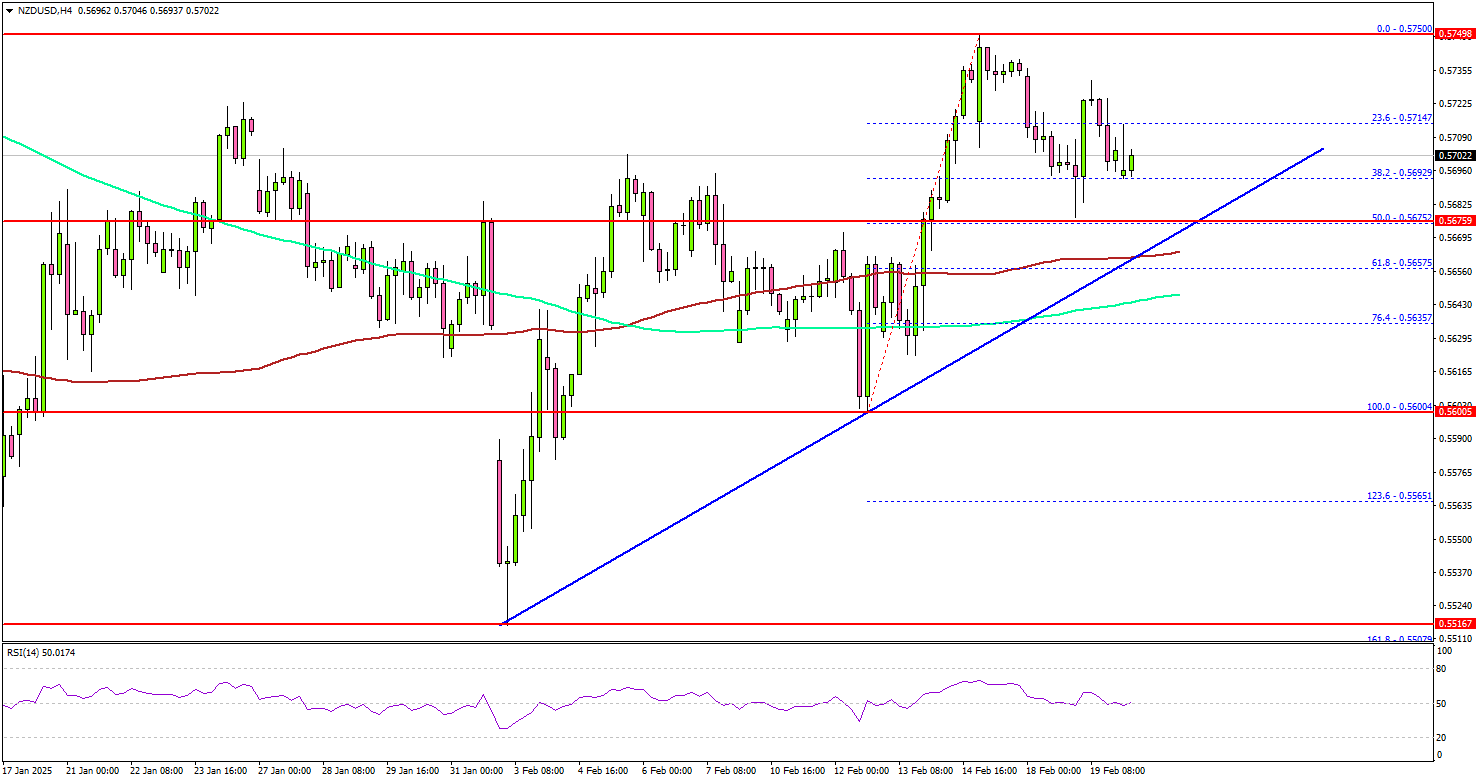
          NZD/USD Finds Stability—Will the Recovery Continue to 0.6000?_1

          The pair dipped and tested the 50% Fib retracement level of the upward move from the 0.5600 swing low to the 0.5750 high. On the downside, immediate support sits near the 0.5690 level.

          The next key support sits near the 0.5670 level. There is also a key bullish trend line forming with support at 0.5670 on the same chart. The main support could be 0.5655 and the 61.8% Fib retracement level of the upward move from the 0.5600 swing low to the 0.5750 high.

          Any more losses could send the pair toward the 0.5600 level. On the upside, the pair seems to be facing hurdles near the 0.5750 level. The next major resistance is near the 0.5800 level. The main resistance is now forming near the 0.5840 zone.

          A close above the 0.5840 level could set the tone for another increase. In the stated case, the pair could even clear the 0.6000 resistance.

          Looking at EUR/USD, the pair remained stable above 1.0450 but the bears are still active near the 1.0520 resistance.

          Upcoming Economic Events:

          US Initial Jobless Claims – Forecast 215K, versus 213K previous.

          Philadelphia Fed Manufacturing Index for Feb 2025 – Forecast 20, versus 44.3 previous.

          Source: ACTIONFOREX

          To stay updated on all economic events of today, please check out our Economic calendar
          Risk Warnings and Disclaimers
          You understand and acknowledge that there is a high degree of risk involved in trading. Following any strategies or investment methods may lead to potential losses. The content on the site is provided by our contributors and analysts for information purposes only. You are solely responsible for determining whether any trading assets, securities, strategy, or any other product is suitable for investing based on your own investment objectives and financial situation.
          Add to Favorites
          Share

          February 20th Financial News

          FastBull Featured

          Daily News

          [Quick Facts]

          1. Nick Timiraos: Federal Reserve officials consider slowing down or pausing asset tapering.
          2. Fed meeting minutes: Hope to see further progress on inflation before interest rate cuts.
          3. Trump intervenes in the budget dispute between the two houses, supporting the House Republicans' $4.5 trillion tax cut plan.
          4. New construction drops sharply in January on cold weather and tariffs concerns.
          5. Fed's Jefferson: The path of disinflation is bumpy, and the adjustment of policy rates awaits the right time.
          6. Orr: Further rate cuts are on the way.
          7. Bostic: Need to observe for a while before considering interest rate cuts.
          8. European stocks suffered their biggest decline in two months as the market worried about tariffs and a shallower path of interest rate cuts.
          9. Trump calls Zelensky a 'dictator' to pressure Ukraine to reach a ceasefire agreement.

          [News Details]

          Nick Timiraos: Federal Reserve Officials consider slowing down or pausing asset tapering
          "Fed's Whisperer" Nick Timiraos stated that the minutes of the Fed's January meeting revealed that officials had discussed whether to slow down or pause the reduction of its nearly $6.8 trillion asset portfolio during last month's meeting. This was because they were facing the complex issues arising from raising the federal debt ceiling in the coming months. The dynamics associated with the debt ceiling could lead to significant fluctuations in the Fed's liabilities. The balance sheet reduction process will eventually exhaust the banking system's reserves, and Fed officials are uncertain about how long this process will take. How the Treasury Department manages the currency market turbulence caused by its cash balance may complicate the Fed's ability to determine the appropriate reserve balance. Therefore, according to the meeting minutes released on Wednesday, officials at the January meeting believed that "considering pausing or slowing the reduction of the balance sheet until the debt ceiling issue is resolved may be appropriate."
          Fed meeting minutes: Hope to see further progress on inflation before interest rate cuts
          The Fed meeting minutes showed that the Fed hopes to see "further progress on inflation" before deciding on further interest rate cuts. Citing rising inflation pressures, the Fed kept interest rates stable in the range of 4.25%-4.5% at the last meeting, and the market did not expect an interest rate cut at the March meeting either. According to the meeting minutes, the committee agreed that "the Fed has ample time to assess the evolving outlooks for economic activity, the labor market, and inflation." Many economists and market strategists are worried that tariffs and stricter immigration policies may increase inflation pressures, potentially offsetting the positive impacts of tax cuts and deregulation. The Fed has previously indicated that it is not in a hurry to cut interest rates further due to persistently high inflation. Inflation has come down from its post-pandemic highs but remains stubbornly above the Fed's ideal level. For example, the consumer price index in January rose 3% year-on-year, the fastest pace in seven months and also higher than the Fed's 2% target.
          Trump intervenes in the budget dispute between the two houses, supporting the House Republicans' $4.5 trillion tax cut plan
          US President Donald Trump expressed his support for the House's plan to cut taxes by 4.5 trillion, pouring cold water on Senate Republicans' eagerness appropriations to help combat immigration by approving appropriations, indicating that he does not favor large-scale bills that may require months of bargaining to reach an agreement. As a key congressional vote approached, Trump intervened in the ongoing budget dispute between House and Senate Republicans by posting on social media on Wednesday. The Senate originally planned to vote on a budget bill this week. The budget bill would increase military spending by 150 billion. Senate Republicans said they prefer to take swift action on these priorities and are not in a rush to resolve core disputes such as tax cuts and raising the debt ceiling. However, Trump expressed his support for the House's more comprehensive budget plan, which has sparked conflicts within the Republican Party over issues such as the amount of federal spending cuts and the scale of tax cuts.
          New Construction Drops Sharply in January on Cold Weather and Tariffs Concerns
          The pace of new construction slowed in January, as colder than normal weather spread across the country, and the rebound may be limited by rising import tariff costs and rising mortgage rates. Starts on single-family units dropped 8.4% from December to a seasonally adjusted annual rate of 993,000, the U.S. Census Bureau reported Wednesday. The December data was revised up to 1.084 million units, higher than the previously reported 1.05 million units. Although housing construction is still supported by a shortage of existing home supplies, the protectionist trade policies implemented by the Trump administration may make it difficult for builders to start new housing projects. A survey showed that due to the fact that 32% of household appliances and 30% of softwood lumber rely on international trade, the uncertainty about the scale and scope of tariffs makes builders more worried about costs. Mortgage rates are also a source of pressure. The average rate for a 30-year fixed-rate mortgage hovers just below 7%.
          Jefferson: The path of inflation is bumpy, and the adjustment of policy rates awaits the right time
          Federal Reserve Vice Chair Philip Jefferson said in a speech on Wednesday that the current monetary policy stance is closer to a neutral setting, but we still believe that the current monetary policy is restrictive. Supported by a strong economy and a solid labor market, policymakers can take a more relaxed attitude in considering any additional interest rate cuts.
          The path of inflation is 'uneven', and disinflation has been 'bumpy'. The Federal Reserve leaves its benchmark interest rate unchanged for January and is not in a hurry to start a new round of interest rate cuts, mainly because it needs more information about the progress of inflation and wants to understand the specific impacts of the Trump administration's policies.
          Orr: Further rate cuts are on the way
          Adrian Orr, Governor of the Reserve Bank of New Zealand, said in a speech on February 19th (local time) that economic activity in New Zealand is picking up, and the economic outlook is in line with the inflation target in the medium term, which gives confidence to continue with interest rate cuts. However, there is still significant spare capacity in the economy, and domestic inflation pressures are expected to continue to ease. He expects that employment growth will pick up in the second half of the year as domestic activity increases.
          The Reserve Bank of New Zealand plans to implement two 25-bps interest rate adjustments, and it is expected to cut interest rates by 50 basis points by mid this year around July. Also, it is expected to cut its key interest rate by 50 bps to 3.75% on Wednesday. Future interest rates will continue to decline, but there will be no rush to adjust to a level like 3% because inflation remains high.
          The New Zealand dollar is close to fair value against the US dollar and has played a positive role in promoting income growth. This trend is expected to continue this year as the factors supporting these prices still exist. In addition, if interest rates can be adjusted to a neutral level and remain stable, GDP and nominal GDP growth will be close to potential levels, and the exchange rate will also stay near fair value (which means there is limited room for a significant short-term depreciation of the New Zealand dollar).
          Near-term risks include a slowdown in GDP growth, and longer term risks include US tariffs which slow global growth. The Reserve Bank of New Zealand is ready to respond to any potential shocks and will take action when necessary to support the economy.
          Bostic: Need to observe for a while before considering interest rate cuts
          Raphael Bostic, President of the Federal Reserve Bank of Atlanta, said in an interview on Wednesday that the US inflation rate is expected to fall to around the 2% target level by early 2026. At the same time, the neutral interest rate level is around 3% to 3.5%, and it may approach this level early next year.
          He fully agrees with the Fed's idea of pausing policy adjustments in the current economic situation to observe how the economy develops and use this information to guide policy-making in the coming months. Officials should be patient when assessing the impact of President Trump's policies on the economy. Some policies may exacerbate inflation, while others may stimulate investment.
          I think we are still in a restrictive stance, which is what we need. We should be more cautious now and in the future than in the past six to eight months. The debt ceiling is one factor, and how banks allocate capital is also an issue that needs attention.
          Bostic is one of several Fed officials who have recently advocated patience regarding further interest rate cuts. He said earlier this month that he hopes to wait "for a while" before cutting interest rates again and expects that the Fed will not be able to clarify the inflation trend at its next policy meeting in March.
          European stocks suffered their biggest decline in two months as the market worried about tariffs and a shallower path of interest rate cuts
          European stocks suffered their biggest decline in two months, constrained by the possibility that the monetary easing cycle may be weaker than expected and the renewed concern about trade disputes with the US. The Stoxx 600 index closed 0.9% lower, marking the largest single-day decline since December 19th. After Isabel Schnabel, an Executive Board member of the European Central Bank, said that the central bank is close to pausing or stopping interest rate cuts, traders lowered their bets on ECB interest rate cuts. Trade tensions were also in the spotlight as US President Donald Trump said that he may impose around 25% import tariffs on cars, semiconductors, and pharmaceuticals.
          Trump calls Zelensky a 'dictator' to pressure Ukraine to reach a ceasefire agreement
          Trump called Zelenskyy a "dictator" and increased pressure on Kiev to accept the terms of the peace agreement that the US is negotiating with Russia. He claimed on Wednesday that Zelenskyy had taken advantage of Democrat Joe Biden's administration and suggested Kyiv was responsible for starting the war. "He refuses to have Elections, is very low in Ukrainian Polls, and the only thing he was good at was playing Biden 'like a fiddle,'" Mr. Trump wrote. "A Dictator without Elections, Zelenskyy better move fast or he is not going to have a Country left." Trump's remarks are the sharpest criticism of Zelensky since his return to the White House and are the latest sign of the rapid deterioration of US-Ukraine relations under Trump's rule. Trump dispatched senior advisors to Saudi Arabia this week to negotiate directly with Russia, excluding Ukraine from the process.

          [Today's Focus]

          UTC+8 15:00 German January PPI monthly rate
          UTC+8 19:00 The ECB publishes its 2024 Financial Stability Review
          UTC+8 21:00 ECB governor Makhlouf speaks on the Irish economy
          UTC+8 22:35 Federal Reserve Bank of Chicago president Goolsbee speaks
          UTC+8 00:00 ECB governor Nagel speaks
          UTC+8 01:05 President of the Federal Reserve Bank of St. Louis Musalem speaks
          Risk Warnings and Disclaimers
          You understand and acknowledge that there is a high degree of risk involved in trading. Following any strategies or investment methods may lead to potential losses. The content on the site is provided by our contributors and analysts for information purposes only. You are solely responsible for determining whether any trading assets, securities, strategy, or any other product is suitable for investing based on your own investment objectives and financial situation.
          Add to Favorites
          Share
          FastBull
          Copyright © 2025 FastBull Ltd

          728 RM B 7/F GEE LOK IND BLDG NO 34 HUNG TO RD KWUN TONG KLN HONG KONG

          TelegramInstagramTwitterfacebooklinkedin
          App Store Google Play Google Play
          Products
          Charts

          Chats

          Q&A with Experts
          Screeners
          Economic Calendar
          Data
          Tools
          Membership
          Features
          Function
          Markets
          Copy Trading
          Latest Signals
          Contests
          News
          Analysis
          24/7
          Columns
          Education
          Company
          Careers
          About Us
          Contact Us
          Advertising
          Help Center
          Feedback
          User Agreement
          Privacy Policy
          Business

          White Label

          Data API

          Web Plug-ins

          Poster Maker

          Affiliate Program

          Risk Disclosure

          The risk of loss in trading financial instruments such as stocks, FX, commodities, futures, bonds, ETFs and crypto can be substantial. You may sustain a total loss of the funds that you deposit with your broker. Therefore, you should carefully consider whether such trading is suitable for you in light of your circumstances and financial resources.

          No decision to invest should be made without thoroughly conducting due diligence by yourself or consulting with your financial advisors. Our web content might not suit you since we don't know your financial conditions and investment needs. Our financial information might have latency or contain inaccuracy, so you should be fully responsible for any of your trading and investment decisions. The company will not be responsible for your capital loss.

          Without getting permission from the website, you are not allowed to copy the website's graphics, texts, or trademarks. Intellectual property rights in the content or data incorporated into this website belong to its providers and exchange merchants.

          Not Logged In

          Log in to access more features

          FastBull Membership

          Not yet

          Purchase

          Become a signal provider
          Help Center
          Customer Service
          Dark Mode
          Price Up/Down Colors

          Log In

          Sign Up

          Position
          Layout
          Fullscreen
          Default to Chart
          The chart page opens by default when you visit fastbull.com