• Trade
  • Markets
  • Copy
  • Contests
  • News
  • 24/7
  • Calendar
  • Q&A
  • Chats
Trending
Screeners
SYMBOL
LAST
BID
ASK
HIGH
LOW
NET CHG.
%CHG.
SPREAD
SPX
S&P 500 Index
6857.13
6857.13
6857.13
6865.94
6827.13
+7.41
+ 0.11%
--
DJI
Dow Jones Industrial Average
47850.93
47850.93
47850.93
48049.72
47692.96
-31.96
-0.07%
--
IXIC
NASDAQ Composite Index
23505.13
23505.13
23505.13
23528.53
23372.33
+51.04
+ 0.22%
--
USDX
US Dollar Index
98.840
98.920
98.840
98.980
98.740
-0.140
-0.14%
--
EURUSD
Euro / US Dollar
1.16591
1.16599
1.16591
1.16715
1.16408
+0.00146
+ 0.13%
--
GBPUSD
Pound Sterling / US Dollar
1.33557
1.33565
1.33557
1.33622
1.33165
+0.00286
+ 0.21%
--
XAUUSD
Gold / US Dollar
4225.04
4225.47
4225.04
4230.62
4194.54
+17.87
+ 0.42%
--
WTI
Light Sweet Crude Oil
59.396
59.426
59.396
59.469
59.187
+0.013
+ 0.02%
--

Community Accounts

Signal Accounts
--
Profit Accounts
--
Loss Accounts
--
View More

Become a signal provider

Sell trading signals to earn additional income

View More

Guide to Copy Trading

Get started with ease and confidence

View More

Signal Accounts for Members

All Signal Accounts

Best Return
  • Best Return
  • Best P/L
  • Best MDD
Past 1W
  • Past 1W
  • Past 1M
  • Past 1Y

All Contests

  • All
  • Trump Updates
  • Recommend
  • Stocks
  • Cryptocurrencies
  • Central Banks
  • Featured News
Top News Only
Share

Kremlin Aide Ushakov Says USA Kushner Is Working Very Actively On Ukrainian Settlement

Share

Norway To Acquire 2 More Submarines, Long-Range Missiles, Daily Vg Reports

Share

Ucb Sa Shares Open Up 7.3% After 2025 Guidance Upgrade, Top Of Bel 20 Index

Share

Shares In Italy's Mediobanca Down 1.3% After Barclays Cuts To Underweight From Equal-Weight

Share

Stats Office - Austrian November Wholesale Prices +0.9% Year-On-Year

Share

Britain's FTSE 100 Up 0.15%

Share

Europe's STOXX 600 Up 0.1%

Share

Taiwan November PPI -2.8% Year-On-Year

Share

Stats Office - Austrian September Trade -230.8 Million EUR

Share

Swiss National Bank Forex Reserves Revised To Chf 724906 Million At End Of October - SNB

Share

Swiss National Bank Forex Reserves At Chf 727386 Million At End Of November - SNB

Share

Shanghai Warehouse Rubber Stocks Up 8.54% From Week Earlier

Share

Turkey's Main Banking Index Up 2%

Share

French October Trade Balance -3.92 Billion Euros Versus Revised -6.35 Billion Euros In September

Share

Kremlin Aide Says Russia Is Ready To Work Further With Current USA Team

Share

Kremlin Aide Says Russia And USA Are Moving Forward In Ukraine Talks

Share

Shanghai Rubber Warehouse Stocks Up 7336 Tons

Share

Shanghai Tin Warehouse Stocks Up 506 Tons

Share

Reserve Bank Of India Chief Malhotra: Goal Is To Have Inflation Be Around 4%

Share

Ukmto Says Master Has Confirmed That The Small Crafts Have Left The Scene, Vessel Is Proceeding To Its Next Port Of Call

TIME
ACT
FCST
PREV
France 10-Year OAT Auction Avg. Yield

A:--

F: --

P: --

Euro Zone Retail Sales MoM (Oct)

A:--

F: --

P: --

Euro Zone Retail Sales YoY (Oct)

A:--

F: --

P: --

Brazil GDP YoY (Q3)

A:--

F: --

P: --

U.S. Challenger Job Cuts (Nov)

A:--

F: --

P: --

U.S. Challenger Job Cuts MoM (Nov)

A:--

F: --

P: --

U.S. Challenger Job Cuts YoY (Nov)

A:--

F: --

P: --

U.S. Initial Jobless Claims 4-Week Avg. (SA)

A:--

F: --

P: --

U.S. Weekly Initial Jobless Claims (SA)

A:--

F: --

P: --

U.S. Weekly Continued Jobless Claims (SA)

A:--

F: --

P: --

Canada Ivey PMI (SA) (Nov)

A:--

F: --

P: --

Canada Ivey PMI (Not SA) (Nov)

A:--

F: --

P: --

U.S. Non-Defense Capital Durable Goods Orders Revised MoM (Excl. Aircraft) (SA) (Sept)

A:--

F: --

P: --
U.S. Factory Orders MoM (Excl. Transport) (Sept)

A:--

F: --

P: --

U.S. Factory Orders MoM (Sept)

A:--

F: --

P: --

U.S. Factory Orders MoM (Excl. Defense) (Sept)

A:--

F: --

P: --

U.S. EIA Weekly Natural Gas Stocks Change

A:--

F: --

P: --

Saudi Arabia Crude Oil Production

A:--

F: --

P: --

U.S. Weekly Treasuries Held by Foreign Central Banks

A:--

F: --

P: --

Japan Foreign Exchange Reserves (Nov)

A:--

F: --

P: --

India Repo Rate

A:--

F: --

P: --

India Benchmark Interest Rate

A:--

F: --

P: --

India Reverse Repo Rate

A:--

F: --

P: --

India Cash Reserve Ratio

A:--

F: --

P: --

Japan Leading Indicators Prelim (Oct)

A:--

F: --

P: --

U.K. Halifax House Price Index YoY (SA) (Nov)

A:--

F: --

P: --

U.K. Halifax House Price Index MoM (SA) (Nov)

A:--

F: --

P: --

France Current Account (Not SA) (Oct)

A:--

F: --

P: --

France Trade Balance (SA) (Oct)

A:--

F: --

P: --

France Industrial Output MoM (SA) (Oct)

A:--

F: --

P: --

Italy Retail Sales MoM (SA) (Oct)

--

F: --

P: --

Euro Zone Employment YoY (SA) (Q3)

--

F: --

P: --

Euro Zone GDP Final YoY (Q3)

--

F: --

P: --

Euro Zone GDP Final QoQ (Q3)

--

F: --

P: --

Euro Zone Employment Final QoQ (SA) (Q3)

--

F: --

P: --

Euro Zone Employment Final (SA) (Q3)

--

F: --

P: --
Brazil PPI MoM (Oct)

--

F: --

P: --

Mexico Consumer Confidence Index (Nov)

--

F: --

P: --

Canada Unemployment Rate (SA) (Nov)

--

F: --

P: --

Canada Labor Force Participation Rate (SA) (Nov)

--

F: --

P: --

Canada Employment (SA) (Nov)

--

F: --

P: --

Canada Part-Time Employment (SA) (Nov)

--

F: --

P: --

Canada Full-time Employment (SA) (Nov)

--

F: --

P: --

U.S. Personal Income MoM (Sept)

--

F: --

P: --

U.S. Dallas Fed PCE Price Index YoY (Sept)

--

F: --

P: --

U.S. PCE Price Index YoY (SA) (Sept)

--

F: --

P: --

U.S. PCE Price Index MoM (Sept)

--

F: --

P: --

U.S. Personal Outlays MoM (SA) (Sept)

--

F: --

P: --

U.S. Core PCE Price Index MoM (Sept)

--

F: --

P: --

U.S. UMich 5-Year-Ahead Inflation Expectations Prelim YoY (Dec)

--

F: --

P: --

U.S. Core PCE Price Index YoY (Sept)

--

F: --

P: --

U.S. Real Personal Consumption Expenditures MoM (Sept)

--

F: --

P: --

U.S. 5-10 Year-Ahead Inflation Expectations (Dec)

--

F: --

P: --

U.S. UMich Current Economic Conditions Index Prelim (Dec)

--

F: --

P: --

U.S. UMich Consumer Sentiment Index Prelim (Dec)

--

F: --

P: --

U.S. UMich 1-Year-Ahead Inflation Expectations Prelim (Dec)

--

F: --

P: --

U.S. UMich Consumer Expectations Index Prelim (Dec)

--

F: --

P: --

U.S. Weekly Total Rig Count

--

F: --

P: --

U.S. Weekly Total Oil Rig Count

--

F: --

P: --

U.S. Consumer Credit (SA) (Oct)

--

F: --

P: --

Q&A with Experts
    • All
    • Chatrooms
    • Groups
    • Friends
    Connecting
    .
    .
    .
    Type here...
    Add Symbol or Code

      No matching data

      All
      Trump Updates
      Recommend
      Stocks
      Cryptocurrencies
      Central Banks
      Featured News
      • All
      • Russia-Ukraine Conflict
      • Middle East Flashpoint
      • All
      • Russia-Ukraine Conflict
      • Middle East Flashpoint

      Search
      Products

      Charts Free Forever

      Chats Q&A with Experts
      Screeners Economic Calendar Data Tools
      Membership Features
      Data Warehouse Market Trends Institutional Data Policy Rates Macro

      Market Trends

      Market Sentiment Order Book Forex Correlations

      Top Indicators

      Charts Free Forever
      Markets

      News

      News Analysis 24/7 Columns Education
      From Institutions From Analysts
      Topics Columnists

      Latest Views

      Latest Views

      Trending Topics

      Top Columnists

      Latest Update

      Signals

      Copy Rankings Latest Signals Become a signal provider AI Rating
      Contests
      Brokers

      Overview Brokers Assessment Rankings Regulators News Claims
      Broker listing Forex Brokers Comparison Tool Live Spread Comparison Scam
      Q&A Complaint Scam Alert Videos Tips to Detect Scam
      More

      Business
      Events
      Careers About Us Advertising Help Center

      White Label

      Data API

      Web Plug-ins

      Affiliate Program

      Awards Institution Evaluation IB Seminar Salon Event Exhibition
      Vietnam Thailand Singapore Dubai
      Fans Party Investment Sharing Session
      FastBull Summit BrokersView Expo
      Recent Searches
        Top Searches
          Markets
          News
          Analysis
          User
          24/7
          Economic Calendar
          Education
          Data
          • Names
          • Latest
          • Prev

          View All

          No data

          Scan to Download

          Faster Charts, Chat Faster!

          Download App
          English
          • English
          • Español
          • العربية
          • Bahasa Indonesia
          • Bahasa Melayu
          • Tiếng Việt
          • ภาษาไทย
          • Français
          • Italiano
          • Türkçe
          • Русский язык
          • 简中
          • 繁中
          Open Account
          Search
          Products
          Charts Free Forever
          Markets
          News
          Signals

          Copy Rankings Latest Signals Become a signal provider AI Rating
          Contests
          Brokers

          Overview Brokers Assessment Rankings Regulators News Claims
          Broker listing Forex Brokers Comparison Tool Live Spread Comparison Scam
          Q&A Complaint Scam Alert Videos Tips to Detect Scam
          More

          Business
          Events
          Careers About Us Advertising Help Center

          White Label

          Data API

          Web Plug-ins

          Affiliate Program

          Awards Institution Evaluation IB Seminar Salon Event Exhibition
          Vietnam Thailand Singapore Dubai
          Fans Party Investment Sharing Session
          FastBull Summit BrokersView Expo

          RBA and Fed Decisions in Focus

          FOREX.com

          Forex

          Political

          Economic

          Summary:

          Traders have a host of key economic data to digest over the next 24 hours, including Australia’s crucial CPI print, US GDP, and interest rate decisions from both the Fed and Bank of Canada (BOC).
          Australia’s CPI in Focus as RBA Decision Looms

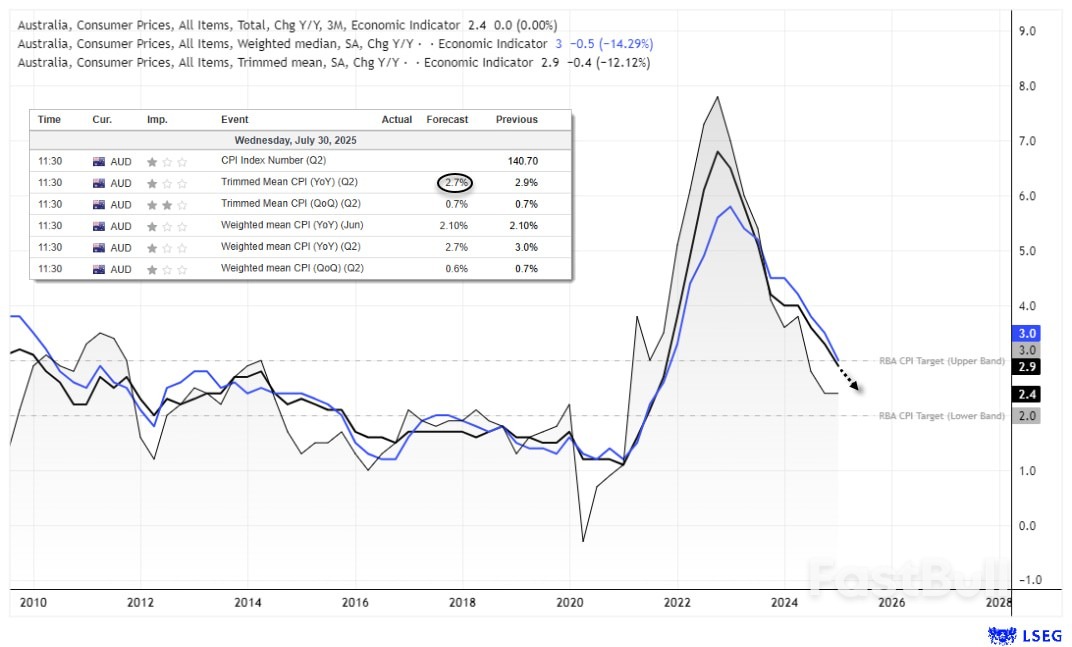
          Australia’s quarterly CPI figures, due out in a few hours, could be the catalyst that forces the Reserve Bank of Australia (RBA) to deliver the 25bp cut we expected at their last meeting on 12 August. As their minutes confirmed, the RBA chose to wait for more information before pulling the trigger—highlighting that CPI excluding volatile items and travel has historically been a better predictor of quarterly inflation.
          RBA and Fed Decisions in Focus_1

          Data source: Australian Bureau of Statistics (ABS), London Stock Exchange Group (LSEG)

          Australia’s trimmed mean CPI is expected to have slowed to 2.7% y/y in Q2 from 2.9%, or held steady at 0.7% q/q.Weighted mean CPI is expected to remain unchanged at 2.1% y/y.Headline CPI is forecast to slow to 2.1% y/y (down from 2.4%), or 0.8% q/q (down from 0.9%).
          I’d like to say that a 2.7% trimmed mean would effectively confirm an RBA cut, but the RBA have really been pushing the envelope on caution lately. Still, with the monthly CPI ex volatile items and travel already sitting at 2.6%, perhaps we’ll be treated to a 2.6% trimmed mean and a q/q print of 0.6% or lower—which could spark renewed bets of a cut in August.Add to that the fact unemployment ticked up 0.2 percentage points to 4.3%, and the case for the RBA to act is certainly building.

          Fed and BOC Expected to Hold Rates, Q2 US GDP Looms

          The Federal Reserve (Fed) are expected defy Trump wishes of an interest rate cut today and hold at their 4.25 – 4.5% band. Fed fund futures imply a 97.9% probability of no action, and it is very rare for the Fed to defy market expectations without an economic catastrophe. Fed fund futures also imply a 64.7% chance of a cut in September.Note that Q2 GDP figures are released in the hours ahead of the FOMC meeting, though they are unlikely to change Fed expectations. The Bank of Canada (BOC) are also expected to hold their interest rate at 2.75%.

          AUD/USD Technical Analysis: Australian Dollar vs US Dollar

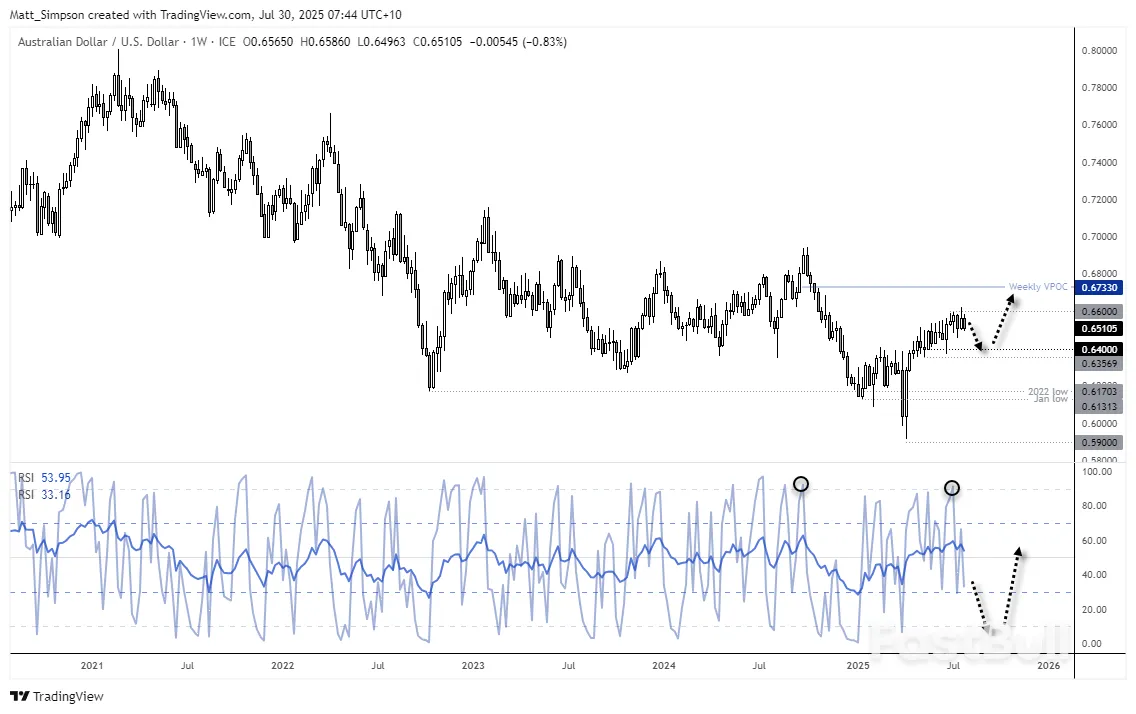
          The Australian dollar has continued to grind higher against the US dollar, although the USD Index is rebounding from recent lows and the case for RBA rate cuts is building. The weekly RSI (2) on AUD/USD reached its most overbought level in four weeks—its highest since September—and has yet to reach oversold territory. This suggests AUD/USD could be due for a leg lower towards 0.64 in the near term.That said, I’m not anticipating a particularly large pullback in AUD/USD. The weekly RSI (14) is confirming the broader bullish trend and has not yet reached overbought levels. Additionally, the RBA has limited scope to cut rates relative to current market expectations, while the case for Fed cuts is also strengthening.
          RBA and Fed Decisions in Focus_2

          Data source: TradingView AUD/USD

          AUD/USD Technical Analysis: Chart

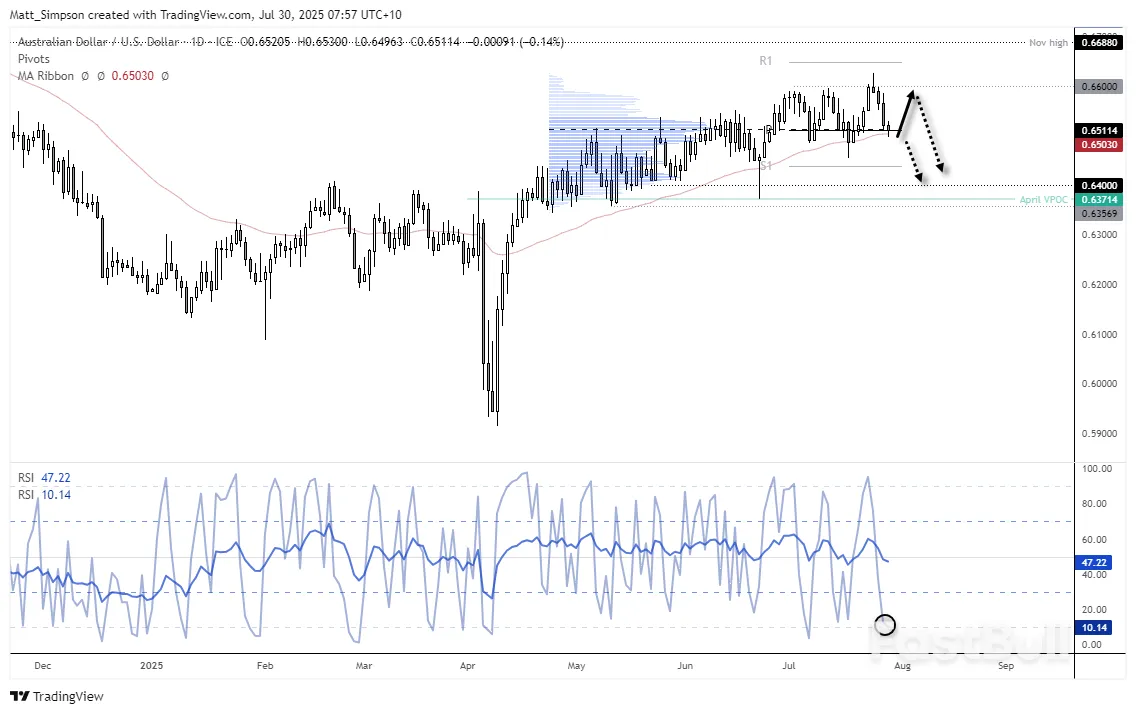
          While my bias remains for AUD/USD to fall to 0.64 over the coming weeks, the pair is currently trying to hold above the monthly pivot point at 0.6515 and the 50-day EMA at 0.6503. This area also aligns with a high-volume node (HVN) from price action since April. Should today’s Australian CPI data fail to convince RBA doves that a rate cut is all but certain, it raises the potential for a bounce on the daily chart before downside momentum resumes.
          Furthermore, the US dollar index (DXY) has reached a key resistance level that could help limit AUD/USD losses in the near term. The daily RSI (2) is also on the cusp of reaching oversold territory.Should a bounce materialise, we can return to the timeless classic of bears fading rallies into cycle highs—a repeatable feature of AUD/USD price action since mid-April.
          RBA and Fed Decisions in Focus_3

          Data source: TradingView AUD/USD

          Source:FOREX.com

          To stay updated on all economic events of today, please check out our Economic calendar
          Risk Warnings and Disclaimers
          You understand and acknowledge that there is a high degree of risk involved in trading. Following any strategies or investment methods may lead to potential losses. The content on the site is provided by our contributors and analysts for information purposes only. You are solely responsible for determining whether any trading assets, securities, strategy, or any other product is suitable for investing based on your own investment objectives and financial situation.
          Add to Favorites
          Share

          India Braces for 20–25% Tariffs as Trump Sets Ultimatum Ahead of August 1 Deadline

          Gerik

          Economic

          India in the Crosshairs as U.S. Trade Ultimatum Looms

          President Trump’s statement aboard Air Force One that India could be subjected to tariffs of “20% to 25%” marks a decisive turn in trade negotiations between Washington and New Delhi. While the comment was qualified by an acknowledgment that “nothing is final yet,” the tone reflects rising frustration from the U.S. side regarding India’s limited market openness especially compared to concessions offered by other countries such as Indonesia and the Philippines.
          The direct implication is that without further liberalization from India particularly in politically sensitive sectors such as agriculture and dairy the Trump administration is likely to impose punitive tariffs when the current grace period ends on August 1. This signals a return to a more transactional and retaliatory trade stance, with India emerging as the latest target.

          Stalled Negotiations and Red Lines in Key Sectors

          Indian officials have tried to navigate a difficult balancing act, offering concessions such as zero tariffs on pharmaceuticals and auto parts while resisting U.S. demands to open its agricultural and automobile sectors. New Delhi has made clear that genetically modified crops and broader dairy liberalization are off-limits due to domestic political sensitivities. The Modi government faces pressure from powerful farmer constituencies ahead of key state elections, limiting its room for compromise.
          This domestic political constraint creates a causal roadblock in negotiations: even though New Delhi seeks to avoid higher tariffs, it cannot cross certain policy red lines. As a result, the possibility of a tariff deal before the deadline is increasingly uncertain, especially with time running out.

          Geopolitical Tensions Add to Trade Friction

          Further complicating talks is the broader geopolitical context. Trump’s claims that his pressure campaign led to a ceasefire between India and Pakistan in April have already irritated New Delhi. Additionally, India is under scrutiny for its continued imports of Russian oil. Trump has warned of “secondary tariffs” on countries including India and China that defy U.S. sanctions tied to the Ukraine war.
          Thus, India is facing dual pressure: one from the bilateral trade deal and another from its alignment in broader U.S. foreign policy goals. This intersection of economic and geopolitical interests weakens the negotiating leverage of the Modi administration and increases the likelihood of U.S. follow-through on tariff threats.

          Trade Pact Unlikely Before Deadline

          Despite a signed terms-of-reference document for a bilateral agreement and ongoing discussions, no concrete progress has been made public. According to U.S. Trade Representative Jamieson Greer, more time is needed to assess India’s willingness to open its markets. With less than 48 hours before Trump’s tariff deadline, the likelihood of a substantive breakthrough appears minimal.
          Trump’s tariff warning to India highlights the persistent structural disconnect between U.S. trade demands and India’s domestic policy constraints. The causal relationship is evident: New Delhi’s refusal to liberalize sensitive sectors invites retaliatory tariffs, which in turn threaten India’s export competitiveness and bilateral ties. With both sides entrenched and geopolitical overhangs worsening, the risk of tariffs being imposed after the August 1 deadline appears elevated. Markets should prepare for heightened volatility in trade-sensitive sectors especially pharmaceuticals, automotive components, and agriculture as India navigates this diplomatic tightrope.

          Source: Bloomberg

          To stay updated on all economic events of today, please check out our Economic calendar
          Risk Warnings and Disclaimers
          You understand and acknowledge that there is a high degree of risk involved in trading. Following any strategies or investment methods may lead to potential losses. The content on the site is provided by our contributors and analysts for information purposes only. You are solely responsible for determining whether any trading assets, securities, strategy, or any other product is suitable for investing based on your own investment objectives and financial situation.
          Add to Favorites
          Share

          Euro Struggles Near One-Month Lows as Market Focus Turns to Fed and BOJ

          Gerik

          Forex

          Economic

          Euro Sinks Under Pressure from Trade Imbalance and Policy Ambiguity

          The euro hovered around $1.1558 in early Wednesday trading, recovering slightly from Tuesday’s one-month low of $1.15185. This week’s decline triggered by a trade agreement seen as disproportionately favorable to the U.S. marks the euro’s first monthly drop in 2025 despite an 11.7% gain year-to-date.
          The EU–U.S. deal, while temporarily easing trade war fears, left many investors unsettled due to its lopsided nature and vague terms. As Saxo’s Charu Chanana noted, markets now interpret such trade agreements as “symbolic and tactical” rather than structurally transformative, especially in the absence of detailed enforcement mechanisms.
          This shift in perception has created a negative feedback loop for the euro: without strong, concrete benefits for the EU economy, the deal has instead highlighted the bloc’s limited leverage in global trade negotiations, increasing concerns over competitiveness and economic marginalization.

          Dollar Strengthens Ahead of Fed Decision

          The U.S. dollar has strengthened on the back of this trade asymmetry and anticipation of key central bank meetings. The dollar index rose to 98.815, its highest in a month, and is set to post its first monthly gain of the year. As investors weigh the implications of the Fed’s upcoming policy announcement, the greenback continues to attract safe-haven flows.
          While the Fed is expected to keep interest rates unchanged, all eyes will be on Chair Jerome Powell’s comments for clues on future monetary policy. Internal dissent is anticipated from Governors Christopher Waller and Michelle Bowman, both of whom may push for rate cuts in alignment with President Trump’s vocal criticism of current Fed policy.
          This potential split within the Federal Open Market Committee (FOMC) has heightened market sensitivity. As Kristina Clifton from Commonwealth Bank of Australia warned, dissent at this meeting could be perceived as politically motivated, potentially undermining perceptions of Fed independence.

          Broader Currency Market Holds Steady Amid Policy Uncertainty

          Elsewhere, major currencies showed relative stability. The British pound traded at $1.3358, while the Australian dollar was at $0.6517, holding gains following Australia's soft inflation data and heightened rate cut expectations. The Japanese yen firmed modestly to 148.20 per dollar ahead of the Bank of Japan's meeting, where Governor Kazuo Ueda’s guidance on rate hikes will be closely scrutinized following Japan’s own trade agreement with the U.S.
          The offshore Chinese yuan was little changed at 7.178, reflecting limited movement despite U.S.–China trade truce talks. While the discussions in Stockholm were deemed “constructive,” no breakthroughs were announced. The looming August 12 expiration of the tariff truce leaves global markets in suspense.

          Markets Enter Holding Pattern as Trade and Monetary Uncertainty Lingers

          The euro’s recent slump reflects both immediate reaction to a trade deal perceived as economically disadvantageous and broader investor caution in the face of uncertain central bank policy paths. The causal chain is clear: the imbalance in the EU–U.S. agreement has diminished confidence in Europe’s economic autonomy, while anticipation of Fed and BOJ decisions adds monetary policy risk.
          Currency markets are poised for sharper movements depending on outcomes from central bank meetings and Trump’s next trade moves. Until clearer signals emerge, major currencies like the euro are likely to remain range-bound, with sentiment dictated less by past gains and more by forward-looking risks.

          Source: Reuters

          To stay updated on all economic events of today, please check out our Economic calendar
          Risk Warnings and Disclaimers
          You understand and acknowledge that there is a high degree of risk involved in trading. Following any strategies or investment methods may lead to potential losses. The content on the site is provided by our contributors and analysts for information purposes only. You are solely responsible for determining whether any trading assets, securities, strategy, or any other product is suitable for investing based on your own investment objectives and financial situation.
          Add to Favorites
          Share

          Oil Prices Hold Firm as Markets React to Trump’s Russia Ultimatum and Tariff Threats

          Gerik

          Economic

          Commodity

          Geopolitical Pressure Drives Price Momentum

          Global oil benchmarks edged higher in early Wednesday trading, extending a strong rally from the previous session. Brent crude rose to $72.65 per barrel, while West Texas Intermediate (WTI) held at $69.23, both marking their highest settlements since June 20. The trigger was a significant geopolitical shift: President Trump’s decision to move up his Russia ultimatum from 50 days to 10–12 days, threatening 100% secondary tariffs on countries continuing to trade with Moscow.
          This escalation introduces a major source of potential supply disruption in global oil markets. Secondary sanctions, if implemented, would penalize not only Russia but also any trading partner particularly large U.S. allies and importers that maintains oil dealings with Russia. As ING analysts noted, such a move would likely deter key buyers and squeeze availability, tilting the market toward a supply deficit.

          China and India in the Spotlight

          U.S. Treasury Secretary Scott Bessent, speaking at trade talks in Stockholm, signaled that China, the largest buyer of Russian oil, had been formally warned about facing punitive tariffs. While China is unlikely to comply with U.S. sanctions due to strategic alignment with Moscow and energy dependency, India has shown willingness to reduce Russian imports. According to J.P. Morgan, this could jeopardize up to 2.3 million barrels per day (bpd) of Russian exports, representing a significant portion of global supply.
          The causal link between Trump’s policy threat and price action is direct. If secondary tariffs are enforced and countries reduce purchases from Russia, crude flows will be disrupted, tightening supply. The possibility that OPEC+ might respond by relaxing some production cuts provides a partial offset, but ING warns that even such a response may not fully bridge the resulting supply gap under worst-case scenarios.

          Trade Truce with EU Eases Broader Demand Concerns

          Adding to the bullish tone in oil markets is the recent U.S.–EU trade agreement, which helped avert a full-blown trade war. While the deal includes 15% tariffs on EU exports to the U.S., it reduces overall global trade uncertainty, which had previously clouded the demand outlook. Averting an escalation with Europe preserves confidence in near-term economic activity, particularly in energy-intensive sectors.
          This interaction between trade diplomacy and energy markets reveals a correlation more than causation: while the deal itself does not directly impact oil supply, the broader confidence it restores can sustain demand expectations, supporting prices.

          Venezuela’s Output Still a Question Mark

          Meanwhile, oil supply from Venezuela remains in limbo. Despite recent discussions, U.S. authorizations for foreign energy firms to resume operations with PDVSA are still pending. If approvals are granted, Venezuelan crude could reenter global markets, easing pressure from Russian supply cuts. However, the timeline remains uncertain and cannot be factored in as an imminent relief valve.
          Oil’s recent price surge reflects the heightened risk of a global supply squeeze if the U.S. follows through with its secondary tariff threats. The causality is clear: the potential for restricted Russian exports, combined with limited short-term alternatives, creates a structurally tighter market. Although OPEC+ flexibility and stalled Venezuelan output may offer relief, near-term momentum favors higher prices especially as geopolitical and trade policy risks become more acute heading into August. The balance between diplomatic outcomes and enforcement actions will shape the trajectory for energy markets in the weeks ahead.

          Source: Reuters

          To stay updated on all economic events of today, please check out our Economic calendar
          Risk Warnings and Disclaimers
          You understand and acknowledge that there is a high degree of risk involved in trading. Following any strategies or investment methods may lead to potential losses. The content on the site is provided by our contributors and analysts for information purposes only. You are solely responsible for determining whether any trading assets, securities, strategy, or any other product is suitable for investing based on your own investment objectives and financial situation.
          Add to Favorites
          Share

          Australia’s Inflation Slowdown Opens Path for RBA Rate Cuts

          Gerik

          Economic

          Benign Inflation Print Clears Policy Path

          Australia's consumer price index (CPI) for the June quarter provided unexpected relief for policymakers, as inflation cooled more than forecast. Core inflation, measured by the RBA’s preferred trimmed mean, rose just 0.6% quarter-on-quarter below the 0.7% forecast bringing annual core inflation down to 2.7%, its lowest since 2022 and well within the central bank’s 2–3% target band. Headline inflation also slowed to 2.1% annually, a four-year low.
          This inflation moderation has effectively removed the RBA’s earlier hesitation. After surprising markets with a pause in July amid inflation concerns, the RBA now has stronger evidence that disinflation is progressing, aligning with its cautious easing trajectory.

          Markets Firmly Price In August Rate Cut

          Financial markets have moved swiftly in response. The probability of a 25-basis-point rate cut at the RBA’s next meeting on August 12 is now seen as near-certain. The cash rate, currently at 3.85%, is expected to drop to 3.10% or lower by year-end, with major banks like Westpac forecasting additional cuts in November, February 2026, and May 2026.
          The Australian dollar was largely unmoved by the data, holding firm at $0.6512, reflecting that easing expectations were already priced in.

          Inflation Slowdown Driven by Core Components and Housing

          The report’s components reinforce the case for further policy easing. Price growth in core areas such as new dwellings and services showed notable declines. Inflation for new housing construction fell to just 0.7% annually, compared to 1.6% in Q1 and a peak near 21% in 2022. Project home builders are now offering incentives and discounts amid softer demand, signaling that prior inflation pressures from construction have sharply reversed.
          Services inflation a more persistent component also eased to 3.3%, with rents and insurance leading the deceleration. This is especially significant as services have been a key concern for central banks globally due to their resistance to cyclical price swings.

          Labour Market Softening Eases Wage Pressures

          The inflation cool-down appears causally linked to emerging slack in the labour market. Australia’s jobless rate rose to 4.3% in June, the highest in 3.5 years, suggesting reduced wage pressures. With wage growth stabilizing and demand in key sectors softening, inflationary momentum is retreating across both goods and services.
          Temporary government subsidies, such as rebates on electricity and child care, helped suppress headline CPI, though their expiry may cause a near-term bump in future inflation readings. However, the underlying disinflation trend remains intact and broad-based.
          Australia’s Q2 inflation report confirms that disinflation is not only progressing but increasingly entrenched. The data supports a clear causal link between cooling domestic demand, easing labour conditions, and the sustained moderation in core prices. As a result, the RBA is now widely expected to resume its rate-cut cycle in August, with multiple cuts likely into 2026. The policy focus is shifting from containing inflation to supporting growth amid emerging economic slack.

          Source: Reuters

          To stay updated on all economic events of today, please check out our Economic calendar
          Risk Warnings and Disclaimers
          You understand and acknowledge that there is a high degree of risk involved in trading. Following any strategies or investment methods may lead to potential losses. The content on the site is provided by our contributors and analysts for information purposes only. You are solely responsible for determining whether any trading assets, securities, strategy, or any other product is suitable for investing based on your own investment objectives and financial situation.
          Add to Favorites
          Share

          Asian Markets Hold Steady as Investors Weigh Tariff Deadline and Fed Signals

          Gerik

          Economic

          Stocks

          Modest Gains Reflect Cautious Optimism Across Asia

          Asian equity markets opened Wednesday with mild gains, reflecting a mixed but measured investor response to an event-heavy week. The MSCI Asia-Pacific Index outside Japan rose 0.3%, led by Taiwan, while Australia’s ASX 200 climbed 0.7%. In contrast, Japan’s Nikkei slipped 0.03% and Hong Kong’s Hang Seng Index declined by 0.4%.
          These modest fluctuations suggest investors are positioning defensively ahead of critical macroeconomic developments, especially the U.S. Federal Reserve's policy announcement later in the day and President Donald Trump’s August 1 deadline for “Liberation Day” tariffs.

          Fed Policy Meeting in Focus as Inflation Risks Rise

          Market participants broadly expect the Federal Reserve to hold rates steady, though a rare internal dissent in favor of rate cuts is possible. With the U.S. labor market near full employment and tariff-driven inflation a growing concern, the Fed is adopting a “wait-and-see” approach, according to ANZ economist Tom Kenny. ANZ projects a potential rate cut at the Fed’s September meeting, suggesting that policymakers view the inflationary impact of tariffs as potentially persistent rather than transitory.
          Ahead of the Fed announcement, demand for U.S. government bonds remained strong. A successful seven-year Treasury auction pushed 10-year yields down to 4.328%, their lowest since early July. Two-year yields were steady at 3.873%, reflecting muted rate hike expectations in the near term.

          Tariff Uncertainty Extends as Truce Talks Continue

          Meanwhile, trade tensions continue to influence market psychology. Talks between the U.S. and China concluded without substantive progress, although both sides agreed to seek an extension to their 90-day tariff truce. Trump retains discretion over whether to allow the truce to lapse on August 12, which could result in tariffs surging into triple-digit territory an outcome that remains a high-risk scenario for global markets.
          India is also preparing for possible 20–25% tariffs on some exports to the U.S., according to local officials, while South Korean ministers held emergency talks with U.S. Commerce Secretary Howard Lutnick to secure a last-minute agreement.
          Despite recent bilateral trade deals like the one with Japan, which paves the way for potential BOJ rate hikes overall tariff uncertainty continues to dampen regional confidence. This was reflected in Japan’s flat equity performance even as Australian and Taiwanese markets posted moderate gains.

          Corporate Earnings and Oil Add Additional Variables

          Investor sentiment is also tethered to the outcome of U.S. corporate earnings. Microsoft and Meta are set to report results that could determine the tone for the remainder of the earnings season. As analyst Chris Weston notes, the expectations bar for tech megacaps is exceptionally high, and anything short of standout performance could disappoint.
          On the commodities front, Brent crude edged up to $72.65 per barrel, buoyed by concerns over supply constraints. Trump’s abbreviated deadline for Moscow to de-escalate the war in Ukraine has increased geopolitical tension, potentially affecting energy flows.

          Markets Balanced Between Policy Uncertainty and Economic Resilience

          The slight upward movement in Asian equities masks deeper undercurrents of volatility linked to trade policy, central bank decisions, and corporate earnings performance. The causal chain is multifaceted: unresolved tariff risks are weighing on sentiment, while anticipated policy pauses by the Fed and BOJ reflect economic fragility amid inflation concerns.
          Though the EU–U.S. trade agreement has brought temporary stability to European markets, the broader global environment remains fluid. Investors in Asia, therefore, appear to be holding their positions, awaiting decisive signals that could either extend market calm or reignite volatility depending on developments in Washington, Beijing, and global corporate boardrooms.

          Source: Reuters

          To stay updated on all economic events of today, please check out our Economic calendar
          Risk Warnings and Disclaimers
          You understand and acknowledge that there is a high degree of risk involved in trading. Following any strategies or investment methods may lead to potential losses. The content on the site is provided by our contributors and analysts for information purposes only. You are solely responsible for determining whether any trading assets, securities, strategy, or any other product is suitable for investing based on your own investment objectives and financial situation.
          Add to Favorites
          Share

          China-U.S. Restart Economic Talks, U.S. Labor Market Cools

          FastBull Featured

          Daily News

          [Quick Facts]

          1. Bessent: The tariff level set for August 1st will be temporary if negotiations are sincere.
          2. Trump says possible 20%-25% tariffs on India, but final decision not yet made.
          3. China-U.S. Economic and Trade Talks held in Stockholm, Sweden.
          4. UK says it will recognize the Palestinian State in September.
          5. Fed's July Meeting voter count drops to 11; Kugler absent for personal reasons.
          6. U.S. Job Openings fall to 7.44 million, signaling a gradual cooling of labor market.

          [News Details]

          Bessent: The tariff level set for August 1st will be temporary if negotiations are sincere
          U.S. Treasury Secretary Scott Bessent stated in an interview with CNBC that the reprisal tariff rate set to take effect on August 1st will remain in place for a few days to a few weeks, provided countries continue to advance and engage in sincere negotiations. Regarding the August 1st tariff rate, Bessent noted he doesn't think this is the end of the world. He also mentioned that President Trump has, in some cases, been satisfied with tariff revenue so much, so that it outweighs the value of reaching an agreement itself.
          Trump says possible 20%-25% tariffs on India, but final decision not yet made
          U.S. President Donald Trump indicated that India could face tariffs of 20% to 25%, but emphasized that the final rate remains undecided as the two countries continue trade talks ahead of the August 1 tariff deadline. "I think so," Trump responded on Tuesday when asked if the tariff level against India could reach that range. India has always been a good friend, but " India is the highest — one of the highest tariff nations in the world." Trump said while returning to Washington aboard Air Force One after a five-day visit to Scotland, explaining that this approach is not working.
          China-U.S. Economic and Trade Talks held in Stockholm, Sweden
          From July 28 to 29 local time, He Lifeng, Chinese lead negotiator and Vice Premier of the State Council, met with U.S. lead negotiator Scott Bessent, U.S. Treasury Secretary, and Robert Lighthizer, U.S. Trade Representative, in Stockholm, Sweden, for China-U.S. economic and trade talks. The two sides conducted frank, in-depth, and constructive exchanges on economic and trade issues of mutual concern, including China-U.S. economic and trade relations and macroeconomic policies. They also reviewed and affirmed the consensus reached at the China-U.S. economic and trade talks in Geneva and the implementation of the London framework.
          Under the consensus from the talks, both sides will continue to push for the scheduled 90-day extension of the suspended 24% U.S. retaliatory tariffs and China's corresponding countermeasures. He Lifeng stated that China-U.S. economic and trade teams should be guided by the important consensus reached in the phone call between the two presidents on June 5, adhere to the principles of mutual respect, peaceful coexistence, and win-win cooperation, respect each other's concerns, further consolidate consensus, and deepen mutual trust.
          China's position on China-U.S. economic and trade relations has been consistent: the essence of these relations is mutual benefit and win-win cooperation. The two sides share extensive common interests and a broad space for cooperation in the economic and trade sphere; cooperation benefits both, while confrontation harms both. A stable, healthy, and sustainable China-U.S. economic and trade relationship not only serves their respective development goals but also promotes the development and stability of the global economy. Moving forward, the two sides should continue to follow the important consensus from the presidential phone call, fully leverage the role of the China-U.S. economic and trade consultation mechanism, continuously enhance consensus, reduce misunderstandings, strengthen cooperation, further deepen dialogue and consultations, and strive for more win-win outcomes. The U.S. side noted that a stable U.S.-China economic and trade relationship is of great significance to both countries and even the global economy. It expressed willingness to work with China to continue resolving economic and trade differences through the consultation mechanism, push for more consultation outcomes, and further stabilize bilateral economic and trade ties.
          UK says it will recognize the Palestinian State in September
          On July 29th, British Foreign Secretary David Lammy announced at the International Conference on Implementing the Two-State Solution held at UN Headquarters that the UK will recognize the State of Palestine during the UN General Assembly in September. According to British media reports, over 200 UK lawmakers have recently called on Prime Minister Keir Starmer to immediately recognize the Palestinian state. In a statement on the situation in Gaza on July 25th, Starmer noted that the UK aims to advance the peace process and urgently calls for a ceasefire, with recognizing the Palestinian state being one of the steps.
          Fed's July Meeting voter count drops to 11; Kugler absent for personal reasons
          Federal Reserve Governor Adriana Kugler will miss this week's policy meeting due to personal reasons, reducing the number of voters for the interest rate decision to 11. Although Governors Christopher Waller and Michelle Bowman may dissent in favor of a rate cut, the committee still has a sufficient majority to keep rates unchanged. There are no alternates for governor seats, though the chair position can be substituted.
          U.S. Job Openings fall to 7.44 million, signaling a gradual cooling of labor market
          Data released by the U.S. Bureau of Labor Statistics on Tuesday showed that job openings dropped to 7.44 million in the month, down from the revised 7.71 million in May and below economists' prior expectation of 7.5 million. By sector, the decline in job openings was broad-based, concentrated in accommodation and food services, health care, and financial and insurance activities.
          The report supports the view that "the labor market is cooling gradually," though at a slow pace. While job openings remain above pre-pandemic averages, indicating relatively healthy labor demand, hiring has slowed and the time it takes for unemployed individuals to find new jobs has lengthened.
          Earlier, Federal Reserve Chair Jerome Powell said the labor market is "strong" and noted that the impact of tariffs on inflation remains unclear, which he cited as one reason for keeping rates unchanged. Markets widely expect the Fed to hold rates steady at this meeting, though some officials may dissent and advocate supporting the cooling labor market instead.

          [Today's Focus]

          UTC+8 13:30 ​ France Q2 GDP First Estimate
          UTC+8 16:00 Germany Q2 GDP First Estimate
          UTC+8 17:00 Eurozone Q2 GDP First Estimate
          UTC+8 20:15 US July ADP Employment Change
          UTC+8 20:30 US Q2 Real GDP First Estimate
          UTC+8 21:45 Bank of Canada July Interest Rate Decision
          UTC+8 22:00 US June Pending Home Sales MoM
          UTC+8 02:00 Federal Reserve July Interest Rate Decision
          UTC+8 02:30 Federal Reserve Chair Jerome Powell Press Conference on Monetary Policy
          Risk Warnings and Disclaimers
          You understand and acknowledge that there is a high degree of risk involved in trading. Following any strategies or investment methods may lead to potential losses. The content on the site is provided by our contributors and analysts for information purposes only. You are solely responsible for determining whether any trading assets, securities, strategy, or any other product is suitable for investing based on your own investment objectives and financial situation.
          Add to Favorites
          Share
          FastBull
          Copyright © 2025 FastBull Ltd

          728 RM B 7/F GEE LOK IND BLDG NO 34 HUNG TO RD KWUN TONG KLN HONG KONG

          TelegramInstagramTwitterfacebooklinkedin
          App Store Google Play Google Play
          Products
          Charts

          Chats

          Q&A with Experts
          Screeners
          Economic Calendar
          Data
          Tools
          Membership
          Features
          Function
          Markets
          Copy Trading
          Latest Signals
          Contests
          News
          Analysis
          24/7
          Columns
          Education
          Company
          Careers
          About Us
          Contact Us
          Advertising
          Help Center
          Feedback
          User Agreement
          Privacy Policy
          Business

          White Label

          Data API

          Web Plug-ins

          Poster Maker

          Affiliate Program

          Risk Disclosure

          The risk of loss in trading financial instruments such as stocks, FX, commodities, futures, bonds, ETFs and crypto can be substantial. You may sustain a total loss of the funds that you deposit with your broker. Therefore, you should carefully consider whether such trading is suitable for you in light of your circumstances and financial resources.

          No decision to invest should be made without thoroughly conducting due diligence by yourself or consulting with your financial advisors. Our web content might not suit you since we don't know your financial conditions and investment needs. Our financial information might have latency or contain inaccuracy, so you should be fully responsible for any of your trading and investment decisions. The company will not be responsible for your capital loss.

          Without getting permission from the website, you are not allowed to copy the website's graphics, texts, or trademarks. Intellectual property rights in the content or data incorporated into this website belong to its providers and exchange merchants.

          Not Logged In

          Log in to access more features

          FastBull Membership

          Not yet

          Purchase

          Become a signal provider
          Help Center
          Customer Service
          Dark Mode
          Price Up/Down Colors

          Log In

          Sign Up

          Position
          Layout
          Fullscreen
          Default to Chart
          The chart page opens by default when you visit fastbull.com