

Markets
News
Analysis
User
24/7
Economic Calendar
Education
Data
- Names
- Latest
- Prev



Signal Accounts for Members
All Signal Accounts
All Contests
 Japan Tankan Small Manufacturing Outlook Index (Q4)
A:--
F: --
P: --
Japan Tankan Large Non-Manufacturing Outlook Index (Q4)A:--
F: --
P: --
Japan Tankan Large Manufacturing Outlook Index (Q4)A:--
F: --
P: --
Japan Tankan Small Manufacturing Diffusion Index (Q4)A:--
F: --
P: --
Japan Tankan Large-Enterprise Capital Expenditure YoY (Q4)A:--
F: --
P: --
 U.K. Rightmove House Price Index YoY (Dec)
A:--
F: --
P: --
 China, Mainland Industrial Output YoY (YTD) (Nov)
A:--
F: --
P: --
China, Mainland Urban Area Unemployment Rate (Nov)A:--
F: --
P: --
 Saudi Arabia CPI YoY (Nov)
A:--
F: --
P: --
 Euro Zone Industrial Output YoY (Oct)
A:--
F: --
P: --
Euro Zone Industrial Output MoM (Oct)A:--
F: --
P: --
 Canada Existing Home Sales MoM (Nov)
A:--
F: --
P: --
Canada National Economic Confidence IndexA:--
F: --
P: --
Canada New Housing Starts (Nov)A:--
F: --
 U.S. NY Fed Manufacturing Employment Index (Dec)
A:--
F: --
P: --
U.S. NY Fed Manufacturing Index (Dec)A:--
F: --
P: --
Canada Core CPI YoY (Nov)A:--
F: --
P: --
Canada Manufacturing Unfilled Orders MoM (Oct)A:--
F: --
P: --
U.S. NY Fed Manufacturing Prices Received Index (Dec)A:--
F: --
P: --
U.S. NY Fed Manufacturing New Orders Index (Dec)A:--
F: --
P: --
Canada Manufacturing New Orders MoM (Oct)A:--
F: --
P: --
Canada Core CPI MoM (Nov)A:--
F: --
P: --
Canada Trimmed CPI YoY (SA) (Nov)A:--
F: --
P: --
Canada Manufacturing Inventory MoM (Oct)A:--
F: --
P: --
Canada CPI YoY (Nov)A:--
F: --
P: --
Canada CPI MoM (Nov)A:--
F: --
P: --
Canada CPI YoY (SA) (Nov)A:--
F: --
P: --
Canada Core CPI MoM (SA) (Nov)A:--
F: --
P: --
Canada CPI MoM (SA) (Nov)A:--
F: --
P: --
Federal Reserve Board Governor Milan delivered a speech U.S. NAHB Housing Market Index (Dec)A:--
F: --
P: --
 Australia Composite PMI Prelim (Dec)
--
F: --
P: --
Australia Services PMI Prelim (Dec)--
F: --
P: --
Australia Manufacturing PMI Prelim (Dec)--
F: --
P: --
Japan Manufacturing PMI Prelim (SA) (Dec)--
F: --
P: --
U.K. 3-Month ILO Employment Change (Oct)--
F: --
P: --
U.K. Unemployment Claimant Count (Nov)--
F: --
P: --
U.K. Unemployment Rate (Nov)--
F: --
P: --
U.K. 3-Month ILO Unemployment Rate (Oct)--
F: --
P: --
U.K. Average Weekly Earnings (3-Month Average, Including Bonuses) YoY (Oct)--
F: --
P: --
U.K. Average Weekly Earnings (3-Month Average, Excluding Bonuses) YoY (Oct)--
F: --
P: --
 France Services PMI Prelim (Dec)
--
F: --
P: --
France Composite PMI Prelim (SA) (Dec)--
F: --
P: --
France Manufacturing PMI Prelim (Dec)--
F: --
P: --
 Germany Services PMI Prelim (SA) (Dec)
--
F: --
P: --
Germany Manufacturing PMI Prelim (SA) (Dec)--
F: --
P: --
Germany Composite PMI Prelim (SA) (Dec)--
F: --
P: --
Euro Zone Composite PMI Prelim (SA) (Dec)--
F: --
P: --
Euro Zone Services PMI Prelim (SA) (Dec)--
F: --
P: --
Euro Zone Manufacturing PMI Prelim (SA) (Dec)--
F: --
P: --
U.K. Services PMI Prelim (Dec)--
F: --
P: --
U.K. Manufacturing PMI Prelim (Dec)--
F: --
P: --
U.K. Composite PMI Prelim (Dec)--
F: --
P: --
Euro Zone ZEW Economic Sentiment Index (Dec)--
F: --
P: --
Germany ZEW Current Conditions Index (Dec)--
F: --
P: --
Germany ZEW Economic Sentiment Index (Dec)--
F: --
P: --
Euro Zone Trade Balance (Not SA) (Oct)--
F: --
P: --
Euro Zone ZEW Current Conditions Index (Dec)--
F: --
P: --
Euro Zone Trade Balance (SA) (Oct)--
F: --
P: --
U.S. Retail Sales MoM (Excl. Gas Stations & Vehicle Dealers) (SA) (Oct)--
F: --
P: --
U.S. Retail Sales MoM (Excl. Automobile) (SA) (Oct)--
F: --
P: --


No matching data

Latest Views
Latest Views
Trending Topics
Top Columnists
Latest Update
White Label
Data API
Web Plug-ins
Affiliate Program
View All
No data
After volatility in August and September, driven by summer shutdowns, October data was key to gauging underlying industrial momentum. Leading indicators suggested a mild contraction, but the official estimate shows a sharper decline in the seasonally adjusted index.

After volatility in August and September, driven by summer shutdowns, October data was key to gauging underlying industrial momentum. Leading indicators suggested a mild contraction, but the official estimate shows a sharper decline in the seasonally adjusted index.
Istat reports a 1% monthly drop in the seasonally adjusted production index and a 0.3% annual decline (adjusted for working days). The monthly fall affects consumer goods (-1.8%), investment goods (-1%) and intermediate goods (-0.3%), while energy is the only segment posting growth (+0.7%).
Sector details offer few surprises: the year-to-date trend confirms marked weakness in transport equipment and textiles, while pharmaceuticals and electronics performed well. The modest decline in machinery and equipment suggests that the investment cycle hinted at in third quarter national accounts is not yet on solid ground.
Today's data dampens hopes of a positive contribution from industry to fourth-quarter growth. Slight improvements in order books and a small drop in inventories, as shown by November's business confidence survey, should support higher production in the coming months – but likely only gradually. A more decisive acceleration will probably require Germany's ambitious investment plan to kick in, which is unlikely before the second half of 2026.
In short, today's figures don't change the overall picture: exiting stagnation remains a bumpy process. We still expect positive GDP growth for Italy in the final three months of the year, but the risk is higher that services will once again carry most of the weight.
The U.K. economy is expected to see lackluster growth and a build-up in labor market slack in the first half of 2026, prompting an extended borrowing cost cutting cycle by the Bank of England, according to Morgan Stanley.
Get premium news and insight, AI stock picks, and deep research tools by upgrading to InvestingPro - get 55% off today.
In a note, analysts at the bank including Bruna Skarica predicted that the British economy's expansion will slow to 0.9% on an annualized basis next year, with the savings rate declining moderately and real disposable income growth decelerating.
Momentum in private capital expenditures is tipped to edge down "a touch too," while the contribution of the state to growth is anticipated to decline by 10 basis points as well.
Meanwhile, the analysts predict that the U.K. unemployment rate will keep rising steadily to quarterly average of 5.3% in the January-June period.
"We don't model a near-term improvement in the labor market, nor a further stark deterioration, given that the scale of increase in the jobless rate might be capped by a sharp decline in inward migration flows," they wrote.
"But we do see a period of elevated slack."
Labor cost growth is also seen decelerating, along with food and energy price gains. Annualized headline inflation is tipped to stand at 2.3% in 2026.
The comments come as financial markets are widely expecting the Bank of England to cut interest rates at an upcoming December 18 meeting, buoyed by signs that inflationary pressures may have eased in the wake of finance minister Rachel Reeves' recently-unveiled budget.
The proposal, announced last month, is projected to knock roughly 0.4 to 0.5 percentage points off the annual rate of inflation from the second quarter of 2026. The BoE has been mindful of price growth hovering above its 2% target level, but has also had to grapple with weak domestic demand.
In theory, cutting rates can help boost investment and economic activity, albeit at the risk of reigniting inflation.
The Morgan Stanley analysts expect the BoE to cut rates in December and February, skip a reduction at its March gathering, and take "further action" in April and June "as inflation data continue to evolve favorably."
"As the BoE reduces restrictiveness, and as global growth picks up, U.K. growth improves over the second half of 2026 and 2027," the Morgan Stanley analysts wrote, adding that risks are "skewed to the downside."
Asian countries should strengthen cross-border early warning systems for natural disasters, the head of a regional United Nations development agency has urged, in the wake of cyclones and floods that killed approximately 1,800 people across the Indian Ocean.
Armida Salsiah Alisjahbana, executive secretary of the U.N.'s Economic and Social Commission for Asia and the Pacific (ESCAP), said meteorological disasters are becoming more frequent and intense in the region as an impact of climate change, while some countries' poor environmental management is exacerbating it.
"Proper functioning of early warning systems is very important to ... better prepare for any natural disaster," Alisjahbana told Nikkei Asia on a visit to Tokyo last week, shortly after storms and flooding battered parts of Indonesia, Sri Lanka, Thailand and Malaysia. "Disaster knows no boundary, therefore the early warning system has to cover a wider region, not only [one] country."
More than half of the deaths from the storms were in three Indonesian provinces in northern Sumatra, where search and rescue efforts are slated to end on Wednesday. The government is preparing plans for reconstruction that it estimates will cost 51.8 trillion rupiah ($3.1 billion).
Alisjahbana, a former Indonesian development planning minister, said ESCAP had developed early warning systems in the wake of the Indian Ocean tsunami in 2004, which killed some 230,000 people in more than a dozen countries. A year after that, ESCAP established a trust fund for disaster preparedness, which finances an integrated regional early warning system for multi-hazards called RIMES, with a secretariat in the Maldives.
Such frameworks should be strengthened, Alisjahbana said, adding there should also be support for countries in Asia and the Pacific that do not have capacity to develop their own early warning systems.
She did not name any countries that might need help, or where poor environmental management is having a detrimental effect. But the Indonesian government, for example, has been accused by environmentalists of mismanaging forests in Sumatra, allowing plantation and mining companies to exploit for many years what are supposed to be natural barriers against floods.
Alisjahbana said ESCAP has also been developing regional disaster mapping to better understand risks faced by individual countries, such as typhoons in the Philippines and Pacific island nations, and sand and dust storms in Central Asia.
More recently, heat pockets in parts of South Asia and Southeast Asia are also being mapped, amid rising temperatures threatening water supply, agriculture and food security in the region. Alisjahbana said ESCAP is working "very closely" with ASEAN to map the "slow onset" disaster.
"Why slow onset? Because it's like creeping, taking many years and becoming worse and worse," she said. "Maybe many countries do not realize [the disaster] immediately, [until] after it becomes quite a big problem."
She asserted that cross-country collaboration is "very important," also for response, recovery, reconstruction and rehabilitation efforts in the aftermath of catastrophes.
With climate change being an underlying cause of the more frequent and more severe water-related disasters, Alisjahbana said Southeast Asia needed to accelerate a transition to clean energy.
To support that, she said her agency is working with ASEAN to develop a regional renewable energy market, as the 11-member bloc seeks to implement its master plan for regional energy connectivity and a power grid.
ASEAN countries like Singapore, which is facing surging electricity demand for data centers, is seeking to import renewable energy from its neighbors. Alisjahbana said making such deals bilaterally is "not efficient, hence the importance of creating ... a regional renewable energy market."
Thailand and Cambodia accused each other of targeting civilians in border attacks on Wednesday, as U.S. President Donald Trump said he would make a telephone call to stop the fighting and salvage a ceasefire he brokered in July.
The Southeast Asian neighbours have blamed each other for the clashes that started on Monday, and remain at odds over a diplomatic solution to months of simmering tension.
Asked about the prospect of further intervention by Trump, a Thai government spokesperson said there had been no talks with him so far, while Bangkok's position was that negotiations should not be initiated by a third party.
"It should not start with a mediator, but it must start with Cambodia changing its stance, stopping threatening Thailand and formally requesting negotiations with Thailand," Siripong Angkasakulkiat told Reuters.
Cambodian government spokesperson Pen Bona said Phnom Penh's position remained the same, that it wanted only peace, and had only acted in self-defence.
The responses followed Trump's offer to halt the renewed Southeast Asian hostilities, made at a rally in Pennsylvania after enumerating the wars he claimed to have helped stop, such as those between Pakistan and India, and Israel and Iran.
"I hate to say this one, named Cambodia-Thailand, and it started up today, and tomorrow I am going to have to make a phone call," he added.
"Who else could say, 'I'm going to make a phone call and stop a war of two very powerful countries, Thailand and Cambodia?'"
In an interview on Tuesday, Thailand's foreign minister had said he saw no potential for negotiations, adding that the situation was not conducive to third-party mediation.
A top adviser to Cambodia's Prime Minister Hun Manet told Reuters that day his country was "ready to talk at any time".
On Wednesday, Cambodia withdrew its athletes from the Southeast Asian Games in Thailand, citing safety reasons and their families' concern.
Thailand's military said BM-21 rockets fired by Cambodian forces landed near the Phanom Dong Rak Hospital in Surin district on Wednesday, forcing the evacuation of patients and staff to a shelter.
Drones and BM-21 rockets and tanks were used at other border points, including the vicinity of the contested Preah Vihear temple complex, it added.
"Our forces destroyed an anti-drone position to the south of Chong Chom in order to support operations to clear Cambodian elements in a mango plantation ... across the line of operations," the military said in an update, referring to a Thai border town.
Cambodia's military said Thailand used artillery fire and armed drones in attacks in Pursat province, fired mortars into homes in Battambang province, while its F-16 fighter jets entered Cambodian airspace to drop bombs near civilian areas.
Trump has previously spoken to leaders of both countries and been central to the fragile truce between them since five days of fighting in July, which killed at least 48 people and was their heaviest conflict in recent history.
In July, Trump used the leverage of trade negotiations to broker a ceasefire. Thai Foreign Minister Sihasak Phuangketkeow told Reuters on Tuesday he did not think tariff threats should be used to pressure his country into talks.
Last month, Thailand suspended de-escalation measures agreed at an October summit in Trump's presence, after a Thai soldier was maimed by a landmine that Bangkok said was newly laid by Cambodia, which rejects the accusation.
Both countries have said they have evacuated hundreds of thousands from border areas, though some people have stayed behind, hoping to avoid the fighting.
"I have to stay behind," said Wuttikrai Chimngarm, as he hunkered down behind a makeshift bunker of tyres stacked six high while shelling shook Thailand's border province of Buriram.
"I'm the head of the village, if not me, then who? Who will be safeguarding the houses and belongings of the villagers from looters?"
As soon as Monday's fighting erupted, wary residents fled the disputed village of Kaun Kriel, about 25 km (15 miles) northwest of Cambodia's city of Samraong.
"This is my second run because the place I live ... was under attack both times," said Cambodian Marng Sarun, a 31-year-old harvester who left with his wife and two children.
On 2 December, we noted that the final month of the year is traditionally favourable for the S&P 500 index (US SPX 500 mini on FXOpen), as:
→ since around the 1950s, December has been positive in more than 70% of cases;
→ the average monthly gain is approximately +1.0%.
Today, with traders worldwide focused on the Federal Reserve's interest rate decision and Chair Powell's subsequent press conference, there is reason to highlight another statistic. According to media reports, in 20 out of 20 instances when equity markets were near record highs and the Fed cut rates, the S&P 500 rose over the following 12 months.
Given the current backdrop — proximity to all-time highs and expectations of rate cuts — it is possible that this could become the 21st such case.
An analysis of price action on the 4-hour chart of the S&P 500 (US SPX 500 mini on FXOpen) suggests that the stock market is reflecting nervous anticipation of the news, as the index is trading at roughly the same levels as at the start of December.
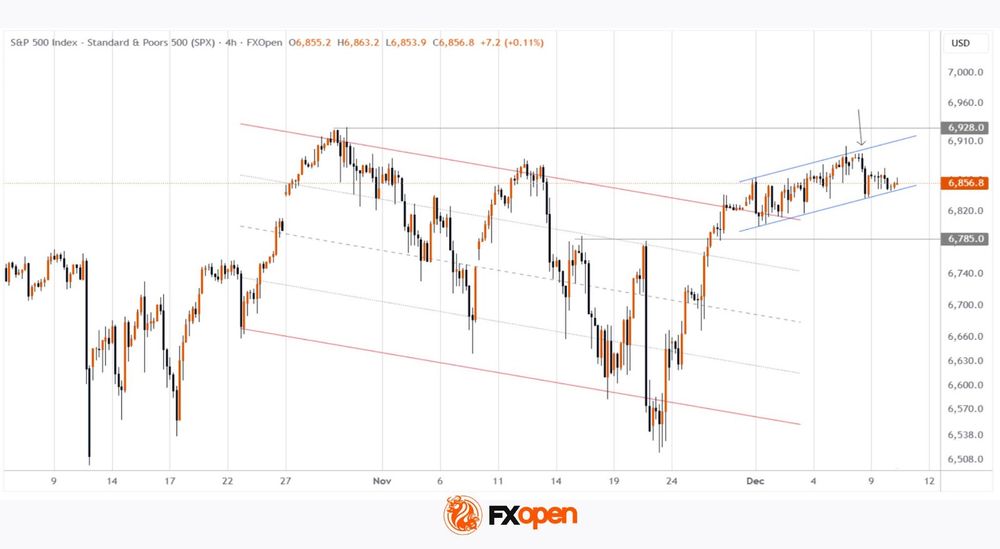
From the demand side:
→ the price has managed to hold firmly above the 6785 level (which may act as support going forward) and has broken above a previously formed descending channel (shown in red);
→ an ascending channel formed in early December, which can be interpreted as cautious optimism ahead of the news.
From the supply side:
→ the late-October record high may act as psychological resistance;
→ yesterday's decline (indicated by the arrow) suggests that bears are ready to act more aggressively if given a catalyst.
Overall, taking the above into account, it is reasonable to suggest that the S&P 500 market (US SPX 500 mini on FXOpen) is in a "calm before the storm" phase. Be prepared for volatility spikes later today, starting from 22:00 GMT+3.
728 RM B 7/F GEE LOK IND BLDG NO 34 HUNG TO RD KWUN TONG KLN HONG KONG


White Label
Data API
Web Plug-ins
Poster Maker
Affiliate Program
The risk of loss in trading financial instruments such as stocks, FX, commodities, futures, bonds, ETFs and crypto can be substantial. You may sustain a total loss of the funds that you deposit with your broker. Therefore, you should carefully consider whether such trading is suitable for you in light of your circumstances and financial resources.
No decision to invest should be made without thoroughly conducting due diligence by yourself or consulting with your financial advisors. Our web content might not suit you since we don't know your financial conditions and investment needs. Our financial information might have latency or contain inaccuracy, so you should be fully responsible for any of your trading and investment decisions. The company will not be responsible for your capital loss.
Without getting permission from the website, you are not allowed to copy the website's graphics, texts, or trademarks. Intellectual property rights in the content or data incorporated into this website belong to its providers and exchange merchants.
Not Logged In
Log in to access more features

FastBull Membership
Not yet
Purchase


Log In
Sign Up


