• Trade
  • Markets
  • Copy
  • Contests
  • News
  • 24/7
  • Calendar
  • Q&A
  • Chats
Trending
Screeners
SYMBOL
LAST
BID
ASK
HIGH
LOW
NET CHG.
%CHG.
SPREAD
SPX
S&P 500 Index
6855.04
6855.04
6855.04
6861.30
6847.07
+27.63
+ 0.40%
--
DJI
Dow Jones Industrial Average
48585.86
48585.86
48585.86
48679.14
48557.21
+127.82
+ 0.26%
--
IXIC
NASDAQ Composite Index
23305.86
23305.86
23305.86
23345.56
23265.18
+110.70
+ 0.48%
--
USDX
US Dollar Index
97.850
97.930
97.850
98.070
97.810
-0.100
-0.10%
--
EURUSD
Euro / US Dollar
1.17540
1.17547
1.17540
1.17596
1.17262
+0.00146
+ 0.12%
--
GBPUSD
Pound Sterling / US Dollar
1.33923
1.33932
1.33923
1.33961
1.33546
+0.00216
+ 0.16%
--
XAUUSD
Gold / US Dollar
4329.40
4329.83
4329.40
4350.16
4294.68
+30.01
+ 0.70%
--
WTI
Light Sweet Crude Oil
56.886
56.916
56.886
57.601
56.789
-0.347
-0.61%
--

Community Accounts

Signal Accounts
--
Profit Accounts
--
Loss Accounts
--
View More

Become a signal provider

Sell trading signals to earn additional income

View More

Guide to Copy Trading

Get started with ease and confidence

View More

Signal Accounts for Members

All Signal Accounts

Best Return
  • Best Return
  • Best P/L
  • Best MDD
Past 1W
  • Past 1W
  • Past 1M
  • Past 1Y

All Contests

  • All
  • Trump Updates
  • Recommend
  • Stocks
  • Cryptocurrencies
  • Central Banks
  • Featured News
Top News Only
Share

The Nasdaq Golden Dragon China Index Fell 0.9% In Early Trading

Share

The S&P 500 Opened 32.78 Points Higher, Or 0.48%, At 6860.19; The Dow Jones Industrial Average Opened 136.31 Points Higher, Or 0.28%, At 48594.36; And The Nasdaq Composite Opened 134.87 Points Higher, Or 0.58%, At 23330.04

Share

Miran: Goods Inflation Could Be Settling In At A Higher Level Than Was Normal Before The Pandemic, But That Will Be More Than Offset By Housing Disinflation

Share

Miran, Who Dissented In Favor Of A Larger Cut At Last Fed Meeting, Repeats Keeping Policy Too Tight Will Lead To Job Losses

Share

Miran: Does Not Think Higher Goods Inflation Is Mostly From Tariffs, But Acknowledges Does Not Have A Full Explanation For It

Share

Toronto Stock Index .GSPTSE Rises 67.16 Points, Or 0.21 Percent, To 31594.55 At Open

Share

Miran: Excluding Housing And Non-Market Based Items, Core Pce Inflation May Be Below 2.3%, “Within Noise” Of The Fed's 2% Target

Share

Polish State Assets Minister Balczun Says Jsw Needs Over USD 830 Million Financing To Keep Liquidity For A Year

Share

Miran: Prices Are “Once Again Stable” And Monetary Policy Should Reflect That

Share

Fed's Miran: Current Excess Inflation Is Not Reflective Of Underlying Supply And Demand In The Economy

Share

Portugal Treasury Puts 2026 Net Financing Needs At 13 Billion Euros, Up From 10.8 Billion In 2025

Share

Portugal Treasury Expects 2026 Net Financing Needs At 29.4 Billion Euros, Up From 25.8 Billion In 2025

Share

Bank Of America Says With Indonesia's Smelter Now Ramping Up, It Expects Aluminium Supply Growth To Accelerate To 2.6% Year On Year In 2026

Share

Bank Of America Expects A Deficit In Aluminium Next Year And Sees Prices Pushing Above $3000/T

Share

Fed Data - USA Effective Federal Funds Rate At 3.64 Percent On 12 December On $102 Billion In Trades Versus 3.64 Percent On $99 Billion On 11 December

Share

Brazil's Petrobras Says No Impact Seen On Oil, Petroleum Products Output As Workers Start Planned Strike

Share

Statement: US Travel Group Warns New Proposed Trump Administration Requirements For Foreign Tourists To Provide Social Media Histories Could Mean Millions Of People Opting Not To Visit

Share

Blackrock: Kerry White Will Become Head Of Citi Investment Management At Citi Wealth

Share

Blackrock: Rob Jasminski, Head Of Citi Investment Management, Has Joined With Team

Share

Blackrock: Effective Dec 15, Citi Investment Management Employees Will Join Blackrock

TIME
ACT
FCST
PREV
Japan Tankan Small Manufacturing Outlook Index (Q4)

A:--

F: --

P: --

Japan Tankan Large Non-Manufacturing Outlook Index (Q4)

A:--

F: --

P: --

Japan Tankan Large Manufacturing Outlook Index (Q4)

A:--

F: --

P: --

Japan Tankan Small Manufacturing Diffusion Index (Q4)

A:--

F: --

P: --

Japan Tankan Large Manufacturing Diffusion Index (Q4)

A:--

F: --

P: --

Japan Tankan Large-Enterprise Capital Expenditure YoY (Q4)

A:--

F: --

P: --

U.K. Rightmove House Price Index YoY (Dec)

A:--

F: --

P: --

China, Mainland Industrial Output YoY (YTD) (Nov)

A:--

F: --

P: --

China, Mainland Urban Area Unemployment Rate (Nov)

A:--

F: --

P: --

Saudi Arabia CPI YoY (Nov)

A:--

F: --

P: --

Euro Zone Industrial Output YoY (Oct)

A:--

F: --

P: --

Euro Zone Industrial Output MoM (Oct)

A:--

F: --

P: --

Canada Existing Home Sales MoM (Nov)

A:--

F: --

P: --

Canada National Economic Confidence Index

A:--

F: --

P: --

Canada New Housing Starts (Nov)

A:--

F: --

P: --
U.S. NY Fed Manufacturing Employment Index (Dec)

A:--

F: --

P: --

U.S. NY Fed Manufacturing Index (Dec)

A:--

F: --

P: --

Canada Core CPI YoY (Nov)

A:--

F: --

P: --

Canada Manufacturing Unfilled Orders MoM (Oct)

A:--

F: --

P: --

U.S. NY Fed Manufacturing Prices Received Index (Dec)

A:--

F: --

P: --

U.S. NY Fed Manufacturing New Orders Index (Dec)

A:--

F: --

P: --

Canada Manufacturing New Orders MoM (Oct)

A:--

F: --

P: --

Canada Core CPI MoM (Nov)

A:--

F: --

P: --

Canada Trimmed CPI YoY (SA) (Nov)

A:--

F: --

P: --

Canada Manufacturing Inventory MoM (Oct)

A:--

F: --

P: --

Canada CPI YoY (Nov)

A:--

F: --

P: --

Canada CPI MoM (Nov)

A:--

F: --

P: --

Canada CPI YoY (SA) (Nov)

A:--

F: --

P: --

Canada Core CPI MoM (SA) (Nov)

A:--

F: --

P: --

Canada CPI MoM (SA) (Nov)

A:--

F: --

P: --

Federal Reserve Board Governor Milan delivered a speech
U.S. NAHB Housing Market Index (Dec)

--

F: --

P: --

Australia Composite PMI Prelim (Dec)

--

F: --

P: --

Australia Services PMI Prelim (Dec)

--

F: --

P: --

Australia Manufacturing PMI Prelim (Dec)

--

F: --

P: --

Japan Manufacturing PMI Prelim (SA) (Dec)

--

F: --

P: --

U.K. 3-Month ILO Employment Change (Oct)

--

F: --

P: --

U.K. Unemployment Claimant Count (Nov)

--

F: --

P: --

U.K. Unemployment Rate (Nov)

--

F: --

P: --

U.K. 3-Month ILO Unemployment Rate (Oct)

--

F: --

P: --

U.K. Average Weekly Earnings (3-Month Average, Including Bonuses) YoY (Oct)

--

F: --

P: --

U.K. Average Weekly Earnings (3-Month Average, Excluding Bonuses) YoY (Oct)

--

F: --

P: --

France Services PMI Prelim (Dec)

--

F: --

P: --

France Composite PMI Prelim (SA) (Dec)

--

F: --

P: --

France Manufacturing PMI Prelim (Dec)

--

F: --

P: --

Germany Services PMI Prelim (SA) (Dec)

--

F: --

P: --

Germany Manufacturing PMI Prelim (SA) (Dec)

--

F: --

P: --

Germany Composite PMI Prelim (SA) (Dec)

--

F: --

P: --

Euro Zone Composite PMI Prelim (SA) (Dec)

--

F: --

P: --

Euro Zone Services PMI Prelim (SA) (Dec)

--

F: --

P: --

Euro Zone Manufacturing PMI Prelim (SA) (Dec)

--

F: --

P: --

U.K. Services PMI Prelim (Dec)

--

F: --

P: --

U.K. Manufacturing PMI Prelim (Dec)

--

F: --

P: --

U.K. Composite PMI Prelim (Dec)

--

F: --

P: --

Euro Zone ZEW Economic Sentiment Index (Dec)

--

F: --

P: --

Germany ZEW Current Conditions Index (Dec)

--

F: --

P: --

Germany ZEW Economic Sentiment Index (Dec)

--

F: --

P: --

Euro Zone Trade Balance (Not SA) (Oct)

--

F: --

P: --

Euro Zone ZEW Current Conditions Index (Dec)

--

F: --

P: --

Euro Zone Trade Balance (SA) (Oct)

--

F: --

P: --

U.S. Retail Sales MoM (Excl. Automobile) (SA) (Oct)

--

F: --

P: --

Q&A with Experts
    • All
    • Chatrooms
    • Groups
    • Friends
    Connecting
    .
    .
    .
    Type here...
    Add Symbol or Code

      No matching data

      All
      Trump Updates
      Recommend
      Stocks
      Cryptocurrencies
      Central Banks
      Featured News
      • All
      • Russia-Ukraine Conflict
      • Middle East Flashpoint
      • All
      • Russia-Ukraine Conflict
      • Middle East Flashpoint

      Search
      Products

      Charts Free Forever

      Chats Q&A with Experts
      Screeners Economic Calendar Data Tools
      Membership Features
      Data Warehouse Market Trends Institutional Data Policy Rates Macro

      Market Trends

      Market Sentiment Order Book Forex Correlations

      Top Indicators

      Charts Free Forever
      Markets

      News

      News Analysis 24/7 Columns Education
      From Institutions From Analysts
      Topics Columnists

      Latest Views

      Latest Views

      Trending Topics

      Top Columnists

      Latest Update

      Signals

      Copy Rankings Latest Signals Become a signal provider AI Rating
      Contests
      Brokers

      Overview Brokers Assessment Rankings Regulators News Claims
      Broker listing Forex Brokers Comparison Tool Live Spread Comparison Scam
      Q&A Complaint Scam Alert Videos Tips to Detect Scam
      More

      Business
      Events
      Careers About Us Advertising Help Center

      White Label

      Data API

      Web Plug-ins

      Affiliate Program

      Awards Institution Evaluation IB Seminar Salon Event Exhibition
      Vietnam Thailand Singapore Dubai
      Fans Party Investment Sharing Session
      FastBull Summit BrokersView Expo
      Recent Searches
        Top Searches
          Markets
          News
          Analysis
          User
          24/7
          Economic Calendar
          Education
          Data
          • Names
          • Latest
          • Prev

          View All

          No data

          Scan to Download

          Faster Charts, Chat Faster!

          Download App
          English
          • English
          • Español
          • العربية
          • Bahasa Indonesia
          • Bahasa Melayu
          • Tiếng Việt
          • ภาษาไทย
          • Français
          • Italiano
          • Türkçe
          • Русский язык
          • 简中
          • 繁中
          Open Account
          Search
          Products
          Charts Free Forever
          Markets
          News
          Signals

          Copy Rankings Latest Signals Become a signal provider AI Rating
          Contests
          Brokers

          Overview Brokers Assessment Rankings Regulators News Claims
          Broker listing Forex Brokers Comparison Tool Live Spread Comparison Scam
          Q&A Complaint Scam Alert Videos Tips to Detect Scam
          More

          Business
          Events
          Careers About Us Advertising Help Center

          White Label

          Data API

          Web Plug-ins

          Affiliate Program

          Awards Institution Evaluation IB Seminar Salon Event Exhibition
          Vietnam Thailand Singapore Dubai
          Fans Party Investment Sharing Session
          FastBull Summit BrokersView Expo

          IC Markets Europe Fundamental Forecast | 30 July 2025

          IC Markets

          Commodity

          Forex

          Economic

          Summary:

          The Australian dollar dropped on a CPI miss, the Japanese Nikkei declined on weak retail data and BOJ caution, tech shares traded positively, while Hong Kong and China equities moved lower.

          What happened in the Asia session?

          The Australian dollar dropped on a CPI miss, the Japanese Nikkei declined on weak retail data and BOJ caution, tech shares traded positively, while Hong Kong and China equities moved lower. Defensive positioning persists ahead of the Fed and BOJ meetings, amid global trade policy uncertainty and anticipation of significant economic data and earnings releases.

          Market focus remains on the near-term U.S. rate path, the sustainability of the U.S.–China tariff truce, and signs of growth stabilization or policy easing in the Asia-Pacific region. Overall, Asian markets are treading water, reacting more to policy and macro headlines than to individual data points, as risk events accumulate on the calendar and volatility could rise in the next 24–48 hours.

          What does it mean for the Europe & US sessions?

          Markets are entering the European and U.S. sessions with a cautious tone. The details of the U.S.–EU trade agreement are weighing on the euro and European stocks while supporting the dollar. U.S. equities are consolidating near their highs but face potential tests with the upcoming Federal Reserve decision and a wave of major earnings reports. Oil remains sensitive to global headlines, while gold stays steady as inflation and trade risks sustain demand. Traders should remain alert to significant headline risks from central banks, trade negotiations, and earnings in the coming hours.

          What can we expect from DXY today?

          The U.S. dollar is exhibiting a strong bullish trend today, supported by gains in trade policy, positive economic data, and increased global capital flows ahead of the upcoming Fed decision. Market participants should closely watch for any shift in the Fed’s tone, which could serve as the next key catalyst for the dollar’s direction. The U.S. Dollar Index (DXY) has extended its rally, trading above 98.8 after a 1% surge at the start of the week. This momentum positions the dollar for its strongest week of the year so far, bolstered by recent U.S. trade agreements, including a 15% tariff on EU imports, which have strengthened the U.S. economy while pressuring the euro.

          Central Bank Notes:

          ● The Board of Governors of the Federal Reserve System voted unanimously to maintain the Federal Funds Rate in a target range of 4.25 to 4.50% on 18 June 2025.
          ● The Committee seeks to achieve maximum employment and inflation at the rate of 2% over the longer run; uncertainty around the economic outlook has diminished but remains elevated.
          ● The Committee is attentive to the risks to both sides of its dual mandate and judges that the unemployment rate remains low, labour market conditions remain solid, but inflation is somewhat elevated.
          ● Although swings in net exports have affected the data, recent indicators suggest that economic activity has continued to expand at a solid pace.
          ● GDP growth forecasts were revised downward for 2025 (1.4% vs. 1.7% in the March projection) while PCE inflation projections have been adjusted higher for 2025, with core inflation expected to reach 3.1% (vs. 2.8% in the March projection), partly due to tariff-related pressures.
          ● In assessing the appropriate stance of monetary policy, the Committee will continue to monitor the implications of incoming information for the economic outlook and would be prepared to adjust the stance of monetary policy as appropriate if risks emerge that could impede the attainment of its goals.
          ● Beginning in April, the Committee will slow the pace of decline of its securities holdings by reducing the monthly redemption cap on Treasury securities from $25B to $5B while maintaining the monthly redemption cap on agency debt and agency mortgage-backed securities at $35B.
          ● The next meeting is scheduled for 29 to 30 July 2025.

          Next 24 Hours Bias

          Weak Bearish

          What can we expect from Gold today?

          Gold is trading slightly higher early Wednesday, recovering from three-week lows as risk sentiment turns cautious and traders await clarity from the U.S. Federal Reserve meeting. For now, the yellow metal remains in a consolidation phase, with its direction hinging on upcoming policy decisions and economic headlines. Gold prices are currently around $3,327 per ounce, marking a modest 0.39% gain from the previous day. The precious metal remains within its recent range, holding above the key $3,300 support level despite ongoing market uncertainty.

          Next 24 Hours Bias

          Weak Bearish

          What can we expect from AUD today?

          The Australian Dollar remains weak and range-bound above 0.6500, with global risk sentiment, a firm US Dollar, and upcoming domestic inflation data and rate decisions shaping market tone. The outcome of Wednesday’s CPI report and the RBA’s response next week will be decisive for AUD direction in the near term. Key risks include trade headlines, signals from the Federal Reserve, and ongoing volatility in global equity and commodity markets, particularly as China–U.S. negotiations continue.

          Central Bank Notes:

          ● The RBA held its cash rate steady at 3.85% at the July meeting on 8 July 2025, following a 25bps reduction in May and line with widespread market expectations after recent data showed inflation tracking within the target band.
          ● Inflation continues to ease from its peak, with higher interest rates helping to rebalance demand and supply across the Australian economy. Data for the June quarter signalled ongoing progress, though underlying pressures persist in certain sectors.
          ● Trimmed mean inflation for the June quarter likely remained near 2.9% and headline CPI around 2.4%, both within the RBA’s 2–3% target range. The Board noted further evidence of inflation convergence, but flagged that not all price categories are moving in tandem.
          ● Financial markets have shown increased volatility in the wake of global tariff and trade policy developments—especially as a result of recent U.S. and EU announcements. This has pushed asset prices higher but contributed to an uncertain outlook for domestic growth and employment.
          ● Private domestic demand showed a tentative recovery. Real household incomes improved and signs of easing household financial stress emerged, but some business sectors continued to face subdued demand, limiting their ability to pass on cost increases.
          ● Labour market conditions remained tight overall. Employment continued to expand, with low rates of underutilisation. Business surveys suggest labour availability remains a constraint, though there are signs of a gradual easing compared to earlier in 2025.
          ● Underlying wage growth softened modestly, though unit labour cost growth remains elevated due to below-trend productivity gains. The Board remains attentive to developments in wage and productivity dynamics as cost pressures continue to evolve.
          ● Uncertainties persist for both domestic activity and inflation. Consumption growth has risen, but more slowly than anticipated three months ago, with global and domestic factors both contributing to the cautious outlook.
          ● There remains a risk that household spending picks up more slowly than forecast, which could result in ongoing subdued aggregate demand and a sharper deterioration in employment conditions.
          ● Given that inflation is expected to remain around the target band, the Board judged that it was appropriate to keep policy settings unchanged in July, maintaining a position that is still mildly restrictive.
          ● The Board continues to monitor all incoming data and assesses risks carefully, with a focus on global trends, domestic demand indicators, inflation outcomes, and the labour market outlook.
          ● The RBA remains committed to its mandate of price stability and full employment and stands ready to adjust policy as needed to achieve these objectives.
          ● The next meeting is on August 11–12 2025.

          Next 24 Hours Bias

          Weak Bearish

          What can we expect from NZD today?

          The NZD remains weak today, driven by a stronger US dollar, uncertainty surrounding future US tariff policies, and a risk-off sentiment in global markets. With no major domestic news, the outlook depends largely on international developments and central bank signals over the next 24–48 hours.

          The New Zealand dollar (NZD/USD) continued its decline, trading around 0.595–0.596 near a one-week low and extending its losing streak to a fourth consecutive session. Over the past month, the NZD has lost about 2.2% in value, reflecting broad weakness against a stronger US dollar, and it is down approximately 0.87% over the past seven days.

          Central Bank Notes:

          • The Monetary Policy Committee (MPC) agreed to hold the Official Cash Rate (OCR) at 3.25% on 9 July, marking the first pause following six consecutive rate cuts.
          • The MPC cited heightened uncertainty and near-term inflation risks as reasons to wait until August for further action.
          • Although the annual consumer price index inflation increased to 2.5% in the first quarter of 2025, it remained within the MPC’s target range of 1 to 3%, noting that the outlook for medium-term inflation pressures has evolved broadly in line with the May MPS projections.
          • While it is expected to be near the upper end of the band in the second and third quarters of this year, easing core inflation and spare capacity in the economy should help return it toward the 2% midpoint over time.
          • The MPC noted that, despite global factors, domestic financial conditions are evolving broadly as expected, as mortgage and deposit interest rates have continued to decline, reflecting a lower OCR, strong bank liquidity, and soft credit growth.
          • In aggregate, GDP growth over the December and March quarters was stronger than expected, reflecting a pick-up in household consumption and business investment, but higher frequency indicators suggest weaker than expected growth in April and May.
          • Large economic policy shifts overseas and concerns about sovereign risk could result in additional financial market volatility and increased bond yields, while prolonged economic uncertainty might induce further precautionary behaviour by households and firms, slowing the domestic economic recovery.
          • Subject to medium-term inflation pressures continuing to ease in line with the Committee’s central projections, the Committee expects to lower the OCR further, broadly consistent with the projection outlined in May.The next meeting is on 20 August 2025.

          Next 24 Hours Bias

          Weak Bearish

          What can we expect from JPY today?

          The Japanese yen is trading near multi-session lows, weighed down by external trade dynamics and defensive positioning ahead of the Bank of Japan’s upcoming policy meeting. While markets expect cautious policy signals and an upward revision to the inflation forecast, any unexpected guidance or political developments could trigger volatility in both the yen and Japanese assets over the next 24–48 hours.

          Currently, the yen (JPY) is hovering around 148.3–148.5 per U.S. dollar after a sharp three-session decline. The currency is down approximately 3.2% for the month but held relatively steady overnight as traders await central bank decisions and key international developments.

          Central Bank Notes:

          ● The Policy Board of the Bank of Japan decided on 17 June, by a unanimous vote, to set the following guidelines for money market operations for the inter-meeting period:
          1.The Bank will encourage the uncollateralized overnight call rate to remain at around 0.5%.
          2.The Bank will continue its plan to reduce the amount of its monthly outright purchases of JGBs. The scheduled amount of monthly long-term government bond purchases will, in principle, be reduced by about ¥400 billion each quarter from January to March 2026, and by about ¥200 billion each quarter from April to June 2026 onward, aiming for a level of around ¥2 trillion in January to March 2027.
          ● Japan’s economy, while showing some weak movements in certain areas, is recovering moderately. Overseas economies, though partly exhibiting weakness due to the effects of various countries’ trade policies, are generally growing at a moderate pace. Exports and industrial production, while showing some last-minute demand due to the U.S. tariff increases, are basically moving sideways.
          ● On the price front, looking at the year-on-year rate of change in consumer prices (excluding fresh food), the rate is currently in the mid-3% range, reflecting continued pass-through of wage increases to sales prices, as well as the effects of past rises in import prices and recent increases in food prices such as rice. Expected inflation rates are rising moderately.
          ● As for consumer prices (excluding fresh food), the effects of past import price increases and recent rises in food prices such as rice, which have pushed up inflation so far, are expected to wane. During this period, the underlying rate of increase in consumer prices may stagnate somewhat due to the slowdown in growth pace.
          ● Looking ahead, the Japanese economy is expected to slow its growth pace, as overseas economies decelerate due to the effects of various countries’ trade policies, putting downward pressure on Japanese corporate profits, etc., although accommodative financial conditions will provide some support. Thereafter, as overseas economies return to a moderate growth path, Japan’s growth rate is expected to increase.
          ● As the growth rate rises, labour shortages intensify, and medium- to long-term expected inflation rates rise, inflation is expected to gradually increase. In the latter half of the projection period in the “Outlook Report,” inflation is expected to move at a level generally consistent with the “price stability target”.
          ● There are various risk factors, but in particular, the outlook for the development of trade policies in various countries and the resulting uncertainty regarding overseas economic and price trends is extremely high. It is necessary to closely monitor the impact on financial and foreign exchange markets, as well as on Japan’s economy and prices.
          ● The next meeting is scheduled for 31 July 2025.

          Next 24 Hours Bias

          Weak Bearish

          What can we expect from EUR today?

          Today, the euro remains under selling pressure, driven by investor disappointment over the U.S.–EU trade agreement, muted regional data, and caution ahead of the Federal Reserve’s decision. The currency is expected to stay sensitive to macroeconomic headlines and central bank policies as the session unfolds. The euro remains weak and is likely to stay volatile amid export headwinds from U.S. tariffs, a cautious ECB stance, and cooling sentiment ahead of key economic data and a major Fed announcement.

          Central Bank Notes:

          ● The Governing Council kept the three key ECB interest rates unchanged at its July 24 meeting, maintaining the main refinancing rate at 2.15%, the marginal lending facility at 2.40%, and the deposit facility at 2.00%, following eight consecutive cuts preceding this decision.
          ● The decision to hold rates steady was driven by evidence that inflation is stabilizing near the Governing Council’s medium-term target of 2%. Policymakers communicated that further moves on rates would be data-dependent, explicitly refraining from pre-committing to any future path amid persistent global and domestic uncertainties.
          ● According to the latest Eurosystem staff projections, headline inflation is expected to remain around 2.0% for 2025, with projections indicating 1.6% for 2026 and a rebound to 2.0% in 2027. Downward revisions from previous forecasts primarily reflect lower energy price assumptions and a stronger euro. Inflation excluding energy and food is seen averaging 2.4% in 2025 and 1.9% in 2026–2027, little changed from prior projections.
          ● Real GDP growth for the Eurozone is forecast at 0.9% in 2025, 1.1% in 2026, and 1.3% in 2027. The projections note that a strong first quarter offsets a weaker outlook for the rest of 2025. While business investment and exports are dampened by ongoing trade policy uncertainties—including recent U.S. tariff measures—rising government investment, particularly in defense and infrastructure, is expected to progressively underpin growth.
          ● Household spending should be supported by firm real income gains and a still-solid labour market. More favorable financing conditions are expected to help strengthen the economy’s resilience to further global shocks. Wage growth, although still elevated, continues to moderate, with profit margins partially absorbing cost pressures.
          ● Amid significant geopolitical and economic uncertainty, the Governing Council underscored its commitment to ensuring inflation stabilises sustainably at the 2% target. The ECB reiterated it would pursue a meeting-by-meeting, data-dependent approach to its monetary policy stance.
          ● Future rate decisions will be guided by the assessment of incoming economic and financial data, the outlook for inflation and underlying inflation dynamics, and the effectiveness of monetary policy transmission. The Council continues to stress that it is not pre-committed to any specific rate trajectory.
          ● The asset purchase programme (APP) and pandemic emergency purchase programme (PEPP) portfolios are continuing to decline in an orderly and predictable way, as the Eurosystem has ceased reinvesting principal payments from maturing securities.
          ● The next meeting is on 11 September 2025

          Next 24 Hours Bias

          Medium Bearish

          What can we expect from CHF today?

          The Swiss franc has softened slightly as global risk sentiment improves and the U.S. dollar rebounds on trade news and Fed policy expectations. The SNB’s policy remains steady following its June rate cut, with near-term direction likely influenced by cross-asset risk trends, U.S. monetary developments, and potential renewed safe-haven demand. The franc faces competing forces, its continued safe-haven appeal versus reduced demand amid improving trade relations. While the SNB’s dovish stance and readiness to intervene highlight concerns about franc strength, recent improvements in inflation may limit the need for further aggressive easing.

          Central Bank Notes:

          ● The SNB eased monetary policy by lowering its key policy rate by 25 basis points, from 0.25% to 0% on 19 June 2025, marking the sixth consecutive reduction.
          ● Inflationary pressure has decreased further as compared to the previous quarter, decreasing from 0.3% in February to -0.1% in May, mainly attributable to lower prices in tourism and oil products.
          ● Compared to March, the new conditional inflation forecast is lower in the short term. In the medium term, there is hardly any change from March, putting the average annual inflation at 0.2% for 2025, 0.5% for 2026 and 0.7% for 2027.
          ● The global economy continued to grow at a moderate pace in the first quarter of 2025 but the global economic outlook for the coming quarters has deteriorated due to the increase in trade tensions.
          ● Swiss GDP growth was strong in the first quarter of 2025, but this development was largely because, as in other countries, exports to the U.S. were brought forward.
          ● Following the strong first quarter, growth is likely to slow again and remain rather subdued over the remainder of the year; the SNB expects GDP growth of 1% to 1.5% for 2025 as a whole, while also anticipating GDP growth of 1% to 1.5% for 2026.
          ● The SNB will continue to monitor the situation closely and will adjust its monetary policy if necessary to ensure inflation remains within the range consistent with price stability over the medium term.
          ● The next meeting is on 25 September 2025.

          Next 24 Hours Bias

          Weak Bearish

          What can we expect from GBP today?

          The pound remains soft and defensive heading into July 30, 2025, weighed down by slowing growth, persistent inflation, and expectations of BoE rate cuts. GBP/USD is trading near multi-month lows, while GBP/EUR saw a brief rebound but continues to hover near its 2023–2024 lows. Domestic economic weakness and strong U.S. dollar demand keep sterling under pressure.

          Markets are positioned cautiously ahead of the August 7 Bank of England meeting, with at least one rate cut priced in. Focus remains on UK growth signals, particularly monthly GDP releases alongside evolving labor market data and shifts in core inflation. GBP volatility continues to track developments in global risk sentiment, U.S. dollar strength, and changes in trade policy outlook.

          Central Bank Notes:

          ● The Bank of England’s Monetary Policy Committee (MPC) voted by a majority of 6 to 3 to maintain the Bank Rate at 4.25% on 19 June 2025, with three members preferring to reduce the Bank Rate by 25 basis points.
          ● The MPC also voted unanimously to reduce the stock of UK government bond purchases held for monetary policy purposes and financed by the issuance of central bank reserves, by £100 billion over the next 12 months to a total of £558 billion, starting in October 2024. On 19 June 2025, the stock of UK government bonds held for monetary policy purposes was £590 billion.
          ● There has been substantial disinflation over the past two years, as previous external shocks have receded, and as the restrictive stance of monetary policy has curbed second-round effects and stabilised longer-term inflation expectations.
          ● Twelve-month CPI inflation increased to 3.4% in May from 2.6% in March, in line with expectations in the May Monetary Policy Report. The rise was largely due to a range of regulated prices and previous increases in energy prices.
          ● Underlying UK GDP growth appears to have remained weak, and the labour market has continued to loosen, leading to clearer signs that a margin of slack has opened up over time.
          ● Measures of pay growth have continued to moderate and, as in May, the Committee expects a significant slowing over the rest of the year.
          ● Global uncertainty remains elevated while energy prices have risen owing to an escalation of the conflict in the Middle East, prompting the Committee to remain sensitive to heightened unpredictability in the economic and geopolitical environment.
          ● There remain two-sided risks to inflation. Given the outlook and continued disinflation, a gradual and careful approach to the further withdrawal of monetary policy restraint remains appropriate and the Committee will continue to monitor closely the risks of inflation persistence and what the evidence may reveal about the balance between aggregate supply and demand in the economy.
          ● Monetary policy will need to continue to remain restrictive for sufficiently long until the risks to inflation returning sustainably to the 2% target in the medium term have dissipated further and the Committee will decide the appropriate degree of monetary policy restrictiveness at each meeting.
          ● The next meeting is on 7 August 2025.

          Next 24 Hours Bias

          Weak Bearish

          What can we expect from CAD today?

          The Canadian dollar enters July 30 under pressure from a strengthening U.S. dollar and ongoing trade uncertainty. With the Bank of Canada widely expected to hold interest rates steady at 2.75%, attention shifts to forward guidance and how policymakers will balance persistent inflation concerns against weak economic growth and external trade risks. Additionally, the Canadian dollar is weighed down by recent U.S. trade agreements with Japan and the EU, which have strengthened the U.S. dollar while leaving Canada without a comparable deal.

          Central Bank Notes:

          ● The Bank of Canada maintained its target for the overnight rate at 2.75%, with the Bank Rate at 3% and the deposit rate at 2.70% on 4th June – marking the second consecutive meeting where rates were kept on hold.
          ● The Governing Council noted that the ongoing increase and decrease of various U.S. tariffs, coupled with highly uncertain outcomes of bilateral trade negotiations and tariff rates remaining well above their levels at the beginning of 2025, placed downside risks on growth and lifted inflation expectations, warranting caution regarding the continuation of monetary easing.
          ● The higher uncertainty stemmed from the absence of a clear tariff path by the U.S. and persistent threats of new trade actions, which prompted the BoC Governing Council to highlight risks such as the extent to which higher US tariffs reduce demand for Canadian exports.
          ● Canada’s economic growth in the first quarter came in at 2.2%, slightly stronger than the original forecast, while the composition of GDP growth was largely as expected. Consumption slowed from its very strong fourth-quarter pace, but continued to grow despite a large drop in consumer confidence.
          ● Housing activity was down, driven by a sharp contraction in resales, while government spending also declined. The economy is expected to be considerably weaker in the second quarter, with the strength in exports and inventories reversing and final domestic demand remaining subdued.
          ● The labour market has weakened, particularly in trade-intensive sectors, and unemployment has risen to 6.9% while CPI inflation eased to 1.7% in April, as the elimination of the federal consumer carbon tax reduced inflation by 0.6%.
          ● The Bank’s preferred measures of core inflation, as well as other measures of underlying inflation, moved up, while recent surveys indicate that households continue to expect that tariffs will raise prices and many businesses say they intend to pass on the costs of higher tariffs.
          ● The Governing Council will continue to assess the timing and strength of both the downward pressures on inflation from a weaker economy and the upward pressures on inflation from higher costs while proceeding carefully, with particular attention to the risks and uncertainties facing the Canadian economy.
          ● The Governing Council will focus on ensuring that Canadians continue to have confidence in price stability through this period of global upheaval by supporting economic growth while ensuring that inflation remains well-controlled.
          ● The next meeting is on 30 July 2025.

          Next 24 Hours Bias

          Medium Bearish

          What can we expect from Oil today?

          Oil prices maintained their recent strength on Wednesday, supported by escalating geopolitical tensions following Trump’s Russia ultimatum, optimism surrounding U.S.-EU trade agreements, and a shift in market sentiment toward bullish positioning. The market remains highly sensitive to developments related to the Russia-Ukraine deadline, Federal Reserve policy signals, and upcoming OPEC+ production decisions.

          Next 24 Hours Bias

          Weak Bullish

          Source: IC Markets

          To stay updated on all economic events of today, please check out our Economic calendar
          Risk Warnings and Disclaimers
          You understand and acknowledge that there is a high degree of risk involved in trading. Following any strategies or investment methods may lead to potential losses. The content on the site is provided by our contributors and analysts for information purposes only. You are solely responsible for determining whether any trading assets, securities, strategy, or any other product is suitable for investing based on your own investment objectives and financial situation.
          Add to Favorites
          Share

          Fed Leaves Rates Steady Despite Trump Pressure, Gives No Hint Of September Cut

          James Riley

          The U.S. central bank held interest rates steady on Wednesday and Federal Reserve Chair Jerome Powell's comments after the decision undercut confidence that borrowing costs would begin to fall in September, possibly stoking the ire of President Donald Trump who has demanded immediate and steep rate relief.

          Powell said the Fed is focused on controlling inflation - not on government borrowing or home mortgage costs that Trump wants lowered - and added that the risk of rising price pressures from the administration's trade and other policies remains too high for the central bank to begin loosening its "modestly restrictive" grip on the economy until more information is collected.

          While there will be two full months of data before the Fed's September 16-17 meeting, Powell said the central bank was still in the early stages of understanding how Trump's rewrite of import taxes and other policy changes will unfold in terms of inflation, jobs and economic growth.

          "You have to think of this as still quite early days," Powell said in a press conference after the release of the Fed's latest policy statement, opens new tab. "There's quite a lot of data coming in before the next meeting. Will it be dispositive? ... It is really hard to say."

          Those comments, and others that placed the burden on upcoming data to convince policymakers that lower rates were warranted, led investors to reduce the probability of a rate cut in September to less than 50%, after entering this week's two-day Fed meeting at nearly 70%. Treasury yields rose while the S&P 500 (.SPX), opens new tab and Dow Jones Industrial Average (.DJI), opens new tab equities indexes closed marginally lower.

          Powell "made clear that he thinks the Fed has room to hold the fed funds rate steady for a period of time and wait and see how much tariffs affect inflation," said Bill Adams, chief economist at Comerica Bank, projecting that the central bank won't cut rates until its last meeting of the year in December.

          "If the unemployment rate holds steady and tariffs push up inflation, it will be hard to justify a rate cut in the next few months."

          The latest policy decision was made by a 9-2 vote, what passes for a split outcome at the consensus-driven central bank, with two Fed governors dissenting for the first time in more than 30 years.

          Trump has given Powell the pejorative nickname "Too Late" for his refusal to cut rates, but the Fed chief on Wednesday said his hope was to be right on time when the decision is made to lower borrowing costs, neither moving so soon that inflation reemerges, or waiting so long that the job market slides and the unemployment rate rises. Indeed, Powell said the fact that the Fed isn't discussing rate hikes could be seen as a willingness to overlook some of the expected impact of tariffs.

          "If you move too soon, you wind up not getting inflation all the way fixed ... That's inefficient," Powell told reporters. "If you move too late, you might do unnecessary damage to the labor market ... In the end, there should be no doubt that we will do what we need to do to keep inflation controlled. Ideally, we do it efficiently."

          The data since the Fed's June 17-18 meeting has given policymakers little reason to shift from the "wait-and-see" approach they have taken on interest rates since Trump's January 20 inauguration raised the possibility that new import tariffs and other policy shifts could put upward pressure on prices.

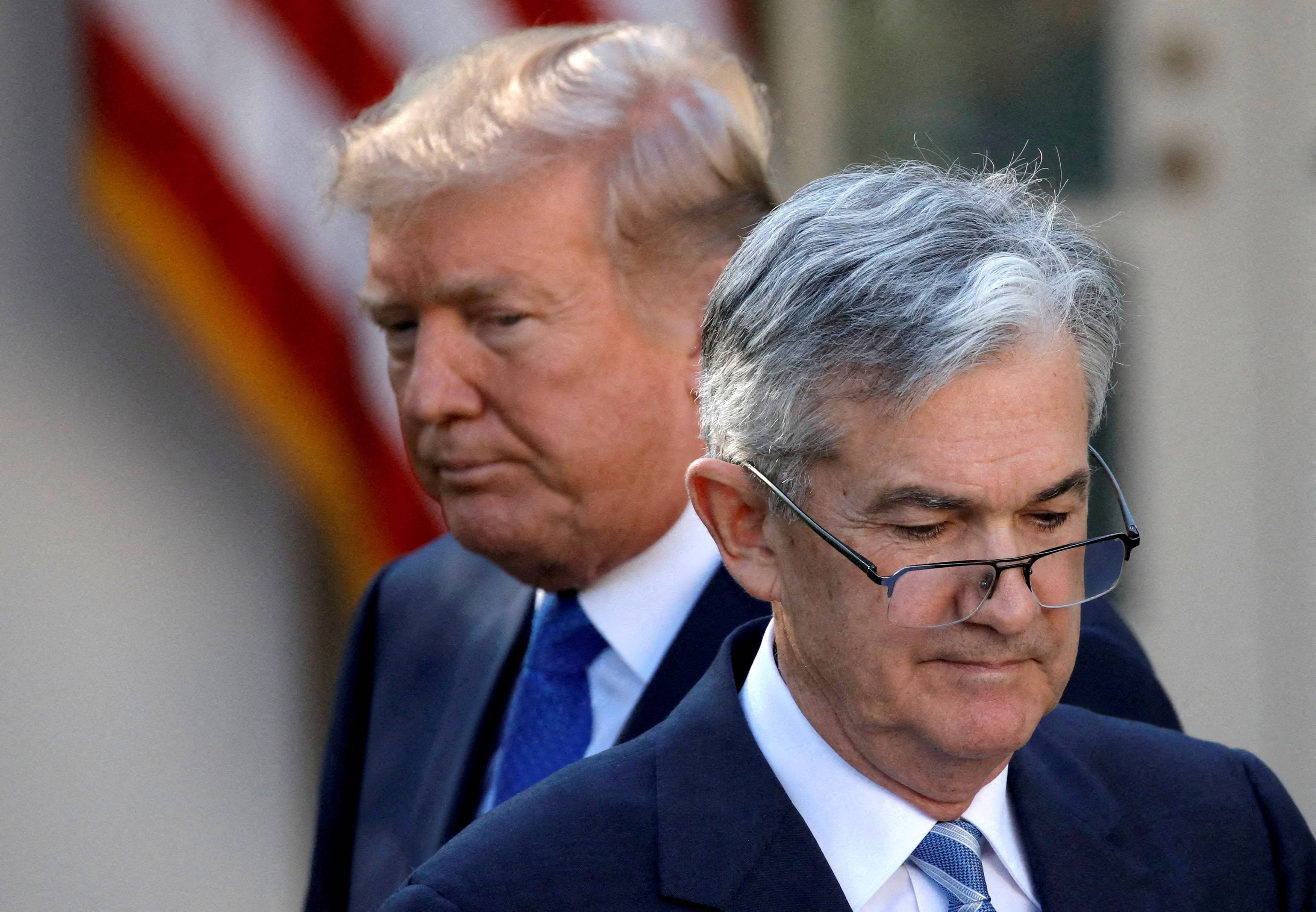
          U.S. President Donald Trump looks on as Jerome Powell, his nominee at the time to lead the U.S. Federal Reserve, moves to the podium at the White House in Washington, U.S., November 2, 2017.

          Inflation is about half a percentage point above the Fed's 2% target and has shown signs of increasing as prices of some heavily imported goods begin to rise, a process Powell said is expected to continue. As of June, Fed policymakers at the median expected inflation to rise further and end the year at about 3%.

          New inflation data for June will be released on Thursday, and a key jobs report for the month of July will follow on Friday, part of the data Powell said policymakers will evaluate as they debate a possible rate cut in September.

          Earlier on Wednesday, the U.S. government reported that economic growth rebounded more than expected in the second quarter, but declining imports accounted for the bulk of the improvement and domestic demand rose at its slowest pace in 2-1/2 years.

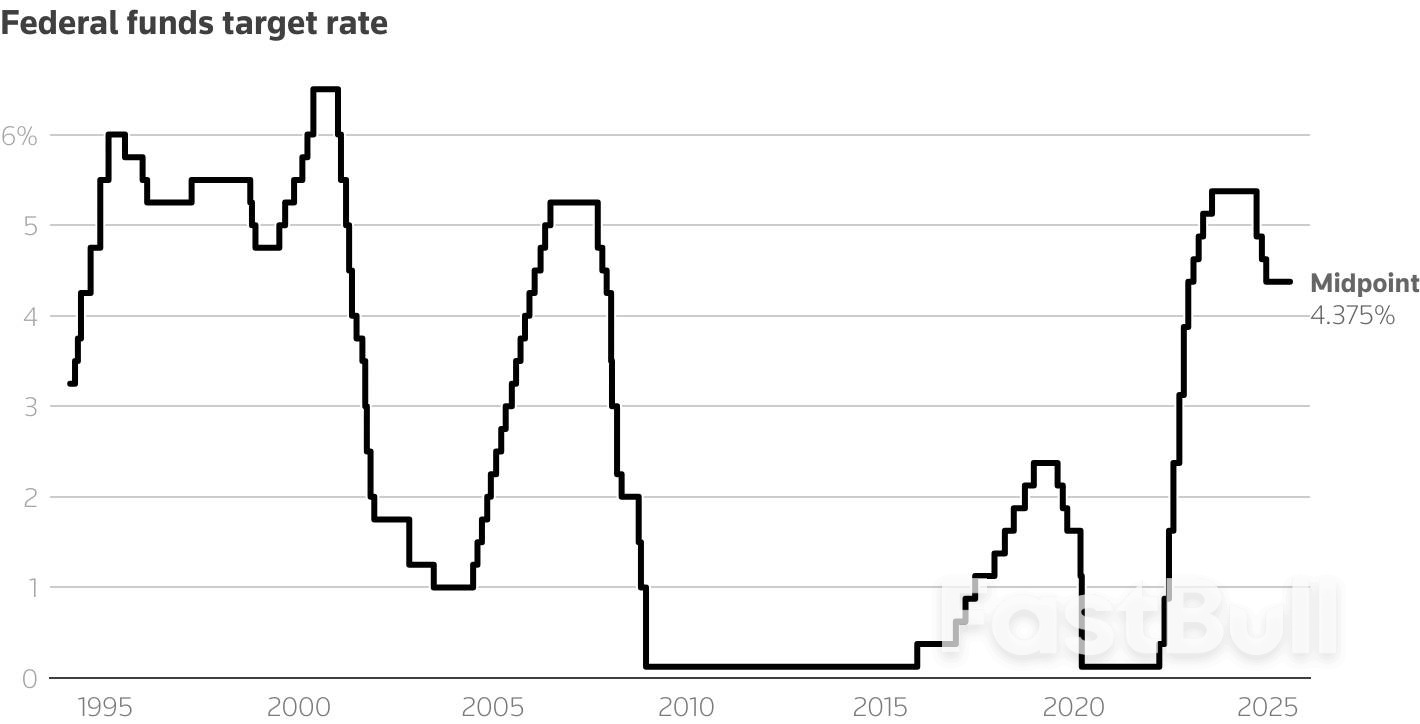
          A line chart showing the benchmark interest rate set by the Federal Open Market Committee

          'THOUGHTFULLY ARGUED'

          Along with Powell's comments, the Fed's new policy statement also gave little hint that rates were likely to fall soon, particularly with an unemployment rate that has stabilized around 4% as weaker hiring trends are offset by slowing growth in the labor force due to Trump's immigration policies.

          "The unemployment rate remains low, and labor market conditions remain solid. Inflation remains somewhat elevated," the central bank said after voting to keep its benchmark overnight interest rate steady in the 4.25%-4.50% range for the fifth consecutive meeting.

          The two dissents came from Fed Vice Chair for Supervision Michelle Bowman and Governor Christopher Waller, who has been mentioned as a possible nominee to replace Powell when the Fed chief's term expires next May. Bowman and Waller, both appointed to the board by Trump, "preferred to lower the target range for the federal funds rate by one quarter of a percentage point at this meeting," the Fed's policy statement said.

          Powell characterized their opposition to the policy decision as part of a debate that was "argued, very thoughtfully ... all around the table," but with a majority of policymakers still reluctant to cut rates without more inflation data in hand.

          A bipartisan figure who was appointed to the Fed's board by former President Barack Obama and later promoted to the top job by Trump, Powell voted to hold rates steady, as did three other governors and the five Fed regional bank presidents who currently hold a vote on the FOMC. The Fed's regional bank presidents are hired by local boards of directors who oversee the Fed's 12 regional institutions.

          Governor Adriana Kugler was absent and did not vote.

          Dissenting members of the FOMC often release statements explaining their vote on the Friday following Fed meetings.

          Source: Reuters

          Risk Warnings and Disclaimers
          You understand and acknowledge that there is a high degree of risk involved in trading. Following any strategies or investment methods may lead to potential losses. The content on the site is provided by our contributors and analysts for information purposes only. You are solely responsible for determining whether any trading assets, securities, strategy, or any other product is suitable for investing based on your own investment objectives and financial situation.
          Add to Favorites
          Share

          U.S. Dollar Dips On ADP Surprise, Recovers As Traders Wait For NFP

          Edward Lawson

          The U.S. private sector unexpectedly lost 33,000 jobs in June, a big miss compared to the forecast for a 95,000 gain. That’s the first drop since March 2023, and to make things worse, May’s figure was revised down to 29,000 from 37,000.

          Most of the weakness came from services, with professional and business services down 56,000 and education and health services shedding 52,000. Still, there were a few bright spots: manufacturing, construction, and leisure and hospitality all added jobs.

          Key points from the release:

          ● Service sectors led the decline: professional/business services (-56,000) and education/health services (-52,000)
          ● Manufacturing, construction, and leisure/hospitality posted gains
          ● Annual wage growth held steady at 4.4% despite job losses
          ● ADP cited “hesitancy to hire” amid trade policy uncertainty

          ADP’s Chief Economist, Nela Richardson, noted that “though layoffs continue to be rare, a hesitancy to hire and a reluctance to replace departing workers led to job losses last month.”

          Market Reactions

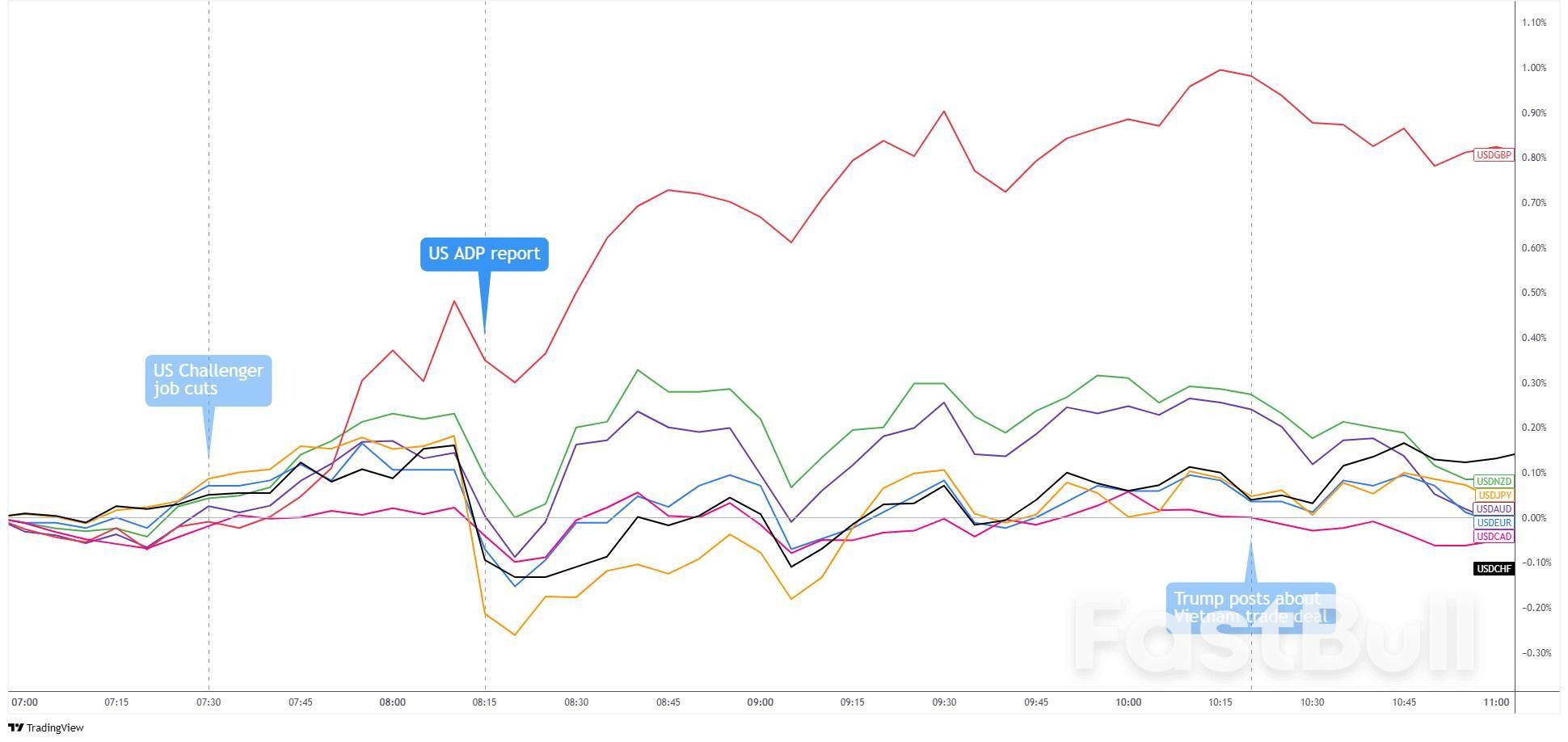
          Overlay of USD vs. Major Currencies Chart by TradingView

          The U.S. dollar had been cruising higher earlier in the session, likely from some profit-taking ahead of Thursday’s jobs report. But that momentum hit a wall when the ADP numbers came in way below expectations.

          The dip didn’t last long, though. USD/JPY and USD/CHF picked up right where they left off after a quick breather, and EUR/USD crept up toward the 1.1700 mark.

          The muted dollar reaction may have been caused by two things. One, ADP has a spotty track record predicting the official NFPs, so traders aren’t exactly scrambling to reposition just yet. And two, even with the ugly headline number, wage growth held steady at 4.4%, which signals the labor market isn’t falling apart just yet.

          With the Fed still on pause and watching how tariffs ripple through inflation, rate cut expectations later in 2025 are keeping a lid on any serious dollar strength for now.

          Source: BabyPips

          Risk Warnings and Disclaimers
          You understand and acknowledge that there is a high degree of risk involved in trading. Following any strategies or investment methods may lead to potential losses. The content on the site is provided by our contributors and analysts for information purposes only. You are solely responsible for determining whether any trading assets, securities, strategy, or any other product is suitable for investing based on your own investment objectives and financial situation.
          Add to Favorites
          Share

          GBPJPY rejects the highs of its range as Traders prepare for the Bank of Japan

          MarketPulse by OANDA Group

          Forex

          Technical Analysis

          Economic

          Markets just saw the released of the FOMC Rate Decision which stayed unchanged.July was a rough month for both the GBP and the JPY which were the worst performing currencies in the Major FX space against the Greenback (which also sparked a market-shaking comeback).The past week however did see the return of some strength for the Yen after observing a lot of bad talk around the Nippon currency– As if bearish positioning for the Yen was at an extreme.Positioning now seems more balanced as players have reduced their positions to prepare for tonight's Bank of Japan Rate Decision.
          No hike is expected but the BoJ tends to surprise markets so always stay ready, this one would shock the Trading World.Markets are expecting a 25 bps rate cut from the upcoming Bank of England meeting on August 7.The meeting will also see the release of the Quarterly Monetary Policy Report which will provide more details on the views from the UK Central Bank amid their ongoing Cut cycle – Cuts are currently priced in for one out of two meetings.

          Taking a look at the GBPJPY Technicals

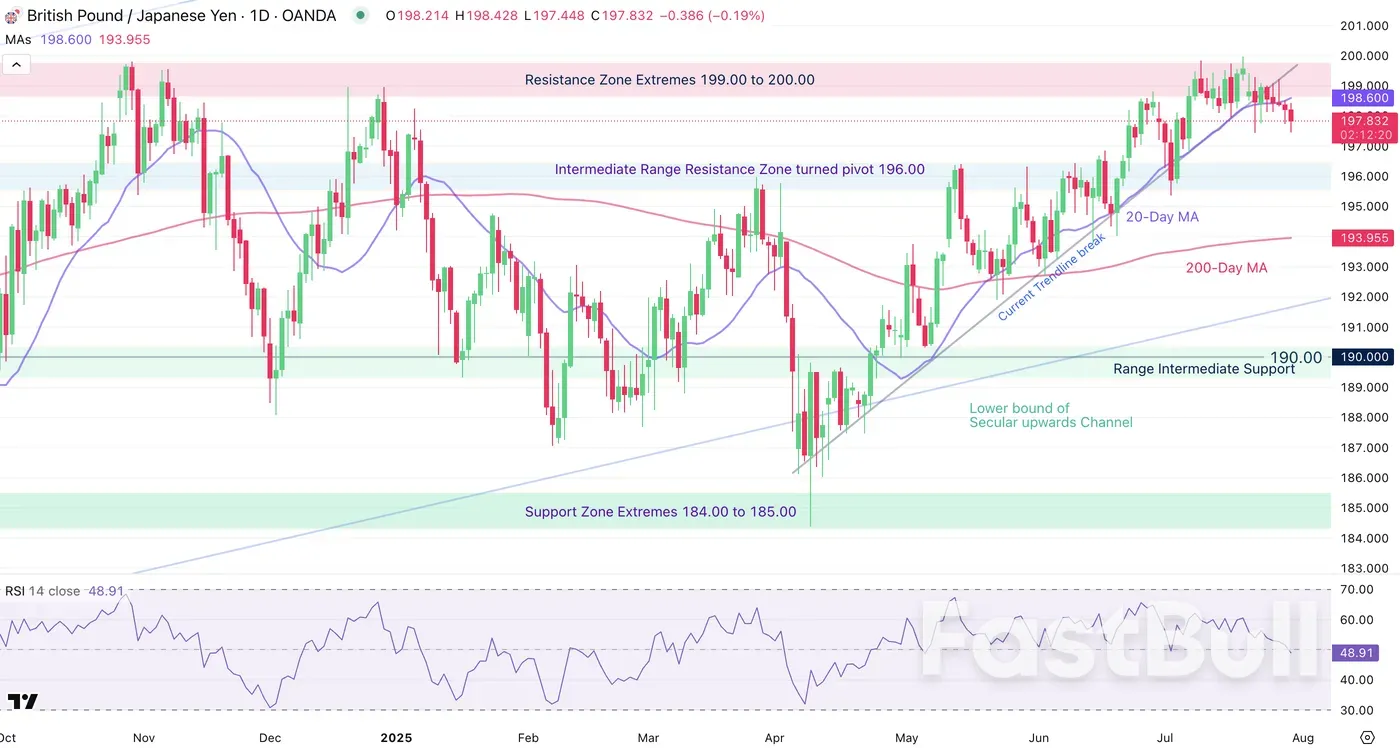
          GBPJPY rejects the highs of its range as Traders prepare for the Bank of Japan_1GBPJPY Daily Chart, July 30, 2025 – Source: TradingView

          The most volatile FX pair has started to show some signs of retraction from its Range Extremes, right after reaching 199.976 (the pair did not breach the 200.00 level).Momentum is actually starting to confirm a potential reversal around here with the RSI going towards bearish (still at a neutral level for now).Expect whipsawing volatility between tonight's BoJ Rate Decision and next week's Bank of England meeting.The most important aspect to spot is actually the confirmation of the range after bulls tried to break higher and saw some consequent sharp reversals.
          Support Levels:
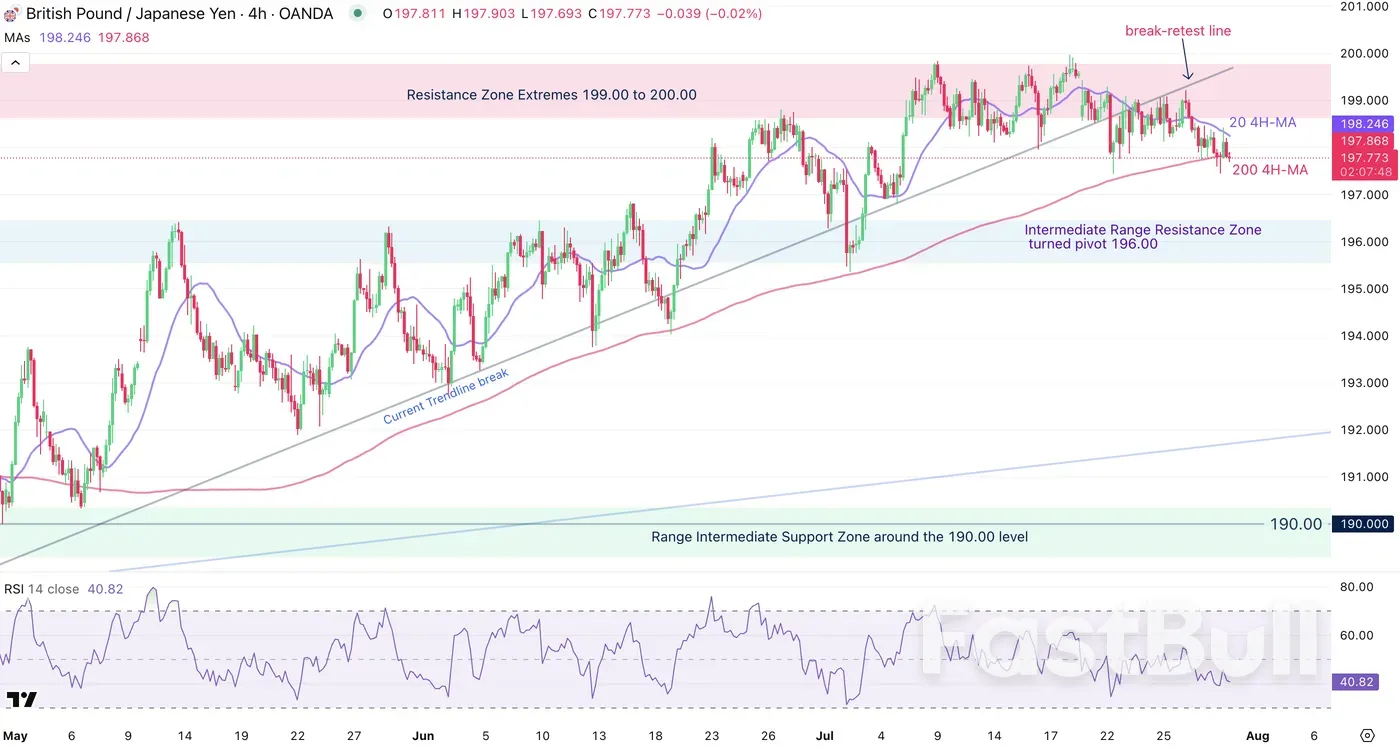
          50 4H-MA 197.75 immediate supportIntermediate Range Resistance Zone turned pivot near 196.00Range Intermediate Support Zone around the 190.00 level
          Resistance Levels:
          Resistance Zone extremes 199.00 to 200.00Weekly highs 199.22020 4H-MA 198.25
          GBPJPY rejects the highs of its range as Traders prepare for the Bank of Japan_2

          GBPJPY 4H Chart, July 30, 2025 – Source: TradingView

          Looking closer to the 4H timeframe, we are spotting a trendline break-retest pattern.This would be a decent sign of reversal if it wasn't for the 4H 200-period MA holding prices – Therefore, keep this one closely in check to get a better idea of the immediate strength for bulls and bears.With the MA 20 also passing as resistance, it will be interesting to see how the action reacts in the waiting of tonight's BoJ Meeting.
          GBPJPY rejects the highs of its range as Traders prepare for the Bank of Japan_3

          GBPJPY 1H Chart, July 30, 2025 – Source: TradingView

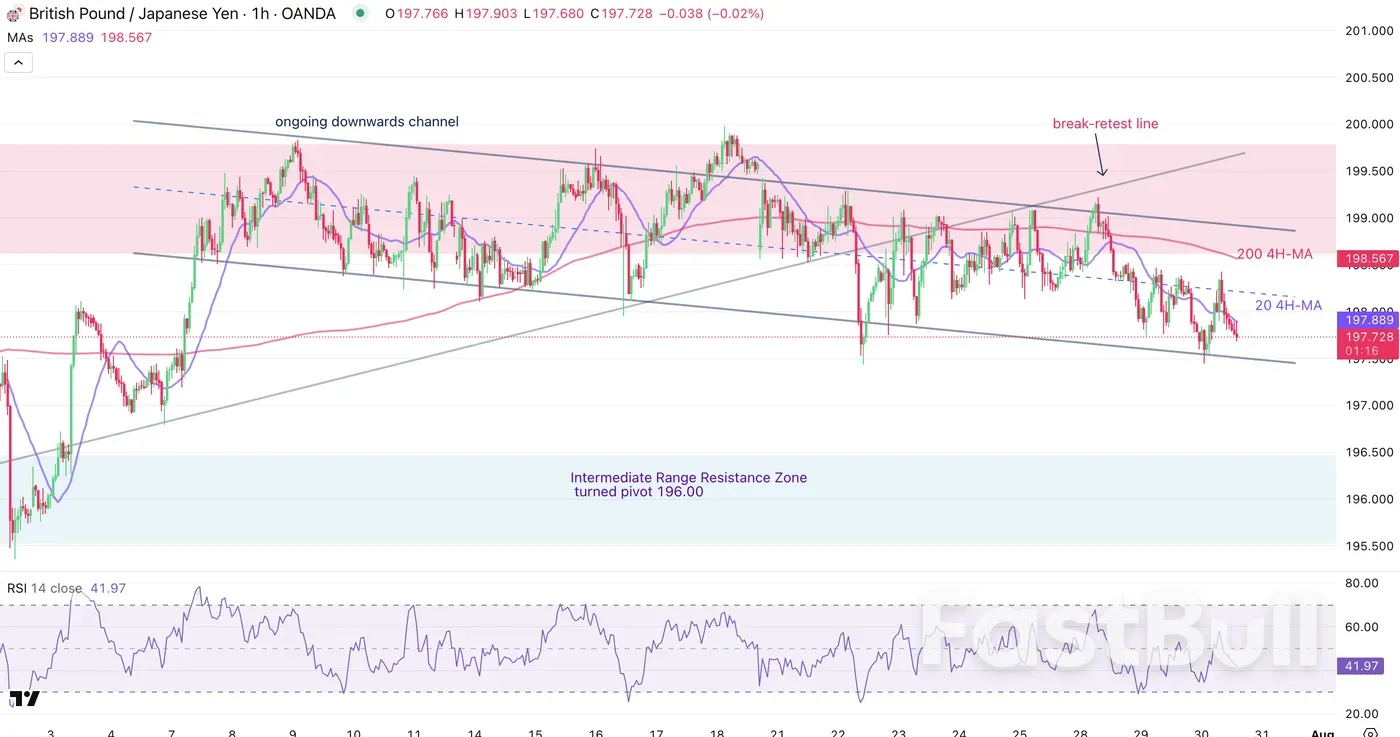
          Looking even closer, we are seeing that the ongoing action is evolving within a downwards channel formed since the July 8th pivot.The lower bound of the Channel is currently below 197.40 to 197.50 and its higher bound is around 198.90 –It would be uncommon to see any major breakout before tonight's BoJ Meeting.The pair will be extremely important to watch as European currencies start to show signs of weakness – Stay ready for the key Rate Decisions coming up soon.

          Source:OANDA

          To stay updated on all economic events of today, please check out our Economic calendar
          Risk Warnings and Disclaimers
          You understand and acknowledge that there is a high degree of risk involved in trading. Following any strategies or investment methods may lead to potential losses. The content on the site is provided by our contributors and analysts for information purposes only. You are solely responsible for determining whether any trading assets, securities, strategy, or any other product is suitable for investing based on your own investment objectives and financial situation.
          Add to Favorites
          Share

          President Trump’s Meeting With Powell Yields Shocking Results, Fed Ready To Lower Rates?

          Henry Thompson

          President Donald Trump’s unexpected visit to the Federal Reserve (FED) headquarters has hinted at a possible shift in the US interest rate policy. During his tour of the central bank’s renovation site with FED Chair Jerome Powell, Trump criticized the rising cost of the project but made it clear that his main concern remains the central bank’s reluctance to lower rates.

          Trump Presses FED Chair Powell For Rate Cut

          On Friday Trump told reporters that he had a productive meeting with Powell, leaving the impression that the FED may be open to cutting rates. According to a Bloomberg report, President Trump and Powell toured the FED’s headquarters renovation project in Washington on July 24, discussing the escalating costs and, more importantly, the direction of US rate cut policy.

          Although Trump voiced concern over the estimated $25 billion renovation price tag, calling it excessive, he used the visit to reiterate his demand for immediate rate cuts, stressing that lower interest rates are essential for economic growth. Despite months of publicly criticizing the FED Chair, Trump’s face-to-face meeting with him ended without the political drama many had anticipated.

          Instead, the rare visit seemed to ease the long-simmering tensions between the two figures, though Trump made clear his expectations of a rate cut remain high. The US President also suggested that he is not currently planning to fire Powell, regardless of ongoing frustrations over interest rates and a controversial renovation project that has drawn scrutiny from the administration.

          Though Powell’s term as Chair ends in May 2026, there’s no indication he plans to step down early. Meanwhile, Trump continues to press for lower rates, stating, “I just want to see one thing happen—interest rates have come down.” He has framed monetary policy as a top concern for his administration moving forward, signaling that pressure on the FED to lower rates is unlikely to quiet down soon.

          Trump Repeats Rate Demands With UK Leader

          Following his recent high-profile visit to the Federal Reserve, Trump escalated his campaign for lower interest rates during a closed-door session with United Kingdom (UK) Prime Minister Keir Starmer. In a pointed critique of Powell, Trump told Starmer and assembled global leaders that US rates must be cut to 1%, describing it as both an economic necessity and a personal frustration with the FED Chair’s leadership.

          He emphasized the potential financial impacts of reduced rates, stating that they should be at least 3% points lower than they are now. He claimed this difference amounts to nearly $1 trillion in potential savings for the US economy, estimating that each percentage point equals approximately $360 billion in reduced costs. By raising this issue in a diplomatic setting, the US President signaled his willingness to challenge central bank policy on a global stage.

          Source: CoinGecko

          Risk Warnings and Disclaimers
          You understand and acknowledge that there is a high degree of risk involved in trading. Following any strategies or investment methods may lead to potential losses. The content on the site is provided by our contributors and analysts for information purposes only. You are solely responsible for determining whether any trading assets, securities, strategy, or any other product is suitable for investing based on your own investment objectives and financial situation.
          Add to Favorites
          Share

          Trump’s Tariffs Threaten To Deepen $248 Billion India Stock Rout

          Samantha Luan

          Stocks

          Political

          Economic

          President Donald Trump said he would impose a 25% levy on Indian goods starting Friday and threatened an additional penalty over the country’s energy purchases from Russia. That’s a steeper hit than the 15% to 20% range applied on several regional peers.India’s stock benchmark has lagged most major global peers this year amid concerns over a slowdown in its economy and corporate earnings. The underperformance has deepened this month as foreign investors have accelerated their withdrawals, turning attention to cheaper or more attractive markets like Hong Kong and South Korea. The value of India’s stock market is down $248 billion since reaching a record on July 2.

          “India is known to be a tough negotiator when it comes to trade, and this time the toughness seems to have effected an undesirable outcome,” said Tomo Kinoshita, global market strategist at Invesco Asset Management. “The 25% tariff should have a moderate negative impact on India’s stock market, especially for export sector stocks.”The MSCI India Index is on track for its weakest month since February. While it has eked out a gain this year, its performance trails the almost 14% jump in MSCI Asia Pacific Index and pales in comparison to the 36% surge in the MSCI Korea Index, which has rallied on optimism surrounding bold reforms under a new president.

          Futures contracts on the local benchmark NSE Nifty 50 Index dropped 0.6% after Trump’s announcement while the iShares MSCI India ETF slid 1.5%. The situation remains fluid, as the US president later said negotiations with India continue and whether or not a trade deal can be reached will be known “at this end of this week.”India’s once-lauded relative insulation from global turmoil is losing its shine. With earnings offering few positive surprises and valuations remaining among the highest in the region, investors are likely to stay cautious in the near term. The MSCI India trades at almost 22 times its one-year forward earnings, well above its long-term average and gauges of Chinese and Korean shares.

          Even as stocks decline, India’s equity capital market is humming. Fundraising from initial public offerings, share placements to large investors and block trades has topped $6 billion for a third straight month. That level of issuance — last seen in late 2024 — coincided with a double-digit correction in local shares.“High valuations and slowing profits are inverting buyer-seller incentives,” said Prateek Parekh, a strategist with Nuvama Institutional Equities. Business founders and private equity investors are on a “selling spree,” while domestic flows are slowing. “Foreign fund flows are now critical.”

          That boost will be key, as foreign investors — who have withdrawn more than $2 billion from local shares this month — weigh whether earnings can justify the rich valuations. The April-June results season so far has done little to ease concerns. Earnings from key technology and financial firms, the two sectors that together make up about 40% of the market’s value, have largely underwhelmed.Yet some believe the tide could still turn. Interest-rate cuts and a pick-up in economic growth could end the “flat-to-weak” positioning of local stocks and lay the foundation for an earnings rebound in the second half of the year through March, according to Emkay Global Financial Services’ strategist Seshadri Sen.

          Rahul Chadha, founder and chief investment officer at New York-based Shikhara Investment Management LP. Chadha, said his fund has raised exposure to Korean stocks in recent months due to benefits including improved corporate governance.“Honestly, 2025 looks challenging for India to close the performance gap,” he added.

          Source: Bloomberg Europe

          To stay updated on all economic events of today, please check out our Economic calendar
          Risk Warnings and Disclaimers
          You understand and acknowledge that there is a high degree of risk involved in trading. Following any strategies or investment methods may lead to potential losses. The content on the site is provided by our contributors and analysts for information purposes only. You are solely responsible for determining whether any trading assets, securities, strategy, or any other product is suitable for investing based on your own investment objectives and financial situation.
          Add to Favorites
          Share

          Fed's Reticence On Rate Cuts Forces Market To Rethink Outlook

          Samantha Luan

          Stocks

          Forex

          Political

          Economic

          The Federal Reserve's decision to avoid signaling imminent rate cuts despite relentless political pressure underscores its prevailing caution and has forced investors to dial back expectations for an easing at the next policy meeting.

          The Federal Open Market Committee held interest rates on Wednesday in a split decision that gave little indication of when borrowing costs might be lowered. It also drew dissent from two Fed governors, both appointees of President Donald Trump who agree with him that monetary policy is too tight.

          The overnight policy rate controlled by the Fed remains in a 4.25%-4.50% range. The last rate cut was in December and the Fed hiked rates from March 2022 to July 2023 to fight inflation.The lack of a clear signal that the Fed was warming to interest rate cuts as soon as the next meeting in September lifted Treasury yields and the dollar in late trade and turned stocks lower."I think the Fed has pushed out the probability of a rate cut," Sonu Varghese, global macro strategist at Carson Group.

          "They're going to wait for more data, but more data means more time, and more time means rates are going to remain restrictive for a few more months," Varghese said.Fed funds futures traders are pricing in a 46% probability of a rate cut by September, down from about 65% a day ago, according to the CME Group's FedWatch Tool. They are no longer pricing in two full 25 basis point cuts by year-end as they were in recent days.Fed Chair Jerome Powell was careful to keep his options open on monetary policy. "We have made no decisions about September," he said in a press conference. He also noted there was still time to take in a wide range of data before the central bank next met in mid-September.

          "There was some possibility that (Powell) would softly signal that a September rate cut is the base case, and (that it) would only not happen if the data didn't play out in a way that's consistent with that," said David Seif, chief economist for Developed Markets at Nomura in New York."I'd say he did not do that at all."Bond yields climbed on Wednesday as Powell reiterated the economy was showing resilience despite interest rates remaining "modestly restrictive". Benchmark Treasury 10-year yields and two-year yields both rose by about two basis points after those remarks.

          Investor positioning may have amplified the bond market reaction, said Jamie Patton, co-head of global rates at TCW."I think the market had gotten a bit ahead of itself thinking we already had enough data to justify a cut in September," said Patton, who remains bullish on short-term bonds due to expectations of imminent interest rate cuts.Powell has come under intense pressure from the White House to lower interest rates, with President Trump regularly berating him for being too slow to lower borrowing costs.Powell's reticence in guiding when the Fed may start cutting rates will leave investors to parse two more months' worth of inflation and employment data for the timing of policy easing, and put some pressure on small-cap stocks in the near term, investors said.

          The Russell 2000 small-cap index, which had been outperforming the S&P 500 index on the day before Powell took the stage, finished the session down 0.47% against a 0.12% loss for the large-cap benchmark.For the dollar, which has come under intense selling pressure this year, the Fed's relatively hawkish message gave some support, lifting the currency to a two-month high against a basket of peers. The dollar index ended up 1%, leaving it down about 8% for the year."We still envision medium-term weakness for the USD, but in the near-term the risk profile is more two-way," BofA Global Research strategists said in a note.

          Higher rates in the U.S. help boost the allure of the dollar relative to other developed market currencies."This patience from the Fed and strength of the U.S. economy coming through is putting a little bit of a pause to that dollar depreciation," Vishal Khanduja, head of broad markets fixed income at Morgan Stanley Investment Management, said.Khanduja, however, warned against reading too much into the market's reaction to the Fed meeting."Overall, I thought they did not change their stance at all," he said.Khanduja expects three to five cuts by the end of next year, though he sees the next two inflation releases as important."They're still going to be wait-and-see, still very convinced that inflation is going to be slightly higher in the next two prints," he said. "But they are still very convinced it's going to be a one-time bump."

          Source: Reuters

          To stay updated on all economic events of today, please check out our Economic calendar
          Risk Warnings and Disclaimers
          You understand and acknowledge that there is a high degree of risk involved in trading. Following any strategies or investment methods may lead to potential losses. The content on the site is provided by our contributors and analysts for information purposes only. You are solely responsible for determining whether any trading assets, securities, strategy, or any other product is suitable for investing based on your own investment objectives and financial situation.
          Add to Favorites
          Share
          FastBull
          Copyright © 2025 FastBull Ltd

          728 RM B 7/F GEE LOK IND BLDG NO 34 HUNG TO RD KWUN TONG KLN HONG KONG

          TelegramInstagramTwitterfacebooklinkedin
          App Store Google Play Google Play
          Products
          Charts

          Chats

          Q&A with Experts
          Screeners
          Economic Calendar
          Data
          Tools
          Membership
          Features
          Function
          Markets
          Copy Trading
          Latest Signals
          Contests
          News
          Analysis
          24/7
          Columns
          Education
          Company
          Careers
          About Us
          Contact Us
          Advertising
          Help Center
          Feedback
          User Agreement
          Privacy Policy
          Business

          White Label

          Data API

          Web Plug-ins

          Poster Maker

          Affiliate Program

          Risk Disclosure

          The risk of loss in trading financial instruments such as stocks, FX, commodities, futures, bonds, ETFs and crypto can be substantial. You may sustain a total loss of the funds that you deposit with your broker. Therefore, you should carefully consider whether such trading is suitable for you in light of your circumstances and financial resources.

          No decision to invest should be made without thoroughly conducting due diligence by yourself or consulting with your financial advisors. Our web content might not suit you since we don't know your financial conditions and investment needs. Our financial information might have latency or contain inaccuracy, so you should be fully responsible for any of your trading and investment decisions. The company will not be responsible for your capital loss.

          Without getting permission from the website, you are not allowed to copy the website's graphics, texts, or trademarks. Intellectual property rights in the content or data incorporated into this website belong to its providers and exchange merchants.

          Not Logged In

          Log in to access more features

          FastBull Membership

          Not yet

          Purchase

          Become a signal provider
          Help Center
          Customer Service
          Dark Mode
          Price Up/Down Colors

          Log In

          Sign Up

          Position
          Layout
          Fullscreen
          Default to Chart
          The chart page opens by default when you visit fastbull.com