• Trade
  • Markets
  • Copy
  • Contests
  • News
  • 24/7
  • Calendar
  • Q&A
  • Chats
Trending
Screeners
SYMBOL
LAST
BID
ASK
HIGH
LOW
NET CHG.
%CHG.
SPREAD
SPX
S&P 500 Index
6878.22
6878.22
6878.22
6895.79
6866.57
+21.10
+ 0.31%
--
DJI
Dow Jones Industrial Average
47995.04
47995.04
47995.04
48133.54
47873.62
+144.11
+ 0.30%
--
IXIC
NASDAQ Composite Index
23584.63
23584.63
23584.63
23680.03
23528.85
+79.50
+ 0.34%
--
USDX
US Dollar Index
98.900
98.980
98.900
99.000
98.740
-0.080
-0.08%
--
EURUSD
Euro / US Dollar
1.16470
1.16478
1.16470
1.16715
1.16408
+0.00025
+ 0.02%
--
GBPUSD
Pound Sterling / US Dollar
1.33377
1.33387
1.33377
1.33622
1.33165
+0.00106
+ 0.08%
--
XAUUSD
Gold / US Dollar
4238.31
4238.72
4238.31
4259.16
4194.54
+31.14
+ 0.74%
--
WTI
Light Sweet Crude Oil
60.079
60.109
60.079
60.236
59.187
+0.696
+ 1.17%
--

Community Accounts

Signal Accounts
--
Profit Accounts
--
Loss Accounts
--
View More

Become a signal provider

Sell trading signals to earn additional income

View More

Guide to Copy Trading

Get started with ease and confidence

View More

Signal Accounts for Members

All Signal Accounts

Best Return
  • Best Return
  • Best P/L
  • Best MDD
Past 1W
  • Past 1W
  • Past 1M
  • Past 1Y

All Contests

  • All
  • Trump Updates
  • Recommend
  • Stocks
  • Cryptocurrencies
  • Central Banks
  • Featured News
Top News Only
Share

Brazil's Real Weakens 1.2% Versus USA Dollar, To 5.37 Per Greenback In Spot Trading

Share

Sources Say The G7 And The EU Are Negotiating To Remove The Cap On Russian Oil Prices

Share

Sources Say The G7 And The EU Are Discussing A Comprehensive Ban On Russia, Prohibiting It From Using Maritime Services To Disrupt Its Oil Exports

Share

Swiss Finance Ministry Says No Final Decision Made, UBS Declines To Comment

Share

The Athens Stock Exchange Composite Index Closed Up 0.67% At 2104.74 Points, Up 1.04% For The Week

Share

ICE New York Cocoa Futures Rise More Than 3% To $5661 Per Metric Ton

Share

Brazil's Benchmark Stock Index Bovespa .Bvsp Hits New All-Time High, Above 165000 Points For The First Time

Share

New York Silver Futures Surged 4.00% To $59.80 Per Ounce On The Day

Share

Spot Silver Touched $59 Per Ounce, A New All-time High, And Has Risen More Than 100% So Far This Year

Share

Spot Gold Touched $4,250 Per Ounce, Up About 1% On The Day

Share

Both WTI And Brent Crude Oil Prices Continued To Rise In The Short Term, With WTI Crude Oil Touching $60 Per Barrel, Up Nearly 1% On The Day, While Brent Crude Oil Is Currently Up About 0.8%

Share

India's SEBI: Sandip Pradhan Takes Charge As Whole Time Member

Share

Spot Silver Rises 3% To $58.84/Oz

Share

The Survey Found That OPEC Oil Production Remained Slightly Above 29 Million Barrels Per Day In November

Share

According To Sources Familiar With The Matter, Japan's SoftBank Group Is In Talks To Acquire Investment Firm Digitalbridge

Share

The S&P 500 Rose 0.5%, The Dow Jones Industrial Average Rose 0.5%, The Nasdaq Composite Rose 0.5%, The NASDAQ 100 Rose 0.8%, And The Semiconductor Index Rose 2.1%

Share

USA Dollar Index Pares Losses After Data, Last Down 0.09% At 98.98

Share

Euro Up 0.02% At $1.1647

Share

Dollar/Yen Up 0.12% At 155.3

Share

Sterling Up 0.14% At $1.3346

TIME
ACT
FCST
PREV
U.K. Halifax House Price Index YoY (SA) (Nov)

A:--

F: --

P: --

France Current Account (Not SA) (Oct)

A:--

F: --

P: --

France Trade Balance (SA) (Oct)

A:--

F: --

P: --

France Industrial Output MoM (SA) (Oct)

A:--

F: --

P: --

Italy Retail Sales MoM (SA) (Oct)

A:--

F: --

P: --

Euro Zone Employment YoY (SA) (Q3)

A:--

F: --

P: --

Euro Zone GDP Final YoY (Q3)

A:--

F: --

P: --

Euro Zone GDP Final QoQ (Q3)

A:--

F: --

P: --

Euro Zone Employment Final QoQ (SA) (Q3)

A:--

F: --

P: --

Euro Zone Employment Final (SA) (Q3)

A:--

F: --

P: --
Brazil PPI MoM (Oct)

A:--

F: --

P: --

Mexico Consumer Confidence Index (Nov)

A:--

F: --

P: --

Canada Unemployment Rate (SA) (Nov)

A:--

F: --

P: --

Canada Labor Force Participation Rate (SA) (Nov)

A:--

F: --

P: --

Canada Employment (SA) (Nov)

A:--

F: --

P: --

Canada Part-Time Employment (SA) (Nov)

A:--

F: --

P: --

Canada Full-time Employment (SA) (Nov)

A:--

F: --

P: --

U.S. Personal Income MoM (Sept)

A:--

F: --

P: --

U.S. PCE Price Index YoY (SA) (Sept)

A:--

F: --

P: --

U.S. PCE Price Index MoM (Sept)

A:--

F: --

P: --

U.S. Personal Outlays MoM (SA) (Sept)

A:--

F: --

P: --

U.S. Core PCE Price Index MoM (Sept)

A:--

F: --

P: --

U.S. Core PCE Price Index YoY (Sept)

A:--

F: --

P: --

U.S. UMich 5-Year-Ahead Inflation Expectations Prelim YoY (Dec)

A:--

F: --

P: --

U.S. Real Personal Consumption Expenditures MoM (Sept)

A:--

F: --

P: --

U.S. 5-10 Year-Ahead Inflation Expectations (Dec)

A:--

F: --

P: --

U.S. UMich Current Economic Conditions Index Prelim (Dec)

A:--

F: --

P: --

U.S. UMich Consumer Sentiment Index Prelim (Dec)

A:--

F: --

P: --

U.S. UMich 1-Year-Ahead Inflation Expectations Prelim (Dec)

A:--

F: --

P: --

U.S. UMich Consumer Expectations Index Prelim (Dec)

A:--

F: --

P: --

U.S. Weekly Total Rig Count

--

F: --

P: --

U.S. Weekly Total Oil Rig Count

--

F: --

P: --

U.S. Consumer Credit (SA) (Oct)

--

F: --

P: --

China, Mainland Foreign Exchange Reserves (Nov)

--

F: --

P: --

China, Mainland Exports YoY (USD) (Nov)

--

F: --

P: --

China, Mainland Imports YoY (CNH) (Nov)

--

F: --

P: --

China, Mainland Imports YoY (USD) (Nov)

--

F: --

P: --

China, Mainland Imports (CNH) (Nov)

--

F: --

P: --

China, Mainland Trade Balance (CNH) (Nov)

--

F: --

P: --

China, Mainland Exports (Nov)

--

F: --

P: --

Japan Wages MoM (Oct)

--

F: --

P: --

Japan Trade Balance (Oct)

--

F: --

P: --

Japan Real GDP QoQ (Q3)

--

F: --

P: --

Japan Nominal GDP Revised QoQ (Q3)

--

F: --

P: --

Japan Trade Balance (Customs Data) (SA) (Oct)

--

F: --

P: --

Japan GDP Annualized QoQ Revised (Q3)

--

F: --

P: --
China, Mainland Exports YoY (CNH) (Nov)

--

F: --

P: --

China, Mainland Trade Balance (USD) (Nov)

--

F: --

P: --

Q&A with Experts
    • All
    • Chatrooms
    • Groups
    • Friends
    Connecting
    .
    .
    .
    Type here...
    Add Symbol or Code

      No matching data

      All
      Trump Updates
      Recommend
      Stocks
      Cryptocurrencies
      Central Banks
      Featured News
      • All
      • Russia-Ukraine Conflict
      • Middle East Flashpoint
      • All
      • Russia-Ukraine Conflict
      • Middle East Flashpoint

      Search
      Products

      Charts Free Forever

      Chats Q&A with Experts
      Screeners Economic Calendar Data Tools
      Membership Features
      Data Warehouse Market Trends Institutional Data Policy Rates Macro

      Market Trends

      Market Sentiment Order Book Forex Correlations

      Top Indicators

      Charts Free Forever
      Markets

      News

      News Analysis 24/7 Columns Education
      From Institutions From Analysts
      Topics Columnists

      Latest Views

      Latest Views

      Trending Topics

      Top Columnists

      Latest Update

      Signals

      Copy Rankings Latest Signals Become a signal provider AI Rating
      Contests
      Brokers

      Overview Brokers Assessment Rankings Regulators News Claims
      Broker listing Forex Brokers Comparison Tool Live Spread Comparison Scam
      Q&A Complaint Scam Alert Videos Tips to Detect Scam
      More

      Business
      Events
      Careers About Us Advertising Help Center

      White Label

      Data API

      Web Plug-ins

      Affiliate Program

      Awards Institution Evaluation IB Seminar Salon Event Exhibition
      Vietnam Thailand Singapore Dubai
      Fans Party Investment Sharing Session
      FastBull Summit BrokersView Expo
      Recent Searches
        Top Searches
          Markets
          News
          Analysis
          User
          24/7
          Economic Calendar
          Education
          Data
          • Names
          • Latest
          • Prev

          View All

          No data

          Scan to Download

          Faster Charts, Chat Faster!

          Download App
          English
          • English
          • Español
          • العربية
          • Bahasa Indonesia
          • Bahasa Melayu
          • Tiếng Việt
          • ภาษาไทย
          • Français
          • Italiano
          • Türkçe
          • Русский язык
          • 简中
          • 繁中
          Open Account
          Search
          Products
          Charts Free Forever
          Markets
          News
          Signals

          Copy Rankings Latest Signals Become a signal provider AI Rating
          Contests
          Brokers

          Overview Brokers Assessment Rankings Regulators News Claims
          Broker listing Forex Brokers Comparison Tool Live Spread Comparison Scam
          Q&A Complaint Scam Alert Videos Tips to Detect Scam
          More

          Business
          Events
          Careers About Us Advertising Help Center

          White Label

          Data API

          Web Plug-ins

          Affiliate Program

          Awards Institution Evaluation IB Seminar Salon Event Exhibition
          Vietnam Thailand Singapore Dubai
          Fans Party Investment Sharing Session
          FastBull Summit BrokersView Expo

          Global Economic Growth Should Remain Stable in 2025

          The Conference Board

          Economic

          Summary:

          The Conference Board's real GDP forecast for the Global Economy was unchanged at 3.1% for 2024 and 3.1% for 2025.

          The Conference Board's real GDP forecast for the Global Economy was unchanged at 3.1% for 2024 and 3.1% for 2025. However, our projections for several major economies have changed over the last month.

          US Growth Prospects Improving

          US economic activity is poised to moderate slightly toward the end of 2024, but not to the degree that we previously forecasted. Recently revised data showed that US real GDP grew at a robust 3.0% quarterly annualized rate in Q2 2024. Additionally, revised data show that consumer spending and income have been growing at a faster pace than previously reported. Healthy consumer spending and a surge in inventory building ahead of the East- and Gulf-Coast port strikes prompted an upgrade to our Q3 2024 real GDP growth estimate.
          Still, we continue to anticipate some growth deceleration in Q4 2024. There may be a slow start to Q4 real GDP growth due to consecutive natural disasters, but the weakness likely will be reversed in coming months as rebuilding efforts take shape. Consumer spending activity is likely to also lose some momentum as the mix between goods and services buying becomes more balanced, and households continue to reallocate spending towards cheaper goods. Nonetheless, real GDP is likely to expand by 2.5% in 2024.
          Quarterly growth prospects should improve in 2025, as interest rates fall, and if businesses continue to retain workers. Lower interest rates will facilitate some revival in the housing market, and more household purchases of durable goods, for which prices are falling. Absent major changes in tax or industrial policies in 2025, household consumption, business investment, and government spending should pick up pace over the course of the year. Still, base effects may cap the annual rate of 2025 real GDP growth at 1.7%.
          Recent data underscore the US labor market’s resilience. September jobs data were much stronger than anticipated and July and August payrolls were revised higher. Furthermore, the unemployment rate fell to 4.1%. Importantly, key inflation gauges continue to slow and are on course to converge on the Fed’s 2-percent target by mid-2025. Against this backdrop, the Fed began cutting interest rates in September 2024 (by 50bp) and we expect the federal funds rate to fall to around 3% by around this time in 2025.

          Europe’s Growth Prospects Soften

          While the Euro Area economy expanded by more than expected in H1 2024, it lost some momentum in H2 as Germany faltered and is likely to fall into a technical recession. Weak German Q2 2024 activity does not appear to be reversing now in the second half of the year. For example, German manufacturing PMIs have sunken deeper into contractionary territory. We expect Q3 2024 GDP growth to be negative following the contraction reported in Q2 2024. Germany’s economy is forecasted to contract by 0.1% in 2024 relative to 2023, but 2025 growth should improve.
          On a more positive note, Euro Area inflation has fallen below the European Central Bank’s (ECB) 2.0% objective. Core inflation remains elevated but is expected to gradually cool as well. Slower inflation and softer regional growth, should prompt continued interest rate cuts by the ECB. Following two rate cuts in March and June, we expect two more rate cuts this year and additional cuts in 2025.

          MENA Growth Downgraded on Regional Strife

          Turmoil in the Middle East is impacting economic activity in the region. There is a great deal of uncertainty in this part of the world. Given that no solution to these disruptive trends appears imminent, we lowered our forecasts for several economies. However, rising energy prices may partially offset some of the geopolitically-induced headwinds to growth for oil producers.

          Risks to Global Growth

          Our global forecast is rooted in key assumptions about prospects for ‘soft landings’ in several large economies around the world, including the United States. Thus far, monetary authorities in these economies have been successful in their work to cool high inflation using restrictive policy without triggering deterioration in GDP growth.
          However, even as key central banks moderate restrictiveness as inflation targets come into sight, downside risks remain. Geopolitical developments in the Middle East are worsening. In the event that strife escalates further and, for instance, impacts energy production or transportation, the economic outlook for the region and the world more broadly could be negatively impacted. Meanwhile, the outcomes of US elections in November also pose risks to the global economic outlook. Depending upon which parties control the executive and congressional branches, there could be major changes in regulations, and tax, trade, and industrial policies having spillover effects on the rest of the world.
          To stay updated on all economic events of today, please check out our Economic calendar
          Risk Warnings and Disclaimers
          You understand and acknowledge that there is a high degree of risk involved in trading. Following any strategies or investment methods may lead to potential losses. The content on the site is provided by our contributors and analysts for information purposes only. You are solely responsible for determining whether any trading assets, securities, strategy, or any other product is suitable for investing based on your own investment objectives and financial situation.
          Add to Favorites
          Share

          Malaysia’s August IPI Rises 4.1%, Propelled by Manufacturing Sector's Growth

          Owen Li

          Economic

          Malaysia’s industrial production index (IPI) increased by 4.1% in August 2024, propelled by the moderate growth in the manufacturing sector, said the Department of Statistics (DOSM).

          “The industrial production index (IPI) moderated to 4.1% in August 2024, as compared to an increase of 5.3% in the preceding month (July),” said chief statistician Datuk Seri Dr Mohd Uzir Mahidin.

          Mohd Uzir said the increase was primarily supported by the expansion of the output in the manufacturing sector at 6.5%, compared to 7.7% in July.

          “This is followed by the positive growth of 4.1% (July 2024: 7.0%) in electricity output.

          “Inversely, the output of the mining sector continued to decline year-on-year (y-o-y) for two consecutive months by recording a 6.4% decline in August 2024, compared to a 5.0% decline in July,” he said in a statement on Friday.

          For a month-on-month (m-o-m) comparison, DOSM said the IPI rebounded to 1.7% in August 2024 after declining by 1.5% in the previous month.

          It added that the increase in manufacturing output in August 2024 was supported by the production in export-oriented industries, which softened to 6.3% growth as against 7.8% recorded in July 2024.

          “The growth was mainly supported by the resilient growth observed in the manufacture of vegetable and animal oils as well as fats, which recorded an increase of 22.6% (July 2024: 21.9%), and the manufacturing of rubber products at 11.1% (July 2024: 10.5%).

          “In addition, the manufacturing of computers, electronics and optical products also contributed to the increase by recording 8.7% growth (July 2024: 5.0%),” it said.

          DOSM added that on a m-o-m comparison, the export-oriented industries improved by 3.0% in August 2024 versus a 3.3% decline in July.

          It also said that the domestic-oriented industries continued to rise by registering 7.1%, slightly slower than the 7.5% increase recorded in the preceding month.

          “This robust performance was largely influenced by a favourable growth in the manufacture of fabricated metal products, except machinery and equipment as well as the manufacture of motor vehicles, trailers and semi-trailers which increased by 10.3% (July 2024: 9.1%) and 7.7% (July 2024: 3.9%), respectively,” it said.

          DOSM also noted that the IPI for several other countries, including Singapore, the US, and Taiwan, experienced higher output growth in August 2024, while China, South Korea, and Vietnam continued to grow but slower than the preceding month.

          “Conversely, Japan and Thailand declined during the month. Cumulatively, throughout the first eight months this year (January–August 2024), the IPI picked up by 4.1% as compared to the same period in 2023, with all sectors posting an expansion, namely the mining index (1.8%), manufacturing index (4.4%) and electricity index (6.7%),” it added.

          Source: The edge markets

          To stay updated on all economic events of today, please check out our Economic calendar
          Risk Warnings and Disclaimers
          You understand and acknowledge that there is a high degree of risk involved in trading. Following any strategies or investment methods may lead to potential losses. The content on the site is provided by our contributors and analysts for information purposes only. You are solely responsible for determining whether any trading assets, securities, strategy, or any other product is suitable for investing based on your own investment objectives and financial situation.
          Add to Favorites
          Share

          Geopolitical Risk and Hurricane Milton Push Oil Prices Toward a Weekly Gain

          Alex

          Commodity

          Crude oil prices have been on a retreat towards the end of the week but still look set to book another weekly gain, supported by the situation in the Middle East and worry about the security of supply.

          In a fresh update, Reuters reported that Gulf states were lobbying with Washington to convince Israel not to target Iranian oil sites on fears that this would prompt retaliatory attacks by Iran-affiliated groups on those Gulf states’ own oil infrastructure.

          “The Iranians have stated: 'If the Gulf states open up their airspace to Israel, that would be an act of war',” a Saudi analyst close to the kingdom’s ruling family told Reuters.

          “The Gulf states aren't letting Israel use their airspace. They won't allow Israeli missiles to pass through, and there's also a hope that they won't strike the oil facilities,” an unnamed source from the Gulf said. The oil kingdoms had made it clear earlier that they would not be taking a side in that war.

          The possibility of such a development has clear bullish implications for the price of oil in the case of an oil-focused escalation, especially in light of Israel’s apparent decision not to consult the U.S. on everything it does on the battlefield and outside it.

          Hurricane Milton also helped push oil prices higher this week after it made landfall in Florida, although it did not wreak the devastation expected from a Category 5 hurricane as it lost a lot of its destructive power before landfall.

          “Investors are evaluating how hurricane damage might impact the U.S. economy and fuel demand,” NS Trading president Hiroyuki Kikukawa told Reuters. “Oil prices are likely to hover around the current 200-day average levels, with the primary concern being whether Israel will retaliate against Iranian oil facilities.”

          Benchmarks added some 3% on Thursday as Israel’s government met to discuss its retaliatory move against Iran. Earlier on Friday, Brent crude was hovering around $80, with West Texas Intermediate above $75 per barrel.

          Source: OILPRICE

          Risk Warnings and Disclaimers
          You understand and acknowledge that there is a high degree of risk involved in trading. Following any strategies or investment methods may lead to potential losses. The content on the site is provided by our contributors and analysts for information purposes only. You are solely responsible for determining whether any trading assets, securities, strategy, or any other product is suitable for investing based on your own investment objectives and financial situation.
          Add to Favorites
          Share

          US Inflation Printed Hotter Than Expected And Contained Some Important Hawkish Details

          Alex

          Economic

          Markets

          US September inflation printed hotter than expected and contained some important hawkish details such as rising food prices and accelerating supercore services inflation (to an annualized 3mMA of around 4%). Several Fed officials including NY’s Williams, Chicago’s Goolsbee and Richmond’s Barkin were not too worried and focused on the broader picture in which inflation is moving in the right direction. Bostic was the odd one out. In an interview with the Wall Street Journal, the Atlanta Fed president said he was comfortable with skipping a meeting if the data say that’s appropriate.

          Coming shortly after a strong ISM, stellar payrolls and yesterday’s CPI, Bostic’s comments briefly sparked an uptick in yields and the dollar. The former finished lower nonetheless, unable to ignore the sharp jump in weekly jobless claims to the highest in more than a year (256k). North Carolina and Florida alone make more than 12k of the net 33k advance from the week before. Both states were hit by hurricane Helene.

          Net daily changes in US yields varied between -6.4 bps (2-yr) to +1.8 bps (30-yr). Underperformance of the long end was way more significant before an excellent 30-yr bond auction called off an intraday yield sprint of almost 7 bps (30-yr). The German yield curve’s shift was similar though much less sizeable (-2.7 bps to +0.6 bps). A fragile risk environment and proper gains in oil (Brent +3.7%) provided a cushion for the dollar. EUR/USD ended slightly lower (1.0934). DXY tested the 103 big figure for the first time since mid-August.

          Today’s economic calendar is a meagre one (Michigan consumer sentiment) and the US has a long weekend coming (Columbus Day on Monday). We don’t expect markets to move much in such an environment. The October US yield rally lost some steam, especially at the front where the 4% mark serves as a difficult-to-break resistance level. The dollar’s recent recovery may therefore ease a little as well. EUR/USD 1.0907 (50% retracement on the April-September EUR/USD rise) serves as first support.

          The financial start of the Q3 earnings season serves as a wildcard. We’d also mention a highly anticipated stimulus announcement of the Chinese finance minister tomorrow. It’s seen as a second chance after the country’s economic planning agency underwhelmed investors on Tuesday. Hopes this time around are for a massive CNY 2tn package.

          News & Views

          “The French economy is holding up, but our public debt is colossal. It would be both cynical and fatal not to see it, say it and recognize it.” And so French Finance Minister Armand yesterday evening unveiled a 2025 budget which delivered a combined €60.6bn in spending cuts (2/3) and tax hikes (1/3) which should reduce the deficit from 6.1% of GDP to 5% next year. The aim is to get below the 3% deficit threshold by 2029, two years after the official EU goal. The debt ratio is projected to hit 114.7 of GDP from 112.9% this year. The government uses 1.1% growth and 1.8% inflation in its calculations. In the proposal, spending cuts zoom in things like medical costs, unemployment and reducing the number of public servants.

          Temporary levies on large companies (revenue > €1bn) should raise around €12bn over the next two years. Company stock buybacks would be subject to an exceptional tax when the shares are canceled. A 20% tax rate floor will be introduced for individuals earning €250k annually or couples earning double the amount to counter tax shelter effects. A controversial measure is delaying the indexation of pensions until July 1. The budget bill will be discussed in parliament starting next week and needs to be adopted by the end 2024. The government’s lack of parliamentary majority makes it extremely vulnerable to obstructions and confidence votes.

          The Bank of Korea lowered its policy rate a first time this morning, from 3.5% to 3.25%, after keeping it level since January 2023. The central bank expects inflation to stabilize at the 2% target level and growth to moderate further. Growth uncertainties increased though due to the delayed recovery in domestic demand. Regarding financial stability, housing prices in the Seoul area and household debt growth are anticipated to gradually slow due to the effects of tightened macroprudential policies.

          The Board will thoroughly assess the trade-offs among variables such as inflation, growth, and financial stability, and carefully determine the pace of further policy rate cuts. Five members want to keep rates steady over the next three months, with one in favor of keeping the door open for a cut. Governor Rhee’s view are not disclosed. The Korean won barely manages to gain ground this morning with USD/KRW holding near recent highs around 1350.

          Graphs

          GE 10y yield

          The ECB cut policy rates by 25 bps in June and in September. Stubborn inflation (core, services) still is a source of concern, but very weak PMI’s and soft comments of Lagarde (and other MPC members) suggest the ECB is likely to step up the pace of easing with an October cut. Spill-overs from strong US data prevented a test of the 2.0% barrier. 2.00-2.35% might serve as a ST consolidation range.

          US 10-y yield

          The Fed kicked off its easing cycle with a 50 bps move. Powell and Co turning the focus from inflation to a potential slowdown in growth/employment made markets consider more 50 bps steps. Strong US September payrolls suggest the economy doesn’t need aggressive Fed support for now, but the debate might resurface as the economic cycle develops. For the US 10-y, 3.60% serves as strong support. The steepening trend is taking a breather.

          EUR/USD

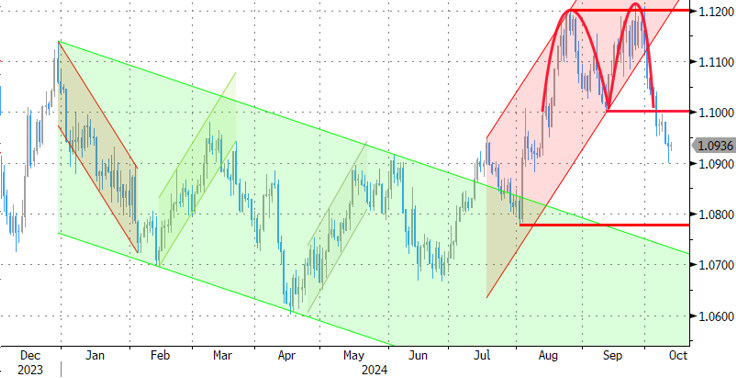
          EUR/USD twice tested the 1.12 big figure as the dollar lost interest rate support at stealth pace. Bets on fast and large rate cuts trumped traditional safe haven flows into USD. An ailing euro(pean economy) partially offset some of the general USD weakness. After solid early October US data, the dollar regained traction, with EUR/USD breaking the 1.1002 neckline. Targets of this pattern are near 1.08.

          EUR/GBP

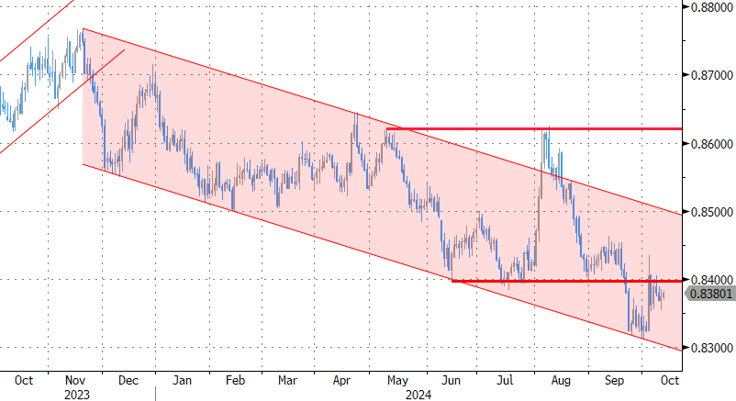
          The BoE delivered a hawkish cut in August. Policy restrictiveness was indicated to be further unwound gradually. The economic picture between the UK and Europe also (temporarily?) diverged to the benefit of sterling, pulling EUR/GBP below 0.84 support. Dovish comments by BoE Bailey ended by default GBP-strength. Uncertainty on the UK budget to be released end this month is becoming an additional headwind for the UK currency.

          Source: ACTIONFOREX

          To stay updated on all economic events of today, please check out our Economic calendar
          Risk Warnings and Disclaimers
          You understand and acknowledge that there is a high degree of risk involved in trading. Following any strategies or investment methods may lead to potential losses. The content on the site is provided by our contributors and analysts for information purposes only. You are solely responsible for determining whether any trading assets, securities, strategy, or any other product is suitable for investing based on your own investment objectives and financial situation.
          Add to Favorites
          Share

          Asian Stocks Mixed as Markets Wait for China Policy Briefing

          Warren Takunda

          Stocks

          Asian stocks were mixed on Friday as Chinese markets declined as investors await a key briefing about the details of the upcoming stimulus plan this weekend.
          U.S. futures rose while oil prices were lower.
          Chinese stocks fell in morning trading on Friday. The Shanghai Composite lost 1.6% to 3,249.14, and the CSI 300 Index, which tracks the top 300 stocks traded in the Shanghai and Shenzhen markets, gave up 1.9%.
          Hong Kong markets were closed Friday for a public holiday. On Tuesday, the index dropped more than 9%, marking its worst loss since the 2008 global financial crisis.
          All market attention was on a briefing China’s Ministry of Finance has scheduled for tomorrow, where it is expected to unveil long-anticipated fiscal stimulus plans. Earlier this week, details of economic stimulus plans from Beijing officials disappointed the markets, as many had hoped that the new fiscal policies would follow the steps of the previous announcements made in late September aimed at reviving the struggling property market and boosting economic growth.
          Elsewhere, South Korea’s central bank cut its benchmark interest rate by 25 basis points to 3.25% on Friday, signaling a shift to an easing cycle intended to stimulate economic growth. This is the Bank of Korea’s first rate cut since 2020, which comes after a contraction in gross domestic product in the second quarter, along with an inflation rate in September that fell below the central bank’s target of 2%.
          The Kospi in Seoul added 0.4% to 2,610.64.
          Australia’s S&P/ASX 200 dipped 0.1% to 8,218.40.
          On Thursday, U.S. stocks edged back from earlier records after reports showed inflation was a touch warmer last month than expected and more workers filed for unemployment benefits last week.
          The S&P 500 slipped 0.2% to 5,780.05, and the Dow Jones Industrial Average dipped 0.1% to 42,454.12 after setting an all-time high the day before. The Nasdaq composite edged down by 0.1% to 18,282.05.
          Stocks had stormed to records in large part on excitement about easing interest rates, now that the Federal Reserve is cutting them as it widens its focus to include keeping the economy humming instead of just fighting high inflation.
          Thursday’s report showed inflation slowing to 2.4% in September from 2.5% in August, according to the consumer price index, but economists were expecting an even sharper slowdown to 2.3%. And after ignoring the swings for food, gasoline and other energy prices, underlying trends that economists say can be a better predictor for where inflation is heading were a touch hotter than expected.
          At the same time, a separate report showed 258,000 U.S. workers filed for unemployment benefits last week. That number is relatively low compared with history, but it was a sharper acceleration than economists expected. Hurricane Helene and a strike by workers at Boeing may have helped make the number look worse.
          In the bond market, Treasury yields rose immediately after the release of the economic data, only to then swing up and down as traders tried to handicap what it would all mean for the Fed.
          The yield on the 10-year Treasury held at 4.07%, the level it was at late Wednesday. The two-year Treasury yield, which more closely tracks expectations for the Fed, fell to 3.96% from 4.02% late Wednesday.
          In other dealings, U.S. benchmark crude oil lost 19 cents to $75.66 per barrel. Brent crude, the international standard, declined 27 cents to $79.13 per barrel.
          The dollar rose to 148.69 Japanese yen from 148.51 yen. The euro cost $1.0942, up from $1.0936.

          Source: AP

          Risk Warnings and Disclaimers
          You understand and acknowledge that there is a high degree of risk involved in trading. Following any strategies or investment methods may lead to potential losses. The content on the site is provided by our contributors and analysts for information purposes only. You are solely responsible for determining whether any trading assets, securities, strategy, or any other product is suitable for investing based on your own investment objectives and financial situation.
          Add to Favorites
          Share

          Jobless Claims Overshadows CPI

          Pepperstone

          Economic

          Where We Stand –

          Well, well, well. We came into Thursday eagerly anticipating the September US CPI report, only for the usually mundane weekly jobless claims data to steal the limelight. It seems that ‘Mr Market’ is having as much trouble balancing employment and inflation as the Fed are!
          The reason for the focus on claims was simple – the data was considerably worse than anyone had expected. Initial claims rose by 258k in the week ending 5th October, the biggest one-week rise since early-April, and well above the top of the forecast range. Continuing claims, for the week ending 28th September, were also worse than expected, at 1.861mln, a 42k increase from the prior figure.
          Thankfully, it is relatively easy to explain away this soft data. Initial claims rose for two reasons – firstly, the impact of Hurricane Helene resulting in a surge in claims in North Carolina, the most heavily impacted state, as well as in others nearby; and, secondly, an almost 10k weekly rise in claims in Michigan, which came by virtue of reduced shifts at auto giant Stellantis.
          That said, there is a natural read-across here to next week’s jobless claims data, which will account for the impact of Hurricane Milton making landfall in Florida. Of note, next week’s initial claims print will coincide with the survey week for the October employment report, including the nonfarm payrolls print, substantially raising downside risks for the next jobs report.
          Put simply, incoming US economic data is about to become very, very messy over the next quarter or so.
          September’s CPI figures, though, mercifully weren’t especially messy, though the figures were marginally hotter than participants had expected. Headline CPI rose by 2.4% YoY last month, still the slowest annual pace since February 2021, while core CPI ticked higher to 3.3% YoY, from a prior 3.2%. On an MoM basis, both headline and core CPI metrics were unchanged from the pace seen in August, at 0.2% and 0.3% respectively.
          On the whole, though, there is relatively little in the data that is likely to dispel the FOMC’s confidence in inflation returning towards the 2% inflation target over the medium-term. As a result, my base case remains that the Committee will deliver 25bp cuts at each of the remaining 2 FOMC meetings this year, with that cadence of cuts likely to continue into 2025 as well, until the fed funds rate returns to a roughly neutral level around 3% next summer.
          Of course, were the labour market to materially weaken, likely defined as unemployment rising north of the 4.4% September SEP year-end forecast, the prospect of larger 50bp cuts remains on the table.
          This, in essence, is the ‘Fed put’, which persists in a forceful and flexible form, and continues to provide participants with confidence to reside further out the risk curve, while also leaving equity dips to remain relatively shallow, and viewed as buying opportunities.
          Atlanta Fed President Bostic did, though, give the market a bit of a jolt late on yesterday, noting his comfort with ‘skipping’ the November meeting, and holding rates steady if the outlook warrants it. While these remarks sent the buck north of the 103 figure, and sparked some selling pressure at the front end, some context is key. These comments come from a man who, as recently as July, thought that the FOMC should wait until December before delivering even a 25bp cut, only to then vote through a 50bp reduction three weeks ago. This flip-flopping serves nobody and nothing well, least of all Bostic’s own reputation.
          Anyway, in terms of markets elsewhere, yesterday, it was a relatively choppy day, with the S&P 500 and Nasdaq 100 both paring knee-jerk declines on the soft jobless data as the session progressed. Crude rallied once more, adding around 3.5%, as markets continue to price an elevated geopolitical risk premium, awaiting the still-elusive Israeli response to last week’s Iranian missile attack.

          Look Ahead –

          A relatively busy end to the week looks to be on the cards, with participants also having to grapple with potential gapping risk over the weekend which, of course, will be a long one in the United States, due to Columbus Day on Monday.
          That gap risk presents itself in two forms, both amid the continued fluid geopolitical situation in the Middle East, and in the form of the scheduled press conference from China’s finance minister on Saturday. The latter is particularly important after Tuesday’s presser saw no fresh fiscal stimulus announced, and subsequently saw substantial selling pressure across the Chinese equity complex. One would imagine that the authorities would seek to avoid a repeat scenario, and at least bring some form of fresh measures to the table.
          As for today’s docket, there’s plenty to get through.
          This morning’s UK GDP figures should show the economy having grown at a monthly clip of 0.2% in August though, as any UK-based readers will know, the dismal weather seen during the summer probably leaves risks to that print tilting to the downside. In any case, HM Treasury are about to kill any economic momentum stone dead, with reports yesterday flagging the potential for capital gains tax to rise as high as 39% in the 30th October Budget.
          Elsewhere, the US brings us September’s PPI report, set to show factory gate prices having risen by 1.6% YoY last month, as well as the latest read on consumer sentiment from the University of Michigan. A couple of Fed speakers are also due this afternoon.
          Meanwhile, the September Canadian labour market report should cement the case for a 50bp BoC cut in a fortnight’s time, with unemployment seen rising to 6.7%, despite the economy being expected to add just shy of 30k net jobs. Markets currently see around a 6-in-10 chance of such a ‘jumbo’ BoC cut.
          Lastly, today marks the ‘proper’ start of third quarter earnings season, with JPMorgan and Wells Fargo set to report before the market open. Overall S&P 500 earnings growth is expected at 4.6% YoY in Q3, which would mark the fifth consecutive quarterly increase.
          To stay updated on all economic events of today, please check out our Economic calendar
          Risk Warnings and Disclaimers
          You understand and acknowledge that there is a high degree of risk involved in trading. Following any strategies or investment methods may lead to potential losses. The content on the site is provided by our contributors and analysts for information purposes only. You are solely responsible for determining whether any trading assets, securities, strategy, or any other product is suitable for investing based on your own investment objectives and financial situation.
          Add to Favorites
          Share

          South Korean Finance Minister Welcomes Central Bank's Rate Cut Decision

          Owen Li

          Economic

          South Korean Finance Minister Choi Sang-mok said Friday he respected and welcomed the central bank's decision to lower interest rates.

          Choi made the comment during a parliamentary audit session into his ministry, which came after the Bank of Korea (BOK) lowered the benchmark rate by a quarter percentage point to 3.25 percent in its first rate cut since August 2021 in an effort to boost economic growth.

          "I respect and welcome the rate reduction decision," Choi said in response to a question by a lawmaker about whether he expected such a decision.

          BOK conducts 1st policy pivot in over 3 yrs amid moderating inflation, cooling property

          The presidential office and the ruling party have voiced expectations for the central bank's pivot to support domestic demand and economic growth despite concerns about rising home prices in Seoul and the surrounding regions that would push up household debts further.

          During a local debate session last month, Choi said that he thinks "as the deputy prime minister for economic affairs that we need to put greater priority on how to recover weak domestic demand (than on household debt issues) in a shorter term."

          The BOK delivered seven consecutive rate hikes from April 2022 to January 2023 and had kept the rate at 3.5 percent, the highest level in about 16 years, and Gov. Rhee Chang-yong recently pointed to surging household debts and rising home prices as major factors for a possible pivot.

          Source: Koreatimes

          To stay updated on all economic events of today, please check out our Economic calendar
          Risk Warnings and Disclaimers
          You understand and acknowledge that there is a high degree of risk involved in trading. Following any strategies or investment methods may lead to potential losses. The content on the site is provided by our contributors and analysts for information purposes only. You are solely responsible for determining whether any trading assets, securities, strategy, or any other product is suitable for investing based on your own investment objectives and financial situation.
          Add to Favorites
          Share
          FastBull
          Copyright © 2025 FastBull Ltd

          728 RM B 7/F GEE LOK IND BLDG NO 34 HUNG TO RD KWUN TONG KLN HONG KONG

          TelegramInstagramTwitterfacebooklinkedin
          App Store Google Play Google Play
          Products
          Charts

          Chats

          Q&A with Experts
          Screeners
          Economic Calendar
          Data
          Tools
          Membership
          Features
          Function
          Markets
          Copy Trading
          Latest Signals
          Contests
          News
          Analysis
          24/7
          Columns
          Education
          Company
          Careers
          About Us
          Contact Us
          Advertising
          Help Center
          Feedback
          User Agreement
          Privacy Policy
          Business

          White Label

          Data API

          Web Plug-ins

          Poster Maker

          Affiliate Program

          Risk Disclosure

          The risk of loss in trading financial instruments such as stocks, FX, commodities, futures, bonds, ETFs and crypto can be substantial. You may sustain a total loss of the funds that you deposit with your broker. Therefore, you should carefully consider whether such trading is suitable for you in light of your circumstances and financial resources.

          No decision to invest should be made without thoroughly conducting due diligence by yourself or consulting with your financial advisors. Our web content might not suit you since we don't know your financial conditions and investment needs. Our financial information might have latency or contain inaccuracy, so you should be fully responsible for any of your trading and investment decisions. The company will not be responsible for your capital loss.

          Without getting permission from the website, you are not allowed to copy the website's graphics, texts, or trademarks. Intellectual property rights in the content or data incorporated into this website belong to its providers and exchange merchants.

          Not Logged In

          Log in to access more features

          FastBull Membership

          Not yet

          Purchase

          Become a signal provider
          Help Center
          Customer Service
          Dark Mode
          Price Up/Down Colors

          Log In

          Sign Up

          Position
          Layout
          Fullscreen
          Default to Chart
          The chart page opens by default when you visit fastbull.com