• Trade
  • Markets
  • Copy
  • Contests
  • News
  • 24/7
  • Calendar
  • Q&A
  • Chats
Trending
Screeners
SYMBOL
LAST
BID
ASK
HIGH
LOW
NET CHG.
%CHG.
SPREAD
SPX
S&P 500 Index
6857.13
6857.13
6857.13
6865.94
6827.13
+7.41
+ 0.11%
--
DJI
Dow Jones Industrial Average
47850.93
47850.93
47850.93
48049.72
47692.96
-31.96
-0.07%
--
IXIC
NASDAQ Composite Index
23505.13
23505.13
23505.13
23528.53
23372.33
+51.04
+ 0.22%
--
USDX
US Dollar Index
98.890
98.970
98.890
98.980
98.890
-0.090
-0.09%
--
EURUSD
Euro / US Dollar
1.16537
1.16545
1.16537
1.16555
1.16408
+0.00092
+ 0.08%
--
GBPUSD
Pound Sterling / US Dollar
1.33394
1.33405
1.33394
1.33396
1.33165
+0.00123
+ 0.09%
--
XAUUSD
Gold / US Dollar
4217.60
4218.05
4217.60
4218.25
4194.54
+10.43
+ 0.25%
--
WTI
Light Sweet Crude Oil
59.282
59.319
59.282
59.469
59.187
-0.101
-0.17%
--

Community Accounts

Signal Accounts
--
Profit Accounts
--
Loss Accounts
--
View More

Become a signal provider

Sell trading signals to earn additional income

View More

Guide to Copy Trading

Get started with ease and confidence

View More

Signal Accounts for Members

All Signal Accounts

Best Return
  • Best Return
  • Best P/L
  • Best MDD
Past 1W
  • Past 1W
  • Past 1M
  • Past 1Y

All Contests

  • All
  • Trump Updates
  • Recommend
  • Stocks
  • Cryptocurrencies
  • Central Banks
  • Featured News
Top News Only
Share

India's NIFTY IT Index Last Up 1.3%

Share

India's Nifty 50 Index Rises 0.35%

Share

Israel Sets 2026 Defence Budget At $34 Billion

Share

Russia Says Azov Sea's Port Of Temryuk Damaged In Ukrainian Attack

Share

Israel's Defense Budget For 2026 Will Be 112 Billion Israeli Shekels - Defense Minister Office

Share

One India Rate Panel Member Ram Singh Was Of View That Stance Should Be Changed To 'Accommodative' From 'Neutral' - Monetary Policy Committee Statement

Share

Reserve Bank Of India Chief: Will Continue To Meet Productive Needs Of Economy In Proactive Manner

Share

Reserve Bank Of India Chief: System Level Financial Parameters Of Nbfcs Sound

Share

Reserve Bank Of India Chief: Dollar Rupee Swap To Be For 3 Years, To Be Conducted This Month

Share

India's Nifty Realty Index Extend Gains, Last Up 1.4%

Share

India's Nifty Psu Bank Index Rises 1%

Share

Reserve Bank Of India Chief: Commited To Providing Sufficient Durable Liquidity

Share

Reserve Bank Of India Chief: Transmission Has Been Broad Based Across Sectors, Satisfactory

Share

Reserve Bank Of India Chief: As Of Nov 28, India's Forex Reserves Stood At $686 Billion

Share

Reserve Bank Of India Chief: Healthy Services Exports With Strong Remittances To Keep Cad Modest In This Year

Share

Reserve Bank Of India Chief: CPI Inflation Seen At 0.6% In Q3 Fy26

Share

Reserve Bank Of India Chief: Fy26 CPI Inflation Seen At 2% Versus 2.6% Previously

Share

India's Nifty Realty Index Up 1% After Reserve Bank Of India's Rate Cut

Share

India's Nifty Psu Bank Index Turns Positive, Up 0.43% After Reserve Bank Of India's Rate Cut

Share

Reserve Bank Of India Chief: Merchandise Exports Face Some Headwinds

TIME
ACT
FCST
PREV
Turkey Trade Balance

A:--

F: --

P: --

Germany Construction PMI (SA) (Nov)

A:--

F: --

P: --

Euro Zone IHS Markit Construction PMI (Nov)

A:--

F: --

P: --

Italy IHS Markit Construction PMI (Nov)

A:--

F: --

P: --

U.K. Markit/CIPS Construction PMI (Nov)

A:--

F: --

P: --

France 10-Year OAT Auction Avg. Yield

A:--

F: --

P: --

Euro Zone Retail Sales MoM (Oct)

A:--

F: --

P: --

Euro Zone Retail Sales YoY (Oct)

A:--

F: --

P: --

Brazil GDP YoY (Q3)

A:--

F: --

P: --

U.S. Challenger Job Cuts (Nov)

A:--

F: --

P: --

U.S. Challenger Job Cuts MoM (Nov)

A:--

F: --

P: --

U.S. Challenger Job Cuts YoY (Nov)

A:--

F: --

P: --

U.S. Initial Jobless Claims 4-Week Avg. (SA)

A:--

F: --

P: --

U.S. Weekly Initial Jobless Claims (SA)

A:--

F: --

P: --

U.S. Weekly Continued Jobless Claims (SA)

A:--

F: --

P: --

Canada Ivey PMI (SA) (Nov)

A:--

F: --

P: --

Canada Ivey PMI (Not SA) (Nov)

A:--

F: --

P: --

U.S. Non-Defense Capital Durable Goods Orders Revised MoM (Excl. Aircraft) (SA) (Sept)

A:--

F: --

P: --
U.S. Factory Orders MoM (Excl. Transport) (Sept)

A:--

F: --

P: --

U.S. Factory Orders MoM (Sept)

A:--

F: --

P: --

U.S. Factory Orders MoM (Excl. Defense) (Sept)

A:--

F: --

P: --

U.S. EIA Weekly Natural Gas Stocks Change

A:--

F: --

P: --

Saudi Arabia Crude Oil Production

A:--

F: --

P: --

U.S. Weekly Treasuries Held by Foreign Central Banks

A:--

F: --

P: --

Japan Foreign Exchange Reserves (Nov)

A:--

F: --

P: --

India Repo Rate

A:--

F: --

P: --

India Benchmark Interest Rate

A:--

F: --

P: --

India Reverse Repo Rate

A:--

F: --

P: --

India Cash Reserve Ratio

A:--

F: --

P: --

Japan Leading Indicators Prelim (Oct)

A:--

F: --

P: --

U.K. Halifax House Price Index YoY (SA) (Nov)

--

F: --

P: --

U.K. Halifax House Price Index MoM (SA) (Nov)

--

F: --

P: --

France Current Account (Not SA) (Oct)

--

F: --

P: --

France Trade Balance (SA) (Oct)

--

F: --

P: --

France Industrial Output MoM (SA) (Oct)

--

F: --

P: --

Italy Retail Sales MoM (SA) (Oct)

--

F: --

P: --

Euro Zone Employment YoY (SA) (Q3)

--

F: --

P: --

Euro Zone GDP Final YoY (Q3)

--

F: --

P: --

Euro Zone GDP Final QoQ (Q3)

--

F: --

P: --

Euro Zone Employment Final QoQ (SA) (Q3)

--

F: --

P: --

Euro Zone Employment Final (SA) (Q3)

--

F: --

P: --
Brazil PPI MoM (Oct)

--

F: --

P: --

Mexico Consumer Confidence Index (Nov)

--

F: --

P: --

Canada Unemployment Rate (SA) (Nov)

--

F: --

P: --

Canada Labor Force Participation Rate (SA) (Nov)

--

F: --

P: --

Canada Employment (SA) (Nov)

--

F: --

P: --

Canada Part-Time Employment (SA) (Nov)

--

F: --

P: --

Canada Full-time Employment (SA) (Nov)

--

F: --

P: --

U.S. Dallas Fed PCE Price Index YoY (Sept)

--

F: --

P: --

U.S. PCE Price Index YoY (SA) (Sept)

--

F: --

P: --

U.S. PCE Price Index MoM (Sept)

--

F: --

P: --

U.S. Personal Outlays MoM (SA) (Sept)

--

F: --

P: --

U.S. Core PCE Price Index MoM (Sept)

--

F: --

P: --

U.S. UMich 5-Year-Ahead Inflation Expectations Prelim YoY (Dec)

--

F: --

P: --

U.S. Core PCE Price Index YoY (Sept)

--

F: --

P: --

U.S. 5-10 Year-Ahead Inflation Expectations (Dec)

--

F: --

P: --

U.S. UMich Current Economic Conditions Index Prelim (Dec)

--

F: --

P: --

U.S. UMich Consumer Sentiment Index Prelim (Dec)

--

F: --

P: --

U.S. UMich 1-Year-Ahead Inflation Expectations Prelim (Dec)

--

F: --

P: --

U.S. UMich Consumer Expectations Index Prelim (Dec)

--

F: --

P: --

Q&A with Experts
    • All
    • Chatrooms
    • Groups
    • Friends
    Connecting
    .
    .
    .
    Type here...
    Add Symbol or Code

      No matching data

      All
      Trump Updates
      Recommend
      Stocks
      Cryptocurrencies
      Central Banks
      Featured News
      • All
      • Russia-Ukraine Conflict
      • Middle East Flashpoint
      • All
      • Russia-Ukraine Conflict
      • Middle East Flashpoint

      Search
      Products

      Charts Free Forever

      Chats Q&A with Experts
      Screeners Economic Calendar Data Tools
      Membership Features
      Data Warehouse Market Trends Institutional Data Policy Rates Macro

      Market Trends

      Market Sentiment Order Book Forex Correlations

      Top Indicators

      Charts Free Forever
      Markets

      News

      News Analysis 24/7 Columns Education
      From Institutions From Analysts
      Topics Columnists

      Latest Views

      Latest Views

      Trending Topics

      Top Columnists

      Latest Update

      Signals

      Copy Rankings Latest Signals Become a signal provider AI Rating
      Contests
      Brokers

      Overview Brokers Assessment Rankings Regulators News Claims
      Broker listing Forex Brokers Comparison Tool Live Spread Comparison Scam
      Q&A Complaint Scam Alert Videos Tips to Detect Scam
      More

      Business
      Events
      Careers About Us Advertising Help Center

      White Label

      Data API

      Web Plug-ins

      Affiliate Program

      Awards Institution Evaluation IB Seminar Salon Event Exhibition
      Vietnam Thailand Singapore Dubai
      Fans Party Investment Sharing Session
      FastBull Summit BrokersView Expo
      Recent Searches
        Top Searches
          Markets
          News
          Analysis
          User
          24/7
          Economic Calendar
          Education
          Data
          • Names
          • Latest
          • Prev

          View All

          No data

          Scan to Download

          Faster Charts, Chat Faster!

          Download App
          English
          • English
          • Español
          • العربية
          • Bahasa Indonesia
          • Bahasa Melayu
          • Tiếng Việt
          • ภาษาไทย
          • Français
          • Italiano
          • Türkçe
          • Русский язык
          • 简中
          • 繁中
          Open Account
          Search
          Products
          Charts Free Forever
          Markets
          News
          Signals

          Copy Rankings Latest Signals Become a signal provider AI Rating
          Contests
          Brokers

          Overview Brokers Assessment Rankings Regulators News Claims
          Broker listing Forex Brokers Comparison Tool Live Spread Comparison Scam
          Q&A Complaint Scam Alert Videos Tips to Detect Scam
          More

          Business
          Events
          Careers About Us Advertising Help Center

          White Label

          Data API

          Web Plug-ins

          Affiliate Program

          Awards Institution Evaluation IB Seminar Salon Event Exhibition
          Vietnam Thailand Singapore Dubai
          Fans Party Investment Sharing Session
          FastBull Summit BrokersView Expo

          Fed Split Deepens As Collins Says She Would Hesitate To Support Another Cut

          Census Bureau
          Summary:

          Boston Federal Reserve President Susan Collins, who voted for both of the Fed's policy-rate reductions this year, said on Wednesday she sees a "relatively high bar" for additional easing in the near term, citing worries about elevated inflation.

          Boston Federal Reserve President Susan Collins, who voted for both of the Fed's policy-rate reductions this year, said on Wednesday she sees a "relatively high bar" for additional easing in the near term, citing worries about elevated inflation.

          "Absent evidence of a notable labor market deterioration, I would be hesitant to ease policy further, especially given the limited information on inflation due to the government shutdown," Collins said in remarks prepared for delivery to a bankers conference in Boston.

          "It will likely be appropriate to keep policy rates at the current level for some time to balance the inflation and employment risks in this highly uncertain environment."

          Her remarks underscore the deepening divisions at the Fed and the lack of consensus around another rate cut, challenges Fed Chair Jerome Powell flagged two weeks ago.

          Despite "solid" support for the most recent interest-rate cut, Powell said, another reduction at the Fed's December meeting was "not a foregone conclusion, far from it."

          Collins "has never dissented and has always been aligned with the center of the Committee so this seems significant," wrote III Capital Management's chief economist, Karim Basta. "January may well be more likely than December for the next move as it gives them time to look at more data."

          The U.S. House on Wednesday was poised to vote to end the record-long shutdown, which has delayed the release of key economic data. The White House on Wednesday said October jobs and inflation reports might never be released.

          October's quarter of a percentage point reduction in the policy rate range to 3.75%-4.00% drew two dissents, one from Kansas City Fed chief Jeffrey Schmid, who wanted to leave rates unchanged, and the other from Fed Governor Stephen Miran, who wanted a bigger half-point cut because he feels inflation is falling faster than is widely appreciated.

          Since then a few others of the Fed's 12 voting rate-setters, like Collins on Wednesday, have signaled growing caution on rate cuts. They include St. Louis Fed President Alberto Musalem who worried about policy becoming too easy, and Fed Vice Chair Philip Jefferson who said proceeding slowly is particularly prudent given the lack of official data during the U.S. government shutdown.

          Non-voting rate-setters including Atlanta Fed President Raphael Bostic have also expressed a preference for holding rates steady, given inflation risks, while others such as San Francisco Fed President Mary Daly call for being open-minded.

          On Wednesday, Collins said she views short-term borrowing costs as "mildly restrictive" amid financial conditions that are a tailwind for economic growth. The labor market has clearly softened, she said, but downside risks have not worsened since the summer.

          And while tariffs have pushed up inflation less than expected and their effect may abate in early 2026, she said, she is worried inflation that has run above the Fed's 2% target for nearly five years could remain elevated.

          "It seems prudent to ensure that inflation is durably on a trajectory back to 2% before making any further adjustments to our policy stance," Collins said.

          Source: Investing

          Risk Warnings and Disclaimers
          You understand and acknowledge that there is a high degree of risk involved in trading. Following any strategies or investment methods may lead to potential losses. The content on the site is provided by our contributors and analysts for information purposes only. You are solely responsible for determining whether any trading assets, securities, strategy, or any other product is suitable for investing based on your own investment objectives and financial situation.
          Add to Favorites
          Share

          Trump Administration Signals Tariff Relief on Coffee and Bananas to Combat Food Inflation

          Gerik

          Economic

          Signs of policy adjustment amid inflation concerns

          In recent interviews on Fox News, President Trump and Treasury Secretary Scott Bessent revealed that the administration is preparing to announce tariff reductions on imported products that are not domestically produced, notably coffee and bananas. These hints signal a notable policy adjustment as Trump seeks to defuse criticism over rising living costs, a factor some Republicans blame for recent electoral underperformance.
          Trump acknowledged that American consumers are bearing part of the burden imposed by his sweeping global tariffs, a rare concession that may foreshadow broader recalibrations. He also mentioned the potential rollout of a "tariff dividend," a populist mechanism designed to redistribute tariff revenues to offset higher consumer prices. Though lacking detail, the concept suggests that tariff relief may be accompanied by compensatory fiscal policies aimed at preserving the administration’s protectionist stance while blunting its regressive impact.

          Supreme Court scrutiny and legal constraints on executive power

          The potential rollback comes as Trump’s tariff strategy faces increasing legal uncertainty. A high-profile case before the Supreme Court is examining the constitutional limits of presidential authority to impose unilateral tariffs. In oral arguments, a majority of justices including members from both ideological wings expressed skepticism about the breadth of Trump’s trade powers. Should the court rule against him, the administration may be forced to revise or re-legislate key components of its trade agenda.
          This legal challenge is not merely symbolic. If the court invalidates major portions of the current tariff structure, especially those not clearly authorized by Congress, Trump’s team will need to seek alternative pathways to implement protectionist measures, possibly involving direct negotiations, legislative proposals, or sector-specific deals.

          Broader trade landscape: soybean bottlenecks and bilateral deals

          Meanwhile, international trade dynamics are shifting. Despite a recent thaw in US-China trade tensions, with Beijing agreeing to resume soybean purchases and loosen export restrictions on rare earth metals, market realities are less optimistic. Chinese soybean stockpiles remain high due to months of oversupply, and demand from the livestock feed industry remains sluggish. As a result, any boost in US agricultural exports may be delayed, blunting the economic payoff of the truce.
          Elsewhere, Trump signaled a willingness to reduce tariffs on Indian goods as part of ongoing trade talks, describing the US as being “close” to a deal with New Delhi. At the same time, Switzerland appears poised to finalize an agreement granting its exports a 15% tariff, potentially by the end of the week. These moves indicate a parallel strategy of engaging in tailored bilateral arrangements while simultaneously addressing inflation concerns at home.
          The administration’s consideration of tariff relief on staples like coffee and bananas highlights a strategic pivot at the intersection of political, economic, and legal pressure. With the Supreme Court review looming and domestic inflation posing a political liability, Trump is navigating a complex trade landscape. While still committed to his broader protectionist ethos, the president appears willing to make tactical concessions to maintain electoral competitiveness and stabilize key consumer prices. The coming weeks will be critical as policy announcements, court rulings, and bilateral negotiations converge.

          Source: Yahoo Finance

          To stay updated on all economic events of today, please check out our Economic calendar
          Risk Warnings and Disclaimers
          You understand and acknowledge that there is a high degree of risk involved in trading. Following any strategies or investment methods may lead to potential losses. The content on the site is provided by our contributors and analysts for information purposes only. You are solely responsible for determining whether any trading assets, securities, strategy, or any other product is suitable for investing based on your own investment objectives and financial situation.
          Add to Favorites
          Share

          China Heads For Longest Consumption Slowdown Since Post-Covid

          Samantha Luan

          Forex

          Economic

          China is heading for its longest slowdown in consumption growth since its post-Covid rebound lost steam more than four years ago, underscoring how the government's rhetoric about supporting domestic demand has struggled to match reality.

          Government data due on Friday will likely show retail sales rose 2.8% last month from a year before, the median forecast of economists in a Bloomberg survey shows. That would mark the fifth straight month of deceleration — the longest such streak since 2021, and the weakest gain in more than a year.

          Top government and Communist Party officials regularly state that they're committed to lifting domestic spending — something the US and other major trading partners have also long demanded. Just last month, the party pledged to "significantly" raise the share of consumer spending in the economy over the coming five years.

          To be sure, some of the anticipated October weakness has a technical nature: sales a year ago offer a high base of comparison, and last month had one fewer working day than in 2024.

          Nevertheless, the soft retail number is projected for release alongside other gauges that may similarly stoke concern about slowing economic growth. Industrial production is forecast at a 5.5% gain, versus 6.5% the previous month. The contraction in fixed-asset investment may have deepened to 0.8% for the first 10 months of the year from 0.5% in January-September, with property investment entrenched in double-digit contraction.

          "Economic indicators seem set to slow down in October due to a higher base and the calendar effect as well as weaker momentum," Citigroup Inc. economists including Yu Xiangrong wrote in a note last week.

          October figures for trade published last week showed exports fell for the first time in eight months.

          Still, top authorities may not be convinced further action is needed, given that their full-year growth target of around 5% remains in sight for 2025. The current consensus forecast among economists is for a 4.9% gross domestic product gain for the year.

          Signs of a moderation in consumption already emerged when lukewarm travel and spending data were reported for the weeklong National Day holiday at the start of the month.

          The cooling underscores the limits of Beijing's approach to spurring household consumption through limited subsidies for specific goods, rather than adopting a broader set of reforms to boost household purchasing power.

          Other areas of the economy offer a mixed picture. Capital spending in high-technology sectors has been a big focus of policymakers. But more traditional infrastructure investment — the main tool the government uses to shore up the economy during down-cycles — has lost traction as Beijing tightens controls on local authorities in order to contain debt risks. And the years-long property slump is also getting worse, not better.

          The government has since the end of September added a combined 1 trillion yuan ($141 billion) in stimulus to bolster investment and beef up local finances. But it may take some time for that funding to trickle through the economy.

          As for monetary stimulus, that may not be immediately forthcoming. Some economists have pushed back their forecasts for another cut in the benchmark interest rate after the People's Bank of China on Tuesday hinted at a less dovish stance by downplaying concerns over slowing loan growth.

          On the plus side, a truce to the trade war with the US and a global investment binge in artificial intelligence are mitigating concerns over China's export outlook.

          "External demand could exceed expectation again on accelerating global growth and China's manufacturing competitiveness," Macquarie Group economists including Larry Hu wrote in a report Tuesday. The team called exports "the biggest surprise" this year, and noted the consensus projection for that growth next year is 1%.

          If that pans out, China's bifurcated economic pattern may continue next year, "as robust external demand reduces the urgency of boosting domestic demand," they said.

          Source: Bloomberg Europe

          To stay updated on all economic events of today, please check out our Economic calendar
          Risk Warnings and Disclaimers
          You understand and acknowledge that there is a high degree of risk involved in trading. Following any strategies or investment methods may lead to potential losses. The content on the site is provided by our contributors and analysts for information purposes only. You are solely responsible for determining whether any trading assets, securities, strategy, or any other product is suitable for investing based on your own investment objectives and financial situation.
          Add to Favorites
          Share

          New Zealand Citizens Depart In Record Numbers As Economy Stalls

          Winkelmann

          Forex

          Economic

          New Zealand saw a record number of citizens depart in the 12 months through September as a sluggish economy forces more people to look offshore for better paying jobs.

          Some 72,684 citizens departed the country in the period, Statistics New Zealand said Thursday in Wellington. There were 26,318 returning citizens, resulting in a net exodus of 46,366. Arrivals of foreign workers saw an annual net immigration gain of 12,434, but that was down from a peak of 135,529 in 2023.

          New Zealand's economy failed to grow in the first half of the year and economists are wary that the expected second-half recovery has been slow to get under way with firms reluctant to hire and unemployment rising. Many citizens have opted to look overseas — particularly to Australia — while foreign workers are also increasingly reluctant to head to New Zealand when work is scarce, resulting in a steady decline in net annual immigration.

          The exodus of citizens has become a pressure point for Prime Minister Christopher Luxon, who argues his center-right government is a better economic manager than the opposition but has yet to convince voters. His party has trailed in recent polls and an election is due in late 2026.

          About 58% of all citizen departures were to Australia, the statistics agency said today, citing data for the year ended March that is the most recent available.

          Source: Bloomberg Europe

          To stay updated on all economic events of today, please check out our Economic calendar
          Risk Warnings and Disclaimers
          You understand and acknowledge that there is a high degree of risk involved in trading. Following any strategies or investment methods may lead to potential losses. The content on the site is provided by our contributors and analysts for information purposes only. You are solely responsible for determining whether any trading assets, securities, strategy, or any other product is suitable for investing based on your own investment objectives and financial situation.
          Add to Favorites
          Share

          Government Shutdown: House Clears Procedural Hurdle To Vote On Funding Bill

          Henry Thompson

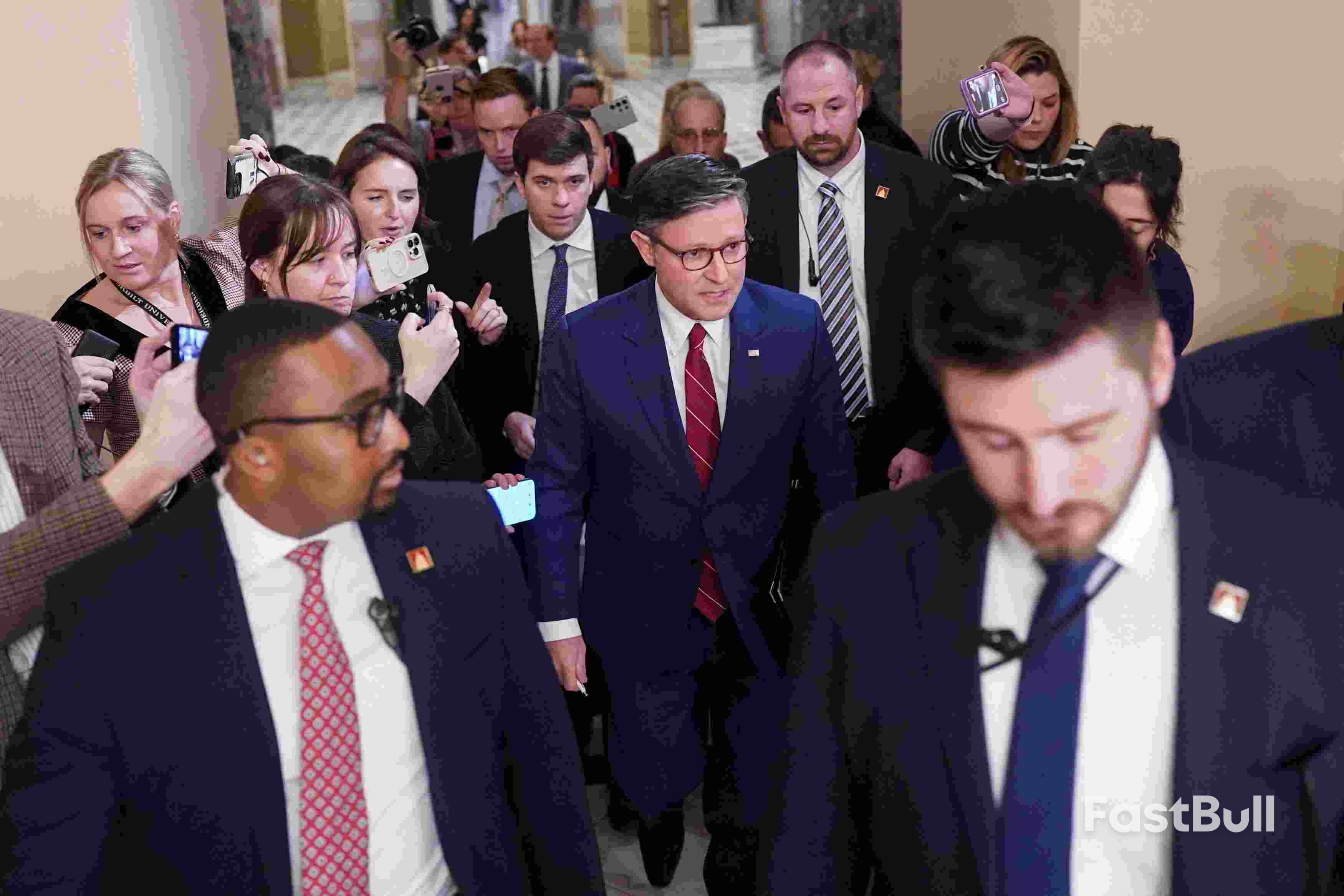
          U.S. Speaker of the House Mike Johnson (R-LA) walks surrounded by the media, as members of the U.S. House of Representatives returned to Washington after a 53-day break, for a vote that could bring the longest U.S. government shutdown in history to a close, on Capitol Hill in Washington, D.C., U.S., Nov. 12, 2025.

          The House of Representatives headed toward a vote on Wednesday night to end the longest U.S. government shutdown in history.

          The House cleared a procedural hurdle required before the vote could begin on a short-term funding bill that would reopen the government until at least the end of January.

          President Donald Trump has said he would sign the bill.

          The final vote to secure passage of the bill is expected to occur between 7 and 7:30 p.m. ET.

          The vote comes two days after the Senate passed the bill, after the Republican majority in that chamber reached a deal with eight members of the Democratic caucus to end a stalemate that led to the shutdown on Oct. 1.

          Most Democratic senators refused to vote for the bill because it did not extend enhanced tax credits for millions of Americans who purchase health insurance coverage on Affordable Care Act marketplaces.

          Under the Senate deal, Republicans agreed to allow Democrats a vote in December on a bill of their choice to extend those boosted subsidies, which are due to expire at the end of that month.

          Source: CNBC

          Risk Warnings and Disclaimers
          You understand and acknowledge that there is a high degree of risk involved in trading. Following any strategies or investment methods may lead to potential losses. The content on the site is provided by our contributors and analysts for information purposes only. You are solely responsible for determining whether any trading assets, securities, strategy, or any other product is suitable for investing based on your own investment objectives and financial situation.
          Add to Favorites
          Share

          Institutional Buyers Retreat, Leaving Bitcoin in a Fragile Recovery Phase

          Gerik

          Economic

          Market stagnation following peak enthusiasm

          After a turbulent October, Bitcoin is attempting to recover from a sharp drop that left its market capitalization down by approximately $330 billion. While the digital asset managed to stabilize slightly above $100,000, this level lacks the former support it enjoyed earlier in the year. The biggest shift is the pullback from institutional investors particularly ETF allocators and corporate treasuries who played a critical role in legitimizing and elevating Bitcoin's profile throughout the first half of 2025.
          Throughout much of the year, institutional enthusiasm funneled over $25 billion into Bitcoin ETFs, helping total assets under management approach $169 billion. This influx contributed to a perception of Bitcoin as a credible hedge against inflation, currency devaluation, and geopolitical instability. However, that narrative is no longer sustaining the same momentum, indicating that the previous relationship between capital inflows and price growth has loosened.

          Investor fatigue and portfolio rebalancing pressure

          Markus Thielen of 10X Research emphasizes that many large-scale investors are showing signs of disengagement. The modest year-to-date gain of 10% in Bitcoin pales in comparison to stronger performances in traditional safe havens like gold or high-growth equities like Nvidia. If performance continues to lag, risk managers may begin advising clients to exit their positions, especially as year-end portfolio rebalancing intensifies.
          This is not a hypothetical risk. On-chain activity indicates that long-term holders have already started selling during price strength. Thielen warns that if Bitcoin dips toward $93,000, a crucial support level, it could trigger additional liquidations by investors who suddenly find themselves in loss-making positions, particularly those with weak balance sheets.

          ETF outflows signal waning momentum

          Bloomberg data confirms that spot Bitcoin ETFs have seen net outflows of roughly $2.8 billion in the past month. If momentum does not recover, further divestments may accelerate in the run-up to the U.S. Federal Reserve’s December meeting. This trend highlights a direct relationship between inflows and price growth. According to Citigroup, $1 billion in net inflows typically corresponds to a 4% price increase. Hence, the absence of new capital is likely a key limiting factor in Bitcoin’s price stagnation.
          Citigroup’s quantitative research head, Alex Saunders, observes that Bitcoin whales wallets holding over 1,000 BTC are slowly declining, while the retail investor segment is expanding. This shift in wallet composition suggests a softening in institutional conviction rather than a full-scale market panic.
          Importantly, the decline in whale balances may not indicate widespread liquidation. Large holders often move tokens for operational reasons unrelated to sales. Still, this movement reflects reduced speculative aggression among Bitcoin's most influential investors.

          MicroStrategy's symbolic devaluation

          Perhaps the most striking example of fading institutional conviction is the decline of MicroStrategy’s share premium over its Bitcoin holdings. Once a poster child for the corporate embrace of crypto, the firm’s equity value has recently mirrored the value of its Bitcoin stash, implying that investors no longer value the leverage-driven model previously celebrated.
          Despite the shift in sentiment, analysts from Bitfinex argue that what the market is witnessing is a routine correction rather than a collapse. Their data shows only a 1.5% reduction in holdings by wallets with over 10,000 BTC in October. They frame this as a rebalancing phase consistent with past market cycles rather than a structural breakdown. In their view, reduced ETF demand is a temporary weakness, not a systemic threat.
          As long as there is no broad-based panic, these rebalancing episodes can lay the foundation for the next phase of growth, once liquidity conditions and investor confidence begin to improve again.
          The recent cooling of Bitcoin’s rally underscores how dependent the asset remains on institutional liquidity and sentiment. The current environment reflects a shift from irrational exuberance to cautious positioning, shaped by underwhelming returns and portfolio pressures. Whether Bitcoin stabilizes or breaks lower in the coming weeks will depend heavily on how these institutional dynamics evolve especially around year-end risk management and macro policy signals from the Federal Reserve.

          Source: Yahoo Finance

          To stay updated on all economic events of today, please check out our Economic calendar
          Risk Warnings and Disclaimers
          You understand and acknowledge that there is a high degree of risk involved in trading. Following any strategies or investment methods may lead to potential losses. The content on the site is provided by our contributors and analysts for information purposes only. You are solely responsible for determining whether any trading assets, securities, strategy, or any other product is suitable for investing based on your own investment objectives and financial situation.
          Add to Favorites
          Share

          New World Investors Watch Rivals To Game Out $1.9 Billion Plan

          Justin

          Forex

          Stocks

          Economic

          Bond investors weighing up a crucial exchange offer by one of Hong Kong's biggest property developers face a classic game theory dilemma: their best option depends on what everyone else does.

          New World Development Co., an embattled property company, has given investors an early deadline of Nov. 17 to accept a plan to swap some of its outstanding bonds for up to $1.9 billion of new debt.

          The new bonds will force some investors to book heavy losses but will also offer extra comfort from the cash flows of the company's Victoria Dockside project, a crown jewel. Investors sticking with the old notes will take more risk but could see their bonds zoom higher on a successful debt swap.

          The guessing game is a sign of the uncertain outlook for New World Development, once one of Hong Kong's most successful property companies but now an increasing source of worry for investors and bankers nervous about the city's tottering real estate market.

          New World executives have worked hard over the past two weeks to convince investors the smart move is to accept the offer. Chief Financial Officer Edward Lau has held late-night talks with investors at New World Tower, the company's headquarters in the center of Hong Kong's financial district, according to multiple investors.

          Executives have also held meetings at the Singapore offices of HSBC Holdings Plc, one of the banks working on the deal, investors said.

          One of the lead banks told some investors on Monday they've received strong indications of interest for the swap, without providing any more details, according to an email seen by Bloomberg.

          "Bondholders will lose something but in such a scenario, losing less is winning," said Glen Ho, Asia-Pacific contingency planning and insolvency leader at Deloitte.

          New World didn't respond to a request for comment.

          New World rose to prominence during Hong Kong's long real estate boom but as a city-wide slump has worsened over the past few years, the company has been left more exposed than some of its biggest rivals. In September, New World posted its second year of losses in a row.

          The company has already made major progress on easing debt repayment pressure, agreeing an $11 billion loan refinancing with banks earlier this year. New World's next step relies on the bond funds and high-net-worth individuals holding its perpetual bonds, which offer juicy yields to compensate for the fact that they never mature.

          New World has offered to issue $1.6 billion of perpetuals in exchange for its old notes at a price of 50 cents on the dollar, meaning it could buy back as much as $3.2 billion of outstanding notes. It also plans a $300 million debt swap for its conventional bonds, which will come at a lower haircut.

          The tricky part for investors is figuring out whether other bondholders will go along for the ride. If New World is able to cut $3.2 billion of its perpetual bond obligations in half, the chance of investors in the old notes once again earning coupons would rise — and bond prices may jump in response.

          A successful swap could also reduce hurdles to the company raising equity, a key step in its attempts to reduce its debt burden and reassure investors. The founding Cheng family has been in talks with investors about matching a planned capital injection worth around HK$10 billion ($1.3 billion), although talks have recently stalled on disagreements over how much control the family should give up.

          It wouldn't be a surprise if the bond swap was a step toward a broader debt restructuring at the company, said Zerlina Zeng, head of Asian strategy at research firm CreditSights.

          The new perpetual bonds will be issued by a special purpose company, meaning they will not have a dividend stopper that can force New World to suspend dividend payments on its shares. Coupons on four of its outstanding perpetual bonds were put on hold earlier this year.

          Although investors officially have until Dec. 2 to respond, the better terms they will get by the early-bird deadline on Monday mean most investors are likely to make their decision by then.

          Source: Bloomberg Europe

          To stay updated on all economic events of today, please check out our Economic calendar
          Risk Warnings and Disclaimers
          You understand and acknowledge that there is a high degree of risk involved in trading. Following any strategies or investment methods may lead to potential losses. The content on the site is provided by our contributors and analysts for information purposes only. You are solely responsible for determining whether any trading assets, securities, strategy, or any other product is suitable for investing based on your own investment objectives and financial situation.
          Add to Favorites
          Share
          FastBull
          Copyright © 2025 FastBull Ltd

          728 RM B 7/F GEE LOK IND BLDG NO 34 HUNG TO RD KWUN TONG KLN HONG KONG

          TelegramInstagramTwitterfacebooklinkedin
          App Store Google Play Google Play
          Products
          Charts

          Chats

          Q&A with Experts
          Screeners
          Economic Calendar
          Data
          Tools
          Membership
          Features
          Function
          Markets
          Copy Trading
          Latest Signals
          Contests
          News
          Analysis
          24/7
          Columns
          Education
          Company
          Careers
          About Us
          Contact Us
          Advertising
          Help Center
          Feedback
          User Agreement
          Privacy Policy
          Business

          White Label

          Data API

          Web Plug-ins

          Poster Maker

          Affiliate Program

          Risk Disclosure

          The risk of loss in trading financial instruments such as stocks, FX, commodities, futures, bonds, ETFs and crypto can be substantial. You may sustain a total loss of the funds that you deposit with your broker. Therefore, you should carefully consider whether such trading is suitable for you in light of your circumstances and financial resources.

          No decision to invest should be made without thoroughly conducting due diligence by yourself or consulting with your financial advisors. Our web content might not suit you since we don't know your financial conditions and investment needs. Our financial information might have latency or contain inaccuracy, so you should be fully responsible for any of your trading and investment decisions. The company will not be responsible for your capital loss.

          Without getting permission from the website, you are not allowed to copy the website's graphics, texts, or trademarks. Intellectual property rights in the content or data incorporated into this website belong to its providers and exchange merchants.

          Not Logged In

          Log in to access more features

          FastBull Membership

          Not yet

          Purchase

          Become a signal provider
          Help Center
          Customer Service
          Dark Mode
          Price Up/Down Colors

          Log In

          Sign Up

          Position
          Layout
          Fullscreen
          Default to Chart
          The chart page opens by default when you visit fastbull.com