• Trade
  • Markets
  • Copy
  • Contests
  • News
  • 24/7
  • Calendar
  • Q&A
  • Chats
Trending
Screeners
SYMBOL
LAST
BID
ASK
HIGH
LOW
NET CHG.
%CHG.
SPREAD
SPX
S&P 500 Index
6827.42
6827.42
6827.42
6899.86
6801.80
-73.58
-1.07%
--
DJI
Dow Jones Industrial Average
48458.04
48458.04
48458.04
48886.86
48334.10
-245.98
-0.51%
--
IXIC
NASDAQ Composite Index
23195.16
23195.16
23195.16
23554.89
23094.51
-398.69
-1.69%
--
USDX
US Dollar Index
98.000
98.080
98.000
98.070
97.920
+0.050
+ 0.05%
--
EURUSD
Euro / US Dollar
1.17335
1.17343
1.17335
1.17447
1.17283
-0.00059
-0.05%
--
GBPUSD
Pound Sterling / US Dollar
1.33560
1.33569
1.33560
1.33740
1.33549
-0.00147
-0.11%
--
XAUUSD
Gold / US Dollar
4327.26
4327.71
4327.26
4329.64
4294.68
+27.87
+ 0.65%
--
WTI
Light Sweet Crude Oil
57.547
57.584
57.547
57.601
57.194
+0.314
+ 0.55%
--

Community Accounts

Signal Accounts
--
Profit Accounts
--
Loss Accounts
--
View More

Become a signal provider

Sell trading signals to earn additional income

View More

Guide to Copy Trading

Get started with ease and confidence

View More

Signal Accounts for Members

All Signal Accounts

Best Return
  • Best Return
  • Best P/L
  • Best MDD
Past 1W
  • Past 1W
  • Past 1M
  • Past 1Y

All Contests

  • All
  • Trump Updates
  • Recommend
  • Stocks
  • Cryptocurrencies
  • Central Banks
  • Featured News
Top News Only
Share

Reuters Poll - Bank Of Thailand To Lower Key Policy Rate To 1.00% In Q1 Of 2026, Said A Majority Of Economists

Share

Reuters Poll - Bank Of Thailand To Cut Its Key Interest Rate To 1.25% On December 17, Said 26 Of 27 Economists

Share

Thai Finance Minister: Earlier Stimulus Measures To Shore Up Economy

Share

Thai Finance Minister: Strong Baht Driven By Capital Inflows

Share

Thai Finance Minister: Has Discussed With Central Bank To Handle Baht

Share

India's Nifty Bank Futures Down 0.1% In Pre-Open Trade

Share

India's Nifty 50 Futures Down 0.3% In Pre-Open Trade

Share

India's Nifty 50 Index Down 0.45% In Pre-Open Trade

Share

Indian Rupee Weakens Past 90.55 Versus USA Dollar To All-Time Low

Share

China's Fossil-Fuelled Power Generation Falls 4.2% Year-On-Year In November

Share

Indian Rupee Opens Down 0.1% At 90.5450 Per USA Dollar, Versus 90.4150 Previous Close

Share

Australia Home Minister: Father Involved In Bondi Gun Attack Came To Australia On Student Visa, Son Is An Australian-Born Citizen

Share

Australian Prime Minister Albanese: Stricter Gun Control Laws Will Include Restrictions On The Number Of Guns An Individual Can Own Or License To Use

Share

Australia's Prime Minister Albanese: We Are Considering A Review Of Gun Licenses For Some Time

Share

Australia's Prime Minister Albanese: Government Considering Tougher Gun Laws

Share

China Stats Bureau Spokesperson: Next Year, Adverse Impact Of Protectionism And Unilateralism May Continue

Share

China's Onshore Yuan Strengthens To A High Of 7.0516 Per Dollar, Strongest Level Since Oct 8, 2024

Share

Indonesia's November Refined Tin Exports At 7458.64 Metric Tons

Share

China's National Bureau Of Statistics: In The Next Stage, We Will Continue To Implement The Special Action To Boost Consumption And Focus On Stabilizing Employment And Promoting Income Growth

Share

China Stats Bureau Spokesperson: Household Consumption Capability And Confidence Needs To Be Further Improved

TIME
ACT
FCST
PREV
U.K. Trade Balance (Oct)

A:--

F: --

P: --

France HICP Final MoM (Nov)

A:--

F: --

P: --

China, Mainland Outstanding Loans Growth YoY (Nov)

A:--

F: --

P: --

China, Mainland M2 Money Supply YoY (Nov)

A:--

F: --

P: --

China, Mainland M0 Money Supply YoY (Nov)

A:--

F: --

P: --

China, Mainland M1 Money Supply YoY (Nov)

A:--

F: --

P: --

India CPI YoY (Nov)

A:--

F: --

P: --

India Deposit Gowth YoY

A:--

F: --

P: --

Brazil Services Growth YoY (Oct)

A:--

F: --

P: --

Mexico Industrial Output YoY (Oct)

A:--

F: --

P: --

Russia Trade Balance (Oct)

A:--

F: --

P: --

Philadelphia Fed President Henry Paulson delivers a speech
Canada Building Permits MoM (SA) (Oct)

A:--

F: --

P: --

Canada Wholesale Sales YoY (Oct)

A:--

F: --

P: --

Canada Wholesale Inventory MoM (Oct)

A:--

F: --

P: --

Canada Wholesale Inventory YoY (Oct)

A:--

F: --

P: --

Canada Wholesale Sales MoM (SA) (Oct)

A:--

F: --

P: --

Germany Current Account (Not SA) (Oct)

A:--

F: --

P: --

U.S. Weekly Total Rig Count

A:--

F: --

P: --

U.S. Weekly Total Oil Rig Count

A:--

F: --

P: --

Japan Tankan Small Manufacturing Outlook Index (Q4)

A:--

F: --

P: --

Japan Tankan Large Non-Manufacturing Diffusion Index (Q4)

A:--

F: --

P: --

Japan Tankan Large Non-Manufacturing Outlook Index (Q4)

A:--

F: --

P: --

Japan Tankan Large Manufacturing Outlook Index (Q4)

A:--

F: --

P: --

Japan Tankan Small Manufacturing Diffusion Index (Q4)

A:--

F: --

P: --

Japan Tankan Large Manufacturing Diffusion Index (Q4)

A:--

F: --

P: --

Japan Tankan Large-Enterprise Capital Expenditure YoY (Q4)

A:--

F: --

P: --

U.K. Rightmove House Price Index YoY (Dec)

A:--

F: --

P: --

China, Mainland Industrial Output YoY (YTD) (Nov)

A:--

F: --

P: --

China, Mainland Urban Area Unemployment Rate (Nov)

A:--

F: --

P: --

Saudi Arabia CPI YoY (Nov)

--

F: --

P: --

Euro Zone Industrial Output YoY (Oct)

--

F: --

P: --

Euro Zone Industrial Output MoM (Oct)

--

F: --

P: --

Canada Existing Home Sales MoM (Nov)

--

F: --

P: --

Euro Zone Total Reserve Assets (Nov)

--

F: --

P: --

U.K. Inflation Rate Expectations

--

F: --

P: --

Canada National Economic Confidence Index

--

F: --

P: --

Canada New Housing Starts (Nov)

--

F: --

P: --

U.S. NY Fed Manufacturing Employment Index (Dec)

--

F: --

P: --

U.S. NY Fed Manufacturing Index (Dec)

--

F: --

P: --

Canada Core CPI YoY (Nov)

--

F: --

P: --

Canada Manufacturing Unfilled Orders MoM (Oct)

--

F: --

P: --

U.S. NY Fed Manufacturing Prices Received Index (Dec)

--

F: --

P: --

U.S. NY Fed Manufacturing New Orders Index (Dec)

--

F: --

P: --

Canada Manufacturing New Orders MoM (Oct)

--

F: --

P: --

Canada Core CPI MoM (Nov)

--

F: --

P: --

Canada Trimmed CPI YoY (SA) (Nov)

--

F: --

P: --

Canada Manufacturing Inventory MoM (Oct)

--

F: --

P: --

Canada CPI YoY (Nov)

--

F: --

P: --

Canada CPI MoM (Nov)

--

F: --

P: --

Canada CPI YoY (SA) (Nov)

--

F: --

P: --

Canada Core CPI MoM (SA) (Nov)

--

F: --

P: --

Canada CPI MoM (SA) (Nov)

--

F: --

P: --

Federal Reserve Board Governor Milan delivered a speech
U.S. NAHB Housing Market Index (Dec)

--

F: --

P: --

Australia Composite PMI Prelim (Dec)

--

F: --

P: --

Australia Services PMI Prelim (Dec)

--

F: --

P: --

Australia Manufacturing PMI Prelim (Dec)

--

F: --

P: --

Japan Manufacturing PMI Prelim (SA) (Dec)

--

F: --

P: --

U.K. Unemployment Rate (Nov)

--

F: --

P: --

U.K. 3-Month ILO Unemployment Rate (Oct)

--

F: --

P: --

Q&A with Experts
    • All
    • Chatrooms
    • Groups
    • Friends
    Connecting
    .
    .
    .
    Type here...
    Add Symbol or Code

      No matching data

      All
      Trump Updates
      Recommend
      Stocks
      Cryptocurrencies
      Central Banks
      Featured News
      • All
      • Russia-Ukraine Conflict
      • Middle East Flashpoint
      • All
      • Russia-Ukraine Conflict
      • Middle East Flashpoint

      Search
      Products

      Charts Free Forever

      Chats Q&A with Experts
      Screeners Economic Calendar Data Tools
      Membership Features
      Data Warehouse Market Trends Institutional Data Policy Rates Macro

      Market Trends

      Market Sentiment Order Book Forex Correlations

      Top Indicators

      Charts Free Forever
      Markets

      News

      News Analysis 24/7 Columns Education
      From Institutions From Analysts
      Topics Columnists

      Latest Views

      Latest Views

      Trending Topics

      Top Columnists

      Latest Update

      Signals

      Copy Rankings Latest Signals Become a signal provider AI Rating
      Contests
      Brokers

      Overview Brokers Assessment Rankings Regulators News Claims
      Broker listing Forex Brokers Comparison Tool Live Spread Comparison Scam
      Q&A Complaint Scam Alert Videos Tips to Detect Scam
      More

      Business
      Events
      Careers About Us Advertising Help Center

      White Label

      Data API

      Web Plug-ins

      Affiliate Program

      Awards Institution Evaluation IB Seminar Salon Event Exhibition
      Vietnam Thailand Singapore Dubai
      Fans Party Investment Sharing Session
      FastBull Summit BrokersView Expo
      Recent Searches
        Top Searches
          Markets
          News
          Analysis
          User
          24/7
          Economic Calendar
          Education
          Data
          • Names
          • Latest
          • Prev

          View All

          No data

          Scan to Download

          Faster Charts, Chat Faster!

          Download App
          English
          • English
          • Español
          • العربية
          • Bahasa Indonesia
          • Bahasa Melayu
          • Tiếng Việt
          • ภาษาไทย
          • Français
          • Italiano
          • Türkçe
          • Русский язык
          • 简中
          • 繁中
          Open Account
          Search
          Products
          Charts Free Forever
          Markets
          News
          Signals

          Copy Rankings Latest Signals Become a signal provider AI Rating
          Contests
          Brokers

          Overview Brokers Assessment Rankings Regulators News Claims
          Broker listing Forex Brokers Comparison Tool Live Spread Comparison Scam
          Q&A Complaint Scam Alert Videos Tips to Detect Scam
          More

          Business
          Events
          Careers About Us Advertising Help Center

          White Label

          Data API

          Web Plug-ins

          Affiliate Program

          Awards Institution Evaluation IB Seminar Salon Event Exhibition
          Vietnam Thailand Singapore Dubai
          Fans Party Investment Sharing Session
          FastBull Summit BrokersView Expo

          A Volatile World Warrants EUR Steepeners

          ING

          Economic

          Summary:

          The euro swap curve is still exceptionally flat by historical standards and forwards don’t price any moves from here. With growth holding up, underpriced structural inflation risks and EU spending plan discussions, we see potential for more bear steepening of the 5s10s curve. If recession risks intensify, then we'd see a bull steepening

          The euro swap curve is still exceptionally flat by historical standards and forwards don’t price any moves from here. With growth holding up, underpriced structural inflation risks and EU spending plan discussions, we see potential for more bear steepening of the 5s10s curve. If recession risks intensify, then we'd see a bull steepening

          The euro curve in forwards is still exceptionally flat

          When we look at the steepness of the euro swap curve in forwards, we see exceptionally flat curves compared to historical norms. The 5s10s in spot rates is strongly influenced by rate cut expectations, which are for a large part expressed by rate expectations in the immediate two years. By charting the 5s10s curve in two-year forwards, we implicitly filter for any near-term monetary policy expectations.
          The last time the 5s10s in forwards space was this flat was around 2007, which was when the European Central Bank was hiking rates to address rising inflation. Policy rates were deemed restrictive at this time, flattening the curve. With the ECB currently moving towards a neutral or even supportive monetary policy stance, we would expect more steepening to materialise than so far has occurred.

          Curves are still as flat as during the ECB’s previous hiking cycle

          A Volatile World Warrants EUR Steepeners_1

          Markets are preventing steepening on structural fears

          Curves remain exceptionally flat because markets take a very pessimistic view on the structural outlook of the eurozone. A potential trade war, an actual war, and political uncertainty in France and Germany are all preventing markets from normalising. The 5Y5Y forward inflation swap reflects this pessimism with the risk premium now close to zero, weighing down the 10y swap rate.

          Inflation swaps in line with expectations suggests little risk premium

          A Volatile World Warrants EUR Steepeners_2
          We see two potential scenarios for where the yield curve will steepen from here: 1) a gradual economic recovery with a rebuild of the term risk premium, or 2) through a sharp rise in recession risk triggering a bull steepening. Our baseline is for a gradual recovery and recent data supports this direction. Talks about defence spending and broader EU reforms can help markets grow more convinced of this as the likely path forward. In contrast, if we do see an escalation of geopolitical risks, then the ECB could be quick to resort to more cuts. Inflation is sticky, but below 3%, and any severe risks to growth can therefore trigger a steepening from the front end.
          We don’t believe the current yield curve can be an equilibrium outcome, although curves can remain flat if risks keep lurking but never materialise. The uncertainty would prevent the term premium from rebuilding while the front end of the curve would remain where it is. It’s hard to imagine a flattening move from here given the already stretched positioning. One would have to see inflation risks pick up while the longer-term growth outlook gets challenged at the same time. As such, the balance of risks favours a steepening of the 5s10s from here.
          To stay updated on all economic events of today, please check out our Economic calendar
          Risk Warnings and Disclaimers
          You understand and acknowledge that there is a high degree of risk involved in trading. Following any strategies or investment methods may lead to potential losses. The content on the site is provided by our contributors and analysts for information purposes only. You are solely responsible for determining whether any trading assets, securities, strategy, or any other product is suitable for investing based on your own investment objectives and financial situation.
          Add to Favorites
          Share

          Oil Prices Slip as Tariff Uncertainty Keeps Investors on Edge

          Warren Takunda

          Commodity

          Oil prices fell on Monday as concern about the impact of U.S. import tariffs on global economic growth and fuel demand, as well as rising output from OPEC+ producers, cooled investor appetite for riskier assets.
          Brent crude fell 6 cents to $70.30 a barrel by 0720 GMT after settling up 90 cents on Friday. U.S. West Texas Intermediate crude was at $66.96 a barrel, down 8 cents after closing 68 cents higher in the previous trading session.
          WTI declined for a seventh successive week, the longest losing streak since November 2023, while Brent was down for a third consecutive week after U.S. President Donald Trump imposed then delayed tariffs on its key oil suppliers Canada and Mexico while raising taxes on Chinese goods. China retaliated against the U.S. and Canada with tariffs on agricultural products.
          "Tariff uncertainty is a key driver behind the weakness," ING analysts said in a note, adding that oil price cuts from Saudi Arabia and deflationary signals from China also hurt sentiment.
          IG analyst Tony Sycamore said other factors weighing on oil prices include concerns about U.S. growth, the potential lifting of U.S. sanctions on Russia, and OPEC+ opting to increase output.
          "Nonetheless, with much of the bad news likely factored in, we expect weekly support around $65/$62 to hold firm before a recovery back to $72.00," he said in a client note in reference to the WTI price.
          Oil prices clawed back some loss on Friday after Trump said the U.S. would increase sanctions on Russia if the latter fails to reach a ceasefire with Ukraine.
          The U.S. is also studying ways to ease sanctions on Russia's energy sector if Russia agrees to end its war with Ukraine, two people familiar with the matter told Reuters.
          So we're looking to do a deal with Ukraine with their rare earth.
          Meanwhile, the Organization of the Petroleum Exporting Countries and allies including Russia, collectively known as OPEC+, said it will proceed with oil output hikes from April.
          Russia's Deputy Prime Minister Alexander Novak on Friday said OPEC+ could reverse the decision in the event of market imbalance.
          Adding to supply concerns, Saudi Arabia cut prices for crude grades it sells to Asia for the first time in three months in April.
          Last week, Trump said he wanted to negotiate a deal with OPEC member Iran to prevent the latter seeking nuclear weapons - though Iran has said it is not seeking such weapons.
          Trump is pursuing a "maximum pressure" campaign against Iran under which the U.S. on Saturday rescinded a waiver that allowed Iraq to pay Iran for electricity, a State Department spokesperson said.
          Iran's Supreme Leader Ayatollah Ali Khamenei on Saturday said his country will not be bullied into negotiations.
          Later this week, investors will scour monthly reports from the International Energy Agency and OPEC for demand and supply forecasts.

          Source: Reuters

          Risk Warnings and Disclaimers
          You understand and acknowledge that there is a high degree of risk involved in trading. Following any strategies or investment methods may lead to potential losses. The content on the site is provided by our contributors and analysts for information purposes only. You are solely responsible for determining whether any trading assets, securities, strategy, or any other product is suitable for investing based on your own investment objectives and financial situation.
          Add to Favorites
          Share

          Trump Says US Economy Faces ‘transition,’ Avoids Recession Call

          Justin

          Economic

          President Donald Trump said the US economy faces “a period of transition,” deflecting concerns about the risks of a slowdown as his early focus on tariffs and federal job cuts causes market turmoil.

          Asked on Fox News’ Sunday Morning Futures whether he’s expecting a recession this year, Trump said, “I hate to predict things like that. There is a period of transition, because what we’re doing is very big.”

          While declining to address the question, Trump’s response broadly aligns with his speech to Congress last week and a flurry of recent comments from top administration officials, including Treasury Secretary Scott Bessent. At the core of the Trump team’s argument is the prospect of tax cuts and tariff revenue down the road that officials contend will spur the economy.

          Trump’s on-again, off-again tariff policies have rattled investors, triggering a selloff in technology shares and levels of volatility not seen in years. Bessent said Friday on CNBC that the US economy needs “detox” to wean it off dependence on public spending and bond traders are signaling an increasing risk that the US economy will stall.

          Trump set the tone on March 4 in his address to a joint session of Congress, acknowledging there may be an “adjustment period” as tariffs take effect. “There’ll be a little disturbance, but we’re okay with that,” he said in his speech. “It won’t be much.”

          Last week brought the deepest stock market rout since Trump was reelected four months ago.

          Trump dismissed the idea on March 6 that his latest reversal on tariffs against Mexico and Canada had any influence on investors, saying “I’m not even looking at the stock market” and blaming “globalists who see how rich our country is going to be and they don’t like it.”

          The US stock market has fallen more than 6% since peaking on Feb. 19. Investors have faced seven straight days in which the S&P 500 Index swung at least 1% during the trading session and tech shares such as Nvidia Corp. and Tesla Inc., which led the market higher over the past three months, have taken a beating.

          In his Sunday Morning Futures interview, recorded late last week, Trump defended his approach.

          “We’re bringing wealth back to America,” he said. “That’s a big thing.

          Source: Theedgemarkets

          To stay updated on all economic events of today, please check out our Economic calendar
          Risk Warnings and Disclaimers
          You understand and acknowledge that there is a high degree of risk involved in trading. Following any strategies or investment methods may lead to potential losses. The content on the site is provided by our contributors and analysts for information purposes only. You are solely responsible for determining whether any trading assets, securities, strategy, or any other product is suitable for investing based on your own investment objectives and financial situation.
          Add to Favorites
          Share

          Pound-to-Australian Dollar Week Ahead Forecast: Into a New Range

          Warren Takunda

          Economic

          The Pound-to-Australian Dollar exchange rate (GBPAUD) rose by 1.10% last week as it broke above a major resistance zone, confirming that a new, higher range will likely evolve.
          The confirmed break above resistance at 2.0316 underpins the constructive technical setup in the pair, with a subsequent high being printed at 2.0544, which was the highest level recorded in nine years.
          The new week starts with a pullback from that high, in line with a turn lower in the Relative Strength Index (RSI) to just below 70:
          Pound-to-Australian Dollar Week Ahead Forecast: Into a New Range_1

          Above: GBPAUD at daily intervals.

          This is important, as the RSI was screening as overbought all last week, and the subsequent retreat forms part of a necessary consolidation in the market from overbought conditions.
          Our Week Ahead Forecast model predicts that GBP/AUD will broadly trade within a range between 2.0316 and 2.0544.
          Weakness should be shallow as the overall setup remains constructive, and risks will remain to the upside.
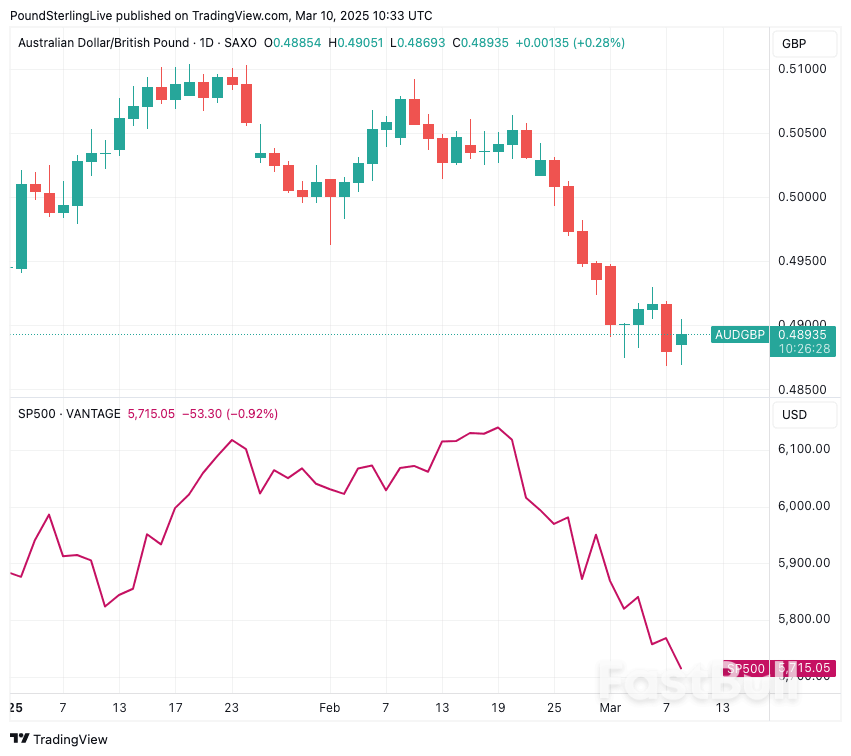
          Australian Dollar losses track the pullback in global investor sentiment and U.S. stock markets over fears that U.S. tariffs pose significant challenges to the world's economy.
          Given the strong correlation, further weakness in U.S. equities should keep AUD under pressure against the Pound:
          Pound-to-Australian Dollar Week Ahead Forecast: Into a New Range_2

          Above: AUDGBP tracks the S&P 500 stock index lower.

          The Australian Dollar fell to new multi-year lows against the GBP and EUR last week after China's foreign minister said his country will continue to retaliate for the "arbitrary tariffs" imposed by the U.S.
          Analysts say the pointed comments by Beijing's most senior foreign affairs official point to a ratcheting up of a trade war that has implications for Australia due to its significant trade linkages with China.
          This week starts with China confirming a host of new tariffs on U.S. imports, with the agricultural sector bearing the brunt of the tariffs.
          Turning to the domestic agenda, Tuesday brings the Westpac-MI Consumer Sentiment reading for March.
          If sentiment rises, it could signal consumer optimism, supporting AUD.
          The NAB Business Survey for February is also due for release, where a stronger-than-expected reading would suggest improving business conditions, potentially supporting AUD.
          A decline could indicate weaker corporate sentiment, raising concerns about slower growth.
          Thursday sees the release of the Melbourne Institute (MI) Inflation Expectations for March, which will give us a signal as to whether Aussie inflation remains too high to entertain a follow-up interest rate cut at the Reserve Bank of Australia anytime soon.
          Turning to the UK, Friday's UK Monthly GDP report will be the data highlight of the coming week.
          "As the first month of the quarter and year, January’s GDP outturn will play a big part in setting the tone for growth expectations for both Q1 and the whole of 2025. We expect January GDP to rise by 0.1% m/m," says Hann-Ju Ho, Senior Economist at Lloyds Bank.
          If GDP beats expectations, the pound will rise into the weekend, as this would confirm that fears of a material slowdown are exaggerated, taking pressure off the Bank of England to cut interest rates.

          Source: Poundsterlinglive

          To stay updated on all economic events of today, please check out our Economic calendar
          Risk Warnings and Disclaimers
          You understand and acknowledge that there is a high degree of risk involved in trading. Following any strategies or investment methods may lead to potential losses. The content on the site is provided by our contributors and analysts for information purposes only. You are solely responsible for determining whether any trading assets, securities, strategy, or any other product is suitable for investing based on your own investment objectives and financial situation.
          Add to Favorites
          Share

          China to Impose Retaliatory Tariffs on Certain Canadian Imports as Trade War Intensifies

          Warren Takunda

          Economic

          China announced on Saturday that it will impose retaliatory tariffs on some Canadian goods, marking a further escalation in the global trade war. Beijing stated that it will impose 100% tariffs on rapeseed oil, oil cakes, and peas, alongside a 25% import levy on aquatic products and pork from Canada, effective 20 March.

          Intensifying China-Canada trade conflicts

          In October, Ottawa slapped a 100% import levy on Chinese electric vehicles and a 25% tariff on steel and aluminum. The Chinese government said in a statement on Saturday: “Canada's measures seriously violate the rules of the World Trade Organization, are typical acts of protectionism, constitute restrictive measures against China, and seriously damage China's legitimate rights and interests.”
          According to the Canadian government, rapeseed (Canola) is the country’s second-largest acreage crop, generating C$13.6 billion (€8.73 billion) in sales in 2023. Canadian canola meal and canola oil exports to China amounted to C$920.9 million (€591.3 million) and C$21 million (€13.5 million) respectively in 2024. Meanwhile, Canada’s pea exports to China reached C$303 million (€194.5 million) in 2024.
          China’s move followed a series of tariff decisions by US President Donald Trump last week, including 25% tariffs on Canada and Mexico while doubling Chinese import levies to 20%. Shortly after, Trump granted a one-month exemption on auto and some agricultural tariffs for Canada and Mexico under USMCA rules, as both countries signalled a willingness to review tariffs on Chinese imports.
          The Canadian Global Affairs said in a statement on Saturday that China’s tariff announcement is “unjustified,” and added: “Canada does not accept the premise of China’s investigation, nor its findings.” The statement indicated that it addresses “China’s non-market policies and practices that artificially lower production costs and distort markets. Canada remains open to engaging in constructive dialogue with Chinese officials to address our respective trade concerns.”

          China’s inflation turns negative

          According to data released over the weekend, Consumer prices in China fell 0.7% year on year in February, turning negative for the first time in 13 months, highlighting ongoing sluggish consumer demands. At the government's annual meeting last week, Beijing set the gross domestic product (GDP) growth target at 5% for 2025 and announced additional stimulus measures to bolster the economy. However, the 5% growth target could be challenging for the world’s second-largest economy, given ongoing weak domestic demands and intensifying trade tensions with the US and other countries.
          China outlined trillions-of-Chinese-Yuan’s stimulus package to support its economic growth as Beijing pledged to adopt a “proactive fiscal policy and a more moderately loose monetary policy” in December last year. The Chinese government also lowered its inflation target to 2%-the lowest in more than two decades-while raising the deficit level to a three-decade high of 4% GDP.

          Chinese stock markets and the Chinese Yuan slip

          On Monday, both the Chinese Yuan and the Chinese stock markets slumped amid intensifying trade tensions and disappointing inflation data. The Chinese Yuan fell 0.22% against the US dollar and the Hang Seng Index slipped 1.7% at 4 am CET. However, both the Yuan and the Chinese stock markets have been rallying this year, partly driven by the launch of DeepSeek’s AI model in January, a Chinese startup aiming to compete with leading US AI models.

          Source: Euronews

          To stay updated on all economic events of today, please check out our Economic calendar
          Risk Warnings and Disclaimers
          You understand and acknowledge that there is a high degree of risk involved in trading. Following any strategies or investment methods may lead to potential losses. The content on the site is provided by our contributors and analysts for information purposes only. You are solely responsible for determining whether any trading assets, securities, strategy, or any other product is suitable for investing based on your own investment objectives and financial situation.
          Add to Favorites
          Share

          Pound-to-Dollar Week Ahead Forecast: Catching Breath

          Warren Takunda

          Economic

          The Pound-to-Dollar exchange rate (GBPUSD) rose 2.66% last week, which is the biggest weekly advance since November 2022, amidst a widespread selloff in the Dollar.
          The gain saw GBPUSD slice through the 200-day exponential moving average (EMA) at 1.2688 (see blue line in chart), which officially shifts the exchange rate from a downtrend into an uptrend, according to our Week Ahead Forecast rulebook.
          Further upside is therefore preferred over the coming weeks.
          However, the rally has been rapid and leaves GBP/USD overbought on a technical basis, and the prospect of a setback and consolidation in the coming hours and days is elevated.
          "GBP/USD has benefited greatly from the broad USD-selloff across the board since the start of March to hit its highest level in almost three months. As a result, the pair has moved very close to our estimate of short-term FX fair value," says Valentin Marinov, chief FX strategist at Crédit Agricole.
          On the daily chart, the Relative Strength Index (RSI) is at 71, which means it has breached 70, which is the level at which an exchange rate becomes overbought.
          Pound-to-Dollar Week Ahead Forecast: Catching Breath_1

          Above: GBPUSD at daily intervals with the RSI (lower panel) and Fibonacci retracement levels shown.

          The RSI is mean-reverting by nature, meaning a slide below 70 is highly likely. For this to happen, GBPUSD must either consolidate or retreat.
          Note, too, that the GBPUSD could also be inclined to consolidate at the 61.8% Fibonacci retracement of the September-January selloff, which is at 1.2926.
          A look at the chart also shows how the previous major retracement lines (38.2% and 23.6%) attracted consolidative action.
          Taken together, we are looking for a range to establish between 1.2874 and 1.2985 in the week ahead.
          Turning to the data docket, U.S. CPI inflation for February will be the highlight of the coming week.
          If the data undershoots expectations, investors will anticipate further rate cuts at the Federal Reserve in 2025. The market recently raised its expectations to three cuts for the year, whereas in early February, only one cut was expected.
          This readjustment has provided the main impetus behind the Dollar's recent selloff. However, it will be hard to see this trend continuing if inflation data proves stuck at elevated levels.
          Headline inflation is forecast to drop to 2.9% in February due to lower energy prices, partially offset by higher food prices. Core inflation is forecast to fall to 3.2%.
          The potential for upside surprises is elevated, however. In January, both headline and core inflation increased compared to December. While some of this rise can be attributed to seasonal adjustment issues, persistent inflationary pressures also played a role.
          Pound-to-Dollar Week Ahead Forecast: Catching Breath_2
          Fears over looking tariffs and the general policy uncertainty surrounding Donald Trump also hint at upside surprises.
          Tariffs are supposed to be an all-out positive for the Dollar, but last week, we saw this expectation upended as the Dollar fell in response to Trump's confirmation that tariffs would be placed on Canada and Mexico.
          Trump will almost certainly stir the pot with further ad-hoc tariff announcements and threats in the coming days, but we wonder if these would be viewed as negative developments for the Dollar.
          "Investors are clearly questioning whether the US economy is being steered by a sound financial strategy or by impulsive political manoeuvring. Markets thrive on stability and predictability—two qualities that are in short supply under an erratic approach to global trade," says Dr. Claudio Wewel, FX Strategist at J. Safra Sarasin.

          Source: Poundsterlinglive

          To stay updated on all economic events of today, please check out our Economic calendar
          Risk Warnings and Disclaimers
          You understand and acknowledge that there is a high degree of risk involved in trading. Following any strategies or investment methods may lead to potential losses. The content on the site is provided by our contributors and analysts for information purposes only. You are solely responsible for determining whether any trading assets, securities, strategy, or any other product is suitable for investing based on your own investment objectives and financial situation.
          Add to Favorites
          Share

          Stock Market Today: Asian Stocks Are Mixed as Week Starts With Uncertainty Over Tariffs

          Warren Takunda

          Stocks

          Asian stocks got a mixed start to trading Monday as uncertainty persisted over what President Donald Trump will do with tariffs.
          U.S. futures were lower and oil prices also fell.
          Shares in China led losses in Asia, with Hong Kong’s Hang Seng index down 1.8% at 23,800.44. The Shanghai Composite index shed 0.2% to 3,366.16.
          In the latest sign of weakness for the world’s second-largest economy, consumer prices fell in China in February for the first time in 13 months, as persistent weak demand was compounded by the early timing of the Lunar New Year holiday.
          In Tokyo, the Nikkei 225 gained 0.4% to 37,028.27. Japan’s trade minister, Yoji Muto, was visiting Washington for talks on ways to avert higher U.S. tariffs on Japanese exports of steel, aluminum, and automobiles.
          “Taking into account the voices we have heard from the industrial sector, we would like to hold discussions that will be a win-win for both Japan and the U.S.,” Muto told reporters late last week.
          U.S. Commerce Secretary Howard Lutnick said on NBC’s “Meet the Press” that 25% tariffs on steel and aluminum imports will take effect Wednesday.
          Elsewhere in the region, Australia’s S&P/ASX 200 was up 0.2% at 7,962.30, while the Kospi in South Korea gained 0.3% to 2,570.39.
          Taiwan’s Taiex lost 0.5% and the Sensex in India gained 0.3%. Bangkok’s SET slipped 1.1%.
          On Friday, Wall Street rose after a wild ending to a brutal week of scary swings dominated by worries about the U.S. economy and uncertainty about what President Donald Trump will do with tariffs.
          The S&P 500 climbed 0.6% to 5,770.20 after storming back from an earlier loss that had reached 1.3%. It was coming off a punishing stretch where it swung more than 1%, up or down, for six straight days.
          The Dow Jones Industrial Average added 0.5% to 42,801.72, and the Nasdaq composite rose 0.7% to 18,196.22. Last week was the worst for the S&P 500 since September and left the index a little more than 6% below its all-time high set last month.
          The head of the Federal Reserve helped ease the market’s worries on Friday afternoon after saying he thinks the economy looks stable at the moment, and he doesn’t feel pressure to cut interest rates in order to prop it up.
          “The costs of being cautious are very, very low” right now, Powell said about holding steady on interest rates. “The economy is fine. It doesn’t need us to do anything really. We can wait, and we should wait.”
          U.S. Labor Department said Friday that U.S. employers added 151,000 more jobs last month than they cut. That was slightly below economists’ expectations, but it was an acceleration from January’s hiring.
          Recent, discouraging surveys had shown souring confidence for U.S. businesses and households because of uncertainty around Trump’s tariffs, and economists were waiting to see if Friday’s report would show if that was translating into real pain for the economy and job market.
          The whiplash actions from the White House on tariffs — first placing them on trading partners and then exempting some and then doing it again — have raised uncertainty for businesses.
          That sparked fears businesses might freeze in response to what they have described as “chaos” and pull back on hiring. U.S. households, meanwhile, are bracing for higher inflation because of tariffs, which is weakening their confidence and could hold back their spending. That would sap more energy from the economy.
          Trump said Friday he wants tariffs to bring jobs back to the United States, and he gave no indication more certainty is imminent for financial markets. “There will always be changes and adjustments,” he said in comments from the Oval Office.
          On Wall Street, Walgreens Boots Alliance climbed 7.5% after the pharmacy and drug store chain agreed to be acquired by private equity firm Sycamore Partners. The buyout would take the struggling chain private for the first time since 1927 and give it more flexibility to make changes to improve its business without worrying about Wall Street’s reaction.
          In other dealings early Monday, U.S. benchmark crude oil lost 38 cents to $66.66 per barrel. Brent crude, the international standard, gave up 35 cents to $70.01 per barrel.
          The U.S. dollar slipped to 147.58 Japanese yen from 147.94 yen. The euro fell to $1.0823 from $1.0836.

          Source: AP

          Risk Warnings and Disclaimers
          You understand and acknowledge that there is a high degree of risk involved in trading. Following any strategies or investment methods may lead to potential losses. The content on the site is provided by our contributors and analysts for information purposes only. You are solely responsible for determining whether any trading assets, securities, strategy, or any other product is suitable for investing based on your own investment objectives and financial situation.
          Add to Favorites
          Share
          FastBull
          Copyright © 2025 FastBull Ltd

          728 RM B 7/F GEE LOK IND BLDG NO 34 HUNG TO RD KWUN TONG KLN HONG KONG

          TelegramInstagramTwitterfacebooklinkedin
          App Store Google Play Google Play
          Products
          Charts

          Chats

          Q&A with Experts
          Screeners
          Economic Calendar
          Data
          Tools
          Membership
          Features
          Function
          Markets
          Copy Trading
          Latest Signals
          Contests
          News
          Analysis
          24/7
          Columns
          Education
          Company
          Careers
          About Us
          Contact Us
          Advertising
          Help Center
          Feedback
          User Agreement
          Privacy Policy
          Business

          White Label

          Data API

          Web Plug-ins

          Poster Maker

          Affiliate Program

          Risk Disclosure

          The risk of loss in trading financial instruments such as stocks, FX, commodities, futures, bonds, ETFs and crypto can be substantial. You may sustain a total loss of the funds that you deposit with your broker. Therefore, you should carefully consider whether such trading is suitable for you in light of your circumstances and financial resources.

          No decision to invest should be made without thoroughly conducting due diligence by yourself or consulting with your financial advisors. Our web content might not suit you since we don't know your financial conditions and investment needs. Our financial information might have latency or contain inaccuracy, so you should be fully responsible for any of your trading and investment decisions. The company will not be responsible for your capital loss.

          Without getting permission from the website, you are not allowed to copy the website's graphics, texts, or trademarks. Intellectual property rights in the content or data incorporated into this website belong to its providers and exchange merchants.

          Not Logged In

          Log in to access more features

          FastBull Membership

          Not yet

          Purchase

          Become a signal provider
          Help Center
          Customer Service
          Dark Mode
          Price Up/Down Colors

          Log In

          Sign Up

          Position
          Layout
          Fullscreen
          Default to Chart
          The chart page opens by default when you visit fastbull.com