• Trade
  • Markets
  • Copy
  • Contests
  • News
  • 24/7
  • Calendar
  • Q&A
  • Chats
Trending
Screeners
SYMBOL
LAST
BID
ASK
HIGH
LOW
NET CHG.
%CHG.
SPREAD
SPX
S&P 500 Index
6827.42
6827.42
6827.42
6899.86
6801.80
-73.58
-1.07%
--
DJI
Dow Jones Industrial Average
48458.04
48458.04
48458.04
48886.86
48334.10
-245.98
-0.51%
--
IXIC
NASDAQ Composite Index
23195.16
23195.16
23195.16
23554.89
23094.51
-398.69
-1.69%
--
USDX
US Dollar Index
97.890
97.970
97.890
98.070
97.810
-0.060
-0.06%
--
EURUSD
Euro / US Dollar
1.17490
1.17498
1.17490
1.17596
1.17262
+0.00096
+ 0.08%
--
GBPUSD
Pound Sterling / US Dollar
1.33881
1.33890
1.33881
1.33961
1.33546
+0.00174
+ 0.13%
--
XAUUSD
Gold / US Dollar
4333.17
4333.51
4333.17
4350.16
4294.68
+33.78
+ 0.79%
--
WTI
Light Sweet Crude Oil
56.897
56.927
56.897
57.601
56.789
-0.336
-0.59%
--

Community Accounts

Signal Accounts
--
Profit Accounts
--
Loss Accounts
--
View More

Become a signal provider

Sell trading signals to earn additional income

View More

Guide to Copy Trading

Get started with ease and confidence

View More

Signal Accounts for Members

All Signal Accounts

Best Return
  • Best Return
  • Best P/L
  • Best MDD
Past 1W
  • Past 1W
  • Past 1M
  • Past 1Y

All Contests

  • All
  • Trump Updates
  • Recommend
  • Stocks
  • Cryptocurrencies
  • Central Banks
  • Featured News
Top News Only
Share

Statement: US Travel Group Warns New Proposed Trump Administration Requirements For Foreign Tourists To Provide Social Media Histories Could Mean Millions Of People Opting Not To Visit

Share

Blackrock: Kerry White Will Become Head Of Citi Investment Management At Citi Wealth

Share

Blackrock: Rob Jasminski, Head Of Citi Investment Management, Has Joined With Team

Share

Blackrock: Effective Dec 15, Citi Investment Management Employees Will Join Blackrock

Share

Blackrock: Formally Launch Citi Portfolio Solutions Powered By Blackrock

Share

According To Data From The Federal Reserve Bank Of New York, The Secured Overnight Funding Rate (Sofr) Was 3.67% On The Previous Trading Day (December 15), Compared To 3.66% The Day Before

Share

Peru Energy And Mines Ministry: Copper Production Up 4.8% Year-On-Year In October To 248192 Metric Tons

Share

Security Source: Ukrainian Drones Hits Russian Oil Infrastructure In Caspian Sea For Third Time

Share

Spot Palladium Extends Gains, Last Up 5% To $1562.7/Oz

Share

Mexico's Economy Ministry Announces Start Of Anti-Dumping Investigation And Anti-Subsidy Investigations Into USA Pork Imports

Share

Canada Nov CPI Common +2.8%, CPI Median +2.8%, CPI Trim +2.8% On Year

Share

NY Fed's Empire State Prices Paid Index +37.6 In December Versus+49.0 In November

Share

Canada Nov Consumer Prices +0.1% On Month, +2.2% On Year

Share

Canada Nov CPI Core -0.1% On Month, +2.9% On Year

Share

Canada Nov Core CPI, Seasonally Adjusted +0.2% On Month, Oct +0.3% (Unrevised)

Share

UK Health Minister Streeting On Doctors' Strike: Vote To Go Ahead Reveals The Bma's Shocking Disregard For Patient Safety

Share

Venezuelan State Oil Company Pdvsa Says Was Subject To Cyber Attack But Operations Unaffected

Share

Russia Central Bank Says January-October Current Account Surplus At $37.1 Billion

Share

Polish Current Account Balance At +1924 Million Euros In October Versus+130 Million Euros Seen In Reuters Poll

Share

Statement: Germany, Ukraine Propose 10-Point Plan To Strengthen Armament Cooperation

TIME
ACT
FCST
PREV
Japan Tankan Small Manufacturing Outlook Index (Q4)

A:--

F: --

P: --

Japan Tankan Large Non-Manufacturing Outlook Index (Q4)

A:--

F: --

P: --

Japan Tankan Large Manufacturing Outlook Index (Q4)

A:--

F: --

P: --

Japan Tankan Small Manufacturing Diffusion Index (Q4)

A:--

F: --

P: --

Japan Tankan Large Manufacturing Diffusion Index (Q4)

A:--

F: --

P: --

Japan Tankan Large-Enterprise Capital Expenditure YoY (Q4)

A:--

F: --

P: --

U.K. Rightmove House Price Index YoY (Dec)

A:--

F: --

P: --

China, Mainland Industrial Output YoY (YTD) (Nov)

A:--

F: --

P: --

China, Mainland Urban Area Unemployment Rate (Nov)

A:--

F: --

P: --

Saudi Arabia CPI YoY (Nov)

A:--

F: --

P: --

Euro Zone Industrial Output YoY (Oct)

A:--

F: --

P: --

Euro Zone Industrial Output MoM (Oct)

A:--

F: --

P: --

Canada Existing Home Sales MoM (Nov)

A:--

F: --

P: --

Canada National Economic Confidence Index

A:--

F: --

P: --

Canada New Housing Starts (Nov)

A:--

F: --

P: --
U.S. NY Fed Manufacturing Employment Index (Dec)

A:--

F: --

P: --

U.S. NY Fed Manufacturing Index (Dec)

A:--

F: --

P: --

Canada Core CPI YoY (Nov)

A:--

F: --

P: --

Canada Manufacturing Unfilled Orders MoM (Oct)

A:--

F: --

P: --

U.S. NY Fed Manufacturing Prices Received Index (Dec)

A:--

F: --

P: --

U.S. NY Fed Manufacturing New Orders Index (Dec)

A:--

F: --

P: --

Canada Manufacturing New Orders MoM (Oct)

A:--

F: --

P: --

Canada Core CPI MoM (Nov)

A:--

F: --

P: --

Canada Trimmed CPI YoY (SA) (Nov)

A:--

F: --

P: --

Canada Manufacturing Inventory MoM (Oct)

A:--

F: --

P: --

Canada CPI YoY (Nov)

A:--

F: --

P: --

Canada CPI MoM (Nov)

A:--

F: --

P: --

Canada CPI YoY (SA) (Nov)

A:--

F: --

P: --

Canada Core CPI MoM (SA) (Nov)

A:--

F: --

P: --

Canada CPI MoM (SA) (Nov)

A:--

F: --

P: --

Federal Reserve Board Governor Milan delivered a speech
U.S. NAHB Housing Market Index (Dec)

--

F: --

P: --

Australia Composite PMI Prelim (Dec)

--

F: --

P: --

Australia Services PMI Prelim (Dec)

--

F: --

P: --

Australia Manufacturing PMI Prelim (Dec)

--

F: --

P: --

Japan Manufacturing PMI Prelim (SA) (Dec)

--

F: --

P: --

U.K. 3-Month ILO Employment Change (Oct)

--

F: --

P: --

U.K. Unemployment Claimant Count (Nov)

--

F: --

P: --

U.K. Unemployment Rate (Nov)

--

F: --

P: --

U.K. 3-Month ILO Unemployment Rate (Oct)

--

F: --

P: --

U.K. Average Weekly Earnings (3-Month Average, Including Bonuses) YoY (Oct)

--

F: --

P: --

U.K. Average Weekly Earnings (3-Month Average, Excluding Bonuses) YoY (Oct)

--

F: --

P: --

France Services PMI Prelim (Dec)

--

F: --

P: --

France Composite PMI Prelim (SA) (Dec)

--

F: --

P: --

France Manufacturing PMI Prelim (Dec)

--

F: --

P: --

Germany Services PMI Prelim (SA) (Dec)

--

F: --

P: --

Q&A with Experts
    • All
    • Chatrooms
    • Groups
    • Friends
    Connecting
    .
    .
    .
    Type here...
    Add Symbol or Code

      No matching data

      All
      Trump Updates
      Recommend
      Stocks
      Cryptocurrencies
      Central Banks
      Featured News
      • All
      • Russia-Ukraine Conflict
      • Middle East Flashpoint
      • All
      • Russia-Ukraine Conflict
      • Middle East Flashpoint

      Search
      Products

      Charts Free Forever

      Chats Q&A with Experts
      Screeners Economic Calendar Data Tools
      Membership Features
      Data Warehouse Market Trends Institutional Data Policy Rates Macro

      Market Trends

      Market Sentiment Order Book Forex Correlations

      Top Indicators

      Charts Free Forever
      Markets

      News

      News Analysis 24/7 Columns Education
      From Institutions From Analysts
      Topics Columnists

      Latest Views

      Latest Views

      Trending Topics

      Top Columnists

      Latest Update

      Signals

      Copy Rankings Latest Signals Become a signal provider AI Rating
      Contests
      Brokers

      Overview Brokers Assessment Rankings Regulators News Claims
      Broker listing Forex Brokers Comparison Tool Live Spread Comparison Scam
      Q&A Complaint Scam Alert Videos Tips to Detect Scam
      More

      Business
      Events
      Careers About Us Advertising Help Center

      White Label

      Data API

      Web Plug-ins

      Affiliate Program

      Awards Institution Evaluation IB Seminar Salon Event Exhibition
      Vietnam Thailand Singapore Dubai
      Fans Party Investment Sharing Session
      FastBull Summit BrokersView Expo
      Recent Searches
        Top Searches
          Markets
          News
          Analysis
          User
          24/7
          Economic Calendar
          Education
          Data
          • Names
          • Latest
          • Prev

          View All

          No data

          Scan to Download

          Faster Charts, Chat Faster!

          Download App
          English
          • English
          • Español
          • العربية
          • Bahasa Indonesia
          • Bahasa Melayu
          • Tiếng Việt
          • ภาษาไทย
          • Français
          • Italiano
          • Türkçe
          • Русский язык
          • 简中
          • 繁中
          Open Account
          Search
          Products
          Charts Free Forever
          Markets
          News
          Signals

          Copy Rankings Latest Signals Become a signal provider AI Rating
          Contests
          Brokers

          Overview Brokers Assessment Rankings Regulators News Claims
          Broker listing Forex Brokers Comparison Tool Live Spread Comparison Scam
          Q&A Complaint Scam Alert Videos Tips to Detect Scam
          More

          Business
          Events
          Careers About Us Advertising Help Center

          White Label

          Data API

          Web Plug-ins

          Affiliate Program

          Awards Institution Evaluation IB Seminar Salon Event Exhibition
          Vietnam Thailand Singapore Dubai
          Fans Party Investment Sharing Session
          FastBull Summit BrokersView Expo

          Gold Slumps to $3,320 as Ceasefire Eases Middle East Tensions

          Warren Takunda

          Commodity

          Summary:

          Gold prices plunged to near $3,320 during Tuesday's European session as easing geopolitical tensions following a ceasefire between Israel and Iran dampened safe-haven demand.

          SELL XAUUSD
          Close Time
          CLOSED

          3305.00

          Entry Price

          3200.00

          TP

          3400.00

          SL

          4333.17 +33.78 +0.79%

          304.7

          Pips

          Profit

          3200.00

          TP

          3274.53

          Exit Price

          3305.00

          Entry Price

          3400.00

          SL
          Gold (XAU/USD) extended its slide sharply on Tuesday, falling to as low as $3,320 in European trading hours as investors offloaded the precious metal amid fading geopolitical risks in the Middle East. The sharp move lower comes after former U.S. President Donald Trump announced a ceasefire between Israel and Iran, putting a halt to nearly two weeks of aerial hostilities that had previously underpinned safe-haven flows into gold.
          “The ceasefire is now in effect. Please do not violate it!” Trump posted on Truth Social, confirming an agreement between the two adversarial nations to end the 12-day conflict. The news prompted a swift reassessment of risk sentiment in global markets, causing safe-haven assets such as gold, U.S. Treasuries, and the Japanese Yen to weaken while equities and risk currencies saw renewed bids.
          Despite the ceasefire, Israeli Prime Minister Benjamin Netanyahu maintained a cautious stance, warning that Israel’s defense forces remain on alert and will respond "forcefully" should Iran breach the terms of the truce. However, for now, markets are treating the development as a signal that geopolitical risk premiums can be dialed down — at least temporarily.
          While the de-escalation in the Middle East has sparked a sell-off in gold, some investors believe the downside could be limited due to a notable shift in the Federal Reserve’s policy tone. Speaking in Prague on Monday, Fed Vice Chair Michelle Bowman struck a dovish note, signaling that rate cuts could be on the table sooner than previously expected if inflation remains subdued.
          “Should inflation pressures remain contained, I would support lowering the policy rate as soon as our next meeting in order to bring it closer to its neutral setting and to sustain a healthy labor market,” Bowman said. Her comments come amid growing concerns about labor market softness and the limited inflationary impact of Donald Trump’s proposed tariff agenda should he return to office in the upcoming U.S. elections.
          Gold, a non-yielding asset, tends to benefit from lower interest rates as they reduce the opportunity cost of holding the metal. With the Fed now tilting more dovish — and the U.S. Dollar (USD) retreating as a result — the outlook for gold remains nuanced. While geopolitical fears may be easing, the fundamental backdrop for precious metals could strengthen in the coming weeks if the Fed follows through with rate cuts.
          Technical AnalysisGold Slumps to $3,320 as Ceasefire Eases Middle East Tensions_1
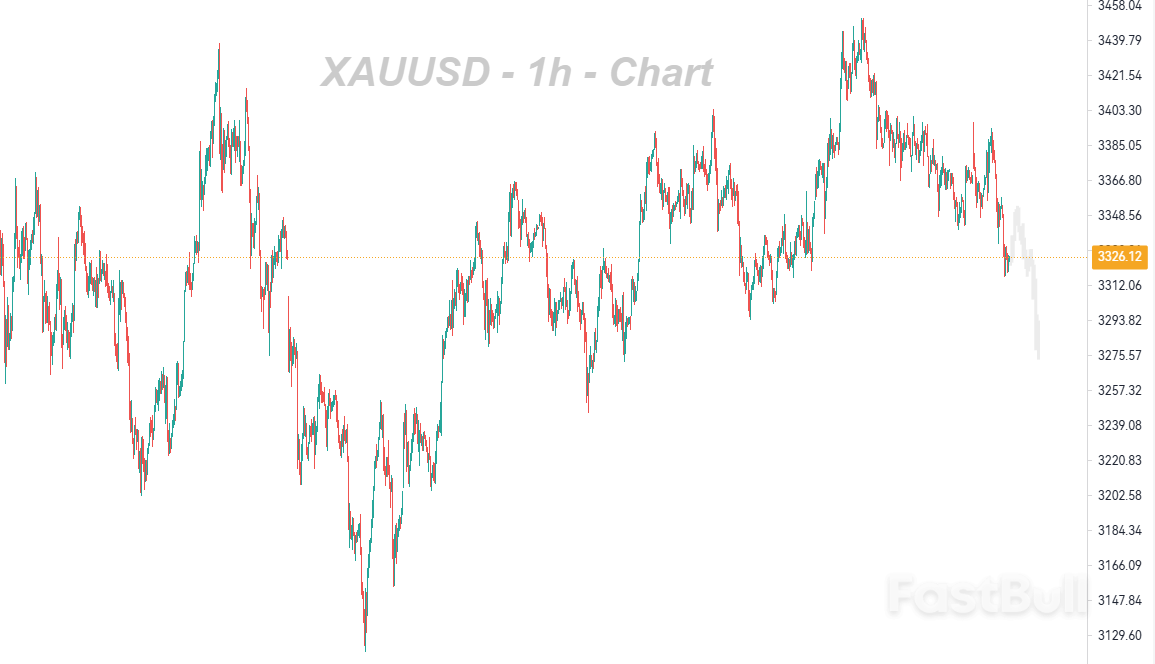
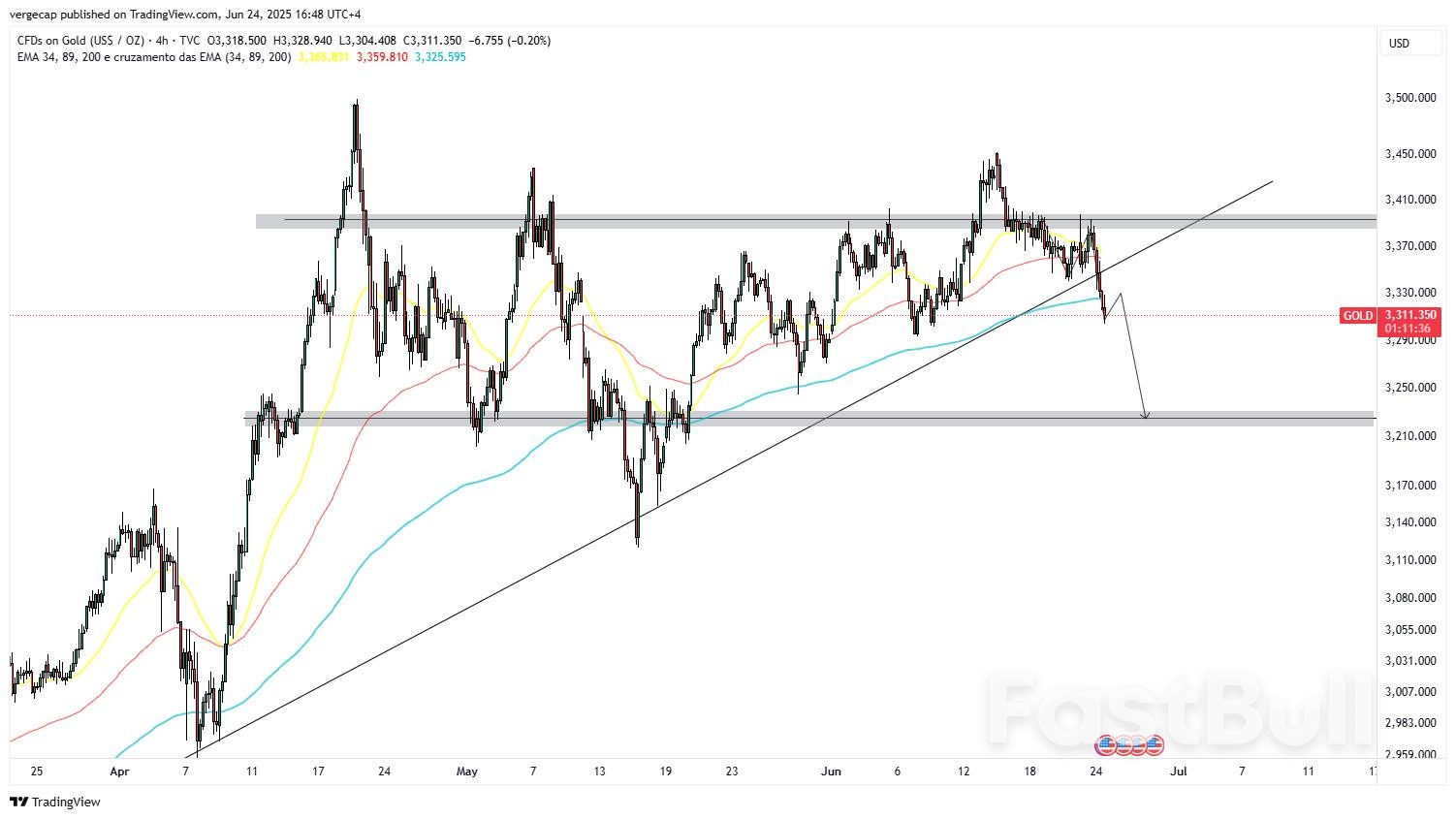
          From a technical standpoint, the gold market is currently trading within a well-defined bearish correctional channel, with the recent breakdown of a key ascending trendline reinforcing downside risks. The price action has been dominated by selling pressure, and the violation of this trendline has opened the door for a deeper retracement, especially as momentum indicators confirm the bearish bias.
          The Relative Strength Index (RSI) has entered oversold territory, yet remains aligned with negative momentum — a classic sign that the bears are firmly in control. Despite oversold conditions, there is little evidence of a near-term reversal, particularly given the broader macro backdrop and weakening demand for safe havens.
          If the downside persists, traders may target further support levels around $3,300 and potentially $3,200, both of which served as key inflection points in prior consolidation phases. On the flip side, any recovery will likely face resistance at the $3,350–$3,370 zone, where the previous trendline intersects with short-term moving averages.
          TRADE RECOMMENDATION
          SELL GOLD
          ENTRY PRICE: 3305
          STOP LOSS: 3400
          TAKE PROFIT: 3200
          Risk Warnings and Disclaimers
          You understand and acknowledge that there is a high degree of risk involved in trading. Following any strategies or investment methods may lead to potential losses. The content on the site is provided by our contributors and analysts for information purposes only. You are solely responsible for determining whether any trading assets, securities, strategy, or any other product is suitable for investing based on your own investment objectives and financial situation.
          Add to Favorites
          Share

          US Dollar Tumbles as Ceasefire Eases Safe-Haven Demand and Dovish Fed Fuels Rate Cut Bets

          Warren Takunda

          Economic

          Summary:

          The US Dollar slumped on Tuesday, extending losses as easing geopolitical tensions and a dovish Federal Reserve outlook crushed demand for safe-haven assets.

          SELL USDX
          EXP
          EXPIRED

          98.200

          Entry Price

          94.000

          TP

          99.300

          SL

          97.890 -0.060 -0.06%

          --

          Pips

          EXPIRED

          94.000

          TP

          97.090

          Exit Price

          98.200

          Entry Price

          99.300

          SL

          The US Dollar came under heavy selling pressure on Tuesday, becoming one of the worst-performing major currencies amid a potent mix of geopolitical de-escalation and growing expectations for a more accommodative Federal Reserve stance. Risk appetite surged across global markets following confirmation of a ceasefire between Israel and Iran, while a chorus of dovish signals from Federal Reserve officials further undermined the greenback’s appeal.
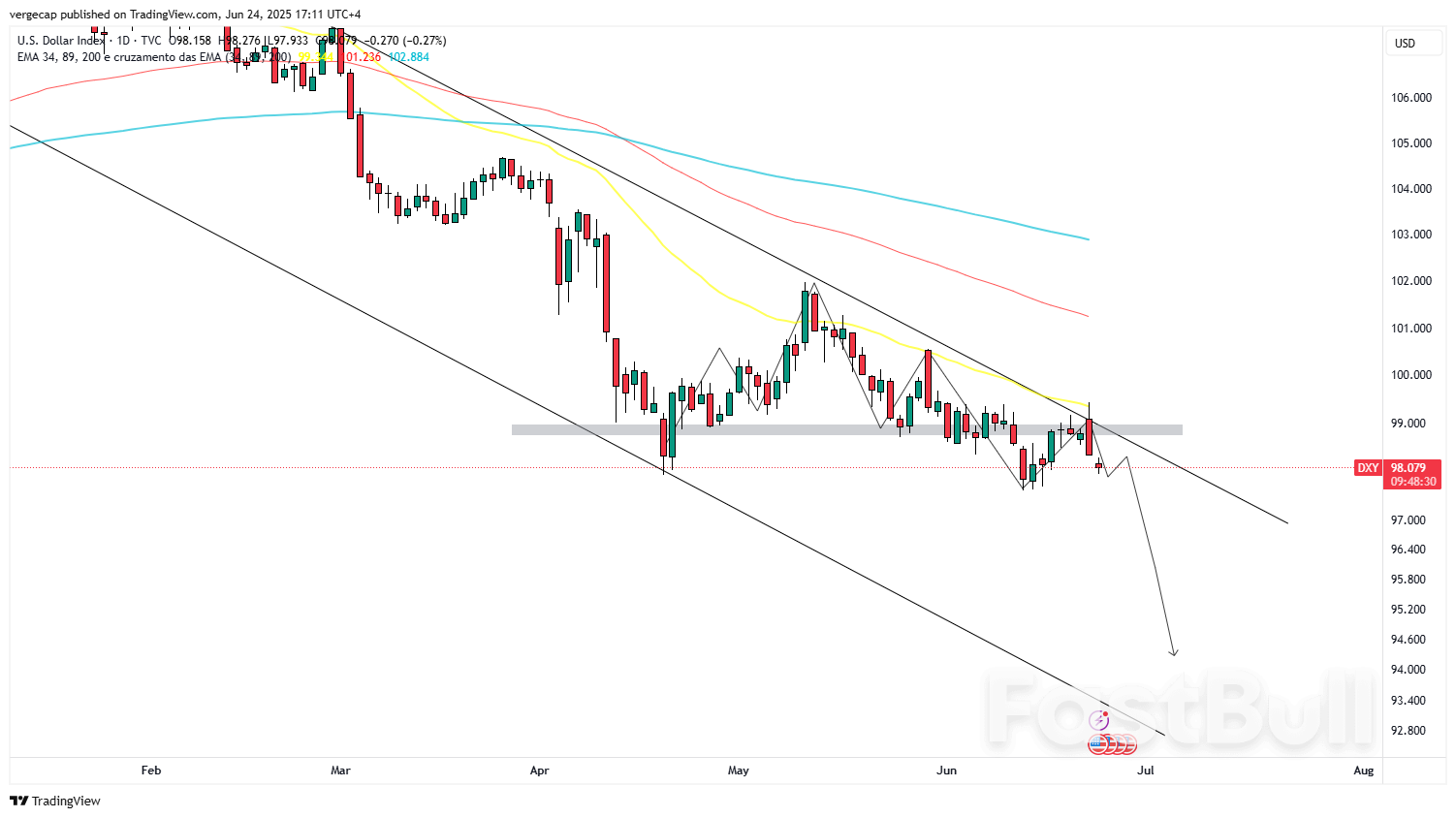
          The US Dollar Index (DXY), which tracks the performance of the Dollar against a basket of six major peers, slumped nearly 1.4% from Monday’s highs, erasing nearly all of its gains from the past two weeks. At the time of writing, the index is hovering below 97.80, eyeing its next major test near the critical three-year support level at 97.13 — a zone that, if broken, could mark a significant structural shift in the broader trend.
          Markets responded swiftly to Monday evening’s announcement by US President Donald Trump confirming a ceasefire agreement between Israel and Iran. The news sparked a rally in risk assets, pushing European equities sharply higher and sending crude oil prices tumbling more than $10 from their intraday highs. In contrast, traditional safe-haven assets such as the US Dollar and Treasury yields retreated as investors rotated into riskier plays.
          Despite ongoing tensions — with Tel Aviv warning of retaliation over alleged ceasefire violations, and Tehran firmly denying any breach — the overall market mood remained buoyant on Tuesday. Risk sentiment has reasserted itself, sidelining the greenback and leaving it vulnerable to further pullbacks as geopolitical risk premia evaporate.
          Amplifying the Dollar's downward momentum were recent comments from key Federal Reserve officials, which solidified investor expectations for rate cuts in the second half of the year. The softening macroeconomic backdrop — characterized by moderating inflation and a weakening labor market — appears to be nudging the central bank toward a more accommodative stance.
          On Monday, Federal Reserve Vice Chair for Supervision Michelle Bowman joined Governor Christopher Waller in signaling that the case for easing is gaining ground. Bowman noted that the inflationary impact of US tariffs was likely to be less severe than initially feared, potentially opening the door for rate cuts to support the labor market. Waller, known for his previously hawkish leanings, also leaned toward July as a viable window for the Fed’s first policy pivot since tightening began.
          Markets are now pricing in a growing probability of a rate cut in September, if not as early as July, particularly if incoming data continues to show signs of slack in the economy.
          All eyes will be on Federal Reserve Chair Jerome Powell later today, as he prepares to deliver semi-annual testimony to Congress. Traders will be combing through his remarks for confirmation of the dovish tilt and clues about the timing of potential easing. Any suggestion that the Fed is leaning toward insurance cuts to preempt a broader slowdown could trigger a deeper correction in the Dollar.

          Technical Analysis US Dollar Tumbles as Ceasefire Eases Safe-Haven Demand and Dovish Fed Fuels Rate Cut Bets_1

          Technically, the US Dollar Index appears to be teetering on the edge of a major bearish reversal. The DXY has been repeatedly rejected at the Daily Swing Supply Zone near the 99.00 level, and recent price action has confirmed a Head & Shoulders formation on the 1-hour chart — typically a strong signal of trend exhaustion.
          On the 4-hour chart, price remains firmly below the 100-period EMA, while a well-respected descending trendline continues to cap upside attempts. Momentum indicators also paint a bearish picture, with a clear RSI divergence reinforcing downside pressure.
          The current pivot sits at 98.59, but with price now trading below the 1st support at 97.69, the path of least resistance appears to be lower. A sustained break below the 97.13 multi-year support would expose the next major downside target at 94.650 — a level that aligns with long-term Fibonacci retracements and previous structural demand zones.
          TRADE RECOMMENDATION
          SELL DXY
          ENTRY PRICE : 98.200
          STOP LOSS: 99.300
          TAKE PROFIT: 94.00
          Risk Warnings and Disclaimers
          You understand and acknowledge that there is a high degree of risk involved in trading. Following any strategies or investment methods may lead to potential losses. The content on the site is provided by our contributors and analysts for information purposes only. You are solely responsible for determining whether any trading assets, securities, strategy, or any other product is suitable for investing based on your own investment objectives and financial situation.
          Add to Favorites
          Share

          Geopolitical Tensions Have Eased, Shifting the Focus to Powell's Semiannual Testimony

          Eva Chen

          Commodity

          Central Bank

          Summary:

          If Federal Reserve Chairman Powell signals further rate cuts during his testimony before Congress later today, the U.S. dollar may experience further depreciation, potentially bolstering gold prices following their recent significant decline.

          SELL XAUUSD
          Close Time
          CLOSED

          3348.00

          Entry Price

          3259.00

          TP

          3398.00

          SL

          4333.17 +33.78 +0.79%

          890.0

          Pips

          Profit

          3259.00

          TP

          3258.66

          Exit Price

          3348.00

          Entry Price

          3398.00

          SL

          Fundamentals

          Gold prices initially sustained a robust bearish sentiment during Tuesday's early European session, subsequently moderating, yet still hovering near a two-week low. The news of a ceasefire between Iran and Israel bolstered investor confidence, triggering a fresh wave of global risk-on trading, which is perceived as a primary factor contributing to the outflow of funds from the safe-haven asset.
          Tensions escalated yesterday following Iran's missile strikes on U.S. airbases in Qatar and Iraq. However, the situation de-escalated as Trump welcomed the pre-warned attacks, characterizing them as a "very weak response," with no reported casualties.
          Brent crude experienced one of its largest single-day declines in five years, decreasing by over US$7 per barrel since yesterday, as the immediate threats in the Strait of Hormuz subsided. Gold prices also retreated significantly due to the easing geopolitical tensions.
          With the geopolitical situation stabilizing, the focus will shift to Federal Reserve Chairman Powell's testimony before the House Financial Services Committee later today, which may offer insights into the future path of interest rate cuts.
          Following support for a rate cut as early as July from Federal Reserve Governors Waller, Goolsbee, and Bowman, Powell's stance suggests an increased risk of a rate cut. The market may interpret any shift in Powell's cautious approach to rate cuts as a sign that pressure from Trump to lower rates has breached the "firewall of the Fed's independence." This could lead to a further decline in the dollar and provide additional trading opportunities for gold in the short term.
          Geopolitical Tensions Have Eased, Shifting the Focus to Powell's Semiannual Testimony_1

          Technical Analysis

          The recent pullback in gold prices, driven by the exhaustion of bullish momentum, aligns with expectations. While prices briefly found support during Tuesday's European session, consolidation is anticipated to dominate trading in the coming sessions. However, the current market structure suggests that the path of least resistance post-consolidation remains downward.
          Given the price breakdown, it is recommended to go short at the highs within the US$3,349-US$3,352 range (the second point of origin for medium-term short positions, following the initial sell-off at US$3,378). The target range is US$3,271-US$3,259. A decisive break below this range would likely attract additional short positions, potentially driving prices lower towards the US$3,245-US$3,200 threshold.

          Trading Recommendations

          Trading Direction: Sell
          Entry Price: 3348
          Target Price: 3259
          Stop Loss: 3398
          Valid Until: July 9, 2025 23:55:00
          Support: 3316, 3302, 3293
          Resistance: 3348, 3352, 3357
          Risk Warnings and Disclaimers
          You understand and acknowledge that there is a high degree of risk involved in trading. Following any strategies or investment methods may lead to potential losses. The content on the site is provided by our contributors and analysts for information purposes only. You are solely responsible for determining whether any trading assets, securities, strategy, or any other product is suitable for investing based on your own investment objectives and financial situation.
          Add to Favorites
          Share

          145 Level Becomes Fierce Battle Between Bulls and Bears – Can Technical Breakthrough Open Upside Potential?

          Alan

          Forex

          Summary:

          Expectations of only two Fed rate cuts this year provide some support for the US dollar, while fading expectations of the Bank of Japan (BoJ) rate hikes may pressure the yen lower.

          BUY USDJPY
          Close Time
          CLOSED

          145.092

          Entry Price

          150.900

          TP

          142.500

          SL

          155.115 -0.699 -0.45%

          10.2

          Pips

          Profit

          142.500

          SL

          145.194

          Exit Price

          145.092

          Entry Price

          150.900

          TP

          Fundamentals

          On June 18th, the Fed held rates steady in its June meeting, but its dot plot revealed that 7 out of 19 officials favored no cuts this year. Projections for just two cuts before 2025 reinforced the US dollar's yield spread advantage. Despite weak data like May's -0.9% MoM U.S. retail sales, the Fed's concerns about sticky inflation suppressed bets for easing, offering the dollar some support. Moreover, June U.S. manufacturing PMI (52) and services PMI (53.1) exceeded expectations, while existing home sales signaled consumer resilience, providing the fundamental underpinning for the US dollar.
          In Japan, the BoJ's dovish stance amplified yen depreciation pressures. Although May core CPI rose 3.7% YoY, the BoJ explicitly delayed rate hikes until Q1 2026 and slowed its bond purchase tapering pace, further cooling expectations for earlier tightening. This policy lag exacerbates the yen's yield disadvantage. Coupled with risks of fiscal expansion ahead of the upper house election (LDP approval rating fell to 32.5%), the yen faces dual depreciation pressures.
          Geopolitically, Trump's claim that Israel and Iran agreed to a "complete and total ceasefire" sent oil prices lower, weakening demand for the yen as a safe haven currency.

          Technical Analysis

          145 Level Becomes Fierce Battle Between Bulls and Bears – Can Technical Breakthrough Open Upside Potential? _1
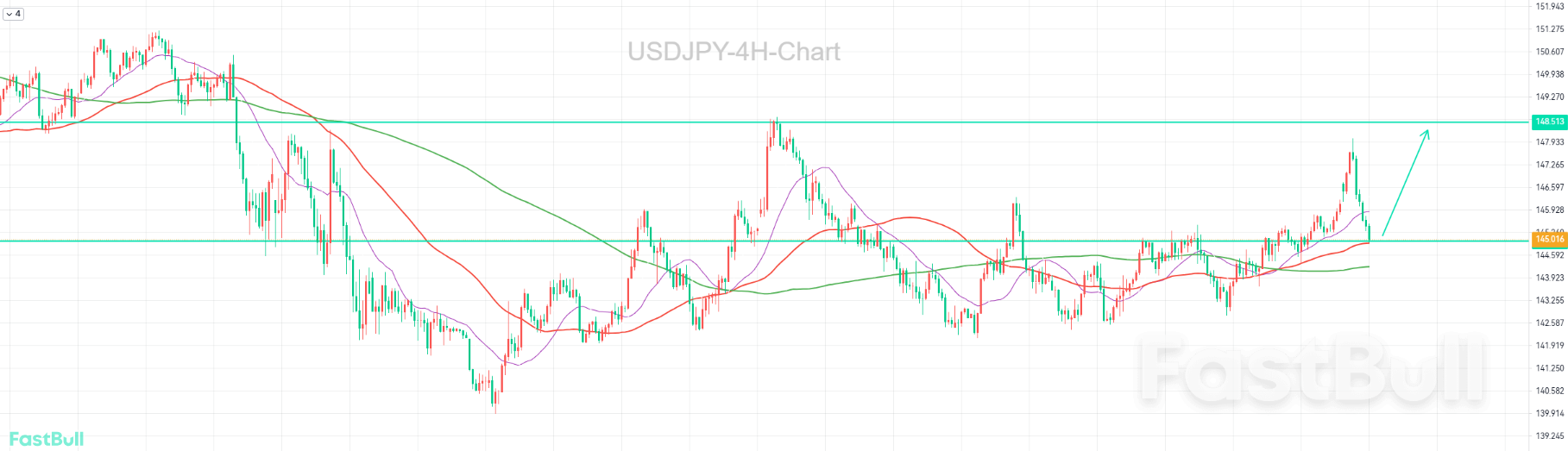
          The 4-hour chart shows USDJPY breaking through the key resistance at 145.00, opening upside potential with significantly strengthened bullish momentum. Yesterday, the pair retreated after facing pressure below 148.50 and has now pulled back near the 145.00 support level. Currently, USDJPY is hovering above the MA60, multiple support factors converge here. If upcoming hourly candles show signs of stabilization near 145.00, the likelihood of short-term continuation upward increases. Simultaneously, the MA system shows a bullish alignment, further boosting the probability of extended gains.
          Therefore, buying at lows is suggested.

          Trading Recommendations

          Trading direction: Buy
          Entry price: 145.10
          Target price: 150.90
          Stop loss: 142.50
          Valid Until: July 08, 2025, 23:00:00
          Support: 144.32/142.79
          Resistance: 148.01/148.64
          Risk Warnings and Disclaimers
          You understand and acknowledge that there is a high degree of risk involved in trading. Following any strategies or investment methods may lead to potential losses. The content on the site is provided by our contributors and analysts for information purposes only. You are solely responsible for determining whether any trading assets, securities, strategy, or any other product is suitable for investing based on your own investment objectives and financial situation.
          Add to Favorites
          Share

          Uptrend May Accelerate After Bullish Reversal Pattern in EURUSD

          Manuel

          Central Bank

          Economic

          Summary:

          This level has acted as a strong support area in recent sessions, and the inability to form a new local low may suggest that bearish pressure is fading.

          BUY EURUSD
          Close Time
          CLOSED

          1.16004

          Entry Price

          1.17250

          TP

          1.15000

          SL

          1.17490 +0.00096 +0.08%

          46.6

          Pips

          Profit

          1.15000

          SL

          1.16470

          Exit Price

          1.16004

          Entry Price

          1.17250

          TP

          As the last trading week of June begins, geopolitical tensions are dominating global attention. Over the weekend, the U.S. carried out synchronized airstrikes on three key Iranian nuclear sites after diplomatic efforts by the White House to resolve tensions with Tehran collapsed.
          In response, Iran launched missile strikes on a U.S. military base in Qatar. At the same time, Iraq’s Ain al-Assad base went on high alert for a possible attack, though no missiles were fired. Adding to the escalation, Iran’s parliament voted to halt cooperation with the International Atomic Energy Agency (IAEA), marking a significant setback for diplomatic ties.
          However, market sentiment shifted after President Donald Trump announced on Monday that a “complete and total” ceasefire between Israel and Iran would soon come into effect. According to Reuters, the ceasefire was expected to begin within approximately six hours, once both sides completed their final military operations.
          “It has been fully agreed between Israel and Iran that there will be a COMPLETE AND TOTAL CEASEFIRE (in about 6 hours from now, once Israel and Iran wrap up their ongoing final missions!), for 12 hours, after which the war will be considered OVER,” Trump posted on social media.
          A senior Iranian official confirmed to Reuters that Tehran had accepted the ceasefire proposal mediated by Qatar and presented by the United States in coordination with Israel, providing some relief to risk sentiment across markets.
          Looking ahead, traders are turning their focus to key macroeconomic events in the U.S., including Fed Chair Jerome Powell’s semiannual testimony and the release of the Conference Board’s Consumer Confidence Index, both scheduled for Tuesday.
          On the monetary policy front, Federal Reserve Vice Chair for Supervision Michelle Bowman stated on Monday that the time to cut interest rates may be approaching, citing potential risks to the labor market. She noted that inflation appears to be on a sustained path back toward the 2% target and expressed reduced concern over tariffs triggering renewed inflationary pressures.
          In Europe, fresh economic data highlighted the fragile nature of the eurozone’s recovery. The HCOB Flash Composite Purchasing Managers’ Index (PMI) for June came in at 50.2—unchanged from May and slightly below the forecast of 50.5. The services sector showed modest improvement, with the services PMI ticking up to 50.0 from 49.7, signaling a tentative stabilization. However, manufacturing remains under pressure, with the manufacturing PMI holding steady at 49.4—missing expectations of 49.8 and reflecting continued weakness in industrial activity.
          Adding to the euro’s support, European Central Bank President Christine Lagarde urged EU lawmakers to press forward with legislation on a digital euro, describing it as vital to safeguarding Europe's financial sovereignty. Separately, Bundesbank President Joachim Nagel stressed that large-scale bond purchases should be reserved for rare emergencies and reaffirmed that interest rates will remain the ECB’s primary policy tool moving forward.Uptrend May Accelerate After Bullish Reversal Pattern in EURUSD_1

          Technical Analysis

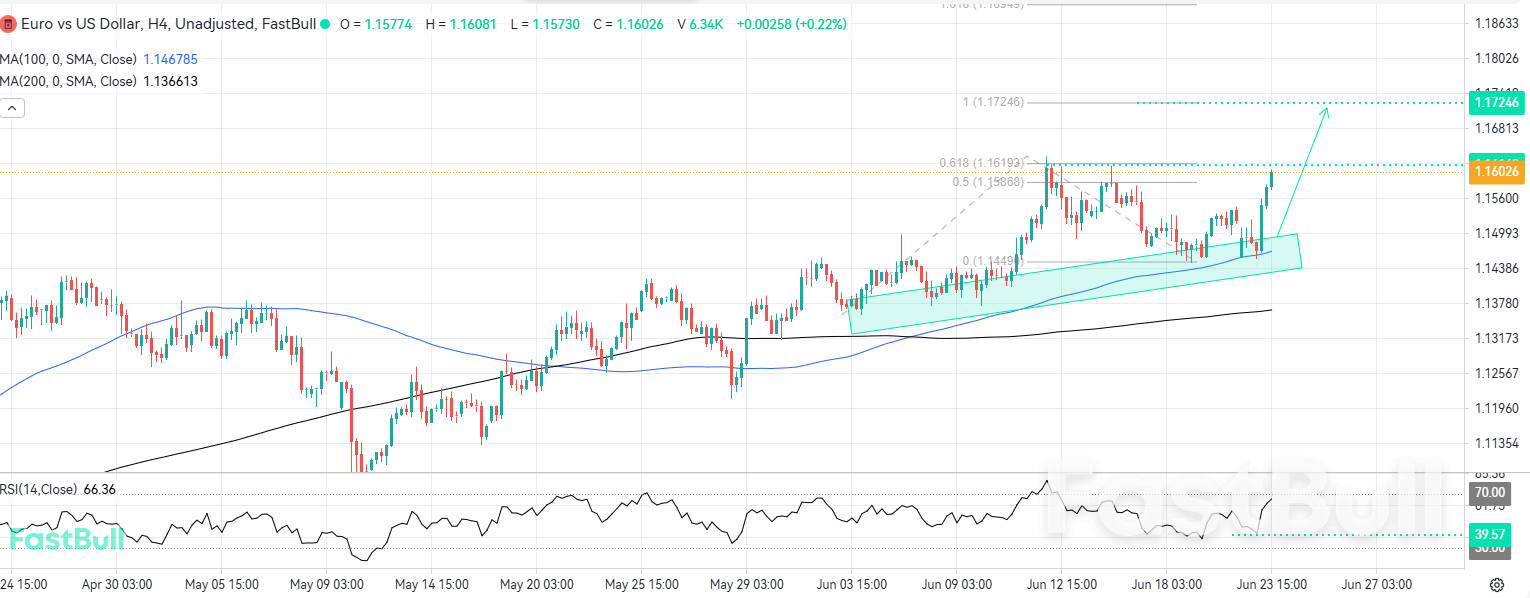
          EUR/USD surged higher after bouncing off its 100-period moving average, currently located at 1.1467 on the 4-hour chart. This level has acted as a strong support area in recent sessions, and the inability to form a new local low may suggest that bearish pressure is fading.
          The pair has printed three strong consecutive bullish candles—forming a classic “three white soldiers” pattern, which is typically seen as a signal of trend reversal or continuation to the upside. Given this structure, bullish momentum could extend toward the 1.1725 area, a level projected by the Fibonacci extension tool.
          Meanwhile, the Relative Strength Index (RSI) dipped to a session low of 39, slightly below the neutral 50 level. The RSI’s inability to reach oversold territory before turning back up suggests limited selling interest and reinforces the potential for further gains. As long as the 1.1467 support zone remains intact, buying pressure is likely to remain dominant from this area.
          Trading Recommendations
          Trading direction: Buy
          Entry price: 1.1605
          Target price: 1.1725
          Stop loss: 1.1500
          Validity: Jun 30, 2025 15:00:00
          Risk Warnings and Disclaimers
          You understand and acknowledge that there is a high degree of risk involved in trading. Following any strategies or investment methods may lead to potential losses. The content on the site is provided by our contributors and analysts for information purposes only. You are solely responsible for determining whether any trading assets, securities, strategy, or any other product is suitable for investing based on your own investment objectives and financial situation.
          Add to Favorites
          Share

          WTI Faces Pivotal Moment as Conflict Intensifies and Support Holds

          Manuel

          Commodity

          Energy

          Summary:

          This rebound suggests that $72.50 may serve as a critical platform for a fresh bullish impulse, with the next upside target being the previous session’s high.

          BUY WTI
          Close Time
          CLOSED

          73.422

          Entry Price

          76.700

          TP

          71.000

          SL

          56.897 -0.336 -0.59%

          242.2

          Pips

          Loss

          71.000

          SL

          70.999

          Exit Price

          73.422

          Entry Price

          76.700

          TP

          The United States has officially joined Israel in military operations against Iran, reportedly striking and destroying critical nuclear facilities. This dramatic development could mark a major turning point for global markets, particularly for oil prices and the U.S. dollar, which often benefits during geopolitical shocks—especially when oil prices spike.
          In response, Iranian officials have threatened to block the Strait of Hormuz, a vital maritime chokepoint through which nearly 20% of global oil supply flows. Should Tehran carry out this threat, some market sources suggest that crude prices could surge to the $120–$130 per barrel range. The market is now intensely focused on the next moves, with any sign of escalation likely to trigger further upward pressure on oil.
          Tehran has also proposed legislation to suspend cooperation with the International Atomic Energy Agency (IAEA), warning of "severe consequences" in retaliation to the attacks. While the U.S. labeled the mission as a one-off strike, President Trump declared the operation a success. However, Israeli Prime Minister Benjamin Netanyahu took a more cautious tone, emphasizing that the nuclear threat has not been fully neutralized, as Iran’s heavily fortified Fordow facility remains intact.
          In an effort to deescalate the situation, European diplomats from France, Germany, the United Kingdom, and the European Union held high-level talks with Iran's Deputy Foreign Minister Abbas Araghchi. Although no ceasefire agreement was reached, the meeting signaled a shared preference for diplomacy over open conflict.
          From a monetary policy perspective, the Federal Reserve is expected to respond to the inflationary impact of soaring oil prices with a sufficiently restrictive stance. Technically speaking, an improvement in a country’s terms of trade can lead to real exchange rate appreciation—either through nominal exchange rate gains or higher inflation. Both outcomes ultimately reduce the competitiveness of U.S. goods abroad. Which channel prevails depends largely on how the central bank handles inflation expectations and interest rate policy.
          In a new and potentially worrying development, Qatar has announced the closure of its airspace to civilian aircraft. Market participants view this as a signal of rising geopolitical risk in the region. If this move precedes a full blockade of the Strait of Hormuz, oil prices could experience a sharp resurgence in the coming sessions.WTI Faces Pivotal Moment as Conflict Intensifies and Support Holds_1

          Technical Analysis

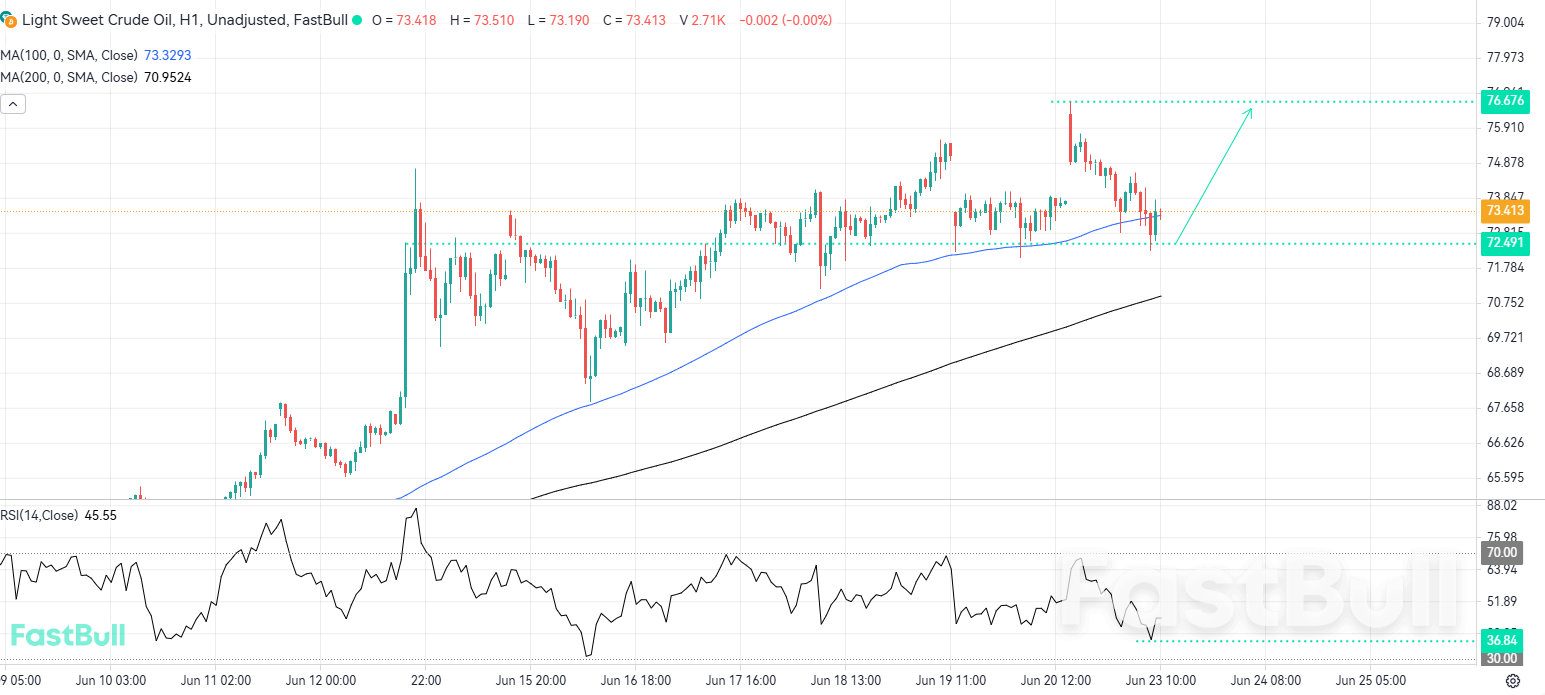
          Following the U.S. strikes on Iranian nuclear facilities, WTI crude surged to an intraday high of $76.67 during Monday’s market open. The heightened risk of retaliatory action by Iran against U.S. assets and infrastructure in the region has created a fragile environment for energy markets, keeping upward pressure on U.S. oil benchmarks.
          WTI has found solid support around the $72.50 zone, a level that has historically acted as a reliable base for bullish reversals. The recent pullback toward this area was met with renewed buying interest, and the price has since recovered above the 100-period moving average. This rebound suggests that $72.50 may serve as a critical platform for a fresh bullish impulse, with the next upside target being the previous session’s high.
          Meanwhile, the Relative Strength Index (RSI) has dropped to 36.8, approaching oversold territory. The RSI also reached its lowest level across recent sessions, creating bullish divergence—lower RSI values without corresponding new price lows. This could be an early signal that bearish momentum is weakening.
          If the $72.50 level fails to hold, further downside could be expected, with the 200-period moving average at $70.95 acting as the next major support level. However, as long as geopolitical tensions remain elevated, the downside may be limited, and bullish momentum could resume swiftly.
          Trading Recommendations
          Trading direction: Buy
          Entry price: 73.41
          Target price: 76.70
          Stop loss: 71.00
          Validity: Jun 30, 2025 15:00:00
          Risk Warnings and Disclaimers
          You understand and acknowledge that there is a high degree of risk involved in trading. Following any strategies or investment methods may lead to potential losses. The content on the site is provided by our contributors and analysts for information purposes only. You are solely responsible for determining whether any trading assets, securities, strategy, or any other product is suitable for investing based on your own investment objectives and financial situation.
          Add to Favorites
          Share

          Australian Dollar Recovers Losses as Safe-Haven Flows Cool, US PMIs Fail to Inspire Dollar Bulls

          Warren Takunda

          Economic

          Summary:

          The Australian Dollar rebounded from a one-month low against the US Dollar on Monday as fading geopolitical risk appetite and mixed US PMI data curbed Greenback demand.

          BUY AUDUSD
          Close Time
          CLOSED

          0.64350

          Entry Price

          0.64800

          TP

          0.63900

          SL

          0.66509 -0.00011 -0.02%

          45.0

          Pips

          Profit

          0.63900

          SL

          0.64800

          Exit Price

          0.64350

          Entry Price

          0.64800

          TP

          The Australian Dollar (AUD) staged an impressive intraday turnaround against the US Dollar (USD) on Monday, clawing back early-session losses that had pushed the currency pair to its lowest level in nearly a month. While the day began under a cloud of geopolitical tension and risk-off flows — triggered by a weekend U.S. military strike on Iran — market sentiment shifted in New York trading hours as the latest batch of U.S. economic data failed to reinforce bullish conviction in the Dollar.
          At the time of writing, AUD/USD is trading near 0.6426, having bounced strongly from the session’s low at 0.6372. The pair was last seen down just 0.38% on the day, after recovering most of the ground lost during the Asian and European sessions. The comeback reflects a broader reassessment of the safe-haven trade and growing investor unease over the sustainability of the Greenback’s recent strength.
          The initial bout of Aussie selling was fueled by escalating geopolitical tensions after the United States launched strikes against Iranian targets over the weekend, stoking fears of broader Middle East instability. The USD initially benefited from safe-haven inflows, with global risk sentiment subdued and commodity-linked currencies like the AUD on the back foot.
          However, as the session progressed and no immediate retaliatory response from Iran emerged, markets began to unwind some of the safety-driven trades. Traders rotated back into risk-sensitive assets, including the Australian Dollar, as attention shifted from headlines to data.
          A key catalyst for the Aussie’s rebound came from the release of mixed US Purchasing Managers’ Index (PMI) data from S&P Global. The Composite PMI dipped slightly to 52.8 in June from 53.0 in May — still signaling expansion, but indicating a marginal loss in momentum.
          The Manufacturing PMI came in at 52.0, unchanged from the prior month’s 15-month high and above expectations, suggesting some resilience in the industrial sector. However, the Services PMI — the largest component of the U.S. economy — slipped to 53.1 from 53.7, reflecting softer demand and tempering enthusiasm for the USD.
          The data did little to support a stronger case for the Federal Reserve to maintain a hawkish stance, particularly as inflation continues to trend downward and rate expectations for 2024 remain anchored to at least one rate cut before year-end. As a result, the US Dollar’s initial strength faded, giving the Aussie room to retrace losses.
          Earlier in the Asia session, Australia’s own PMI data provided a degree of insulation against geopolitical volatility. According to S&P Global, the Australian private sector recorded its second-fastest expansion in ten months. The services sector, in particular, notched a three-month high in activity, while manufacturing held broadly steady — a welcome development for a market that has grown increasingly cautious on the domestic outlook amid soft employment and retail sales data in recent weeks.
          The upbeat figures temporarily eased concerns about the Reserve Bank of Australia (RBA) needing to pivot toward policy easing. While some economists still forecast a potential rate cut in late 2024, the stronger PMI print may delay that narrative and keep AUD sentiment anchored in the near term.
          Technical AnalysisAustralian Dollar Recovers Losses as Safe-Haven Flows Cool, US PMIs Fail to Inspire Dollar Bulls_1
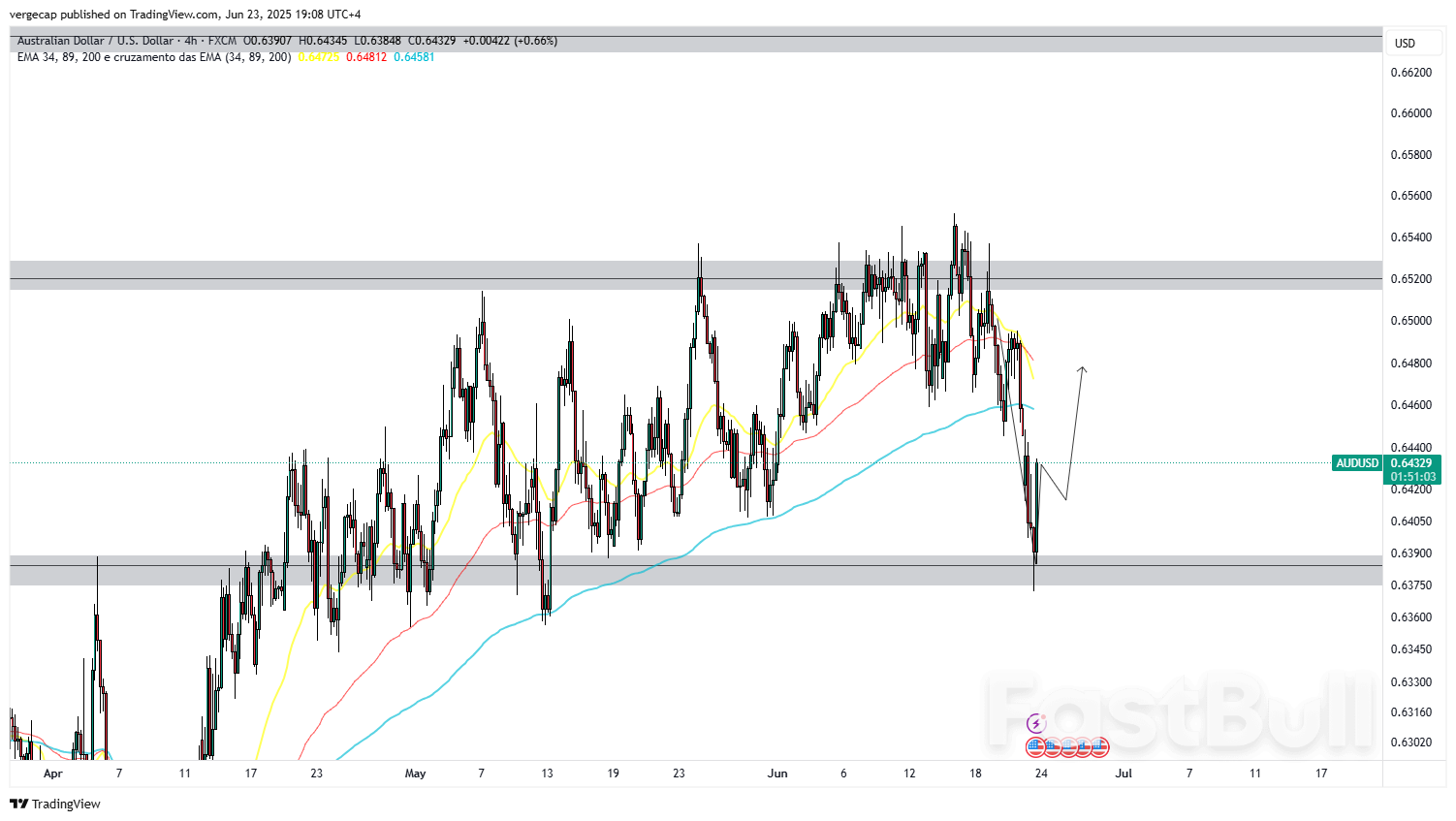
          From a technical perspective, AUD/USD is now testing a key pivot point at 0.6427, which could determine the pair’s direction over the next few sessions.
          The Super Trend indicator has generated a clear long signal, and the Pivot Point HL is pointing to a bullish underlying structure in the market. The pair has also managed to hold above recent lows and climb back within a broader consolidation zone, adding to the near-term upside potential.
          If momentum continues to build, the next upside target sits near 0.6480 — a level that would mark a full retracement of Monday’s geopolitical-driven drop and challenge short-term resistance.
          TRADE RECOMMENDATION
          BUY AUDUSD
          ENTRY PRICE: 0.6435
          STOP LOSS: 0.6390
          TAKE PROFIT: 0.6480
          Risk Warnings and Disclaimers
          You understand and acknowledge that there is a high degree of risk involved in trading. Following any strategies or investment methods may lead to potential losses. The content on the site is provided by our contributors and analysts for information purposes only. You are solely responsible for determining whether any trading assets, securities, strategy, or any other product is suitable for investing based on your own investment objectives and financial situation.
          Add to Favorites
          Share
          FastBull
          Copyright © 2025 FastBull Ltd

          728 RM B 7/F GEE LOK IND BLDG NO 34 HUNG TO RD KWUN TONG KLN HONG KONG

          TelegramInstagramTwitterfacebooklinkedin
          App Store Google Play Google Play
          Products
          Charts

          Chats

          Q&A with Experts
          Screeners
          Economic Calendar
          Data
          Tools
          Membership
          Features
          Function
          Markets
          Copy Trading
          Latest Signals
          Contests
          News
          Analysis
          24/7
          Columns
          Education
          Company
          Careers
          About Us
          Contact Us
          Advertising
          Help Center
          Feedback
          User Agreement
          Privacy Policy
          Business

          White Label

          Data API

          Web Plug-ins

          Poster Maker

          Affiliate Program

          Risk Disclosure

          The risk of loss in trading financial instruments such as stocks, FX, commodities, futures, bonds, ETFs and crypto can be substantial. You may sustain a total loss of the funds that you deposit with your broker. Therefore, you should carefully consider whether such trading is suitable for you in light of your circumstances and financial resources.

          No decision to invest should be made without thoroughly conducting due diligence by yourself or consulting with your financial advisors. Our web content might not suit you since we don't know your financial conditions and investment needs. Our financial information might have latency or contain inaccuracy, so you should be fully responsible for any of your trading and investment decisions. The company will not be responsible for your capital loss.

          Without getting permission from the website, you are not allowed to copy the website's graphics, texts, or trademarks. Intellectual property rights in the content or data incorporated into this website belong to its providers and exchange merchants.

          Not Logged In

          Log in to access more features

          FastBull Membership

          Not yet

          Purchase

          Become a signal provider
          Help Center
          Customer Service
          Dark Mode
          Price Up/Down Colors

          Log In

          Sign Up
          Position
          Layout
          Fullscreen
          Default to Chart
          The chart page opens by default when you visit fastbull.com