• Trade
  • Markets
  • Copy
  • Contests
  • News
  • 24/7
  • Calendar
  • Q&A
  • Chats
Trending
Screeners
SYMBOL
LAST
BID
ASK
HIGH
LOW
NET CHG.
%CHG.
SPREAD
SPX
S&P 500 Index
6870.39
6870.39
6870.39
6895.79
6858.28
+13.27
+ 0.19%
--
DJI
Dow Jones Industrial Average
47954.98
47954.98
47954.98
48133.54
47871.51
+104.05
+ 0.22%
--
IXIC
NASDAQ Composite Index
23578.12
23578.12
23578.12
23680.03
23506.00
+72.99
+ 0.31%
--
USDX
US Dollar Index
98.820
98.900
98.820
98.960
98.730
-0.130
-0.13%
--
EURUSD
Euro / US Dollar
1.16597
1.16605
1.16597
1.16717
1.16341
+0.00171
+ 0.15%
--
GBPUSD
Pound Sterling / US Dollar
1.33291
1.33301
1.33291
1.33462
1.33151
-0.00021
-0.02%
--
XAUUSD
Gold / US Dollar
4216.84
4217.27
4216.84
4218.85
4190.61
+18.93
+ 0.45%
--
WTI
Light Sweet Crude Oil
59.983
60.020
59.983
60.063
59.752
+0.174
+ 0.29%
--

Community Accounts

Signal Accounts
--
Profit Accounts
--
Loss Accounts
--
View More

Become a signal provider

Sell trading signals to earn additional income

View More

Guide to Copy Trading

Get started with ease and confidence

View More

Signal Accounts for Members

All Signal Accounts

Best Return
  • Best Return
  • Best P/L
  • Best MDD
Past 1W
  • Past 1W
  • Past 1M
  • Past 1Y

All Contests

  • All
  • Trump Updates
  • Recommend
  • Stocks
  • Cryptocurrencies
  • Central Banks
  • Featured News
Top News Only
Share

Angola November Inflation At 0.85% Month-On-Month

Share

Indonesia Finance Minister: Potential Revenues From Planned Gold And Coal Export Taxes At 23 Trillion Rupiah

Share

Angola November Inflation At 16.56% Year-On-Year

Share

United Arab Emirates Oct Bank Lending +15.65% Year-On-Year - Central Bank

Share

United Arab Emirates Oct M3 Money Supply +14.98% Year-On-Year - Central Bank

Share

Bayer Seen Up 1.8% In Pre-Mkt Indications After Jp Morgan Raises To Overweight From Neutral

Share

Most Active China Coking Coal Contract Falls 7.1% To 1082.5 Yuan/Metric Ton

Share

German Foreign Minister Says A Lot Of Work Is Still Needed To Persuade China To Issue General Export Licences For Rare Earths

Share

European Central Bank's Schnabel 'Rather Comfortable' On Investor Bets Next Move To Be Interest Rate Hike

Share

Agriculture Ministry: Uganda October Coffee Shipments Up 38% From Last Year

Share

Russia's Nornickel: Cobalt Production Capacity To Be At Up To 3000 Tons Per Year

Share

Russia's Nornickel: Fully Restarts Cobalt Production In Murmansk Region

Share

India's Nifty Realty Index Down 2.7%

Share

China Vice President, In Meeting With German Foreign Minister: China Willing To Enhance Communication With Germany - Xinhua

Share

Japan Finance Minister Katayama: Will Take Appropriate Action If Necessary

Share

Japan Finance Minister Katayama: Concerned About Forex Moves

Share

Japan Finance Minister Katayama: Recently Seeing One-Sided, Rapid Moves

Share

LME Three-month Copper Rose To $11,771 Per Tonne, Setting A New Record High

Share

Shanghai's Most Active Copper Contract Sets Peak At 93300 Yuan Per Metric Ton

Share

Thai Prime Minister: Thailand Does Not Want Violence

TIME
ACT
FCST
PREV
U.S. Personal Income MoM (Sept)

A:--

F: --

P: --

U.S. PCE Price Index YoY (SA) (Sept)

A:--

F: --

P: --

U.S. PCE Price Index MoM (Sept)

A:--

F: --

P: --

U.S. Personal Outlays MoM (SA) (Sept)

A:--

F: --

P: --

U.S. Core PCE Price Index MoM (Sept)

A:--

F: --

P: --

U.S. Core PCE Price Index YoY (Sept)

A:--

F: --

P: --

U.S. UMich 5-Year-Ahead Inflation Expectations Prelim YoY (Dec)

A:--

F: --

P: --

U.S. Real Personal Consumption Expenditures MoM (Sept)

A:--

F: --

P: --

U.S. UMich Current Economic Conditions Index Prelim (Dec)

A:--

F: --

P: --

U.S. UMich Consumer Sentiment Index Prelim (Dec)

A:--

F: --

P: --

U.S. UMich 1-Year-Ahead Inflation Expectations Prelim (Dec)

A:--

F: --

P: --

U.S. UMich Consumer Expectations Index Prelim (Dec)

A:--

F: --

P: --

U.S. Weekly Total Rig Count

A:--

F: --

P: --

U.S. Weekly Total Oil Rig Count

A:--

F: --

P: --

U.S. Unit Labor Cost Prelim (SA) (Q3)

--

F: --

P: --

U.S. Consumer Credit (SA) (Oct)

A:--

F: --

P: --

China, Mainland Foreign Exchange Reserves (Nov)

A:--

F: --

P: --

Japan Wages MoM (Oct)

A:--

F: --

P: --

Japan Trade Balance (Oct)

A:--

F: --

P: --

Japan Nominal GDP Revised QoQ (Q3)

A:--

F: --

P: --

Japan Trade Balance (Customs Data) (SA) (Oct)

A:--

F: --

P: --

Japan GDP Annualized QoQ Revised (Q3)

A:--

F: --

P: --
China, Mainland Exports YoY (CNH) (Nov)

A:--

F: --

P: --

China, Mainland Trade Balance (USD) (Nov)

A:--

F: --

P: --

China, Mainland Imports YoY (CNH) (Nov)

A:--

F: --

P: --

China, Mainland Exports (Nov)

A:--

F: --

P: --

China, Mainland Imports (CNH) (Nov)

A:--

F: --

P: --

China, Mainland Trade Balance (CNH) (Nov)

A:--

F: --

P: --

China, Mainland Imports YoY (USD) (Nov)

A:--

F: --

P: --

China, Mainland Exports YoY (USD) (Nov)

A:--

F: --

P: --

Germany Industrial Output MoM (SA) (Oct)

--

F: --

P: --

Euro Zone Sentix Investor Confidence Index (Dec)

--

F: --

P: --

Canada Leading Index MoM (Nov)

--

F: --

P: --

Canada National Economic Confidence Index

--

F: --

P: --

U.S. Dallas Fed PCE Price Index YoY (Sept)

--

F: --

P: --

China, Mainland Trade Balance (USD) (Nov)

--

F: --

P: --

U.S. 3-Year Note Auction Yield

--

F: --

P: --

U.K. BRC Overall Retail Sales YoY (Nov)

--

F: --

P: --

U.K. BRC Like-For-Like Retail Sales YoY (Nov)

--

F: --

P: --

Australia Overnight (Borrowing) Key Rate

--

F: --

P: --

RBA Rate Statement
RBA Press Conference
Germany Exports MoM (SA) (Oct)

--

F: --

P: --

U.S. NFIB Small Business Optimism Index (SA) (Nov)

--

F: --

P: --

Mexico Core CPI YoY (Nov)

--

F: --

P: --

Mexico 12-Month Inflation (CPI) (Nov)

--

F: --

P: --

Mexico PPI YoY (Nov)

--

F: --

P: --

Mexico CPI YoY (Nov)

--

F: --

P: --

U.S. Weekly Redbook Index YoY

--

F: --

P: --

U.S. JOLTS Job Openings (SA) (Oct)

--

F: --

P: --

China, Mainland M2 Money Supply YoY (Nov)

--

F: --

P: --

China, Mainland M0 Money Supply YoY (Nov)

--

F: --

P: --

China, Mainland M1 Money Supply YoY (Nov)

--

F: --

P: --

U.S. EIA Short-Term Crude Production Forecast For The Next Year (Dec)

--

F: --

P: --

U.S. EIA Short-Term Crude Production Forecast For The Year (Dec)

--

F: --

P: --

U.S. EIA Natural Gas Production Forecast For The Next Year (Dec)

--

F: --

P: --

EIA Monthly Short-Term Energy Outlook
U.S. 10-Year Note Auction Avg. Yield

--

F: --

P: --

U.S. API Weekly Cushing Crude Oil Stocks

--

F: --

P: --

U.S. API Weekly Crude Oil Stocks

--

F: --

P: --

U.S. API Weekly Refined Oil Stocks

--

F: --

P: --

Q&A with Experts
    • All
    • Chatrooms
    • Groups
    • Friends
    Connecting
    .
    .
    .
    Type here...
    Add Symbol or Code

      No matching data

      All
      Trump Updates
      Recommend
      Stocks
      Cryptocurrencies
      Central Banks
      Featured News
      • All
      • Russia-Ukraine Conflict
      • Middle East Flashpoint
      • All
      • Russia-Ukraine Conflict
      • Middle East Flashpoint

      Search
      Products

      Charts Free Forever

      Chats Q&A with Experts
      Screeners Economic Calendar Data Tools
      Membership Features
      Data Warehouse Market Trends Institutional Data Policy Rates Macro

      Market Trends

      Market Sentiment Order Book Forex Correlations

      Top Indicators

      Charts Free Forever
      Markets

      News

      News Analysis 24/7 Columns Education
      From Institutions From Analysts
      Topics Columnists

      Latest Views

      Latest Views

      Trending Topics

      Top Columnists

      Latest Update

      Signals

      Copy Rankings Latest Signals Become a signal provider AI Rating
      Contests
      Brokers

      Overview Brokers Assessment Rankings Regulators News Claims
      Broker listing Forex Brokers Comparison Tool Live Spread Comparison Scam
      Q&A Complaint Scam Alert Videos Tips to Detect Scam
      More

      Business
      Events
      Careers About Us Advertising Help Center

      White Label

      Data API

      Web Plug-ins

      Affiliate Program

      Awards Institution Evaluation IB Seminar Salon Event Exhibition
      Vietnam Thailand Singapore Dubai
      Fans Party Investment Sharing Session
      FastBull Summit BrokersView Expo
      Recent Searches
        Top Searches
          Markets
          News
          Analysis
          User
          24/7
          Economic Calendar
          Education
          Data
          • Names
          • Latest
          • Prev

          View All

          No data

          Scan to Download

          Faster Charts, Chat Faster!

          Download App
          English
          • English
          • Español
          • العربية
          • Bahasa Indonesia
          • Bahasa Melayu
          • Tiếng Việt
          • ภาษาไทย
          • Français
          • Italiano
          • Türkçe
          • Русский язык
          • 简中
          • 繁中
          Open Account
          Search
          Products
          Charts Free Forever
          Markets
          News
          Signals

          Copy Rankings Latest Signals Become a signal provider AI Rating
          Contests
          Brokers

          Overview Brokers Assessment Rankings Regulators News Claims
          Broker listing Forex Brokers Comparison Tool Live Spread Comparison Scam
          Q&A Complaint Scam Alert Videos Tips to Detect Scam
          More

          Business
          Events
          Careers About Us Advertising Help Center

          White Label

          Data API

          Web Plug-ins

          Affiliate Program

          Awards Institution Evaluation IB Seminar Salon Event Exhibition
          Vietnam Thailand Singapore Dubai
          Fans Party Investment Sharing Session
          FastBull Summit BrokersView Expo

          GBP/JPY Drops Below 192: Reversal Signal Or Short-Term Correction?

          Adam

          Forex

          Summary:

          On May 5, 2025, the GBP/JPY pair fell below the 192 mark, reflecting cautious market sentiment on factors such as the Bank of Japan's (BoJ) interest rate policy and weak economic data from the UK.

          SELL GBPJPY
          Close Time
          CLOSED

          191.600

          Entry Price

          190.700

          TP

          192.300

          SL

          206.883 -0.217 -0.10%

          47.1

          Pips

          Profit

          190.700

          TP

          191.129

          Exit Price

          191.600

          Entry Price

          192.300

          SL

          Market Overview
          As of 18:47 GMT+7 on 05/05/2025, GBP/JPY is trading around 191.59, down 0.19% from the previous day. This weakness comes after the pair failed to overcome the strong resistance at 193.75, indicating increased selling pressure from the high price zone.
          The Bank of Japan (BoJ) kept interest rates on hold at 0.5%, but trade risks clouded the outlook. USD/JPY and GBP/JPY rose, with speculators eyeing the 145 and 193 levels, respectively.

          Market psychology

          The current market sentiment shows concern about the global economic outlook and interest rate policy. The RSI(14) is at 41.613, indicating a sell bias. The Stochastic(9.6) is at 41.701, also showing a sell signal.
          Trading data shows large investors are adjusting positions and moving away from risky assets like cryptocurrencies and stocks, seeking safety in defensive assets like gold and bonds.

          Technical analysis

          GBP/JPY Drops Below 192: Reversal Signal Or Short-Term Correction?_1
          Bollinger Bands (20,0,2) : Price is hovering near support at 191.24 and resistance at 192.32. Bollinger Bands are narrowing, indicating reduced volatility and a possible price breakout.
          Ichimoku Kinko Hyo (9,26,52) : Price is below the Ichimoku cloud, indicating a downtrend. Tenkan-sen line crosses below Kijun-sen, confirming a sell signal.
          Stochastic Oscillator (5,3,3) : The Stochastic indicator is in the oversold zone, indicating a possible short-term recovery before continuing the downtrend.

          Trading Recommendations

          Entry: 191.60
          Take Profit: 190.70
          Stop Loss: 192.30
          Risk Warnings and Disclaimers
          You understand and acknowledge that there is a high degree of risk involved in trading. Following any strategies or investment methods may lead to potential losses. The content on the site is provided by our contributors and analysts for information purposes only. You are solely responsible for determining whether any trading assets, securities, strategy, or any other product is suitable for investing based on your own investment objectives and financial situation.
          Add to Favorites
          Share

          Buyers Eye Rebound as Oversold Signals Emerge

          Manuel

          Forex

          Economic

          Summary:

          The U.S. dollar has experienced a sharp drop, retreating to the 1.3770 area, a level that previously acted as resistance and could now serve as a key support.

          BUY USDCAD
          Close Time
          CLOSED

          1.37900

          Entry Price

          1.41000

          TP

          1.36500

          SL

          1.38217 +0.00070 +0.05%

          1.1

          Pips

          Profit

          1.36500

          SL

          1.37911

          Exit Price

          1.37900

          Entry Price

          1.41000

          TP

          Progress toward a trade agreement between the United States and Canada appears to be slowly taking shape. President Donald Trump revealed that newly elected Canadian Prime Minister Mark Carney reached out to him personally, stating, “Let’s make a deal.” According to Trump, Carney is expected to visit the White House sometime within the next week, raising hopes for a breakthrough in bilateral negotiations that have been stalled by tariff uncertainties and political friction.
          Meanwhile, the Bank of Canada’s Summary of Deliberations from its April 16 meeting confirmed that Governing Council members weighed the option of either holding the policy rate steady or cutting it by 25 basis points. In the end, consensus was reached to maintain the benchmark rate at 2.75% while policymakers await further clarity on the economic impact of tariffs and broader external developments. This cautious stance highlights the central bank’s balancing act between addressing downside risks and avoiding premature policy shifts.
          In the United States, labor market data offered a mixed picture. The April Nonfarm Payrolls (NFP) report showed that the U.S. economy added 177,000 jobs, outperforming expectations of 130,000 and providing some temporary reassurance about the health of the labor market. However, downward revisions totaling 58,000 jobs across February and March tempered the optimism. The unemployment rate held steady at 4.2%, and wage growth came in at 3.8% year-over-year—slightly softer than projected. Initial jobless claims rose to 241,000, the highest since mid-February, while continuing claims reached levels not seen since November 2021. These data points collectively suggest that cracks are emerging in the labor market, potentially supporting the case for a rate cut by the Federal Reserve as early as July.
          Further signs of a cooling economy came from the ISM Manufacturing PMI, which slipped to 48.7 in April from 49.0 in March—remaining below the 50 threshold that signals expansion. The production component dropped significantly to 44.0, indicating weakening output. While new orders and employment components showed marginal improvement, inflationary pressures persisted. The prices paid index climbed to 69.8, its highest since mid-2022, keeping inflation concerns alive despite signs of slowing growth.
          Earlier in the week, the U.S. Department of Commerce reported that the American economy contracted at an annualized rate of 0.3% in the first quarter of 2025. This outcome sharply missed the 0.4% growth expected by economists and marked a notable deceleration from the 2.4% expansion seen in Q4 2024. The contraction arrives amid rising uncertainty surrounding the direction of U.S. trade policy under the Trump administration.
          President Trump, speaking on Wednesday, admitted that the impact of current policies may take longer to become evident in the broader economy. He also sought to shift blame for the recent volatility in equity markets, pointing fingers at former President Joe Biden. These remarks came just ahead of several key data releases, including jobless claims and PMI readings, injecting additional tension into an already nervous market environment.Buyers Eye Rebound as Oversold Signals Emerge_1

          Technical Analysis

          The U.S. dollar has experienced a sharp drop, retreating to the 1.3770 area, a level that previously acted as resistance and could now serve as a key support. This zone may offer a foundation for a potential bullish reversal. On the daily chart, the RSI recently touched the 30 level, signaling oversold conditions. Historically, such levels have attracted buyers—particularly considering that similar price points were last seen in October of the previous year.
          The 100-period and 200-period moving averages are positioned at 1.3654 and 1.4000, respectively, and have yet to form a bearish crossover. This technical setup increases the probability of a rebound in price. A bullish move from current levels could see USD climbing back toward the 1.4174 area, where the ascending trendline also intersects—a key technical zone that could act as a magnet in an upward move. However, a decisive breakdown below 1.3770 would invalidate this scenario and open the door for further losses, potentially accelerating the current downtrend.
          Trading Recommendations
          Trading direction: Buy
          Entry price: 1.3790
          Target price: 1.4100
          Stop loss: 1.3650
          Validity: May 12, 2025 15:00:00
          Risk Warnings and Disclaimers
          You understand and acknowledge that there is a high degree of risk involved in trading. Following any strategies or investment methods may lead to potential losses. The content on the site is provided by our contributors and analysts for information purposes only. You are solely responsible for determining whether any trading assets, securities, strategy, or any other product is suitable for investing based on your own investment objectives and financial situation.
          Add to Favorites
          Share

          Upside Continuation in Focus as USDCHF Finds Fresh Support

          Manuel

          Central Bank

          Economic

          Summary:

          For now, the technical setup suggests that the bulls may still have room to push higher—at least until the price tests major resistance.

          BUY USDCHF
          Close Time
          CLOSED

          0.82500

          Entry Price

          0.83300

          TP

          0.82000

          SL

          0.80329 -0.00126 -0.16%

          50.0

          Pips

          Loss

          0.82000

          SL

          0.81999

          Exit Price

          0.82500

          Entry Price

          0.83300

          TP

          The April Nonfarm Payrolls (NFP) report showed that the U.S. economy added 177,000 jobs, beating expectations of 130,000 and offering some relief to concerns about a sharp labor market slowdown. However, the headline beat was partially offset by downward revisions to February and March, which collectively removed 58,000 jobs from previous estimates. The unemployment rate held steady at 4.2%, while wage growth rose 3.8% year-over-year—slightly below forecasts. Meanwhile, initial jobless claims climbed to 241,000, the highest level since mid-February, and continuing claims reached their highest point since November 2021. These figures hint at underlying softness in the labor market and have bolstered market expectations for a potential rate cut by the Federal Reserve as early as July.
          Adding to the economic narrative, the ISM Manufacturing PMI for April dipped further to 48.7 from March’s 49.0, remaining below the 50-mark that separates expansion from contraction. The production sub-index saw a notable drop to 44.0, signaling weakening output, though marginal improvements were seen in new orders and employment. On the inflation front, the prices paid index rose modestly to 69.8, its highest reading since mid-2022, keeping inflationary concerns alive despite cooling economic indicators.
          Earlier in the week, data from the U.S. Department of Commerce confirmed that the economy contracted at an annualized rate of 0.3% in Q1 2025—well below the expected 0.4% growth and a steep decline from the 2.4% expansion in the previous quarter. This marks the first quarterly contraction in over a year and comes amid growing uncertainty over the trajectory of U.S. trade policy under President Donald Trump.
          President Trump, speaking on Wednesday, acknowledged that the effects of current policies may take time to filter through the economy. He redirected blame for the recent weakness in equity markets toward former President Joe Biden. These comments arrived ahead of several key economic releases, including jobless claims and PMI reports, adding more tension to already jittery markets.
          Meanwhile, concerns are also surfacing in Switzerland. On Friday, Swiss National Bank (SNB) President Martin Schlegel cautioned that an economic slowdown in Switzerland “cannot be ruled out.” Trade policy uncertainty is proving disruptive not only for large economies but also for traditionally stable nations like Switzerland. Schlegel emphasized that while price stability remains crucial, it cannot eliminate the uncertainty brought about by fragmented global trade relationships. He noted that in addition to interest rates, foreign exchange interventions remain a viable tool for shaping monetary conditions.
          The Swiss franc’s sharp appreciation has created renewed deflationary pressures, prompting speculation that the SNB might consider reintroducing negative interest rates. However, the central bank appears more restrained this time, mindful of potential political pushback—especially from Washington.Upside Continuation in Focus as USDCHF Finds Fresh Support_1

          Technical Analysis

          The USD/CHF pair remains in a bullish phase, having recently found support at the 200-period moving average on the 1-hour chart. The pair also rebounded from an ascending trendline, reinforcing the strength of the current uptrend. With bullish momentum picking up again, the dollar may continue climbing toward the next resistance area near 0.8330. RSI recently dipped to 31, approaching oversold territory—often a magnet for buyers looking to join the prevailing trend.
          However, should the price break decisively below the ascending trendline and sustain that move, a deeper correction may be in play. In such a scenario, the next key support to watch would be around the 0.8200 level. This area could provide a short-term floor unless broader dollar weakness emerges. For now, the technical setup suggests that the bulls may still have room to push higher—at least until the price tests major resistance.
          Trading Recommendations
          Trading direction: Buy
          Entry price: 0.8250
          Target price: 0.8330
          Stop loss: 0.8200
          Validity: May 09, 2025 15:00:00
          Risk Warnings and Disclaimers
          You understand and acknowledge that there is a high degree of risk involved in trading. Following any strategies or investment methods may lead to potential losses. The content on the site is provided by our contributors and analysts for information purposes only. You are solely responsible for determining whether any trading assets, securities, strategy, or any other product is suitable for investing based on your own investment objectives and financial situation.
          Add to Favorites
          Share

          Focus Shifts to U.S. April Non-Farm Payrolls Report

          Eva Chen

          Economic

          Commodity

          Summary:

          During the Asian and European trading sessions on Friday, gold prices continued to rebound, reaching levels near $3,265. The initial short-sellers' profit-taking, following the sustained selling pressure observed at the beginning of the week, has provided upward impetus to the market. Concurrently, the anticipated release of the U.S. April Non-Farm Payrolls (NFP) report has heightened risk-aversion sentiment, thereby offering additional support to gold prices.

          SELL XAUUSD
          Close Time
          CLOSED

          3310.00

          Entry Price

          3162.00

          TP

          3359.00

          SL

          4216.84 +18.93 +0.45%

          490.0

          Pips

          Loss

          3162.00

          TP

          3359.00

          Exit Price

          3310.00

          Entry Price

          3359.00

          SL

          Fundamentals

          During the Asian and European trading sessions on Friday, gold prices rallied consecutively, supported by the $3,227 level. The intraday market attention is sharply focused on the upcoming U.S. April Non-Farm Payrolls (NFP) report. The downside risks to the NFP data have been exacerbated by the weaker-than-expected ADP employment data released on Wednesday, coupled with the increase in unemployment benefit claims. These factors have collectively intensified the market's risk-aversion sentiment.
          This week, the U.S. labor market data have exhibited a pronounced tilt towards downside risks. Initial jobless claims surged to 241,000 last week, driving the four-week moving average to 226,000. Meanwhile, the ADP employment report revealed a significant deceleration in private-sector job growth, with only 62,000 new jobs added, compared to the revised figure of 147,000 in March. Additionally, although the employment sub-index of the ISM Manufacturing PMI edged up slightly from 44.7 to 46.2, it remains firmly within contractionary territory.
          Amid rising macroeconomic uncertainty in the United States, the U.S. April NFP report, scheduled for release tonight, will serve as a pivotal indicator of labor market resilience. The market currently anticipates a gain of 130,000 jobs in April, a notable deceleration from the far-better-than-expected increase of 228,000 jobs in March. Moreover, average hourly earnings are projected to rise by 0.3% MoM, while the unemployment rate is expected to hold steady at 4.2%.
          While the recent volatility in reciprocal tariff policies has yet to be fully reflected in the data, other indicators have already signaled an increasing fragility in the labor market. Should today's report significantly underperform expectations, it could reignite market concerns about a potential economic downturn, especially following the unexpected contraction in the Q1 GDP data released earlier this week. For the Federal Reserve, a disappointing employment report would further amplify the pressure to resume accommodative policies as early as June.
           Focus Shifts to U.S. April Non-Farm Payrolls Report _1

          Technical Analysis

          On Thursday, gold prices declined by 1.6%, reaching a two-week low, driven by rising risk appetite amid easing trade tensions and consecutive profit-taking by long positions. This development further eroded gold's appeal as a safe-haven asset. However, with the market momentum becoming oversold due to sustained selling pressure and the emergence of new uncertainties, gold prices are now showing signs of a bottoming-out recovery.
          From a broader cyclical perspective, the Relative Strength Index (RSI) is approaching the neutral level of 50, which could represent a critical inflection point. Should momentum rebound at this level, it may signal that the bullish momentum remains intact, potentially fueling a short-term rebound. In the shorter term, price fluctuations remain within the normal range of range-bound trading.
          In light of the current market dynamics, traders are advised to adopt a swing trading approach, capitalizing on short-term price movements while remaining vigilant to broader macroeconomic developments.

          Trading Recommendations

          Trading Direction: Sell
          Entry Price: 3310
          Target Price: 3162
          Stop Loss: 3359
          Valid Until: May 17, 2025, 23:55:00
          Support: 3243/3227/3201
          Resistance: 3268/3283/3307
          Risk Warnings and Disclaimers
          You understand and acknowledge that there is a high degree of risk involved in trading. Following any strategies or investment methods may lead to potential losses. The content on the site is provided by our contributors and analysts for information purposes only. You are solely responsible for determining whether any trading assets, securities, strategy, or any other product is suitable for investing based on your own investment objectives and financial situation.
          Add to Favorites
          Share

          AUD Bulls Defend 0.6440 as Range-Bound Pattern Holds Ahead of NFP, CPI Fallout

          Warren Takunda

          Traders' Opinions

          Summary:

          The Australian Dollar clings to gains despite underwhelming retail sales and renewed global slowdown concerns.

          BUY AUDUSD
          Close Time
          CLOSED

          0.64501

          Entry Price

          0.65400

          TP

          0.63800

          SL

          0.66431 +0.00048 +0.07%

          21.1

          Pips

          Profit

          0.63800

          SL

          0.64712

          Exit Price

          0.64501

          Entry Price

          0.65400

          TP

          The Australian Dollar (AUD) managed to maintain a modest rebound against the US Dollar (USD) on Friday, even as a weaker-than-expected retail sales figure for March, softening commodity prices, and lingering political uncertainties at home cloud the outlook for the currency. Traders are grappling with a mix of fragile global sentiment, renewed trade optimism, and a murky domestic political picture ahead of the national elections this weekend.
          According to the Australian Bureau of Statistics (ABS), retail sales rose just 0.3% month-over-month in March, falling short of the 0.4% forecast and down sharply from the revised 0.8% jump in February. While the data underscores ongoing consumer caution amid cost-of-living pressures, it has done little to immediately derail the Aussie, which has been buoyed by technical factors and a mild pullback in the US Dollar ahead of key labor market data.
          Despite holding ground in Friday trading, the AUD remains fundamentally vulnerable to fluctuations in commodity prices and those are under pressure. Key Australian exports such as iron ore, copper, and gold have seen declines in recent sessions, as global risk sentiment deteriorates. Concerns over faltering growth in China and soft US manufacturing data have reignited fears of a broader global economic slowdown, which could curtail demand for Australia’s commodity-heavy export basket.
          The National Bureau of Statistics (NBS) in China reported that its Manufacturing Purchasing Managers' Index (PMI) slipped to 49.0 in April from 50.5 in March, falling back into contraction territory and missing market expectations. The Non-Manufacturing PMI also eased to 50.4, further dampening hopes for a robust recovery in the world’s second-largest economy.
          Given Australia’s heavy trade reliance on China, the disappointing data adds another layer of pressure on the Aussie, which already faces headwinds from a cooling domestic economy and political instability.
          Australia’s federal election this weekend adds yet another source of potential volatility. While polling suggests a narrow edge for incumbent Prime Minister Anthony Albanese, the possibility of a hung parliament looms large. Should Albanese secure only a minority, the need to form a coalition with the Greens or independents could complicate fiscal planning and raise the risk of policy gridlock or excessive public spending. Markets are particularly wary of fiscal slippage at a time when the Reserve Bank of Australia (RBA) remains cautious about the inflation outlook.
          A delayed or contested result could also weigh on investor sentiment, especially given Australia’s recent history of political turnover and fragile parliamentary majorities.
          Recent inflation data from the ABS showed that the Consumer Price Index (CPI) climbed 0.9% quarter-over-quarter in Q1 2025, significantly above the 0.2% gain in Q4 2024 and slightly ahead of consensus. On an annualized basis, CPI rose 2.4%, exceeding expectations of 2.2%. While these numbers are unlikely to fundamentally shift the RBA’s dovish stance, they complicate the central bank’s narrative as it balances between supporting growth and anchoring inflation expectations.
          Despite these inflation surprises, market participants still anticipate a 25-basis-point rate cut in May, amid fears that new US tariffs and slowing global trade could dent Australian export demand.
          On the other side of the AUD/USD pair, the US Dollar has been losing momentum after several sessions of gains, weighed down by a softer tone in recent US economic data and growing political uncertainty around trade.
          President Donald Trump has been signaling renewed optimism about potential trade deals with key partners, including China, India, Japan, and South Korea. Trump stated during a recent NewsNation Town Hall that a deal with China has a "very good probability" of materializing, provided US conditions are met. He also confirmed progress in trade talks with Ukraine.
          Yet, the positive tone has been tempered by structural concerns in the US economy. The ISM Manufacturing PMI fell to 48.7 in April still in contraction and Initial Jobless Claims rose unexpectedly to 241,000, raising fresh doubts about the resilience of the labor market. The Employment Index within the ISM report, while improved at 46.5, remains firmly in contraction territory.
          US Treasury Secretary Janet Yellen and Treasury Secretary Scott Bessent both issued warnings about the risks of Trump's tariff policies, with Bessent emphasizing that the inverted yield curve strengthens the case for Fed rate cuts in the coming months.
          In more supportive news for the Australian Dollar, the ABS reported a March trade surplus of AUD 6.9 billion more than double market expectations of AUD 3.13 billion driven by a sharp 7.6% surge in exports and a 2.2% drop in imports. The strong data provides a tailwind for the AUD, reinforcing Australia's favorable trade balance even as commodity prices wobble.
          However, the question remains whether this will be enough to shield the currency from mounting global and domestic risks.
          Technical AnalysisAUD Bulls Defend 0.6440 as Range-Bound Pattern Holds Ahead of NFP, CPI Fallout_1
          From a technical perspective, AUD/USD is trading around 0.6440 and shows signs of modest bullish momentum. The pair remains above its 9-day Exponential Moving Average (EMA), and the 14-day Relative Strength Index (RSI) holds above 50 typically a positive signal for short-term strength.
          Immediate resistance lies at 0.6450, the recent four-month high. A break above that level could open the door to 0.6540, the five-month peak. Support is seen at 0.6340, with a break below likely signaling the start of a bearish leg.
          The currency remains range-bound in the near term, with direction likely hinging on upcoming US Nonfarm Payrolls data and the outcome of Australia's election. A move outside the 0.6340–0.6440 band could set the tone for the weeks ahead.
          TRADE RECOMMENDATION
          BUY AUDUSD
          ENTRY PRICE: 0.6450
          STOP LOSS: 0.6380
          TAKE PROFIT: 0.6540
          Risk Warnings and Disclaimers
          You understand and acknowledge that there is a high degree of risk involved in trading. Following any strategies or investment methods may lead to potential losses. The content on the site is provided by our contributors and analysts for information purposes only. You are solely responsible for determining whether any trading assets, securities, strategy, or any other product is suitable for investing based on your own investment objectives and financial situation.
          Add to Favorites
          Share

          Correction Still in Play

          Alan

          Commodity

          Summary:

          Gold prices have been experiencing a sustained correction in recent sessions, primarily driven by the Trump administration's signals of a more accommodative stance on tariffs.

          SELL XAUUSD
          Close Time
          CLOSED

          3264.06

          Entry Price

          3180.00

          TP

          3295.00

          SL

          4216.84 +18.93 +0.45%

          309.4

          Pips

          Loss

          3180.00

          TP

          3295.13

          Exit Price

          3264.06

          Entry Price

          3295.00

          SL
          Fundamentals

          Gold has undergone a significant correction, with a decline of nearly $300. The current pressure on gold prices is primarily attributable to a confluence of factors, including policy expectations, market sentiment, and technical breakdowns. The Trump administration's recent signals of a more lenient approach to tariffs have significantly alleviated market concerns over escalating trade frictions, thereby diminishing the safe-haven appeal of gold.
          Moreover, the marginal impact of geopolitical risks that previously underpinned gold prices, such as the India-Pakistan tensions and the Middle East situation, has waned. This has led to a rapid outflow of funds from gold ETFs. Notably, the world's largest gold ETF, SPDR, recorded a weekly reduction in holdings of 6.02 tons last week, marking the largest single-week drawdown within the month.
          Concurrently, the recalibration of Federal Reserve policy expectations has exerted additional downward pressure on gold prices. While the market still anticipates two interest rate cuts within the year, recent U.S. economic data have demonstrated underlying resilience. Market participants are currently pricing in a 93.3% probability that the Fed will maintain interest rates unchanged in next week's monetary policy decision. This expectation is expected to further amplify the short-term upward pressure on the U.S. dollar, thereby exerting additional downward pressure on gold prices.
          It is noteworthy that market focus has now pivoted to tonight's Non-Farm Payrolls (NFP) report. A strong NFP outcome (with non-farm employment growth ≥180,000 and wage growth ≥4.3%) could reinforce the Fed's hawkish stance and potentially push gold prices below the $3,200 mark. Conversely, a weak NFP report (with non-farm employment growth ≤120,000) may trigger short-covering activities. However, given the short-term constraints imposed by policy rate differentials and the easing of tariff negotiations, the upside potential for gold prices is likely to remain capped.

          Technical AnalysisCorrection Still in Play_1

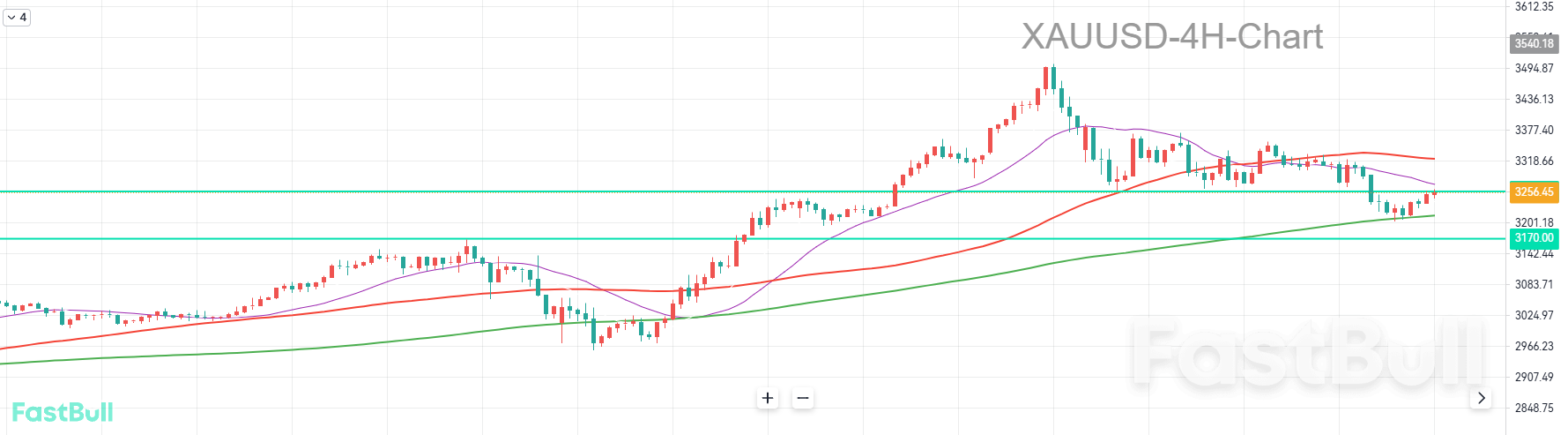
          From a broader trend perspective, despite the recent correction of nearly $300, the underlying bullish trend in gold remains intact, with the overall trajectory still favoring higher prices.
          On the 4-hour chart, gold has recently breached the key support level at $3,260, thereby opening up further downside potential. The subsequent target may be to test the support level at $3,170.
          Currently, the level of $3,260 has transitioned from support to resistance. XAUUSD has rebounded to the vicinity of this resistance level. Should gold prices exhibit signs of weakness at this resistance level, a further decline in gold prices is likely in the short term.

          Trading Recommendations

          Trading Direction: Sell
          Entry Price: 3260.00
          Target Price: 3180.00
          Stop Loss: 3295.00
          Valid Until: May 16, 2025, 23:00:00
          Support: 3201.87/3170.00
          Resistance: 3260.00/3280.00
          Risk Warnings and Disclaimers
          You understand and acknowledge that there is a high degree of risk involved in trading. Following any strategies or investment methods may lead to potential losses. The content on the site is provided by our contributors and analysts for information purposes only. You are solely responsible for determining whether any trading assets, securities, strategy, or any other product is suitable for investing based on your own investment objectives and financial situation.
          Add to Favorites
          Share

          Euro Slides Below 1.1330 as Dollar Rallies on Solid U.S. Data and Hawkish Fed Bets

          Warren Takunda

          Economic

          Summary:

          The EUR/USD pair has come under renewed selling pressure, sliding toward 1.1285 as the US Dollar strengthens following upbeat ISM manufacturing data and persistent inflation fears.

          SELL EURUSD
          Close Time
          CLOSED

          1.12800

          Entry Price

          1.10000

          TP

          1.14300

          SL

          1.16597 +0.00171 +0.15%

          27.3

          Pips

          Profit

          1.10000

          TP

          1.12527

          Exit Price

          1.12800

          Entry Price

          1.14300

          SL

          The euro came under heavy selling pressure on Thursday, sliding decisively below the 1.1330 level and hitting session lows around 1.1285 during North American trade. The sharp drop in the EUR/USD exchange rate marks a critical technical and psychological shift, coming as the US dollar flexes its muscle once again supported by a surprisingly firm manufacturing sector and stubbornly persistent inflation in the United States. In contrast, the euro is facing growing headwinds amid dovish European Central Bank rhetoric and renewed fears of slowing inflation across the bloc.
          The dollar’s rebound has been swift and forceful. The US Dollar Index (DXY), which tracks the greenback’s performance against a basket of major currencies, extended its recovery for the second consecutive session, punching through the crucial 100.00 mark a level often seen as a sentiment bellwether in currency markets. This resurgence followed the release of the April ISM Manufacturing PMI, which printed at 48.7, beating analysts' expectations of 48.0. Although the reading remained below the 50.0 threshold that demarcates contraction from expansion, the data was nonetheless taken as a signal of relative resilience, especially considering broader fears of economic softness.
          More importantly for markets, inflationary pressure within the manufacturing sector remains elevated. The Prices Paid sub-index climbed to 69.8 from the previous 69.4, indicating that cost pressures on inputs are not easing, but rather intensifying. This uptick complicates the Federal Reserve’s path forward, as it suggests price growth is more entrenched than previously anticipated — a scenario that would likely delay any potential interest rate cuts and strengthen the dollar further in the process.
          This follows Wednesday’s release of US GDP data, which revealed that the economy contracted by 0.3% on an annualized basis in the first quarter. It was the first time in three years that the US economy has posted a negative quarter. However, analysts from Morgan Stanley were quick to highlight that the contraction might not tell the full story. They argued that the dip in output was partially masked by inventory distortions, as American firms scrambled to frontload imports ahead of looming tariff hikes imposed by President Donald Trump. The full brunt of those protectionist measures, they warned, would likely manifest more clearly in the coming quarters, with possible ripple effects in hiring, inflation, and consumer spending.
          Meanwhile, the geopolitical backdrop continues to offer little reassurance. Trade tensions between Washington and Beijing remain unresolved. In an interview with Fox News, US Trade Representative Jamieson Greer made it clear that no formal negotiations have resumed with China since the latest round of reciprocal tariffs. According to reporting by the South China Morning Post, Greer acknowledged that the current environment is one of “stalemate,” with no near-term dialogue planned an admission that immediately rekindled concerns over the global trade outlook and reinforced safe-haven demand for the dollar.
          On the other side of the Atlantic, the euro has been weighed down by rising expectations that the European Central Bank will be the first major monetary authority to cut rates this year. A growing chorus of ECB officials has voiced concern about the downside risks to inflation, particularly as the continent struggles to digest the economic fallout from US trade policy. The ECB’s Deposit Facility rate, currently at 2.25%, is widely expected to be cut by 25 basis points at the central bank’s June meeting. Such a move would not only widen the policy divergence with the Federal Reserve but could also undermine the euro further, particularly if inflation data continues to trend lower.
          Indeed, preliminary inflation figures for the Eurozone, set for release on Friday, are expected to confirm the ECB’s concerns. The Harmonized Index of Consumer Prices (HICP) for April is forecast to rise just 2.1% year-on-year, a modest slowdown from the 2.2% pace in March. At the core level — which strips out volatile items like energy, food, alcohol, and tobacco — price growth is seen ticking up slightly to 2.5% from 2.4%. However, national-level data suggests that the disinflationary trend is uneven. While Germany and France reported cooling inflation, Spain and Italy showed more stable price trends, highlighting the fragmented nature of price dynamics within the bloc.
          To complicate matters further, recent GDP figures for the Eurozone offered a mixed picture. Eurostat reported that the region’s economy grew 0.4% in the first quarter — a stronger-than-expected print that doubled the growth rate recorded in the final quarter of 2024. Yet analysts caution that these numbers likely do not reflect the full impact of recently imposed US tariffs on European automobile exports, a key sector for the region. As these trade barriers filter through supply chains and corporate profit margins, the case for looser monetary policy in Europe may become more compelling.
          From a market psychology standpoint, the current move in EUR/USD is not merely technical — it reflects an increasingly clear macro divergence between the US and Europe. The Federal Reserve, despite a brief pause in tightening, remains in a holding pattern due to sticky inflation, while the ECB appears poised to ease amid softer price pressures and external trade shocks. This policy bifurcation has reasserted itself in currency markets, and barring a dramatic shift in incoming data, it is likely to persist.
          Technical AnalysisEuro Slides Below 1.1330 as Dollar Rallies on Solid U.S. Data and Hawkish Fed Bets_1
          Technically, the EUR/USD pair has breached key support levels, and the recent drop has been exacerbated by a classic head-and-shoulders pattern breakdown on the short-term charts. The neckline breach reinforced bearish sentiment, and while intraday price action attempted a modest rebound, these efforts have so far failed to reclaim meaningful ground. Momentum indicators such as the Relative Strength Index (RSI) have begun to emerge from oversold territory, suggesting the potential for minor recoveries, but the broader trend remains firmly tilted to the downside.
          Unless buyers manage to decisively retake the 1.1360–1.1390 resistance zone, the euro remains vulnerable to further losses. A drop toward the next support level at 1.1260 appears likely, and if that fails to hold, markets may begin to price in a test of the psychologically important 1.1000 level.
          TRADE RECOMMENDATION
          SELL EURUSD
          ENTRY PRICE: 1.1280
          STOP LOSS: 1.1430
          TAKE PROFIT: 1.1000
          Risk Warnings and Disclaimers
          You understand and acknowledge that there is a high degree of risk involved in trading. Following any strategies or investment methods may lead to potential losses. The content on the site is provided by our contributors and analysts for information purposes only. You are solely responsible for determining whether any trading assets, securities, strategy, or any other product is suitable for investing based on your own investment objectives and financial situation.
          Add to Favorites
          Share
          FastBull
          Copyright © 2025 FastBull Ltd

          728 RM B 7/F GEE LOK IND BLDG NO 34 HUNG TO RD KWUN TONG KLN HONG KONG

          TelegramInstagramTwitterfacebooklinkedin
          App Store Google Play Google Play
          Products
          Charts

          Chats

          Q&A with Experts
          Screeners
          Economic Calendar
          Data
          Tools
          Membership
          Features
          Function
          Markets
          Copy Trading
          Latest Signals
          Contests
          News
          Analysis
          24/7
          Columns
          Education
          Company
          Careers
          About Us
          Contact Us
          Advertising
          Help Center
          Feedback
          User Agreement
          Privacy Policy
          Business

          White Label

          Data API

          Web Plug-ins

          Poster Maker

          Affiliate Program

          Risk Disclosure

          The risk of loss in trading financial instruments such as stocks, FX, commodities, futures, bonds, ETFs and crypto can be substantial. You may sustain a total loss of the funds that you deposit with your broker. Therefore, you should carefully consider whether such trading is suitable for you in light of your circumstances and financial resources.

          No decision to invest should be made without thoroughly conducting due diligence by yourself or consulting with your financial advisors. Our web content might not suit you since we don't know your financial conditions and investment needs. Our financial information might have latency or contain inaccuracy, so you should be fully responsible for any of your trading and investment decisions. The company will not be responsible for your capital loss.

          Without getting permission from the website, you are not allowed to copy the website's graphics, texts, or trademarks. Intellectual property rights in the content or data incorporated into this website belong to its providers and exchange merchants.

          Not Logged In

          Log in to access more features

          FastBull Membership

          Not yet

          Purchase

          Become a signal provider
          Help Center
          Customer Service
          Dark Mode
          Price Up/Down Colors

          Log In

          Sign Up

          Position
          Layout
          Fullscreen
          Default to Chart
          The chart page opens by default when you visit fastbull.com
