• Trade
  • Markets
  • Copy
  • Contests
  • News
  • 24/7
  • Calendar
  • Q&A
  • Chats
Trending
Screeners
SYMBOL
LAST
BID
ASK
HIGH
LOW
NET CHG.
%CHG.
SPREAD
SPX
S&P 500 Index
6845.49
6845.49
6845.49
0.00
0
0.00
0.00%
--
DJI
Dow Jones Industrial Average
48063.28
48063.28
48063.28
0.00
0
0.00
0.00%
--
IXIC
NASDAQ Composite Index
23241.98
23241.98
23241.98
0.00
0
0.00
0.00%
--
USDX
US Dollar Index
97.950
98.030
97.950
0.000
0
0.000
0.00%
--
EURUSD
Euro / US Dollar
1.17453
1.17469
1.17453
1.17591
1.17198
-0.00021
-0.02%
--
GBPUSD
Pound Sterling / US Dollar
1.34721
1.34753
1.34721
1.34832
1.34014
+0.00046
+ 0.03%
--
XAUUSD
Gold / US Dollar
4319.61
4320.02
4319.61
0.00
0
0.00
0.00%
--
WTI
Light Sweet Crude Oil
57.439
57.469
57.439
0.000
0
0.000
0.00%
--

Community Accounts

Signal Accounts
--
Profit Accounts
--
Loss Accounts
--
View More

Become a signal provider

Sell trading signals to earn additional income

View More

Guide to Copy Trading

Get started with ease and confidence

View More

Signal Accounts for Members

All Signal Accounts

Best Return
  • Best Return
  • Best P/L
  • Best MDD
Past 1W
  • Past 1W
  • Past 1M
  • Past 1Y

All Contests

  • All
  • Trump Updates
  • Recommend
  • Stocks
  • Cryptocurrencies
  • Central Banks
  • Featured News
Top News Only
Share

[US Imposes 1% Tax On Certain Cross-Border Remittances] On January 1st, New Tax Measures For Certain Cross-border Remittances Officially Took Effect In The United States. According To Regulations From The US Treasury Department And The IRS, Starting January 1, 2026, Remittance Service Providers Are Required To Collect A 1% Tax On Eligible Remittance Transactions And Declare And Pay It As Required. The Regulations Indicate That This Tax Will Be Payable When Remitters Use Cash Or Similar "instruments Of Payment In Kind" (including Drafts, Bank Drafts, Etc.) As The Source Of Funds For Cross-border Remittances; Transactions Using US Bank Accounts Or Debit Cards, Credit Cards, Etc., Are Generally Not Subject To This Tax

Share

Gambia Defence Ministry: Seven Bodies Recovered, 96 People Rescued After Migrant Boat Capsizes

Share

[KFC And Pizza Hut Operator In India To Merge For $934 Million] On January 1st, Sapphire Foods, The Operator Of KFC And Pizza Hut In India, And Devyani International Announced A Merger Worth $934 Million. Under The Agreement, Devyani Will Merge At A Ratio Of 177 Devyani Shares For Every 100 Sapphire Shares. The Merged Entity Is Expected To Generate Synergies Of 2.1 Billion To 2.25 Billion Rupees ($23.34 Million To $25.01 Million) Annually Starting From Its Second Year Of Full Operation

Share

In The Past 24 Hours, The Marketvector™ Digital Asset 100 Small Cap Index Rose 3.61%, Currently At 3575 Points. The Marketvector Digital Asset 100 Index Rose 0.47%, Currently At 18035 Points

Share

President Of Cantonal Government Mathias Reynard: Likely That Some Burn Patients Will Be Soon Transferred To Neighbouring Countries

Share

Reuters Poll: 9 Of 10 Economists See Bank Of Israel Keeping Benchmark Interest Rate At 4.25% On Monday, 1 Sees 25 Bps Cut

Share

Swiss Prosecutor Beatrice Pilloud: There Are Several Hypotheses On The Table About Fire's Cause

Share

President Of Cantonal Government Mathias Reynard: Identification Of Dead Will Take Time

Share

Swiss President Guy Parmelin: Swiss Flags In Bern Will Fly At Half Mast For Five Days

Share

Swiss President Guy Parmelin: Many Of The Victims Were Youths

Share

Swiss President Guy Parmelin: The Fire Is One Of The Worst Tragedies Our Country Has Ever Known

Share

[Affordable Care Act Subsidies Expire, Many Americans To Face Higher Healthcare Costs] It Was Learned On January 1st That The Enhanced Subsidy Aimed At Reducing Premiums For Affordable Care Act Participants In The United States Will Expire At The End Of 2025. It Is Estimated That More Than 20 Million Americans Will Face Higher Healthcare Costs At The Beginning Of 2026. The Democratic And Republican Parties In The United States Have Clashed Repeatedly Over Whether To Extend This Subsidy. Ultimately, They Failed To Reach An Agreement Before The Subsidy Expires. The House Of Representatives Is Expected To Vote On The Relevant Proposal Again In January

Share

Ukraine's Lead Peace Negotiator Says He Met Turkey's Foreign Minister

Share

Foreign Minister: Sixteen Italians Missing After Swiss Blaze

Share

Trump Tells Wsj He Is Taking More Aspirin Than Doctors Recommend

Share

Saudi Source: Yemen's Aden Airport Shut By Stc-Backed Transport Minister

Share

The Southern Transitional Council Transportation Minister Is Refusing To Comply With The Directive And Has Instead Ordered The Shutdown Of All Air Traffic - Saudi Source

Share

Yemen's Internationally Recongized Government Imposes Restrictions On Air Traffic To And From Abu Dhabi And Dubai To Mitigate Ongoing Escalation In The Country - Saudi Source To Reuters

Share

Russia Says It Will Give USA Proof Of Attempted Ukrainian Strike On Putin Residence

Share

Somali Armed Forces In Coordination With International Partners Eliminate 29 Al-Shabaab Militants In Jabad Godane

TIME
ACT
FCST
PREV
U.S. S&P/CS 10-City Home Price Index MoM (Not SA) (Oct)

A:--

F: --

P: --

U.S. S&P/CS 20-City Home Price Index (Not SA) (Oct)

A:--

F: --

P: --

U.S. S&P/CS 20-City Home Price Index MoM (Not SA) (Oct)

A:--

F: --

P: --

U.S. Chicago PMI (Dec)

A:--

F: --

P: --

Brazil CAGED Net Payroll Jobs (Nov)

A:--

F: --

P: --

U.S. Weekly Total Oil Rig Count

A:--

F: --

P: --

U.S. Weekly Total Rig Count

A:--

F: --

P: --

FOMC Meeting Minutes
U.S. API Weekly Refined Oil Stocks

A:--

F: --

P: --

U.S. API Weekly Crude Oil Stocks

A:--

F: --

P: --

U.S. API Weekly Cushing Crude Oil Stocks

A:--

F: --

P: --

U.S. API Weekly Gasoline Stocks

A:--

F: --

P: --

South Korea CPI YoY (Dec)

A:--

F: --

P: --

China, Mainland NBS Manufacturing PMI (Dec)

A:--

F: --

P: --

China, Mainland Composite PMI (Dec)

A:--

F: --

P: --

China, Mainland NBS Non-manufacturing PMI (Dec)

A:--

F: --

P: --

China, Mainland Caixin Manufacturing PMI (SA) (Dec)

A:--

F: --

P: --

Turkey Trade Balance (Nov)

A:--

F: --

P: --

South Africa Trade Balance (Nov)

A:--

F: --

P: --

U.S. Initial Jobless Claims 4-Week Avg. (SA)

A:--

F: --

P: --
U.S. Weekly Continued Jobless Claims (SA)

A:--

F: --

P: --
U.S. Weekly Initial Jobless Claims (SA)

A:--

F: --

P: --
U.S. EIA Weekly Cushing, Oklahoma Crude Oil Stocks Change

A:--

F: --

P: --

U.S. EIA Weekly Crude Demand Projected by Production

A:--

F: --

P: --

U.S. EIA Weekly Gasoline Stocks Change

A:--

F: --

P: --

U.S. EIA Weekly Crude Stocks Change

A:--

F: --

P: --

U.S. EIA Weekly Heating Oil Stock Changes

A:--

F: --

P: --

U.S. EIA Weekly Crude Oil Imports Changes

A:--

F: --

P: --

U.S. EIA Weekly Natural Gas Stocks Change

A:--

F: --

P: --

South Korea Trade Balance Prelim (Dec)

A:--

F: --

P: --

South Korea IHS Markit Manufacturing PMI (SA) (Dec)

--

F: --

P: --

Indonesia IHS Markit Manufacturing PMI (Dec)

--

F: --

P: --

India HSBC Manufacturing PMI Final (Dec)

--

F: --

P: --

U.K. Nationwide House Price Index MoM (Dec)

--

F: --

P: --

U.K. Nationwide House Price Index YoY (Dec)

--

F: --

P: --

Turkey Manufacturing PMI (Dec)

--

F: --

P: --

Italy Manufacturing PMI (SA) (Dec)

--

F: --

P: --

Euro Zone Manufacturing PMI Final (Dec)

--

F: --

P: --

Euro Zone M3 Money Supply (SA) (Nov)

--

F: --

P: --

Euro Zone 3-Month M3 Money Supply YoY (Nov)

--

F: --

P: --

Euro Zone Private Sector Credit YoY (Nov)

--

F: --

P: --

Euro Zone M3 Money Supply YoY (Nov)

--

F: --

P: --

U.K. Manufacturing PMI Final (Dec)

--

F: --

P: --

India Deposit Gowth YoY

--

F: --

P: --

Brazil IHS Markit Manufacturing PMI (Dec)

--

F: --

P: --

Canada Manufacturing PMI (SA) (Dec)

--

F: --

P: --

U.S. IHS Markit Manufacturing PMI Final (Dec)

--

F: --

P: --

Mexico Manufacturing PMI (Dec)

--

F: --

P: --

U.S. Weekly Treasuries Held by Foreign Central Banks

--

F: --

P: --

Philadelphia Fed President Henry Paulson delivers a speech
Japan Manufacturing PMI Final (Dec)

--

F: --

P: --

China, Mainland Caixin Composite PMI (Dec)

--

F: --

P: --

China, Mainland Caixin Services PMI (Dec)

--

F: --

P: --

Indonesia Trade Balance (Nov)

--

F: --

P: --

Indonesia Core Inflation YoY (Dec)

--

F: --

P: --

Indonesia Inflation Rate YoY (Dec)

--

F: --

P: --

Saudi Arabia IHS Markit Composite PMI (Dec)

--

F: --

P: --

Turkey CPI YoY (Excl. Energy, Food, Beverage, Tobacco & Gold) (Dec)

--

F: --

P: --

Turkey CPI YoY (Dec)

--

F: --

P: --

Turkey PPI YoY (Dec)

--

F: --

P: --

U.K. Mortgage Approvals (Nov)

--

F: --

P: --

Q&A with Experts
    • All
    • Chatrooms
    • Groups
    • Friends
    3213054 flag
    hey
    3213054 flag
    hi guys
    3213045 flag
    hi
    john flag
    Kihungi De
    hello guys new here
    @Kihungi Dewelcome,,,I have been here for the last 2 years
    john flag
    Kihungi De
    hello guys new here
    @Kihungi DeAnd I have really learned a lot
    3213058 flag
    hello everyone
    john flag
    Kihungi De
    hello guys new here
    @Kihungi Deare you new to trading as well ?
    john flag
    3213058
    hello everyone
    @Visitor3213058hello,, happy new year
    King Zefx flag
    King Zefx flag
    Those who want to join the rebate, please join
    3213098 flag
    hello
    3213098 flag
    oooo
    3213098 flag
    hello yahoo
    Khang Le flag
    Why didn't I receive a verification code after verifying my phone number, guys?
    ROHIM flag
    Hello friends..
    ROHIM flag
    Let's make BTC fun again today..
    ROHIM flag
    ROHIM flag
    mukesh jha flag
    Enjoy life and wife today morning trade setup first tgt hit 1000 point move
    Ahmed flag
    This traders
    Type here...
    Add Symbol or Code

      No matching data

      All
      Trump Updates
      Recommend
      Stocks
      Cryptocurrencies
      Central Banks
      Featured News
      • All
      • Russia-Ukraine Conflict
      • Middle East Flashpoint
      • All
      • Russia-Ukraine Conflict
      • Middle East Flashpoint

      Search
      Products

      Charts Free Forever

      Chats Q&A with Experts
      Screeners Economic Calendar Data Tools
      Membership Features
      Data Warehouse Market Trends Institutional Data Policy Rates Macro

      Market Trends

      Market Sentiment Order Book Forex Correlations

      Top Indicators

      Charts Free Forever
      Markets

      News

      News Analysis 24/7 Columns Education
      From Institutions From Analysts
      Topics Columnists

      Latest Views

      Latest Views

      Trending Topics

      Top Columnists

      Latest Update

      Signals

      Copy Rankings Latest Signals Become a signal provider AI Rating
      Contests
      Brokers

      Overview Brokers Assessment Rankings Regulators News Claims
      Broker listing Forex Brokers Comparison Tool Live Spread Comparison Scam
      Q&A Complaint Scam Alert Videos Tips to Detect Scam
      More

      Business
      Events
      Careers About Us Advertising Help Center

      White Label

      Data API

      Web Plug-ins

      Affiliate Program

      Awards Institution Evaluation IB Seminar Salon Event Exhibition
      Vietnam Thailand Singapore Dubai
      Fans Party Investment Sharing Session
      FastBull Summit BrokersView Expo
      Recent Searches
        Top Searches
          Markets
          News
          Analysis
          User
          24/7
          Economic Calendar
          Education
          Data
          • Names
          • Latest
          • Prev

          View All

          No data

          Scan to Download

          Faster Charts, Chat Faster!

          Download App
          English
          • English
          • Español
          • العربية
          • Bahasa Indonesia
          • Bahasa Melayu
          • Tiếng Việt
          • ภาษาไทย
          • Français
          • Italiano
          • Türkçe
          • Русский язык
          • 简中
          • 繁中
          Open Account
          Search
          Products
          Charts Free Forever
          Markets
          News
          Signals

          Copy Rankings Latest Signals Become a signal provider AI Rating
          Contests
          Brokers

          Overview Brokers Assessment Rankings Regulators News Claims
          Broker listing Forex Brokers Comparison Tool Live Spread Comparison Scam
          Q&A Complaint Scam Alert Videos Tips to Detect Scam
          More

          Business
          Events
          Careers About Us Advertising Help Center

          White Label

          Data API

          Web Plug-ins

          Affiliate Program

          Awards Institution Evaluation IB Seminar Salon Event Exhibition
          Vietnam Thailand Singapore Dubai
          Fans Party Investment Sharing Session
          FastBull Summit BrokersView Expo

          EUR/USD Finds Support Near 1.1720 as Year-End Dollar Recovery Loses Momentum

          Warren Takunda

          Traders' Opinions

          Summary:

          EUR/USD has turned modestly higher after finding support near 1.1720, with fading US dollar momentum and policy divergence between the ECB and the Fed keeping the broader bias constructive despite thin year-end liquidity.

          BUY EURUSD
          EXP
          TRADING

          1.17548

          Entry Price

          1.18200

          TP

          1.17160

          SL

          1.17453 -0.00021 -0.02%

          0.0

          Pips

          Flat

          1.17160

          SL

          Exit Price

          1.17548

          Entry Price

          1.18200

          TP
          The euro has regained a firmer footing against the US dollar, with EUR/USD turning positive on the daily chart on Wednesday as selling pressure in the greenback begins to ease. The pair found solid demand around the 1.1720 area during the European morning session before pushing back above 1.1750, where it was trading as markets headed into the US opening. While the rebound remains tentative, the price action suggests that downside momentum is losing traction, even as year-end conditions keep trading volumes subdued.
          The immediate catalyst for the mild recovery appears to be a loss of steam in the recent US dollar bounce. With liquidity thinning sharply ahead of the New Year holiday, even modest shifts in expectations can generate outsized moves. Attention later in the session turns to US Initial Jobless Claims, one of the few remaining top-tier data points before markets effectively shut down for the year. While the release is unlikely to dramatically alter the macro narrative on its own, it could inject some short-lived volatility into what has otherwise been a sleepy trading environment.
          Looking beyond the day-to-day fluctuations, the broader trend continues to favor the common currency. The euro is on course to post an annual gain of roughly 14% against the dollar, a striking performance that underscores the scale of the shift in global monetary policy expectations over the past year. At the heart of this move lies a clear divergence between the European Central Bank and the US Federal Reserve. While the ECB has signaled a willingness to keep policy restrictive for longer in its fight against inflation, the Fed has moved closer to the end of its tightening cycle and has already begun easing policy.
          Political and structural factors in the United States have added to the dollar’s woes. President Donald Trump’s unpredictable approach to trade policy has injected a fresh layer of uncertainty into the outlook for US growth and global trade flows. At the same time, signs of a softening US economy have become harder to ignore, reinforcing the view that US interest rates are more likely to fall than rise in the months ahead. Together, these dynamics have steadily eroded the dollar’s yield advantage, a key pillar of its strength in previous years.
          The minutes from the Federal Open Market Committee’s latest meeting, released on Tuesday, offered further insight into the shifting balance within the Fed. They revealed a wider-than-expected divergence among policymakers, with the decision to cut rates by 25 basis points passing by a narrower margin than markets had assumed. Importantly, the committee emphasized that any additional easing would depend on a sustained and convincing decline in inflation. This conditional stance has cast doubt over the timing and pace of future rate cuts, prompting a brief bout of dollar strength immediately after the minutes were published.
          However, that reaction proved short-lived. Investors appear increasingly skeptical that the Fed will be able to maintain a restrictive stance for long if economic data continue to soften. As a result, rallies in the dollar are being viewed as opportunities to sell rather than the start of a more durable recovery, particularly against currencies such as the euro that are underpinned by a relatively more hawkish central bank outlook.
          From a market structure perspective, conditions remain far from ideal for trend-following strategies. Most major financial centers will be closed on Thursday for New Year celebrations, while Japanese markets are shut for the remainder of the week. These closures are likely to keep liquidity thin and price action choppy, increasing the risk of false breakouts in either direction.
          Technical analysisEUR/USD Finds Support Near 1.1720 as Year-End Dollar Recovery Loses Momentum_1
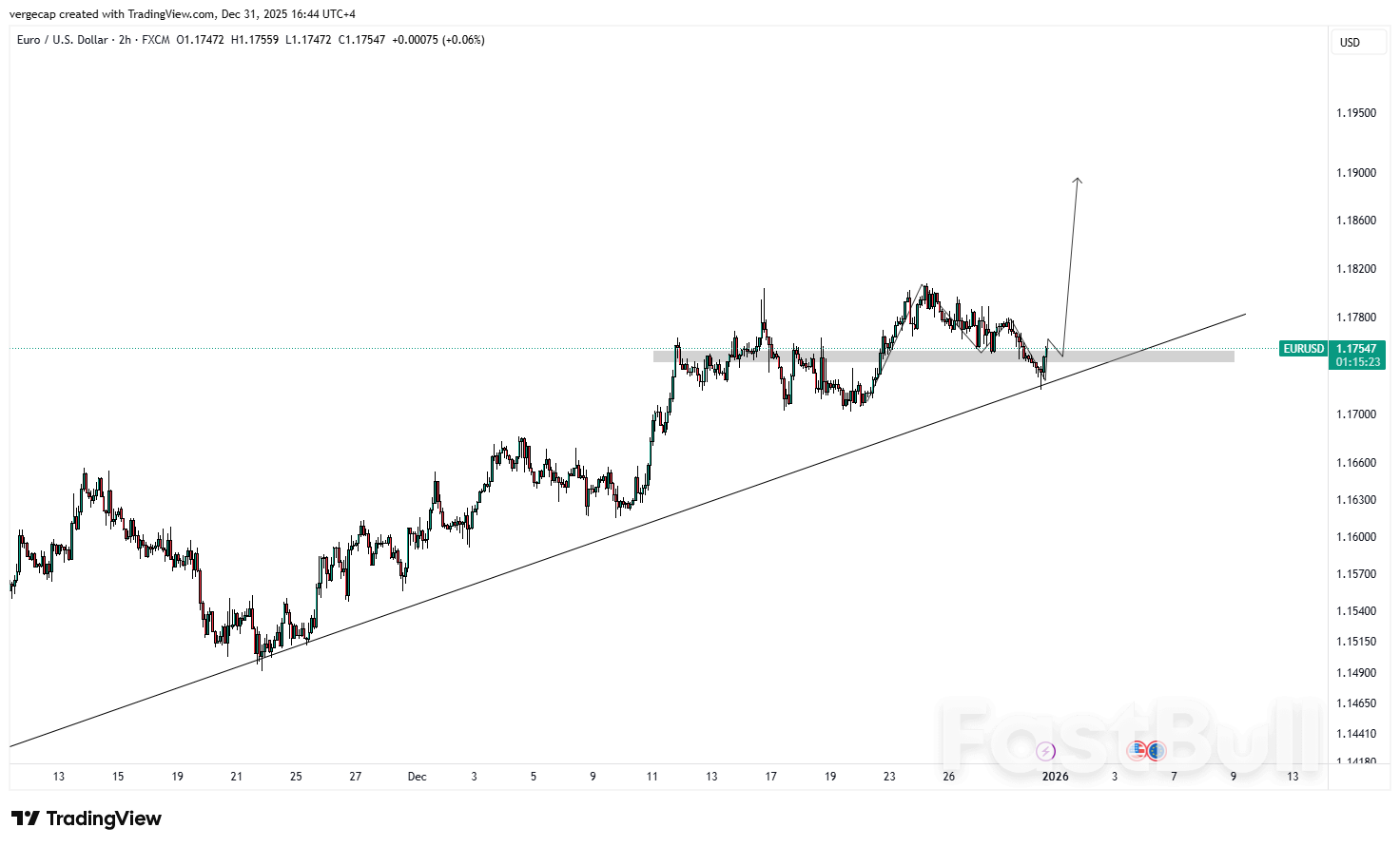
          On the technical front, EUR/USD is showing early signs of stabilization, though the recovery is still fragile. On the four-hour chart, the Relative Strength Index has rebounded from levels close to oversold territory, indicating that bearish pressure is easing. Nevertheless, the RSI remains below the neutral 50 mark, suggesting that upside momentum has yet to fully reassert itself. The Moving Average Convergence Divergence indicator tells a similar story: bearish momentum is fading, but the MACD line is still below zero, pointing to lingering downside risks.
          Key resistance levels remain clearly defined. A reverse trendline, currently around 1.1770, is likely to act as the first major obstacle to any sustained bullish reversal. A decisive break above this area would open the door toward the December 16 and December 24 highs near 1.1805. Beyond that, the September 23 and 24 peaks around 1.1820 come into focus, a zone that could prove challenging without a stronger fundamental catalyst.

          TRADE RECOMMENDATION

          BUY EURUSD
          ENTRY PRICE: 1.17550
          STOP LOSS: 1.17160
          TAKE PROFIT: 1.1820
          Risk Warnings and Disclaimers
          You understand and acknowledge that there is a high degree of risk involved in trading. Following any strategies or investment methods may lead to potential losses. The content on the site is provided by our contributors and analysts for information purposes only. You are solely responsible for determining whether any trading assets, securities, strategy, or any other product is suitable for investing based on your own investment objectives and financial situation.
          Add to Favorites
          Share

          EUR/JPY Stays Elevated as Japan Policy Risks Outshine Eurozone Concerns

          Warren Takunda

          Traders' Opinions

          Summary:

          The yen continues to crumble as the Bank of Japan’s slow policy shift contrasts sharply with a firming ECB outlook, keeping EUR/JPY near multi-decade highs with technicals pointing to further upside toward 185.50.

          BUY EURJPY
          EXP
          TRADING

          184.100

          Entry Price

          185.500

          TP

          183.300

          SL

          183.993 +0.202 +0.11%

          0.0

          Pips

          Flat

          183.300

          SL

          Exit Price

          184.100

          Entry Price

          185.500

          TP

          The Japanese yen continues to struggle near the bottom of the major currency performance table, extending its underwhelming run during thin holiday trading on Wednesday. Against the euro, the yen remains firmly on the defensive, with EUR/JPY gravitating toward the 184.00 level by the European midday session. The pair rebounded from the 183.50 area on Tuesday, but the recovery has done little to alter the broader narrative of sustained yen weakness.
          Viewed from a longer-term perspective, the cross remains uncomfortably close to its cycle highs. EUR/JPY is trading only a short distance below the long-term peak near 185.00 reached earlier this month and is on track to close the year with gains of more than 14%. Such a move is striking not only for its scale but also for its persistence, underscoring how deeply entrenched the negative sentiment toward the yen has become.
          The primary driver of that sentiment continues to be the Bank of Japan’s hesitant approach to monetary normalisation. After years of ultra-loose policy, investors had hoped for a clearer and more decisive exit strategy. Instead, the BoJ has delivered cautious signals that tightening will continue, while offering little guidance on timing or pace. The latest Summary of Opinions from the central bank reaffirmed its commitment to further rate increases, yet stopped short of outlining a concrete path forward. This lack of clarity has reinforced the perception that any tightening will be slow, cautious and easily derailed by political considerations.
          Those political considerations are increasingly important. Prime Minister Sanae Takaichi’s expansionary fiscal stance has revived concerns about Japan’s already stretched public finances, raising doubts about how aggressively monetary policy can tighten without destabilising growth. At the same time, lingering uncertainty over potential US trade tariffs under Donald Trump has added another layer of risk for Japan’s export-oriented economy. Together, these factors have created what many investors see as a perfect storm for the yen, helping to explain why it has emerged as the weakest major currency performer of 2025.
          In this environment, upside attempts in the yen have consistently failed to gain traction. The government is widely expected to oppose anything more than a very gradual normalisation cycle, effectively limiting how far Japanese yields can rise relative to their global peers. As long as that remains the case, yield differentials are likely to continue favouring yen selling on rallies rather than encouraging a sustained recovery.
          By contrast, the euro has found modest but meaningful support from shifting expectations around European Central Bank policy. In recent weeks, ECB communication has increasingly suggested that the easing cycle may be over. While officials remain cautious and data-dependent, markets are beginning to price the possibility that the next policy move could be a rate hike, potentially in the second half of next year. That change in tone has given the euro additional lift, particularly against low-yielding currencies such as the yen.

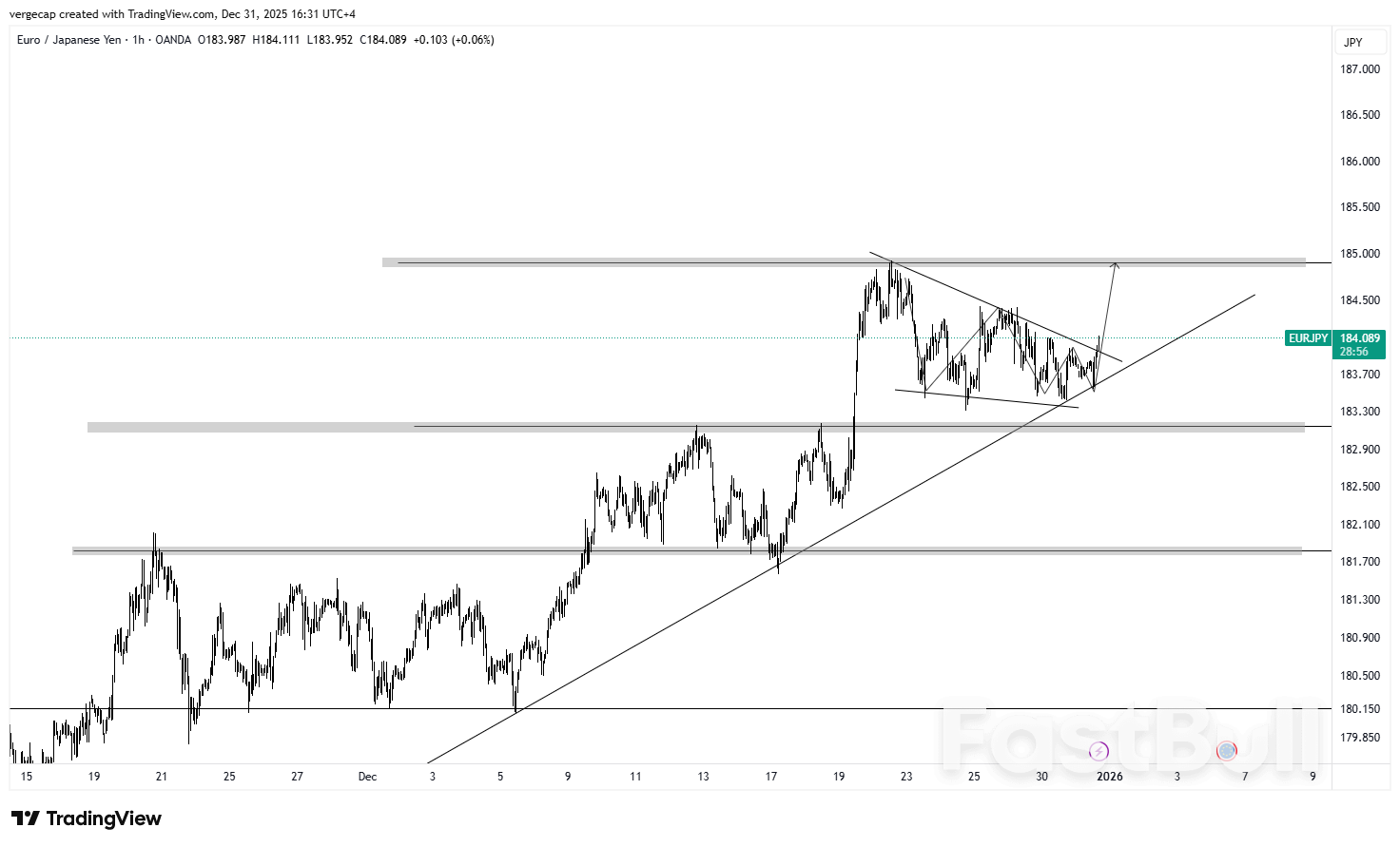
          Technical AnalysisEUR/JPY Stays Elevated as Japan Policy Risks Outshine Eurozone Concerns_1

          From an analytical standpoint, this divergence in central bank trajectories remains the dominant force shaping EUR/JPY. Even without a strong growth impulse from the euro zone, relative policy expectations have been enough to keep the cross elevated. Unless the BoJ surprises markets with a clearer and more assertive tightening signal, or global risk sentiment deteriorates sharply enough to trigger broad safe-haven demand, the balance of risks continues to tilt against the yen.
          The technical picture reinforces that view. EUR/JPY continues to trade within a well-defined upward channel, confirming that the broader bullish structure remains intact. Recent price action shows the pair consolidating rather than reversing, forming a bullish triangle pattern that typically precedes trend continuation. The series of higher lows over recent sessions highlights the willingness of buyers to step in on dips, absorbing selling pressure without allowing a deeper correction to develop.
          As price action compresses near the upper boundary of this consolidation, the probability of a directional break is increasing. A strong bullish candle closing above the upper trendline would confirm a breakout and likely attract momentum-driven flows, rather than trigger profit-taking. In that scenario, the next area of interest sits around 185.50, extending beyond this month’s highs and reinforcing the sense that the rally has not yet run its course.

          TRADE RECOMMENDATION

          BUY EURJPY
          ENTRY PRICE: 184.10
          STOP LOSS: 183.30
          TAKE PROFIT: 185.50
          Risk Warnings and Disclaimers
          You understand and acknowledge that there is a high degree of risk involved in trading. Following any strategies or investment methods may lead to potential losses. The content on the site is provided by our contributors and analysts for information purposes only. You are solely responsible for determining whether any trading assets, securities, strategy, or any other product is suitable for investing based on your own investment objectives and financial situation.
          Add to Favorites
          Share

          Market Returns to Oversupply Pattern, Decline May Continue

          Alan

          Commodity

          Summary:

          With the impact of geopolitical factors easing, supply-demand dynamics drive market movements again. Under an oversupplied environment, WTI may continue to weaken.

          SELL WTI
          EXP
          TRADING

          57.689

          Entry Price

          52.800

          TP

          59.100

          SL

          57.439 -0.414 -0.72%

          0.0

          Pips

          Flat

          52.800

          TP

          Exit Price

          57.689

          Entry Price

          59.100

          SL

          Fundamentals

          The core factor currently influencing oil prices lies in the dual pattern of ample supply and fragile demand. On one hand, global supply remains difficult to tighten quickly, given the resilience of U.S. production and news of overall output increases or maintained production levels from OPEC+. As a result, the market faces persistent downward pressure. Multiple institutions and media outlets note that although prices were temporarily jolted by geopolitical events during the year, oversupply has been the dominant factor overall.
          On the other hand, international agencies are not entirely pessimistic about demand: IEA's monthly report revised 2026 demand slightly higher. However, this improvement is insufficient to absorb the current excess capacity immediately. In the short term, it is unlikely to change the fundamental backdrop of "slow inventory digestion."
          In addition, positioning on exchanges and microstructure in the futures market have amplified intraday volatility: recent reports show futures positions and trading volumes declining seasonally toward year-end. If technical selling pressure or margin adjustments occur, price pullbacks could be magnified.

          Technical Analysis

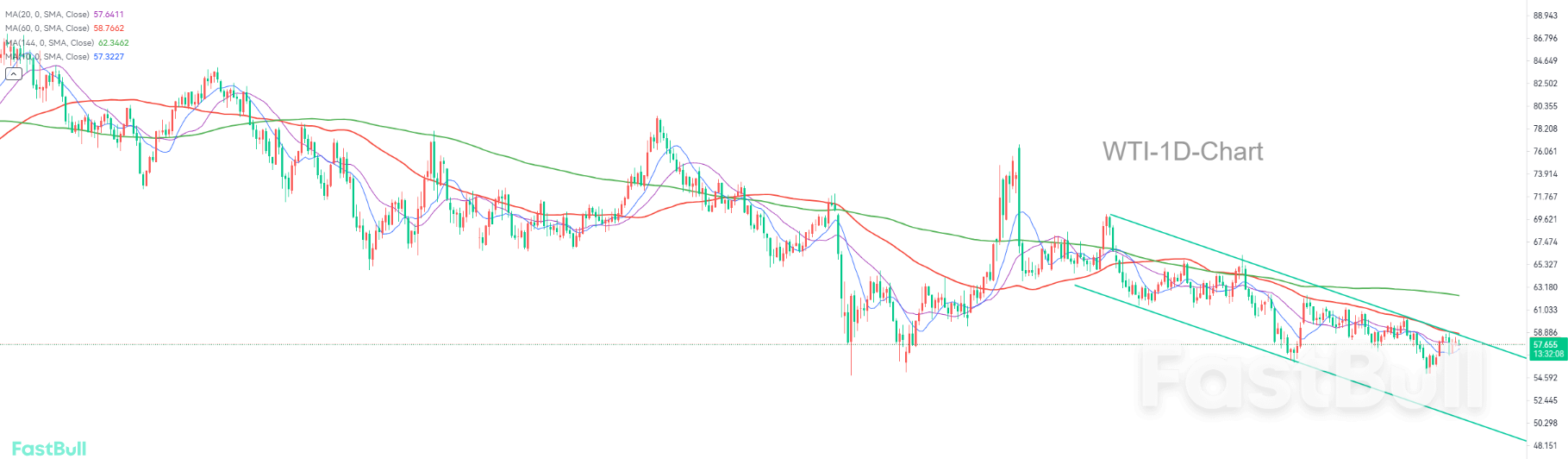
          Market Returns to Oversupply Pattern, Decline May Continue_1
          Based on the daily chart, WTI's trend stays within a descending channel. Recently, price action has repeatedly touched the upper rail of the descending channel but failed to break through effectively, indicating weakening bullish momentum and increasing likelihood of a near-term downtrend.
          Currently, key resistance above WTI is around 58.76. If the price can break through and hold above this level in the short term, upside potential will open up, with a possible test of the 60.00 level. The primary support below is near 56.60, and WTI may continue lower to test the 55.00 support and potentially move toward the 50.00 level if this level is breached.

          Trading Recommendations

          Trading direction: Sell
          Entry price: 57.60
          Target price: 52.80
          Stop loss: 59.10
          Valid Until: January 14, 2026, 23:00:00
          Support: 55.70/54.75
          Resistance: 58.34/58.76
          Risk Warnings and Disclaimers
          You understand and acknowledge that there is a high degree of risk involved in trading. Following any strategies or investment methods may lead to potential losses. The content on the site is provided by our contributors and analysts for information purposes only. You are solely responsible for determining whether any trading assets, securities, strategy, or any other product is suitable for investing based on your own investment objectives and financial situation.
          Add to Favorites
          Share

          USD/CAD bullish reversal brewing? Oil-linked loonie pressure may soon give way to USD strength

          Gerik

          Forex

          Summary:

          USD/CAD is hovering around ~1.368–1.370 with price stuck below 1.3700 as the Canadian dollar (CAD) finds temporary support from stable oil prices and risk-on sentiment that benefits commodity-linked currencies...

          BUY USDCAD
          Close Time
          CLOSED

          1.36898

          Entry Price

          1.37400

          TP

          1.36500

          SL

          1.37241 +0.00284 +0.21%

          34.3

          Pips

          Profit

          1.36500

          SL

          1.37241

          Exit Price

          1.36898

          Entry Price

          1.37400

          TP

          Overview

          USD/CAD’s current behavior reflects the tug-of-war between two macro forces. On one hand, oil prices Canada’s largest export have stabilized and strengthened, bolstering CAD and capping USD/CAD under 1.3700, as seen in recent Asian session action.
          Still, broader macro dynamics favor intermittent USD strength into year-end. The US Dollar has been rebuilding off five-month lows, and while upside has struggled, weak CAD momentum cannot be taken as confirmation of a collapsing USD trend. Dollar sentiment is conditioned by expectations around the Federal Reserve’s future rate path; markets are pricing in possible rate cuts in 2026, but the transition could be asymmetric and supportive of USD in short bursts around data/events like Fed Minutes.
          Oil and CAD correlation is structural Canada is a major energy exporter to the US but oil’s current $57–$59 trading band has been providing only modest support to CAD. Therefore, if global equity risk returns or US growth data surprises to the upside, USD tends to outperform commodity currencies like CAD.

          Market sentiment

          Sentiment in the M15 timeframe shows a pair that is not collapsing in a clear downtrend, but also not trending strongly upward yet. USD/CAD’s recent consolidation below 1.3700 indicates short-term acceptance of stronger CAD levels amid risk-on flows and oil price stability.
          However, sentiment has oscillated rather than directional conviction strengthening in CAD’s favor USD has been trying to stabilize after sharp losses earlier in the year and recent Fed Minutes, combined with holiday thin liquidity, can exaggerate moves in either direction. Given USD’s status as the world’s reserve currency, any shift toward risk-off or stronger US macro prints typically triggers renewed USD strength, which could spark upside in USD/CAD from current levels.

          Technical analysis

          USD/CAD bullish reversal brewing? Oil-linked loonie pressure may soon give way to USD strength_1
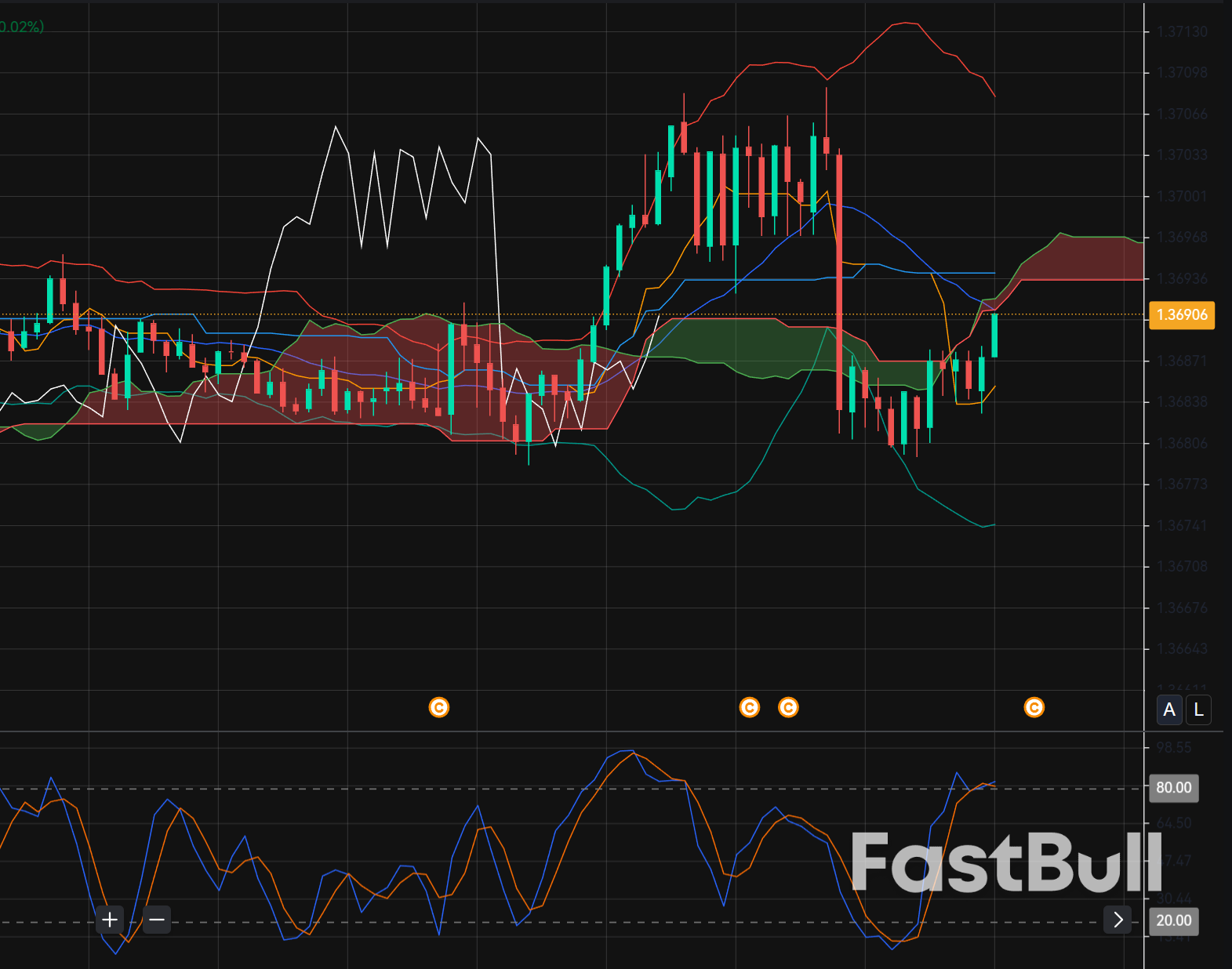
          On M15, USD/CAD is trading near the lower range of the recent session, just below the Bollinger mid-band. The key technical setup lies in whether pullbacks find rejection at the Bollinger median combined with Ichimoku equilibrium (Kijun/Senkou span). A buy trigger would be a clean reclaim above the mid-band with confirmed support on the Ichimoku Kijun an indication that short-term momentum is flipping from sellers taking profit to buyers stepping in on dips toward value.
          Bollinger Bands currently show relatively compressed volatility, meaning a breakout (either direction) could be swift once price structurally commits above/below a tight band squeeze. An upside breakout above the mid-band would signal buyers gaining control in the short term.The Ichimoku Cloud can serve as dynamic support/resistance; sustained closes above the Kijun-sen and through the cloud’s lower boundary on M15 would validate a bullish skew and offer confidence that the short dip toward 1.3641 (recent temporary low) is being rejected in favor of higher prices.
          Stoch (5,3,3) oscillators approaching oversold or mid-range from below suggest room for upside momentum if buyers step in confidently on pullbacks near support zones. A rising stochastic crossing above its signal line while price holds above M15 cloud levels would be a classic early buy signal.

          Trade recommendation

          Entry: 1.3708–1.3715
          Take Profit: 1.3740
          Stop Loss: 1.3680
          Risk Warnings and Disclaimers
          You understand and acknowledge that there is a high degree of risk involved in trading. Following any strategies or investment methods may lead to potential losses. The content on the site is provided by our contributors and analysts for information purposes only. You are solely responsible for determining whether any trading assets, securities, strategy, or any other product is suitable for investing based on your own investment objectives and financial situation.
          Add to Favorites
          Share

          Key Support Retest May Ignite the Next Bullish Expansion

          Manuel

          Central Bank

          Economic

          Summary:

          This specific price zone is attracting significant interest because it represents a classic support-resistance flip.

          BUY GBPUSD
          Close Time
          CLOSED

          1.34539

          Entry Price

          1.35600

          TP

          1.34100

          SL

          1.34721 +0.00046 +0.03%

          43.9

          Pips

          Loss

          1.34100

          SL

          1.34100

          Exit Price

          1.34539

          Entry Price

          1.35600

          TP

          The U.S. Bureau of Economic Analysis reported that the domestic economy expanded at a robust annualized rate of 4.3% in the third quarter. This figure significantly outperformed market expectations of 3.3% and surpassed the previous estimate of 3.8%. Accompanying this strong growth, inflation metrics within the Gross Domestic Product (GDP) report remained firm: the GDP Price Index rose by 3.7%, while Personal Consumption Expenditures (PCE) increased by 2.9%, with core PCE prices climbing 2.8%.
          Despite this vigorous growth, the manufacturing sector exhibited signs of cooling. Durable Goods Orders fell by 2.2% in October, reversing a prior gain of 0.7%. Excluding defense, orders dropped by 1.5%, and while orders excluding transportation saw a marginal 0.2% increase, overall Industrial Production slipped by 0.1% month-over-month. In contrast, the housing market showed unexpected strength; data from the National Association of Realtors revealed that Pending Home Sales rose by 3.3% in November, marking their highest level since early 2023.
          The Federal Reserve reduced the federal funds rate by 25 basis points (bps) at its December meeting, bringing the target range to 3.50%–3.75%. This marks a cumulative reduction of 75 bps in 2025 as the central bank navigates a cooling labor market and persistent inflation. According to the CME FedWatch Tool, markets are now pricing in an accelerated easing cycle, with traders anticipating at least two additional cuts by the end of September 2026.
          Market participants anticipate that the Bank of England (BoE) will adopt a cautious approach toward monetary easing throughout 2026. In its most recent meeting, the institution cut interest rates by 25 basis points, bringing the rate to 3.75%, while making it clear that any further adjustments would be implemented progressively.
          This moderate stance is closely linked to the fact that inflation in the United Kingdom remains uncomfortably elevated. Although the headline index retreated to 3.2% in November from its September peak of 3.8%, it remains significantly above the central bank’s 2% target. BoE Governor Andrew Bailey recently suggested that the room for maneuver regarding further cuts may narrow as the policy stance approaches neutral levels. Consequently, future decisions will be heavily contingent on the evolution of macroeconomic data.
          Looking toward 2026, the BoE’s trajectory will be strictly tied to the performance of the British labor market and Gross Domestic Product (GDP). Throughout 2025, employment demand remained soft as many firms chose to halt hiring to offset the increase in social security contributions—a structural factor that could continue to hinder overall economic growth.Key Support Retest May Ignite the Next Bullish Expansion_1

          Technical Analysis

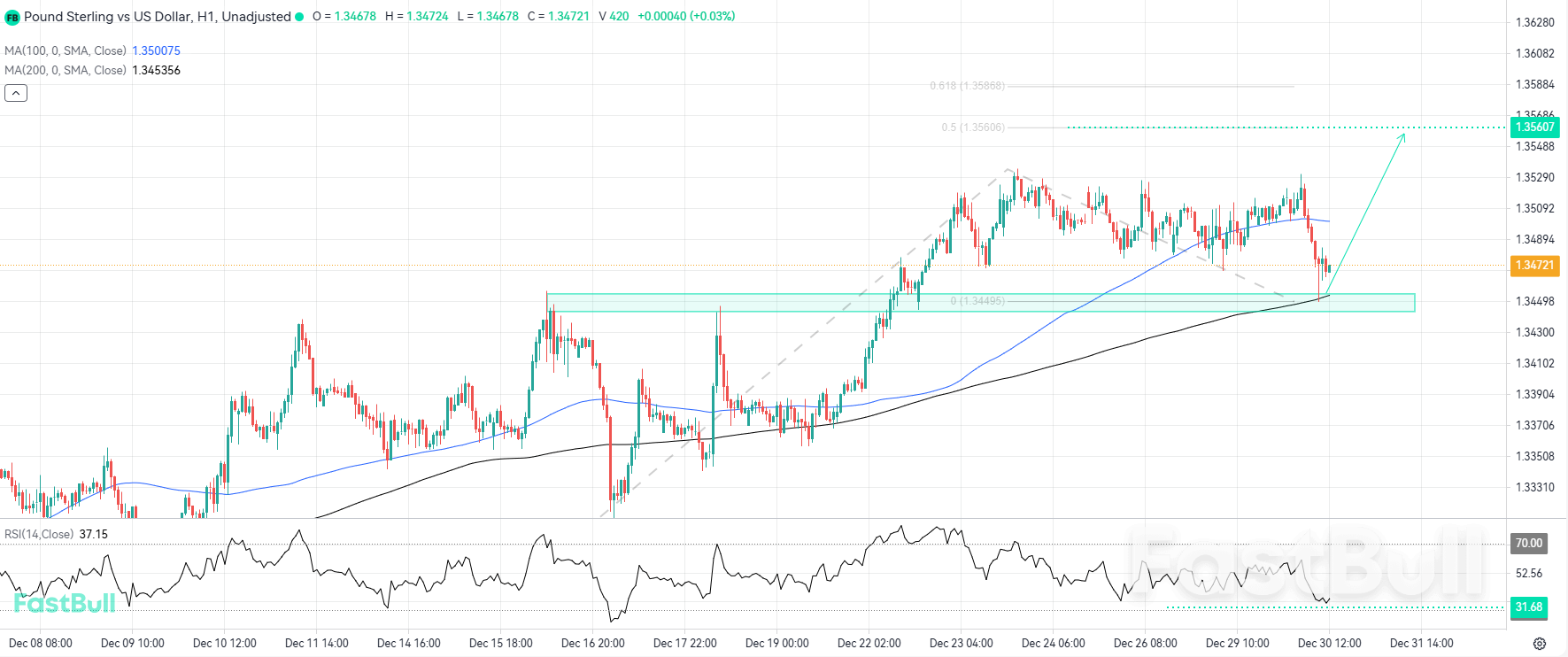
          The GBP/USD pair recently retraced to the 200-period Moving Average (MA), currently situated at 1.3452. This specific price zone is attracting significant interest because it represents a classic support-resistance flip; a level that previously functioned as a ceiling is now being tested as a technical floor.
          The fact that this area is holding suggests that the prevailing bullish trend still possesses sufficient underlying strength to continue. On the 1-hour chart, the 100-period MA is located at 1.3500. When this level was breached to the downside, it effectively triggered the corrective move toward the 200-period MA. If this support holds firm, we could witness a renewed impulse toward the 1.3560 zone, which aligns with the 0.50 Fibonacci expansion. In technical terms, this means the next bullish leg could achieve a magnitude equal to 50% of the primary impulse.
          Meanwhile, the Relative Strength Index (RSI) is rapidly approaching oversold territory, this condition could exert upward pressure, as the combination of key interest zones and momentum indicators suggest that the bullish trend remains the primary force. Notably, the RSI has shed significant levels even though the price has not made an equivalently large move to the downside, indicating exhaustion in the bearish momentum and granting bulls an opportunity to reclaim control. However, a forceful break below the current support level would clear the path for a deeper correction, putting the overall bullish trend in doubt.
          Trading Recommendations
          Trading direction: Buy
          Entry price: 1.3454
          Target price: 1.3400
          Stop loss: 1.3560
          Validity: Jan 09, 2025 15:00:00
          Risk Warnings and Disclaimers
          You understand and acknowledge that there is a high degree of risk involved in trading. Following any strategies or investment methods may lead to potential losses. The content on the site is provided by our contributors and analysts for information purposes only. You are solely responsible for determining whether any trading assets, securities, strategy, or any other product is suitable for investing based on your own investment objectives and financial situation.
          Add to Favorites
          Share

          Analyzing the Trading Logic of Gold in Low-Liquidity Environments

          Eva Chen

          Commodity

          Summary:

          Gold prices maintained their rebound amid expectations of a Federal Reserve rate cut and inflows of safe-haven capital.

          BUY XAUUSD
          Close Time
          CLOSED

          4371.24

          Entry Price

          4465.00

          TP

          4300.00

          SL

          4319.61 -19.50 -0.45%

          712.4

          Pips

          Loss

          4300.00

          SL

          4299.47

          Exit Price

          4371.24

          Entry Price

          4465.00

          TP

          Fundamentals

          Since December, the precious metals market has undergone a significant shift in sentiment amid intense volatility. After hitting a record high last weekend, gold prices retreated sharply on Monday, with spot gold briefly dipping to around US$4,300. With year-end holidays approaching, overall market liquidity has tightened noticeably. Concentrated profit-taking by previously accumulated long positions amplified the technical correction following months of substantial gains. Concurrently, a mild rebound in the U.S. dollar exerted short-term downward pressure on gold prices.
          The adjustment in silver has been more pronounced. Last week, driven by silver's sustained strong rally, market attention rapidly intensified. Rumors of a “short squeeze” and margin calls briefly fueled the final surge on Friday. However, as sentiment gradually cooled, silver prices swiftly reversed course, plunging over US$7 intraday—marking the largest single-day nominal decline in history. The precious metals market currently exhibits pronounced sentiment-driven characteristics, and gold was no exception. Affected by profit-taking, it experienced a daily decline of nearly 4%.
          The precious metals market is currently navigating a relatively challenging trading environment. Overall market liquidity remains generally low, which tends to amplify price fluctuations abnormally: on one hand, hedge funds are reluctant to counter-trend interventions to hedge excessive moves amid insufficient liquidity; on the other hand, market makers are also actively reducing their participation, further weakening the market's buffering capacity. This structural characteristic makes short-term prices more susceptible to sharp spikes and plunges.
          However, from a medium-to-long-term perspective, the macroeconomic underpinnings for gold remain solid. The market widely expects the Federal Reserve to maintain its accommodative monetary policy stance through next year and into 2026, with the outlook for a medium-term weakening of the U.S. dollar unchanged. Simultaneously, discussions surrounding central bank independence within the U.S. political landscape continue to amplify macroeconomic uncertainty, bolstering demand for safe-haven asset allocations. Against this backdrop, while gold and silver prices face near-term pressure from high-level adjustments and cooling sentiment, their downside potential is expected to be significantly constrained once the market completes its phase of consolidation.
          Analyzing the Trading Logic of Gold in Low-Liquidity Environments_1

          Technical Analysis

          During European trading hours on Tuesday, gold prices held steady near US$4,350, maintaining their rebound momentum. This followed a 4.5% decline the previous session—the steepest single-day drop since October last year—after which prices recovered some losses. The Chicago Mercantile Exchange Group (CME Group), one of the world's largest commodity trading platforms, raised margin requirements for gold and silver futures, triggering widespread profit-taking and portfolio rebalancing.
          Based on historical instances where institutional selling pushed prices below US$100, buying on dips would be a prudent move, with stop-loss orders placed at the previous low.

          Trading Recommendations

          Trading Direction: Buy
          Entry Price: 4345
          Target Price: 4465
          Stop Loss: 4300
          Valid Until: January 14, 2026 23:55:00
          Support: 4350, 4345, 4314
          Resistance: 4391, 4367, 4498
          Risk Warnings and Disclaimers
          You understand and acknowledge that there is a high degree of risk involved in trading. Following any strategies or investment methods may lead to potential losses. The content on the site is provided by our contributors and analysts for information purposes only. You are solely responsible for determining whether any trading assets, securities, strategy, or any other product is suitable for investing based on your own investment objectives and financial situation.
          Add to Favorites
          Share

          Gold’s Sharp Pullback Looks Like a Reset, Not the End of the Bull Run

          Warren Takunda

          Traders' Opinions

          Summary:

          Gold prices suffered their sharpest pullback in months after retreating more than 4% from record highs, but mounting geopolitical risks and a cautious market mood are helping the metal stabilize above key technical support near $4,300.

          BUY XAUUSD
          Close Time
          CLOSED

          4379.93

          Entry Price

          4555.00

          TP

          4290.00

          SL

          4319.61 -19.50 -0.45%

          899.3

          Pips

          Loss

          4290.00

          SL

          4283.52

          Exit Price

          4379.93

          Entry Price

          4555.00

          TP

          Gold prices (XAU/USD) are attempting to regain composure after suffering their steepest decline in months, underscoring how fragile sentiment has become at historically elevated price levels. The precious metal slid more than 4% from last week’s all-time high near $4,555, marking its weakest performance in recent months, as thin liquidity conditions amplified profit-taking during Monday’s session. By Tuesday, however, gold was showing tentative signs of stabilization, holding above the psychologically important $4,300 handle as geopolitical tensions resurfaced and investors reassessed downside risks.
          The abrupt sell-off followed a powerful rally that had propelled gold to record territory, fuelled by expectations of easier global monetary conditions, persistent geopolitical uncertainty and strong demand for safe-haven assets. Yet the absence of deep liquidity, combined with overstretched technical conditions, left the market vulnerable to a sharp correction once momentum faltered. In my view, the magnitude of the pullback reflects not a fundamental shift against gold, but rather a classic reset after an overheated move.
          Geopolitics remain a central pillar of support. Late Monday, Moscow announced it would reassess its position on peace negotiations with Ukraine after claiming that President Vladimir Putin’s residence had been targeted in an attack. The allegation, which Kyiv has denied, injected fresh uncertainty into an already fragile diplomatic backdrop and quickly dampened the cautious optimism that had emerged following last weekend’s meeting between U.S. President Donald Trump and Ukrainian President Volodymyr Zelenskyy. Any setback to peace prospects tends to reinforce gold’s appeal as a hedge against geopolitical risk, particularly at a time when broader markets are already on edge.
          Tensions are also simmering in Asia, where China extended its military drills around Taiwan for a second consecutive day. The exercises have kept investors alert to the risk of miscalculation in the South China Sea, a region critical to global trade and supply chains. Adding another layer of uncertainty, President Trump warned that the United States could launch a new round of attacks on Iran should Tehran resume its nuclear weapons programme. The combination of flashpoints across Eastern Europe, East Asia and the Middle East reinforces the notion that geopolitical risk premiums are far from priced out, even after gold’s recent retreat.
          Beyond geopolitics, markets are increasingly focused on U.S. monetary policy signals. Later on Tuesday, the Federal Reserve is set to release the minutes of its December policy meeting. While no immediate policy change is expected, investors will scrutinize the language for clues on how comfortable policymakers are with easing financial conditions and how they assess inflation risks. Any hint of a more cautious or divided Fed could support the U.S. dollar in the near term, potentially capping gold’s rebound. Conversely, confirmation that the Fed remains inclined toward eventual rate cuts would likely underpin bullion, especially after the recent correction has eased valuation concerns.

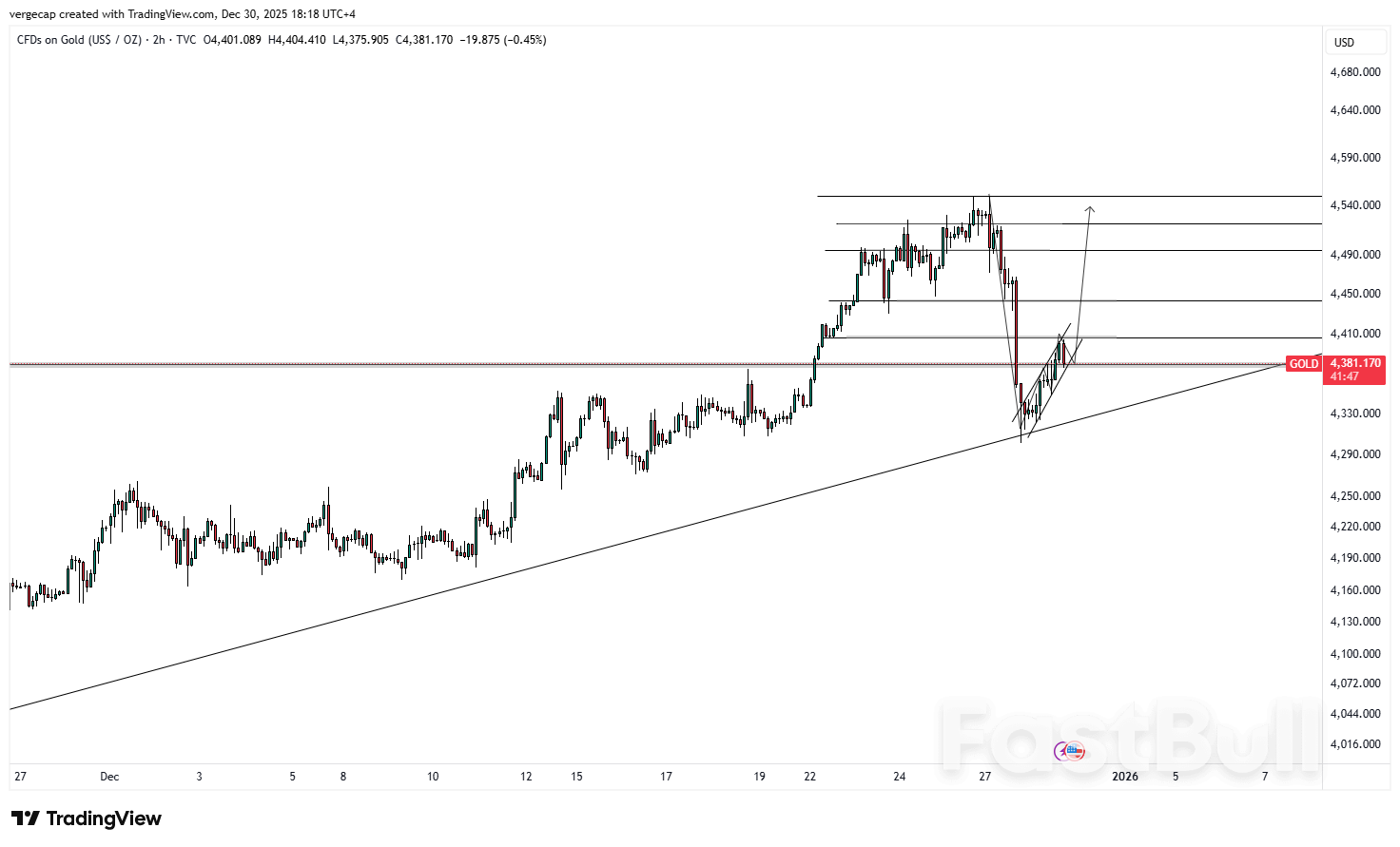
          Technical AnalysisGold’s Sharp Pullback Looks Like a Reset, Not the End of the Bull Run_1

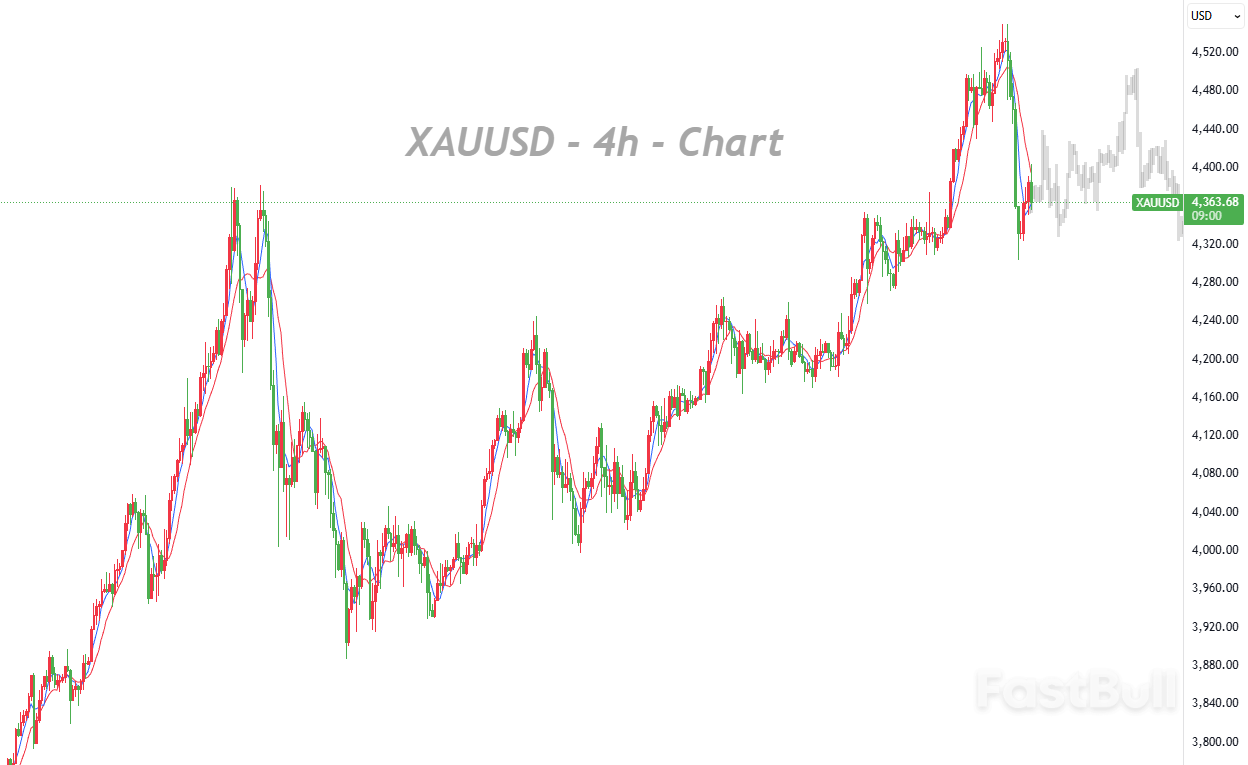
          From a technical perspective, gold’s structure has weakened but not collapsed. On the four-hour chart, XAU/USD was trading around $4,372 after rebounding from Monday’s lows near $4,300. The Moving Average Convergence Divergence (MACD) histogram remains below the zero line, signalling that bearish momentum is still present, but the steady contraction from deeply negative readings suggests that selling pressure is losing intensity. Meanwhile, the Relative Strength Index (RSI) stands at 38.93, still below the neutral 50 level but recovering from oversold territory, an early sign that downside momentum may be stabilizing.
          The break below the ascending trendline drawn from mid-December lows, now intersecting around $4,450, represents a notable technical setback. This level, together with the December 22 and December 24 lows at $4,430 and $4,448 respectively, forms a dense resistance zone that is likely to challenge any near-term recovery attempts. As long as gold remains capped below this region, the path back to the record high near $4,555 appears difficult.

          TRADE RECOMMENDATION

          BUY GOLD
          ENTRY PRICE: 4380
          STOP LOSS: 4290
          TAKE PROFIT: 4555
          Risk Warnings and Disclaimers
          You understand and acknowledge that there is a high degree of risk involved in trading. Following any strategies or investment methods may lead to potential losses. The content on the site is provided by our contributors and analysts for information purposes only. You are solely responsible for determining whether any trading assets, securities, strategy, or any other product is suitable for investing based on your own investment objectives and financial situation.
          Add to Favorites
          Share
          FastBull
          Copyright © 2026 FastBull Ltd

          728 RM B 7/F GEE LOK IND BLDG NO 34 HUNG TO RD KWUN TONG KLN HONG KONG

          TelegramInstagramTwitterfacebooklinkedin
          App Store Google Play Google Play
          Products
          Charts

          Chats

          Q&A with Experts
          Screeners
          Economic Calendar
          Data
          Tools
          Membership
          Features
          Function
          Markets
          Copy Trading
          Latest Signals
          Contests
          News
          Analysis
          24/7
          Columns
          Education
          Company
          Careers
          About Us
          Contact Us
          Advertising
          Help Center
          Feedback
          User Agreement
          Privacy Policy
          Personal Information Protection Statement
          Business

          White Label

          Data API

          Web Plug-ins

          Poster Maker

          Affiliate Program

          Risk Disclosure

          The risk of loss in trading financial instruments such as stocks, FX, commodities, futures, bonds, ETFs and crypto can be substantial. You may sustain a total loss of the funds that you deposit with your broker. Therefore, you should carefully consider whether such trading is suitable for you in light of your circumstances and financial resources.

          No decision to invest should be made without thoroughly conducting due diligence by yourself or consulting with your financial advisors. Our web content might not suit you since we don't know your financial conditions and investment needs. Our financial information might have latency or contain inaccuracy, so you should be fully responsible for any of your trading and investment decisions. The company will not be responsible for your capital loss.

          Without getting permission from the website, you are not allowed to copy the website's graphics, texts, or trademarks. Intellectual property rights in the content or data incorporated into this website belong to its providers and exchange merchants.

          Not Logged In

          Log in to access more features

          FastBull Membership

          Not yet

          Purchase

          Become a signal provider
          Help Center
          Customer Service
          Dark Mode
          Price Up/Down Colors

          Log In

          Sign Up
          Position
          Layout
          Fullscreen
          Default to Chart
          The chart page opens by default when you visit fastbull.com