• Trade
  • Markets
  • Copy
  • Contests
  • News
  • 24/7
  • Calendar
  • Q&A
  • Chats
Trending
Screeners
SYMBOL
LAST
BID
ASK
HIGH
LOW
NET CHG.
%CHG.
SPREAD
SPX
S&P 500 Index
6827.42
6827.42
6827.42
6899.86
6801.80
-73.58
-1.07%
--
DJI
Dow Jones Industrial Average
48458.04
48458.04
48458.04
48886.86
48334.10
-245.98
-0.51%
--
IXIC
NASDAQ Composite Index
23195.16
23195.16
23195.16
23554.89
23094.51
-398.69
-1.69%
--
USDX
US Dollar Index
97.950
98.030
97.950
98.500
97.950
-0.370
-0.38%
--
EURUSD
Euro / US Dollar
1.17394
1.17409
1.17394
1.17496
1.17192
+0.00011
+ 0.01%
--
GBPUSD
Pound Sterling / US Dollar
1.33707
1.33732
1.33707
1.33997
1.33419
-0.00148
-0.11%
--
XAUUSD
Gold / US Dollar
4299.39
4299.39
4299.39
4353.41
4257.10
+20.10
+ 0.47%
--
WTI
Light Sweet Crude Oil
57.233
57.485
57.233
58.011
56.969
-0.408
-0.71%
--

Community Accounts

Signal Accounts
--
Profit Accounts
--
Loss Accounts
--
View More

Become a signal provider

Sell trading signals to earn additional income

View More

Guide to Copy Trading

Get started with ease and confidence

View More

Signal Accounts for Members

All Signal Accounts

Best Return
  • Best Return
  • Best P/L
  • Best MDD
Past 1W
  • Past 1W
  • Past 1M
  • Past 1Y

All Contests

  • All
  • Trump Updates
  • Recommend
  • Stocks
  • Cryptocurrencies
  • Central Banks
  • Featured News
Top News Only
Share

China's Central Financial And Economic Affairs Commission Deputy Director: Will Expand Export And Increase Import In 2026

Share

Thai Leader Anutin: Landmine Blast That Killed Thai Soldiers 'Not A Roadside Accident'

Share

Thai Leader Anutin: Thailand To Continue Military Action Until 'We Feel No More Harm'

Share

Cambodian Prime Minister Hun Manet Says He Had Phone Calls With Trump And Malaysian Leader Anwar About Ceasefire

Share

Cambodia's Hun Manet Says USA, Malaysia Should Verify 'Which Side Fired First' In Latest Conflict

Share

Cambodia's Hun Manet: Cambodia Maintains Its Stance In Seeking Peaceful Resolution Of Disputes

Share

Nasdaq Companies: Allergan, Ferrovia, Insmed, Monolithic Power Systems, Seagate Technology, And Western Digital Will Be Added To The NASDAQ 100 Index. Biogen, CdW, GlobalFoundries, Lululemon, ON Semiconductor, And Tradedesk Will Be Removed From The NASDAQ 100 Index

Share

Witkoff Headed To Berlin This Weekend To Meet With Zelenskiy, European Leaders -Wsj Reporter On X

Share

Russia Attacks Two Ukrainian Ports, Damaging Three Turkish-Owned Vessels

Share

[Historic Flooding Occurs In At Least Four Rivers In Washington State Due To Days Of Torrential Rains] Multiple Areas In Washington State Have Been Hit By Severe Flooding Due To Days Of Torrential Rains, With At Least Four Rivers Experiencing Historic Flooding. Reporters Learned On The 12th That The Floods Caused By The Torrential Rains In Washington State Have Destroyed Homes And Closed Several Highways. Experts Warn That Even More Severe Flooding May Occur In The Future. A State Of Emergency Has Been Declared In Washington State

Share

Trump Says Proposed Free Economic Zone In Donbas Would Work

Share

Trump: I Think My Voice Should Be Heard

Share

Trump Says Will Be Choosing New Fed Chair In Near Future

Share

Trump Says Proposed Free Economic Zone In Donbas Complex But Would Work

Share

Trump Says Land Strikes In Venezuela Will Start Happening

Share

US President Trump: Thailand And Cambodia Are In A Good Situation

Share

State Media: North Korean Leader Kim Hails Troops Returning From Russia Mission

Share

The 10-year Treasury Yield Rose About 5 Basis Points During The "Fed Rate Cut Week," And The 2/10-year Yield Spread Widened By About 9 Basis Points. On Friday (December 12), In Late New York Trading, The Yield On The Benchmark 10-year US Treasury Note Rose 2.75 Basis Points To 4.1841%, A Cumulative Increase Of 4.90 Basis Points For The Week, Trading Within A Range Of 4.1002%-4.2074%. It Rose Steadily From Monday To Wednesday (before The Fed Announced Its Rate Cut And Treasury Bill Purchase Program), Subsequently Exhibiting A V-shaped Recovery. The 2-year Treasury Yield Fell 1.82 Basis Points To 3.5222%, A Cumulative Decrease Of 3.81 Basis Points For The Week, Trading Within A Range Of 3.6253%-3.4989%

Share

Trump: Lots Of Progress Being Made On Russia-Ukraine

Share

NOPA November US Soybean Crush Estimated At 220.285 Million Bushels

TIME
ACT
FCST
PREV
U.K. Trade Balance Non-EU (SA) (Oct)

A:--

F: --

P: --

U.K. Trade Balance (Oct)

A:--

F: --

P: --

U.K. Services Index MoM

A:--

F: --

P: --

U.K. Construction Output MoM (SA) (Oct)

A:--

F: --

P: --

U.K. Industrial Output YoY (Oct)

A:--

F: --

P: --

U.K. Trade Balance (SA) (Oct)

A:--

F: --

P: --

U.K. Trade Balance EU (SA) (Oct)

A:--

F: --

P: --

U.K. Manufacturing Output YoY (Oct)

A:--

F: --

P: --

U.K. GDP MoM (Oct)

A:--

F: --

P: --

U.K. GDP YoY (SA) (Oct)

A:--

F: --

P: --

U.K. Industrial Output MoM (Oct)

A:--

F: --

P: --

U.K. Construction Output YoY (Oct)

A:--

F: --

P: --

France HICP Final MoM (Nov)

A:--

F: --

P: --

China, Mainland Outstanding Loans Growth YoY (Nov)

A:--

F: --

P: --

China, Mainland M2 Money Supply YoY (Nov)

A:--

F: --

P: --

China, Mainland M0 Money Supply YoY (Nov)

A:--

F: --

P: --

China, Mainland M1 Money Supply YoY (Nov)

A:--

F: --

P: --

India CPI YoY (Nov)

A:--

F: --

P: --

India Deposit Gowth YoY

A:--

F: --

P: --

Brazil Services Growth YoY (Oct)

A:--

F: --

P: --

Mexico Industrial Output YoY (Oct)

A:--

F: --

P: --

Russia Trade Balance (Oct)

A:--

F: --

P: --

Philadelphia Fed President Henry Paulson delivers a speech
Canada Building Permits MoM (SA) (Oct)

A:--

F: --

P: --

Canada Wholesale Sales YoY (Oct)

A:--

F: --

P: --

Canada Wholesale Inventory MoM (Oct)

A:--

F: --

P: --

Canada Wholesale Inventory YoY (Oct)

A:--

F: --

P: --

Canada Wholesale Sales MoM (SA) (Oct)

A:--

F: --

P: --

Germany Current Account (Not SA) (Oct)

A:--

F: --

P: --

U.S. Weekly Total Rig Count

A:--

F: --

P: --

U.S. Weekly Total Oil Rig Count

A:--

F: --

P: --

Japan Tankan Large Non-Manufacturing Diffusion Index (Q4)

--

F: --

P: --

Japan Tankan Small Manufacturing Outlook Index (Q4)

--

F: --

P: --

Japan Tankan Large Non-Manufacturing Outlook Index (Q4)

--

F: --

P: --

Japan Tankan Large Manufacturing Outlook Index (Q4)

--

F: --

P: --

Japan Tankan Small Manufacturing Diffusion Index (Q4)

--

F: --

P: --

Japan Tankan Large Manufacturing Diffusion Index (Q4)

--

F: --

P: --

Japan Tankan Large-Enterprise Capital Expenditure YoY (Q4)

--

F: --

P: --

U.K. Rightmove House Price Index YoY (Dec)

--

F: --

P: --

China, Mainland Industrial Output YoY (YTD) (Nov)

--

F: --

P: --

China, Mainland Urban Area Unemployment Rate (Nov)

--

F: --

P: --

Saudi Arabia CPI YoY (Nov)

--

F: --

P: --

Euro Zone Industrial Output YoY (Oct)

--

F: --

P: --

Euro Zone Industrial Output MoM (Oct)

--

F: --

P: --

Canada Existing Home Sales MoM (Nov)

--

F: --

P: --

Euro Zone Total Reserve Assets (Nov)

--

F: --

P: --

U.K. Inflation Rate Expectations

--

F: --

P: --

Canada National Economic Confidence Index

--

F: --

P: --

Canada New Housing Starts (Nov)

--

F: --

P: --

U.S. NY Fed Manufacturing Employment Index (Dec)

--

F: --

P: --

U.S. NY Fed Manufacturing Index (Dec)

--

F: --

P: --

Canada Core CPI YoY (Nov)

--

F: --

P: --

Canada Manufacturing Unfilled Orders MoM (Oct)

--

F: --

P: --

Canada Manufacturing New Orders MoM (Oct)

--

F: --

P: --

Canada Core CPI MoM (Nov)

--

F: --

P: --

Canada Manufacturing Inventory MoM (Oct)

--

F: --

P: --

Canada CPI YoY (Nov)

--

F: --

P: --

Canada CPI MoM (Nov)

--

F: --

P: --

Canada CPI YoY (SA) (Nov)

--

F: --

P: --

Canada Core CPI MoM (SA) (Nov)

--

F: --

P: --

Q&A with Experts
    • All
    • Chatrooms
    • Groups
    • Friends
    Connecting
    .
    .
    .
    Type here...
    Add Symbol or Code

      No matching data

      All
      Trump Updates
      Recommend
      Stocks
      Cryptocurrencies
      Central Banks
      Featured News
      • All
      • Russia-Ukraine Conflict
      • Middle East Flashpoint
      • All
      • Russia-Ukraine Conflict
      • Middle East Flashpoint

      Search
      Products

      Charts Free Forever

      Chats Q&A with Experts
      Screeners Economic Calendar Data Tools
      Membership Features
      Data Warehouse Market Trends Institutional Data Policy Rates Macro

      Market Trends

      Market Sentiment Order Book Forex Correlations

      Top Indicators

      Charts Free Forever
      Markets

      News

      News Analysis 24/7 Columns Education
      From Institutions From Analysts
      Topics Columnists

      Latest Views

      Latest Views

      Trending Topics

      Top Columnists

      Latest Update

      Signals

      Copy Rankings Latest Signals Become a signal provider AI Rating
      Contests
      Brokers

      Overview Brokers Assessment Rankings Regulators News Claims
      Broker listing Forex Brokers Comparison Tool Live Spread Comparison Scam
      Q&A Complaint Scam Alert Videos Tips to Detect Scam
      More

      Business
      Events
      Careers About Us Advertising Help Center

      White Label

      Data API

      Web Plug-ins

      Affiliate Program

      Awards Institution Evaluation IB Seminar Salon Event Exhibition
      Vietnam Thailand Singapore Dubai
      Fans Party Investment Sharing Session
      FastBull Summit BrokersView Expo
      Recent Searches
        Top Searches
          Markets
          News
          Analysis
          User
          24/7
          Economic Calendar
          Education
          Data
          • Names
          • Latest
          • Prev

          View All

          No data

          Scan to Download

          Faster Charts, Chat Faster!

          Download App
          English
          • English
          • Español
          • العربية
          • Bahasa Indonesia
          • Bahasa Melayu
          • Tiếng Việt
          • ภาษาไทย
          • Français
          • Italiano
          • Türkçe
          • Русский язык
          • 简中
          • 繁中
          Open Account
          Search
          Products
          Charts Free Forever
          Markets
          News
          Signals

          Copy Rankings Latest Signals Become a signal provider AI Rating
          Contests
          Brokers

          Overview Brokers Assessment Rankings Regulators News Claims
          Broker listing Forex Brokers Comparison Tool Live Spread Comparison Scam
          Q&A Complaint Scam Alert Videos Tips to Detect Scam
          More

          Business
          Events
          Careers About Us Advertising Help Center

          White Label

          Data API

          Web Plug-ins

          Affiliate Program

          Awards Institution Evaluation IB Seminar Salon Event Exhibition
          Vietnam Thailand Singapore Dubai
          Fans Party Investment Sharing Session
          FastBull Summit BrokersView Expo

          EUR/JPY Hits 11-Month Highs Amid Japan Political Jitters, Inflation

          Warren Takunda

          Economic

          Summary:

          The Euro extended its rally against the Japanese Yen on Tuesday, pushing toward the 173.00 mark for the first time since July 2024.

          BUY EURJPY
          Close Time
          CLOSED

          172.800

          Entry Price

          175.450

          TP

          171.500

          SL

          182.929 +0.318 +0.17%

          17.2

          Pips

          Profit

          171.500

          SL

          172.972

          Exit Price

          172.800

          Entry Price

          175.450

          TP
          The Euro is on a roll against the Japanese Yen, advancing for a third consecutive session on Tuesday and closing in on the psychologically and technically significant 173.00 level. This move places EUR/JPY at its strongest levels in nearly a year, and investors appear increasingly confident in a sustained bullish trend, underpinned by a widening monetary policy gap and rising domestic political instability in Japan.
          At the time of writing, EUR/JPY trades around 172.85 during the American session, just shy of the July 12, 2024 high. The rally comes as a resurgent Euro rides the tailwinds of upbeat industrial data, while the Yen remains weighed down by Japan’s cautious central bank, geopolitical uncertainty, and domestic inflation pressures.
          The Japanese Yen continues to be a victim of its own policy isolation. While most major central banks have either paused or begun cutting interest rates following aggressive hiking cycles, the Bank of Japan remains stuck in first gear. Despite inflation running consistently above its 2% target — fueled by higher import costs and global commodity pressures — the BoJ has refrained from making significant tightening moves.
          Officials have repeatedly cited weak domestic demand, an uneven wage recovery, and heightened global risk as reasons to hold back. With nominal interest rates still hovering around zero, the carry trade remains attractive, encouraging capital to flow out of Japan and into higher-yielding assets — such as European or U.S. bonds — thereby amplifying downward pressure on the Yen.
          Adding fuel to the fire, Japan is entering a politically sensitive phase. With Upper House elections set for July 20, polls suggest the ruling coalition could lose its majority, raising questions over future fiscal policy and governance stability. Investors fear increased fiscal spending post-election, potentially widening the country’s already concerning debt load — and leaving the central bank in an even tighter corner. This cocktail of weak monetary response and political risk is discouraging Yen buying, allowing the Euro to continue climbing.
          While the Yen is contending with local headwinds, the Euro has found renewed support from improving macroeconomic fundamentals. Data released Tuesday showed a healthy bounce in Eurozone industrial output. According to Eurostat, industrial production rose by 1.7% in May from the prior month, rebounding sharply from April’s 2.2% decline and exceeding expectations of a 0.9% gain. On a year-over-year basis, production jumped 3.7% — its fastest pace since early 2023 — signaling a potential inflection point in the region’s sluggish manufacturing sector.
          Complementing the data, investor sentiment across the bloc held steady. The German ZEW Economic Sentiment Index ticked up to 36.1 in July from 35.3 in June. Though this missed market consensus of 37.8, the modest increase suggests that optimism is stabilizing as energy prices normalize and inflation gradually retreats.
          While the European Central Bank is still expected to ease rates further this year, any further monetary loosening is likely to be modest and conditional on incoming data. For now, the Euro remains resilient, particularly in crosses like EUR/JPY, where divergent fundamentals are stark.

          Technical Analysis EUR/JPY Hits 11-Month Highs Amid Japan Political Jitters, Inflation_1

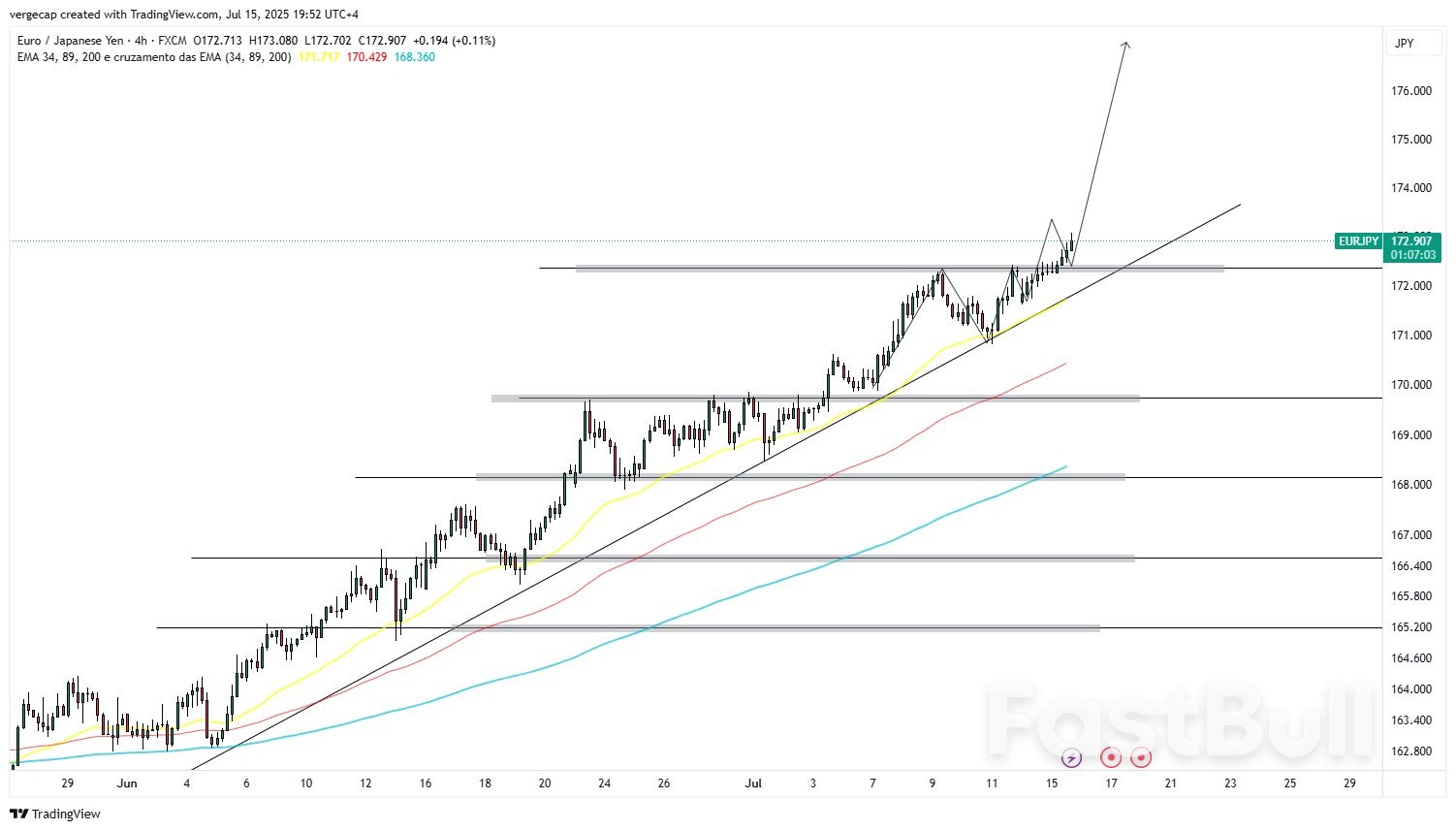
          From a technical standpoint, EUR/JPY continues to respect a bullish channel structure. The pair remains firmly supported above 170.45 — a key horizontal support and prior breakout level — and is now challenging the upper boundary of the channel near 172.40.
          Momentum indicators, particularly the stochastic oscillator, are showing bullish signals, suggesting that upward pressure remains intact. A decisive breakout above 172.40 would likely open the door for a retest of the 172.85 intraday resistance and eventually a push toward the 161.8% Fibonacci extension level at 175.45 — a potential magnet for short-term bulls.

          TRADE RECOMMENDATION

          BUY EURJPY
          ENTRY PRICE: 172.80
          STOP LOSS: 171.50
          TAKE PROFIT: 175.45
          Risk Warnings and Disclaimers
          You understand and acknowledge that there is a high degree of risk involved in trading. Following any strategies or investment methods may lead to potential losses. The content on the site is provided by our contributors and analysts for information purposes only. You are solely responsible for determining whether any trading assets, securities, strategy, or any other product is suitable for investing based on your own investment objectives and financial situation.
          Add to Favorites
          Share

          Logic and Opportunities Behind the Plunge

          Eva Chen

          Cryptocurrency

          Summary:

          Bitcoin has pulled back sharply after breaking out to new all-time highs last Thursday, raising concerns in the market. Is this decline a precursor to a trend reversal? Or is it a “healthy consolidation” in a bullish market? In this article, we will analyze the on-chain data and market dynamics behind the price adjustment, and combine it with technical graphics to provide market judgment and trading recommendations.

          BUY BTC-USDT
          EXP
          EXPIRED

          112500.0

          Entry Price

          135842.0

          TP

          106000.0

          SL

          90372.0 +430.6 +0.48%

          --

          Pips

          EXPIRED

          106000.0

          SL

          117910.1

          Exit Price

          112500.0

          Entry Price

          135842.0

          TP

          Fundamentals

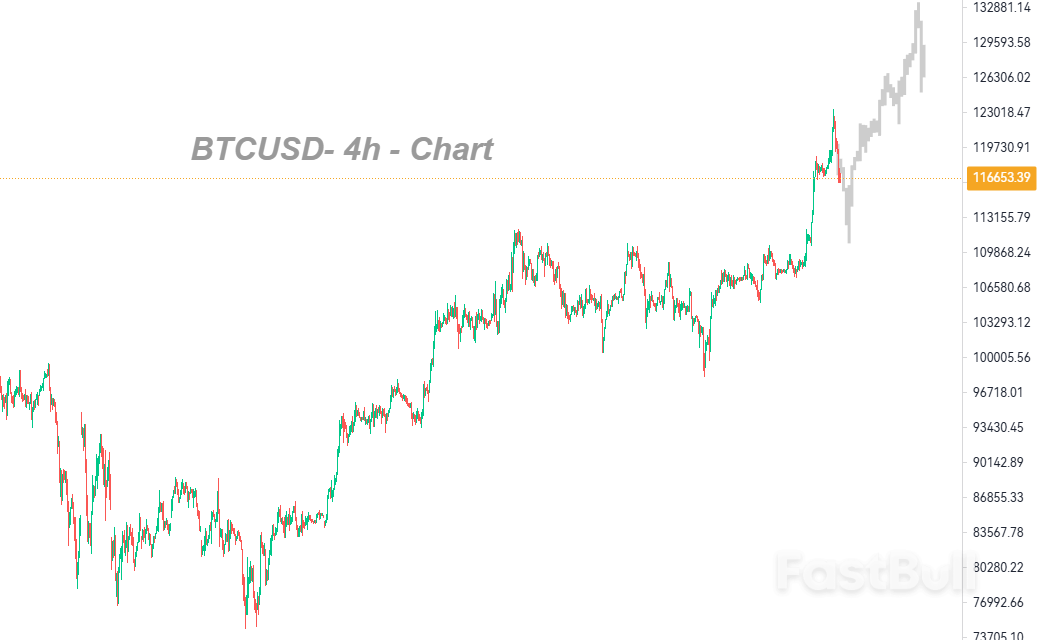
          Following a successful breach of the all-time high of US$112,030 last Thursday, Bitcoin's price surged to US$123,256 before experiencing a notable correction.
          Market consensus attributes this pullback to a natural consolidation phase within the prevailing upward cycle, reflecting investors' portfolio rebalancing following the substantial gains, rather than a reversal signal. Bitcoin's long-term fundamentals remain robust, with strong support from buying activity at lower price levels.
          What were the immediate catalysts for this downturn? On-chain data reveals that miners have been offloading their Bitcoin holdings at the highest rate in months. Simultaneously, dormant wallet addresses have transferred thousands of BTC to exchanges, signaling significant selling pressure. Two substantial transactions, totaling nearly 17,000 BTC, served as the primary trigger for the price decline. Within a 24-hour period, over US$500 million in positions were liquidated, impacting over 130,000 traders, with almost US$400 million in liquidations occurring within just four hours.
          Despite this, some analysts suggest that this drop may be "strategic," potentially aimed at filling a price gap of approximately US$115,000 on the Chicago Mercantile Exchange (CME). A more robust rebound is anticipated once the market consolidates.
          Logic and Opportunities Behind the Plunge_1

          Technical Analysis

          The current Bitcoin price has declined by over 5% from its peak, seeking support within the US$116,591 - US$116,895 range. In the short term, a potential stabilization and subsequent rebound may occur if selling pressure subsides.
          Technical indicators reveal that the StochRSI has entered the oversold territory, suggesting an impending rebound. However, a breach of the support level could lead to a further retracement towards the previous starting point, approximately US$112,000 range.
          Overall, this downturn remains within the existing structure, and a strategy of buying on dips is recommended.

          Trading Recommendations

          Trading Direction: Buy
          Entry Price: 113000, 112500
          Target Price: 135842
          Stop Loss: 106000
          Valid Until: July 30, 2025 23:55:00
          Support: 115240, 113435, 112090
          Resistance: 118851, 120515, 123256
          Risk Warnings and Disclaimers
          You understand and acknowledge that there is a high degree of risk involved in trading. Following any strategies or investment methods may lead to potential losses. The content on the site is provided by our contributors and analysts for information purposes only. You are solely responsible for determining whether any trading assets, securities, strategy, or any other product is suitable for investing based on your own investment objectives and financial situation.
          Add to Favorites
          Share

          USD/JPY Hits Two-Month High as U.S.–Japan Tariff Fight Escalates

          Warren Takunda

          Economic

          Summary:

          The U.S. dollar strengthened against the Japanese yen for a third straight session on Tuesday, with USD/JPY climbing back toward the 148.00 level—its highest in nearly two months.

          BUY USDJPY
          Close Time
          CLOSED

          148.199

          Entry Price

          151.000

          TP

          146.600

          SL

          155.814 +0.255 +0.16%

          44.7

          Pips

          Profit

          146.600

          SL

          148.646

          Exit Price

          148.199

          Entry Price

          151.000

          TP

          The USD/JPY pair extended its winning streak on Tuesday, pushing higher for a third consecutive session amid a backdrop of resurgent trade tensions and strong technical tailwinds. During European trading hours, the currency pair touched levels near 148.00, marking a new two-month high and reigniting bullish interest in the dollar-yen cross.
          This latest rally comes on the heels of renewed strain in U.S.–Japan trade relations. Last week, U.S. President Donald Trump imposed a fresh 25% tariff on a broad range of Japanese imports. The move, which came after Washington and Tokyo failed to finalize a trade agreement during the 90-day grace period, sent ripples through financial markets and reignited fears of a prolonged trade dispute. The tariffs are not sector-specific, marking a broad-based escalation that appears to be more politically charged than strategically targeted. Despite the setback, Tokyo has reiterated its intent to continue negotiations with Washington before the new deadline of August 1, hoping to de-escalate the dispute.
          Adding another layer to the geopolitical narrative, Japan's Yomiuri newspaper reported earlier in the day that Prime Minister Shigeru Ishiba is scheduled to meet U.S. Treasury Secretary Scott Bessent on Friday. The meeting is set to take place during Ishiba’s visit to the United States, where he will also attend the U.S. national day at the World Expo 2025. This diplomatic engagement may serve as a critical juncture for re-establishing common ground between the two economic powers. But until then, the uncertainty is fueling yen weakness and dollar strength.
          The Japanese yen’s status as a safe-haven currency appears to be overshadowed by structural headwinds, including a persistently dovish Bank of Japan. The central bank’s reluctance to tighten monetary policy—even in the face of global normalization—has kept Japan’s yield profile notably low, making the yen an ideal funding currency in carry trades. In contrast, the Federal Reserve has maintained a firm stance on inflation, with markets still pricing in the potential for interest rates to remain higher for longer. This policy divergence continues to widen the gap between U.S. and Japanese bond yields, adding further pressure on the yen.

          Technical AnalysisUSD/JPY Hits Two-Month High as U.S.–Japan Tariff Fight Escalates_1

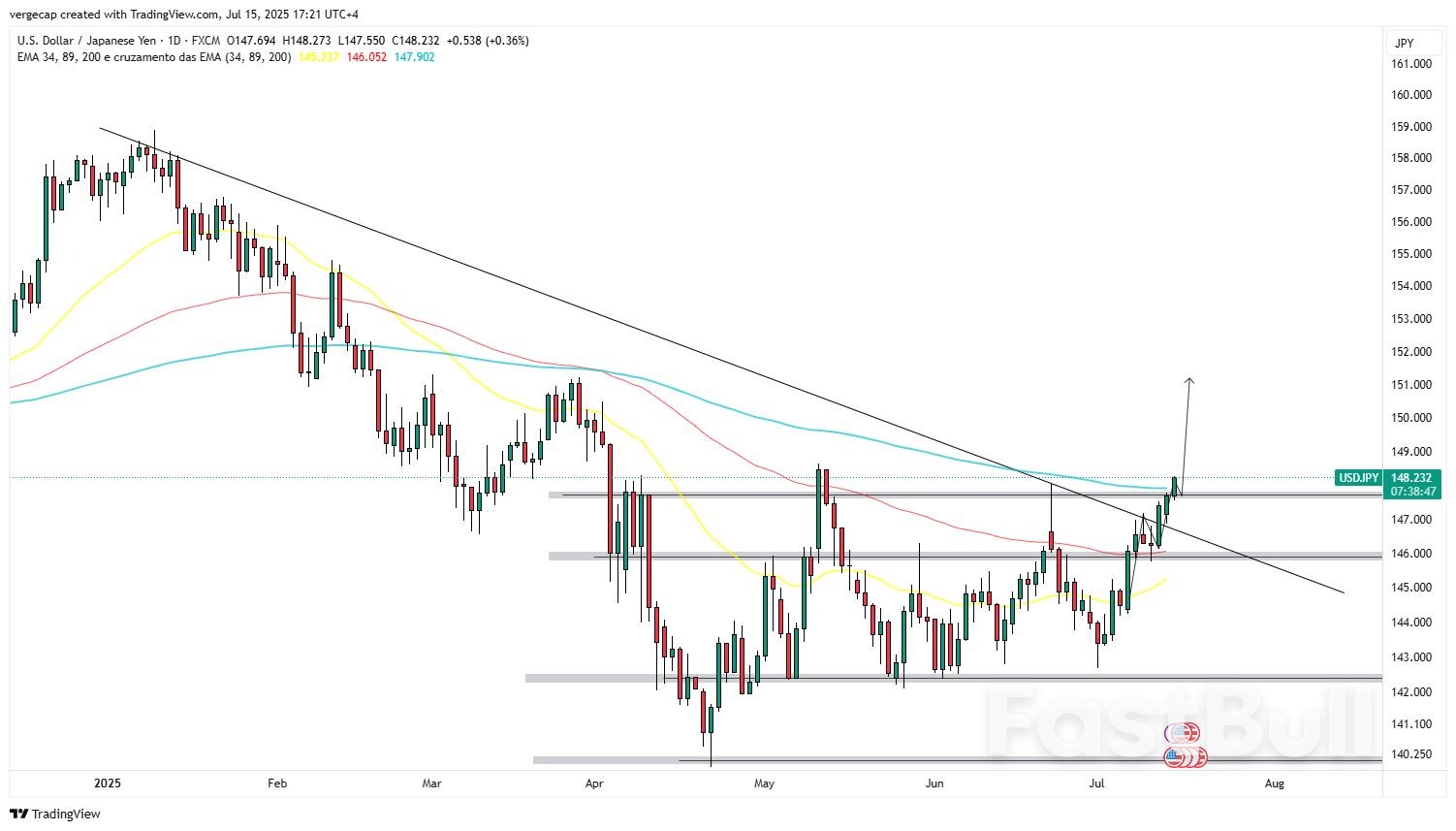
          The bullish tone in USD/JPY is also supported by strong technical structure. The pair has broken through a long-standing resistance trendline, signaling a meaningful shift in sentiment. This breakout suggests the previous consolidation phase has ended, giving way to renewed upward momentum. Price action has sustained itself above former highs, and the structure shows a series of higher lows forming along an inner ascending trendline, a signal of persistent buying interest on dips. Additionally, the pair continues to trade well above the 200-day exponential moving average, now located around 145.14, reinforcing the broader bullish trend.
          Momentum indicators lend further credibility to the rally. The Relative Strength Index (RSI) currently reads near 63, indicating strong upward momentum without flashing overbought conditions. This suggests that there may still be ample room for further gains before technical exhaustion sets in.
          From a price projection standpoint, traders are now focusing on two key levels. The first is around 149.70, a level derived from the measured move following the recent breakout. This area also coincides with short-term resistance from early April. A more ambitious upside target lies at 151.00, which reflects an extended move based on previous bullish patterns and a historically significant resistance area from 2022.

          TRADE RECOMMENDATION

          BUY USDJPY
          ENTRY PRICE: 148.20
          STOP LOSS: 146.60
          TAKE PROFIT: 151.00
          Risk Warnings and Disclaimers
          You understand and acknowledge that there is a high degree of risk involved in trading. Following any strategies or investment methods may lead to potential losses. The content on the site is provided by our contributors and analysts for information purposes only. You are solely responsible for determining whether any trading assets, securities, strategy, or any other product is suitable for investing based on your own investment objectives and financial situation.
          Add to Favorites
          Share

          A Strong Bounce From Local Support Could Reignite the Bullish Momentum in AUDUSD

          Manuel

          Central Bank

          Economic

          Summary:

          If the pattern repeats, we could see the price attempt to move back toward the next resistance level at 0.6589.

          BUY AUDUSD
          Close Time
          CLOSED

          0.65398

          Entry Price

          0.65900

          TP

          0.65250

          SL

          0.66520 -0.00118 -0.18%

          26.9

          Pips

          Profit

          0.65250

          SL

          0.65667

          Exit Price

          0.65398

          Entry Price

          0.65900

          TP

          The Australian labor market data for June, due to be released this Thursday, is expected to take center stage for investors. Employment figures will be particularly important, as they could significantly impact market expectations regarding the Reserve Bank of Australia’s (RBA) monetary policy outlook.
          Last week, in a surprising move, the RBA kept its official cash rate (OCR) steady at 3.85%, despite market consensus anticipating a 25 basis point (bps) rate cut. The decision has fueled speculation about the RBA’s next steps and whether further rate cuts are likely in the near term.
          On Tuesday, China’s second-quarter GDP data, along with retail sales figures, will be in the spotlight. The Chinese economy is expected to have slowed slightly in Q2, with growth forecast to ease to 5.2% year-over-year, down from 5.4% in Q1, largely due to ongoing trade tensions with the U.S. On a quarterly basis, growth is expected to have moderated to 1.0% from 1.2% in the previous quarter. Should the GDP figures surprise to the upside, it could provide some short-term relief to the Australian dollar (AUD), which often acts as a proxy for Chinese economic activity given the close trading relationship between the two nations.
          Meanwhile, President Trump made headlines over the weekend by threatening to impose 30% tariffs on imports from the European Union and Mexico unless a trade agreement is finalized before the August 1 deadline. These new tariffs would add to the existing 20% and 25% levies announced earlier in April, further escalating the trade conflict. This heightened trade uncertainty continues to weigh on the broader market sentiment, with many investors fearing the inflationary impact of these measures.
          The financial markets are also awaiting the release of the U.S. Consumer Price Index (CPI) for June. Headline inflation is expected to rise from 2.4% to 2.7% year-over-year, with core CPI projected to increase from 2.8% to 3.0%. If these expectations are met, it could reinforce concerns about persistently high inflation and validate the Federal Reserve’s cautious approach to monetary policy.
          Fed officials have also begun to signal their thoughts ahead of the next meeting. Cleveland Fed President Beth Hammack reiterated her hawkish stance, highlighting that inflation remains too high despite the recent moderation. She emphasized the possibility of further tightening if needed to control rising prices.A Strong Bounce From Local Support Could Reignite the Bullish Momentum in AUDUSD_1

          Technical Analysis

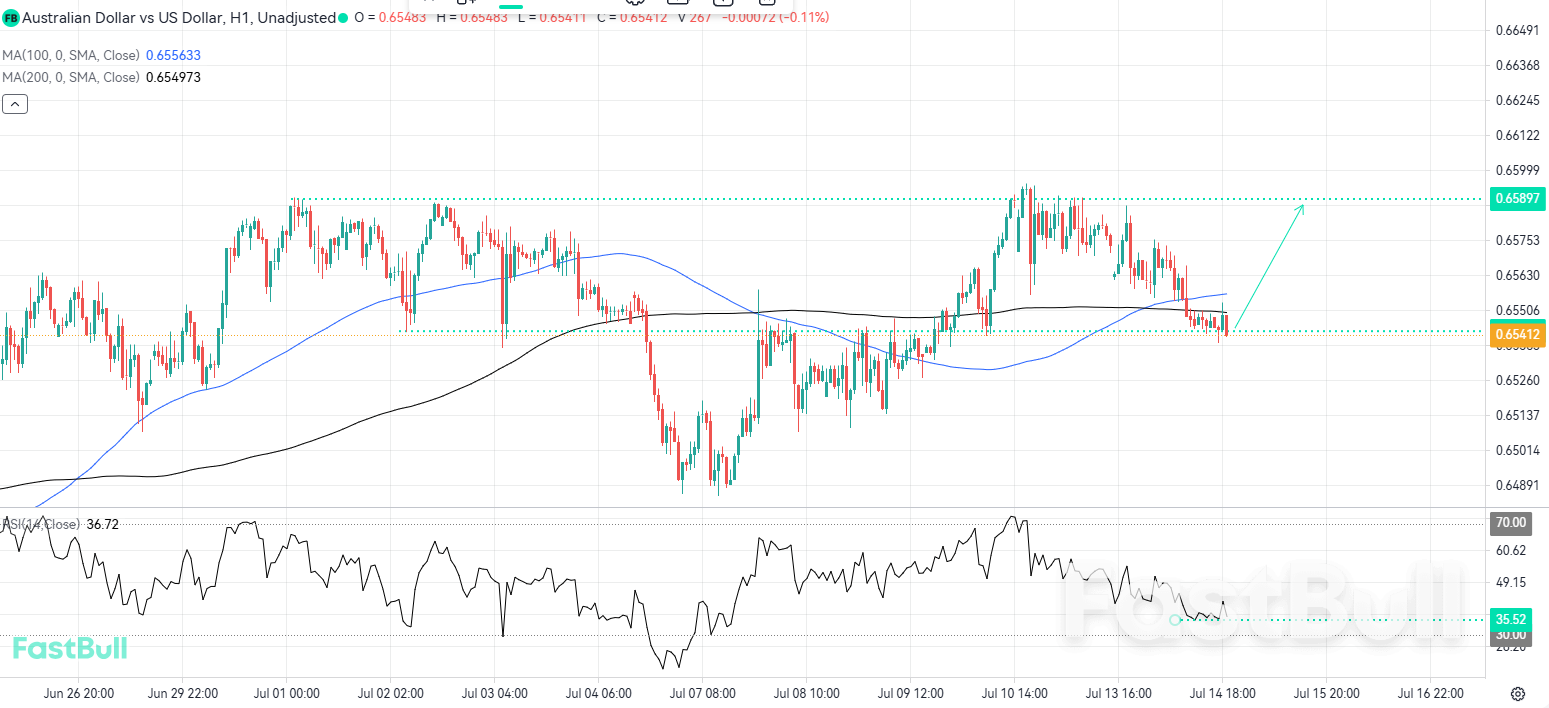
          AUDUSD has recently dropped to the 0.6544 level, where a significant local support zone lies. This area has served as a reliable reversal point in the past, leading to bullish bounces from these levels. If the pattern repeats, we could see the price attempt to move back toward the next resistance level at 0.6589.
          Additionally, the Relative Strength Index (RSI) has fallen to 35, approaching oversold conditions. This suggests that the currency pair may be primed for a potential bullish reversal if the support zone holds. If the price starts to show signs of recovery from here, it would be consistent with the previous price action.
          The 100-period and 200-period moving averages are positioned at 0.6556 and 0.6549, respectively, very close to each other. The price has recently closed below these levels, which could trigger a deeper downward move if the support breaks. However, a sustained hold above these moving averages and a close above the current support zone would confirm that the bullish momentum could continue, potentially driving the price higher.
          The focus will be on whether AUDUSD can maintain its support near 0.6544. If the price successfully holds above this level and closes above the moving averages, the chances of a bullish reversal will increase, making the 0.6589 resistance level the next key target.
          Trading Recommendations
          Trading direction: Buy
          Entry price: 0.6540
          Target price: 0.6590
          Stop loss: 0.6525
          Validity: Jul 25, 2025 15:00:00
          Risk Warnings and Disclaimers
          You understand and acknowledge that there is a high degree of risk involved in trading. Following any strategies or investment methods may lead to potential losses. The content on the site is provided by our contributors and analysts for information purposes only. You are solely responsible for determining whether any trading assets, securities, strategy, or any other product is suitable for investing based on your own investment objectives and financial situation.
          Add to Favorites
          Share

          A Second Rejection Could Confirm Double Top and Spark Pullback

          Manuel

          Central Bank

          Economic

          Summary:

          A pullback toward the 145.80 zone remains plausible if the price begins to retreat from local top levels.

          SELL USDJPY
          Close Time
          CLOSED

          148.000

          Entry Price

          145.850

          TP

          149.500

          SL

          155.814 +0.255 +0.16%

          62.9

          Pips

          Profit

          145.850

          TP

          147.371

          Exit Price

          148.000

          Entry Price

          149.500

          SL

          President Donald Trump jolted financial markets over the weekend by threatening to impose 30% tariffs on imports from both the European Union and Mexico if a trade agreement is not reached by the August 1 deadline. These proposed levies would come on top of previous tariffs announced on April 2—20% and 25% respectively—and follow earlier moves that targeted Canada with a 35% rate and slapped a 50% duty on key commodities like copper, aluminum, and steel.
          While many investors still view Trump’s threats as mere bargaining tools, the unpredictability of his approach continues to inject uncertainty into the markets. Increasing concerns about the inflationary and growth-slowing consequences of these trade measures are beginning to weigh on the U.S. dollar’s recent recovery momentum.
          Adding to the pressure, the White House confirmed an additional 50% tariff on U.S. copper imports is scheduled to take effect alongside the other measures on August 1.
          Traders are now bracing for the release of the U.S. Consumer Price Index (CPI) report for June. Headline inflation is forecast to climb from 2.4% to 2.7% year-over-year, while core CPI is expected to rise from 2.8% to 3.0%—well above the Federal Reserve’s 2% target. If realized, these figures could validate the Fed’s current cautious monetary stance and reinforce concerns that inflation may prove to be more persistent than previously thought.
          Fed officials have already begun weighing in ahead of the next policy meeting. Cleveland Fed President Beth Hammack reiterated her hawkish tone, stating that the economy remains healthy and she is open to supporting tighter policy if necessary. She noted that while inflation is moving toward target, it remains too high, especially with tariffs potentially stoking a renewed wave of price pressures.
          Meanwhile, Japanese and European Union officials are reportedly working on a joint statement to deepen their economic partnership, focusing on advanced technology, trade, and supply chain resilience—moves aimed at counterbalancing rising geopolitical tensions. This comes as Japanese core machinery orders and tertiary industry activity data both beat expectations, boosting hopes for a more resilient Japanese economy.
          Market participants are also closely monitoring the upcoming visit of U.S. Treasury Secretary Scott Bessent, especially in light of President Trump’s latest remarks targeting the auto sector’s trade imbalance. As the Bank of Japan prepares for its July 31 policy meeting, speculation is mounting over a potential upgrade to the central bank’s inflation forecasts.
          Japanese Government Bond (JGB) yields are rising, narrowing yield differentials with global peers, which in turn lends support to the yen.A Second Rejection Could Confirm Double Top and Spark Pullback_1

          Technical Analysis

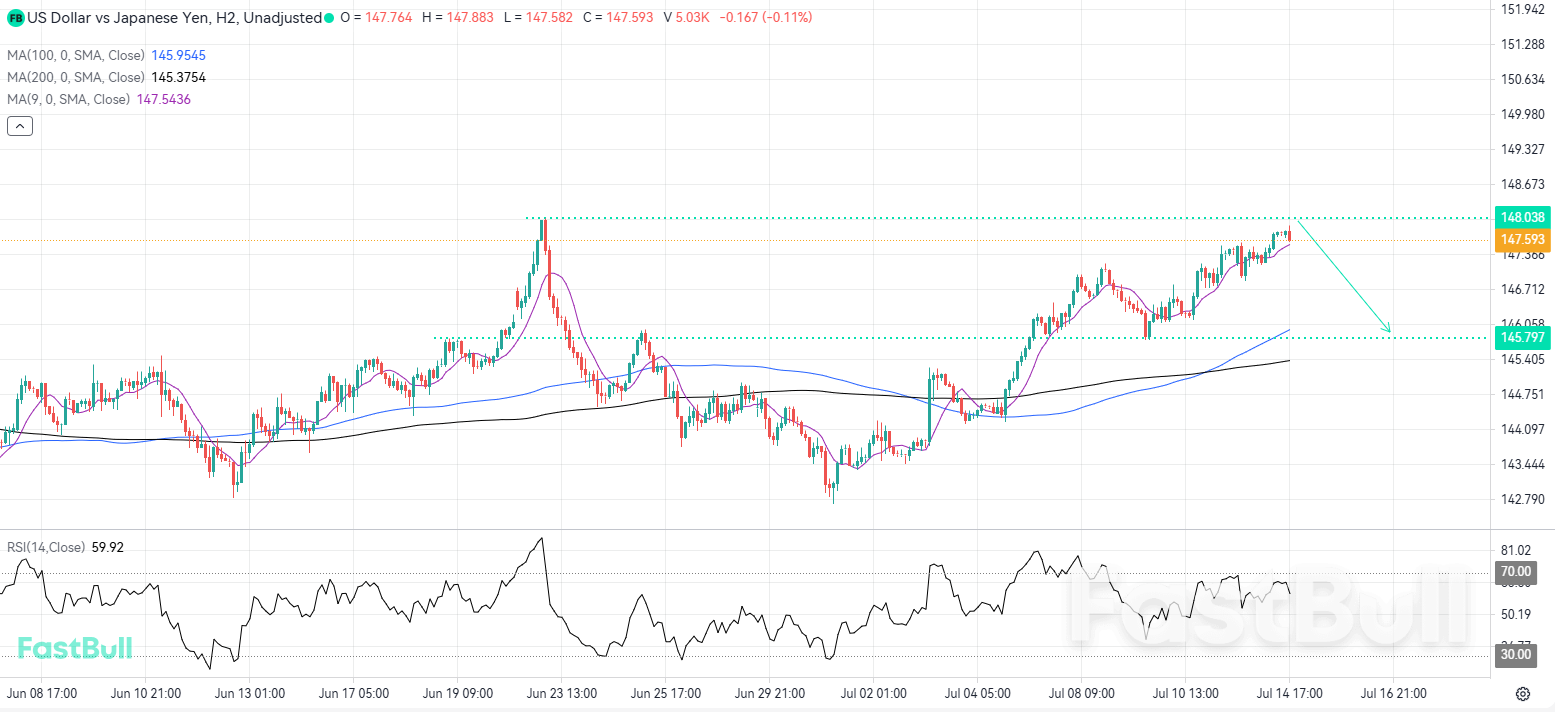
          USDJPY has experienced a strong bullish rally, driving the pair back toward the key resistance zone around 148.00—its local high from June 23. This level has historically served as a significant barrier, and another failure to break above it could set the stage for a bearish correction. A pullback toward the 145.80 zone remains plausible if the price begins to retreat from local top levels.
          The 145.80 region is particularly notable, as both the 100-period and 200-period moving averages on the 2-hour chart converge around this level. These moving averages often act as dynamic support targets during corrections, and their alignment here adds weight to the probability of a retracement.
          Meanwhile, the RSI currently sits at 61, suggesting bullish momentum is still present but approaching overbought territory. A brief retest of the 148.00 resistance could still occur before a more meaningful rejection sets in. Should the price fail to decisively break and close above that level, selling pressure could build—especially if signs of a double-top formation emerge.
          However, if USDJPY manages to breach 148.00 with strong bullish conviction, it would invalidate the bearish setup and signal the potential for continued upward movement. For now, traders are eyeing this critical resistance as a tipping point for the next directional move.
          Trading Recommendations
          Trading direction: Sell
          Entry price: 148.00
          Target price: 145.85
          Stop loss: 149.50
          Validity: Jul 25, 2025 15:00:00
          Risk Warnings and Disclaimers
          You understand and acknowledge that there is a high degree of risk involved in trading. Following any strategies or investment methods may lead to potential losses. The content on the site is provided by our contributors and analysts for information purposes only. You are solely responsible for determining whether any trading assets, securities, strategy, or any other product is suitable for investing based on your own investment objectives and financial situation.
          Add to Favorites
          Share

          NZD/USD Stuck Below 0.60 as Traders Eye China GDP, Tariff Fallout

          Warren Takunda

          Traders' Opinions

          Economic

          Summary:

          The New Zealand Dollar remained under pressure on Monday, slipping to three-week lows amid renewed global trade tensions triggered by U.S. tariff threats.

          SELL NZDUSD
          Close Time
          CLOSED

          0.59750

          Entry Price

          0.58600

          TP

          0.60300

          SL

          0.58040 -0.00044 -0.08%

          34.8

          Pips

          Profit

          0.58600

          TP

          0.59402

          Exit Price

          0.59750

          Entry Price

          0.60300

          SL

          The New Zealand Dollar (NZD) extended its losing streak on Monday, pressured by a deteriorating global risk backdrop and a stronger U.S. Dollar, as market sentiment soured following the latest tariff threats from Washington. Risk-sensitive assets such as the Kiwi were hit hard by President Donald Trump’s announcement over the weekend of fresh punitive tariffs on major trade partners, heightening fears of renewed trade frictions that could weigh on global growth.
          At the time of writing, NZD/USD was trading just under the 0.6000 handle, attempting a modest recovery from the intraday low of 0.5975 touched during the Asian session — its weakest level in three weeks. The pair remains down roughly 0.25% on the day, and the technical backdrop suggests sellers are still in control.
          The latest pressure on the Kiwi came after U.S. President Donald Trump announced a sharp escalation in tariffs on imports from both the European Union and Mexico. The new levies — 30% on EU imports and 30% on Mexican goods — represent a significant jump from the 20% and 25% duties unveiled just weeks earlier on April 2, a date Trump proclaimed “Liberation Day” in reference to American trade policy.
          Though markets have not yet reacted with panic, the implications of this aggressive trade stance are clearly being felt in FX. The targeted nations have so far avoided immediate retaliation, instead signaling a willingness to engage in talks ahead of the looming August 1 implementation deadline. Nonetheless, investors remain on edge, concerned that the situation could spiral and reignite a full-scale trade war — a scenario that would be especially damaging for export-dependent economies like New Zealand’s.
          The uncertainty is fueling demand for safe-haven assets, boosting the U.S. Dollar and weighing on higher-beta currencies such as the Kiwi, Australian Dollar, and emerging-market FX. Volatility, while contained for now, could rise sharply if rhetoric escalates or if global equity markets begin to buckle under the weight of geopolitical and trade uncertainty.
          Providing a partial offset to the risk-off mood was a surprisingly strong set of trade data from China, New Zealand’s largest trading partner. Chinese exports surged in May, outpacing market expectations and widening the country’s trade surplus. The data reflects a boost from improved U.S.-China trade relations and suggests that Chinese manufacturing activity may be stabilizing after months of weakness.
          For New Zealand, whose economy is tightly linked to Chinese demand — particularly for agricultural exports, dairy, and raw commodities — the upbeat numbers offered a degree of reassurance. With China’s second-quarter GDP figures due out on Tuesday, investors will be watching closely for confirmation that the world’s second-largest economy is regaining momentum. A solid GDP reading could offer the Kiwi some reprieve, especially in the absence of major domestic data this week.
          Technical AnalysisNZD/USD Stuck Below 0.60 as Traders Eye China GDP, Tariff Fallout_1
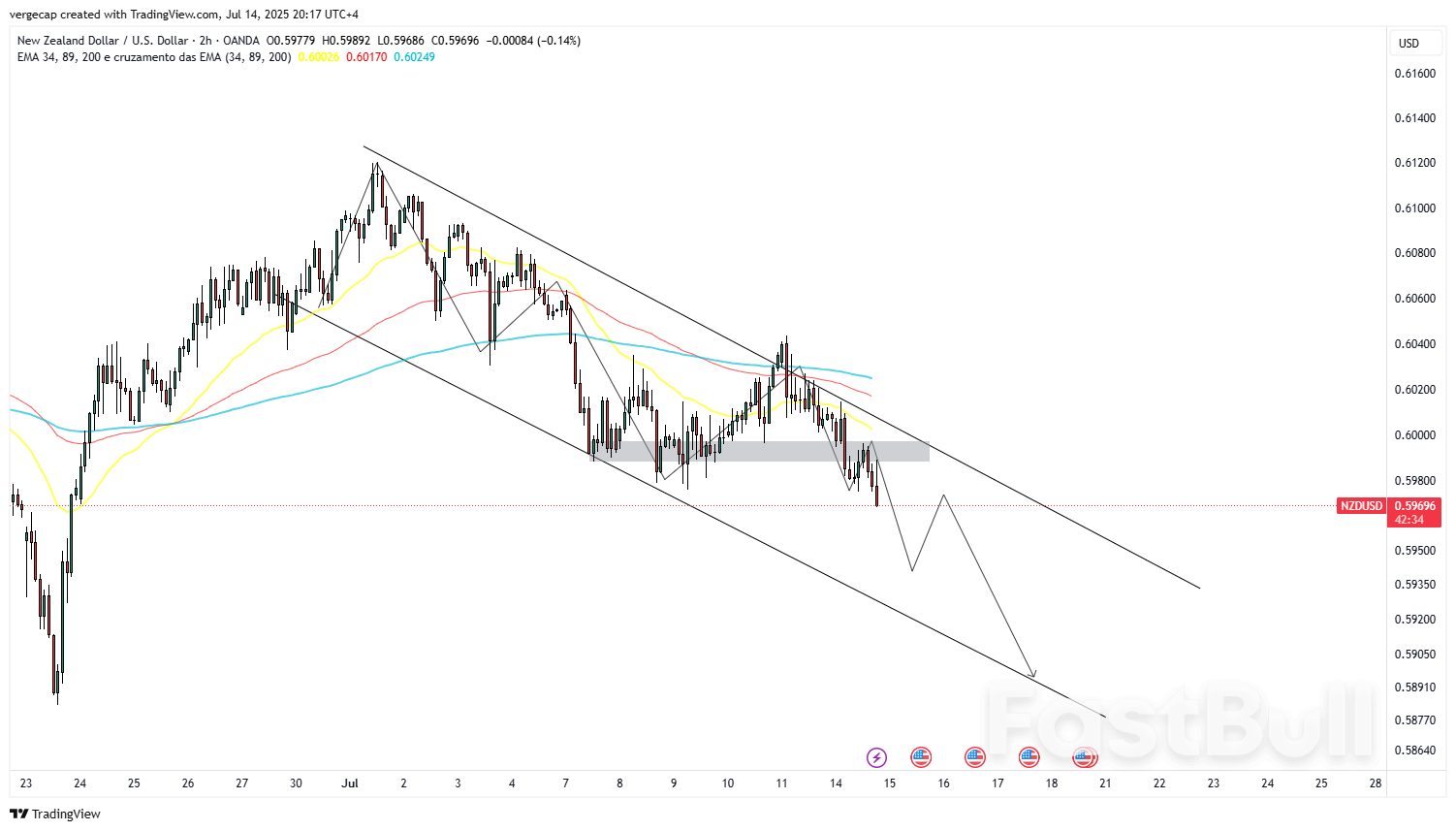
          From a technical standpoint, NZD/USD continues to exhibit a bearish structure, with price action dominated by a sequence of lower highs and lower lows — a textbook definition of a downtrend. There are no signs of bullish divergence on key indicators, suggesting that bears still have control of the market narrative.
          The pair recently retraced to the 0.382 Fibonacci level, a common turning point during corrective moves, only to face rejection near the 0.6000 round number — an area reinforced by the 50-period exponential moving average (EMA50), which is acting as dynamic resistance. Additionally, the Relative Strength Index (RSI) is beginning to tilt lower after briefly reaching overbought territory, hinting at the emergence of negative divergence that could amplify downside pressure.
          Moreover, the pair appears to be trading within a well-defined bearish channel — a continuation pattern that typically results in further declines. Should bearish momentum resume, immediate support lies at 0.5970, followed by 0.5925 and the March swing low near 0.5860. On the upside, any recovery would need to clear the 0.6000 threshold decisively to even begin challenging the bearish bias.
          TRADE RECOMMENDATION
          SELL NZDUSD
          ENTRY PRICE: 0.5975
          STOP LOSS: 0.6030
          TAKE PROFIT: 0.5860
          Risk Warnings and Disclaimers
          You understand and acknowledge that there is a high degree of risk involved in trading. Following any strategies or investment methods may lead to potential losses. The content on the site is provided by our contributors and analysts for information purposes only. You are solely responsible for determining whether any trading assets, securities, strategy, or any other product is suitable for investing based on your own investment objectives and financial situation.
          Add to Favorites
          Share

          Euro Rebounds from Three-Week Lows but Remains Under Pressure as Trump’s EU Tariffs Cloud Outlook

          Warren Takunda

          Traders' Opinions

          Economic

          Summary:

          EUR/USD bounced higher in early European trading Monday, recovering from three-week lows, but the broader bearish trend remains intact amid investor unease following new 30% U.S.

          BUY EURUSD
          Close Time
          CLOSED

          1.17036

          Entry Price

          1.20000

          TP

          1.16000

          SL

          1.17394 +0.00011 +0.01%

          103.6

          Pips

          Loss

          1.16000

          SL

          1.15994

          Exit Price

          1.17036

          Entry Price

          1.20000

          TP

          The Euro staged a modest recovery against the U.S. Dollar on Monday, rebounding from a three-week low as European markets opened, but the move was far from a trend reversal. The EUR/USD pair gained ground during the early European session, trading up from 1.1655 to hover just below the 1.1700 handle. Despite the bounce, the broader outlook for the pair remains clouded by renewed trade tensions and a cautious global mood, particularly in light of aggressive new tariffs announced by the United States over the weekend.
          U.S. President Donald Trump revealed plans to impose sweeping 30% levies on all European Union imports, escalating transatlantic trade tensions that had simmered since the previous round of negotiations in April. While markets opened with a relatively measured reaction—unlike the sharp moves seen earlier in the year—investor sentiment remained fragile, keeping the Euro on the defensive and weighing on broader risk appetite.
          The new round of tariffs, though aggressive, is being interpreted by many traders as part of a high-stakes negotiation tactic rather than a final declaration of policy. This perception has somewhat cushioned the market reaction. The Euro’s downside was also mitigated by the European Union’s restrained response. Rather than retaliate immediately, Brussels opted for diplomacy, with EU Trade Commissioner Maros Sefcovic expressing optimism that a trade agreement with Washington could still be reached before the self-imposed August deadline.
          Sefcovic’s remarks were seen as an attempt to de-escalate tensions and maintain the momentum of ongoing negotiations. This has provided a floor beneath the Euro, keeping the currency from sliding deeper despite the fundamentally bearish tilt in the near term. However, with trade rhetoric intensifying and no concrete deal on the table yet, investor caution prevails.
          Monday’s economic calendar is light, with little in the way of tier-one data from either side of the Atlantic. Instead, the market's attention is fixed on political developments, including the Eurogroup meeting and a scheduled speech by ECB member Piero Cipollone, which may offer clues on the central bank’s evolving stance in a volatile global environment.
          Across the Atlantic, eyes are firmly on Tuesday’s release of U.S. Consumer Price Index (CPI) data for June. With inflation trends playing a pivotal role in shaping the Federal Reserve’s policy path, any upside surprise in CPI could reinforce expectations for a delayed or more gradual easing cycle. That, in turn, would lend additional strength to the U.S. Dollar and challenge the Euro’s recovery attempts. Conversely, a softer inflation print could revive speculation of a dovish pivot, creating a temporary tailwind for EUR/USD.
          Technical AnalysisEuro Rebounds from Three-Week Lows but Remains Under Pressure as Trump’s EU Tariffs Cloud Outlook_1
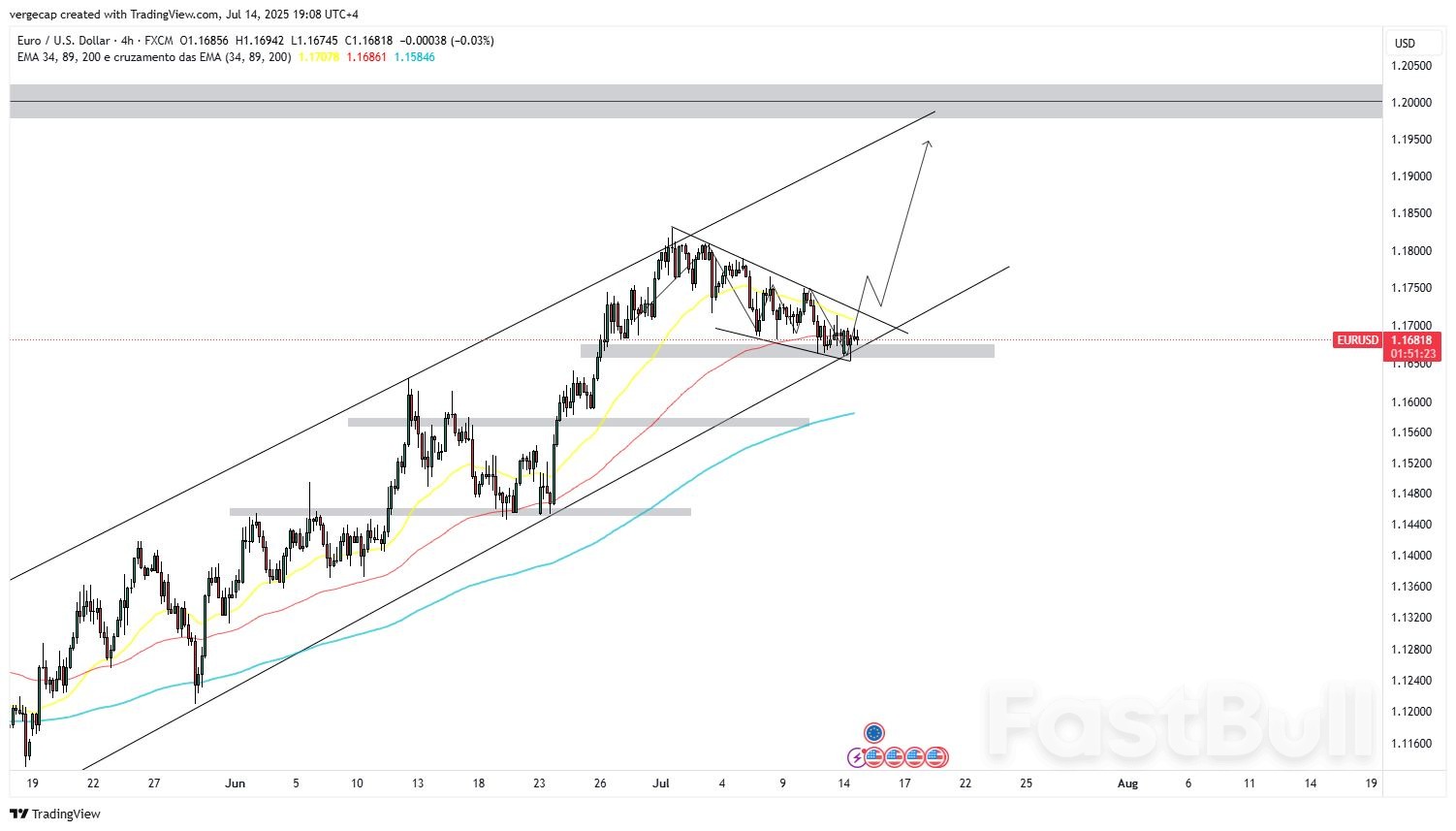
          From a technical perspective, EUR/USD is undergoing a healthy retracement after failing to sustain the bullish momentum that had lifted the pair to 1.1830 — a level not seen in nearly four years — earlier this month. Since then, price action has been confined within a well-defined descending channel, with the pair making lower highs and lower lows, a classic bearish pattern.
          Monday’s bounce finds the Euro testing the mid-line of the longer-term ascending channel. The 1.16288 – 1.15774 zone, which once served as stiff resistance, now acts as a potential demand area. This support flip is a textbook structural pivot point, and its ability to hold will be key in determining whether the bullish undertone can reassert itself.
          A convincing bounce from this zone could reignite upward momentum, setting the stage for a potential move back toward the 1.2000 psychological level over the coming weeks — assuming fundamental catalysts such as a trade resolution or soft U.S. inflation data emerge. However, a decisive break below the lower boundary of the demand zone and channel support would invalidate the bullish thesis and expose the pair to deeper losses, possibly toward 1.1500 and the 200-day EMA.
          TRADE RECEOMMENDATION
          BUY EURUSD
          ENTRY PRICE: 1.1700
          STOP LOSS: 1.1600
          TAKE PROFIT :1.2000
          Risk Warnings and Disclaimers
          You understand and acknowledge that there is a high degree of risk involved in trading. Following any strategies or investment methods may lead to potential losses. The content on the site is provided by our contributors and analysts for information purposes only. You are solely responsible for determining whether any trading assets, securities, strategy, or any other product is suitable for investing based on your own investment objectives and financial situation.
          Add to Favorites
          Share
          FastBull
          Copyright © 2025 FastBull Ltd

          728 RM B 7/F GEE LOK IND BLDG NO 34 HUNG TO RD KWUN TONG KLN HONG KONG

          TelegramInstagramTwitterfacebooklinkedin
          App Store Google Play Google Play
          Products
          Charts

          Chats

          Q&A with Experts
          Screeners
          Economic Calendar
          Data
          Tools
          Membership
          Features
          Function
          Markets
          Copy Trading
          Latest Signals
          Contests
          News
          Analysis
          24/7
          Columns
          Education
          Company
          Careers
          About Us
          Contact Us
          Advertising
          Help Center
          Feedback
          User Agreement
          Privacy Policy
          Business

          White Label

          Data API

          Web Plug-ins

          Poster Maker

          Affiliate Program

          Risk Disclosure

          The risk of loss in trading financial instruments such as stocks, FX, commodities, futures, bonds, ETFs and crypto can be substantial. You may sustain a total loss of the funds that you deposit with your broker. Therefore, you should carefully consider whether such trading is suitable for you in light of your circumstances and financial resources.

          No decision to invest should be made without thoroughly conducting due diligence by yourself or consulting with your financial advisors. Our web content might not suit you since we don't know your financial conditions and investment needs. Our financial information might have latency or contain inaccuracy, so you should be fully responsible for any of your trading and investment decisions. The company will not be responsible for your capital loss.

          Without getting permission from the website, you are not allowed to copy the website's graphics, texts, or trademarks. Intellectual property rights in the content or data incorporated into this website belong to its providers and exchange merchants.

          Not Logged In

          Log in to access more features

          FastBull Membership

          Not yet

          Purchase

          Become a signal provider
          Help Center
          Customer Service
          Dark Mode
          Price Up/Down Colors

          Log In

          Sign Up

          Position
          Layout
          Fullscreen
          Default to Chart
          The chart page opens by default when you visit fastbull.com