• Trade
  • Markets
  • Copy
  • Contests
  • News
  • 24/7
  • Calendar
  • Q&A
  • Chats
Trending
Screeners
SYMBOL
LAST
BID
ASK
HIGH
LOW
NET CHG.
%CHG.
SPREAD
SPX
S&P 500 Index
6870.39
6870.39
6870.39
6895.79
6858.28
+13.27
+ 0.19%
--
DJI
Dow Jones Industrial Average
47954.98
47954.98
47954.98
48133.54
47871.51
+104.05
+ 0.22%
--
IXIC
NASDAQ Composite Index
23578.12
23578.12
23578.12
23680.03
23506.00
+72.99
+ 0.31%
--
USDX
US Dollar Index
98.880
98.960
98.880
98.960
98.730
-0.070
-0.07%
--
EURUSD
Euro / US Dollar
1.16528
1.16535
1.16528
1.16717
1.16341
+0.00102
+ 0.09%
--
GBPUSD
Pound Sterling / US Dollar
1.33275
1.33284
1.33275
1.33462
1.33136
-0.00037
-0.03%
--
XAUUSD
Gold / US Dollar
4208.93
4209.34
4208.93
4218.85
4190.61
+11.02
+ 0.26%
--
WTI
Light Sweet Crude Oil
59.383
59.413
59.383
60.084
59.291
-0.426
-0.71%
--

Community Accounts

Signal Accounts
--
Profit Accounts
--
Loss Accounts
--
View More

Become a signal provider

Sell trading signals to earn additional income

View More

Guide to Copy Trading

Get started with ease and confidence

View More

Signal Accounts for Members

All Signal Accounts

Best Return
  • Best Return
  • Best P/L
  • Best MDD
Past 1W
  • Past 1W
  • Past 1M
  • Past 1Y

All Contests

  • All
  • Trump Updates
  • Recommend
  • Stocks
  • Cryptocurrencies
  • Central Banks
  • Featured News
Top News Only
Share

GFZ - Earthquake Of Magnitude 5.45 Strikes Turkey

Share

Kremlin: India Buys Energy Where It Is Profitable To And As Far As We Understand They Will Continue To Do That

Share

Turkey's Main Banking Index Up 2.5%

Share

Turkey's Main BIST-100 Index Up 1.9%

Share

Hungary's Preliminary November Budget Balance Huf -403 Billion

Share

Indian Rupee Down 0.1% At 90.07 Per USA Dollar As Of 3:30 P.M. Ist, Previous Close 89.98

Share

India's Nifty 50 Index Provisionally Ends 0.96% Lower

Share

[JPMorgan: US Stock Rally May Stagnate Following Fed Rate Cut] JPMorgan Strategists Say The Recent Rally In US Stocks May Stall As Investors Take Profits Following The Anticipated Fed Rate Cut. The Market Currently Predicts A 92% Probability Of The Fed Lowering Borrowing Costs On Wednesday. Expectations Of A Rate Cut Have Continued To Rise, Fueled By Positive Signals From Policymakers In Recent Weeks. "Investors May Be More Inclined To Lock In Gains At The End Of The Year Rather Than Increase Directional Exposure," Mislav Matejka's Team Wrote In A Report

Share

Russian Defence Ministry: Russian Forces Take Control Of Novodanylivka In Ukraine's Zaporizhzhia Region

Share

Russian Defence Ministry: Russian Forces Take Control Of Chervone In Ukraine's Donetsk Region

Share

French Finance Ministry: Government Started Process To Block Temporarily Shein Platform

Share

Finance Minister: Indonesia To Impose Coal Export Tax Of Up To 5% Next Year

Share

[Trump Considering Fired Homeland Security Secretary Noem? White House Denies] According To Reports From US Media Outlets Such As The Daily Beast And The UK's Independent, The White House Has Denied Reports That US President Trump Is Considering Firing Homeland Security Secretary Noem. White House Spokesperson Abigail Jackson Posted On Social Media On The 7th Local Time, Calling The Claims "fake News" And Stating That "Secretary Noem Has Done An Excellent Job Implementing The President's Agenda And 'making America Safe Again'."

Share

HKEX: Standard Chartered Bought Back 571604 Total Shares On Other Exchanges For Gbp9.5 Million On Dec 5

Share

Morgan Stanley Reiterates Bullish Outlook On US Stocks Due To Fed Rate Cut Expectations. Morgan Stanley Strategists Believe That The US Stock Market Faces A "bullish Outlook" Given Improved Earnings Expectations And Anticipated Fed Rate Cuts. They Expect Strong Corporate Earnings By 2026, And Anticipate The Fed Will Cut Rates Based On Lagging Or Mildly Weak Labor Markets. They Expect The US Consumer Discretionary Sector And Small-cap Stocks To Continue To Outperform

Share

China's National Development And Reform Commission Announced That Starting From 24:00 On December 8, The Retail Price Limit For Gasoline And Diesel In China Will Be Reduced By 55 Yuan Per Ton, Which Translates To A Reduction Of 0.04 Yuan Per Liter For 92-octane Gasoline, 0.05 Yuan Per Liter For 95-octane Gasoline, And 0.05 Yuan Per Liter For 0# Diesel

Share

Tkms CEO: US Security Strategy Highlights Need For Europe To Take Care Of Its Own Defences

Share

USA S&P 500 E-Mini Futures Up 0.1%, NASDAQ 100 Futures Up 0.18%, Dow Futures Down 0.02%

Share

London Metal Exchange (LME): Copper Inventories Increased By 2,000 Tons, Aluminum Inventories Decreased By 2,500 Tons, Nickel Inventories Increased By 228 Tons, Zinc Inventories Increased By 2,375 Tons, Lead Inventories Decreased By 3,725 Tons, And Tin Inventories Decreased By 10 Tons

Share

Swiss Sight Deposits Of Domestic Banks At 440.519 Billion Sfr In Week Ending December 5 Versus 437.298 Billion Sfr A Week Earlier

TIME
ACT
FCST
PREV
France Industrial Output MoM (SA) (Oct)

A:--

F: --

P: --
France Trade Balance (SA) (Oct)

A:--

F: --

P: --
Euro Zone Employment YoY (SA) (Q3)

A:--

F: --

P: --
Canada Part-Time Employment (SA) (Nov)

A:--

F: --

P: --

Canada Unemployment Rate (SA) (Nov)

A:--

F: --

P: --

Canada Full-time Employment (SA) (Nov)

A:--

F: --

P: --

Canada Labor Force Participation Rate (SA) (Nov)

A:--

F: --

P: --

Canada Employment (SA) (Nov)

A:--

F: --

P: --

U.S. PCE Price Index MoM (Sept)

A:--

F: --

P: --

U.S. Personal Income MoM (Sept)

A:--

F: --

P: --

U.S. Core PCE Price Index MoM (Sept)

A:--

F: --

P: --

U.S. PCE Price Index YoY (SA) (Sept)

A:--

F: --

P: --

U.S. Core PCE Price Index YoY (Sept)

A:--

F: --

P: --

U.S. Personal Outlays MoM (SA) (Sept)

A:--

F: --

P: --
U.S. 5-10 Year-Ahead Inflation Expectations (Dec)

A:--

F: --

P: --

U.S. Real Personal Consumption Expenditures MoM (Sept)

A:--

F: --

P: --
U.S. Weekly Total Rig Count

A:--

F: --

P: --

U.S. Weekly Total Oil Rig Count

A:--

F: --

P: --

U.S. Consumer Credit (SA) (Oct)

A:--

F: --

P: --
China, Mainland Foreign Exchange Reserves (Nov)

A:--

F: --

P: --

Japan Trade Balance (Oct)

A:--

F: --

P: --

Japan Nominal GDP Revised QoQ (Q3)

A:--

F: --

P: --

China, Mainland Imports YoY (CNH) (Nov)

A:--

F: --

P: --

China, Mainland Exports (Nov)

A:--

F: --

P: --

China, Mainland Imports (CNH) (Nov)

A:--

F: --

P: --

China, Mainland Trade Balance (CNH) (Nov)

A:--

F: --

P: --

China, Mainland Exports YoY (USD) (Nov)

A:--

F: --

P: --

China, Mainland Imports YoY (USD) (Nov)

A:--

F: --

P: --

Germany Industrial Output MoM (SA) (Oct)

A:--

F: --

P: --
Euro Zone Sentix Investor Confidence Index (Dec)

A:--

F: --

P: --

Canada National Economic Confidence Index

--

F: --

P: --

U.K. BRC Like-For-Like Retail Sales YoY (Nov)

--

F: --

P: --

U.K. BRC Overall Retail Sales YoY (Nov)

--

F: --

P: --

Australia Overnight (Borrowing) Key Rate

--

F: --

P: --

RBA Rate Statement
RBA Press Conference
Germany Exports MoM (SA) (Oct)

--

F: --

P: --

U.S. NFIB Small Business Optimism Index (SA) (Nov)

--

F: --

P: --

Mexico 12-Month Inflation (CPI) (Nov)

--

F: --

P: --

Mexico Core CPI YoY (Nov)

--

F: --

P: --

Mexico PPI YoY (Nov)

--

F: --

P: --

U.S. Weekly Redbook Index YoY

--

F: --

P: --

U.S. JOLTS Job Openings (SA) (Oct)

--

F: --

P: --

China, Mainland M1 Money Supply YoY (Nov)

--

F: --

P: --

China, Mainland M0 Money Supply YoY (Nov)

--

F: --

P: --

China, Mainland M2 Money Supply YoY (Nov)

--

F: --

P: --

U.S. EIA Short-Term Crude Production Forecast For The Year (Dec)

--

F: --

P: --

U.S. EIA Natural Gas Production Forecast For The Next Year (Dec)

--

F: --

P: --

U.S. EIA Short-Term Crude Production Forecast For The Next Year (Dec)

--

F: --

P: --

EIA Monthly Short-Term Energy Outlook
U.S. API Weekly Gasoline Stocks

--

F: --

P: --

U.S. API Weekly Cushing Crude Oil Stocks

--

F: --

P: --

U.S. API Weekly Crude Oil Stocks

--

F: --

P: --

U.S. API Weekly Refined Oil Stocks

--

F: --

P: --

South Korea Unemployment Rate (SA) (Nov)

--

F: --

P: --

Japan Reuters Tankan Non-Manufacturers Index (Dec)

--

F: --

P: --

Japan Reuters Tankan Manufacturers Index (Dec)

--

F: --

P: --

Japan Domestic Enterprise Commodity Price Index MoM (Nov)

--

F: --

P: --

Japan Domestic Enterprise Commodity Price Index YoY (Nov)

--

F: --

P: --

China, Mainland PPI YoY (Nov)

--

F: --

P: --

Q&A with Experts
    • All
    • Chatrooms
    • Groups
    • Friends
    Connecting
    .
    .
    .
    Type here...
    Add Symbol or Code

      No matching data

      All
      Trump Updates
      Recommend
      Stocks
      Cryptocurrencies
      Central Banks
      Featured News
      • All
      • Russia-Ukraine Conflict
      • Middle East Flashpoint
      • All
      • Russia-Ukraine Conflict
      • Middle East Flashpoint

      Search
      Products

      Charts Free Forever

      Chats Q&A with Experts
      Screeners Economic Calendar Data Tools
      Membership Features
      Data Warehouse Market Trends Institutional Data Policy Rates Macro

      Market Trends

      Market Sentiment Order Book Forex Correlations

      Top Indicators

      Charts Free Forever
      Markets

      News

      News Analysis 24/7 Columns Education
      From Institutions From Analysts
      Topics Columnists

      Latest Views

      Latest Views

      Trending Topics

      Top Columnists

      Latest Update

      Signals

      Copy Rankings Latest Signals Become a signal provider AI Rating
      Contests
      Brokers

      Overview Brokers Assessment Rankings Regulators News Claims
      Broker listing Forex Brokers Comparison Tool Live Spread Comparison Scam
      Q&A Complaint Scam Alert Videos Tips to Detect Scam
      More

      Business
      Events
      Careers About Us Advertising Help Center

      White Label

      Data API

      Web Plug-ins

      Affiliate Program

      Awards Institution Evaluation IB Seminar Salon Event Exhibition
      Vietnam Thailand Singapore Dubai
      Fans Party Investment Sharing Session
      FastBull Summit BrokersView Expo
      Recent Searches
        Top Searches
          Markets
          News
          Analysis
          User
          24/7
          Economic Calendar
          Education
          Data
          • Names
          • Latest
          • Prev

          View All

          No data

          Scan to Download

          Faster Charts, Chat Faster!

          Download App
          English
          • English
          • Español
          • العربية
          • Bahasa Indonesia
          • Bahasa Melayu
          • Tiếng Việt
          • ภาษาไทย
          • Français
          • Italiano
          • Türkçe
          • Русский язык
          • 简中
          • 繁中
          Open Account
          Search
          Products
          Charts Free Forever
          Markets
          News
          Signals

          Copy Rankings Latest Signals Become a signal provider AI Rating
          Contests
          Brokers

          Overview Brokers Assessment Rankings Regulators News Claims
          Broker listing Forex Brokers Comparison Tool Live Spread Comparison Scam
          Q&A Complaint Scam Alert Videos Tips to Detect Scam
          More

          Business
          Events
          Careers About Us Advertising Help Center

          White Label

          Data API

          Web Plug-ins

          Affiliate Program

          Awards Institution Evaluation IB Seminar Salon Event Exhibition
          Vietnam Thailand Singapore Dubai
          Fans Party Investment Sharing Session
          FastBull Summit BrokersView Expo

          BoJ Hawkish Talk and Government Warning Spark Yen Whipsaw

          Eva Chen

          Forex

          Summary:

          A Policy Board member signals the Bank of Japan (BoJ) could lift rates "as early as December," while Chief Cabinet Secretary urges vigilance against "one-sided, abrupt FX moves."

          SELL USDJPY
          EXP
          EXPIRED

          160.000

          Entry Price

          153.250

          TP

          162.500

          SL

          155.452 +0.107 +0.07%

          --

          Pips

          EXPIRED

          153.250

          TP

          155.345

          Exit Price

          160.000

          Entry Price

          162.500

          SL
          Fundamentals

          Amid the JPY pair falling to its lowest level against USD in roughly ten months, Bank of Japan (BoJ) Policy Board member Junko Koeda on Thursday signaled that a rate hike could come as early as next month and underscored the need to advance interest-rate normalization.
          Speaking to local business leaders in Niigata, Koeda said: "Given that real interest rates are currently at a significantly low level, I believe the Bank must proceed with normalizing policy rates."
          Following her remarks, JPY extended its decline against USD, suggesting investors may be awaiting a more unambiguous tightening signal. The market consensus now expects the BoJ to raise rates no later than January, while Koeda's comments have reinforced the possibility of a December move.
          Separately, Chief Cabinet Secretary Kihara Minoru told reporters on Thursday that the recent one-way, rapid moves in the yen are "a source of concern" and warrant close monitoring. "We need to be vigilant against excessive and disorderly exchange-rate fluctuations," he said, speaking after JPY breached the 157.00 against USD handle to hit its weakest level since January.
          A key driver of the stronger dollar and weaker yen has been the ebbing market conviction that the Fed will cut rates in the near term. Kihara stressed that exchange-rate stability grounded in economic fundamentals is essential, opposing sharp moves fueled by speculative flows or market sentiment.
          Market watch: The cabinet secretary's warning about "one-way yen volatility" is likely to raise bets on imminent FX intervention. Each time Japanese officials issue such language, traders speculate that the authorities are poised to step in, prompting both longs and shorts to add size in an effort to test the government's threshold. Rather than deterring speculation, this dynamic often fuels two-way whipsaw moves as investors probe "where Tokyo draws the line."
          BoJ Hawkish Talk and Government Warning Spark Yen Whipsaw_1

          Technical Analysis

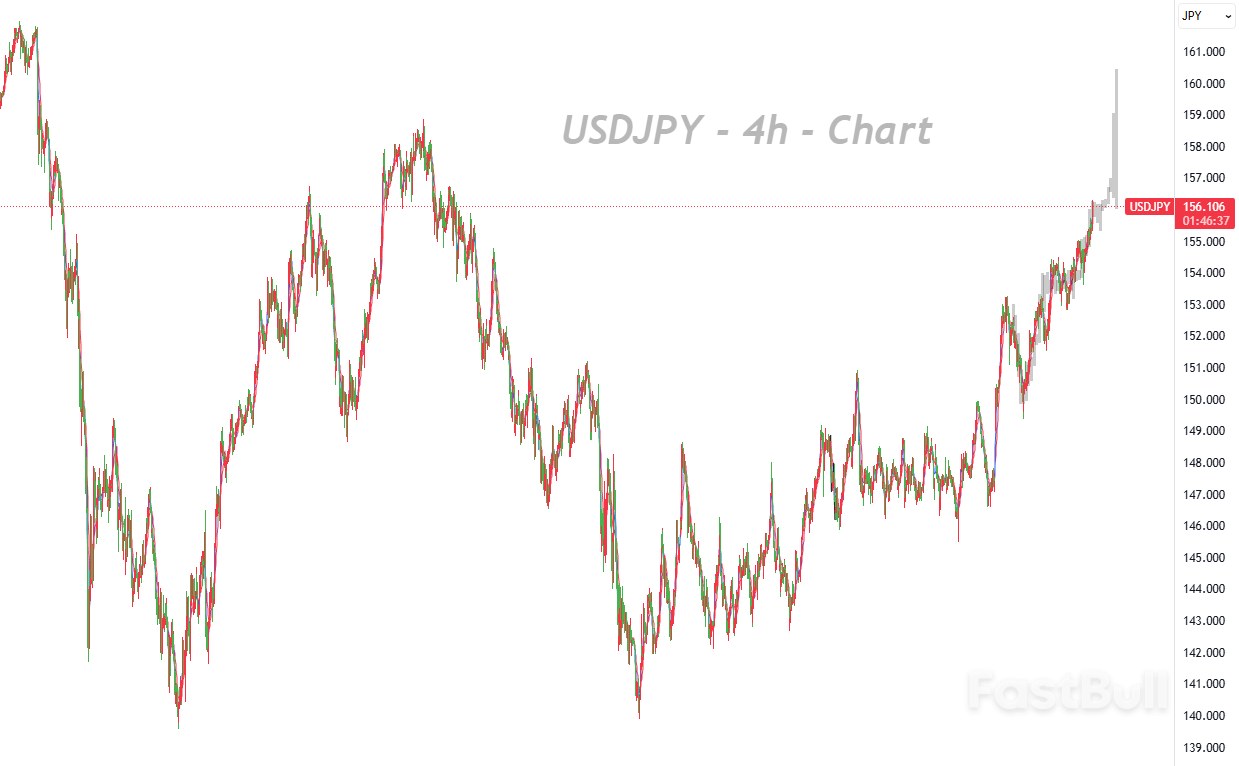
          USDJPY accelerated to the upside today. The intraday bias remains bullish, with the initial target at the key structural resistance of 158.85, followed by the 161.8% extension of the 149.37–153.26 range at 160.17.
          On the downside, a break below the minor support at 155.72 would neutralize the intraday outlook and trigger a consolidation phase before another potential leg higher. The trading strategy for this phase is to position for the next directional move.

          Trade Recommendations

          Trade Direction: Sell
          Entry Price: 160.00
          Target Price: 153.25
          Stop Loss: 162.50
          Valid Until: December 5, 2025, 23:55:00
          Support: 158.88/156.76/154.81
          Resistance Levels: 158.91/160.21/161.78
          Risk Warnings and Disclaimers
          You understand and acknowledge that there is a high degree of risk involved in trading. Following any strategies or investment methods may lead to potential losses. The content on the site is provided by our contributors and analysts for information purposes only. You are solely responsible for determining whether any trading assets, securities, strategy, or any other product is suitable for investing based on your own investment objectives and financial situation.
          Add to Favorites
          Share

          Dollar Extends Rally as Fed Minutes Crush Hopes for December Rate Cut

          Warren Takunda

          Forex

          Traders' Opinions

          Summary:

          The US Dollar strengthened broadly on Thursday as markets slashed expectations for a December rate cut, with hawkish Fed minutes reinforcing a bullish technical setup and positioning the USD Index for a potential breakout toward medium-term resistance.

          BUY USDX
          Close Time
          CLOSED

          100.300

          Entry Price

          102.000

          TP

          99.000

          SL

          98.880 -0.070 -0.07%

          130.0

          Pips

          Loss

          99.000

          SL

          99.000

          Exit Price

          100.300

          Entry Price

          102.000

          TP
          The US Dollar advanced firmly across major currency pairs on Thursday, lifted by a sweeping repricing of Federal Reserve expectations and a technical landscape that continues to skew in favor of the bulls. The USD Index (DXY) climbed into the 100.35–100.50 region — a critical ceiling that capped upside attempts in May, August, and early November — as investors increasingly retreat from earlier assumptions that the Fed will cut rates again in December.
          The move follows the release of hawkish minutes from the Federal Reserve’s latest meeting, which fueled renewed USD demand already supported by risk-averse market sentiment earlier in the week. While the Fed delivered a quarter-point rate cut on October 29, the minutes revealed a surprisingly divided committee, with “many” officials opposing the decision — a signal that policymakers remain hesitant about easing too aggressively while inflation risks linger.
          For investors, the message was simple: the Fed is nowhere near unanimous on additional easing, and the December meeting could be far less dovish than the market had priced in. As a result, rate-cut odds receded sharply, giving the Dollar fresh momentum at a time when global growth concerns and softer equity sentiment already favored safe-haven flows.
          The Fed’s internal disagreement has forced traders to reassess the policy outlook going into year-end. While October’s rate cut was largely seen as part of a dovish pivot, the minutes suggest the central bank is not prepared to commit to a multi-step easing cycle without more evidence of economic cooling.
          The next major catalyst arrives Friday with the long-delayed September Nonfarm Payrolls figures. Economists expect the US economy to have added 55,000 jobs — an improvement from August’s meager 22,000, yet still well below the 2024 monthly average. A stronger-than-expected print would further complicate the case for easing and could embolden USD bulls ahead of the December 10 Fed meeting.

          Technical Analysis Dollar Extends Rally as Fed Minutes Crush Hopes for December Rate Cut_1

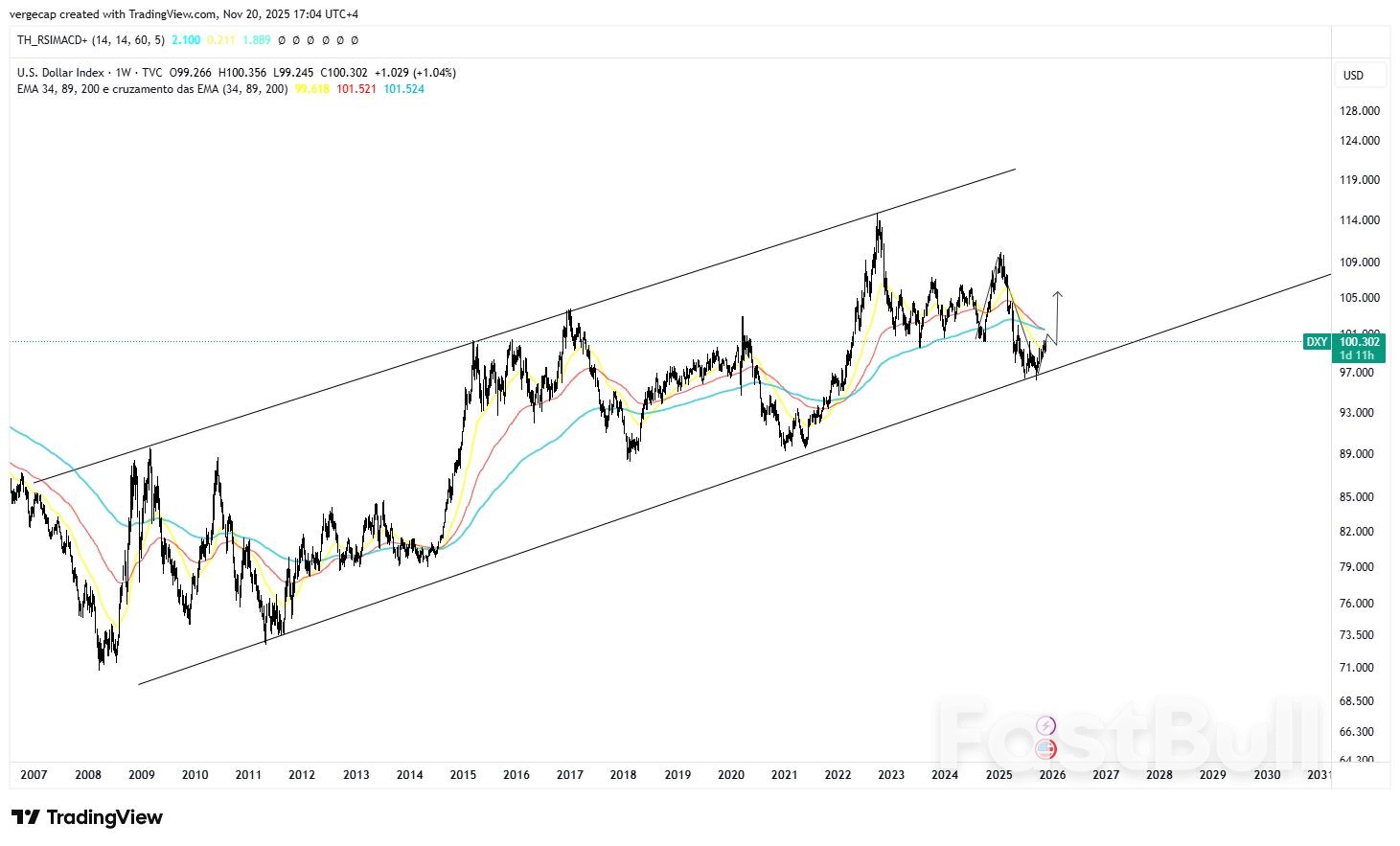
          From a technical perspective, DXY continues to trade within a well-defined ascending channel, carving out higher lows while maintaining structure above mid-channel support. This pattern has held steady throughout the autumn, with the October rate-cut reaction generating a clean bullish leg that may now be developing into a broader impulsive wave.
          The current pullback is unfolding precisely at a key demand zone that aligns with channel support — a confluence typically associated with continuation setups rather than reversals. Higher-timeframe supply remains overhead, yet with structure intact, the narrative increasingly favors additional USD appreciation.
          For conviction of a sustained breakout, traders are watching the daily resistance at 100.54. A clean move above this zone — which has repeatedly rejected bulls since May — would open a relatively unobstructed path toward 102.00, a major daily resistance level reinforced by the 50-month SMA. This confluence serves as a clear medium-term target for Dollar bulls and could define the next phase of the USD’s broader recovery.

          TRADE RECOMMENDATION

          BUY DXY
          ENTRY PRICE: 100.30
          STOP LOSS: 99.00
          TAKE PROFIT: 102.00
          Risk Warnings and Disclaimers
          You understand and acknowledge that there is a high degree of risk involved in trading. Following any strategies or investment methods may lead to potential losses. The content on the site is provided by our contributors and analysts for information purposes only. You are solely responsible for determining whether any trading assets, securities, strategy, or any other product is suitable for investing based on your own investment objectives and financial situation.
          Add to Favorites
          Share

          EUR/USD Extends Slide as Hawkish Fed Minutes Crush December Rate-Cut Hopes

          Warren Takunda

          Economic

          Summary:

          EUR/USD extends its losing streak to five sessions, pressured by a surging U.S. Dollar after hawkish Fed minutes slashed expectations for December rate cuts.

          SELL EURUSD
          Close Time
          CLOSED

          1.15150

          Entry Price

          1.14670

          TP

          1.15700

          SL

          1.16528 +0.00102 +0.09%

          55.0

          Pips

          Loss

          1.14670

          TP

          1.15701

          Exit Price

          1.15150

          Entry Price

          1.15700

          SL
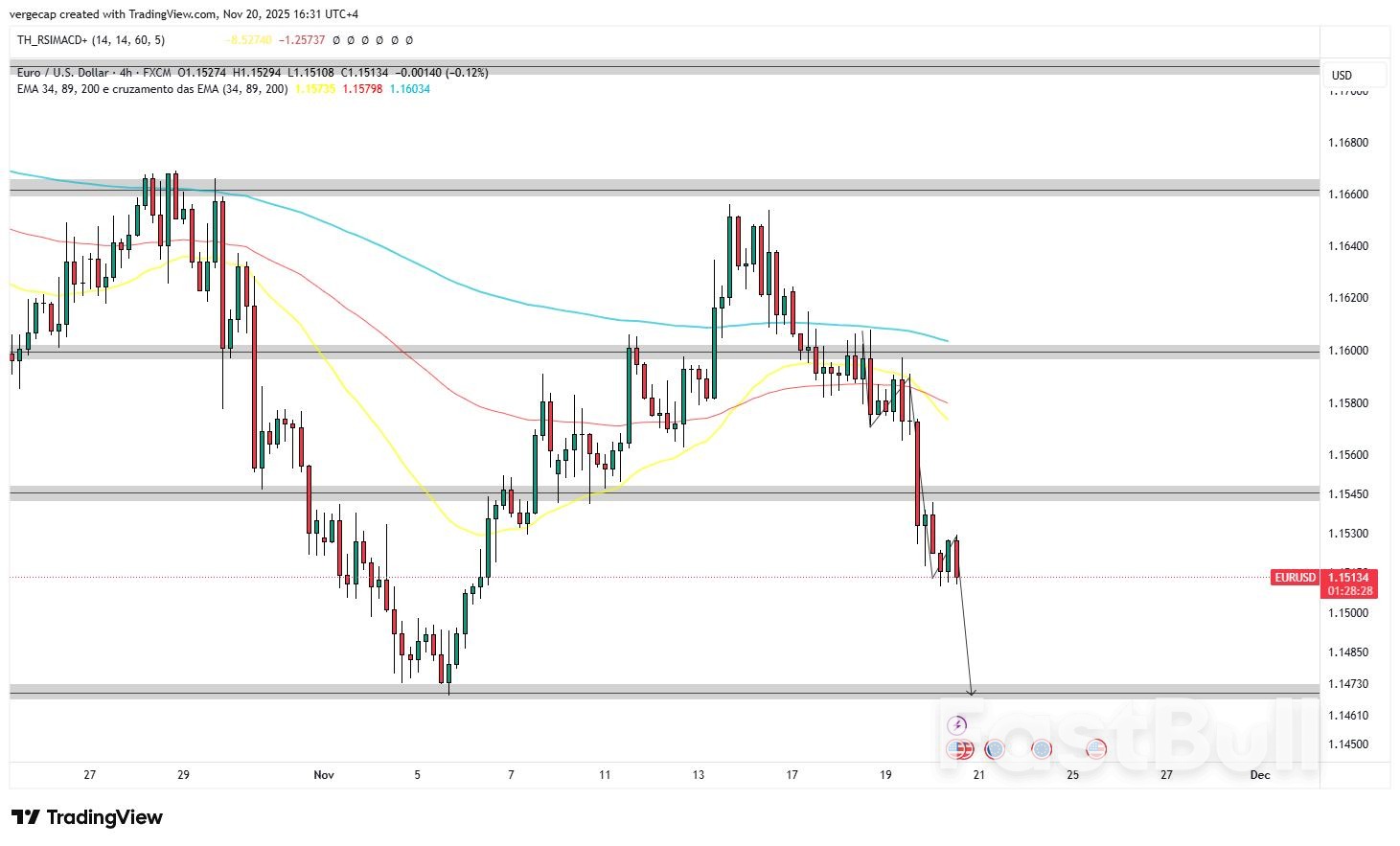
          EUR/USD extended its decline for a fifth consecutive session on Thursday, sliding to 1.1525 during the European trading hours after failing to hold above the 1.1600 handle on Wednesday. The renewed weakness in the euro comes as the U.S. Dollar continues to assert dominance across the FX board, bolstered by a hawkish tone from the Federal Reserve’s October meeting minutes and a cautious market mood ahead of the September Nonfarm Payrolls (NFP) release.
          The Fed minutes, published late Wednesday, reaffirmed policymakers’ strong reluctance to cut interest rates prematurely. According to the document, many officials expressed concern that easing too soon could undermine progress in the inflation fight and risk eroding public confidence in the central bank’s credibility. This marks one of the more hawkish shifts in tone seen in months, effectively cooling a wave of dovish bets that had built up through October and early November.
          Market pricing adjusted swiftly. The probability of a 25-basis-point cut at the December 10 FOMC meeting plunged below 30%, down from 50% just a day earlier and more than 90% only a month ago, according to the CME FedWatch tool. The sharp repricing has revived the Greenback’s bullish momentum, with traders re-entering long-dollar positions as U.S. yields stabilize at elevated levels.
          The euro, meanwhile, faced its own headwinds. Eurozone Construction Output data revealed a deepening contraction in September, amplifying concerns about Europe’s weakening growth profile. The bloc continues to struggle with feeble industrial activity and softening labor-market indicators, all while inflation trends lower at a pace that underscores policymakers' concerns about stagnation.
          Later today, investors will scrutinize Germany’s Bundesbank Monthly Report for fresh insight into the Eurozone’s largest economy, which has been battling persistent manufacturing weakness. Markets will also monitor the European Commission’s preliminary November Consumer Confidence data—figures that could influence sentiment toward the euro should households signal deeper pessimism heading into the winter months.
          Across the Atlantic, focus is locked squarely on Friday’s NFP report, with markets looking for clearer signals on the resilience of the U.S. labor market. A stronger-than-expected print would likely reinforce the Fed’s hawkish stance and add further downside pressure on EUR/USD, while a softer figure may offer temporary relief for the pair. The Philadelphia Fed Manufacturing Survey is also on traders’ radar as a secondary risk catalyst.

          Technical AnalysisEUR/USD Extends Slide as Hawkish Fed Minutes Crush December Rate-Cut Hopes_1

          EUR/USD attempted a brief intraday rebound on Thursday, but the bounce appears shallow and primarily driven by oversold conditions on momentum indicators rather than genuine buying conviction. Relative Strength Index (RSI) readings show tentative positive signals, yet the pair continues to trade below a minor descending trendline that has guided price action throughout November.
          The broader structure remains decisively bearish. The sustained inability to hold above 1.1600 confirms sellers’ control, with the next notable support zone located near 1.1467. A decisive break below that level would open the door to deeper losses, particularly if U.S. data continues to outperform Eurozone figures.

          TRADE RECOMMENDATION

          SELL EURUSD
          ENTRY PRICE: 1.1515
          STOP LOSS: 1.1570
          TAKE PROFIT: 1.1467
          Risk Warnings and Disclaimers
          You understand and acknowledge that there is a high degree of risk involved in trading. Following any strategies or investment methods may lead to potential losses. The content on the site is provided by our contributors and analysts for information purposes only. You are solely responsible for determining whether any trading assets, securities, strategy, or any other product is suitable for investing based on your own investment objectives and financial situation.
          Add to Favorites
          Share

          GBP/JPY Strength Persists as Traders Shrug Off Risk of Japanese FX Intervention

          Warren Takunda

          Traders' Opinions

          Summary:

          GBP/JPY holds firm near multi-month highs above 205 as the Yen weakens amid fading intervention fears and expectations of a large fiscal stimulus in Japan, while softer UK inflation raises questions about the Bank of England’s rate-cut path.

          BUY GBPJPY
          Close Time
          CLOSED

          205.782

          Entry Price

          208.000

          TP

          204.500

          SL

          207.178 +0.078 +0.04%

          128.2

          Pips

          Loss

          204.500

          SL

          204.496

          Exit Price

          205.782

          Entry Price

          208.000

          TP
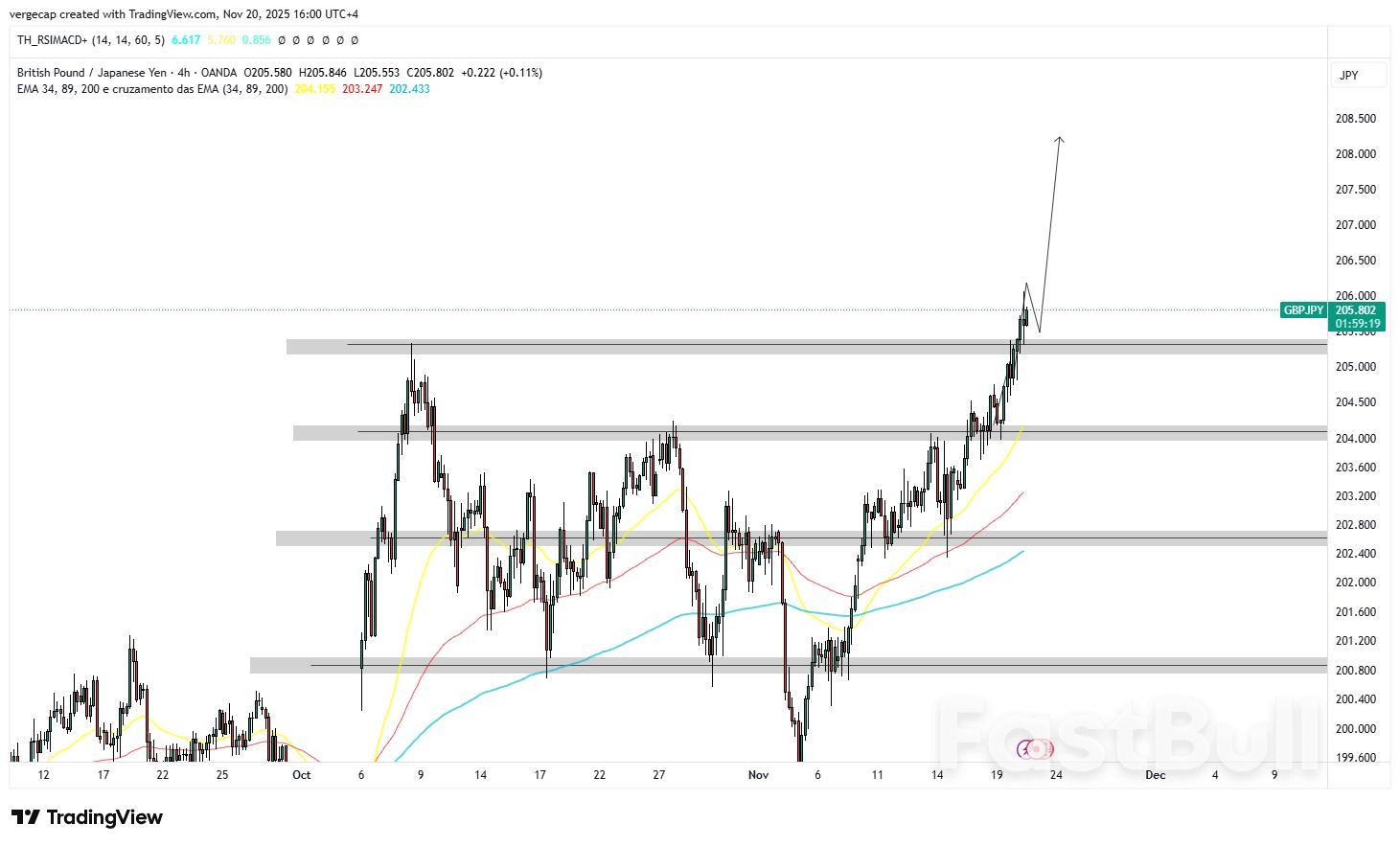
          The British Pound extended its advance against a broadly weaker Japanese Yen on Thursday, with GBP/JPY holding comfortably above the 205 handle as mounting policy divergence and renewed fiscal speculation in Tokyo kept the Japanese currency under sustained selling pressure.
          The cross, which briefly touched a fresh 16-month high just above 206.00 earlier in the week, has since eased slightly but remains supported near 205.75 at the time of writing. The pair found strong buying interest around 205.35—its previous year-to-date peak—suggesting that bullish sentiment is still firmly anchored despite a temporary loss of upside momentum.
          The Yen’s latest depreciation continues a trend seen over the past several sessions, driven primarily by waning concerns about foreign-exchange intervention and renewed expectations of aggressive fiscal action in Japan. Investors, who had previously speculated that Tokyo might step into markets to curb rapid Yen weakness, appear more confident that authorities are currently reluctant to act.
          That view was reinforced on Wednesday when Finance Minister Satsuki Katayama stated that she had not discussed currency matters during a meeting with Bank of Japan Governor Kazuo Ueda. Markets interpreted the remark as a sign that policymakers remain comfortable with the current exchange-rate dynamics, even as the Yen trades near historically weak levels against major peers.
          At the same time, Japanese media reports suggesting that Prime Minister Sanae Takaichi is preparing a stimulus package worth roughly $21 billion added further downward pressure on the currency. The proposed measures—intended to help households manage persistent cost-of-living pressures—would come as Japan grapples with rising inflation and limited fiscal room. For traders, the prospect of an additional fiscal boost implies further strain on public finances and the possibility of sustained monetary-policy accommodation, both of which weigh on the Yen.
          In contrast, the macroeconomic backdrop in the United Kingdom remains mixed. UK inflation data released Wednesday showed consumer prices slowing to 3.6% year-on-year in October, easing from the 3.8% pace recorded over the previous three months. While still above the Bank of England’s 2% target, the continued deceleration bolsters expectations that policymakers may proceed with additional rate cuts over the coming months. That prospect has capped some of the Pound’s upside momentum, though the currency remains well supported against the Yen given Japan’s comparatively more dovish stance.
          Technical AnalysisGBP/JPY Strength Persists as Traders Shrug Off Risk of Japanese FX Intervention_1
          GBP/JPY continues to show a constructive technical profile, having already met the 2.00% Fibonacci extension level at 205.25—an initial upside target highlighted in earlier analyses. The pair’s recent consolidation appears to reflect a temporary pause as markets await renewed bullish momentum.
          A sustained break and daily close above the current resistance zone would strengthen the case for a continuation of the uptrend, potentially opening the path toward 206.70 and ultimately the next medium-term target around 208.00. Failure to overcome this resistance, however, could trigger short-term volatility or a corrective pullback, with 203.70 acting as a key support to watch.
          For Thursday’s session, the expected trading range is projected between 204.45 and 205.70, with the broader trend bias remaining firmly bullish.

          TRADE RECOMMENDATION

          BUY GBPJPY
          ENTRY PRICE: 205.80
          STOP LOSS: 204.50
          TAKE PROFIT: 208.00
          Risk Warnings and Disclaimers
          You understand and acknowledge that there is a high degree of risk involved in trading. Following any strategies or investment methods may lead to potential losses. The content on the site is provided by our contributors and analysts for information purposes only. You are solely responsible for determining whether any trading assets, securities, strategy, or any other product is suitable for investing based on your own investment objectives and financial situation.
          Add to Favorites
          Share

          After Breaking Below $99,000, Where Will Bitcoin Go Next?

          Alan

          Cryptocurrency

          Summary:

          Recently, institutional outflows from Bitcoin have surged, while technical indicators have broken downward. In the short term, Bitcoin is likely to continue its decline.

          SELL BTC-USDT
          Close Time
          CLOSED

          92141.6

          Entry Price

          78000.0

          TP

          96000.0

          SL

          92008.0 +2453.2 +2.74%

          7960.6

          Pips

          Profit

          78000.0

          TP

          84181.0

          Exit Price

          92141.6

          Entry Price

          96000.0

          SL
          Fundamentals

          The most significant fundamental change for Bitcoin is the large-scale outflow from institutional investors.
          According to reports by Reuters and CoinDesk, BlackRock's flagship Bitcoin ETF (IBIT) recorded a record single-day net outflow of $523 million. This exacerbated the cumulative net redemptions seen throughout the month, pushing the total ETF outflows to the billions of dollars level. The shift to net outflows directly weakened spot market buying power, causing the price to briefly break below the key psychological level of approximately $90,000. The pace of institutional outflows has also exposed previously marginal long positions—those that entered the market via ETFs—to selling pressure. Data from Bloomberg also shows that the average entry cost for recent new investors is around $89,600. This means that as prices fall, it could trigger a cascade of stop-loss and short-selling orders, further amplifying volatility.
          In addition, macroeconomic factors are compounding sentiment: the Federal Reserve's interest rate outlook isn't noticeably dovish, and the U.S. dollar remains strong, reducing the appeal of risk assets. At the same time, concerns over an "overheated capital withdrawal" and deleveraging force some short-term arbitrage and leveraged positions to close, contributing to the downward momentum. While large-scale redemptions from ETFs are the immediate trigger, the broader macro capital flows are the key determinants of Bitcoin's medium-term direction.

          Technical Analysis

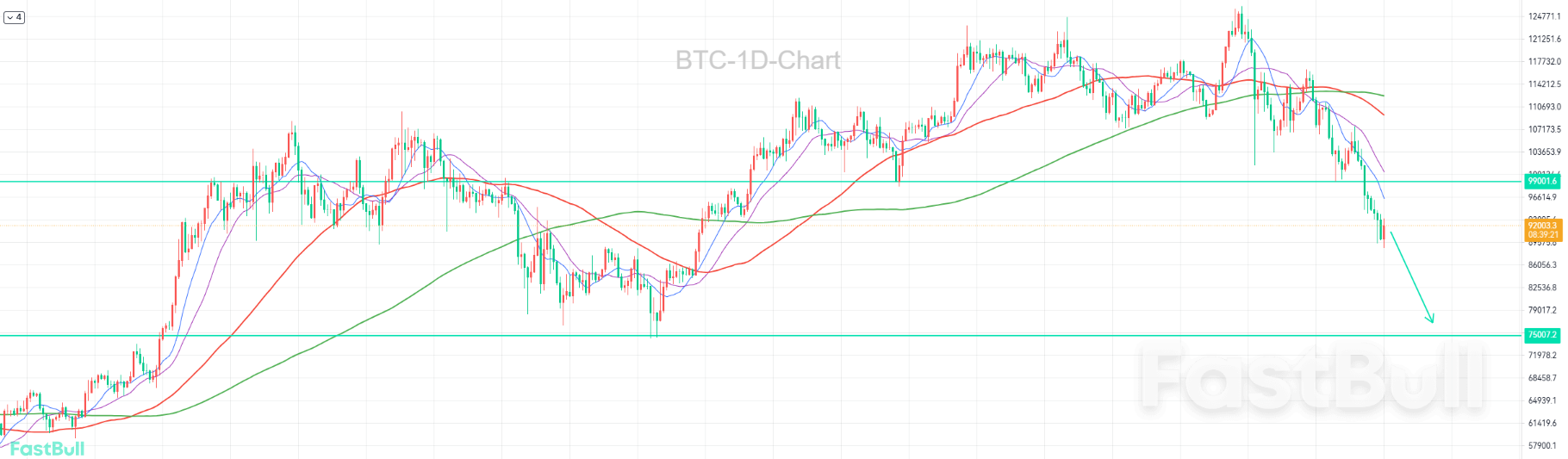
          After Breaking Below $99,000, Where Will Bitcoin Go Next?_1
          Based on the daily chart, Bitcoin broke below the key support level of $99,000 last Friday, opening up further downside potential. The first major downside target may be around the $75,000 support level. Moreover, the continued downward trend over recent trading sessions indicates that bearish sentiment currently dominates the overall market.
          At present, the key resistance zone is around $95,000. If Bitcoin fails to hold firmly above this area, it will be difficult for bulls to regain control in the short term. The near-term support zone lies between $86,500, and a break below that could see the next historical buying zone near $80,000 reactivated. Trading volumes have expanded during declines but remained weak during rebounds, suggesting that current rallies are more likely to be technical pullbacks after forced liquidations, rather than signs of sustained buying by capital inflows.

          Trading Recommendations

          Trading direction: Sell
          Entry price: 92300
          Target price: 78000
          Stop loss: 96000
          Valid Until: December 04, 2025, 23:00:00
          Support: 88611/75000
          Resistance: 95000/99000
          Risk Warnings and Disclaimers
          You understand and acknowledge that there is a high degree of risk involved in trading. Following any strategies or investment methods may lead to potential losses. The content on the site is provided by our contributors and analysts for information purposes only. You are solely responsible for determining whether any trading assets, securities, strategy, or any other product is suitable for investing based on your own investment objectives and financial situation.
          Add to Favorites
          Share

          Dollar Surges! EURUSD Faces Major Challenge?

          Tank

          Forex

          Technical Analysis

          Summary:

          The primary reason for the EURUSD's decline is the strengthening of the U.S. dollar, which has outperformed other major currencies as market expectations for a rate cut at the Federal Reserve's December monetary policy meeting have diminished.

          SELL EURUSD
          Close Time
          CLOSED

          1.15179

          Entry Price

          1.12000

          TP

          1.17500

          SL

          1.16528 +0.00102 +0.09%

          11.9

          Pips

          Profit

          1.12000

          TP

          1.15060

          Exit Price

          1.15179

          Entry Price

          1.17500

          SL
          Fundamentals

          The Federal Reserve's dovish outlook has softened, leading to a decline in investor risk appetite and putting downward pressure on the euro. The latest harmonized Consumer Price Index (CPI) data for the Eurozone indicates that overall inflation increased month-on-month from 0.1% in September to 0.2% in October, while the annual growth rate slowed slightly from 2.2% to 2.1%, edging closer to the European Central Bank's (ECB) 2% target. Core inflation rose to 0.3% month-on-month but remained stable at 2.4% year-on-year. These figures send an intriguing signal: after energy and certain commodity prices stabilized, overall Eurozone inflationary pressures continue to ease, while services and core components maintain moderate stickiness. This combination neither justifies new monetary tightening nor compels the ECB to rapidly shift towards aggressive easing, aligning more with a neutral, dovish stance of maintaining restrictive rates over the medium term while remaining prepared to respond to economic downturns. For the euro, this implies limited carry trade advantages and a lack of clear support from interest rate expectations. Looking ahead, the euro will be influenced by the HCOB preliminary purchasing managers' index (PMI) data for November, which is scheduled for release on Friday.
          Recent movements in the EURUSD exchange rate are influenced less by fundamental factors such as interest rates and inflation, and more by the cumulative effects of macroeconomic developments and risk sentiment. On one hand, market expectations for Federal Reserve rate cuts in December have diminished, with CME FedWatch indicating the probability of a 25-basis-point reduction to 3.50%-3.75% dropping from 50.1% to 32.8%. A month ago, the market overwhelmingly anticipated a rate cut, with probabilities as high as 96%. On the other hand, recent global equity market sell-offs have reinforced risk aversion. In an environment of waning risk appetite, the U.S. dollar, traditionally perceived as a safe-haven currency, has attracted capital inflows. Investors have reduced holdings in equities and certain high-risk assets, reallocating funds into cash and highly liquid instruments. This "risk-averse dollar buying" often temporarily offsets the negative impact of weakening rate expectations, enabling the U.S. Dollar Index to remain robust at high levels and causing the euro to retreat below the 1.16 level amid consolidation. Structural changes within the U.S. macroeconomic fundamentals indicate that weak employment data is somewhat constraining the outlook for consumer spending, real estate, and the service sector. Conversely, August factory orders posted a month-on-month increase of 1.4%, aligning with market expectations and partially offsetting the previous 1.3% decline. Manufacturing demand has not experienced a sharp slowdown but is instead exhibiting a pattern of "gradual deceleration amid volatility." This structural composition causes the Federal Reserve to adopt a data-dependent approach to policy, refraining from issuing a clear easing timeline. Some officials emphasize the need for additional data to determine the next policy direction, which to some extent suppresses market expectations for rapid rate cuts and limits downside potential for the U.S. dollar.

          Technical Analysis

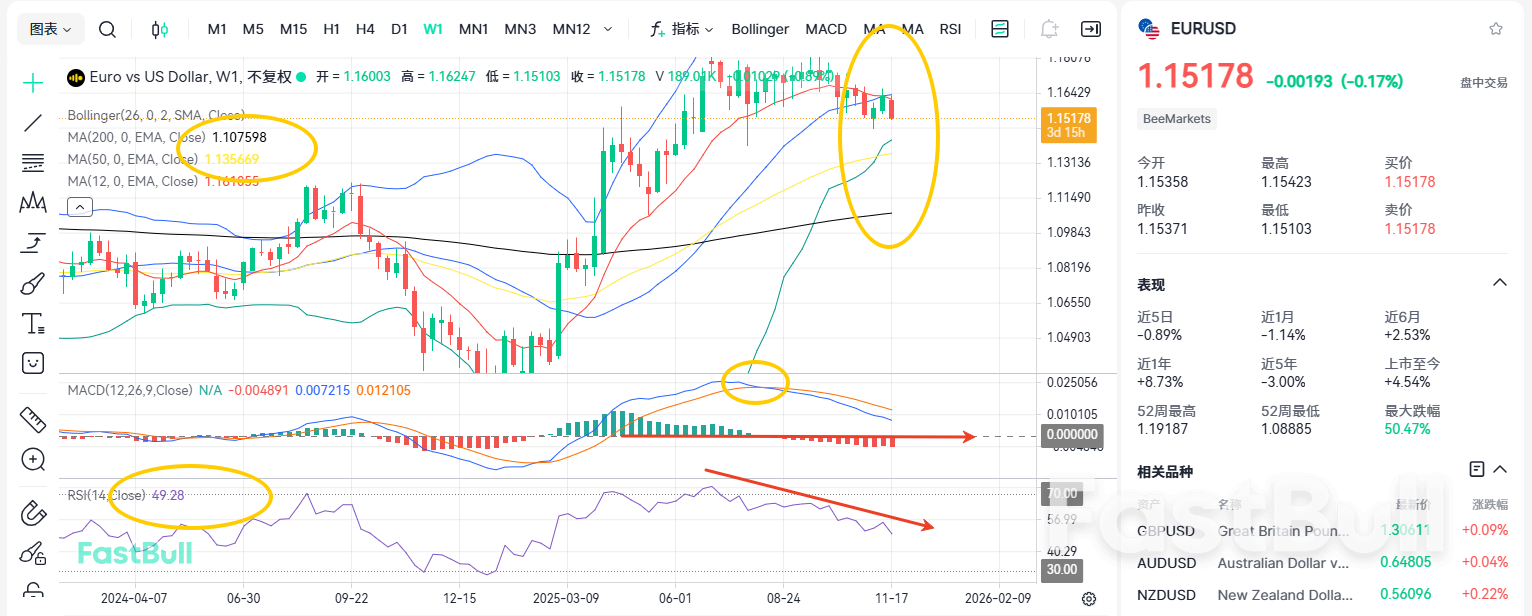
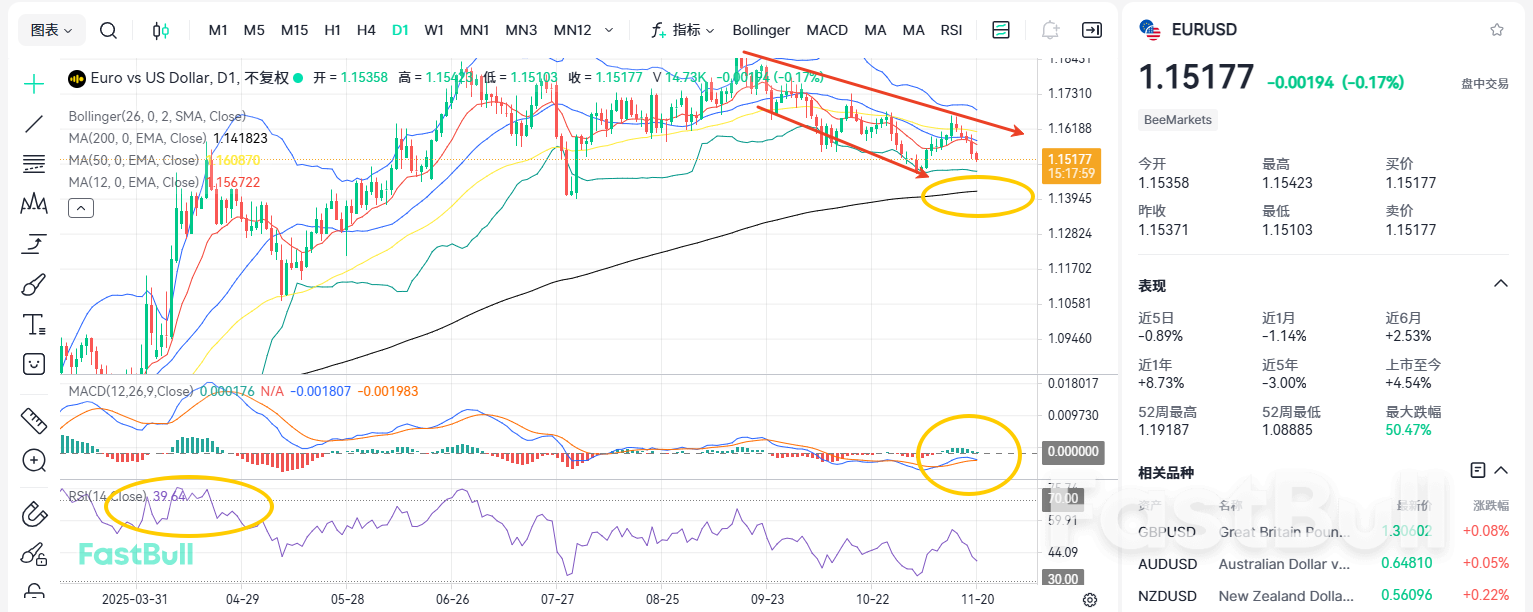
          In the 1D timeframe, following a MACD golden cross, the MACD line and signal line have retracted towards the zero-axis, indicating potential trend reversal signals. The Bollinger Bands are opening downward, with SMAs diverging downward, and the price is oscillating along the EMA12. A significant bearish candlestick was observed yesterday, with RSI at 39, reflecting increasing market pessimism. Current price action remains within the descending channel; unless the upper boundary is broken, a retest of the lower Bollinger Band around 1.148 is likely. In the 1W timeframe, Bollinger Bands are converging narrowly, EMA 12 is turning downward, and following the MACD death cross, the MACD line and signal line are retuning toward the zero-axis with some distance remaining, suggesting the downtrend may not be complete. RSI at 49 shows a gradual decline in highs, indicating strong market caution. Short-term support levels are positioned near the lower/middle Bollinger Band and EMA50. It is recommended to go short at the highs in the short term.
          Dollar Surges! EURUSD Faces Major Challenge?_1Dollar Surges! EURUSD Faces Major Challenge?_2

          Trading Recommendations

          Trading Direction: Sell
          Entry Price: 1.152
          Target Price: 1.12
          Stop Loss: 1.175
          Support: 1.145, 1.14, 1.12
          Resistance: 1.182, 1.192, 1.2
          Risk Warnings and Disclaimers
          You understand and acknowledge that there is a high degree of risk involved in trading. Following any strategies or investment methods may lead to potential losses. The content on the site is provided by our contributors and analysts for information purposes only. You are solely responsible for determining whether any trading assets, securities, strategy, or any other product is suitable for investing based on your own investment objectives and financial situation.
          Add to Favorites
          Share

          NFP Release! Bullish or Bearish for Gold?

          Tank

          Forex

          Commodity

          Summary:

          Diminished expectations for another Fed rate cut have lifted the U.S. dollar to its highest level since late May, a headwind for non-yielding bullion.

          SELL XAUUSD
          Close Time
          CLOSED

          4064.67

          Entry Price

          3600.00

          TP

          4390.00

          SL

          4208.93 +11.02 +0.26%

          1792.8

          Pips

          Loss

          3600.00

          TP

          4243.95

          Exit Price

          4064.67

          Entry Price

          4390.00

          SL
          Fundamentals

          The Central Bank of Russia is no longer content with token additions to its gold reserves. It has launched a full-scale offensive, sweeping up every good-delivery bar the domestic market can furnish. In a world where sanction-bound reserves are immobilised, dollar assets are frozen, and geopolitics is redrawing the global map, the Kremlin has concluded that the only balance-sheet item still capable of crossing borders unhindered is bullion.
          Behind the headlines lies far more than Moscow's well-worn mantra of "buy gold, dump dollars". The liquidity dynamics of the Russian gold market have quietly shifted, enabling the central bank to scale its operations to levels that would have been operationally impossible only a few years ago. This is not a publicity stunt. It is a structural inflection point that is injecting fresh momentum into a market already primed by fear, fiscal deficits and the accelerating dedollarisation narrative.
          For years, thin on-shore liquidity stymied sustained accumulation. Despite ranking as the world's second-largest producer, Russian miners could sell only at the pace the domestic clearing system could absorb. Sanctions severed the international outlet, yet—perversely—they have also forced the ecosystem to mature.
          The turnover rate has already reached a level at which the central bank can execute matched CNY-and-gold transactions to rotate assets for the National Wealth Fund with the same precision a liability-driven-investment (LDI) portfolio manager uses to fine-tune duration and collateral mix. The crux is that the North-West financial architecture—currently weighted around 60% RMB and 40% monetary gold—now functions as a fiscal shock absorber for the federal budget deficit in Moscow. Every uptick in the global gold price therefore not only swells the reserve base but also expands the rouble liquidity envelope that can be tapped without touching the sovereign's frozen Western assets. A higher mark-to-market valuation translates directly into a wider political option set. In short, Russia is not merely accumulating bullion—it has re-engineered its entire reserve framework around gold as the core asset.
          While headlines focus on the $300+ billion of Russian reserves immobilised abroad, inside Russia the bullion that has been freed from domestic vaults is being monetised in real time to fund military spending. For global traders this distinction is critical. A top-three producer has been severed from the international financial system, its policy reaction function reshaped by sanctions, domestic rouble liquidity ballooning, and its reserve-management office now treating gold as an operational instrument rather than a macro hedge. When a central bank sitting on almost $720 bn of reserves (including frozen assets) concludes that only physical gold is a "clean" settlement asset, the resulting flow becomes a structural bid that cannot be ignored. It is a slow-motion but powerful source of demand that is appearing just as the other drivers of gold—declining real yields, brittle geopolitics and the steady de-dollarisation wave—are already repricing the metal to a new equilibrium. In effect, Russia has become a price-insensitive, forced buyer of its own output.
          China is accumulating quietly but at scale. The Global South continues to add. Western portfolios remain structurally under-weight. Each time the market tries to declare gold "soft", another sovereign reminds participants that, in a fragmented monetary architecture, the gold is the only asset that cannot be frozen. That is why dips are shallow and why any window of weakness is instantly filled by physical offtake. Gold is no longer merely a trade. It is becoming the settlement medium of a world in which trust is evaporating faster than liquidity.
          The recent U.S. federal-government shutdown delayed the release of key employment reports, amplifying macro uncertainty and complicating the Fed's assessment of labor-market conditions. That dynamic has, in turn, lifted demand for safe-haven assets such as gold. Investors will scrutinize the belated September non-farm payroll (NFP) release for evidence of the labor market's underlying health and for clearer guidance on the U.S. rate trajectory. A print below consensus would raise the probability of a December rate cut and thereby provide additional upside to bullion; lower policy rates reduce the opportunity cost of holding a non-yielding asset. Conversely, a diminution in near-term easing expectations would exert downward pressure on gold prices.
          The minutes of the Federal Open Market Committee's October 28–29 meeting revealed that Fed officials were divided and cautious about the future path of interest rates. Although the Committee ultimately decided to cut the policy rate by 25 bp, the decision was not unanimous. Some participants leaned against an additional reduction at the December meeting. According to the CME FedWatch Tool, the market now assigns a roughly 30% probability to a rate cut next month, down from about 60% a week earlier.

          Technical Analysis

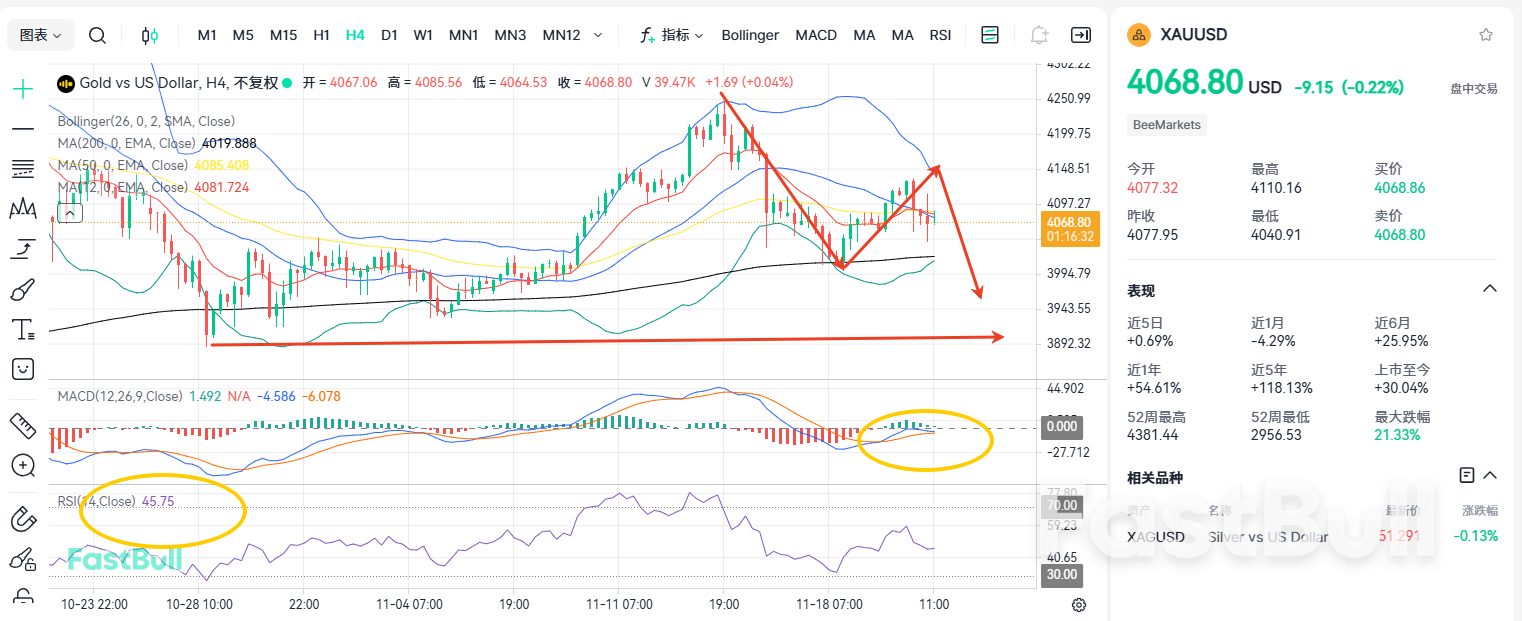
          The Bollinger Bands on the 4-hour chart are contracting, with bandwidth narrowing significantly. After a brief break above the psychological 4,100 level, the gold price met strong resistance and reversed. The short-term downtrend remains intact. The MACD is on the verge of forming a bearish crossover. Both the fast and slow lines have pulled back to the zero axis, raising the probability of a sudden directional shift. RSI reads 45, reflecting pronounced bearish sentiment. Immediate resistance is at 4,100, followed by 4,150.
          Daily Time Frame:
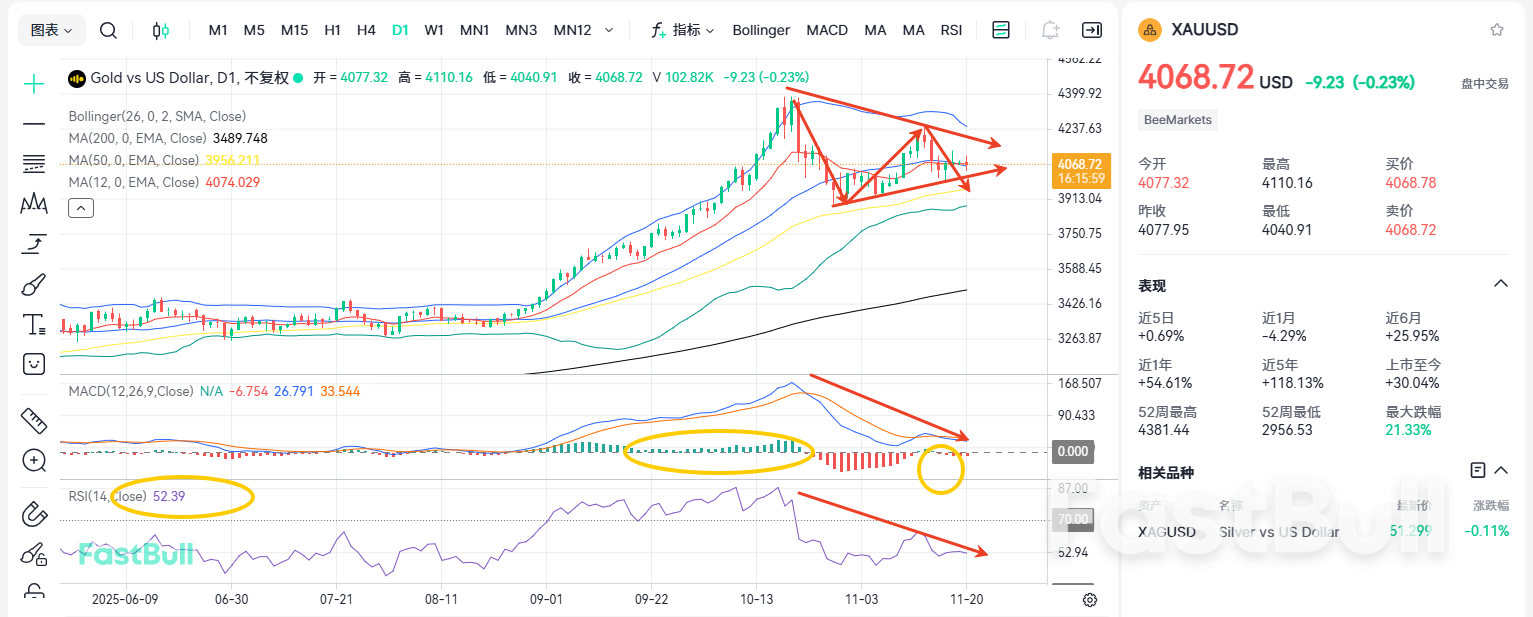
          On the daily chart, the MACD histogram's upward momentum is visibly waning while price has failed to print a higher high—classic bearish divergence. The probability of a continued pullback is elevated. Downside support rests first at the lower Bollinger Band (3,878) and then at the EMA50 (3,956). RSI sits at 52, placing price in a wait-and-see zone, but successive lower highs reinforce the bearish bias.
          Therefore, traders are recommended to take a strategy of selling into rallies.
          NFP Release! Bullish or Bearish for Gold?_1NFP Release! Bullish or Bearish for Gold?_2

          Trade Recommendations

          Trade Direction: Sell
          Entry Price: 4070
          Target Price: 3600
          Stop Loss: 4390
          Support: 3900/3800/3600
          Resistance Levels: 4380/4500/5000
          Risk Warnings and Disclaimers
          You understand and acknowledge that there is a high degree of risk involved in trading. Following any strategies or investment methods may lead to potential losses. The content on the site is provided by our contributors and analysts for information purposes only. You are solely responsible for determining whether any trading assets, securities, strategy, or any other product is suitable for investing based on your own investment objectives and financial situation.
          Add to Favorites
          Share
          FastBull
          Copyright © 2025 FastBull Ltd

          728 RM B 7/F GEE LOK IND BLDG NO 34 HUNG TO RD KWUN TONG KLN HONG KONG

          TelegramInstagramTwitterfacebooklinkedin
          App Store Google Play Google Play
          Products
          Charts

          Chats

          Q&A with Experts
          Screeners
          Economic Calendar
          Data
          Tools
          Membership
          Features
          Function
          Markets
          Copy Trading
          Latest Signals
          Contests
          News
          Analysis
          24/7
          Columns
          Education
          Company
          Careers
          About Us
          Contact Us
          Advertising
          Help Center
          Feedback
          User Agreement
          Privacy Policy
          Business

          White Label

          Data API

          Web Plug-ins

          Poster Maker

          Affiliate Program

          Risk Disclosure

          The risk of loss in trading financial instruments such as stocks, FX, commodities, futures, bonds, ETFs and crypto can be substantial. You may sustain a total loss of the funds that you deposit with your broker. Therefore, you should carefully consider whether such trading is suitable for you in light of your circumstances and financial resources.

          No decision to invest should be made without thoroughly conducting due diligence by yourself or consulting with your financial advisors. Our web content might not suit you since we don't know your financial conditions and investment needs. Our financial information might have latency or contain inaccuracy, so you should be fully responsible for any of your trading and investment decisions. The company will not be responsible for your capital loss.

          Without getting permission from the website, you are not allowed to copy the website's graphics, texts, or trademarks. Intellectual property rights in the content or data incorporated into this website belong to its providers and exchange merchants.

          Not Logged In

          Log in to access more features

          FastBull Membership

          Not yet

          Purchase

          Become a signal provider
          Help Center
          Customer Service
          Dark Mode
          Price Up/Down Colors

          Log In

          Sign Up

          Position
          Layout
          Fullscreen
          Default to Chart
          The chart page opens by default when you visit fastbull.com