• Trade
  • Markets
  • Copy
  • Contests
  • News
  • 24/7
  • Calendar
  • Q&A
  • Chats
Trending
Screeners
SYMBOL
LAST
BID
ASK
HIGH
LOW
NET CHG.
%CHG.
SPREAD
SPX
S&P 500 Index
6870.39
6870.39
6870.39
6895.79
6858.28
+13.27
+ 0.19%
--
DJI
Dow Jones Industrial Average
47954.98
47954.98
47954.98
48133.54
47871.51
+104.05
+ 0.22%
--
IXIC
NASDAQ Composite Index
23578.12
23578.12
23578.12
23680.03
23506.00
+72.99
+ 0.31%
--
USDX
US Dollar Index
98.790
98.870
98.790
98.960
98.730
-0.160
-0.16%
--
EURUSD
Euro / US Dollar
1.16633
1.16642
1.16633
1.16717
1.16341
+0.00207
+ 0.18%
--
GBPUSD
Pound Sterling / US Dollar
1.33326
1.33336
1.33326
1.33462
1.33151
+0.00014
+ 0.01%
--
XAUUSD
Gold / US Dollar
4216.08
4216.42
4216.08
4218.85
4190.61
+18.17
+ 0.43%
--
WTI
Light Sweet Crude Oil
59.978
60.015
59.978
60.063
59.752
+0.169
+ 0.28%
--

Community Accounts

Signal Accounts
--
Profit Accounts
--
Loss Accounts
--
View More

Become a signal provider

Sell trading signals to earn additional income

View More

Guide to Copy Trading

Get started with ease and confidence

View More

Signal Accounts for Members

All Signal Accounts

Best Return
  • Best Return
  • Best P/L
  • Best MDD
Past 1W
  • Past 1W
  • Past 1M
  • Past 1Y

All Contests

  • All
  • Trump Updates
  • Recommend
  • Stocks
  • Cryptocurrencies
  • Central Banks
  • Featured News
Top News Only
Share

Most Active China Coking Coal Contract Falls 7.1% To 1082.5 Yuan/Metric Ton

Share

German Foreign Minister Says A Lot Of Work Is Still Needed To Persuade China To Issue General Export Licences For Rare Earths

Share

European Central Bank's Schnabel 'Rather Comfortable' On Investor Bets Next Move To Be Interest Rate Hike

Share

Agriculture Ministry: Uganda October Coffee Shipments Up 38% From Last Year

Share

Russia's Nornickel: Cobalt Production Capacity To Be At Up To 3000 Tons Per Year

Share

Russia's Nornickel: Fully Restarts Cobalt Production In Murmansk Region

Share

India's Nifty Realty Index Down 2.7%

Share

China Vice President, In Meeting With German Foreign Minister: China Willing To Enhance Communication With Germany - Xinhua

Share

Japan Finance Minister Katayama: Will Take Appropriate Action If Necessary

Share

Japan Finance Minister Katayama: Concerned About Forex Moves

Share

Japan Finance Minister Katayama: Recently Seeing One-Sided, Rapid Moves

Share

LME Three-month Copper Rose To $11,771 Per Tonne, Setting A New Record High

Share

Shanghai's Most Active Copper Contract Sets Peak At 93300 Yuan Per Metric Ton

Share

Thai Prime Minister: Thailand Does Not Want Violence

Share

Thai Prime Minister: Ready To Take Necessary Measures To Maintain Security, Sovereignty Of Country

Share

China Politburo: Will Better Coordinate Between China's Economic Work And International Economic And Trade Battle Next Year

Share

China Politburo: Moderately Loose Monetary Policy

Share

China Politburo:Continue To Implement More Active Fiscal Policies

Share

India's SEBI Chair: If Any Entity Wants To Advertise Any Past Return They Can Do Only Via The Platform

Share

Vietnam's Plans To Have Nuclear Power Plant Ready By 2035 Are Too Tight - Ambassador

TIME
ACT
FCST
PREV
U.S. Personal Income MoM (Sept)

A:--

F: --

P: --

U.S. PCE Price Index YoY (SA) (Sept)

A:--

F: --

P: --

U.S. PCE Price Index MoM (Sept)

A:--

F: --

P: --

U.S. Personal Outlays MoM (SA) (Sept)

A:--

F: --

P: --

U.S. Core PCE Price Index MoM (Sept)

A:--

F: --

P: --

U.S. Core PCE Price Index YoY (Sept)

A:--

F: --

P: --

U.S. UMich 5-Year-Ahead Inflation Expectations Prelim YoY (Dec)

A:--

F: --

P: --

U.S. Real Personal Consumption Expenditures MoM (Sept)

A:--

F: --

P: --

U.S. UMich Current Economic Conditions Index Prelim (Dec)

A:--

F: --

P: --

U.S. UMich Consumer Sentiment Index Prelim (Dec)

A:--

F: --

P: --

U.S. UMich 1-Year-Ahead Inflation Expectations Prelim (Dec)

A:--

F: --

P: --

U.S. UMich Consumer Expectations Index Prelim (Dec)

A:--

F: --

P: --

U.S. Weekly Total Rig Count

A:--

F: --

P: --

U.S. Weekly Total Oil Rig Count

A:--

F: --

P: --

U.S. Unit Labor Cost Prelim (SA) (Q3)

--

F: --

P: --

U.S. Consumer Credit (SA) (Oct)

A:--

F: --

P: --

China, Mainland Foreign Exchange Reserves (Nov)

A:--

F: --

P: --

Japan Wages MoM (Oct)

A:--

F: --

P: --

Japan Trade Balance (Oct)

A:--

F: --

P: --

Japan Nominal GDP Revised QoQ (Q3)

A:--

F: --

P: --

Japan Trade Balance (Customs Data) (SA) (Oct)

A:--

F: --

P: --

Japan GDP Annualized QoQ Revised (Q3)

A:--

F: --

P: --
China, Mainland Exports YoY (CNH) (Nov)

A:--

F: --

P: --

China, Mainland Trade Balance (USD) (Nov)

A:--

F: --

P: --

China, Mainland Imports YoY (CNH) (Nov)

A:--

F: --

P: --

China, Mainland Exports (Nov)

A:--

F: --

P: --

China, Mainland Imports (CNH) (Nov)

A:--

F: --

P: --

China, Mainland Trade Balance (CNH) (Nov)

A:--

F: --

P: --

China, Mainland Imports YoY (USD) (Nov)

A:--

F: --

P: --

China, Mainland Exports YoY (USD) (Nov)

A:--

F: --

P: --

Germany Industrial Output MoM (SA) (Oct)

--

F: --

P: --

Euro Zone Sentix Investor Confidence Index (Dec)

--

F: --

P: --

Canada Leading Index MoM (Nov)

--

F: --

P: --

Canada National Economic Confidence Index

--

F: --

P: --

U.S. Dallas Fed PCE Price Index YoY (Sept)

--

F: --

P: --

China, Mainland Trade Balance (USD) (Nov)

--

F: --

P: --

U.S. 3-Year Note Auction Yield

--

F: --

P: --

U.K. BRC Overall Retail Sales YoY (Nov)

--

F: --

P: --

U.K. BRC Like-For-Like Retail Sales YoY (Nov)

--

F: --

P: --

Australia Overnight (Borrowing) Key Rate

--

F: --

P: --

RBA Rate Statement
RBA Press Conference
Germany Exports MoM (SA) (Oct)

--

F: --

P: --

U.S. NFIB Small Business Optimism Index (SA) (Nov)

--

F: --

P: --

Mexico Core CPI YoY (Nov)

--

F: --

P: --

Mexico 12-Month Inflation (CPI) (Nov)

--

F: --

P: --

Mexico PPI YoY (Nov)

--

F: --

P: --

Mexico CPI YoY (Nov)

--

F: --

P: --

U.S. Weekly Redbook Index YoY

--

F: --

P: --

U.S. JOLTS Job Openings (SA) (Oct)

--

F: --

P: --

China, Mainland M2 Money Supply YoY (Nov)

--

F: --

P: --

China, Mainland M0 Money Supply YoY (Nov)

--

F: --

P: --

China, Mainland M1 Money Supply YoY (Nov)

--

F: --

P: --

U.S. EIA Short-Term Crude Production Forecast For The Next Year (Dec)

--

F: --

P: --

U.S. EIA Short-Term Crude Production Forecast For The Year (Dec)

--

F: --

P: --

U.S. EIA Natural Gas Production Forecast For The Next Year (Dec)

--

F: --

P: --

EIA Monthly Short-Term Energy Outlook
U.S. 10-Year Note Auction Avg. Yield

--

F: --

P: --

U.S. API Weekly Cushing Crude Oil Stocks

--

F: --

P: --

U.S. API Weekly Crude Oil Stocks

--

F: --

P: --

U.S. API Weekly Refined Oil Stocks

--

F: --

P: --

Q&A with Experts
    • All
    • Chatrooms
    • Groups
    • Friends
    Connecting
    .
    .
    .
    Type here...
    Add Symbol or Code

      No matching data

      All
      Trump Updates
      Recommend
      Stocks
      Cryptocurrencies
      Central Banks
      Featured News
      • All
      • Russia-Ukraine Conflict
      • Middle East Flashpoint
      • All
      • Russia-Ukraine Conflict
      • Middle East Flashpoint

      Search
      Products

      Charts Free Forever

      Chats Q&A with Experts
      Screeners Economic Calendar Data Tools
      Membership Features
      Data Warehouse Market Trends Institutional Data Policy Rates Macro

      Market Trends

      Market Sentiment Order Book Forex Correlations

      Top Indicators

      Charts Free Forever
      Markets

      News

      News Analysis 24/7 Columns Education
      From Institutions From Analysts
      Topics Columnists

      Latest Views

      Latest Views

      Trending Topics

      Top Columnists

      Latest Update

      Signals

      Copy Rankings Latest Signals Become a signal provider AI Rating
      Contests
      Brokers

      Overview Brokers Assessment Rankings Regulators News Claims
      Broker listing Forex Brokers Comparison Tool Live Spread Comparison Scam
      Q&A Complaint Scam Alert Videos Tips to Detect Scam
      More

      Business
      Events
      Careers About Us Advertising Help Center

      White Label

      Data API

      Web Plug-ins

      Affiliate Program

      Awards Institution Evaluation IB Seminar Salon Event Exhibition
      Vietnam Thailand Singapore Dubai
      Fans Party Investment Sharing Session
      FastBull Summit BrokersView Expo
      Recent Searches
        Top Searches
          Markets
          News
          Analysis
          User
          24/7
          Economic Calendar
          Education
          Data
          • Names
          • Latest
          • Prev

          View All

          No data

          Scan to Download

          Faster Charts, Chat Faster!

          Download App
          English
          • English
          • Español
          • العربية
          • Bahasa Indonesia
          • Bahasa Melayu
          • Tiếng Việt
          • ภาษาไทย
          • Français
          • Italiano
          • Türkçe
          • Русский язык
          • 简中
          • 繁中
          Open Account
          Search
          Products
          Charts Free Forever
          Markets
          News
          Signals

          Copy Rankings Latest Signals Become a signal provider AI Rating
          Contests
          Brokers

          Overview Brokers Assessment Rankings Regulators News Claims
          Broker listing Forex Brokers Comparison Tool Live Spread Comparison Scam
          Q&A Complaint Scam Alert Videos Tips to Detect Scam
          More

          Business
          Events
          Careers About Us Advertising Help Center

          White Label

          Data API

          Web Plug-ins

          Affiliate Program

          Awards Institution Evaluation IB Seminar Salon Event Exhibition
          Vietnam Thailand Singapore Dubai
          Fans Party Investment Sharing Session
          FastBull Summit BrokersView Expo

          A Potential Downside Move Develops From Triangular Resistance

          Manuel

          Central Bank

          Economic

          Summary:

          This resistance zone also aligns with a descending trendline on the 4-hour chart, reinforcing the potential for a bearish rejection.

          SELL USDCAD
          Close Time
          CLOSED

          1.36900

          Entry Price

          1.35800

          TP

          1.37300

          SL

          1.38194 +0.00047 +0.03%

          8.3

          Pips

          Profit

          1.35800

          TP

          1.36817

          Exit Price

          1.36900

          Entry Price

          1.37300

          SL
          In its latest Survey of Consumer Expectations, the New York Federal Reserve reported that one-year inflation expectations declined to 3.0% in June, down from 3.2% in May. Meanwhile, the three-year inflation outlook remained steady at 3.0%, and the five-year expectation was unchanged at 2.6%.
          While the inflation outlook moderated, expectations for price increases in sectors such as rent, gasoline, healthcare, and higher education accelerated in June. Housing price expectations also held firm at 3.0%, underscoring a somewhat mixed inflation landscape.
          At the same time, U.S. Commerce Secretary Howard Lutnick told CNBC he expects 15–20 more tariff-related letters to be issued in the coming days. Investor sentiment remained cautious as President Trump threatened to expand tariffs to include pharmaceuticals, semiconductors, and copper—industries critical to global supply chains.
          On Monday night, the White House confirmed that President Trump signed an executive order delaying the implementation of newly announced tariffs from July to August 1. The 25% levies—initially targeted at goods from Japan and South Korea—will also extend to imports from Malaysia, Kazakhstan, and Tunisia. South Africa faces a 30% tariff, while Laos and Myanmar are hit with 40% duties. Additional affected nations include Indonesia (32%), Bangladesh (35%), and both Thailand and Cambodia (36%).
          Analysts continue to view the unpredictability of U.S. trade and fiscal policies as a significant factor behind the U.S. dollar's volatile performance. A Reuters poll published on July 2 revealed that 37% of foreign exchange strategists consider tariff negotiations a major drag on the greenback, alongside persistent concerns over debt levels and the uncertain interest rate trajectory.
          Meanwhile, Fed Chair Jerome Powell reaffirmed that monetary policy will remain data-dependent. Although he has not ruled out a rate cut in July, the likelihood of action this month remains low. According to the CME FedWatch Tool, markets are pricing in just a 4.7% probability of a 25-basis-point cut in July, down from 20.7% last week. The focus has now shifted to September, with a 62.8% chance of easing—though that has also slipped from 73.2%.
          Elsewhere, Canada remains outside the scope of Washington’s global tariff push, according to a statement from the Prime Minister’s office on Monday. However, Canadian exports are still impacted by targeted tariffs on steel, aluminum, autos, and fentanyl-related trade. While a bilateral agreement with the U.S. is expected by July 21, these measures continue to weigh on the Canadian dollar, particularly in the short term.
          In addition, the Canadian dollar has come under renewed pressure following a drop in crude oil prices. OPEC+ surprised markets by agreeing to a larger-than-anticipated production increase for August, dragging crude prices lower. Given that Canada is the largest oil exporter to the United States, falling energy prices tend to exert downward pressure on the Loonie.A Potential Downside Move Develops From Triangular Resistance_1

          Technical Analysis

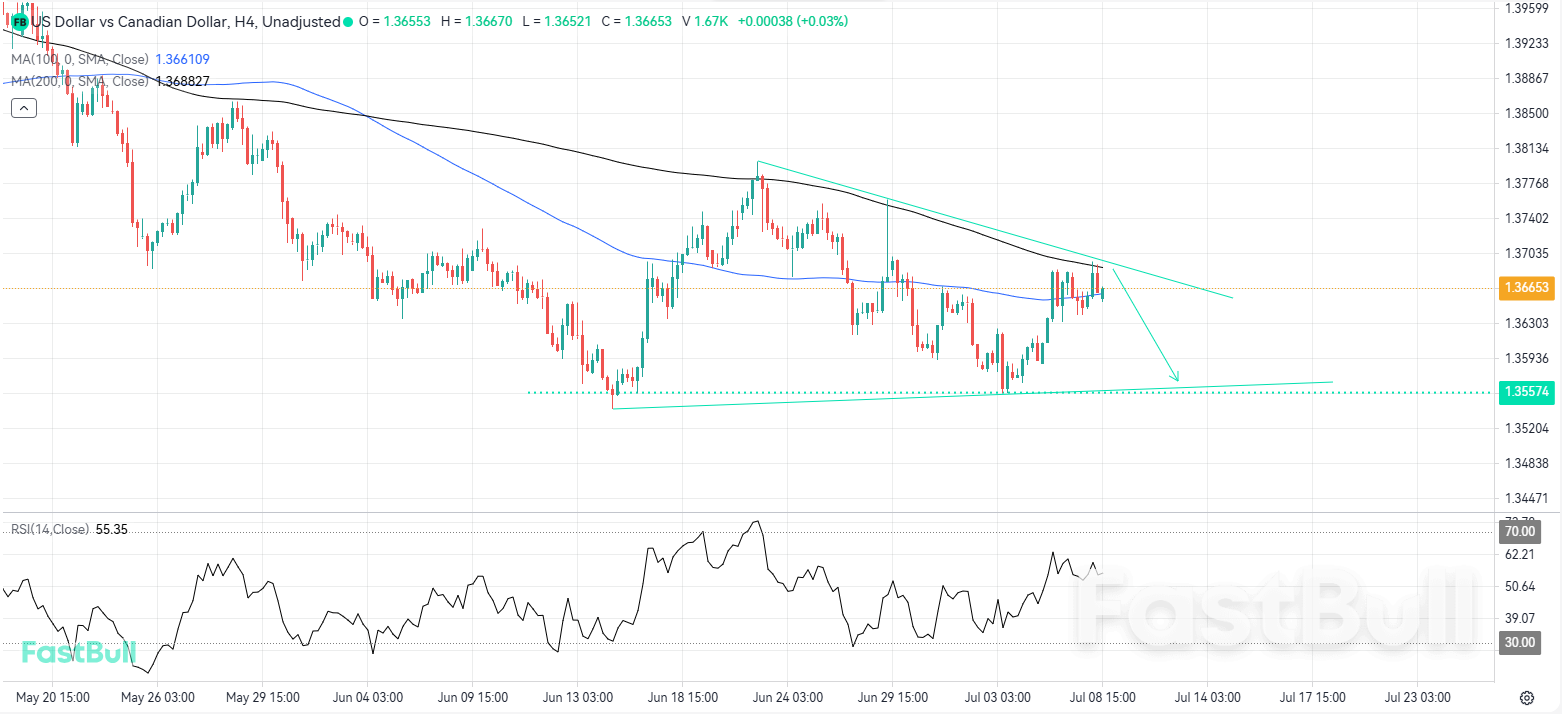
          USD/CAD recently advanced, but bullish momentum is showing signs of exhaustion as the pair approaches the confluence of the 100- and 200-period moving averages, located at 1.3661 and 1.3688 respectively. This resistance zone also aligns with a descending trendline on the 4-hour chart, reinforcing the potential for a bearish rejection.
          If the pair is turned away once more from this area, a corrective move lower could unfold, targeting the lower boundary of a triangle pattern—an area that has previously acted as support and may do so again during a potential retracement.
          The RSI currently sits near 55, still within neutral territory, suggesting a retest of the upper triangle boundary remains a possibility before any decisive move lower. A clear rejection from the resistance zone would provide confirmation for short setups. However, a strong breakout above the descending trendline could invalidate the bearish scenario and open the door for further upside.
          Trading Recommendations
          Trading direction: Sell
          Entry price: 1.3690
          Target price: 1.3580
          Stop loss: 1.3730
          Validity: Jul 18, 2025 15:00:00
          Risk Warnings and Disclaimers
          You understand and acknowledge that there is a high degree of risk involved in trading. Following any strategies or investment methods may lead to potential losses. The content on the site is provided by our contributors and analysts for information purposes only. You are solely responsible for determining whether any trading assets, securities, strategy, or any other product is suitable for investing based on your own investment objectives and financial situation.
          Add to Favorites
          Share

          Bullish Momentum Builds as EURUSD Finds Strong Technical Base

          Manuel

          Forex

          Economic

          Summary:

          If the pair reacts positively around this dynamic support, the case for a bullish continuation will strengthen significantly.

          BUY EURUSD
          Close Time
          CLOSED

          1.17231

          Entry Price

          1.19000

          TP

          1.16000

          SL

          1.16633 +0.00207 +0.18%

          17.2

          Pips

          Profit

          1.16000

          SL

          1.17403

          Exit Price

          1.17231

          Entry Price

          1.19000

          TP

          Reports have surfaced that the United States offered the European Union a 10% tariff across all goods—with specific exemptions for sensitive sectors such as aircraft and spirits. Negotiations appear to remain in flux, with final approval resting solely in the hands of President Trump. This element of uncertainty continues to cast a shadow over the dollar’s performance in the short term.
          Meanwhile, Germany’s trade balance surprised to the upside in May, widening its surplus to €18.4 billion from €15.8 billion in April (revised up from €14.6 billion), according to the latest figures from Destatis. This was well above market expectations of €15.5 billion and represents a solid sign of resilience from the region’s largest economy.
          In detail, Germany exported goods worth €129.4 billion and imported €111.1 billion in May 2025. The resulting external trade surplus highlights a modest rebound in trade momentum, although the surplus still trails the €22.3 billion reported in May 2024.
          Monthly data showed that exports declined by 1.4%, a steeper drop than the -0.2% forecast, while imports fell sharply by 3.8%, far worse than the projected 0.9% contraction. April’s import reading was also revised lower from +3.9% to +2.2%. However, on a year-over-year basis, exports edged up 0.4% and imports climbed 4.2%, underscoring a shift in trade dynamics within the eurozone.
          Across the Atlantic, the White House confirmed Monday night that President Trump had signed an executive order postponing the implementation of new tariffs from July to August 1. The original proposal had called for 25% tariffs on imports from Japan and South Korea. Under the new framework, additional 25% levies will also target goods from Malaysia, Kazakhstan, and Tunisia, while South Africa faces a 30% tariff. Laos and Myanmar are set to endure 40% duties, with Indonesia (32%), Bangladesh (35%), and both Thailand and Cambodia (36%) included in the expanded list.
          Analysts have cited the unpredictability of Trump’s fiscal and trade policy as a key reason for continued caution surrounding the U.S. dollar. A Reuters poll conducted on July 2 found that 37% of foreign exchange strategists believe the tariff standoff is a primary headwind for the greenback, alongside fiscal concerns and an unclear path for future interest rates.
          In parallel, Federal Reserve Chair Jerome Powell has reiterated the Fed’s commitment to data-dependent decision-making and has not ruled out a rate cut in July. However, with recent economic signals sending mixed messages, the central bank appears poised to remain cautious for now. Markets are pricing in just a 4.7% chance of a 25 basis point rate cut this month, according to CME’s FedWatch tool, compared to 20.7% a week ago. September now stands as the more likely target, with a 62.8% probability of easing—though even that has slipped from 73.2% the previous week.Bullish Momentum Builds as EURUSD Finds Strong Technical Base_1

          Technical Analysis

          EUR/USD has found solid support near the 1.1675 level—a zone that has previously triggered bullish rebounds. This time, the pair showed a similar pattern, with two strong bullish candles emerging on the 2-hour chart, suggesting buyers are defending the area. If momentum holds, a new upside leg could be in the making, particularly as the broader trend remains bullish while the pair continues to print higher lows. Any sustained move above this support may encourage traders to reload long positions, targeting the next key resistance level near 1.1900. However, a decisive break below 1.1675 would invalidate the bullish setup and potentially open the door to a deeper correction.
          The RSI recently touched 30—often considered oversold territory—without printing a new price low, hinting that bearish pressure might be fading. Additionally, EUR/USD is approaching the 200-period moving average, which in the past has acted as a launchpad for upside moves. If the pair reacts positively around this dynamic support, the case for a bullish continuation will strengthen significantly.
          Trading Recommendations
          Trading direction: Buy
          Entry price: 1.1722
          Target price: 1.1900
          Stop loss: 1.1600
          Validity: Jul 18, 2025 15:00:00
          Risk Warnings and Disclaimers
          You understand and acknowledge that there is a high degree of risk involved in trading. Following any strategies or investment methods may lead to potential losses. The content on the site is provided by our contributors and analysts for information purposes only. You are solely responsible for determining whether any trading assets, securities, strategy, or any other product is suitable for investing based on your own investment objectives and financial situation.
          Add to Favorites
          Share

          Easing Bias Continues? RBNZ Remarks Become Market Weathervane

          Eva Chen

          Forex

          Central Bank

          Summary:

          The Reserve Bank of New Zealand (RBNZ) is expected to hold steady in July, leaving the market to interpret the implications of potential rate cuts.

          SELL EURNZD
          Close Time
          CLOSED

          1.96500

          Entry Price

          1.90520

          TP

          1.97600

          SL

          2.01658 +0.00107 +0.05%

          73.9

          Pips

          Profit

          1.90520

          TP

          1.95761

          Exit Price

          1.96500

          Entry Price

          1.97600

          SL

          Fundamentals

          This week's market focus shifts to the Southern Hemisphere, with monetary policy meetings from the Reserve Bank of Australia (RBA) and the Reserve Bank of New Zealand (RBNZ). The RBA held rates in July, opting for policy clarity.
          In contrast, the RBNZ has aggressively cut rates six times since August, totaling 225 basis points.
          New Zealand's recent data is mixed: unemployment remains at a cyclical peak of 5.1%, but Q1 GDP rebounded strongly, and inflation rose slightly to 2.5%.
          Investors anticipate an 80% probability of the RBNZ holding the cash rate at 3.25% on Wednesday, with a final 25 basis point cut expected by year-end.
          MARKET WATCH: While the RBNZ is expected to maintain its dovish stance from the May Monetary Policy Statement, it is unlikely to provide strong forward guidance on the timing of further rate cuts. Instead, the RBNZ is expected to allow market discretion based on data released before the August Monetary Policy Statement, determining whether a rate cut to 3% will occur in August, be delayed until later this year, or be abandoned entirely.
          The RBNZ may highlight stronger-than-expected economic activity in Q1 2025, followed by indicators suggesting a slowdown, consistent with its May forecasts, and may also emphasize that short-term inflation remains uncomfortably high.
          If the RBNZ signals an end to its rate cut plans, the EURNZD may appreciate. Conversely, if the RBNZ maintains its easing bias, the EURNZD may continue to decline.
          Easing Bias Continues? RBNZ Remarks Become Market Weathervane_1

          Technical Analysis

          The EURNZD is currently trading around 1.9500, fluctuating within a 1.9400-1.9600 range. Short-term SMAs are trending downward, and momentum indicators favor bears, yet the price nears a mid-term support level, warranting caution for potential rebounds.
          In the 1D timeframe, the 10-day and 20-day SMAs are flattening and slightly declining, with short-term SMAs below mid-term ones, indicating bearish dominance. The 50-day SMA, near 1.9650, serves as a key mid-term resistance; a rise to this level may face selling pressure.
          Regarding price-volume dynamics, intraday volume increased during the decline, while rebounds lacked volume, suggesting bears control the current trend. A subsequent rebound with increased volume could signal a short-term technical correction.

          Trading Recommendations

          Trading Direction: Sell
          Entry Price: 1.9650
          Target Price: 1.9052
          Stop Loss: 1.9760
          Valid Until: July 23, 2025 23:55:00
          Support: 1.9483, 1.9412, 1.9347
          Resistance: 1.9588, 1.9650, 1.9667
          Risk Warnings and Disclaimers
          You understand and acknowledge that there is a high degree of risk involved in trading. Following any strategies or investment methods may lead to potential losses. The content on the site is provided by our contributors and analysts for information purposes only. You are solely responsible for determining whether any trading assets, securities, strategy, or any other product is suitable for investing based on your own investment objectives and financial situation.
          Add to Favorites
          Share

          Brent crude attempts rebound above $69 amid supply constraints and seasonal summer demand surge

          Gerik

          Commodity

          Summary:

          On July 8, 2025, Brent crude traded near $69.50–$69.80, supported by tighter Iranian sanctions, OPEC+ production discipline, and seasonal demand. Key technical pivot zones are resistance at $70.85–$71.00 and support at $68.70...

          BUY BRENT
          Close Time
          CLOSED

          69.710

          Entry Price

          70.800

          TP

          68.500

          SL

          63.697 +0.241 +0.38%

          22.8

          Pips

          Profit

          68.500

          SL

          69.938

          Exit Price

          69.710

          Entry Price

          70.800

          TP

          Market Overview

          Tightening U.S. sanctions on Iranian oil shipments could remove ~1.5% of global supply, potentially lifting prices by ~8%. Although OPEC+ stepped up production by ~548k bpd in August, inventories remain relatively balanced. Seasonal summer demand, especially from travel and cooling, supports price resiliency. Goldman Morgan Stanley forecasts anticipate Brent around $60/bbl by early 2026, suggesting current levels offer near‑term upside before eventual downside.

          Market Sentiment

          Sentiment is cautiously bullish. Sanctions and Middle East escalation fears favor long positions, but OPEC+ supply expansions cap momentum. Volatility indicators (e.g., GARCH for the Brent index) show ~39.9%, slightly down—signaling steadier risk environment. Barchart technical sentiment is mixed-to-slightly bearish (~64% sell signals), though moving averages are conflicted between short-term strength and intraday hesitation.

          Technical Analysis

          Brent crude attempts rebound above $69 amid supply constraints and seasonal summer demand surge_1
          Using Bollinger (20,0,2), Ichimoku (9,26,52), Stoch (5,3,3) on the M15 timeframe:
          Bollinger Bands: Price holding above mid‑band (~69.00), riding upper band near $69.80, signaling bullish continuation.
          Ichimoku: Intraday candles sit above Tenkan/Kijun crossover; cloud resistance sits near $70.85–$71.00.
          Stochastic: Currently at ~60—still bullish with room before reaching overbought.

          Trade Recommendation

          Entry (Long): $69.50–$69.70 — near current midpoint with confirmation
          Take Profit: $70.80–$71.00 — aligns with Ichimoku & seasonal resistance
          Stop Loss: $68.50 — just below lower Bollinger band and former resistance
          Risk Warnings and Disclaimers
          You understand and acknowledge that there is a high degree of risk involved in trading. Following any strategies or investment methods may lead to potential losses. The content on the site is provided by our contributors and analysts for information purposes only. You are solely responsible for determining whether any trading assets, securities, strategy, or any other product is suitable for investing based on your own investment objectives and financial situation.
          Add to Favorites
          Share

          GBP/JPY Climbs Toward 200 as Trade Tensions Hit Yen and UK Fiscal Woes Loom

          Warren Takunda

          Traders' Opinions

          Economic

          Summary:

          The Pound gains against the Yen, pushing GBP/JPY near 199.50 as Trump’s renewed tariff threat on Japan weighs heavily on JPY sentiment.

          BUY GBPJPY
          Close Time
          CLOSED

          199.209

          Entry Price

          201.550

          TP

          197.200

          SL

          206.899 -0.201 -0.10%

          57.9

          Pips

          Profit

          197.200

          SL

          199.788

          Exit Price

          199.209

          Entry Price

          201.550

          TP

          The British Pound extended its rally against the Japanese Yen on Tuesday, with the GBP/JPY pair climbing to fresh multi-month highs near 199.45 during the early European session. The move reflects mounting pressure on the Yen, driven by heightened trade tensions between Japan and the United States, while the Pound remains supported by technical strength—despite facing growing scrutiny over the UK’s fiscal outlook.
          The latest blow to the Japanese Yen came after U.S. President Donald Trump reiterated plans to slap 25% tariffs on Japanese imports, targeting one of America’s most crucial trading partners. In comments made late Monday on Truth Social, Trump doubled down on his protectionist trade strategy, announcing that tariffs would apply to a wide range of Japanese goods, potentially going into effect by early August.
          Japan’s government wasted no time responding. On Tuesday morning, Chief Trade Negotiator Ryosei Akazawa revealed that he had held a 40-minute call with U.S. Commerce Secretary Howard Lutnick to discuss the issue. While both sides agreed to continue negotiations, Akazawa emphasized that Japan would not back down on its core industrial interests, specifically its critical automobile sector.
          “The auto sector is the backbone of our economy,” Akazawa said in Tokyo. “A 25% tariff on Japanese cars and auto parts is not only unjustified—it is destructive. It’s already inflicting heavy losses on our companies.”
          Markets interpreted the exchange as a sign that any resolution to U.S.-Japan trade friction will be slow and uncertain. As a result, traders largely shed the Yen in early trading, concerned that the trade conflict could weigh on Japanese exports and business sentiment over the coming quarters. With the Bank of Japan already navigating a cautious and gradual path toward policy normalization, any external drag on growth makes it even harder for the central bank to tighten monetary conditions.
          While Sterling has benefited from the Yen’s weakness and supportive technical factors, it is not without headwinds of its own. The UK faces growing questions about fiscal discipline after Chancellor of the Exchequer Rachel Reeves broke her own spending limits last week by raising the standard allowance for Universal Credit. The policy shift, estimated to cost the Treasury an additional £4.8 billion by FY2029–30, is seen as a politically driven measure aimed at softening the cost-of-living burden for low-income families.
          According to analysis from Barclays, Reeves’ decision likely sets the stage for tax increases in the Autumn Budget to maintain some semblance of fiscal credibility.
          “The Chancellor is in a tight spot,” Barclays noted in a Tuesday research note. “If revenues don’t exceed expectations, new tax hikes will be needed to plug the fiscal gap.”
          Although the short-term impact on the Pound has been muted, analysts warn that the UK’s rising deficit could weigh on Sterling in the months ahead—particularly if bond markets begin to price in higher risk premiums for UK debt.

          Technical Analysis GBP/JPY Climbs Toward 200 as Trade Tensions Hit Yen and UK Fiscal Woes Loom_1

          From a technical standpoint, the GBP/JPY cross remains firmly embedded in a bullish trend, having surged from key support near 196.70. That level, which aligns with the lower bound of the ascending channel, served as a launchpad for Monday’s impressive rally that saw the pair break above the 199.00 handle—surpassing the 66.8% Fibonacci retracement of the last major downswing.
          Tuesday’s action has been similarly constructive, with price extending to 199.45 in early European hours. As long as GBP/JPY holds above immediate support at 198.80, the path of least resistance remains to the upside. Technical projections now point toward a potential test of 200.30—an important psychological threshold—and possibly 201.55 if bullish momentum continues to build.
          The primary risk to this outlook would be a decisive break below 197.50, which would suggest fading momentum and open the door for a deeper corrective pullback toward 196.00.
          TRADE RECOMMENDATION
          BUY GBPJPY
          ENTRY PRICE: 199.20
          STOP LOSS: 197.20
          TAKE PROFIT: 201.55
          Risk Warnings and Disclaimers
          You understand and acknowledge that there is a high degree of risk involved in trading. Following any strategies or investment methods may lead to potential losses. The content on the site is provided by our contributors and analysts for information purposes only. You are solely responsible for determining whether any trading assets, securities, strategy, or any other product is suitable for investing based on your own investment objectives and financial situation.
          Add to Favorites
          Share

          Momentum Remains in a Refueling Mode, but Structurally It Still Favors Buying Low and Selling High

          Eva Chen

          Economic

          Forex

          Summary:

          The persistent weakness of the Japanese yen is attributed to economic and trade uncertainties, which have dampened expectations for the Bank of Japan (BOJ) to raise interest rates. However, a cautious approach is warranted when considering new bullish positions on the USDJPY, given the technical context.

          SELL USDJPY
          Close Time
          CLOSED

          146.807

          Entry Price

          144.030

          TP

          149.500

          SL

          155.182 -0.163 -0.10%

          28.8

          Pips

          Profit

          144.030

          TP

          146.519

          Exit Price

          146.807

          Entry Price

          149.500

          SL

          Fundamentals

          The USDJPY continued its upward trajectory on Tuesday, surpassing the 146.20 resistance level and currently trading near 146.35. The USDJPY has maintained a strong uptrend since late June. The yen remains under pressure due to domestic economic fragility and external headwinds.
          Data released on Monday revealed a significant 2.9% drop in Japan's real wages for May, the fastest in nearly two years, highlighting the disconnect between inflation and nominal income growth. Inflation rose 4.0% year-over-year, while nominal wages increased only 1.0%. Despite a brief rebound in household spending, the decline in purchasing power raises concerns for Japan's fragile consumption recovery.
          Monetary policy continues to impede economic progress. The BOJ's dovish stance, complicated by wage stagnation and inflation-adjusted growth, complicates any rate normalization efforts. These internal factors are exacerbated by external shocks, notably the 25% tariffs on Japanese imports announced by the US. The breakdown of US-Japan trade talks and the threat of retaliatory tariffs further undermine the economic outlook.
          The yen reacted swiftly, breaching the 146.00 level against the dollar, driven by rising US Treasury yields and widening yield differentials. Technically, the asset has room to appreciate if safe-haven flows are limited and the BOJ maintains its current position.
          However, geopolitical risks, weak consumer fundamentals, and trade-related uncertainties make the yen increasingly vulnerable. Short-term movements will depend on Tokyo's policy adjustments and the outcome of bilateral trade negotiations with Washington. Furthermore, the yen may strengthen in the coming months if the market increases bets on further rate hikes this year, as the market currently prices in only a 3-basis-point hike in September, which appears insufficient.
          Momentum Remains in a Refueling Mode, but Structurally It Still Favors Buying Low and Selling High_1

          Technical Analysis

          The USDJPY's Relative Strength Index (RSI) has reached 75, entering overbought territory for the first time in weeks, indicating strong bullish momentum. However, a short-term pullback is possible unless the price consolidates below key resistance levels.
          The MACD continues to show strong bullish momentum, with the MACD line above the signal line and expanding momentum histograms. No divergence or reversal signals are present.
          The asset's recent trend remains in a refueling mode, supported by the 146.20 breakout level. Further gains could target 147.70 and potentially the June high of 148.60. Yet, overbought conditions and geopolitical uncertainties may trigger a short-term correction before further advances.

          Trading Recommendations

          Trading Direction: Sell
          Entry Price: 147.29
          Target Price: 144.03
          Stop Loss: 149.50
          Valid Until: July 23, 2025-07-23 23:55:00
          Support: 146.20, 145.26, 144.18
          Resistance: 147.08, 148.05, 148.68
          Risk Warnings and Disclaimers
          You understand and acknowledge that there is a high degree of risk involved in trading. Following any strategies or investment methods may lead to potential losses. The content on the site is provided by our contributors and analysts for information purposes only. You are solely responsible for determining whether any trading assets, securities, strategy, or any other product is suitable for investing based on your own investment objectives and financial situation.
          Add to Favorites
          Share

          GBP/USD Drops Below 1.3550 as UK Fiscal Risk Grows – More Losses Ahead?

          Warren Takunda

          Traders' Opinions

          Economic

          Summary:

          The British Pound fell on Tuesday as investors reacted to heightened fiscal concerns following Labour's proposed welfare spending increase.

          SELL GBPUSD
          Close Time
          CLOSED

          1.35000

          Entry Price

          1.34000

          TP

          1.36500

          SL

          1.33326 +0.00014 +0.01%

          9.8

          Pips

          Profit

          1.34000

          TP

          1.34902

          Exit Price

          1.35000

          Entry Price

          1.36500

          SL

          The Pound Sterling (GBP) came under renewed selling pressure on Tuesday, extending losses against major counterparts, as growing fiscal uncertainty in the United Kingdom weighed on sentiment. Markets responded negatively to the Labour government’s recent unveiling of a large-scale welfare expansion package, stoking concerns over future borrowing levels, debt sustainability, and the broader macroeconomic outlook for the UK.
          At the center of the latest wave of Sterling weakness is last week’s welfare spending bill, introduced by the Labour-led government in the House of Commons. The proposed legislation includes a significant increase in the standard allowance for Universal Credit (UC), which would raise government expenditure by an estimated £4.8 billion by the 2029–2030 fiscal year. While the measure was broadly welcomed by social advocates, investors were far less enthusiastic.
          The market's reaction was swift and clear. UK government bonds, or gilts, came under intense pressure as traders reassessed the UK’s debt trajectory in light of the new welfare spending. Yields on 10-year gilts climbed sharply, reflecting a combination of increased risk premium and expectations of greater issuance over the medium term. The yield spread between UK gilts and their U.S. Treasury counterparts also widened, underlining a loss of relative attractiveness for British assets.
          Sterling followed suit, weakening notably across the board. The Pound’s decline was particularly pronounced against the U.S. Dollar (USD), as the GBP/USD pair dipped below the 1.3550 handle, marking a 0.43% intraday drop at the time of writing.
          Market participants voiced concern over the absence of a concrete funding strategy for the new spending obligations. Chancellor of the Exchequer Rachel Reeves acknowledged that the plan would have budgetary implications but offered little clarity on how the additional burden would be absorbed.
          “Of course, there is a cost to the welfare changes that Parliament voted through this week, and that will be reflected in the Budget,” Reeves told reporters. However, she stopped short of confirming whether the government would resort to tax increases, spending cuts, or additional borrowing—leaving investors in a state of unease.
          The ambiguity surrounding Labour’s fiscal intent is creating headaches for policymakers and investors alike. After years of managing a delicate balancing act between public spending and fiscal prudence, the UK now finds itself at a crossroads. The push for welfare reform—while perhaps politically popular—risks clashing with the market’s demand for fiscal credibility, particularly at a time when borrowing costs remain elevated and economic growth remains patchy.
          Adding to the uncertainty is the possibility that the UK’s fiscal path could strain relations with the Bank of England (BoE), which remains laser-focused on inflation containment. While UK inflation has been trending lower in recent months, it remains above the central bank’s 2% target, and any perceived fiscal loosening could complicate the BoE’s efforts to maintain a credible monetary stance.
          In this environment, analysts are growing more cautious on the Pound. Many believe that unless the government provides a clearer blueprint for funding the welfare package—without compromising its fiscal rules—the Pound could remain under pressure for the foreseeable future.
          Technical Analysis GBP/USD Drops Below 1.3550 as UK Fiscal Risk Grows – More Losses Ahead?_1
          Technically, the GBP/USD pair is showing signs of fatigue, with the recent drop below the 1.3550 level reinforcing a bearish near-term bias. The pair is currently trading at 1.3545, down 0.43% on the day. Resistance is forming around 1.3591—just shy of recent swing highs—while support is beginning to cluster near the 1.3470–1.3400 zone, which also aligns with the pair’s 50-day moving average.
          Momentum indicators are starting to turn negative, with the Relative Strength Index (RSI) drifting toward the 40-level, signaling a loss of bullish control. A deeper move below 1.3470 could pave the way for an extended correction toward the 1.3400 target, especially if fiscal concerns remain unresolved and U.S. Dollar strength persists.
          TRADE RECOMMENDATION
          SELL GBPUSD
          ENTRY PRICE: 1.3500
          STOP LOSS: 1.3650
          TAKE PROFIT: 1.3400
          Risk Warnings and Disclaimers
          You understand and acknowledge that there is a high degree of risk involved in trading. Following any strategies or investment methods may lead to potential losses. The content on the site is provided by our contributors and analysts for information purposes only. You are solely responsible for determining whether any trading assets, securities, strategy, or any other product is suitable for investing based on your own investment objectives and financial situation.
          Add to Favorites
          Share
          FastBull
          Copyright © 2025 FastBull Ltd

          728 RM B 7/F GEE LOK IND BLDG NO 34 HUNG TO RD KWUN TONG KLN HONG KONG

          TelegramInstagramTwitterfacebooklinkedin
          App Store Google Play Google Play
          Products
          Charts

          Chats

          Q&A with Experts
          Screeners
          Economic Calendar
          Data
          Tools
          Membership
          Features
          Function
          Markets
          Copy Trading
          Latest Signals
          Contests
          News
          Analysis
          24/7
          Columns
          Education
          Company
          Careers
          About Us
          Contact Us
          Advertising
          Help Center
          Feedback
          User Agreement
          Privacy Policy
          Business

          White Label

          Data API

          Web Plug-ins

          Poster Maker

          Affiliate Program

          Risk Disclosure

          The risk of loss in trading financial instruments such as stocks, FX, commodities, futures, bonds, ETFs and crypto can be substantial. You may sustain a total loss of the funds that you deposit with your broker. Therefore, you should carefully consider whether such trading is suitable for you in light of your circumstances and financial resources.

          No decision to invest should be made without thoroughly conducting due diligence by yourself or consulting with your financial advisors. Our web content might not suit you since we don't know your financial conditions and investment needs. Our financial information might have latency or contain inaccuracy, so you should be fully responsible for any of your trading and investment decisions. The company will not be responsible for your capital loss.

          Without getting permission from the website, you are not allowed to copy the website's graphics, texts, or trademarks. Intellectual property rights in the content or data incorporated into this website belong to its providers and exchange merchants.

          Not Logged In

          Log in to access more features

          FastBull Membership

          Not yet

          Purchase

          Become a signal provider
          Help Center
          Customer Service
          Dark Mode
          Price Up/Down Colors

          Log In

          Sign Up

          Position
          Layout
          Fullscreen
          Default to Chart
          The chart page opens by default when you visit fastbull.com