
• Trade
  • Markets
  • Copy
  • Contests
  • News
  • 24/7
  • Calendar
  • Q&A
  • Chats
Trending
Screeners
SYMBOL
LAST
BID
ASK
HIGH
LOW
NET CHG.
%CHG.
SPREAD
SPX
S&P 500 Index
6835.40
6835.40
6835.40
6878.28
6827.18
-35.00
-0.51%
--
DJI
Dow Jones Industrial Average
47681.14
47681.14
47681.14
47971.51
47611.93
-273.84
-0.57%
--
IXIC
NASDAQ Composite Index
23487.25
23487.25
23487.25
23698.93
23455.05
-90.86
-0.39%
--
USDX
US Dollar Index
99.000
99.080
99.000
99.160
98.730
+0.050
+ 0.05%
--
EURUSD
Euro / US Dollar
1.16415
1.16422
1.16415
1.16717
1.16162
-0.00011
-0.01%
--
GBPUSD
Pound Sterling / US Dollar
1.33294
1.33301
1.33294
1.33462
1.33053
-0.00018
-0.01%
--
XAUUSD
Gold / US Dollar
4186.57
4186.98
4186.57
4218.85
4175.92
-11.34
-0.27%
--
WTI
Light Sweet Crude Oil
58.613
58.643
58.613
60.084
58.495
-1.196
-2.00%
--

Community Accounts

Signal Accounts
--
Profit Accounts
--
Loss Accounts
--
View More

Become a signal provider

Sell trading signals to earn additional income

View More

Guide to Copy Trading

Get started with ease and confidence

View More

Signal Accounts for Members

All Signal Accounts

Best Return
  • Best Return
  • Best P/L
  • Best MDD
Past 1W
  • Past 1W
  • Past 1M
  • Past 1Y

All Contests

  • All
  • Trump Updates
  • Recommend
  • Stocks
  • Cryptocurrencies
  • Central Banks
  • Featured News
Top News Only
Share

Brent Crude Futures Settle At $62.49/Bbl, Down $1.26, 1.98 Percent

Share

Trump: Farming Equipment Has Gotten Too Expensive

Share

Trump: We Will Take Off A Lot Of Environment Rules That Affect Tractor Companies

Share

Kremlin Says Still No Word On US-Ukraine Talks In Florida

Share

Trump: USA Will Take Small Portion Of Tariff Revenues To Give It To Farmers

Share

Trump: Taking Action To Protect Farmers

Share

Nymex January Gasoline Futures Closed At $1.7981 Per Gallon, And Nymex January Heating Oil Futures Closed At $2.2982 Per Gallon

Share

USA Crude Oil Futures Settle At $58.88/Bbl, Down $1.20, 2.00 Percent

Share

Netflix Co-CEO On Warner Bros Deal: We Are Very Confident That Regulators Should And Will Approve It

Share

Alina Habba, The Interim Federal Prosecutor For New Jersey, Has Resigned. This Follows An Appeals Court Ruling That President Trump's Nomination Of Her Was Illegitimate

Share

Netflix Co-CEO On Paramount Skydance Bid For Warner Bros Says The Move Was Entirely Expected- UBS Conf

Share

U.S. Senate Democratic Member And Antitrust Activist Warren Stated That Paramount Skydance's Hostile Takeover Offer Triggered A "Level 5 Antitrust Alert."

Share

Benin Government: Coup Plotters Kidnapped Two Senior Military Officials Who Were Later Freed

Share

Canada: G7 Finance Ministers Discussed Export Controls And Critical Minerals In Call

Share

Benin Government: Nigeria Carried Out Air Strikes To Help Thwart Coup Bid

Share

Fitch: Expects General Government (Gg) Deficit To Fall Modestly In Canada And But Rise Modestly In USA In 2026

Share

An Important Point Of Consensus Was Concern Regarding Application Of Non-Market Policies, Including Export Controls, To Critical Minerals Supply Chains

Share

Fitch: Despite Full-Year Impact Of Tariffs, We Expect USA Fiscal Deficit To Widen In 2026 Due To Additional Tax Cuts Under One Big Beautiful Bill Act

Share

Private Equity Firm Cinven Has Signed A £190 Million Deal To Acquire A Majority Stake In UK Advisory Firm Flint Global

Share

Bank Of England's Taylor Expects Inflation To Fall To Target 'In The Near Term'

TIME
ACT
FCST
PREV
France Trade Balance (SA) (Oct)

A:--

F: --

P: --
Euro Zone Employment YoY (SA) (Q3)

A:--

F: --

P: --
Canada Part-Time Employment (SA) (Nov)

A:--

F: --

P: --

Canada Unemployment Rate (SA) (Nov)

A:--

F: --

P: --

Canada Full-time Employment (SA) (Nov)

A:--

F: --

P: --

Canada Labor Force Participation Rate (SA) (Nov)

A:--

F: --

P: --

Canada Employment (SA) (Nov)

A:--

F: --

P: --

U.S. PCE Price Index MoM (Sept)

A:--

F: --

P: --

U.S. Personal Income MoM (Sept)

A:--

F: --

P: --

U.S. Core PCE Price Index MoM (Sept)

A:--

F: --

P: --

U.S. PCE Price Index YoY (SA) (Sept)

A:--

F: --

P: --

U.S. Core PCE Price Index YoY (Sept)

A:--

F: --

P: --

U.S. Personal Outlays MoM (SA) (Sept)

A:--

F: --

P: --
U.S. 5-10 Year-Ahead Inflation Expectations (Dec)

A:--

F: --

P: --

U.S. Real Personal Consumption Expenditures MoM (Sept)

A:--

F: --

P: --
U.S. Weekly Total Rig Count

A:--

F: --

P: --

U.S. Weekly Total Oil Rig Count

A:--

F: --

P: --

U.S. Consumer Credit (SA) (Oct)

A:--

F: --

P: --
China, Mainland Foreign Exchange Reserves (Nov)

A:--

F: --

P: --

Japan Trade Balance (Oct)

A:--

F: --

P: --

Japan Nominal GDP Revised QoQ (Q3)

A:--

F: --

P: --

China, Mainland Imports YoY (CNH) (Nov)

A:--

F: --

P: --

China, Mainland Exports (Nov)

A:--

F: --

P: --

China, Mainland Imports (CNH) (Nov)

A:--

F: --

P: --

China, Mainland Trade Balance (CNH) (Nov)

A:--

F: --

P: --

China, Mainland Exports YoY (USD) (Nov)

A:--

F: --

P: --

China, Mainland Imports YoY (USD) (Nov)

A:--

F: --

P: --

Germany Industrial Output MoM (SA) (Oct)

A:--

F: --

P: --
Euro Zone Sentix Investor Confidence Index (Dec)

A:--

F: --

P: --

Canada National Economic Confidence Index

A:--

F: --

P: --

U.K. BRC Like-For-Like Retail Sales YoY (Nov)

--

F: --

P: --

U.K. BRC Overall Retail Sales YoY (Nov)

--

F: --

P: --

Australia Overnight (Borrowing) Key Rate

--

F: --

P: --

RBA Rate Statement
RBA Press Conference
Germany Exports MoM (SA) (Oct)

--

F: --

P: --

U.S. NFIB Small Business Optimism Index (SA) (Nov)

--

F: --

P: --

Mexico 12-Month Inflation (CPI) (Nov)

--

F: --

P: --

Mexico Core CPI YoY (Nov)

--

F: --

P: --

Mexico PPI YoY (Nov)

--

F: --

P: --

U.S. Weekly Redbook Index YoY

--

F: --

P: --

U.S. JOLTS Job Openings (SA) (Oct)

--

F: --

P: --

China, Mainland M1 Money Supply YoY (Nov)

--

F: --

P: --

China, Mainland M0 Money Supply YoY (Nov)

--

F: --

P: --

China, Mainland M2 Money Supply YoY (Nov)

--

F: --

P: --

U.S. EIA Short-Term Crude Production Forecast For The Year (Dec)

--

F: --

P: --

U.S. EIA Natural Gas Production Forecast For The Next Year (Dec)

--

F: --

P: --

U.S. EIA Short-Term Crude Production Forecast For The Next Year (Dec)

--

F: --

P: --

EIA Monthly Short-Term Energy Outlook
U.S. API Weekly Gasoline Stocks

--

F: --

P: --

U.S. API Weekly Cushing Crude Oil Stocks

--

F: --

P: --

U.S. API Weekly Crude Oil Stocks

--

F: --

P: --

U.S. API Weekly Refined Oil Stocks

--

F: --

P: --

South Korea Unemployment Rate (SA) (Nov)

--

F: --

P: --

Japan Reuters Tankan Non-Manufacturers Index (Dec)

--

F: --

P: --

Japan Reuters Tankan Manufacturers Index (Dec)

--

F: --

P: --

Japan Domestic Enterprise Commodity Price Index MoM (Nov)

--

F: --

P: --

Japan Domestic Enterprise Commodity Price Index YoY (Nov)

--

F: --

P: --

China, Mainland PPI YoY (Nov)

--

F: --

P: --

China, Mainland CPI MoM (Nov)

--

F: --

P: --

Italy Industrial Output YoY (SA) (Oct)

--

F: --

P: --

Q&A with Experts
    • All
    • Chatrooms
    • Groups
    • Friends
    Connecting
    .
    .
    .
    Type here...
    Add Symbol or Code

      No matching data

      All
      Trump Updates
      Recommend
      Stocks
      Cryptocurrencies
      Central Banks
      Featured News
      • All
      • Russia-Ukraine Conflict
      • Middle East Flashpoint
      • All
      • Russia-Ukraine Conflict
      • Middle East Flashpoint
      Search
      Products

      Charts Free Forever

      Chats Q&A with Experts
      Screeners Economic Calendar Data Tools
      Membership Features
      Data Warehouse Market Trends Institutional Data Policy Rates Macro

      Market Trends

      Market Sentiment Order Book Forex Correlations

      Top Indicators

      Charts Free Forever
      Markets

      News

      News Analysis 24/7 Columns Education
      From Institutions From Analysts
      Topics Columnists

      Latest Views

      Latest Views

      Trending Topics

      Top Columnists

      Latest Update

      Signals

      Copy Rankings Latest Signals Become a signal provider AI Rating
      Contests
      Brokers

      Overview Brokers Assessment Rankings Regulators News Claims
      Broker listing Forex Brokers Comparison Tool Live Spread Comparison Scam
      Q&A Complaint Scam Alert Videos Tips to Detect Scam
      More

      Business
      Events
      Careers About Us Advertising Help Center

      White Label

      Data API

      Web Plug-ins

      Affiliate Program

      Awards Institution Evaluation IB Seminar Salon Event Exhibition
      Vietnam Thailand Singapore Dubai
      Fans Party Investment Sharing Session
      FastBull Summit BrokersView Expo
      Recent Searches
        Top Searches
          Markets
          News
          Analysis
          User
          24/7
          Economic Calendar
          Education
          Data
          • Names
          • Latest
          • Prev

          View All

          No data

          Scan to Download

          Faster Charts, Chat Faster!

          Download App
          English
          • English
          • Español
          • العربية
          • Bahasa Indonesia
          • Bahasa Melayu
          • Tiếng Việt
          • ภาษาไทย
          • Français
          • Italiano
          • Türkçe
          • Русский язык
          • 简中
          • 繁中
          Open Account
          Search
          Products
          Charts Free Forever
          Markets
          News
          Signals

          Copy Rankings Latest Signals Become a signal provider AI Rating
          Contests
          Brokers

          Overview Brokers Assessment Rankings Regulators News Claims
          Broker listing Forex Brokers Comparison Tool Live Spread Comparison Scam
          Q&A Complaint Scam Alert Videos Tips to Detect Scam
          More

          Business
          Events
          Careers About Us Advertising Help Center

          White Label

          Data API

          Web Plug-ins

          Affiliate Program

          Awards Institution Evaluation IB Seminar Salon Event Exhibition
          Vietnam Thailand Singapore Dubai
          Fans Party Investment Sharing Session
          FastBull Summit BrokersView Expo

          USDJPY: BoJ Policy Change Bets Rise Higher

          Chandan Gupta

          Traders' Opinions

          Forex

          Summary:

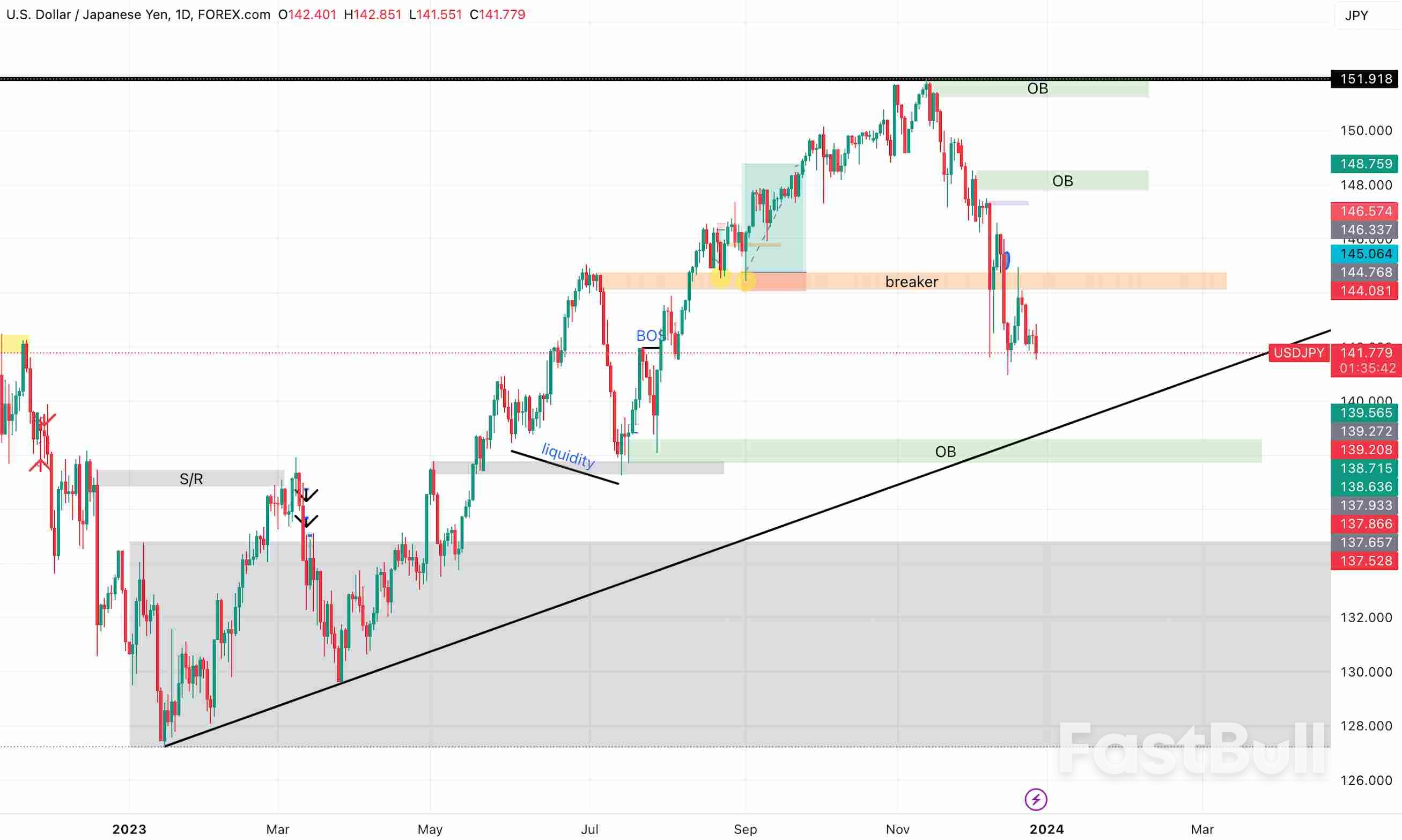
          Holiday stability at USD/JPY 142.45 may shift. Yen strengthens, yet reversal possible. Recent gains uncertain; technicals hint fluctuation 140.00-145.85, shaped by market and central bank actions.
          Fundamental Analysis

          Hey there! So, imagine this, the USD/JPY is doing its holiday dance around 142.45, chillin' like a pro in the quiet holiday season. Why? 'Cause holidays mean less action and more "meh" vibes for the USD/JPY, affecting how investors feel about risk and cash flow. It's like the calm before a financial storm, but a really chill one.
          Now, the Japanese yen has been flexing its muscles, getting stronger against the dollar lately—over 6% stronger since November. But hold your horses! History's whispering that this yen parade might just be reaching its grand finale. Why? 'Cause when big investors start getting all starry-eyed over the yen, it tends to flip the script real quick. They go from buying big to selling faster than you can say "yen-yen."
          Get this: Managers, those big financial decision-makers, took a turn from "meh" to "yay" on the yen in early January. Result? The yen went downhill—like an 8% slip 'n slide against the dollar in the weeks that followed. That yen's got mood swings, I tell ya!
          But wait, there's more drama! Forecasters were all, "Yen's gonna rise in 2023, folks!" Turns out, it didn't. Nope, instead, it took a nosedive. Three years of "down, down, down," and suddenly, they're all predicting a yen-yen bounce-up again next year. The yen's playing hard to get, keeping everyone on their toes, especially with the Bank of Japan hinting at ending its negative interest rate era. Sly moves, Bank of Japan, real sly!
          Now, here's a curveball: Someone said, "Sell the Swiss franc against the Japanese yen!" Why? 'Cause apparently, they were hitting sky-high levels in November. Meanwhile, the yen itself took a dive against the US dollar this year, earning the title of "Worst Performer" among its rich buddies in the currency world. Oh boy, the yen's having a rollercoaster year!
          But hold onto your hats, 'cause across the pond, the US Federal Reserve is doing its balancing act. They're trying to chill the economy a bit by cranking up those US interest rates to keep that wild inflation in check. Yet, they gotta be careful not to push the country straight into recession town. It's like they're walking a tightrope with clown shoes—it's serious, but you can't help but giggle.
          Traders are basically saying, "Fed, we bet you're gonna drop those interest rates by at least 1.50 percentage points next year!" That's some serious betting happening there. And the current federal funds rate? It's hanging out between 5.25% and 5.50%, the highest it's been in ages. Big numbers, big decisions!
          Oh, and the Fed made forecasts! They're thinking, "Yeah, we might cut those US interest rates a few times next year, but not as much as y'all think." It's like they're telling Wall Street, "Hey, slow your roll!" And speaking of Wall Street, it's been throwing a party in the stock market since October, all pumped up for that support from the Fed.
          So, what's the lesson here? Well, maybe the surge in stocks got a bit too excited, like kids at a candy store. And the Fed's looking at the situation like a parent saying, "Okay, enough sugar, time to calm down." But hey, who knows? Maybe the markets need a little sweet treat every now and then.
          In the end, it's like a financial soap opera out there. The yen's playing games, the Fed's doing its balancing act, and investors? Well, they're just trying to make sense of this wild ride. So, grab some popcorn and enjoy the show, 'cause this financial rollercoaster ain't slowing down anytime soon!

          Technical Analysis

          Alright, so picture this, the USD/JPY chart is doing its daily dance, hinting at a downward slide towards the 140.00 mark. Why? Well, if the dollar stays all floppy and Japan keeps teasing about changing policies, we might just take that plunge. But wait, if the bullish gang swoops in and pushes it up to 145.85, kaboom! That might just shatter this gloomy trend. Guess the market's taking a snooze until everyone's back from the holiday break next week.
          But hold onto your hats, folks! If we nosedive below ¥141, brace yourself for more dollar drama. Yet, if we magically leap over that 200-day Exponential Moving Average, hello, bull run to ¥145! That move's gonna make traders drop their coffee cups in excitement.
          So, here's the scoop: the USD and JPY are locked in a game of stability tug-of-war. Keep those eyes peeled for ¥141 and ¥145—they're the boss here. Traders, stay on your toes for any surprises that could shake this snoozy market. Until the big fireworks start, well, it's like waiting for the party to kick off but everyone's stuck in holiday mode—boring!USDJPY: BoJ Policy Change Bets Rise Higher_1
          Risk Warnings and Disclaimers
          You understand and acknowledge that there is a high degree of risk involved in trading. Following any strategies or investment methods may lead to potential losses. The content on the site is provided by our contributors and analysts for information purposes only. You are solely responsible for determining whether any trading assets, securities, strategy, or any other product is suitable for investing based on your own investment objectives and financial situation.
          Comments
          Add to Favorites
          Share

          Stocks Flirt with Record Highs as Rate Cut Bets Run Wild

          XM

          Economic

          Forex

          Stocks

          Stocks get another gift from Santa
          Equities look set to end the year in buoyant form as the disinflation theme continues to fuel the rally in global risk assets. Shares on Wall Street extended their year-to-date gains on Tuesday after the final major data release of 2023 endorsed the view that central banks will begin to cut rates sooner rather than later.
          Core PCE inflation in the United States slowed slightly more than expected in November, easing to 3.2% y/y from a downwardly revised 3.4% y/y in October. Personal consumption was subdued for a second month but without flashing any alarm bells, all of which support the soft landing narrative.
          Expectations for Fed rate cuts strengthened on the back of the data and markets are currently pricing in around 155 basis points of cut by December 2024, widening the gap with FOMC members' own predicted rate path.
          Is inflation dead?
          In the absence of any new inflationary threat and clear evidence that the American economy is no longer running on all cylinders, there's little reason for traders at the moment to be as cautious on the inflation outlook as policymakers are.
          Everything points to a slowing economy and an inflation trend that's firmly headed downwards, so a rate cut as early as March is not that inconceivable. If there is anything that can spoil this optimism, it is an upside surprise in the next jobs report. Weekly jobless claims have been somewhat lower in December compared to November, so a strong payrolls print is possible in next week's report. But until then, there's little that's likely to get in the way of the risk rally.
          Global stock rally gathers pace
          The S&P 500 closed at a record high on Tuesday and came close to beating its all-time intraday high from January 2022. The Nasdaq 100, meanwhile, climbed further in uncharted territory, closing at a new record peak.
          The upbeat mood is continuing today in Asia and Europe where many markets are reopening after the long Christmas weekend. Shares in Hong Kong and China are some of the best performers as gaming stocks have rebounded after Beijing stepped in to reassure investors about its plans for new regulatory curbs for the gaming industry following last week's surprise announcement that triggered a sharp selloff.
          Dollar mixed as yen struggles after BoJ Summary
          It was a slightly different picture in FX markets, however, as the major currencies were subdued in thin holiday trade. The US dollar slid to fresh five-month lows against a basket of currencies, as it remained pressured from falling Treasury yields. The euro advanced further above the $1.10 handle, but sterling was slightly softer.
          The Japanese yen was also weaker on Wednesday after the Summary of Opinions of the Bank of Japan's December policy meeting did not suggest that a rate hike was imminent. Policymakers appeared split on the need to make an early exit from stimulus. Comments from Governor Ueda on Monday indicated that the Bank is still waiting to see more sustainable wage growth before making any decision.
          If it wasn't for the rate cut wagers for the Fed, the yen would likely be facing a steeper selloff right now. Nevertheless, with the dollar on the backfoot and the BoJ in wait-and-see mode, the yen might manage to hold steady for a while.
          To stay updated on all economic events of today, please check out our Economic calendar
          Risk Warnings and Disclaimers
          You understand and acknowledge that there is a high degree of risk involved in trading. Following any strategies or investment methods may lead to potential losses. The content on the site is provided by our contributors and analysts for information purposes only. You are solely responsible for determining whether any trading assets, securities, strategy, or any other product is suitable for investing based on your own investment objectives and financial situation.
          Comments
          Add to Favorites
          Share

          Analyzing the Paradox: Elevated Expenditure Amidst Negative Sentiments

          Ukadike Micheal

          Economic

          Americans may not be as miserable as perceived, according to the Misery Index, a measure invented by economist Arthur Okun that combines the unemployment and inflation rates. Initially gaining prominence in the 1976 presidential election, the Misery Index experienced a surge during the Covid crisis in April 2020 but has since sharply fallen as unemployment decreased and inflation cooled. Despite this, consumer sentiment measures have been slow to improve, prompting the question of why spending remains robust, which can be attributed to a strong job market and real wage gains.
          The Misery Index, devised by economist Arthur Okun, has historically gauged the economic well-being of Americans by summing the unemployment and inflation rates. Its rise during the 1976 presidential election, notably highlighted by Jimmy Carter, resurfaced as an issue during his re-election campaign against Ronald Reagan in 1980 when the index was even higher. The Covid-induced increase in unemployment led the Misery Index to its highest levels in almost four decades in April 2020. However, as inflation cooled and unemployment decreased, the index sharply declined, standing at 6.8 in November, compared to 12.5 in June 2022.
          Despite this positive economic trend, consumer sentiment measures, such as the University of Michigan's index, have been slow to reflect improvements. The divergence between the improving economic conditions and consumer sentiment raises the question of why Americans continue to spend despite pessimism. A key factor contributing to this spending resilience is the robust job market coupled with cooling inflation, resulting in real wage gains that provide individuals with the income to sustain spending.
          The disconnect between sentiment measures and economic conditions prompts a deeper exploration into the reasons behind the apparent discrepancy. Increased political polarization, particularly following President Biden's election, has played a role, with Republicans expressing lower sentiment figures than during the early days of the pandemic. Lingering impacts of recent inflation experiences and the lasting effects of the pandemic contribute to the subdued consumer sentiment. While political polarization may persist in an election year, the fading memories of inflation and the pandemic could contribute to an improved outlook, potentially leading to less misery among Americans in the near future.
          The intricate interplay between economic indicators and consumer sentiment underscores the complexity of understanding Americans' perception of their well-being. Despite economic improvements, the impact of political factors, inflation experiences, and the enduring effects of the pandemic contribute to a nuanced narrative of why sentiment measures may lag behind positive economic developments.

          Source: Wall Street Journal

          To stay updated on all economic events of today, please check out our Economic calendar
          Risk Warnings and Disclaimers
          You understand and acknowledge that there is a high degree of risk involved in trading. Following any strategies or investment methods may lead to potential losses. The content on the site is provided by our contributors and analysts for information purposes only. You are solely responsible for determining whether any trading assets, securities, strategy, or any other product is suitable for investing based on your own investment objectives and financial situation.
          Comments
          Add to Favorites
          Share

          Q4 2023 Earnings Season – Growth Expected to Slow Compared to Q3

          IG

          Economic

          Earnings growth to slow
          ​The current expected earnings growth rate is 2.4%, which is lower than the estimated growth rate of 8.1% on September 30. If 2.4% is the actual growth rate, it will mark the second consecutive quarter of year-over-year earnings growth for the US 500 index, but at a lower rate compared to the third quarter.
          ​The earnings outlook for S&P 500 companies in the fourth quarter is currently more pessimistic compared to historical averages. Analysts have lowered their earnings estimates for Q4 2023 by a larger margin than usual, resulting in a decrease in estimated earnings for the quarter. This decline is larger than the 5-year and 10-year averages and represents the largest decrease in quarterly Earnings Per Share (EPS) estimate since Q1 2023.
          ​Negative guidance above average
          ​In terms of guidance, a higher percentage of S&P 500 companies have issued negative EPS guidance for Q4 2023 compared to the average. This suggests that more companies are expecting lower earnings for the quarter. The number and percentage of companies issuing negative EPS guidance are above the 5-year and 10-year averages.
          ​Among the sectors, Communication Services, Utilities, and Consumer Discretionary are projected to report year-over-year earnings growth, while Energy, Materials, and Health Care sectors are predicted to report a decline in earnings.
          ​Analysts have also decreased their revenue estimates for the quarter. The current expected year-over-year revenue growth rate for the S&P 500 is 3.1%, which is lower than the expectations on September 30. If 3.1% is the actual revenue growth rate, it will mark the 12th consecutive quarter of revenue growth for the index.
          ​Longer-term outlook more encouraging
          ​Looking ahead, analysts expect earnings growth of 6.2% for Q1 2024, 10.5% for Q2 2024, and 11.5% for the full year 2024.
          ​The forward 12-month price-to-earnings (P/E) ratio for the S&P 500 is currently 19.3, which is above the 5-year and 10-year averages. It is also higher than the forward P/E ratio recorded at the end of the third quarter.
          To stay updated on all economic events of today, please check out our Economic calendar
          Risk Warnings and Disclaimers
          You understand and acknowledge that there is a high degree of risk involved in trading. Following any strategies or investment methods may lead to potential losses. The content on the site is provided by our contributors and analysts for information purposes only. You are solely responsible for determining whether any trading assets, securities, strategy, or any other product is suitable for investing based on your own investment objectives and financial situation.
          Comments
          Add to Favorites
          Share

          Cocoa Futures Ascend to Apex: Technical Hurdles Await Chocolate Manufacturers

          Ukadike Micheal

          Commodity

          Leading chocolate manufacturers, including Hershey Co. and Nestle SA, find themselves on the precipice of unprecedented challenges as the cocoa market experiences a pinnacle in its rally, with futures soaring to a 46-year high. Traditionally, these companies engage in advanced cocoa procurement; however, the current scenario of depleting supplies and persistently elevated prices forces chocolate makers to confront intensified financial burdens, compelling them to inevitably transfer these costs to consumers.
          Jonathan Parkman, the seasoned head of agricultural sales at Marex Group, brings over three decades of expertise to elucidate the unparalleled nature of the current cocoa market conditions, marking it as the most extraordinary in his career. At the crux of this surge in cocoa prices is the dismal state of cocoa production in West Africa, a region contributing nearly 70% to the global cocoa supply. The outlook for cocoa production in West Africa proves even more dire than initial projections, leading to a substantial shortfall in global supplies compared to demand, marking the third consecutive year of such imbalance since the season commenced in October.
          Compounding the challenges for chocolate manufacturers is the remarkable escalation in the costs of cocoa products, particularly butter, constituting around 20% of the average chocolate bar's weight. Butter prices have ascended to record levels, reaching nearly 9,600 euros per metric ton in Europe—approximately 2.5 times the cost of cocoa futures. The intricacies of planning chocolate production, especially for seasonal peaks like Halloween and Christmas, are now complicated by the surge in butter prices. Notably, both Nestle and Mondelez have signaled their necessity to implement price hikes in the approaching year.
          Leveraging the futures market to hedge risk is a common practice among chocolate manufacturers, involving the procurement of cocoa eight to nine months in advance. Nevertheless, the current elevated prices have constricted this hedging window to six months. Lindt & Sprüngli Group has proactively adjusted to this landscape by implementing an average price increase of 9.3% in the initial half of the year, while Hershey's North American confectionery unit experienced an 11% price surge in the third quarter.
          The significant surge in cocoa costs has outpaced the marginal easing observed in some other raw materials, a fact highlighted by Lindt. Beyond cocoa, chocolate manufacturers are grappling with augmented costs in labor, processing, transportation, and marketing. Industry experts, such as Carl Quash III, head of snacks and nutrition at Euromonitor, posit that the trajectory of rising chocolate prices may persist for an extended period.
          Forecasts indicate that cocoa prices are poised to remain elevated until the advent of the new crop in October 2024, potentially effecting a cooling of the market by almost 20% to $3,500 per ton. However, alternative perspectives from traders suggest that relief might only materialize in 2025 when West African farmers have had ample time to react to the escalating price environment. Steven Retzlaff, president of global cocoa at Barry Callebaut AG, the leading bulk chocolate manufacturer, sees potential among large producers to enhance production and counteract the impact of soaring prices.
          While chocolate consumption currently exhibits resilience, discernible signs of change emerge. Unit sales within the grocery category, spanning baking chocolate to brownies, have incurred a 4.7% decline in the 12-month period concluding on Dec. 9. A September survey underscores consumer sentiments, with over 40% expressing an inclination to curtail chocolate and candy purchases in response to rising inflation, hinting at a potential shift in consumer behavior.
          Factories in the industry are already contending with challenges, with returns for producers of cocoa butter and powder plummeting to the lowest levels recorded since the 1980s, as per KnowledgeCharts. Processing facilities in Europe, North America, and Asia are experiencing deceleration, with global grinding, a proxy for demand, anticipated to witness a potential contraction of up to 6% over the ensuing two years, according to Marex estimates. The prevailing extreme price levels may incite demand destruction if they endure, a caution voiced by Aakash Doshi, Citigroup Inc.'s head of commodities for the Americas. Notwithstanding these formidable challenges, chocolate manufacturers are bracing for the impending pinnacle of the cocoa rally, navigating this complex landscape with a blend of caution and resilience.

          Source: Bloomberg

          Risk Warnings and Disclaimers
          You understand and acknowledge that there is a high degree of risk involved in trading. Following any strategies or investment methods may lead to potential losses. The content on the site is provided by our contributors and analysts for information purposes only. You are solely responsible for determining whether any trading assets, securities, strategy, or any other product is suitable for investing based on your own investment objectives and financial situation.
          Comments
          Add to Favorites
          Share

          Asia's Trading Vigor Powers the Nonstop Thrill of the 24-Hour US Stock Market!

          Ukadike Micheal

          Stocks

          Asia's surging enthusiasm is reshaping the landscape of the US stock market, as a 24-hour retail trading phenomenon emerges, emphasizing New York's central role in global share trading. The activity during the overnight period, between 8 pm and 4 am Eastern Time, has seen a substantial uptick this year, driven by increased demand from smaller investors in Asia and Europe. This shift comes on the heels of the S&P 500's nearly 25% rise this year, approaching its all-time high, and amid continued attraction of global companies for initial public offerings in the US.
          Blue Ocean Technologies, the primary regulated venue for individual US stocks overnight, witnessed a record session with 40.6 million shares worth $405 million changing hands earlier this month. This surge in trading volumes, while relatively modest compared to major exchanges like Nasdaq and NYSE, hints at a potential transformation in the US equity market towards continuous trading, aligning with markets such as Treasuries and major currencies.
          The rise of "back-of-the-clock" trading is prompting more brokers to offer overnight services. Platforms like Robinhood and Interactive Brokers have entered this space, with Blue Ocean Technologies exploring partnerships with other brokers in the US and abroad. Connecting Asian retail investors with their US counterparts has played a crucial role in driving Blue Ocean's activity, with approximately 70% of its volume originating from Asia.
          However, skepticism remains regarding the sustainability and broader institutional participation in overnight trading. While retail traders can use limit orders during the overnight period, institutional activity has been relatively muted due to requirements for greater market depth, credit, and settlement support. Some argue that extending trading hours may not address long-standing issues like lack of liquidity and settlement risks in US stock markets.
          Despite the uncertainties, the shift towards a 24-hour trading paradigm is gaining momentum. Industry leaders recognize the potential demand from a global investor base, with brokers eyeing expansion overseas. The success of platforms like Robinhood, which has incorporated overnight trading into its UK business strategy, underscores the market's evolution towards continuous trading.
          The emergence of a 24-hour retail market fueled by Asian enthusiasm reflects a dynamic shift in the traditional trading landscape. While challenges and skepticism persist, the trend signals a growing appetite for continuous trading, raising questions about the future trajectory of the US equity market.

          Source: Financial Times

          Risk Warnings and Disclaimers
          You understand and acknowledge that there is a high degree of risk involved in trading. Following any strategies or investment methods may lead to potential losses. The content on the site is provided by our contributors and analysts for information purposes only. You are solely responsible for determining whether any trading assets, securities, strategy, or any other product is suitable for investing based on your own investment objectives and financial situation.
          Comments
          Add to Favorites
          Share

          GOLD: Soon Reaching Its Highest Price Ever

          Chandan Gupta

          Commodity

          As we kick off the final week of 2023, the price of gold (XAU/USD) is going up. Traders are eyeing possible cuts in US interest rates by the Federal Reserve in 2024, which is making the US dollar weaker. Gold prices are close to their highest ever, looking to finish this year with their first gain in three years. There's news that US inflation, a measure of how prices increase, is slowing down. This suggests the Fed might cut rates in 2024. The chances of a rate cut by March are now more than 80%, which is good for things like gold that don’t pay interest. But some Fed officials are not so sure about cutting rates soon.
          Gold hit $2,069 per ounce, going up by 1.7% last week. It reached a high of $2,072.22 on December 1. The Bloomberg Dollar Spot Index fell a bit. Silver and palladium prices went up, while platinum prices stayed steady.
          Looking at the stock market, Wall Street indices have been rising for eight weeks in a row. With less than a week left in 2023, the S&P 500 is up by more than 24% for the year, and the Nasdaq is up by more than 43%. Reports show that inflation is going down even though the economy is doing better than expected.
          The Federal Reserve has a tough job: it needs to slow down the economy to control inflation by raising interest rates, but not so much that it causes a recession. Traders think the Fed might cut interest rates by 1.50 percentage points next year. Right now, the rate is between 5.25% and 5.50%, the highest in over 20 years. The Fed said it might cut rates a few times next year, but maybe not as much as Wall Street thinks.
          As for the gold price's outlook, it's still positive as long as it stays above $2,000. Even though some indicators show it might be overbought, the weak US dollar might push it higher. Targets are set at $2070 and $2085 per ounce, but if the dollar gets stronger, people might sell for profit. Trading might slow down during the holiday season due to low activity.
          Risk Warnings and Disclaimers
          You understand and acknowledge that there is a high degree of risk involved in trading. Following any strategies or investment methods may lead to potential losses. The content on the site is provided by our contributors and analysts for information purposes only. You are solely responsible for determining whether any trading assets, securities, strategy, or any other product is suitable for investing based on your own investment objectives and financial situation.
          Comments
          Add to Favorites
          Share
          FastBull
          Copyright © 2025 FastBull Ltd

          728 RM B 7/F GEE LOK IND BLDG NO 34 HUNG TO RD KWUN TONG KLN HONG KONG

          TelegramInstagramTwitterfacebooklinkedin
          App Store Google Play Google Play
          Products
          Charts

          Chats

          Q&A with Experts
          Screeners
          Economic Calendar
          Data
          Tools
          Membership
          Features
          Function
          Markets
          Copy Trading
          Latest Signals
          Contests
          News
          Analysis
          24/7
          Columns
          Education
          Company
          Careers
          About Us
          Contact Us
          Advertising
          Help Center
          Feedback
          User Agreement
          Privacy Policy
          Business

          White Label

          Data API

          Web Plug-ins

          Poster Maker

          Affiliate Program

          Risk Disclosure

          The risk of loss in trading financial instruments such as stocks, FX, commodities, futures, bonds, ETFs and crypto can be substantial. You may sustain a total loss of the funds that you deposit with your broker. Therefore, you should carefully consider whether such trading is suitable for you in light of your circumstances and financial resources.

          No decision to invest should be made without thoroughly conducting due diligence by yourself or consulting with your financial advisors. Our web content might not suit you since we don't know your financial conditions and investment needs. Our financial information might have latency or contain inaccuracy, so you should be fully responsible for any of your trading and investment decisions. The company will not be responsible for your capital loss.

          Without getting permission from the website, you are not allowed to copy the website's graphics, texts, or trademarks. Intellectual property rights in the content or data incorporated into this website belong to its providers and exchange merchants.

          Not Logged In

          Log in to access more features

          FastBull Membership

          Not yet

          Purchase

          Become a signal provider
          Help Center
          Customer Service
          Dark Mode
          Price Up/Down Colors

          Log In

          Sign Up

          Position
          Layout
          Fullscreen
          Default to Chart
          The chart page opens by default when you visit fastbull.com