• Trade
  • Markets
  • Copy
  • Contests
  • News
  • 24/7
  • Calendar
  • Q&A
  • Chats
Trending
Screeners
SYMBOL
LAST
BID
ASK
HIGH
LOW
NET CHG.
%CHG.
SPREAD
SPX
S&P 500 Index
6827.42
6827.42
6827.42
6899.86
6801.80
-73.58
-1.07%
--
DJI
Dow Jones Industrial Average
48458.04
48458.04
48458.04
48886.86
48334.10
-245.98
-0.51%
--
IXIC
NASDAQ Composite Index
23195.16
23195.16
23195.16
23554.89
23094.51
-398.69
-1.69%
--
USDX
US Dollar Index
97.950
98.030
97.950
98.500
97.950
-0.370
-0.38%
--
EURUSD
Euro / US Dollar
1.17394
1.17409
1.17394
1.17496
1.17192
+0.00011
+ 0.01%
--
GBPUSD
Pound Sterling / US Dollar
1.33707
1.33732
1.33707
1.33997
1.33419
-0.00148
-0.11%
--
XAUUSD
Gold / US Dollar
4299.39
4299.39
4299.39
4353.41
4257.10
+20.10
+ 0.47%
--
WTI
Light Sweet Crude Oil
57.233
57.485
57.233
58.011
56.969
-0.408
-0.71%
--

Community Accounts

Signal Accounts
--
Profit Accounts
--
Loss Accounts
--
View More

Become a signal provider

Sell trading signals to earn additional income

View More

Guide to Copy Trading

Get started with ease and confidence

View More

Signal Accounts for Members

All Signal Accounts

Best Return
  • Best Return
  • Best P/L
  • Best MDD
Past 1W
  • Past 1W
  • Past 1M
  • Past 1Y

All Contests

  • All
  • Trump Updates
  • Recommend
  • Stocks
  • Cryptocurrencies
  • Central Banks
  • Featured News
Top News Only
Share

USA Embassy In Lithuania: Maria Kalesnikava Is Not Going To Vilnius

Share

USA Embassy In Lithuania: Other Prisoners Are Being Sent From Belarus To Ukraine

Share

Ukraine President Zelenskiy: Five Ukrainians Released By Belarus In US-Brokered Deal

Share

USA Vilnius Embassy: USA Stands Ready For "Additional Engagement With Belarus That Advances USA Interests"

Share

USA Vilnius Embassy: Belarus, USA, Other Citizens Among The Prisoners Released Into Lithuania

Share

USA Vilnius Embassy: USA Will Continue Diplomatic Efforts To Free The Remaining Political Prisoners In Belarus

Share

USA Vilnius Embassy: Belarus Releases 123 Prisoners Following Meeting Of President Trump's Envoy Coale And Belarus President Lukashenko

Share

USA Vilnius Embassy: Masatoshi Nakanishi, Aliaksandr Syrytsa Are Among The Prisoners Released By Belarus

Share

USA Vilnius Embassy: Maria Kalesnikava And Viktor Babaryka Are Among The Prisoners Released By Belarus

Share

USA Vilnius Embassy: Nobel Peace Prize Laureate Ales Bialiatski Is Among The Prisoners Released By Belarus

Share

Belarusian Presidential Administration Telegram Channel: Lukashenko Has Pardoned 123 Prisoners As Part Of Deal With US

Share

Two Local Syrian Officials: Joint US-Syrian Military Patrol In Central Syria Came Under Fire From Unknown Assailants

Share

Israeli Military Says It Targeted 'Key Hamas Terrorist' In Gaza City

Share

Rwanda's Actions In Eastern Drc Are A Clear Violation Of Washington Accords Signed By President Trump - Secretary Of State Rubio

Share

Israeli Military Issues Evacuation Warning In Southern Lebanon Village Ahead Of Strike - Spokesperson On X

Share

Belarusian State Media Cites US Envoy Coale As Saying He Discussed Ukraine And Venezuela With Lukashenko

Share

Belarusian State Media Cites US Envoy Coale As Saying That US Removes Sanctions On Belarusian Potassium

Share

Thai Prime Minister: No Ceasefire Agreement With Cambodia

Share

US, Ukraine To Discuss Ceasefire In Berlin Ahead Of European Summit

Share

Incoming Czech Prime Minister Babis: Czech Republic Will Not Take On Guarantees For Ukraine Financing, European Commission Must Find Alternatives

TIME
ACT
FCST
PREV
U.K. Trade Balance Non-EU (SA) (Oct)

A:--

F: --

P: --

U.K. Trade Balance (Oct)

A:--

F: --

P: --

U.K. Services Index MoM

A:--

F: --

P: --

U.K. Construction Output MoM (SA) (Oct)

A:--

F: --

P: --

U.K. Industrial Output YoY (Oct)

A:--

F: --

P: --

U.K. Trade Balance (SA) (Oct)

A:--

F: --

P: --

U.K. Trade Balance EU (SA) (Oct)

A:--

F: --

P: --

U.K. Manufacturing Output YoY (Oct)

A:--

F: --

P: --

U.K. GDP MoM (Oct)

A:--

F: --

P: --

U.K. GDP YoY (SA) (Oct)

A:--

F: --

P: --

U.K. Industrial Output MoM (Oct)

A:--

F: --

P: --

U.K. Construction Output YoY (Oct)

A:--

F: --

P: --

France HICP Final MoM (Nov)

A:--

F: --

P: --

China, Mainland Outstanding Loans Growth YoY (Nov)

A:--

F: --

P: --

China, Mainland M2 Money Supply YoY (Nov)

A:--

F: --

P: --

China, Mainland M0 Money Supply YoY (Nov)

A:--

F: --

P: --

China, Mainland M1 Money Supply YoY (Nov)

A:--

F: --

P: --

India CPI YoY (Nov)

A:--

F: --

P: --

India Deposit Gowth YoY

A:--

F: --

P: --

Brazil Services Growth YoY (Oct)

A:--

F: --

P: --

Mexico Industrial Output YoY (Oct)

A:--

F: --

P: --

Russia Trade Balance (Oct)

A:--

F: --

P: --

Philadelphia Fed President Henry Paulson delivers a speech
Canada Building Permits MoM (SA) (Oct)

A:--

F: --

P: --

Canada Wholesale Sales YoY (Oct)

A:--

F: --

P: --

Canada Wholesale Inventory MoM (Oct)

A:--

F: --

P: --

Canada Wholesale Inventory YoY (Oct)

A:--

F: --

P: --

Canada Wholesale Sales MoM (SA) (Oct)

A:--

F: --

P: --

Germany Current Account (Not SA) (Oct)

A:--

F: --

P: --

U.S. Weekly Total Rig Count

A:--

F: --

P: --

U.S. Weekly Total Oil Rig Count

A:--

F: --

P: --

Japan Tankan Large Non-Manufacturing Diffusion Index (Q4)

--

F: --

P: --

Japan Tankan Small Manufacturing Outlook Index (Q4)

--

F: --

P: --

Japan Tankan Large Non-Manufacturing Outlook Index (Q4)

--

F: --

P: --

Japan Tankan Large Manufacturing Outlook Index (Q4)

--

F: --

P: --

Japan Tankan Small Manufacturing Diffusion Index (Q4)

--

F: --

P: --

Japan Tankan Large Manufacturing Diffusion Index (Q4)

--

F: --

P: --

Japan Tankan Large-Enterprise Capital Expenditure YoY (Q4)

--

F: --

P: --

U.K. Rightmove House Price Index YoY (Dec)

--

F: --

P: --

China, Mainland Industrial Output YoY (YTD) (Nov)

--

F: --

P: --

China, Mainland Urban Area Unemployment Rate (Nov)

--

F: --

P: --

Saudi Arabia CPI YoY (Nov)

--

F: --

P: --

Euro Zone Industrial Output YoY (Oct)

--

F: --

P: --

Euro Zone Industrial Output MoM (Oct)

--

F: --

P: --

Canada Existing Home Sales MoM (Nov)

--

F: --

P: --

Euro Zone Total Reserve Assets (Nov)

--

F: --

P: --

U.K. Inflation Rate Expectations

--

F: --

P: --

Canada National Economic Confidence Index

--

F: --

P: --

Canada New Housing Starts (Nov)

--

F: --

P: --

U.S. NY Fed Manufacturing Employment Index (Dec)

--

F: --

P: --

U.S. NY Fed Manufacturing Index (Dec)

--

F: --

P: --

Canada Core CPI YoY (Nov)

--

F: --

P: --

Canada Manufacturing Unfilled Orders MoM (Oct)

--

F: --

P: --

Canada Manufacturing New Orders MoM (Oct)

--

F: --

P: --

Canada Core CPI MoM (Nov)

--

F: --

P: --

Canada Manufacturing Inventory MoM (Oct)

--

F: --

P: --

Canada CPI YoY (Nov)

--

F: --

P: --

Canada CPI MoM (Nov)

--

F: --

P: --

Canada CPI YoY (SA) (Nov)

--

F: --

P: --

Canada Core CPI MoM (SA) (Nov)

--

F: --

P: --

Q&A with Experts
    • All
    • Chatrooms
    • Groups
    • Friends
    Connecting
    .
    .
    .
    Type here...
    Add Symbol or Code

      No matching data

      All
      Trump Updates
      Recommend
      Stocks
      Cryptocurrencies
      Central Banks
      Featured News
      • All
      • Russia-Ukraine Conflict
      • Middle East Flashpoint
      • All
      • Russia-Ukraine Conflict
      • Middle East Flashpoint
      Search
      Products

      Charts Free Forever

      Chats Q&A with Experts
      Screeners Economic Calendar Data Tools
      Membership Features
      Data Warehouse Market Trends Institutional Data Policy Rates Macro

      Market Trends

      Market Sentiment Order Book Forex Correlations

      Top Indicators

      Charts Free Forever
      Markets

      News

      News Analysis 24/7 Columns Education
      From Institutions From Analysts
      Topics Columnists

      Latest Views

      Latest Views

      Trending Topics

      Top Columnists

      Latest Update

      Signals

      Copy Rankings Latest Signals Become a signal provider AI Rating
      Contests
      Brokers

      Overview Brokers Assessment Rankings Regulators News Claims
      Broker listing Forex Brokers Comparison Tool Live Spread Comparison Scam
      Q&A Complaint Scam Alert Videos Tips to Detect Scam
      More

      Business
      Events
      Careers About Us Advertising Help Center

      White Label

      Data API

      Web Plug-ins

      Affiliate Program

      Awards Institution Evaluation IB Seminar Salon Event Exhibition
      Vietnam Thailand Singapore Dubai
      Fans Party Investment Sharing Session
      FastBull Summit BrokersView Expo
      Recent Searches
        Top Searches
          Markets
          News
          Analysis
          User
          24/7
          Economic Calendar
          Education
          Data
          • Names
          • Latest
          • Prev

          View All

          No data

          Scan to Download

          Faster Charts, Chat Faster!

          Download App
          English
          • English
          • Español
          • العربية
          • Bahasa Indonesia
          • Bahasa Melayu
          • Tiếng Việt
          • ภาษาไทย
          • Français
          • Italiano
          • Türkçe
          • Русский язык
          • 简中
          • 繁中
          Open Account
          Search
          Products
          Charts Free Forever
          Markets
          News
          Signals

          Copy Rankings Latest Signals Become a signal provider AI Rating
          Contests
          Brokers

          Overview Brokers Assessment Rankings Regulators News Claims
          Broker listing Forex Brokers Comparison Tool Live Spread Comparison Scam
          Q&A Complaint Scam Alert Videos Tips to Detect Scam
          More

          Business
          Events
          Careers About Us Advertising Help Center

          White Label

          Data API

          Web Plug-ins

          Affiliate Program

          Awards Institution Evaluation IB Seminar Salon Event Exhibition
          Vietnam Thailand Singapore Dubai
          Fans Party Investment Sharing Session
          FastBull Summit BrokersView Expo

          May 30th Financial News

          FastBull Featured

          Daily News

          Summary:

          U.K. Labor leader plans to block new North Sea oil and gas projects; German economy is expected to grow moderately in Q2...

          【Quick Facts】
          1. The U.S. House of Representatives Rules Committee will meet on Tuesday to discuss the debt ceiling bill.
          2. U.K. Labor leader plans to block new North Sea oil and gas projects.
          3. German economy is expected to grow moderately in Q2.
          4. The debt ceiling deal is unlikely to significantly change the long-term fiscal capacity of the U.S.
          【News Details】
          1. The U.S. House of Representatives Rules Committee will meet on Tuesday to discuss the debt ceiling bill.
          The U.S. House Rules panel will meet at 3 p.m. on Tuesday (May 30th) to discuss the debt ceiling bill. Congress needs to pass the bill before June 5th, when the U.S. Treasury says it will face a shortage of funds to meet all debt service obligations.
          Last Sunday, U.S. President Joe Biden said that he had finalized a budget deal with House Speaker McCarthy that would suspend the $31.4 trillion debt ceiling and send it to Congress for a vote.
          For now, the deal will suspend the debt ceiling until January 2025, limit budget spending in 2024 and 2025, recoup unspent epidemic emergency money, speed up the permitting process for some energy projects, and some additional work requirements of food assistance programs for poor people.
          The 99-page bill would authorize more than $886 billion in defense spending and more than $703 billion in non-defense spending in fiscal year 2024, excluding some adjustments. The bill would also authorize a 1% increase in security spending in fiscal year 2025.
          2. U.K. Labor leader plans to block new North Sea oil and gas projects.
          Labor leader Starmer plans to block all new North Sea oil and gas development and limit borrowing for green investments, the Sunday Times reported. Starmer is expected to set out a net-zero energy policy in Scotland next month, which includes a commitment to ban new North Sea licenses. According to the report, the policy will be one of Starmer's five major promises to voters. Starmer also announces that the Labor government will only borrow money to invest in green businesses. Labor will continue to use existing oil and gas wells for decades to come and manage them sustainably as the U.K. transforms into a clean energy superpower, according to the report.
          3. German economy is expected to grow moderately in Q2.
          The Bundesbank recently released its monthly report for May, predicting that German economic output will grow slightly in Q2 of 2023: the labor market remains strong, despite a slight increase in the unemployment rate; inflation has a significant impact on wage increases; given inflation still high (especially food inflation), inflation growth will slow down slowly in the next few months.
          Experts at the Bundesbank expect GDP to pick up slightly in Q2 of 2023. Reduced supply bottlenecks, a large backlog of orders, and lower energy prices all support the continued recovery of the industry. Despite persistently high inflation, strong wage growth at least means that real net household income will not fall further. Private consumption is likely to stagnate.
          The revised GDP in Q1 released by the German Federal Statistical Office on May 25th showed that the German economy shrank by 0.3% YoY in the first three months of this year. Signs that the German economy might be better than expected and getting out of the winter are illusory, the Bundesbank said.
          4. The debt ceiling deal is unlikely to significantly change the long-term fiscal capacity of the U.S.
          The preliminary debt-ceiling deal that has been reached will raise the U.S. debt ceiling for two years while setting new limits on spending during that time. The agreement would keep non-defense spending roughly flat in fiscal year 2024 and increase it by about 1% in 2025. The agreement would impose some new restrictions on certain government aid programs, such as food stamps. The deal faces hurdles in getting through Congress, and the compromise will likely need bipartisan support to pass the Republican-controlled House of Representatives.
          The proposed agreement is unlikely to substantially alter the long-term U.S. fiscal capacity, as both sides backed away from their initial positions. The deal will have a minor impact on spending that accounts for less than a third of the federal budget, with spending on mandatory programs such as Social Security and Medicare, as well as interest on the debt, unaffected.
          【Focus of the Day】
          UTC+8 17:00 Speech by ECB Governing Council Simkus
          UTC+8 21:00 Speech by ECB Governing Council Holzmann
          UTC+8 21:30 ECB Governing Council Centeno Attends an Economic Event
          UTC+8 23:45 Speech by ECB Governing Council Villeroy
          Risk Warnings and Disclaimers
          You understand and acknowledge that there is a high degree of risk involved in trading. Following any strategies or investment methods may lead to potential losses. The content on the site is provided by our contributors and analysts for information purposes only. You are solely responsible for determining whether any trading assets, securities, strategy, or any other product is suitable for investing based on your own investment objectives and financial situation.
          Comments
          Add to Favorites
          Share

          Japanese Yen Crosses $140 as Monetary Policy Divergence Persists

          Warren Takunda

          Forex

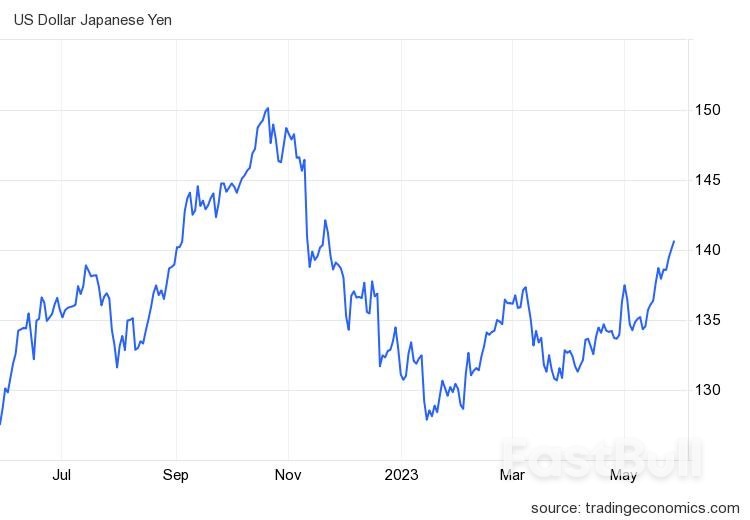
          The Japanese yen has recently plummeted to its lowest level in six months, breaking the crucial $140 mark against the US dollar. This decline can be attributed to the widening monetary policy divergence between Japan and the United States. While the Bank of Japan maintains its ultra-low interest rate policy despite market pressures and persistent inflation, expectations are growing that the Federal Reserve will implement further rate hikes and keep rates elevated for an extended period. This article explores the factors contributing to the yen's depreciation and analyzes the potential implications for Japan's economy.
          Japanese Yen Crosses $140 as Monetary Policy Divergence Persists_1Monetary Policy Divergence
          The Bank of Japan's steadfast commitment to maintaining ultra-low interest rates has diverged significantly from the tightening monetary stance adopted by the US Federal Reserve. This policy disparity has prompted investors to seek higher-yielding assets in the United States, consequently weakening the yen. The anticipation of additional rate hikes by the Federal Reserve, coupled with strong economic data, has fueled expectations of sustained monetary tightening in the US. In contrast, the Bank of Japan's reluctance to adjust its accommodative policy has created a growing gap in interest rate differentials, encouraging the yen's decline.
          Inflation and Economic Fundamentals
          Despite forecasts for a slowdown, Japan's headline inflation rate unexpectedly accelerated to 3.5% in April, surpassing expectations of 2.5%. Additionally, the core inflation rate rose to a three-month high of 3.4%, indicating underlying price pressures. These inflationary pressures, combined with the persistent ultra-low interest rate environment, have eroded the yen's attractiveness as a store of value. Consequently, investors have sought higher-yielding currencies, contributing to the yen's depreciation.
          Japanese Yen Crosses $140 as Monetary Policy Divergence Persists_2Government's Stance
          Japanese Finance Minister Shunichi Suzuki has emphasized that currency rates should be determined by market forces based on economic fundamentals. While the government is closely monitoring market movements, Suzuki's statement indicates a willingness to allow the yen to find its equilibrium. It is worth noting that Japanese authorities are likely aware of the potential benefits that a weaker yen can bring to export-driven industries, as it enhances their competitiveness in global markets. However, a significant depreciation in the yen could also raise concerns about imported inflation and the impact on domestic consumers.
          Implications for Japan's Economy
          The yen's decline below $140 against the US dollar carries both advantages and disadvantages for Japan's economy. On the positive side, a weaker yen can boost the competitiveness of Japanese exporters, supporting industries such as automotive, electronics, and machinery. This could potentially lead to increased export volumes and revenues, which can contribute to economic growth. However, a prolonged and substantial depreciation of the yen may also lead to higher import costs, impacting domestic consumers and potentially exacerbating inflationary pressures.
          The recent depreciation of the Japanese yen below $140 against the US dollar can be attributed to the diverging monetary policies pursued by Japan and the United States. The Bank of Japan's commitment to ultra-low interest rates, despite rising inflation, has created a policy disparity with the Federal Reserve's tightening stance. As a result, investors have sought higher-yielding assets in the US, exerting downward pressure on the yen. While a weaker yen can benefit export-oriented industries, careful monitoring of its impact on domestic consumers and inflation is crucial. As market forces continue to shape currency movements, Japan's policymakers will need to strike a balance between supporting export competitiveness and maintaining stability in the domestic economy.
          Risk Warnings and Disclaimers
          You understand and acknowledge that there is a high degree of risk involved in trading. Following any strategies or investment methods may lead to potential losses. The content on the site is provided by our contributors and analysts for information purposes only. You are solely responsible for determining whether any trading assets, securities, strategy, or any other product is suitable for investing based on your own investment objectives and financial situation.
          Comments
          Add to Favorites
          Share

          President Biden's Optimism Prevails: Debt Bill Expected to Reach His Desk Despite Opposition

          Warren Takunda

          Traders' Opinions

          In a recent statement, President Joe Biden conveyed his optimism that the legislation based on the tentative deal he reached with House Speaker Kevin McCarthy would successfully reach his desk. The proposed agreement aims to prevent a historic US default by raising the nation's debt limit by $2.5 trillion and implementing spending caps for the upcoming fiscal year. However, the deal faces resistance from both progressive Democrats and hardline Republicans who have expressed discontent with certain provisions.
          The Congress must approve the proposed deal by June 1 in order to avert the potentially calamitous default. President Biden's confident stance suggests that he believes the necessary support can be garnered to push the legislation forward. While the President has expressed his belief in the agreement's potential success, it remains to be seen whether it will indeed secure the backing required to pass.
          According to sources, the tentative deal encompasses several key provisions that have come under scrutiny from various factions within Congress. Progressive Democrats, for instance, have raised concerns over the provisions that they perceive as lacking in support for social programs and failing to adequately address income inequality. On the other hand, hardline Republicans have criticized the agreement for what they perceive as excessive spending and insufficient measures to address the national debt.
          As negotiations continue, the President and Speaker McCarthy face the challenging task of rallying support from both sides of the aisle. The success of the deal hinges on their ability to assuage the concerns of dissenting lawmakers and secure the necessary votes for its passage. The coming days will prove critical in determining the fate of this legislation, as time runs short before the June 1 deadline.
          The President's unwavering confidence in the proposed debt bill suggests his commitment to avoiding a default scenario and maintaining the stability of the nation's economy. However, the opposition from progressive Democrats and hardline Republicans underscores the intricate nature of the political landscape, where finding a balance between different ideologies and interests remains a formidable challenge.
          It is worth noting that while the President remains optimistic, uncertainty surrounds the final outcome of the deal. The conflicting opinions among lawmakers indicate that further negotiations and potential revisions may be necessary to address the concerns raised. As the deadline approaches, all eyes will be on Congress to observe how these deliberations unfold and whether a consensus can be reached to avert a default and ensure the financial stability of the United States.
          Risk Warnings and Disclaimers
          You understand and acknowledge that there is a high degree of risk involved in trading. Following any strategies or investment methods may lead to potential losses. The content on the site is provided by our contributors and analysts for information purposes only. You are solely responsible for determining whether any trading assets, securities, strategy, or any other product is suitable for investing based on your own investment objectives and financial situation.
          Comments
          Add to Favorites
          Share

          China's Industrial Profits Witness Sharp Decline of 20.6% in Jan-April

          Warren Takunda

          Traders' Opinions

          China's industrial sector experienced a significant setback in the first four months of 2023, as profits plummeted by 20.6% compared to the same period last year. This concerning trend reflects the challenges posed by a weakening economic recovery, feeble demand, and margin pressures. The decline in profits follows a steep 21.4% drop in the previous reporting period and a more modest 4% fall in 2022. Notably, both state-owned firms and the private sector faced profit contractions, exacerbating concerns about the overall health of China's industrial landscape.

          China's Industrial Profits Witness Sharp Decline of 20.6% in Jan-April_1Industry-Specific Analysis

          A comprehensive survey of 41 industries reveals that a staggering 27 sectors experienced losses during this period. Noteworthy among the struggling industries were ferrous metal smelting and rolling, petroleum and coal, chemical products, non-ferrous metal smelting and rolling, computer, communication, and electronic equipment, agricultural and food processing, textile, non-metallic mineral products, coal mining and washing, special equipment manufacturing, and oil and natural gas extraction. These industries recorded substantial declines in profitability, amplifying the challenges faced by China's industrial landscape.

          State-owned Firms

          The decline in profits for state-owned enterprises (SOEs) was notable, with a year-on-year contraction of 17.9% during Jan-April. This downturn follows a 16.9% decrease reported in the Jan-March period. The struggling industries mentioned earlier, coupled with broader economic challenges, have created headwinds for SOEs. Factors such as reduced demand, pricing pressures, and increased operational costs have contributed to the decline in profitability for state-owned firms.

          Private Sector

          The private sector also experienced a significant blow to its profitability, with profits falling by 22.5% during Jan-April. This decline surpassed the 23.0% drop observed in the preceding quarter. The private sector's struggles parallel those of state-owned enterprises, reflecting the widespread challenges faced by the industrial landscape. The weakening economic recovery and dwindling demand have affected private enterprises across various industries, causing declines in profitability and hindering growth prospects.

          Implications and Future Outlook

          The notable drop in industrial profits in China raises concerns about the country's economic recovery. The combination of feeble demand, margin pressures, and a weakening economic landscape has presented a formidable challenge for both state-owned firms and private enterprises. If these trends persist, they could potentially impede investment, hinder job creation, and dampen overall economic growth.
          Going forward, policymakers and industry leaders must closely monitor the situation and devise strategies to support the recovery of the industrial sector. Measures such as targeted fiscal stimulus, streamlined regulations, and initiatives to bolster domestic demand can play a crucial role in revitalizing profitability and restoring investor confidence.
          In conclusion, the sharp decline of 20.6% in China's industrial profits during Jan-April 2023 reflects the prevailing challenges faced by the economy. The impact is evident across various industries, affecting both state-owned enterprises and private sector firms. Urgent action is needed to address these challenges and foster a more resilient and prosperous industrial landscape in China.
          Risk Warnings and Disclaimers
          You understand and acknowledge that there is a high degree of risk involved in trading. Following any strategies or investment methods may lead to potential losses. The content on the site is provided by our contributors and analysts for information purposes only. You are solely responsible for determining whether any trading assets, securities, strategy, or any other product is suitable for investing based on your own investment objectives and financial situation.
          Comments
          Add to Favorites
          Share

          Recep Tayyip Erdogan Clinches Presidential Election Victory in Turkey, Displaying Resilience Amidst Skepticism

          Warren Takunda

          Traders' Opinions

          Istanbul, Turkey - Recep Tayyip Erdogan has emerged victorious in the presidential election run-off in Turkey, securing his third term as president. With 52.1% of the votes, Erdogan defeated his main rival, Kemal Kilicdaroglu, who garnered 47.9% of the votes. This election result solidifies Erdogan's grip on power, as he has been at the helm of Turkish politics since 2003.
          Erdogan's win comes as a surprise to many, as his conservative and nationalist policies have often strained relations with Western governments and investors. Despite facing criticism and skepticism, Erdogan's ability to rally support and secure a significant portion of the electorate highlights his enduring popularity among a considerable portion of the Turkish population.
          Throughout his tenure, Erdogan has implemented a range of economic policies aimed at boosting Turkey's growth and stability. However, his administration has faced challenges such as high inflation, currency depreciation, and a widening current account deficit. These economic concerns have led to tensions with international investors and hindered foreign direct investment into the country.
          As Erdogan begins his third presidential term, it remains to be seen how he will address these economic challenges and foster cooperation with foreign governments and investors. The outcome of the election raises questions about the future direction of Turkey's economic policies and its engagement with global markets.
          In response to Erdogan's victory, financial markets in Turkey initially experienced a degree of volatility. The uncertainty surrounding his administration's economic approach and its potential impact on market stability has prompted cautious sentiment among investors. Analysts anticipate that the government's ability to address economic concerns and maintain a favorable investment climate will be crucial in determining the future trajectory of Turkey's financial landscape.
          Erdogan's win also carries geopolitical implications, as Turkey's strategic position between Europe and Asia makes it an influential player on the global stage. The president's nationalist stance and assertive foreign policy have often clashed with Western interests, leading to strained relations with countries like the United States and European Union. Balancing these relationships will be a key challenge for Erdogan as he navigates the complex dynamics of international diplomacy.
          In conclusion, Recep Tayyip Erdogan's victory in the Turkish presidential election run-off solidifies his position as the country's leader for a third term. His conservative and nationalist policies, coupled with strained relations with Western governments and investors, have raised concerns about Turkey's economic outlook and geopolitical role. As Erdogan assumes office, all eyes will be on his economic strategies and efforts to foster international cooperation, as these factors will shape the country's future trajectory and influence its standing in the global arena.
          Risk Warnings and Disclaimers
          You understand and acknowledge that there is a high degree of risk involved in trading. Following any strategies or investment methods may lead to potential losses. The content on the site is provided by our contributors and analysts for information purposes only. You are solely responsible for determining whether any trading assets, securities, strategy, or any other product is suitable for investing based on your own investment objectives and financial situation.
          Comments
          Add to Favorites
          Share

          Distinguishing Securities from Non-Securities in the Cryptocurrency Market

          Kevin Du

          Cryptocurrency

          The cryptocurrency market raises many questions concerning its financial and regulatory status, including whether cryptocurrencies are securities​​. Securities are typically negotiable financial instruments with monetary value issued by companies or governments, which are also well-regulated, and investors must be informed about potential risks​​.
          On the other hand, cryptocurrencies are largely unregulated, and their status as securities remains debated and unclear. Exchanges and crypto developers exercise caution to operate within the law in various financial jurisdictions. However, these laws and requirements differ from one jurisdiction to another, contributing to the issue's complexity​.

          What Is the Howey Test for Crypto?

          Classifying cryptos as securities or commodities is a topic of ongoing debate in many jurisdictions. This is primarily due to the unique nature of cryptos and the fact that they do not fit into traditional asset classifications.
          The US Securities and Exchange Commission (SEC) proposed the Howey Test to determine which offerings qualify as securities. This test posits that for a transaction or an asset to be classified as a security, it must involve an "investment of money in a common enterprise with a reasonable expectation of profits to be derived from the efforts of others."
          Applying the Howey Test to cryptos generates mixed results:
          · Investment in Money : Cryptos pass this criterion as investing in them involves money​​.
          · In a Common Enterprise : This criterion is met to some extent. For instance, in crypto lending services, clients lend out their money expecting a fixed or variable profit based on how an exchange uses it​​.
          · Expectation of Profit : While many crypto investors aim to profit, there are exceptions, like stablecoins, which are used as a store of wealth, not for profit, classifying them more as a currency than a security​​.
          · Efforts of Others : Here, cryptos generally do not pass the test, as no third party is typically involved in ensuring investors' profits. It is more about collective market sentiment and investor activities. However, due to third-party involvement, stablecoins and certain cases like crypto staking and lending services may pass this test​.
          Despite these guidelines, confusion lingers over which cryptos the SEC's criteria should label as securities.
          Conversely, commodities are interchangeable basic goods that commerce utilizes, substitutable with other goods of a similar kind. Some cryptos, particularly Bitcoin, have been considered commodities because any particular entity did not issue it, and their value does not depend on the performance of an underlying company.

          Which Cryptocurrencies Are Not Securities?

          Often, cryptocurrencies do not meet all the criteria of the Howey Test, which is why they might not be classified as securities.
          For instance, the expectation of profits when investing in cryptocurrencies generally depends on market forces of supply and demand, not necessarily on the efforts of a common enterprise or third parties. This distinction separates them from securities, where the issuing entity's efforts typically generate profits.
          The SEC has declared that Bitcoin and Ether, the cryptocurrencies underpinning the Bitcoin and Ethereum networks, respectively, do not fall under the category of securities. This is largely due to their decentralized nature. The agency no longer views them as securities when a cryptocurrency becomes sufficiently decentralized, as Bitcoin and Ether have become.
          In contrast, the SEC almost always views smaller initial coin offerings, or ICOs, as securities.
          Also, in a landmark case in Connecticut, a federal jury concluded that Paycoin and several cryptocurrency mining-related assets are not securities, marking the first time a federal jury has considered whether a cryptocurrency is a security. The jury followed the Howey Test to determine whether the products constituted an investment contract or security. After deliberation, they concluded that the products at issue did not constitute a security​​.
          However, one should note that factors such as the specific details of the cryptocurrency, its underlying technology, and the jurisdiction evaluating it can influence the classification of a cryptocurrency as a security.
          Therefore, this information may not apply to all cryptocurrencies, and it is always advisable to consult with a legal professional or regulatory guidance when dealing with these issues.

          Which Cryptocurrencies Are Considered Securities?

          The regulatory and legal spaces are still grappling with the complex issue of deciding which cryptocurrencies qualify as securities. The SEC typically applies the Howey Test to determine whether a cryptocurrency qualifies as a security.
          Recently, the SEC has identified a number of cryptocurrencies as securities. The list of these crypto-assets classified as securities includes:
          · XRP (XRP)
          · Telegram Gram Token (TON)
          · LBRY Credits (LBC)
          · Decentraland (MANA)
          · DASH (DASH)
          · Power Ledger (POWR)
          · OmiseGo (OMG)
          · Algorand (ALGO)
          · Naga (NGC)
          · TokenCard (TKN)
          · IHT Real Estate (IHT)Kik (KIN)
          · Salt Lending (SALT)
          · Beaxy Token (BXY)
          · DragonChain (DRGN)
          · Tron (TRX)
          · BitTorrent (BTT)
          · Terra USD (UST)
          · Luna (LUNA)
          · Mirror Protocol mAssets (Multiple Symbols)
          · Mirror Protocol (MIR)
          · Mango (MNGO)
          · Ducat (DUCAT)
          · Locke (LOCKE)
          · EthereumMax (EMAX)
          · Hydro (HYDRO)
          · BitConnect (BCC)
          · Meta 1 Coin (META1)
          · Rally (RLY)
          · DerivaDAO (DDX)
          · XYO Network (XYO)
          · Rari (RGT)
          · Liechtenstein Cryptoasset Exchange (LCX)
          · DFX Finance (DFX)
          · Kromatica (KROM)
          · FlexaCoin (AMP)
          · Filecoin (FIL)

          What Happens If Cryptocurrencies Are Securities?

          Suppose a cryptocurrency is classified as a security. In that case, it becomes subject to the regulatory framework governing securities. This includes registration requirements, disclosure obligations, and other legal responsibilities designed to protect investors.
          · Registration : The issuer must register the offering with the SEC unless an exemption applies. Registration involves providing detailed information about the company, its management, and the security itself. This is a substantial process and can be expensive and time-consuming.
          · Disclosure : Issuers of securities must make regular disclosures to the public, including financial statements and information about their business operations, risk factors, and management.
          · Compliance and Enforcement : The issuer must comply with various laws and regulations designed to protect investors. If the issuer fails to comply, it could face enforcement actions from the SEC, which could result in fines, penalties, or other sanctions.
          · Broker-Dealer Rules : If the cryptocurrency qualifies as a security, then anyone participating in its sale might require registration as a broker-dealer. This requirement extends to exchanges that facilitate the trading of the cryptocurrency.
          · Investor Limitations : Only accredited investors, individuals or entities that fulfill certain financial criteria, can purchase some securities. This could limit the pool of potential buyers for the cryptocurrency.
          · Legal Ramifications : Should a cryptocurrency receive a security designation after its issuance, investors may file lawsuits against it, especially if the ICO did not adhere to securities laws.
          · Market Perception : Lastly, being classified as a security may affect the market's perception of the cryptocurrency. Some investors may see it as a more legitimate investment, while the increased regulation and potential for reduced liquidity may deter others.
          Cases such as BlockFi's interest rates account not being registered as a security highlight the ongoing complexity. This led to a $100 million fine for BlockFi, which neither accepted nor denied the allegation​.
          The SEC's lawsuit against Ripple for not registering XRP as a security presents another example of negatively impacting the industry.
          The agency's view of certain cryptocurrency assets as securities has even led to an investigation of Coinbase. Consequently, many tokens have been delisted from Coinbase, the US-based arm of Binance, and Kraken.
          Implications of Cryptocurrency's Regulatory Status
          The unclear regulatory status of cryptocurrencies has significant implications, making the idea of wide-ranging regulation seem unlikely. As long as they are unregulated in one jurisdiction, arguing for their legal status in others will always be challenging. This issue also influences the usage and trading of cryptocurrencies.
          Governments considering regulating crypto must also contend with general market risks, such as the irreversibility of blockchain transactions, the potential for scams, hacks, and manipulation, and the volatility of cryptocurrency values​​.
          Distinguishing Securities from Non-Securities in the Cryptocurrency Market_1Despite the regulatory challenges and uncertainties, the future of cryptocurrencies remains promising. They have the potential to revolutionize various aspects of finance, from payments and remittances to lending and fundraising.
          As regulators, industry players, and investors continue to navigate the complexities of this new digital frontier, it is essential to foster an environment that supports innovation while ensuring adequate protection for all participants.

          Source: Be in Crypto

          Risk Warnings and Disclaimers
          You understand and acknowledge that there is a high degree of risk involved in trading. Following any strategies or investment methods may lead to potential losses. The content on the site is provided by our contributors and analysts for information purposes only. You are solely responsible for determining whether any trading assets, securities, strategy, or any other product is suitable for investing based on your own investment objectives and financial situation.
          Comments
          Add to Favorites
          Share

          Anticipating Market Volatility: Major Economic Events for May 29 - June 2

          Warren Takunda

          Traders' Opinions

          In the dynamic world of financial markets, it is crucial for investors and traders to stay informed about upcoming economic events that can potentially impact various asset classes. This week, we have identified several major events that could shape market sentiment and contribute to heightened volatility. By understanding and analyzing these events, investors can make more informed decisions and navigate the markets with confidence. Let's delve into the key economic events to watch out for between May 29 and June 2.
          U.S. Non-Farm Payrolls (NFP) Report (June 2)
          One of the most eagerly awaited economic indicators, the U.S. Non-Farm Payrolls report, is scheduled for release on Friday. This report provides valuable insights into the labor market's health and serves as a key gauge for assessing the overall state of the U.S. economy. Investors closely monitor the NFP figures, including job creation, unemployment rates, and wage growth, as they can significantly influence market sentiment, particularly in the equity, currency, and bond markets. A robust NFP report often strengthens investor optimism, while a disappointing report can lead to increased market volatility.
          Eurozone Inflation Data (May 31)
          On Monday, the Eurozone will release its inflation data for the month of May. Inflation plays a critical role in shaping monetary policy decisions, and it is closely watched by central banks, investors, and market participants alike. Higher-than-expected inflation figures could potentially raise concerns about rising price levels and trigger speculation of central bank tightening measures, which could impact the value of the euro and European equity markets. Conversely, lower-than-expected inflation may alleviate inflationary concerns and support accommodative monetary policies.
          OPEC+ Meeting (June 1)
          The Organization of the Petroleum Exporting Countries (OPEC) and its allies, collectively known as OPEC+, are set to meet on Tuesday. This meeting holds significance for global oil markets as it determines production levels and quotas for participating countries. Any decisions made regarding production cuts or increases can have a substantial impact on oil prices, which, in turn, can reverberate throughout various sectors of the global economy. Investors and energy market participants will closely monitor the outcomes of this meeting for potential trading opportunities.
          Chinese Manufacturing PMI (May 31)
          The Purchasing Managers' Index (PMI) for the Chinese manufacturing sector will be released on Monday. China's manufacturing PMI is an essential economic indicator as it provides insights into the health of the world's second-largest economy. A PMI reading above 50 suggests expansion, while a reading below 50 indicates contraction. Investors and traders keenly observe this data to gauge the overall strength of the Chinese economy and its potential implications for global markets, particularly commodities, emerging markets, and global supply chains.
          As we approach the end of May and the start of a new month, several key economic events have the potential to influence financial markets. The U.S. NFP report, Eurozone inflation data, OPEC+ meeting, and Chinese manufacturing PMI are among the significant events that can spark market volatility and present both risks and opportunities for investors and traders. By staying abreast of these events and carefully analyzing their potential impact, market participants can make more informed decisions and adapt their strategies accordingly. As always, it is crucial to exercise caution, diversify portfolios, and maintain a long-term perspective when navigating the complex and ever-evolving world of financial markets.
          Risk Warnings and Disclaimers
          You understand and acknowledge that there is a high degree of risk involved in trading. Following any strategies or investment methods may lead to potential losses. The content on the site is provided by our contributors and analysts for information purposes only. You are solely responsible for determining whether any trading assets, securities, strategy, or any other product is suitable for investing based on your own investment objectives and financial situation.
          Comments
          Add to Favorites
          Share
          FastBull
          Copyright © 2025 FastBull Ltd

          728 RM B 7/F GEE LOK IND BLDG NO 34 HUNG TO RD KWUN TONG KLN HONG KONG

          TelegramInstagramTwitterfacebooklinkedin
          App Store Google Play Google Play
          Products
          Charts

          Chats

          Q&A with Experts
          Screeners
          Economic Calendar
          Data
          Tools
          Membership
          Features
          Function
          Markets
          Copy Trading
          Latest Signals
          Contests
          News
          Analysis
          24/7
          Columns
          Education
          Company
          Careers
          About Us
          Contact Us
          Advertising
          Help Center
          Feedback
          User Agreement
          Privacy Policy
          Business

          White Label

          Data API

          Web Plug-ins

          Poster Maker

          Affiliate Program

          Risk Disclosure

          The risk of loss in trading financial instruments such as stocks, FX, commodities, futures, bonds, ETFs and crypto can be substantial. You may sustain a total loss of the funds that you deposit with your broker. Therefore, you should carefully consider whether such trading is suitable for you in light of your circumstances and financial resources.

          No decision to invest should be made without thoroughly conducting due diligence by yourself or consulting with your financial advisors. Our web content might not suit you since we don't know your financial conditions and investment needs. Our financial information might have latency or contain inaccuracy, so you should be fully responsible for any of your trading and investment decisions. The company will not be responsible for your capital loss.

          Without getting permission from the website, you are not allowed to copy the website's graphics, texts, or trademarks. Intellectual property rights in the content or data incorporated into this website belong to its providers and exchange merchants.

          Not Logged In

          Log in to access more features

          FastBull Membership

          Not yet

          Purchase

          Become a signal provider
          Help Center
          Customer Service
          Dark Mode
          Price Up/Down Colors

          Log In

          Sign Up

          Position
          Layout
          Fullscreen
          Default to Chart
          The chart page opens by default when you visit fastbull.com