

Markets
News
Analysis
User
24/7
Economic Calendar
Education
Data
- Names
- Latest
- Prev



Signal Accounts for Members
All Signal Accounts
All Contests
 Turkey Trade Balance
A:--
F: --
P: --
 Germany Construction PMI (SA) (Nov)
A:--
F: --
P: --
 Euro Zone IHS Markit Construction PMI (Nov)
A:--
F: --
P: --
 Italy IHS Markit Construction PMI (Nov)
A:--
F: --
P: --
 U.K. Markit/CIPS Construction PMI (Nov)
A:--
F: --
P: --
 France 10-Year OAT Auction Avg. Yield
A:--
F: --
P: --
Euro Zone Retail Sales MoM (Oct)A:--
F: --
P: --
Euro Zone Retail Sales YoY (Oct)A:--
F: --
P: --
 Brazil GDP YoY (Q3)
A:--
F: --
P: --
 U.S. Challenger Job Cuts (Nov)
A:--
F: --
P: --
U.S. Challenger Job Cuts MoM (Nov)A:--
F: --
P: --
U.S. Challenger Job Cuts YoY (Nov)A:--
F: --
P: --
U.S. Initial Jobless Claims 4-Week Avg. (SA)A:--
F: --
P: --
U.S. Weekly Initial Jobless Claims (SA)A:--
F: --
P: --
U.S. Weekly Continued Jobless Claims (SA)A:--
F: --
P: --
 Canada Ivey PMI (SA) (Nov)
A:--
F: --
P: --
Canada Ivey PMI (Not SA) (Nov)A:--
F: --
P: --
U.S. Non-Defense Capital Durable Goods Orders Revised MoM (Excl. Aircraft) (SA) (Sept)A:--
F: --
U.S. Factory Orders MoM (Excl. Transport) (Sept)A:--
F: --
P: --
U.S. Factory Orders MoM (Sept)A:--
F: --
P: --
U.S. Factory Orders MoM (Excl. Defense) (Sept)A:--
F: --
P: --
U.S. EIA Weekly Natural Gas Stocks ChangeA:--
F: --
P: --
Saudi Arabia Crude Oil ProductionA:--
F: --
P: --
U.S. Weekly Treasuries Held by Foreign Central BanksA:--
F: --
P: --
 Japan Foreign Exchange Reserves (Nov)
A:--
F: --
P: --
 India Repo Rate
A:--
F: --
P: --
India Benchmark Interest RateA:--
F: --
P: --
India Reverse Repo RateA:--
F: --
P: --
India Cash Reserve RatioA:--
F: --
P: --
Japan Leading Indicators Prelim (Oct)A:--
F: --
P: --
U.K. Halifax House Price Index YoY (SA) (Nov)--
F: --
P: --
U.K. Halifax House Price Index MoM (SA) (Nov)--
F: --
P: --
France Current Account (Not SA) (Oct)--
F: --
P: --
France Trade Balance (SA) (Oct)--
F: --
P: --
France Industrial Output MoM (SA) (Oct)--
F: --
P: --
Italy Retail Sales MoM (SA) (Oct)--
F: --
P: --
Euro Zone Employment YoY (SA) (Q3)--
F: --
P: --
Euro Zone GDP Final YoY (Q3)--
F: --
P: --
Euro Zone GDP Final QoQ (Q3)--
F: --
P: --
Euro Zone Employment Final QoQ (SA) (Q3)--
F: --
P: --
Euro Zone Employment Final (SA) (Q3)--
F: --
Brazil PPI MoM (Oct)--
F: --
P: --
 Mexico Consumer Confidence Index (Nov)
--
F: --
P: --
Canada Unemployment Rate (SA) (Nov)--
F: --
P: --
Canada Labor Force Participation Rate (SA) (Nov)--
F: --
P: --
Canada Employment (SA) (Nov)--
F: --
P: --
Canada Part-Time Employment (SA) (Nov)--
F: --
P: --
Canada Full-time Employment (SA) (Nov)--
F: --
P: --
U.S. Dallas Fed PCE Price Index YoY (Sept)--
F: --
P: --
U.S. PCE Price Index YoY (SA) (Sept)--
F: --
P: --
U.S. PCE Price Index MoM (Sept)--
F: --
P: --
U.S. Personal Outlays MoM (SA) (Sept)--
F: --
P: --
U.S. Core PCE Price Index MoM (Sept)--
F: --
P: --
U.S. UMich 5-Year-Ahead Inflation Expectations Prelim YoY (Dec)--
F: --
P: --
U.S. Core PCE Price Index YoY (Sept)--
F: --
P: --
U.S. 5-10 Year-Ahead Inflation Expectations (Dec)--
F: --
P: --
U.S. UMich Current Economic Conditions Index Prelim (Dec)--
F: --
P: --
U.S. UMich Consumer Sentiment Index Prelim (Dec)--
F: --
P: --
U.S. UMich 1-Year-Ahead Inflation Expectations Prelim (Dec)--
F: --
P: --
U.S. UMich Consumer Expectations Index Prelim (Dec)--
F: --
P: --


No matching data

Latest Views
Latest Views
Trending Topics
Top Columnists
Latest Update
White Label
Data API
Web Plug-ins
Affiliate Program
View All
No data
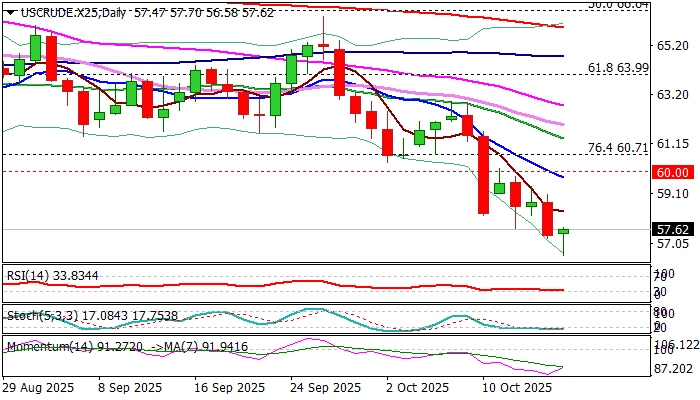
WTI Oil price fell further on Friday, remaining on track for the third consecutive weekly loss and the second straight weekly close below $60 mark.
WTI Oil price fell further on Friday, remaining on track for the third consecutive weekly loss and the second straight weekly close below $60 mark.
Oil remains under pressure from darkened demand outlook, with the latest forecast from International Energy Agency about growing supply surplus, news about potential meeting between US and Russian Presidents, and growing US-China trade tensions, contributing to current picture.
Oil price fell to the lowest in five months and eyes key supports at $55.40/12 (2025 lows posted in Apr/May) which also formed a double bottom, ahead of subsequent strong rally.
Daily studies are in full bearish setup, but oversold conditions,14-d momentum indicator turning north from the depth of negative territory and anticipated profit taking at the end of the week, suggest that we may see some consolidation or limited correction.
Broken $60 level reverted to initial resistance (reinforced by falling 10DMA), followed by broken Fibo 76.4% ($60.71) and $61.50 zone (former range floor and higher base, reinforced by 20DMA), where stronger upticks should be capped to keep larger bears in play.
Res: 58.37; 59.74; 60.00; 60.71.
Sup: 56.58; 55.40; 55.12; 53.87.
Gitex this year has been all about artificial intelligence. The technology is in the spotlight like never before, with companies across sectors scrambling to understand how they can use it to boost productivity and efficiency and prepare for the so-called future economy.But its rapid ascent has also meant that organisations are sometimes adding AI agents just to tick a box without understanding what their needs are, according to experts.For the technology to work well, it is vital that AI has access to the right data and tools, said Ahmad Abu Hantash, partner, digital and technology Consulting at PwC.
“I think we are still in the experimentation phase. There's a lot of money being spent on multiple use cases to validate the business outcome. The biggest challenge that people see is not only on the technology, it's on the readiness of the business … the readiness of the consumer, of the information, and the availability of the data and the information to be used,” he said on the sidelines of Gitex Global in Dubai.“AI, if it does not have the right data and the right information and the right landscape around it, you won't get the right results … You need to have the right data and tools, the right regulatory requirements, for example, privacy, responsibility, bias – all of this has to be there … That's the key element.“And if we don't change how we process the information, how we get the data, how we analyse it, what are the rules around it, you will not get the value that we really expect.”
Companies are swiftly incorporating the technology, with the number of organisations using at least AI business function reaching 78 per cent in 2024 from 20 per cent in 2017, a survey earlier this year by McKinsey found. Meanwhile, the use of generative AI also sharply grew to 71 per cent last year from 33 per cent in 2023.Workday, a US-based enterprise AI platform that supports human resource management, finance and also support AI agents, currently has 70 million users globally, generating more than a trillion transactions a year.
“So, we have an extremely rich, clean, pure data set, which, if we're talking about AI, is really foundational,” said Michael Douroux, group vice president of field operations Europe, Middle East and Africa at Workday.“With regards to AI, we've seen a very steady explosion … The main thing for us is that they [AI products] demonstrate and can be measured in terms of the value that they provide, which I think is a unique part of the AI hype cycle,” he said.“There's been a lot of hype and a trough – this is what happens with any tectonic shift where organisations are really trying to understand and justify all the money that they're spending on AI, and is it actually amplifying the productivity of their employees within the realm of people and in finance.”
Companies need to have a clear plan for their AI strategy before making heavy investments.“Some people come to us say, ‘I want to have 300 or 400 AI agents’. Why? What problem are you trying to solve?,” said Mr Abu Hantash.He said he urges companies to experiment first. “Start small and grow bigger. Let's look at the low hanging fruit. So for example, the easiest thing for us is usually the back office operations. Go to procurement, HR, finance, admin, supply chain, because these are usually the most mature elements of the organisation.”
US-based cyber protection company Cohesity handles huge quantities of data, and the insights that AI can provide using that data is enormous, said chief executive Sanjay Poonen.
“For example, a lot of our banks or insurance companies collect massive amounts of data, and a lot of that is in hundreds of millions of PDF files.“If they write a query [addressing AI] that said, ‘could you summarise all the contracts, documents I've had with my vendors over the last 10 years, and give me a summary of all the discounts I've given them, the terms of my agreement, all the economic terms, put it in a nice table so I can see it’, it will [AI agent will] go and scour like – imagine you had a million interns that could read all those documents and summarise it for you – that’s what it's doing,” said Mr Poonen.
There are some “incredible breakthroughs” that are going to happen using AI, he added.Workday, which announced last month that it will enter the Middle East with a new office in Dubai, is confident about growth in the region, said Mr Douroux.“We are very measured when it comes to market expansion, meaning we want to be thoughtful and not just drop in a sales team and figure out the rest later,” he said.
In line with government initiatives in countries such as the UAE and Saudi Arabia, “we thought that we had a unique opportunity to support multiple countries in this region in their digital transformations, not just within business, but in terms of what they're doing”, he said.While the company is supporting the growth of the digital workforce, he also stressed that AI agents will coexist with employees.“There's going to be a growth and explosion of new types of roles, but what we see right now is an amplification, an increase in the level of productivity with our users, with our customers and their employees, and really a strategy that complements what they're doing, as opposed to replacing.”
The Trump administration has been fixated, predictably enough, on the Nobel Peace Prize. But his more far-sighted officials would be wise to pay some attention to the Economics Prize, which was awarded on Oct. 13. For this year’s award inadvertently illuminates growing problems in the US economy: problems that began accumulating long before MAGA materialized but will doom the administration’s plan to make America great again.
The Nobel committee awarded the prize to three economists for their research on what creates long-term growth: Half the prize money went to Joel Mokyr for his work on how a culture of innovation fostered economic take-off in Northern Europe in the 17th and 18th centuries; the other half went to Philippe Aghion and Peter Howitt for their insights about creative destruction’s role in driving sustained success.
There is no better example of the value of these two insights than the US. Immigrant settlers transported Mokyr’s culture of growth and innovation from Northern Europe lock, stock and barrel. America’s founding political elite contained a remarkable number of inveterate tinkerers, from George Washington and Benjamin Franklin to Thomas Jefferson (who devised everything from a revolving bookstand to a cipher coding wheel and pasta dough extruder). Abraham Lincoln took out a patent on “a device for buoying vessels over shoals” that consisted of bellows that inflated beneath a ship’s waterline to ship in shallow water. (A wooden model of the invention is in the National Museum of American History).
Most settlers had a stark choice between embracing practical knowledge and starving: “why I could make anything a body wanted,” a character in Mark Twain’s A Connecticut Yankee in King Arthur’s Court says, “anything in the world no matter what; and if there wasn’t any quick new-fangled way to make a thing, I could invent one.” The US reinforced this cult of practical knowledge by founding a national network of land-grant colleges, focused on the practical arts, and by creating the world’s most liberal patent regime. Between 1875 and 1926, 44% of the world’s breakthrough inventions took place in the US, with Britain, France and Germany hovering between 14% and 22%.
The US was even more exemplary when it came to creative destruction. Joseph Schumpeter, the man who coined the phrase, argued that you needed two things for his explosive formula to work: egomaniacal entrepreneurs and societies willing to be shaken up. Business titans built companies of unprecedented scale and scope: John D. Rockefeller controlled 90% of the world’s refinery capacity and Andrew Carnegie produced more steel than the United Kingdom. They were able to do so partly because they were so ruthless and partly because the country was so new, with wide open spaces and a fluid social structure.
Much of this culture still survives. US universities are second-to-none in producing practical innovations. The tech titans are the modern equivalent of the Robber Barons. The World Values Survey ranks the US as the most individualistic in the world.
Yet Mokyr’s culture of openness is also under threat in the US as never before. The Trump administration is not uniquely to blame: For decades, the progressive left has fetishized anti-enlightenment thinkers such as Michel Foucault and embraced cancel culture, on campuses and beyond. But the right threatens to turn the crisis into a catastrophe by waging two mutually reinforcing campaigns, in academia and immigration.
The administration’s war on woke universities is threatening the one thing that made US universities the envy of the world: their freedom from political control. (Remember that German universities were the best in the world in the 19th and early 20th centuries, until they were degraded, after 1914 and particularly after 1933, by political partisanship and nationalist fervor.) The administration’s clampdown on H-1B visas hampers the arrival of highly skilled immigrants who are statistically more likely to become inventors or entrepreneurs.
At the same time, the US is losing some of its distinctive strength in creative destruction. A new book by Oxford University’s Carl Benedikt Frey, How Progress Ends: Technology, Innovation and the Fate of Nations, provides a compelling summary of how corporate consolidation in the US is dampening the entrepreneurial spirit. Three-quarters of US industries are more concentrated than they were in the 1990s. Silicon Valley is in the hands of giant corporations, replete with fully staffed legal offices and PR departments, that either buy up start-ups or squeeze them out of business. There has even been an upsurge in the use of non-compete clauses in technical fields, restricting the sort of job-hopping that once defined Silicon Valley.
In the Gilded Age, the US overcame similar problems through a combination of anti-trust laws and grass roots pressure from both Progressives and populists. But few signs suggest this is happening today. Corporations, particularly in tech, have augmented their ability to crush innovators underfoot by investing heavily in lobbying. (Significantly, the surge in corporate political activities started in the late 1990s when the country’s latest productivity boom petered out.) America’s anti-trust authorities have seldom enforced the laws on their books let alone enacted new ones designed to deal with the world of information behemoths. At the grassroots, society is too polarized over the culture wars to embrace anything so technical as an anti-trust agenda.
The broader culture is also turning against risk-taking. The half-American Winston Churchill once said of the English-speaking peoples that “we have not journeyed across the centuries, across the oceans, across the mountains, across the prairies, because we are made of sugar candy.” Yet an army of overzealous lawyers, health-and-safety bureaucrats and woke warriors are busy killing the creative spirit. Fast-food restaurants warn you that hot drinks may be hot. Universities warn that Ernest Hemingway’s The Old Man and the Sea may contain scenes of “graphic fishing.”
And even if your pioneering spirit manages to survive such mollycoddling, will the effort be worth it? Until 2000, Americans were unusually confident in thinking that their children would live better lives than they did. Today that confidence has collapsed. Why endure destruction if all you get as a reward is not creation but stagnation?
America has a long history of defying its critics: Back in the 1970s and 1980s, the world’s wise men and women were convinced that the US was ceding first place to Japan. The new Japan, China, suffers from more extreme versions of America’s problems: the consolidation of the corporate sector, the politicization of economic decisions and a passive anti-trust system. The European Union has made little progress in implementing Mario Draghi’s reforms.
Yet economic history of the sort practiced by Joel Mokyr — and by other historically-minded economists such as Daron Acemoglu, James Robinson and Ben Bernanke who have been so favored by the Nobel Committee in recent years — points to two powerful conclusions. The first is that far from being automatic, progress depends on having the right economic and cultural conditions. The second is that no economic superpower, from China in the Song dynasty in the 10th and 11th centuries, to the Dutch Republic in the 17th century to Britain in the 19th, has succeeded in fending off the onset of senescence.
The European Central Bank’s monetary policy is well positioned but officials must react should data or forecasts shift, according to Governing Council member Olaf Sleijpen.
Despite the trade troubles, the euro-zone economy is “holding up pretty well,” with “more or less full employment,” the Dutch central-bank chief told Bloomberg Television on Friday. Even so, there are a lot of risks and uncertainty, he said.
“We’re in a good place — that doesn’t mean that you’ll always stay in that place,” Sleijpen said in Washington, where’s he attending the IMF’s annual meetings. “We have the instruments that can be employed whenever it is necessary. That is also part of being in a good place.”
Most policymakers show little interest in adding to the eight reductions in interest rates that they’ve made this cycle — even as some suggest further cuts shouldn’t be excluded. Bundesbank President Joachim Nagel told Bloomberg TV on Thursday that he’s “rather comfortable” with where rates are right now.
A majority of economists think the ECB is done lowering borrowing costs. Money markets don’t see more easing this year.
Euro-area inflation is envisaged to slow to 1.7% in 2026 before returning to 1.9% in 2027 — slightly below the 2% goal. At the same time, September’s projections saw growth picking up over the next quarters — mainly due to higher fiscal spending Germany.
“The inflation rate is basically around our target,” said Sleijpen, who started as governor in July, succeeding Klaas Knot.
728 RM B 7/F GEE LOK IND BLDG NO 34 HUNG TO RD KWUN TONG KLN HONG KONG


White Label
Data API
Web Plug-ins
Poster Maker
Affiliate Program
The risk of loss in trading financial instruments such as stocks, FX, commodities, futures, bonds, ETFs and crypto can be substantial. You may sustain a total loss of the funds that you deposit with your broker. Therefore, you should carefully consider whether such trading is suitable for you in light of your circumstances and financial resources.
No decision to invest should be made without thoroughly conducting due diligence by yourself or consulting with your financial advisors. Our web content might not suit you since we don't know your financial conditions and investment needs. Our financial information might have latency or contain inaccuracy, so you should be fully responsible for any of your trading and investment decisions. The company will not be responsible for your capital loss.
Without getting permission from the website, you are not allowed to copy the website's graphics, texts, or trademarks. Intellectual property rights in the content or data incorporated into this website belong to its providers and exchange merchants.
Not Logged In
Log in to access more features

FastBull Membership
Not yet
Purchase


Log In
Sign Up


