• Trade
  • Markets
  • Copy
  • Contests
  • News
  • 24/7
  • Calendar
  • Q&A
  • Chats
Trending
Screeners
SYMBOL
LAST
BID
ASK
HIGH
LOW
NET CHG.
%CHG.
SPREAD
SPX
S&P 500 Index
6721.42
6721.42
6721.42
6812.25
6720.51
-78.84
-1.16%
--
DJI
Dow Jones Industrial Average
47885.96
47885.96
47885.96
48387.33
47856.79
-228.29
-0.47%
--
IXIC
NASDAQ Composite Index
22693.33
22693.33
22693.33
23159.20
22692.00
-418.12
-1.81%
--
USDX
US Dollar Index
98.040
98.120
98.040
98.060
97.940
+0.090
+ 0.09%
--
EURUSD
Euro / US Dollar
1.17378
1.17386
1.17378
1.17455
1.17349
-0.00023
-0.02%
--
GBPUSD
Pound Sterling / US Dollar
1.33643
1.33653
1.33643
1.33792
1.33613
-0.00097
-0.07%
--
XAUUSD
Gold / US Dollar
4334.03
4334.42
4334.03
4342.98
4324.34
-4.14
-0.10%
--
WTI
Light Sweet Crude Oil
56.185
56.239
56.185
56.795
55.873
-0.411
-0.73%
--

Community Accounts

Signal Accounts
--
Profit Accounts
--
Loss Accounts
--
View More

Become a signal provider

Sell trading signals to earn additional income

View More

Guide to Copy Trading

Get started with ease and confidence

View More

Signal Accounts for Members

All Signal Accounts

Best Return
  • Best Return
  • Best P/L
  • Best MDD
Past 1W
  • Past 1W
  • Past 1M
  • Past 1Y

All Contests

  • All
  • Trump Updates
  • Recommend
  • Stocks
  • Cryptocurrencies
  • Central Banks
  • Featured News
Top News Only
Share

Thai Central Bank Chief: Proposing Finance Ministry To Control Gold Trade

Share

Reserve Bank Of India: India Government Surplus Cash Balance With Reserve Bank Of India For Auction Was 571.75 Billion Rupees As On Dec 17

Share

Indian Rupee Opens At 90.35 Per USA Dollar, Nearly Unchanged From 90.38 Previous Close

Share

Thai Central Bank Chief: Will Introduce Loan Guarantee Measures Next Week

Share

Thai Central Bank Chief: No Deflation Yet

Share

Thai Central Bank Chief: Very Low Rates Will Imapct Savings

Share

Thai Central Bank Chief: Monetary Policy Space Limited

Share

Thai Central Bank Chief: Ready To Cut Rates Further

Share

Thai Central Bank Chief: Need To Boost Loans, Investment

Share

[US International Trade Commission Issues Affirmative Final Determination Of Injury In Anti-dumping And Countervailing Duties On Thermoformed Molded Fiber Products From China] According To The China Trade Remedy Information Network, On December 15, The US International Trade Commission (ITC) Voted To Issue An Affirmative Final Determination Of Injury In Its Anti-dumping And Countervailing Duty Investigations Of Thermoformed Molded Fiber Products Imported From China And Vietnam. The ITC Determined That The Products Alleged To Be Dumped And Subsidized Caused Material Injury To The US Industry. Based On The ITC's Affirmative Final Determination, The US Department Of Commerce Will Issue Anti-dumping And Countervailing Duty Orders On The Products From The Aforementioned Countries

Share

China's CSI Defense Index Up More Than 2% To Two-Month High After US Approves $11.1 Billion Arms Package For Taiwan

Share

Both WTI And Brent Crude Oil Fell 1%, Currently Trading At $56.13 Per Barrel And $60.18 Per Barrel, Respectively

Share

US President Trump: We Are Ready For Economic Prosperity

Share

US President Trump: Our Borders Are Secure

Share

Trump: New Fed Chair Will Believe In Lower Interest Rates By A Lot

Share

Trump: Will Announce Housing Reforms In New Year

Share

Trump: Soon Announce Next Fed Chair

Share

US President Trump: Drug Price Cuts Will Begin In January

Share

US President Trump: Wage Growth Is Far Outpacing Inflation. The Effects Of Tax Cuts Will Be Seen Next Year

Share

Pentagon: State Dept Approves Potential Sale To Tecro Of High Mobility Artillery Rocket Systems And Related Equipment For An Estimated Cost Of $4.05 Billion

TIME
ACT
FCST
PREV
Indonesia Deposit Facility Rate (Dec)

A:--

F: --

P: --

Indonesia Lending Facility Rate (Dec)

A:--

F: --

P: --

Indonesia Loan Growth YoY (Nov)

A:--

F: --

P: --

South Africa Core CPI YoY (Nov)

A:--

F: --

P: --

South Africa CPI YoY (Nov)

A:--

F: --

P: --

Germany Ifo Business Expectations Index (SA) (Dec)

A:--

F: --

P: --
Germany Ifo Current Business Situation Index (SA) (Dec)

A:--

F: --

P: --

Germany IFO Business Climate Index (SA) (Dec)

A:--

F: --

P: --
Euro Zone Core CPI Final MoM (Nov)

A:--

F: --

P: --

Euro Zone Labor Cost YoY (Q3)

A:--

F: --

P: --
Euro Zone Core HICP Final YoY (Nov)

A:--

F: --

P: --

Euro Zone Core HICP Final MoM (Nov)

A:--

F: --

P: --

Euro Zone Core CPI Final YoY (Nov)

A:--

F: --

P: --

Euro Zone CPI YoY (Excl. Tobacco) (Nov)

A:--

F: --

P: --

Euro Zone HICP MoM (Excl. Food & Energy) (Nov)

A:--

F: --

P: --

Euro Zone Gross Wages YoY (Q3)

A:--

F: --

P: --

Euro Zone HICP Final YoY (Nov)

A:--

F: --

P: --

Euro Zone HICP Final MoM (Nov)

A:--

F: --

P: --

U.K. CBI Industrial Prices Expectations (Dec)

A:--

F: --

P: --

U.K. CBI Industrial Trends - Orders (Dec)

A:--

F: --

P: --

U.S. MBA Mortgage Application Activity Index WoW

A:--

F: --

P: --

U.S. EIA Weekly Crude Oil Imports Changes

A:--

F: --

P: --

U.S. EIA Weekly Cushing, Oklahoma Crude Oil Stocks Change

A:--

F: --

P: --

U.S. EIA Weekly Crude Stocks Change

A:--

F: --

P: --

U.S. EIA Weekly Heating Oil Stock Changes

A:--

F: --

P: --

U.S. EIA Weekly Gasoline Stocks Change

A:--

F: --

P: --

U.S. EIA Weekly Crude Demand Projected by Production

A:--

F: --

P: --

Russia PPI YoY (Nov)

A:--

F: --

P: --

Russia PPI MoM (Nov)

A:--

F: --

P: --

Australia Consumer Inflation Expectations

A:--

F: --

P: --

South Africa PPI YoY (Nov)

--

F: --

P: --

Euro Zone Construction Output MoM (SA) (Oct)

--

F: --

P: --

Euro Zone Construction Output YoY (Oct)

--

F: --

P: --

U.K. BOE MPC Vote Unchanged (Dec)

--

F: --

P: --

Mexico Retail Sales MoM (Oct)

--

F: --

P: --

U.K. Benchmark Interest Rate

--

F: --

P: --

U.K. BOE MPC Vote Cut (Dec)

--

F: --

P: --

U.K. BOE MPC Vote Hike (Dec)

--

F: --

P: --

MPC Rate Statement
Euro Zone ECB Deposit Rate

--

F: --

P: --

Euro Zone ECB Marginal Lending Rate

--

F: --

P: --

Euro Zone ECB Main Refinancing Rate

--

F: --

P: --

ECB Monetary Policy Statement
Canada Average Weekly Earnings YoY (Oct)

--

F: --

P: --

U.S. Core CPI YoY (Not SA) (Nov)

--

F: --

P: --

U.S. Weekly Initial Jobless Claims (SA)

--

F: --

P: --

U.S. Weekly Continued Jobless Claims (SA)

--

F: --

P: --

U.S. Real Income MoM (SA) (Nov)

--

F: --

P: --

U.S. CPI YoY (Not SA) (Nov)

--

F: --

P: --

U.S. Initial Jobless Claims 4-Week Avg. (SA)

--

F: --

P: --

U.S. CPI MoM (Not SA) (Nov)

--

F: --

P: --

U.S. Philadelphia Fed Business Activity Index (SA) (Dec)

--

F: --

P: --

U.S. Philadelphia Fed Manufacturing Employment Index (Dec)

--

F: --

P: --

U.S. Core CPI (SA) (Nov)

--

F: --

P: --

ECB Press Conference
U.S. Conference Board Employment Trends Index (SA) (Oct)

--

F: --

P: --

U.S. EIA Weekly Natural Gas Stocks Change

--

F: --

P: --

U.S. Kansas Fed Manufacturing Production Index (Dec)

--

F: --

P: --

U.S. Cleveland Fed CPI MoM (Nov)

--

F: --

P: --

Russia PPI MoM (Nov)

--

F: --

P: --

Q&A with Experts
    • All
    • Chatrooms
    • Groups
    • Friends
    Connecting
    .
    .
    .
    Type here...
    Add Symbol or Code

      No matching data

      All
      Trump Updates
      Recommend
      Stocks
      Cryptocurrencies
      Central Banks
      Featured News
      • All
      • Russia-Ukraine Conflict
      • Middle East Flashpoint
      • All
      • Russia-Ukraine Conflict
      • Middle East Flashpoint
      Search
      Products

      Charts Free Forever

      Chats Q&A with Experts
      Screeners Economic Calendar Data Tools
      Membership Features
      Data Warehouse Market Trends Institutional Data Policy Rates Macro

      Market Trends

      Market Sentiment Order Book Forex Correlations

      Top Indicators

      Charts Free Forever
      Markets

      News

      News Analysis 24/7 Columns Education
      From Institutions From Analysts
      Topics Columnists

      Latest Views

      Latest Views

      Trending Topics

      Top Columnists

      Latest Update

      Signals

      Copy Rankings Latest Signals Become a signal provider AI Rating
      Contests
      Brokers

      Overview Brokers Assessment Rankings Regulators News Claims
      Broker listing Forex Brokers Comparison Tool Live Spread Comparison Scam
      Q&A Complaint Scam Alert Videos Tips to Detect Scam
      More

      Business
      Events
      Careers About Us Advertising Help Center

      White Label

      Data API

      Web Plug-ins

      Affiliate Program

      Awards Institution Evaluation IB Seminar Salon Event Exhibition
      Vietnam Thailand Singapore Dubai
      Fans Party Investment Sharing Session
      FastBull Summit BrokersView Expo
      Recent Searches
        Top Searches
          Markets
          News
          Analysis
          User
          24/7
          Economic Calendar
          Education
          Data
          • Names
          • Latest
          • Prev

          View All

          No data

          Scan to Download

          Faster Charts, Chat Faster!

          Download App
          English
          • English
          • Español
          • العربية
          • Bahasa Indonesia
          • Bahasa Melayu
          • Tiếng Việt
          • ภาษาไทย
          • Français
          • Italiano
          • Türkçe
          • Русский язык
          • 简中
          • 繁中
          Open Account
          Search
          Products
          Charts Free Forever
          Markets
          News
          Signals

          Copy Rankings Latest Signals Become a signal provider AI Rating
          Contests
          Brokers

          Overview Brokers Assessment Rankings Regulators News Claims
          Broker listing Forex Brokers Comparison Tool Live Spread Comparison Scam
          Q&A Complaint Scam Alert Videos Tips to Detect Scam
          More

          Business
          Events
          Careers About Us Advertising Help Center

          White Label

          Data API

          Web Plug-ins

          Affiliate Program

          Awards Institution Evaluation IB Seminar Salon Event Exhibition
          Vietnam Thailand Singapore Dubai
          Fans Party Investment Sharing Session
          FastBull Summit BrokersView Expo

          Why Rate Hikes Are Back On The Table For 2026

          Winkelmann

          Political

          Central Bank

          Economic

          Summary:

          Australia's hopes for rate cuts in 2026 have dimmed after RBA Governor Michele Bullock signaled they're no longer on the table – and that a rate hike is now a real possibility.

          Australia's hopes for rate cuts in 2026 have dimmed after RBA Governor Michele Bullock signaled they're no longer on the table – and that a rate hike is now a real possibility. With inflation proving stickier than expected and price pressures broadening on everything from housing to everyday essentials, markets are beginning to reprice the path for interest rates.

          Here is a lightly edited transcript of the conversation:

          Rebecca Jones: This week we were told by RBA Governor Michele Bullock that rate cuts were pretty much off the table and now it looks like we could instead have a rate hike by June. I don't know about you, but that wasn't exactly the festive surprise I was hoping for this week. To take us through the reasons why, and what the coming year holds for the Australian economy, I'm joined by Bloomberg's APAC economy reporter Swati Pandey from our Sydney newsroom. Swati, welcome back to the podcast.

          Swati Pandey: Thank you Bec. Delighted to be here.

          Jones: Swati, it was widely expected that the RBA would keep interest rates on hold at this week's meeting, which was of course the last one for 2025. That is exactly what happened. But what everyone was waiting to hear was, are we going to get another rate cut? You were at the press conference on Tuesday. What did we hear instead?

          Pandey: Yes, you're right Bec, expectation was that the Reserve Bank would leave interest rates unchanged for the third straight meeting at 3.6% and there was not a lot of clarity around what the governor's press conference would bring. So it was quite surprising to a lot of people when she gave a very clear signal that other interest rate cuts are off the table. And given where the economy is tracking, given where inflation was and the upside risks to both, it looks like forget about an interest rate cut—in fact, it's an interest rate hike that we will be staring at for 2026.

          Jones: And so when you heard that at the presser, you've got your phone in your hand, you start messaging your contacts. What did they tell you?

          Pandey: So as soon as—that was the very first question in fact—that Governor Bullock was asked, whether they considered a cut or whether they considered a hike, and she said they did not explicitly consider a cut but they discussed the circumstances under which interest rates could go up. And then I followed that up by asking what those circumstances were that they discussed, if she could provide some more color. Following that, I started messaging some economists just trying to understand how they were reading the comments because you know when the press conference is on, everybody's watching it. By everybody I mean people who are interested in this, right? So from economists to traders, people overseas as well. And I think half of our newsroom watches it as well. And so a lot of these people kind of commented. So there's a kind of like a big bit of back and forth in messaging that also helps in understanding how people are viewing it from outside as well. And also helps shape the story, shapes the thought and the thinking that goes into writing the story after the press conference.

          Jones: So the group chat went crazy because I can imagine— looking at the first part of Tuesday's event, it's the written statement from the RBA and that was pretty short, pretty sort of formulaic. But then the real surprise sort of came at the press conference. Was it a surprise to the economists that you talked to? What did they have to say?

          Pandey: Yes, it did come as a surprise to people that Michele Bullock was that clear in signaling that interest rate cuts were off the table and in fact preparing the groundwork for a hike. And in fact, one of the economists I spoke with during the press conference said that the governor was laying the markers for a full pivot towards a tightening bias. There is a kind of view that it's a conditional tightening bias right now. So what that means is if we have a bad inflation report in January and the RBA has to raise interest rates in February, nobody is going to say that, oh my gosh, this came as a shock, this came as a surprise, the RBA is not communicating, this just came out of nowhere. So that criticism is unlikely to happen because like the economist from Westpac, Pat Bustamante, that I spoke with, he said that the governor was laying the markers for a full pivot to a tightening bias, right? And that was the inference a lot of people in the market and economists drew as well from her remarks. So the onus, as Su-Lin Ong from RBC told me, is on data and if inflation continues to surprise on the upside, the RBA will not hesitate to raise interest rates from here.

          Jones: I wanna pick up on something that you've just mentioned and that is inflation, because I think that's where the story gets messy. Swati, we've all noticed price pressures picking up over the last couple of months. When did things get so pricey? What is actually driving inflation?

          Pandey: Yeah, so the past maybe three months of inflation reports have surprised on the upside. And in fact the very latest report had broad-based price pressures. So by that I mean everything from housing costs, clothing and footwear, education and culture, eating out, buying food and groceries—everything showed a big jump in price increases. And obviously the biggest driver has been housing costs, which includes the construction cost of a new property, new development. But it also includes things like electricity. As we know, Treasurer Chalmers this week announced the end of the electricity rebate that had helped to put some downward pressure on prices, and those rebates are now going away. So we are going to get a sticker shock in the fourth quarter inflation report and maybe in the first quarter inflation report as well. The good thing is that the RBA knew that would happen.

          So when they released their forecasts in November, they had already priced that in. So the RBA is expecting inflationary pressures to remain high through at least the middle of next year. If inflation is higher than their already lofty expectations, that is when we see the risk of interest rate hikes happening. If inflation is tracking around their lofty expectations, the RBA will just probably want to keep interest rates on hold. So if there's an upside shock, that is when interest rate hikes become a real possibility.

          Jones: And Swati, there's a view out there that the RBA is completely done easing. And of course by easing I mean cutting interest rates. There is also running along the same track another very live debate that suggests that if inflation stays sticky—that means keeps on going up, right?—Governor Bullock may in fact have to pivot and tighten, that is raise interest rates to try and bring inflation down. And then there is another track, which is people who believe that one or two cuts are still plausible in 2026. What does the data suggest is most likely at this point in time?

          Pandey: That is a very complicated question only because the answer to that is not easy. So we are in an economy where productivity growth is very low and what that has done is it has brought down our potential rate of growth. So when during the mining boom Australia's economy, let's say, was growing at 4%, it was able to grow at that pace without really sparking inflationary pressures, right? Now, if the economy grows at let's say 2.5%, there is fear that it may spark inflationary pressures only because the potential for it to grow without sparking inflation has reduced because of lower productivity growth. And that is where this discrepancy arises between how economists are looking at this.

          Some economists are saying that the supply constraints that we have seen in our economy—which have led to higher housing construction costs, for example, it's very hard to find tradies and likewise— I mean the economy has not been able to supply enough to meet the demand that there is. Some economists believe that this supply-demand conundrum will be resolved eventually or soon enough. Those who believe that feel that the RBA will not end up raising interest rates. Either the way it'll resolve is that demand will come down, the labour market would slow. We are already seeing signs of slowness in the labour market. We are hearing about companies laying off employees, unfortunately. We are seeing more increase in the unemployment rate. So some economists believe that that would be enough to cool demand.

          Others believe that inflation will remain a concern—housing costs will be sticky or elevated and people will continue to spend on eating out, going to concerts and stuff like that. So these are the people who believe that the RBA may then have to increase interest rates next year. And then there are some people who feel that things are going to kind of wobble along, which would suggest that the current interest rate setting—where interest rate is at 3.6%—is fine. So you don't touch it, you don't do anything, just keep watching data.

          Economists, the median in our Bloomberg survey, are expecting no change at all in fact. So they're expecting interest rates will remain at 3.6% through 2026. There are only a handful of economists who are predicting an interest rate hike and only a handful who are predicting a cut. So the majority is still sitting on no change.

          Jones: It is such a complicated recipe to get right. And as you described, three very distinct schools of thought around what's going to happen next year. Swati, I want to talk to you a little bit now about a topic that makes Australians collectively inhale—you can guess—it's housing. Mortgage stress is rising, APRA is tightening lending standards and yet prices are still marching higher. We're sort of getting to the tail end of the so-called spring selling season right now. Swati, how big a risk is the housing market heading into next year?

          Pandey: One of the biggest problems with Australia's housing market is the lack of supply and we are not seeing that being resolved very quickly. In fact, it takes forever to build a house in Australia and you would know that when you're trying to get renovations done—it's very hard to find tradies and then even when you find them, it's very hard for them to stick with their timelines. Either it's difficult to get the right supply, it's difficult to get the right people, but whatever it is, it takes longer and that is what the country is facing in general. We are much behind our timelines to build enough housing to meet the growing demand of our people.

          As long as that remains the case, housing prices are going to be elevated or rise. In fact, in some markets like Sydney, for example, affordability constraints mean that house price growth is not as rapid as it is in some other places like Adelaide or Brisbane or even Perth. Perth in fact is seeing a big boom in housing prices and there's big demand as well in Western Australia. So yes, it is a concern for people who want to buy a house, but it is also a concern for the Reserve Bank because housing costs are a big part of the inflation basket. If we are not able to bring that cost down, it would keep inflation sticky, which means elevated.

          Jones: Let's zoom out a little bit now. The Federal Reserve in the US cut rates this week and that was widely expected. Swati, how does Australia's trajectory compare with the US right now?

          Pandey: So in the past, Australia and most countries used to follow what the Fed would do, but that's not the case anymore. For example, the RBA started cutting rates much later than the Fed in this current cycle. Australia has only cut by 75 basis points. The Fed has cut by more. The RBA left interest rates unchanged this week for the third straight meeting and the Fed has cut for the third straight time. So they are completely diverging. The Fed is still cutting and the RBA is on hold but is signaling that the next move will not be a cut but a hike. They don't want to act too quick, too fast, which is why the bar to raise interest rates next year is very high as well. A key thing to watch out for is the inflation report for the December quarter, which will come out at the end of January. That is actually going to be really critical in deciding what the RBA does in February and the year ahead.

          Jones: So there might be a few economists recalled back a little early from their summer holidays here in Australia. So Swati, let me get this straight. We've got inflation that won't go quietly, an RBA that may not be finished moving, a housing market that is continuing to defy both gravity and policy, plus a Fed that's cutting where we stay put. It's a really complex picture, isn't it? But very fascinating as we head towards 2026. I want to finally ask you about something completely different and that is AI and how that relates to Australia's economic prosperity. There is a view that 2026 could be the year that AI starts to show up in the real economy—in earnings, in efficiencies, in growth. We saw just last week how heavily the government is supporting the OpenAI–NextDC link-up. Is AI genuinely a bright spot for Australia or is the hype still running ahead of reality?

          Pandey: Look, Michele Bullock was asked this question at the press conference on Tuesday and her response was that the data centres are being fitted—they're not being constructed here. So you are importing the required machinery from overseas and then you're getting them fitted here. You obviously need people to set them up, but then how many people would you employ in data centres, right? Is it a very labour-intensive industry? Maybe not. So for now, with the investments that we are seeing, it is a good thing and AI investments are expected to lead to greater productivity benefits as well. So from that point, it's good too.

          One thing that Governor Bullock did not address, and I think it's something to watch out for, is the renewable energy transition, which may happen finally for Australia as a result of this, because data centres are extremely energy intensive and they are very water intensive as well. Australia has been trying forever to do this transition from basically coal to renewable—so whether it's solar or wind. If we start seeing these data centre investments spur huge demand for energy, then that will probably lead to that renewable transition that we have all been waiting for and that is going to have a huge impact for the economy and even in terms of productivity. So that is something that I would say we should watch out for and something to end the podcast on a positive note as well.

          Source: Bloomberg Europe

          To stay updated on all economic events of today, please check out our Economic calendar
          Risk Warnings and Disclaimers
          You understand and acknowledge that there is a high degree of risk involved in trading. Following any strategies or investment methods may lead to potential losses. The content on the site is provided by our contributors and analysts for information purposes only. You are solely responsible for determining whether any trading assets, securities, strategy, or any other product is suitable for investing based on your own investment objectives and financial situation.
          Add to Favorites
          Share

          EURUSD Advances Further in Extended Post-Fed Rally

          Blue River

          Forex

          Technical Analysis

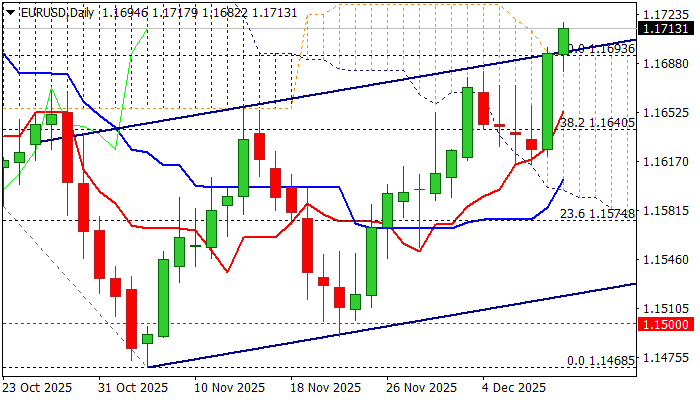
          The Euro remains firm and rises to the highest in seven weeks on Thursday, in extension of Wednesday's 0.6% advance, mainly seen in post-Fed acceleration.

          The single currency benefited from Fed rate cut and more hawkish than expected monetary policy projections for 2026, which further deflated the US dollar.

          Rise above significant barriers at 1.1700 zone (psychological / near 50% retracement of 1.1918/1.1468 / daily Ichimoku cloud top) generated bullish signal which need to be verified on sustained break above these levels and keep bullish structure for attack at 1.1746 (Fibo 61.8%) and potential extension towards 1.1800.

          Daily studies in full bullish setup (daily Tenkan/Kijun-sen in steep ascend and diverging after formation of bull-cross /strong bullish momentum, with thick daily cloud underpinning the action) contribute to positive fundamentals and keep the door open for further advance.

          Broken top of daily Ichimoku cloud (1.1693, also broken bull-channel upper boundary) reverted to strong support, which should contain dips and keep fresh bulls in play.

          Res: 1.1746; 1.1778; 1.1812; 1.1830
          Sup: 1.1693; 1.1680; 1.1653; 1.1603

          Source: ACTIONFOREX

          Risk Warnings and Disclaimers
          You understand and acknowledge that there is a high degree of risk involved in trading. Following any strategies or investment methods may lead to potential losses. The content on the site is provided by our contributors and analysts for information purposes only. You are solely responsible for determining whether any trading assets, securities, strategy, or any other product is suitable for investing based on your own investment objectives and financial situation.
          Add to Favorites
          Share

          Nasdaq 100: Post-FOMC gains wiped out, but technicals are still bullish

          Adam

          Economic

          Key takeaways

          Post-FOMC optimism faded fast, with S&P 500 and Nasdaq 100 futures reversing sharply on renewed US–China tensions and concerns over AI-related export violations tied to DeepSeek.
          Sentiment worsened after Oracle’s 11.5% after-hours plunge, as weak revenue reignited worries over stretched AI valuations and dragged index futures lower.
          Despite the pullback, Nasdaq 100 technicals remain constructive, with improving market breadth and key supports holding, keeping the medium-term bullish reversal bias intact.
          The post-FOMC rally quickly fizzled in today’s Asia session, with S&P 500 and Nasdaq 100 E-mini futures falling -0.8% and -1.1%, effectively wiping out Wednesday’s gains.
          The pullback appears driven by renewed US-China geopolitical tension after reports that Chinese AI firm DeepSeek obtained smuggled Nvidia Blackwell chips, hardware banned for export to China, to build its next-generation model.
          Sentiment was further hit by an 11.5% plunge in Oracle’s after-hours trading following weaker-than-expected Q2 revenue, reigniting concerns over stretched AI valuations and feeding into index futures weakness.
          Despite the current intraday weak sentiment in the US futures, technicals are not suggesting the potential start of a medium-term downtrend phase for the Nasdaq 100.
          Let’s dive deeper into several technical elements that are still constructively bullish.

          Nasdaq 100 market breadth has improved in the past three weeks

          Nasdaq 100: Post-FOMC gains wiped out, but technicals are still bullish_1Fig. 1: Percentage of Nasdaq 100 component stocks trading above 20-day & 50-day moving averages as of 10 Dec 2025

          Based on the percentage of Nasdaq 100 component stocks that are trading above their respective 20-day and 50-day moving averages, there has been a significant improvement since 17 November 2025, after the three-week down move seen in the Nasdaq 100 from its current all-time high in late October 2025, triggered by AI bubble fears and weakness in the share price of Nvidia ex-post earnings.
          The share of Nasdaq 100 component stocks trading above their 20-day moving average has surged to 65%, up sharply from 23% on 17 November 2025.
          Similarly, the proportion trading above the 50-day moving average has risen to 56%, from 28% on 17 November 2025, though at a more gradual pace (see Fig. 1).

          Peferred trend bias (1-3 weeks) – Bullish reversal remains intact

          Nasdaq 100: Post-FOMC gains wiped out, but technicals are still bullish_2Fig. 2: US Nasdaq 100 CFD Index medium-term trend as of 11 Dec 2025

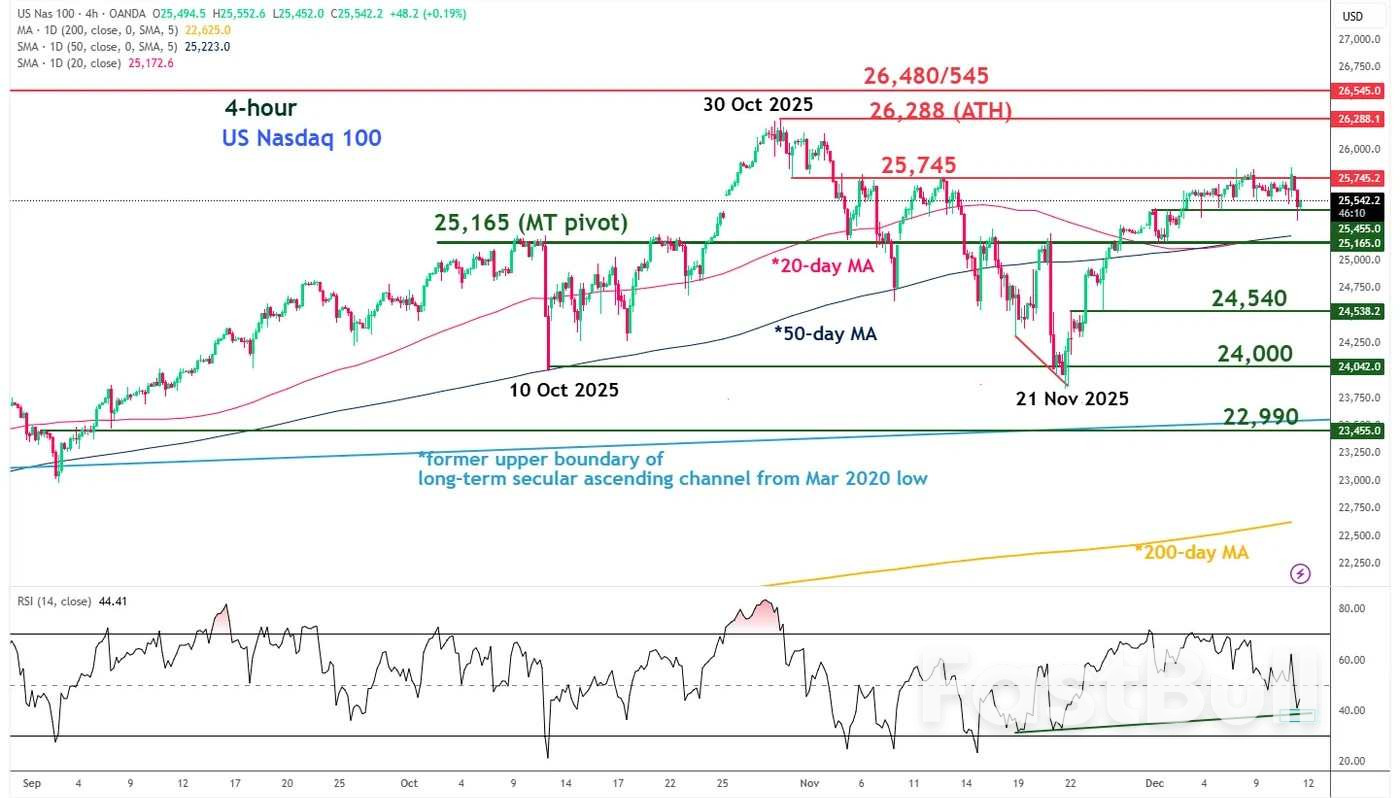
          The potential bullish reversal that has taken form on the Nasdaq 100 CFD Index (a proxy of the Nasdaq 100 E-mini futures) since the 21 November 2025 low of 23,840 remains intact.
          Medium-term pivotal support rests on 25,165 to maintain the bullish bias, and a clearance above 25,745 potential upside trigger level, is likely to increase the odds of a new bullish impulsive up move sequence to retest the current all-time high at 26,288 before the next medium-term resistance comes in at 26,480/26,545 (Fibonacci extension) (see Fig. 2).

          Key elements

          Price actions of the Nasdaq 100 CFD Index continue to trade above its rising 20-day and 50-day moving averages since 26 November 2025.
          The 4-hour RSI momentum indicator has pulled back and just staged a rebound right above a key ascending support, which suggests a potential medium-term bullish momentum revival for the Nasdaq 100 CFD Index.

          Alternative trend bias (1 to 3 weeks)

          Failure to hold at the 25,165 key medium-term pivotal support invalidates the bullish scenario to kick-start a deeper corrective decline on the Nasdaq 100 CFD Index to retest the next medium-term supports at 24,540 and 24,000 (critical swing low areas of 10 October 2025 and 21 November 2025).

          Source: marketpulse

          To stay updated on all economic events of today, please check out our Economic calendar
          Risk Warnings and Disclaimers
          You understand and acknowledge that there is a high degree of risk involved in trading. Following any strategies or investment methods may lead to potential losses. The content on the site is provided by our contributors and analysts for information purposes only. You are solely responsible for determining whether any trading assets, securities, strategy, or any other product is suitable for investing based on your own investment objectives and financial situation.
          Add to Favorites
          Share

          Mercosur Trade Deal Hangs in Balance as EU Enters Final Stretch

          Warren Takunda

          Economic

          EU Commission President Ursula von der Leyen and European Council President Antonio Costa plan to travel to Brazil on 20 December for the signing of the contentious agreement with the Mercosur trading bloc of South American countries.
          The Commission, which has been negotiating the deal for 25 years, is confident a majority of EU member states will support it. But EU diplomats say the arithmetic remains uncertain, with the split between supporters and opponents still razor-thin.
          The next ten days will be decisive.
          The deal was concluded in December 2024 by Argentina, Brazil, Paraguay and Uruguay with the EU aims to create a transatlantic free-trade zone.

          Italy in the spotlight

          France has led the opposition for years, arguing that Mercosur imports would create unfair competition for its farmers.
          Paris is still campaigning against the pact, demanding strong safeguard clauses to protect the EU market from the disruption it claims would result from increase of Mercosur’s imports and reciprocity provisions to ensure Mercosur countries meet the same production standards as Europeans.
          Poland has rallied its farmers against the deal, with Ireland and Hungary also opposed. The Dutch and Austrian governments, bound by earlier parliamentary positions, remain opposed. Belgium, meanwhile, will abstain.
          Yet this group is still not big enough to block the deal, a move that would require at least four member states representing 35% of the EU population.
          That puts the spotlight on Italy, whose Prime Minister Giorgia Meloni – an ally of Argentina’s President Javier Milei – has not taken a formal position. Italy is the EU’s second-largest exporter to Mercosur, and the market access on offer is highly valuable for its industry.
          Meloni's agriculture minister and party colleague Francesco Lollobrigida defended Italian farmers in October and pushed for strong safeguards, but the guarantees presented by the Commission on 8 October to monitor the EU market may have swayed Rome toward supporting the pact.
          Even countries opposing the deal have backed the Commission’s safeguards, arguing that if the agreement is approved, strong market protection will be essential.

          The Parliament problem

          The European Parliament, whose consent is required for the deal to enter into force, will vote on 16 December on tougher safeguards, including the reciprocity clause. Talks with the Council will follow to agree a common text. A special procedure could fast-track negotiations, allowing member states to take a final position in time for von der Leyen and Costa’s planned trip.
          But even if member states approve the deal and it is signed in Latin America, the process will not be over. MEPs will still have to ratify it – and recent months have shown deep divisions.
          Both the far right and far left are opposed to the deal, while other groups are split along similar lines as in the Council. So come 2026, Parliament could still derail the entire agreement.
          In Brussels, diplomats from countries backing the deal are growing increasingly anxious about the fragile state of the negotiations, warning that failure would cost the EU strategic market access at a time when its relationship with its top trading partner, the US, is fraying.
          They are particularly concerned about the dynamics of the European Parliament, which this year has moved away from the position of member states on many critical issues, fuelling institutional tensions.
          Privately, they warn that if the Mercosur deal falls apart in the final stretch, it will be a vivid display of political incompetence, torpedoing Europe's much-vaunted ambition to diversify its trade partners and strengthen its geopolitical clout.
          Meanwhile, on the Mercosur side, patience is running thin after decades of work.
          As one senior diplomat from the South American side told Euronews: “If the deal isn’t backed, I’ll dig a hole, bury it and cover it with concrete.”

          Source: Euronews

          To stay updated on all economic events of today, please check out our Economic calendar
          Risk Warnings and Disclaimers
          You understand and acknowledge that there is a high degree of risk involved in trading. Following any strategies or investment methods may lead to potential losses. The content on the site is provided by our contributors and analysts for information purposes only. You are solely responsible for determining whether any trading assets, securities, strategy, or any other product is suitable for investing based on your own investment objectives and financial situation.
          Add to Favorites
          Share

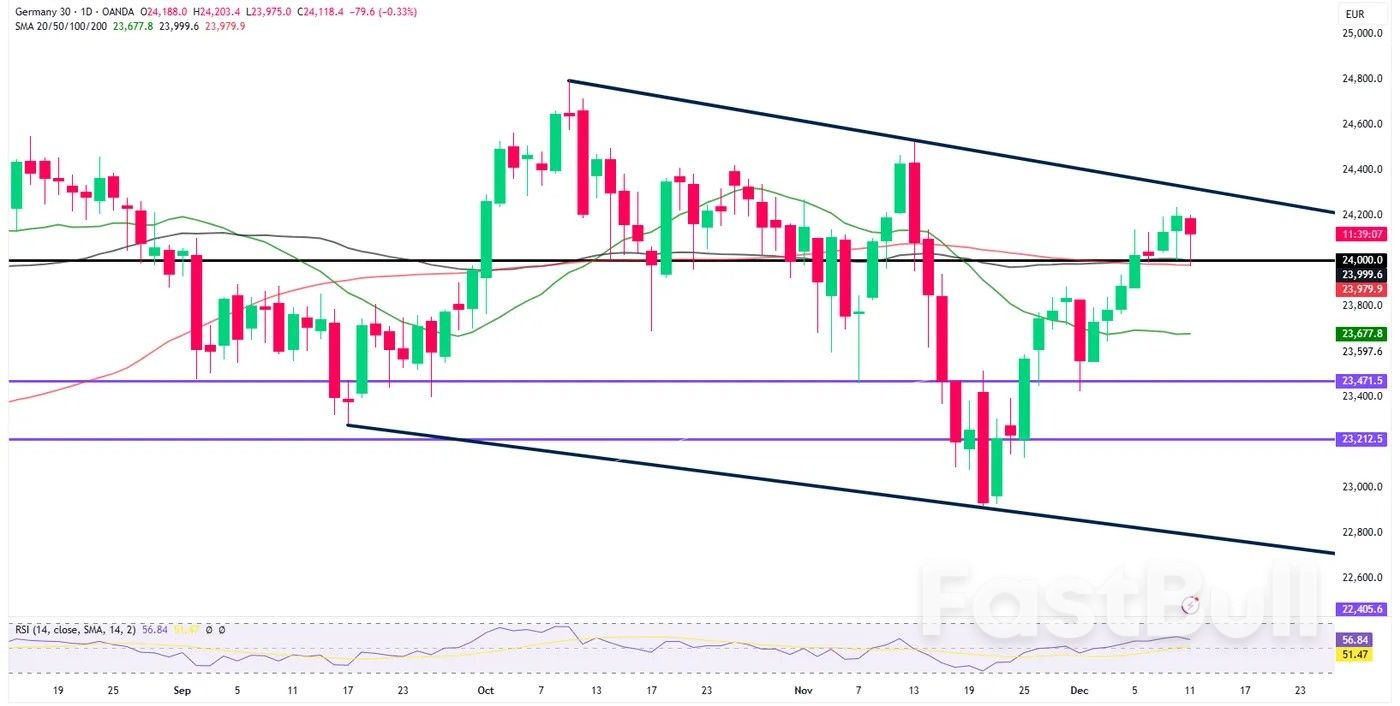
          Markets Today: SNB Hold Rates, SoftBank Falls 7.7%, Gold Slips Post FOMC. DAX Holds Above Psychological 24000 Handle

          Adam

          Economic

          Asia Market Wrap - Nikkei Struggles, Ends the Day Down 0.9%

          The Nikkei finished lower on Thursday, primarily because of a large drop in SoftBank Group shares. SoftBank's decline mirrored the steep fall of the US tech giant Oracle, which disappointed investors by predicting sales and profit below what Wall Street analysts expected.
          Although the Nikkei briefly rose by 0.5% earlier in the day, it closed down 0.9% at 50148.82. The broader Topix index also fell by 0.94% after opening at a record high.
          SoftBank Group was the biggest drag, plummeting 7.69%. Other Japanese technology companies also lost ground, including Tokyo Electron (down 1.57%), Shin-Etsu Chemical (down 3.94%), and the robot maker Fanuc (down 2.19%).
          Even bank stocks, such as Mizuho Financial Group and Sumitomo Mitsui Financial Group, gave up their initial gains and finished lower.

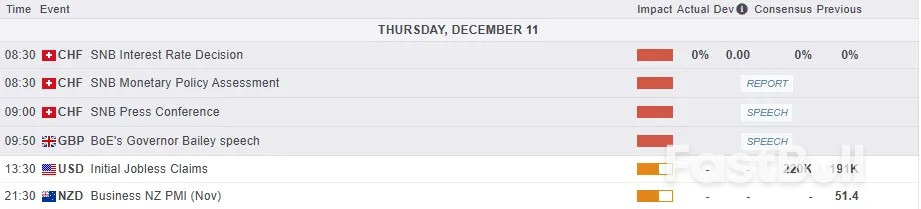
          Swiss National Bank Hold Rates at 0%

          The Swiss National Bank (SNB) concluded its final meeting of the year by keeping its key interest rate at zero, and it will continue to charge a small fee ($0.25$ percentage point) on bank deposits that exceed a certain limit.
          The bank also stated it is prepared to step into the foreign exchange markets if necessary. Inflation in Switzerland is currently very low, falling to 0.0% in November (from 0.2% in August), mainly because of cheaper hotel stays, rent, and clothing.
          Looking ahead, the SNB predicts inflation will remain low, gradually increasing to 0.2% in 2025, 0.3% in 2026, and 0.6% in 2027. Globally, economic growth was better than expected in the third quarter of 2024 despite trade conflicts, though risks from US tariffs and uncertain trade policies remain.
          Within Switzerland, the economy actually shrank in the third quarter, largely due to a decrease in pharmaceutical exports to the US after an earlier surge, but other sectors like manufacturing and services saw minor improvements.
          The SNB expects the country's economy to grow by just under 1.5% in 2025, slowing to about 1% in 2026, which may lead to a slight rise in unemployment as the economy cools down.

          European Session - European Shares Edge Lower, Delivery Hero Down 5%

          European stock markets were relatively quiet on Thursday, seeing a small dip overall. The main reason for the decline was the poor forecast from the American cloud company Oracle, which caused technology stocks to fall. This negative news overshadowed the relief felt after the US Federal Reserve made comments that were less aggressive about future interest rate hikes than investors had anticipated.
          The general European STOXX 600 index, along with major markets like London and France, was down by about 0.1% to 0.3%. The technology sector specifically dropped about 0.9%, with the German software company SAP falling 2.5% because Oracle's disappointing sales and profit predictions, combined with increased spending plans, brought back worries about the high valuations and returns on investments in artificial intelligence.
          Although the Federal Reserve indicated that it might not cut interest rates immediately until the job market stabilizes, which was a positive signal for investors, it wasn't enough to counteract the tech sector's decline.
          In other company news, Delivery Hero shares dropped 5% after a downgrade from Citigroup, while Drax in London rose 2.2% after predicting higher-than-expected yearly profits, and RS Group was the top performer on the STOXX 600, gaining 3% after an analyst upgrade.
          On the FX front, the US dollar received some support on Thursday because there was a general avoidance of risk across the markets.
          However, it couldn't fully recover the ground it lost the previous day against other major currencies like the euro, yen, and sterling, mainly because the Federal Reserve's recent announcement was not as aggressive as some investors had anticipated.
          The euro remained stable at 1.1704 (a two-month high) after a significant gain on Wednesday, and the British pound held steady at 1.13374 following a similar rise. The dollar also continued to weaken against the Japanese yen, dipping 0.14% to 155.8 yen.
          Meanwhile, the Swiss franc reached its strongest level against the dollar in nearly a month, trading at 0.7992 per dollar.
          The Australian dollar suffered from the same risk-aversion trend, falling 0.5% to 0.6644. Reflecting the broad drop in risk appetite,
          Bitcoin briefly fell below the 90,000 mark, and Ether dropped more than 4% to 3,200..
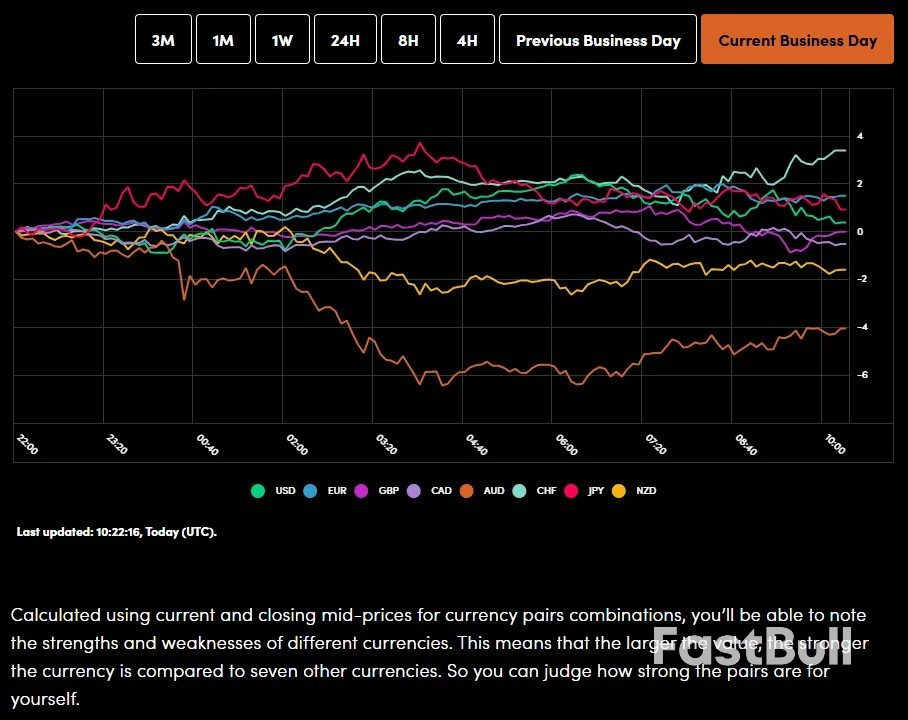
          Currency Power Balance
          Markets Today: SNB Hold Rates, SoftBank Falls 7.7%, Gold Slips Post FOMC. DAX Holds Above Psychological 24000 Handle_1
          Oil prices declined on Thursday as investors redirected their attention toward two main events: the ongoing peace negotiations between Russia and Ukraine and the potential consequences of the US seizing an oil tanker that had been sanctioned off the Venezuelan coast.
          These factors led to a decrease in prices. Specifically, Brent crude futures dropped by 81 cents, or 1.3%, settling at 61.40/barrel, and US West Texas Intermediate crude also fell by 78 cents, or 1.3%, to 57.68/barrel.
          Gold prices dropped slightly on Thursday, moving away from a high point reached earlier in the week. This dip occurred because the US Federal Reserve's recent interest rate cut was not unanimously supported, leaving investors uncertain about how quickly the central bank will continue to lower rates next year.
          However, in contrast, silver hit a new record high. Specifically, spot gold fell 0.4% to 4,210.88/oz, though it had briefly reached its highest price since December 5th earlier in the trading session.
          Meanwhile, US gold futures for February delivery saw a small increase of 0.3% to 4,238.10/oz.
          Economic Calendar and Final Thoughts
          The European session will be quiet from a data perspective. There are Turkish interest rates and the OPEC monthly report which will be released and could stoke some volatility.
          The US session will be busier though with Canadian and US trade balance data, Initial jobless claims and the NVIDIA senate bill coming into focus.
          None of the above are expected to be massive market moving events and attention will now turn to inputs from the November jobs data next Tuesday.
          The Federal Open Market Committee (FOMC) meeting yesterday was likely the most significant event that could positively impact the markets before the end of the year. Since that event has now passed, the US dollar might start to experience its typical seasonal weakness as the year concludes. This could cause the US Dollar Index (DXY) to gradually fall toward the 98.00 level.
          Markets Today: SNB Hold Rates, SoftBank Falls 7.7%, Gold Slips Post FOMC. DAX Holds Above Psychological 24000 Handle_2

          Chart of the Day - DAX Index

          From a technical standpoint, the DAX Index has held above the key confluence level at 24000 for the last four trading days.
          This could be seen as both positive and potentially slightly concerning. The failure to push higher means bulls are hesitant to push on and a lot of this is likely down to the FOMC meeting.
          The post FOMC reaction has been rather tentative and not had a major impact on the DAX for now.
          The period-14 RSI is eyeing a retest of the neutral 50 level. A bounce off this level could give bulls some optimism as it does hint that bullish momentum remains intact for now.
          Immediate resistance rests at 24200 before the swing high just above the 24400 handle comes into focus.
          Immediate support rests at 24000 before the swing high at 23880 and the 20-day MA at 23667 come into focus.
          DAX Index Index Daily Chart, December 11, 2025
          Markets Today: SNB Hold Rates, SoftBank Falls 7.7%, Gold Slips Post FOMC. DAX Holds Above Psychological 24000 Handle_3

          Source: marketpulse

          To stay updated on all economic events of today, please check out our Economic calendar
          Risk Warnings and Disclaimers
          You understand and acknowledge that there is a high degree of risk involved in trading. Following any strategies or investment methods may lead to potential losses. The content on the site is provided by our contributors and analysts for information purposes only. You are solely responsible for determining whether any trading assets, securities, strategy, or any other product is suitable for investing based on your own investment objectives and financial situation.
          Add to Favorites
          Share

          Republican-controlled US Congress Poised to Allow Obamacare Health Subsidies to Expire

          Michelle

          Forex

          Economic

          The Republican-controlled U.S. Congress is poised to allow tax credits to lapse for 24 million Americans this month, as a December 31 deadline approaches with no sign of a healthcare compromise before the Senate votes on Thursday on dueling proposals that lack enough support to pass.

          The Democratic proposal on the subsidies under the Affordable Care Act, popularly known as Obamacare, would extend COVID-era subsidies for three years to keep insurance premiums from soaring for many. Those premiums could more than double in cost on average, according to KFF, a health policy organization.

          A Republican bill by U.S. Senators Bill Cassidy of Louisiana and Mike Crapo of Idaho would send up to $1,500 to individuals earning less than 700% of the federal poverty level — about $110,000 for an individual or $225,000 for a family of four in 2025. Those funds could not be used for abortion or gender transition procedures and would require verification of beneficiaries' immigration or citizenship status — provisions Democrats reject.

          Each party's leader in the Senate has panned the rival party's bill, with 60 votes needed to pass either measure in a Senate that Republicans control 53-47.

          President Donald Trump has largely sat out the brawl over healthcare, although he ultimately embraced the Cassidy-Crapo approach.

          The $1,500 payments in the Republican bill are meant to cover some of the out-of-pocket costs that people on lower-cost "Bronze" or "Catastrophic" Obamacare plans need to pay before their insurance kicks in.

          However, it is far below the plans' deductibles, meaning that even after that payment, a patient would be on the hook for up to $7,500 in out-of-pocket medical expenses before their insurance would start to pay for part of their care.

          Those costs can rack up quickly for people with lower-cost plans, with a visit to a U.S. emergency room costing between $1,000 and $3,000, while an ambulance ride can cost anywhere from $500 to over $3,500.

          MIDTERM ELECTIONS LOOM

          With 2026 congressional elections coming into focus, many Republicans are nervous about the prospect of stiff premium increases hitting every state, including many that backed Trump's 2024 reelection. Polling indicates voters could mostly punish Republicans, who control Congress and the White House.

          Republican U.S. Senator Josh Hawley of Missouri told reporters on Monday it would be unacceptable to close out the year without a healthcare fix. Even in a state Trump carried by 18 points, Hawley said constituents tell him: "We can't afford our premiums now, let alone if they would go up by 50 or 100%."

          Congress' failure to send a solution to Trump would mean tens of millions of Americans being forced to make difficult spending decisions as voters cite affordability as their top worry.

          "What are they going to cut back on?" top Senate Democrat Chuck Schumer of New York asked on Wednesday. "Their healthcare or their food or their ability to buy some Christmas presents for their kids?"

          Insurance companies have warned customers of the rising premiums in the new year, and Democrats argue there isn't enough time to do anything but a clean extension of the tax credits. Congress aims to leave town by the end of next week until January 5.

          MOST AMERICANS SUPPORT EXTENSION

          A new Reuters/Ipsos poll found Americans back a healthcare subsidy continuation. Some 51% of respondents — including three-quarters of Democrats and a third of Republicans — said they support extending the subsidies. Only 21% said they were opposed.

          Other healthcare bills are swirling, including four from Senate Republicans this week. Schumer said Republicans' ideas "are loaded with poison pills, unworkable restrictions and don't do anything to bring down premiums."

          Meanwhile, some bipartisan House measures would temporarily extend the subsidy and add some restrictions, but House Republican leaders have rejected any extension.

          Moderate Republican Representative Brian Fitzpatrick of Pennsylvania is spearheading a bipartisan bill to extend the subsidy through 2027. He is hoping to garner enough support to circumvent leadership and force votes on the measure by the full House.

          It is unclear what healthcare legislation Republican House Speaker Mike Johnson will unveil in time for House votes next week. He has given no sign of consulting Democrats, whom he blames for skyrocketing premiums.

          "You cannot be an arsonist and a firefighter at the same time," Johnson said of Democrats.

          Source: Reuters

          To stay updated on all economic events of today, please check out our Economic calendar
          Risk Warnings and Disclaimers
          You understand and acknowledge that there is a high degree of risk involved in trading. Following any strategies or investment methods may lead to potential losses. The content on the site is provided by our contributors and analysts for information purposes only. You are solely responsible for determining whether any trading assets, securities, strategy, or any other product is suitable for investing based on your own investment objectives and financial situation.
          Add to Favorites
          Share

          ECB’s Surprise AT1 Proposal, Short on Detail, Sows Confusion

          Glendon

          Economic

          Investors in a key piece of bank capital were left puzzled after the European Central Bank proposed changing the market without explaining how.

          The idea to make so-called AT1 bonds more like equity capital came with "no details" on how that would work, KBW analysts led by Andrew Stimpson said in a note. "We are a little confused over what the ECB means here."

          The ECB on Thursday presented recommendations on how to simplify banking regulation, and the question of how banks can use AT1s to meet their capital requirements has loomed large in the debate. The report included another proposal, which had previously been floated by the German Bundesbank, to ban banks from using AT1s to meet a certain regulatory capital level they need to achieve during normal times.

          "Enhancing the capacity of AT1 must fully consider the potential impact on banks' funding costs, market availability and lending capacity," Caroline Liesegang, an official at the lobby group AFME, said in a statement. "It would be counterproductive if simplification ultimately increased the cost of capital and reduced the competitiveness of the banking sector."

          Additional Tier 1 bonds have grown to a market worth about $275 billion in Europe as they allow banks to boost regulatory capital at a lower cost than issuing common equity. AT1 holders rank above equity holders when a bank fails, which, alongside other terms in the bonds, limit their downside compared to stocks.

          Introduced after the global financial crisis to ensure that bondholders foot the bill when a bank gets into trouble instead of taxpayers, AT1s are some of the most complex instruments in the global credit market. They have come under fire over the years and particularly after the demise of Credit Suisse, when more than $17 billion of bonds were wiped out.

          Despite the confusion, prices of AT1 bonds issued in major currencies by European lenders were little changed on the secondary market on Thursday, based on data compiled by Bloomberg.

          "We are talking about how these characteristics of AT1 should evolve over time and that they should have as I have said before a more equity profile," ECB Vice President Luis de Guindos said on Thursday when asked during a press conference to provide more details on the proposal. "Going down to the details will depend on the legislator, but there are several elements that can be modified," he said.

          Radical changes to the AT1 market could make the asset class "an unattractive form of equity," said Romain Miginiac, a fund manager and head of research at Atlanticomnium. He highlighted "very high triggers" as an example, referring to the capital level at which some AT1 bonds get wiped out or converted to equity.

          As deeply subordinated bonds with many bells and whistles, AT1s have been very lucrative for investors. European banks' AT1s are on track to return more than 10% in 2025 on US dollar-hedged terms, after gains of about 13% the year before, based on Bloomberg indexes.

          Still, Miginiac's base-case scenario is no or limited changes to the bonds. He was also unclear what Thursday's announcements meant regarding specific changes to the bonds. "What it does mean is that getting rid of AT1s is a non-starter," he said.

          Source: Bloomberg Europe

          To stay updated on all economic events of today, please check out our Economic calendar
          Risk Warnings and Disclaimers
          You understand and acknowledge that there is a high degree of risk involved in trading. Following any strategies or investment methods may lead to potential losses. The content on the site is provided by our contributors and analysts for information purposes only. You are solely responsible for determining whether any trading assets, securities, strategy, or any other product is suitable for investing based on your own investment objectives and financial situation.
          Add to Favorites
          Share
          FastBull
          Copyright © 2025 FastBull Ltd

          728 RM B 7/F GEE LOK IND BLDG NO 34 HUNG TO RD KWUN TONG KLN HONG KONG

          TelegramInstagramTwitterfacebooklinkedin
          App Store Google Play Google Play
          Products
          Charts

          Chats

          Q&A with Experts
          Screeners
          Economic Calendar
          Data
          Tools
          Membership
          Features
          Function
          Markets
          Copy Trading
          Latest Signals
          Contests
          News
          Analysis
          24/7
          Columns
          Education
          Company
          Careers
          About Us
          Contact Us
          Advertising
          Help Center
          Feedback
          User Agreement
          Privacy Policy
          Personal Information Protection Statement
          Business

          White Label

          Data API

          Web Plug-ins

          Poster Maker

          Affiliate Program

          Risk Disclosure

          The risk of loss in trading financial instruments such as stocks, FX, commodities, futures, bonds, ETFs and crypto can be substantial. You may sustain a total loss of the funds that you deposit with your broker. Therefore, you should carefully consider whether such trading is suitable for you in light of your circumstances and financial resources.

          No decision to invest should be made without thoroughly conducting due diligence by yourself or consulting with your financial advisors. Our web content might not suit you since we don't know your financial conditions and investment needs. Our financial information might have latency or contain inaccuracy, so you should be fully responsible for any of your trading and investment decisions. The company will not be responsible for your capital loss.

          Without getting permission from the website, you are not allowed to copy the website's graphics, texts, or trademarks. Intellectual property rights in the content or data incorporated into this website belong to its providers and exchange merchants.

          Not Logged In

          Log in to access more features

          FastBull Membership

          Not yet

          Purchase

          Become a signal provider
          Help Center
          Customer Service
          Dark Mode
          Price Up/Down Colors

          Log In

          Sign Up

          Position
          Layout
          Fullscreen
          Default to Chart
          The chart page opens by default when you visit fastbull.com