Markets
News
Analysis
User
24/7
Economic Calendar
Education
Data
- Names
- Latest
- Prev


Signal Accounts for Members
All Signal Accounts
All Contests


U.S. Challenger Job Cuts MoM (Nov)A:--
F: --
P: --
U.S. Initial Jobless Claims 4-Week Avg. (SA)A:--
F: --
P: --
U.S. Weekly Initial Jobless Claims (SA)A:--
F: --
P: --
U.S. Weekly Continued Jobless Claims (SA)A:--
F: --
P: --
Canada Ivey PMI (SA) (Nov)A:--
F: --
P: --
Canada Ivey PMI (Not SA) (Nov)A:--
F: --
P: --
U.S. Non-Defense Capital Durable Goods Orders Revised MoM (Excl. Aircraft) (SA) (Sept)A:--
F: --
U.S. Factory Orders MoM (Excl. Transport) (Sept)A:--
F: --
P: --
U.S. Factory Orders MoM (Sept)A:--
F: --
P: --
U.S. Factory Orders MoM (Excl. Defense) (Sept)A:--
F: --
P: --
U.S. EIA Weekly Natural Gas Stocks ChangeA:--
F: --
P: --
Saudi Arabia Crude Oil ProductionA:--
F: --
P: --
U.S. Weekly Treasuries Held by Foreign Central BanksA:--
F: --
P: --
Japan Foreign Exchange Reserves (Nov)A:--
F: --
P: --
India Repo RateA:--
F: --
P: --
India Benchmark Interest RateA:--
F: --
P: --
India Reverse Repo RateA:--
F: --
P: --
India Cash Reserve RatioA:--
F: --
P: --
Japan Leading Indicators Prelim (Oct)A:--
F: --
P: --
U.K. Halifax House Price Index YoY (SA) (Nov)A:--
F: --
P: --
U.K. Halifax House Price Index MoM (SA) (Nov)A:--
F: --
P: --
France Current Account (Not SA) (Oct)A:--
F: --
P: --
France Trade Balance (SA) (Oct)A:--
F: --
P: --
France Industrial Output MoM (SA) (Oct)A:--
F: --
P: --
Italy Retail Sales MoM (SA) (Oct)A:--
F: --
P: --
Euro Zone Employment YoY (SA) (Q3)A:--
F: --
P: --
Euro Zone GDP Final YoY (Q3)A:--
F: --
P: --
Euro Zone GDP Final QoQ (Q3)A:--
F: --
P: --
Euro Zone Employment Final QoQ (SA) (Q3)A:--
F: --
P: --
Euro Zone Employment Final (SA) (Q3)A:--
F: --
Brazil PPI MoM (Oct)--
F: --
P: --
Mexico Consumer Confidence Index (Nov)--
F: --
P: --
Canada Unemployment Rate (SA) (Nov)--
F: --
P: --
Canada Labor Force Participation Rate (SA) (Nov)--
F: --
P: --
Canada Employment (SA) (Nov)--
F: --
P: --
Canada Part-Time Employment (SA) (Nov)--
F: --
P: --
Canada Full-time Employment (SA) (Nov)--
F: --
P: --
U.S. Personal Income MoM (Sept)--
F: --
P: --
U.S. Dallas Fed PCE Price Index YoY (Sept)--
F: --
P: --
U.S. PCE Price Index YoY (SA) (Sept)--
F: --
P: --
U.S. PCE Price Index MoM (Sept)--
F: --
P: --
U.S. Personal Outlays MoM (SA) (Sept)--
F: --
P: --
U.S. Core PCE Price Index MoM (Sept)--
F: --
P: --
U.S. UMich 5-Year-Ahead Inflation Expectations Prelim YoY (Dec)--
F: --
P: --
U.S. Core PCE Price Index YoY (Sept)--
F: --
P: --
U.S. Real Personal Consumption Expenditures MoM (Sept)--
F: --
P: --
U.S. 5-10 Year-Ahead Inflation Expectations (Dec)--
F: --
P: --
U.S. UMich Current Economic Conditions Index Prelim (Dec)--
F: --
P: --
U.S. UMich Consumer Sentiment Index Prelim (Dec)--
F: --
P: --
U.S. UMich 1-Year-Ahead Inflation Expectations Prelim (Dec)--
F: --
P: --
U.S. UMich Consumer Expectations Index Prelim (Dec)--
F: --
P: --
U.S. Weekly Total Rig Count--
F: --
P: --
U.S. Weekly Total Oil Rig Count--
F: --
P: --
U.S. Consumer Credit (SA) (Oct)--
F: --
P: --
China, Mainland Foreign Exchange Reserves (Nov)--
F: --
P: --
China, Mainland Exports YoY (USD) (Nov)--
F: --
P: --


No matching data
Latest Views
Latest Views
Trending Topics
Top Columnists
Latest Update
White Label
Data API
Web Plug-ins
Affiliate Program
View All

No data
The U.S. government shut down Wednesday, putting hundreds of thousands of federal workers at risk of losing pay.
About 750,000 federal employees are expected to be furloughed each day, according to the Congressional Budget Office. Hundreds of thousands more are required to keep working without pay until funding resumes, based on federal agency estimates, including essential staff like air traffic controllers and border patrol agents.
The shutdown was triggered early Wednesday after the Senate failed to pass a short-term funding bill. The measure, which would have kept the government open through Nov. 20, fell short in a 55-45 vote, below the 60 needed.
All but two Democratic senators opposed the bill. Led by Senate Minority Leader Chuck Schumer, D-N.Y., Democrats have been pushing for an extension of expiring Affordable Care Act subsidies and the reversal of about $1 trillion in Medicaid cuts included in President Donald Trump's One Big Beautiful Bill.
In turn, Trump and Vice President J.D Vance have threatened permanent job cuts. Last week, the Office of Management and Budget sent a memo directing federal agencies to prepare layoff plans for programs "not consistent with the president's priorities" if funding lapses, according to the memo published by PBS.
Labor unions have already sued over the move, arguing it violates federal law.
Each year, Congress must approve funding for the government's new fiscal year, which begins Oct. 1. A shutdown occurs when lawmakers miss that deadline. The last time it happened was a 34-day shutdown in 2018, during Trump's first term.
In a shutdown, agencies pause many operations and split workers into two categories:
Federal employees are guaranteed back pay once the shutdown ends, but contractors are not.
The shutdown's effects will be most visible in the government's largest agencies. At the Department of Homeland Security, more than 250,000 employees are required to keep working without pay, including border patrol officers and TSA agents, according to its contingency plan.
The Department of Health and Human Services expects to furlough about 32,460 workers, or 41% of its staff, Reuters reports. And at the FAA, more than 11,000 employees are being sent home while about 13,000 air traffic controllers continue working without pay.
Most social programs will continue because they're funded outside the annual budget process. Social Security and Medicare benefits will still go out, the Postal Service will keep running and veterans' health care and disability payments will continue. SNAP food assistance is not expected to be affected immediately, though a prolonged shutdown could strain USDA's reserves, AARP reports.
Shutdowns are a considerable disruption, especially for federal employees whose pay status can be unclear. To help them, the Office of Personnel Management maintains the government-wide shutdown guidance that applies to all federal employees.
Federal agencies have also posted contingency plans that outline who is furloughed, who must keep working without pay and the procedures employees are expected to follow while operations are scaled back. Below is guidance from some of the agencies with the most employees affected:
For contract workers wondering if they'll get paid, the National Law Review offers advice on confirming contract status and possible recourse on compensation.
Beyond that, out-of-work federal workers and contractors might qualify for state unemployment insurance. Furloughed federal employees access it through the Unemployment Compensation for Federal Employees program.
Unfortunately, excepted employees have fewer options and often need to rely on personal savings until the shutdown ends.
The Australian and New Zealand dollars clung to weekly gains on Friday as economic uncertainty hindered their U.S. counterpart, while the outlook for interest rates at home continued to diverge markedly.The Aussie held at $0.6600, having found support at $0.6577 overnight. It was up 0.8% for the week and near the middle of its recent $0.6521 to $0.6707 range.The kiwi dollar was steady at $0.5820 NZD=D3>, having rallied 0.7% for the week and away from a six-month trough of $0.5755.
The kiwi was aided by profit-taking on short positions against the Aussie, which had risen for eight straight weeks to hit a three-year peak of NZ$1.1416before easing back to NZ$1.1336.The Aussie's ascent came as the Reserve Bank of Australia turned more hawkish on policy, warning inflation was running hotter than expected.Futures now imply around a 45% chance of a quarter-point cut in the 3.60% cash rate when the RBA next meets on November 4, compared to nearly 100% a month ago. (0#AUDIRPR)
ANZ on Friday became the latest of the major local banks to give up on a November easing, while forecasting the trimmed mean measure of core inflation was likely to rise by a hefty 0.9% in the third quarter. The data are out at the end of this month and the RBA had been looking for a rise of around 0.6%.
in November," said ANZ senior economist Adelaide Timbrell. "We remain of the view that a final easing to 3.35% is more likely than not, although the most likely scenarios are one or no cuts, instead of one versus two or more.""We now forecast the next rate cut to occur in February, which would seem the first plausible month for easing."In contrast, a run of dismal economic news has seen markets price in a 44% chance the Reserve Bank of New Zealand will cut its 3.0% cash rate by an outsized 50 basis points when it meets next week. (0#NZDIRPR)
"The New Zealand economy contracted at an around a 4% annualised pace in the second quarter, house prices continue to fall and we expect the RBNZ to cut rates by 50bp when it meets next Wednesday," said Andrew Boak, an economist at Goldman Sachs.
U.S. President Donald Trump's administration approved $230 million for Lebanon's security forces this week as they push to disarm the once powerful armed group Hezbollah, sources in Washington and Beirut said.A Lebanese source familiar with the decision said the funding included $190 million for the Lebanese Armed Forces and $40 million for the Internal Security Forces.Democratic U.S. congressional aides said the funds had been released just before Washington's fiscal year ended on September 30. "For a small country like Lebanon, that's really, really significant," one of the aides said on a call with reporters, requesting anonymity in order to speak freely.
The funding was released at a time when the Republican president's administration has been slashing many foreign assistance programs, saying that its priority in spending taxpayer dollars is America First.The release of the funds appeared to reflect the priority Trump has put on trying to resolve theconflict in Gazaand the wider region.Asked for comment, a State Department spokesperson said in an emailed statement that U.S. assistance supports Lebanese forces "as they work to assert Lebanese sovereignty across the country and fully implement UN Security Council Resolution 1701, the only viable framework for a durable security arrangement for both Lebanese and Israelis."
The resolution, adopted in August 2006, ended the last round of deadly conflict between Hezbollah and Israel.A conflict between Israel and Lebanon that began a year ago has battered Hezbollah and left swathes of Lebanon in ruins.President Joseph Aoun and Prime Minister Nawaf Salam asked the U.S.-backed army on August 5 to devise a plan to ensure that all arms across the country would be in the hands of security forces by the end of the year.
Hezbollah has rejected calls to disarm since the devastating war with Israel. But the Iran-backed group is under pressure to give up its weapons from its rivals in Lebanon and from Washington.The Lebanese source said the funding would allow the Internal Security Forces to take over internal security in Lebanon so the LAF can focus on other critical missions.
Japan's service sector activity extended solid gains in September, buoyed by strong domestic demand and in sharp contrast to shrinking factory activity, a private-sector survey reported on Friday.
The S&P Global final Japan Services Purchasing Managers' Index (PMI) edged up to 53.3 in September from 53.1 in August, marking a slightly steeper increase in business activity and an 11th month of readings above the 50.0 threshold, which indicates growth.
The final reading for September also overshot the flash figure of 53.0.
The sustained expansion in the services sector was driven by a constant increase in new orders, particularly from domestic clients, the survey showed. Meanwhile, new export business decreased for a third month.
Employment in the service sector expanded slightly as firms responded to increased sales and anticipated future demand, according to survey respondents.
Business confidence was also at an eight-month high, with optimism linked to planned company expansions and new product releases, the data showed.
The rate of input cost inflation eased slightly, but companies continued to note high costs for labour, raw materials and fuel, leading to a solid rise in output charges as they passed on expenses to customers.
The broader picture for Japan's economy was less optimistic in September, as the S&P Global Japan Composite PMI, which includes both manufacturing and services, fell to 51.3 from 52.0 in August.
This marked the slowest combined rate of growth since May, as the sustained expansion of services was offset by a sharper decline in factory activity.
"The survey data also suggest that growth is being largely driven by stronger domestic demand, as both manufacturers and services companies noted further falls in new export business," said Annabel Fiddes, Economics Associate Director at S&P Global Market Intelligence.
Japanese businesses were starting to weather the initial hit from U.S. tariffs, but worries remain over rising labour costs, slowing tourist demand and inflation, according to the Bank of Japan's quarterly survey published on Wednesday.
Gold headed for a seventh weekly advance, as the US government shutdown added another layer of uncertainty for investors seeking signals on the Federal Reserve’s monetary-easing path.
Bullion held near $3,860 an ounce, after ending Thursday slightly lower as traders booked profits following a five-day rally that pushed prices to a record earlier in the session. The torrid pace of the advance has left gold vulnerable to pullbacks, with technical indicators showing it’s been trading in overbought territory for the past month.
With the US shutdown set to delay Friday’s government payroll report, investors have become reliant on private data for crucial clues about an already murky economic outlook. Figures from outplacement firm Challenger, Gray & Christmas on Thursday showed US employers dialed back hiring plans in September and announced fewer job cuts.
The blackout will also make it harder for central bankers to interpret the economy’s direction, Fed Bank of Chicago President Austan Goolsbee said this week. Money markets are still almost fully pricing a quarter-point cut at the end of the month, and are widely expecting another in December. Lower borrowing costs tend to benefit non-yielding precious metals.
Gold has soared more than 45% this year in a rally that’s seen successive all-time highs, with prices now on track for the biggest annual gain since 1979. The precious metal has been supported by central-bank buying and rising holdings in gold-backed exchange-traded funds, as the Fed resumed interest-rate cuts.

The CEO of North America’s largest energy infrastructure company says Canada can “absolutely” be an energy superpower — but federal government regulations are standing in the way.In an exclusive broadcast with CTV’s Power Play, Enbridge CEO Greg Ebel says Canada has the tools to dominate the global energy landscape, with supplies of uranium, natural gas, oil, and gold.“We have everything set up,” he told host Mike Le Couteur. “The only thing that’s stopping us is ourselves.”
On Wednesday, Alberta announced it will commit $14 million to support a new pipeline to northwestern B.C. The province is leading a technical advisory group involving three major pipeline companies — Enbridge, South Bow and Trans Mountain — which will provide counsel on the proposal, though none of those companies would be obligated to be involved in the project.While Alta. Premier Danielle Smith says she hopes the pipeline will make the federal government’s next phase of major projects, B.C. Premier David Eby has sharply criticized Smith, telling reporters the proposal “is not a real project.”
Danielle Smith Alberta Premier Danielle Smith announces plans to submit an application for a new oil pipeline to northwestern British Columbia, in Calgary, on Wednesday, Oct. 1, 2025. THE CANADIAN PRESS/Todd KorolHe notes it would require a lifting of the federal government’s oil tanker ban, which he says is “foundational” for British Columbians who value the province’s coast.Ebel says that while Enbridge would “entertain the possibility” of becoming a project proponent, the current regulatory conditions are a barrier.“You’re not going to build a pipeline to nowhere, so if the tanker ban is there, why would you build a pipeline to the west coast?” he said.
Enbridge has been involved in many pipeline projects proposals in the past, including the ill-fated Northern Gateway pipeline project from Alberta to B.C., which was cancelled in 2016.“I don’t think you have to look too far to see concrete, real examples of Enbridge and other pipelines being willing to be the proponent of a pipeline, if the conditions are set. Capital will go to where the conditions are set, and today, the conditions are not set for that pipeline to exist,” Ebel said.On April 30, Enbridge wrote a letter to Prime Minister Mark Carney on behalf of leading energy companies, outlining an action plan to support investment in the Canadian energy sector. Among the requests was an elimination of the emissions cap and industrial carbon levy to allow the sector to “reach its full potential.”
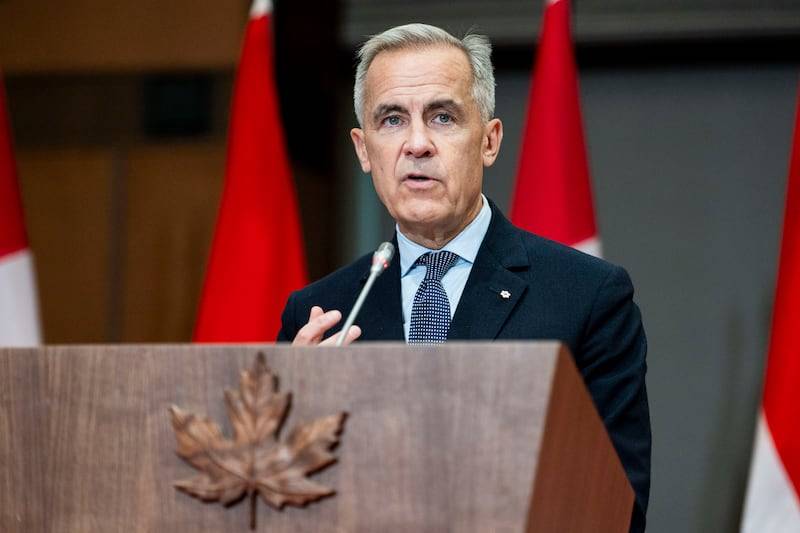
Mark Carney Prime Minister Mark Carney delivers remarks on Parliament Hill in Ottawa, on Wednesday, Sept. 24, 2025. THE CANADIAN PRESS/Spencer ColbyThe company wrote another open letter on Sept. 15 with the same requests, writing that though the launch of the federal government’s new Major Projects Office is a “crucial step in the right direction” in becoming an energy superpower, regulations still impede that vision.When asked by Le Couteur if it matters whether it’s a blanket removal of all these regulations to enable Canada to become an energy superpower, Ebel says having “bespoke regulation is not a great way to formulate capital and bring it together.”
“I think what you would be better off doing is creating the conditions across the entire country that will allow capital to come and these projects to be pursued,” he said.In a statement to CTV News, Energy and Natural Resources Minister Tim Hodgson did not express explicit support for Alberta’s proposal to be the proponent of a pipeline, but said the province has the “right to do so.”“We have an active and constructive dialogue with Alberta and will always look for ways to advance shared priorities,” part of the statement read.
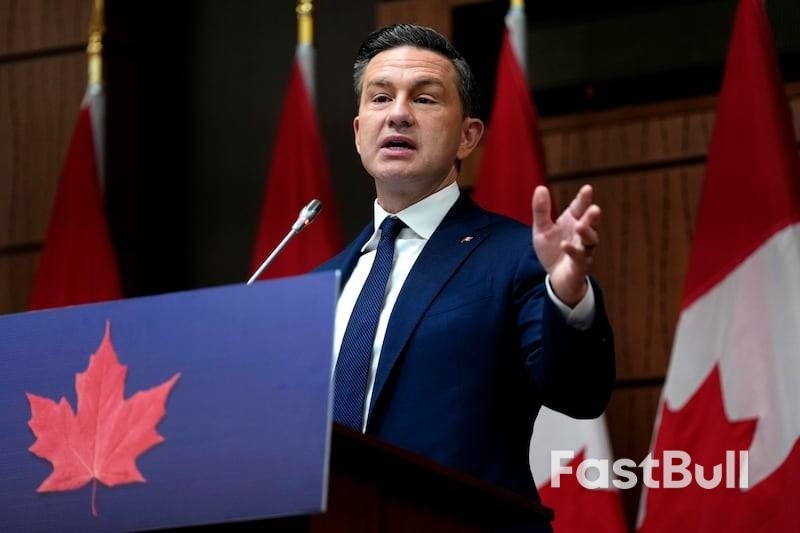
Pierre Poilievre in Ottawa Conservative Leader Pierre Poilievre speaks during a meeting of the Conservative caucus on Parliament Hill in Ottawa, before Monday's return of the House of Commons, on Sunday, Sept. 14, 2025. THE CANADIAN PRESS/Justin Tang (Justin Tang/The Canadian Press)Meanwhile, Conservative Leader Pierre Poilievre has continued to criticize the federal Liberal government, saying Carney needs to “get out of the way” for a pipeline to be built.When it comes to federal leadership, Ebel says he believes Carney recognizes that it’s a competitive world and Canada has the products, but government regulation is standing in the way of taking advantage of global demand.“On election night, I believe he said, ‘Build, baby, build.’ I think those words matter. I love that enthusiasm. I think he recognizes we have been uncompetitive for the last 10 years, and he knows that changes have to be made,” Ebel said. “I support him in that, and look forward to those changes actually coming to fruition.”
Capacity prices — a cost that is ultimately paid for by electricity consumers — surged in PJM’s last two July capacity auctions.
An Amazon Web Services data center near single-family homes on July 17, 2024, in Stone Ridge, Virginia. Data center load resulted in $16.6 billion in capacity auction revenue in the PJM Interconnection’s last two capacity auctions, according to a report released on Oct. 1, 2025, by the grid operator’s market monitorPJM holds capacity auctions to help ensure that it has adequate power supplies to meet future needs. In the last auction, PJM bought capacity for a one-year period that starts on June 1. The grid operator is preparing to hold its next auction in early December to buy capacity for a year beginning on June 1, 2027.
Monitoring Analytics contends it is “misleading” to say that PJM’s recent capacity market results simply reflect tightening supply and demand.“The current conditions are not the result of organic load growth,” it stated. “The current conditions in the capacity market are almost entirely the result of large load additions from data centers, both actual historical and forecast.”Also, the “extreme uncertainty” in data center load forecasts is unprecedented and “raises questions about the meaning of clearing a capacity auction based on those forecasts,” Monitoring Analytics said.
In June, the market monitor recommended requiring new data centers to supply their own generation instead of tapping into existing power supplies in PJM.“The impact of the uncertain forecast of data center load on other customers would be limited or eliminated” by the requirement, Monitoring Analytics said in the report.PJM is in the middle of a fast-track stakeholder process to develop new rules for adding large data centers to its system with a goal of filing a proposal before the end of the year at the Federal Energy Regulatory Commission.
As part of the process, PJM is proposing to bolster its load forecasting for data centers and other large loads, according to an Oct. 1 presentation from PJM staff. Under the proposal, state utility commissions could review and provide feedback on large load adjustments before they are included in PJM’s load forecast.Utilities would also have to ask if any data center proposals in their service territory are duplicative proposals. Staff suggested requiring large load customers to post financial security for the capacity they plan to buy in an auction.
PJM has dropped a proposal for “non-capacity-backed load” that was widely opposed by its stakeholders, according to the presentation.On the issue of a price cap and floor for PJM’s capacity auctions, the last auction would have been $3.2 billion, or 20%, higher except for a cost cap that grew out of an agreement between the grid operator and Pennsylvania Gov. Josh Shapiro, a Democrat, according to the market monitor’s report.
The impact of data center development on PJM’s auction results will increase sharply in the 2028/2029 base capacity auction scheduled for June, when the maximum and minimum price caps in the agreement expire, Monitoring Analytics said.Separately, the Union of Concerned Scientists this week found that utility ratepayers in PJM will pay about $4.4 billion for data center-related transmission projects that were approved in 2024 with similar results expected this year.
White Label
Data API
Web Plug-ins
Poster Maker
Affiliate Program
The risk of loss in trading financial instruments such as stocks, FX, commodities, futures, bonds, ETFs and crypto can be substantial. You may sustain a total loss of the funds that you deposit with your broker. Therefore, you should carefully consider whether such trading is suitable for you in light of your circumstances and financial resources.
No decision to invest should be made without thoroughly conducting due diligence by yourself or consulting with your financial advisors. Our web content might not suit you since we don't know your financial conditions and investment needs. Our financial information might have latency or contain inaccuracy, so you should be fully responsible for any of your trading and investment decisions. The company will not be responsible for your capital loss.
Without getting permission from the website, you are not allowed to copy the website's graphics, texts, or trademarks. Intellectual property rights in the content or data incorporated into this website belong to its providers and exchange merchants.
Not Logged In
Log in to access more features

FastBull Membership
Not yet
Purchase
Log In
Sign Up