• Trade
  • Markets
  • Copy
  • Contests
  • News
  • 24/7
  • Calendar
  • Q&A
  • Chats
Trending
Screeners
SYMBOL
LAST
BID
ASK
HIGH
LOW
NET CHG.
%CHG.
SPREAD
SPX
S&P 500 Index
6839.54
6839.54
6839.54
6878.28
6827.18
-30.86
-0.45%
--
DJI
Dow Jones Industrial Average
47692.40
47692.40
47692.40
47971.51
47611.93
-262.58
-0.55%
--
IXIC
NASDAQ Composite Index
23510.81
23510.81
23510.81
23698.93
23455.05
-67.31
-0.29%
--
USDX
US Dollar Index
99.010
99.090
99.010
99.160
98.730
+0.060
+ 0.06%
--
EURUSD
Euro / US Dollar
1.16393
1.16400
1.16393
1.16717
1.16162
-0.00033
-0.03%
--
GBPUSD
Pound Sterling / US Dollar
1.33268
1.33277
1.33268
1.33462
1.33053
-0.00044
-0.03%
--
XAUUSD
Gold / US Dollar
4186.14
4186.55
4186.14
4218.85
4175.92
-11.77
-0.28%
--
WTI
Light Sweet Crude Oil
58.593
58.623
58.593
60.084
58.495
-1.216
-2.03%
--

Community Accounts

Signal Accounts
--
Profit Accounts
--
Loss Accounts
--
View More

Become a signal provider

Sell trading signals to earn additional income

View More

Guide to Copy Trading

Get started with ease and confidence

View More

Signal Accounts for Members

All Signal Accounts

Best Return
  • Best Return
  • Best P/L
  • Best MDD
Past 1W
  • Past 1W
  • Past 1M
  • Past 1Y

All Contests

  • All
  • Trump Updates
  • Recommend
  • Stocks
  • Cryptocurrencies
  • Central Banks
  • Featured News
Top News Only
Share

Trump: Farming Equipment Has Gotten Too Expensive

Share

Trump: We Will Take Off A Lot Of Environment Rules That Affect Tractor Companies

Share

Kremlin Says Still No Word On US-Ukraine Talks In Florida

Share

Trump: USA Will Take Small Portion Of Tariff Revenues To Give It To Farmers

Share

Trump: Taking Action To Protect Farmers

Share

Nymex January Gasoline Futures Closed At $1.7981 Per Gallon, And Nymex January Heating Oil Futures Closed At $2.2982 Per Gallon

Share

USA Crude Oil Futures Settle At $58.88/Bbl, Down $1.20, 2.00 Percent

Share

Netflix Co-CEO On Warner Bros Deal: We Are Very Confident That Regulators Should And Will Approve It

Share

Alina Habba, The Interim Federal Prosecutor For New Jersey, Has Resigned. This Follows An Appeals Court Ruling That President Trump's Nomination Of Her Was Illegitimate

Share

Netflix Co-CEO On Paramount Skydance Bid For Warner Bros Says The Move Was Entirely Expected- UBS Conf

Share

U.S. Senate Democratic Member And Antitrust Activist Warren Stated That Paramount Skydance's Hostile Takeover Offer Triggered A "Level 5 Antitrust Alert."

Share

Benin Government: Coup Plotters Kidnapped Two Senior Military Officials Who Were Later Freed

Share

Canada: G7 Finance Ministers Discussed Export Controls And Critical Minerals In Call

Share

Benin Government: Nigeria Carried Out Air Strikes To Help Thwart Coup Bid

Share

Fitch: Expects General Government (Gg) Deficit To Fall Modestly In Canada And But Rise Modestly In USA In 2026

Share

An Important Point Of Consensus Was Concern Regarding Application Of Non-Market Policies, Including Export Controls, To Critical Minerals Supply Chains

Share

Fitch: Despite Full-Year Impact Of Tariffs, We Expect USA Fiscal Deficit To Widen In 2026 Due To Additional Tax Cuts Under One Big Beautiful Bill Act

Share

Private Equity Firm Cinven Has Signed A £190 Million Deal To Acquire A Majority Stake In UK Advisory Firm Flint Global

Share

Bank Of England's Taylor Expects Inflation To Fall To Target 'In The Near Term'

Share

Ukraine President Zelenskiy: He Will Travel To Italy On Tuesday

TIME
ACT
FCST
PREV
France Trade Balance (SA) (Oct)

A:--

F: --

P: --
Euro Zone Employment YoY (SA) (Q3)

A:--

F: --

P: --
Canada Part-Time Employment (SA) (Nov)

A:--

F: --

P: --

Canada Unemployment Rate (SA) (Nov)

A:--

F: --

P: --

Canada Full-time Employment (SA) (Nov)

A:--

F: --

P: --

Canada Labor Force Participation Rate (SA) (Nov)

A:--

F: --

P: --

Canada Employment (SA) (Nov)

A:--

F: --

P: --

U.S. PCE Price Index MoM (Sept)

A:--

F: --

P: --

U.S. Personal Income MoM (Sept)

A:--

F: --

P: --

U.S. Core PCE Price Index MoM (Sept)

A:--

F: --

P: --

U.S. PCE Price Index YoY (SA) (Sept)

A:--

F: --

P: --

U.S. Core PCE Price Index YoY (Sept)

A:--

F: --

P: --

U.S. Personal Outlays MoM (SA) (Sept)

A:--

F: --

P: --
U.S. 5-10 Year-Ahead Inflation Expectations (Dec)

A:--

F: --

P: --

U.S. Real Personal Consumption Expenditures MoM (Sept)

A:--

F: --

P: --
U.S. Weekly Total Rig Count

A:--

F: --

P: --

U.S. Weekly Total Oil Rig Count

A:--

F: --

P: --

U.S. Consumer Credit (SA) (Oct)

A:--

F: --

P: --
China, Mainland Foreign Exchange Reserves (Nov)

A:--

F: --

P: --

Japan Trade Balance (Oct)

A:--

F: --

P: --

Japan Nominal GDP Revised QoQ (Q3)

A:--

F: --

P: --

China, Mainland Imports YoY (CNH) (Nov)

A:--

F: --

P: --

China, Mainland Exports (Nov)

A:--

F: --

P: --

China, Mainland Imports (CNH) (Nov)

A:--

F: --

P: --

China, Mainland Trade Balance (CNH) (Nov)

A:--

F: --

P: --

China, Mainland Exports YoY (USD) (Nov)

A:--

F: --

P: --

China, Mainland Imports YoY (USD) (Nov)

A:--

F: --

P: --

Germany Industrial Output MoM (SA) (Oct)

A:--

F: --

P: --
Euro Zone Sentix Investor Confidence Index (Dec)

A:--

F: --

P: --

Canada National Economic Confidence Index

A:--

F: --

P: --

U.K. BRC Like-For-Like Retail Sales YoY (Nov)

--

F: --

P: --

U.K. BRC Overall Retail Sales YoY (Nov)

--

F: --

P: --

Australia Overnight (Borrowing) Key Rate

--

F: --

P: --

RBA Rate Statement
RBA Press Conference
Germany Exports MoM (SA) (Oct)

--

F: --

P: --

U.S. NFIB Small Business Optimism Index (SA) (Nov)

--

F: --

P: --

Mexico 12-Month Inflation (CPI) (Nov)

--

F: --

P: --

Mexico Core CPI YoY (Nov)

--

F: --

P: --

Mexico PPI YoY (Nov)

--

F: --

P: --

U.S. Weekly Redbook Index YoY

--

F: --

P: --

U.S. JOLTS Job Openings (SA) (Oct)

--

F: --

P: --

China, Mainland M1 Money Supply YoY (Nov)

--

F: --

P: --

China, Mainland M0 Money Supply YoY (Nov)

--

F: --

P: --

China, Mainland M2 Money Supply YoY (Nov)

--

F: --

P: --

U.S. EIA Short-Term Crude Production Forecast For The Year (Dec)

--

F: --

P: --

U.S. EIA Natural Gas Production Forecast For The Next Year (Dec)

--

F: --

P: --

U.S. EIA Short-Term Crude Production Forecast For The Next Year (Dec)

--

F: --

P: --

EIA Monthly Short-Term Energy Outlook
U.S. API Weekly Gasoline Stocks

--

F: --

P: --

U.S. API Weekly Cushing Crude Oil Stocks

--

F: --

P: --

U.S. API Weekly Crude Oil Stocks

--

F: --

P: --

U.S. API Weekly Refined Oil Stocks

--

F: --

P: --

South Korea Unemployment Rate (SA) (Nov)

--

F: --

P: --

Japan Reuters Tankan Non-Manufacturers Index (Dec)

--

F: --

P: --

Japan Reuters Tankan Manufacturers Index (Dec)

--

F: --

P: --

Japan Domestic Enterprise Commodity Price Index MoM (Nov)

--

F: --

P: --

Japan Domestic Enterprise Commodity Price Index YoY (Nov)

--

F: --

P: --

China, Mainland PPI YoY (Nov)

--

F: --

P: --

China, Mainland CPI MoM (Nov)

--

F: --

P: --

Italy Industrial Output YoY (SA) (Oct)

--

F: --

P: --

Q&A with Experts
    • All
    • Chatrooms
    • Groups
    • Friends
    Connecting
    .
    .
    .
    Type here...
    Add Symbol or Code

      No matching data

      All
      Trump Updates
      Recommend
      Stocks
      Cryptocurrencies
      Central Banks
      Featured News
      • All
      • Russia-Ukraine Conflict
      • Middle East Flashpoint
      • All
      • Russia-Ukraine Conflict
      • Middle East Flashpoint
      Search
      Products

      Charts Free Forever

      Chats Q&A with Experts
      Screeners Economic Calendar Data Tools
      Membership Features
      Data Warehouse Market Trends Institutional Data Policy Rates Macro

      Market Trends

      Market Sentiment Order Book Forex Correlations

      Top Indicators

      Charts Free Forever
      Markets

      News

      News Analysis 24/7 Columns Education
      From Institutions From Analysts
      Topics Columnists

      Latest Views

      Latest Views

      Trending Topics

      Top Columnists

      Latest Update

      Signals

      Copy Rankings Latest Signals Become a signal provider AI Rating
      Contests
      Brokers

      Overview Brokers Assessment Rankings Regulators News Claims
      Broker listing Forex Brokers Comparison Tool Live Spread Comparison Scam
      Q&A Complaint Scam Alert Videos Tips to Detect Scam
      More

      Business
      Events
      Careers About Us Advertising Help Center

      White Label

      Data API

      Web Plug-ins

      Affiliate Program

      Awards Institution Evaluation IB Seminar Salon Event Exhibition
      Vietnam Thailand Singapore Dubai
      Fans Party Investment Sharing Session
      FastBull Summit BrokersView Expo
      Recent Searches
        Top Searches
          Markets
          News
          Analysis
          User
          24/7
          Economic Calendar
          Education
          Data
          • Names
          • Latest
          • Prev

          View All

          No data

          Scan to Download

          Faster Charts, Chat Faster!

          Download App
          English
          • English
          • Español
          • العربية
          • Bahasa Indonesia
          • Bahasa Melayu
          • Tiếng Việt
          • ภาษาไทย
          • Français
          • Italiano
          • Türkçe
          • Русский язык
          • 简中
          • 繁中
          Open Account
          Search
          Products
          Charts Free Forever
          Markets
          News
          Signals

          Copy Rankings Latest Signals Become a signal provider AI Rating
          Contests
          Brokers

          Overview Brokers Assessment Rankings Regulators News Claims
          Broker listing Forex Brokers Comparison Tool Live Spread Comparison Scam
          Q&A Complaint Scam Alert Videos Tips to Detect Scam
          More

          Business
          Events
          Careers About Us Advertising Help Center

          White Label

          Data API

          Web Plug-ins

          Affiliate Program

          Awards Institution Evaluation IB Seminar Salon Event Exhibition
          Vietnam Thailand Singapore Dubai
          Fans Party Investment Sharing Session
          FastBull Summit BrokersView Expo

          Vietnam Reduces 50% of Fees Across 46 Categories Until End of 2026: A Strategic Fiscal Move for Economic Stability

          Gerik

          Economic

          Summary:

          Starting July 1, 2025, Vietnam's Ministry of Finance will cut 50% of fees and charges across 46 categories until December 2026, aiming to ease business costs and support economic recovery with an estimated relief of over VND 3 trillion....

          Expanded Fiscal Support for a Challenging Economic Landscape

          On July 1, 2025, Vietnam’s Ministry of Finance officially implemented Circular No. 64/2025/TT-BTC, introducing a 50% reduction in 46 fee and charge categories, valid until December 31, 2026. This move is designed to ease operational pressures on businesses and citizens during a period marked by post-pandemic recovery, global market instability, and rising input costs.
          While this is the sixth fee-reduction initiative since 2020, it stands out for its extended timeline and broader scope. By lasting 18 months and covering a wider range of sectors, the government demonstrates a commitment to maintaining economic momentum through proactive and inclusive fiscal tools.

          Wide-Ranging Reductions Cover Core and Peripheral Sectors

          The reductions apply across diverse fields such as business registration, banking, construction, public health, passport issuance, import-export certifications, fire safety inspections, and securities. For example, the fee for issuing licenses to establish and operate banks has been halved, in alignment with Circular No. 150/2016. Likewise, fees for business registration and investment project appraisal in construction are reduced by 50%.
          For export-import businesses, the reduction in the Certificate of Origin (C/O) issuance fee is particularly beneficial. This cost reduction can improve competitiveness in international trade, especially for firms managing high volumes of cross-border transactions.

          Estimated Financial Relief Exceeds VND 3 Trillion

          While earlier reductions totaled around VND 700 billion, the extended scope and duration of this policy raise the anticipated financial support to over VND 3 trillion. This calculation considers not only large-scale enterprises but also micro, small, and individual business households, which represent a substantial portion of Vietnam's economic ecosystem.
          Smaller but essential fee reductions were also included, such as those for importing non-commercial publications, industrial design and trademark registration, barcode usage, inland waterway inspections, and certifications in specialized sectors like fire safety or construction. These categories may seem minor but are operationally significant for niche industries and small-scale operators.

          Foreign-Invested Enterprises Also Recognize the Benefits

          Foreign investors have positively received the fee cuts, viewing them as signs of a stable and cost-efficient business environment. While the policy is not designed exclusively for FDI, its broad application indirectly contributes to improving the investment climate. Lower administrative fees may not directly cause an increase in foreign investment, but they do help reduce barriers to project expansion and new market entry, fostering an atmosphere of economic openness.
          The timing of this initiative coincides with lingering global uncertainties, from supply chain disruptions to geopolitical tensions. While the fee cuts cannot directly shield Vietnam from external shocks, they offer businesses greater flexibility in cost management, encouraging reinvestment rather than contraction.
          It is more accurate to describe this as a correlation rather than a strict cause-effect scenario—fee reductions do not instantly boost GDP but help create favorable conditions for capital flow, production continuity, and employment retention. By doing so, they reinforce the domestic economy’s resilience against international turbulence.

          Fiscal Flexibility as a Strategic Anchor

          The government’s decision to extend the policy through the end of 2026 reflects a broader strategy of using flexible fiscal tools to maintain growth. This is not merely a short-term stimulus but part of a medium-term recovery framework, where lowered business costs serve as indirect support for investment and productivity.
          In contrast to more rigid monetary interventions, fee and charge adjustments offer quicker, more targeted relief with fewer systemic risks. Vietnam’s approach in this case mirrors international best practices, where fiscal levers are pulled in tandem with structural reforms to achieve a stable, pro-business environment.

          Sustained Fee Reductions Reflect Strategic Foresight

          Circular No. 64/2025 represents more than just a regulatory adjustment—it encapsulates a proactive and inclusive fiscal philosophy. By focusing on both macro-level stability and micro-level access, this policy ensures that a wide range of businesses, from large exporters to small-scale practitioners, can share in the relief.
          Although fee reductions alone may not transform the economy, their impact on business confidence, transaction costs, and investor sentiment is tangible. The 18-month implementation window signals the government's intent to maintain stability, encourage reinvestment, and foster economic resilience during a period of global unpredictability.
          To stay updated on all economic events of today, please check out our Economic calendar
          Risk Warnings and Disclaimers
          You understand and acknowledge that there is a high degree of risk involved in trading. Following any strategies or investment methods may lead to potential losses. The content on the site is provided by our contributors and analysts for information purposes only. You are solely responsible for determining whether any trading assets, securities, strategy, or any other product is suitable for investing based on your own investment objectives and financial situation.
          Add to Favorites
          Share

          Gold Prices Hold Gains Amid US Fiscal Deficit Concerns, Trade Uncertainty

          Glendon

          Economic

          Commodity

          Gold prices held steady in Asian trade on Wednesday after sharp gains in the past two sessions, supported by U.S. fiscal deficit concerns as the Senate passed President Donald Trump’s tax-and-spending megabill.

          Bullion was also supported by uncertainty over U.S. trade deals ahead of Trump’s July 9 tariff deadline.

          Spot Gold was largely unchanged at $3,337.25 an ounce, while Gold Futures for August edged 0.1% lower to $3,347.40/oz by 01:52 ET (05:52 GMT).

          Gold has risen more than 2% this week so far, erasing losses from last week when Israel-Iran ceasefire reduced its safe-haven appeal.

          Trump’s tax-cut bill clears Senate, sparks national debt concerns

          Senate Republicans narrowly passed Trump’s sweeping tax-cut and spending bill on Tuesday.

          The bill—aimed at cutting taxes, curbing social programs, and increasing military and immigration enforcement funding—is projected to add $3.3 trillion to the national debt.

          It will now move to the House of Representatives for potential final approval, with Trump aiming to sign it into law by the July 4 Independence Day holiday.

          Meanwhile, Federal Reserve Chair Jerome Powell repeated on Tuesday that the central bank will wait and learn about tariff impacts before cutting rates, defying Trump’s calls for swift, deep cuts.

          Investors parsed Powell’s recent comments as slightly dovish as he did not rule out the chances of a rate cut next month.

          Markets now await Thursday’s nonfarm payrolls report to gauge the chances of a July rate cut, while a reduction in September is largely priced in.

          Trump’s July 9 tariff deadline looms

          Expectations of lower interest rates and U.S. fiscal deficit concerns supported gold prices, while uncertainty over U.S. trade deals ahead of the looming July 9 deadline further aided sentiment.

          Trump said he had no plans to extend the deadline and would instead notify countries of the tariff rates they will face through formal letters.

          He said India may ease curbs on U.S. firms, opening the door to a deal, but added that he was doubtful about a deal with Japan.

          Metal markets subdued, copper rises with dollar near 3-½ yr low

          The US Dollar Index remained subdued in Asian trading hours, wallowing near its lowest level since February 2022.

          Still, metal markets were largely subdued as investors sought clarity on trade deals and sectoral tariffs.

          Silver Futures were largely muted at $36.05 per ounce, while Platinum Futures edged up 0.2% to $1,369.05.

          Meanwhile, benchmark Copper Futures on the London Metal Exchange rose 0.4% $9,968.65 a ton, while U.S. Copper Futures jumped 1.6% to $5.1165 a pound.

          Source: Investing

          To stay updated on all economic events of today, please check out our Economic calendar
          Risk Warnings and Disclaimers
          You understand and acknowledge that there is a high degree of risk involved in trading. Following any strategies or investment methods may lead to potential losses. The content on the site is provided by our contributors and analysts for information purposes only. You are solely responsible for determining whether any trading assets, securities, strategy, or any other product is suitable for investing based on your own investment objectives and financial situation.
          Add to Favorites
          Share

          Putin–Macron Phone Call Signals a Possible Diplomatic Shift in Europe–Russia Relations

          Gerik

          Russia-Ukraine Conflict

          Political

          Resuming Dialogue After Nearly Three Years

          This phone call marks a significant thaw after nearly three years of frozen diplomatic ties, especially as France had been one of Ukraine’s strongest supporters within Europe. According to the Kiel Institute, Paris has committed over €3.7 billion in military aid since the conflict escalated in early 2022. However, Macron has recently adopted a more restrained tone, acknowledging the limits of France’s capacity to support Ukraine and suggesting that Europe must now consider resuming dialogue with Russia as part of any potential peace agreement.
          This development is more than symbolic — it may open the door to renewed direct diplomacy between Moscow and a key EU and NATO power.

          Moscow's Message: Blaming the West and Defining Terms

          According to the Kremlin, Putin blamed Western nations for the Ukraine war, arguing that they ignored Russia’s security concerns for years and used Ukraine as a staging ground against Moscow. He reiterated Russia’s position that any resolution must be “comprehensive and long-lasting,” based on the “new territorial realities” — a phrase referencing the areas Russia has annexed from Ukraine.
          While the tone was assertive, the fact that Putin is now engaging directly with Macron suggests that Moscow may be looking for leverage or political openings as Western sanctions and economic pressure continue to mount.

          Macron’s Shift: From Confrontation to Strategic Reassessment

          Macron, once a vocal advocate for strong support to Ukraine, has softened his stance in recent months. Acknowledging that France can no longer endlessly provide weapons, he recently urged European NATO members to think seriously about restarting dialogue with Moscow. This shift may reflect broader fatigue in Europe over prolonged war costs and a desire to reposition France as a potential broker in future peace efforts.
          While this doesn’t mean a policy reversal, it points to a more pragmatic French strategy — preparing for the “day after” the war ends.

          Middle East Concerns and Nuclear Nonproliferation: A Shared Interest

          Beyond Ukraine, both leaders discussed the recent escalation between Israel and Iran. They agreed that diplomacy is the only viable path and emphasized the need to uphold global nuclear nonproliferation norms. They highlighted Iran’s legitimate right to pursue peaceful nuclear energy under the Non-Proliferation Treaty (NPT), underlining a rare area of shared concern between Russia and France in an increasingly fragmented global order.
          This shared stance suggests that while Europe and Russia remain adversaries on Ukraine, they could still cooperate on multilateral issues like arms control and regional stability.

          Could France Be Russia’s Way Back to the European Table?

          Though no major breakthroughs were announced, the Putin–Macron call may indicate a subtle pivot in diplomatic postures. Russia may be testing the waters for reengagement, while France — strained by war fatigue and financial constraints — appears to be recalibrating its role from combatant ally to potential mediator.
          If this trend continues, Europe could be entering a new phase of geopolitical recalibration. Not out of goodwill — but out of necessity, and long-term strategic calculation.

          Source: France24

          Risk Warnings and Disclaimers
          You understand and acknowledge that there is a high degree of risk involved in trading. Following any strategies or investment methods may lead to potential losses. The content on the site is provided by our contributors and analysts for information purposes only. You are solely responsible for determining whether any trading assets, securities, strategy, or any other product is suitable for investing based on your own investment objectives and financial situation.
          Add to Favorites
          Share

          Chart Art: CAD/JPY’s Trend Pullback Opportunity Near 105.00

          Blue River

          Forex

          Technical Analysis

          The Loonie is having trouble extending its downswings near a key support zone!

          Think it means CAD/JPY is ready to extend a longer-term uptrend?

          Let’s take a closer look at the 4-hour time frame!

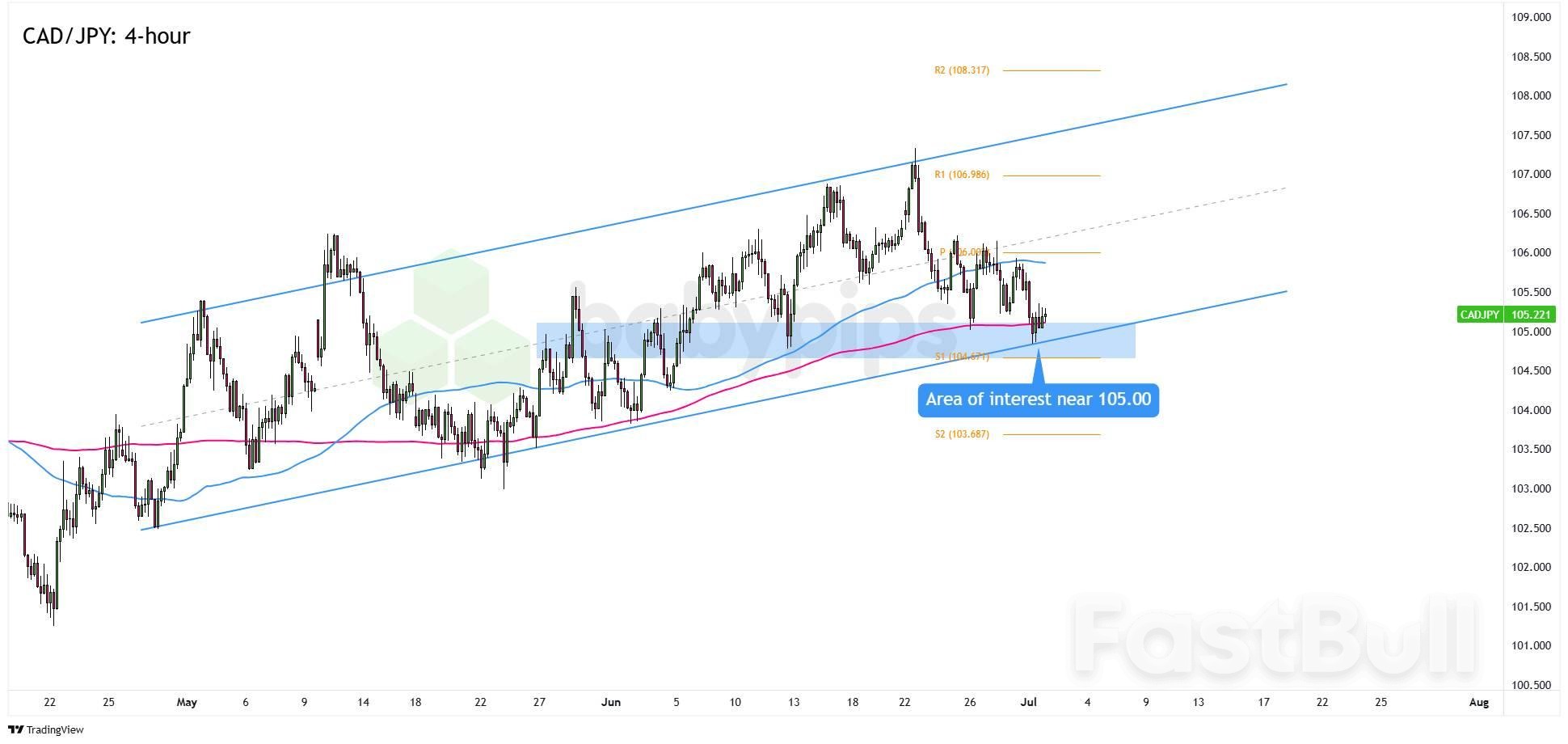
          CAD/JPY: 4-hour

          CAD/JPY 4-hour Forex Chart

          Japanese yen traders found some support from slightly better-than-expected manufacturing surveys and comments from BOJ Governor Ueda at the ECB Forum, where he noted that underlying inflation remains below the central bank’s 2% target. Still, the yen gave back some of its weekly gains on Tuesday as geopolitical tensions and trade war concerns began to ease.

          Over in Canada, a modest rebound in crude oil prices and signs of progress on a potential U.S.-Canada trade deal helped limit the Loonie’s losses, even though it remains one of the less favored major currencies when risk appetite returns.

          Remember that directional biases and volatility conditions in market price are typically driven by fundamentals. If you haven’t yet done your homework on the Canadian dollar and the Japanese yen, then it’s time to check out the economic calendar and stay updated on daily fundamental news!

          CAD/JPY has been slipping since hitting resistance at 107.00 last week, and is now trading near the 105.00 psychological level.

          As you can see, this area lines up with the 100 SMA on the 4-hour chart, the S1(104.67) Pivot Point, and the ascending channel support that has held since May.

          If the pair holds above 105.00 and prints bullish candlesticks, it could resume its longer-term uptrend. A move toward the 106.00 Pivot Point or even a retest of the 107.00 highs would be on the table.

          But if downside momentum picks up and CAD/JPY breaks below the channel support, the uptrend could be in trouble. In that case, watch for a possible drop toward the 104.00 handle or the S2 Pivot Point near 103.69.

          Whichever bias you end up trading, don’t forget to practice proper risk management and stay aware of top-tier catalysts that could influence overall market sentiment.

          Source: BabyPips

          Risk Warnings and Disclaimers
          You understand and acknowledge that there is a high degree of risk involved in trading. Following any strategies or investment methods may lead to potential losses. The content on the site is provided by our contributors and analysts for information purposes only. You are solely responsible for determining whether any trading assets, securities, strategy, or any other product is suitable for investing based on your own investment objectives and financial situation.
          Add to Favorites
          Share

          China Eyes Stablecoins as Strategic Tool in Global Currency Race Amid U.S. Dollar Dominance

          Gerik

          Economic

          Cryptocurrency

          From Skepticism to Strategy: China’s Pivot on Stablecoins

          Despite its historic ban on crypto trading and mining, China is now showing growing interest in stablecoins—privately issued digital tokens pegged to traditional currencies. Triggered by recent remarks from People’s Bank of China (PBOC) Governor Pan Gongsheng and former central bank chief Zhou Xiaochuan, the conversation has shifted from rejection to exploration. Their comments during the Lujiazui Forum highlighted stablecoins’ potential to reshape global finance and reduce reliance on politicized traditional systems like SWIFT.
          Morgan Stanley supports the idea of using Hong Kong’s financial system to test offshore yuan-backed stablecoins. This move would allow China to experiment with global digital finance innovations while avoiding violations of capital control laws. The push, however, is also reactive: just hours before the Shanghai conference, the U.S. Senate passed a bill regulating stablecoins, giving President Trump another legislative win and reinforcing the dollar’s digital dominance.

          Trump’s Digital Dollar Push Raises Stakes for China

          The United States is positioning stablecoins as a strategic extension of the dollar. Treasury Secretary Scott Bessent publicly endorsed stablecoins as a tool to strengthen—not weaken—dollar dominance, claiming they offer more trust than Europe’s or China’s central bank digital currencies (CBDCs). This stance aligns with President Trump’s broader digital asset agenda and aligns regulatory policy with financial innovation.
          As stablecoins grow—projected to reach $3.7 trillion by 2030—most remain dollar-pegged and backed by U.S. assets, consolidating America's first-mover advantage. Economists like JD.com’s Shen Jianguang now warn that if China fails to develop competitive yuan-linked stablecoins, it risks ceding leadership in the next era of global finance.

          Hong Kong as a Launchpad for Digital Yuan

          Hong Kong’s new regulatory framework for fiat-referenced stablecoins offers a convenient backdoor for Chinese firms. JD.com and Ant Group are among the first expected to apply for stablecoin licenses, aiming to slash cross-border payment costs by up to 90% and reduce settlement times to under 10 seconds. Zhejiang China Commodities City Group, which manages the world’s largest wholesale goods market, has also declared interest in entering the stablecoin space.
          This aligns with broader efforts to promote the yuan in trade settlement. In February 2025, over 30% of China’s goods trade was settled in yuan—a decade high—yet global usage remains limited. The failure of China’s official digital currency, the e-CNY, to gain traction, and the uncertainty surrounding the mBridge cross-border CBDC project after BIS pulled out, adds urgency to finding alternative digital channels.

          Dual-Track Strategy and Global Perception Challenge

          Chinese economists suggest a dual-track strategy: expanding traditional channels like the CIPS system and currency swaps, while using offshore yuan stablecoins as a flexible and politically safer alternative. Yet, barriers remain. As Cornell professor Eswar Prasad notes, offshore yuan stablecoins will struggle unless Beijing unifies its onshore and offshore exchange regimes.
          The rise of stablecoins could also backfire domestically, potentially forcing China to accelerate reforms in capital mobility and exchange rate flexibility—changes Beijing has long resisted. Still, pressure from a fast-evolving global digital economy may turn stablecoins into a catalyst for long-overdue liberalization.
          The global currency race is no longer just about traditional fundamentals but also about technological adaptability and geopolitical foresight. As the U.S. aggressively backs stablecoins to extend the dollar’s reach, China faces a make-or-break moment. Failing to embrace yuan-backed stablecoins could mean strategic retreat in the financial arena. Yet, doing so may require the country to confront deep-rooted structural challenges, potentially setting the stage for a transformative shift in how China engages with the world economy.

          Source: Bloomberg

          To stay updated on all economic events of today, please check out our Economic calendar
          Risk Warnings and Disclaimers
          You understand and acknowledge that there is a high degree of risk involved in trading. Following any strategies or investment methods may lead to potential losses. The content on the site is provided by our contributors and analysts for information purposes only. You are solely responsible for determining whether any trading assets, securities, strategy, or any other product is suitable for investing based on your own investment objectives and financial situation.
          Add to Favorites
          Share

          Trump Tariff Risks Put Asian Stocks’ Strong July Record To Test

          James Whitman

          Economic

          A seasonal lift for Asian equities in July may be hard to come by this year, as tariff and macroeconomic concerns dampen sentiment.

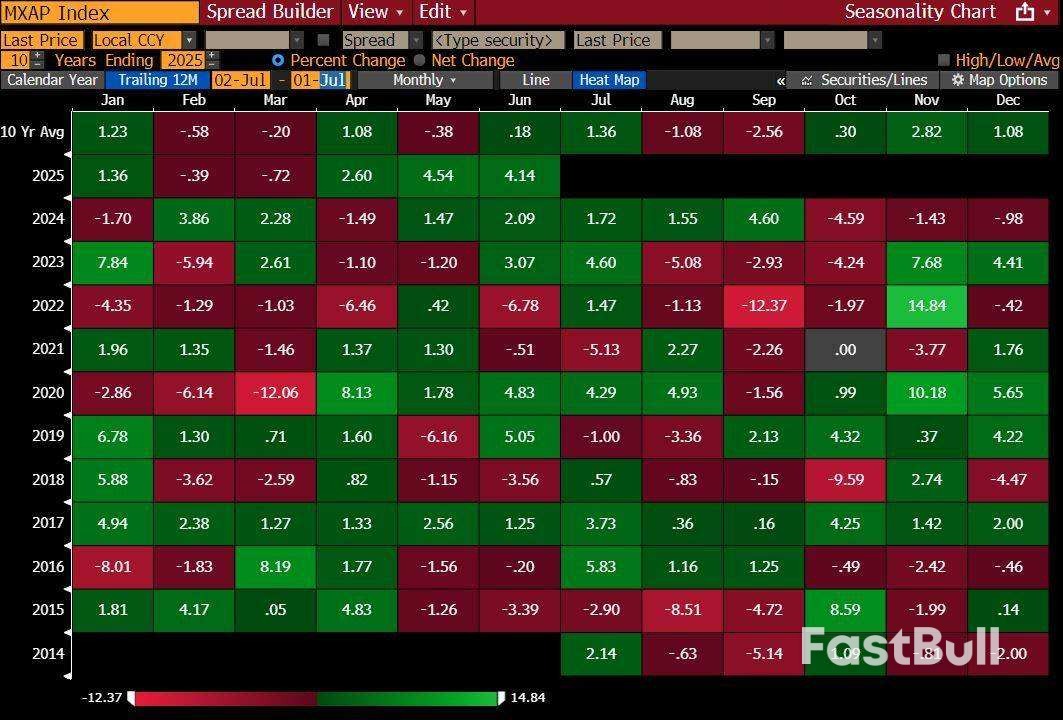
          Markets are bracing for heightened volatility ahead of the July 9 deadline for countries to cut trade deals with the US. Uncertainty over the outcome of these negotiations poses a hurdle for regional shares to maintain an average return of 1.36% for July — the second-best performing month of the year — over the past decade.

          Investors are “somewhat holding back on fresh allocations to emerging Asia,” said Christian Nolting, global chief investment officer at Deutsche Bank’s Private Bank. “While recent comments from high-level negotiators suggest constructive progress in ongoing talks with major Asian trading partners,” uncertainties remain high, given that trade disputes during US President Donald Trump’s first term lasted one and a half years, he added.

          While the MSCI Asia Pacific Index has gained for three consecutive months through June, a potential return of “Liberation Day” tariff rates could send shares plunging in a similar way they did in early April.

          Trump ruled out delaying the July 9 deadline for imposing higher levies on trading partners and renewed threats to hike tariffs on Japan. That saw Japanese shares leading losses in Asia early on Wednesday, with the Nikkei 225 down about 1%.

          Even if trade deals materialise, some levels of tariffs are likely to stay. That would be a drag on the region’s export-led economies. A number of central banks in Asia have lowered their growth outlooks for the year. Meanwhile, elevated US interest rates may curb the scope for Asian central banks to further lower borrowing costs.

          “The third quarter looks to have lots of dangerous potholes, with higher inflation and the prospect of slower growth,” said Gary Dugan, chief executive officer of the Global CIO Office. “We are not so convinced [that] the US Federal Reserve (Fed) will have sufficient reasons to cut rates at the pace the market prices.”

          To be sure, a milder-than-expected tariff outcome and more dovish signalling from the Fed may encourage flows into the region. Current positioning in Asian assets leaves room for upside, said Gary Tan, a portfolio manager at Allspring Global Investments.

          The US central bank has refrained from cutting interest rates this year, as it assesses the impact of Trump’s tariffs on inflation. The Trump administration though, has been applying pressure to lower borrowing costs, and two Fed governors in recent days have said a cut could be appropriate as soon as July.

          The MSCI Asia Pacific gauge has risen 12% so far this year, outperforming the US, with shares in South Korea and Hong Kong seeing renewed interest. Still, some markets in Southeast Asia, where countries were hit with among the highest tariff rates, remain under pressure.

          “We continue to expect choppy markets over the summer,” Nomura Holdings Inc strategists, including Chetan Seth, wrote in a recent note. “We recommend [that] investors focus on stock selection and on idiosyncratic themes that provide insulation from policy uncertainty and ones that offer better visibility.”

          Source: Theedgemarkets

          To stay updated on all economic events of today, please check out our Economic calendar
          Risk Warnings and Disclaimers
          You understand and acknowledge that there is a high degree of risk involved in trading. Following any strategies or investment methods may lead to potential losses. The content on the site is provided by our contributors and analysts for information purposes only. You are solely responsible for determining whether any trading assets, securities, strategy, or any other product is suitable for investing based on your own investment objectives and financial situation.
          Add to Favorites
          Share

          Tariffs, Not Timing, Delay U.S. Rate Cuts as Trump Policies Redefine Economic Trajectory

          Gerik

          Economic

          Tariffs Blamed for Blocking Rate Relief

          Jerome Powell’s confirmation that President Donald Trump’s tariffs are the primary obstacle to cutting interest rates has crystallized a hard truth for investors: policy choices, not economic fundamentals alone, are shaping the monetary trajectory. Without the inflationary push caused by these tariffs, the U.S. might already be experiencing a fed funds range of 3.75% to 4.25%, instead of the current 4.5% to 4.75%.
          This divergence between reality and potential has created what CNBC describes as a “what-could-have-been” economic environment, where past projections of two 2025 rate cuts remain technically alive, but politically hamstrung. Tariffs, particularly in their unexpected size and reach, have lifted inflation expectations enough to stall Fed action.

          Market Pullback from Record Territory

          The S&P 500 edged down 0.11% Tuesday from its all-time high, a modest retreat but symbolic of growing caution. Tesla led declines after Trump’s suggestion that DOGE investigate subsidies received by Elon Musk’s companies, a move that added political uncertainty to an already volatile tech sector.
          European markets fared little better, with the Stoxx 600 slipping 0.21% as euro zone inflation ticked up to 2%. A synchronous inflation uptick on both sides of the Atlantic has reintroduced fear of monetary stalling, even as growth cools.

          Figma’s IPO and the Trump Megabill: Risk and Opportunity

          Amid the macro backdrop, Figma filed for its long-awaited IPO, aiming to trade on the NYSE. With a previous valuation of $12.5 billion during a tender offer last year, Figma’s public debut is poised to test investor appetite in a cautious but hopeful equity market.
          Meanwhile, Trump’s $3.3 trillion megabill narrowly passed the Senate after a tie-breaking vote from Vice President JD Vance. While controversial for its debt implications, several analysts believe the fiscal stimulus could temporarily lift U.S. growth, offsetting some rate hike drag and providing a mid-year catalyst for equities and consumption.

          Bond Market: A Rare Window Opens

          BlackRock’s Rick Rieder described current fixed-income conditions as a “generational opportunity” for income investors. With yields still historically elevated, especially for corporate and municipal bonds, the disinflationary outlook and potential rate cuts later in the year make this a rare alignment of income and price appreciation potential.
          In a significant geopolitical and technological move, Huawei open-sourced its Pangu AI model series. This reinforces its transformation from a telecom provider into a full-spectrum AI player, seeking to dominate both hardware and software despite U.S. chip export controls. Paul Triolo of DGA-Albright Stonebridge describes Huawei’s repositioning as that of a “muscular technology juggernaut.”
          By giving global developers access to Pangu’s capabilities, Huawei aims not just to survive export restrictions but to embed its systems into the core of global AI infrastructure, a strategy that mirrors China’s broader attempt to build tech sovereignty.
          The global economy stands at the intersection of aggressive fiscal policy, unresolved trade tensions, and delayed monetary easing. While the U.S. market continues to flirt with record levels, the absence of expected rate cuts — due largely to tariffs — clouds what might otherwise be an unequivocally bullish landscape. With the July 9 tariff deadline looming, non-farm payrolls due Thursday, and OPEC+ set to meet this week, the path forward remains murky but charged with potential for both volatility and value.

          Source: CNBC

          To stay updated on all economic events of today, please check out our Economic calendar
          Risk Warnings and Disclaimers
          You understand and acknowledge that there is a high degree of risk involved in trading. Following any strategies or investment methods may lead to potential losses. The content on the site is provided by our contributors and analysts for information purposes only. You are solely responsible for determining whether any trading assets, securities, strategy, or any other product is suitable for investing based on your own investment objectives and financial situation.
          Add to Favorites
          Share
          FastBull
          Copyright © 2025 FastBull Ltd

          728 RM B 7/F GEE LOK IND BLDG NO 34 HUNG TO RD KWUN TONG KLN HONG KONG

          TelegramInstagramTwitterfacebooklinkedin
          App Store Google Play Google Play
          Products
          Charts

          Chats

          Q&A with Experts
          Screeners
          Economic Calendar
          Data
          Tools
          Membership
          Features
          Function
          Markets
          Copy Trading
          Latest Signals
          Contests
          News
          Analysis
          24/7
          Columns
          Education
          Company
          Careers
          About Us
          Contact Us
          Advertising
          Help Center
          Feedback
          User Agreement
          Privacy Policy
          Business

          White Label

          Data API

          Web Plug-ins

          Poster Maker

          Affiliate Program

          Risk Disclosure

          The risk of loss in trading financial instruments such as stocks, FX, commodities, futures, bonds, ETFs and crypto can be substantial. You may sustain a total loss of the funds that you deposit with your broker. Therefore, you should carefully consider whether such trading is suitable for you in light of your circumstances and financial resources.

          No decision to invest should be made without thoroughly conducting due diligence by yourself or consulting with your financial advisors. Our web content might not suit you since we don't know your financial conditions and investment needs. Our financial information might have latency or contain inaccuracy, so you should be fully responsible for any of your trading and investment decisions. The company will not be responsible for your capital loss.

          Without getting permission from the website, you are not allowed to copy the website's graphics, texts, or trademarks. Intellectual property rights in the content or data incorporated into this website belong to its providers and exchange merchants.

          Not Logged In

          Log in to access more features

          FastBull Membership

          Not yet

          Purchase

          Become a signal provider
          Help Center
          Customer Service
          Dark Mode
          Price Up/Down Colors

          Log In

          Sign Up

          Position
          Layout
          Fullscreen
          Default to Chart
          The chart page opens by default when you visit fastbull.com