Markets
News
Analysis
User
24/7
Economic Calendar
Education
Data
- Names
- Latest
- Prev


Signal Accounts for Members
All Signal Accounts
All Contests


Japan Tankan Small Manufacturing Outlook Index (Q4)A:--
F: --
P: --
Japan Tankan Large Non-Manufacturing Outlook Index (Q4)A:--
F: --
P: --
Japan Tankan Large Manufacturing Outlook Index (Q4)A:--
F: --
P: --
Japan Tankan Small Manufacturing Diffusion Index (Q4)A:--
F: --
P: --
Japan Tankan Large Manufacturing Diffusion Index (Q4)A:--
F: --
P: --
Japan Tankan Large-Enterprise Capital Expenditure YoY (Q4)A:--
F: --
P: --
U.K. Rightmove House Price Index YoY (Dec)A:--
F: --
P: --
China, Mainland Industrial Output YoY (YTD) (Nov)A:--
F: --
P: --
China, Mainland Urban Area Unemployment Rate (Nov)A:--
F: --
P: --
Saudi Arabia CPI YoY (Nov)A:--
F: --
P: --
Euro Zone Industrial Output YoY (Oct)A:--
F: --
P: --
Euro Zone Industrial Output MoM (Oct)A:--
F: --
P: --
Canada Existing Home Sales MoM (Nov)A:--
F: --
P: --
Canada National Economic Confidence IndexA:--
F: --
P: --
Canada New Housing Starts (Nov)A:--
F: --
U.S. NY Fed Manufacturing Employment Index (Dec)A:--
F: --
P: --
U.S. NY Fed Manufacturing Index (Dec)A:--
F: --
P: --
Canada Core CPI YoY (Nov)A:--
F: --
P: --
Canada Manufacturing Unfilled Orders MoM (Oct)A:--
F: --
P: --
U.S. NY Fed Manufacturing Prices Received Index (Dec)A:--
F: --
P: --
U.S. NY Fed Manufacturing New Orders Index (Dec)A:--
F: --
P: --
Canada Manufacturing New Orders MoM (Oct)A:--
F: --
P: --
Canada Core CPI MoM (Nov)A:--
F: --
P: --
Canada Trimmed CPI YoY (SA) (Nov)A:--
F: --
P: --
Canada Manufacturing Inventory MoM (Oct)A:--
F: --
P: --
Canada CPI YoY (Nov)A:--
F: --
P: --
Canada CPI MoM (Nov)A:--
F: --
P: --
Canada CPI YoY (SA) (Nov)A:--
F: --
P: --
Canada Core CPI MoM (SA) (Nov)A:--
F: --
P: --
Canada CPI MoM (SA) (Nov)A:--
F: --
P: --
Federal Reserve Board Governor Milan delivered a speech
U.S. NAHB Housing Market Index (Dec)--
F: --
P: --
Australia Composite PMI Prelim (Dec)--
F: --
P: --
Australia Services PMI Prelim (Dec)--
F: --
P: --
Australia Manufacturing PMI Prelim (Dec)--
F: --
P: --
Japan Manufacturing PMI Prelim (SA) (Dec)--
F: --
P: --
U.K. 3-Month ILO Employment Change (Oct)--
F: --
P: --
U.K. Unemployment Claimant Count (Nov)--
F: --
P: --
U.K. Unemployment Rate (Nov)--
F: --
P: --
U.K. 3-Month ILO Unemployment Rate (Oct)--
F: --
P: --
U.K. Average Weekly Earnings (3-Month Average, Including Bonuses) YoY (Oct)--
F: --
P: --
U.K. Average Weekly Earnings (3-Month Average, Excluding Bonuses) YoY (Oct)--
F: --
P: --
France Services PMI Prelim (Dec)--
F: --
P: --
France Composite PMI Prelim (SA) (Dec)--
F: --
P: --
France Manufacturing PMI Prelim (Dec)--
F: --
P: --
Germany Services PMI Prelim (SA) (Dec)--
F: --
P: --


No matching data
Latest Views
Latest Views
Trending Topics
Top Columnists
Latest Update
White Label
Data API
Web Plug-ins
Affiliate Program
View All

No data
Labor market softening as both demand for and supply of workers diminish; Fed cuts interest rates to support labor market amid stall in hiring.
The number of Americans filing new applications for unemployment benefits fell last week, but the labor market has softened as both demand for and supply of workers have diminished.
Initial claims for state unemployment benefits decreased 33,000 to a seasonally adjusted 231,000 for the week ended September 13, the Labor Department said on Thursday. The decline partially reversed a surge in the prior week, which had pushed claims to levels last seen in October 2021.
That increase in applications was concentrated in Texas, with the state's Workforce Commission later saying it had since the September 1 Labor Day holiday "observed an uptick in identity fraud claim attempts aimed at exploiting the unemployment insurance system."
Economists polled by Reuters had forecast 240,000 claims for the latest week. Layoffs remain relatively low, but the hiring side of the labor market has almost stalled. Demand for workers has slowed, with economists blaming uncertainty stemming fromtariffson imports. At the same time, an immigration crackdown has reduced labor supply, creating what Federal Reserve Chair Jerome Powell on Wednesday described as a "curious balance."
"Typically when we say things are in balance, that sounds good," Powell told reporters. "But in this case, the balance is because both supply and demand have come down quite sharply. We now see the unemployment rate edging up."
The U.S. central bank on Wednesday cut its benchmark overnight interest rate by a quarter-percentage-point to a 4.00%-4.25% range and projected a steady pace of reductions for the rest of 2025 to help the labor market. The Fed paused its policy easing cycle in January because of uncertainty over the inflationary impact of President DonaldTrump'simport tariffs.
The claims data covered the period during which the government surveyed business establishments for the nonfarm payrolls component of September's employment report. Payrolls increased by only 22,000 jobs in August, with employment gains averaging 29,000 positions per month over the last three months.
The unemployment rate is near a four-year high of 4.3%. The government said last week payrolls could have been overstated by 911,000 jobs in the 12 months through March.
Though layoffs remain low, those who lose their jobs are experiencing long bouts of unemployment because of the stall-speed pace of hiring. The number of people receiving benefits after an initial week of aid fell 7,000 to 1.920 million during the week ending September 6, the claims report showed.
The average duration of joblessness jumped to 24.5 weeks in August, the longest since April 2022, from 24.1 in July.
After months of pressure from President Donald Trump, Federal Reserve Chair Jerome Powell made clear Wednesday he and most of his colleagues aren’t about to buy the administration’s argument on inflation or the case for slashing rates.
While policymakers did trim their benchmark rate by 25 basis points, it was really just a “risk-management cut,” Powell said in his press conference after the decision to bring the target to a 4% to 4.25% range. He said the move reflected “the much lower level of job creation and other evidence of softening in the labor market apparent in data in recent weeks.
As for where the economy is headed from here, however, he flagged risks to both of the Fed’s main mandates – price stability and full employment. But “our tools can’t do two things at once,” so policy isn’t on any pre-set path.
The Fed’s new board member, Stephen Miran, who was Trump’s White House chief economist until shifting roles Tuesday, dissented for a 50 basis-point cut. But the other two Trump appointees on the board, Christopher Waller and Michelle Bowman, failed to join him, even after having dissented themselves in July in favor of a quarter-point cut.
“Really the only way for any voter to really move things around is to be incredibly persuasive,” Powell said. And, apparently, Miran wasn’t. “There wasn’t widespread support at all for for a 50 basis point cut today,” Powell said.
Peppered with questions about Fed independence and political pressure, he dismissed the idea of the US central bank becoming a politicized cabal. “Really strong arguments based on the data and one’s understanding of the economy” is all that matters, he said. “And that’s how it’s going to work,” said Powell, who’s been on the board since 2012.
“That’s in the DNA of the institution, that’s not going to change,” he emphasized. For good measure, he also declined specific comment on Treasury Secretary Scott Bessent’s call for an independent review of the Fed, saying he wouldn’t reply to anything an “officer” says.
Perhaps most provocative to Trump and his team, Powell continued to hold out the possibility that he stays on the Fed board even after his term as chair ends in May. (His governorship runs to January 2028.) That would limit Trump’s ability to revamp its leadership.
Waller and Bowman might have taken themselves out of the running to succeed Powell as the next Fed chair, but “it does signal that the independence of the institution may be more durable than some have feared,” Michael Feroli, chief US economist at JPMorgan Chase, wrote in a note.
Is Trump bringing an end to US free market capitalism? On this week’s Trumponomics podcast, host Stephanie Flanders is joined by Bloomberg managing editor Shelly Banjo and senior reporter Ian King to discuss how the US president’s dealmaking is reshaping corporate America and whether it will outlast his presidency. Listen on Apple, Spotify or wherever you get your podcasts.
Before the latest economic projections from Fed policymakers, a group of former central bankers trimmed their own forecasts for rate cuts, taking the benchmark rate down to 3.5% by the end of 2026. The survey, conducted by ex-reporter Jon Hilsenrath, now a visiting scholar at Duke University, also warned about the consequences of political pressure.
“Twenty-four of 25 people described the risk of a policy error due to political interference as ‘extreme,’ ‘serious,’ or ‘elevated,’” the survey, which included nine former policymakers and 16 staff members, showed. “More specifically, people said the Fed risked cutting interest rates too much and spurring more inflation than is already projected.”
The former officials “strongly support” Waller, who served as research director at the St. Louis Fed before joining the Fed board in 2020, to succeed Powell as chair next year, “in part because he was deemed most independent among leading contenders for the job.” However, “several people expressed skepticism that Waller will get the job,” because of that same perception of independence.
Last week’s unprecedented NATO downing of Russian drones over Poland, which this analysis here argues was due to jamming causing them to radically veer off course, drew wider attention to the dueling military drills in Central & Eastern Europe (CEE).

The day before the incident, RT informed their audience that Poland, Lithuania, and eight other NATO allies in Latvia were carrying out three separate drills timed to coincide with Russia and Belarus’ then-upcoming Zapad 2025 ones in that latter state.To illustrate the mismatch between each side, Poland’s, Lithuania’s, and Latvia’s drills respectively involve 30,000, 17,000, and 12,000 for a little less than 60,000 total troops compared to Zapad 2025 only involving 13,000 troops from Russia and Belarus. Observers should also know that Belarus only has around 60,000 servicemen (48,000) and border guards (12,000) in total so these NATO drills on its western and northern borders comprise the same number of troops as its armed forces.
It's little wonder then that Russia earlier transferred tactical nukes to Belarus with the right to use them in self-defense and is planning to deploy hypersonic Oreshnik missiles there too for deterrence purposes. NATO as a whole and in particular its three aforesaid members who hosted the latest drills believe that Belarus is the “weak link” in Russia’s regional security matrix and thus think they can intimidate it via large-scale drills into “defecting” to the West after summer 2020’s attempted Color Revolution failed.
This plot won’t succeed due to Russia’s Article 5-like mutual security guarantees for Belarus, its abovementioned tactical nuke and Oreshnik deployments there, and President Alexander Lukashenko striking up a surprising friendship with Trump via his role in trying to facilitate a grand deal with Putin. Nevertheless, none of this means that NATO will abandon its intimidation campaign against Belarus, ergo the importance of regular joint Russian-Belarusian drills in order to visibly demonstrate deterrence.
These same drills are then deliberately misportrayed by the West as aggressively intentioned and consequently exploited as the pretext for staging their own much larger ones at the same time for faux deterrence purposes that thinly veil their aggressive motives against Belarus and Russia by extension. This dynamic isn’t new but has been dishonestly dramatized by the West since the start of the special operation for maximum domestic fearmongering purposes that advance the elite’s geopolitical agenda.
Given these stakes, it’s expected that they’ll maintain this dynamic even after the Ukrainian Conflict ends, which’ll keep NATO-Russian tensions high for the indefinite future. The Western elites might also have economic interests in doing so since this’ll serve as the impetus for accelerating construction of the “EU Defense Line” along NATO’s borders with Russia and Belarus. Knowing how corrupt the West is, it should be assumed that some officials have invested in companies involved in this megaproject.
The new normal of dueling military drills in CEE is therefore driven by the Western elite’s geopolitical interests in fearmongering about Russia and their economic ones in enriching themselves from this. Russia won’t unilaterally suspend these drills since doing so could further embolden Western warmongers and inadvertently prompt Belarus into panicking that it might soon be “sold out”. The ball is thus in NATO’s court whether or not to maintain this dynamic, but all indications suggest that it will.
The United Arab Emirates could downgrade diplomatic ties with Israel if Prime Minister Benjamin Netanyahu's government annexes part or all of the Israeli-occupied West Bank, according to three sources briefed on the Gulf Arab state's deliberations.
UAE is one of just a few Arab states with diplomatic relations with Israel and downgrading ties would be a major setback for the Abraham Accords - a signature foreign policy achievement of U.S. PresidentDonald Trumpand Netanyahu.
Israel's government has recently taken steps that could presage annexation of the West Bank, which was captured along with East Jerusalem in a war in 1967. The United Nations and most countries oppose such a move.
For Netanyahu, whose coalition relies on right-wing nationalist parties, annexation could be seen as a valuable vote winner before an election expected next year.
Abu Dhabi warned Netanyahu's right-wing coalition this month that any annexation of the West Bank would be a "red line" for the Gulf state but did not say what measures could follow.
The UAE, which established ties with Israel in 2020 under the Abraham Accords, was considering withdrawing its ambassador in any response, the sources told Reuters.
The sources, who all spoke on condition of anonymity, said Abu Dhabi was not considering completely severing ties, although tensions have mounted during the almost two-year-oldGaza War.
A source in Israel said the government believed it could repair its strained ties with the UAE, a major commercial centre seen as the most significant of the Arab states to establish ties with Israel in 2020. The others were Bahrain and Morocco.
No other Arab state has since established formal ties with Israel, which also has diplomatic relations with Egypt and Jordan, and direct contacts with Qatar, though without full diplomatic recognition. Once-thriving business ties between the UAE and Israel have cooled due to the Gaza war and Netanyahu has yet to visit the Gulf state five years after establishing ties.
In a sign of growing tension with Israel, the Gulf state last week decided to bar Israeli defense companies from exhibiting at the Dubai Airshow in November, three of the sources said. Two other sources, an Israeli official and an Israeli defence industry executive, confirmed the decision.
Israel's defence ministry said it had been made aware of the decision but did not elaborate. A spokesperson for the Israeli embassy in Abu Dhabi said discussions over Israel's participation in the week-long trade show were continuing.
Israel's media were the first to report the move to block the firms from the UAE's flagship aerospace and defence event.
The UAE foreign ministry did not respond to questions on whether it was weighing downgrading diplomatic ties with Israel.
The spokesperson at the Israeli embassy in Abu Dhabi said that Israel was committed to the Abraham Accords and that it would continue to work towards strengthening ties with the UAE.
Emirati foreign ministry official Lana Nusseibeh had told Reuters and Israeli media on September 3 that any annexation of the West Bank would jeopardise the Abraham Accords and end the pursuit of regional integration.
That warning preceded Israel's air strike on Qatar last week, which targeted Hamas leaders, an attack that Anwar Gargash, diplomatic adviser to UAE President Sheikh Mohamed bin Zayed Al Nahyan, condemned as treacherous.
At an emergency meeting of Muslim nations in Qatar, convened in response to the strike, a communique was issued urging countries to review diplomatic and economic ties with Israel.
As part of the Abraham Accords, Netanyahu promised to hold off annexing the West Bank for four years. But that deadline has passed and some Israeli ministers are now pressing for action.
Finance Minister Bezalel Smotrich this month said that maps were being drawn up to annex most of the West Bank, urging Netanyahu to accept the plan. Itamar Ben-Gvir, the national security minister, also backs annexing the territory.
After establishing ties, the UAE and Israel built a close relationship, focusing on economic, security and intelligence cooperation. This followed years of discreet contacts.
But differences began emerging after Netanyahu returned to power in 2023, leading the most right-wing government in Israel's history. Abu Dhabi has condemned repeated efforts by Ben-Gvir to alter the status quo of Jerusalem's Al Aqsa compound to allow Jews to be able to pray there. The site is sacred to Muslims and Jews and at present non-Muslims can visit but cannot pray.
The UAE has also criticised Israel's policies in the West Bank, including the expansion of settlements, and its military siege of Gaza, and said an independent Palestinian state alongside Israel was necessary for regional stability. Netanyahu this month declared there would never be a Palestinian state.
The Bank of England has held its main interest rate at 4% as inflation in the U.K. remains almost double its target of 2%.
Thursday’s decision was widely anticipated.
On Wednesday, figures showed inflation in the U.K. held steady at 3.8% in the year to August.
Since it started cutting borrowing costs in August 2024 after the unwinding of the previous spike in inflation in the wake of Russia’s invasion of Ukraine, the bank has done so in a gradual manner every three months.
If the bank were to continue to cut interest rates in the manner it has been doing so, the next meeting in November would see a further reduction.
However, economists remain split as to whether another cut will be forthcoming since inflation has proven to be stickier than anticipated, partly because of relatively high wage increases.
In our 2025 outlook we emphasized the strong link between the health of the US consumer and the performance of securitized credit markets, especially asset-backed securities (ABS). In a bit of fortuitous programming, our Consumer Finance Symposium earlier this year brought together a broad mix of consumer lenders who were more than eager to dive into both the opportunities and risks ahead and how investors should think about their allocations.
Two key themes to watch as it relates to US consumer health include the increasing bifurcation in credit strength among consumer cohorts and how this will ultimately manifest itself, and the role the labor market will have on neutralizing the impact of inflation. In both cases, acute analysis is critical. Relying on just headline data (e.g., aggregate delinquencies, headline CPI, and unemployment) can mask the actual implications for consumer credit health and securitized credit performance and not tell the full story.
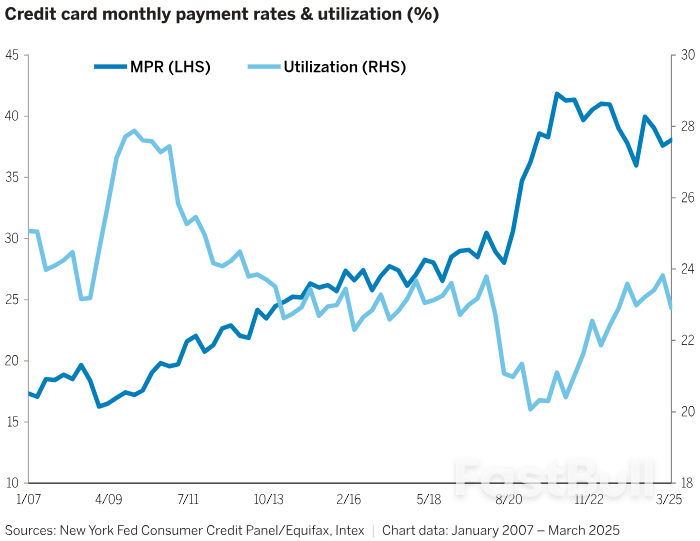
The gap between the performance of higher-income consumers and lower-income cohorts is widening. Lower-come households are experiencing duress due to affordability challenges, which in turn are leading to higher delinquency rates and more reliance on credit. Other cohorts remain relatively healthy. As the chart below shows, credit card utilization and payoff rates — both of which tend to be effective performance measures — are healthy. Utilization, while higher than in recent years, has normalized. Credit card monthly payment rates remain elevated relative to history.
Figure 1

This bifurcation and its effects are important considerations for those lenders and investors most exposed to lower-income consumers and are also important to the overall health of the economy due to the notable, ongoing shift in consumption patterns. The top 40% of consumers by income account for more than 70% of total consumption — an all-time high. In our view, this is the cohort we should be focusing on to chart trends and develop big-picture ideas. Put simply, this cohort drives the health of the economy.
As for addressing this anomaly, bifurcations create pockets of both risk and reward and place a premium on precision over broad diversification. Some actions to take to stay on your front foot include:
The second dynamic revolves around the symbiotic relationship between labor market conditions and inflation. Inflation has been driving credit performance for some time, and we still see the potential for price increases on the horizon that will cause discomfort for many. That said, the key gauges of consumer health are steadily moving back to focusing on employment, on-time bill paying, and consumption.
While the payrolls report in July showed weaker-than-expected job growth, the unemployment rate remains at a relatively healthy 4.2%, and wages, as measured by average hourly earnings, are still growing, both supported by still-low labor supply. Steady employment in this market is a powerful stabilizer that helps credit consumers, particularly the most vulnerable ones, navigate inflation. A strong labor market provides consistent income streams, which in turn support debt servicing. Job stability also mitigates credit risk by lowering the lielihood of default on consumer products like credit cards, personal loans, and auto loans. For subprime and near-prime consumers, employment income is often their sole financial cushion — thus, robust job openings, wage growth, and low unemployment rates can provide a valuable buffer. Inflation reduces real wages, but a steady paycheck still allows for repayment. As a result, credit investors should keep in mind that any headline deterioration caused by inflation may be less acute than history suggests — that is, provided the job market holds beyond the weak July reading.
The nature and sequencing of fiscal policy will matter and will determine the actual impact experienced from tariffs and tax cuts. Investors should also be on the lookout for any signs of further labor market deterioration — particularly where that erosion comes from, i.e., in lower-income or higher-income jobs. If it is the former, the bifurcation challenge becomes that much more acute but if it is the latter, it will have bigger implications for macroeconomic vulnerability.
Several other top-of-mind trends to watch as we move through the second half of 2025:
The health of the US consumer remains a cornerstone of securitized credit performance and will inform our security selection process within multisector credit portfolios. As we move through 2025, bifurcation across income cohorts and the evolving labor market will continue to shape credit dynamics. Investors must navigate this landscape with precision — recognizing that while lower-income consumers face acute affordability challenges, higher-income cohorts dominate consumption and drive macro trends. The resilience of the labor market offers a stabilizing force against inflationary pressures, reinforcing the importance of employment as a buffer for credit risk. Ultimately, cohort-sensitive analysis, selective exposure, and proactive risk management will be key to unlocking value and mitigating downside in a bifurcated consumer credit environment.
White Label
Data API
Web Plug-ins
Poster Maker
Affiliate Program
The risk of loss in trading financial instruments such as stocks, FX, commodities, futures, bonds, ETFs and crypto can be substantial. You may sustain a total loss of the funds that you deposit with your broker. Therefore, you should carefully consider whether such trading is suitable for you in light of your circumstances and financial resources.
No decision to invest should be made without thoroughly conducting due diligence by yourself or consulting with your financial advisors. Our web content might not suit you since we don't know your financial conditions and investment needs. Our financial information might have latency or contain inaccuracy, so you should be fully responsible for any of your trading and investment decisions. The company will not be responsible for your capital loss.
Without getting permission from the website, you are not allowed to copy the website's graphics, texts, or trademarks. Intellectual property rights in the content or data incorporated into this website belong to its providers and exchange merchants.
Not Logged In
Log in to access more features

FastBull Membership
Not yet
Purchase
Log In
Sign Up