Markets
News
Analysis
User
24/7
Economic Calendar
Education
Data
- Names
- Latest
- Prev


Signal Accounts for Members
All Signal Accounts
All Contests


U.S. Initial Jobless Claims 4-Week Avg. (SA)A:--
F: --
P: --
U.S. Weekly Continued Jobless Claims (SA)A:--
F: --
P: --
Canada Ivey PMI (SA) (Nov)A:--
F: --
P: --
Canada Ivey PMI (Not SA) (Nov)A:--
F: --
P: --
U.S. Non-Defense Capital Durable Goods Orders Revised MoM (Excl. Aircraft) (SA) (Sept)A:--
F: --
U.S. Factory Orders MoM (Excl. Transport) (Sept)A:--
F: --
P: --
U.S. Factory Orders MoM (Sept)A:--
F: --
P: --
U.S. Factory Orders MoM (Excl. Defense) (Sept)A:--
F: --
P: --
U.S. EIA Weekly Natural Gas Stocks ChangeA:--
F: --
P: --
Saudi Arabia Crude Oil ProductionA:--
F: --
P: --
U.S. Weekly Treasuries Held by Foreign Central BanksA:--
F: --
P: --
Japan Foreign Exchange Reserves (Nov)A:--
F: --
P: --
India Repo RateA:--
F: --
P: --
India Benchmark Interest RateA:--
F: --
P: --
India Reverse Repo RateA:--
F: --
P: --
India Cash Reserve RatioA:--
F: --
P: --
Japan Leading Indicators Prelim (Oct)A:--
F: --
P: --
U.K. Halifax House Price Index YoY (SA) (Nov)A:--
F: --
P: --
U.K. Halifax House Price Index MoM (SA) (Nov)A:--
F: --
P: --
France Current Account (Not SA) (Oct)A:--
F: --
P: --
France Trade Balance (SA) (Oct)A:--
F: --
P: --
France Industrial Output MoM (SA) (Oct)A:--
F: --
P: --
Italy Retail Sales MoM (SA) (Oct)A:--
F: --
P: --
Euro Zone Employment YoY (SA) (Q3)A:--
F: --
P: --
Euro Zone GDP Final YoY (Q3)A:--
F: --
P: --
Euro Zone GDP Final QoQ (Q3)A:--
F: --
P: --
Euro Zone Employment Final QoQ (SA) (Q3)A:--
F: --
P: --
Euro Zone Employment Final (SA) (Q3)A:--
F: --
Brazil PPI MoM (Oct)A:--
F: --
P: --
Mexico Consumer Confidence Index (Nov)A:--
F: --
P: --
Canada Unemployment Rate (SA) (Nov)--
F: --
P: --
Canada Labor Force Participation Rate (SA) (Nov)--
F: --
P: --
Canada Employment (SA) (Nov)--
F: --
P: --
Canada Part-Time Employment (SA) (Nov)--
F: --
P: --
Canada Full-time Employment (SA) (Nov)--
F: --
P: --
U.S. Personal Income MoM (Sept)--
F: --
P: --
U.S. Dallas Fed PCE Price Index YoY (Sept)--
F: --
P: --
U.S. PCE Price Index YoY (SA) (Sept)--
F: --
P: --
U.S. PCE Price Index MoM (Sept)--
F: --
P: --
U.S. Personal Outlays MoM (SA) (Sept)--
F: --
P: --
U.S. Core PCE Price Index MoM (Sept)--
F: --
P: --
U.S. UMich 5-Year-Ahead Inflation Expectations Prelim YoY (Dec)--
F: --
P: --
U.S. Core PCE Price Index YoY (Sept)--
F: --
P: --
U.S. Real Personal Consumption Expenditures MoM (Sept)--
F: --
P: --
U.S. 5-10 Year-Ahead Inflation Expectations (Dec)--
F: --
P: --
U.S. UMich Current Economic Conditions Index Prelim (Dec)--
F: --
P: --
U.S. UMich Consumer Sentiment Index Prelim (Dec)--
F: --
P: --
U.S. UMich 1-Year-Ahead Inflation Expectations Prelim (Dec)--
F: --
P: --
U.S. UMich Consumer Expectations Index Prelim (Dec)--
F: --
P: --
U.S. Weekly Total Rig Count--
F: --
P: --
U.S. Weekly Total Oil Rig Count--
F: --
P: --
U.S. Consumer Credit (SA) (Oct)--
F: --
P: --
China, Mainland Foreign Exchange Reserves (Nov)--
F: --
P: --
China, Mainland Exports YoY (USD) (Nov)--
F: --
P: --
China, Mainland Imports YoY (CNH) (Nov)--
F: --
P: --
China, Mainland Imports YoY (USD) (Nov)--
F: --
P: --
China, Mainland Imports (CNH) (Nov)--
F: --
P: --
China, Mainland Trade Balance (CNH) (Nov)--
F: --
P: --
China, Mainland Exports (Nov)--
F: --
P: --


No matching data
Latest Views
Latest Views
Trending Topics
Top Columnists
Latest Update
White Label
Data API
Web Plug-ins
Affiliate Program
View All

No data
U.S. stock index futures were down on Tuesday, pulling back after a sharp rally fueled by a U.S.-China trade truce...

U.S. stock index futures were down on Tuesday, pulling back after a sharp rally fueled by a U.S.-China trade truce, as investors turned their focus to a key U.S. inflation reading that could shape the outlook for monetary policy.
April consumer price inflation (CPI) is due at 8:30 a.m. ET, with economists polled by Reuters expecting a 0.3% monthly rise and an annual rate holding steady at 2.4%.
"Today's inflation data is highly anticipated, as higher figures could further diminish the outlook for additional rate cuts — potentially leading to no cuts at all by 2025," said Jochen Stanzl, chief market analyst at CMC Markets.
Traders currently see at least two 25-basis-point rate reduction by the year-end, with the first cut expected in September, according to data compiled by LSEG.
A number of Federal Reserve officials are slated to speak this week, including Chair Jerome Powell on Thursday.
All three main U.S. indexes closed sharply higher on Monday, with the S&P 500 notching its highest closing level since March 5, as a relief rally ensued after the U.S. and China agreed to temporarily slash harsh reciprocal tariffs and cooperate to avoid rupturing the global economy.
The U.S. will cut extra tariffs it imposed on Chinese imports to 30% from 145% for the next three months, while Chinese duties on U.S. imports will fall to 10% from 125%.
A White House executive order said that the U.S. will cut the low value "de minimis" tariff on China shipments.
Following the tariff truce, Goldman Sachs became the first major brokerage to lower its probability of a U.S. recession.
All three major indexes have recouped their losses since April 2 - dubbed "Liberation Day" - when U.S. President Donald Trump announced reciprocal tariffs on almost all trading partners.
A 90-day pause announced on April 9 for countries other than China, along with solid earnings reports and a limited U.S.-UK trade agreement last week, have helped the S&P 500 and tech-heavy Nasdaq regain lost ground.
Still, the S&P 500 remains nearly 5% below its February record high.
At 05:02 a.m. ET, Dow E-minis were down 97 points, or 0.23%, S&P 500 E-minis were down 26.25 points, or 0.45%, and Nasdaq 100 E-minis were down 113.75 points, or 0.54%.
Most megacap and growth stocks inched lower after rallying in the previous session, with Tesla and Nvidia down about 1% each in premarket trading.
Among the early movers were crypto exchange operator Coinbase Global, which jumped 9.3% after being slated to join the S&P 500 on May 19.
The earnings season is winding down, and more than 90% of S&P 500 companies have reported, while results from retail giant Walmart are due later this week.
U.S. PresidentDonald Trumpsigned a broad executive order on Monday directing drugmakers to lower the prices of their prescription drugs to align with what other countries pay.
The order said the Trump administration will give drugmakers price targets within a month and, if they fail to make "significant progress", may pursue regulatory actions or measures like importing medicines -- though analysts and legal experts say such steps would be difficult to implement.
Here is what you need to know:
Trump has sharply criticised the pharmaceutical industry for years over the price of medicines in the United States. He has also chided other wealthy nations for "freeloading" on U.S. pharmaceutical innovation.
During his first term, in 2017, he accused the industry of "getting away with murder" in the prices they charge the government for prescription drugs.
Trump's proposed international reference pricing program was blocked by a court in 2020.
During his 2024 presidential campaign, Trump said Americans were being overcharged for medicines compared to other nations and pledged to take action.
On Monday, he said he wants to "equalize" prices with other countries by implementingtariffs.
Yes. The U.S. pays the most for prescription medicines in the world, often nearly three times that of other developed nations.
Top-selling blood thinner Eliquis from Bristol Myers Squibband Pfizercarries a U.S. list price of $606 for a month's supply. The previous administration of Democratic President Joe Biden negotiated that down to $295 for Medicare, which goes into effect in 2026, but the drug costs $114 in Sweden and just $20 in Japan.
Since taking office in January, Trump has reiterated that he wants to end this inequity. On Sunday, he announced on Truth Social that he would sign an executive order to pursue "most favoured nation" pricing.
Also known as international reference pricing, it seeks to narrow the gap between the U.S. and foreign drug prices. Reuters reported in April such a policy was under consideration.
The executive order on Monday differed from what drugmakers had been expecting. Lobbyist sources had told Reuters ahead of the order's signing on Monday that they expected the "most favored nation" pricing to apply to drugs for Medicare patients. But the order appeared to apply to all medicines.
Separately, Trump has also pushed for drugmakers to boost U.S. manufacturing. His administration is conducting an investigation into imports of pharmaceuticals in a bid to levy tariffs on grounds that reliance on foreign production of medicine threatens national security.
Biden's Inflation Reduction Act allows the government to negotiate the price of its most expensive drugs within Medicare.
The prices for the first 10 prescription drugs it negotiated were still on average more than double, and in some cases five times, what drugmakers had agreed to in four other high-income countries, Reuters previously reported.
The industry is strongly opposed to the prospect of dramatically lower drug prices in the United States, the world's largest pharmaceuticals market.
Two industry sources told Reuters last month that any such policy was more concerning to the industry than other potential government moves such as tariffs on imported medicines.
The main U.S. lobby group for drugmakers, the Pharmaceutical Research and Manufacturers of America, known as PhRMA, said, "to lower costs for Americans, we need to address the real reasons U.S. prices are higher: foreign countries not paying their fair share and middlemen driving up prices for U.S. patients."
"Most favored nation is a deeply flawed proposal that would devastate our nation's small- and mid-size biotech companies," said John Crowley, CEO of BIO, the main U.S. trade group for biotechnology companies, in a statement.
Experts warn that referencing prices from other countries is complex, as many drugs sold in the U.S. are not available abroad, and some nations do not publish what they pay for drugs or take years to negotiate prices.
The U.S. does not buy drugs directly for a national health system, as countries such as England and Germany do, instead relying on the private sector to manage drug price negotiations for both government and private health plans.
Analysts said implementing the broad order would be difficult.
The executive order is also likely to face legal challenges, particularly for exceeding limits set by U.S. law, including on imports of drugs from abroad, legal experts said.
Key Points:
Global fund managers, polled by Bank of America, reported the highest bearish sentiment on the US dollar since 2006. The survey conducted in May highlights the impact of U.S. trade policies.
This sentiment signals potential shifts in investment strategy, with broader implications for global markets and risk asset allocations.
Bank of America's recent survey indicates a dive in confidence among global fund managers regarding the US dollar, recording the highest bearish sentiment in almost 20 years. Managers have notably cut their dollar holdings, already down to levels last achieved in 2006, marking a critical shift. The survey shows a reduction in cash holdings, reflecting a slightly more robust market sentiment compared to April.
The report shows profound changes in investor strategy, emphasizing political events like President Trump's trade policies. These have led to a substantial movement towards risk-off assets, including gold, now deemed the most crowded trade. Investor sentiment remains low despite a slight improvement over the previous month, indicating potential further reductions in cash and dollar allocations.
Did you know? The last time bearish sentiment on the US dollar was this high, in 2006, major repositioning led to increased investments in alternative assets such as gold, signaling similar possible trends now.
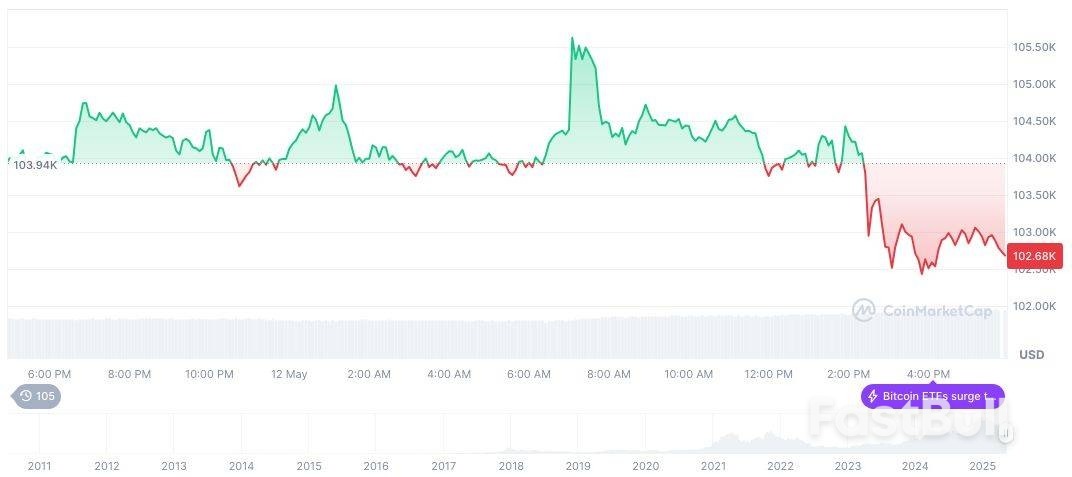
Bitcoin (BTC) experienced a minor dip of -1.71% over 24 hours, trading at $102,692.66. It boasts a market cap of $2.04 trillion, according to CoinMarketCap, dominating 61.93% of the market. Over 60 days, Bitcoin’s price has risen by 24.85%, reflecting strong quarterly gains, influenced by global financial trends.
Bitcoin(BTC), daily chart, screenshot on CoinMarketCap at 07:51 UTC on May 13, 2025. Source: CoinMarketCapCoincu research suggests significant shifts could impact the regulatory landscape and digital asset appeal. The flow from US equities to asset classes like gold and Bitcoin reflects broader uncertainty in traditional markets, positioning these assets as potential hedges amid weakening investor confidence.
The U.K. unemployment rate rose in March, data showed Tuesday, as employers anticipated the impact of higher employment costs, even before the potential impact of U.S. President Donald Trump’s volatile trade policies.
According to the Office for National Statistics, the jobless rate rose to 4.5% in the three months to March, as expected, up from the 4.4% seen in February.
However, pay growth across the whole economy, excluding bonuses, dropped to an annual 5.6% rate in the three months to March, below the 5.9% seen the prior month, and the 5.7% expected. This was the slowest increase since the three months to November last year, the ONS said.
Higher national insurance contributions and the rise in the national living wage, which both came into effect in April, appear to have deterred employers from taking on staff.
"The further softening in employment," said analysts at Capital Economics, in a note, "suggests businesses continued to respond to the rise in business taxes and the minimum wage by reducing headcount."
The Bank of England referenced a cooling labor market as it cut interest rates last week, and the policymakers will have noted a lessening in the strength of wage growth as a source of inflation pressure.
"Overall, the combination of weakening labor activity but still-high wage growth leaves the Bank in a tricky position," added Capital Economics. "If the jobs market remains weak, then underlying price pressures should eventually fade markedly. But sticky wage growth may mean the Bank remains uneasy about inflationary pressures in the near term. As a result, the “gradual” interest rate cutting path will remain the balancing act."
Additionally, the economy will have to cope with the uncertainty created by the U.S. president’s import duties, even though last week’s U.S.-U.K. trade deal may have lessened these concerns.
White Label
Data API
Web Plug-ins
Poster Maker
Affiliate Program
The risk of loss in trading financial instruments such as stocks, FX, commodities, futures, bonds, ETFs and crypto can be substantial. You may sustain a total loss of the funds that you deposit with your broker. Therefore, you should carefully consider whether such trading is suitable for you in light of your circumstances and financial resources.
No decision to invest should be made without thoroughly conducting due diligence by yourself or consulting with your financial advisors. Our web content might not suit you since we don't know your financial conditions and investment needs. Our financial information might have latency or contain inaccuracy, so you should be fully responsible for any of your trading and investment decisions. The company will not be responsible for your capital loss.
Without getting permission from the website, you are not allowed to copy the website's graphics, texts, or trademarks. Intellectual property rights in the content or data incorporated into this website belong to its providers and exchange merchants.
Not Logged In
Log in to access more features

FastBull Membership
Not yet
Purchase
Log In
Sign Up